Article

Short-Term Exposure to Ambient Air Pollution and Psoriasis in Guangzhou, China: Estimating the Association and Population Attributable Fraction

1
Department of Dermatology, Guangzhou Dermatology Hospital, Guangzhou 510095, China
2
Institute of Dermatology, Guangzhou Medical University, Guangzhou 510095, China
3
Department of Epidemiology, School of Public Health, Sun Yat-sen University, Guangzhou 510080, China
4
Department of Epidemiology and Biostatistics, School of Public Health, SUNY Downstate Health Sciences University, Brooklyn, NY 11203, USA
5
The First Affiliated Hospital of Guangzhou University of Chinese Medicine, Guangzhou 510405, China
6
Guangdong Clinical Research Academy of Chinese Medicine, Guangzhou 510405, China
*
Authors to whom correspondence should be addressed.
These authors contributed equally to this work.
Atmosphere 2026, 17(2), 198; https://doi.org/10.3390/atmos17020198
Submission received: 22 December 2025 / Revised: 5 February 2026 / Accepted: 7 February 2026 / Published: 13 February 2026

Abstract

Psoriasis is a common, chronic skin disorder that has negative impacts on patients’ quality of life, and is triggered by a combination of genetic and environmental factors. However, epidemiological evidence about the effect of air pollution on psoriasis risk is still limited and inconsistent. The generalized additive model (GAM) was applied to investigate the association between common air pollutants and daily psoriasis outpatient visits in Guangzhou, China from 2013 to 2019. The analysis focused on particulate matter with an aerodynamic diameter of less than 10 μm and 2.5 μm (PM10 and PM2.5), nitrogen dioxide (NO2), and sulfur dioxide (SO2). To examine the effect modifications, stratified analyses were conducted by gender, age, and season. Population attributable fraction of psoriasis burden from ambient air pollution exposure was further calculated. A total of 145,034 psoriasis outpatient visits were included during the study period. Each 10 μg/m3 increment in PM2.5, PM10, SO2, and NO2 was significantly associated with an excess risk of psoriasis outpatient visits of 3.46% (95% CI: 2.53%, 4.39%), 2.51% (95% CI: 1.86%, 3.17%), 4.73% (95% CI: 2.67%, 6.82%), and 4.75% (95% CI: 3.78%, 5.73%) at lag05. Stratified analysis revealed notably stronger effects during the cold seasons. Based on the World Health Organization’s Ambient Air Quality Guidelines, PM2.5, PM10, NO2, and SO2 accounted for 9.08% (95% CI: 6.54%, 11.74%), 4.73% (95% CI: 3.45%, 6.06%), 8.93% (95% CI: 6.99%, 10.93%), and 0.18% (95% CI: 0.10%, 0.27%) of psoriasis outpatient visits, respectively. In conclusion, short-term air pollution exposure is an important risk factor for psoriasis outpatient visits, especially in cold seasons. PM2.5 and NO2 accounted for a relatively larger attributable burden among common air pollutants. Effective strategies are needed for air pollution control and prevention of psoriasis exacerbation.

1. Introduction

Psoriasis is a chronic inflammatory skin disorder characterized by erythema, thickening, and plaques covered in silvery scales [1]. Though not typically life-threatening, psoriasis is recognized as a chronic and painful disease with a large impact on patients’ quality of life, psychological well-being, and personal relationships [2]. According to the Global Burden of Disease Study 2023, the number of psoriasis patients has continued to increase over the past decades and reached 31 million in 2023 worldwide. Importantly, the psoriasis burden is forecast to continue rising from 2022 to 2040 [3]. Genetic factors, disorders of the immune system, and environmental influences contribute to the occurrence and progression of psoriasis [4]. While genetic factors play a major role in the pathogenesis of psoriasis, its onset and exacerbation can also be triggered by environmental factors, including air pollutants [5,6].
Ambient air pollutants, including particulate matter with an aerodynamic diameter of less than 10 μm and 2.5 μm (PM10 and PM2.5), carbon monoxide (CO), ozone (O3), nitrogen dioxide (NO2), and sulfur dioxide (SO2), are known to have an adverse impact on human health [7,8,9,10]. Numerous studies have demonstrated the impacts of air pollution on respiratory diseases such as lung cancer, asthma, and chronic obstructive pulmonary disease (COPD) [11,12,13]. Ambient air pollution can also increase the risk of clinical dementia and cardiovascular events such as myocardial infarction and stroke [14,15,16]. In addition to these systemic health impacts, air pollution also affects the skin, which is directly exposed to ambient air pollutants. Evidence also shows that air pollution exposure has adverse effects on the skin, causing skin diseases such as atopic dermatitis, psoriasis, acne, and urticaria [17,18]. As for psoriasis, one cohort study based on the UK Biobank reported an association between long-term air pollution exposure and increased psoriasis risk [19]. Another similar study showed that each 10 μg/m3 increment in PM2.5, PM10, NO2, and NOx resulted in a significantly increased risk of psoriasis by 95.7%, 19.7%, 9.0%, and 4.4%, respectively [20]. Additionally, a case-crossover study found that short-term exposure to air pollutants, especially PM10 and PM2.5, was associated with a higher risk of psoriasis flare [21].
However, epidemiological studies about the association between short-term air pollution exposure and psoriasis are still limited and inconsistent. For instance, a time-series analysis in Beijing revealed that a short-term increase in PM2.5 was associated with a higher risk of psoriasis, especially among females and patients aged ≥65 years [22]. Another study in Hefei, China found that higher concentrations of NO2, O3, and SO2 were associated with increased psoriasis outpatient visits, especially among females and patients aged 0–17 years [23]. In contrast, a subsequent study in Wuhan, China reported that only NO2 showed significant and stable effects, and higher susceptibility was observed in people aged 18–45 years [24]. A recent study in Nanchang, China demonstrated that six air pollutants (PM2.5, PM10, NO2, O3, CO, and SO2) had significant effects on psoriasis outpatient visits, with higher risks in the cold seasons, among females, and in the 15–64 and ≥65 age groups [25].
Therefore, this study was conducted to investigate the association between ambient air pollution (PM2.5, PM10, NO2, and SO2) and daily psoriasis outpatient visits in Guangzhou, China. Stratified analyses were conducted by gender, age, and season to examine effect modification. Moreover, the population-attributable fraction was calculated to estimate the burden of psoriasis outpatient visits caused by air pollution exposure. This study aimed to provide evidence for the development of air pollution control policies and psoriasis exacerbation prevention strategies in the future.

2. Materials and Methods

2.1. Study Area and Data Collection

Guangzhou, located in southern China, is the provincial capital city of Guangdong and has an oceanic subtropical monsoon climate. It has higher temperature and more rain water in summer, and is relatively colder and drier in winter [26]. It is a megacity with approximately 12.7 million residents [27]. This study was conducted in Guangzhou mainly for two reasons. First, Guangzhou is one of the most economically and industrially developed cities in China, with a high population density and relatively severe air pollution [28]. The adverse effects of air pollution on residents’ health outcomes here cannot be neglected. In addition, as a developed capital city with air monitoring stations situated close to living areas, Guangzhou can provide health outcome data with less exposure measurement error and higher quality [29].
Psoriasis outpatient visits and disease diagnosis information from 18 January 2013 to 31 December 2019 were obtained from the electronic medical records of Guangzhou Municipal Clinical Center for Dermatology (GMCCD). This is the only municipal hospital dedicated to dermatology in Guangzhou, which has comprehensive and representative psoriasis outpatient data. The outpatient medical records contained demographic data and clinical diagnoses according to the International Classification of Diseases, Revision 10 (ICD-10: L40). This study included outpatient visitors who were diagnosed with psoriasis and were residents of Guangzhou.
The daily concentration data of air pollutants (PM2.5, PM10, NO2, O3, and SO2) were gathered from 11 air monitoring stations in Guangzhou (Figure 1). Then, the average daily concentrations were calculated and used in the following analysis. Meteorological factors, including temperature and relative humidity (RH), were retrieved from the National Weather Data Sharing System (https://data.cma.cn/).

2.2. Statistical Analysis

Compared with the total population of residents in Guangzhou, the daily number of psoriasis outpatient visits is relatively small and consists of non-negative integer counts, for which Poisson-type models are commonly used in time-series analyses [25]. To evaluate the relationship between daily air pollution exposure and psoriasis outpatient visits, the analysis was conducted using a quasi-Poisson generalized additive model (GAM) [30]. Unpenalized cubic regression splines were applied to predict the non-linear trends of temperature and relative humidity (RH) [31]. The day of the week (DOW) and public holidays (PH) were controlled as categorical variables in the model. Degrees of freedom (df) were used in the GAM to control the smoothness of the function [32], and appropriate degrees of freedom can make the estimation more accurate. Based on previous literature, 6 df per year were used for temporal trends and temperature, while 3 df per year were used for RH to control potential non-linear confounding effects [33]. The model is defined as follows:
l o g [ E ( Y t ) ] = α + β 1 × Z t + s ( t , d f = 6 / y e a r ) + s ( T e m p 03 , d f = 6 ) + s ( R H , d f = 3 ) + β 2 × D O W + β 3 × P H
in which t is the day of observation, E ( Y t ) means the expected number of psoriasis outpatient visits on day t.  α is the intercept and β 1 , β 2 and β 3 are regression coefficients. Z t is defined as the concentration of pollutants (PM2.5, PM10, NO2, and SO2) on day t, and s ( ) represents an unpenalized cubic spline function. T e m p 03 signifies the moving average temperature for the past 4 days including the current day, and RH means the daily average relative humidity. DOW and PH are dummy variables representing the day of the week and public holiday status on day t, respectively.
Considering that the effects of air pollution on residents’ health can persist for several days, both single-day and multi-day lag models were developed to investigate the lag effect [34]. Specifically, the single-day lag model begins from the current day to 5 days prior (lag0 to lag5), while the multi-day lag model includes the moving average of air pollution concentrations of the previous 1 day (lag01), previous 3 days (lag03), and previous 5 days (lag05). In order to avoid multicollinearity between highly correlated pollutants such as PM2.5 and PM10, single-pollutant models were used in the main analyses.
To explore the non-linear concentration-response relationship between ambient air pollutants and the risk of psoriasis exacerbation, a restricted cubic spline (RCS) integrated with a GAM was employed. For each of the four pollutants (PM2.5, PM10, SO2, NO2), RCS with 5 knots placed at the 10th, 25th, 50th, 75th, and 90th percentiles of the pollutant concentration distribution were constructed, which was then embedded into the original GAM framework.

2.3. Stratified Analysis

The data were stratified by gender (female and male), age (<65 and ≥65 years), and season (cold and warm) to investigate the potential effect modification. The cold season was defined as 1 October to 31 March, while the warm season was 1 April to 30 September. To assess whether the differences across strata were statistically significant, the following formula was used to calculate the 95% confidence interval (CI):
Q 1 Q 2 ± 1.96 ( S E 1 ) 2 + ( S E 2 ) 2
where Q 1 and Q 2 represent the estimated coefficients of each stratum, and S E 1 and S E 2 are the corresponding standard errors [30].

2.4. Estimating the Psoriasis Burden Attributable to Air Pollution

The attributable number (AN) and population attributable fraction (PAF) were calculated as metrics to estimate the psoriasis burden attributable to short-term ambient air pollution, with reference to the WHO’s Ambient Air Quality Guidelines [35]. To be specific, the reference concentrations for PM2.5, PM10, NO2, and SO2 were 15 μg/m3, 45 μg/m3, 25 μg/m3, and 40 μg/m3, respectively. Previous studies have described the methods for calculating AN and PAF [36,37].

2.5. Sensitivity Analysis

Sensitivity analyses were conducted to examine the robustness of the results. First, the df of calendar time (5–8 df/year) and meteorological factors (3–5 df/year) were varied. Subsequently, a two-pollutant model was applied to estimate the confounding effects among air pollutants. Furthermore, the interaction effects between temperature and air pollutants were tested to investigate the potential drivers of the observed seasonal differences.
All statistical analyses were conducted in R software (Version 4.5.1). Statistical significance was defined as a two-sided p-value < 0.05, and excess risk (ER) was calculated as ( r e l a t i v e   r i s k [ R R ] 1 ) × 100 % . ER was applied to describe the increase in psoriasis risk attributable to short-term air pollution exposure.

3. Results

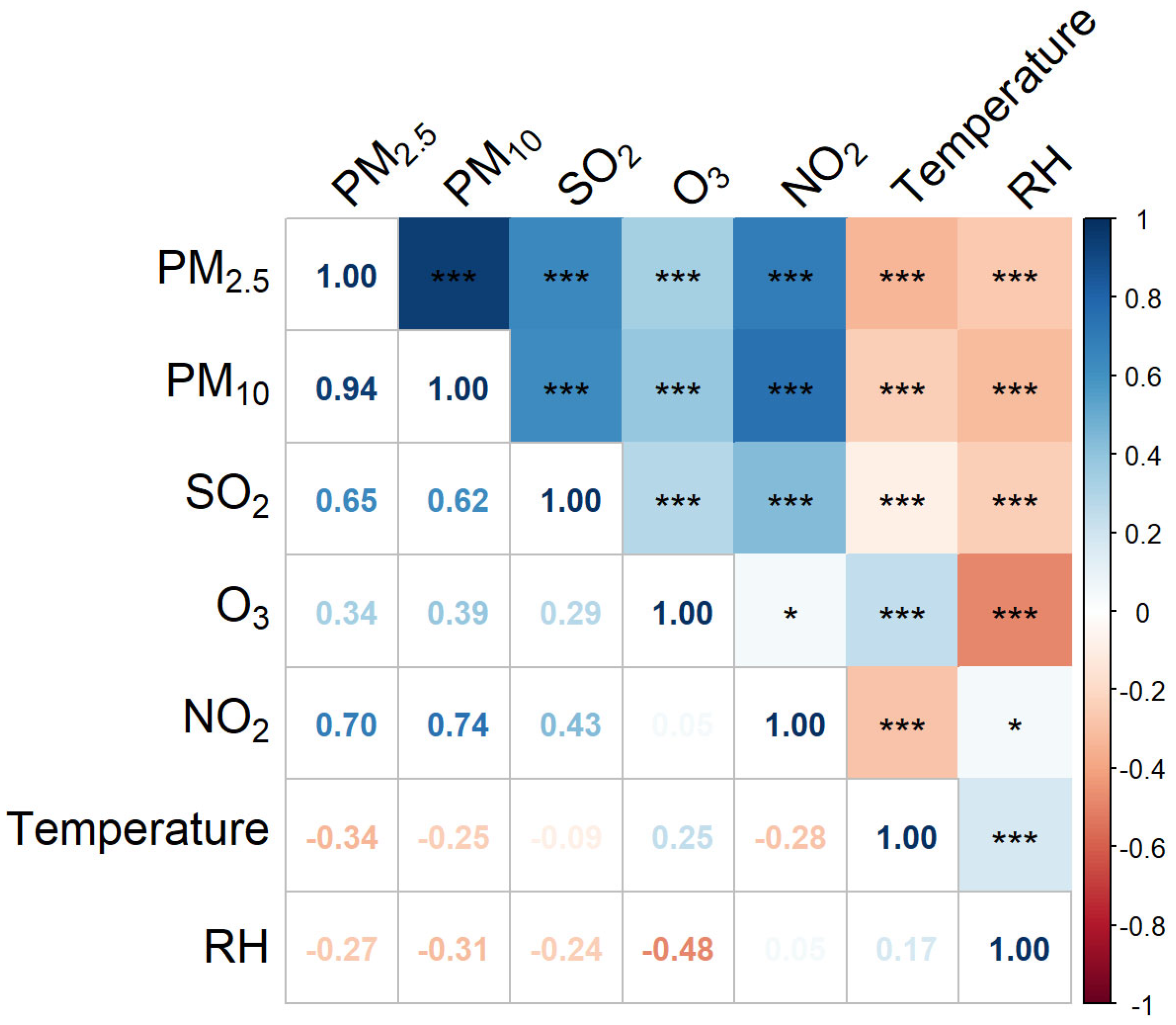
A total of 145,034 psoriasis outpatient visits were recorded in Guangzhou during the study period. Table 1 illustrates the descriptive statistics for air pollutant concentrations, meteorological factors, and psoriasis outpatient visits. Daily average concentrations of air pollutants (PM2.5, PM10, NO2, O3, and SO2) from 2013 to 2019 were 38.9, 59.8, 46.6, 52.6, and 13.6 μg/m3, respectively. The mean values of temperature and relative humidity were 22.8 °C and 80.7%. The number of psoriasis outpatient visits per day was 57 on average. The Spearman correlations between air pollutants and meteorological factors are demonstrated in Figure 2. Both PM2.5 and PM10 showed moderate to high correlations with other gaseous air pollutants, with r ranging from 0.29 to 0.74. In particular, a strong correlation was observed between PM2.5 and PM10 (r = 0.94).
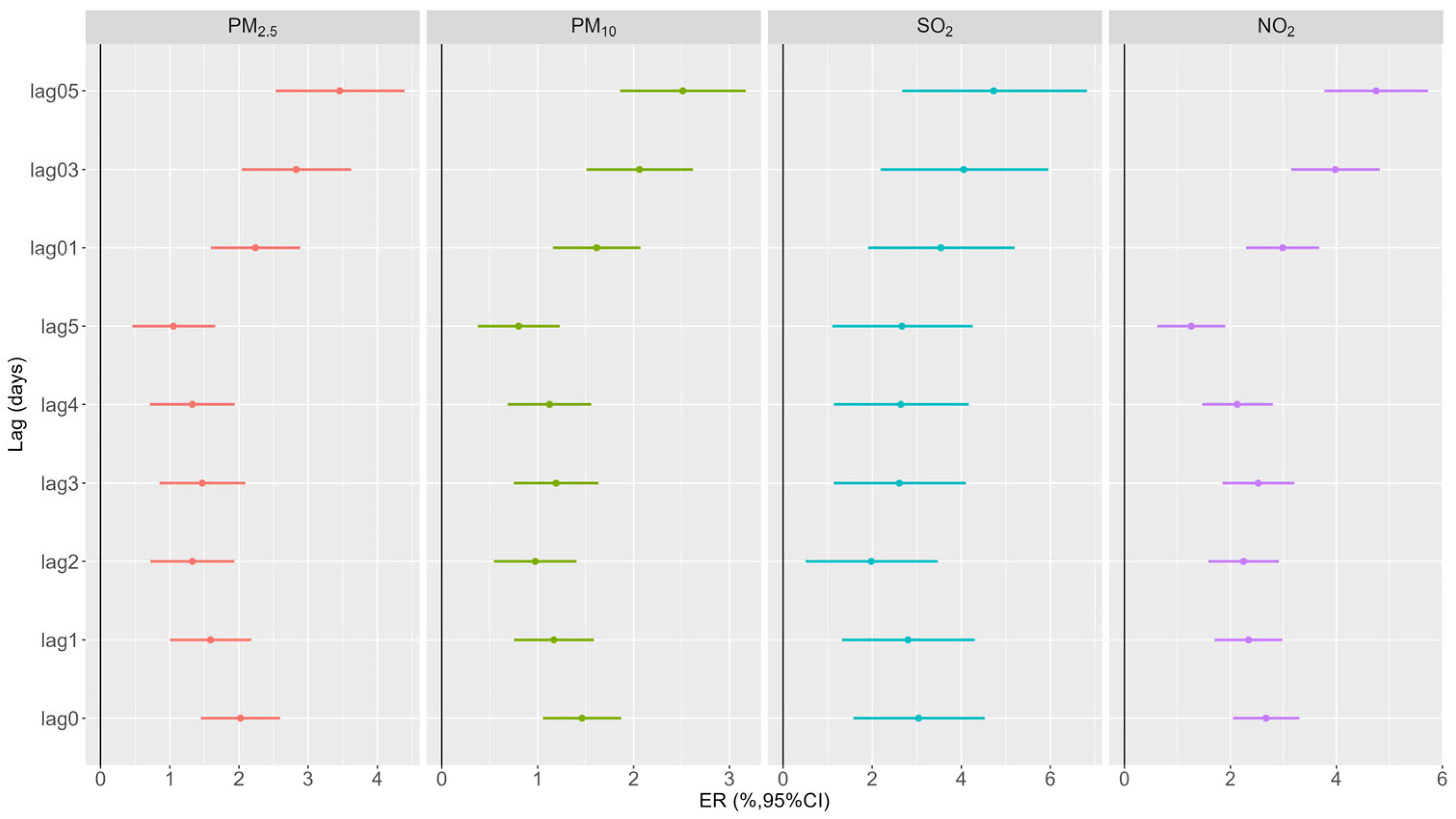
Figure 3 illustrates the excess risk (ER) and 95% confidence interval (CI) for daily psoriasis outpatient visits per 10 μg/m3 increment in PM2.5, PM10, SO2, and NO2 after adjusting for day of the week, public holidays, relative humidity, and 3-day moving average temperature. The general pattern of lag effects was similar among different air pollutants. Statistically significant associations were observed between air pollutants and psoriasis in all single-day and multi-day lag models. In the single-day lag model, all effects gradually decreased from lag0 to lag5, while the cumulative effects in the multi-day lag model increased from lag01 to lag05. Additionally, the multi-day lag model showed stronger effects when compared to any single-day model, and the largest effect was observed at lag05. To be specific, each 10 μg/m3 increment in PM2.5 at lag0 was associated with a 2.02% (95% CI: 1.45%, 2.60%) increase in psoriasis outpatient visits, while the effect declined to 1.05% (95% CI: 0.46%, 1.65%) at lag5. The strongest effect of PM2.5 was a 3.46% (95% CI: 2.53%, 4.39%) increase at lag05. Similar trends were observed for other air pollutants. The ER for daily air pollution on psoriasis outpatient visits at lag0 was 1.46% (95% CI: 1.06%, 1.87%) for PM10, 3.04% (95% CI: 1.58%, 4.53%) for SO2, and 2.67% (95% CI: 2.05%, 3.30%) for NO2. Notably, the highest effects occurred at lag05, where each 10 μg/m3 increment was associated with 2.51% (95% CI: 1.86%, 3.17%) increase for PM10, 4.73% (95% CI: 2.67%, 6.82%) for SO2, and 4.75% (95% CI: 3.78%, 5.73%) for NO2, respectively. The exposure-response curves for PM2.5, PM10, and NO2 exhibited a generally linear, non-threshold positive association with psoriasis visits (Supplementary Figure S1). This suggests that the seasonal difference is likely driven by the temperature-pollutant interaction rather than a non-linear steepening of the curve at high concentrations. However, for SO2, a non-linear relationship was observed, with a steeper slope at higher concentrations.
Given that the strongest effects were observed at lag05, lag05 was applied for stratified analysis. Table 2 demonstrates the ER and 95% CI of psoriasis outpatient visits per 10 μg/m3 increment in air pollutants (PM2.5, PM10, SO2, and NO2) at lag05, with stratification by gender, age, and season. Different effects were observed across these strata. Though not statistically significant, a relatively stronger effect of PM10 was observed in females than in males. In contrast, PM2.5 and SO2 had slightly higher effects in males. As for age-stratified analysis, PM10, SO2, and NO2 had relatively stronger effects on psoriasis outpatient visits among people aged <65 years. Notably, the difference in the effect of NO2 across age strata was statistically significant. Specifically, an increase of 4.89% (95% CI: 3.90%, 5.89%) per 10 μg/m3 increment in NO2 was observed among people aged <65 years, compared with 3.83% (95% CI: 2.28%, 5.41%) among those aged ≥65 years. All air pollutants except SO2 demonstrated significantly stronger effects in the cold season than in the warm season. During the cold season, an increase of 4.06% (95% CI: 2.80%, 5.33%), 2.62% (95% CI: 1.80%, 3.44%), and 5.60% (95% CI: 4.34%, 6.88%) in psoriasis outpatient visits for each 10 μg/m3 increment in PM2.5, PM10, and NO2, compared with 0.52% (95% CI: −0.94%, 2.01%), 0.61% (95% CI: −0.49%, 1.73%), and 0.51% (95% CI: −1.36%, 2.42%) increases in the warm season, respectively.
Table 3 presents the AN and PAF of psoriasis outpatient visits attributable to short-term ambient air pollution exposure, with reference concentrations from WHO ambient air quality guidelines. Specifically, PM2.5, PM10, NO2, and SO2 accounted for 9.08% (95% CI: 6.54%, 11.74%), 4.73% (95% CI: 3.45%, 6.06%), 8.93% (95% CI: 6.99%, 10.93%), and 0.18% (95% CI: 0.10%, 0.27%) of psoriasis outpatient visits, respectively. These estimates correspond to 13,169 (95% CI: 9478, 17,020), 6864 (95% CI: 5007, 8789), 12,944 (95% CI: 10,144, 15,854), and 256 (95% CI: 138,387) psoriasis outpatient visits. Moreover, different psoriasis burdens were observed for these air pollutants. PM2.5 and NO2 were associated with larger attributable burdens than those of PM10 and SO2, and the largest AN and PAF were caused by PM2.5 in Guangzhou, China.
Furthermore, sensitivity analyses were conducted and the results suggested that the main findings were stable. There was no substantial difference after changing the df and applying two-pollutant models (Tables S1 and S2). As shown in Figure S2, the risk of psoriasis outpatient visits increases notably as temperature decreases, confirming that low temperature exacerbates the adverse effects of air pollution.

4. Discussion

This study further investigated the association between air pollution exposure and the risk of psoriasis outpatient visits in Guangzhou, China. This study revealed a significant association between short-term air pollutants (PM2.5, PM10, SO2, and NO2) exposure and increased psoriasis outpatient visits, with notably stronger effects observed in the cold seasons.
Consistent findings were found in Hefei, Wuhan, and Nanchang, China, all of which reported a significant association between psoriasis and air pollution, especially in the cold seasons [23,24,25]. The consistency across these studies provides strong support for the effect of air pollutants on psoriasis, indicating the importance of air pollution control in psoriasis prevention.
After stratifying by season, this study observed a significantly stronger association between psoriasis outpatient visits and PM2.5, PM10, and NO2 in the cold seasons than in the warm seasons. Several environmental factors may contribute to this seasonal difference. In the cold seasons, lower temperature, decreased humidity, higher concentrations of air pollutants, and inadequate UV exposure all lead to higher psoriasis risk [38,39]. Specifically, interaction analyses revealed that low ambient temperature significantly amplifies the inflammatory impact of air pollutants on psoriasis exacerbation. Though the underlying mechanisms are complex, these factors have shared adverse impacts on skin condition, including disruption of the skin barrier and exacerbation of the inflammatory response [39]. Moreover, residents’ outdoor activities in the cold seasons also influence psoriasis risk by changing the exposure levels to these environmental factors. In addition, the cold season often coincides with peaks in respiratory viral infections (e.g., influenza), which may independently precipitate psoriasis flares or alter healthcare-seeking behavior. Because daily data on influenza-like illness or other indicators of viral activity were unavailable during the study period, adjustment for these factors was not performed. This potential residual confounding is an important limitation of this analysis, and the observed seasonal differences in effect estimates should therefore be interpreted with caution.
Another notable finding of this study was the substantial burden of psoriasis outpatient visits attributable to air pollution. PM2.5 and NO2 were associated with the largest AN and PAF. The findings of this study indicate that a considerable number of psoriasis outpatient visits could potentially be avoided if ambient pollutant concentrations were reduced to the WHO air quality guideline levels. It is crucial to note that these estimates are based on a theoretical scenario in which air pollutant concentrations are reduced to the WHO air quality guideline levels. They represent the potentially preventable fraction under an ideal public health target and highlight the substantial population health burden associated with current air pollution levels. The uncertainty in these estimates arises both from the statistical uncertainty in the exposure–response coefficients and from the assumptions underlying the counterfactual scenario. Given that air pollution has become a major source of disease and economic burden in many provinces of China [40], it is of great urgency to strengthen air quality control. This study highlights the importance of air pollution control in psoriasis prevention and provides useful evidence to inform the development of targeted environmental and public health policies.
Though the biological mechanism is not completely clear, previous studies reported some possible explanations for the association between air pollution and psoriasis. Air pollutants can be absorbed directly through the skin or via hair follicles and sweat glands, causing adverse effects on the skin by inducing oxidative damage and resulting in inflammatory conditions [41]. Specifically, the effects of air pollution mainly include pro-inflammatory cytokine production, oxidative stress, altered methylation, and the activation of Aryl hydrocarbon receptors pathway [42]. T helper 17 lymphocytes, the central effectors of psoriasis, can be regulated by the aryl hydrocarbon receptors and produce IL-17 to promote inflammatory responses and psoriasis onset [43].
Considering that psoriasis is still an incurable disease and its global burden is continually increasing, it is of great importance to identify environmental risk factors and apply targeted preventive measures. For clinicians and public health practitioners, effective health education should be conducted to recommend preventive methods such as wearing masks and reducing outdoor activities during periods of heavy air pollution and in the cold seasons. Residents, especially susceptible populations, should take these measures seriously in their daily lives. Moreover, for policymakers, strict air quality standards and effective air pollution control policies should be adopted to reduce the psoriasis burden attributable to air pollutants.
The findings of this study could provide a valuable reference for air pollution control and psoriasis prevention policy development in the future. However, this study still has several limitations that should be considered. First, as an ecological study, the lack of individual level data such as individual exposure, indoor pollution, and other psoriasis risk factors, may lead to inevitable potential confounding. Second, outpatient data from only one center was used to represent the condition of the whole city because citywide data were not accessible. Third, the exposure assessment relied on the daily average concentrations from 11 fixed-site monitoring stations across the city. This approach may lead to exposure misclassification due to within-city spatial variation, which could have influenced the effect estimates.

5. Conclusions

This study provides robust evidence that short-term exposure to ambient air pollutants (PM2.5, PM10, NO2, and SO2) can significantly increase the number of psoriasis outpatient visits in Guangzhou, China. The adverse effects were cumulative, with the strongest associations observed at lag05. Notably, interaction analysis revealed that low temperature significantly amplifies the inflammatory effects of air pollutants, explaining the stronger associations observed in the cold season. Furthermore, a substantial disease burden attributable to air pollution was estimated, with PM2.5 and NO2 contributing the largest fractions. These findings suggest that current air pollution levels pose a non-negligible threat to skin health. From a public health perspective, the findings underscore the urgency of stricter air quality control policies. For clinical practice, patients with psoriasis should be advised to minimize outdoor exposure and enhance skin protection during periods of high pollution, particularly on cold days, to reduce the risk of disease exacerbation.

Supplementary Materials

The following supporting information can be downloaded at: https://www.mdpi.com/article/10.3390/atmos17020198/s1, Table S1: Sensitivity analysis for psoriasis outpatient visits associated with each 10 μg/m3 increment of air pollution at lag05. Table S2: Excess risk and 95% confidence intervals of psoriasis outpatient visits for each 10 μg/m3 increment in air pollution at lag05 in single and two-pollutant models in Guangzhou. Figure S1: Exposure-response curves of ambient air pollutants associated with outpatient visits for psoriasis. Figure S2: Interaction effects of ambient temperature and air pollutants on the risk of outpatient visits for psoriasis.

Author Contributions

Conceptualization, H.W., S.Z. and Z.H.; formal analysis, H.W. and Z.H.; writing—original draft preparation, H.W., J.L., M.H., W.L. and Z.H.; writing—review and editing, J.L., M.H., W.L., J.S. and Z.H.; funding acquisition, H.W. All authors have read and agreed to the published version of the manuscript.

Funding

This research was funded by the Science and Technology Program of Guangzhou (No. 2023A03J0469); the Project of Guangdong Society of Science and Technology Journal Editing (No. 2024-YB-27); the Scientific Research Special Project of the National Center for Traditional Chinese Medicine Inheritance and Innovation (No. 2023GLYB10).

Institutional Review Board Statement

Not applicable.

Informed Consent Statement

Not applicable.

Data Availability Statement

Please contact the corresponding authors for data requests.

Acknowledgments

The authors thank the Chinese Meteorological Data Sharing Service System for providing the meteorological data used in this study.

Conflicts of Interest

The authors declare no conflicts of interest.

Abbreviations

The following abbreviations are used in this manuscript:
ANAttributable Number
CIConfidence Interval
COCarbon Monoxide
COPDChronic Obstructive Pulmonary Disease
dfDegrees of Freedom
DOWDay of the Week
ERExcess Risk
GAMGeneralized Additive Model
ICD-10International Classification of Diseases, Revision 10
NO2Nitrogen Dioxide
O3Ozone
PAFPopulation Attributable Fraction
PHPublic Holidays
PM10Particulate Matter with an Aerodynamic Diameter <10 μm
PM2.5Particulate Matter with an Aerodynamic Diameter <2.5 μm
RHRelative Humidity
RRRelative Risk
SEStandard Error
SO2sulfur Dioxide
WHOWorld Health Organization

References

  1. Griffiths, C.E.M.; Armstrong, A.W.; Gudjonsson, J.E.; Barker, J. Psoriasis. Lancet 2021, 397, 1301–1315. [Google Scholar] [CrossRef] [PubMed]
  2. Armstrong, A.W.; Bohannan, B.; Mburu, S.; Coates, L.C.; Ogdie, A.; Alarcon, I.; Kasparek, T.; Frade, S.; Barrio, S.F.; Augustin, M. Patient Perspectives on Psoriatic Disease Burden: Results from the Global Psoriasis and Beyond Survey. Dermatology 2023, 239, 621–634. [Google Scholar] [CrossRef] [PubMed]
  3. Wei, J.; Wang, Y.; Chen, Y.; Wang, Z.; Dai, X.; Gelfand, J.M.; Bachelez, H.; Chen, X.; Xiao, Y.; Shen, M. Global Burden of Psoriasis from 1990 to 2021 and Potential Factors: A Systematic Analysis. J. Investig. Dermatol. 2025; in press. [Google Scholar] [CrossRef] [PubMed]
  4. Kamiya, K.; Kishimoto, M.; Sugai, J.; Komine, M.; Ohtsuki, M. Risk Factors for the Development of Psoriasis. Int. J. Mol. Sci. 2019, 20, 4347. [Google Scholar] [CrossRef]
  5. Liu, S.; He, M.; Jiang, J.; Duan, X.; Chai, B.; Zhang, J.; Tao, Q.; Chen, H. Triggers for the onset and recurrence of psoriasis: A review and update. Cell Commun. Signal. 2024, 22, 108. [Google Scholar] [CrossRef]
  6. Zhou, H.; Hong, F.; Wang, L.; Tang, X.; Guo, B.; Luo, Y.; Yu, H.; Mao, D.; Liu, T.; Feng, Y.; et al. Air pollution and risk of 32 health conditions: Outcome-wide analyses in a population-based prospective cohort in Southwest China. BMC Med. 2024, 22, 370. [Google Scholar] [CrossRef]
  7. Mannucci, P.M.; Franchini, M. Health Effects of Ambient Air Pollution in Developing Countries. Int. J. Environ. Res. Public Health 2017, 14, 1048. [Google Scholar] [CrossRef]
  8. Tavares, M.S.; Rodrigues, C.T.; de Menezes, S.L.S.; Moreno, A.M. Health at Risk: Air Pollution and Urban Vulnerability—Perspectives in Light of the 2030 Agenda. Green Health 2025, 1, 21. [Google Scholar] [CrossRef]
  9. Zheng, Y.; Zhong, X.; Peng, W.; Chen, Z.; Wang, L.; Xia, C.; Huang, Y.; Zhu, Q.; Fan, Y.; Lai, Y.; et al. Associations of Prenatal Exposures to Fine Particulate Matter and Its Compositions with Preterm Birth Risk in Twins. Green Health 2025, 1, 11. [Google Scholar] [CrossRef]
  10. Fan, J.; Chen, J.; Wang, L.; Yuan, C.; Liu, X.; Wang, J. The global burden and attributable risk factor analysis of cardiovascular disease between females and males, 1990–2021: Findings from the 2021 global burden of disease study. Int. J. Surg. 2026, 112, 239–249. [Google Scholar] [CrossRef]
  11. Adamkiewicz, G.; Liddie, J.; Gaffin, J.M. The Respiratory Risks of Ambient/Outdoor Air Pollution. Clin. Chest Med. 2020, 41, 809–824. [Google Scholar] [CrossRef] [PubMed]
  12. Wu, Y.; Gasevic, D.; Wen, B.; Yu, P.; Xu, R.; Zhou, G.; Zhang, Y.; Song, J.; Liu, H.; Li, S.; et al. Association between air pollution and telomere length: A study of 471,808 UK Biobank participants. Innov. Med. 2023, 1, 100017. [Google Scholar] [CrossRef]
  13. Li, G.; Zhang, K.; Yang, T.; Jin, J.; Guo, X.; Cai, Y.S.; Huang, J. Air pollution, genetic susceptibility and risk of progression from asthma to COPD. Thorax 2025, 81, 51–60. [Google Scholar] [CrossRef] [PubMed]
  14. Bevan, G.H.; Al-Kindi, S.G.; Brook, R.; Rajagopalan, S. Ambient Air Pollution and Atherosclerosis: Recent Updates. Curr. Atheroscler. Rep. 2021, 23, 63. [Google Scholar] [CrossRef]
  15. Wang, X.; Qian, Z.; Wang, X.; Hong, H.; Yang, Y.; Xu, Y.; Xu, X.; Yao, Z.; Zhang, L.; Rolling, C.A.; et al. Estimating the acute effects of fine and coarse particle pollution on stroke mortality of in six Chinese subtropical cities. Environ. Pollut. 2018, 239, 812–817. [Google Scholar] [CrossRef]
  16. Wilker, E.H.; Osman, M.; Weisskopf, M.G. Ambient air pollution and clinical dementia: Systematic review and meta-analysis. BMJ 2023, 381, e071620. [Google Scholar] [CrossRef]
  17. Roberts, W. Air pollution and skin disorders. Int. J. Womens Dermatol. 2021, 7, 91–97. [Google Scholar] [CrossRef]
  18. Wang, H.; Matusik, M.; Wunderlich, R.; Hanson, S.E.; Babich, K.; Samad, L.; Qian, A.M.; McMillin, S.E.; Ye, X.; Zhang, S.; et al. Short-Term Ambient Air Pollution and Urticaria in Guangzhou, China: Estimating the Association and Population Attributable Fraction. Toxics 2023, 11, 949. [Google Scholar] [CrossRef]
  19. Wu, J.; Ma, Y.; Yang, J.; Tian, Y. Exposure to Air Pollution, Genetic Susceptibility, and Psoriasis Risk in the UK. JAMA Netw. Open 2024, 7, e2421665. [Google Scholar] [CrossRef]
  20. Gao, J.; He, J.; Zhao, W.; Cui, J.; Zhang, Q.; Yang, P.; Yang, F.; Chen, Y.; Zhang, M. Long-term air pollutants exposure on risk of psoriasis: The mediating role of accelerated biological aging among 284,544 participants. J. Gerontol. A Biol. Sci. Med. Sci. 2025, 80, glaf118. [Google Scholar] [CrossRef]
  21. Bellinato, F.; Adami, G.; Vaienti, S.; Benini, C.; Gatti, D.; Idolazzi, L.; Fassio, A.; Rossini, M.; Girolomoni, G.; Gisondi, P. Association Between Short-term Exposure to Environmental Air Pollution and Psoriasis Flare. JAMA Dermatol. 2022, 158, 375–381. [Google Scholar] [CrossRef] [PubMed]
  22. Wu, J.; Chen, H.; Yang, R.; Yu, H.; Shang, S.; Hu, Y. Short-term exposure to ambient fine particulate matter and psoriasis: A time-series analysis in Beijing, China. Front. Public Health 2022, 10, 1015197. [Google Scholar] [CrossRef] [PubMed]
  23. Fang, J.; Song, X.; Xu, H.; Wu, R.; Song, J.; Xie, Y.; Xu, X.; Zeng, Y.; Wang, T.; Zhu, Y.; et al. Associations of ultrafine and fine particles with childhood emergency room visits for respiratory diseases in a megacity. Thorax 2022, 77, 391–397. [Google Scholar] [CrossRef] [PubMed]
  24. Lan, J.; Huang, Q.; Yang, L.; Li, Y.; Yang, J.; Jiang, B.; Zhao, L.; Xia, Y.; Yu, X.; Tao, J. Effects of ambient air pollution on outpatient visits for psoriasis in Wuhan, China: A time-series analysis. Br. J. Dermatol. 2023, 188, 491–498. [Google Scholar] [CrossRef]
  25. Qu, F.; Ma, H.; Wang, X.; Dong, J.; Zhang, J. Association between short-term air pollutants and psoriasis outpatient visits: A time series study in Nanchang, China. Int. J. Biometeorol. 2025, 69, 2601–2614. [Google Scholar] [CrossRef]
  26. Chen, S.; Xu, B.; Shi, T.; Yang, Q. Short-term effect of ambient air pollution on outpatient visits for children in Guangzhou, China. Front. Public Health 2023, 11, 1058368. [Google Scholar] [CrossRef]
  27. Wang, H.L.; Sun, J.; Qian, Z.M.; Gong, Y.Q.; Zhong, J.B.; Yang, R.D.; Wan, C.L.; Zhang, S.Q.; Ning, D.F.; Xian, H.; et al. Association between air pollution and atopic dermatitis in Guangzhou, China: Modification by age and season. Br. J. Dermatol. 2021, 184, 1068–1076. [Google Scholar] [CrossRef]
  28. Yang, M.; Zeng, H.X.; Wang, X.F.; Hakkarainen, H.; Leskinen, A.; Komppula, M.; Roponen, M.; Wu, Q.Z.; Xu, S.L.; Lin, L.Z.; et al. Sources, chemical components, and toxicological responses of size segregated urban air PM samples in high air pollution season in Guangzhou, China. Sci. Total Environ. 2023, 865, 161092. [Google Scholar] [CrossRef]
  29. Wang, X.; Tian, J.; Li, Z.; Lai, J.; Huang, X.; He, Y.; Ye, Z.; Li, G. Relationship between different particle size fractions and all-cause and cause-specific emergency ambulance dispatches. Environ. Health 2020, 19, 69. [Google Scholar] [CrossRef]
  30. Wang, X.; Leng, M.; Liu, Y.; Qian, Z.; Zhang, J.; Li, Z.; Sun, L.; Qin, L.; Wang, C.; Howard, S.W.; et al. Different sized particles associated with all-cause and cause-specific emergency ambulance calls: A multicity time-series analysis in China. Sci. Total Environ. 2021, 783, 147060. [Google Scholar] [CrossRef]
  31. Lin, H.; Liu, T.; Xiao, J.; Zeng, W.; Li, X.; Guo, L.; Zhang, Y.; Xu, Y.; Tao, J.; Xian, H.; et al. Mortality burden of ambient fine particulate air pollution in six Chinese cities: Results from the Pearl River Delta study. Environ. Int. 2016, 96, 91–97. [Google Scholar] [CrossRef] [PubMed]
  32. Ravindra, K.; Rattan, P.; Mor, S.; Aggarwal, A.N. Generalized additive models: Building evidence of air pollution, climate change and human health. Environ. Int. 2019, 132, 104987. [Google Scholar] [CrossRef] [PubMed]
  33. Liu, C.; Chen, R.; Sera, F.; Vicedo-Cabrera, A.M.; Guo, Y.; Tong, S.; Coelho, M.; Saldiva, P.H.N.; Lavigne, E.; Matus, P.; et al. Ambient Particulate Air Pollution and Daily Mortality in 652 Cities. N. Engl. J. Med. 2019, 381, 705–715. [Google Scholar] [CrossRef] [PubMed]
  34. Lin, X.; Cai, M.; Tan, K.; Liu, E.; Wang, X.; Song, C.; Wei, J.; Lin, H.; Pan, J. Ambient particulate matter and in-hospital case fatality of acute myocardial infarction: A multi-province cross-sectional study in China. Ecotoxicol. Environ. Saf. 2023, 268, 115731. [Google Scholar] [CrossRef]
  35. World Health Organization. WHO Global Air Quality Guidelines: Particulate Matter (PM2.5 and PM10), Ozone, Nitrogen Dioxide, Sulfur Dioxide and Carbon Monoxide; World Health Organization: Geneva, Switzerland, 2021. [Google Scholar]
  36. Wu, Z.; Chen, X.; Li, G.; Tian, L.; Wang, Z.; Xiong, X.; Yang, C.; Zhou, Z.; Pan, X. Attributable risk and economic cost of hospital admissions for mental disorders due to PM2.5 in Beijing. Sci. Total Environ. 2020, 718, 137274. [Google Scholar] [CrossRef]
  37. Aik, J.; Chua, R.; Jamali, N.; Chee, E. The burden of acute conjunctivitis attributable to ambient particulate matter pollution in Singapore and its exacerbation during South-East Asian haze episodes. Sci. Total Environ. 2020, 740, 140129. [Google Scholar] [CrossRef]
  38. Niedźwiedź, M.; Skibińska, M.; Ciążyńska, M.; Noweta, M.; Czerwińska, A.; Krzyścin, J.; Narbutt, J.; Lesiak, A. Psoriasis and Seasonality: Exploring the Genetic and Epigenetic Interactions. Int. J. Mol. Sci. 2024, 25, 1670. [Google Scholar] [CrossRef]
  39. Yang, J.; Li, G.; Yue, L.; Dang, E.; Qiao, P. The Impacts of Seasonal Factors on Psoriasis. Exp. Dermatol. 2025, 34, e70078. [Google Scholar] [CrossRef]
  40. Zhou, D.; Yang, Y.; Zhao, Z.; Zhou, K.; Zhang, D.; Tang, W.; Zhou, M. Air pollution-related disease and economic burden in China, 1990-2050: A modelling study based on Global burden of disease. Environ. Int. 2025, 196, 109300. [Google Scholar] [CrossRef]
  41. Puri, P.; Nandar, S.K.; Kathuria, S.; Ramesh, V. Effects of air pollution on the skin: A review. Indian. J. Dermatol. Venereol. Leprol. 2017, 83, 415–423. [Google Scholar] [CrossRef]
  42. Gu, X.; Li, Z.; Su, J. Air pollution and skin diseases: A comprehensive evaluation of the associated mechanism. Ecotoxicol. Environ. Saf. 2024, 278, 116429. [Google Scholar] [CrossRef]
  43. Brembilla, N.C.; Boehncke, W.H. Revisiting the interleukin 17 family of cytokines in psoriasis: Pathogenesis and potential targets for innovative therapies. Front. Immunol. 2023, 14, 1186455. [Google Scholar] [CrossRef]
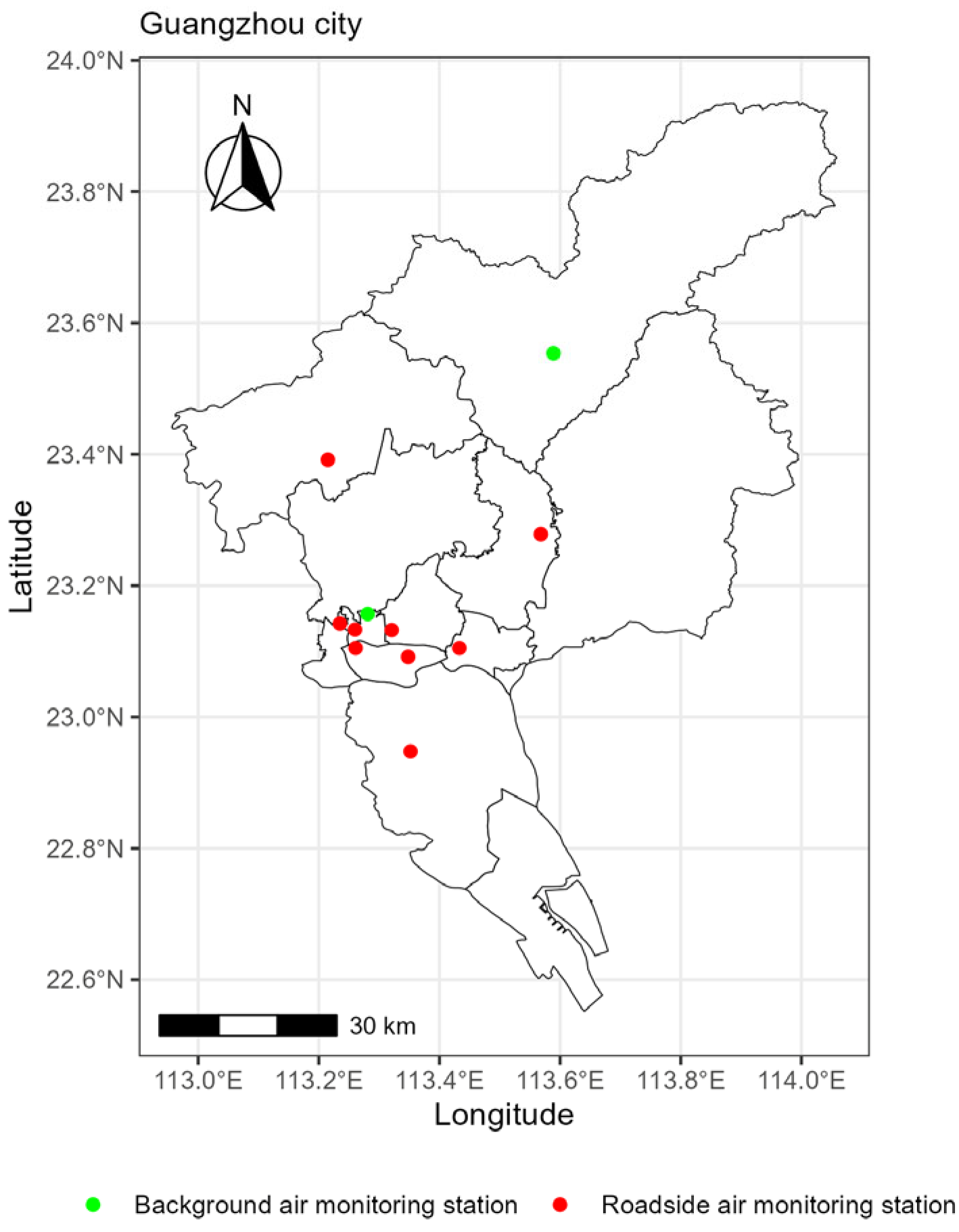
Figure 1. The geographic distribution of air monitoring stations in Guangzhou.
Atmosphere 17 00198 g001
Figure 2. Spearman correlations between daily air pollutant concentrations and meteorological factors. * p < 0.05, *** p < 0.001.
Atmosphere 17 00198 g002
Figure 3. ER and 95% CI of psoriasis outpatient visits per 10 μg/m3 increment in PM2.5, PM10, SO2, and NO2 across different lag days.
Atmosphere 17 00198 g003
Table 1. Daily air pollution, meteorological factors, and psoriasis outpatient visits in Guangzhou, China from 18 January 2013 to 31 December 2019.
Daily Mean (SD)Quantiles
MinP25P50P75Max
Air Pollution, μg/m3
PM2.538.9 (22.3)6.422.938.949.5156.4
PM1059.8 (29.4)10.838.552.275.8208.7
NO246.6 (19.3)4.433.342.455.6176.7
O352.6 (29.4)3.531.248.668.2294.6
SO213.6 (8.9)4.08.411.516.1166.4
Meteorological factors
Temperature (°C)22.8 (6.3)3.518.124.227.737.0
Relative Humidity (%)80.7 (10.8)30.575.082.088.0100.0
Psoriasis outpatient visits, n57.1 (24.2)0.035.062.075.0120.0
Table 2. ER and 95% CI of psoriasis outpatient visits per 10 μg/m3 increment in PM2.5, PM10, SO2, and NO2 at lag05, with stratification by gender, age, and season.
StrataPM2.5PM10SO2NO2
  Gender
    Male3.48 (2.48, 4.48)2.47 (1.76, 3.17)4.74 (2.53, 7.00)4.74 (3.70, 5.80)
    Female3.40 (2.28, 4.53)2.58 (1.79, 3.37)4.68 (2.23, 7.19)4.75 (3.57, 5.94)
  Age
    ≥653.76 (2.26, 5.29)2.39 (1.33, 3.46)4.64 (1.24, 8.16)3.83 (2.28, 5.41)
    <653.40 (2.46, 4.35)2.53 (1.87, 3.20)4.72 (2.64, 6.85)4.89 (3.90, 5.89)
  Season
    Cold4.06 (2.80, 5.33)2.62 (1.80, 3.44)4.43 (2.02, 6.91)5.60 (4.34, 6.88)
    Warm0.52 (−0.94, 2.01)0.61 (−0.49, 1.73)4.22 (−1.01, 9.72)0.51 (−1.36, 2.42)
Data in bold indicated statistically significant (p < 0.05) differences between the effect estimates of the strata. The warm season is April to September and the cold season is October to March.
Table 3. The attributable numbers and fractions and 95% CI of psoriasis outpatient visit due to exceeding PM2.5, PM10, NO2, and SO2 concentrations at lag05 using WHO air quality guidelines.
PollutantsAttributable Fraction (%)Attributable Number
PM2.59.08 (6.54, 11.74)13,169 (9478, 17,020)
PM104.73 (3.45, 6.06)6864 (5007, 8789)
NO28.93 (6.99, 10.93)12,944 (10,144, 15,854)
SO20.18 (0.10, 0.27)256 (138, 387)
The reference concentrations of PM2.5, PM10, NO2, and SO2 based on the WHO’s Ambient Air Quality Guidelines were 15 μg/m3, 45 μg/m3, 25 μg/m3, and 40 μg/m3.
Disclaimer/Publisher’s Note: The statements, opinions and data contained in all publications are solely those of the individual author(s) and contributor(s) and not of MDPI and/or the editor(s). MDPI and/or the editor(s) disclaim responsibility for any injury to people or property resulting from any ideas, methods, instructions or products referred to in the content.