Article

Enhanced Thunderstorm Forecasting over the South China Sea Through VLF Lightning Data Assimilation

1
Postgraduate Department, China Academy of Railway Sciences, Beijing 100081, China
2
Signal and Communication Research Institute China Academy of Railway Sciences Corporation Limited, Beijing 100081, China
3
National Research Center of Railway Intelligence Transportation System Engineering Technology, Beijing 100081, China
4
Heyuan Meteorological Service Center, Heyuan 517000, China
5
Guangdong Climate Center, Guangzhou 510640, China
6
Foshan Shunde District Meteorological Bureau, Foshan 528300, China
*
Authors to whom correspondence should be addressed.
Atmosphere 2026, 17(2), 197; https://doi.org/10.3390/atmos17020197
Submission received: 27 December 2025 / Accepted: 29 January 2026 / Published: 13 February 2026
(This article belongs to the Special Issue Atmospheric Electricity (2nd Edition))

Abstract

To advance marine thunderstorm forecasting and enhance the operational utility of lightning data, this study developed a novel very low-frequency (VLF) lightning data assimilation scheme for the South China Sea region. The three-dimensional graupel mixing ratio field was successfully inverted from VLF lightning detection data through the application of an empirical formula linking lightning frequency to graupel mass, a database of graupel mixing ratio profiles, and a distance-weighted diffusion scheme. This reconstructed field was then subjected to horizontal diffusion and assimilated into the Weather Research and Forecasting (WRF) model using the Grid Nudging module within the WRF–Four-Dimensional Data Assimilation (WRF-FDDA) system. A quantitative evaluation of 37 nocturnal marine convective cases was conducted using Fengyun-4A(FY-4A) satellite observations. The results demonstrate that the proposed assimilation method significantly enhances short-term (0–6 h) forecast performance. Specifically, the Fractions Skill Score (FSS) derived from the Advanced Geosynchronous Radiation Imager (AGRI) data increased rapidly during the early forecast stage, exceeding a value of 0.9. Meanwhile, the Lightning Mapping Imager Event (LMIE) product evaluation showed a high probability of detection (POD) of 85% for lightning forecasts, with a false alarm ratio (FAR) of only 9%. These findings indicate that the assimilation approach improves the accuracy of capturing the spatial structure and evolution of convective systems. Although the degree of improvement diminished with longer lead times, the results confirm the value of VLF lightning data in initializing convective-scale processes and underscore its practical value in marine nowcasting applications.

1. Introduction

Lightning, as a critical phenomenon within thunderstorm clouds, serves not only as a visual manifestation of intra-cloud charge separation but also as a key indicator for the development and evolution of severe convective weather [1]. Examining lightning activity parameters, including frequency, types (e.g., intra-cloud and cloud-to-ground), and spatial distribution, can contribute to a better understanding of microphysical and dynamical characteristics of convective clouds, such as graupel mass and updraft volume [1,2,3]. This includes tracking trends in graupel mass and concentration, as well as identifying the location of updraft cores driving charge separation processes [3,4]. Thus, inversion-based analyses of cloud microphysics and dynamic fields using lightning data play a vital role in revealing the internal structures of mesoscale and small-scale convective systems.
In recent years, coastal provinces in China, including Guangdong and Zhejiang, have actively promoted the establishment of marine economic zones. By fostering specialized industries such as offshore wind power clusters and marine ranching, these initiatives have not only stimulated substantial regional economic growth but also bolstered employment opportunities and facilitated industrial upgrading, thereby enhancing overall economic vitality. However, in open marine environments, wind turbine towers and aquaculture facilities are located in remote and exposed areas, making them more vulnerable to frequent impacts from severe convective weather events such as lightning and heavy precipitation. These conditions can lead to severe equipment damage, operational disruptions, and significant economic losses. Moreover, the complex oceanic environment, corrosive marine atmosphere, and sparse ground-based monitoring stations hinder effective severe weather monitoring. Existing detection technologies, including meteorological radar and satellite systems, suffer from limitations in spatial coverage, accuracy, and real-time performance in open marine environments, hindering effective severe weather monitoring.
To address this, effectively assimilating high spatiotemporal resolution lightning localization data into numerical models can provide refined initial field information for mesoscale and small-scale convective systems [5,6,7,8,9,10,11]. The core of this assimilation lies in establishing a robust link between lightning activity and its microphysical and dynamical characteristics. This approach not only compensates for the limitations of traditional means of observation (such as radiosondes, ground stations, and radar) in vertical structure and spatiotemporal coverage but, more importantly, by constraining key microphysical processes (e.g., graupel growth) and dynamic fields (e.g., updraft intensity), it also significantly enhances the prediction accuracy of numerical models regarding the timing, distribution, and intensity of severe convective weather events (e.g., short-term heavy precipitation, hail, and thunderstorm gales) [12,13]. Ultimately, this improves the precision and lead time of severe convective weather forecasting [14]. Compared to relying solely on detection methods like dual-polarization radar, lightning data assimilation demonstrates unique advantages for optimizing the microphysical structure of initial model fields [15]. For example, Li et al. [16] employed a three-dimensional lightning positioning system consisting of a low-frequency electric-field change sensor array. By integrating observational data from an S-band dual-polarization weather radar and applying a fuzzy logic classification method, they identified the phase states of hydrometeors within thunderstorms. This approach enabled an in-depth analysis of the charge structure distribution inside thunderstorm clouds. Nevertheless, the findings of this study are largely confined to inland regions, leaving a gap in research concerning the charge structure of oceanic thunderstorms.
In the field of lightning monitoring, ground-based lightning detection technology has reached a relatively mature stage of development, as demonstrated by the low-frequency lightning positioning network that covers most regions of mainland China [17,18,19]. Nevertheless, its effectiveness over marine areas is still significantly limited. Because the system operates within a low-frequency detection band and relies on ground-based stations with restricted coverage, it exhibits notable shortcomings in detecting long-range thunderstorm activity over the ocean—especially in marine economic zones. These constraints lead to reduced positioning accuracy and amplitude estimation, as well as a higher false-negative rate for distant lightning events. Consequently, the current system does not fully meet operational requirements for lightning detection in marine environments [20].
To address this issue, Zheng et al. [21] utilized lightning location network data from the Jianghuai region to specifically evaluate the network’s lightning detection capabilities in inland and offshore areas. Their findings revealed that the network performs relatively well in capturing lightning activity in nearshore coastal zones, showing some monitoring potential. However, its lightning detection capability is significantly weaker in deep-sea areas far from coastlines, with substantial performance gaps requiring urgent technical or station optimization improvements.
In a related study, Cai et al. [22] developed a very low frequency (VLF) lightning detection network in the Foshan area. By upgrading detection technologies and optimizing positioning algorithms, they achieved substantial improvements in detection efficiency. However, these improvements were largely limited to the network’s immediate coverage zone, and data quality remained low in peripheral regions. Moreover, current applications and research involving such integrated observation systems remain primarily concentrated in inland and coastal areas. Consequently, existing approaches are still inadequate for tackling the challenges of lightning detection and convective weather forecasting in open marine environments, including those within marine economic zones.
The satellite-borne lightning imager aboard the Fengyun-4A(FY-4A) meteorological satellite, while enabling long-term continuous observation of lightning activities in China and surrounding regions, suffers from severe daytime lightning data gaps due to its high background noise threshold during daylight hours [23,24,25,26], which compromises data integrity and reliability. Zhang et al. [15] conducted an in-depth analysis of Typhoon Mangkhut (1822) using multi-source data, revealing that the lightning imager on FY-4A demonstrated significant limitations in both detection accuracy and coverage, thereby affecting the precision of typhoon-related research. Hu et al. [27] systematically studied optical band observations through Monte Carlo methods, identifying multiple critical parameters crucial for optimizing observation models and improving data quality. Lyu et al. [28] analyzed Terrestrial gamma-ray flashes (TGFs), demonstrating that precise coordination of observations between ground-based and satellite platforms can comprehensively reveal the generation processes and physical mechanisms of TGFs, providing new breakthroughs for related research fields.
In this paper, we systematically introduce an assimilation method for VLF lightning data and thoroughly evaluate its applicability and effectiveness in marine convective forecasting. First, we briefly outline the fundamental attributes and sources of both the lightning and numerical model data utilized in the study. Subsequently, we explore the quantitative relationship between lightning data and graupel mixing ratios, while detailing the steps of implementing the VLF lightning data assimilation methodology. Finally, through comparative analysis, we comprehensively assess the beneficial effects and potential impacts of VLF lightning data assimilation on marine convective forecasting.

2. Data and Methods

2.1. Data Sources

2.1.1. VLF Lightning Data

The VLF Lightning Location Network (VLF-LLN), established by Nanjing University of Information Science and Technology in 2021, currently comprises 18 stations (Figure 1). Each station has a detection radius of up to 3000 km, covering all of China and parts of East Asia and Southeast Asia [29,30,31]. Compared with China Advanced Direction and Time-of-Arrival Detecting (ADTD). This network demonstrates a superior relative detection accuracy of over 80% for lightning in land areas, with detection ranges below 5 km, and a relative detection efficiency between 60% and 80%, significantly exceeding the relevant indicators of global lightning location networks [32], offering distinct advantages in marine lightning-related research. Performance evaluation of this network indicates a median location error of approximately 4.32 km and a typical azimuth error of 8.6 degrees, providing reliable data for assimilation [29,33]. This study utilizes ground-based lightning observation data obtained from the system. For subsequent assimilation analyses, only lightning events simultaneously detected by at least five measurement stations equipped with VLF stations were selected to ensure the reliability of location data.

2.1.2. National Centers for Environmental Protection Final Operational Global Analysis (NCEP-FNL)

The NCEP-FNL dataset, jointly developed by the U.S. National Center for Atmospheric Prediction (NCAP) and the National Center for Atmospheric Research (NCAR), is a comprehensive global analysis product derived from quality-controlled and assimilated observational data, including conventional and unconventional sources such as ground weather stations, radiosondes, weather balloons, ships, buoys, aircraft, and satellites.
Key specifications of the NCEP-FNL dataset are as follows:
Spatial resolution: 0.25° × 0.25° (latitude–longitude), representing the finest grid spacing available for global operational analysis as of its 2015 upgrade.
Temporal resolution: Four daily analyses at 00:00, 06:00, 12:00, and 18:00 UTC, with each analysis incorporating data collected over the preceding 6-h window.
Applications: Beyond serving as initial conditions for meteorological and climate models, the NCEP-FNL dataset is widely used for diagnostic studies of severe convective weather (e.g., heavy rainfall, typhoons) due to its ability to capture mesoscale and synoptic-scale atmospheric structures.
For this study, the NCEP-FNL dataset was obtained from the Data Archiving and Computing Laboratory (https://rda.ucar.edu/datasets/ds083.3/) at NCEP, accessed on 1 May 2025. It was used as the initial condition for our numerical weather model (WRF) to drive both the control (CTL) and data assimilation (DA) experiments, ensuring consistency in large-scale environmental forcing across simulations.

2.1.3. FY-4A

The FY-4A Advanced Geosynchronous Radiation Imager (AGRI) data utilized in this study were obtained from the National Satellite Meteorological Center’s Remote Sensing Data Service Network (http://satellite.nsmc.org.cn/), accessed on 1 January 2025. These Level 2 products, including cloud top temperature, cloud top height, and cloud top phase state, possess a spatial resolution of 4 km (at nadir) and a temporal resolution of 15 min. This data is used to evaluate the assimilation effect of VLF lightning data in ocean thunderstorm prediction [34,35].
Furthermore, this study incorporated the minute-level Level 2 lightning event product derived from the Lightning Mapping Imager (LMI) onboard the FY-4A satellite. The LMI utilizes a charge-coupled device (CCD) array and optical imaging technology to identify and extract lightning flash events within a narrow spectral band centered at 777.4 nm (near-infrared), with the raw data transmitted in real time to ground stations. For nighttime observations, LMI achieves a detection accuracy of approximately 1 km spatially and 1 min temporally, a performance that is degraded during daytime due to significant background noise.
Following the satellite-based detection, ground-based processing generates the final Lightning Mapping Imager Event (LMIE) product. This involves applying a series of algorithms for geographic positioning, false-signal filtering, and event clustering. This product can detect multiple lightning types within its observation range, including intra-cloud, inter-cloud, and cloud-to-ground flashes. Due to its extensive spatial coverage and superior nighttime performance, the study specifically utilized nighttime LMIE observations for the quantitative evaluation of assimilation results.

2.2. Assimilation Method

The assimilation of VLF lightning data into the WRF model involves converting the observed two-dimensional lightning frequency into a physically consistent, three-dimensional field of graupel mixing ratio, which is then ingested into the model’s initial conditions. The process consists of the following three key steps:
(1)
Calculation of lightning frequency and column-integrated graupel mass
The lightning data obtained from the VLF detection system were organized into a horizontal grid, specifically a 3 km × 3 km grid for this study. This process resulted in the calculation of lightning frequency for each grid cell over a specified unit of time. In the Deep Convective Cloud Sand Chemistry Field Experiment (DCCSC), Carey et al. [36] determined the empirical relationship between the lightning frequency and column-integrated mass of graupel via radar and multi-band lightning detection data and through a large number of observations and statistical experiments, with the following equation:
F E R = M g · p .
FER is the lightning frequency, M g is the column-integrated mass of graupel passed through the isothermal layer between −10 °C and −40 °C by integration, and p is the parameter of the empirical formula, with a value of 2.43 × 10⁻⁸ kg−1·min−1.
In studies by Petersen et al. [37], Deiering et al. [1], and Fierro et al. [38], it was found that the relationship between the lightning frequency and intra-cloud particle mass is relatively constant in different regions, independent of the meteorological environment. That is, the empirical relationship statistically established by Carey et al. from their strong convection observation in Alabama can be used for inversion work in other regions. Furthermore, the empirical relationships established by Carey et al. [36] were based on the entire thunderstorm scale, whereas the background fields in numerical weather models are grid-based. Allen et al. [39] found that the empirical relationship between the lightning frequency and graupel mass also applies to finer grid scales with resolutions below 8 km. Wang et al. [6] further demonstrated that this empirical formula remains valid even in 3 km fine-grid simulations.
(2)
Three-dimensional graupel mixing ratio field
The aforementioned formula is used to inversely calculate the column-integrated graupel mass. In numerical weather prediction models, however, the column-integrated graupel mass at a specific location is derived by integrating the graupel mixing ratio across all grid points in various height layers above that location. Consequently, it is essential to construct a profiles database that represents the internal distribution of graupel mixing ratios within clouds. The inversely calculated column-integrated graupel mass must be converted into the corresponding vertical distribution profile of the internal graupel mixing ratio, thereby facilitating the inversion of the three-dimensional cloud internal graupel mixing ratio field.
This study employs the three-dimensional graupel mixing ratio characteristic profile developed by Sun et al. [40]. The climatological profiles are based on backtracking simulations of a significant convective event that occurred near Hainan Island, an area closely associated with the focus on marine economic zones in this research. The horizontal resolution of the backtracking simulation is 3 km × 3 km, with a vertical range spanning from the 0 °C to −40 °C isotherm. From this simulation, the three-dimensional graupel mixing ratio profile is extracted. Subsequently, the column-integrated graupel mass calculated in the initial step is matched with the characteristic profiles database to identify the corresponding profile, thereby completing the preliminary inversion of the three-dimensional graupel mixing ratio field, with the following dimensions: horizontal (longitude, latitude) and vertical (height above sea level), representing graupel concentration at each grid point.
(3)
Horizontal diffusion
The three-dimensional intra-cloud graupel mixing ratio field derived from VLF lightning data is spatially dispersed (sparse at lightning points, zero elsewhere). Horizontal diffusion is required to convert this into a continuous field suitable for model assimilation. The horizontal diffusion function employs the distance-weighted formula proposed by Cressman et al. [41], which applies a diffusion treatment between non-zero grid points of intra-cloud graupel particle mixtures and their surrounding regions, as detailed in the following formula:
q g x = i = 1 n q g x i · W i r i , R N .
Here, q g x represents the cloud-based graupel mixing ratio within the grid where lightning has not been observed; R denotes the influence radius of 15 km; q g x i indicates the i-th non-zero cloud-based graupel mixing ratio within the influence radius R ; N stands for the number of grids containing non-zero cloud-based graupel mixing ratios within the influence radius R ; and W i is the spatial weighting function proposed by Cressman et al. [41], defined as
W i r i , R = R 2 r i 2 R 2 + r i 2 , 0 < r i R 0 , r i > R .
Here, r i is the horizontal distance between lattice point x and lattice point x i .
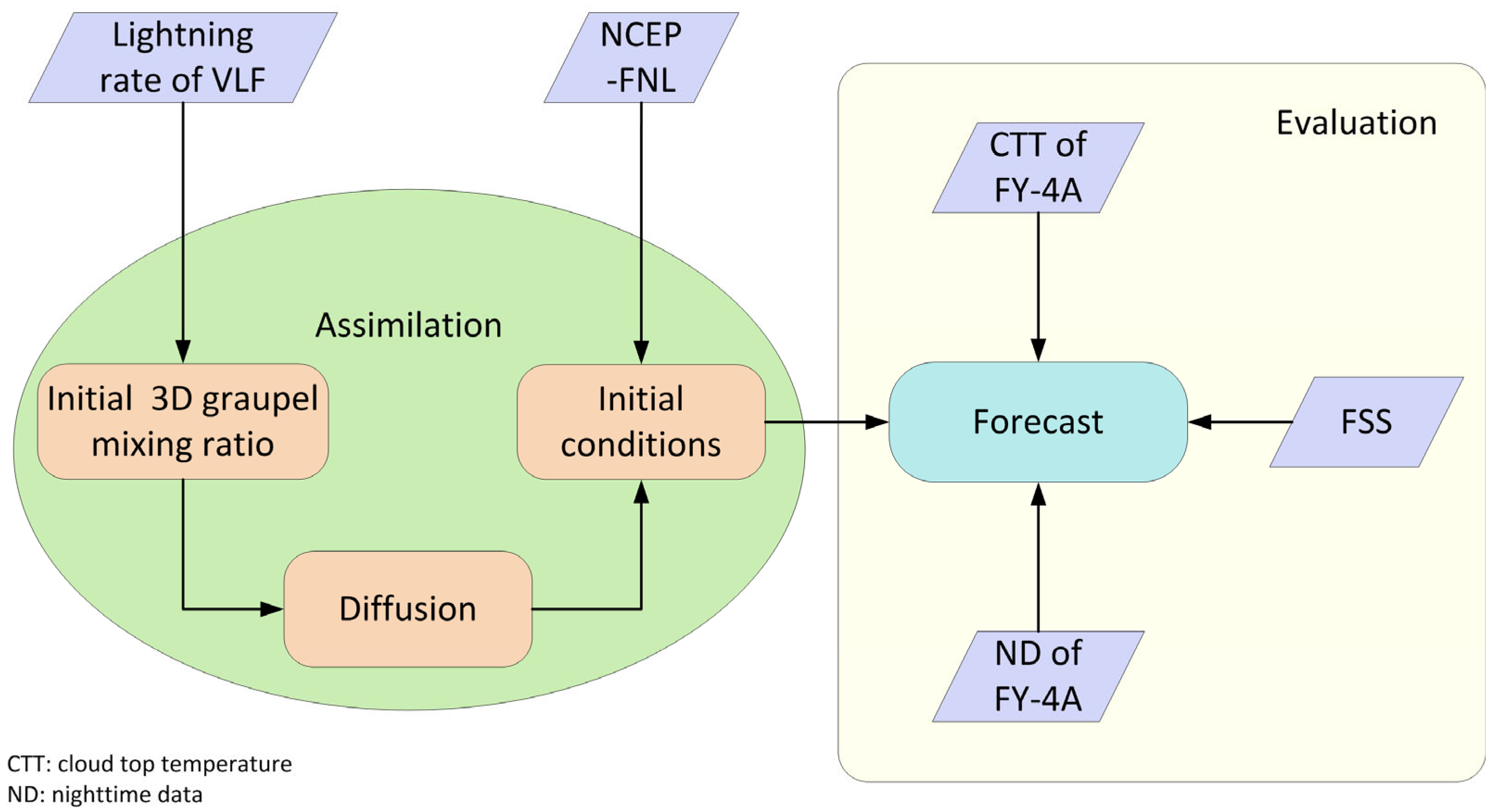
After the horizontal diffusion of the three-dimensional internal graupel mixing ratio field, it is assimilated into the WRF mode through the “Grid nudging” module in the WRF-FDDA system. The assimilation scheme is illustrated in Figure 2. The methodology for evaluating the forecast results will be detailed in a subsequent section.

2.3. Case Descriptions and Simulation Domain Setting

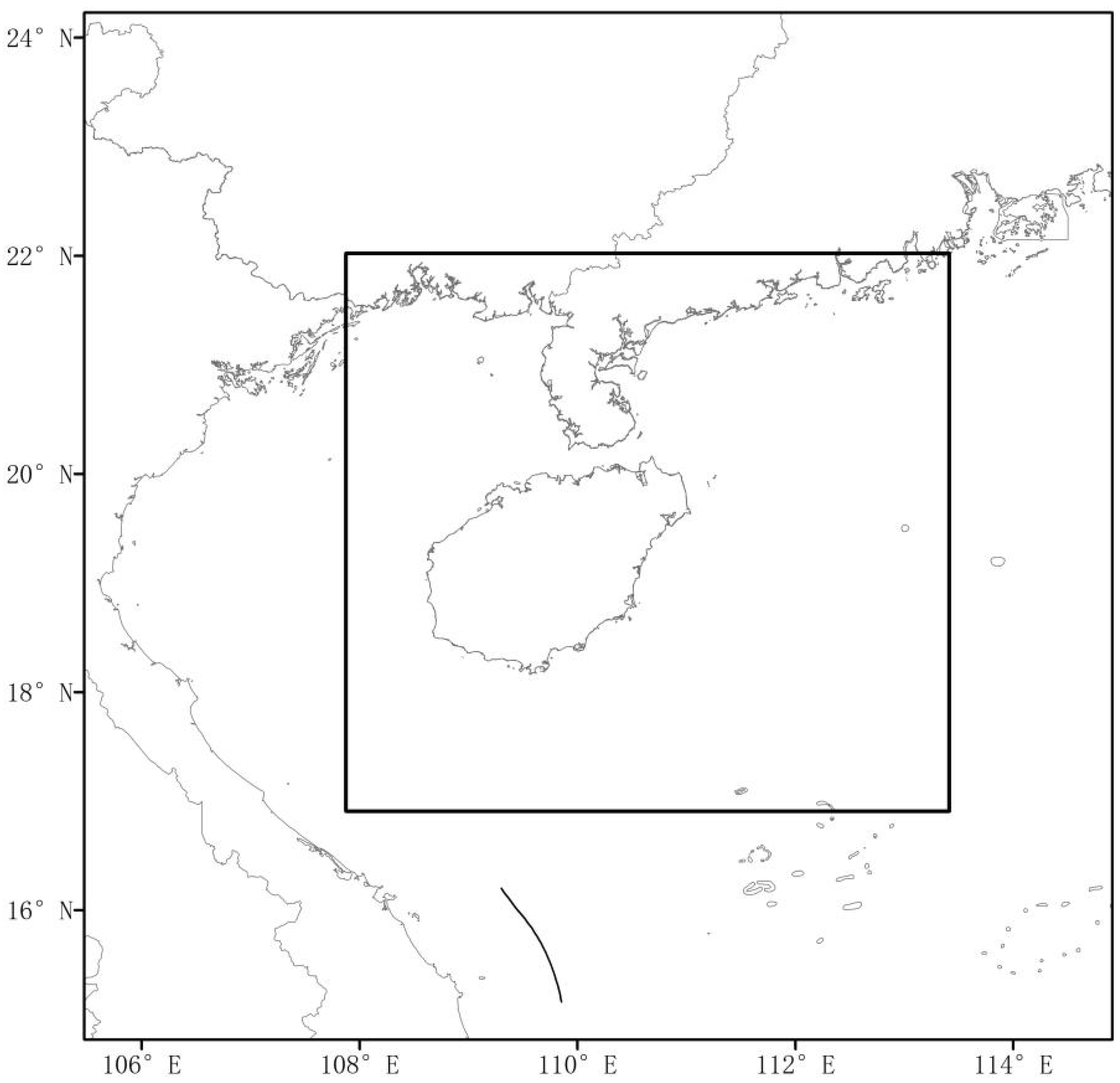
This study analyzes and simulates strong convective weather processes that occurred or intensified over a specific region of the South China Sea (108–114° E, 17–22° N), encompassing the northern Beibu Gulf and parts of the Qiongzhou Strait. As shown in Figure 3, this region serves as a key area for recent marine economic development initiatives in China. The analysis incorporates 37 nighttime forecast cases drawn from January to December 2024, which were selected to evaluate the effectiveness of a lightning data assimilation method for improving thunderstorm prediction over the South China Sea. The focus on nighttime processes was chosen because observations from the FY-4A LMI experience less interference at night, allowing for a more objective assessment of the assimilation scheme’s performance.
The numerical model employed in this case is the Compressible Eulerian Non-Static Mesoscale WRF Model Version 4.1.2 (https://www.mmm.ucar.edu/wrf/), accessed on 1 February 2020. The experiment used a dual-grid bidirectional nesting scheme, with inner and outer grids with resolutions of 3 km and 9 km, respectively. The vertical grid layers were set to 34 levels, and the model’s uppermost layer reached 50 hPa. Initial fields and lateral boundary conditions utilized the global NCEP-FNL analysis data with a resolution of 0.25° × 0.25°. The simulation area was visualized as the Mercator projection, as illustrated in Figure 3.
The numerical model employs the Thompson scheme for microphysics parameterization. For long-wave and short-wave radiation, the RRTMG (Rapid Radiation Transfer Model for General Circulation Models) scheme is selected. The atmospheric boundary layer uses the Mellor–Yamada–Janjic scheme, while the land surface model adopts the Noah scheme. Additionally, the outer grid utilizes the Grell–Freitas cumulus cloud parameterization scheme, whereas no cloud parameterization schemes are applied to the inner grid.

3. Results and Discussion

3.1. Case Study

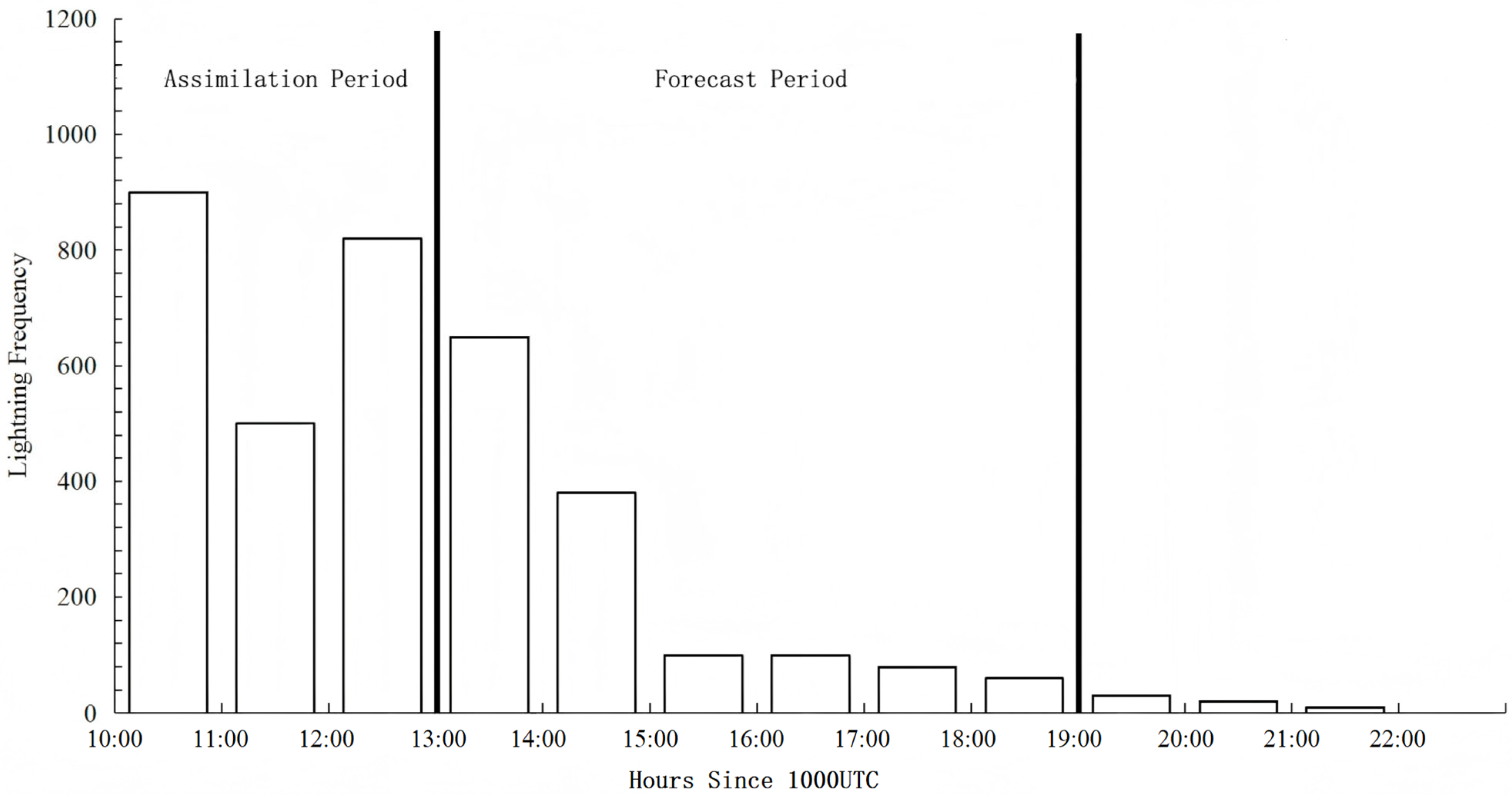
A convective event consisting of multiple discrete storms that developed over the South China Sea, centered on the Leizhou Peninsula on 4 June 2024, was selected to demonstrate the application of the VLF lightning data assimilation technique. Two experiments were conducted for comparison: a control experiment (CTL) and a data assimilation experiment (DA). In the DA experiment, lightning data were assimilated only within the inner model domain. However, due to the model’s two-way nesting capability, the assimilation effects were also propagated to the outer domain. As shown in Figure 4, the numerical simulation was initialized at 10:00 UTC and integrated for 12 h, ending at 22:00 UTC. The assimilation was performed continuously during the first 3 h, using VLF lightning data at 15-min intervals. After the assimilation window, a 6-h forecast was initiated, with outputs saved hourly to evaluate the influence of lightning data assimilation on subsequent nowcasting (0–2 h) and short-term forecasting (0–6 h).

3.2. Lightning Activity and Inversion of Cloud Internal Graupel Mixing Ratio Field

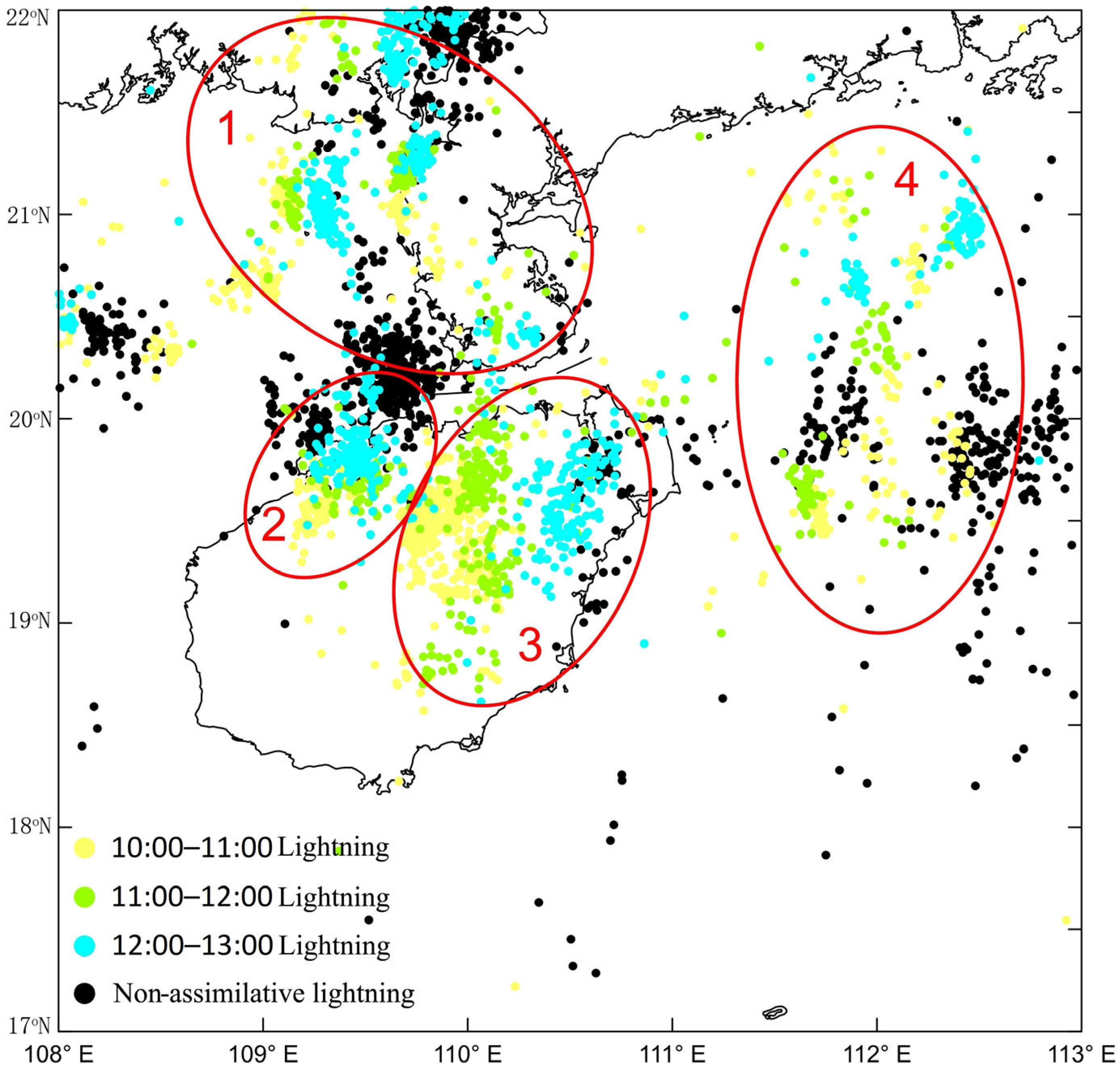
Figure 4 presents the temporal evolution of lightning events in this case. Lightning activity peaked during the assimilation period, gradually decreased throughout the forecast, and subsided as thunderstorms dissipated. Although the overall number of simulated lightning events was smaller than in observations, their spatial distribution remained concentrated (Figure 5), making the case suitable for testing lightning data assimilation in a numerical model. Lightning mainly occurred in four regions associated with distinct weather systems: (1) thunderstorms over the Leizhou Peninsula and its western coast (Red Circle 1 in Figure 5); (2) coastal–land boundary thunderstorms near northwestern Hainan Island (Red Circle 2); (3) west-to-east-moving thunderstorms over Hainan Island (Red Circle 3); and (4) scattered marine thunderstorms over the South China Sea (Red Circle 4). Among these, Thunderstorm 2 persisted throughout the forecast period, whereas the others were primarily active during the assimilation phase.
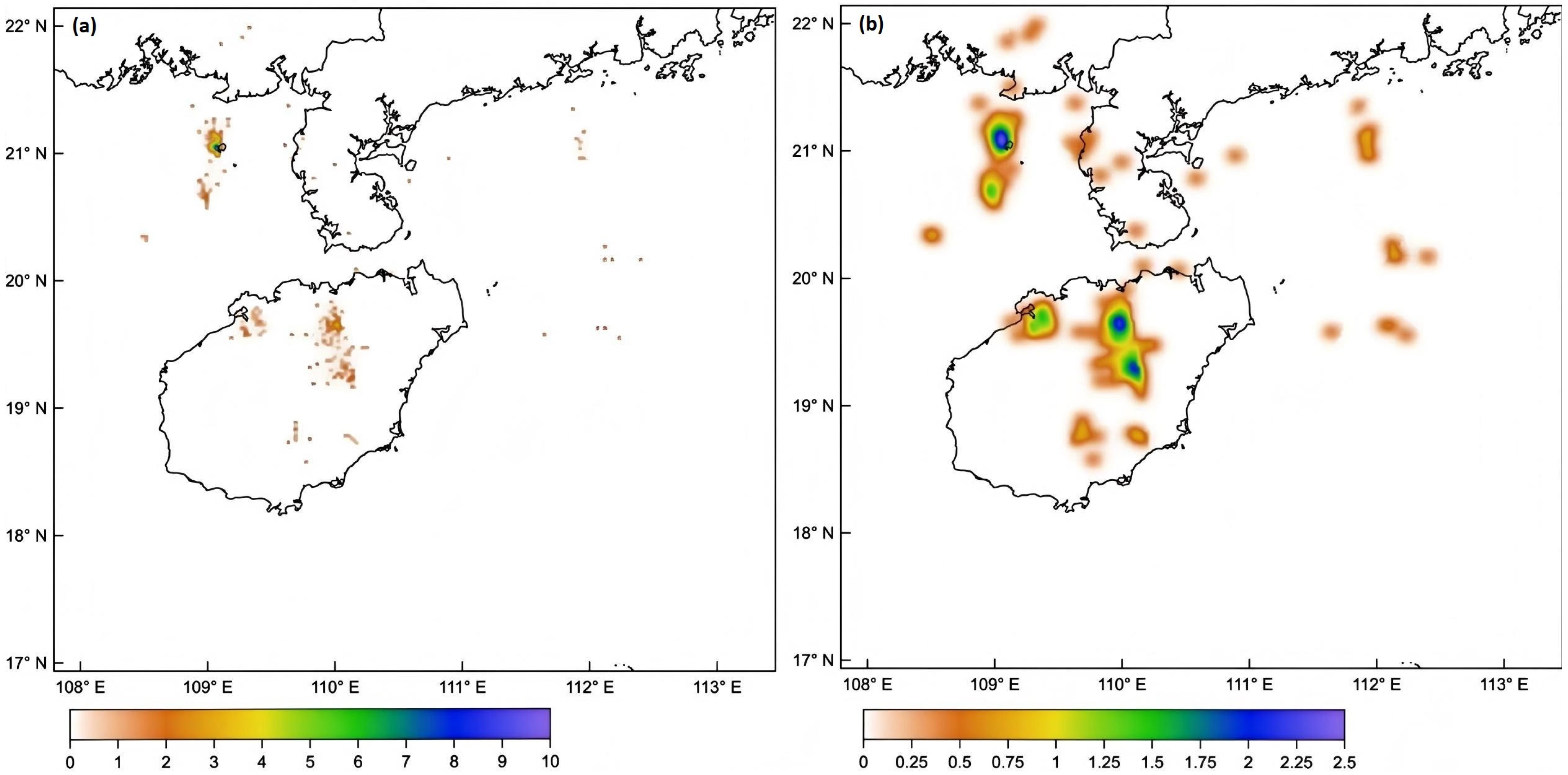
During the assimilation period, lightning events were assigned to cells within a 3 km × 3 km grid using the nearest neighbor principle, with lightning frequency calculated for each cell within a 15-min time interval. The subsequent calculation of the graupel mass based on these rates was followed by horizontal diffusion processing. Finally, three-dimensional intra-cloud graupel mixing ratio fields were constructed by selecting suitable mixing ratio profiles from a pre-established database for the study region. Figure 6 presents lightning frequency data and spatial distribution of horizontally diffused intra-cloud mixing ratios from 10:45 to 11:00. While the lightning frequency demonstrates poor continuity in the horizontal direction, the spatial distribution of the three-dimensional mixing ratios becomes more consistent after horizontal diffusion. To avoid false updrafts caused by assimilating convective edges or non-convective areas post-diffusion, this study only performed assimilation at model cells where the intra-cloud mixing ratio exceeded 1 g/kg.

3.3. Discussion of Forecast Results

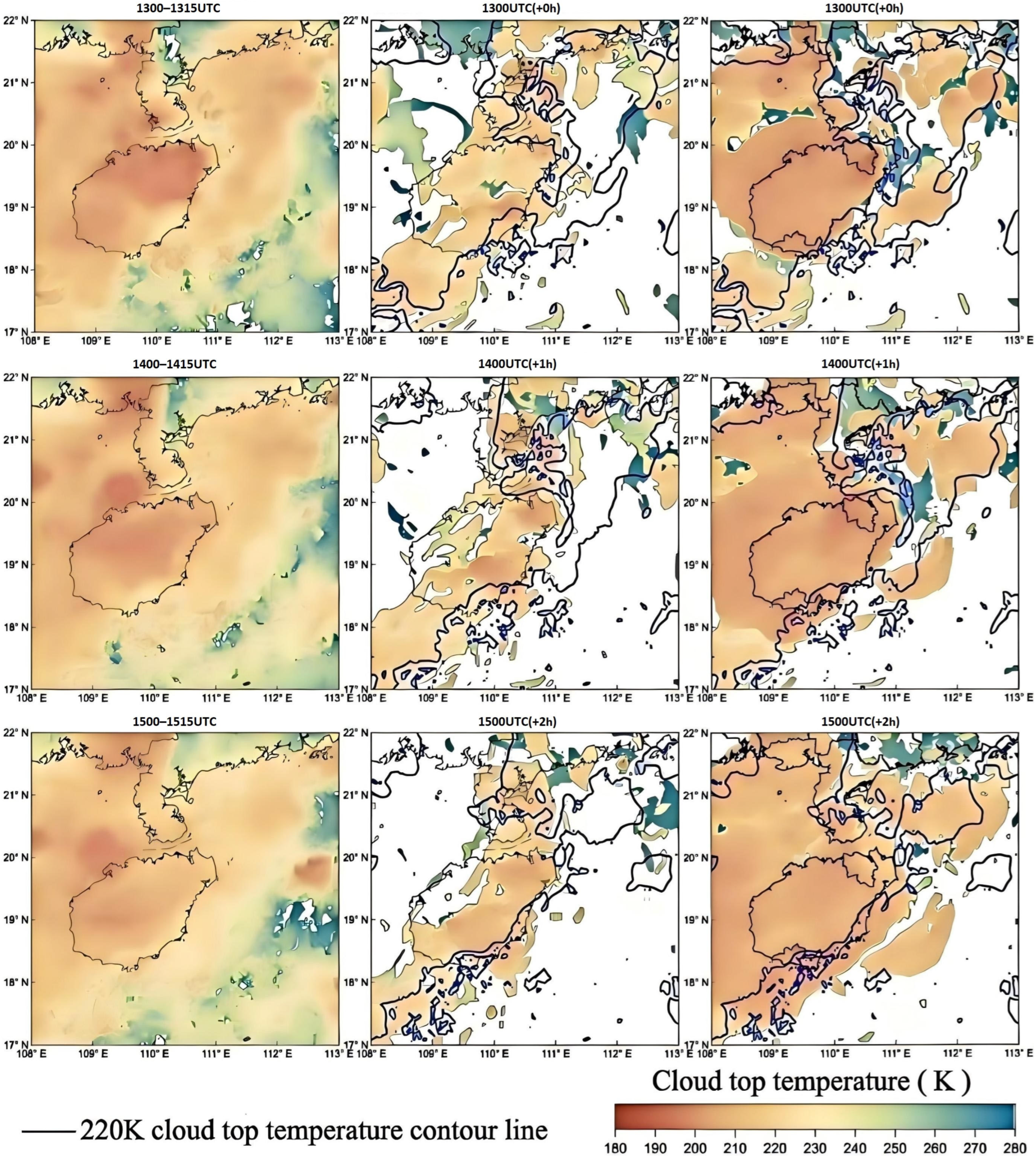
To evaluate the effectiveness of VLF lightning data assimilation in forecasting marine thunderstorms, simulated cloud-top temperatures (CTT) from the CTL and DA experiments were compared with satellite observations (Figure 7). CTT is a widely used indicator of strong convection, as colder CTT corresponds to higher cloud tops and stronger updrafts, which are associated with intense latent heat release and lightning activity [24]. The CTL experiment performed poorly: its simulated convective area was much smaller than observed, and the locations of strong convection (cloud-top temperatures below 220 K) deviated significantly from reality. In contrast, the DA experiment successfully incorporated VLF lightning data into the model, activating convection in regions where the CTL run failed to capture it and reproducing cloud-top patterns closely resembling observations. Moreover, the DA maintained high simulation accuracy even two hours after the assimilation period ended.
In addition to subjectively evaluating cloud top temperatures, this study employed a neighborhood space validation method called the FSS (fractional skill score) to objectively quantify the simulation performance of both CTL and DA in the case [42,43]. The FSS method provides reliable displacement error estimates, effectively avoiding the “double penalty” effect caused by minor spatial and temporal errors. It has been widely adopted in the forecasting and analysis of fine-scale strong convective systems. The specific formula is as follows:
F S S = 1 1 N i = 1 N P S P 0 2 1 N i = 1 N P S 2 + P S 0 2 2 .
where N denotes the total number of grid points in the model. P S and P 0 represent the proportions of forecasted and observed grid points meeting threshold requirements within the neighboring radius, respectively. The FSS value is approximately one, indicating that the closer the simulated results are to actual observations, the better the simulation performance. This study specifies a cloud top temperature threshold of 220 K and a neighboring radius of 24 km. In this study, our model’s inner grid resolution is 3 km. The selected FSS radius of 24 km (~8 grid cells) is consistent with the typical scale of oceanic convective systems observed in the South China Sea and aligns with established practices for high-resolution convective forecasts, as demonstrated by Roberts and Lean [42] who utilized radii of 20–30 km.
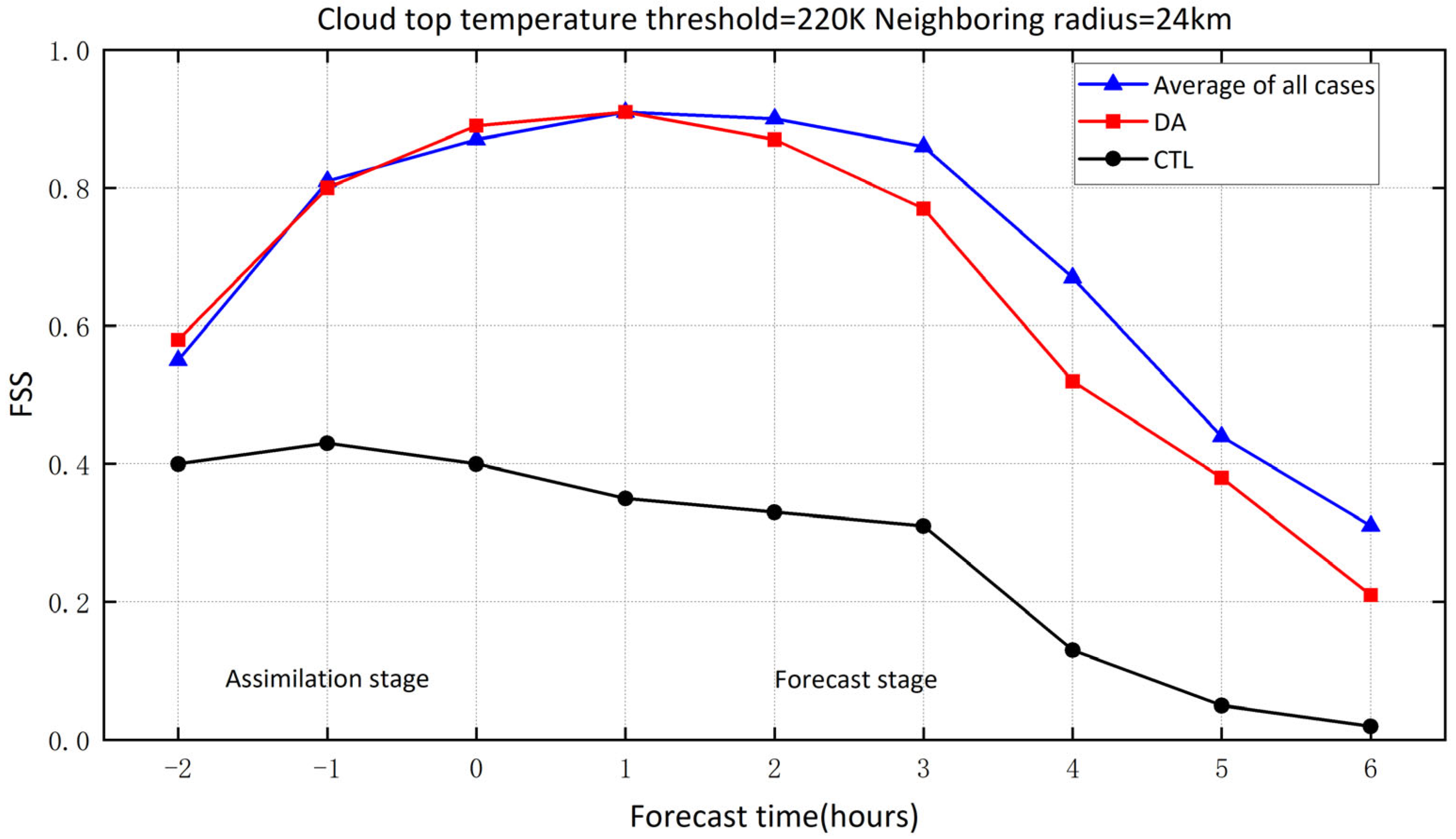
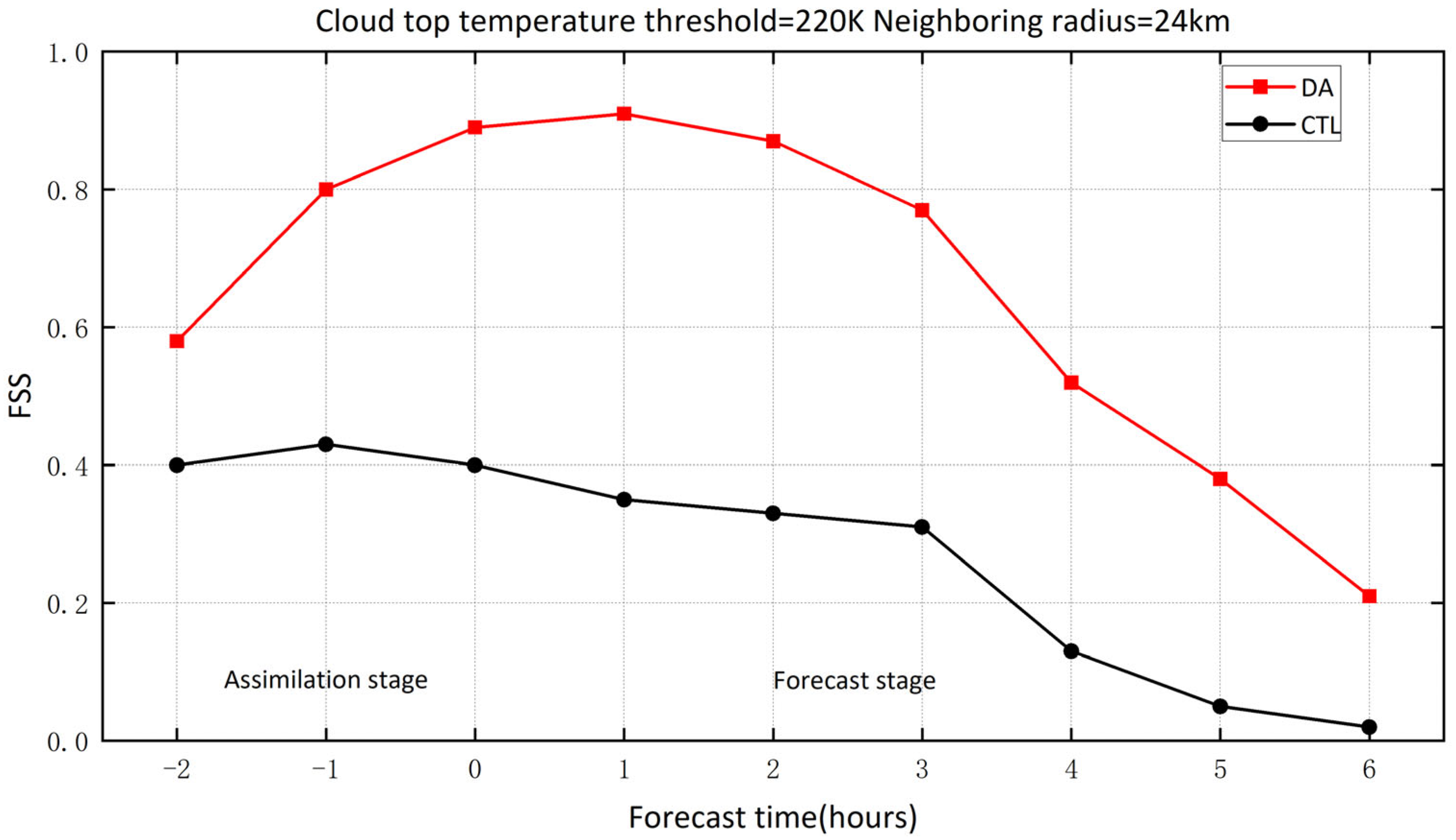
Figure 8 presents the temporal evolution of FSS for both experiments. Overall, the DA run consistently achieved higher FSS values than the CTL run. During the assimilation phase, as the VLF lightning data were continuously incorporated into the numerical prediction model, the background field in the numerical model increasingly approximated the observed field, leading to a rapid increase in FSSs. The most pronounced improvement occurred during the early forecast period (0–2 h), when the DA FSS exceeded 0.9, indicating a substantial enhancement in short-term forecast accuracy. Although the DA FSS gradually decreased with forecast time, it remained consistently higher than that of the CTL run. In subsequent forecast periods, while the DA FSSs gradually declined over time, they remained consistently higher than those of CTL. This phenomenon occurs because the lightning data only modifies the convective zone background field during the assimilation phase, and as time progresses, the external macro-environment gradually replaces the enhanced effects of the lightning data assimilation. This limitation could be addressed through rapid cyclic assimilation methods.
A comparison of Figure 7 (columns 1 and 2) further illustrates that the CTL experiment produced substantial cloud-top temperature errors over the Beibu Gulf at the initial forecast time (0 h). These errors persisted through subsequent forecasts, degrading accuracy over both the Beibu Gulf and adjacent land areas by 15:00 UTC (2-h forecast). Correspondingly, the CTL FSS (Figure 8) dropped to around 0.3 early in the forecast. In contrast, the DA experiment produced forecasts more consistent with observations (Figure 7, column 3). Although minor discrepancies appeared at 13:00 UTC, they were corrected in the following intervals, allowing the DA FSS to exceed 0.9 in the early forecast stage.
A similar pattern occurred east of the Qiongzhou Strait. Without assimilation, the CTL run accumulated growing errors, whereas the DA run improved forecast quality by assimilating graupel mixing ratios inferred from lightning data. However, it failed to accurately predict discrete convective cells that developed east of the strait at 15:00 UTC (2-h forecast). This limitation likely stems from the high sensitivity of localized convection to the precise timing of graupel initialization, explaining the sharp FSS decrease at that time.
Overall, the combined qualitative and quantitative analyses confirm that assimilating graupel-mixing ratios derived from lightning occurrence rates enhances convective system forecasts. Therefore, applying VLF lightning data assimilation offers an effective approach for nowcasting (0–2 h) marine thunderstorms over economically significant regions, such as marine ranching zones.

3.4. Evaluation of Assimilation Methods

Building on the promising results from the case analysis, the assimilation method was systematically applied to all 37 test cases to evaluate its broader applicability. Figure 9 displays the average FSS distribution across all cases (blue curve), with the individual case from Figure 8 overlaid for comparison. The average FSS remained high throughout the forecast period, demonstrating good consistency with the individual case results. This indicates that VLF lightning data effectively characterize the updraft intensity and graupel spatial distribution within severe convective systems. However, the average FSS exhibited a systematic decay as the forecast lead time increased, with a marked decline observed beyond five hours. This trend can be attributed to several factors: the diminishing graupel concentration leads to a weakening of lightning activity; the influence of the large-scale environmental field becomes increasingly dominant; and the initial corrective effect of the lightning data assimilation diminishes. The overall trend in FSS is consistent with findings from a similar lightning assimilation study by Lynn et al. [44].
Notably, in cases where strong convection initially developed over land or coastal areas before propagating offshore, forecast scores at the 3- and 4-h lead times were significantly higher. Although such cases constituted less than 30% of the total, they exerted a substantial positive influence on the overall average, resulting in the mean FSS for these periods exceeding the score of the individual case shown in Figure 9. This finding confirms that employing accurate VLF lightning data during assimilation effectively enhances forecast performance, underscoring the potential of lightning data assimilation for improving short-term prediction of oceanic convective systems.
To objectively assess the performance of the lightning data assimilation scheme, a binary confusion matrix was constructed by comparing lightning forecasts derived from the assimilation with nighttime FY-4A satellite observations. A forecast was considered consistent with observations when the relative error between the observed and predicted lightning frequencies within a 3 km × 3 km grid cell during the same period did not exceed ±30%. This threshold accounts for observational uncertainties in VLF lightning data (e.g., positioning errors ~1 km) and model resolution (3 km grid). Pilot tests showed that ±30% minimizes false positives/negatives while retaining meaningful forecast signal, as stricter thresholds led to excessive false negatives due to model lightning underprediction [45]. The matrix components were defined as follows: True Positives (TP) refer to grid cells where forecasts and observations were consistent. False Negatives (FN) denote grid cells where the observed lightning frequency exceeded the forecast by more than 30%. False Positives (FP) indicate grid cells where the forecasted lightning frequency exceeded the observed value by more than 30%. True Negatives (TN), referring to grid cells with neither observed nor forecast lightning, were excluded from this analysis. The evaluation was performed on an hourly basis across 37 selected cases, and the results are summarized in Table 1.
Based on the constructed confusion matrix, key quantitative metrics—including the Probability of Detection (POD), False Alarm Ratio (FAR), Frequency Bias (BIAS), Threat Score (TS), and F1 Score (F1_Score)—were calculated to objectively evaluate the performance of the lightning data assimilation [45,46]. These metrics are defined by Equations (5) through (9), respectively.
P O D = T P T P + F N
F A R = F P T P + F P
B I A S = T P + F P T P + F N
T S = T P T P + F P + F N
F 1 _ S c o r e = 2 × T P 2 × T P + F N + F P
Substitute the values from Table 1 into the above formulas, and the evaluation indicators for each item are shown in Table 2.
Quantitative evaluation demonstrated that the lightning forecasting algorithm achieved a high POD of 85%, with FAR of only 9%. The remaining three metrics also exhibited satisfactory performance. This promising performance can be attributed to two primary factors. First, the high quality of the VLF lightning data, combined with the concentration of lightning activity during the initial convective stage, significantly enhanced nowcasting capability and overall detection efficiency. Second, the marine environment, being less susceptible to light pollution than terrestrial regions, provided more reliable observational data from the FY-4A satellite, thereby reducing the introduction of systematic errors.
Despite the overall high scores, the assimilation results showed that the number of FN was approximately double that of FP. This imbalance considerably lowered the POD and BIAS, and also adversely affected the TS and F1-score. Further analysis revealed that a substantial proportion of FN events occurred during the middle to late forecast periods. This pattern is consistent with the observed decay in the FSS, reinforcing the interpretation that forecast accuracy is strongly influenced by the representation of graupel concentration. Case analysis based on cloud-top temperature data (Figure 7) further indicated that some discrete, localized convective systems were not adequately captured in the forecasts. Consequently, future work will focus on reducing the FN ratio and improving forecasting capabilities for the later stages of convective evolution and discrete convective cells.
In summary, the favorable metrics derived from FY-4A observations confirm the effectiveness of the VLF lightning data assimilation scheme for oceanic lightning prediction. This approach provides a practical solution for improving severe convective weather forecasting in marine economic zones. The quantitative evaluation based on the confusion matrix not only highlighted the advantages of the method but also precisely identified its current limitations, thereby providing clear direction for future model optimization.

4. Conclusions

This study developed a lightning data assimilation scheme to enhance the numerical forecasting of marine convective systems. The approach utilized high spatiotemporal resolution VLF lightning location data and NCEP-FNL analysis data to establish a quantitative relationship between lightning occurrence rate and in-cloud graupel mixing ratio. The three-dimensional graupel mixing ratio field was horizontally diffused and subsequently assimilated into the WRF model using the “Grid Nudging” module within the WRF-FDDA system.
A representative case from 4 June 2024, was selected to evaluate the assimilation performance by comparing the FY-4A AGRI-observed cloud-top brightness temperature with the assimilation results. The assimilation performance was quantitatively assessed using the FSS. The results indicated that the graupel mixing ratio inverted from VLF lightning data successfully initiated convection in lightning-active areas, accelerated the development of the convective system, and prompted a rapid increase in FSS. These findings demonstrate that the assimilation scheme significantly improves the forecasting of marine thunderstorms.
Furthermore, 37 nocturnal severe convection cases over the South China Sea were systematically evaluated using FY-4A lightning imager nighttime observations to assess the broader applicability of the VLF lightning data assimilation approach. The results showed that the spatial structure and coverage of the convective systems simulated by the assimilation experiment were more consistent with observations compared to the control run. The lightning forecast achieved a high POD of 85% and a low FAR of only 9%, demonstrating the practicality and robustness of this method for short-term forecasting over marine areas.
Analysis of multiple quantitative metrics identified graupel particle concentration as the key factor directly influencing the short-term (0–6 h) forecast performance. This finding also reflects the inherent uncertainty in retrieving the three-dimensional graupel distribution based solely on lightning occurrence rates. To address this limitation, future work will explore multi-parameter assimilation approaches to improve the reliability of graupel mixing ratio retrieval and improve short-term forecast accuracy.
The research confirms that the graupel mixing ratio derived from VLF lightning data can accurately initiate convective activity at observed lightning locations, effectively shortening the convective initiation time and leading to a rapid improvement in the FSS. Throughout the forecast period, the simulated convective systems from the assimilation experiment exhibited more realistic structure and spatial distribution, showing strong agreement with satellite observations and indicating marked improvement in forecast precision. Across the assimilation and forecast cycles, the assimilation experiment consistently produced higher FSS values than the control experiment. Notably, during the short-term nowcasting period (0–2 h), the FSS steadily increased and exceeded the 0.9 threshold, demonstrating substantial enhancement in forecast skill. However, this improvement gradually diminished with longer forecast lead times, emphasizing the continuing challenge of maintaining high forecast accuracy in extended convective predictions.

Author Contributions

Conceptualization, T.X. and Q.Y.; methodology, Q.Y.; validation, Z.L. and Z.C.; formal analysis, T.X. and Q.Y.; investigation, Z.L.; resources, Z.C.; writing—original draft preparation, Q.Y.; writing—review and editing, T.X., Z.L., and Z.C.; supervision, H.L. All authors have read and agreed to the published version of the manuscript.

Funding

This research was funded by Key Laboratory of Lightning, China Meteorological Administration (Grant No. 2023KELL-B006), China Academy of Railway Sciences Corporation Limited (Grant Nos. 2023YJ108, 2024YJ318), and Signal & Communication Research Institute of China Academy of Railway Sciences Corporation Limited (Grant No. 2024HT04).

Institutional Review Board Statement

Not applicable.

Informed Consent Statement

Not applicable.

Data Availability Statement

The NCEP-FNL dataset is available from the Data Archiving and Computing Laboratory at the U.S. National Center for Environmental Prediction (https://rda.ucar.edu/datasets/ds083.3/), accessed on 1 May 2025. The FY-4A AGRI data can be obtained from the Remote Sensing Data Service Network of the National Satellite Meteorological Center (http://satellite.nsmc.org.cn/), accessed on 1 May 2025. The numerical model is the Compressible Eulerian Non-Static Mesoscale WRF Model Version 4.1.2 (https://www.mmm.ucar.edu/wrf/), accessed on 1 May 2025.

Acknowledgments

ChatGPT-4 was used for language polishing and grammatical correction. The authors have thoroughly reviewed, edited, and validated all content generated by AI and take full responsibility for the work’s integrity and accuracy. The authors express their gratitude to all the members for their contribution to the lightning detection system. We are grateful to the Editor and anonymous reviewers for their assistance in evaluating this paper.

Conflicts of Interest

Authors Tong Xiao and Hui Li were employed by the Signal and Communication Research Institute China Academy of Railway Sciences Corporation Limited. The remaining authors declare that the research was conducted in the absence of any commercial or financial relationships that could be construed as a potential conflict of interest.

Abbreviations

The following abbreviations are used in this manuscript:
ADTDAdvanced Direction and Time-of-Arrival Detecting
AGRIAdvanced Geosynchronous Radiation Imager
DCCSCDeep Convective Cloud Sand Chemistry Field Experiment
FSSsfractional skill scores
FY-4AFengyun-4A
MSIRmulti-channel scanning imaging radiometer
NCAPNational Center for Atmospheric Prediction
NCEP-FNLNational Centers for Environmental Protection Final Operational Global Analysis
RRTMGRapid Radiation Transfer Model for General Circulation Models
TGFsTerrestrial gamma-ray flashes
VLFVery-Low-Frequency
VLF-LLNVery-Low-Frequency Lightning Location Network
WRFWeather Research and Forecasting
WRF-FDDAWeather Research and Forecasting–Four-Dimensional Data Assimilation

References

  1. Deierling, W.; Petersen, W.A.; Latham, J.; Ellis, S.; Christian, H.J. The Relationship between Lightning Activity and Ice Fluxes in Thunderstorms. J. Geophys. Res. 2008, 113, D15210. [Google Scholar] [CrossRef]
  2. Goodman, S.J.; Buechler, D.E.; Wright, P.D.; Rust, W.D. Lightning and Precipitation History of a Microburst-producing Storm. Geophys. Res. Lett. 1988, 15, 1185–1188. [Google Scholar] [CrossRef]
  3. Wiens, K.C.; Rutledge, S.A.; Tessendorf, S.A. The 29 June 2000 Supercell Observed during STEPS. Part II: Lightning and Charge Structure. J. Atmos. Sci. 2005, 62, 4151–4177. [Google Scholar] [CrossRef]
  4. Deierling, W.; Petersen, W.A. Total Lightning Activity as an Indicator of Updraft Characteristics. J. Geophys. Res. 2008, 113, D16210. [Google Scholar] [CrossRef]
  5. Fierro, A.O.; Mansell, E.R.; Ziegler, C.L.; MacGorman, D.R. Application of a Lightning Data Assimilation Technique in the WRF-ARW Model at Cloud-Resolving Scales for the Tornado Outbreak of 24 May 2011. Mon. Weather. Rev. 2012, 140, 2609–2627. [Google Scholar] [CrossRef]
  6. Wang, H.; Liu, Y.; Cheng, W.Y.Y.; Zhao, T.; Xu, M.; Liu, Y.; Shen, S.; Calhoun, K.M.; Fierro, A.O. Improving Lightning and Precipitation Prediction of Severe Convection Using Lightning Data Assimilation with NCAR WRF-RTFDDA. JGR Atmos. 2017, 122, 12296–12316. [Google Scholar] [CrossRef]
  7. Xu, Y.; Shen, Y.; Jiang, X.; Tian, F.; Cao, L.; Wang, N. Quality Control Technique for Ground-Based Lightning Detection Data Based on Multi-Source Data over China. Remote Sens. 2025, 17, 1928. [Google Scholar] [CrossRef]
  8. Do, C.; Kuleshov, Y.; Choy, S.; Sun, C. Evaluating Tropical Cyclone-Induced Flood and Surge Risks for Vanuatu by Assessing Location Hazard Susceptibility. Remote Sens. 2024, 16, 1890. [Google Scholar] [CrossRef]
  9. Wang, H.; Yuan, S.; Liu, Y.; Li, Y. Comparison of the WRF-FDDA-Based Radar Reflectivity and Lightning Data Assimilation for Short-Term Precipitation and Lightning Forecasts of Severe Convection. Remote Sens. 2022, 14, 5980. [Google Scholar] [CrossRef]
  10. Vargas, V.; Ferreira, R.C.; Pinto, O.; Herdies, D.L. Assessing the Impact of Lightning Data Assimilation in the WRF Model. Atmosphere 2024, 15, 826. [Google Scholar] [CrossRef]
  11. Federico, S.; Torcasio, R.C.; Puca, S.; Vulpiani, G.; Comellas Prat, A.; Dietrich, S.; Avolio, E. Impact of Radar Reflectivity and Lightning Data Assimilation on the Rainfall Forecast and Predictability of a Summer Convective Thunderstorm in Southern Italy. Atmosphere 2021, 12, 958. [Google Scholar] [CrossRef]
  12. Rafiezadeh Shahi, K.; Ghamisi, P.; Rasti, B.; Jackisch, R.; Scheunders, P.; Gloaguen, R. Data Fusion Using a Multi-Sensor Sparse-Based Clustering Algorithm. Remote Sens. 2020, 12, 4007. [Google Scholar] [CrossRef]
  13. Marullo, S.; Pitarch, J.; Bellacicco, M.; Sarra, A.G.D.; Meloni, D.; Monteleone, F.; Sferlazzo, D.; Artale, V.; Santoleri, R. Air–Sea Interaction in the Central Mediterranean Sea: Assessment of Reanalysis and Satellite Observations. Remote Sens. 2021, 13, 2188. [Google Scholar] [CrossRef]
  14. Zhou, Z.M.; Guo, X.L. A Three Dimensional Modeling Study of Multi-Layer Distribution and Formation Processes of Electric Charges in a Severe Thunderstorm. Chin. J. Atmos. 2009, 33, 600–620. [Google Scholar]
  15. Zhang, J.; Sun, J.; Shen, X.; Sun, Y.; Ma, Z.; Jin, H.; Liu, Q.; Zhang, H.; Jiang, Q.; Chen, F.; et al. Key Model Technologies of CMA-GFS V4.0 and Application to Operational Forecast. J. Appl. Meteor. Sci. 2023, 34, 513–526. [Google Scholar] [CrossRef]
  16. Li, Z.; Zhang, T.; Zheng, D.; Cui, X.; Yu, H.; Gan, Z.; Gao, T.; Bao, M.; Zhou, F. The characteristics of lightning activity-dynamics-microphysical in a tropical hailstorm. Chin. J. Geophys. 2024, 67, 3311–3326. [Google Scholar] [CrossRef]
  17. Yin, Q.; Fan, X.; Zhang, Y.; Zhang, Y.; Zheng, D.; Chen, S. Analysis of a lightning strike fatality. Acta Meteorol. Sin. 2019, 77, 292–302. [Google Scholar]
  18. Jin, S.; Xiao, T.; Wang, Z.; Xu, J. Research on a Self-Monitoring System for the Life Span of SPD. Railw. Signal. Commun. 2024, 60, 13–18. [Google Scholar] [CrossRef]
  19. Chen, C. Ground Potential Counterattack Judgment Method Based on Lightning Protection Monitoring System. Railw. Signal. Commun. 2024, 60, 28–33. [Google Scholar] [CrossRef]
  20. Li, J.; Shen, S.; Xia, B.; Xiang, B.; Li, B.; Ren, Y. Analysis of Lightning Frequency Distribution Characteristics Based on Adtd System. J. Trop. Meteorol. 2011, 27, 710–716. [Google Scholar]
  21. Zheng, J.; Lu, G.; Liu, F.; Ren, H.; Peng, K.; Wang, Y.; Zhu, B. Evaluate the detection efficiency of jianghuai area sferic array based on the world wide lightning location network:a case study of typhoon lekima. J. Trop. Meteorol. 2023, 39, 129–138. [Google Scholar] [CrossRef]
  22. Cai, L.; Zou, X.; Wang, J.; Li, Q.; Zhou, M.; Fan, Y. The Foshan Total Lightning Location System in China and Its Initial Operation Results. Atmosphere 2019, 10, 149. [Google Scholar] [CrossRef]
  23. Cao, D.; Huang, F.; Qie, X. Development and Evaluation of Detection Algorithm for FY-4 Geostationary Lightning Imager (GLI) Measurement. In Proceedings of the XV International Conference on Atmospheric Electricity, Norman, OK, USA, 15–20 June 2014. [Google Scholar]
  24. Sun, H.; Yang, J.; Zhang, Q.; Song, L.; Gao, H.; Jing, X.; Lin, G.; Yang, K. Effects of Day/Night Factor on the Detection Performance of FY4A Lightning Mapping Imager in Hainan, China. Remote Sens. 2021, 13, 2200. [Google Scholar] [CrossRef]
  25. Federico, S.; Torcasio, R.C.; Lagasio, M.; Lynn, B.H.; Puca, S.; Dietrich, S. A Year-Long Total Lightning Forecast over Italy with a Dynamic Lightning Scheme and WRF. Remote Sens. 2022, 14, 3244. [Google Scholar] [CrossRef]
  26. Sun, H.; Wang, H.; Yang, J.; Zeng, Y.; Zhang, Q.; Liu, Y.; Gu, J.; Huang, S. Improving Forecast of Severe Oceanic Mesoscale Convective Systems Using FY-4A Lightning Data Assimilation with WRF-FDDA. Remote Sens. 2022, 14, 1965. [Google Scholar] [CrossRef]
  27. Hu, L.; Huang, F. Monte Carlo Radiative Transfer Modeling of Optical Lightning Signals Observed by Satellite. Acta Opt. Sin. 2012, 32, 1101001. [Google Scholar] [CrossRef]
  28. Lyu, F.; Zhang, Y.; Lu, G.; Zhu, B.; Zhang, H.; Xu, W.; Xiong, S.; Lyu, W. Recent Observations and Research Progresses of Terrestrial Gamma-Ray Flashes during Thunderstorms. Sci. China Earth Sci. 2023, 66, 435–455. [Google Scholar] [CrossRef]
  29. Li, J.; Dai, B.; Zhou, J.; Zhang, J.; Zhang, Q.; Yang, J.; Wang, Y.; Gu, J.; Hou, W.; Zou, B.; et al. Preliminary Application of Long-Range Lightning Location Network with Equivalent Propagation Velocity in China. Remote Sens. 2022, 14, 560. [Google Scholar] [CrossRef]
  30. Wang, J.; Ma, Q.; Zhou, X.; Xiao, F.; Yuan, S.; Chang, S.; He, J.; Wang, H.; Huang, Q. Asia-Pacific Lightning Location Network (APLLN) and Preliminary Performance Assessment. Remote Sens. 2020, 12, 1537. [Google Scholar] [CrossRef]
  31. Wang, J.; Cheng, S.; Cai, L.; Fan, Y.; Zhou, M.; Li, Q.; Huang, Y. Mapping Thunderstorm Electrical Structure in the Troposphere in Warm Season with VLF/LF Total Lightning Monitoring Data over the Pearl River Delta Region, China. Atmosphere 2022, 13, 1015. [Google Scholar] [CrossRef]
  32. Hou, W.; Gu, J.; Wang, Y.; Dai, B.; Cui, X.; Wang, H.; Jiao, X.; Li, J.; Zhang, Q. Remote Measurement of the Lightning Impulse Charge Moment Change Using the Fast Electric Field Antenna. Remote Sens. 2022, 14, 724. [Google Scholar] [CrossRef]
  33. Zhou, J.; Zhang, Q.; Zhang, J.; Dai, B.; Li, J.; Wang, Y.; Gu, J. Evaluation and Revision of Long-Range Single-Site Lightning Location Accuracy Considering the Time Delay of Ground Wave. Front. Environ. Sci. 2023, 11, 1131897. [Google Scholar] [CrossRef]
  34. Yang, C.; Shi, B.; Min, J. The Combination Application of FY-4 Satellite Products on Typhoon Saola Forecast on the Sea. Remote Sens. 2024, 16, 4105. [Google Scholar] [CrossRef]
  35. Xie, Y.; Zhang, S.; Sun, X.; Chen, M.; Shi, J.; Xia, Y.; Liu, R. Assimilation of Fengyun-4A Atmospheric Motion Vectors and Its Impact on China Meteorological Administration—Beijing System Forecasts. Remote Sens. 2024, 16, 4561. [Google Scholar] [CrossRef]
  36. Carey, L.D.; Bain, A.L.; Matthee, R. Kinematic and Microphysical Control of Lightning in Multicell Convection over Alabama during DC3. In Proceedings of the 5th International Conference on Lightning Meteorology, Tucson, AZ, USA, 18–21 March 2014. [Google Scholar]
  37. Petersen, W.A.; Christian, H.J.; Rutledge, S.A. TRMM Observations of the Global Relationship between Ice Water Content and Lightning. Geophys. Res. Lett. 2005, 32, L14819. [Google Scholar] [CrossRef]
  38. Fierro, A.O.; Mansell, E.R.; Ziegler, C.L.; MacGorman, D.R. Explicitly Simulated Electrification and Lightning within a Tropical Cyclone Based on the Environment of Hurricane Isaac (2012). J. Atmos. Sci. 2015, 72, 4167–4193. [Google Scholar] [CrossRef]
  39. Allen, B.J.; Mansell, E.R.; Dowell, D.C.; Deierling, W. Assimilation of Pseudo-GLM Data Using the Ensemble Kalman Filter. Mon. Wea. Rev. 2016, 144, 3465–3486. [Google Scholar] [CrossRef]
  40. Sun, H. The Evaluation of FY-4A Lightning Mapper Imager Data and Its Application in Severe Convection Forecast. Ph.D. Thesis, Nanjing University of Information Science & Technology, Nanjing, China, 2022. Available online: https://kns.cnki.net/kcms2/article/abstract?v=OLEU9YGVhk3vc1b0LJyIqmWEVvWS1zNRG9_Js9tGVOd-FYg9L7ebL3ubw-ezjBWyup0iklaf2z6IJD2F9-OEFRaE35bDQztR3-Y-6PxKc-allfSsrLkbSAqdKtYBEsti1O4GHxxKhNap2g8YRRvX8Rr2rUOClue8xYTI1b8lAs0YaWifGTMwiT_d-ZqXfiMA&uniplatform=NZKPT&language=CHS (accessed on 15 October 2025).
  41. Cressman, G.P. An Operational Objective Analysis System. Mon. Weather. Rev. 1959, 87, 367–374. [Google Scholar] [CrossRef]
  42. Roberts, N.M.; Lean, H.W. Scale-Selective Verification of Rainfall Accumulations from High-Resolution Forecasts of Convective Events. Mon. Weather. Rev. 2008, 136, 78–97. [Google Scholar] [CrossRef]
  43. Qian, X.; Wang, H. Evaluation of Different Storm Parameters as the Proxies for Gridded Total Lightning Flash Rates: A Convection-Allowing Model Study. Atmosphere 2021, 12, 95. [Google Scholar] [CrossRef]
  44. Lynn, B.H.; Kelman, G.; Ellrod, G. An Evaluation of the Efficacy of Using Observed Lightning to Improve Convective Lightning Forecasts. Weather. Forecast. 2015, 30, 405–423. [Google Scholar] [CrossRef]
  45. Torcasio, R.C.; Papa, M.; Del Frate, F.; Dietrich, S.; Toffah, F.E.; Federico, S. Study of the Intense Meteorological Event Occurred in September 2022 over the Marche Region with WRF Model: Impact of Lightning Data Assimilation on Rainfall and Lightning Prediction. Atmosphere 2023, 14, 1152. [Google Scholar] [CrossRef]
  46. Mansouri, E.; Mostajabi, A.; Tong, C.; Rubinstein, M.; Rachidi, F. Lightning Nowcasting Using Solely Lightning Data. Atmosphere 2023, 14, 1713. [Google Scholar] [CrossRef]
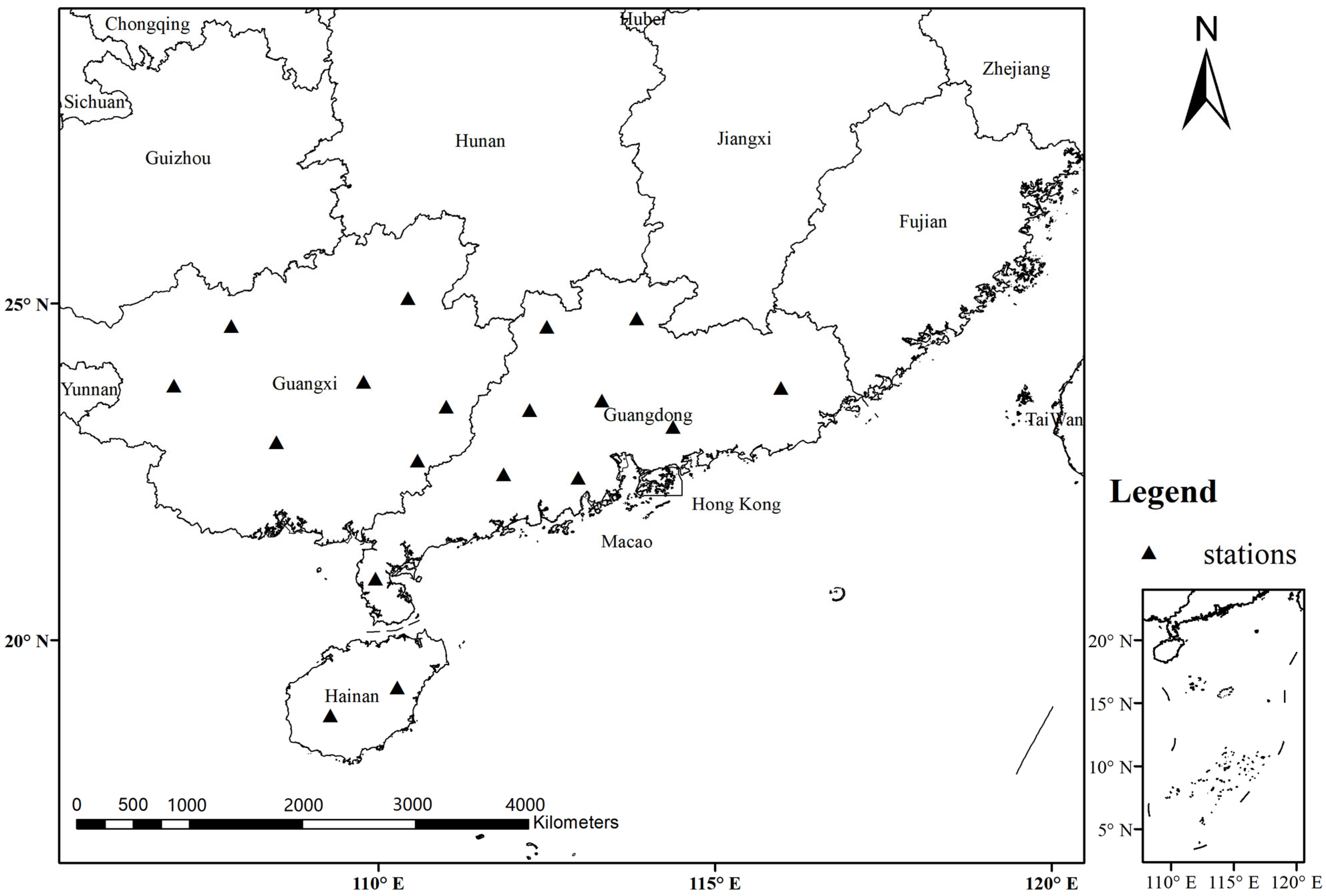
Figure 1. Schematic of the VLF-LLN operated by Nanjing University of Information Science and Technology. The figure illustrates the geographical distribution of 18 stations, marked by black triangles, which have been in operation since 2021. These stations are situated across three provinces, providing comprehensive coverage of the marine ranching regions relevant to this research.
Atmosphere 17 00197 g001
Figure 2. Diagram illustrating the assimilation scheme and evaluation methodology. Measurement-based: VLF lightning data, NCEP-FNL reanalysis data, and FY-4A AGRI/LMI data. Assumption-driven: Initial 3D graupel mixing ratio derived via the empirical relationship in Equation (1). Vertical distribution of graupel mixing ratio, based on pre-established profiles from high-resolution model simulations of the South China Sea. Following horizontal diffusion, as described by Equation (2), the resulting 3D graupel mixing ratio is then utilized as the initial condition for model assimilation.
Atmosphere 17 00197 g002
Figure 3. Simulation area (the middle black box).
Atmosphere 17 00197 g003
Figure 4. Assimilation period, forecast period division, and hourly lightning frequency distribution.
Atmosphere 17 00197 g004
Figure 5. Spatiotemporal distribution of lightning activity for the case of 4 June 2024.
Atmosphere 17 00197 g005
Figure 6. (a) Total lightning frequency (times/15 min) derived from VLF lightning data, and (b) spatial distribution of in-cloud graupel mixing ratio (g/kg) after horizontal diffusion.
Atmosphere 17 00197 g006
Figure 7. A comparison of cloud top temperature observations at each time point and the simulation results of the control group and the assimilation group. The blue contour line represents the observed value of CTT = 220 K. (The first column is the observed value, the second column is the control group, and the third column is the assimilation group.).
Atmosphere 17 00197 g007
Figure 8. Temporal evolution of the FSS for the convective case on 4 June 2024. The DA experiment (assimilation run) is shown in red, and the CTL experiment (control run without assimilation) is shown in black.
Atmosphere 17 00197 g008
Figure 9. Average FSS across all 37 nocturnal convective cases (blue curve). The calculation method used to derive this average is identical to the one applied in Figure 8. For comparison, the red and black lines indicate the FSS values from individual cases shown in Figure 8.
Atmosphere 17 00197 g009
Table 1. Binary classification confusion matrix.
ClassifyForecast
Yes
ValueForecast
No
Value
ObservationYesTrue Positive
(TP)
151,794False Negative
(FN)
27,368
NoFalse Positive (FP)15,217True Negative
(TN)
-
Table 2. Skill scores.
PODFARBIASTSF1_Score
Score0.850.090.930.780.88
Range[0, 1][0, 1]≥0[0, 1][0, 1]
Perfect10111
Disclaimer/Publisher’s Note: The statements, opinions and data contained in all publications are solely those of the individual author(s) and contributor(s) and not of MDPI and/or the editor(s). MDPI and/or the editor(s) disclaim responsibility for any injury to people or property resulting from any ideas, methods, instructions or products referred to in the content.