Article

Assessing the Association Between Unfavorable Meteorological Conditions and Severe PM2.5 and Ozone Pollution

1
School of Atmospheric Sciences, Nanjing University, Nanjing 210023, China
2
Nanjing-Helsinki Institute in Atmospheric and Earth System Sciences, Nanjing University, Suzhou 215163, China
3
Frontiers Science Center for Critical Earth Material Cycling, Nanjing 210023, China
*
Author to whom correspondence should be addressed.
Atmosphere 2026, 17(2), 194; https://doi.org/10.3390/atmos17020194
Submission received: 7 January 2026 / Revised: 6 February 2026 / Accepted: 6 February 2026 / Published: 12 February 2026
(This article belongs to the Special Issue Air Quality in China (4th Edition))

Abstract

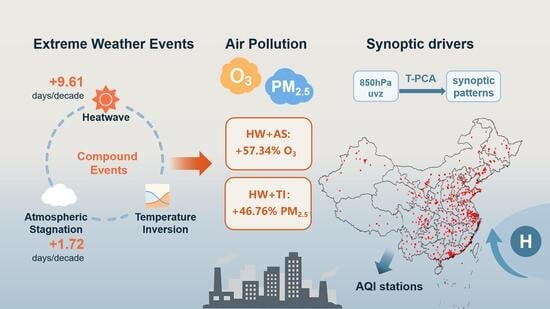
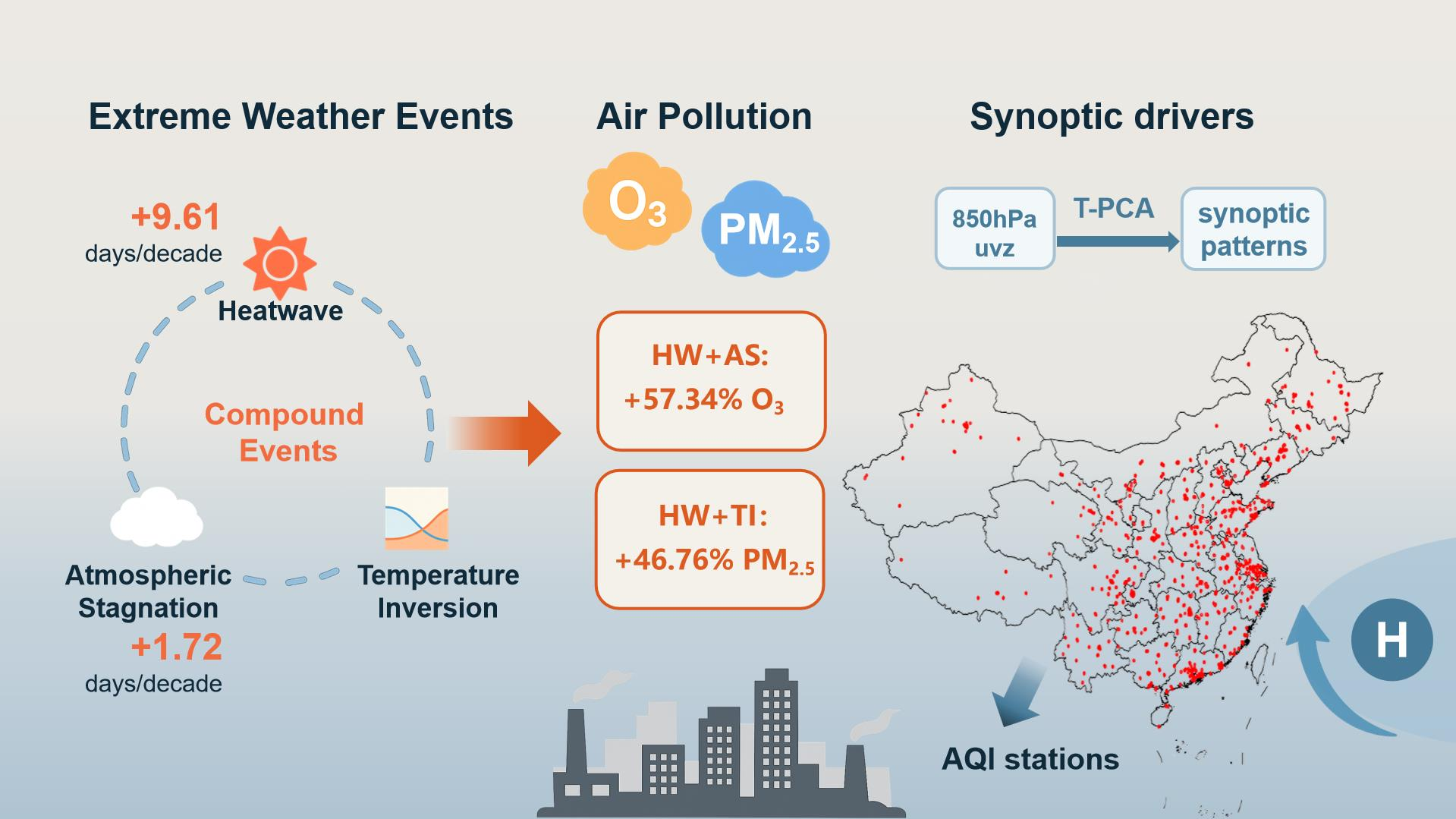
The increasing occurrence of unfavorable meteorological conditions under global warming has significantly impacted urban atmospheric environments, particularly ozone (O3) and fine particulate matter (PM2.5) pollution in densely populated cities. Using nationwide air quality observations and reanalysis data from 2013 to 2022, we assessed the variations in three typical unfavorable meteorological conditions—heatwave (HW), atmospheric stagnation (AS), and temperature inversion (TI)—in Eastern China and their influences on air pollution, as well as the large-scale synoptic drivers behind them. Results indicate that HW and AS events have increased substantially by 9.61 and 1.72 days/decade, leading to remarkable rises in O3 and PM2.5 concentrations. Compound events (e.g., HW + AS and HW + TI) exhibit even stronger synergistic impacts, raising O3 and PM2.5 concentrations by more than 57.34% and 46.76%, respectively, compared to individual events. In addition, by applying the T-mode Principal Component Analysis (T-PCA), this study identified typical synoptic patterns favorable for such conditions and air pollution events. Synoptic patterns such as the northward displacement of Western Pacific Subtropical High (WPSH) were identified as critical large-scale drivers. These findings highlight linkages between unfavorable meteorological conditions and air quality, providing scientific support for air-quality management and pollution control in Eastern China.

Graphical Abstract

1. Introduction

With rapid economic growth and accelerated urban expansion in recent decades, Chinese cities have suffered from severe tropospheric ozone (O3) and fine particulate matter (PM2.5) pollution. According to the World Air Quality Report 2023 by IQAir [1], China’s annual average PM2.5 concentration was 32.5 μg/m3—significantly higher than levels reported in the United States (9 μg/m3) and most European countries (12–15 μg/m3). Meanwhile, the ozone concentrations in most cities of Eastern China have significantly exceeded the WHO’s safety guideline of 100 μg/m3 (8 h mean), whereas 58% of cities in North America and Europe remained below this threshold [2,3]. The elevated concentrations of O3 or PM2.5 could increase the risk of respiratory and cardiovascular diseases [4,5,6], imposing a substantial public health burden, particularly in densely populated urban areas. In China, every 10 μg/m3 increase in short-term (daily mean) PM2.5 concentrations was associated with a 0.38% increase in total mortality, a 0.51% increase in respiratory mortality, and a 0.44% increase in cardiovascular mortality [7]. Long-term exposure to ambient ozone in China was estimated to cause 186,000 respiratory deaths and 125,000 cardiovascular deaths annually [5]. Moreover, ozone and PM2.5 are both phytotoxic pollutants and can threaten the biodiversity and sustainability of environments [8,9]. High concentrations of ozone, by inhibiting photosynthesis and accelerating leaf senescence, lead to reduced yields in crops such as wheat and corn [8]. PM2.5 can reduce crop yields by directly coating leaf surfaces to suppress photosynthesis [10] and inducing stomatal morphological abnormalities [11].
To combat the increasingly severe air pollution problems, the Chinese government has launched a series of legislations, such as the “Clean Air Action Plan (2013−2017)” and “Three-Year Action Plan to Win the Blue-Sky Protection (2018−2020)”. Driven by these initiatives, the nationwide annual mean PM2.5 concentration decreased from 55.1 μg/m3 in 2013 to 27.7 μg/m3 in 2022 across all cities [12]. While local emissions primarily dictate the average levels of air pollutants, meteorological conditions are another critical factor that may influence air quality through modulating the formation and transport of air pollutants [13,14,15]. Under unfavorable weather conditions, extreme PM2.5 air pollution events still frequently occurred in recent years, such as the persistent haze events during January 2017 in Beijing [16], February 2018 in Zhengzhou [17], and January 2023 in Chengdu [18]. Moreover, O3 pollution has become increasingly severe [19,20], and O3 is now a primary urban air pollutant in China [21,22]. Tropospheric O3 is a typical secondary pollutant [23], formed primarily through photochemical reactions of nitrogen oxides (NOx) and volatile organic compounds (VOCs) [23,24]. Consequently, its production and accumulation are highly sensitive to meteorological conditions, with key controlling factors including air temperature, solar radiation, and humidity [25]. The summertime daily maximum 8 h average (MDA8) O3 levels increased steadily by 2.5 μg/m3 per year in 2013−2022 due to a combination of the nonlinear chemical response of O3 to its precursors (NOx and VOCs) and warming climate [26].
Under global warming, unfavorable meteorological conditions have intensified and are predicted to become more frequent in China [27,28,29]. Some studies have suggested that such conditions, including heatwave, atmospheric stagnation, and temperature inversion, may have potentially significant impacts on severe urban air pollution by altering radiative conditions, boundary-layer structure, and ventilation and transport processes [28,30,31,32]. For instance, Hou and Wu [33] found that the mixing ratio of afternoon ozone was enhanced by more than 40% on heatwave (HW) days in the United States. Similarly, surface MDA8 O3 concentration may increase by 7–10 μg/m3 per °C with rising air temperature, leading to a positive O3 anomaly during the 2022 heatwaves in China [34,35]. Additionally, PM2.5 pollution was sensitive to atmospheric stagnation (AS) [36], and its daily mean concentrations were increased by up to 95.8 μg/m3 on stagnant days in the North China Plain (NCP) and 77.2 μg/m3 in Fenwei Plain (FWP) of China [37]. Moreover, plentiful studies have proved that the cumulative impacts of compound conditions may surpass those of a single event, leading to additional increase (10–16%) in air pollution concentrations [38,39]. Co-occurrence of these conditions and air pollution could exert compound stress on ecosystems and human health, especially under the conditions of accelerated climate warming. This risk is of particular concern in Eastern China. The region hosts some of the country’s most densely populated and economically dynamic urban clusters, leading to a large-scale exposed population [40]. Moreover, its intensive industrial production, energy consumption, and transportation activities result in high levels of ozone precursors and particulate matter emissions [41].
While existing studies have examined the impacts of meteorology on air pollution, an integrated assessment of multiple unfavorable conditions and their compound forms remain limited for Eastern China. Furthermore, occurrences of unfavorable meteorology and associated air pollution events are often controlled by large-scale weather systems. The identification of large-scale synoptic patterns driving these conditions and the underlying mechanisms connecting them require further investigation. For instance, Chang et al. [42] recognized that the high-pressure system, which exhibited strong solar radiation, high air temperature, and strong southwesterly winds, was most favorable for high O3 production in Shanghai. Zheng et al. [43] assessed the major synoptic patterns prone to air pollution in China and identified that homogeneous surface pressure field or persistent westerly flow in the middle troposphere was conducive to the extreme PM2.5 air pollution events. Accordingly, unfavorable meteorological situations and associated synoptic patterns might be an important predictor of severe air pollution events, and a thorough understanding of their relationship is essential to mitigate extreme air pollutant events. In this study, we focus on Eastern China and systematically evaluate the impacts of heatwave (HW), atmospheric stagnation (AS), temperature inversion (TI), and their compound events on O3 and PM2.5. We further identify the typical synoptic patterns and associated circulation structures that are conducive to the occurrence of unfavorable meteorological conditions and air pollution.

2. Materials and Methods

2.1. Ground Air Pollution Data During 2013 and 2022

The ground air pollution data used in this study were obtained from a mirror site (https://quotsoft.net/air, accessed on 8 November 2025) of the official air quality data platform of China’s Ministry of Ecology and Environment. The dataset covers hourly observations of ozone (O3) and fine particulate matter (PM2.5) concentrations from major Chinese cities during 2013–2022. We focused on Eastern China (110–125° E, 25–45° N) and included data from a total of 943 environmental monitoring sites in the analysis (Figure S1). Based on hourly observations, the maximum daily 8 h moving average O3 (MDA8 O3) and daily mean PM2.5 concentrations were calculated for analysis. In addition, we quantified the exceedance rate as the fraction of days on which pollutant concentrations exceeded the corresponding Grade II limits of the Chinese National Ambient Air Quality Standards (NAAQS). Specifically, a PM2.5 exceedance day was defined when the daily mean PM2.5 concentration is >75 μg/m3, and an O3 exceedance day is defined when MDA8 O3 was >160 μg/m3.
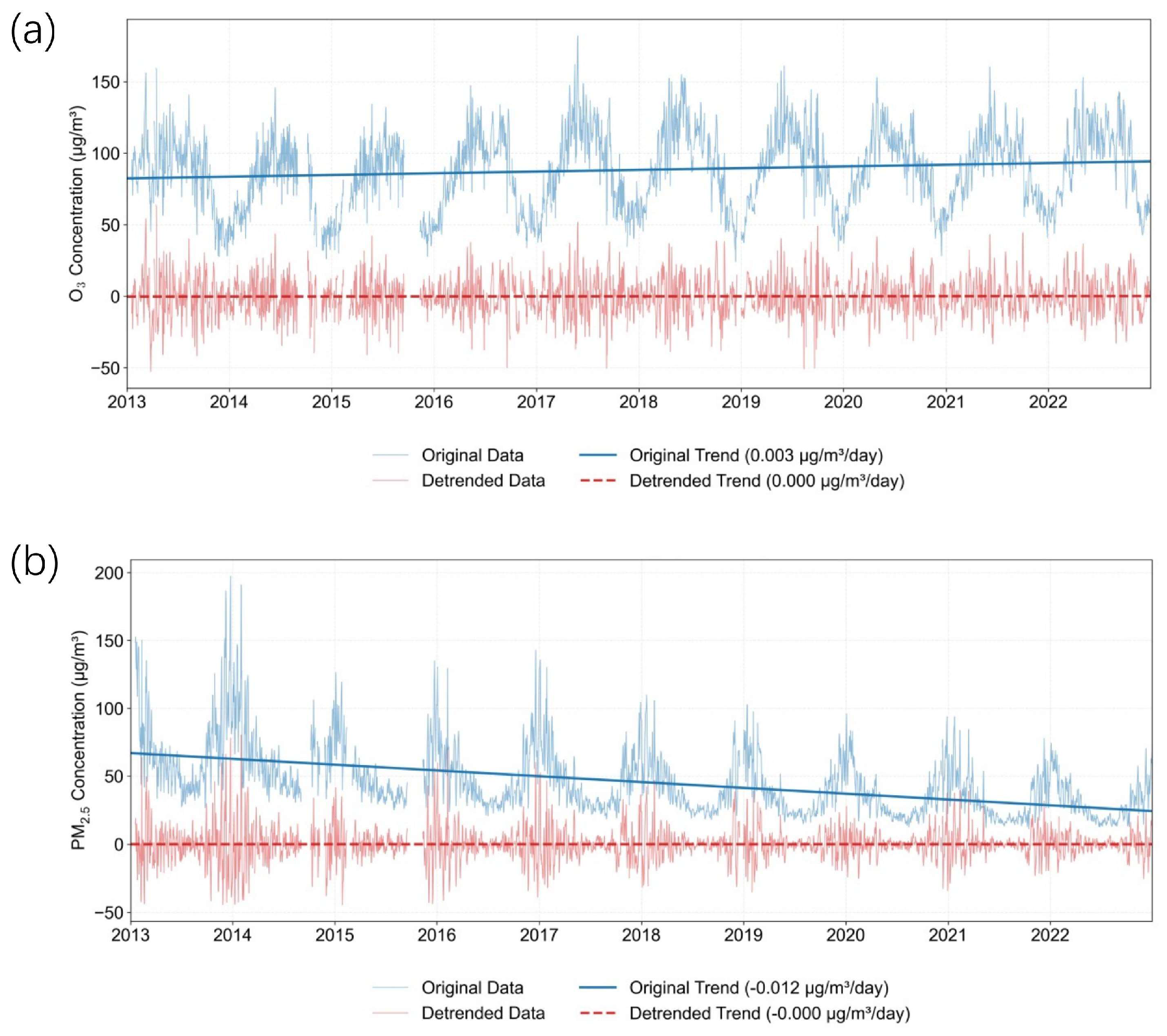
To remove the influence of long-term trends in PM2.5 and O3 concentrations, we employed detrended data processing methods [44,45], as reflected in Equation (1):
D e v y , m . i = C y , m , i i = 1 n C y , m , i n
where D e v y , m . i is the detrended air pollutant concentration, C y , m , i is the pollutant concentration on day i of month m in year y, and n is the number of days in the specific month. This procedure removes the monthly mean of each year–month and thus effectively eliminates both seasonal background differences and long-term trends. Comparisons of air pollutant concentrations before and after detrending are shown in Figure 1. The reported pollution changes associated with unfavorable meteorological conditions in this study are based on D e v y , m . i .

2.2. Identification of Unfavorable Meteorological Conditions Using ERA5 Reanalysis Data

To identify unfavorable meteorological conditions and to classify weather patterns, we used the fifth-generation reanalysis climate data (ERA5) obtained from the European Centre for Medium-Range Weather Forecasts (ECMWF; http://www.ecmwf.int, accessed on 12 October 2025). This dataset has a spatial resolution of 0.25° × 0.25° and an hourly temporal resolution. Meteorological variables, including 2 m air temperature, 10 m zonal and meridional winds, 500 hPa zonal and meridional winds, total precipitation, and air temperature at nine levels below 800 hPa, are used to identify unfavorable meteorological conditions. And to analyze the impacts of these conditions on air pollution, these variables were extracted from the nearest ERA5 grid cell (0.25° × 0.25°) for each monitoring site. Additionally, 850 hPa zonal and meridional winds, along with 850 hPa geopotential height, are used for synoptic classification.
Using the ERA5 reanalysis data covering Mainland China from 1960 to 2022, we identified three unfavorable meteorological conditions—heatwave, temperature inversion, and atmospheric stagnation—and analyzed their trends and spatial–temporal characteristics. As suggested by Perkins-Kirkpatrick and Lewis [29], a heatwave event is defined by the occurrence of at least 3 consecutive days with daily maximum air temperature (Tmax) exceeding 90th percentile threshold (Tmax_90th). This 90th percentile is based on a 15-day moving window of Tmax over the base period of 1961−1990. TI events are identified using temperature data below 800 hPa. It is identified when air temperature at the upper layer is at least 0.1 K higher than that at the adjacent lower layer [28]. In this study, if more than 12 h is identified as TI in a single day, this day is marked as a TI day. This study adopted the commonly used criterion for identifying atmospheric stagnation (AS) in air-pollution meteorology [28,46,47]. A day is classified as an AS day if it meets the following criteria: daily total precipitation below 1 mm, daily mean 10 m wind speed under 3.2 m s−1, and daily mean 500 hPa wind speed less than 13 m s−1. This set of thresholds is based on the typical dynamical and moisture characteristics of stagnant weather conditions and is suitable for large study areas [46]. In addition, to investigate the variations in air pollutant concentrations under simultaneous occurrence of multiple unfavorable meteorology, compound conditions are defined when two or more of the above unfavorable meteorological conditions occur concurrently.

2.3. T-PCA Objective Classification Method

The classification approaches of synoptic pattern can be divided into subjective, objective, and mixed approaches [48]. In this study, we chose an objective Principal Component Analysis in T-mode (T-PCA) based on Huth [49] to identify the synoptic patterns in Eastern China. It is a typical objective classification method that can cluster samples based on the similarity of meteorological fields, without relying on subjective judgment. Compared with traditional subjective approaches, it exhibits higher temporal–spatial stability and reproducibility, can better capture the dominant features of large-scale circulation patterns, and shows relatively low sensitivity to preset parameters [48,50,51]. It has been widely used in air quality research in recent years [50,52,53].
The T-PCA classification is implemented using the COST733class version 1.4 software package (http://cost733.met.no, accessed on 7 March 2024). This software enables objective classification and evaluation of meteorological fields based on single or multiple variables. In this study, the 850 hPa geopotential height and corresponding wind fields (u and v components) are selected as the classification variables. To evaluate the performance of classifications with different numbers of clusters, the explained cluster variance (ECV) and its increment (ΔECV) were calculated to determine the optimal number of synoptic patterns [54,55,56]. ECV is calculated directly by the COST733 software (Equation (2)), and its value is between 0 and 1.
E C V = 1 W S S T S S
where WSS represents the within-class sum of squares across all classified weather types, calculated in Equation (3); TSS represents the total of sum of squares, calculated in Equation (5).
W S S = j = 1 k i C j D ( X i , X ¯ j ) 2
D ( X i , X ¯ j ) 2 = l = 1 m ( X i l X ¯ j l ) 2
T S S = i = 1 n l = 1 m ( X i l X ¯ l ) 2
where k is the number of synoptic patterns; C j is the jth synoptic pattern; D ( X i , X ¯ j ) 2 is the squared Euclidean distance between an element and its centroid; l is the time step (l = 1, 2, …, m); X i l is the respective data point; X ¯ j l is the estimate of the mean value for synoptic pattern j; and X ¯ l is the estimate of the total mean.
We calculated ΔECV based on Equation (6):
E C V k = E C V k + 1 E C V k
where ECVk is the ECV with k classes.
A higher ECV value usually indicates a stronger ability of the classification to explain the characteristics of original field [54], while the maximum value of ΔECV corresponds to a significant improvement and subsequent stabilization of the classification performance [56]. Therefore, a series of synoptic pattern classifications (k = 1, 2, 3…) are tested, and the optimal number of weather patterns is determined based on their ECV and ΔECV values.

3. Results and Discussion

3.1. Trends of Unfavorable Meteorological Conditions in the Present and Future Scenarios

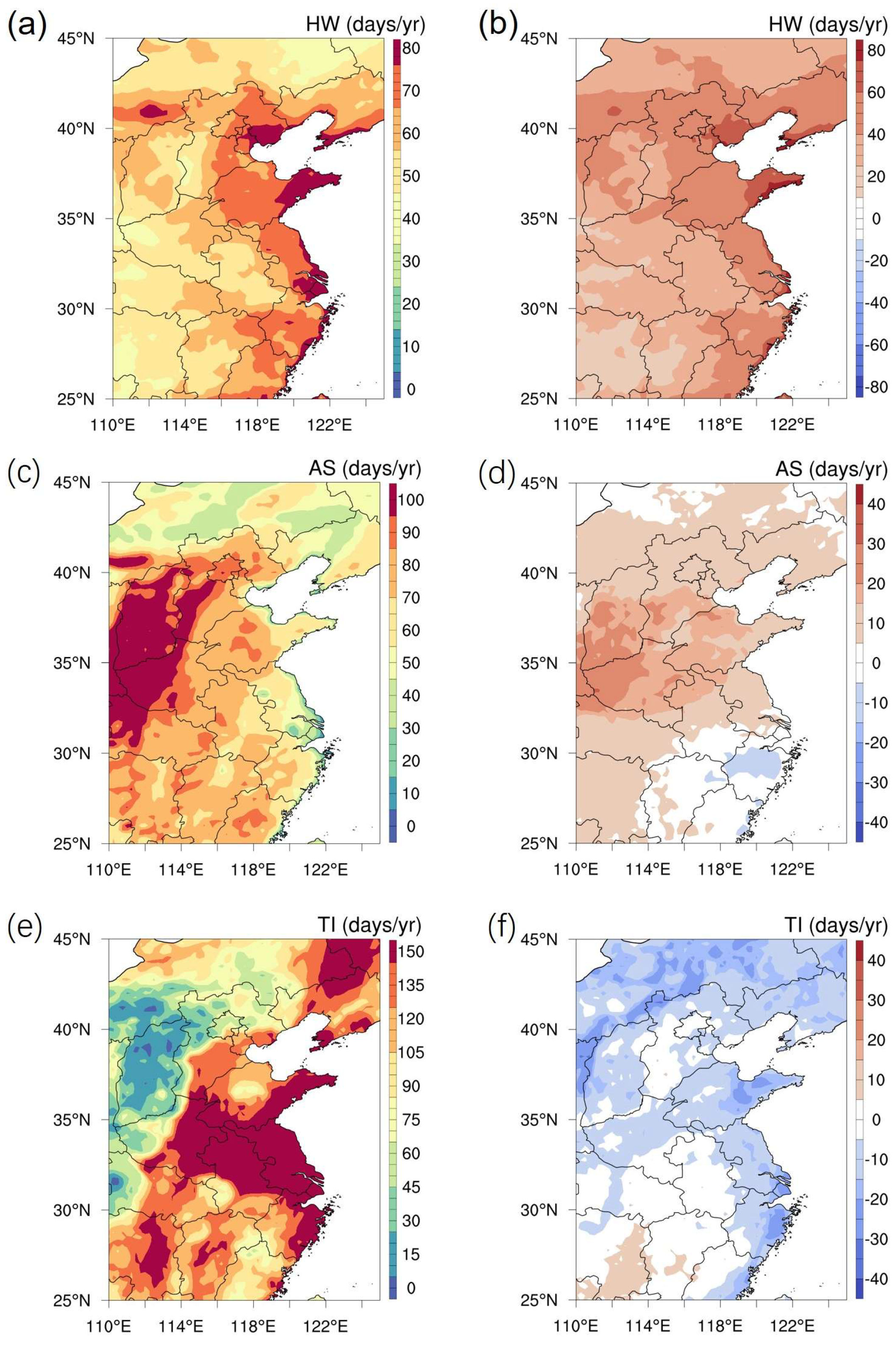
By analyzing ERA5 reanalysis data from 1960 to 2022, we identified the features and trends of three unfavorable meteorology conditions over Eastern China. Figure 2 illustrates the spatial distributions of HW, AS, and TI during 2013–2022, along with the changes relative to the period of 1960–1969. Notably, aligning with global climate warming, the frequency of heatwaves has increased with a linear trend of 9.61 events decade−1 in China since the 1960s (Figure S2). Particularly, in the recent decade (2013–2022), heatwave days reached 66.43 days/yr (Figure 2a,b), representing a substantial increase compared to the value of 19.09 days/yr during 1960–1969. This substantial rise by more than twofold can be attributed to accelerated climate warming due to anthropogenic greenhouse gas emissions [57]. Spatially, heatwaves are more frequent in the middle and lower reaches of the Yangtze River, as well as the northern and southeastern coast of China. In addition, the seasonal distribution of heatwaves exhibits the highest occurrence in autumn, with an average of 39.37 days per year (Figure S3).
AS also exhibited a moderately increasing trend in the past decades (Figure 2 and Figure S2). Since 1960, the annual frequency of AS events has increased gradually at a rate of 1.72 days decade−1. During 2013–2022, the annual number of AS days reached 59.25 days/yr, which is 7.69 days higher than the average level during 1960–1969, particularly in the inland regions of China. This pattern may be attributed to the strong precipitation and upper-level winds over coastal areas [58,59], which are unfavorable for the formation of atmospheric stagnation (Figure S4). Seasonally, AS events were most frequent in summer (28.5%; Figure S3). The increase in AS frequency is particularly prominent over the North China Plain (NCP) region, where Huang, Cai, Song, and Zhu [59] identified the weakening of upper-level wind speeds as the primary contributing factor.
The annual number of TI days in Eastern China from 2013 to 2022 was strikingly high at 120.29 days/yr (32.94%), which was higher than that of both HW and AS events. However, analysis indicates a decreased trend of TI events by −7.81 days/yr (6.1%) compared to the 1960–1969 period. This decline may be partially attributed to our identification methods. For instance, Bai et al. [60] reported a noticeable decrease in intra-layer temperature differences during 2014–2022, indicating a weakening of inversion strength. Despite that, TI remains a dominant background weather condition for wintertime air pollution, with an occurrence frequency exceeding 50.32%.

3.2. Association Between Unfavorable Meteorological Conditions and Air Pollution Across Eastern China

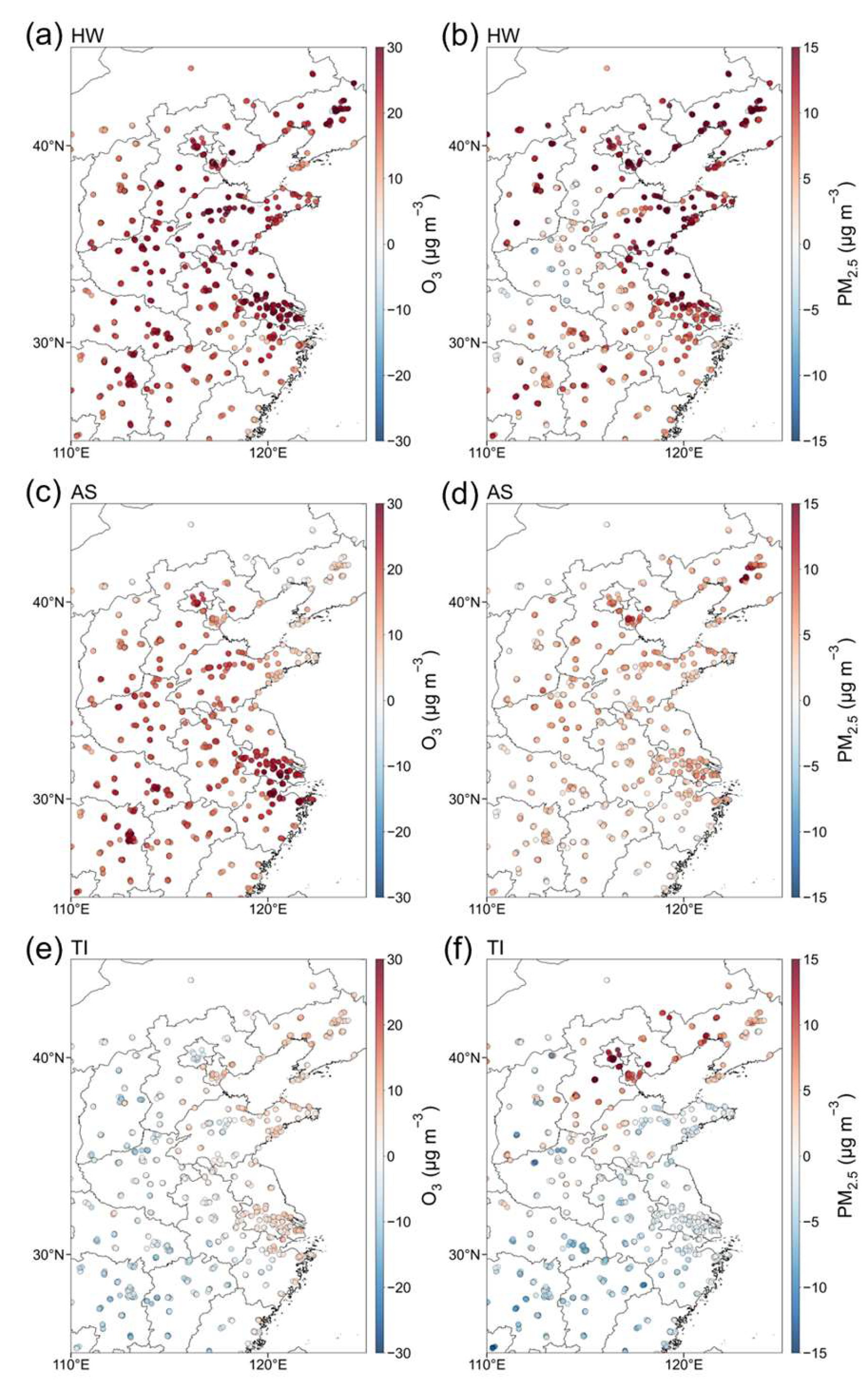
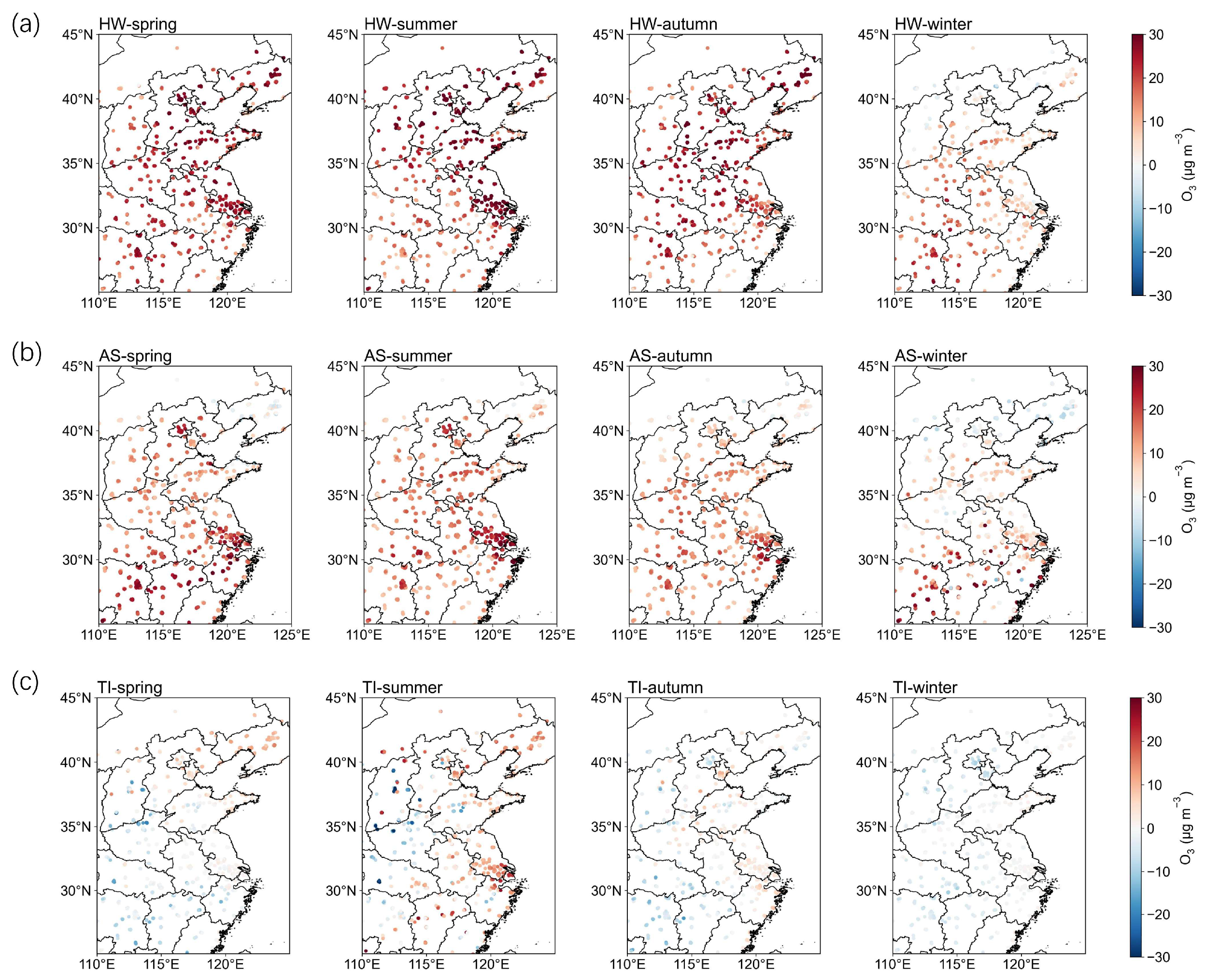
Comparing PM2.5 and O3 concentrations under unfavorable meteorology with those under normal conditions between 2013 and 2022 reveals the impacts of unfavorable situations on air pollution (Figure 3). We defined the pollution anomaly induced by unfavorable conditions as the difference in mean pollutant concentrations between unfavorable days and normal days at each monitoring site. Based on the anomaly values across all sites, a two-sided one-sample t-test was applied to assess whether the regional-mean enhancement was significantly different from zero, with p < 0.05 used as the significance threshold. It is evident that heatwaves and stagnation have most substantial enhancement impacts on O3 levels compared to normal conditions (Figure 3a,c). Specifically, heatwaves increased surface MDA8 O3 concentrations in Eastern China by 18.87 μg/m3 (spring), 21.85 μg/m3 (summer), 18.90 μg/m3 (autumn), and 9.65 μg/m3 (winter; Figure 4; p < 0.05), compared to non-heatwave conditions. Furthermore, the enhanced ozone pollution during heatwaves exhibited clear regional clustering over the major urban agglomerations, such as Beijing–Tianjin–Hebei (BTH) and Yangtze River Delta (YRD), where the O3 levels increased by more than 15 μg/m3 compared to non-heatwave days. The elevated O3 levels during heatwaves are presumably associated with accelerated photochemical reaction rates under sustained high temperatures [61]; heat-boosted anthropogenic and natural emissions, particularly volatile organic compounds (VOCs) [35,62]; and as suppressed plant stomatal uptake [63,64]. Atmospheric stagnation was typically accompanied by weak winds, facilitating the accumulation of ozone and its precursors in the near-surface layer. Ozone enhancement due to AS was particularly significant in spring and summer, reaching 15.67 μg/m3 and 15.31 μg/m3, respectively (p < 0.05). In contrast, the impacts of TI on ozone pollution were relatively minor, with a slight increase in O3 concentrations only during summer (+7.35 μg/m3), whereas in other seasons (Figure 4; p < 0.05), TI was associated with lower O3 levels. This may be attributed to suppressed vertical transport of ozone from upper layers under stable conditions, thus reducing the near-surface O3 supply [65].
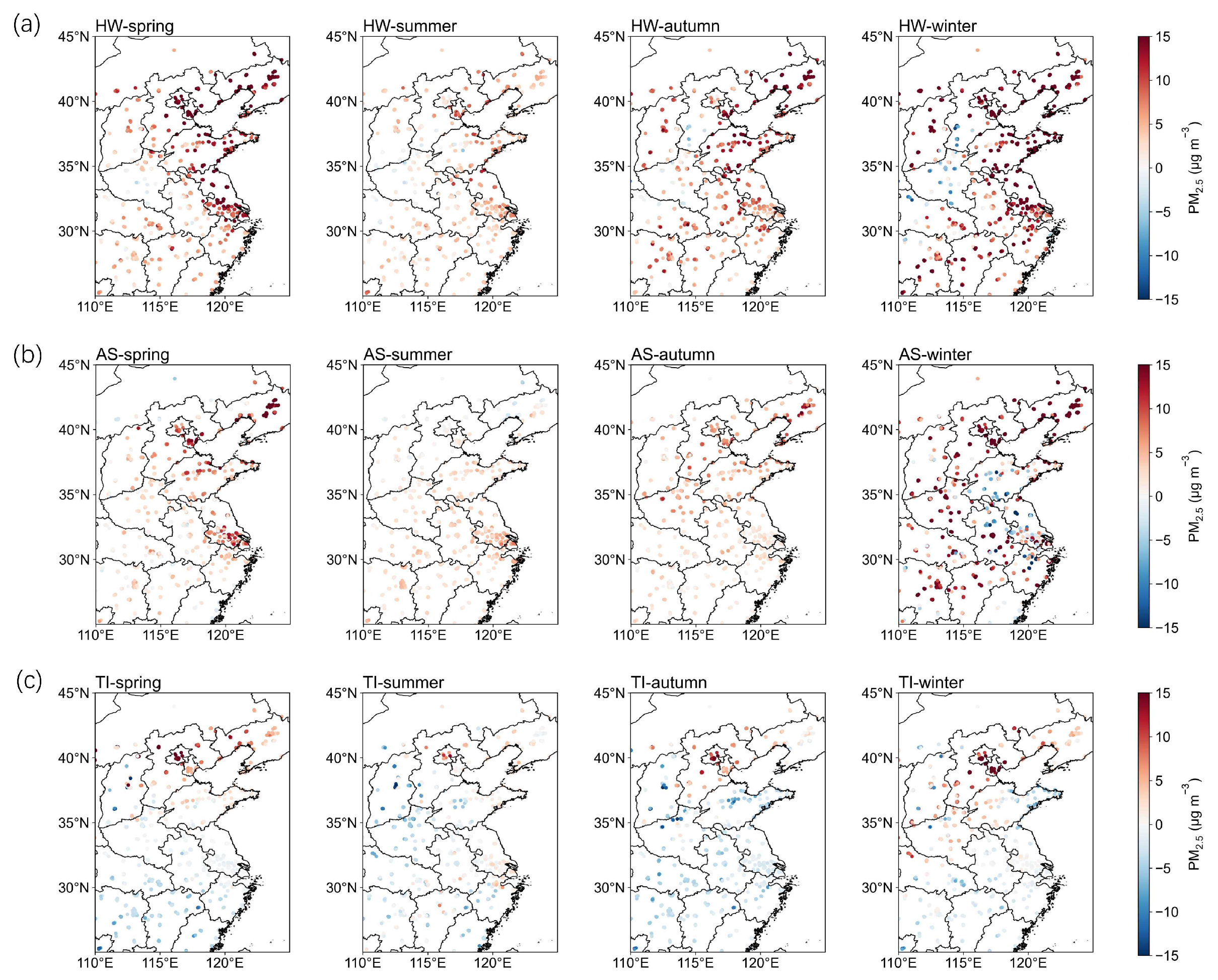
Similar exacerbated PM2.5 pollution was observed during heatwaves and AS, but with distinct seasonal patterns (Figure 5). Heatwave-related PM2.5 increases were also concentrated in regions such as BTH and YRD. The largest increase in PM2.5 due to heatwaves occurred in winter (+12.28 μg/m3), but it was less significant (+3.63 μg/m3) or even showed a slight decrease in some areas of NCP in summer (Figure 5), possibly due to the unstable atmospheric stratification and strong convection [66]. The PM2.5 enhancement by heatwaves may be attributed to multiple factors, including enhanced secondary aerosol formation driven by high temperatures [67] and elevated emissions from heat-induced sources [67,68]. The PM2.5 concentrations on AS days were also significantly higher than those on normal days, particularly in winter (+9.29 μg/m3) and spring (+4.79 μg/m3). The limited atmospheric dispersion during AS events promotes the buildup of both primary emissions and secondary aerosols, which are key contributors to regional haze [69,70]. The enhancement of PM2.5 by TI conditions is most prominent across Central BTH, with an increase in PM2.5 by up to 35.69 μg/m3. Inversion layers suppress vertical mixing, trapping air pollutants near the surface and resulting in high localized concentrations [70,71].
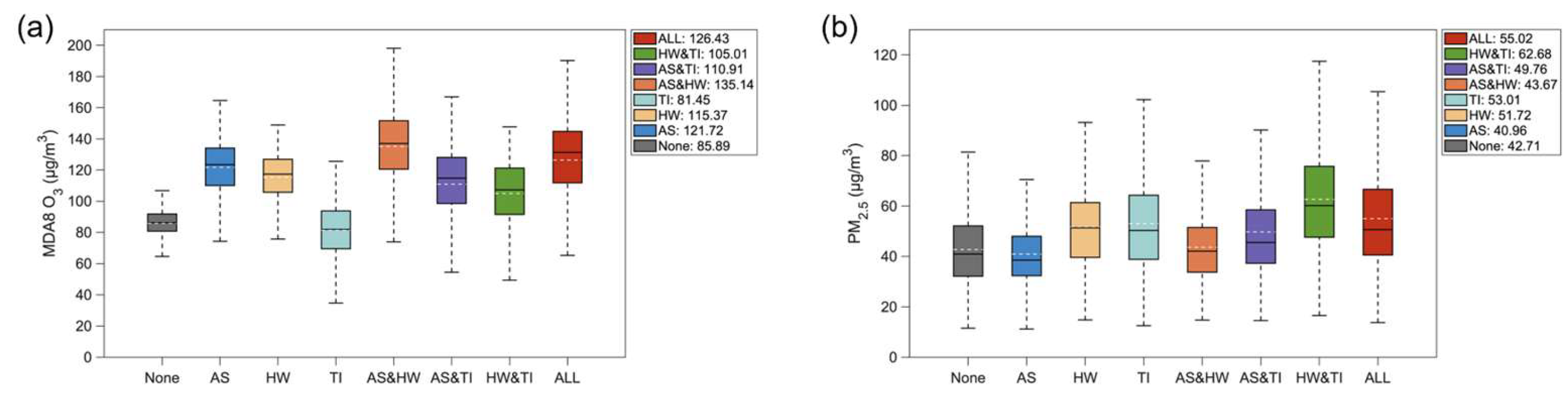
Furthermore, we examined the spatial distribution of compound unfavorable meteorology (Figure S5) and its impacts on O3 and PM2.5 concentrations (Figure 6). Compound conditions exhibit pronounced spatial heterogeneity across Eastern China (Figure S5). The HW + TI events are primarily concentrated over Liaodong Peninsula, Shandong Peninsula, and the YRD region, with annual occurrence reaching 35–40 days/yr. The HW + AS events exhibit broader spatial extent, spanning from the southeastern coast of China to the inland regions. The AS + TI events are more prevalent in the NCP and YRD regions due to the topographical effects [72] and meteorological conditions [73] that favor the formation of atmospheric stagnation and inversion. In contrast, triple-compound events (AS + HW + TI) show high occurrences in regions such as the YRD and parts of Southern NCP (e.g., Shandong, Henan, and Anhui Provinces). Compared with single conditions, compound conditions have even stronger synergistic effects on both O3 and PM2.5 pollution (Figure 6). For instance, O3 concentrations increased by 57.34% under compound HW-AS conditions, while under compound HW-TI conditions, PM2.5 concentrations rose by 46.76%, far exceeding the increases in single-event scenarios.

3.3. Synoptic Patterns Identified for Unfavorable Meteorological Conditions and Air Pollution Events

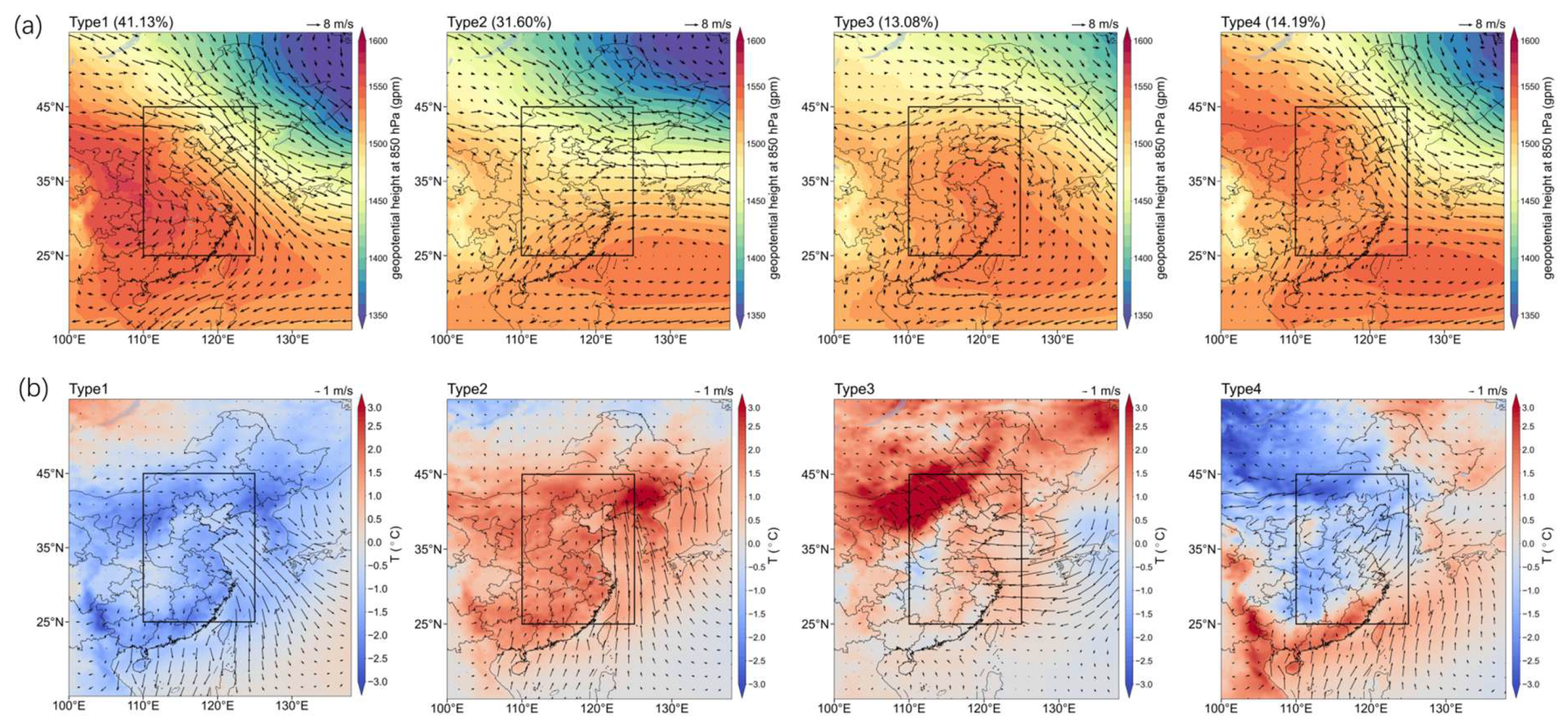
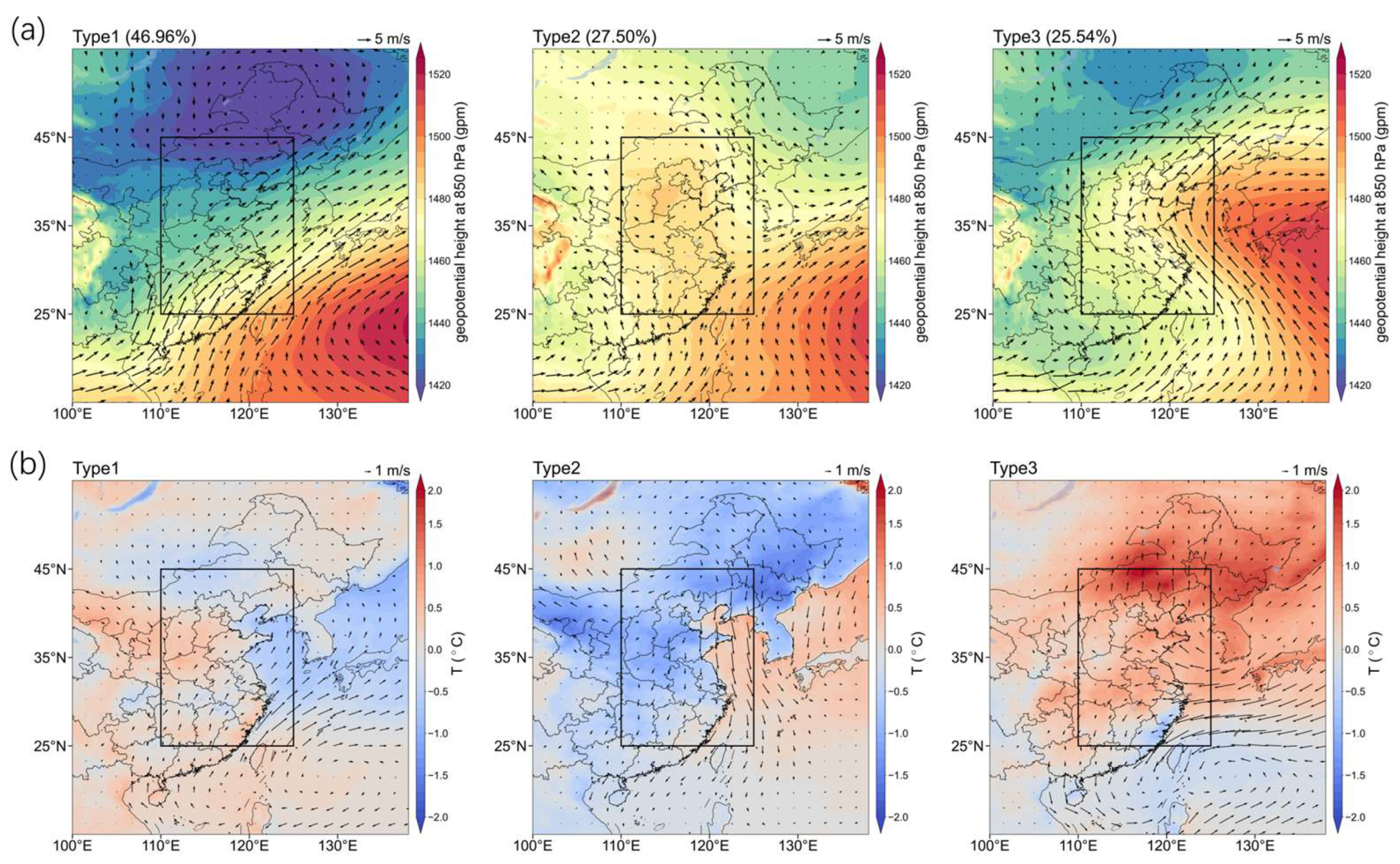
To investigate the synoptic backgrounds of unfavorable meteorology and air pollution events, we employed the T-PCA classification method to cluster synoptic patterns over Eastern China. Three weather types in summer and four weather types in winter were identified (Figure 7 and Figure 8), with the temperature and wind anomalies, and air pollutant concentrations analyzed for each synoptic type (Table S1). We found that summer Type 3 and winter Types 2 and 3, with prominent occurrence of unfavorable meteorological situations (Figures S6 and S8), were the core synoptic patterns associated with high O3 or PM2.5.
The summer Type 3 pattern was typical characterized by a northward movement of Western Pacific Subtropical High (WPSH). Significantly positive air temperature anomalies were observed in most areas of China (Figure 7), particularly in the NCP, as well as the middle and lower reaches of the Yangtze River. These regions experienced frequent occurrence of heatwaves and stagnant conditions (Figure S6), accounting for 18.23% and 35.89% of Type 3, respectively, both exceeding their seasonal averages. These unfavorable weather conditions under the summer Type 3 pattern led to accelerated photochemical activity, and an increase in MDA8 O3 concentration to 115.21 μg/m3 and exceedance rate to 14.58%. Nevertheless, the ozone concentration in coastal areas is abnormally low (Figure S8c), which may be attributable to the intensified surface wind speeds along the periphery of the subtropical high-pressure system [74] (Figure 7). Meanwhile, under the summer Type 1 synoptic pattern, Eastern China is positioned at the northern flank of the strong WPSH and ahead of an upper-level trough. The 850 hPa wind field is characterized by a prevailing southerly flow, which facilitates the northward transport of warm air and supports the persistence of high temperatures. This synoptic configuration is conducive to the occurrence of heatwaves, with a frequency reaching 19.34%. The O3 pattern reveals distinct regional contrasts (Figure S8), where the moderately high temperature coinciding with low wind speed in Northern China favors the formation and accumulation of high-concentration O3. Moreover, the summer Type 2 synoptic pattern is dominated by a high-pressure system, under which the large-scale circulation over Eastern China is relatively weak. Regional mean wind speeds are low (Figure 7), leading to a higher frequency of stagnant conditions (up to 28.56%) and accumulation of O3 near the surface (114.43 μg/m3) in mid-Eastern China.
Overall, the PM2.5 levels and exceedances were substantially higher than averages under the winter Types 2 and 3 patterns (Table S1 and Figure 8). The winter Type 2 pattern was characterized by a weak high-pressure and zonal flow regime, with substantial near-surface air temperature anomalies of 2–3 °C, along with an unusually high frequency of heatwaves and temperature inversion of 23.47% and 57.2%, respectively. Guo et al. [75] demonstrated that warm high-pressure conditions in winter are likely to induce low-level inversion, thus enhancing the near-surface retention and aqueous-phase formation of secondary PM2.5. The PM2.5 concentration under Type 2 reached 77.89 μg/m3, making it the most polluted winter-weather type. By contrast, the winter Type 3 pattern was a classic stagnation-dominated pattern that featured a strong upper-level high-pressure system and weak surface winds (Figure 8). A persistent surface inversion layer was also observed (63.01%), accompanied by notable atmospheric stagnation (11.12%; Figure S7), marking it as another weather pattern conducive to wintertime PM2.5 pollution, with an average concentration of 73.30 μg/m3 and exceedance rate of 31.61%. Otherwise, under the winter Type 1 pattern, the study area is located on the ventilated periphery of a high-pressure system, leading to enhanced wind speeds, favorable atmospheric mixing conditions, and widespread negative temperature anomalies. The frequencies of various unfavorable meteorology are markedly lower than the seasonal averages. As a result, this weather type is associated with lowest PM2.5 concentration (61.18 μg/m3) and exceedance rate (25.21%). Under the Type 4 pattern, the transport of clean marine air leads to negative PM2.5 anomalies across southeastern coastal areas, highlighting the role of enhanced ventilation and maritime air masses in mitigating pollution levels. These results reveal the role of large-scale circulations in driving pollution episodes under unfavorable meteorological conditions.

4. Conclusions

Frequent occurrences of unfavorable meteorological conditions and severe urban air pollution in Eastern China have exerted significant impacts on ecosystems and human health. Based on reanalysis data and air pollutant observations from 2013 to 2022, this study analyzed the trends of heatwaves (HW), atmospheric stagnation (AS), and temperature inversions (TI) in Eastern China and assessed their impacts on O3 and PM2.5. Over Eastern China, heatwaves and atmospheric stagnation events have increased at rates of 9.61 and 1.72 days/decade, respectively, over the past decade. Relative to normal meteorological conditions, HW (AS) was associated with regional-mean enhancements of O3 and PM2.5 by 17.32 and 7.67 μg/m3 (12.66 and 5.06 μg/m3), while the spatial response exhibited marked regional heterogeneity, with stronger O3 enhancements over major urban agglomerations. Notably, compound conditions further amplified pollution, with HW + AS and HW + TI producing substantially larger increases than single events. Synoptic classification further highlights that circulation patterns featuring a northward-displaced Western Pacific Subtropical High in summer and warm high-pressure control in winter are conducive to the co-occurrence of unfavorable meteorology and severe pollution.
Climate projections consistently suggest that heatwave occurrence and persistence will intensify under continued warming [76]. Meanwhile, previous modelling evidence also indicates that the frequency of compound heat-related events (e.g., heatwaves co-occurring with stagnation) is likely to increase over China [38], thus potentially elevating the risk of extreme pollution episodes. As air quality is jointly governed by meteorological conditions and anthropogenic emissions, the future pollution burden under more frequent unfavorable meteorology will be strongly contingent on the stringency and effectiveness of emission controls. Implementing sustained and coordinated emission mitigation is imperative to offset the projected “climate change penalty” [77,78]. Specifically, a synergistic “two-pollutant” strategy targeting both NOx and VOCs is essential to counteract the escalating O3 levels [79]. Furthermore, reducing aerosol emissions can trigger positive physical feedback—such as increasing planetary boundary layer height—which helps facilitate pollutant diffusion even under stagnant conditions [80].The projected increase in unfavorable meteorological conditions not only implies heightened air pollution risks; it also signals a greater threat to public health in the future [81]. Although this study indicated significant increase in those conditions and associated air pollution, it did not consider the complex interactions and feedback between urban meteorological changes and pollutant concentrations. Future research should incorporate detailed chemical simulation results to assess the health risks under combined effects of multiple pollutants and those conditions.

Supplementary Materials

The following supporting information can be downloaded at: https://www.mdpi.com/article/10.3390/atmos17020194/s1, Table S1. Occurrence frequency, regional mean temperature and wind speed, frequency of extreme weather events, O3 and PM2.5 concentrations and exceedances of different synoptic patterns in summer and winter, respectively. Figure S1. Spatial distribution of 943 national environmental monitoring sites over eastern China (110–125° E, 25–45° N) used in this study. Figure S2. Historical trend of extreme weather days (gray bar) and its 10-year moving average (orange line) from 1960 to 2022, and the blue dotted line indicating the linearly fitted changing trend. Figure S3. Seasonal frequency of extreme weather days during 2013–2022. Figure S4. Spatial distributions of (a) daily maximum air temperature, (b) daily total precipitation, (c) 10 m wind speed, and (d) 500 hPa wind speed averaged from 2013 to 2022. Figure S5. Spatial distribution of composite extreme weather from 2013 to 2022. Figure S6. Percentage of extreme weather event days under different summer weather patterns, relative to the total number of days for each pattern during 2013–2022. Figure S7. Same as Figure S6, but for winter weather patterns. Figure S8. Spatial distributions of MDA8 O3 anomalies under three summer weather patterns (upper panels) and PM2.5 anomalies under four winter weather patterns (bottom panels).

Author Contributions

Y.Z., writing—original draft, investigation, validation, and visualization; W.W., methodology and visualization; Y.L., software and visualization; H.Z., visualization and validation; M.L., writing—review and editing, supervision, software, methodology, funding acquisition, and conceptualization; T.W., writing—review and editing, Supervision. All authors have read and agreed to the published version of the manuscript.

Funding

This research was funded the National Natural Science Foundation of China (42575122); and the Research Funds for the Frontiers Science Center for Critical Earth Material Cycling, Nanjing University.

Institutional Review Board Statement

Not applicable.

Informed Consent Statement

Not applicable.

Data Availability Statement

ERA5 data are publicly available from the European Center for Medium-Range Weather Forecasts (ECMWF; http://www.ecmwf.int, accessed on 5 February 2026). The surface air pollutant data are provided by China’s Ministry of Ecology and Environment (MEE) and can be downloaded from mirror website (https://quotsoft.net/air, accessed on 5 February 2026).

Conflicts of Interest

The authors declare no conflict of interest.

References

  1. IQAir. World Air Quality Report 2023; IQAir: Steinach, Switzerland, 2024; p. 45. Available online: https://www.iqair.com/newsroom/waqr-2023-pr (accessed on 5 February 2026).
  2. Liu, J.; He, C.; Si, Y.; Li, B.; Wu, Q.; Ni, J.; Zhao, Y.; Hu, Q.; Du, S.; Lu, Z.; et al. Toward Better and Healthier Air Quality: Global PM2.5 and O3 Pollution Status and Risk Assessment Based on the New WHO Air Quality Guidelines for 2021. Glob. Chall. 2024, 8, 2300258. [Google Scholar] [CrossRef] [PubMed]
  3. Xiao, Q.; Geng, G.; Xue, T.; Liu, S.; Cai, C.; He, K.; Zhang, Q. Tracking PM2.5 and O3 Pollution and the Related Health Burden in China 2013–2020. Environ. Sci. Technol. 2022, 56, 6922–6932. [Google Scholar] [CrossRef] [PubMed]
  4. Liu, C.; Chen, R.; Sera, F.; Vicedo-Cabrera, A.M.; Guo, Y.; Tong, S.; Coelho, M.; Saldiva, P.H.N.; Lavigne, E.; Matus, P.; et al. Ambient Particulate Air Pollution and Daily Mortality in 652 Cities. N. Engl. J. Med. 2019, 381, 705–715. [Google Scholar] [CrossRef] [PubMed]
  5. Wang, Y.; Wild, O.; Chen, X.; Wu, Q.; Gao, M.; Chen, H.; Qi, Y.; Wang, Z. Health impacts of long-term ozone exposure in China over 2013–2017. Environ. Int. 2020, 144, 106030. [Google Scholar] [CrossRef]
  6. Ebi, K.L.; Vanos, J.; Baldwin, J.W.; Bell, J.E.; Hondula, D.M.; Errett, N.A.; Hayes, K.; Reid, C.E.; Saha, S.; Spector, J.; et al. Extreme Weather and Climate Change: Population Health and Health System Implications. Annu. Rev. Public Health 2021, 42, 293–315. [Google Scholar] [CrossRef]
  7. Shang, Y.; Sun, Z.; Cao, J.; Wang, X.; Zhong, L.; Bi, X.; Li, H.; Liu, W.; Zhu, T.; Huang, W. Systematic review of Chinese studies of short-term exposure to air pollution and daily mortality. Environ. Int. 2013, 54, 100–111. [Google Scholar] [CrossRef]
  8. Xu, C.; Mao, Y.H.; Liao, H. Future Ozone Changes and Their Impacts on Vegetation and Human Health in China Under the Shared Socio-Economic Pathways. J. Geophys. Res. Atmos. 2024, 129, e2023JD040086. [Google Scholar] [CrossRef]
  9. Emberson, L. Effects of ozone on agriculture, forests and grasslands. Philos. Trans. A Math. Phys. Eng. Sci. 2020, 378, 20190327. [Google Scholar] [CrossRef]
  10. Zhou, L.; Chen, X.; Tian, X. The impact of fine particulate matter PM2.5 on China’s agricultural production from 2001 to 2010. J. Clean. Prod. 2018, 178, 133–141. [Google Scholar] [CrossRef]
  11. Rai, P.K. Impacts of particulate matter pollution on plants: Implications for environmental biomonitoring. Ecotoxicol. Environ. Saf. 2016, 129, 120–136. [Google Scholar] [CrossRef]
  12. Miao, Y.; Geng, C.; Ji, Y.; Wang, S.; Wang, L.; Yang, W. Understanding the Dynamics of PM2.5 Concentration Levels in China: A Comprehensive Study of Spatio-Temporal Patterns, Driving Factors, and Implications for Environmental Sustainability. Sustainability 2025, 17, 1742. [Google Scholar] [CrossRef]
  13. Yang, Y.; Zhou, Y.; Wang, H.; Li, M.; Li, H.; Wang, P.; Yue, X.; Li, K.; Zhu, J.; Liao, H. Meteorological characteristics of extreme ozone pollution events in China and their future predictions. Atmos. Chem. Phys. 2024, 24, 1177–1191. [Google Scholar] [CrossRef]
  14. Xu, Y.; Xue, W.; Lei, Y.; Zhao, Y.; Cheng, S.; Ren, Z.; Huang, Q. Impact of Meteorological Conditions on PM2.5 Pollution in China during Winter. Atmosphere 2018, 9, 429. [Google Scholar] [CrossRef]
  15. Ren, Y.; Chen, W.; Pang, B.; Lu, R. Atmospheric circulation anomalies related to the winter PM2.5 mass concentration rapid decline cases in Beijing, China. Atmos. Res. 2024, 311, 107665. [Google Scholar] [CrossRef]
  16. Shao, P.; Tian, H.; Sun, Y.; Liu, H.; Wu, B.; Liu, S.; Liu, X.; Wu, Y.; Liang, W.; Wang, Y.; et al. Characterizing remarkable changes of severe haze events and chemical compositions in multi-size airborne particles (PM1, PM2.5 and PM10) from January 2013 to 2016–2017 winter in Beijing, China. Atmos. Environ. 2018, 189, 133–144. [Google Scholar] [CrossRef]
  17. Yu, S.; Xue, C.; Deng, F.; Xu, Q.; Zhao, B. VOCs Concentration, SOA Formation Contribution and Festival Effects during Heavy Haze Event: A Case Study in Zhengzhou, Central China. Atmosphere 2024, 15, 1009. [Google Scholar] [CrossRef]
  18. Zhang, J.; Su, Y.; Chen, C.; Guo, W.; Tan, Q.; Feng, M.; Song, D.; Jiang, T.; Chen, Q.; Li, Y.; et al. Chemical composition, sources and formation mechanism of urban PM2.5 in Southwest China: A case study at the beginning of 2023. Atmos. Chem. Phys. 2024, 24, 2803–2820. [Google Scholar] [CrossRef]
  19. Li, K.; Jacob, D.J.; Liao, H.; Shen, L.; Zhang, Q.; Bates, K.H. Anthropogenic drivers of 2013-2017 trends in summer surface ozone in China. Proc. Natl. Acad. Sci. USA 2019, 116, 422–427. [Google Scholar] [CrossRef]
  20. Wang, Y.; Gao, W.; Wang, S.; Song, T.; Gong, Z.; Ji, D.; Wang, L.; Liu, Z.; Tang, G.; Huo, Y.; et al. Contrasting trends of PM2.5 and surface-ozone concentrations in China from 2013 to 2017. Natl. Sci. Rev. 2020, 7, 1331–1339. [Google Scholar] [CrossRef]
  21. Cheng, L.; Wang, S.; Gong, Z.; Li, H.; Yang, Q.; Wang, Y. Regionalization based on spatial and seasonal variation in ground-level ozone concentrations across China. J. Environ. Sci. 2018, 67, 179–190. [Google Scholar] [CrossRef]
  22. Yang, Z.; Li, Z.; Cheng, F.; Lv, Q.; Li, K.; Zhang, T.; Zhou, Y.; Zhao, B.; Xue, W.; Wei, J. Two-decade surface ozone (O3) pollution in China: Enhanced fine-scale estimations and environmental health implications. Remote Sens. Environ. 2025, 317, 114459. [Google Scholar] [CrossRef]
  23. Zhang, J.; Shen, A.; Jin, Y.; Cui, Y.; Xu, Y.; Lu, X.; Liu, Y.; Fan, Q. Evolution of ozone formation regimes during different periods in representative regions of China. Atmos. Environ. 2024, 338, 120830. [Google Scholar] [CrossRef]
  24. Pusede, S.E.; Steiner, A.L.; Cohen, R.C. Temperature and Recent Trends in the Chemistry of Continental Surface Ozone. Chem. Rev. 2015, 115, 3898–3918. [Google Scholar] [CrossRef] [PubMed]
  25. Chen, Z.Y.; Zhuang, Y.; Xie, X.M.; Chen, D.L.; Cheng, N.L.; Yang, L.; Li, R.Y. Understanding long-term variations of meteorological influences on ground ozone concentrations in Beijing During 2006–2016. Environ. Pollut. 2019, 245, 29–37. [Google Scholar] [CrossRef]
  26. Yan, D.; Jin, Z.; Zhou, Y.; Li, M.; Zhang, Z.; Wang, T.; Zhuang, B.; Li, S.; Xie, M. Anthropogenically and meteorologically modulated summertime ozone trends and their health implications since China’s clean air actions. Environ. Pollut. 2024, 343, 123234. [Google Scholar] [CrossRef]
  27. Wang, J.; Yan, Z. Rapid rises in the magnitude and risk of extreme regional heat wave events in China. Weather Clim. Extrem. 2021, 34, 100379. [Google Scholar] [CrossRef]
  28. Yang, J.B.; Shao, M. Impacts of Extreme Air Pollution Meteorology on Air Quality in China. J. Geophys. Res. Atmos. 2021, 126, e2020JD033210. [Google Scholar] [CrossRef]
  29. Perkins-Kirkpatrick, S.E.; Lewis, S.C. Increasing trends in regional heatwaves. Nat. Commun. 2020, 11, 3357. [Google Scholar] [CrossRef]
  30. Wang, R.; Bei, N.; Hu, B.; Wu, J.; Liu, S.; Li, X.; Jiang, Q.; Tie, X.; Li, G. The relationship between the intensified heat waves and deteriorated summertime ozone pollution in the Beijing-Tianjin-Hebei region, China, during 2013–2017. Environ. Pollut. 2022, 314, 120256. [Google Scholar] [CrossRef]
  31. Wang, W.; Zhou, Y.; Li, M.; Lu, Y.; Jiang, X.; Wang, T.; Zhuang, B.; Li, S.; Zhan, C.; Sun, X.; et al. Large-scale synoptic and weather drivers for the co-occurrence of fine particulate matter and ozone extremes over China. Sci. China Earth Sci. 2025, 68, 1448–1457. [Google Scholar] [CrossRef]
  32. Zhou, X.; Li, M.; Huang, X.; Liu, T.; Zhang, H.; Qi, X.; Wang, Z.; Qin, Y.; Geng, G.; Wang, J.; et al. Urban meteorology–chemistry coupling in compound heat–ozone extremes. Nat. Cities 2025, 2, 847–856. [Google Scholar] [CrossRef]
  33. Hou, P.; Wu, S.L. Long-term Changes in Extreme Air Pollution Meteorology and the Implications for Air Quality. Sci. Rep. 2016, 6, 23792. [Google Scholar] [CrossRef] [PubMed]
  34. Pu, X.; Wang, T.J.; Huang, X.; Melas, D.; Zanis, P.; Papanastasiou, D.K.; Poupkou, A. Enhanced surface ozone during the heat wave of 2013 in Yangtze River Delta region, China. Sci. Total Environ. 2017, 603–604, 807–816. [Google Scholar] [CrossRef]
  35. Li, M.; Huang, X.; Yan, D.; Lai, S.; Zhang, Z.; Zhu, L.; Lu, Y.; Jiang, X.; Wang, N.; Wang, T.; et al. Coping with the concurrent heatwaves and ozone extremes in China under a warming climate. Sci. Bull. 2024, 69, 2938–2947. [Google Scholar] [CrossRef]
  36. Zhou, M.; Xie, Y.; Wang, C.; Shen, L.; Mauzerall, D.L. Impacts of current and climate induced changes in atmospheric stagnation on Indian surface PM2.5 pollution. Nat. Commun. 2024, 15, 7448. [Google Scholar] [CrossRef]
  37. Wang, L.; Li, M.; Wang, Q.; Li, Y.; Xin, J.; Tang, X.; Du, W.; Song, T.; Li, T.; Sun, Y.; et al. Air stagnation in China: Spatiotemporal variability and differing impact on PM2.5 and O3 during 2013–2018. Sci. Total Environ. 2022, 819, 152778. [Google Scholar] [CrossRef]
  38. Zhang, J.; Gao, Y.; Luo, K.; Leung, L.R.; Zhang, Y.; Wang, K.; Fan, J. Impacts of compound extreme weather events on ozone in the present and future. Atmos. Chem. Phys. 2018, 18, 9861–9877. [Google Scholar] [CrossRef]
  39. Lu, P.; Liu, R.; Luo, Z.; Li, S.; Wu, Y.; Hu, W.; Xue, X. Impacts of compound extreme weather events on summer ozone in the Beijing-Tianjin-Hebei region. Atmos. Pollut. Res. 2024, 15, 102030. [Google Scholar] [CrossRef]
  40. Tan, J.; Yan, P.; Wang, J.; Chen, S.; Bai, J.; Zhang, Z.; Nicholas, S.; Maitland, E.; Li, P.; Hu, Y.; et al. Environmental inequality in eastern China: Socio-economic status and air pollution. Popul. Environ. 2024, 46, 13. [Google Scholar] [CrossRef]
  41. Hu, W.; Lu, N.; Wang, X.; Henze, D.K.; Zhang, L.; Fu, T.M.; Zheng, B.; Zhao, Y. Decoding Heavy PM2.5 and Ozone Pollution: A Multi-Year Emission Sensitivity and Synoptic Pattern Analysis Over Eastern China. J. Geophys. Res. Atmos. 2025, 130, e2025JD044252. [Google Scholar] [CrossRef]
  42. Chang, L.; He, F.; Tie, X.; Xu, J.; Gao, W. Meteorology driving the highest ozone level occurred during mid-spring to early summer in Shanghai, China. Sci. Total Environ. 2021, 785, 147253. [Google Scholar] [CrossRef]
  43. Zheng, X.Y.; Fu, Y.F.; Yang, Y.J.; Liu, G.S. Impact of atmospheric circulations on aerosol distributions in autumn over eastern China: Observational evidence. Atmos. Chem. Phys. 2015, 15, 12115–12138. [Google Scholar] [CrossRef]
  44. Dai, H.; Zhu, J.; Liao, H.; Li, J.; Liang, M.; Yang, Y.; Yue, X. Co-occurrence of ozone and PM2.5 pollution in the Yangtze River Delta over 2013–2019: Spatiotemporal distribution and meteorological conditions. Atmos. Res. 2021, 249, 105363. [Google Scholar] [CrossRef]
  45. Tai, A.P.K.; Mickley, L.J.; Jacob, D.J. Correlations between fine particulate matter (PM2.5) and meteorological variables in the United States: Implications for the sensitivity of PM2.5 to climate change. Atmos. Environ. 2010, 44, 3976–3984. [Google Scholar] [CrossRef]
  46. Horton, D.E.; Harshvardhan; Diffenbaugh, N.S. Response of air stagnation frequency to anthropogenically enhanced radiative forcing. Environ. Res. Lett. 2012, 7, 044034. [Google Scholar] [CrossRef]
  47. Horton, D.E.; Skinner, C.B.; Singh, D.; Diffenbaugh, N.S. Occurrence and persistence of future atmospheric stagnation events. Nat. Clim. Change 2014, 4, 698–703. [Google Scholar] [CrossRef]
  48. Huth, R.; Beck, C.; Philipp, A.; Demuzere, M.; Ustrnul, Z.; Cahynová, M.; Kysely, J.; Tveito, O.E. Classifications of Atmospheric Circulation Patterns Recent Advances and Applications. Ann. N. Y. Acad. Sci. 2008, 1146, 105–152. [Google Scholar] [CrossRef]
  49. Huth, R. A circulation classification scheme applicable in GCM studies. Theor. Appl. Climatol. 2000, 67, 1–18. [Google Scholar] [CrossRef]
  50. Miao, Y.C.; Guo, J.P.; Liu, S.H.; Liu, H.; Li, Z.Q.; Zhang, W.C.; Zhai, P.M. Classification of summertime synoptic patterns in Beijing and their associations with boundary layer structure affecting aerosol pollution. Atmos. Chem. Phys. 2017, 17, 3097–3110. [Google Scholar] [CrossRef]
  51. Philipp, A.; Bartholy, J.; Beck, C.; Erpicum, M.; Esteban, P.; Fettweis, X.; Huth, R.; James, P.; Jourdain, S.; Kreienkamp, F.; et al. Cost733cat—A database of weather and circulation type classifications. Phys. Chem. Earth Parts A/B/C 2010, 35, 360–373. [Google Scholar] [CrossRef]
  52. Li, J.; Liao, H.; Hu, J.; Li, N. Severe particulate pollution days in China during 2013–2018 and the associated typical weather patterns in Beijing-Tianjin-Hebei and the Yangtze River Delta regions. Environ. Pollut. 2019, 248, 74–81. [Google Scholar] [CrossRef]
  53. Dong, Y.M.; Li, J.; Guo, J.P.; Jiang, Z.J.; Chu, Y.Q.; Chang, L.; Yang, Y.; Liao, H. The impact of synoptic patterns on summertime ozone pollution in the North China Plain. Sci. Total Environ. 2020, 735, 139559. [Google Scholar] [CrossRef]
  54. Hoffmann, P.; Schlünzen, K.H. Weather Pattern Classification to Represent the Urban Heat Island in Present and Future Climate. J. Appl. Meteorol. Climatol. 2013, 52, 2699–2714. [Google Scholar] [CrossRef]
  55. Philipp, A.; Beck, C.; Esteban, P.; Kreienkamp, F.; Krennert, T.; Lochbihler, K.; Lykoudis, S.P.; Pianko-Kluczynska, K.; Post, P.; Alvarez, D.R.; et al. COST733CLASS v1.2 User Guide; University of Augsburg: Augsburg, Germany, 2014. [Google Scholar]
  56. Ning, G.; Yim, S.H.L.; Wang, S.; Duan, B.; Nie, C.; Yang, X.; Wang, J.; Shang, K. Synergistic effects of synoptic weather patterns and topography on air quality: A case of the Sichuan Basin of China. Clim. Dyn. 2019, 53, 6729–6744. [Google Scholar] [CrossRef]
  57. Eyring, V.; Gillett, N.P.; Achuta Rao, K.M.; Barimalala, R.; Barreiro Parrillo, M.; Bellouin, N.; Cassou, C.; Durack, P.J.; Kosaka, Y.; McGregor, S.; et al. Human Influence on the Climate System. In Climate Change 2021: The Physical Science Basis. Contribution of Working Group I to the Sixth Assessment Report of the Intergovernmental Panel on Climate Change; Masson-Delmotte, V., Zhai, P., Pirani, A., Connors, S.L., Péan, C., Berger, S., Caud, N., Chen, Y., Goldfarb, L., Gomis, M.I., et al., Eds.; Cambridge University Press: Cambridge, UK, 2021; pp. 423–552. [Google Scholar] [CrossRef]
  58. Xie, M.; Zhan, C.; Zhan, Y.; Shi, J.; Luo, Y.; Zhang, M.; Liu, Q.; Shen, F. Spatiotemporal Variability of Air Stagnation and its Relation to Summertime Ozone in the Yangtze River Delta of China. Front. Environ. Sci. 2021, 9, 783524. [Google Scholar] [CrossRef]
  59. Huang, Q.; Cai, X.; Song, Y.; Zhu, T. Air stagnation in China (1985–2014): Climatological mean features and trends. Atmos. Chem. Phys. 2017, 17, 7793–7805. [Google Scholar] [CrossRef]
  60. Bai, K.; Li, K.; Guo, J.; Cheng, W.; Xu, X. Do More Frequent Temperature Inversions Aggravate Haze Pollution in China? Geophys. Res. Lett. 2022, 49, e2021GL096458. [Google Scholar] [CrossRef]
  61. Pyrgou, A.; Hadjinicolaou, P.; Santamouris, M. Enhanced near-surface ozone under heatwave conditions in a Mediterranean island. Sci. Rep. 2018, 8, 9191. [Google Scholar] [CrossRef]
  62. Zhang, G.; Yu, X.; Yin, H.; Feng, C.; Ma, C.; Sun, S.; Cheng, H.; Wang, S.; Shang, K.; Liu, X. Heatwave-amplified atmospheric oxidation in a multi-province border area in Xuzhou, China. Front. Environ. Sci. 2024, 12, 1496584. [Google Scholar] [CrossRef]
  63. Hoshika, Y.; Fares, S.; Pellegrini, E.; Conte, A.; Paoletti, E. Water use strategy affects avoidance of ozone stress by stomatal closure in Mediterranean trees-A modelling analysis. Plant Cell Environ. 2020, 43, 611–623. [Google Scholar] [CrossRef]
  64. Juran, S.; Karl, T.; Ofori-Amanfo, K.K.; Sigut, L.; Zavadilova, I.; Grace, J.; Urban, O. Drought shifts ozone deposition pathways in spruce forest from stomatal to non-stomatal flux. Environ. Pollut. 2025, 372, 126081. [Google Scholar] [CrossRef]
  65. Liu, H.; Han, X.; Tang, G.; Zhang, J.; Xia, X.; Zhang, M.; Meng, L. Model analysis of vertical exchange of boundary layer ozone and its impact on surface air quality over the North China Plain. Sci. Total Environ. 2022, 821, 153436. [Google Scholar] [CrossRef]
  66. Liu, Y.; Tang, G.; Zhou, L.; Hu, B.; Liu, B.; Li, Y.; Liu, S.; Wang, Y. Mixing layer transport flux of particulate matter in Beijing, China. Atmos. Chem. Phys. 2019, 19, 9531–9540. [Google Scholar] [CrossRef]
  67. Sun, W.; Huo, J.; Fu, Q.; Zhang, Y.; Lin, X. Influence of Meteorological Factors and Chemical Processes on the Explosive Growth of PM2.5 in Shanghai, China. Atmosphere 2022, 13, 1068. [Google Scholar] [CrossRef]
  68. Burke, M.; Driscoll, A.; Heft-Neal, S.; Xue, J.; Burney, J.; Wara, M. The changing risk and burden of wildfire in the United States. Proc. Natl. Acad. Sci. USA 2021, 118, e2011048118. [Google Scholar] [CrossRef]
  69. Wang, H.; Peng, Y.; Zhang, X.; Liu, H.; Zhang, M.; Che, H.; Cheng, Y.; Zheng, Y. Contributions to the explosive growth of PM2.5 mass due to aerosol–radiation feedback and decrease in turbulent diffusion during a red alert heavy haze in Beijing–Tianjin–Hebei, China. Atmos. Chem. Phys. 2018, 18, 17717–17733. [Google Scholar] [CrossRef]
  70. Liu, C.; Huang, J.; Wang, Y.; Tao, X.; Hu, C.; Deng, L.; Xu, J.; Xiao, H.W.; Luo, L.; Xiao, H.Y.; et al. Vertical distribution of PM2.5 and interactions with the atmospheric boundary layer during the development stage of a heavy haze pollution event. Sci. Total Environ. 2020, 704, 135329. [Google Scholar] [CrossRef]
  71. Xu, Y.; Zhu, B.; Shi, S.; Huang, Y. Two Inversion Layers and Their Impacts on PM2.5 Concentration over the Yangtze River Delta, China. J. Appl. Meteorol. Climatol. 2019, 58, 2349–2362. [Google Scholar] [CrossRef]
  72. Tao, M.H.; Chen, L.F.; Su, L.; Tao, J.H. Satellite observation of regional haze pollution over the North China Plain. J. Geophys. Res. Atmos. 2012, 117, D12203. [Google Scholar] [CrossRef]
  73. Zhang, H.; Wang, X.Q.; Hong, X.Y.; Wang, S.B.; Huang, Y. Observational study of river-land breeze and its influence on distribution of PM10 concentrations over a main mining city in the Yangtze River Delta, China. Front. Earth Sci. 2023, 10, 1073885. [Google Scholar] [CrossRef]
  74. Han, H.; Liu, J.; Shu, L.; Wang, T.; Yuan, H. Local and synoptic meteorological influences on daily variability in summertime surface ozone in eastern China. Atmos. Chem. Phys. 2020, 20, 203–222. [Google Scholar] [CrossRef]
  75. Guo, J.; Chen, X.; Su, T.; Liu, L.; Zheng, Y.; Chen, D.; Li, J.; Xu, H.; Lv, Y.; He, B.; et al. The Climatology of Lower Tropospheric Temperature Inversions in China from Radiosonde Measurements: Roles of Black Carbon, Local Meteorology, and Large-Scale Subsidence. J. Clim. 2020, 33, 9327–9350. [Google Scholar] [CrossRef]
  76. Martinez-Villalobos, C.; Fu, D.; Loikith, P.C.; Neelin, J.D. Accelerating increase in the duration of heatwaves under global warming. Nat. Geosci. 2025, 18, 716–723. [Google Scholar] [CrossRef]
  77. Liu, S.; Xing, J.; Westervelt, D.M.; Liu, S.; Ding, D.; Fiore, A.M.; Kinney, P.L.; Zhang, Y.; He, M.Z.; Zhang, H.; et al. Role of emission controls in reducing the 2050 climate change penalty for PM2.5 in China. Sci. Total Environ. 2021, 765, 144338. [Google Scholar] [CrossRef] [PubMed]
  78. Zhao, M.-Z.; Zhang, C.; Cai, W.-J.; Zhao, Z.-P.; Lu, B.; Li, T.-T.; Hong, C.-K.; Liao, W.-Y.; Chen, J.; Zhang, S.-C.; et al. Identifying practical adaptations to health risks from extreme weather events for multi-actors. Adv. Clim. Change Res. 2025, 16, 698–707. [Google Scholar] [CrossRef]
  79. Li, K.; Jacob, D.J.; Liao, H.; Zhu, J.; Shah, V.; Shen, L.; Bates, K.H.; Zhang, Q.; Zhai, S. A two-pollutant strategy for improving ozone and particulate air quality in China. Nat. Geosci. 2019, 12, 906–910. [Google Scholar] [CrossRef]
  80. Hong, C.; Zhang, Q.; Zhang, Y.; Davis, S.J.; Zhang, X.; Tong, D.; Guan, D.; Liu, Z.; He, K. Weakening aerosol direct radiative effects mitigate climate penalty on Chinese air quality. Nat. Clim. Change 2020, 10, 845–850. [Google Scholar] [CrossRef]
  81. Zhou, Q.-Y.; Gao, M.-N.; Yang, J.; Sun, X.-Y.; Lu, Y.-Y.; Jiang, T.; Su, B.-D.; Zhu, T. Future changes in population exposure to intensified heatwaves over three major urban agglomerations in China based on excess heat factor. Adv. Clim. Change Res. 2025, 16, 12–24. [Google Scholar] [CrossRef]
Figure 1. Comparison of daily MDA8 O3 (a) and PM2.5 (b) concentrations before and after detrending from 2013 to 2022 and their linear trends. Solid lines denote the linear trends of the original series, while dashed lines denote the trends after detrending, which are close to zero.
Atmosphere 17 00194 g001
Figure 2. Spatial distribution of the mean annual frequency (left panels; days/yr) of three types of unfavorable meteorological conditions during 2013–2022 and their changes relative to 1960–1969 (right panels; 2013–2022 minus 1960–1969, days/yr) over Eastern China (110–125° E, 25–45° N). (a,b) Heatwaves (HWs), (c,d) atmospheric stagnation (AS), and (e,f) temperature inversions (TIs).
Atmosphere 17 00194 g002
Figure 3. Changes in detrended MDA8 O3 (left panels) and PM2.5 (right panels) concentrations due to heatwave (HW; (a,b)), atmospheric stagnation (AS; (c,d)), and temperature inversion (TI; (e,f)) compared to normal days.
Atmosphere 17 00194 g003
Figure 4. Changes in seasonal mean detrended MDA8 O3 concentration due to (a) heatwave (HW), (b) atmospheric stagnation (AS), and (c) temperature inversion (TI) compared to normal days.
Atmosphere 17 00194 g004
Figure 5. Changes in seasonal mean detrended PM2.5 concentration changes due to (a) heatwave (HW), (b) atmospheric stagnation (AS), and (c) temperature inversion (TI) compared to normal days.
Atmosphere 17 00194 g005
Figure 6. Comparisons of MDA8 O3 (a) and PM2.5 (b) concentrations under single and compound unfavorable meteorological conditions. Numbers in the legend denote the mean concentrations (μg/m3) for each category (p < 0.05).
Atmosphere 17 00194 g006
Figure 7. (a) Three synoptic patterns in summer—their 850 hPa geopotential height (color shading) and wind vectors. The frequency of each synoptic pattern is indicated in the panel. (b) Anomalies for 2 m temperature and 10 m wind vector in each synoptic pattern.
Atmosphere 17 00194 g007
Figure 8. (a) Four synoptic patterns in winter—their 850 hPa geopotential height (color shading) and wind vectors. The frequency of each synoptic pattern is indicated in the panel. (b) Anomalies for 2 m temperature and 10 m wind vector.
Atmosphere 17 00194 g008
Disclaimer/Publisher’s Note: The statements, opinions and data contained in all publications are solely those of the individual author(s) and contributor(s) and not of MDPI and/or the editor(s). MDPI and/or the editor(s) disclaim responsibility for any injury to people or property resulting from any ideas, methods, instructions or products referred to in the content.