Article

Evaluating the Effect of Emission Schemes on Dust Simulation in East Asia During Spring 2023

1
State Key Laboratory of Marine Environmental Science, Center for Marine Meteorology and Climate Change, College of Ocean and Earth Sciences, Xiamen University, Xiamen 361000, China
2
College of Physics and Electronic Information Engineering, Minjiang University, Fuzhou 350108, China
*
Author to whom correspondence should be addressed.
Atmosphere 2026, 17(2), 154; https://doi.org/10.3390/atmos17020154
Submission received: 31 December 2025 / Revised: 25 January 2026 / Accepted: 28 January 2026 / Published: 30 January 2026
(This article belongs to the Section Atmospheric Techniques, Instruments, and Modeling)

Abstract

In the spring of 2023, dust outbreaks were unusually active in East Asia, posing substantial risks to air quality. Accurately simulating dust storms is essential for improving regional dust prediction and impact assessment. In this study, we evaluated dust simulations over East Asia using different dust emission schemes in the FLEXDUST/FLEXPART model and quantified the regional dust budget. Overall, the GOCART (Goddard Chemistry Aerosol Radiation and Transport) scheme shows the highest skill among the evaluated schemes. Under mild dust conditions (300–1000 μg m−3), it yielded a mean PM10 bias of −89.2 μg m−3, markedly smaller than those from other schemes/models (−450.2 to −265.6 μg m−3). It also better reproduced the dominant spatial patterns of dust optical depth over Xinjiang and Inner Mongolia, with lower errors and higher correlations. Budget diagnostics show that the Taklamakan and Gobi Deserts are net dust exporters (7.4 and 11.6 Tg, respectively), whereas East Asia exhibits a negative net external flux (−12.1 Tg). The comparable magnitudes of these terms underscore the role of inter-regional transport in shaping the East Asian dust budget. These results offer insights for improving dust emission schemes in the FLEXDUST/FLEXPART model, thereby enhancing dust simulations over East Asia.

1. Introduction

Dust aerosols are among the most abundant aerosol species in the atmosphere and exert substantial impacts on the Earth’s climate system [1,2,3,4]. By absorbing and scattering shortwave and longwave radiation, dust directly affects the surface and atmospheric energy balance [2,5,6]. Dust particles also serve as cloud condensation nuclei and ice nuclei, thereby influencing cloud microphysical processes and indirectly altering cloud formation and precipitation [7,8,9]. In addition, severe dust events can trigger sharp increases in respiratory health problems, elevate the risk of traffic accidents, and reduce solar power generation efficiency [10,11,12].
East Asia is the world’s second-largest source region of mineral dust, with its dominant sources located in the Taklamakan Desert of northwestern China and the Gobi Desert spanning the China–Mongolia border [13,14,15]. East Asia is a global hotspot for dust-storm activity, with outbreaks occurring primarily in spring, when scarce precipitation and intensified evaporation accelerate soil desiccation, suppress vegetation cover, and leave the land surface increasingly bare [16,17]. Dust storm outbreaks over East Asia are primarily triggered by Mongolian cyclones, cold fronts, and cold highs, and the resulting dust plumes can be transported downwind over thousands of kilometers [18].
Dust models are powerful tools for understanding dust storms, encompassing dust emission, transport, and removal processes at various grid scales. In recent years, the expanding availability of observational datasets, advances in numerical modeling, and sustained improvements in data assimilation and key parameterization schemes have collectively accelerated the development and application of both global and regional dust models. Overall, most dust models can reasonably capture the global distribution of major source regions, the pathways of intercontinental transport, and the associated seasonal cycle [19,20,21,22,23]. However, their performance over East Asia warrants further improvement. For example, models often show systematic biases in simulating the frequency and intensity of severe spring dust storms, including underestimated peak concentrations and overly weak transport [12,24,25,26].
Off-line Lagrangian dispersion models provide an alternative approach for studying the dust cycle [27,28]. Compared to the Eulerian approach commonly used in weather prediction and Earth system models, the dispersion model excludes dust–cloud–precipitation–radiation interactions and requires substantially fewer computing resources when meteorological forcing data are available [29,30]. The FLEXPART Lagrangian particle dispersion model, together with its associated dust emission model FLEXDUST, can simulate both regional and global dust cycles [27,31,32]. In dust models, the design of the dust emission scheme strongly influences simulation accuracy. Tang et al. [33] reported that the MB95 dust emission scheme (developed by Marticorena and Bergametti [34]) severely underestimated an extreme East Asian dust storm in March 2021, while the KOK14 dust emission scheme (developed by Kok et al. [35]) performed better than MB95 but still considerably underestimated peak dust concentrations. FLEXPART/FLEXDUST have been applied to East Asian dust events (e.g., Tang et al. [33]), but broader applications in this region are still relatively limited.
In this study, FLEXPART and FLEXDUST are employed, together with a suite of multi-source datasets, including reanalysis products, satellite observations, and ground-based measurements, to evaluate the effect of dust emission schemes on the forecasting performance of East Asian dust storms. The remainder of this paper is organized as follows: Section 2 describes the FLEXPART and FLEXDUST models, dust emission schemes, experiment design, and measurements; Section 3 analyzes the sensitivity of dust simulations to the emission schemes and compares the results to observations; and Section 4 and Section 5 present the discussion and conclusions, respectively.

2. Materials and Methods

2.1. FLEXPART and FLEXDUST

FLEXPART (FLEXible PARTicle dispersion model) is a Lagrangian particle dispersion model originally developed to simulate the long-range and mesoscale transport of hazardous materials from point-source releases, such as nuclear power plant accidents. FLEXPART version 10.4 has since been widely applied to a broad range of atmospheric tracers, including greenhouse gases, dust, black carbon, and volcanic ash [28,30,36,37,38,39,40]. FLEXDUST is a stand-alone dust emission model that generates mineral dust release files specifying the location and number of emitted particles at each time step, which can be directly read by FLEXPART as input [28,31]. For the simulation of dust emission, deposition, and transport using FLEXDUST and FLEXPART, ERA5 (the fifth-generation atmospheric reanalysis from the European Centre for Medium-Range Weather Forecasts) meteorological fields with 137 vertical levels were retrieved and preprocessed using the Flex_extract (version 7.0.4) [29]. The data have a temporal resolution of 3 h and a horizontal resolution of 30 km.
The simulations spanned the period from 9 February to 31 May 2023 and were conducted with a 1 h time step and a horizontal resolution of 0.1° × 0.1°. Simulation outputs before 1 March were used only for spin-up of chemical initial conditions and were excluded from the analyses in Section 3. The model domain encompassed the major dust source regions of East Asia, extending from 40° E to 150° E and 20° N to 62° N. FLEXPART was run in forward mode in this study. The model configuration followed the default settings recommended by Pisso et al. [28], with two modifications: the effect of sub-grid scale orographic variability on planetary boundary-layer height was turned on, and the maximum particle age for dust particles was set to 20 days. The output of FLEXPART has a spatial resolution of 0.1° × 0.1° and 25 vertical levels from near surface (100 m above surface) to the stratosphere (18 km above surface).

2.2. Dust Emission Schemes

Dust emission schemes span a spectrum of complexity, ranging from semi-empirical formulations to more physically based parameterizations, and typically differ in how they represent threshold friction velocity, surface erodibility, and size-resolved fluxes. Differences in required input variables and in the mathematical representations used to compute dust flux lead to substantial variability in the resulting emission estimates across schemes. The MB95 and KOK14 schemes are size-resolved dust emission parameterizations based on wind erosion theory. The Goddard Chemistry Aerosol Radiation and Transport (hereinafter referred to as GOCART) dust emission scheme is an empirical formulation [41]. In this work, we further integrated the GOCART dust emission scheme into FLEXDUST to enable a consistent comparison among the three approaches. The details of each dust emission scheme are provided below.

2.2.1. MB95

The MB95 dust emission scheme is a size-resolved dust emission scheme based on the wind erosion physical theory. The dust flux can be summarized in the following form [34]:
F = c S α ρ a u * 3 g ( 1 u * t 2 u * 2 ) ( 1 + u * t u * ) ,   i f   u * > u * t
where c = 4.8 × 10 4 is an empirical proportionality constant. S is the source function that is determined by the erodibility factor and soil function (see Section 2.2.4). α is the sand blasting efficiency, depending on the clay content. ρ a is air density. g is gravitational acceleration. u * and u * t are the friction velocity and threshold friction velocity. u * t is calculated as [42]:
u * t ( d p ) = A n ( ρ p ρ a g d p + γ ρ a d p )
where d p is the dust particle diameter, ρ p is the dust particle density, A n = 0.0123 , and γ = 2.9 × 10 4   kg s 2 .

2.2.2. KOK14

The formula of vertical dust flux in KOK14 is expressed as [35]:
F = C d S f c l a y ρ a ( u * 2 u * t 2 ) u * s t ( u * u * t ) C α u * s t u * s t 0 u * s t 0 ,   i f   u * > u * t
where u * s t is the soil threshold friction velocity standardized to standard atmospheric density, u * s t 0 is the standardized threshold friction velocity of an optimally erodible soil. S is the dust source function, and f c l a y is the clay content. C α = 1.8 is a dimensionless constant scaling the fragmentation exponent. C d is a dimensionless dust emission coefficient and is calculated as:
C d = C d 0 exp ( C e u * s t u * s t 0 u * s t 0 )
where C d 0 = 4.8 × 10 3   kg s 2 m 5 is an empirical proportionality constant. C e = 2.0 is a dimensionless constant scaling the exponential decrease of C d with u * s t .
The threshold friction velocity u * t is calculated with Equation (2), but A n is set to 0.0123 for KOK14.

2.2.3. GOCART

The formula of vertical dust flux in GOCART is approximated as [12,41]:
F = c S u 10 3 ( 1 u t u 10 ) ,   if   u 10 > u t
given systematic biases among models in simulating key meteorological drivers (e.g., 10 m wind speed and boundary-layer structure), the estimated empirical parameter c can differ markedly across models (e.g., 1.5 × 10 9   kg s 2 m 5 in Takemura et al. [43]; 0.375 × 10 9   kg s 2 m 5 in Chen et al. [12]). In this study, c is set to 0.8 × 10 9   kg s 2 m 5 , S is the dust source function, u 10 is the horizontal wind speed at 10 m, and the wind erosion threshold velocity is u t = 6.5   m s 1 .

2.2.4. Dust Source Function

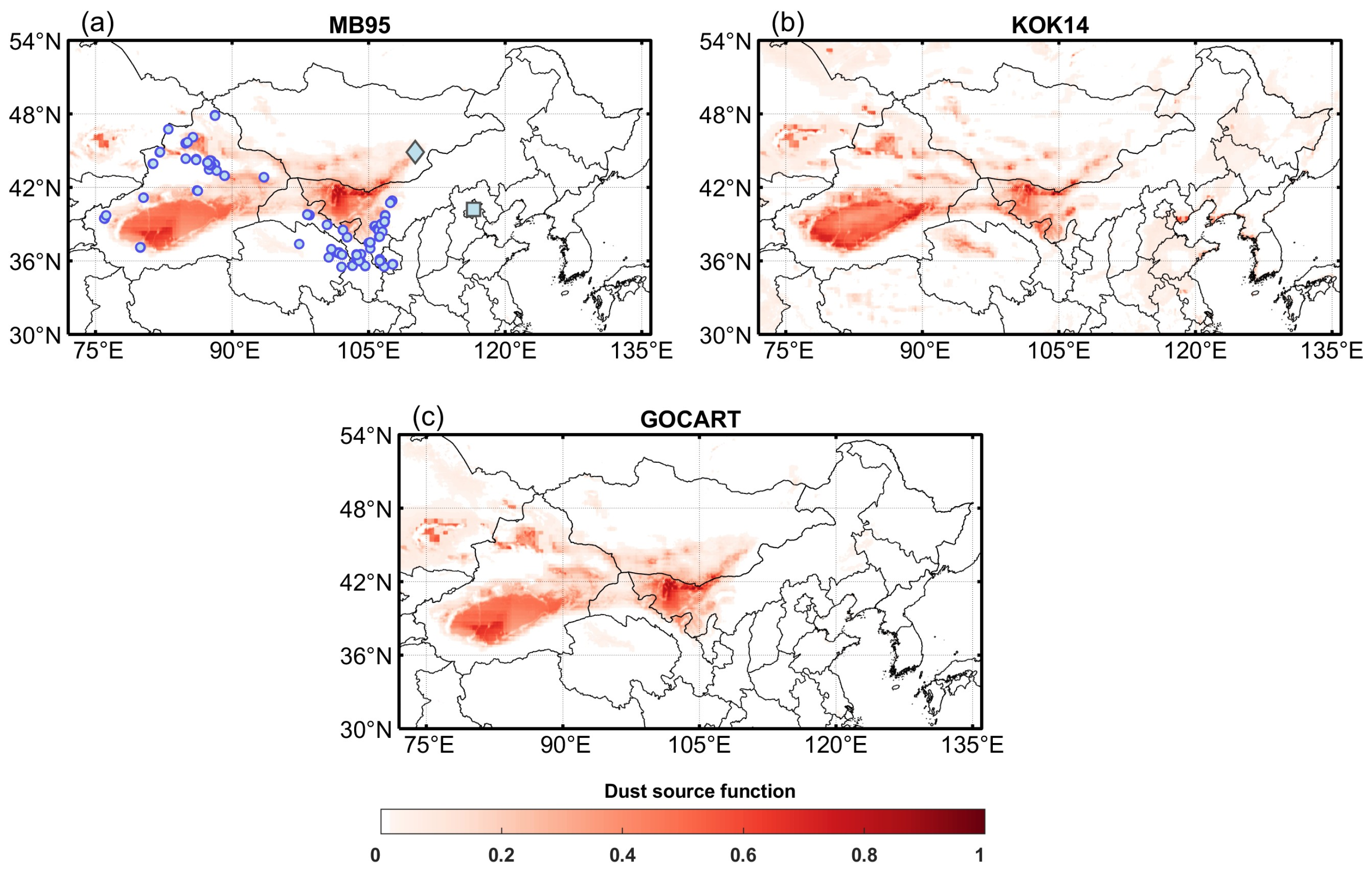
Dust source function is a dimensionless factor indicating the potential for dust emission, with values ranging from 0 to 1 (Figure 1). It is determined by the erodibility scaling factor ( e s ) and the land type (soil fraction, sf ). The formulation is given by:
S = e s × s f
According to Ginoux et al. [41]:
e s = ( z max z i z max z min ) 5
where z i is the local elevation, and z min and z max are the minimum and maximum elevation in a 10° × 10° area.
The land cover data used in this study are derived from the Global Land Cover by National Mapping Organizations, version 3 (GLCNMO3) [44]. GLCNMO3 classifies the global land cover into 20 categories, each associated with a specific soil fraction (Table 1).

2.3. Data Description

The data used in this work, including observational data and model data referenced for model validation and comparison, are summarized in Table 2, with further details provided below.

2.3.1. In Situ Observations

In situ measurements are commonly used as reference observations for meteorological variables due to standardized instrumentation and calibration/quality-control procedures, and they often provide lower measurement uncertainty than remotely sensed retrievals for the same variables [45,46]. In this study, multiple in situ datasets are employed to evaluate the performance of the dust simulations. Hourly PM10 (particulate matter with an aerodynamic diameter of less than 10 μm) concentration data are obtained from the air quality monitoring network operated by the China National Environmental Monitoring Center (CNEMC) [47].
AERONET (AErosol RObotic NETwork) is a collaborative ground-based aerosol remote sensing network established by NASA, PHOTONS and other institutions [48,49]. In this study, quality-assured AERONET Level 2.0 aerosol optical depth data are used.
The Asian Dust and Aerosol Lidar Observation Network (AD-Net) employs dual-wavelength polarized backscatter lidar to continuously monitor vertical profiles of aerosols, including dust, volcanic ash, and biomass burning particles [50,51]. Here, AD-Net attenuated backscatter coefficients and dust extinction coefficients are used to assess the vertical distribution of dust. The spatial distribution of observation sites is shown in Figure 1a.

2.3.2. Satellite Products

Although satellite observations generally exhibit larger uncertainties than ground-based measurements, they offer broader spatial coverage, enabling the assessment of the regional distribution of dust. Aerosol optical depth (AOD), which represents the column-integrated aerosol extinction, serves as a useful proxy for the column-integrated dust concentration. In this study, Level 2 daily AOD data at 550 nm from the MODIS sensors aboard the Terra and Aqua satellites are used. Following the approach described by Gui et al. [52], AOD data from both satellites are interpolated onto a 0.1° × 0.1° grid and subsequently averaged to produce a combined daily AOD product.

2.3.3. GCM Products

The performance of FLEXDUST/FLEXPART simulations is also assessed using two widely recognized dust General circulation model (GCM) products as benchmarks. The first benchmark model is NASA’s Modern-Era Retrospective Analysis for Research and Applications, Version 2 (MERRA2), which assimilates multi-platform aerosol optical depth observations and represents the three-dimensional evolution of dust aerosols [53,54]. The second benchmark model is the ECMWF Copernicus Atmosphere Monitoring Service forecast (CAMS), integrating satellite observations with aerosol chemistry through a 4D-VAR data assimilation system [55,56]. A comparison of the dust emission schemes, particle size distributions, and key parameters for FELEXDUST/FLEXPART, MERRA2, and CAMS is presented in Table 3. This study evaluates the simulations of dust concentration and dust optical depth (DOD) from MERRA2 and CAMS.
The DOD and extinction efficiencies in FLEXDUST/FLEXPART, MERRA2, and CAMS are derived calculated using the following equations [5]:
D O D = 0 b e x t d z b e x t ( λ ) = i = 1 m Q x i π r i 2 n r i
where r i is the dust radius, n r i is the number concentration (number per unit volume) associated with the section i , x i is a dimensionless factor related to wavelength and dust radius, and the extinction efficiencies ( Q ) are calculated with a Mie code [57].
Table 2. Datasets used in this work.
VariableDatasetResolutionReferences
Temporal Spatial
PM10CNEMCHourlyStationCNEMC [47]
AODAERONET5 MinutesStationHolben et al. [48,49]
AODTerra-MODIS, Aqua-MODISDaily10 kmLevy et al. [58]
Attenuated backscatter coefficient, dust extinction coefficientAD-Net15 MinutesStationShimizu et al. [50] Sugimoto et al. [51]
dust mixing ratio, DODMERRA23-Hourly0.5° × 0.625°Gelaro et al. [53]
dust mixing ratio, DODCAMS3-Hourly0.4° × 0.4°Rémy et al. [56]
Table 3. Dust models and their key parameters.
ModelResolution (Lon × Lat × Lev)Size Bins (μm in Radius)Emission Scheme
FLEXDUST (MB95) and FLEXPART0.3° × 0.3° × 137 L0.02, 0.11, 0.36, 0.65, 1.03, 1.77, 3.05, 4.32, 6.13, 8.66See the MB95 scheme [32,34].
FLEXDUST (KOK14) and FLEXPART0.3° × 0.3° × 137 L0.02, 0.11, 0.36, 0.65, 1.03, 1.77, 3.05, 4.32, 6.13, 8.66See the KOK14 scheme [33,35].
FLEXDUST (GOCART) and FLEXPART0.3° × 0.3° × 137 L0.02, 0.11, 0.36, 0.65, 1.03, 1.77, 3.05, 4.32, 6.13, 8.66Equation (5).
MERRA20.5° × 0.625° × 72 L0.1–1.0, 1.0–1.8, 1.8–3.0, 3.0–6.0, 6.0–10.0.See GOCART scheme [41].
CAMS0.4° × 0.4° × 137 L0.03–0.55, 0.55–0.9, 0.9–20.See MB95 scheme [34,56,59].
Note. FLEXPART/FLEXDUST bins are taken from FLEXDUST configuration file.

3. Results

3.1. Seasonal Evaluation: GOCART’s Performance in Spring 2023

China experienced several severe dust events in the spring of 2023, marking the most frequent occurrence in the past decade. This unusually active season offers a valuable basis for conducting statistically robust assessments of dust-storm prediction performance [60].
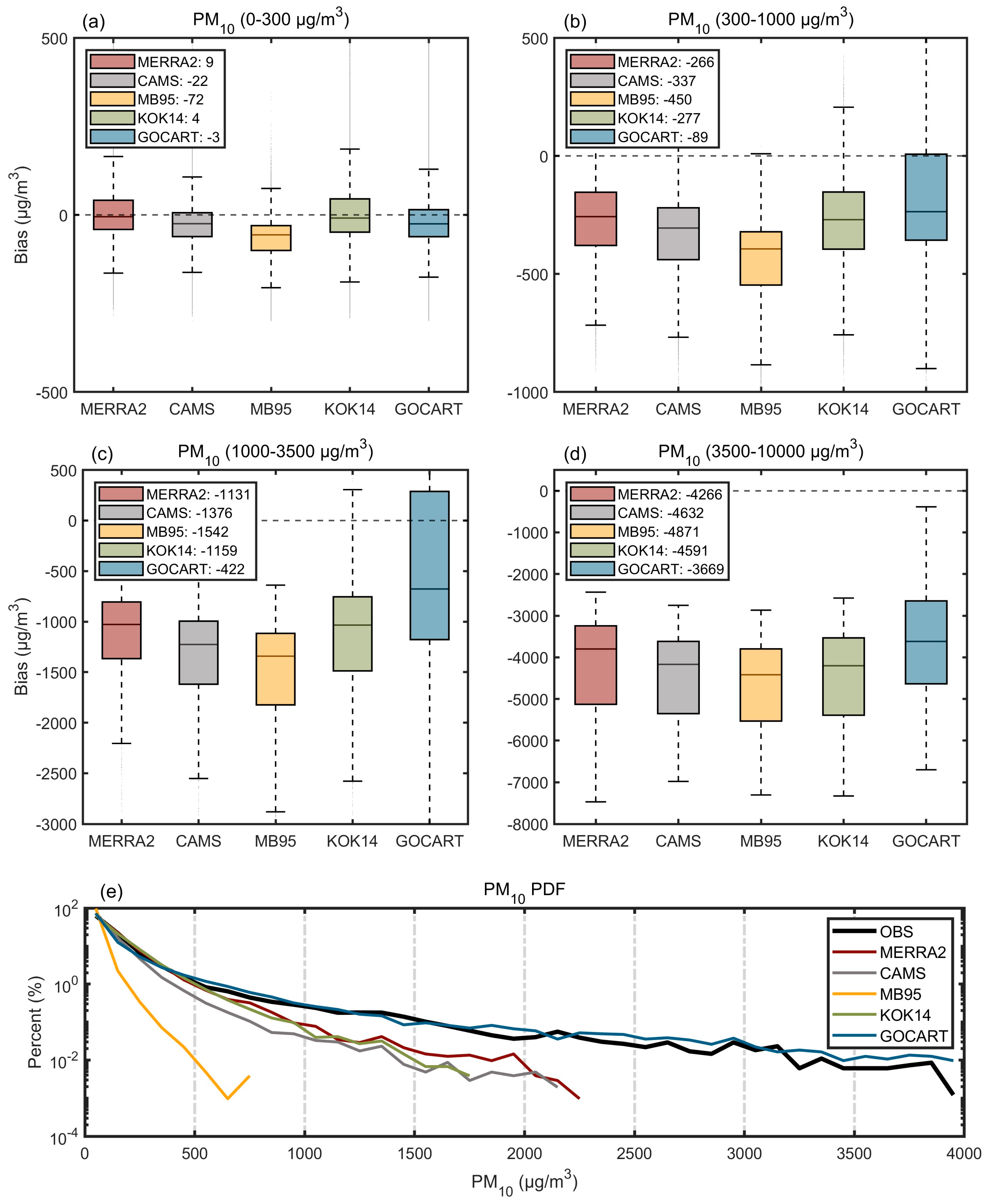
Using observations from the CNEMC stations, we evaluate the performance of MERRA2, CAMS, MB95, KOK14, and GOCART in simulating surface PM10 concentrations over northwestern China during spring 2023. The calculation of surface PM10 concentrations follows the methodology described by Tang et al. [33]. Concentrations are classified into four levels using threshold values of 300, 1000, and 3500 μg/m3 to evaluate simulation biases across different intensity ranges (Figure 2a–d). Figure 2e shows the probability density function (PDF) for all samples.
The results show that, for low PM10 concentrations (0–300 μg/m3), all models exhibit minimal biases (−72 to 9 μg/m3). Under mild dust conditions (300–1000 μg/m3), MB95 significantly underestimates surface PM10 (bias: −450 μg/m3), while GOCART shows the best simulation performance (bias: −89 μg/m3). For intense dust events (1000–3500 μg/m3) and extreme dust events (>3500 μg/m3), other models substantially underestimate surface PM10 (bias: −1542 to −1131 μg/m3), although GOCART outperforms the others (bias: −422 μg/m3). The PDF further reveals that MERRA2, CAMS, KOK14, and MB95 all markedly underestimate the occurrence of high-impact extreme dust events.
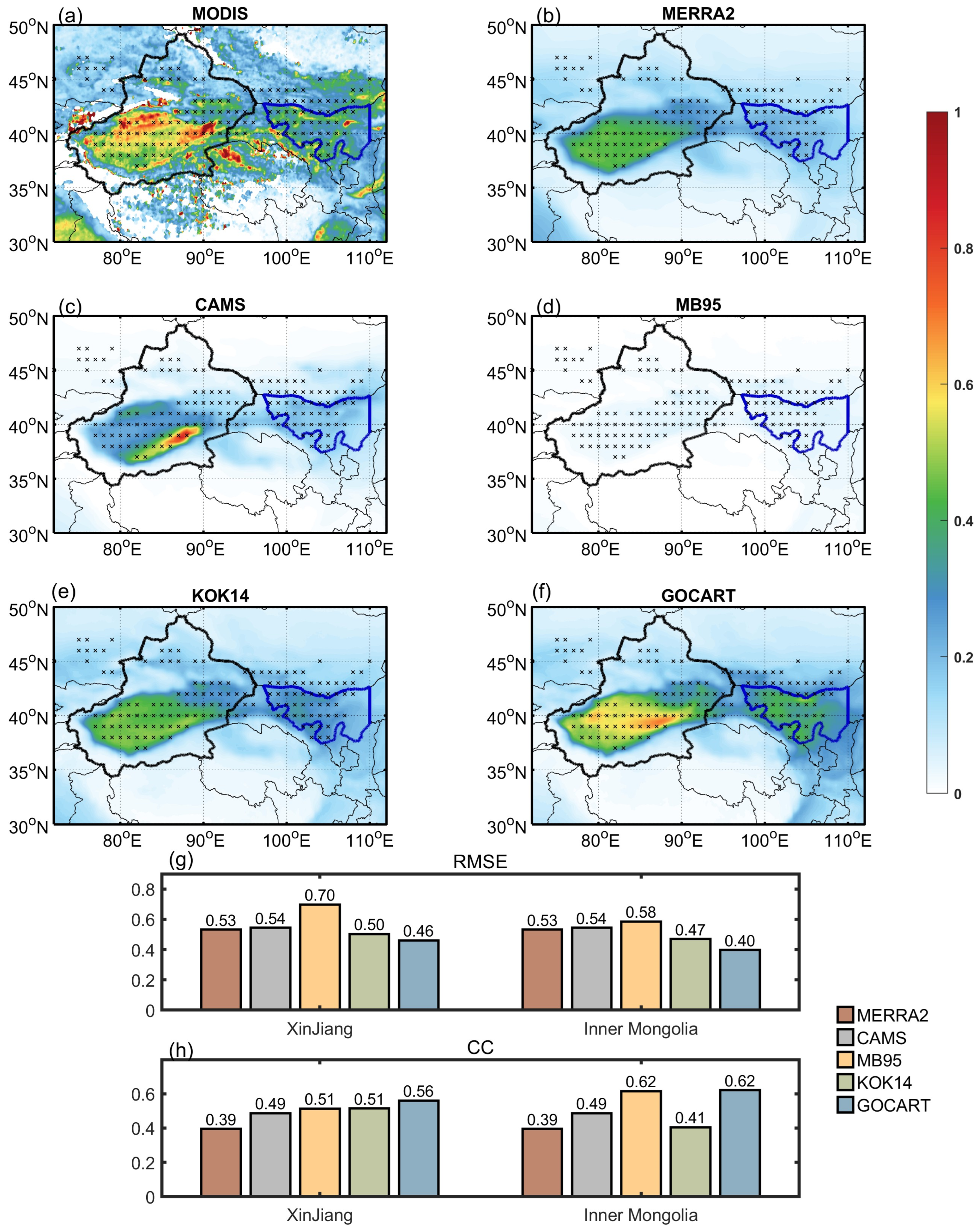
Compared to in situ observations, satellite data offer broader spatial coverage. Figure 3 presents the spring 2023 averages of (a) aerosol optical depth (AOD) from Terra-MODIS and Aqua-MODIS, and (b to f) the spatial distributions of dust optical depth (DOD) from MERRA2, CAMS, and FLEXDUST simulations using the MB95, KOK14, and GOCART schemes. Panels (g) and (h) show the root mean square error (RMSE) and correlation coefficient (CC) between the model simulations and satellite observations over Xinjiang (outlined in black) and Inner Mongolia (outlined in blue).
Overall, all models reproduce the elevated DOD values over the Taklimakan Desert in Xinjiang and the Gobi Desert in northwestern China. In Xinjiang, the GOCART scheme most accurately represents the spatial distribution of DOD (RMSE: 0.46, CC: 0.56), whereas the other models or emission schemes substantially underestimate it (RMSE: 0.50–0.70, CC: 0.39–0.51). A similar pattern is observed in Inner Mongolia, where GOCART shows the closest agreement with measurements (RMSE: 0.40 vs. 0.47–0.58; CC: 0.62 vs. 0.39–0.62). Considering the spatial distribution, RMSE, and CC, GOCART consistently outperforms the other schemes and achieves the highest overall simulation skill.

3.2. Event Evaluation: GOCART’s Performance During an Extreme Dust Storm

The above analyses highlight GOCART’s overall performance in simulating dust events in northwestern China in spring 2023. To further assess GOCART’s capability to capture the temporal evolution of extreme dust events, we examine the extreme dust storm that occurred 9–12 April 2023.
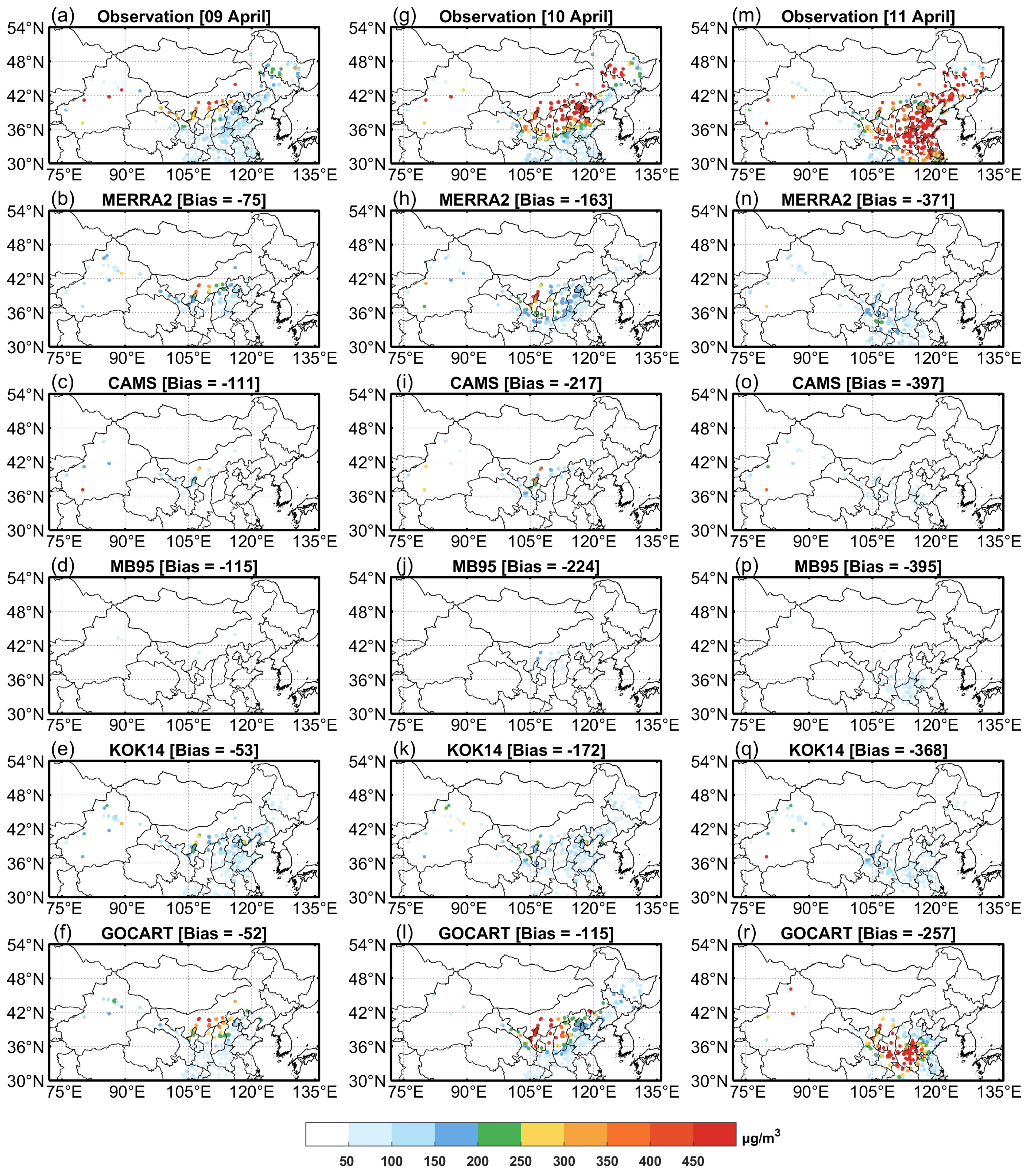
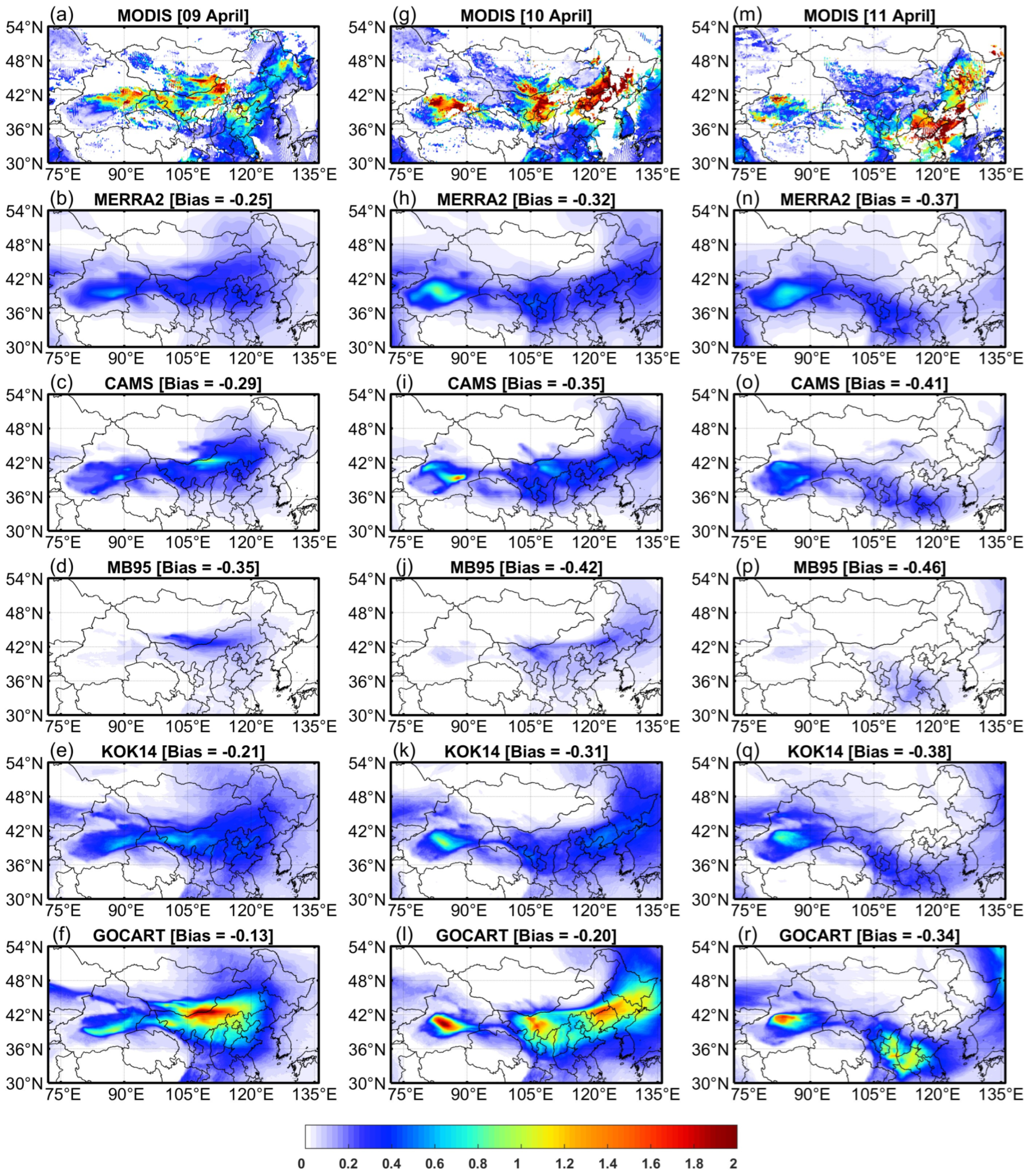
Figure 4 and Figure 5 present the spatial distributions of observed and simulated AOD and PM10, along with their corresponding bias statistics. On 9 April, a dust storm originated over the Taklimakan and Gobi Deserts, with daily mean PM10 concentrations exceeding 400 μg m−3 at multiple stations (Figure 4a and Figure 5a). On 10 April, the dust plume propagated eastward, reaching northern and northeastern China, during which MERRA2 and CAMS substantially underestimated the dust intensity (Figure 4g,h,k and Figure 5g,h,k). By 11 April, the dust had been transported to the Yangtze River Basin, where GOCART more accurately captured the spatial distribution of the event. Overall, considering both spatial patterns and quantitative metrics, GOCART demonstrates the highest simulation skill.
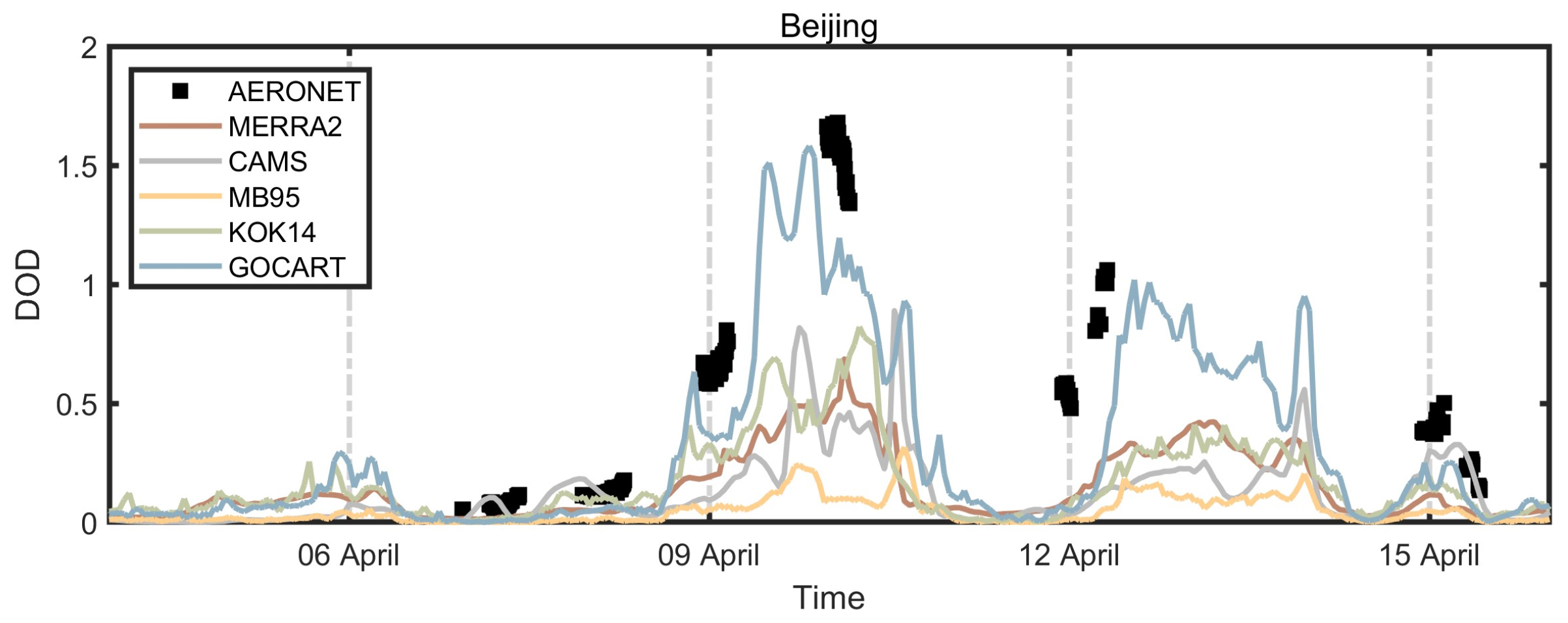
Since AERONET provides AOD at 500 nm, the AOD data is converted to 550 nm using the Ångström exponent [61]. Figure 6 illustrates the time series of 550 nm AOD from the AERONET Beijing station, alongside the corresponding DOD from MERRA2, CAMS, and FLEXDUST simulations using the MB95, KOK14, and GOCART schemes. The GOCART scheme accurately captures the higher DOD values observed on 10 and 12 April, closely matching the observational data. In contrast, other models significantly underestimate the DOD/AOD. This further underscores GOCART’s superior ability to capture the dynamics of extreme dust events.
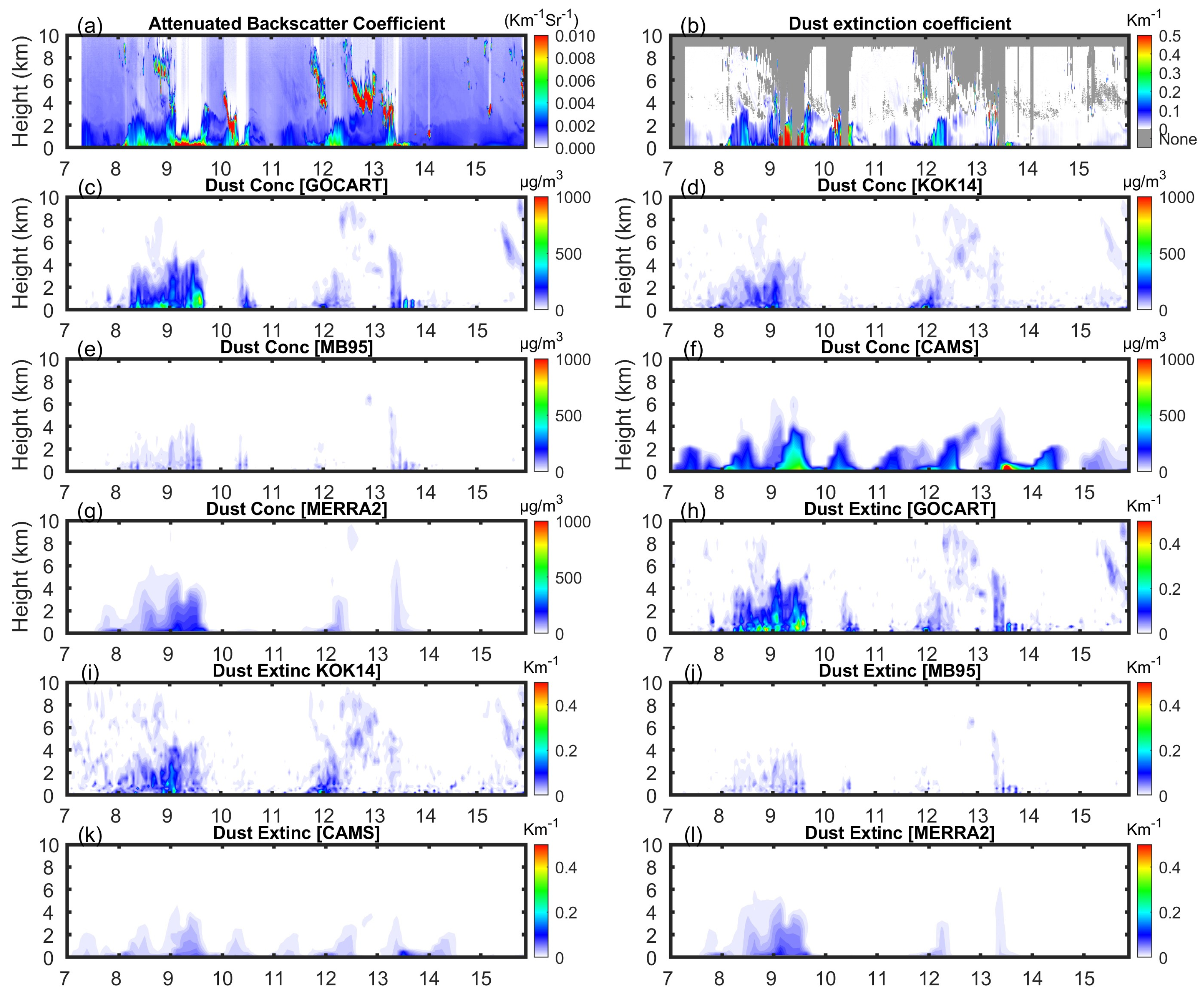
Figure 7 shows the vertical distribution of the 532 nm dust backscatter coefficient, and extinction coefficient at Sainshand during the extreme dust event. Also presented are the corresponding dust extinction coefficients and concentrations from MERRA2, CAMS, MB95, KOK14, and GOCART simulations. While all models capture the elevated near-surface dust concentrations from April 8 to 10, the GOCART simulation results more closely align with observational data for both dust concentration and extinction coefficients. Between April 12 and 13, higher dust concentrations are observed at altitudes of approximately 3 to 8 km, indicating dust transport in the upper atmosphere. GOCART accurately simulates this transport process, while MERRA2 and CAMS fail to capture it. This case study underscores GOCART’s superior ability to simulate both vertical dust distribution and long-range transport during extreme dust events.

3.3. Dust Budget over East Asia in Spring 2023

In Section 3.1 and Section 3.2, we demonstrated the superior performance of the GOCART scheme in simulating East Asian dust storms examined in this study. Here, we examine the regional dust budget over East Asia. For a given region, dust emissions ( D e ) are balanced by dust column burden ( D b u r ), dry deposition ( D d r y ), wet deposition ( D w e t ), and the net external flux ( Δ F n ):
D e = D b u r + D d r y + D w e t + Δ F n
a positive Δ F n indicates a net export of dust from the region to its surroundings, whereas a negative Δ F n indicates a net import of dust from outside the region.
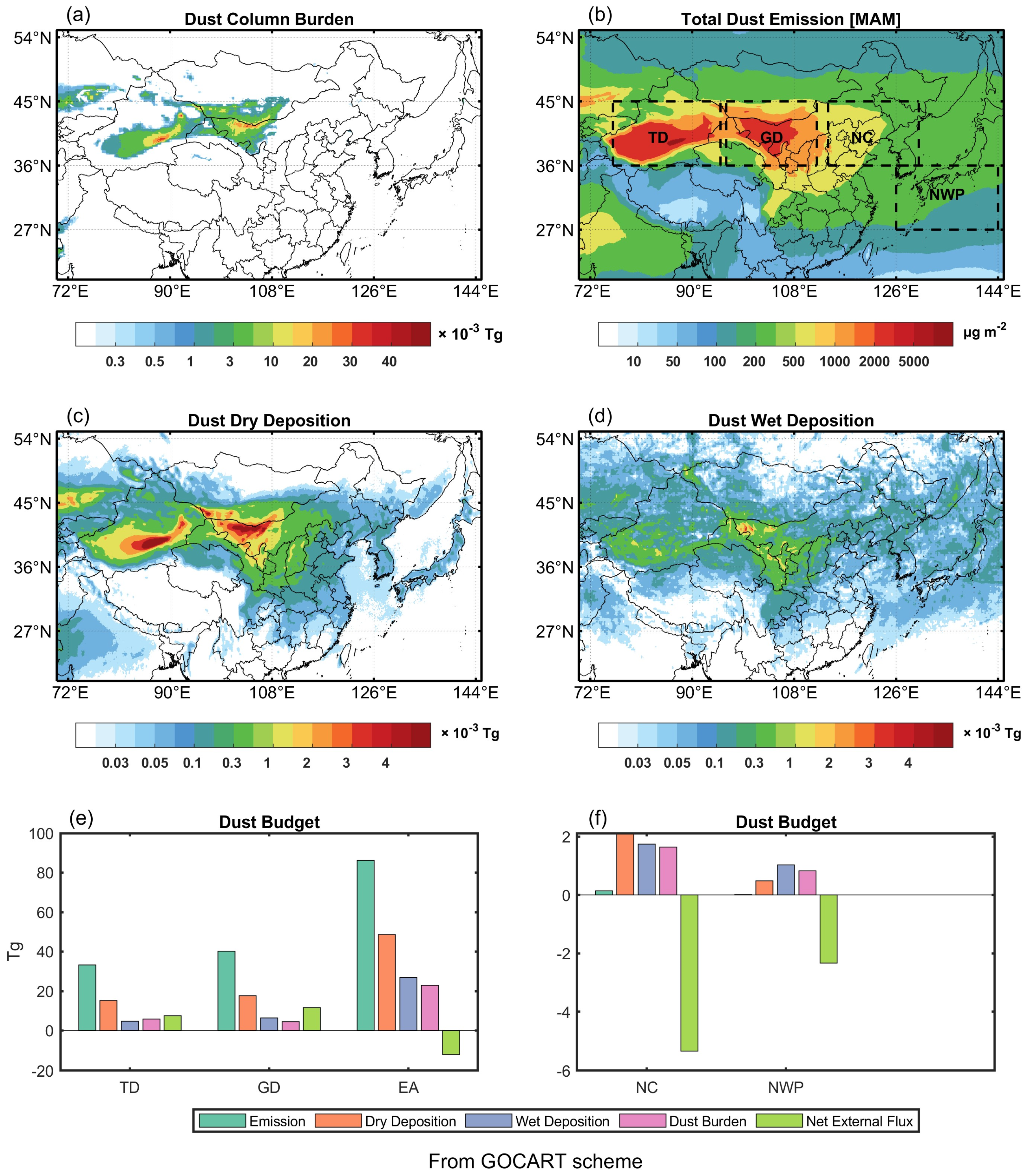
Figure 8 shows the spatial distribution of dust emission, dust column burden, dry deposition, and wet deposition. The Taklamakan and Gobi Deserts constitute East Asia’s dominant dust-source regions and exhibit the highest dust column burden, with spring-mean values exceeding 5000 μg m−2 (Figure 8a,b). The dry deposition is substantially higher over the Taklamakan and Gobi Deserts relative to downwind land and ocean regions, with 45.8% and 44.0% of their respective dust emissions redepositing within the source regions (Figure 8c,e). This spatial contrast is governed by both dust column burden and deposition velocity. Dust column burden peaks near desert sources, whereas the deposition velocity increases with particle size, enhancing gravitational settling and preventing coarse particles from being transported over long distances [25,28,62]. As dust transports farther downwind, wet deposition steadily gains prominence and ultimately overtakes dry deposition (Figure 8c,d). Specifically, the dry-to-wet deposition ratio drops from 3.2:1 over the Taklamakan Desert and 2.7:1 over the Gobi Desert to 1.2:1 over North China, and further to 0.47:1 over the Northwest Pacific (Figure 8e,f). These spatial gradients indicate that wet deposition is the dominant pathway delivering dust aerosols to oceanic regions and their ecosystems [63].
The Taklamakan Desert and Gobi Deserts are net dust exporters, with net external fluxes of 7.4 Tg and 11.6 Tg, respectively (Figure 8e). Consistent with this study, East Asia exhibits a negative net external flux of −12.1 Tg, indicating net dust import from outside the region, with potential contributions from Africa, the Middle East, and Central Asia (Figure 8e) [64,65,66,67,68]. North China and the Northwest Pacific stand out as major deposition sinks, characterized by net dust influx (Figure 8f).

4. Discussion

In this study, we improve the model performance over East Asia by updating the dust emission scheme used in FLEXDUST/FLEXPART. The differences among emission schemes mainly arise from how dust sources and wind/threshold-wind controls are represented. MB95 likely underperforms over East Asia because it identifies erodible surfaces more restrictively and is highly sensitive to parameter choices; its sandblasting-efficiency formulation has documented limitations and may require refinement [69]. By contrast, GOCART better accounts for heterogeneous erodible surfaces and land-surface/vegetation controls, leading to improved skill in reproducing PM10 and DOD patterns.
Compared to MB95 and KOK14, the GOCART scheme simulates dust over East Asia more accurately, yet it still underestimates dust concentrations during extreme dust events. This underestimation is caused by several factors. Surface wind speed is the primary driver of dust emission [70]. Although ERA5 is the reanalysis dataset that best matches station observations, it still significantly underestimates extreme wind speeds [12,71]. Due to the highly nonlinear relationship between dust flux and wind speed, this underestimation of strong winds substantially reduces dust emissions. Furthermore, studies have shown that gust-wind-induced saltation bursts and intermittent emissions are inherent components of dust emission; using hourly averaged wind speeds ignores these processes and leads to severe underestimation of dust fluxes [72]. In addition, most dust emission schemes are calibrated under moderate wind conditions and may not be applicable to extreme events, limiting their ability to reproduce peak dust fluxes [73,74]. To mitigate the impact of underestimated strong winds, we follow the approach proposed in previous studies (e.g., Basart et al., [75]; Chen et al. [12];) by introducing an additional factor ( u t / u 10 ) n t in the emission parameterization to account for the relative wind intensity and related higher-order effects. In the present study, we used n t = 1 for this term. We will further refine this parameterization (including n t ) to reduce the bias associated with weakly simulated near-surface strong winds and to improve the representation of extreme dust events over East Asia.
The dust source function used in models also affects dust emission. The current FLEXDUST model relies on a static source function. However, seasonal changes, vegetation dynamics, and precipitation or snowfall can alter the source function [76,77]. Chen et al. [78] find significant monthly and annual variations in the dust sources in East Asia, and neglecting the source function changes can depress the feature in the dust cycle simulation. In the future, this improvement might work by introducing additional, physically motivated constraints into the empirical source relations, for example: (i) dynamic vegetation and bare-soil fraction (e.g., leaf area index) to modulate erodibility seasonally and interannually; (ii) soil texture and aggregate state (clay/silt/sand fractions and crusting) to better constrain threshold friction velocity and sandblasting efficiency; (iii) soil moisture/precipitation history to represent wet suppression and post-rain recovery that are known preferential dust sources. Empirically, these factors can be incorporated either as multiplicative modifiers to the source strength/erodibility or through a recalibrated source function trained against observations.

5. Conclusions

In this study, we evaluate the dust simulations for the unusual active spring of 2023 in East Asia and quantify the regional dust budget, with a focus on the optimized GOCART scheme.
(1) Using CNEMC PM10 observations, MODIS AOD, and AERONET AOD, the optimized GOCART scheme shows the highest overall skill among the tested configurations. Under mild dust conditions (300–1000 μg/m3), GOCART shows a mean bias of −89.2 μg/m3, which is substantially lower than that of MERRA2 (−265.6 μg/m3), CAMS (−336.8 μg/m3), MB95 (−450.2 μg/m3), and KOK14 (−277.5 μg/m3). It more accurately reproduces the dominant spatial patterns of dust optical depth over Xinjiang and Inner Mongolia in spring 2023, with lower RMSE and higher correlations, and better captures the evolution of the 9–12 April 2023 extreme dust storm. FLEXPART/FLEXDUST and CAMS are forced by the same meteorological fields, making the emission-related parameters calibrated in our framework readily transferable to CAMS. This offers a direct route to improve the dust emission representation and, in turn, the simulated dust loading and transport over East Asia in CAMS. Nevertheless, extreme dust storms remain markedly underestimated, highlighting the persistent challenge of representing rare, high-impact outbreaks in numerical models.
(2) The Taklamakan and Gobi Deserts are net dust exporters (net external fluxes of 7.4 and 11.6 Tg, respectively), whereas East Asia exhibits a negative net external flux (−12.1 Tg), underscoring the importance of external dust influx in shaping the regional dust budget. Dry deposition drives substantial local recycling of emitted dust, returning 45.8% and 44.0% of dust emissions from the Taklamakan and Gobi Deserts, respectively, to their source regions. Farther downwind, wet deposition becomes increasingly dominant. Over the Northwest Pacific, the dry-to-wet deposition ratio decreases to 0.47:1, indicating that wet deposition ultimately governs dust delivery to oceanic regions and ecosystems.
Overall, these findings guide targeted model improvements for FLEXDUST and FLEXPART and enhance confidence in their broader use for characterizing Asian dust spatiotemporal dynamics from the past to the present and under projected future scenarios.

Author Contributions

Conceptualization, X.-Y.Y. and C.L.; methodology, X.-Y.Y. and C.L.; software, S.W.; validation, X.-Y.Y. and C.L.; data curation, S.W.; formal analysis, X.-Y.Y. and C.L.; investigation, S.W.; resources, X.-Y.Y. and C.L.; writing—original draft preparation, S.W.; writing—review and editing, X.-Y.Y. and C.L.; project administration, C.L. All authors have read and agreed to the published version of the manuscript.

Funding

This research has been supported by the Major Science and Technology Project of Fuzhou City (2024-ZD-018) and the Cooperation Project of Zhangzhou Meteorological Bureau (ZL202402).

Data Availability Statement

The datasets used in this study are publicly accessible. Surface PM10 concentrations are obtained from the China National Environmental Monitoring Centre (CNEMC) (http://www.cnemc.cn/ (accessed on 12 March 2025)). MODIS aerosol optical property products (MOD04_L2, MYD04_L2) are available at https://doi.org/10.5067/MODIS/MOD04_L2.061 and https://doi.org/10.5067/MODIS/MYD04_L2.061 (accessed on 20 May 2025). AERONET observations can be accessed through the AERONET website (https://aeronet.gsfc.nasa.gov/ (accessed on 20 May 2025)). AD-Net lidar data products are available at https://www-lidar.nies.go.jp/AD-Net/ncdf/ (accessed on 28 June 2025). CAMS global atmospheric composition forecast data are accessible via the Copernicus Atmosphere Monitoring Service portal (https://www.copernicus.eu/en (accessed on 28 June 2025)). MERRA-2 reanalysis data are obtained from the NASA GES DISC (https://disc.gsfc.nasa.gov/ (accessed on 28 June 2025)). The code and model outputs generated during the study are available from the corresponding author upon reasonable request.

Acknowledgments

We gratefully acknowledge the data providers whose efforts made this study possible. We acknowledge CNEMC, ERA5, NOAA and NASA for providing the observational and reanalysis datasets used in this study. We acknowledge the authors and developers of FLEXDUST and FLEXPART for publicly releasing the model source code.

Conflicts of Interest

The authors declare no conflicts of interest.

Abbreviations

The following abbreviations are used in this manuscript:
FLEXPARTFLEXible PARTicle dispersion model
MB95Dust emission schemes developed by [34]
KOK14Dust emission schemes developed by [35]
GOCARTDust emission schemes developed by [41]
GLCNMO3Global Land Cover by National Mapping Organizations, version 3
CNEMCChina National Environmental Monitoring Center
AERONETAErosol RObotic NETwork
AD-NetAsian Dust and Aerosol Lidar Observation Network
AODAerosol optical depth
GCMGeneral circulation model
DODDust optical depth
MERRA2Modern-Era Retrospective analysis for Research and Applications, version 2
CAMSCopernicus Atmosphere Monitoring Service
PDFProbability density function
RMSERoot mean square error
CCCorrelation coefficient

References

  1. Tegen, I.; Fung, I. Contribution to the Atmospheric Mineral Aerosol Load from Land Surface Modification. J. Geophys. Res. 1995, 100, 18707–18726. [Google Scholar] [CrossRef]
  2. Huang, J.; Wang, T.; Wang, W.; Li, Z.; Yan, H. Climate Effects of Dust Aerosols over East Asian Arid and Semiarid Regions. JGR Atmos. 2014, 119, 11398–11416. [Google Scholar] [CrossRef]
  3. Kok, J.F.; Storelvmo, T.; Karydis, V.A.; Adebiyi, A.A.; Mahowald, N.M.; Evan, A.T.; He, C.; Leung, D.M. Mineral Dust Aerosol Impacts on Global Climate and Climate Change. Nat. Rev. Earth Environ. 2023, 4, 71–86. [Google Scholar] [CrossRef]
  4. Miller, R.L.; Perlwitz, J.; Tegen, I. Feedback upon Dust Emission by Dust Radiative Forcing through the Planetary Boundary Layer. J. Geophys. Res. 2004, 109, D24209. [Google Scholar] [CrossRef]
  5. Kok, J.F.; Ridley, D.A.; Zhou, Q.; Miller, R.L.; Zhao, C.; Heald, C.L.; Ward, D.S.; Albani, S.; Haustein, K. Smaller Desert Dust Cooling Effect Estimated from Analysis of Dust Size and Abundance. Nat. Geosci. 2017, 10, 274–278. [Google Scholar] [CrossRef]
  6. Chen, Y.; Chen, S.; Zhou, J.; Zhao, D.; Bi, H.; Zhang, Y.; Alam, K.; Yu, H.; Yang, Y.; Chen, J. A Super Dust Storm Enhanced by Radiative Feedback. npj Clim. Atmos. Sci. 2023, 6, 90. [Google Scholar] [CrossRef]
  7. DeMott, P.J.; Prenni, A.J.; Liu, X.; Kreidenweis, S.M.; Petters, M.D.; Twohy, C.H.; Richardson, M.S.; Eidhammer, T.; Rogers, D.C. Predicting Global Atmospheric Ice Nuclei Distributions and Their Impacts on Climate. Proc. Natl. Acad. Sci. USA 2010, 107, 11217–11222. [Google Scholar] [CrossRef]
  8. Creamean, J.M.; Suski, K.J.; Rosenfeld, D.; Cazorla, A.; DeMott, P.J.; Sullivan, R.C.; White, A.B.; Ralph, F.M.; Minnis, P.; Comstock, J.M.; et al. Dust and Biological Aerosols from the Sahara and Asia Influence Precipitation in the Western U.S. Science 2013, 339, 1572–1578. [Google Scholar] [CrossRef]
  9. Zhao, C.; Yang, Y.; Fan, H.; Huang, J.; Fu, Y.; Zhang, X.; Kang, S.; Cong, Z.; Letu, H.; Menenti, M. Aerosol Characteristics and Impacts on Weather and Climate over the Tibetan Plateau. Natl. Sci. Rev. 2020, 7, 492–495. [Google Scholar] [CrossRef]
  10. Tong, D.Q.; Gill, T.E.; Sprigg, W.A.; Van Pelt, R.S.; Baklanov, A.A.; Barker, B.M.; Bell, J.E.; Castillo, J.; Gassó, S.; Gaston, C.J.; et al. Health and Safety Effects of Airborne Soil Dust in the Americas and Beyond. Rev. Geophys. 2023, 61, e2021RG000763. [Google Scholar] [CrossRef]
  11. Zhang, C.; Yan, M.; Du, H.; Ban, J.; Chen, C.; Liu, Y.; Li, T. Mortality Risks from a Spectrum of Causes Associated with Sand and Dust Storms in China. Nat. Commun. 2023, 14, 6867. [Google Scholar] [CrossRef]
  12. Chen, X.; Chong, M.; Lin, S.; Liang, Z.; Ginoux, P.; Liang, Y.; Zhang, B.; Song, Q.; Wang, S.; Li, J.; et al. The Efficient Integration of Dust and Numerical Weather Prediction for Renewable Energy Applications. J. Adv. Model. Earth Syst. 2025, 17, e2024MS004525. [Google Scholar] [CrossRef]
  13. Sun, J.; Zhang, M.; Liu, T. Spatial and Temporal Characteristics of Dust Storms in China and Its Surrounding Regions, 1960–1999: Relations to Source Area and Climate. J. Geophys. Res. 2001, 106, 10325–10333. [Google Scholar] [CrossRef]
  14. Qian, W.H.; Quan, L.S.; Shi, S.Y. Variations of the Dust Storm in China and Its Climatic Control. J. Clim. 2002, 15, 1216–1229. [Google Scholar] [CrossRef]
  15. Li, J.; Hao, X.; Liao, H.; Yue, X.; Li, H.; Long, X.; Li, N. Predominant Type of Dust Storms That Influences Air Quality Over Northern China and Future Projections. Earth’s Future 2022, 10, e2022EF002649. [Google Scholar] [CrossRef]
  16. Huang, J.; Minnis, P.; Chen, B.; Huang, Z.; Liu, Z.; Zhao, Q.; Yi, Y.; Ayers, J.K. Long-Range Transport and Vertical Structure of Asian Dust from CALIPSO and Surface Measurements during PACDEX. JGR Atmos. 2008, 113, 23212. [Google Scholar] [CrossRef]
  17. Shao, Y.; Wyrwoll, K.-H.; Chappell, A.; Huang, J.; Lin, Z.; McTainsh, G.H.; Mikami, M.; Tanaka, T.Y.; Wang, X.; Yoon, S. Dust Cycle: An Emerging Core Theme in Earth System Science. Aeolian Res. 2011, 2, 181–204. [Google Scholar] [CrossRef]
  18. Yin, Z.; Wan, Y.; Zhang, Y.; Wang, H. Why Super Sandstorm 2021 in North China? Natl. Sci. Rev. 2022, 9, nwab165. [Google Scholar] [CrossRef]
  19. Kok, J.F.; Adebiyi, A.A.; Albani, S.; Balkanski, Y.; Checa-Garcia, R.; Chin, M.; Colarco, P.R.; Hamilton, D.S.; Huang, Y.; Ito, A.; et al. Improved Representation of the Global Dust Cycle Using Observational Constraints on Dust Properties and Abundance. Atmos. Chem. Phys. 2021, 21, 8127–8167. [Google Scholar] [CrossRef]
  20. Pu, B.; Ginoux, P. How Reliable Are CMIP5 Models in Simulating Dust Optical Depth? Atmos. Chem. Phys. 2018, 18, 12491–12510. [Google Scholar] [CrossRef]
  21. Inness, A.; Ades, M.; Agustí-Panareda, A.; Barré, J.; Benedictow, A.; Blechschmidt, A.-M.; Dominguez, J.J.; Engelen, R.; Eskes, H.; Flemming, J.; et al. The CAMS Reanalysis of Atmospheric Composition. Atmos. Chem. Phys. 2019, 19, 3515–3556. [Google Scholar] [CrossRef]
  22. Randles, C.A.; Da Silva, A.M.; Buchard, V.; Colarco, P.R.; Darmenov, A.; Govindaraju, R.; Smirnov, A.; Holben, B.; Ferrare, R.; Hair, J.; et al. The MERRA-2 Aerosol Reanalysis, 1980 Onward. Part I: System Description and Data Assimilation Evaluation. J. Clim. 2017, 30, 6823–6850. [Google Scholar] [CrossRef] [PubMed]
  23. Pérez, C.; Haustein, K.; Janjic, Z.; Jorba, O.; Huneeus, N.; Baldasano, J.M.; Black, T.; Basart, S.; Nickovic, S.; Miller, R.L.; et al. Atmospheric Dust Modeling from Meso to Global Scales with the Online NMMB/BSC-Dust Model—Part 1: Model Description, Annual Simulations and Evaluation. Atmos. Chem. Phys. 2011, 11, 13001–13027. [Google Scholar] [CrossRef]
  24. Zeng, Y.; Wang, M.; Zhao, C.; Chen, S.; Liu, Z.; Huang, X.; Gao, Y. WRF-Chem v3.9 Simulations of the East Asian Dust Storm in May 2017: Modeling Sensitivities to Dust Emission and Dry Deposition Schemes. Geosci. Model Dev. 2020, 13, 2125–2147. [Google Scholar] [CrossRef]
  25. Kong, S.S.-K.; Fu, J.S.; Lin, N.-H.; Sheu, G.-R.; Huang, W.-S. Modeling CMAQ Dry Deposition Treatment over the Western Pacific: A Distinct Characteristic of Mineral Dust and Anthropogenic Aerosols. Atmos. Chem. Phys. 2025, 25, 7245–7268. [Google Scholar] [CrossRef]
  26. Yoon, J.W.; Lee, S.; Lee, E.; Park, S.K. Evaluation of Dust Emission and Land Surface Schemes in Predicting a Mega Asian Dust Storm over South Korea Using WRF-Chem. Geosci. Model Dev. 2025, 18, 2303–2328. [Google Scholar] [CrossRef]
  27. Sodemann, H.; Lai, T.M.; Marenco, F.; Ryder, C.L.; Flamant, C.; Knippertz, P.; Rosenberg, P.; Bart, M.; McQuaid, J.B. Lagrangian Dust Model Simulations for a Case of Moist Convective Dust Emission and Transport in the Western Sahara Region during Fennec/LADUNEX. JGR Atmos. 2015, 120, 6117–6144. [Google Scholar] [CrossRef]
  28. Pisso, I.; Sollum, E.; Grythe, H.; Kristiansen, N.I.; Cassiani, M.; Eckhardt, S.; Arnold, D.; Morton, D.; Thompson, R.L.; Zwaaftink, C.D.G.; et al. The Lagrangian Particle Dispersion Model FLEXPART Version 10.4. Geosci. Model Dev. 2019, 12, 4955–4997. [Google Scholar] [CrossRef]
  29. Tipka, A.; Haimberger, L.; Seibert, P. Flex_extract v7.1.2—A Software Package to Retrieve and Prepare ECMWF Data for Use in FLEXPART. Geosci. Model Dev. 2020, 13, 5277–5310. [Google Scholar] [CrossRef]
  30. Bakels, L.; Tatsii, D.; Tipka, A.; Thompson, R.; Dütsch, M.; Blaschek, M.; Seibert, P.; Baier, K.; Bucci, S.; Cassiani, M.; et al. FLEXPART Version 11: Improved Accuracy, Efficiency, and Flexibility. Geosci. Model Dev. 2024, 17, 7595–7627. [Google Scholar] [CrossRef]
  31. Zwaaftink, C.D.G.; Grythe, H.; Skov, H.; Stohl, A. Substantial Contribution of Northern High-Latitude Sources to Mineral Dust in the Arctic. JGR Atmos. 2016, 121, 13678–13697. [Google Scholar] [CrossRef] [PubMed]
  32. Zwaaftink, C.D.G.; Arnalds, Ó.; Dagsson-Waldhauserova, P.; Eckhardt, S.; Prospero, J.M.; Stohl, A. Temporal and Spatial Variability of Icelandic Dust Emissions and Atmospheric Transport. Atmos. Chem. Phys. 2017, 17, 10865–10878. [Google Scholar] [CrossRef]
  33. Tang, H.; Haugvaldstad, O.W.; Stordal, F.; Bi, J.; Zwaaftink, C.D.G.; Grythe, H.; Wang, B.; Rao, Z.; Zhang, Z.; Berntsen, T.; et al. Modelling the 2021 East Asia Super Dust Storm Using FLEXPART and FLEXDUST and Its Comparison with Reanalyses and Observations. Front. Environ. Sci. 2023, 10, 1013875. [Google Scholar] [CrossRef]
  34. Marticorena, B.; Bergametti, G. Modeling the Atmospheric Dust Cycle: 1. Design of a Soil-derived Dust Emission Scheme. J. Geophys. Res. 1995, 100, 16415–16430. [Google Scholar] [CrossRef]
  35. Kok, J.F.; Mahowald, N.M.; Fratini, G.; Gillies, J.A.; Ishizuka, M.; Leys, J.F.; Mikami, M.; Park, M.-S.; Park, S.-U.; Van Pelt, R.S.; et al. An Improved Dust Emission Model—Part 1: Model Description and Comparison against Measurements. Atmos. Chem. Phys. 2014, 14, 13023–13041. [Google Scholar] [CrossRef]
  36. Stohl, A. Computation, Accuracy and Applications of Trajectories—A Review and Bibliography. Atmos. Environ. 1998, 32, 947–966. [Google Scholar] [CrossRef]
  37. Stohl, A.; Hittenberger, M.; Wotawa, G. Validation of the Lagrangian Particle Dispersion Model FLEXPART against Large-Scale Tracer Experiment Data. Atmos. Environ. 1998, 32, 4245–4264. [Google Scholar] [CrossRef]
  38. Stohl, A. Characteristics of Atmospheric Transport into the Arctic Troposphere. J. Geophys. Res. 2006, 111, D11306. [Google Scholar] [CrossRef]
  39. Seibert, P.; Frank, A. Source-Receptor Matrix Calculation with a Lagrangian Particle Dispersion Model in Backward Mode. Atmos. Chem. Phys. 2004, 4, 51–63. [Google Scholar] [CrossRef]
  40. Stohl, A.; Forster, C.; Frank, A.; Seibert, P.; Wotawa, G. Technical Note: The Lagrangian Particle Dispersion Model FLEXPART Version 6.2. Atmos. Chem. Phys. 2005, 5, 2461–2474. [Google Scholar] [CrossRef]
  41. Ginoux, P.; Chin, M.; Tegen, I.; Prospero, J.M.; Holben, B.; Dubovik, O.; Lin, S.-J. Sources and Distributions of Dust Aerosols Simulated with the GOCART Model. J. Geophys. Res. 2001, 106, 20255–20273. [Google Scholar] [CrossRef]
  42. Shao, Y.; Lu, H. A Simple Expression for Wind Erosion Threshold Friction Velocity. J. Geophys. Res. 2000, 105, 22437–22443. [Google Scholar] [CrossRef]
  43. Takemura, T.; Okamoto, H.; Maruyama, Y.; Numaguti, A.; Higurashi, A.; Nakajima, T. Global Three-dimensional Simulation of Aerosol Optical Thickness Distribution of Various Origins. J. Geophys. Res. 2000, 105, 17853–17873. [Google Scholar] [CrossRef]
  44. Kobayashi, T.; Tateishi, R.; Alsaaideh, B.; Sharma, R.C.; Wakaizumi, T.; Miyamoto, D.; Bai, X.; Long, B.D.; Gegentana, G.; Maitiniyazi, A.; et al. Production of Global Land Cover Data—GLCNMO2013. J. Geogr. Geol. 2017, 9, 1. [Google Scholar] [CrossRef]
  45. Ramsey, M.H. Challenges for the Estimation of Uncertainty of Measurements Made in Situ. Accredit. Qual. Assur. 2021, 26, 183–192. [Google Scholar] [CrossRef]
  46. Povey, A.C.; Grainger, R.G. Known and Unknown Unknowns: Uncertainty Estimation in Satellite Remote Sensing. Atmos. Meas. Tech. 2015, 8, 4699–4718. [Google Scholar] [CrossRef]
  47. CNEMC PM10 [Dataset]. 2023. Available online: https://air.cnemc.cn:18007/ (accessed on 28 June 2025).
  48. Holben, B.N.; Eck, T.F.; Slutsker, I.; Tanré, D.; Buis, J.P.; Setzer, A.; Vermote, E.; Reagan, J.A.; Kaufman, Y.J.; Nakajima, T.; et al. AERONET—A Federated Instrument Network and Data Archive for Aerosol Characterization. Remote Sens. Environ. 1998, 66, 1–16. [Google Scholar] [CrossRef]
  49. Holben, B.N.; Tanré, D.; Smirnov, A.; Eck, T.F.; Slutsker, I.; Abuhassan, N.; Newcomb, W.W.; Schafer, J.S.; Chatenet, B.; Lavenu, F.; et al. An Emerging Ground-based Aerosol Climatology: Aerosol Optical Depth from AERONET. J. Geophys. Res. 2001, 106, 12067–12097. [Google Scholar] [CrossRef]
  50. Shimizu, A.; Sugimoto, N.; Matsui, I.; Arao, K.; Uno, I.; Murayama, T.; Kagawa, N.; Aoki, K.; Uchiyama, A.; Yamazaki, A. Continuous Observations of Asian Dust and Other Aerosols by Polarization Lidars in China and Japan during ACE-Asia. J. Geophys. Res. 2004, 109, D19S17. [Google Scholar] [CrossRef]
  51. Sugimoto, N.; Matsui, I.; Shimizu, A.; Nishizawa, T.; Hara, Y.; Xie, C.; Uno, I.; Yumimoto, K.; Wang, Z.; Yoon, S.-C. Lidar Network Observations of Tropospheric Aerosols; Singh, U.N., Asai, K., Jayaraman, A., Eds.; SPIE: Bellingham, WA, USA, 2008; p. 71530A. [Google Scholar]
  52. Gui, K.; Yao, W.; Che, H.; An, L.; Zheng, Y.; Li, L.; Zhao, H.; Zhang, L.; Zhong, J.; Wang, Y.; et al. Record-Breaking Dust Loading during Two Mega Dust Storm Events over Northern China in March 2021: Aerosol Optical and Radiative Properties and Meteorological Drivers. Atmos. Chem. Phys. 2022, 22, 7905–7932. [Google Scholar] [CrossRef]
  53. Gelaro, R.; McCarty, W.; Suárez, M.J.; Todling, R.; Molod, A.; Takacs, L.; Randles, C.A.; Darmenov, A.; Bosilovich, M.G.; Reichle, R.; et al. The Modern-Era Retrospective Analysis for Research and Applications, Version 2 (MERRA-2). J. Clim. 2017, 30, 5419–5454. [Google Scholar] [CrossRef] [PubMed]
  54. Tindan, J.Z.; Jin, Q.; Pu, B. Understanding Day–Night Differences in Dust Aerosols over the Dust Belt of North Africa, the Middle East, and Asia. Atmos. Chem. Phys. 2023, 23, 5435–5466. [Google Scholar] [CrossRef]
  55. Peuch, V.-H.; Engelen, R.; Rixen, M.; Dee, D.; Flemming, J.; Suttie, M.; Ades, M.; Agustí-Panareda, A.; Ananasso, C.; Andersson, E.; et al. The Copernicus Atmosphere Monitoring Service: From Research to Operations. Bull. Am. Meteorol. Soc. 2022, 103, E2650–E2668. [Google Scholar] [CrossRef]
  56. Rémy, S.; Kipling, Z.; Huijnen, V.; Flemming, J.; Nabat, P.; Michou, M.; Ades, M.; Engelen, R.; Peuch, V.-H. Description and Evaluation of the Tropospheric Aerosol Scheme in the Integrated Forecasting System (IFS-AER, Cycle 47R1) of ECMWF. Geosci. Model Dev. 2022, 15, 4881–4912. [Google Scholar] [CrossRef]
  57. Mätzler, C. MATLAB Functions for Mie Scattering and Absorption; Institut für Angewandte Physik: Dresden, Germany, 2002. [Google Scholar]
  58. Levy, R.C.; Mattoo, S.; Munchak, L.A.; Remer, L.A.; Sayer, A.M.; Patadia, F.; Hsu, N.C. The Collection 6 MODIS Aerosol Products over Land and Ocean. Atmos. Meas. Tech. 2013, 6, 2989–3034. [Google Scholar] [CrossRef]
  59. Rémy, S.; Kipling, Z.; Flemming, J.; Boucher, O.; Nabat, P.; Michou, M.; Bozzo, A.; Ades, M.; Huijnen, V.; Benedetti, A.; et al. Description and Evaluation of the Tropospheric Aerosol Scheme in the European Centre for Medium-Range Weather Forecasts (ECMWF) Integrated Forecasting System (IFS-AER, Cycle 45R1). Geosci. Model Dev. 2019, 12, 4627–4659. [Google Scholar] [CrossRef]
  60. Chen, Y.; Chen, S.; Bi, H.; Zhou, J.; Zhang, Y. Where Is the Dust Source of 2023 Several Severe Dust Events in China? Bull. Am. Meteorol. Soc. 2024, 105, E2085–E2096. [Google Scholar] [CrossRef]
  61. Eck, T.F.; Holben, B.N.; Reid, J.S.; Dubovik, O.; Smirnov, A.; O’Neill, N.T.; Slutsker, I.; Kinne, S. Wavelength Dependence of the Optical Depth of Biomass Burning, Urban, and Desert Dust Aerosols. J. Geophys. Res. 1999, 104, 31333–31349. [Google Scholar] [CrossRef]
  62. Du, H.; Wang, T.; Xue, X.; Li, S. Modelling of Sand/Dust Emission in Northern China from 2001 to 2014. Geoderma 2018, 330, 162–176. [Google Scholar] [CrossRef]
  63. Zhao, T.L.; Gong, S.L.; Zhang, X.Y.; Blanchet, J.-P.; McKendry, I.G.; Zhou, Z.J. A Simulated Climatology of Asian Dust Aerosol and Its Trans-Pacific Transport. Part I: Mean Climate and Validation. J. Clim. 2006, 19, 88–103. [Google Scholar] [CrossRef]
  64. Liu, Q.; Huang, Z.; Hu, Z.; Dong, Q.; Li, S. Long-Range Transport and Evolution of Saharan Dust Over East Asia From 2007 to 2020. JGR Atmos. 2022, 127, e2022JD036974. [Google Scholar] [CrossRef]
  65. Bi, H.; Chen, S.; Zhang, D.; Wang, Y.; Kang, L.; Alam, K.; Tang, M.; Chen, Y.; Zhang, Y.; Wang, D. The Circumglobal Transport of Massive African Dust and Its Impacts on the Regional Circulation in Remote Atmosphere. Bull. Am. Meteorol. Soc. 2024, 105, E605–E622. [Google Scholar] [CrossRef]
  66. Pan, H.; Hu, Z.; Feng, T.; Huang, Z.; Liu, Q.; Feng, G. Distribution Characteristics and Air-Quality Effect of Intercontinental Transport Dust: An Unexpected Dust Storm Case Study in China. Atmos. Environ. 2025, 350, 121177. [Google Scholar] [CrossRef]
  67. Han, Y.; Wang, T.; Tan, R.; Tang, J.; Wang, C.; He, S.; Dong, Y.; Huang, Z.; Bi, J. CALIOP-Based Quantification of Central Asian Dust Transport. Remote Sens. 2022, 14, 1416. [Google Scholar] [CrossRef]
  68. Li, Y.-X.; Luo, L.; Li, J.-W.; Hsu, S.-C.; Ni, Y.-Z.; Kao, S.-J. Middle East and Central Asian Dust Reaches the South China Sea in Summer. Natl. Sci. Rev. 2025, 12, nwaf274. [Google Scholar] [CrossRef]
  69. Joshi, J.R. Dust Model Sensitivity to Dust Source Mask, Sandblasting Efficiency, Air Density, and Land Use: Implications for Model Improvement. Atmos. Pollut. Res. 2024, 15, 102230. [Google Scholar] [CrossRef]
  70. Tai, A.P.; Ma, P.H.; Chan, Y.-C.; Chow, M.-K.; Ridley, D.A.; Kok, J.F. Impacts of Climate and Land Cover Variability and Trends on Springtime East Asian Dust Emission over 1982–2010: A Modeling Study. Atmos. Environ. 2021, 254, 118348. [Google Scholar] [CrossRef]
  71. Hersbach, H.; Bell, B.; Berrisford, P.; Hirahara, S.; Horányi, A.; Muñoz-Sabater, J.; Nicolas, J.; Peubey, C.; Radu, R.; Schepers, D.; et al. The ERA5 Global Reanalysis. Q. J. R. Meteorol. Soc. 2020, 146, 1999–2049. [Google Scholar] [CrossRef]
  72. Siegmund, N.; Panebianco, J.E.; Avecilla, F.; Iturri, L.A.; Sommer, M.; Buschiazzo, D.E.; Funk, R. From Gustiness to Dustiness—The Impact of Wind Gusts on Particulate Matter Emissions in Field Experiments in La Pampa, Argentina. Atmosphere 2022, 13, 1173. [Google Scholar] [CrossRef]
  73. Cowie, S.M.; Marsham, J.H.; Knippertz, P. The Importance of Rare, High-wind Events for Dust Uplift in Northern Africa. Geophys. Res. Lett. 2015, 42, 8208–8215. [Google Scholar] [CrossRef]
  74. Leung, D.M.; Kok, J.F.; Li, L.; Okin, G.S.; Prigent, C.; Klose, M.; García-Pando, C.P.; Menut, L.; Mahowald, N.M.; Lawrence, D.M.; et al. A New Process-Based and Scale-Aware Desert Dust Emission Scheme for Global Climate Models—Part I: Description and Evaluation against Inverse Modeling Emissions. Atmos. Chem. Phys. 2023, 23, 6487–6523. [Google Scholar] [CrossRef]
  75. Basart, S.; Pérez, C.; Nickovic, S.; Cuevas, E.; Baldasano, J.M. Development and Evaluation of the BSC-DREAM8b Dust Regional Model over Northern Africa, the Mediterranean and the Middle East. Tellus B Chem. Phys. Meteorol. 2012, 64, 18539. [Google Scholar] [CrossRef]
  76. Katra, I.; Elperin, T.; Fominykh, A.; Krasovitov, B.; Yizhaq, H. Modeling of Particulate Matter Transport in Atmospheric Boundary Layer Following Dust Emission from Source Areas. Aeolian Res. 2016, 20, 147–156. [Google Scholar] [CrossRef]
  77. Parajuli, S.P.; Stenchikov, G.L.; Ukhov, A.; Kim, H. Dust Emission Modeling Using a New High-Resolution Dust Source Function in WRF-Chem With Implications for Air Quality. JGR Atmos. 2019, 124, 10109–10133. [Google Scholar] [CrossRef]
  78. Chen, Y.; Zhang, Y.; Chen, S.; Yang, B.; Yan, H.; Li, J.; Zhang, C.; Lou, G.; Chen, J.; Lian, L.; et al. Exploring the Impact of Dynamic Dust Source on the East Asian Dust Cycle Using WRF-Chem. JGR Atmos. 2025, 130, e2024JD041239. [Google Scholar] [CrossRef]
Figure 1. (a) Spatial distribution of the dust source function for the MB95 dust emission scheme, along with surrounding 121 CNEMC observation stations (blue points). Cyan square represents the AERONET site, and cyan diamond denotes the AD-Net observation site. (b,c) are the same as (a), but for KOK14 and GOCART dust emission schemes, respectively.
Atmosphere 17 00154 g001
Figure 2. (ad) PM10 biases categorized into four levels (0–300, 300–1000, 1000–3500, and above 3500 μg/m3); legend shows the mean biases. (e) Probability density function (PDF) of all samples. The PDF indicates the relative frequency of occurrence per unit concentration, and it is normalized such that the area under the curve equals 1 over the full PM10 range.
Atmosphere 17 00154 g002
Figure 3. Spatial distribution of (a) averaged AOD from MODIS and (bf) averaged DOD from MERRA2, CAMS, MB95, Kok14 and GOCART in spring 2023. (g) RMSE (root mean square error) and (h) CC (correlation coefficient) between the simulation and observation over Xinjiang and parts of Inner Mongolia are also presented; black and blue edge lines in panels (af) denote Xinjiang and parts of Inner Mongolia, respectively. The “×” symbols indicate dust source regions (dust source function is greater than 0.01).
Atmosphere 17 00154 g003
Figure 4. Spatial distribution of CNEMC Daily mean PM10 (first row) and PM10 simulated by MERRA2, CAMS, MB95, KOK14, and GOCART (second to sixth rows) for 9–11 April. The bias between the simulations and observations is indicated in the panel titles.
Atmosphere 17 00154 g004
Figure 5. Spatial distribution of the daily mean MODIS AOD (first row) and DOD simulated by MERRA2, CAMS, MB95, KOK14 and GOCART (second to sixth rows) for 9–11 April. The bias between the simulations and observations is indicated in the panel titles.
Atmosphere 17 00154 g005
Figure 6. The time series of AOD observations (AERONET) and DOD from MERRA2, CAMS, MB95, KOK14 and GOCART at Beijing station.
Atmosphere 17 00154 g006
Figure 7. (a,b) Vertical profiles of observed 532 nm backscatter coefficient and dust extinction coefficient at AD-Net station Sainshand, along with dust concentration simulated by (c) GOCART, (d) KOK14, (e) MB95, (f) CAMS, (g) MERRA2, along with calculated dust extinction simulated by (h) GOCART, (i) Kok14, (j) MB95, (k) CAMS, (l) MERRA2. Here the height is above ground level in units of km.
Atmosphere 17 00154 g007
Figure 8. Spatial distribution of (a) total springtime dust emission, (b) mean springtime dust column burdens, (c) total springtime dust dry deposition and (d) total springtime dust wet deposition. In (b), the dashed boxes denote the Taklimakan Desert (TD), Gobi Desert (TD), North China (NC), and Northwest Pacific (NWP). Panels (e,f) show the dust budget for TD, GD, NC, NWP, and East Asia (EA; 70° E–145° E, 20° N–55° N) in spring 2023.
Atmosphere 17 00154 g008
Table 1. Erodibility scaling and soil fraction of three dust emission schemes.
SchemeMB95Kok14GOCART
Erodibility scaling e s 10 ° × 10 ° e s 10 ° × 10 ° + e s 6 ° × 6 ° 4 + + e s 3 ° × 3 ° + e s 1.2 ° × 1.2 ° 4 e s 10 ° × 10 °
Soil type17 (Bare area, unconsolidated (sand))100%100%100%
16 (Bare area, consolidated (gravel, rock))40%40%40%
13 (Cropland/other vegetation mosaic)0var *0
11 (Cropland)0var *0
10 (Sparse vegetation)0var *var *
9 (Herbaceous with sparse tree/shrub)0var *var *
8 (Herbaceous)0var *var *
Note. var * indicates that the soil fraction varies as a function of vegetation cover.
Disclaimer/Publisher’s Note: The statements, opinions and data contained in all publications are solely those of the individual author(s) and contributor(s) and not of MDPI and/or the editor(s). MDPI and/or the editor(s) disclaim responsibility for any injury to people or property resulting from any ideas, methods, instructions or products referred to in the content.