

Neural Network Algorithms for Estimating Snow Depth and Scattering Mean Free Path from ICESat-2 Measurements of Multiple Scattering Inside Snow


Abstract
1. Introduction
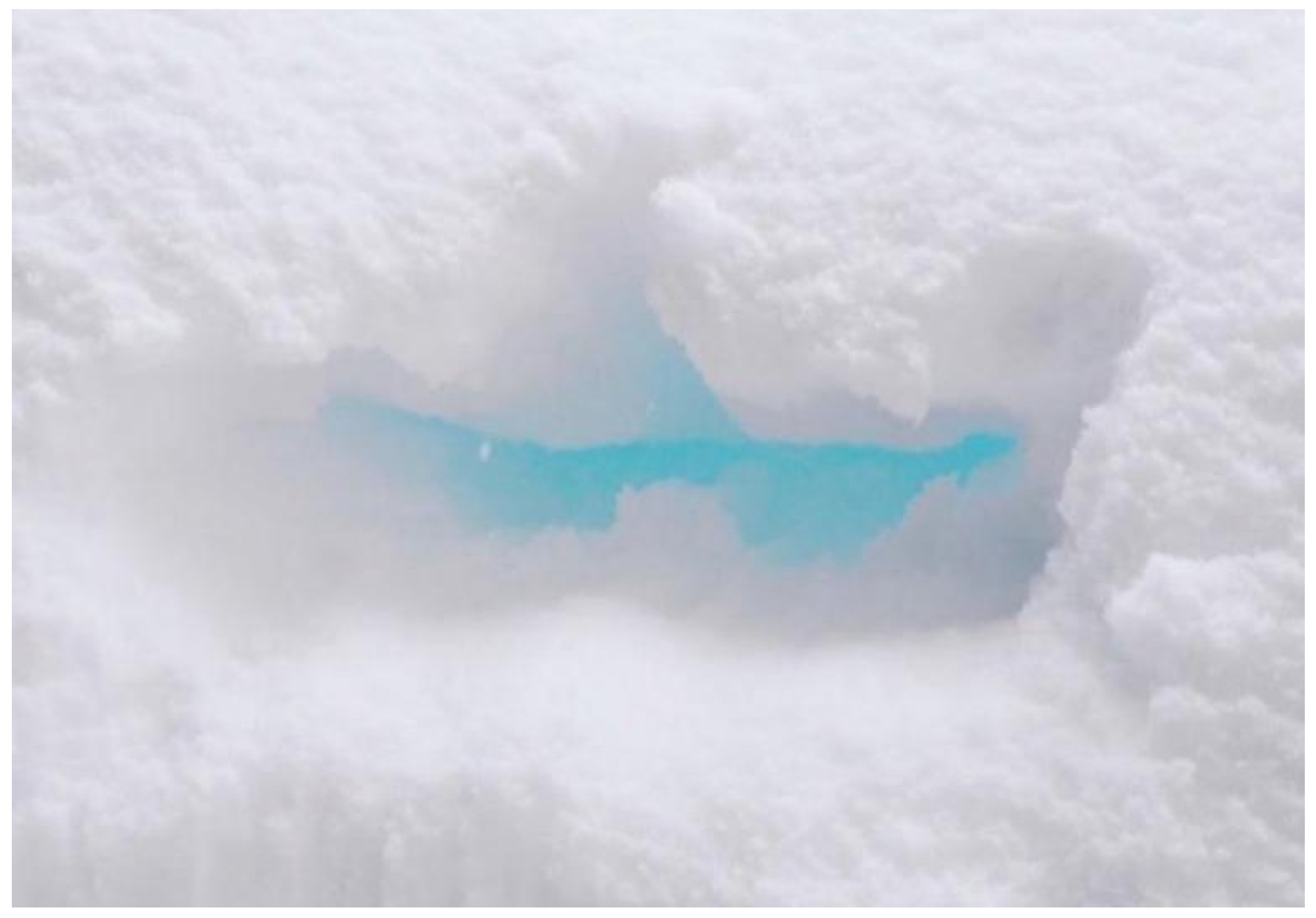
- The photon multiple-scattering pathlength distribution is primarily determined by snow depth and the effective scattering mean free path, <p>, which is a function of snow density, effective single scattering asymmetry factor, and snow particle volume-to-surface-area ratio (commonly referred to as “grain size”).
- The averaged pathlength of the photon multiple-scattering pathlength distribution, <L>, equals twice the physical snow depth, i.e., <L> = 2× (snow depth).
- (1)
- to develop a machine learning-based data analysis framework that can efficiently explore the potential for estimating snow depths from imperfect spaceborne lidar measurements, and
- (2)
- to investigate new strategies for obtaining feasible and informative snow-depth measurements using current spaceborne and potentially future optimized lidar systems.
2. Methodology
2.1. ICESat-2 Measurement Limitations and Data Challenges
- Transient response of ATLAS: ICESat-2’s ATLAS exhibits a transient response that affects its recorded signals [46]. After receiving the primary signal (e.g., snow surface signal), the lidar system can produce secondary signals (so-called “after-pulses”) that appear as additional photons, potentially misrepresenting and distorting the true surface return. Traditionally, a deconvolution procedure [47,48,49] is required to remove this effect and recover the true scattering pathlength distribution. However, this deconvolution process can introduce errors, especially when applied to noisy lidar profiles.
- Limited photon return data: ICESat-2 was primarily designed to measure the elevation of Earth’s surface [33]. Due to limited downlink bandwidth, the satellite only sends back the time-tags of photons that are close to the surface and ignores the long tails of the multiple-scattering pathlength distribution. Although those ignored tails can be approximated from the near-surface portion of the signals, such extrapolation may introduce errors into the estimated averaged photon pathlength.
2.2. Monte Carlo Simulations
2.3. Neural Network Algorithm Development
- Monte Carlo simulations: Simulate ICESat-2 laser light propagation inside snow for various snow depths and scattering mean free paths. The Monte Carlo simulation model is based on the fast-converging semi-analytical polarized Monte Carlo algorithms originally developed for another spaceborne lidar [54] and is modified for ICESat-2. Instead of tracing each photon interacting with scattering media until they disappear outside of the field-of-view, the semi-analytical algorithm computes the probability of the photon being detected by the space lidar at each individual scattering event.
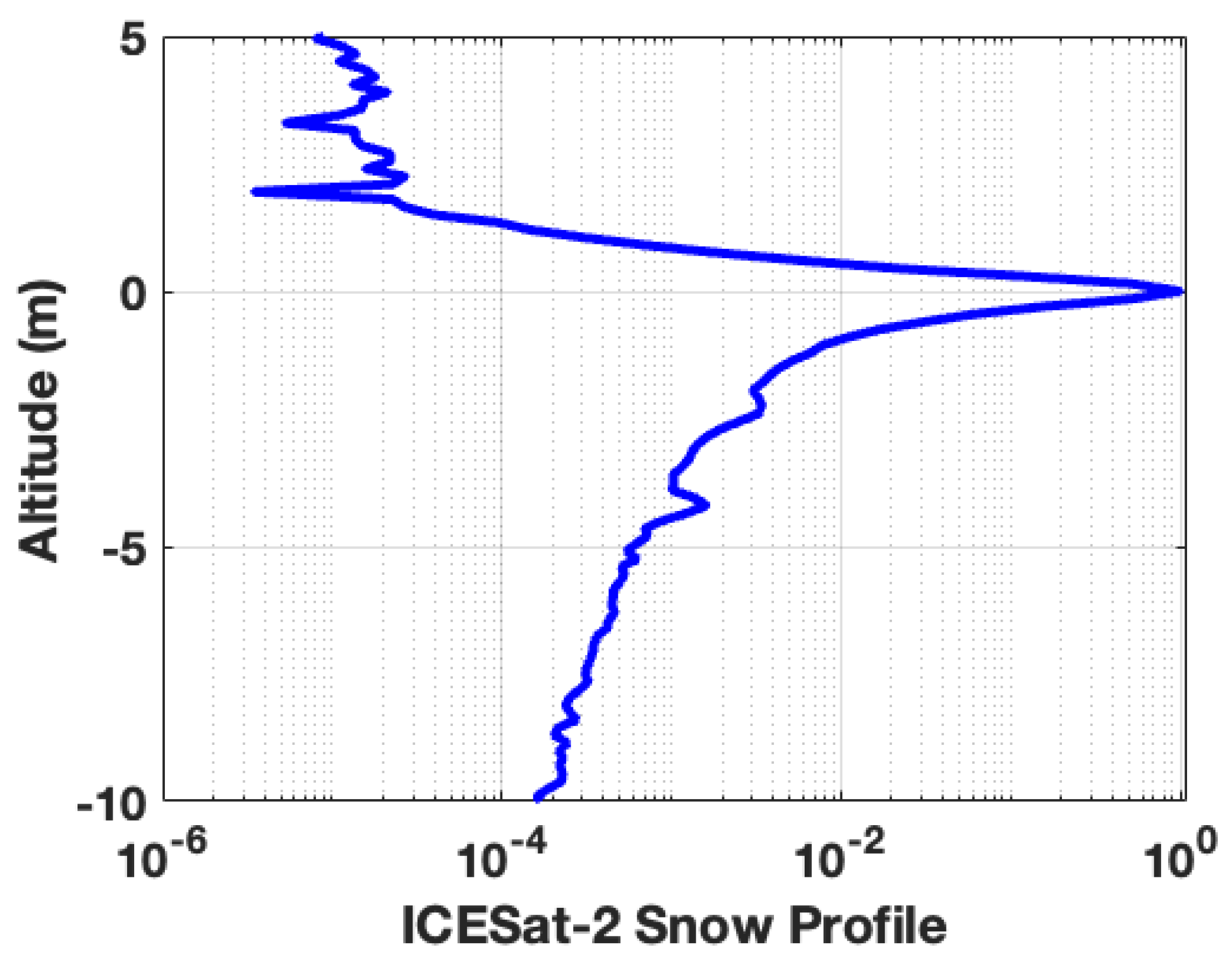
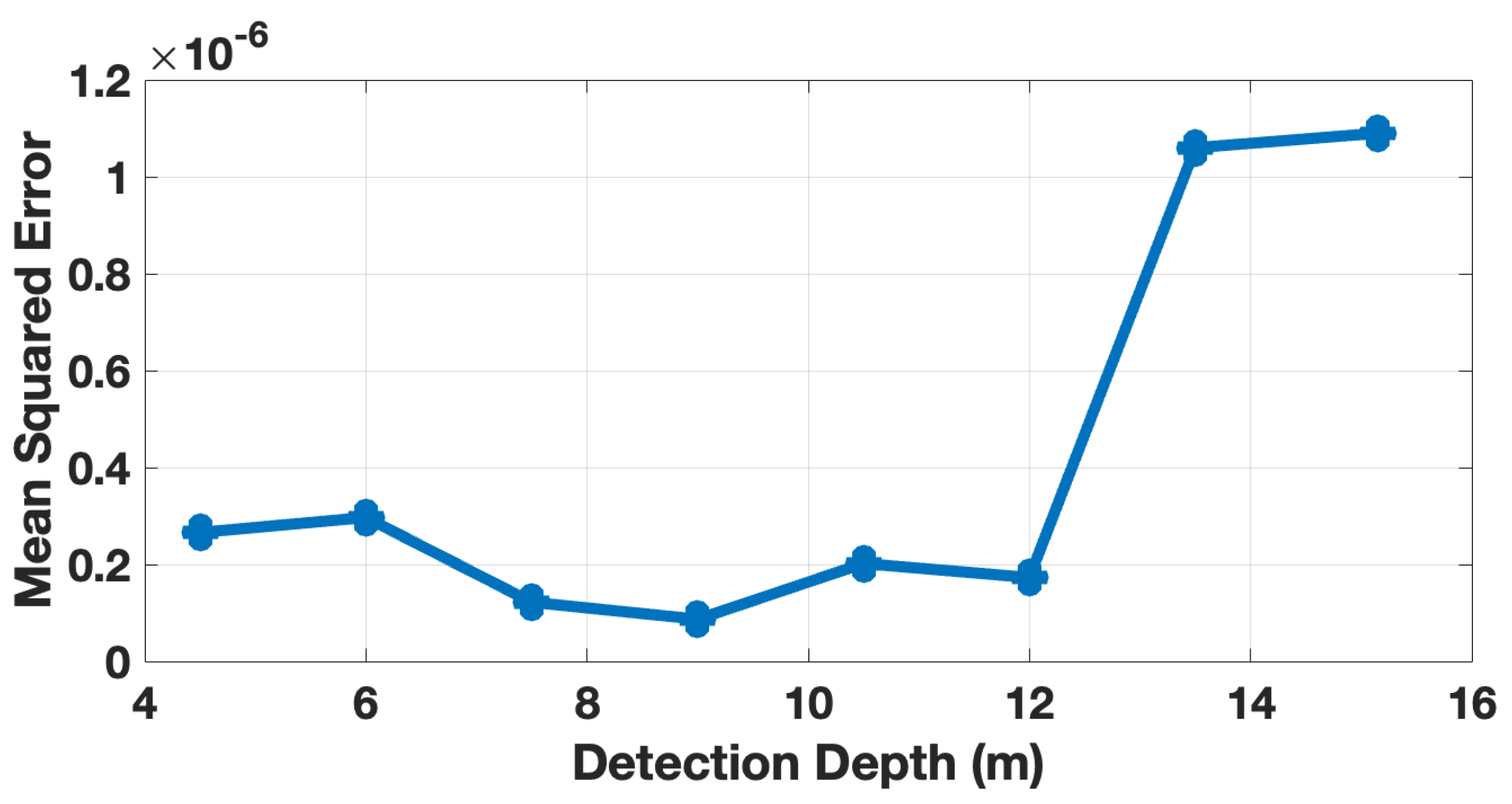
- Neural network training: Three feedforward neural network models were trained using MATLAB’s (Release 2025b) FITNET deep learning toolbox [56]. The inputs consisted of near-surface photon pathlength distributions corresponding to one-way photon travel distances of 6 m, 10 m, and 15 m, e.g., the snow profiles shown in Figure 2. The outputs were the corresponding snow depths and effective scattering mean free paths. Each network included two hidden layers, with 20 neurons in the first layer and 5 neurons in the second layer. Training was performed using randomly selected subsets of the Monte Carlo simulations, while the remaining data were reserved for validation and cross-validation. This procedure ensured that the networks learned robust mappings from photon pathlength distributions to snow properties and were not dependent on a single photon travel distance or subset of the data.
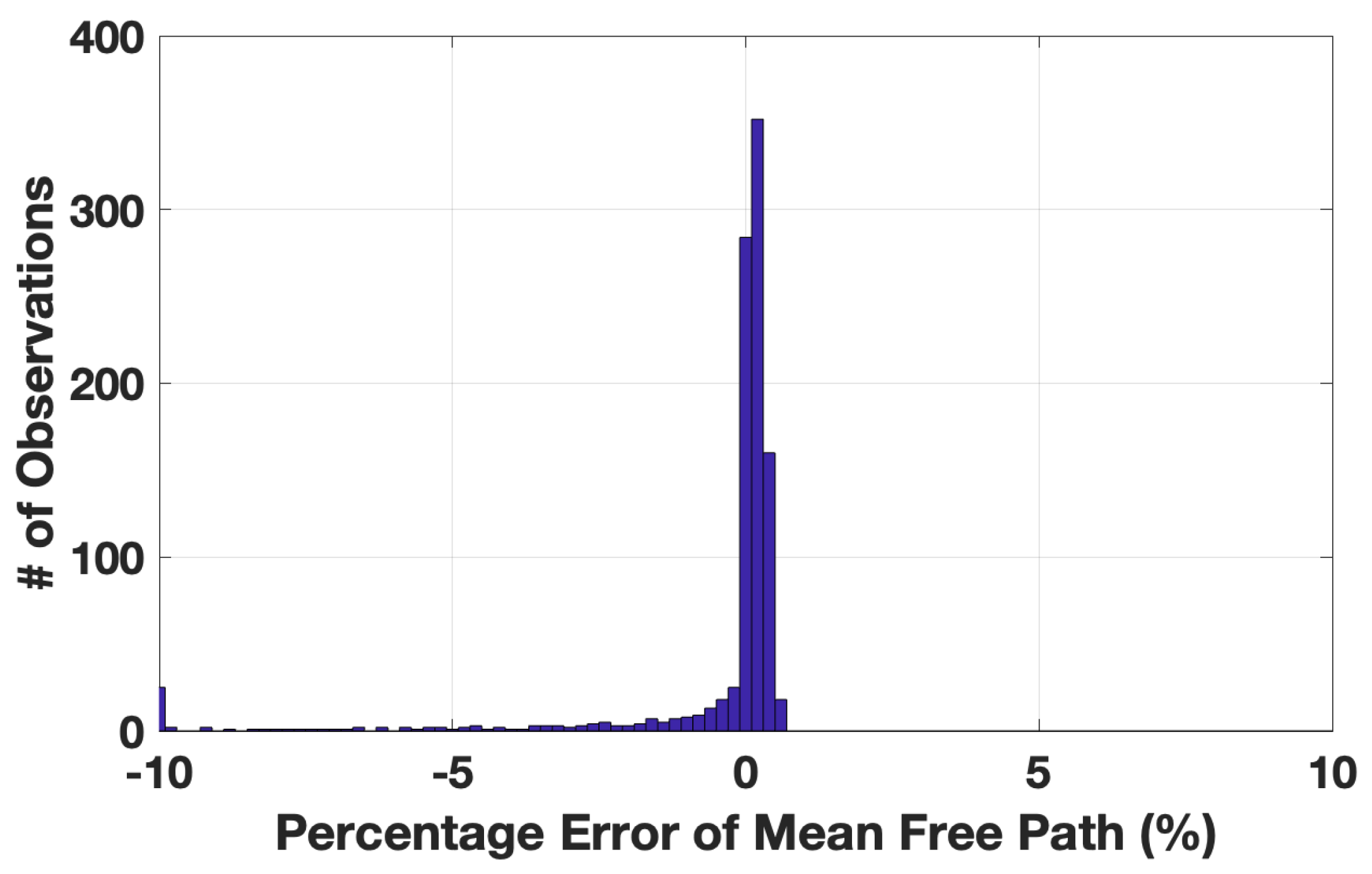
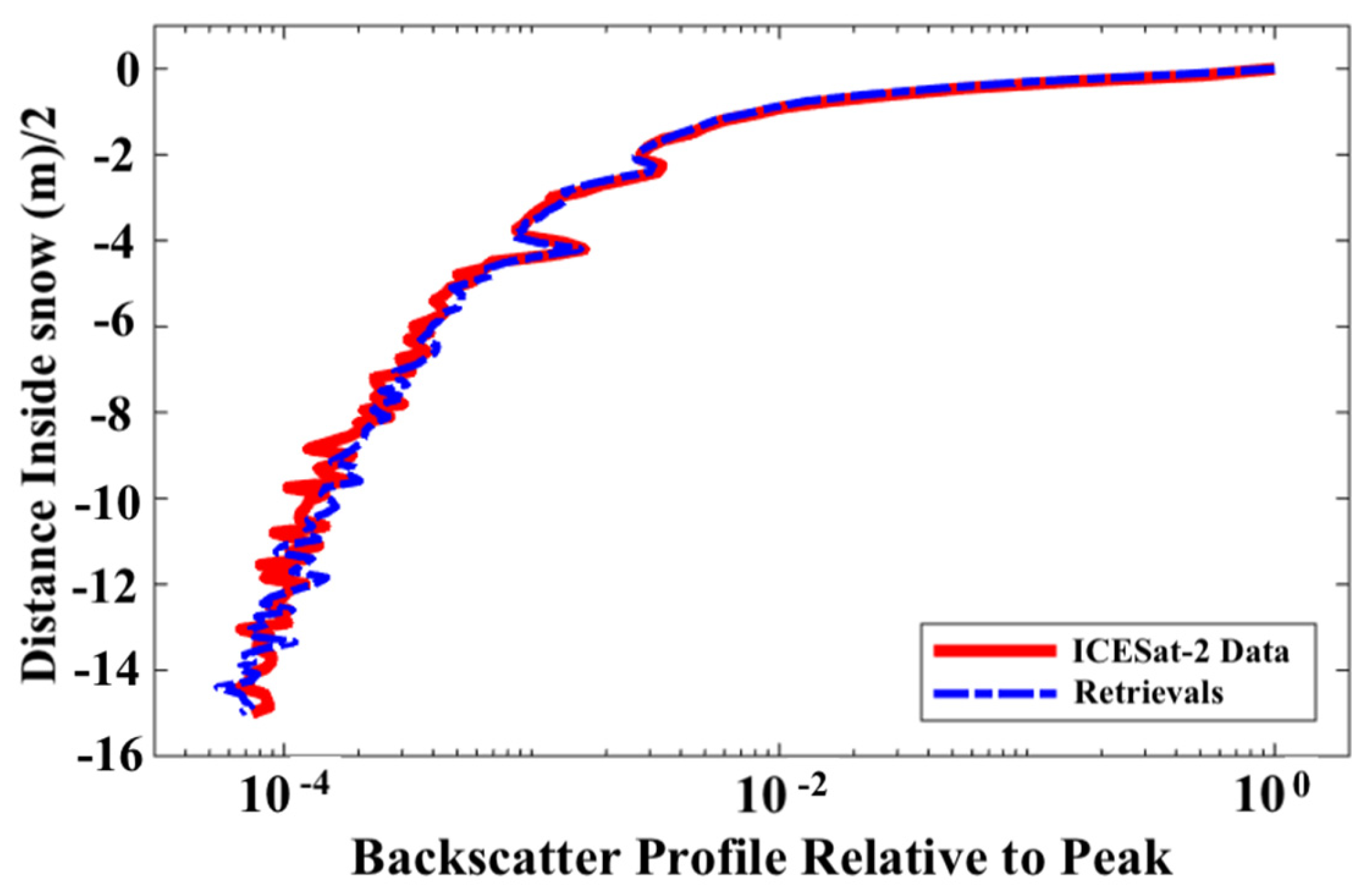
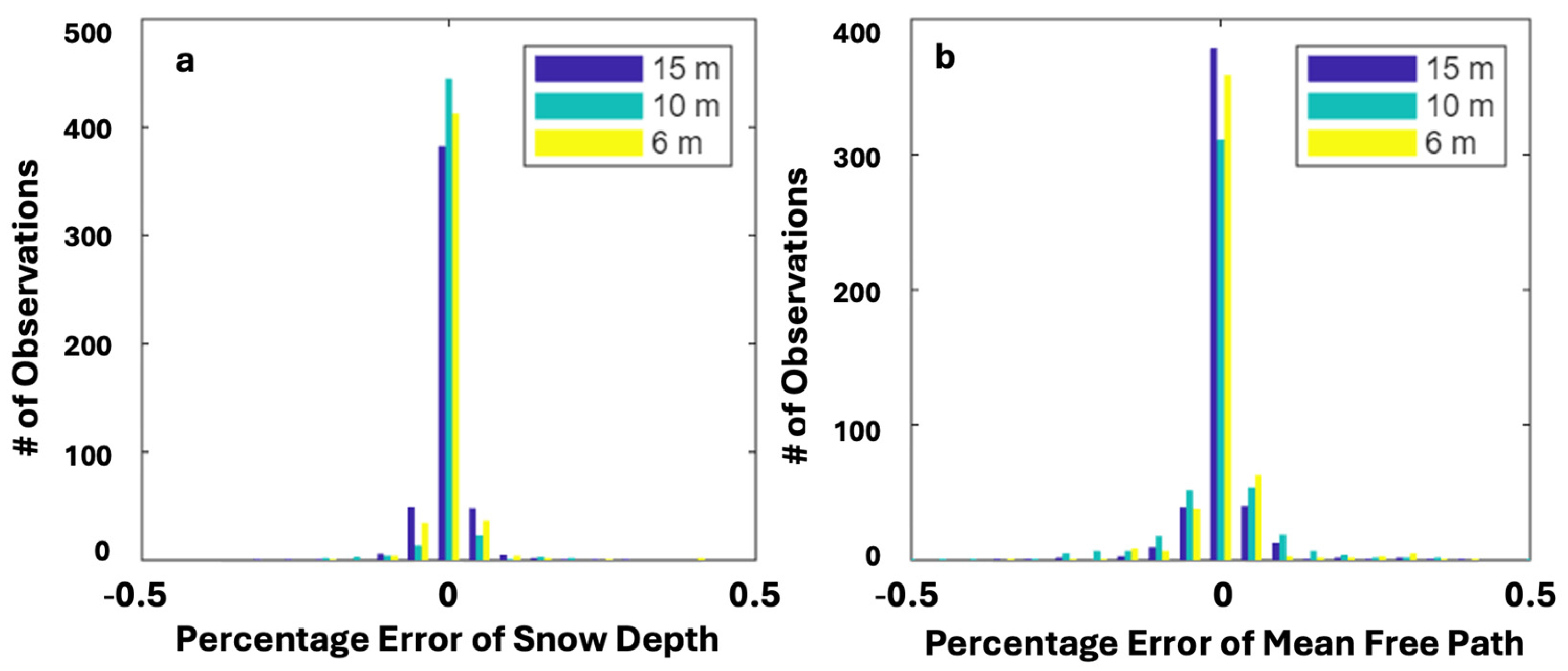
- Validation: The trained networks were applied to the remaining Monte Carlo-simulated lidar profiles, and the retrieved snow depths and mean free paths are compared with the true values used in the simulations to evaluate the retrieval accuracy of the neural networks. Additionally, forward-modeled snow backscatter profiles, generated using the retrieved snow properties by the neural network, were compared to the original simulated profiles to confirm physical and optical consistency.
2.4. Neural Network Architecture
3. Results
4. Conclusions
Author Contributions
Funding
Institutional Review Board Statement
Informed Consent Statement
Data Availability Statement
Acknowledgments
Conflicts of Interest
References
- Ford, C.M.; Kendall, A.D.; Hyndman, D.W. Snowpacks Decrease and Streamflows Shift across the Eastern US as Winters Warm. Sci. Total Environ. 2021, 793, 148483. [Google Scholar] [CrossRef] [PubMed]
- Simpkins, G. Snow-Related Water Woes. Nat. Clim. Chang. 2018, 8, 945. [Google Scholar] [CrossRef]
- Bormann, K.J.; Brown, R.D.; Derksen, C.; Painter, T.H. Estimating Snow-Cover Trends from Space. Nat. Clim. Chang. 2018, 8, 924–928. [Google Scholar] [CrossRef]
- Demil, G.; Haghighi, A.T.; Klöve, B.; Oussalah, M. Advances in Image-Based Estimation of Snow Variable: A Systematic Literature Review on Recent Studies. J. Hydrol. 2025, 654, 132855. [Google Scholar] [CrossRef]
- Gascoin, S.; Luojus, K.; Nagler, T.; Lievens, H.; Masiokas, M.; Jonas, T.; Zheng, Z.; Rosnay, P.D. Remote Sensing of Mountain Snow from Space: Status and Recommendations. Front. Earth Sci. 2024, 12, 1381323. [Google Scholar] [CrossRef]
- Ye, K.; Cohen, J.; Chen, H.W.; Zhang, S.; Luo, D.; Hamouda, M.E. Attributing Climate and Weather Extremes to Northern Hemisphere Sea Ice and Terrestrial Snow: Progress, Challenges and Ways Forward. npj Clim. Atmos. Sci. 2025, 8, 166. [Google Scholar] [CrossRef]
- Qin, Y.; Abatzoglou, J.T.; Siebert, S.; Huning, L.S.; AghaKouchak, A.; Mankin, J.S.; Hong, C.; Tong, D.; Davis, S.J.; Mueller, N.D. Agricultural Risks from Changing Snowmelt. Nat. Clim. Chang. 2020, 10, 459–465. [Google Scholar] [CrossRef]
- Vano, J.A. Implications of Losing Snowpack. Nat. Clim. Chang. 2020, 10, 388–390. [Google Scholar] [CrossRef]
- Groisman, P.Y.; Karl, T.R.; Knight, R.W. Observed Impact of Snow Cover on the Heat Balance and the Rise of Continental Spring Temperatures. Science 1994, 263, 198–200. [Google Scholar] [CrossRef]
- Clow, D.W. Changes in the Timing of Snowmelt and Streamflow in Colorado: A Response to Recent Warming. J. Clim. 2010, 23, 2293–2306. [Google Scholar] [CrossRef]
- Sanders-DeMott, R.; Campbell, J.L.; Groffman, P.M.; Rustad, L.E.; Templer, P.H. Chapter 10—Soil Warming and Winter Snowpacks: Implications for Northern Forest Ecosystem Functioning. In Ecosystem Consequences of Soil Warming; Mohan, J.E., Ed.; Academic Press: Cambridge, MA, USA, 2019; pp. 245–278. ISBN 978-0-12-813493-1. [Google Scholar]
- Westerling, A.L.; Hidalgo, H.G.; Cayan, D.R.; Swetnam, T.W. Warming and Earlier Spring Increase Western U.S. Forest Wildfire Activity. Science 2006, 313, 940–943. [Google Scholar] [CrossRef] [PubMed]
- Dyer, J.L.; Mote, T.L. Spatial Variability and Trends in Observed Snow Depth over North America. Geophys. Res. Lett. 2006, 33, L16503. [Google Scholar] [CrossRef]
- Ryan, W.A.; Doesken, N.J.; Fassnacht, S.R. Evaluation of Ultrasonic Snow Depth Sensors for U.S. Snow Measurements. J. Atmos. Ocean. Technol. 2008, 25, 667–684. [Google Scholar] [CrossRef]
- Macfarlane, A.R.; Schneebeli, M.; Dadic, R.; Wagner, D.N.; Arndt, S.; Clemens-Sewall, D.; Hämmerle, S.; Hannula, H.-R.; Jaggi, M.; Kolabutin, N.; et al. Snowpit Raw Data Collected During the MOSAiC Expedition; PANGAEA, 2021; Available online: https://doi.pangaea.de/10.1594/PANGAEA.935934 (accessed on 27 January 2026).
- Deems, J.S.; Painter, T.H.; Finnegan, D.C. Lidar Measurement of Snow Depth: A Review. J. Glaciol. 2013, 59, 467–479. [Google Scholar] [CrossRef]
- Pirazzini, R.; Leppänen, L.; Picard, G.; Lopez-Moreno, J.I.; Marty, C.; Macelloni, G.; Kontu, A.; von Lerber, A.; Tanis, C.M.; Schneebeli, M.; et al. European In-Situ Snow Measurements: Practices and Purposes. Sensors 2018, 18, 2016. [Google Scholar] [CrossRef]
- Sun-Mack, S.; Hu, Y.; Lu, X.; Chen, Y.; Omar, A. Neural Network-Based Snow Depth Retrieval from AMSR-2 Brightness Temperatures Using ICESat-2 Measurement as Ground Truth. Front. Remote Sens. 2025, 6, 1591276. [Google Scholar] [CrossRef]
- Cavalieri, D.J.; Markus, T.; Comiso, J.C. AMSR-E/Aqua Daily L3 12.5 km Brightness Temperature, Sea Ice Concentration, & Snow Depth Polar Grids, version 3. Archived by National Aeronautics and Space Administration. NASA National Snow and Ice Data Center Distributed Active Archive Center (DAAC): Boulder, CO, USA, 2014. [CrossRef]
- Hall, D.K.; Riggs, G.A. Accuracy Assessment of the MODIS Snow Products. Hydrol. Process. 2007, 21, 1534–1547. [Google Scholar] [CrossRef]
- Barnett, T.P.; Adam, J.C.; Lettenmaier, D.P. Potential Impacts of a Warming Climate on Water Availability in Snow-Dominated Regions. Nature 2005, 438, 303–309. [Google Scholar] [CrossRef]
- Brucker, L.; Markus, T. Arctic-Scale Assessment of Satellite Passive Microwave-Derived Snow Depth on Sea Ice Using Operation IceBridge Airborne Data. J. Geophys. Res. Oceans 2013, 118, 2892–2905. [Google Scholar] [CrossRef]
- Hall, D.K.; Riggs, G.A.; Salomonson, V.V.; DiGirolamo, N.E.; Bayr, K.J. MODIS Snow-Cover Products. Remote Sens. Environ. 2002, 83, 181–194. [Google Scholar] [CrossRef]
- Stillinger, T.; Rittger, K.; Raleigh, M.S.; Michell, A.; Davis, R.E.; Bair, E.H. Landsat, MODIS, and VIIRS Snow Cover Mapping Algorithm Performance as Validated by Airborne Lidar Datasets. Cryosphere 2023, 17, 567–590. [Google Scholar] [CrossRef]
- Kim, E.; Gatebe, C.; Hall, D.; Newlin, J.; Misakonis, A.; Elder, K.; Marshall, H.P.; Hiemstra, C.; Brucker, L.; De Marco, E.; et al. NASA’s Snowex Campaign: Observing Seasonal Snow in a Forested Environment. In Proceedings of the 2017 IEEE International Geoscience and Remote Sensing Symposium (IGARSS), Fort Worth, TX, USA, 23–28 July 2017; pp. 1388–1390. [Google Scholar]
- Newman, T.; Farrell, S.L.; Richter-Menge, J.; Connor, L.N.; Kurtz, N.T.; Elder, B.C.; McAdoo, D. Assessment of Radar-Derived Snow Depth over Arctic Sea Ice. J. Geophys. Res. Oceans 2014, 119, 8578–8602. [Google Scholar] [CrossRef]
- Ying, J.J.; Yang, J.W.; Jiang, L.M.; Pan, J.M.; Zhang, C.; Xiong, C.; Shi, J.C. Evaluation of the Sentinel-1 SAR-Based Snow Depth Product over the Northern Hemisphere. J. Hydrol. 2025, 661, 133593. [Google Scholar] [CrossRef]
- Tedesco, M.; Narvekar, P.S. Assessment of the NASA AMSR-E SWE Product. IEEE J. Sel. Top. Appl. Earth Obs. Remote Sens. 2010, 3, 141–159. [Google Scholar] [CrossRef]
- Markus, T.; Cavalieri, D.J. Snow Depth Distribution Over Sea Ice in the Southern Ocean from Satellite Passive Microwave Data. In Antarctic Sea Ice: Physical Processes, Interactions and Variability; American Geophysical Union (AGU): Washington, DC, USA, 1998; pp. 19–39. ISBN 978-1-118-66824-5. [Google Scholar]
- Fair, Z.; Vuyovich, C.; Neumann, T.; Pflug, J.; Shean, D.; Enderlin, E.M.; Zikan, K.; Besso, H.; Lundquist, J.; Deschamps-Berger, C.; et al. Review Article: Using Spaceborne Lidar for Snow Depth Retrievals: Recent Findings and Utility for Hydrologic Applications. Cryosphere 2025, 19, 5671–5691. [Google Scholar] [CrossRef]
- Sturm, M.; Taras, B.; Liston, G.E.; Derksen, C.; Jonas, T.; Lea, J. Estimating Snow Water Equivalent Using Snow Depth Data and Climate Classes. J. Hydrometeorol. 2010, 11, 1380–1394. [Google Scholar] [CrossRef]
- Stuefer, S.L.; Hale, K.; May, L.D.; Mason, M.; Vuyovich, C.; Marshall, H.-P.; Vas, D.; Elder, K. Snow Depth Measurements from Arctic Tundra and Boreal Forest Collected during NASA SnowEx Alaska Campaign. Sci. Data 2025, 12, 919. [Google Scholar] [CrossRef]
- Markus, T.; Neumann, T.; Martino, A.; Abdalati, W.; Brunt, K.; Csatho, B.; Farrell, S.; Fricker, H.; Gardner, A.; Harding, D.; et al. The Ice, Cloud, and Land Elevation Satellite-2 (ICESat-2): Science Requirements, Concept, and Implementation. Remote Sens. Environ. 2017, 190, 260–273. [Google Scholar] [CrossRef]
- Feng, D.; Che, T.; Wang, G.; Dai, L.; Gao, L.; Jiang, Y.; Wang, J.; Hu, Y.; Xiao, L.; Shi, Y. Seasonal Snow Depth Dataset over Flat Terrains in the Northern Hemisphere Based on ICESat-2 Data from 2018 to 2020. Int. J. Digit. Earth 2025, 18, 2528632. [Google Scholar] [CrossRef]
- Chen, T.; Jiang, L.; Yang, J.; Kong, D.; Pang, Y. An Improvement in ICESat-2 ATL03 Snow Depth Estimation: A Case Study in the Tuolumne Basin, USA. Int. J. Digit. Earth 2025, 18, 2505628. [Google Scholar] [CrossRef]
- Fair, Z.; Vuyovich, C.; Neumann, T.A.; Larsen, C.; Stuefer, S.L.; Mason, M.; May, L.D. Characterizing ICESat-2 Snow Depths Over the Boreal Forests and Tundra of Alaska in Support of the SnowEx 2023 Campaign. Water Resour. Res. 2025, 61, e2024WR039076. [Google Scholar] [CrossRef]
- Kacimi, S.; Kwok, R. The Antarctic Sea Ice Cover from ICESat-2 and CryoSat-2: Freeboard, Snow Depth, and Ice Thickness. Cryosphere 2020, 14, 4453–4474. [Google Scholar] [CrossRef]
- Hu, X.; Hao, X.; Wang, J.; Huang, G.; Li, H.; Yang, Q. Can the Depth of Seasonal Snow Be Estimated from ICESat-2 Products: A Case Investigation in Altay, Northwest China. IEEE Geosci. Remote Sens. Lett. 2022, 19, 2000405. [Google Scholar] [CrossRef]
- Shean, D.E.; Bhushan, S.; Smith, B.E.; Besso, H.; Sutterley, T.C.; Swinski, J.-P.; Henderson, S.T.; Neumann, T.A.; Williams, J.B. Evaluating and Improving Seasonal Snow Depth Retrievals with Satellite Laser Altimetry. In Proceedings of the AGU Fall Meeting, New Orleans, LA, USA, 13–17 December 2021; p. C33B-04. [Google Scholar]
- Deschamps-Berger, C.; Gascoin, S.; Shean, D.; Besso, H.; Guiot, A.; López-Moreno, J.I. Evaluation of Snow Depth Retrievals from ICESat-2 Using Airborne Laser-Scanning Data. Cryosphere 2023, 17, 2779–2792. [Google Scholar] [CrossRef]
- Hu, Y.; Lu, X.; Zeng, X.; Gatebe, C.; Fu, Q.; Yang, P.; Weimer, C.; Stamnes, S.; Baize, R.; Omar, A.; et al. Linking Lidar Multiple Scattering Profiles to Snow Depth and Snow Density: An Analytical Radiative Transfer Analysis and the Implications for Remote Sensing of Snow. Front. Remote Sens. 2023, 4, 1202234. [Google Scholar] [CrossRef]
- Hu, Y.; Lu, X.; Zeng, X.; Stamnes, S.A.; Neuman, T.A.; Kurtz, N.T.; Zhai, P.; Gao, M.; Sun, W.; Xu, K.; et al. Deriving Snow Depth from ICESat-2 Lidar Multiple Scattering Measurements. Front. Remote Sens. 2022, 3, 855159. [Google Scholar] [CrossRef]
- Lu, X.; Hu, Y.; Zeng, X.; Stamnes, S.A.; Neuman, T.A.; Kurtz, N.T.; Yang, Y.; Zhai, P.-W.; Gao, M.; Sun, W.; et al. Deriving Snow Depth from ICESat-2 Lidar Multiple Scattering Measurements: Uncertainty Analyses. Front. Remote Sens. 2022, 3, 891481. [Google Scholar] [CrossRef]
- Magruder, L.; Neumann, T.; Kurtz, N. ICESat-2 Early Mission Synopsis and Observatory Performance. Earth Space Sci. 2021, 8, e2020EA001555. [Google Scholar] [CrossRef]
- Magruder, L.; Brunt, K.; Alonzo, M. Early ICESat-2 on-Orbit Geolocation Validation Using Ground-Based Corner Cube Retro-Reflectors. Remote Sens. 2020, 12, 3653. [Google Scholar] [CrossRef]
- Field, C.; Martino, A.; Ramos-Izquierdo, L. ICESat-2/ATLAS Instrument Linear System Impulse Response. ESS Open Arch. 2020. [Google Scholar] [CrossRef]
- Lu, X.; Hu, Y.; Yang, Y.; Vaughan, M.; Palm, S.; Trepte, C.; Omar, A.; Lucker, P.; Baize, R. Enabling Value Added Scientific Applications of ICESat-2 Data with Effective Removal of Afterpulses. Earth Space Sci. 2021, 8, e2021EA001729. [Google Scholar] [CrossRef] [PubMed]
- Lu, X.; Hu, Y.; Vaughan, M.; Rodier, S.; Trepte, C.; Lucker, P.; Omar, A. New Attenuated Backscatter Profile by Removing the CALIOP Receiver’s Transient Response. J. Quant. Spectrosc. Radiat. Transf. 2020, 255, 107244. [Google Scholar] [CrossRef]
- Li, J.; Hu, Y.; Huang, J.; Stamnes, K.; Yi, Y.; Stamnes, S. A New Method for Retrieval of the Extinction Coefficient of Water Clouds by Using the Tail of the CALIOP Signal. Atmos. Chem. Phys. 2011, 11, 2903–2916. [Google Scholar] [CrossRef]
- Henley, C.A.; Meyer, C.R.; Chalif, J.I.; Hollmann, J.L.; Raskar, R. Measurement of Snowpack Density, Grain Size, and Black Carbon Concentration Using Time-Domain Diffuse Optics. J. Glaciol. 2025, 71, e6. [Google Scholar] [CrossRef]
- Kokhanovsky, A.A.; Zege, E.P. Scattering Optics of Snow. Appl. Opt. 2004, 43, 1589–1602. [Google Scholar] [CrossRef]
- Bohren, C.F.; Barkstrom, B.R. Theory of the Optical Properties of Snow. J. Geophys. Res. 1974, 79, 4527–4535. [Google Scholar] [CrossRef]
- Warren, S.G. Optical Properties of Snow. Rev. Geophys. 1982, 20, 67–89. [Google Scholar] [CrossRef]
- Hu, Y.-X.; Winker, D.; Yang, P.; Baum, B.; Poole, L.; Vann, L. Identification of Cloud Phase from PICASSO-CENA Lidar Depolarization: A Multiple Scattering Sensitivity Study. J. Quant. Spectrosc. Radiat. Transf. 2001, 70, 569–579. [Google Scholar] [CrossRef]
- Lu, X.; Hu, Y.; Yang, Y. Ocean Subsurface Study from ICESat-2 Mission. In Proceedings of the 2019 Photonics & Electromagnetics Research Symposium-Fall (PIERS-Fall), Xiamen, China, 17–20 December 2019; pp. 910–918. [Google Scholar]
- MathWorks Fitnet (Deep Learning Toolbox) [Computer Software]. 2025. Available online: https://www.mathworks.com/help/deeplearning/ref/fitnet.html (accessed on 27 January 2026).
- Yang, Y.; Marshak, A.; Palm, S.P.; Várnai, T.; Wiscombe, W.J. Wiscombe Cloud Impact on Surface Altimetry from a Spaceborne 532-Nm Micropulse Photon-Counting Lidar: System Modeling for Cloudy and Clear Atmospheres. IEEE Trans. Geosci. Remote Sens. 2011, 49, 4910–4919. [Google Scholar] [CrossRef]




Disclaimer/Publisher’s Note: The statements, opinions and data contained in all publications are solely those of the individual author(s) and contributor(s) and not of MDPI and/or the editor(s). MDPI and/or the editor(s) disclaim responsibility for any injury to people or property resulting from any ideas, methods, instructions or products referred to in the content. |
© 2026 by the authors. Licensee MDPI, Basel, Switzerland. This article is an open access article distributed under the terms and conditions of the Creative Commons Attribution (CC BY) license.
Share and Cite
Zhou, Y.; Hu, K.; Lu, X. Neural Network Algorithms for Estimating Snow Depth and Scattering Mean Free Path from ICESat-2 Measurements of Multiple Scattering Inside Snow. Atmosphere 2026, 17, 151. https://doi.org/10.3390/atmos17020151
Zhou Y, Hu K, Lu X. Neural Network Algorithms for Estimating Snow Depth and Scattering Mean Free Path from ICESat-2 Measurements of Multiple Scattering Inside Snow. Atmosphere. 2026; 17(2):151. https://doi.org/10.3390/atmos17020151
Chicago/Turabian StyleZhou, Yinuo, Kyle Hu, and Xiaomei Lu. 2026. "Neural Network Algorithms for Estimating Snow Depth and Scattering Mean Free Path from ICESat-2 Measurements of Multiple Scattering Inside Snow" Atmosphere 17, no. 2: 151. https://doi.org/10.3390/atmos17020151
APA StyleZhou, Y., Hu, K., & Lu, X. (2026). Neural Network Algorithms for Estimating Snow Depth and Scattering Mean Free Path from ICESat-2 Measurements of Multiple Scattering Inside Snow. Atmosphere, 17(2), 151. https://doi.org/10.3390/atmos17020151