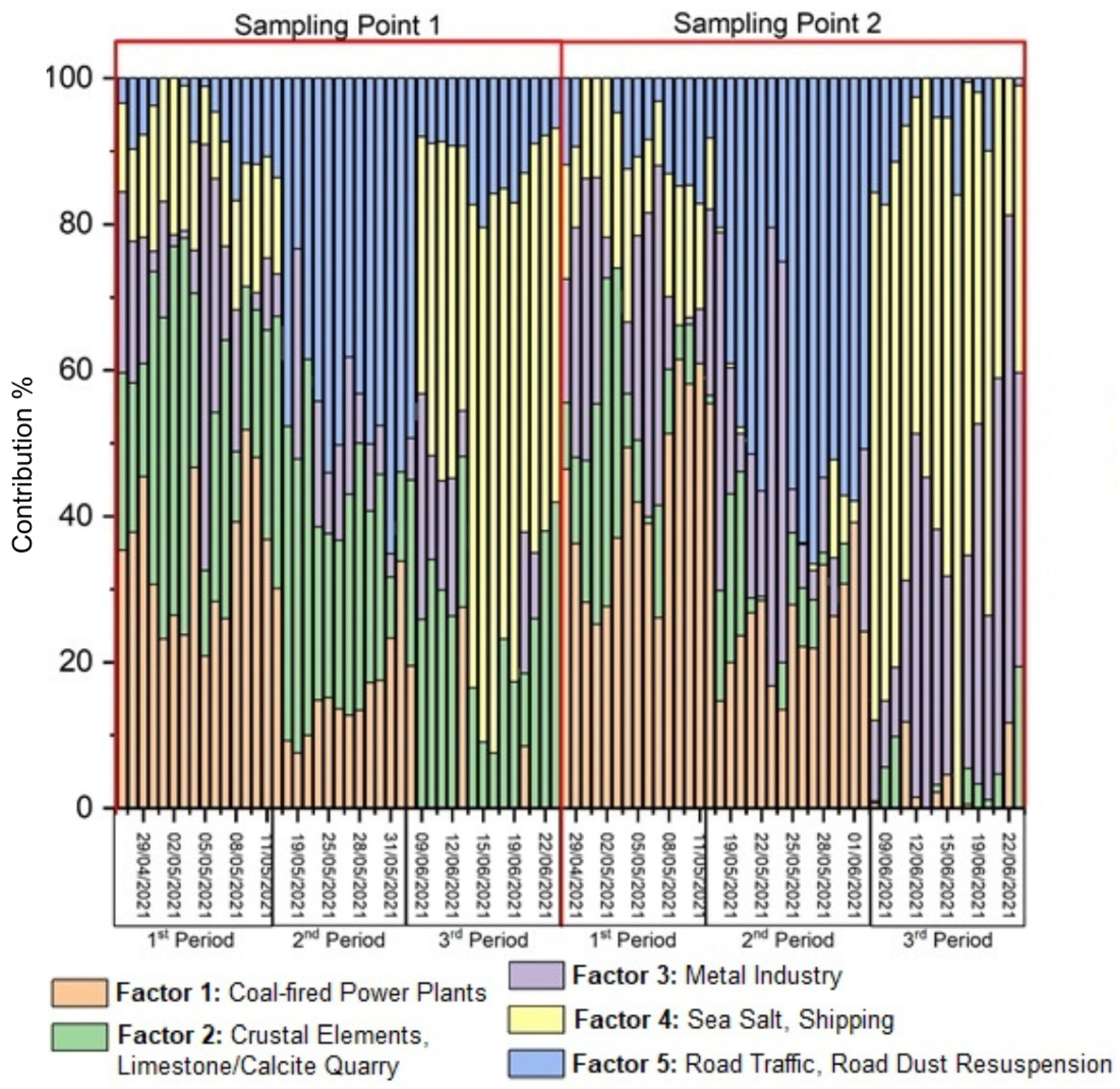



Source Apportionment of PM10 in Biga, Canakkale, Turkiye Using Positive Matrix Factorization

Abstract
1. Introduction
2. Materials and Methods
2.1. Study Area
2.2. Sampling and Analysis of Metals
2.3. PMF Analysis
- Preparation of data to be modeled
- -
- Generation of uncertainty values for the data set
- Processing data into PMF to develop a viable and stable solution
- -
- Interpretation of the solution and selection of the most appropriate number of factors
- -
- Subtraction of incompatible values [59]
2.3.1. Development of the Dataset
- Samples (rows of the data matrix) where any measurement is missing are eliminated.
- Parameters are entirely removed from the PMF analysis, where a large percentage of measurement results for the relevant parameter are missing.
- A value is assigned, and uncertainty is associated with that value so that the relevant data has less impact on PMF modeling. A standard procedure for this third approach is to assign the arithmetic or geometric mean as the parameter value for missing values and to use 3 or 4 times the mean concentration as the uncertainty value [59]. S. Huang et al. concluded that mean substitution yielded superior PMF results over deletion on a case-by-case basis [62].
2.3.2. Model Input Data Selection
3. Results and Discussion
3.1. PM10 Levels in the Study Area
3.2. Data Analysis and Modeling
3.3. Identification of Sources
3.3.1. Factor 1—Coal-Fired Power Plants
3.3.2. Factor 2—Crustal Elements, Limestone/Calcite Quarry
3.3.3. Factor 3—Metal Industry
3.3.4. Factor 4—Sea Salt, Shipping
3.3.5. Factor 5—Road Traffic, Road Dust Resuspension
4. Conclusions
Supplementary Materials
Author Contributions
Funding
Institutional Review Board Statement
Informed Consent Statement
Data Availability Statement
Acknowledgments
Conflicts of Interest
References
- Sari, D.; Incecik, S.; Ozkurt, N. Analysis of surface ozone episodes using WRF-HYSPLIT model at Biga Peninsula in the Marmara region of Turkey. Atmos. Pollut. Res. 2020, 11, 2361–2378. [Google Scholar] [CrossRef]
- Bodor, Z.; Bodor, K.; Keresztesi, Á.; Szép, R. Major air pollutants seasonal variation analysis and long-range transport of PM 10 in an urban environment with specific climate condition in Transylvania (Romania). Environ. Sci. Pollut. Res. 2020, 27, 38181–38199. [Google Scholar] [CrossRef] [PubMed]
- Ari, A.; Ertürk Ari, P.; Gaga, E.O. Source apportionment of primary and secondary fine particulate matter in Eskisehir/Türkiye using conventional and dispersion-normalized positive matrix factorization. Atmos. Pollut. Res. 2025, 16, 102653. [Google Scholar] [CrossRef]
- Yatkin, S.; Bayram, A. Source apportionment of PM10 and PM2.5 using positive matrix factorization and chemical mass balance in Izmir, Turkey. Sci. Total Environ. 2008, 390, 109–123. [Google Scholar] [CrossRef]
- EPA. Criteria Air Pollutants. Available online: https://www.epa.gov/criteria-air-pollutants#:~:text=The%20Clean%20Air%20Act%20requires,known%20as%20%22%20criteria%20air%20pollutants (accessed on 8 July 2022).
- Samoli, E.; Stafoggia, M.; Rodopoulou, S.; Ostro, B.; Alessandrini, E.; Basagaña, X.; Díaz, J.; Faustini, A.; Gandini, M.; Karanasiou, A.; et al. Which specific causes of death are associated with short term exposure to fine and coarse particles in Southern Europe? Results from the MED-PARTICLES project. Environ. Int. 2014, 67, 54–61. [Google Scholar] [CrossRef]
- Manisalidis, I.; Stavropoulou, E.; Stavropoulos, A.; Bezirtzoglou, E. Environmental and health impacts of air pollution: A review. Front. Public Health 2020, 8, 14. [Google Scholar] [CrossRef] [PubMed] [PubMed Central]
- Samoli, E.; Stafoggia, M.; Rodopoulou, S.; Ostro, B.; Declercq, C.; Alessandrini, E.; Díaz, J.; Karanasiou, A.; Kelessis, A.G.; Le Tertre, A.; et al. Associations between fine and coarse particles and mortality in Mediterranean cities: Results from the MED-PARTICLES project. Environ. Health Perspect. 2013, 121, 932–938. [Google Scholar] [CrossRef]
- Jain, S.; Sharma, S.; Mandal, T.; Saxena, M. Source apportionment of PM10 in Delhi, India using PCA/APCS, UNMIX and PMF. Particuology 2018, 37, 107–118. [Google Scholar] [CrossRef]
- Eleftheriadis, K.; Ochsenkuhn, K.M.; Lymperopoulou, T.; Karanasiou, A.; Razos, P.; Ochsenkuhn-Petropoulou, M. Influence of local and regional sources on the observed spatial and temporal variability of size resolved atmospheric aerosol mass concentrations and water-soluble species in the Athens metropolitan area. Atmos. Environ. 2014, 97, 252–261. [Google Scholar] [CrossRef]
- Naidja, L.; Ali-Khodja, H.; Khardi, S. Sources and levels of particulate matter in North African and Sub-Saharan cities: A literature review. Environ. Sci. Pollut. Res. 2018, 25, 12303–12328. [Google Scholar] [CrossRef]
- Dockery, D.W.; Pope, C.A., 3rd. Acute respiratory effects of particulate air pollution. Annu. Rev. Public Health 1994, 15, 107–132. [Google Scholar] [CrossRef] [PubMed]
- Tang, H.; Cheng, Z.; Li, N.; Mao, S.; Ma, R.; He, H.; Niu, Z.; Chen, X.; Xiang, H. The short-and long-term associations of particulate matter with inflammation and blood coagulation markers: A meta-analysis. Environ. Pollut. 2020, 267, 115630. [Google Scholar] [CrossRef] [PubMed]
- Natusch, D.F.S.; Wallace, J.R.; Evans, C.A. Toxic Trace Elements: Preferential Concentration in Respirable Particles. Science 1974, 183, 202–204. [Google Scholar] [CrossRef] [PubMed]
- EPA. Health and Environmental Effects of Particulate Matter (PM). Available online: https://www.epa.gov/pm-pollution/health-and-environmental-effects-particulate-matter-pm (accessed on 8 July 2022).
- Almeida, S.; Manousakas, M.; Diapouli, E.; Kertesz, Z.; Samek, L.; Hristova, E.; Šega, K.; Alvarez, R.P.; Belis, C.; Eleftheriadis, K. Ambient particulate matter source apportionment using receptor modelling in European and Central Asia urban areas. Environ. Pollut. 2020, 266, 115199. [Google Scholar] [CrossRef]
- Dai, T.; Dai, Q.; Yin, J.; Chen, J.; Liu, B.; Bi, X.; Wu, J.; Zhang, Y.; Feng, Y. Spatial source apportionment of airborne coarse particulate matter using PMF-Bayesian receptor model. Sci. Total Environ. 2024, 917, 170235. [Google Scholar] [CrossRef]
- Hsu, C.-Y.; Chiang, H.-C.; Lin, S.-L.; Chen, M.-J.; Lin, T.-Y.; Chen, Y.-C. Elemental characterization and source apportionment of PM10 and PM2.5 in the western coastal area of central Taiwan. Sci. Total Environ. 2016, 541, 1139–1150. [Google Scholar] [CrossRef]
- Lim, J.-M.; Lee, J.-H.; Moon, J.-H.; Chung, Y.-S.; Kim, K.-H. Source apportionment of PM10 at a small industrial area using Positive Matrix Factorization. Atmos. Res. 2010, 95, 88–100. [Google Scholar] [CrossRef]
- Galvão, E.S.; de Cassia Feroni, R.; Orlando, M.T.D.A. A review of the main strategies used in the interpretation of similar chemical profiles yielded by receptor models in the source apportionment of particulate matter. Chemosphere 2021, 269, 128746. [Google Scholar] [CrossRef]
- Kara, M.; Hopke, P.K.; Dumanoglu, Y.; Altiok, H.; Elbir, T.; Odabasi, M.; Bayram, A. Characterization of PM Using Multiple Site Data in a Heavily Industrialized Region of Turkey. Aerosol Air Qual. Res. 2015, 15, 11–27. [Google Scholar] [CrossRef]
- Kumar, S.; Raman, R.S. Source apportionment of fine particulate matter over a National Park in Central India. Sci. Total Environ. 2020, 720, 137511. [Google Scholar] [CrossRef]
- Viana, M.; Amato, F.; Alastuey, A.; Querol, X.; Moreno, T.; García Dos Santos, S.; Herce, M.D.; Fernández-Patier, R. Chemical Tracers of Particulate Emissions from Commercial Shipping. Environ. Sci. Technol. 2009, 43, 7472–7477. [Google Scholar] [CrossRef]
- Schauer, J.J.; Rogge, W.F.; Hildemann, L.M.; Mazurek, M.A.; Cass, G.R.; Simoneit, B.R.T. Source apportionment of airborne particulate matter using organic compounds as tracers. Atmos. Environ. 1996, 30, 3837–3855. [Google Scholar] [CrossRef]
- Villalobos, A.M.; Barraza, F.; Jorquera, H.; Schauer, J.J. Wood burning pollution in southern Chile: PM2.5 source apportionment using CMB and molecular markers. Environ. Pollut. 2017, 225, 514–523. [Google Scholar] [CrossRef] [PubMed]
- Paatero, P.; Tapper, U. Positive matrix factorization: A non-negative factor model with optimal utilization of error estimates of data values. Environmetrics 1994, 5, 111–126. [Google Scholar] [CrossRef]
- Yazman, M.M.; Ustaoğlu, F.; Yüksel, B. Nutritional profiling of Oncorhynchus mykiss from Çamlıgöze Dam, Türkiye: Health risk assessment through Monte Carlo simulation and elemental source attribution using positive matrix factorization. Process Saf. Environ. Prot. 2025, 198, 107172. [Google Scholar] [CrossRef]
- Demir, T.; Karakaş, D.; Yenisoy-Karakaş, S. Source identification of exhaust and non-exhaust traffic emissions through the elemental carbon fractions and Positive Matrix Factorization method. Environ. Res. 2022, 204, 112399. [Google Scholar] [CrossRef]
- Javed, W.; Guo, B. Chemical characterization and source apportionment of fine and coarse atmospheric particulate matter in Doha, Qatar. Atmos. Pollut. Res. 2021, 12, 122–136. [Google Scholar] [CrossRef]
- Dörter, M.; Karadeniz, H.; Saklangıç, U.; Yenisoy-Karakaş, S. The use of passive lichen biomonitoring in combination with positive matrix factor analysis and stable isotopic ratios to assess the metal pollution sources in throughfall deposition of Bolu plain, Turkey. Ecol. Indic. 2020, 113, 106212. [Google Scholar] [CrossRef]
- Celik-Saglam, I.; Yurtsever, M.; Civan, M.; Yurdakul, S.; Cetin, B. Evaluation of levels and sources of microplastics and phthalic acid esters and their relationships in the atmosphere of highly industrialized and urbanized Gebze, Türkiye. Sci. Total Environ. 2023, 881, 163508. [Google Scholar] [CrossRef]
- Lage, J.; Wolterbeek, H.T.; Reis, M.A.; Chaves, P.C.; Garcia, S.; Almeida, S.M. Source apportionment by positive matrix factorization on elemental concentration obtained in PM10 and biomonitors collected in the vicinities of a steelworks. J. Radioanal. Nucl. Chem. 2016, 309, 397–404. [Google Scholar] [CrossRef]
- Çulha, S.T.; Yabanlı, M.; Baki, B.; Yozukmaz, A. Heavy metals in tissues of scorpionfish (Scorpaena porcus) caught from Black Sea (Turkey) and potential risks to human health. Environ. Sci. Pollut. Res. Int. 2016, 23, 20882–20892. [Google Scholar] [CrossRef] [PubMed]
- Sanli, G.; Celik, S.; Joubi, V.; Tasdemir, Y. Concentrations, phase exchanges and source apportionment of polycyclic aromatic hydrocarbons (PAHs) In Bursa-Turkey. Environ. Res. 2023, 232, 116344. [Google Scholar] [CrossRef] [PubMed]
- Ouyang, W.; Guo, B.; Cai, G.; Li, Q.; Han, S.; Liu, B.; Liu, X. The washing effect of precipitation on particulate matter and the pollution dynamics of rainwater in downtown Beijing. Sci. Total Environ. 2015, 505, 306–314. [Google Scholar] [CrossRef] [PubMed]
- McMullen, N.; Annesi-Maesano, I.; Renard, J.-B. Impact of Rain Precipitation on Urban Atmospheric Particle Matter Measured at Three Locations in France between 2013 and 2019. Atmosphere 2021, 12, 769. [Google Scholar] [CrossRef]
- MoEUCC. Canakkale City Environmental Status Report—2021 (Canakkale İli 2021 Yılı Çevre Durum Raporu). Available online: https://webdosya.csb.gov.tr/db/ced/icerikler/canakkale_-cdr2021-20221216112021.pdf (accessed on 18 December 2025).
- Sari, D.; İncecik, S.; Ozkurt, N. Surface ozone levels in the forest and vegetation areas of the Biga Peninsula, Turkey. Sci. Total Environ. 2016, 571, 1284–1297. [Google Scholar] [CrossRef]
- Hassan, H.; Latif, M.T.; Juneng, L.; Amil, N.; Khan, M.F.; Yik, D.J.; Abdullah, N.A. Interaction of PM10 concentrations with local and synoptic meteorological conditions at different temporal scales. Atmos. Res. 2020, 241, 104975. [Google Scholar] [CrossRef]
- Kim, Y.M.; Kim, J.; Han, Y.; Jeon, B.H.; Cheong, H.K.; Ahn, K. Short-term effects of weather and air pollution on atopic dermatitis symptoms in children: A panel study in Korea. PLoS ONE 2017, 12, e0175229. [Google Scholar] [CrossRef]
- MoEUCC. Integrated Environmental Information System. Available online: https://eizin.cevre.gov.tr/ (accessed on 1 January 2021).
- Duan, J.; Tan, J. Atmospheric heavy metals and Arsenic in China: Situation, sources and control policies. Atmos. Environ. 2013, 74, 93–101. [Google Scholar] [CrossRef]
- Li, W.; Dryfhout-Clark, H.; Hung, H. PM10-bound trace elements in the Great Lakes Basin (1988–2017) indicates effectiveness of regulatory actions, variations in sources and reduction in human health risks. Environ. Int. 2020, 143, 106008. [Google Scholar] [CrossRef]
- Huang, Y.; Deng, M.; Li, T.; Japenga, J.; Chen, Q.; Yang, X.; He, Z. Anthropogenic mercury emissions from 1980 to 2012 in China. Environ. Pollut. 2017, 226, 230–239. [Google Scholar] [CrossRef]
- Agyeman, P.C.; Ahado, S.K.; John, K.; Kebonye, N.M.; Vašát, R.; Borůvka, L.; Kočárek, M.; Němeček, K. Health risk assessment and the application of CF-PMF: A pollution assessment–based receptor model in an urban soil. J. Soils Sediments 2021, 21, 3117–3136. [Google Scholar] [CrossRef]
- Ogundele, L.T.; Owoade, O.K.; Olise, F.S.; Hopke, P.K. Source identification and apportionment of PM2.5 and PM2.5−10 in iron and steel scrap smelting factory environment using PMF, PCFA and UNMIX receptor models. Environ. Monit. Assess. 2016, 188, 574. [Google Scholar] [CrossRef]
- Saraga, D.E.; Tolis, E.I.; Maggos, T.; Vasilakos, C.; Bartzis, J.G. PM2.5 source apportionment for the port city of Thessaloniki, Greece. Sci. Total Environ. 2019, 650, 2337–2354. [Google Scholar] [CrossRef] [PubMed]
- Biegalski, S.R.; Hopke, P.K. Total potential source contribution function analysis of trace elements determined in aerosol samples collected near Lake Huron. Environ. Sci. Technol. 2004, 38, 4276–4284. [Google Scholar] [CrossRef] [PubMed]
- Pio, C.A.; Cerqueira, M.A.; Castro, L.M.; Salgueiro, M.L. Sulphur and nitrogen compounds in variable marine/continental air masses at the southwest European coast. Atmos. Environ. 1996, 30, 3115–3127. [Google Scholar] [CrossRef]
- Pey, J.; Pérez, N.; Cortés, J.; Alastuey, A.; Querol, X. Chemical fingerprint and impact of shipping emissions over a western Mediterranean metropolis: Primary and aged contributions. Sci. Total Environ. 2013, 463–464, 497–507. [Google Scholar] [CrossRef]
- Boamponsem, L.K.; de Freitas, C.R.; Williams, D. Source apportionment of air pollutants in the Greater Auckland Region of New Zealand using receptor models and elemental levels in the lichen, Parmotrema reticulatum. Atmos. Pollut. Res. 2017, 8, 101–113. [Google Scholar] [CrossRef]
- Morawska, L.; Zhang, J.J. Combustion sources of particles. 1. Health relevance and source signatures. Chemosphere 2002, 49, 1045–1058. [Google Scholar] [CrossRef]
- Zhang, Y.; Cao, S.; Xu, X.; Qiu, J.; Chen, M.; Wang, D.; Guan, D.; Wang, C.; Wang, X.; Dong, B.; et al. Metals compositions of indoor PM2.5, health risk assessment, and birth outcomes in Lanzhou, China. Environ. Monit. Assess. 2016, 188, 325. [Google Scholar] [CrossRef]
- Waked, A.; Favez, O.; Alleman, L.Y.; Piot, C.; Petit, J.E.; Delaunay, T.; Verlinden, E.; Golly, B.; Besombes, J.L.; Jaffrezo, J.L.; et al. Source apportionment of PM10 in a north-western Europe regional urban background site (Lens, France) using positive matrix factorization and including primary biogenic emissions. Atmos. Chem. Phys. 2014, 14, 3325–3346. [Google Scholar] [CrossRef]
- Lucarelli, F.; Mandò, P.A.; Nava, S.; Prati, P.; Zucchiatti, A. One-year study of the elemental composition and source apportionment of PM10 aerosols in Florence, Italy. J. Air Waste Manag. Assoc. 2004, 54, 1372–1382. [Google Scholar] [CrossRef]
- TS-EN-12341; Ambient Air—Standard Gravimetric Measurement Method for the Determination of the PM10 or PM2,5 Mass Concentration of Suspended Particulate Matter. Turkish Standards Institute: Ankara, Turkey, 2023.
- EPA. EPA Positive Matrix Factorization (PMF) 5.0 Fundamentals and User Guide. Available online: https://www.epa.gov/scram/air-quality-dispersion-modeling-preferred-and-recommended-models#aermod (accessed on 1 January 2021).
- Işıkdemir, Ö.; Pekey, H.; Doğan, G.; Tuncel, G. Doğu Akdeniz Bölgesi Yağmur Suyu Kompozisyonunu Etkileyen Kaynaklarin Pozitif Matris Faktörizasyonu Ile Belirlenmesi. In Proceedings of the 3rd National Air Pollution and Control Symposium, Hatay, Turkey, 22–25 October 2008; pp. 355–363. [Google Scholar]
- Reff, A.; Eberly, S.I.; Bhave, P.V. Receptor Modeling of Ambient Particulate Matter Data Using Positive Matrix Factorization: Review of Existing Methods. J. Air Waste Manag. Assoc. 2007, 57, 146–154. [Google Scholar] [CrossRef]
- Hopke, P.K.; Cohen, D.D. Application of receptor modeling methods. Atmos. Pollut. Res. 2011, 2, 122–125. [Google Scholar] [CrossRef]
- Polissar, A.V.; Hopke, P.K.; Paatero, P.; Malm, W.C.; Sisler, J.F. Atmospheric aerosol over Alaska: 2. Elemental composition and sources. J. Geophys. Res. Atmos. 1998, 103, 19045–19057. [Google Scholar] [CrossRef]
- Huang, S.; Rahn, K.A.; Arimoto, R. Testing and optimizing two factor-analysis techniques on aerosol at Narragansett, Rhode Island. Atmos. Environ. 1999, 33, 2169–2185. [Google Scholar] [CrossRef]
- Abdullahi, K.; Delgado-Saborit, J.; Harrison, R.M. Sensitivity of a Chemical Mass Balance model for PM2.5 to source profiles for differing styles of cooking. Atmos. Environ. 2018, 178, 282–285. [Google Scholar] [CrossRef]
- Zhang, Y.; Sheesley, R.J.; Bae, M.-S.; Schauer, J.J. Sensitivity of a molecular marker based positive matrix factorization model to the number of receptor observations. Atmos. Environ. 2009, 43, 4951–4958. [Google Scholar] [CrossRef]
- Men, C.; Liu, R.; Wang, Q.; Guo, L.; Miao, Y.; Shen, Z. Uncertainty analysis in source apportionment of heavy metals in road dust based on positive matrix factorization model and geographic information system. Sci. Total Environ. 2019, 652, 27–39. [Google Scholar] [CrossRef]
- Hopke, P.K. Discussion of “Sensitivity of a molecular marker based positive matrix factorization model to the number of receptor observations” by YuanXun Zhang, Rebecca J. Sheesley, Min-Suk Bae and James J. Schauer. Atmos. Environ. 2010, 44, 1138. [Google Scholar] [CrossRef]
- Feng, J.; Song, N.; Li, Y. An in-depth investigation of the influence of sample size on PCA-MLR, PMF, and FA-NNC source apportionment results. Environ. Geochem. Health 2023, 45, 5841–5855. [Google Scholar] [CrossRef]
- Fernández-Olmo, I.; Andecochea, C.; Ruiz, S.; Fernández-Ferreras, J.A.; Irabien, A. Local source identification of trace metals in urban/industrial mixed land-use areas with daily PM10 limit value exceedances. Atmos. Res. 2016, 171, 92–106. [Google Scholar] [CrossRef]
- Pacyna, J.M.; Pacyna, E.G. An assessment of global and regional emissions of trace metals to the atmosphere from anthropogenic sources worldwide. Environ. Rev. 2001, 9, 269–298. [Google Scholar] [CrossRef]
- MoEUCC. National Air Quality Monitoring Network (Ulusal Hava Kalitesi İzleme Ağı). Available online: https://sim.csb.gov.tr/Services/AirQuality (accessed on 18 May 2022).
- MoEU. Air Quality Assessment and Management Regulation (Hava Kalitesi Değerlendirme ve Yönetimi Yönetmeliği). Available online: https://www.mevzuat.gov.tr/Metin.Aspx?MevzuatKod=7.5.12188&MevzuatIliski=0&sourceXmlSearch=hava%20kalitesi (accessed on 1 December 2017).
- Sofowote, U.M.; Su, Y.; Dabek-Zlotorzynska, E.; Rastogi, A.K.; Brook, J.; Hopke, P.K. Sources and temporal variations of constrained PMF factors obtained from multiple-year receptor modeling of ambient PM2.5 data from five speciation sites in Ontario, Canada. Atmos. Environ. 2015, 108, 140–150. [Google Scholar] [CrossRef]
- Shu, Q.; Pei, C.; Lin, X.; Hong, D.; Lai, S.; Zhang, Y. Variations of aminiums in fine particles at a suburban site in Guangzhou, China: Importance of anthropogenic and natural emissions. Particuology 2023, 80, 140–147. [Google Scholar] [CrossRef]
- Taghvaee, S.; Sowlat, M.H.; Hassanvand, M.S.; Yunesian, M.; Naddafi, K.; Sioutas, C. Source-specific lung cancer risk assessment of ambient PM2.5-bound polycyclic aromatic hydrocarbons (PAHs) in central Tehran. Environ. Int. 2018, 120, 321–332. [Google Scholar] [CrossRef] [PubMed]
- Liu, K.; Wang, S.; Wu, Q.; Wang, L.; Ma, Q.; Zhang, L.; Li, G.; Tian, H.; Duan, L.; Hao, J. A Highly Resolved Mercury Emission Inventory of Chinese Coal-Fired Power Plants. Environ. Sci. Technol. 2018, 52, 2400–2408. [Google Scholar] [CrossRef]
- Lv, J.; Wang, Y. PMF receptor models and sequential Gaussian simulation to determine the quantitative sources and hazardous areas of potentially toxic elements in soils. Geoderma 2019, 353, 347–358. [Google Scholar] [CrossRef]
- Alloway, B.J. Heavy Metals in Soils: Trace Metals and Metalloids in Soils and Their Bioavailability; Springer Science & Business Media: Berlin, Germany, 2012; Volume 22. [Google Scholar]
- Manousakas, M.; Diapouli, E.; Papaefthymiou, H.; Migliori, A.; Karydas, A.G.; Padilla-Alvarez, R.; Bogovac, M.; Kaiser, R.B.; Jaksic, M.; Bogdanovic-Radovic, I.; et al. Source apportionment by PMF on elemental concentrations obtained by PIXE analysis of PM10 samples collected at the vicinity of lignite power plants and mines in Megalopolis, Greece. Nucl. Instrum. Methods Phys. Res. Sect. B Beam Interact. Mater. At. 2015, 349, 114–124. [Google Scholar] [CrossRef]
- Clemente, Á.; Yubero, E.; Galindo, N.; Crespo, J.; Nicolás, J.F.; Santacatalina, M.; Carratala, A. Quantification of the impact of port activities on PM10 levels at the port-city boundary of a mediterranean city. J. Environ. Manag. 2021, 281, 111842. [Google Scholar] [CrossRef]




| Month | Average Total Precipitation | Number of Rainy Days |
|---|---|---|
| January | 72.98 | 13.2 |
| February | 58.34 | 10.6 |
| March | 53.02 | 12 |
| April | 44.96 | 7.9 |
| May | 25.72 | 5.4 |
| June | 26.58 | 5.5 |
| July | 7.72 | 1.9 |
| August | 12.56 | 1.4 |
| September | 38.82 | 3.9 |
| October | 59.66 | 6.9 |
| November | 38.06 | 6.7 |
| December | 60.9 | 11.5 |
| Source Type | Emitted Characteristic Pollutants |
|---|---|
| Thermal power plant | As, Cr, Pb, Mn, Ni, V, Zn (Coal Combustion) [42] As, Ba, Bi, Cd, Cr, Mo, Pb, Sb, Se, V, Zn (Coal Combustion) [43] Hg [44] |
| Steelworks | Cd, Mn, Pb, Zn [42] Cr, Ni [45] Cr, Cd, Mn, Ni, Pb, Zn [46] |
| Maritime traffic emissions | Ni, V [47] |
| Sea salt | Br, I, Na [48] Sr, Ca [23] Al, Ti, K, Mg [49] Na, Mg [50] |
| Mining | Au, Ag, Cu, Fe, Pb, Zn, Sb, Th, As, Hg, Cd, Co, Cu, Al, Mn, V [51] |
| Road (D200) traffic emissions/Road dust | Ag, As, Se (Fossil fuel combustion) [48] As, Pb, Ni (Exhaust emissions) [52,53] Ba (an element added to lubricating oil to prevent smoke and engine wear of diesel vehicles, can be used as an indicator species) [19] Cd (Lubricating oil and rubber) [42] Cu (Vehicle emissions), Pb (leaded gasoline) [42] Sb, Br (Br is used to prevent wear in lubricating oil) [19] Zn (Road dust, rubber coating) [19,42,45] Mn (Gasoline additive) [42] Fe, Mo [54] Cu, Ni, Pb (Road surface wear) [54] Ca, Fe, Mg (Basic materials emitted from brake pads, tires, and mechanical parts) [55] |
| Crustal elements Clay/Limestone/Calcite Quarry | Ca, Ce, K, Mn, Sc, Si, Zn [48], V (Natural rock weathering) [42,48] Al, Fe, Mg, Ti [19,48] Al, Co, Fe, Mn, Sr, Ti [43] |
| Parameter | Average Concentration (ng/m3) | <DL (%) | Parameter | Average Concentration (ng/m3) | <DL (%) |
|---|---|---|---|---|---|
| Ag | 0.6 | 1 | Mn | 29.8 | 0 |
| Al | 1806.3 | 0 | Mo | 73.9 | 1 |
| As | 6.0 | 1 | Na | 597.7 | 0 |
| Au | 15.9 | 1 | Ni | 22.4 | 0 |
| Ba | 53.3 | 1 | P | 191.7 | 0 |
| Be | 17.2 | 0 | Pb | 15.7 | 0 |
| Ca | 6286.4 | 0 | Rb | 1.6 | 17 |
| Cd | 0.7 | 6 | Sb | 3.0 | 20 |
| Ce | 2.0 | 2 | Sc | 15.6 | 0 |
| Co | 0.5 | 94 | Se | 5.3 | 70 |
| Cr | 13.0 | 0 | Si | 1.1 × 10⁶ | 0 |
| Cu | 27.7 | 1 | Sn | 8.3 | 96 |
| Fe | 733.6 | 0 | Sr | 11.7 | 22 |
| Ga | 5.4 | 0 | Ti | 61.0 | 0 |
| Hg | 0.3 | 11 | Tl | 0.2 | 97 |
| K | 612.0 | 0 | V | 11.8 | 0 |
| La | 1.0 | 48 | Zn | 194.9 | 1 |
| Mg | 322.2 | 0 |
| Model Input Data | Assumptions |
|---|---|
| Parameters labeled weak | PM, As, Ba, Be, Cd, Hg, K, Mg, Na, Ni, P, Zn |
| Parameters labeled bad | Au, Ce, Co, Ga, La, Sb, Se, Si, Sn, Tl |
| Excluded samples | Sampling Point 1—05/23/21, 06/08/21, 06/18/21 Sampling Point 2—04/27/21, 05/31/21, 06/18/21 |
| Base model runs | 17 |
| Number of Bootstraps | 100 |
| Seed number | 29 |
| Minimum correlation R2 value | 0.6 |
| Number of factors | 5 |
Disclaimer/Publisher’s Note: The statements, opinions and data contained in all publications are solely those of the individual author(s) and contributor(s) and not of MDPI and/or the editor(s). MDPI and/or the editor(s) disclaim responsibility for any injury to people or property resulting from any ideas, methods, instructions or products referred to in the content. |
© 2026 by the authors. Licensee MDPI, Basel, Switzerland. This article is an open access article distributed under the terms and conditions of the Creative Commons Attribution (CC BY) license.
Share and Cite
Cakmak, E.G.; Sari, D.; Tezel-Oguz, M.N.; Ozkurt, N. Source Apportionment of PM10 in Biga, Canakkale, Turkiye Using Positive Matrix Factorization. Atmosphere 2026, 17, 141. https://doi.org/10.3390/atmos17020141
Cakmak EG, Sari D, Tezel-Oguz MN, Ozkurt N. Source Apportionment of PM10 in Biga, Canakkale, Turkiye Using Positive Matrix Factorization. Atmosphere. 2026; 17(2):141. https://doi.org/10.3390/atmos17020141
Chicago/Turabian StyleCakmak, Ece Gizem, Deniz Sari, Melike Nese Tezel-Oguz, and Nesimi Ozkurt. 2026. "Source Apportionment of PM10 in Biga, Canakkale, Turkiye Using Positive Matrix Factorization" Atmosphere 17, no. 2: 141. https://doi.org/10.3390/atmos17020141
APA StyleCakmak, E. G., Sari, D., Tezel-Oguz, M. N., & Ozkurt, N. (2026). Source Apportionment of PM10 in Biga, Canakkale, Turkiye Using Positive Matrix Factorization. Atmosphere, 17(2), 141. https://doi.org/10.3390/atmos17020141