Article

Evaluating the Effectiveness of Combined Indoor Air Quality Management and Asthma Education on Indoor Air Quality and Asthma Control in Adults


1
Department of Environmental and Occupational Health, School of Public Health, Texas A&M University, 212 Adriance Lab Road, College Station, TX 77843, USA
2
Department of Epidemiology and Biostatistics, School of Public Health, Texas A&M University, 212 Adriance Lab Road, College Station, TX 77843, USA
3
Department of Architecture, University of Strathclyde Glasgow, 75 Montrose Street, Glasgow G1 1XJ, UK
*
Author to whom correspondence should be addressed.
Atmosphere 2026, 17(1), 84; https://doi.org/10.3390/atmos17010084
Submission received: 21 November 2025 / Revised: 12 January 2026 / Accepted: 12 January 2026 / Published: 15 January 2026
(This article belongs to the Special Issue Air Quality in the Era of Net-Zero Buildings)

Abstract

Indoor air quality (IAQ) is a critical determinant of respiratory health and plays an essential role in asthma management. Exposure to indoor pollutants such as particulate matter (PM2.5), volatile organic compounds (VOCs), and biological allergens can exacerbate asthma symptoms. This pilot quasi-experimental, one-group pretest–posttest study evaluated the combined effect of high-efficiency particulate air (HEPA) purifiers and tailored asthma education on the IAQ and asthma outcomes of 30 adults diagnosed with asthma. Indoor PM2.5, total VOCs (tVOC), temperature, and relative humidity were monitored using low-cost air quality monitors across three home locations for 30 days, and participants completed baseline and follow-up assessments of asthma control (ACQ) and quality of life (AQLQ). The intervention reduced PM2.5 concentrations from 21.32 µg/m3 to 18.19 µg/m3 (p < 0.001), while tVOC levels increased slightly from 237.05 ppb to 251.81 ppb (p = 0.02). The median ACQ scores improved from 1.17 to 0.50 (p < 0.001), the proportion of participants with well-controlled asthma (ACQ ≤ 0.75) rose from 30% to 66.7%, and the median AQLQ scores increased from 5.75 to 6.30 (p < 0.001). Participants in the intervention experienced significantly improved asthma control, quality of life, and indoor PM2.5 levels, which underscores the significance of integrating environmental and educational strategies in adult asthma management.

1. Introduction

Asthma is one of the most prevalent chronic diseases and a major public health concern, affecting an estimated 339 million people worldwide, with a substantial burden among adults [1]. In the United States, asthma affects approximately 25 million individuals, including 1 in 13 adults [2]. Despite advances in medical treatments, asthma remains difficult to manage, particularly in urban areas with high exposure to pollutants. Current trends indicate a rise in both the prevalence of asthma and the frequency of asthma episodes in adults, with the percentage of adults reporting asthma episodes increasing from 3.4% in 2019 to 3.7% in 2022 [3]. Current asthma prevalence has also risen from 8.0% to 8.7% during the same period [4].
The impact of asthma extends beyond physical symptoms as it also affects overall quality of life. Asthma is a leading cause of missed school and workdays, reduced physical activity, and disrupted sleep [5]. The economic burden of asthma is also substantial, with direct costs estimated at over $50 billion annually in the United States alone [6], costs that include emergency department visits, hospitalizations, and routine medical care for asthma management. Asthma also contributes to indirect costs, including lost productivity from missed work and school days. In 2020, asthma accounted for approximately 439,000 hospitalizations and 1.6 million emergency department visits, underscoring the severity of its impact on public health [7].
Indoor air quality (IAQ) is a critical factor in asthma management, largely because individuals spend the majority of their time indoors. The relationship between indoor air quality and asthma morbidity is supported by extensive epidemiological evidence [8,9,10,11,12,13]. Exposure to indoor pollutants such as PM2.5, PM10, VOCs, and biological allergens (e.g., dust mites, mold) has been shown to increase the risk of asthma symptom exacerbation and hospital admissions [8,9]. For example, studies have provided evidence that indoor PM2.5 concentrations are closely correlated with asthma symptoms, particularly in vulnerable populations such as children and the elderly [10,11,12].
Therefore, effective asthma management must include strategies to improve indoor air quality, patient education, and consistent medication adherence. Such strategies include air cleaning technologies, source control, and improvements in ventilation and allergen reduction [14]. Interventions to improve indoor air quality have been shown to reduce asthma morbidity and improve health outcomes. Air cleaning technologies, particularly high-efficiency particulate air (HEPA) filters, have been shown to effectively reduce indoor concentrations of particulate matter and allergens [15]. HEPA filters are designed to efficiently capture a wide range of airborne particle sizes, including fine particulate matter (PM2.5) and larger particles (PM10), making them effective for reducing asthma-related airborne exposures [16].
Studies have provided evidence that home use of HEPA filters can significantly improve asthma control, particularly among children and individuals with severe asthma [13,17]. For example, a randomized controlled trial produced findings that children with asthma who used HEPA filters experienced fewer asthma symptoms and required less medication compared to those who did not use HEPA filters [17]. Similarly, research findings have provided evidence that HEPA filters can reduce indoor concentrations of PM2.5 and other pollutants, which improves lung function and quality of life for asthma patients [18].
In addition to air cleaning, environmental interventions such as allergen mitigation, source control, and improved ventilation have been shown to reduce asthma symptoms and improve overall respiratory health [19]. Another study reported findings that demonstrated that using integrated pest management, moisture control, and mold remediation are effective in reducing exposure to biological allergens that are common triggers of asthma symptoms [20]. Educational interventions that teach patients how to identify and reduce exposure to asthma triggers in their homes have also been successful in improving asthma outcomes, particularly in low-income and marginalized populations [21,22,23].
Most studies evaluating asthma health outcomes have focused on children rather than adults [17,22,23] and have examined single-component interventions [21]. A small number of studies have evaluated the effect of a multi-factor intervention, i.e., air purification and health education [23,24,25]. Therefore, the goal of this study was to evaluate the impact of a combined intervention that included both asthma education and indoor air quality management on both household indoor air quality and asthma outcomes in adults.

2. Materials and Methods

A one-group pretest-posttest quasi-experimental design was employed to evaluate changes in indoor air quality and asthma control pre- and post-intervention.
A total of 30 homes were assessed for indoor air quality levels. Prospective participants were initially contacted via email that outlined the study purpose, eligibility criteria, and enrollment process. Recruitment was also conducted through flyers describing the study objectives and enrollment details that were distributed in person to potential participants at local health fairs. Additional recruitment efforts included collaborations with local non-profit health centers, clinics, and allergist offices. Healthcare providers and nursing staff introduced the study during counseling sessions and distributed informational flyers. Eligible participants were adults 18 years of age or older with physician-diagnosed asthma who resided in the Bryan-College Station, Texas, area who could participate in home visits.
The study was conducted over a six-month period, during which each participant was enrolled for a minimum of 30 days and completed three scheduled visits, with an optional fourth visit for feedback. During the first visit, participants signed informed consent forms and had three Foobot air monitors installed in their home. The performance and accuracy of these monitors have been described in other studies [26,27]. This device measures multiple indoor air quality parameters, with sensing ranges specified by the manufacturer, including PM2.5 (0–1300 µg/m3), total volatile organic compounds (tVOC; 0–5000 ppm), temperature (−40 to 257 °F), and relative humidity (0–100% RH). As with other low-cost sensors, measurements are more reliable for identifying relative changes and trends than for reporting absolute concentrations [26]. The Foobot air monitors were installed in the kitchen, living room, and bedroom of each participant to continuously measure study parameters at 15 min intervals. Additionally, each participant completed the self-administered demographic survey, an indoor air quality survey, the Standardized Asthma Quality of Life Questionnaire (AQLQ), and the Asthma Control Questionnaire (ACQ). These ACQ and AQLQ surveys assessed participant asthma control, quality of life, and symptom burden. The validity of these surveys has been described elsewhere [28,29].
The second visit occurred 15 days later, during which a HEPA filter air purifier was installed in the bedroom of the participant, and they were provided with education on asthma and indoor air quality management using the Asthma and Healthy Homes Curriculum. This curriculum provides guidance on identifying and reducing asthma triggers, adhering to medications, developing action plans, improving ventilation, controlling moisture, and managing allergens such as dust mites, pests, and mold. They were also encouraged to adopt safer cleaning alternatives, such as vinegar and sodium bicarbonate, in place of chemical-based products [30]. Participants were instructed to leave the air purifier turned on continuously throughout the post-intervention monitoring period. The air purifier used in the study was the Levoit Core 300, a compact and efficient device designed to improve indoor air quality by removing airborne contaminants such as dust, pollen, smoke, and pet dander. It features a three-stage filtration system including a pre-filter, True HEPA filter, and an activated carbon filter. According to the manufacturer, the unit has a clean air delivery rate (CADR) of 141 cubic feet per minute (240 m3/h), suitable for rooms up to 222 ft2 (20 m2).
The third visit took place 30 days after the first. During this visit, the air monitors were removed from the household, and participants completed the ACQ and AQLQ surveys consistent with baseline assessments. Participants were also offered an optional fourth visit to review the air monitoring results. The study was conducted with the approval of, and in accordance with, the ethical standards set by the Institutional Review Board of Texas A&M University (protocol ID IRB2022-1447D).
Data from the 30 study participants and the air quality parameters collected from their homes were included in this analysis. Descriptive statistics were used to characterize participant demographic characteristics. The daily and overall geometric means of PM2.5 and tVOC concentrations were calculated. Further comparisons were drawn between the calculated daily averages of PM2.5 and the 24 h air quality benchmarks established by the United States Environmental Protection Agency (35 µg/m3) and the World Health Organization (15 µg/m3). A Wilcoxon signed-rank test was performed to determine the impact of the combined intervention on IAQ and asthma outcomes. All statistical analyses were conducted using SAS version 9.4 (SAS Institute Inc., Cary, NC, USA).

3. Results

Data were collected from 30 participants with physician diagnosed asthma. The median age was 23 years with participants ranging from 18 to 64 years. Most participants were female (83%), and 50% were Non-Hispanic White, 27% were Non-Hispanic Asian or mixed, 17% were Hispanic, and 3.3% were Non-Hispanic Black (Table 1). Approximately 80% of the participants reported education beyond high school. Most participants (90%) had received some form of asthma education prior to enrollment in the study (Table 1).
The geometric mean of PM2.5 decreased from 21.32 µg/m3 (SD: 1.74) pre-intervention to 18.19 µg/m3 (SD: 1.76) post-intervention, indicating an improvement in indoor air quality. Conversely, tVOC levels increased slightly from 237.05 ppb (SD: 1.28) to 251.81 ppb (SD: 1.29) after the intervention. Temperature and relative humidity remained relatively stable, with post-intervention values of 71.9 °F (SD: 4.3) and 55.6% (SD: 6.2%), respectively (Table 2).
ACQ scores showed a significant improvement post-intervention, with the median ACQ score decreasing from 1.17 (IQR: 0.67–1.67) to 0.50 (IQR: 0.33–0.83). The percentage of participants with well-controlled asthma (ACQ ≤ 0.75) increased from 30% to 66.7% post-intervention, whereas those with poorly controlled asthma (ACQ > 1.5) decreased from 26.7% to 10%. The AQLQ scores provided evidence of improvement in asthma-related quality of life, with the median score increasing from 5.75 (IQR: 5.19–6.41) pre-intervention to 6.30 (IQR: 6.16–6.81) post-intervention (Table 3).
A Wilcoxon signed-rank test was used to compare pre- and post-intervention changes in ACQ and AQLQ scores and air quality indicators (PM2.5 and tVOC). The test revealed a statistically significant reduction in ACQ scores with a mean difference of −0.52 (p < 0.001), indicating improved asthma control post-intervention. AQLQ scores increased by a mean of 0.58 (p < 0.001), reflecting a statistically significant improvement in asthma-related quality of life. PM2.5 levels decreased by a mean of −3.62 µg/m3 (p < 0.001), demonstrating a significant reduction in particulate matter concentration. Total VOC levels showed a significant increase of 16.29 ppb (p = 0.02) post-intervention (Table 3).
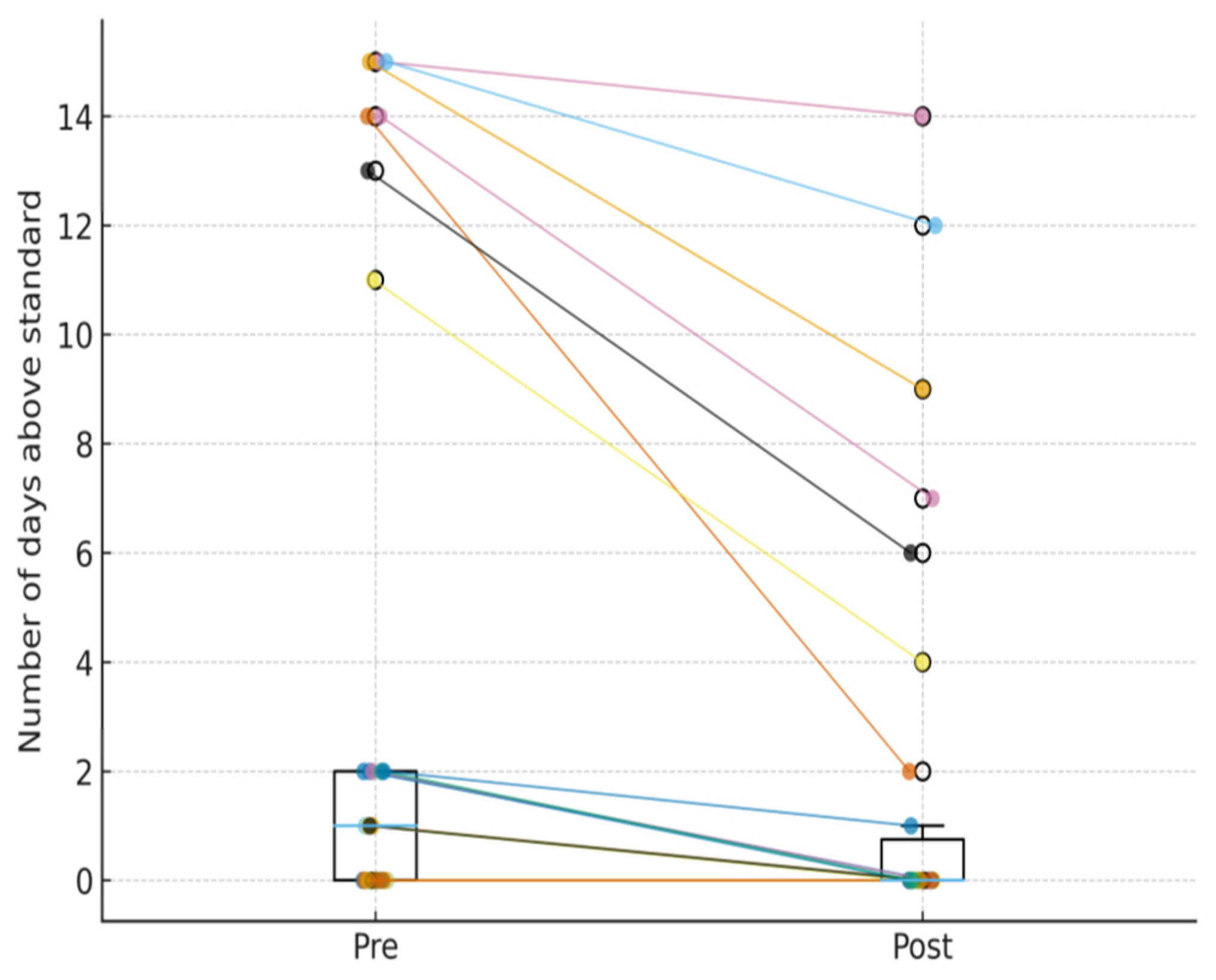
Figure 1 and Figure 2 illustrate the changes in the number of days that indoor PM2.5 concentrations exceeded the 24 h air quality standards established by the World Health Organization (WHO) (15 µg/m3) and the US Environmental Protection Agency (USEPA) (35 µg/m3), respectively. Each figure combines box plots with paired individual data points to show both the overall distributions and within-participant changes before and after the intervention.
At baseline, the mean (±SD) number of days with average indoor PM2.5 concentrations exceeding the WHO standard (15 µg/m3) was 10.6 ± 5.7 days, which decreased to 8.1 ± 5.9 days following the intervention (Figure 1). This corresponded to a mean reduction of 2.5 days, which was statistically significant (paired t-test, p < 0.001). On an individual level, 21 participants (70%) experienced a reduction in the number of exceedance days. These results indicate that reductions in PM2.5 exceedance days were observed in the majority of households.
Exceedances of the EPA PM2.5 standard (35 µg/m3) were less frequent at baseline. The mean number of exceedance days decreased from 3.7 ± 5.8 days pre-intervention to 1.8 ± 3.8 days post-intervention (Figure 2), representing a mean change of 1.9 days (p = 0.001). Overall, 16 participants (53.3%) experienced a reduction in exceedance days relative to the EPA standard. Although baseline exceedances were less common, the paired trajectories demonstrate consistent reductions across most participant households.

4. Discussion

This study evaluated the combined effects of air purifier use and asthma education on indoor air quality and asthma outcomes in adults diagnosed with asthma by a physician. The findings of our study provide empirical evidence of the significant role that indoor air quality plays managing asthma outcomes. The intervention (which combined HEPA purifiers with tailored asthma education) provided a significant reduction in indoor PM2.5 levels and corresponding improvements in asthma control and quality of life.
The significant reduction in PM2.5 levels post-intervention, as evidenced by a mean decrease of 3.62 µg/m3, underscores the importance of controlling indoor air pollutants in asthma management. Particulate matter, particularly PM2.5, has been consistently associated with adverse respiratory outcomes, including asthma symptom exacerbations [9]. By reducing PM2.5 levels, the intervention likely mitigated a key trigger of asthma symptoms, contributing to the observed improvement in asthma control among participants.
The observed increase in tVOC levels post-intervention requires further investigation. Although the air purifiers used in this study included activated carbon filters intended to reduce gaseous pollutants, no reduction in tVOC concentrations was observed. The effectiveness of carbon filtration can vary depending on VOC composition, concentration, and filter capacity [31,32]; however, specific VOC species and filter performance were not assessed in this study. Future intervention studies should incorporate targeted evaluation of gaseous pollutant removal to better characterize the performance of combined particulate and VOC filtration systems [33].
Pre-intervention indoor PM2.5 levels frequently exceeded both WHO and EPA standards across participant households. The number of days with PM2.5 concentrations above both standards was notably reduced post-intervention, indicating a meaningful decrease in exposure to fine particulate matter. Reductions were more pronounced when evaluated against the WHO 15 µg/m3 guideline, reflecting its more stringent and health-protective threshold, while exceedances of the EPA 35 µg/m3 standard were less common at baseline and showed smaller but consistent declines. Participants with the highest baseline exceedance days experienced the greatest post-intervention reductions, suggesting that the combined environmental and educational strategies were particularly effective in homes with higher initial PM2.5 exposure. These findings are consistent with prior studies showing that home-based environmental interventions reduce indoor PM2.5 concentrations and improve residential indoor air quality. For instance, an inner-city randomized trial found that households assigned to air cleaners experienced significantly greater reductions in indoor PM2.5 (mean change −18.0 µg/m3) [34]. In addition, in an agricultural cohort of children with asthma, portable HEPA cleaners reduced PM2.5 by ~60% in sleeping areas (p < 0.001) and ~42% in living areas (p = 0.002) [35]. Other US studies pairing asthma education with in-home filtration have reported large particle reductions (e.g., ~69–80% decreases) in homes of children with asthma [36].
The improvement in asthma control, as indicated by the significant reduction in ACQ scores, suggests that the interventions effectively addressed both the environmental and behavioral factors that contribute to asthma morbidity. A decrease of 0.5 points or more in ACQ scores is considered clinically meaningful as such decreases reflect a significant improvement in asthma symptoms and control [28,29]. Accordingly, the observed difference of 0.52 confirms the clinical relevance of our intervention. Moreover, the increase in well-controlled asthma from 30% to 66.7% and improvements in AQLQ scores support the efficacy of the intervention in improving asthma symptoms and participants’ ability to engage in daily activities. These findings are consistent with prior research that indicated that environmental interventions with air purifier and education can substantially improve asthma outcomes. For example, a community health worker–delivered home-visit program in Washington increased symptom-free days by approximately two days per two-week period and improved asthma-related quality of life by 0.50 points on the Mini-AQLQ (p < 0.001) [37]. Similarly, the Inner-City Asthma Study, conducted across seven major US cities, reported significantly fewer symptom days in the intervention group compared with controls during the intervention year (3.39 vs. 4.20 days per two weeks, p < 0.001) [38]. In addition, a double-blind, placebo-controlled crossover study in Cincinnati demonstrated that four weeks of portable HEPA cleaner use significantly improved asthma control (ACQ: 1.3 → 0.9, p = 0.003) and asthma-related quality of life (AQLQ: 4.9 → 5.5, p = 0.02) in children with poorly controlled asthma [39].
The findings of our study are subject to limitations that should be addressed in future research. Our relatively small sample size with limited demographic representation, our inability to account for possible seasonal variations as monitoring was limited to 30 days, and the use of low-cost sensors that were more reliable for detecting trends than for reporting absolute concentrations may have limited the generalizability of our findings. As we also did not analyze the chemical composition of particulate matter, we were unable to distinguish between particles arising from different sources. We were unable to identify the presence of biologically derived particles that may have had a greater impact on asthma morbidity. Additionally, participants’ awareness of being monitored may have introduced a Hawthorne effect, potentially influencing behavior related to cleaning, ventilation, or air purifier use during the study period. Finally, while our findings produced evidence of a significant short-term improvements in PM2.5 levels and asthma outcomes, the observed increase in tVOC levels suggests that both indoor and outdoor air pollutants should be concurrently monitored and controlled in future interventions.

5. Conclusions

The findings provide supporting evidence that the combination of improving indoor air quality with HEPA purifiers and asthma education can lead to short-term reductions in PM2.5 levels and lead to measurable improvements in asthma control and quality of life. These findings emphasize the importance of addressing environmental factors alongside medical management in caring for adults with asthma.
Beyond individual benefits, our findings suggest that home-based interventions that integrate education and environmental control could reduce asthma-related morbidity, decrease healthcare utilization, and reduce the health disparities experienced by vulnerable populations. However, given the small and demographically limited sample, these findings are most applicable to young adults. Future research should expand on these findings by examining the long-term benefits of such interventions and evaluating their applicability across a wide variety of populations and settings.

Author Contributions

Study design and conceptualization, A.O. and G.C.; methodology, A.O., T.R., A.M.-R., and G.C.; data analysis and interpretation: A.O.; writing—original draft preparation, A.O.; writing—review and editing, A.O., T.R., A.M.-R., and G.C.; project administration and funding acquisition, A.O. and G.C. All authors have read and agreed to the published version of the manuscript.

Funding

This research was funded by the Department of Environmental and Occupational Health at Texas A&M School of Public Health and the National Institute of Environmental Health Sciences (NIEHS) under Grant Number P30 ESES029067.

Institutional Review Board Statement

The study was conducted in accordance with the Declaration of Helsinki and approved by the Institutional Review Board of Texas A&M University (IRB2022-1447D, APRIL 2023).

Informed Consent Statement

Informed consent was obtained from all subjects involved in the study.

Data Availability Statement

The data used to support the findings of this study are available from the corresponding author upon request.

Acknowledgments

The authors thank Anisha Aggarwal, Aashna Vajramani and Christian Dominguez for coordinating the field work.

Conflicts of Interest

The authors declare no conflicts of interest.

Abbreviations

The following abbreviations are used in this manuscript:
ACQAsthma Control Questionnaire
AQLQAsthma Quality of Life Questionnaire
WHOWorld Health Organization
EPAEnvironmental Protection Agency
IAQIndoor Air Quality
PM2.5Particulate Matter ≤ 2.5 μm
VOCVolatile Organic Compounds
tVOCTotal Volatile Organic Compounds
HEPAHigh-Efficiency Particulate Air

References

  1. Vos, T.; Abajobir, A.A.; Abate, K.H.; Abbafati, C.; Abbas, K.M.; Abd-Allah, F.; Abdulkader, R.S.; Abdulle, A.M.; Abebo, T.A.; Abera, S.F.; et al. Global, regional, and national incidence, prevalence, and years lived with disability for 328 diseases and injuries for 195 countries, 1990–2016: A systematic analysis for the Global Burden of Disease Study 2016. Lancet 2017, 390, 1211–1259. [Google Scholar] [CrossRef]
  2. Pate, C.A.; Zahran, H.S. The status of asthma in the United States. Prev. Chronic Dis. 2024, 21, E53. [Google Scholar] [CrossRef]
  3. National Center for Health Statistics. Percentage of Asthma Episode in the Past 12 Months for Adults Aged 18 and Over, United States, 2019–2024. National Health Interview Survey. 2025. Available online: https://wwwn.cdc.gov/NHISDataQueryTool/SHS_adult/index.html (accessed on 15 October 2025).
  4. Gaffney, A.; Himmelstein, D.U.; Woolhandler, S. Asthma disparities in the United States narrowed during the COVID-19 pandemic: Findings from a national survey, 2019 to 2022. Ann. Intern. Med. 2024, 177, 103–106. [Google Scholar] [CrossRef] [PubMed]
  5. Merghani, M.M.; Mohmmed, R.G.A.; Al-Sayaghi, K.M.; Alshamrani, N.S.M.; Awadalkareem, E.M.; Shaaib, H.; Alharbi, A.; AlKaabi, A.; Faqihi, S.; Abdalla, A.; et al. Asthma-related school absenteeism: Prevalence, disparities, and the need for comprehensive management: A systematic review and meta-analysis. Dialogues Health 2025, 7, 100239. [Google Scholar] [CrossRef]
  6. Nurmagambetov, T.; Kuwahara, R.; Garbe, P. The economic burden of asthma in the United States, 2008–2013. Ann. Am. Thorac. Soc. 2018, 15, 348–356. [Google Scholar] [CrossRef]
  7. American Lung Association. Asthma. 2023. Available online: https://www.lung.org/lung-health-diseases/lung-disease-lookup/asthma (accessed on 18 October 2023).
  8. Paterson, C.A.; Sharpe, R.A.; Taylor, T.; Morrissey, K. Indoor PM2.5, VOCs and asthma outcomes: A systematic review in adults and their home environments. Environ. Res. 2021, 202, 111631. [Google Scholar] [CrossRef] [PubMed]
  9. Pham, D.L.; Le, K.M.; Truong, D.D.; Le, H.T.; Trinh, T.H. Environmental allergen reduction in asthma management: An overview. Front. Allergy 2003, 4, 1229238. [Google Scholar] [CrossRef] [PubMed]
  10. Breysse, P.N.; Diette, G.B.; Matsui, E.C.; Butz, A.M.; Hansel, N.N.; McCormack, M.C. Indoor air pollution and asthma in children. Proc. Am. Thorac. Soc. 2010, 7, 102–106. [Google Scholar] [CrossRef]
  11. Matsui, E.C.; Hansel, N.N.; McCormack, M.C.; Rusher, R.; Breysse, P.N.; Diette, G.B. Asthma in the inner city and the indoor environment. Immunol. Allergy Clin. N. Am. 2008, 28, 665–686. [Google Scholar] [CrossRef][Green Version]
  12. Jie, Y.; Ismail, N.H.; Jie, X.; Isa, Z.M. Do indoor environments influence asthma and asthma-related symptoms among adults in homes? A review of the literature. J. Formos. Med. Assoc. 2011, 110, 555–563. [Google Scholar] [CrossRef][Green Version]
  13. Kanchongkittiphon, W.; Mendell, M.J.; Gaffin, J.M.; Wang, G.; Phipatanakul, W. Indoor environmental exposures and exacerbation of asthma: An update to the 2000 review by the Institute of Medicine. Environ. Health Perspect. 2015, 123, 6–20. [Google Scholar] [CrossRef]
  14. Diette, G.B.; McCormack, M.C.; Hansel, N.N.; Breysse, P.N.; Matsui, E.C. Environmental issues in managing asthma. Respir. Care 2008, 53, 602–617. [Google Scholar]
  15. Sublett, J.L. Effectiveness of air filters and air cleaners in allergic respiratory diseases: A review of the recent literature. Curr. Allergy Asthma Rep. 2011, 11, 395–402. [Google Scholar] [CrossRef]
  16. Xu, Y.; Raja, S.; Ferro, A.R.; Jaques, P.A.; Hopke, P.K.; Gressani, C.; Wetzel, L.E. Effectiveness of heating, ventilation and air conditioning system with HEPA filter unit on indoor air quality and asthmatic children’s health. Build. Environ. 2010, 45, 330–337. [Google Scholar] [CrossRef]
  17. Drieling, R.L.; Sampson, P.D.; Krenz, J.E.; Tchong French, M.I.; Jansen, K.L.; Massey, A.E.; Farquhar, S.A.; Min, E.; Perez, A.; Riederer, A.M.; et al. Randomized trial of a portable HEPA air cleaner intervention to reduce asthma morbidity among Latino children in an agricultural community. Environ. Health 2022, 21, 1. [Google Scholar] [CrossRef]
  18. Mansoor, J.; Haq, M.Z.U.; Ahsan, Z.; Bilal, M.; Fatima, S.S. Effect of high-efficiency particulate air filter on children with asthma: A systematic review protocol of RCTs. BMJ Open 2024, 14, e087493. [Google Scholar] [CrossRef] [PubMed]
  19. Wright, L.S.; Phipatanakul, W. Environmental remediation in the treatment of allergy and asthma: Latest updates. Curr. Allergy Asthma Rep. 2014, 14, 419. [Google Scholar] [CrossRef]
  20. Krieger, J.; Takaro, T.K.; Song, L.; Beaudet, N.; Edwards, K. A randomized controlled trial of asthma self-management support comparing clinic-based nurses and in-home community health workers: The Seattle–King County Healthy Homes II Project. Arch. Pediatr. Adolesc. Med. 2009, 163, 141–149. [Google Scholar] [CrossRef] [PubMed]
  21. Baek, J.; Huang, K.; Conner, L.; Tapangan, N.; Xu, X.; Carrillo, G. Effects of the home-based educational intervention on health outcomes among primarily Hispanic children with asthma: A quasi-experimental study. BMC Public Health 2019, 19, 912. [Google Scholar] [CrossRef]
  22. Carrillo, G.; Roh, T.; Baek, J.; Chong-Menard, B.; Ory, M. Evaluation of Healthy South Texas Asthma Program on improving health outcomes and reducing health disparities among the underserved Hispanic population: Using the RE-AIM model. BMC Pediatr. 2021, 21, 510. [Google Scholar] [CrossRef]
  23. Moreno-Rangel, A.; Baek, J.; Roh, T.; Xu, X.; Carrillo, G. Assessing impact of household intervention on indoor air quality and health of children with asthma in the US-Mexico border: A pilot study. J. Environ. Public Health 2020, 2020, 6042146. [Google Scholar] [CrossRef] [PubMed]
  24. Moreno-Rangel, A.; Roh, T.; Wang, T.; Baek, J.; Conner, L.; Carrillo, G. Reviewing the impact of indoor air quality management and asthma education on asthmatic children’s health outcomes—A pilot study. In Proceedings of the Healthy Buildings Europe 2021, Oslo, Norway, 21–23 June 2021; Available online: https://strathprints.strath.ac.uk/82999/ (accessed on 15 October 2025).
  25. Muanprasong, S.; Aqilah, S.; Hermayurisca, F.; Taneepanichskul, N. Effectiveness of Asthma Home Management Manual and Low-Cost Air Filter on Quality of Life Among Asthma Adults: A 3-Arm Randomized Controlled Trial. J. Multidiscip. Healthc. 2024, 17, 2613–2622. [Google Scholar] [CrossRef]
  26. Moreno-Rangel, A.; Musau, T.S.; McGill, G. Field evaluation of a low-cost indoor air quality monitor to quantify exposure to pollutants in residential environments. J. Sens. Sens. Syst. 2018, 7, 373–388. [Google Scholar] [CrossRef]
  27. Sousan, S.; Koehler, K.; Hallett, L.; Peters, T.M. Evaluation of consumer monitors to measure particulate matter. J. Aerosol Sci. 2017, 107, 123–133. [Google Scholar] [CrossRef]
  28. Juniper, E.F.; Buist, A.S.; Cox, F.M.; Ferrie, P.J.; King, D.R. Validation of a standardized version of the Asthma Quality of Life Questionnaire. Chest 1999, 115, 1265–1270. [Google Scholar] [CrossRef]
  29. Juniper, E.F.; O’Byrne, P.M.; Guyatt, G.H.; Ferrie, P.J.; King, D.R. Development and validation of a questionnaire to measure asthma control. Eur. Respir. J. 1999, 14, 902–907. [Google Scholar] [CrossRef]
  30. Carrillo, G.; Spence, E.; Lucio, R.B.C.; Smith, K. Improving asthma in Hispanic families through a home-based educational intervention. Pediatr. Allergy Immunol. Pulmonol. 2015, 28, 165–171. [Google Scholar] [CrossRef]
  31. Yao, M.; Zhang, Q.; Hand, D.W.; Perram, D.L.; Taylor, R. Investigation of the Treatability of the Primary Indoor Volatile Organic Compounds on Activated Carbon Fiber Cloths at Typical Indoor Concentrations. J. Air Waste Manag. Assoc. 2009, 59, 882–890. [Google Scholar] [CrossRef] [PubMed][Green Version]
  32. Khararoodi, M.G.; Haghighat, F.; Lee, C.S. Develop and validate a mathematical model to estimate the removal of indoor VOCs by carbon filters. Build. Environ. 2023, 233, 110082. [Google Scholar] [CrossRef]
  33. González-Martín, J.; Kraakman, N.J.R.; Pérez, C.; Lebrero, R.; Muñoz, R. A state-of-the-art review on indoor air pollution and strategies for indoor air pollution control. Chemosphere 2021, 262, 128376. [Google Scholar] [CrossRef] [PubMed]
  34. Butz, A.M.; Matsui, E.C.; Breysse, P.; Curtin-Brosnan, J.; Eggleston, P.; Diette, G.; Williams, D.A.; Yuan, J.; Bernert, J.T.; Rand, C. A randomized trial of air cleaners and a health coach to improve indoor air quality for inner-city children with asthma and secondhand smoke exposure. Arch. Pediatr. Adolesc. Med. 2011, 165, 741–748. [Google Scholar]
  35. Riederer, A.M.; Krenz, J.E.; Tchong-French, M.I.; Torres, E.; Perez, A.; Younglove, L.R.; Jansen, K.L.; Hardie, D.C.; Farquhar, S.A.; Sampson, P.D.; et al. Effectiveness of portable HEPA air cleaners on reducing indoor PM2.5 and NH3 in an agricultural cohort of children with asthma: A randomized intervention trial. Indoor Air 2021, 31, 454–466. [Google Scholar]
  36. Du, L.; Batterman, S.; Parker, E.; Godwin, C.; Chin, J.Y.; O’Toole, A.; Robins, T.; Brakefield-Caldwell, W.; Lewis, T. Particle concentrations and effectiveness of free-standing air filters in bedrooms of children with asthma in Detroit, Michigan. Build. Environ. 2011, 46, 2303–2313. [Google Scholar] [CrossRef] [PubMed]
  37. Krieger, J.; Song, L.; Philby, M. Community health worker home visits for adults with uncontrolled asthma: The HomeBASE Trial randomized clinical trial. JAMA Intern. Med. 2015, 175, 109–117. [Google Scholar] [CrossRef] [PubMed]
  38. Morgan, W.J.; Crain, E.F.; Gruchalla, R.S.; O’Connor, G.T.; Kattan, M.; Evans, R., III; Stout, J.; Malindzak, G.; Smartt, E.; Plaut, M.; et al. Results of a home-based environmental intervention among urban children with asthma. N. Engl. J. Med. 2004, 351, 1068–1080. [Google Scholar] [PubMed]
  39. James, C.; Bernstein, D.I.; Cox, J.; Ryan, P.; Wolfe, C.; Jandarov, R.; Newman, N.; Indugula, R.; Reponen, T. HEPA filtration improves asthma control in children exposed to traffic-related airborne particles. Indoor Air 2020, 30, 235–243. [Google Scholar] [CrossRef]
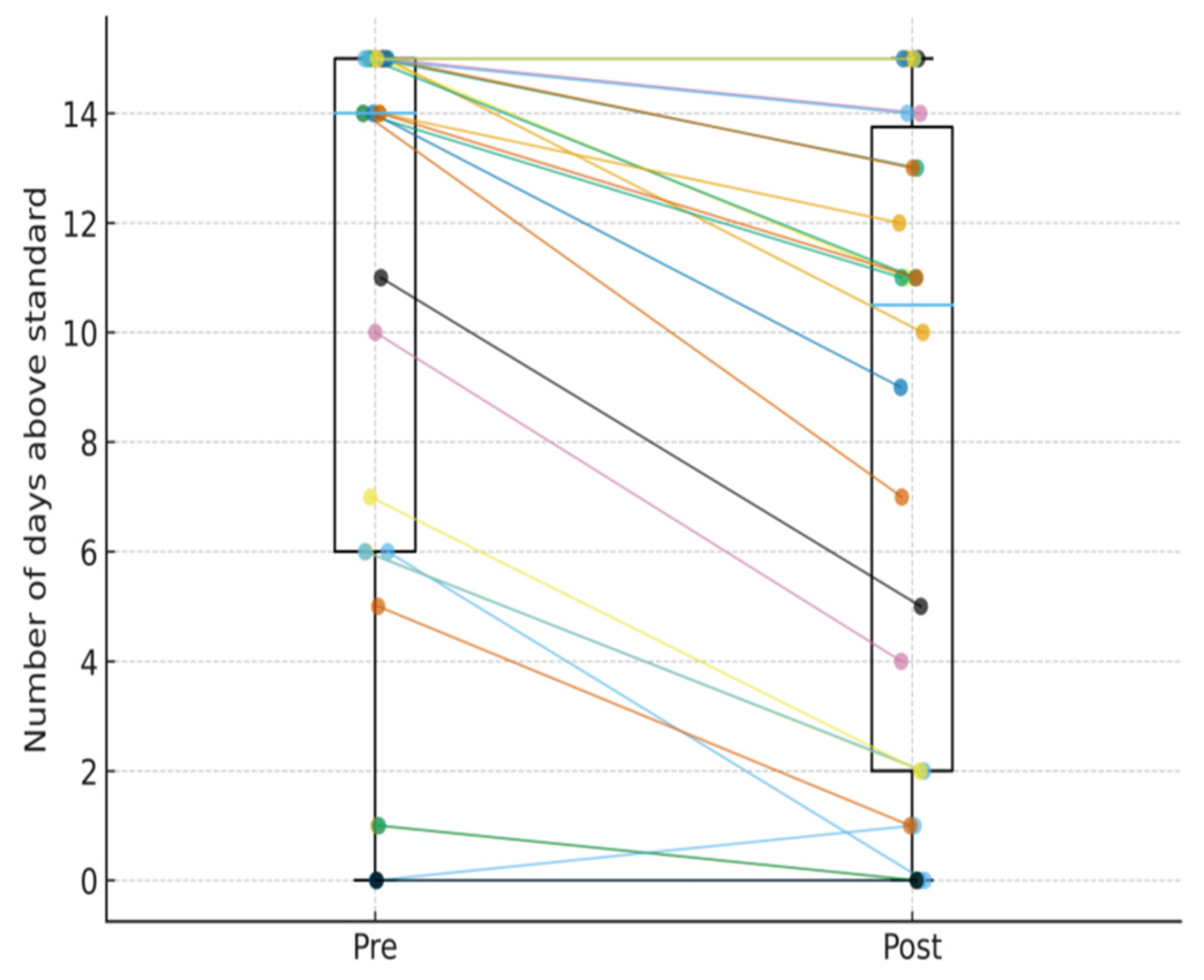
Figure 1. Number of days with the average PM2.5 concentrations above the WHO standard (15 µg/m3) pre- and post-intervention. Each color represents one individual participant.
Atmosphere 17 00084 g001
Figure 2. Number of days with the average PM2.5 concentrations above the EPA standard (35 µg/m3) pre- and post-intervention. Each color represents one individual participant.
Atmosphere 17 00084 g002
Table 1. Characteristics of participants in Bryan-College Station, Texas (n = 30).
Demographicsn (%)
Age (median (IQR)23 (20, 30)
Sex
  Female25 (83%)
  Male5 (17%)
Race
  Non-Hispanic White15 (50%)
  Non-Hispanic Black1 (3.3%)
  Hispanic5 (17%)
  Non-Hispanic Asian or mixed8 (27%)
  Did not respond1 (3.3%)
Education
  High School4 (13%)
  >High School24 (80%)
  Did not respond2 (6.7%)
Income
  <$75,00019 (63%)
  ≥$75,0008 (27%)
  Did not respond3 (10%)
Table 2. Distribution of pre- and post-intervention asthma health outcomes and indoor air quality indicators (n = 30).
CharacteristicPre-InterventionPost-Intervention
Air quality indicators 1
  PM2.5 (µg/m3)21.32 (1.74)18.19 (1.76)
  tVOC (ppb)237.05 (1.28)251.81 (1.29)
  Temperature (°F)71.7 (2.8)71.9 (4.3)
  Relative humidity (%)55.7 (6.3)55.6 (6.2)
Asthma health outcomes 2
  Well-controlled asthma (≤0.75)9 (30%)20 (66.7%)
  Partially controlled asthma (0.76–1.5)13 (43.3%)7 (23.3%)
  Poorly controlled asthma (>1.5)8 (26.7%)3 (10%)
ACQ score 31.17 (0.67, 1.67)0.50 (0.33, 0.83)
AQLQ score 35.75 (5.19, 6.41)6.30 (6.16, 6.81)
1 Geometric mean (SD), 2 Frequency (%), 3 Median (IQR).
Table 3. Results of Wilcoxon signed rank test for 30 participants.
CharacteristicPre-Post Mean Difference (95% CI)p
ACQ score−0.52 (−0.76–−0.27)<0.001
AQLQ score0.58 (0.35–0.81)<0.001
PM2.5−3.62 (−5.46–−1.78)<0.001
tVOC16.29 (1.93–30.65)0.02
Disclaimer/Publisher’s Note: The statements, opinions and data contained in all publications are solely those of the individual author(s) and contributor(s) and not of MDPI and/or the editor(s). MDPI and/or the editor(s) disclaim responsibility for any injury to people or property resulting from any ideas, methods, instructions or products referred to in the content.