Article

Evaluation of WRF Planetary Boundary Layer Parameterization Schemes for Dry Season Conditions over Complex Terrain in the Liangshan Prefecture, Southwestern China

1
College of Electronic Engineering, Chengdu University of Information Technology, Chengdu 610000, China
2
Liangshan Yi Autonomous Prefecture Meteorological Bureau, Xichang 615014, China
*
Author to whom correspondence should be addressed.
Atmosphere 2026, 17(1), 53; https://doi.org/10.3390/atmos17010053
Submission received: 26 November 2025 / Revised: 28 December 2025 / Accepted: 29 December 2025 / Published: 31 December 2025

Abstract

The planetary boundary layer (PBL) exerts strong control on heat, moisture, and momentum exchange, yet its representation over the steep mountains and deep valleys of Liangshan remains poorly understood. This study evaluates six Weather Research and Forecasting (WRF) PBL schemes (ACM2, BL, MYJ, MYNN2.5, QNSE, and YSU) using multi-source observations from radiosondes, surface stations, and wind profiling radar during clear-sky dry-season cases in spring and winter. The schemes exhibit substantial differences in governing turbulent mixing and stratification. For the specific cases studied, QNSE best reproduces 2 m temperature in both seasons by realistically capturing nocturnal stability and large diurnal ranges, while non-local schemes overestimate nighttime temperatures due to excessive mixing. MYNN2.5 performs robustly for boundary layer growth in spring, and BL aligns most closely with radar-derived PBL height (PBLH). Vertical profile comparisons show that QNSE and MYJ better represent the lower–middle level thermodynamic structure, whereas all schemes underestimate extreme near-surface winds, reflecting unresolved terrain-induced variability. PBLH simulations reproduce diurnal cycles but differ in amplitude, with QNSE occasionally producing unrealistic spikes. Overall, no scheme performs optimally for all variables. However, QNSE and MYNN2.5 show the most balanced performance across seasons. These findings provide guidance for selecting PBL schemes for high-resolution modeling and fire–weather applications over complex terrain.

1. Introduction

The planetary boundary layer (PBL) refers to the lowest part of the troposphere adjacent to the underlying surface, with a thickness ranging from several hundred meters to 1–2 km. It is directly influenced by the Earth’s surface on short timescales and exhibits pronounced turbulent characteristics [1]. Turbulent eddies within the PBL strongly affect the exchange of momentum, heat, and moisture between the surface and the atmosphere, governing many critical feedback mechanisms [2]. Because turbulence cannot be explicitly resolved in most numerical weather and climate models, the physical processes in the PBL must be parameterized [3]. The choice of PBL parameterization scheme therefore exerts a substantial influence on simulated meteorological variables and the vertical structure of the PBL [4]. Different schemes rely on distinct turbulence closures, mixing formulations, and diagnostic methods for determining PBL height (PBLH), leading to substantial variations in how well they capture the characteristics of atmospheric turbulence [5].
The Weather Research and Forecasting (WRF) model incorporates a wide variety of PBL parameterization schemes, which have been extensively tested across different regions and meteorological regimes [6,7,8,9,10]. Wang et al. [9] found that the Asymmetrical Convective Model version 2 (ACM2) scheme achieved the highest overall accuracy in simulating meteorological elements over the semi-fixed Gurbantünggüt Desert. Wang et al. [11] reported that the Quasi-Normal Scale Elimination (QNSE) scheme best represented temporal variations in near-surface wind speed, while the Mellor–Yamada–Janjic (MYJ) scheme produced the smallest bias over the western Sichuan Basin at 0.33 km resolution. Hariprasad et al. [12] concluded that in tropical regions, the Yonsei University (YSU) and Mellor–Yamada–Nakanishi–Niino Level 2.5 (MYNN2.5) schemes performed best under convective and stable conditions, respectively, whereas ACM2 and QNSE tended to overestimate PBL depth and the University of Washington (UW) scheme underestimated the mixed layer height. Hu, Nielsen-Gammon and Zhang [13] found that non-local closure schemes such as YSU and ACM2 reproduced temperature and humidity profiles more realistically than the local closure scheme MYJ due to stronger vertical mixing and entrainment. Shin and Hong [14] further emphasized that non-local schemes generally perform better under unstable conditions, while local turbulent kinetic energy (TKE) closures such as MYJ, QNSE, and Bougeault–Lacarrére (BouLac) are more appropriate under stable stratification. Ntoumos et al. [15] based on the evaluation of three PBL schemes in the WRF model over the Middle East–North Africa region, the YSU scheme performed best by more accurately representing vertical mixing processes that influence extreme temperature simulations. These studies indicate that the performance of PBL schemes highly depends on their ability to accurately represent key physical processes of the PBL under different conditions, resulting in strong regional variability across WRF applications.
Although extensive studies have been conducted to evaluate PBL parameterization schemes, no single scheme has yet proven universally optimal. The performance of each scheme varies under different atmospheric conditions, surface characteristics, geographic settings, and seasons. Therefore, it remains essential to assess PBL parameterizations across diverse geographical environments. This study focuses on complex terrain conditions that include mountains, plateaus, rivers, valleys, and lakes, where the development of the PBL is affected by strong mechanical turbulence, mesoscale advection induced by thermal heterogeneity, and extremely stable stratification during the dry season. These factors interact to create significant challenges for accurately simulating PBL processes. Singh et al. [16] found that the YSU, Shin-Hong Scale-aware (SHSS), and MYJ PBL schemes in the WRF model performed best for simulating temperature and specific humidity over the Himalayas, though all schemes struggled to capture nocturnal PBLH peaks driven by complex terrain-synoptic interaction.
Recent advances in multi-platform observation systems, including radiosonde (RS), wind profiling radar (WPR), and microwave radiometer (MWR), have enabled comprehensive evaluation of WRF simulations at high spatiotemporal resolutions [17,18,19]. Herrera-Mejía and Hoyos [20] characterized the PBL dynamics in Colombia’s Aburrá Valley using multi-sensor observations and the WRF model, demonstrating that PBLH variability significantly influences pollutant dispersion and is modulated by regional climate conditions. Ma et al. [21] evaluated WRF model simulations against multi-source observations, underscoring the critical impact of PBL scheme selection and horizontal resolution on accurately representing PBL processes over complex topography.
However, few studies have examined PBL scheme performance over the Liangshan Prefecture of southwestern China, where steep mountains, deep valleys, and river–lake interactions create highly heterogeneous surface and atmospheric conditions. Therefore, this paper evaluates the performance of six PBL parameterization schemes over the Liangshan Prefecture using multi-instrument observations during representative clear-sky episodes in the dry season from a common station, providing a reference for developing high-resolution numerical weather prediction models suitable for this complex terrain area. The structure of this paper is organized as follows: Section 2 of this paper mainly introduces the data and methods, including the PBL scheme and WRF model setup. Section 3 is the analysis of the observation and simulation results, and Section 4 presents the main conclusions drawn from the whole effort.

2. Materials and Methods

2.1. Description of Case Study

Liangshan Yi Autonomous Prefecture (26°03′–29°18′ N, 100°03′–103°52′ E) is situated in southwestern Sichuan Province, China, at the transitional zone between the southeastern Tibetan Plateau and the northern Yunnan-Guizhou Plateau. The Prefecture’s complex topography is defined by major physical-geographical units, including the southern extension of the Hengduan Mountains to the west and the deep canyons of the Jinsha and Dadu Rivers to the south and north, respectively. Centrally, the Anning River Valley forms a prominent north–south tectonic trench. With elevations ranging from 300 m to 4500 m, the landscape alternates between high peaks, steep valleys, and expansive plateaus. Under the influence of the subtropical plateau monsoon climate, Liangshan exhibits distinct wet and dry seasons due to its unique orographic effects. During the dry season (December to May of the following year), the prevailing westerlies descend after crossing the Hengduan Mountains, leading to adiabatic warming and moisture depletion. Concurrently, the blocking effect of the surrounding mountains inhibits the convergence of cold northern air with warm, humid air masses, resulting in minimal precipitation (80–150 mm) that accounts for only 10% to 15% of the annual total (800–1100 mm). These climatic conditions create a high-risk period for forest wildfires. Given that dynamic and thermal processes in this region are primarily mediated through the PBL, accurate characterization of PBL dynamics is critical for understanding local meteorology and associated fire weather.
This study selects two different time periods representing spring and winter for simulation and validation. The synoptic conditions at the beginning of the spring and winter cases are shown in Figure 1. The spring period is from 8 to 11 April 2025, while the winter period spans from 24 to 27 December 2024. Both periods are characterized by clear skies with minimal cloud cover, making them ideal for simulating PBL processes. Figure 1 illustrates the atmospheric dynamics and geopotential heights at 850 hPa and 500 hPa levels for spring (8 April 2025, at 00:00 UTC) and winter (24 December 2024, at 00:00 UTC), respectively. In spring, 850 hPa features light southwester winds with noticeable warm, moist air advection, while 500 hPa shows stable southwester flow and no strong troughs—indicating mild, calm weather. In winter, 850 hPa winds are weak with a stable stratification, and 500 hPa exhibits a strong westerly jet. The region is under the influence of cold, dry northerly air, resulting in cold and clear conditions. The primary dynamic was daytime solar heating, causing turbulent mixing near the surface. This indicates an absence of significant weather disturbances, making it suitable for focused studies on PBL processes.

2.2. Numerical Model Description

This study utilized the WRF model version 4.2 with the Advanced Research WRF (ARW) dynamical solver. Initial and lateral boundary conditions were derived from the 0.25° × 0.25° Final Operational Global Analysis (FNL) dataset provided by the National Centers for Environmental Prediction (NCEP), available at 6 h intervals. Numerical simulations were conducted for two clear-sky cases in spring (8–11 April 2025) and winter (24–27 December 2024). Each 78 h simulation, initialized at 18:00 UTC on the day prior to the case period, included a 6 h spin-up. The subsequent 72 h forecast period (from 00:00 UTC on the start date to 00:00 UTC on the end date) was used for analysis and validation. The model configuration incorporated 45 terrain-following vertical levels and a model top set at 50 hPa.
The WRF-ARW V4.2 offers at least nineteen PBL schemes for selection. Each PBL scheme is coupled with one or more surface layer schemes, which provide the surface fluxes of momentum, moisture, and heat for the PBL scheme. In this study, we selected six of these schemes for evaluation, and Table 1 lists the PBL schemes selected for this study. The selected PBL schemes consist of two non-local and four local schemes. Each PBL scheme also defines the PBLH differently, primarily falling into two categories: the first category determines the PBLH by calculating the bulk Richardson number (Rib) from a predetermined starting level. The second category identifies the PBLH at the level where the TKE profile decreases to a predetermined threshold. We will provide a detailed introduction to the various PBL schemes in Section 2.3.
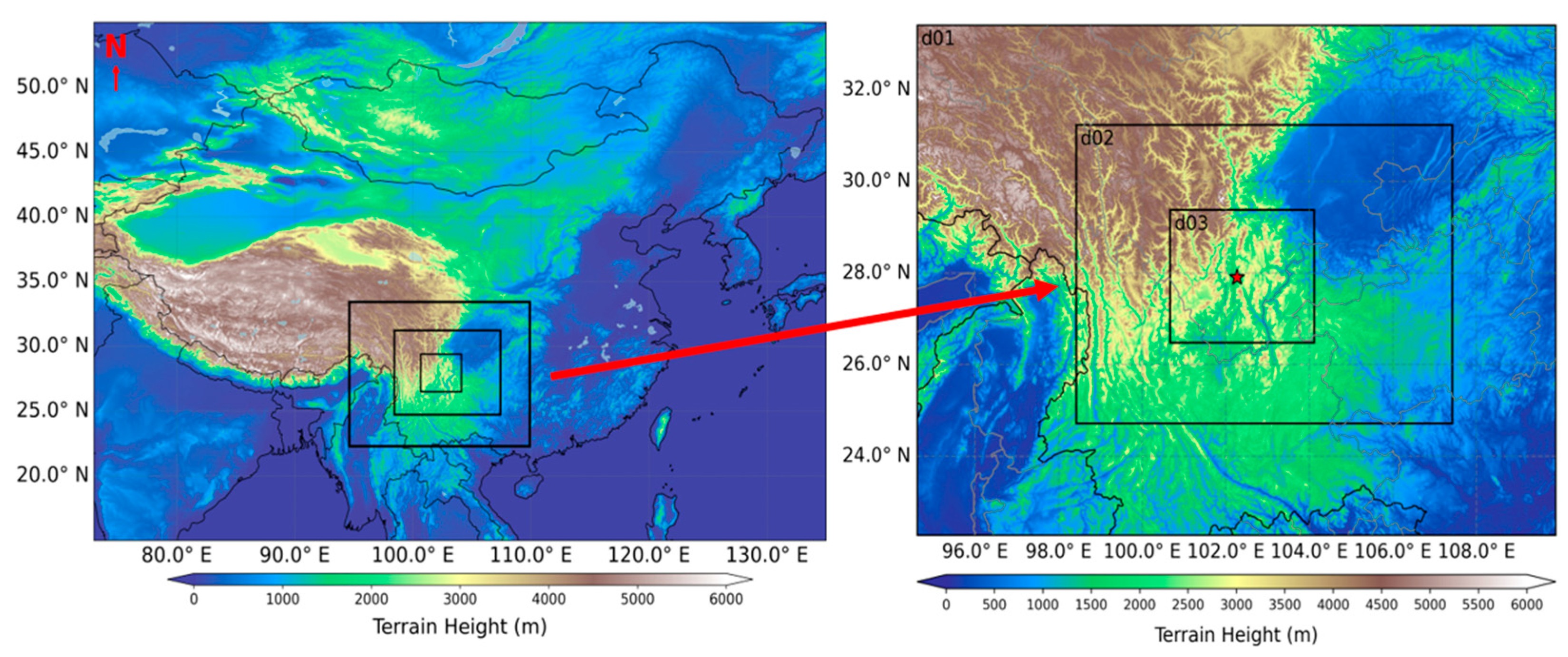
The associated surface layer schemes are also listed in the table, which represent another important source of error in WRF model simulations. Additional physics options included the Lin microphysics scheme [22], the Kain-Fritsch cumulus parameterization [23], the Dudhia shortwave radiation scheme [24], the Rapid Radiative Transfer Model (RRTM) for longwave radiation [25], and the Noah land-surface model [26]. As illustrated in Figure 2, the computational domain featured three nested layers with horizontal resolutions of 9 km (d01; 158 × 138 grid points), 3 km (d02; 286 × 241), and 1 km (d03; 337 × 325), using time steps of 45 s, 15 s, and 5 s, respectively. The cumulus parameterization was disabled in the innermost domains (d02, d03) to better resolve convection explicitly.

2.3. PBL Schemes

2.3.1. Asymmetrical Convective Model Version 2 (ACM2) Scheme

The ACM2 scheme [27] is a first-order hybrid PBL parameterization that combines non-local upward mixing with local downward mixing, effectively accounting for both large-scale convective eddies and local turbulent exchange. For PBLH determination, ACM2 adopts a similar Rib-based approach as the YSU scheme, but with a key difference: it calculates the Rib starting from the neutral buoyancy level rather than the surface [28]. The PBL top is identified where Rib reaches a fixed threshold of 0.25. Notably, the scheme automatically switches to pure local closure under stable or neutral conditions by disabling non-local transport. Compared to other schemes, ACM2 typically produces deeper PBLH [29].

2.3.2. Bougeault–Lacarrère (BL) Scheme

The BL scheme [30] is a 1.5-order turbulence closure scheme that incorporates a prognostic TKE equation with an additional counter-gradient term. Unlike the MYJ scheme, the BL formulation accounts for terrain-induced turbulence and maintains upward heat flux under weakly stable conditions. This scheme offers flexibility through compatibility with two different surface layer parameterizations, where each surface layer combination produces distinct meteorological field structures. For PBLH determination, the scheme evaluates the TKE profile, defining the PBLH as the elevation where TKE decreases to 0.005 m2·s−2.

2.3.3. Mellor–Yamada–Janjic (MYJ) Scheme

The MYJ scheme is a widely used PBL parameterization scheme, developed as an improved version of the Mellor and Yamada [31] second-order closure model [32]. As a 1.5-order local closure scheme, it employs a prognostic TKE equation to estimate eddy diffusion coefficients. However, due to its neglect of non-local effects, the scheme tends to produce weaker turbulent mixing. In the MYJ scheme, the PBLH is defined as the level at which the TKE decreases to a critical threshold value of 0.1 m2 s−2 [33].

2.3.4. Mellor–Yamada–Nakanishi–Niino Level 2.5 (MYNN2.5) Scheme

The WRF model includes two MYNN PBL parameterization schemes: the MYNN2.5 which is a 1.5-order local closure scheme and MYNN3 which is a second-order local closure scheme [34]. Developed as an improved version based on the Mellor–Yamada [31] framework, these schemes feature modified formulations for stability functions and mixing length derived from large-eddy simulation (LES). Currently, the MYNN schemes are primarily applied to fog simulations due to their incorporated condensation processes [34]. This scheme can be coupled with either the MYNN or MM5 surface layer parameterizations. For PBLH determination, the MYNN2.5 schemes adopt a TKE-based approach, defining the BLH as the elevation where TKE decreases below a critical threshold of 1.0 × 10⁻⁶ m2·s−2.

2.3.5. Quasi-Normal Scale Elimination (QNSE) Scheme

The QNSE scheme is a 1.5-order local closure parameterization that employs a TKE closure approximation under unstable conditions and switches to a K-ε turbulence model for other stability regimes [35]. This scheme is particularly suitable for simulating stably stratified and weakly unstable turbulent atmospheric conditions, with specialized applications in nocturnal stable boundary layer (SBL) research. For PBLH determination, the QNSE scheme utilizes a TKE threshold approach, defining the PBL top at the elevation where TKE decreases to 0.01 m2 s−2 [35].

2.3.6. Yonsei University (YSU) Scheme

The YSU scheme is another widely used first-order non-local closure PBL parameterization, developed as an extension of the MRF scheme [36]. Its key features include an explicit representation of the entrainment process and a parabolic K-profile in the unstable mixed layer. Compared to the MRF scheme, the most significant improvement in YSU is the introduction of an explicit term to better characterize the entrainment zone. In the YSU scheme, PBLH is determined using the Rib method, calculated upward from the surface. Different Rib thresholds are applied depending on atmospheric stability: Rib = 0.25 for stable conditions and Rib = 0 for unstable conditions [37].

2.4. Observation Data

This study evaluates the performance of different PBL parameterization schemes using comprehensive observation data from RS, surface meteorological stations, and a WPR. The digital GTS13 RS system provides high-resolution atmospheric profiles (60 m vertical resolution) up to 30 km altitude, measuring temperature (± 0.3 °C accuracy), relative humidity (±5%), and pressure (±2.0 hPa) twice daily at 07:15 and 19:15 Local Standard Time (LST = UTC + 8 h). Surface observations include 10 min averaged 2 m temperature (T2), 2 m relative humidity (R2), surface pressure, and 10 m wind speed (WS10) and wind direction (WD10) for model validation. The TWP-8 L-band PBL WPR (Beijing Minshida Radar Co., Ltd.) delivers high-temporal-resolution data (6 min intervals) with 120 m vertical resolution, including power spectrum and instantaneous radial velocity spectra. The WPR-derived PBLH, determined through wavelet transform analysis of signal-to-noise ratio (SNR) data, were validated against RS observations [38,39]. All instruments are located at the point marked by the red pentagram in Figure 2.

2.5. Evaluation Metrics

To evaluate the performance of the PBL scheme and meteorological variable estimation model, we used statistical parameters including mean bias (MBE), root mean square error (RMSE) and correlation coefficient (R). The relevant statistical parameters are defined as follows:
Mean bias:
M B E = 1 n i = 1 n ( X s i m X o b s )
Root-mean-square error:
R M S E = 1 n i = 1 n ( X s i m X o b s ) 2
Correlation coefficient:
R   =   i = 1 n ( X s i m ,   i X ¯ s i m ,   i ) ( X o b s ,   i X ¯ o b s ,   i ) i = 1 n ( X s i m ,   i X ¯ s i m ,   i ) 2 i = 1 n ( X o b s ,   i X ¯ o b s ,   i ) 2
Here, X s i m represents the simulated variable, and X o b s represents the observed variable. n is the number of values for each variable. X ¯ s i m and   X ¯ o b s are the average values of the observed and simulated variables, respectively.

3. Results

3.1. Diurnal Evolution of Surface Meteorological Parameters

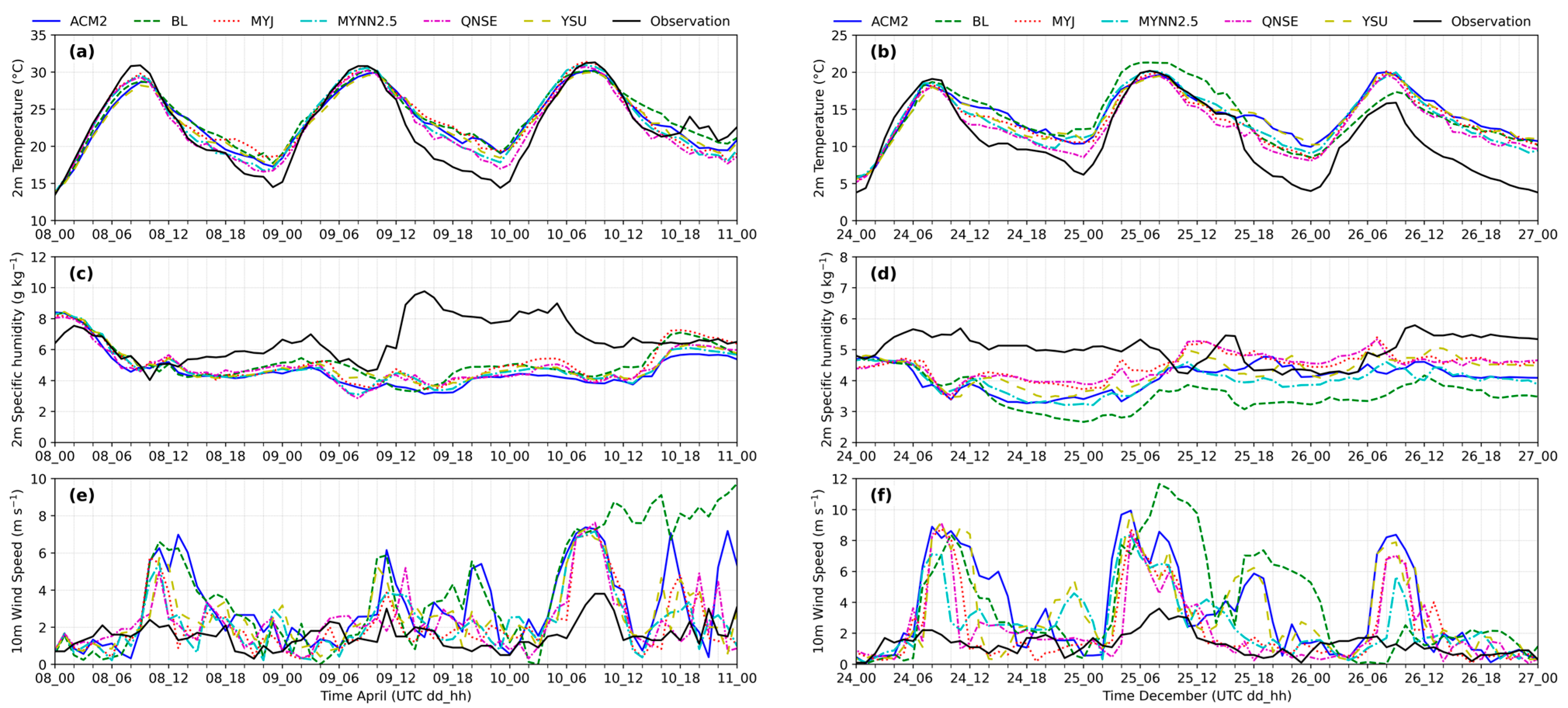
In evaluating model performance, the accurate simulation of near-surface variables such as T2, 2 m specific humidity (Q2), and WS10 is crucial, Q2 is derived from R2. Figure 3a,c,e shows a case study from 8 to 11 April 2025 (hereafter Case April). In Figure 3a, during the morning transition period, the MYJ, MYNN2.5, and QNSE schemes captured the rapid increase in T2 relatively well, while the BL, ACM2, and YSU schemes showed evident cold biases. At night, T2 was generally overestimated, reflecting excessive turbulent diffusion under stable stratification, with QNSE being the closest to observations. Over the three-day simulation, the QNSE scheme achieved the best overall performance (RMSE = 1.79 °C, MBE = 0.10 °C, R = 0.94), followed by MYNN2.5 (RMSE = 1.98 °C, MBE = 0.63 °C, R = 0.93). During December (Figure 3b, hereafter Case December), when radiative cooling and stratification are stronger, all schemes reproduced the daytime evolution of T2 reasonably well but significantly overestimated nighttime temperatures after the second day. Among all schemes, QNSE remained closest to observations (RMSE = 2.98 °C, MBE = 1.86 °C, R = 0.89), while YSU, and ACM2 exhibited larger deviations. Furthermore, comparative studies revealed that, except for the BL scheme in Case December, both local and non-local schemes showed relatively small differences in daytime T2 simulations. The larger differences were primarily observed at night. The non-local schemes ACM2 and YSU, due to their stronger turbulent mixing, excessively exaggerated nighttime temperatures, resulting in significant deviations. The study by Tastula et al. [40] found that the QNSE scheme performs well in simulations with a virtual temperature of 2 m under stable stratification conditions. This is because the QNSE scheme uses a stability function derived based on the spectral method and considers wave-turbulence interactions and anisotropic effects, making it suitable for stable stratification conditions. In contrast, other schemes such as MYJ use empirical stability functions and iterative TKE calculations, resulting in relatively poor simulation performance under stable stratification conditions.
For Q2 (Figure 3c), all schemes reproduced the daytime humidity evolution well on the first day but showed notable dry biases at night. The nighttime dry bias suggests an underestimation of moisture accumulation near the surface under weak turbulence. Although the BL scheme showed a weak correlation between the simulation and the observed sequence (R = −0.09), its RMSE and MBE values were relatively low in the spring case (RMSE = 2.3 g kg−1, MBE = −1.50 g kg−1). In Figure 3d, QNSE and MYJ showed small errors, followed by YSU, whereas BL displayed pronounced dry bias at night.
Regarding WS10 (Figure 3e), all schemes captured the diurnal fluctuation pattern despite discrepancies between instantaneous model outputs and 10 min averaged observations. Wind speeds were generally overestimated during the daytime. The MYJ scheme performed best overall (RMSE = 1.46 m s−1, MBE = 0.57 m s−1, R = 0.58). In Case December (Figure 3f), QNSE, MYJ, and MYNN2.5 performed similarly. Detailed statistical results for each scheme are shown in Table 2.

3.2. Surface Flux

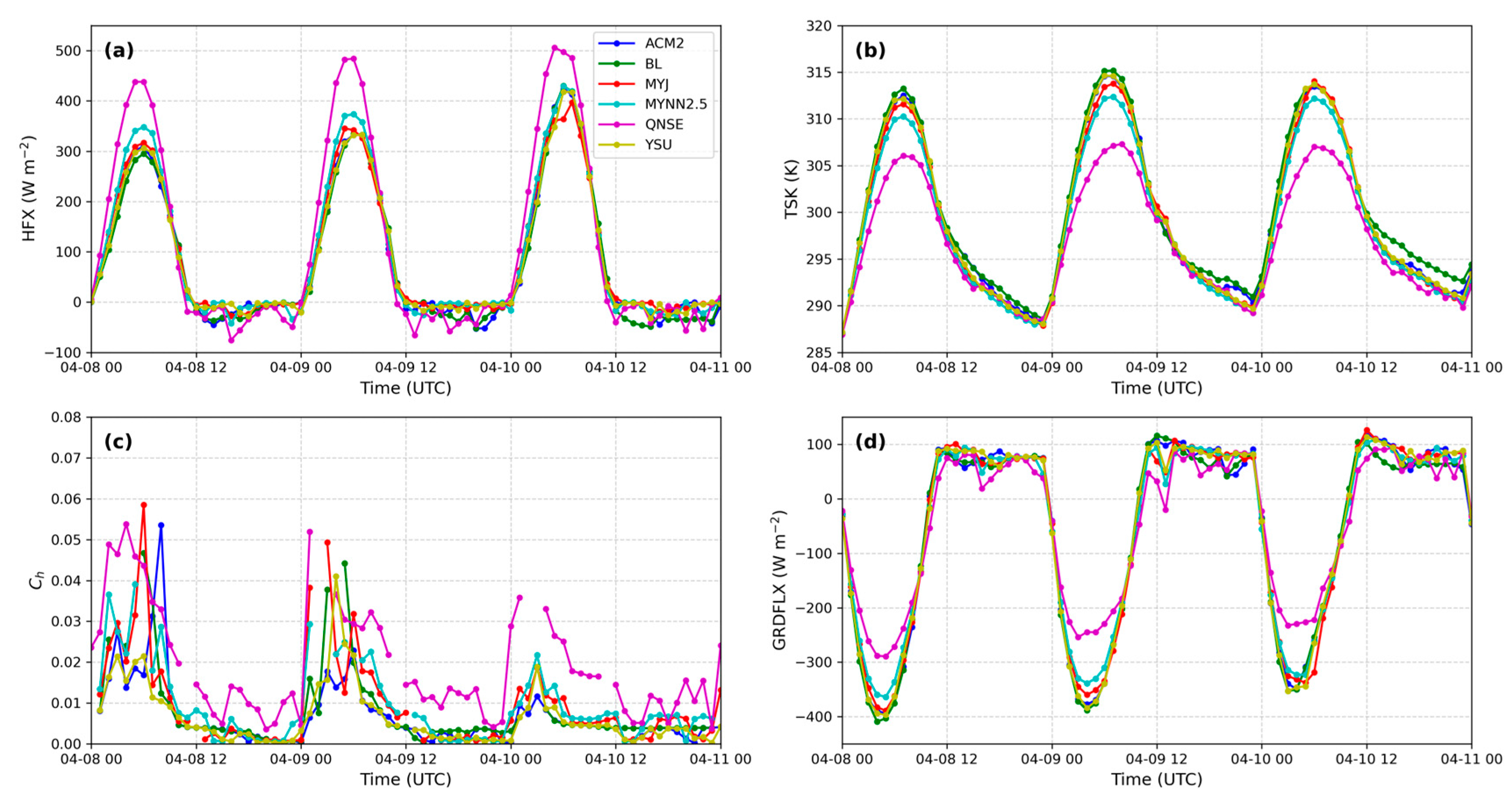
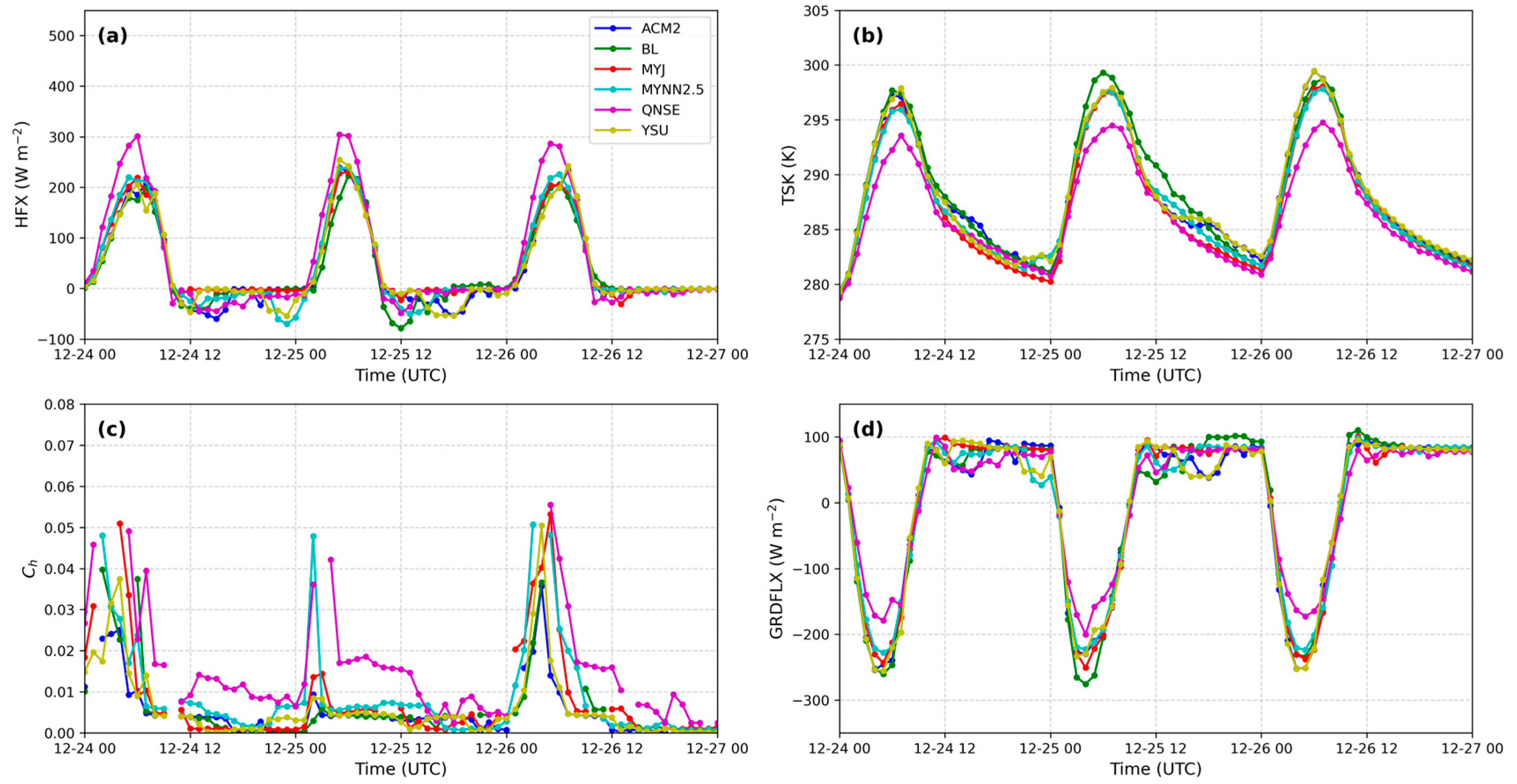
Figure 4 and Figure 5 compare the diurnal variations in surface energy fluxes and near-surface heat transfer coefficients simulated by different PBL schemes during spring and winter. Overall, all schemes reproduce the typical diurnal cycle of positive daytime and negative nighttime sensible (HFX) and ground heat fluxes (GRDFLX). The QNSE scheme produces the largest daytime HFX and the surface temperature (TSK), indicating a more efficient upward transfer of heat from the surface to the atmosphere. This pattern is consistent with its lower simulated T2, which in WRF is a diagnostic variable determined jointly by the TSK, HFX, and heat transfer coefficient ( C h ). QNSE yields relatively large C h values, implying a higher turbulent exchange efficiency and a more uniform mixing within the surface layer, which in turn reduces the temperature difference between TSK and T2. It should be noted that C h here is not the WRF model-output diagnostic variable but was calculated using Equation (4). To ensure physical consistency, extreme values of C h were filtered out, resulting in some missing points in the time series. The overall results suggest that QNSE enhances daytime surface–atmosphere coupling through stronger heat exchange, while maintaining a realistic nighttime cooling structure due to its stability-dependent formulation.
H F X = C h ρ C p U ( T S K T 2 )
Here ρ is the air density, C p is the specific heat of air at constant pressure, U is the wind speed at the reference altitude.
In the QNSE scheme, the GRDFLX exhibits a smaller daytime amplitude (Figure 4d and Figure 5d), indicating that less net energy is stored in the soil because a larger portion of the available surface energy is allocated to turbulent fluxes. When the differences in net radiation ( R n ) among schemes are small, a higher HFX generally corresponds to a smaller downward GRDFLX. Moreover, as the study area in Liangshan was in the dry season, the soil moisture was extremely low and the latent heat flux (LH) was nearly negligible. Consequently, QNSE produced the smallest GRDFLX, reflecting its enhanced partitioning of surface energy into sensible rather than soil heat storage.
R n = H F X + L H + G
Given the negligible LH during the dry season, the inverse relationship between HFX and G becomes the dominant control on how the available energy is distributed, which explains the minimal GRDFLX observed in the QNSE scheme.

3.3. Vertical Profile

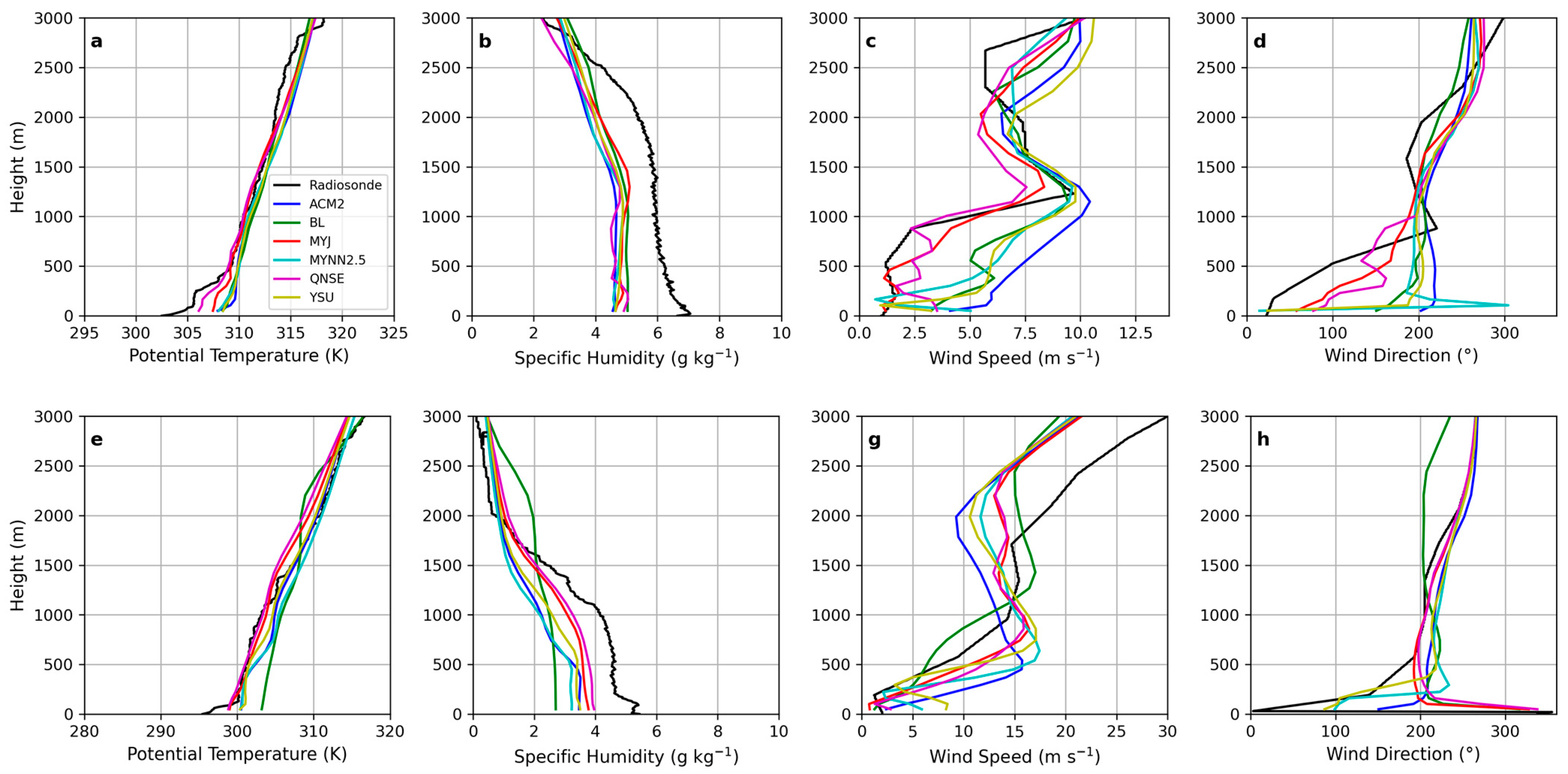
Figure 6 present the vertical profiles of potential temperature ( θ ), specific humidity (Q), wind speed (WS), and wind direction (WD) from RS observations and six PBL schemes during the spring (April) and winter (December) periods. Overall, all schemes reproduce the basic vertical structure of the boundary layer, but their differences in stratification and mixing intensity are evident between seasons. In April (Figure 6a–d) all schemes produced θ profiles that were warmer than the observations, with QNSE showing the best agreement near the surface. The two non-local schemes, YSU and ACM2, simulated the warmest θ profiles, mainly due to the characteristics of their PBL parameterizations. For the Q profiles, all schemes were approximately 2 g kg−1 drier than the observations. Regarding WS, QNSE and MYJ matched the observations most closely in the lower and middle layers, while MYNN2.5, YSU, and BL performed better around 1500 m. Wind direction showed large deviations from observations near the surface but improved noticeably in the middle and upper layers.
In December (Figure 6e–h), the stratification is much more stable. The QNSE and MYJ schemes agreed best with observations, while other schemes simulated a warmer PBL profile. The Q was generally underestimated below 1800 m and overestimated above that height. Simulated WS were stronger than observed in the lower to middle layers but weaker above 1000 m, with BL producing the weakest winds. WD exhibited notable discrepancies near the surface but showed better agreement with observations in the middle and upper levels.

3.4. Planetary Boundary Layer Height

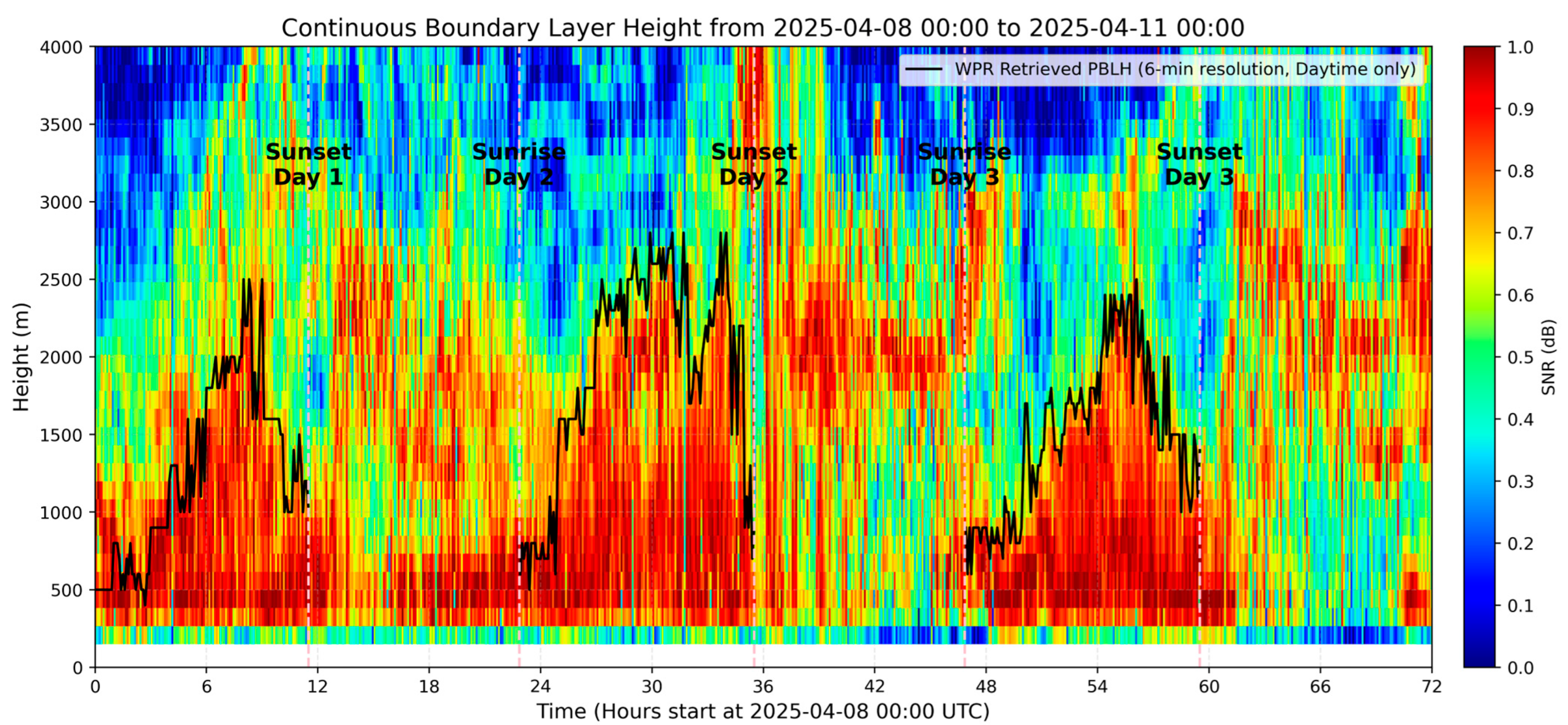
Figure 7 shows the continuous variation process of the PBLH from 8 to 10 April 2025, which was retrieved using the SNR data of the WPR. The background of the figure represents the SNR intensity distribution observed by the WPR (with colors indicating the normalized SNR magnitude, red for high signal areas and blue for low signal areas), and the black solid line represents the PBLH retrieved through the wavelet transform method (WTM) with a time resolution of 6 min. The vertical dashed lines represent the sunrise and sunset times each day. The WTM has been widely applied in recent years for PBLH detection, as it can effectively identify the altitude of the most significant gradient in SNR or backscattering signals, corresponding to the top of the turbulent mixing layer [38,41,42]. By analyzing the multiscale variation in SNR with height, the method allows for the continuous retrieval of PBLH evolution. However, this technique is mainly suitable for daytime convective boundary layers (CBL), since at night the SBL height is usually only a few tens to several hundred meters, which often falls within the radar’s low-level blind zone. Therefore, the nighttime PBLH retrieved from WPR data is highly uncertain and not used for validation in this study. It can be seen that the PBLH significantly increases during the day due to solar heating, usually reaching 1500–2500 m. The PBLH development was most vigorous on the second day.
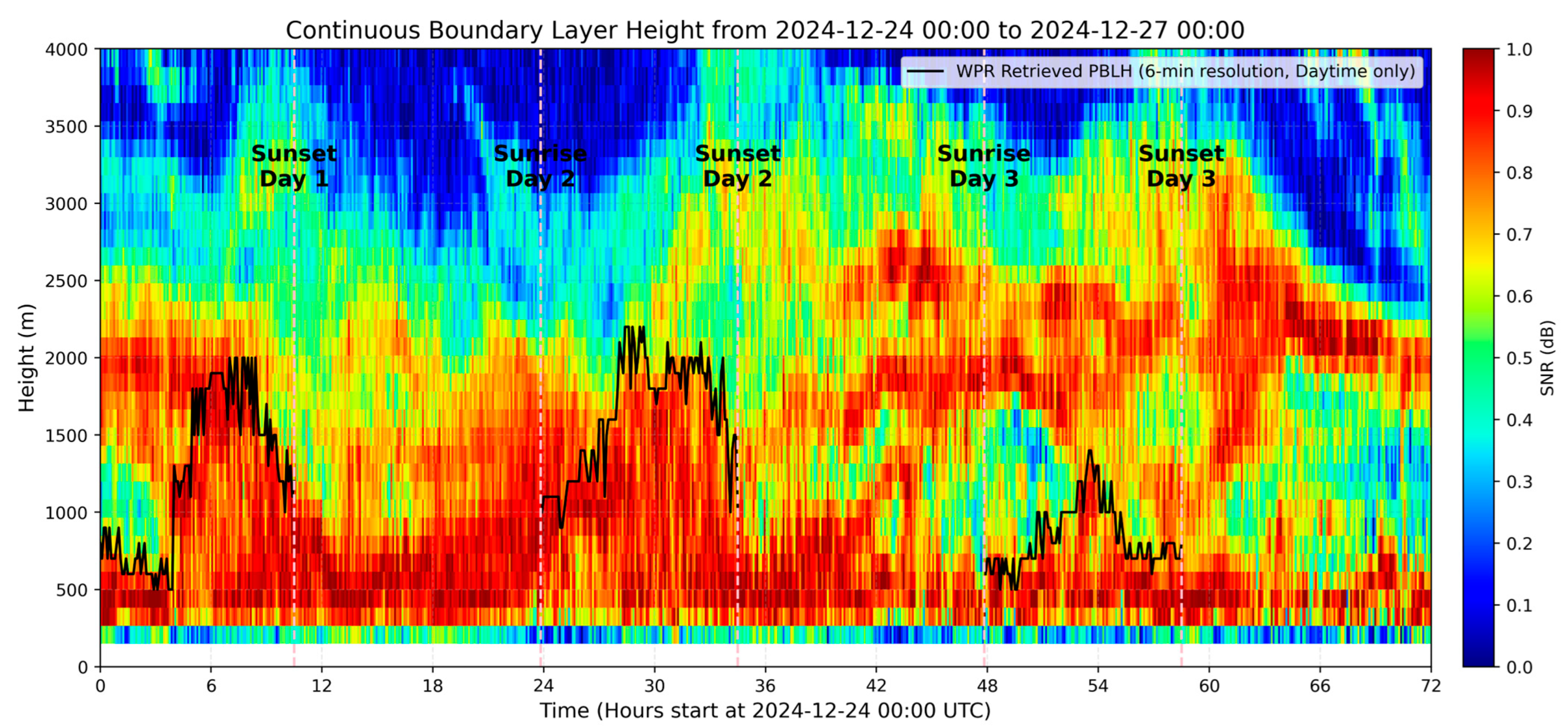
Figure 8 shows the continuous PBLH changes obtained by inversion using the WPR SNR data from 24 to 26 December 2024. Compared with the spring case (Case April), the PBLH in winter is generally significantly lower. The maximum height during the day usually does not exceed 2000 m. This is primarily attributable to weaker solar radiation, reduced surface heating, and diminished turbulent mixing in winter. It can be seen in the figure that the PBLH still shows obvious diurnal cycle characteristics, but the growth rate during the day is smaller and the duration is shorter, indicating that the development of the atmospheric mixed layer is restricted in winter.
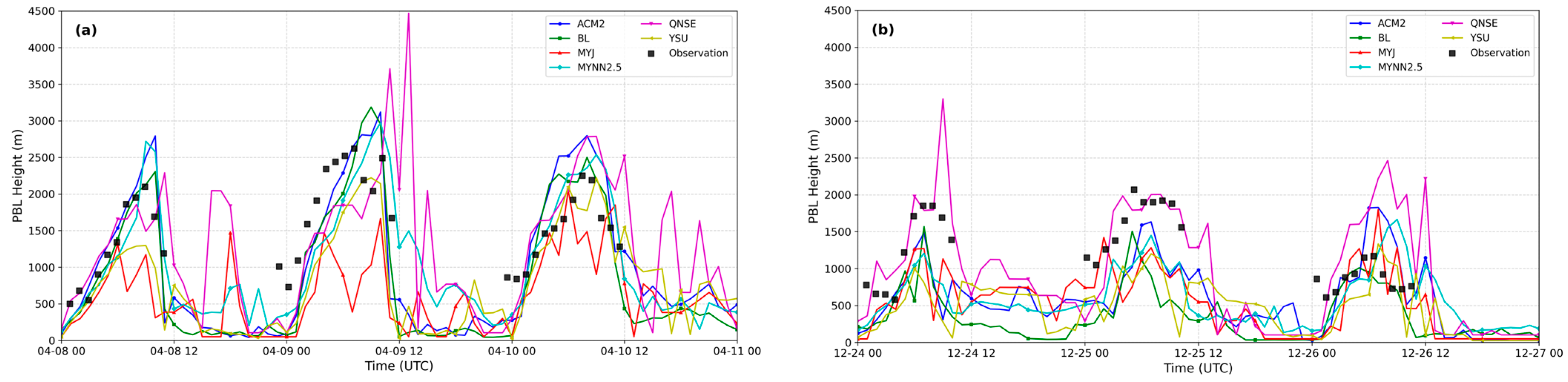
Figure 9a compares the time series of PBLH simulated by six PBL schemes with the observed PBLH retrieved from WPR (black squares) from 8 to 11 April 2025. The hourly average of the WPR results was used for observation and comparison. Both observational and simulation results show similar diurnal variation cycles. The QNSE scheme tends to overestimate PBLH and shows occasional unrealistic spikes, while MYNN2.5 and BL capture the daytime growth more accurately. As shown in Table 3, MYNN2.5 and BL schemes have the lowest RMSE. the MYJ scheme exhibits the largest bias and the weakest CBL development. Overall, all schemes reproduce the diurnal evolution of the PBL but differ in representing the strength and timing of PBL development. Compared with the April case, Figure 9b shows that the PBLH in winter is much lower, with daytime maxima generally below 2000 m, reflecting the weak solar heating typical of the cold season. Apart from the QNSE scheme, all other schemes underestimated the development of PBLH in the first two days. But the QNSE scheme also produces several overestimated peaks. On the third day, the PBLH decreased, but none of the simulations captured this situation. In this case, the QNSE and MYNN2.5 schemes performed better. Table 3 compares the PBLH simulation performance of six PBL schemes for April and December. Overall, all schemes exhibit higher correlations during April than December, indicating that these schemes still has limitations in simulating PBLH in winter.

4. Conclusions

This study systematically evaluated six PBL parameterization schemes (ACM2, BL, MYJ, MYNN2.5, QNSE, and YSU) within the WRF model over the complex terrain of the Liangshan Prefecture, using multi-source observational data for validation. The results revealed distinct scheme-dependent differences in the simulation of near-surface meteorological variables, vertical profiles, and PBLH, with clear seasonal variability in model performance.
For surface meteorology, the QNSE scheme achieved the best overall agreement with observations in both spring and winter, accurately reproducing the diurnal variation and large temperature amplitude of T2. Its stability-dependent turbulence closure effectively represents nocturnal cooling and daytime heating. The MYNN2.5 scheme also performed well, particularly in spring, maintaining stable temperature and humidity simulations. Non-local schemes such as YSU and ACM2 tended to overmix and overestimate nighttime T2. The BL and MYJ schemes provided more realistic near-surface Q2 and WS10 simulations. However, all schemes underestimated extreme wind values, reflecting the influence of terrain-induced subgrid variability not fully resolved by the model.
For the vertical structure, the QNSE and MYJ schemes simulated θ and moisture profiles that were closer to sounding profiles in the middle and lower troposphere for both seasons. Furthermore, QNSE and MYJ showed similar results in simulating WS and WD, with both schemes producing better simulations of WS and WD profiles in spring than in winter. Compared to other models, the BL scheme produced warmer and wetter profiles in spring, but warmer and drier profiles in winter.
For PBLH, all schemes reproduced the diurnal cycle of PBLH but differed in amplitude. In spring, MYNN2.5 and BL achieved the smallest RMSE and highest correlation with wind-profiler observations. In winter, QNSE performed best in capturing daytime PBLH, though it occasionally produced unrealistic spikes. MYJ persistently underestimated PBLH in both seasons.
In summary, no single scheme performed optimally for all variables. Nonetheless, QNSE and MYNN2.5 demonstrated the most balanced overall performance across both spring and winter seasons, making them the recommended choices for high-resolution WRF simulations in the Liangshan Prefecture, particularly for studies of PBL dynamics, air-quality modeling, and fire–weather forecasting in dry-season conditions.
It is important to note that these findings are based on a limited sample of clear-sky episodes. Future work will extend the temporal scope to multi-seasonal and multi-year analyses, incorporating different weather regimes (convective, cloudy, and precipitation periods) to examine how PBL scheme performance varies under diverse atmospheric states. Such long-term evaluations will provide deeper insight into PBL evolution mechanisms and improve the regional applicability of numerical models over complex terrain.

Author Contributions

Conceptualization, J.Z. and D.S.; methodology, J.Z.; software, J.Z.; validation, D.S. and Z.Z.; formal analysis, J.Z.; investigation, J.Z.; resources, Z.Z.; data curation, W.K.; writing—original draft preparation, J.Z.; writing—review and editing, All authors; visualization, Z.Z.; supervision, D.S.; project administration, P.F.; funding acquisition, F.M. All authors have read and agreed to the published version of the manuscript.

Funding

This research was funded by Sichuan Province Science and Technology Plan Project, grant number 2024YFTX0016; Science and Technology Development Fund Project of Sichuan Provincial Key Laboratory of Rainstorm, Drought and Flood Disasters in Plateau and Basin, grant number SCQXKJYJXMS202210; and Liangshan Prefecture Science and Technology Plan Project, grant number 23ZDYF0182.

Institutional Review Board Statement

Not applicable.

Informed Consent Statement

Not applicable.

Data Availability Statement

The original contributions presented in the study are included in the article, further inquiries can be directed to the corresponding author.

Acknowledgments

For the data used in this study, we acknowledge the field observation data support provided by the Liangshan Meteorological Bureau. We also gratefully thank Su for his valuable guidance, as well as all other colleagues and collaborators for their dedicated efforts and contributions to this study.

Conflicts of Interest

The authors declare no conflicts of interest.

References

  1. Stull, R.B. An Introduction to Boundary Layer Meteorology; Kluwer Academic Publishers: Dordrecht, The Netherlands, 1988. [Google Scholar]
  2. Garratt, J.R.; Pielke, R.A. On the sensitivity of mesoscale models to surface-layer parameterization constants. Bound. Layer Meteorol. 1989, 48, 377–387. [Google Scholar] [CrossRef]
  3. Garratt, J.R. Review: The atmospheric boundary layer. Earth Sci. Rev. 1994, 37, 89–134. [Google Scholar] [CrossRef]
  4. Jia, W.; Zhang, X. The role of the planetary boundary layer parameterization schemes on the meteorological and aerosol pollution simulations: A review. Atmos. Res. 2020, 239, 104890. [Google Scholar] [CrossRef]
  5. Wang, W.; Shen, X.; Huang, W. A Comparison of Boundary Layer Characteristics Simulated Using Different Parametrization Schemes. Bound. Layer Meteorol. 2016, 161, 375–403. [Google Scholar] [CrossRef]
  6. Cohen, A.E.; Cavallo, S.M.; Coniglio, M.C.; Brooks, H.E. A Review of Planetary Boundary Layer Parameterization Schemes and Their Sensitivity in Simulating Southeastern U.S. Cold Season Severe Weather Environments. Weather Forecast. 2015, 30, 591–612. [Google Scholar] [CrossRef]
  7. Shin, H.H.; Dudhia, J. Evaluation of PBL Parameterizations in WRF at Subkilometer Grid Spacings: Turbulence Statistics in the Dry Convective Boundary Layer. Mon. Weather Rev. 2016, 144, 1161–1177. [Google Scholar] [CrossRef]
  8. García-Díez, M.; Fernández, J.; Fita, L.; Yagüe, C. Seasonal dependence of WRF model biases and sensitivity to PBL schemes over Europe. Q. J. R. Meteorol. Soc. 2013, 139, 501–514. [Google Scholar] [CrossRef]
  9. Wang, R.; Zhu, Y.; Qiao, F.; Liang, X.Z.; Zhang, H.; Ding, Y. High-resolution Simulation of an Extreme Heavy Rainfall Event in Shanghai Using the Weather Research and Forecasting Model: Sensitivity to Planetary Boundary Layer Parameterization. Adv. Atmos. Sci. 2021, 38, 98–115. [Google Scholar] [CrossRef]
  10. Jia, W.; Zhang, X.; Wang, H.; Wang, Y.; Wang, D.; Zhong, J.; Zhang, W.; Zhang, L.; Guo, L.; Lei, Y.; et al. Comprehensive evaluation of typical planetary boundary layer (PBL) parameterization schemes in China—Part 1: Understanding expressiveness of schemes for different regions from the mechanism perspective. Geosci. Model Dev. 2023, 16, 6635–6670. [Google Scholar] [CrossRef]
  11. Wang, Q.; Zeng, B.; Chen, G.; Li, Y. Simulation performance of planetary boundary layer schemes in WRF v4.3.1 for near-surface wind over the western Sichuan Basin: A single-site assessment. Geosci. Model Dev. 2025, 18, 1769–1784. [Google Scholar] [CrossRef]
  12. Hariprasad, K.B.; Srinivas, C.V.; Singh, A.B.; Rao, S.V.; Baskaran, R.; Venkatraman, B. Numerical simulation and intercomparison of boundary layer structure with different PBL schemes in WRF using experimental observations at a tropical site. Atmos. Res. 2014, 145, 27–44. [Google Scholar] [CrossRef]
  13. Hu, X.-M.; Nielsen-Gammon, J.W.; Zhang, F. Evaluation of Three Planetary Boundary Layer Schemes in the WRF Model. J. Appl. Meteorol. Climatol. 2010, 49, 1831–1844. [Google Scholar] [CrossRef]
  14. Shin, H.H.; Hong, S.-Y. Intercomparison of Planetary Boundary Layer Parametrizations in the WRF Model for a Single Day from CASES-99. Bound. Layer Meteorol. 2011, 139, 261–281. [Google Scholar] [CrossRef]
  15. Ntoumos, A.; Hadjinicolaou, P.; Zittis, G.; Constantinidou, K.; Tzyrkalli, A.; Lelieveld, J. Evaluation of WRF Model Boundary Layer Schemes in Simulating Temperature and Heat Extremes over the Middle East–North Africa (MENA) Region. J. Appl. Meteorol. Climatol. 2023, 62, 1315–1332. [Google Scholar] [CrossRef]
  16. Singh, J.; Singh, N.; Ojha, N.; Dimri, A.P.; Singh, R.S. Impacts of different boundary layer parameterization schemes on simulation of meteorology over Himalaya. Atmos. Res. 2024, 298, 107154. [Google Scholar] [CrossRef]
  17. Singh, N.; Solanki, R.; Ojha, N.; Janssen, R.H.; Pozzer, A.; Dhaka, S.K. Boundary layer evolution over the central Himalayas from radio wind profiler and model simulations. Atmos. Chem. Phys. 2016, 16, 10559–10572. [Google Scholar] [CrossRef]
  18. Banks, R.F.; Baldasano, J.M. Impact of WRF model PBL schemes on air quality simulations over Catalonia, Spain. Sci. Total Environ. 2016, 572, 98–113. [Google Scholar] [CrossRef]
  19. Banks, R.F.; Tiana-Alsina, J.; Baldasano, J.M.; Rocadenbosch, F.; Papayannis, A.; Solomos, S.; Tzanis, C.G. Sensitivity of Boundary Layer variables to PBL schemes in the WRF model based on surface meteorological observations, lidar, and radiosondes during the HygrA-CD campaign. Atmos. Res. 2016, 176–177, 185–201. [Google Scholar] [CrossRef]
  20. Herrera-Mejía, L.; Hoyos, C.D. Characterization of the atmospheric boundary layer in a narrow tropical valley using remote-sensing and radiosonde observations and the WRF model: The Aburrá Valley case-study. Q. J. R. Meteorol. Soc. 2019, 145, 2641–2665. [Google Scholar] [CrossRef]
  21. Ma, Y.-F.; Wang, Y.; Xian, T.; Tian, G.; Lu, C.; Mao, X.; Wang, L.P. Impact of PBL schemes on multiscale WRF modeling over complex terrain, Part I: Mesoscale simulations. Atmos. Res. 2024, 297, 107117. [Google Scholar] [CrossRef]
  22. Lin, Y.-L.; Farley, R.D.; Orville, H.D. Bulk Parameterization of the Snow Field in a Cloud Model. J. Clim. Appl. Meteorol. 1983, 22, 1065–1092. [Google Scholar] [CrossRef]
  23. Kain, J.S. The Kain–Fritsch Convective Parameterization: An Update. J. Appl. Meteorol. 2004, 43, 170–181. [Google Scholar] [CrossRef]
  24. Dudhia, J. Numerical Study of Convection Observed during the Winter Monsoon Experiment Using a Mesoscale Two-Dimensional Model. J. Atmos. Sci. 1989, 46, 3077–3107. [Google Scholar] [CrossRef]
  25. Iacono, M.J.; Mlawer, E.J.; Clough, S.A.; Morcrette, J.J. Impact of an improved longwave radiation model, RRTM, on the energy budget and thermodynamic properties of the NCAR community climate model, CCM3. J. Geophys. Res. Atmos. 2000, 105, 14873–14890. [Google Scholar] [CrossRef]
  26. Noilhan, J.; Planton, S. A Simple Parameterization of Land Surface Processes for Meteorological Models. Mon. Weather Rev. 1989, 117, 536–549. [Google Scholar] [CrossRef]
  27. Pleim, J.E. A Combined Local and Nonlocal Closure Model for the Atmospheric Boundary Layer. Part II: Application and Evaluation in a Mesoscale Meteorological Model. J. Appl. Meteorol. Climatol. 2007, 46, 1396–1409. [Google Scholar] [CrossRef]
  28. Pleim, J.E.; Xiu, A. Development and Testing of a Surface Flux and Planetary Boundary Layer Model for Application in Mesoscale Models. J. Appl. Meteorol. Climatol. 1995, 34, 16–32. [Google Scholar] [CrossRef]
  29. Pleim, J.E. A Combined Local and Nonlocal Closure Model for the Atmospheric Boundary Layer. Part I: Model Description and Testing. J. Appl. Meteorol. Climatol. 2007, 46, 1383–1395. [Google Scholar] [CrossRef]
  30. Bougeault, P.; Lacarrere, P. Parameterization of Orography-Induced Turbulence in a Mesobeta-Scale Model. Mon. Weather Rev. 1989, 117, 1872–1890. [Google Scholar] [CrossRef]
  31. Yamada, T.; Mellor, G. A Simulation of the Wangara Atmospheric Boundary Layer Data. J. Atmos. Sci. 1975, 32, 2309–2329. [Google Scholar] [CrossRef]
  32. Janić, Z.I. Nonsingular Implementation of the Mellor-Yamada Level 2.5 Scheme in the NCEP Meso Model; NOAA: Camp Springs, MD, USA, 2001. [Google Scholar]
  33. Janjić, Z.I. The Step-Mountain Eta Coordinate Model: Further Developments of the Convection, Viscous Sublayer, and Turbulence Closure Schemes. Mon. Weather Rev. 1994, 122, 927–945. [Google Scholar] [CrossRef]
  34. Nakanishi, M.; Niino, H. An Improved Mellor–Yamada Level-3 Model with Condensation Physics: Its Design and Verification. Bound. Layer Meteorol. 2004, 112, 1–31. [Google Scholar] [CrossRef]
  35. Sukoriansky, S.; Galperin, B.; Perov, V. Application of a New Spectral Theory of Stably Stratified Turbulence to the Atmospheric Boundary Layer over Sea Ice. Bound. Layer Meteorol. 2005, 117, 231–257. [Google Scholar] [CrossRef]
  36. Hong, S.-Y.; Noh, Y.; Dudhia, J. A New Vertical Diffusion Package with an Explicit Treatment of Entrainment Processes. Mon. Weather Rev. 2006, 134, 2318–2341. [Google Scholar] [CrossRef]
  37. Hong, S.-Y. A new stable Boundary Layer mixing scheme and its impact on the simulated East Asian summer monsoon. Q. J. R. Meteorol. Soc. 2010, 136, 1481–1496. [Google Scholar] [CrossRef]
  38. Molod, A.; Salmun, H.; Dempsey, M. Estimating planetary boundary layer heights from NOAA profiler network wind profiler data. J. Atmos. Ocean. Technol. 2015, 32, 1545–1561. [Google Scholar] [CrossRef]
  39. Salmun, H.; Josephs, H.; Molod, A. GRWP-PBLH: Global Radar Wind Profiler Planetary Boundary Layer Height Data. Bull. Am. Meteorol. Soc. 2023, 104, E1044–E1057. [Google Scholar] [CrossRef]
  40. Tastula, E.-M.; Galperin, B.; Dudhia, J.; LeMone, M.A.; Sukoriansky, S.; Vihma, T. Methodical assessment of the differences between the QNSE and MYJ PBL schemes for stable conditions. Q. J. R. Meteorol. Soc. 2015, 141, 2077–2089. [Google Scholar] [CrossRef]
  41. Compton, J.C.; Delgado, R.; Berkoff, T.A.; Hoff, R.M. Determination of Planetary Boundary Layer Height on Short Spatial and Temporal Scales: A Demonstration of the Covariance Wavelet Transform in Ground-Based Wind Profiler and Lidar Measurements. J. Atmos. Ocean. Technol. 2013, 30, 1566–1575. [Google Scholar] [CrossRef]
  42. Cohn, S.A.; Angevine, W.M. Boundary Layer Height and Entrainment Zone Thickness Measured by Lidars and Wind-Profiling Radars. J. Appl. Meteorol. 2000, 39, 1233–1247. [Google Scholar] [CrossRef]
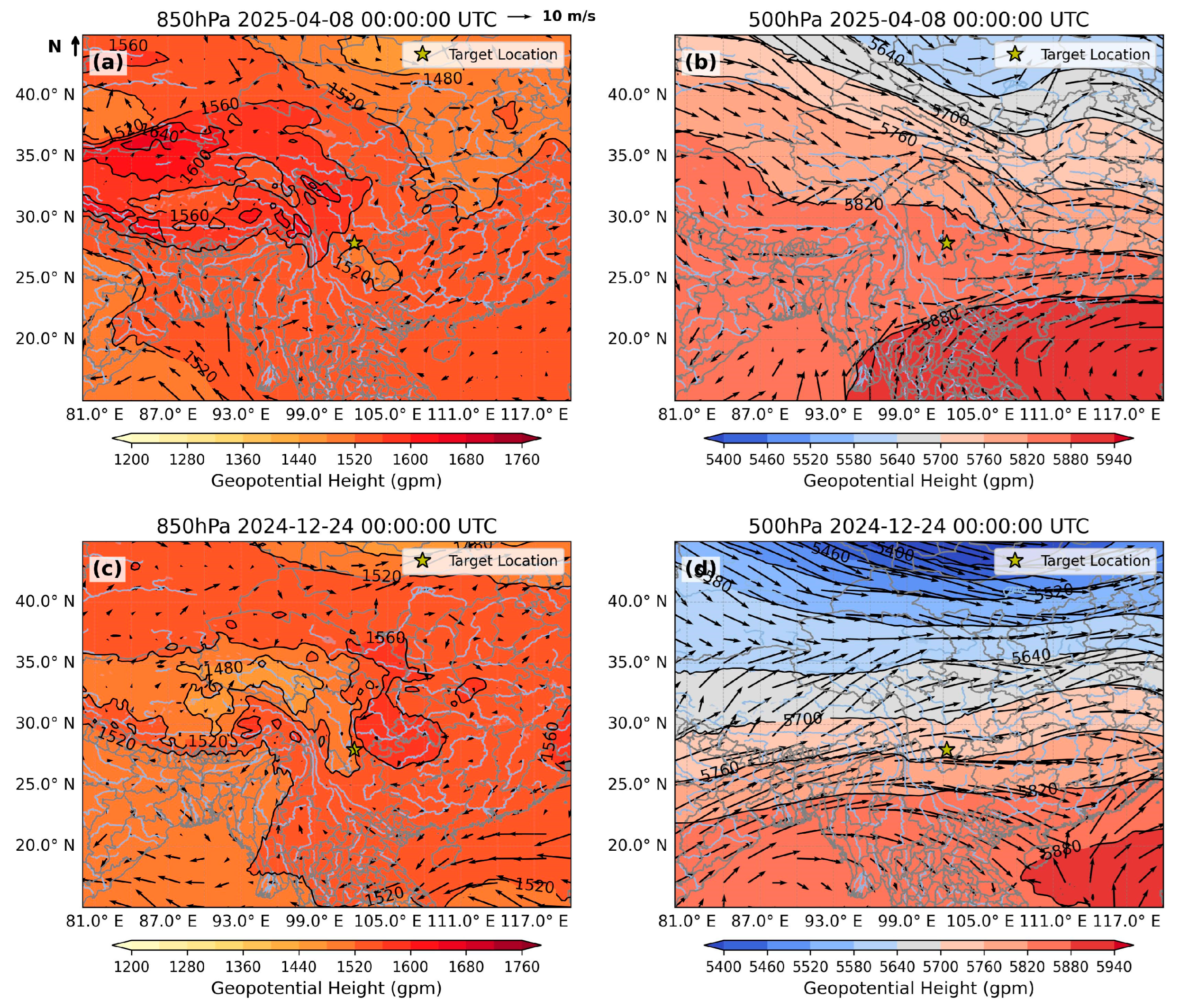
Figure 1. Geopotential height (gpm, shading and contours) and wind vectors at 850 hPa (a,c) and 500 hPa (b,d) for 00:00 UTC on 8 April 2025 (spring) and 24 December 2024 (winter). The yellow star indicates the observation station in the Liangshan Prefecture.
Atmosphere 17 00053 g001
Figure 2. Location of Liangshan Prefecture within China, the WRF simulation nested domains, and the local topography. The red star marks the location of the multi-source observation equipment, which is also the center point of the simulation at an elevation of 1590.8 m.
Atmosphere 17 00053 g002
Figure 3. Comparison of observed and simulated near-surface meteorological variables using six PBL schemes for the Liangshan Prefecture: 2 m temperature (T2; panels (a,b)), 2 m specific humidity (Q2; panels (c,d)), and 10 m wind speed (WS10; panels (e,f)). The spring case (a,c,e) corresponds to 8–11 April 2025, and the winter case (b,d,f) corresponds to 24–27 December 2024. The black line denotes observations, and colored lines represent simulations with different PBL schemes.
Atmosphere 17 00053 g003
Figure 4. Diurnal variations in (a) sensible heat flux (HFX), (b) surface temperature (TSK), (c) heat transfer coefficient (Ch), and (d) ground heat flux (GRDFLX) simulated by different PBL schemes during the spring case. Negative values of GRDFLX indicate downward heat flux into the soil.
Atmosphere 17 00053 g004
Figure 5. Same as Figure 4 but for Case December. Temporal evolution of (a) sensible heat flux, (b) skin temperature, (c) heat exchange coefficient, and (d) ground heat flux for six different parameterization schemes over a 72-hour period.
Atmosphere 17 00053 g005
Figure 6. Vertical profile of potential temperature (K), Specific humidity (g kg−1), Wind Speed (m s−1) and Wind Direction (°) from observations and model simulations at 23 UTC on April 8 (panels (ad)) and December 25 (panels (eh)).
Atmosphere 17 00053 g006
Figure 7. Continuous PBLH retrieved from WPR SNR data using the WTM from 8 to 11 April 2025. The background color represents the SNR intensity, and the black line denotes the retrieved PBLH with a 6 min temporal resolution (daytime). The white dashed line represents sunrise and sunset times.
Atmosphere 17 00053 g007
Figure 8. Same as Figure 6, but from 24 to 27 December 2024.
Atmosphere 17 00053 g008
Figure 9. Comparison of simulated PBLH from six PBL schemes with WPR observations (black squares) for (a) 8–11 April 2025 and (b) 24–27 December 2024.
Atmosphere 17 00053 g009
Table 1. Six WRF PBL schemes were evaluated in this study, including TKE closure type, associated surface layer scheme, and operational method and threshold value for diagnosing PBLH.
PBL SchemeSurface Layer SchemesClosurePBLH Definition
ACM2Revised MM5 SchemeHybrid 1.0 non-local and local closure schemeRib = 0.25
BLRevised MM5 Scheme1.5 localTKE = 0.005 m2·s−2
MYJEta similarity1.5 localTKE = 0.1 m2·s−2
MYNN2.5MYNN Scheme1.5 localTKE = 1.0 × 10⁻⁶ m2·s−2
QNSEQNSE Scheme1.5 localTKE = 0.01 m2·s−2
YSURevised MM5 Scheme1.0 non-localRib = 0.25 (stable), 0 (unstable)
Table 2. Statistics of model performance with different PBL schemes in April 2025 and December 2024. Bold text represents the statistics for December.
(April, December)
IndicatorsACM2BLMYJMYNN2.5QNSEYSU
T2(°C)
RMSE2.32, 4.25 2.52, 3.832.51, 3.601.97, 3.511.79, 2.982.32, 4.19
MBE0.78, 3.221.27, 3.121.05, 2.590.63, 2.710.10, 1.890.57, 3.01
R0.91, 0.830.92, 0.900.90, 0.870.93, 0.900.94, 0.890.91, 0.81
Q2(g kg−1)
RMSE2.70, 1.182.32, 1.582.33, 0.862.50, 1.202.44, 0.882.41, 0.97
MBE−2.03, −0.95−1.50, −1.47−1.54, −0.55−1.82, −1.03−1.78, −0.55−1.68, −0.72
R−0.11, −0.22−0.09, 0.300.002, −0.21−0.02, 0.004−0.002, −0.31−0.08, −0.03
WS10(m s−1)
RMSE2.40, 3.483.62, 3.711.46, 2.341.50, 2.191.47, 2.221.70, 3.18
MBE1.49, 2.192.37, 2.330.57, 0.980.67, 1.310.68, 0.970.98, 1.94
R0.42, 0.470.41, 0.520.58, 0.550.54, 0.570.51, 0.520.51, 0.38
Table 3. Statistical metrics of simulated PBLH using different PBL schemes during daytime 8–11 April and daytime 24–26 December.
AprilPBL SchemeRMSEMBERDecemberRMSEMBER
PBLH (daytime)ACM2585.0210.750.820PBLH (daytime)656.01−374.790.397
BL526.32−107.280.840745.40−605.150.493
MYJ914.23−729.450.535657.83−435.420.422
MYNN2.5532.85−72.920.778624.58−396.210.397
QNSE621.94−12.260.639669.46238.680.507
YSU611.32−446.260.791811.21−658.400.400
Disclaimer/Publisher’s Note: The statements, opinions and data contained in all publications are solely those of the individual author(s) and contributor(s) and not of MDPI and/or the editor(s). MDPI and/or the editor(s) disclaim responsibility for any injury to people or property resulting from any ideas, methods, instructions or products referred to in the content.