Article

DWTPred-Net: A Spatiotemporal Ionospheric TEC Prediction Model Using Denoising Wavelet Transform Convolution


1
China National Offshore Oil Corporation Research Institute, Co., Ltd., Beijing 100028, China
2
School of Computer Science and Engineering, Institute of Disaster Prevention, Langfang 065201, China
3
College of Industry and Information Technology, Hainan Vocational University, Haikou 570216, China
4
Institute of Intelligent Emergency Information Processing, Institute of Disaster Prevention, Langfang 065201, China
*
Author to whom correspondence should be addressed.
Atmosphere 2026, 17(1), 54; https://doi.org/10.3390/atmos17010054
Submission received: 8 December 2025 / Revised: 29 December 2025 / Accepted: 29 December 2025 / Published: 31 December 2025
(This article belongs to the Section Upper Atmosphere)

Abstract

PredRNN is a spatiotemporal prediction model based on ST-LSTM units, capable of simultaneously extracting spatiotemporal features from ionospheric Total Electron Content (TEC). However, its internal convolutional operations require large kernels to capture low-frequency features, which can easily lead to model over-parameterization and consequently limit its performance. Although some studies have employed wavelet transform convolution (WTConv) to improve feature extraction efficiency, the introduced noise interferes with effective feature representation. To address this, this paper proposes a denoising wavelet transform convolution (DWTConv) and constructs the DWTPred-Net model with it as the key component. To systematically validate the model’s performance, we compared it with mainstream models (C1PG, ConvLSTM, and ConvGRU) under different solar activity conditions. The results show that both M A E and R M S E of DWTPred-Net are greatly reduced under all test conditions. In high solar activity, DWTPred-Net reduces R M S E by 13.81%, 6.19%, and 9.28% compared to the C1PG, ConvLSTM, and ConvGRU, respectively. In low solar activity, the advantage of DWTPred-Net becomes even more pronounced, with R M S E reductions further increasing to 19.39%, 11.51%, and 16.10%, respectively. Furthermore, in additional tests across different latitudinal bands and during geomagnetic storm events, the model consistently demonstrates superior performance. These multi-perspective experimental results collectively indicate that DWTPred-Net possesses obvious advantages in improving TEC prediction accuracy.

1. Introduction

The ionosphere rich in charged particles refracts and reflects radio waves, changing their velocity and path, resulting in ionospheric delay [1,2]. This effect is a major source of positioning error in Global Navigation Satellite Systems (GNSS). Total Electron Content (TEC) is the key parameter for quantifying this delay [3]. Its value is directly proportional to the degree of delay, making it the core basis for error correction. Therefore, the prediction of TEC is crucial for correcting GNSS positioning errors, which improves the reliability and accuracy of navigation systems [4].
Traditional prediction methods often struggle to accurately forecast TEC due to its complex and highly nonlinear variations [5,6]. In contrast, deep learning excels at capturing such intricate patterns, making it a powerful and increasingly prevalent approach for TEC prediction.
Currently, deep learning-based TEC prediction models can be broadly divided into two categories. The first category consists of time series prediction models based on LSTM and GRU, such as ED-LSTM [7], BiLSTM [8,9], CNN-LSTM [10], CNN-GRU [11] and CNN-BiLSTM [12]. However, these models can only capture the long-term trends and short-term fluctuations in TEC evolution over time, i.e., nonlinear temporal dependencies, and their predictive performance is often limited. The second category comprises spatiotemporal prediction models, which not only model temporal dynamics but also extract interactions and spatial structures between TEC values across different geographical regions, thereby providing a more comprehensive description of ionospheric variation. The first proposed spatiotemporal prediction model was ConvLSTM, introduced by [13], which was successfully applied to precipitation nowcasting tasks. By embedding convolutional operations into the recurrent neural network structure, this model achieves joint modeling of spatiotemporal sequences. Due to its effectiveness, ConvLSTM has been widely adopted in the field of TEC prediction and has inspired a series of improved models, such as ED-ConvLSTM [14,15,16], ConvGRU [17], BiConvLSTM [18,19], BiConvGRU [20], iConvLSTM-SA [21], MConvLSTM-attention [22], which continuously advance the accuracy of TEC prediction.
PredRNN can also be regarded as an important variant of ConvLSTM, but its core mechanism differs fundamentally from other variant models [23]. Common ConvLSTM and its variants typically maintain a single-memory structure, transmitting information only along the temporal dimension, where spatiotemporal features are processed in a coupled manner within the same state. In contrast, PredRNN introduces an innovative dual-memory mechanism, which independently transmits information through both temporal and spatial dimensions. The model is composed of spatiotemporal LSTM (ST-LSTM) units and employs a unique zigzag pathway to enable interactive flow of features in the horizontal (temporal) and vertical (spatial) directions. This unique design makes PredRNN’s prediction performance superior to other models [24,25,26].
However, whether it is ConvLSTM or its various variants, including PredRNN, all rely on convolutional operations for feature extraction. These convolution-based models exhibit significant limitations: existing research indicates that while small convolutional kernels effectively capture high-frequency information [27], extracting low-frequency information requires enlarging the kernel size [28]. This expansion, however, leads to model over-parameterization, which consequently degrades model performance [29]. To solve this problem, researchers have proposed Wavelet Transform Convolution (WTConv) [29], a method that extracts low-frequency and high-frequency information simultaneously using a small kernel. However, WTConv still presents certain issues. When four sub-images are produced via wavelet transform decomposition, one corresponds to the noise component. If this component is retained during the ensuing feature extraction process, it will ultimately degrade the quality of the extracted features. To mitigate the influence of noise on the extracted features, this work removes the noise components following the method proposed by [29]. Denoising wavelet transform convolution (DWTConv) is then employed for feature extraction. This method maintains the capability to capture both low-frequency and high-frequency information concurrently while suppressing noise interference, ultimately improving feature effectiveness.
This paper integrates DWTConv into ST-LSTM, forming a novel feature extraction unit named DWTConv-ST-LSTM. Building upon this unit, we further construct a new spatiotemporal prediction model named DWTPred-Net for TEC forecasting. The proposed model not only preserves the dual-memory mechanism that separately processes temporal and spatial information, but also enables the simultaneous extraction of both low-frequency and high-frequency features using small convolutional kernels while effectively mitigating noise interference. To comprehensively demonstrate the effectiveness of our model, we conduct extensive comparative experiments against C1PG, ConvLSTM, and ConvGRU from multiple perspectives.

2. Data

The Global Ionospheric Maps (GIM) utilized in this work were obtained from International GNSS Service (IGS). These GIMs have a spatial resolution of 2.5° in latitude by 5.0° in longitude and a temporal resolution of 2 h. The dataset covers 6 years of GIMs. The data were partitioned as follows: the training set: 2013–2014 and 2017–2018; the test set: 2015 and 2019. Although data from the entire solar cycle were not used, the dataset selected already encompasses a relatively complete period of high solar activity (2013–2015) and a period of low solar activity (2017–2019). This coverage is sufficient to represent typical ionospheric disturbance patterns under different solar activity levels.

3. Methodology

This section begins with an introduction to the ST-LSTM unit, which serves as the fundamental building block of PredRNN. It then elaborates on the overall architecture of the original PredRNN. Next, the principles of WTConv and DWTConv are explained in detail. Building on this foundation, a novel DWTConv-ST-LSTM unit is proposed by integrating the DWTConv with ST-LSTM. Finally, the systematically constructed DWTPred-Net model, developed based on this proposed unit, is presented.

3.1. The ST-LSTM Unit

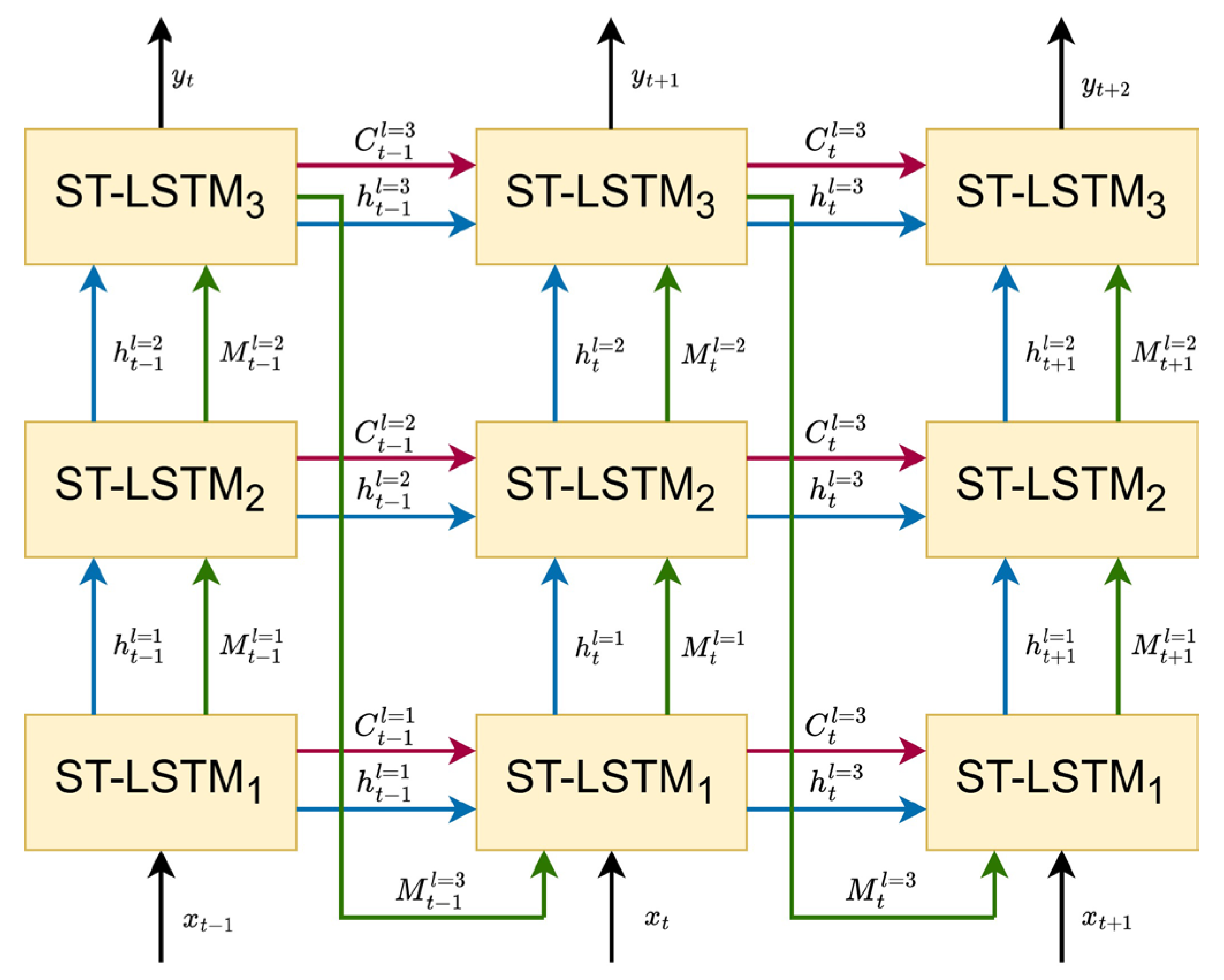
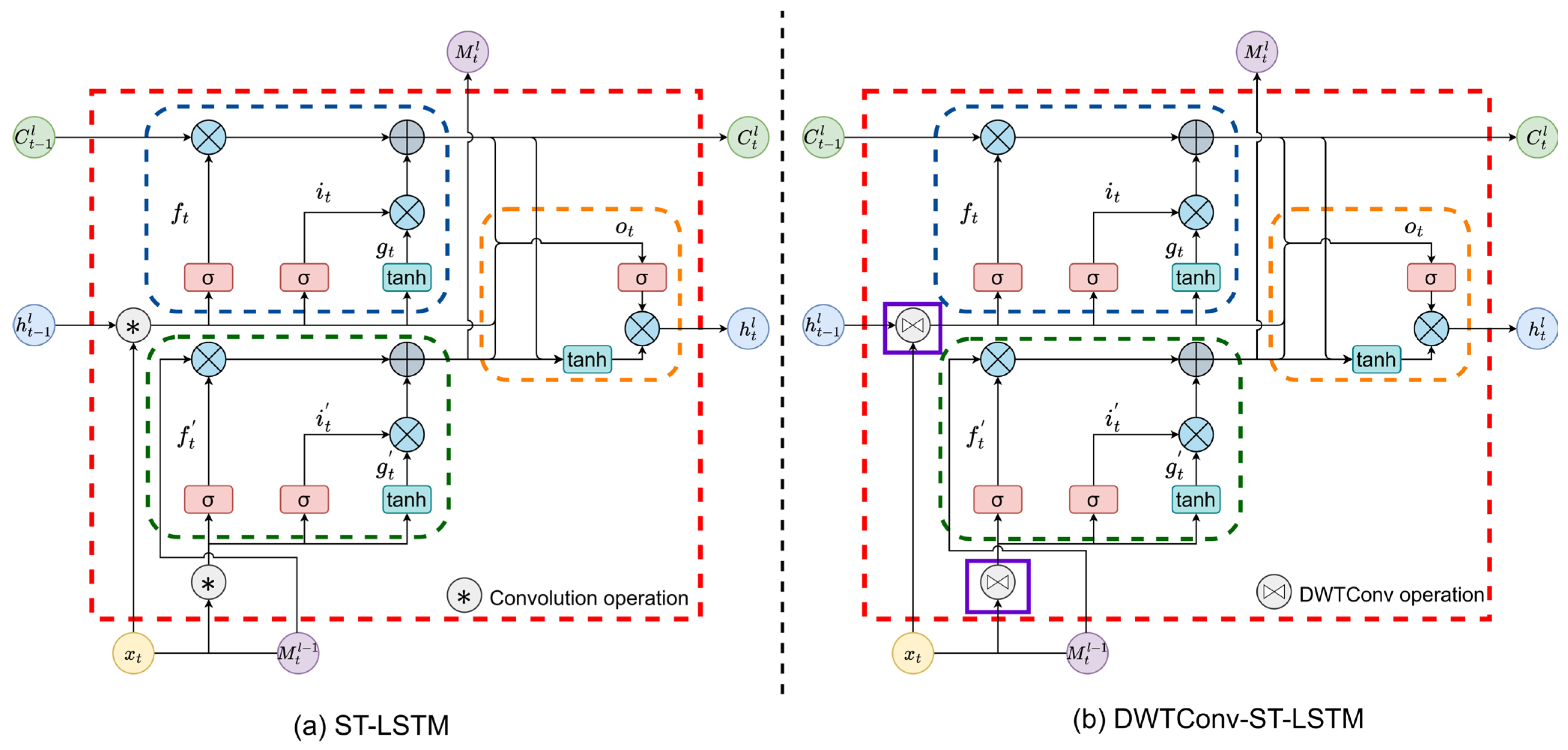
ST-LSTM is an LSTM variant, distinguished by its dual-memory mechanism. In contrast to the standard LSTM, which maintains only a temporal memory cell, the ST-LSTM incorporates an additional spatial memory unit dedicated to capturing spatial correlations. It contains three states: hidden layer memory, temporal memory, and spatial memory. The detailed structure is illustrated in Figure 1a.
In Figure 1a, the blue box represents the time memory state C t l , which is updated only along the time dimension in the horizontal direction. The corresponding calculations are as follows:
  g t = tanh W g [ x t , h t 1 l ] + b g i t = σ W i [ x t , h t 1 l ] + b i f t = σ W f [ x t , h t 1 l ] + b f C t l = f t C t 1 l + i t g t
where x t corresponds to the input data at time t; The temporal memory state and the previous hidden state of the l -th layer ST-LSTM unit are represented by C t l and h t 1 l , respectively; is convolution operation.
The green box indicates the spatial memory state M t l . While this unit shares structural similarities with the temporal memory state, it is only updated vertically along the spatial dimension. The corresponding calculations are as follows:
  g t = tanh W g x t , M t l 1 + b g i t = σ W i x t , M t l 1 + b i f t = σ W f x t , M t l 1 + b f M t l = f t M t l 1 + i t g t
Finally, the orange box represents the hidden state, which integrates information from both the temporal and spatial memory states and propagates it forward. Its computation is formulated as follows:
  o t = σ W o x t , h t 1 l , C t l , M t l + b o h t l = o t tanh W 1 × 1 C t l , M t l
Among them, W 1 × 1 represents the 1 × 1 weight matrix.

3.2. PredRNN

PredRNN is constructed by interconnecting multiple ST-LSTM units in a zigzag pattern, with its overall architecture illustrated in Figure 2. As illustrated in Figure 2, besides the horizontal flow of temporal memory ( C ), spatial memory ( M ) propagates vertically. This design enables the preservation of spatial memory from the top layer. Specifically, the spatial memory state undergoes a bottom-up propagation at the previous time step to capture spatial feature variations. Subsequently, this top-layer spatial memory is transferred to the bottom layer at the next time step to support prediction. This collaborative mechanism of simultaneously modeling temporal and spatial features improves prediction accuracy.

3.3. WTConv and DWTConv

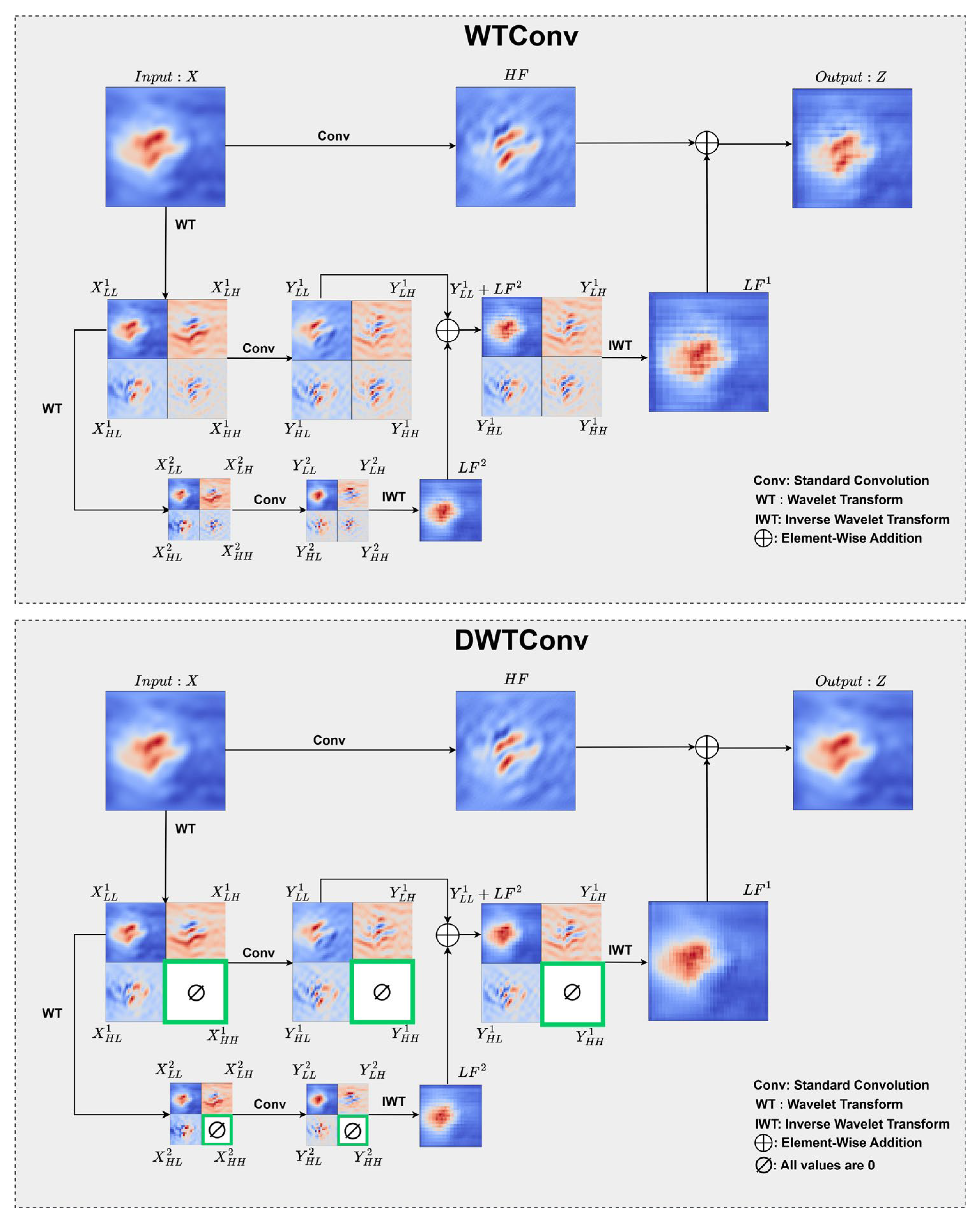
Finder et al. [29] proposed the Wavelet Transform Convolution (WTConv) method, which utilizes small convolutional kernels to achieve a large receptive field while simultaneously extracting both low-frequency and high-frequency information, without introducing excessive parameters that could degrade model performance. The process of WTConv comprises three steps. First, the original image is directly convolved with a small kernel to obtain high-frequency features. Second, the original input image undergoes wavelet transform for decomposition, yielding four frequency sub-images: the low-frequency approximation component X L L , the horizontal high-frequency detail component X L H , the vertical high-frequency detail component X H L , and the diagonal high-frequency detail component X H H . Each sub-image has spatial dimensions reduced by half compared to the original image, capturing distinct directional frequency characteristics: X L L retains the overall structure and smooth information of the image; X L H and X H L extract edge and texture details in the horizontal and vertical directions, respectively; X H H corresponds to high-frequency components along diagonal orientations. Subsequently, small-kernel convolution is applied independently to each sub-image for feature extraction and processing. The convolved sub-images are then reconstructed via inverse wavelet transform to produce the low-frequency feature map. In the final step, the low-frequency and high-frequency feature maps are fused to form the final output. The complete computational procedure of WTConv is described as follows:
  H F = Conv X
  X L L , X L H , X H L , X H H = WT X
  Y L L , Y L H , Y H L , Y H H = Conv X L L , X L H , X H L , X H H
  L F = IWT Y L L , Y L H , Y H L , Y H H
  Z = L F + H F
Among them, H F is high-frequency features; L F represents low-frequency features; Z denotes fused features, C o n v · is convolution operation; X L L , X L H , X H L , X H H are the four sub-images obtained by wavelet transform of the input, respectively; Y L L , Y L H , Y H L , Y H H correspond to the feature representations of each sub image after convolution processing; W T · and I W T · represent wavelet transform and inverse wavelet transform, respectively.
Furthermore, the WTConv can be cascaded, with the operational procedure as follows:
  Z = L F 1 + H F
  L F i = I W T [ L F i + 1 + Y L L i , Y L H i , Y H L i , Y H H i ] ,   i 1
where Z is the final output of the cascade. When the cascade has i layers, L F i + 1 = 0 .
While WTConv offers notable advantages, the X H H sub-image obtained through wavelet transform primarily contains noise. To address this issue, this study proposes setting X H H to zero during the convolution process, resulting in the Denoising Wavelet Transform Convolution (DWTConv). The computational procedure of DWTConv remains largely consistent with that of WTConv, except for the removal of X H H . Consequently, Equations (5) and (6) in the original WTConv formulation are modified as follows:
  Y L L , Y L H , Y H L , 0 = Conv X L L , X L H , X H L , 0
  L F = IWT Y L L , Y L H , Y H L , 0
Additionally, DWTConv can also be cascaded, and its calculation process is as follows:
  Z = L F 1 + H F
  L F i = IWT [ L F i + 1 + Y L L i , Y L H i , Y H L i , 0 ] ,   i 1
The schematic diagrams of the two-level WTConv and DWTConv are illustrated in Figure 3, with the green highlighted areas indicating the improved components.

3.4. DWTConv-ST-LSTM

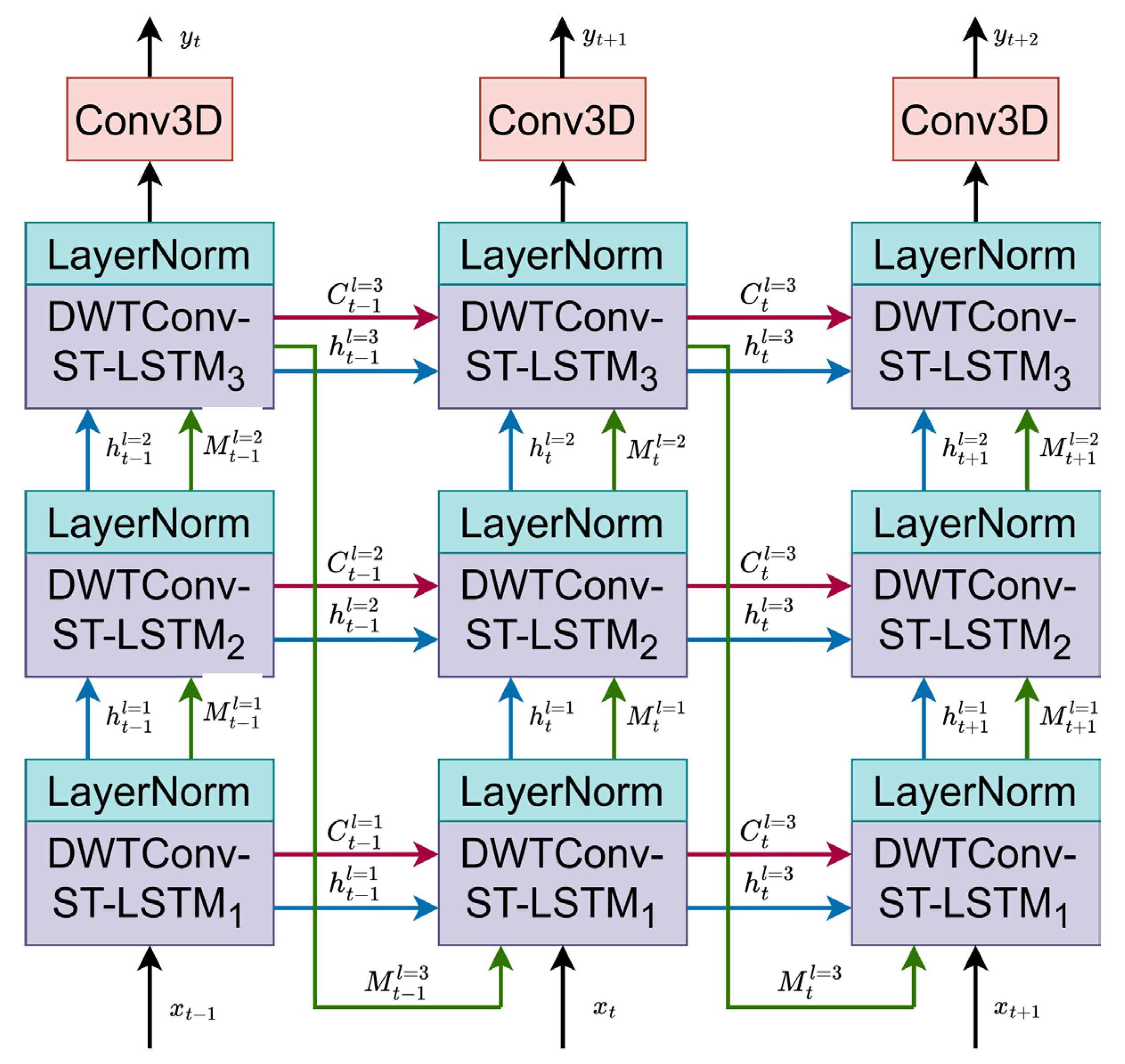
The previous sections introduced ST-LSTM and DWTConv separately. In this section, we integrate DWTConv by replacing the convolutional operations in ST-LSTM, resulting in a novel recurrent unit named DWTConv-ST-LSTM. This enhanced unit not only maintains the dual memory states propagating through temporal and spatial dimensions but also enables the simultaneous extraction of high- and low-frequency features using small convolutional kernels while mitigating noise interference. The architectural diagram of the proposed unit is depicted in Figure 1b, where the components highlighted in purple represent the DWTConv operations. The overall computational flow of DWTConv-ST-LSTM remains largely consistent with that of the original ST-LSTM, with the key distinction being the replacement of all convolutional operations with DWTConv. Accordingly, the computational formulas for DWTConv-ST-LSTM are updated as follows:
  g t = tanh W g [ x t , h t 1 l ] + b g i t = σ W i [ x t , h t 1 l ] + b i f t = σ W f [ x t , h t 1 l ] + b f C t l = f t C t 1 l + i t g t
  g t = tanh W g x t , M t l 1 + b g i t = σ W i x t , M t l 1 + b i f t = σ W f x t , M t l 1 + b f M t l = f t M t l 1 + i t g t
  o t = σ W o x t , h t 1 l , C t l , M t l + b o h t l = o t tanh W 1 × 1 C t l , M t l
where is the DWTConv operation.

3.5. DWTPred-Net

This paper proposes DWTPred-Net, a novel spatiotemporal TEC prediction model constructed using the DWTConv-ST-LSTM unit. Its structure is shown in Figure 4. The proposed model effectively addresses the limitations of both PredRNN and WTConv, enabling more accurate TEC forecasting. It is important to note that the data distribution undergoes transformation after being processed by each DWTConv-ST-LSTM unit. Therefore, a LayerNorm (LN) layer is incorporated after each unit to standardize the activations, thereby mitigating the risk of gradient vanishing or explosion caused by distribution shift. Finally, a 3D convolutional layer (Conv3D) is applied to integrate the spatiotemporal features and generate the 12 predicted TEC maps.
Figure 4 illustrates the prediction pipeline of the DWTPred-Net. Firstly, the DWTPred-Net takes a sequence of 12 consecutive GIMs as input. Then, a three-layer DWTConv-ST-LSTM module extracts and fuses spatiotemporal features from the input. Finally, a Conv3D layer reconstructs and outputs the predicted sequence of 12 GIMs.

4. Experimental Results and Discussion

4.1. Evaluation Metric

This paper assesses model performance using Mean Absolute Error ( M A E ) and Root Mean Square Error ( R M S E ), which are calculated as follows:
  M A E = 1 n i = 1 n y i y ^ i
  R M S E = 1 n i = 1 n y i y ^ i 2
where n represents the total number of observations, and y i and y ^ i are the corresponding observed and predicted values, respectively.

4.2. Optimization of the Model’s Hyperparameter

To evaluate the performance of the DWTPred-Net, we selected three mainstream models as baselines for comparison: C1PG (a prediction product), ConvLSTM, and ConvGRU (both deep learning models). Among the deep learning models (including DWTPred-Net, ConvLSTM, and ConvGRU), the number of convolutional kernels is one of the most critical hyperparameters affecting performance. Therefore, this study introduces a Bayesian optimization framework for automatic hyperparameter tuning, with the primary objective of determining the optimal number of convolutional kernels. The search space is set to the interval [8, 64], with the Mean Squared Error (MSE) serving as the optimization objective. The search process is guided by a Gaussian process surrogate model and the Expected Improvement acquisition function. The experiments were conducted on an NVIDIA GeForce RTX 3090 GPU (24 GB of memory). The specific optimization results are shown in Table 1.

4.3. Ablation Experiment

In this section, we first integrate the WTConv into the ST-LSTM cell, constructing a WTConv-ST-LSTM module. This module serves as the foundational block for building the WTConv-PredRNN. By comparing it with the standard PredRNN, we evaluate the effectiveness of incorporating WTConv. Subsequently, a comparison between WTConv-PredRNN and the proposed DWTPred-Net is conducted to further validate the advantage of the DWTConv in enhancing prediction accuracy. The detailed results are shown in Table 2.
Compared with the baseline model PredRNN, the WTConv-PredRNN, which incorporates WTConv, shows consistent improvement in both M A E and R M S E : reductions of 1.09% and 1.29% in 2015, and 1.88% and 2.01% in 2019, respectively. This confirms the performance enhancement brought by the WTConv. Furthermore, the DWTPred-Net, equipped with DWTConv, achieves an even more significant leap: compared to WTConv-PredRNN, it further reduces   M A E and R M S E by 2.37% and 1.98% in 2015, and by 7.76% and 5.29% in 2019. These results robustly demonstrate that the denoising mechanism can more effectively improve the predictive accuracy of the model.
Table 2 in this study demonstrates that the DWTConv outperforms the standard convolution and the WTConv, which aligns with the findings of Sun et al. [30]. In [30], the superiority of DWTConv was also confirmed. However, despite using the same DWTConv, the prediction error in this study is higher than that in [30]. This discrepancy may be attributed to two main reasons. On one hand, although the PredRNN used in this study incorporates two memory states, it operates with unidirectional memory transmission. In contrast, Ref. [30] is based on BiConvLSTM, which supports bidirectional memory transmission even with only one memory state, allowing it to leverage both past and future contextual information. On the other hand, Ref. [30] utilized data covering a complete solar cycle year, i.e., 11 years of GIMs. However, constrained by equipment limitations, this study only selected 6 years of GIMs. The relatively smaller dataset may have hindered the model’s ability to capture long-term cyclical patterns, potentially leading to higher prediction errors.
In summary, differences in model architecture and limitations in data scale are likely the primary reasons for the higher prediction error in this study compared to the existing research.

4.4. Comparison with Other Mainstream Models

4.4.1. Performance Evaluations Under Different Solar Activity Conditions

In this subsection, we compare DWTPred-Net with C1PG, ConvLSTM, and ConvGRU under different solar activity levels, with detailed results presented in Table 3. During the high solar activity year (2015), DWTPred-Net achieves the lowest M A E and R M S E among all models. Specifically, its M A E is reduced by 19.55%, 7.56%, and 11.22% compared to C1PG, ConvLSTM, and ConvGRU, respectively, while the corresponding R M S E reductions are 13.81%, 6.19%, and 9.28%. During the low solar activity year (2019), DWTPred-Net maintains its leading performance, with M A E reductions of 26.51%, 15.98%, and 21.59%, and R M S E reductions of 19.39%, 11.51%, and 16.10% compared to the three baseline models. These results clearly demonstrate that DWTPred-Net outperforms the other comparative models across different solar activity conditions.
From Table 3, it can be seen that the prediction error in 2015 is higher than that in 2019. This is mainly due to the fact that MAE and RMSE are absolute error indicators, and their numerical values are directly related to the true magnitude of TEC. In 2015, which was a year of high solar activity, the background values of ionospheric TEC were generally high. In 2019, which was a year of low solar activity, the background values of TEC were relatively low. Therefore, in the context of high solar activity, higher true TEC values directly lead to larger prediction errors.
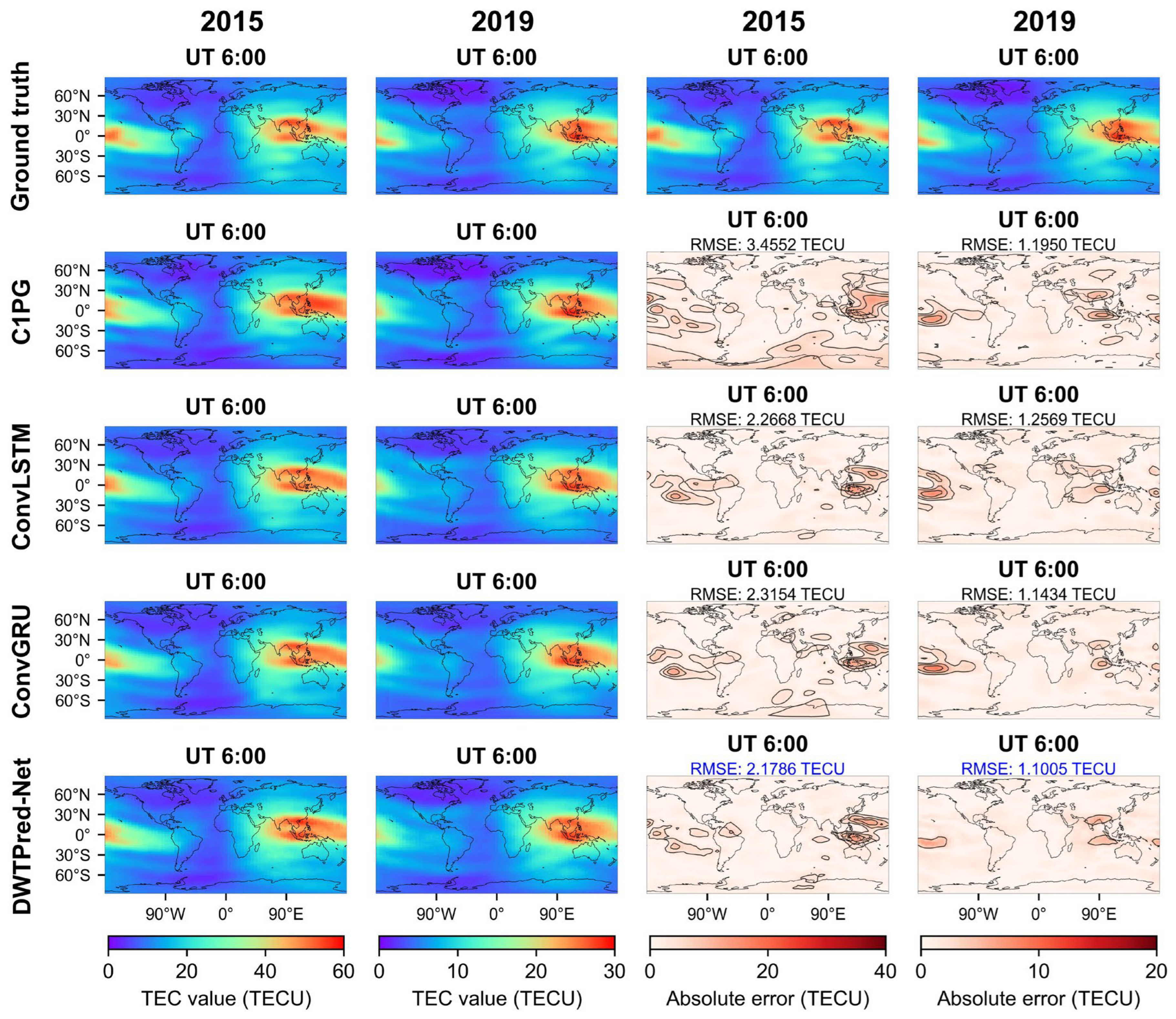
Furthermore, to visually demonstrate the predictive capability of the models, we selected the autumnal equinox (DOY 266) from both 2015 and 2019 and displayed the global TEC distribution at a specific moment, as shown in Figure 5. The autumnal equinox is characterized by nearly equal day and night lengths globally, with the Sun directly overhead at the equator.
In the 5-row × 4-column layout of Figure 5, the first row presents the ground truth observations for 2015 and 2019. Rows 2 to 5 display the prediction maps and corresponding absolute error distributions of the four models, respectively. Specifically, except for the first row, the first and second columns of each row show the prediction maps of each model for 2015 and 2019, while the third and fourth columns present the absolute error maps for the corresponding years. The RMSE value is indicated above each error map. From the absolute error maps, it can be clearly observed that the error areas of DWTPred-Net are smaller and the error values are lower. Its predictions are the closest to the ground truth.

4.4.2. Comparison at Different Latitudinal Bands

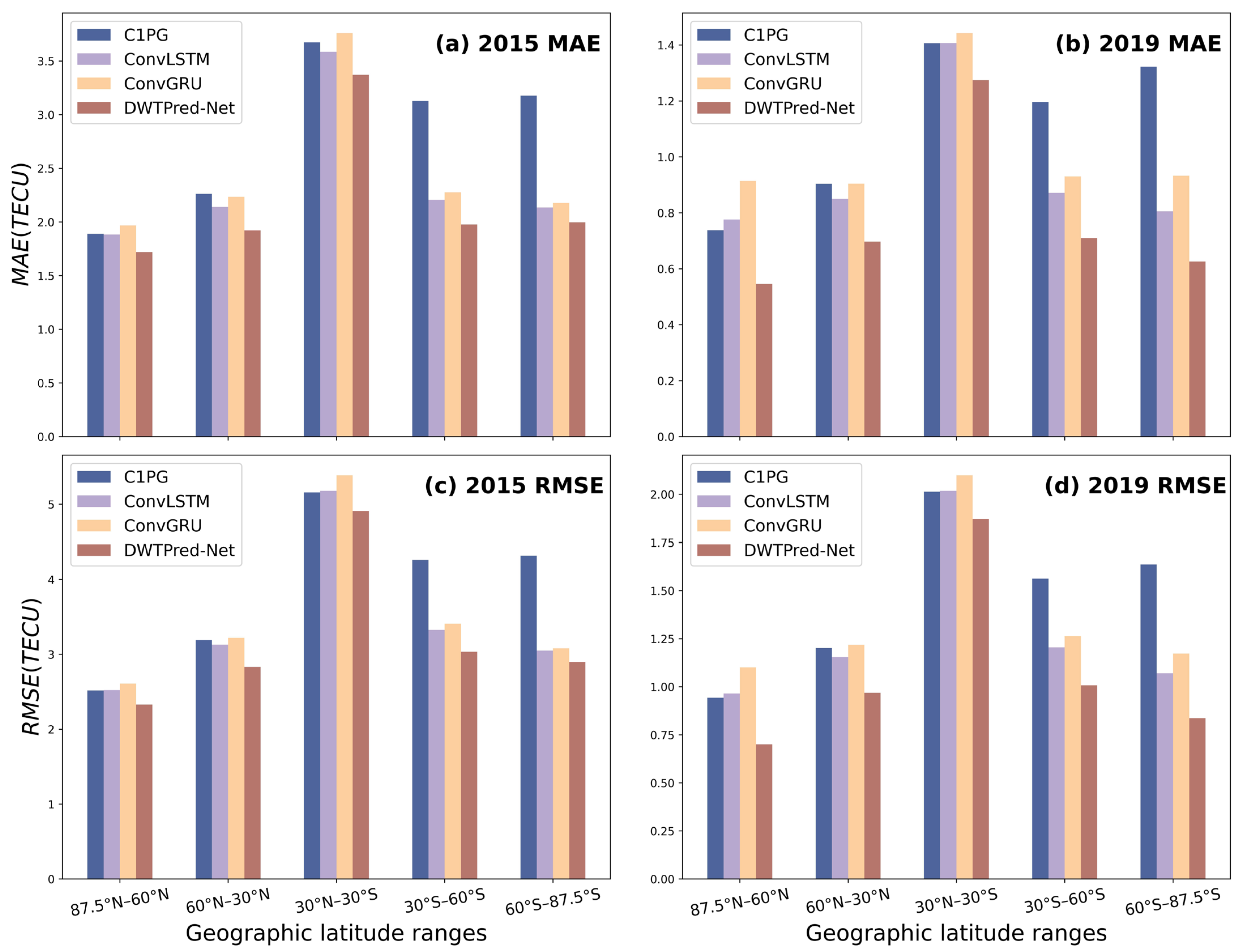
To conduct in-depth analysis of the performance of the model, this subsection divides the globe into five latitudinal bands: the high-latitude band (87.5° N–60° N) and mid-latitude band (60° N–30° N) in the Northern Hemisphere, the equatorial region (30° N–30° S), and the mid-latitude band (30° S–60° S) and high-latitude band (60° S–87.5° S) in the Southern Hemisphere. As shown in Figure 6, subplots (a) and (b) illustrate the M A E distributions for 2015 and 2019, respectively, and subplots (c) and (d) depict the R M S E distributions for the respective years. By comparing the M A E and R M S E of the all models across these latitudinal bands, the results indicate that in all four subplots (a), (b), (c), and (d), the proposed model DWTPred-Net performs the best across all latitude bands, with both M A E and R M S E values significantly lower than those of the other comparative models. It is noteworthy that the errors of all models in the equatorial region are higher than in other latitudinal bands. This is primarily attributed to the presence of equatorial ionization anomaly in this region, where TEC variations are intense, thereby increasing prediction difficulty. Nevertheless, even in this challenging region, DWTPred-Net still outperforms all other models, further confirming its effectiveness in capturing the complex dynamics of ionospheric anomalies.

4.4.3. Comparison Under Geomagnetic Storm Conditions

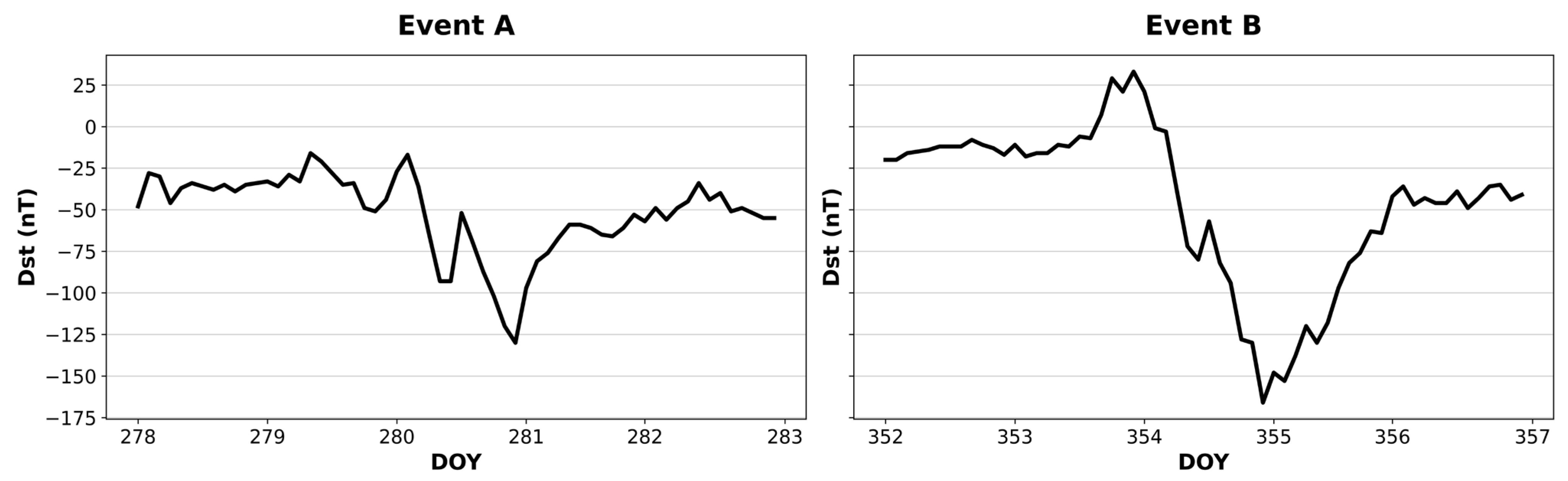
During geomagnetic storms, ionospheric variations are intense, making accurate model prediction challenging. To validate the model’s predictive performance during geomagnetic storms, this subsection selects two typical storm events in 2015 based on DST index: Event A (DOY 278–282) and Event B (DOY 352–356). The detailed information of DST for these two events is shown in Figure 7.
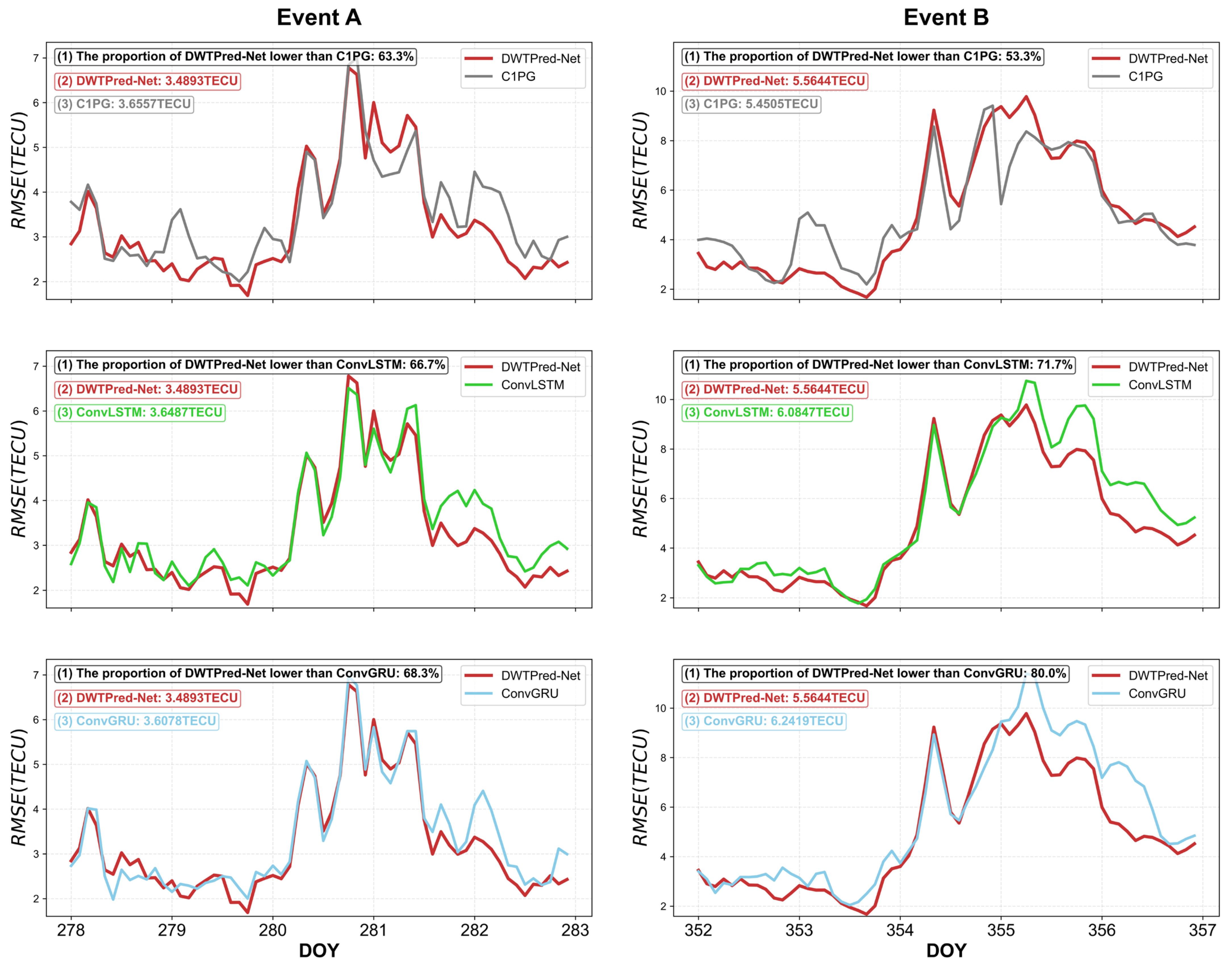
We calculated the R M S E at each forecasting timestep (60 steps in total) for all models, with the trends shown in Figure 8. In each subplot of Figure 8, we present three key evaluation metrics: (1) the proportion of timesteps where DWTPred-Net achieves lower R M S E than the compared model; (2) the overall R M S E of DWTPred-Net in the entire storm event; and (3) the overall R M S E of the comparative model in the entire storm event. Statistical analysis of the proportion of time points where DWTPred-Net outperforms the comparative models reveals that: in Event A, it outperforms C1PG, ConvLSTM, and ConvGRU by 63.3%, 66.7%, and 68.3%, respectively; in Event B, these proportions reach 53.3%, 71.7%, and 80.0%, respectively. In all comparisons, the superior ratio of DWTPred-Net significantly exceeds 50%, with the performance against ConvGRU in Event B being particularly outstanding (reaching 80.0%).
In terms of overall R M S E , DWTPred-Net outperforms the comparison models in most cases. Specifically, the prediction error in Event A is lower than that in Event B, primarily because Event A involves a weaker geomagnetic storm with relatively milder ionospheric disturbances, making it easier for the models to capture its variation patterns. However, in Event B, the overall R M S E of DWTPred-Net is higher than that of the C1PG. C1PG, as an empirical forecasting product, relies on fixed empirical parameters, which may grant it certain predictive advantages in some scenarios. Additionally, it is noteworthy that during the main phases of both geomagnetic storms (DOY 280 and DOY 354), the error differences among the models are minimized. This may be attributed to the sharp global increase in TEC during this period, which results in a relatively uniform pattern of ionospheric variation, thereby reducing the impact of structural differences among different models on the results.
In summary, DWTPred-Net maintains stable and superior predictive performance even under intense ionospheric disturbance conditions.

4.5. Computational Cost

Apart from C1PG, the other three models are based on deep learning models. To comprehensively evaluate their computational complexity, we quantify Parameters for each model. Here, Parameters reflect the total number of learnable parameters in the model. The detailed results are summarized in Table 4. The results in Table 4 are based on the Bayesian optimized model. Therefore, they are parameter comparisons under the optimal model.
As shown in Table 4, ConvGRU has the fewest Parameters, while DWTPred-Net has the most. This difference stems primarily from their distinct gating structures and information propagation mechanisms: ConvGRU contains only two gating units and propagates information solely along the temporal dimension; ConvLSTM also operates along the temporal dimension but employs three gating units; DWTPred-Net incorporates four gating units, enabling simultaneous information propagation and integration across both temporal and spatial dimensions, which leads to its highest Parameters. However, as demonstrated in Section 4.4, DWTPred-Net achieves better performance than the other comparative models. This indicates that the increased parameter effectively enhances its predictive capability.

5. Conclusions

This paper proposes a new TEC prediction model named DWTPred-Net. Its key innovation lies in the design of the DWTConv-ST-LSTM unit. This unit replaces the standard convolution within the ST-LSTM with a DWTConv. This enables the model to suppress noise while using relatively small convolutional kernels to simultaneously extract both low-frequency and high-frequency components of spatial features, effectively avoiding over-parameterization. At the same time, it can extract temporal and spatial dependencies in parallel. The synergistic work of these two aspects allows the model to capture the spatiotemporal characteristics of TEC more comprehensively, thereby improving prediction accuracy.
To comprehensively validate the performance of the proposed DWTPred-Net, this paper conducts experiments at the following two levels: firstly, the effectiveness of the critical module, DWTConv, is verified through ablation experiments; Secondly, DWTPred-Net is compared with C1PG, ConvLSTM, and ConvGRU from multiple perspectives, specifically including performance evaluations under different solar activity conditions, across different latitudinal bands, and during geomagnetic storm conditions. These experiments, ranging from module contribution to overall performance and from normal conditions to extreme space weather events, multi-dimensionally confirm the effectiveness of the DWTPred-Net.
Finally, the DWTPred-Net still has certain limitations. Its predictive performance is not yet stable under specific disturbance morphologies. Inspired by the work of [30], we plan to pursue the following directions for future improvement. First, we will train the model using data covering a complete solar activity cycle (approximately 11 years) and divide it into independent validation sets. This approach will allow a more comprehensive evaluation of the model’s generalization capability across different levels of solar activity, thereby enhancing its predictive accuracy and robustness in complex space weather events. Second, we intend to explore extending the model’s memory transmission mechanism from a unidirectional to a bidirectional structure, with the aim of more fully leveraging temporal contextual information and further strengthening its ability to learn and model the dynamic evolution of space weather processes.

Author Contributions

Methodology, J.L., J.X. and H.L.; software, J.L., J.X., X.D. and S.L. (Shixiang Liu); validation, Y.W. and S.L. (Shaomin Li); investigation, Y.W. and S.L. (Shaomin Li); writing—original draft preparation, J.L. and J.X.; writing—review and editing, J.L., J.X., X.D., S.L. (Shixiang Liu) and H.L.; funding acquisition, Y.W. and S.L. (Shaomin Li). All authors have read and agreed to the published version of the manuscript.

Funding

This research was funded by Hainan Provincial Educational Science Planning Project (QJY202512014) and Langfang City Science and Technology Support Plan Project (2025011082).

Institutional Review Board Statement

Not applicable.

Informed Consent Statement

Not applicable.

Data Availability Statement

The IGS final product and CODE’s C1PG prediction were sourced from NASA’s CDDIS archive. (https://cddis.nasa.gov/archive/gnss/products/ionex/ (accessed on 25 November 2025)).

Acknowledgments

We extend our sincere gratitude to the IGS and CODE teams for their sustained efforts in maintaining and improving these invaluable resources for the global research community.

Conflicts of Interest

Authors Jie Li, Xiaofeng Du and Shixiang Liu were employed by the China National Offshore Oil Corporation Research Institute, Co., Ltd. The remaining authors declare that the research was conducted in the absence of any commercial or financial relationships that could be construed as a potential conflict of interest.

References

  1. Forbes, J.M.; Palo, S.E.; Zhang, X. Variability of the Ionosphere. J. Atmos. Sol.-Terr. Phys. 2000, 62, 685–693. [Google Scholar] [CrossRef]
  2. Klobuchar, J. Ionospheric Time-Delay Algorithm for Single-Frequency GPS Users. IEEE Trans. Aerosp. Electron. Syst. 1987, AES-23, 325–331. [Google Scholar] [CrossRef]
  3. Belehaki, A.; Stanislawska, I.; Lilensten, J. An Overview of Ionosphere—Thermosphere Models Available for Space Weather Purposes. Space Sci. Rev. 2009, 147, 271–313. [Google Scholar] [CrossRef]
  4. Luo, H.; Gong, Y.; Chen, S.; Yu, C.; Yang, G.; Yu, F.; Hu, Z.; Tian, X. Prediction of Global Ionospheric Total Electron Content (TEC) Based on SAM-ConvLSTM Model. Space Weather 2023, 21, e2023SW003707. [Google Scholar] [CrossRef]
  5. Lean, J.L.; Emmert, J.T.; Picone, J.M.; Meier, R.R. Global and Regional Trends in Ionospheric Total Electron Content. J. Geophys. Res. Space Phys. 2011, 116. [Google Scholar] [CrossRef]
  6. Sivavaraprasad, G.; Deepika, V.S.; SreenivasaRao, D.; Ravi Kumar, M.; Sridhar, M. Performance Evaluation of Neural Network TEC Forecasting Models over Equatorial Low-Latitude Indian GNSS Station. Geod. Geodyn. 2020, 11, 192–201. [Google Scholar] [CrossRef]
  7. Xiong, P.; Zhai, D.; Long, C.; Zhou, H.; Zhang, X.; Shen, X. Long Short-Term Memory Neural Network for Ionospheric Total Electron Content Forecasting Over China. Space Weather 2021, 19, e2020SW002706. [Google Scholar] [CrossRef]
  8. Shi, S.; Zhang, K.; Wu, S.; Shi, J.; Hu, A.; Wu, H.; Li, Y. An Investigation of Ionospheric TEC Prediction Maps Over China Using Bidirectional Long Short-Term Memory Method. Space Weather 2022, 20, e2022SW003103. [Google Scholar] [CrossRef]
  9. Sivakrishna, K.; Venkata Ratnam, D.; Sivavaraprasad, G. A Bidirectional Deep-Learning Algorithm to Forecast Regional Ionospheric TEC Maps. IEEE J. Sel. Top. Appl. Earth Obs. Remote Sens. 2022, 15, 4531–4543. [Google Scholar] [CrossRef]
  10. Mao, S.; Li, H.; Zhang, Y.; Shi, Y. Prediction of Ionospheric Electron Density Distribution Based on CNN-LSTM Model. IEEE Geosci. Remote Sens. Lett. 2024, 21, 1003305. [Google Scholar] [CrossRef]
  11. Kaselimi, M.; Doulamis, N.; Voulodimos, A.; Doulamis, A.; Delikaraoglou, D. Spatio-Temporal Ionospheric TEC Prediction Using a Deep CNN-GRU Model on GNSS Measurements. In Proceedings of the 2021 IEEE International Geoscience and Remote Sensing Symposium IGARSS, Brussels, Belgium, 11–16 July 2021; pp. 8317–8320. [Google Scholar]
  12. Ren, X.; Zhao, B.; Ren, Z.; Wang, Y.; Xiong, B. Deep Learning-Based Prediction of Global Ionospheric TEC During Storm Periods: Mixed CNN-BiLSTM Method. Space Weather 2024, 22, e2024SW003877. [Google Scholar] [CrossRef]
  13. Shi, X.; Chen, Z.; Wang, H.; Yeung, D.-Y.; Wong, W.; WOO, W. Convolutional LSTM Network: A Machine Learning Approach for Precipitation Nowcasting. In Proceedings of the Advances in Neural Information Processing Systems, Montreal, QC, Canada, 7–12 December 2015; Curran Associates Inc.: New York, NY, USA, 2015; Volume 28. [Google Scholar]
  14. Li, L.; Liu, H.; Le, H.; Yuan, J.; Shan, W.; Han, Y.; Yuan, G.; Cui, C.; Wang, J. Spatiotemporal Prediction of Ionospheric Total Electron Content Based on ED-ConvLSTM. Remote Sens. 2023, 15, 3064. [Google Scholar] [CrossRef]
  15. Xia, G.; Zhang, F.; Wang, C.; Zhou, C. ED-ConvLSTM: A Novel Global Ionospheric Total Electron Content Medium-Term Forecast Model. Space Weather 2022, 20, e2021SW002959. [Google Scholar] [CrossRef]
  16. Yang, J.; Huang, W.; Zhang, L.; Xu, H.; Shen, H.; Wang, X.; Li, M. Ionospheric TEC Forecasting with ED-ConvLSTM-Res Integrating Multi-Channel Features. Remote Sens. 2025, 17, 3564. [Google Scholar] [CrossRef]
  17. Tang, J.; Zhong, Z.; Ding, M.; Yang, D.; Liu, H. Forecast of Ionospheric TEC Maps Using ConvGRU Deep Learning Over China. IEEE J. Sel. Top. Appl. Earth Obs. Remote Sens. 2024, 17, 3334–3344. [Google Scholar] [CrossRef]
  18. Wang, H.; Liu, H.; Yuan, J.; Le, H.; Shan, W.; Li, L. MAOOA-Residual-Attention-BiConvLSTM: An Automated Deep Learning Framework for Global TEC Map Prediction. Space Weather 2024, 22, e2024SW003954. [Google Scholar] [CrossRef]
  19. Liu, H.; Wang, H.; Le, H.; Yuan, J.; Shan, W.; Wu, Y.; Chen, Y. CGAOA-STRA-BiConvLSTM: An Automated Deep Learning Framework for Global TEC Map Prediction. GPS Solut. 2025, 29, 55. [Google Scholar] [CrossRef]
  20. Tang, J.; Zhong, Z.; Hu, J.; Wu, X. Forecasting Regional Ionospheric TEC Maps over China Using BiConvGRU Deep Learning. Remote Sens. 2023, 15, 3405. [Google Scholar] [CrossRef]
  21. Chen, J.; Zhi, N.; Liao, H.; Lu, M.; Feng, S. Global Forecasting of Ionospheric Vertical Total Electron Contents via ConvLSTM with Spectrum Analysis. GPS Solut. 2022, 26, 69. [Google Scholar] [CrossRef]
  22. Xu, C.; Ding, M.; Tang, J. Prediction of GNSS-Based Regional Ionospheric TEC Using a Multichannel ConvLSTM With Attention Mechanism. IEEE Geosci. Remote Sens. Lett. 2024, 21, 1001405. [Google Scholar] [CrossRef]
  23. Wang, Y.; Long, M.; Wang, J.; Gao, Z.; Yu, P.S. PredRNN: Recurrent Neural Networks for Predictive Learning Using Spatiotemporal LSTMs. Adv. Neural Inf. Process. Syst. 2017, 30, 879–888. [Google Scholar]
  24. Wu, D.; Wu, L.; Zhang, T.; Zhang, W.; Huang, J.; Wang, X. Short-Term Rainfall Prediction Based on Radar Echo Using an Improved Self-Attention PredRNN Deep Learning Model. Atmosphere 2022, 13, 1963. [Google Scholar] [CrossRef]
  25. Liu, H.; Ma, Y.; Le, H.; Li, L.; Zhou, R.; Xiao, J.; Shan, W.; Wu, Z.; Li, Y. Global Ionospheric TEC Map Prediction Based on Multichannel ED-PredRNN. Atmosphere 2025, 16, 422. [Google Scholar] [CrossRef]
  26. Wu, D.; Kong, J.; Li, Z.; Zhang, G.; Zhang, H.; Liang, J.; Zhang, X. EnPredRNN: An Enhanced PredRNN Network for Extending Spatio-Temporal Prediction Period. IEEE Access 2024, 12, 107631–107644. [Google Scholar] [CrossRef]
  27. Wang, H.; Wu, X.; Huang, Z.; Xing, E.P. High-Frequency Component Helps Explain the Generalization of Convolutional Neural Networks. In Proceedings of the IEEE/CVF Conference on Computer Vision and Pattern Recognition, Seattle, WA, USA, 13–19 June 2020; pp. 8684–8694. [Google Scholar]
  28. Liu, Z.; Mao, H.; Wu, C.-Y.; Feichtenhofer, C.; Darrell, T.; Xie, S. A ConvNet for the 2020s. In Proceedings of the IEEE/CVF Conference on Computer Vision and Pattern Recognition, New Orleans, LA, USA, 18–24 June 2022; pp. 11976–11986. [Google Scholar]
  29. Finder, S.E.; Amoyal, R.; Treister, E.; Freifeld, O. Wavelet Convolutions for Large Receptive Fields. In Proceedings of the Computer Vision—ECCV 2024, Milan, Italy, 29 September–4 October 2024; Leonardis, A., Ricci, E., Roth, S., Russakovsky, O., Sattler, T., Varol, G., Eds.; Springer Nature: Cham, Switzerland, 2025; pp. 363–380. [Google Scholar]
  30. Sun, L.; Yuan, G.; Le, H.; Yao, X.; Li, S.; Liu, H. Global Ionosphere Total Electron Content Prediction Based on Bidirectional Denoising Wavelet Transform Convolution. Atmosphere 2025, 16, 1139. [Google Scholar] [CrossRef]
Figure 1. Structure of ST-LSTM and DWTConv-ST-LST.
Atmosphere 17 00054 g001
Figure 2. The structure of PredRNN.
Atmosphere 17 00054 g002
Figure 3. Structure diagram of WTConv and DWTConv.
Atmosphere 17 00054 g003
Figure 4. The Structure of DWTPred-Net.
Atmosphere 17 00054 g004
Figure 5. The prediction maps and corresponding absolute error maps of the models on the autumnal equinox. (Blue represents the lowest R M S E ).
Atmosphere 17 00054 g005
Figure 6. Comparison of model performance under different latitude bands.
Atmosphere 17 00054 g006
Figure 7. Dst index variations during Event A and Event B.
Atmosphere 17 00054 g007
Figure 8. Comparison of model performance during geomagnetic storm conditions.
Atmosphere 17 00054 g008
Table 1. Optimization results.
ModelThe Number of Convolution Kernels
DWTPred-Net39
ConvLSTM31
ConvGRU40
Table 2. Comparison of ablation experiment results. (The optimal results are bolded).
YearModel M A E ( T E C U ) Improve   ( M A E ) R M S E ( T E C U ) Improve   ( R M S E )
2015PredRNN2.4851-3.7678-
WTConv-PredRNN2.45801.09%3.71921.29%
DWTPred-Net2.39972.37%3.64561.98%
2019PredRNN0.9500-1.4087-
WTConv-PredRNN0.93211.88%1.38042.01%
DWTPred-Net0.85987.76%1.30745.29%
Table 3. Comparison of the results between 2015 and 2019. (The optimal results are bolded).
YearModel M A E ( T E C U ) R M S E ( T E C U )
2015C1PG2.98284.2296
ConvLSTM2.59593.8863
ConvGRU2.70294.0183
DWTPred-Net2.39973.6456
2019C1PG1.16991.6186
ConvLSTM1.02301.4775
ConvGRU1.09651.5583
DWTPred-Net0.85981.3074
Table 4. The computational complexity of each model.
Model Parameters   ( × 10 6 )
DWTPred-Net7.02
ConvLSTM4.03
ConvGRU3.95
Disclaimer/Publisher’s Note: The statements, opinions and data contained in all publications are solely those of the individual author(s) and contributor(s) and not of MDPI and/or the editor(s). MDPI and/or the editor(s) disclaim responsibility for any injury to people or property resulting from any ideas, methods, instructions or products referred to in the content.