Modeling of Drought-Induced Crop Yield Loss Based on Solar-Induced Chlorophyll Fluorescence by Machine Learning Methods


Abstract
1. Introduction
- Can SIF effectively indicate changes in winter wheat yield caused by drought?
- How effective is a drought-induced yield reduction model based on SIF and VIs?
- How do different machine learning (ML) models perform in predicting drought-induced yield loss in winter wheat?
2. Materials and Methods
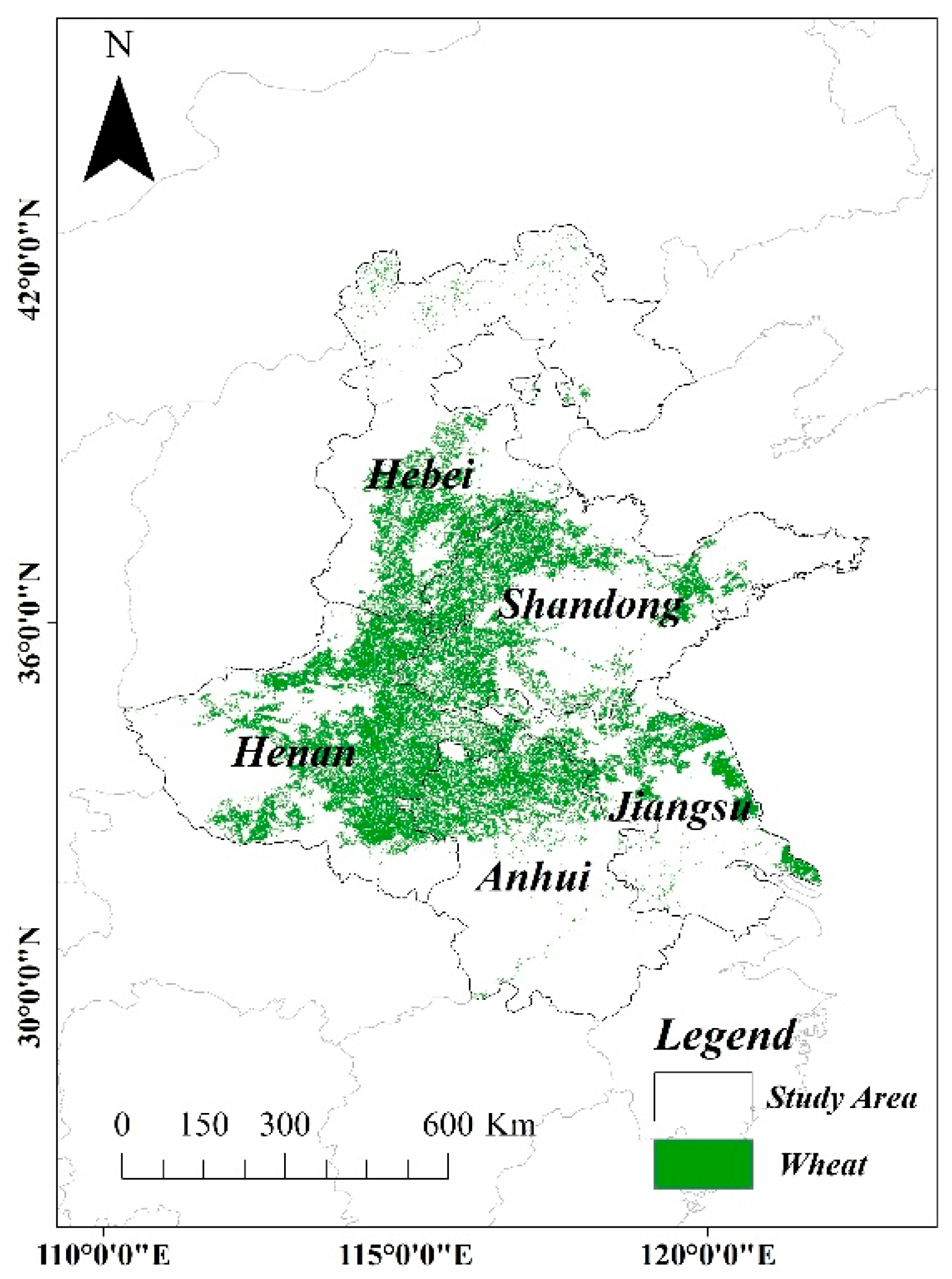
2.1. Study Area
2.2. Data
- (1)
- Satellite-based vegetation data
- (a)
- SIF data:
- (b)
- MODIS data:
- (2)
- Climate data:
- (3)
- Soil properties data:
- (4)
- SPEI data:
- (5)
- Winter wheat yield and planting area
2.3. Methods
2.3.1. Screening for Optimal Variables
2.3.2. Calculation of SYRS
2.3.3. Experiment Design
3. Results
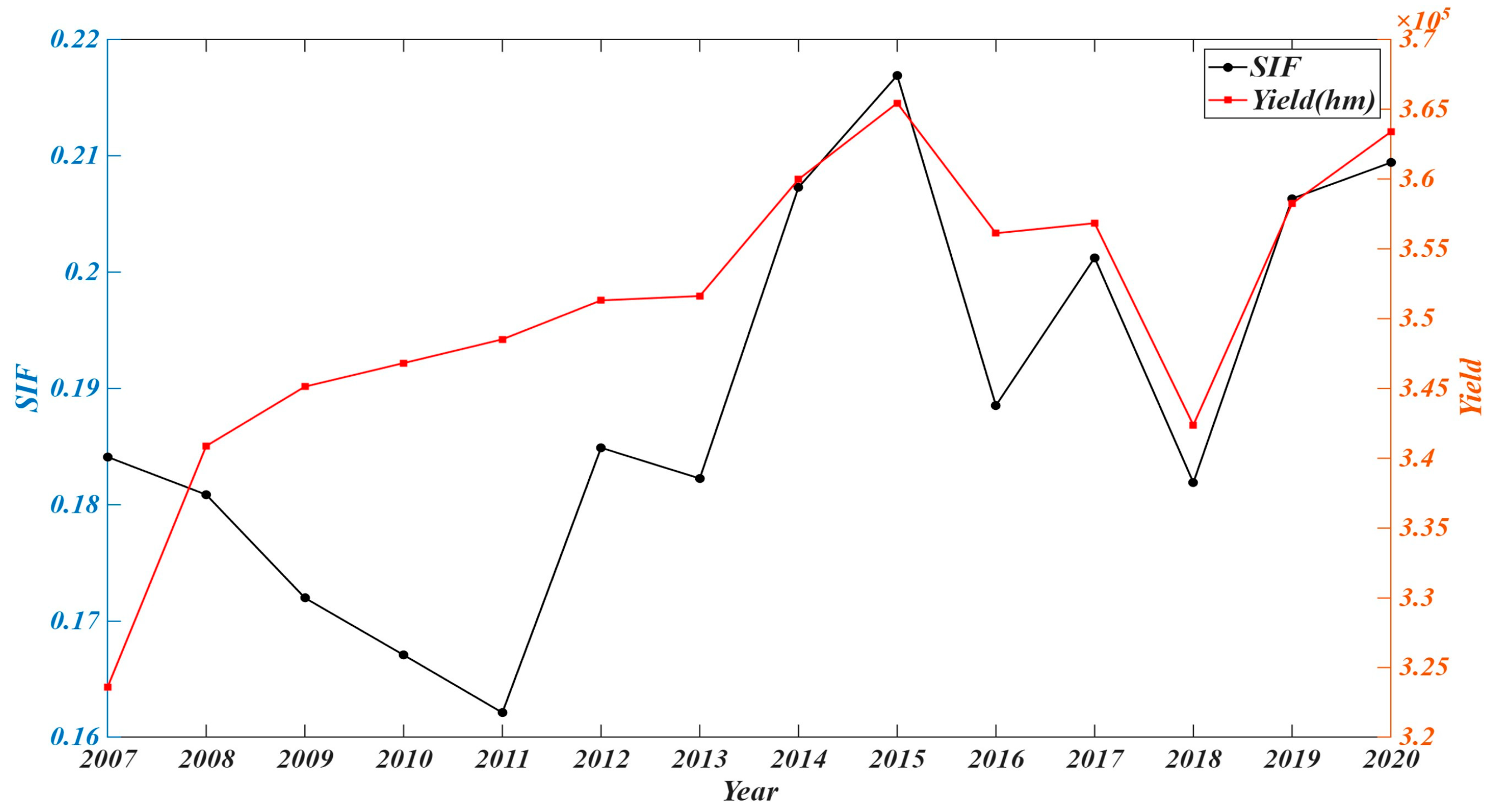
3.1. Inter-Annual Variation in SIF and Winter Wheat Yield
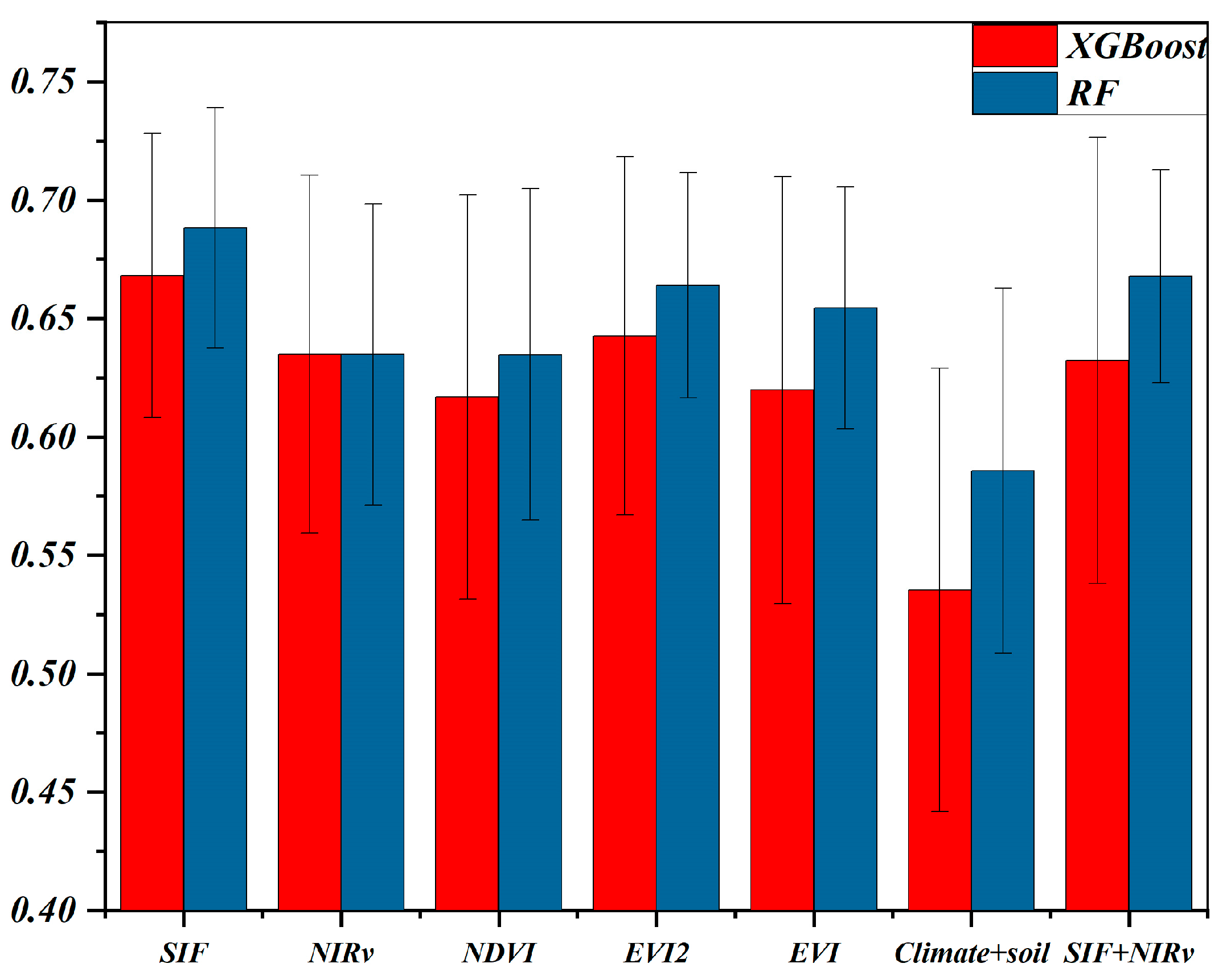
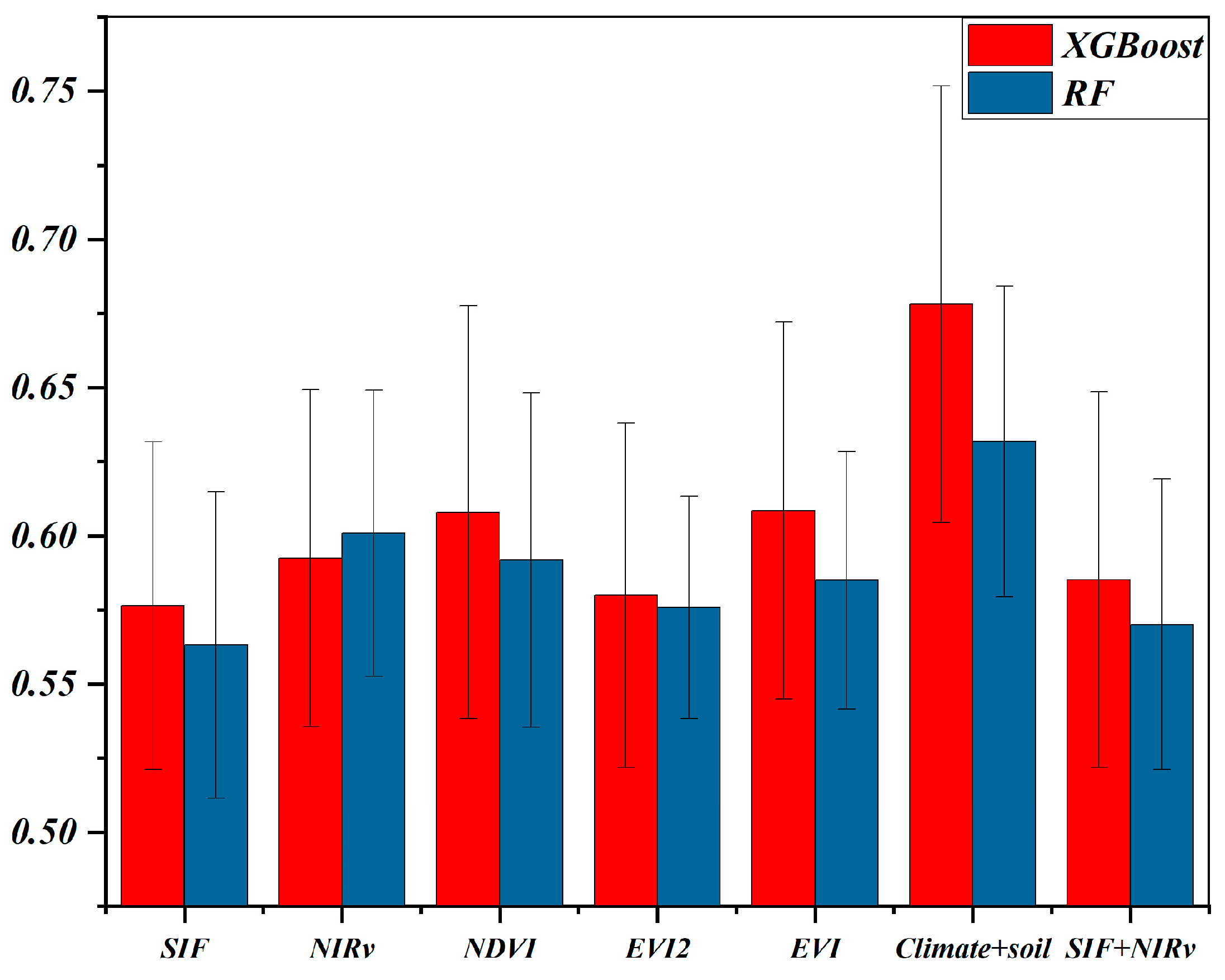
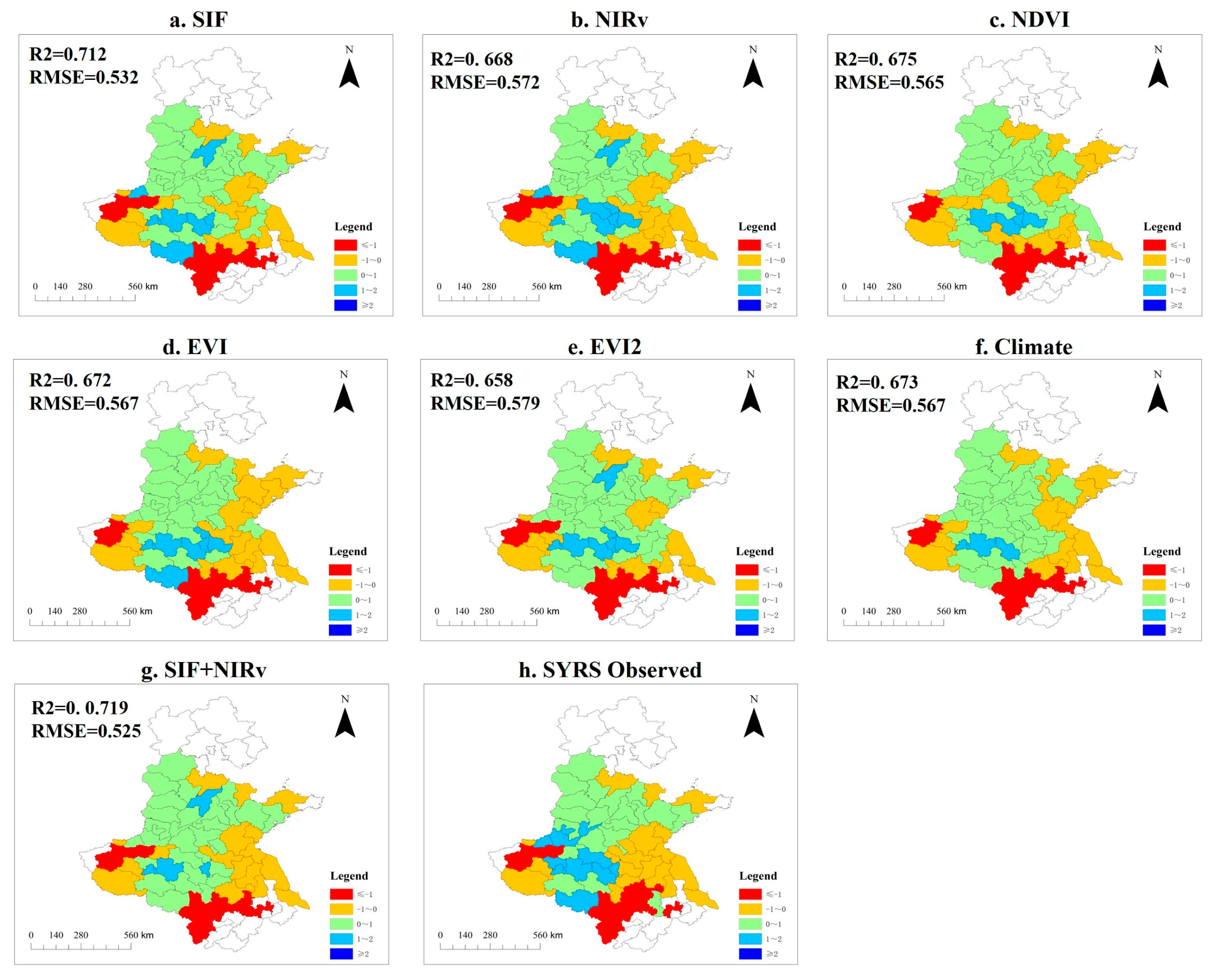
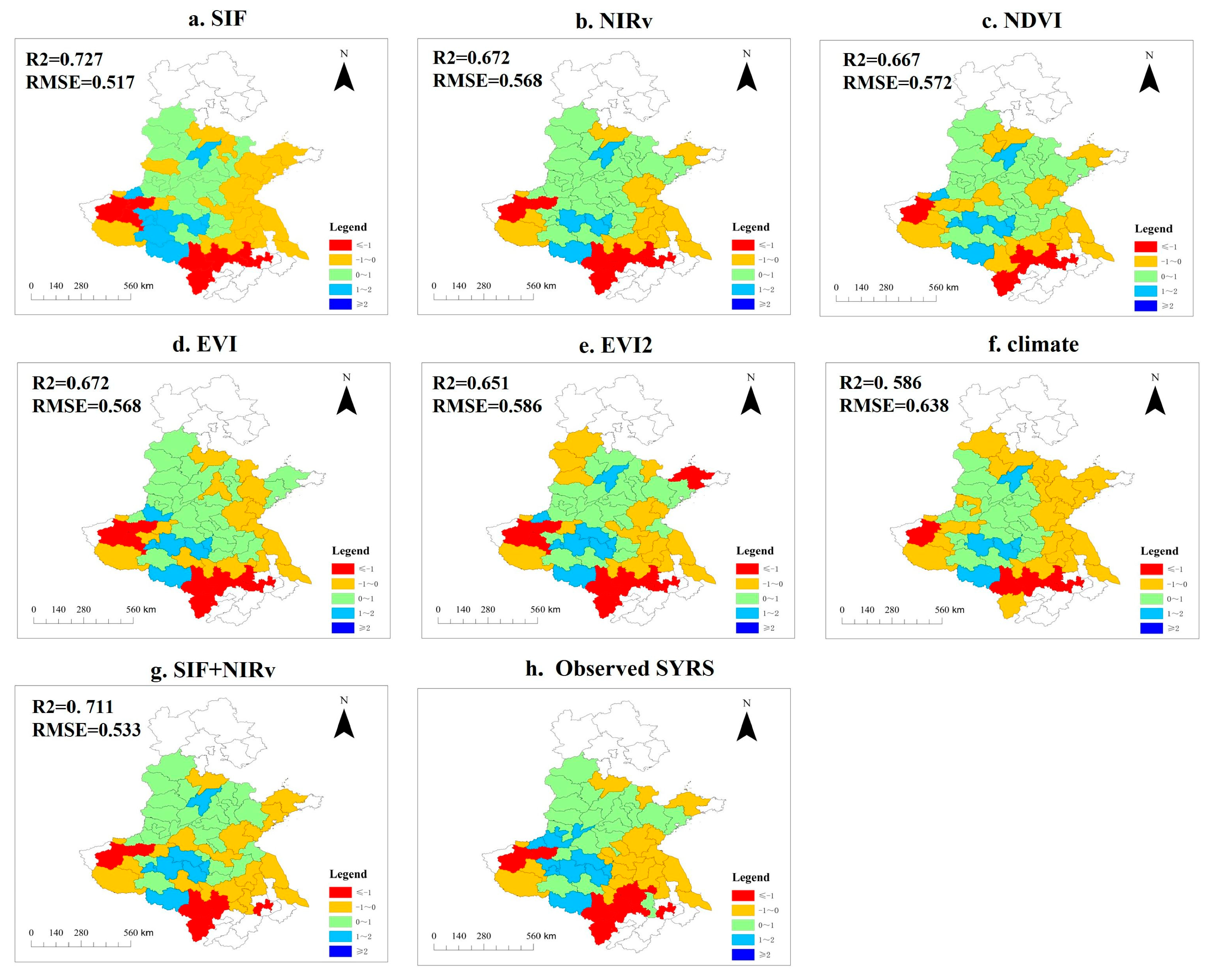
3.2. Performance of a SIF-Based Model for Assessing Drought-Induced Yield Reduction
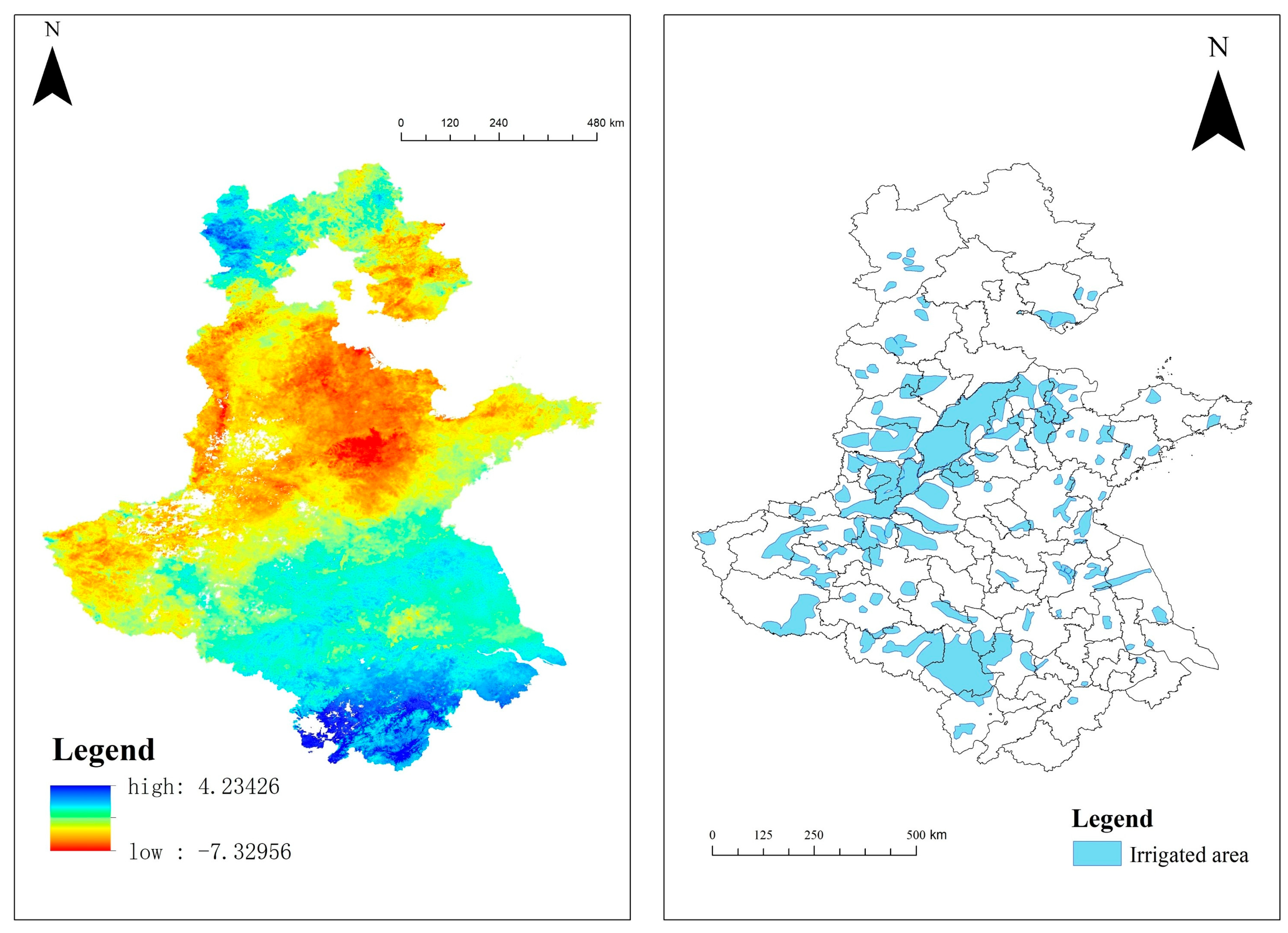
3.3. Assessment of Yield Losses in a Typical Drought Year
4. Discussion
4.1. Relationship Between SIF and Winter Wheat Yield
4.2. Predictive Power of Drought-Induced Yield Loss Evaluation Models of Winter Wheat
4.3. Comparison of Different ML Algorithms Used in the Modeling
4.4. Shortcomings and Prospects
5. Conclusions
- 1.
- Average SIF values during the peaking growing season could effectively capture interannual fluctuations in winter wheat yield and could serve as a quantitative indicator of yield variability.
- 2.
- By integrating multiple sources of data, the models based on normalized anomalies of these variables could directly quantify drought-induced yield losses without the need for additional auxiliary data or complex computations. Among all combinations of vegetation variables, SIF demonstrated superior performance, yielding the most accurate predictions.
- 3.
- Both RF and XGBoost algorithms exhibited similar strong performance in evaluating drought-induced yield loss.
Supplementary Materials
Author Contributions
Funding
Institutional Review Board Statement
Informed Consent Statement
Data Availability Statement
Conflicts of Interest
References
- Shen, Q.; Lin, J.; Yang, J.; Zhao, W.; Wu, J. Exploring the Potential of Spatially Downscaled Solar-Induced Chlorophyll Fluorescence to Monitor Drought Effects on Gross Primary Production in Winter Wheat. IEEE J. Sel. Top. Appl. Earth Obs. Remote Sens. 2022, 15, 2012–2022. [Google Scholar] [CrossRef]
- Gao, Y.; Wang, S.; Guan, K.; Wolanin, A.; You, L.; Ju, W.; Zhang, Y. The Ability of Sun-Induced Chlorophyll Fluorescence From OCO-2 and MODIS-EVI to Monitor Spatial Variations of Soybean and Maize Yields in the Midwestern USA. Remote Sens. 2020, 12, 1111. [Google Scholar] [CrossRef]
- Wu, J.; Cheng, G.; Wang, N.; Shen, H.; Ma, X. Spatiotemporal Patterns of Multiscale Drought and Its Impact on Winter Wheat Yield over North China Plain. Agronomy 2022, 12, 1209. [Google Scholar] [CrossRef]
- Zhang, L.; Chu, Q.-q.; Jiang, Y.-l.; Chen, F.; Lei, Y.-d. Impacts of climate change on drought risk of winter wheat in the North China Plain. J. Integr. Agric. 2021, 20, 2601–2612. [Google Scholar] [CrossRef]
- Harsányi, E. Predicting agricultural drought in central Europe by using machine learning algorithms. J. Agric. Food Res. 2025, 20, 101783. [Google Scholar] [CrossRef]
- Yang, J.; Wu, J.; Liu, L.; Zhou, H.; Gong, A.; Han, X.; Zhao, W. Responses of Winter Wheat Yield to Drought in the North China Plain: Spatial–Temporal Patterns and Climatic Drivers. Water 2020, 12, 3094. [Google Scholar] [CrossRef]
- Mu, Q.; Cai, H.; Sun, S.; Wen, S.; Xu, J.; Dong, M.; Saddique, Q. The physiological response of winter wheat under short-term drought conditions and the sensitivity of different indices to soil water changes. Agric. Water Manag. 2021, 243, 106475. [Google Scholar] [CrossRef]
- Zhou, H.; Geng, G.; Yang, J.; Hu, H.; Sheng, L.; Lou, W. Improving Soil Moisture Estimation via Assimilation of Remote Sensing Product into the DSSAT Crop Model and Its Effect on Agricultural Drought Monitoring. Remote Sens. 2022, 14, 3187. [Google Scholar] [CrossRef]
- Hou, X.; Zhang, B.; Chen, J.; Zhou, J.; He, Q.-Q.; Yu, H. Response of Vegetation Productivity to Greening and Drought in the Loess Plateau Based on VIs and SIF. Forests 2024, 15, 339. [Google Scholar] [CrossRef]
- Zhu, X.; Li, Q.; Guo, C. Evaluation of the monitoring capability of various vegetation indices and mainstream satellite band settings for grassland drought. Ecol. Inform. 2024, 82, 102717. [Google Scholar] [CrossRef]
- Gao, X.-B.; Guo, C.; Li, F.-M.; Li, M.; He, J. High Soybean Yield and Drought Adaptation Being Associated with Canopy Architecture, Water Uptake, and Root Traits. Agronomy 2020, 10, 608. [Google Scholar] [CrossRef]
- Thakur, V.; Rane, J.; Nankar, A.N. Comparative Analysis of Canopy Cooling in Wheat under High Temperature and Drought Stress. Agronomy 2022, 12, 978. [Google Scholar] [CrossRef]
- Zhao, F.; Li, R.; Verhoef, W.; Cogliati, S.; Liu, X.; Huang, Y.; Guo, Y.; Huang, J. Reconstruction of the full spectrum of solar-induced chlorophyll fluorescence: Intercomparison study for a novel method. Remote Sens. Environ. 2018, 219, 233–246. [Google Scholar] [CrossRef]
- Liu, L.; Zhao, W.; Shen, Q.; Wu, J.; Teng, Y.; Yang, J.; Han, X.; Tian, F. Nonlinear Relationship Between the Yield of Solar-Induced Chlorophyll Fluorescence and Photosynthetic Efficiency in Senescent Crops. Remote Sens. 2020, 12, 1518. [Google Scholar] [CrossRef]
- Behera, S.; Elakkiyaa, T.L.; Sarkar, A.; Dutta, D. Solar-Induced Chlorophyll Fluorescence Yield Holds the Potential for Drought Early Warning. Geophys. Res. Lett. 2025, 52, 3419. [Google Scholar] [CrossRef]
- Mohammadi, K.; Jiang, Y.; Wang, G. Flash drought early warning based on the trajectory of solar-induced chlorophyll fluorescence. Proc. Natl. Acad. Sci. USA 2022, 119, e2202767119. [Google Scholar] [CrossRef]
- Ren, H.; Du, L.; Peng, C.; Yang, J.; Gao, W. The composite drought index incorporated solar-induced chlorophyll fluorescence enhances the monitoring capability of short-term drought. J. Hydrol. 2024, 637, 131361. [Google Scholar] [CrossRef]
- Song, L.; Guanter, L.; Guan, K.; You, L.; Huete, A.; Ju, W.; Zhang, Y. Satellite sun-induced chlorophyll fluorescence detects early response of winter wheat to heat stress in the Indian Indo-Gangetic Plains. Glob. Change Biol. 2018, 24, 4023–4037. [Google Scholar] [CrossRef] [PubMed]
- Song, Y.; Wang, J.; Wang, L. Satellite Solar-Induced Chlorophyll Fluorescence Reveals Heat Stress Impacts on Wheat Yield in India. Remote Sens. 2020, 12, 3277. [Google Scholar] [CrossRef]
- Cao, J.; An, Q.; Zhang, X.; Xu, S.; Si, T.; Niyogi, D. Is satellite Sun-Induced Chlorophyll Fluorescence more indicative than vegetation indices under drought condition? Sci. Total Environ. 2021, 792, 148396. [Google Scholar] [CrossRef] [PubMed]
- Zhang, Z.; Li, X.; Qiu, Y.; Shi, Z.; Gao, Z.; Jia, Y. A Spatial Downscaling Method for Solar-Induced Chlorophyll Fluorescence Product Using Random Forest Regression and Drought Monitoring in Henan Province. Remote Sens. 2024, 16, 963. [Google Scholar] [CrossRef]
- Zhang, Z.; Xu, W.; Qin, Q.; Long, Z. Downscaling Solar-Induced Chlorophyll Fluorescence Based on Convolutional Neural Network Method to Monitor Agricultural Drought. IEEE Trans. Geosci. Remote Sens. 2021, 59, 1012–1028. [Google Scholar] [CrossRef]
- Li, X.; Xiao, J. A Global, 0.05-Degree Product of Solar-Induced Chlorophyll Fluorescence Derived from OCO-2, MODIS, and Reanalysis Data. Remote Sens. 2019, 11, 517. [Google Scholar] [CrossRef]
- Holben, B.N. Characteristics of maximum-value composite images from temporal AVHRR data. Int. J. Remote Sens. 1986, 7, 1417–1434. [Google Scholar] [CrossRef]
- Zeng, Y.; Badgley, G.; Dechant, B.; Ryu, Y.; Chen, M.; Berry, J.A. A practical approach for estimating the escape ratio of near-infrared solar-induced chlorophyll fluorescence. Remote Sens. Environ. 2019, 232, 111209. [Google Scholar] [CrossRef]
- Jiang, Z.; Huete, A.; Didan, K.; Miura, T. Development of a two-band enhanced vegetation index without a blue band. Remote Sens. Environ. 2008, 112, 3833–3845. [Google Scholar] [CrossRef]
- Abatzoglou, J.T.; Dobrowski, S.Z.; Parks, S.A.; Hegewisch, K.C. TerraClimate, a high-resolution global dataset of monthly climate and climatic water balance from 1958–2015. Sci. Data 2018, 5, 170191. [Google Scholar] [CrossRef]
- Shangguan, W.; Dai, Y.; Liu, B.; Ye, A.; Yuan, H. A soil particle-size distribution dataset for regional land and climate modelling in China. Geoderma 2012, 171–172, 85–91. [Google Scholar] [CrossRef]
- Xia, H.; Sha, Y.; Zhao, X.; Jiao, W.; Song, H.; Yang, J.; Zhao, W.; Qin, Y. HSPEI: A 1-km spatial resolution SPEI dataset across the Chinese mainland from 2001 to 2022. Geosci. Data J. 2024. [Google Scholar] [CrossRef]
- Luo, Y.; Zhang, Z.; Li, Z.; Chen, Y.; Zhang, L.; Cao, J.; Tao, F. Identifying the spatiotemporal changes of annual harvesting areas for three staple crops in China by integrating multi-data sources. Environ. Res. Lett. 2020, 15, 074003. [Google Scholar] [CrossRef]
- Yang, T.; Qiu, J.; Xiao, G. Agricultural drought monitoring and winter wheat yield estimation in North China. Acta Ecol. Sin. 2023, 43, 1936–1947. [Google Scholar] [CrossRef]
- Wood, J.D.; Griffis, T.J.; Baker, J.M.; Frankenberg, C.; Verma, M.; Yuen, K. Multiscale analyses of solar-induced florescence and gross primary production. Geophys. Res. Lett. 2017, 44, 533–541. [Google Scholar] [CrossRef]
- Potopová, V.; Zahradníček, P.; Štěpánek, P.; Türkott, L.; Farda, A.; Soukup, J. The impacts of key adverse weather events on the field-grown vegetable yield variability in the Czech Republic from 1961 to 2014. Int. J. Climatol. 2016, 37, 1648–1664. [Google Scholar] [CrossRef]
- Yao, J.; Wu, Y.; Liu, J.; Wang, H. Multimodal deep learning-based drought monitoring research for winter wheat during critical growth stages. PLoS ONE 2024, 19, e0300746. [Google Scholar] [CrossRef]
- Cai, Y.; Guan, K.; Lobell, D.; Potgieter, A.B.; Wang, S.; Peng, J.; Xu, T.; Asseng, S.; Zhang, Y.; You, L.; et al. Integrating satellite and climate data to predict wheat yield in Australia using machine learning approaches. Agric. For. Meteorol. 2019, 274, 144–159. [Google Scholar] [CrossRef]
- Wang, H.; Ding, Y.; Yao, Q.; Ma, L.; Ma, Y.; Yang, M.; Qin, S.; Xu, F.; Zhang, Z.; Gao, Z. Modeling of Cotton Yield Estimation Based on Canopy Sun-Induced Chlorophyll Fluorescence. Agronomy 2024, 14, 364. [Google Scholar] [CrossRef]
- Zheng, M.; Hu, H.; Niu, Y.; Shen, Q.; Jia, F.; Geng, X. Modeling of winter wheat yield prediction based on solar-induced chlorophyll fluorescence by machine learning methods. Eur. J. Remote Sens. 2025, 58, 2455940. [Google Scholar] [CrossRef]
- Guanter, L.; Zhang, Y.; Jung, M.; Joiner, J.; Voigt, M.; Berry, J.A.; Frankenberg, C.; Huete, A.R.; Zarco-Tejada, P.; Lee, J.-E.; et al. Global and time-resolved monitoring of crop photosynthesis with chlorophyll fluorescence. Proc. Natl. Acad. Sci. USA 2014, 111, E1327–E1333. [Google Scholar] [CrossRef]
- Kheyruri, Y.; Asadollah, S.B.H.S.; Sharafati, A.; Rahman, A.; Mohajeri, S.H. Examining the effects of meteorological drought variability on rainfed cultivation yields in Iran. Theor. Appl. Climatol. 2024, 155, 6427–6444. [Google Scholar] [CrossRef]
- Bai, J.; Zhang, H.; Sun, R.; Li, X.; Xiao, J.; Wang, Y. Estimation of global GPP from GOME-2 and OCO-2 SIF by considering the dynamic variations of GPP-SIF relationship. Agric. For. Meteorol. 2022, 326, 109180. [Google Scholar] [CrossRef]
- Chen, R.; Liu, L.; Liu, Z.; Liu, X.; Kim, J.; Kim, H.S.; Lee, H.; Wu, G.; Guo, C.; Gu, L. SIF-based GPP modeling for evergreen forests considering the seasonal variation in maximum photochemical efficiency. Agric. For. Meteorol. 2024, 344, 109814. [Google Scholar] [CrossRef]
- Dechant, B.; Ryu, Y.; Badgley, G.; Zeng, Y.; Berry, J.A.; Zhang, Y.; Goulas, Y.; Li, Z.; Zhang, Q.; Kang, M.; et al. Canopy structure explains the relationship between photosynthesis and sun-induced chlorophyll fluorescence in crops. Remote Sens. Environ. 2020, 241, 111733. [Google Scholar] [CrossRef]
- Zhang, L.; Zhang, Z.; Luo, Y.; Cao, J.; Tao, F. Combining Optical, Fluorescence, Thermal Satellite, and Environmental Data to Predict County-Level Maize Yield in China Using Machine Learning Approaches. Remote Sens. 2019, 12, 21. [Google Scholar] [CrossRef]
- Li, Z.; Ding, L.; Xu, D. Exploring the potential role of environmental and multi-source satellite data in crop yield prediction across Northeast China. Sci. Total Environ. 2022, 815, 152880. [Google Scholar] [CrossRef]
- Ma, J.; Ding, Y.; Cheng, J.C.P.; Jiang, F.; Tan, Y.; Gan, V.J.L.; Wan, Z. Identification of high impact factors of air quality on a national scale using big data and machine learning techniques. J. Clean. Prod. 2020, 244, 118955. [Google Scholar] [CrossRef]
- Wang, Y.-Q.; Leng, P.; Shang, G.-F.; Zhang, X.; Li, Z.-L. Sun-induced chlorophyll fluorescence is superior to satellite vegetation indices for predicting summer maize yield under drought conditions. Comput. Electron. Agric. 2023, 205, 107615. [Google Scholar] [CrossRef]
- Zhang, G.; Roslan, S.; Shafri, H.Z.M.; Zhao, Y.; Wang, C.; Quan, L. Predicting wheat yield from 2001 to 2020 in Hebei Province at county and pixel levels based on synthesized time series images of Landsat and MODIS. Sci. Rep. 2024, 14, 16212. [Google Scholar] [CrossRef]
- Guanter, L.; Aben, I.; Tol, P.; Krijger, J.M.; Hollstein, A.; Köhler, P.; Damm, A.; Joiner, J.; Frankenberg, C.; Landgraf, J. Potential of the TROPOspheric Monitoring Instrument (TROPOMI) onboard the Sentinel-5 Precursor for the monitoring of terrestrial chlorophyll fluorescence. Atmos. Meas. Tech. 2015, 8, 1337–1352. [Google Scholar] [CrossRef]
- Drusch, M.; Moreno, J.; Bello, U.D.; Franco, R.; Goulas, Y.; Huth, A.; Kraft, S.; Middleton, E.M.; Miglietta, F.; Mohammed, G.; et al. The FLuorescence EXplorer Mission Concept—ESA’s Earth Explorer 8. IEEE Trans. Geosci. Remote Sens. 2017, 55, 1273–1284. [Google Scholar] [CrossRef]



| Type | Variable | Source | Spatial | Temporal | Time |
|---|---|---|---|---|---|
| Resolution | Resolution | Acquired | |||
| Crop yield | Recorded yield of winter wheat | Statistical yearbook | Prefecture- | Yearly | 2007–2020 |
| level city | |||||
| Planting area | Planting area of winter wheat | ChinaCropArea 1 km | 1 km | Yearly | 2007–2015 |
| (https://doi.org/10.17632/jbs44b2hrk.2) (accessed on 30 March 2025) | |||||
| Vegetation variable | SIF | GOSIF | 0.05° | Monthly | 2007–2020 |
| (http://globalecology.unh.edu) (accessed on 30 March 2025) | |||||
| VIs | MCD43C4 | 0.05° | Daily | 2007–2020 | |
| (http://ladsweb.nascom.nasa.gov/) (accessed on 30 March 2025) | |||||
| Climate variable | Tmin, Tmax, Ppt, Pet, Vpd, SM, Srad | TerraClimate datasets | 1/24° | Monthly | 2007–2020 |
| (https://doi.org/10.7923/G43J3B0R) (accessed on 30 March 2025) | |||||
| Soil properties data | PSD-SA, PSD-SI, PSD-CL, | Soil particle-size distribution dataset | 1 km | Yearly | 2007–2020 |
| SOM, CEC, PH, BD | (http://globalchange.bnu.edu.cn) (accessed on 30 March 2025) | ||||
| SPEI | SPEI-03 | 1-km spatial resolution SPEI dataset across Chinese Mainland from 2001 to 2022 | 1 km | Monthly | 2007–2020 |
| Degree of Drought | SPEI |
|---|---|
| Drought-free | −0.5 < SPEI |
| Mild drought | −1.0 < SPEI ≤ −0.5 |
| Moderate drought | −1.5 < SPEI ≤ −1.0 |
| Severe drought | −2.0 < SPEI ≤ −1.5 |
| Extreme drought | SPEI ≤ −2.0 |
Disclaimer/Publisher’s Note: The statements, opinions and data contained in all publications are solely those of the individual author(s) and contributor(s) and not of MDPI and/or the editor(s). MDPI and/or the editor(s) disclaim responsibility for any injury to people or property resulting from any ideas, methods, instructions or products referred to in the content. |
© 2025 by the authors. Licensee MDPI, Basel, Switzerland. This article is an open access article distributed under the terms and conditions of the Creative Commons Attribution (CC BY) license.
Share and Cite
Hu, H.; Zheng, M.; Niu, Y.; Shen, Q.; Ren, Q.; You, Y. Modeling of Drought-Induced Crop Yield Loss Based on Solar-Induced Chlorophyll Fluorescence by Machine Learning Methods. Atmosphere 2026, 17, 42. https://doi.org/10.3390/atmos17010042
Hu H, Zheng M, Niu Y, Shen Q, Ren Q, You Y. Modeling of Drought-Induced Crop Yield Loss Based on Solar-Induced Chlorophyll Fluorescence by Machine Learning Methods. Atmosphere. 2026; 17(1):42. https://doi.org/10.3390/atmos17010042
Chicago/Turabian StyleHu, Han, Minxue Zheng, Yue Niu, Qiu Shen, Qinyao Ren, and Yanlin You. 2026. "Modeling of Drought-Induced Crop Yield Loss Based on Solar-Induced Chlorophyll Fluorescence by Machine Learning Methods" Atmosphere 17, no. 1: 42. https://doi.org/10.3390/atmos17010042
APA StyleHu, H., Zheng, M., Niu, Y., Shen, Q., Ren, Q., & You, Y. (2026). Modeling of Drought-Induced Crop Yield Loss Based on Solar-Induced Chlorophyll Fluorescence by Machine Learning Methods. Atmosphere, 17(1), 42. https://doi.org/10.3390/atmos17010042