Article

Validation Testing of Continuous Laser Methane Monitoring at Operational Oil and Gas Production Facilities


1
LongPath Technologies, Inc., Boulder, CO 80301, USA
2
Paul M. Rady Mechanical Engineering Department, University of Colorado, Boulder, Boulder, CO 80309, USA
*
Author to whom correspondence should be addressed.
These authors contributed equally to this work.
Atmosphere 2025, 16(12), 1409; https://doi.org/10.3390/atmos16121409
Submission received: 3 October 2025 / Revised: 20 November 2025 / Accepted: 11 December 2025 / Published: 18 December 2025

Abstract

Methane emissions at oil and gas facilities can be measured in real time with continuous monitoring systems that alert operators of upset conditions, including fugitive emissions. We report on extensive operator field testing of a continuous laser monitoring system in ~year-long deployments at 46 oil and gas sites in two U.S. basins. The operator assessed periods of non-alerts with daily optical gas imaging sweeps to confirm emission status. Detection precision was 98% and false positive and negative rates were 3%. Quantification of challenge-controlled release tests at active oil and gas sites yielded a measured versus true emissions curve with slope = 1.2, R2 = 0.90. Repeatability test measurements of four production facilities with two different laser systems showed 33.9% average quantification agreement. Separate third-party blind controlled release testing at two state-of-the-art test facilities yielded 100% true positive rate (0 false negatives). Combining the third-party blind tests with field tests, emission rate quantification uncertainty was +/−41% across five orders of magnitude. These varied evaluation approaches validate the measurement system and operator integration of data for measurement and monitoring of upstream oil and gas emissions and demonstrate a test regime for vetting of monitoring and measurement technologies in active oil and gas operations.

1. Introduction

Methane is a potent greenhouse gas with a high global warming potential in the atmosphere [1]. In the oil and gas sector—one of the largest anthropogenic sources of methane—emissions are highly variable, both spatially and temporally, often driven by intermittent events that may be poorly captured by traditional survey-based approaches [2,3]. Mitigation of methane emissions from oil and gas also offers the co-benefit of reducing other gases that can be hazardous to human health [4]. As corporate, regulatory, investor, and public commitments to emissions reduction continue to grow, operators seek methods to quantify and reduce emissions with better accuracy and transparency. Continuous emissions measurement and monitoring (CEMM) technologies offer an alternative to conventional methods by providing high-resolution, near-real-time data that can reveal emission patterns, detect anomalies, and verify reductions. These systems are particularly well-suited to capturing emissions that can evade detection during periodic inspections but may contribute disproportionately to total emissions [3,5].
Methane measurement and monitoring systems must meet the needs of a diverse set of stakeholders: operators require tools that enable efficient mitigation and operational decision-making; regulators demand defensible data that supports compliance and enforcement; investors seek credible metrics for emissions intensity and reporting; and the public expects transparent, verifiable reductions in climate-relevant emissions. Several technologies, including those demonstrated here, have already been approved by the Environmental Protection Agency (EPA) for use in screening for fugitive emissions on oil and gas sites [6]. However, operators often have additional criteria for adoption, including strict requirements for minimal false positive alerts. It is therefore important to test the accuracy and credibility of CEMM data not only at controlled test centers but also in active oil and gas operations. This study goes beyond typical blind testing at a single test facility, expanding on the validation of the system by testing under multiple different test protocols and frameworks, and across a wide variety of site and test site types. All tests were designed and administered by independent third parties, with results reported here having been compiled and delivered to the authors by the third parties.
This study reports primarily on extensive field tests of the LongPath Laser Emissions Sensing Network [7] in operational oil and gas settings. Secondarily, this study reports on test center validation. Whereas controlled releases at test facilities following standardized protocols and programs have controlled baseline emissions, these test sites are typically highly simplistic simulacrums of true oil and gas operations. By contrast, challenge releases and other validation tests at facilities that are actively producing, processing, and transporting oil and gas are “performed on top of a facility’s normal operational emissions” [8].
Operational testing took place across 46 upstream and midstream oil and gas facilities and well sites in two U.S. basins over the course of one year. The testing took place across a diversity of upstream oil and gas operations across different regions, including different vintages of equipment and site designs. Operator testing of the LongPath system was designed and executed by the operator with the goal of assessing the following system capabilities: emissions detection and monitoring for leak detection and repair via true positive, false positive, true negative, and false negative results; emissions detection and monitoring of elevated equipment leak sources that can challenge some ground-based systems; quantification accuracy of fugitive emissions sources; quantification accuracy of blind controlled release emissions sources on active oil and gas production facilities or challenge test environments; quantification accuracy vis a vis independent measurements of the same site; and overall emissions reductions attributable to monitoring, including through the impact of operations teams access to real-time methane emissions data. The technology was additionally subjected to two different third-party test center protocols, designed and administered by the Colorado State University, the Methane Emission Technology Evaluation Center (METEC), TotalEnergies Anomalies Detection Initiatives (TADI), and Stanford University. These protocols assessed detection and quantification accuracy in controlled settings.

2. Materials and Methods

2.1. LongPath Continuous Emissions Measurement and Monitoring

The LongPath Laser Emissions Sensing Network (LongPath Technologies, Inc., Boulder, CO, USA) measures (quantifies the mass emission rate of) and monitors (alerts on abnormal and fugitive emissions of) methane emitted from industrial infrastructure, such as oil and gas production, transmission and distribution sites, and equipment.
The method requires operator cooperation for the installation of a laser transceiver and retroreflective mirrors (“reflectors”) near their oil and gas infrastructure to measure atmospheric methane concentrations. One LongPath laser node has one laser transceiver and can monitor one or more production or processing facilities, well sites, compressor stations, or other similar sites using two or more inexpensive reflectors. Local collection of atmospheric meteorological parameters using an anemometer and atmospheric inversion modeling allows the system to autonomously determine the presence, rate(s), and location(s) of methane emissions from oil and gas infrastructure. Automated alerting algorithms notify operators of problematic or unusual methane emissions in real-time.
Atmospheric concentrations are measured using long-range open-path laser spectroscopy, in which the absorption of the laser light at wavelengths resonant with quantum transitions of methane is recorded and converted into an integrated methane concentration along the beam path [9,10]. The atmospheric concentration of methane gas measured at a sensor downwind of a site, CH4 ATMOS, is influenced by background methane concentrations, CH4 BG, and methane emissions occurring on the site, including both fugitive emissions, xFUG, and non-target (non-fugitive) emissions, xNTE. In Equation (1), A is a function linking emission sources, x, to changes in atmospheric methane concentrations, ΔCH4:
C H 4 A T M O S = A x N T E + x F U G + C H 4 B G = C H 4 + C H 4 B G
The LongPath method measures CH4 ATMOS and background (CH4 BG) and solves for total emissions (ΔCH4) directly [9,11,12].

2.2. Operational Oil and Gas Sites and Validation Test Locations

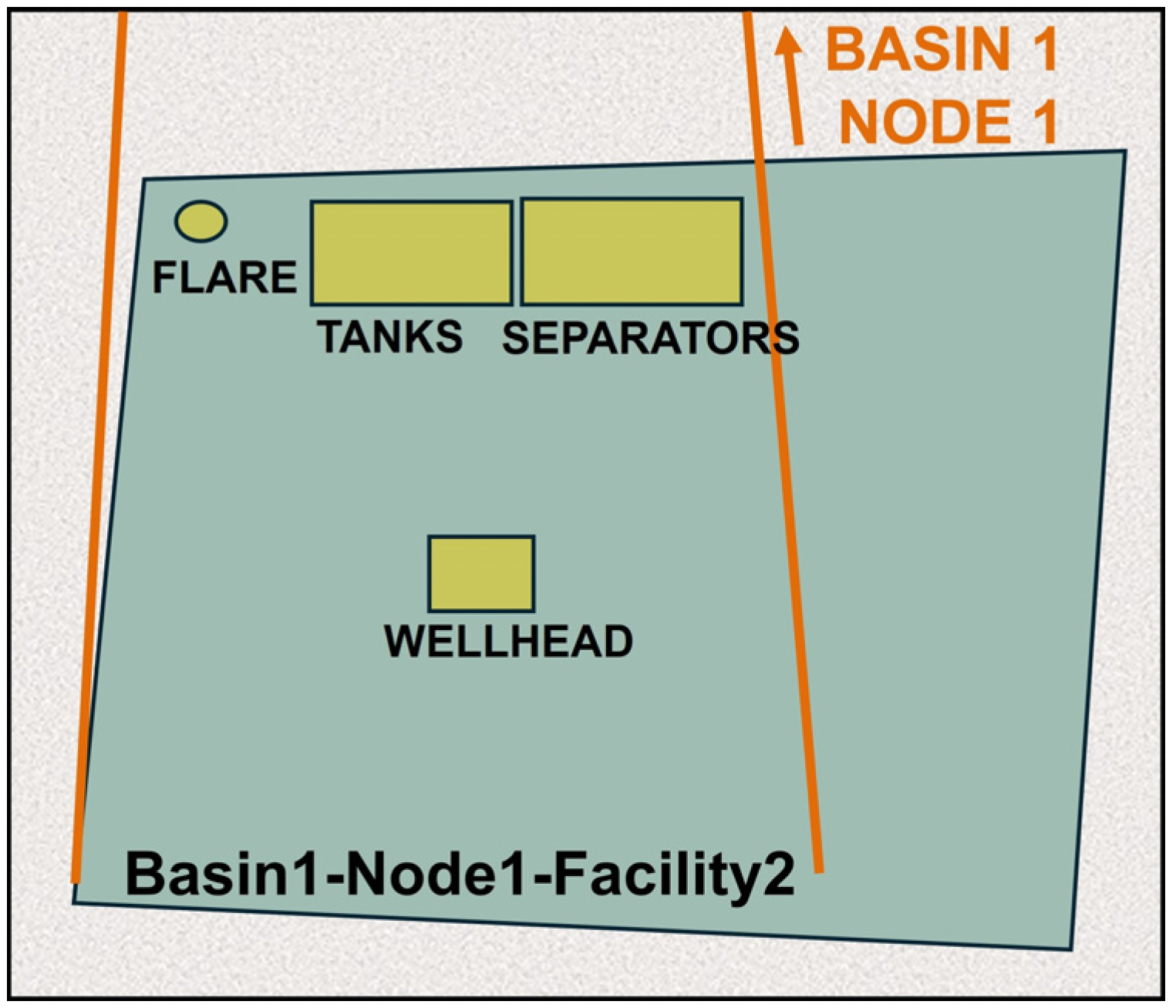
The operational oil and gas site validation test data were collected with 5 LongPath laser nodes deployed in two different United States oil and natural gas producing basins. Table 1 describes the density and type of sites measured and monitored by each of the nodes. The locations of sites and any designations that relate to the oil and gas owners and operators (hereafter, “operator”) that participated in the study were anonymized by using basin numbers, LongPath laser node names, and facility numbers when referring to sites and results. In this study, production facility or facility is used to refer to an oil and/or gas production facility with one or more storage vessels and equipment to gather crude oil, condensate, produced water, or intermediate hydrocarbon liquid from one or more offsite natural gas or oil production wells. Well site is used to refer to wellhead only sites and, additionally, well sites that may include one or more pieces of production equipment, including reciprocating or centrifugal compressors or storage vessels but are not used for centralized production or gathering. In this study, all well sites included additional production equipment; no sites were wellhead only. Figure 1 shows an example sensor layout on a site.
Throughout the full 10-month monitoring period in Basin 1 and the initial 7.5 months in Basin 2, operators received continuous access to data through the LongPath dashboard and API, with abnormal and fugitive emission events also triggering automated email and text alerts to operations staff. During the final 1.5 months of observation in Basin 2, this access was discontinued, creating approximately 63 site-months of monitoring conducted in a “data-off” configuration. After this cutoff, LongPath continued to measure and record emissions at all sites without interruption, but operators no longer received data streams or alerts regarding emission activity, including those related to fugitive releases. The results of this test, which assesses the correlation between emissions reduction and operator access to data, can be found in a companion paper [13].
The test center single-blind controlled release validation testing was performed over the course of approximately one month at the Stanford Large Release Facility (“Stanford”) in Arizona and over the course of approximately one week at the TotalEnergies Anomalies Detection Initiatives (TADI) test facility in France.

2.3. Leak Detection Classification Schema

An important application of emissions monitoring data is for leak detection and repair (LDAR). LDAR programs that use continuous measurement and monitoring solutions send alerts to operators when specific characteristics of the collected data suggest that a fugitive emission source (i.e., leak) or other upset conditions may be causing abnormal or unintended emissions. The alert tells the operator that emissions mitigation actions may be necessary. Validation testing of the LongPath system was performed to measure the precision and accuracy of LongPath alerts for abnormal emissions [14,15]. Standard true and false positive and negative nomenclature were used to characterize LongPath data and alerts, for example, as shown in Table 2.
These characterizations of alerting efficacy were further consolidated into descriptions of accuracy and precision (Table 3) [14,15].
Three forms of detection validation testing of the LongPath system were undertaken: verification of operational emission status, challenge testing of controlled releases at operational oil and gas facilities, and controlled release testing at third-party test facilities.

2.4. Validation Testing: Operational Emissions Verification

The operator subjected the LongPath data to single-blind assessment of the “true” nature of emissions in active oil and gas operations, as assessed by other means. The operator developed and implemented blinded assessments of both alert (emission events) and non-alert periods. Specifically, true positive and false positive results were assessed based on the operator’s investigation follow-ups in response to receipt of a LongPath alert. True positive results were confirmed by aligning one or more independent data point indicating abnormal emissions, for example, from optical gas imaging (OGI), physical identification of abnormal conditions (e.g., open thief hatch, unseated seal), or correlation with SCADA data. False positives were assigned when no such correlating independent data were identified. To assess false negative and true negative results, the operator performed frequent OGI inspections of all sites. In Basin 1, the operator performed daily OGI inspections of every monitored site for a period of three months—from November 2023 to February 2024. Leak or other upset conditions discovered by other means were also recorded for assessment of true positive or false negative results. For example, a high-pressure alarm from a tank sensor was recorded by the operator as a fugitive emission and logged as a false negative event, as there was not a coincident LongPath alarm.

2.5. Validation Testing: Operational Controlled Release Challenge Testing

The operator performed in-field challenge release testing of controlled releases at active oil and gas facilities in both Basin 1 and Basin 2. Challenge release test conditions are those in which baseline emissions (xNTE) from the sites are present and not directly known by either the operator or the technology solution. For all tests, all siting, duration, location, and rate constraints were established and administered by the operator. The operator metered the controlled release flow rate using a regulator and flow meter at a single simulated source location. The meter was specific for methane and had a glass tube and ceramic ball and was monitored for icing. The operator did not estimate uncertainty in the controlled flow rates.
The operator test design was intended to simulate a “multiple release test”, in which emissions due to normal operating conditions at the site (e.g., incomplete combustion from flares, compressor exhaust, and emissions from pneumatic devices) were present in addition to an added, single controlled release simulating a fugitive source.
The operator administering the controlled releases in Basin 1 chose to run multiple shorter (2 h) tests at each location so that each source location could be tested at different times of day (see Supplementary Materials). An additional single longer-duration test was chosen by the operator to see whether quantification accuracy changed with test duration. The operator administering the controlled releases in Basin 2 similarly chose to run multiple shorter-duration (1–2 h) tests to maximize the number of locations and rates that could be tested at different times of day.
The operator in Basin 1 aimed to meter the controlled releases at rates that would be comparable to the EPA periodic screening detection limits of 10 kg/hr and 15 kg/hr [16]. The operator administering the controlled releases in Basin 2 aimed to meter the controlled releases at rates that would be comparable to the EPA periodic screening detection limits of 5 kg/hr, 10 kg/hr, and 15 kg/hr [16].
Basin 1 challenge release testing took place on two sites: Basin1-Node1-Facility5 and Basin1-Node1-Facility2. Basin1-Node1-Facility5 was a production facility with tanks, separators, wells, and other production and processing equipment. At site Basin1-Node1-Facility5, controlled releases were tested at three different locations: Location 1 was a ground-level release near but not at the location of the meter run; Location 2 was a ground-level release near but not at the location of a wellhead; and Location 3 was on a set of stairs leading to a tank battery, 2 m above ground level. Each location at Basin1-Node1-Facility5 was tested at least twice over the course of two days. Each individual release period lasted for approximately 2 h and at an estimated controlled release rate of 15 kg hr−1. Basin1-Node1-Facility2 was a production facility with tanks, separators, wells, and other equipment. At Basin1-Node1-Facility2, the controlled release Location 4 was in the center of the pad, near the separators, 3 m above ground level. At Location 4, a single longer-duration (11 h) release was run at an estimated controlled release rate of 10 kg hr−1.
The Basin 2 challenge release testing was targeted specifically at LongPath detection of leaks from taller equipment types. Oil and gas facilities can have a wide range of equipment heights, which can pose a challenge for ground-based emissions monitoring and measurement solutions. In the upstream segment, tanks and flares can be relatively high above the ground compared with other equipment types. To assess the LongPath system’s leak detection accuracy on elevated equipment types, the operator designed and performed a series of blind tests at differing heights above ground level.
The Basin2 test pad was a relatively large, centralized tank battery. The operator placed a gas line in three different locations on the site: Location 5 was 6 m above the ground at the top of a stairway up to a tank battery; Location 6 was 1.5 m above the ground near the same battery; and Location 7 was 7.6 m above the ground, midway across a walkway at the top of the tanks. Blind tests were performed across three days. Thirteen individual tests were performed at rates of 4.4 kg hr−1 (1), 5 kg hr−1 (1), 8.3 kg hr−1 (1), 10 kg hr−1 (3), and 13.8 kg hr−1 (7), with 6 tests at location 5, 2 tests at location 6, and 5 tests at location 7. Each location was monitored by two nodes. This allowed for an effective doubling in the duration of test data collected, without doubling of operator personnel time or gas lost to the atmosphere. All data collected in all experiments described in this study were processed on independent edge computing devices with no data or information sharing between nodes. Each test was 1–2 h in duration. Test locations, times, durations, and rates are found in the Supplemental Materials.

2.6. Validation Testing: Third-Party Controlled Release Testing

The third method of validation testing of the LongPath system was single-blind controlled release testing at two controlled release test facilities and under two protocols: the Advancing Development of Emissions Detection (ADED) 2.0 protocol and the Stanford large release test protocol [14,17]. A probability of detection (POD) curve was created using data collected under these protocols combined with data at lower emission rates from previous testing at the Methane Emissions Technology Evaluation Center [11,18]. The probability of detection curve was calculated using TP and FN detections and the independent variable of emission rate. Curve fitting was performed using a logistic function with an asymptote at 100% detection, with bootstrapping to calculate confidence intervals. For Stanford tests, the TP and FN confusion matrix was populated by evaluating the intersection of Stanford-defined emission events with LongPath-reported emission events (answering the question: “When there is a release of gas onsite, is the continuous monitoring solution effectively identifying the emission?”) [14]. A classification of TP and FP was assigned via the methodology of Chen et al. (2024), using ≥10% overlap of Stanford-defined positive events with LongPath-defined positive events and >90% overlap of Stanford-defined positive events with LongPath-defined negative events, respectively [14]. All Stanford events were down-selected to events with a minimum duration of 15 min to align with the reporting frequency detailed in Section 3.4. The data collected at TADI under the ADED 2.0 protocol were included in the confusion matrix following the sample-based metrics defined for filtered and paired detections as described in the protocol [17].

2.7. Quantification of Site-Wide Emissions, Fugitive Emissions, and Controlled Releases

Accurate quantification of emission rates is important for long-term study of the efficacy of mitigation strategies, accurate inventory reporting, and prioritization of repairs and equipment replacement. This is particularly true for fugitive emissions sources, so that operators can identify the effects of other mitigation strategies on the frequency, duration, and rate of unplanned emissions. The emission rate for a fugitive emission source is characterized in this context as emissions (xFUG) that exceed the baseline emission rates (xNTE) for the site for unintended or otherwise non-process reasons (Equation (1)).
The LongPath system’s quantification accuracy was validated using four independent methods. First, when possible, the operator compared the LongPath-reported emission rate for fugitive emission alerts to quantitative OGI (Q-OGI). Although Q-OGI does not have a demonstrated consistency in quantification, it was nonetheless a secondary method of assessment [19], and while Q-OGI is source level, the quantification of site-level emissions by LongPath required removal of baseline rates to obtain fugitive emission rates. Second, the challenge testing of controlled releases of methane at active oil and gas sites with non-zero xNTE offered an important opportunity for quantification verification. Third, emissions quantification of controlled releases at third-party test facilities was assessed. And finally, emission rate quantification agreement between two independent LongPath systems measuring the same site was assessed.
Accurate site-wide emissions quantification is increasingly important for measurement informed inventories and protocols that require top-down emissions estimates to be reconciled with other scales of measurement, for example, the Oil and Gas Methane Partnership (OGMP) 2.0 [20]. While third-party controlled release testing is the gold standard for controlled site-wide emissions testing, the comparison of rates measured by independent laser systems measuring the same site also provided a unique means to test the site-wide quantification capabilities of the LongPath system. In Basin 2, 5 different sites were measured and monitored by more than one node for 9 months. One site, Basin2-Node1-Facility8, was installed specifically for the purposes of forcing a failure of the system by having one of the measurement laser beams for the site pass directly over the compressor exhaust of a different site. Excluding the site with forced failure limitation testing, 4 sites offered comparison of quantification information (Table 4).
The emissions distributions from both datasets for the 4 sites were compared for verification of site-wide quantification precision.

3. Results

3.1. Detection and Quantification Validation: Operational Emissions

Across all sites and all months of monitoring, a total of 197 emission events were recorded, either by the LongPath system, the operator, or both. These included 116 events alerted through LongPath’s automated alerting protocols, 37 blind testing events, 17 events found by other means, and 27 OGI inspections.
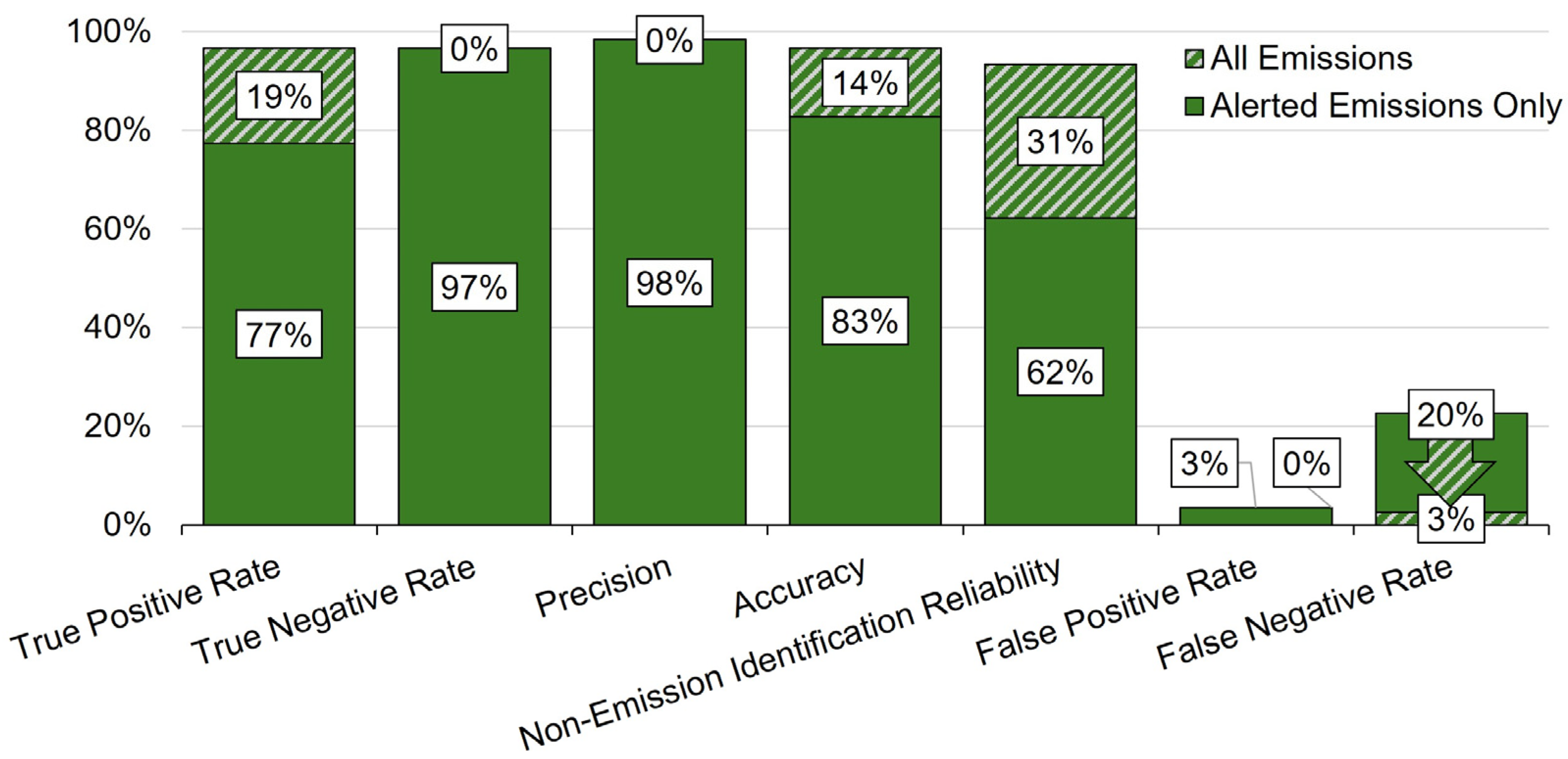
Overall, the LongPath system’s emission identification reliability (precision) was 98%, meaning nearly all LongPath alerts were confirmed as true positive by the operator. Figure 2 shows results of emissions that generated alerts as well as periods when abnormal emissions were noted but alerts were not necessarily generated because persistency and/or rate were below the operator-set alert thresholds. True negative rates were measured directly by the operator in single-blind fashion by deploying random OGI checks during non-alert periods; LongPath was blind to the number, timing, and location of OGI visits.
The differences in accuracy and reliability rates considering alerts only and alerts plus abnormal emissions are important because alerting thresholds and criteria are challenging to set and somewhat separate from the ability of the system to detect abnormal emissions. There were 17 possible fugitive emissions found by other means by the operator. These emissions were not measured by Q-OGI or quantified by other means, so it was not known whether they were above or below the LongPath alert thresholds. Of these, 16 were evident in the LongPath data but an alert had not yet been sent because the alert criteria required higher persistency, duration, and/or rate. Only one operator-reported event was not evident in the LongPath data at all, but that event was not confirmed with OGI and was logged by the operator based on an intermittent spike in tank pressure alone. One false positive was triggered but it was due to deliberate experimentation with the LongPath system siting by the operator, and the system behaved as expected (see Supplementary Materials).
An important part of fugitive emissions monitoring with site-level quantification methods is to ensure the lack of small fugitive emissions in the XNTE or baseline profile. During the Basin 1 tests, a clean OGI sweep was not initially performed by the operator on any sites prior to the initiation of LongPath monitoring. Additionally, during the initial phase of monitoring, alert thresholds were set by the operator to a high rate of >50 kg hr−1 to preclude operator alert fatigue during the initial integration phase. Consequently, four small fugitive emissions, all <30 kg hr−1, were seen in a subsequent OGI inspection that was performed on all sites to verify baseline rates. Following the autonomous adaptation of the system to the new emissions baseline rates for each site, five additional fugitive emissions < 2 kg hr−1 were found by OGI through the remainder of the test period. All five emission sources were confirmed by Q-OGI to be below the LongPath alert threshold such that an alert was not triggered. The operator noted that future best practice for the operator use of site-wide CEMM was to perform an OGI inspection of the entire facility immediately before, after, or during the baseline collection period for a site to ensure that emissions designated as xNTE do not inadvertently include undetected fugitive emissions sources [16].
For two true positive LongPath alerts, the operator used Q-OGI to compare with the LongPath-reported rates for fugitive emission events. The first emission event was due to a pneumatic controller malfunction. The LongPath-recorded baseline emission rate during the week prior to the fugitive emission event was 7.0 kg hr−1. The average emission rate during the fugitive emission event, which lasted 8 h in duration, was 20.6 kg hr−1. The difference of 13.6 kg hr−1 was attributed to the fugitive leak, per Equation (1). The same leak was estimated to be 15.0 kg hr−1 by the Q-OGI assessment, indicating agreement within 10% of the LongPath and Q-OGI quantified rate. The second emission event was due to a leaking fuel gas line on a vertical gas scrubber. The LongPath-recorded baseline emission rate during the week prior to the fugitive event was 14.8 kg hr−1. The average emission rate during the 12.5 h event was 28.7 kg hr−1, implying a fugitive emission rate of 13.9 kg hr−1. The Q-OGI reading at follow-up was 5.6 kg hr−1, or a roughly 60% difference from the LongPath rate. Averaging these two comparisons, the overall agreement between LongPath and Q-OGI quantification of fugitive emission rates was 35%.
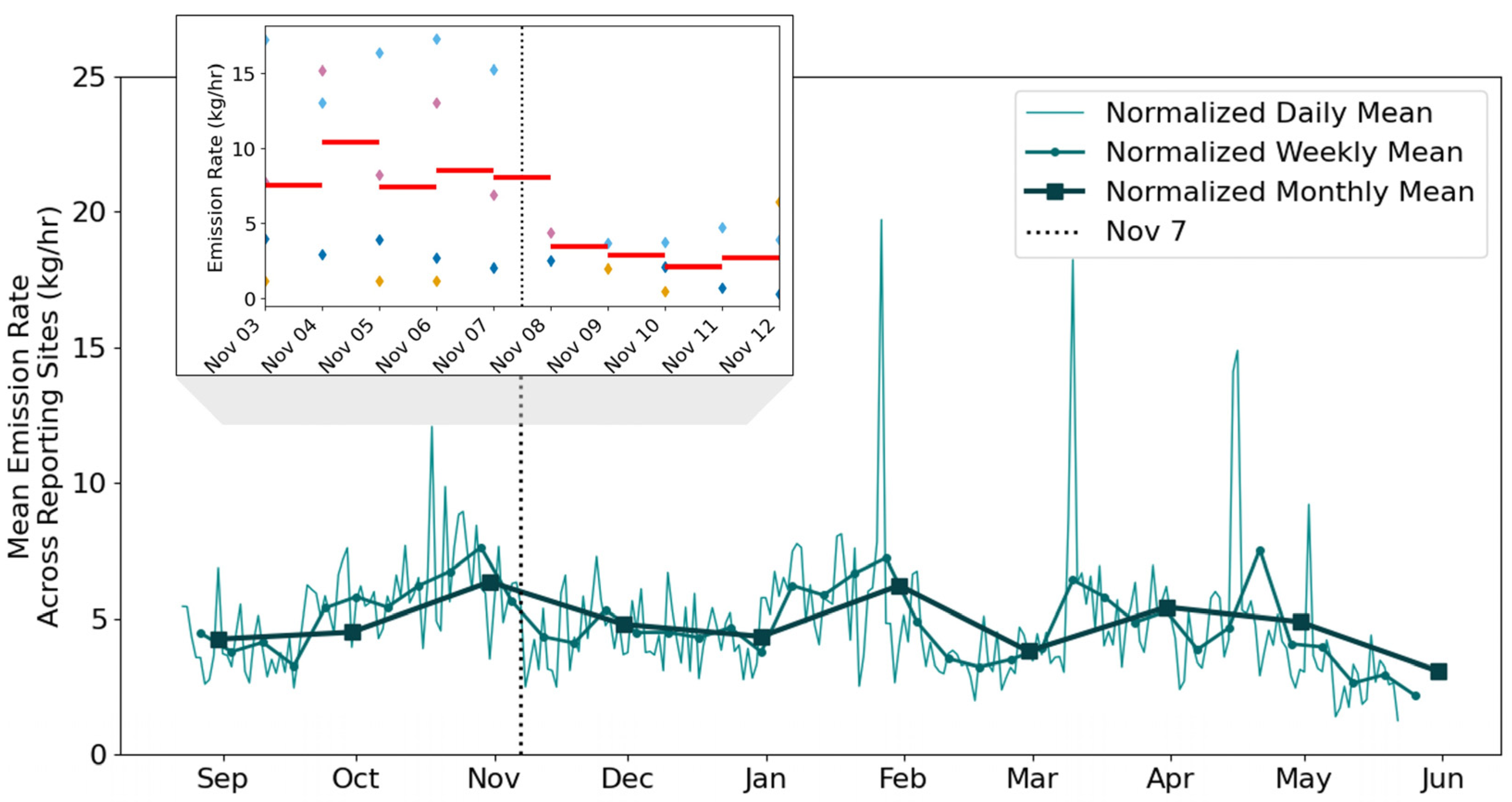
The operator further assessed LongPath system’s fugitive emission rate quantification by comparing before-and-after changes in emission rates following repair of small emissions below the LongPath alert thresholds that were caught with OGI surveys (see Figure 3). The daily average across all sites decreased from 6.3 kg hr−1 on the day before the OGI survey to 2.5 kg hr−1 on the day after the OGI survey, which identified small fugitive emissions at 4 of the 10 sites, although clear reductions were only evident at 2 sites within day-to-day emissions variability. The daily average across the four sites where emissions were found was 8.5 kg hr−1 on the day before the repairs were made and 3.4 kg hr−1 on the day after the repairs were made (Figure 3).

3.2. Alert Frequency and Time-to-Alert

In cases of true positive emission events, time-to-alert and time-to-repair were important metrics for operator assessment of overall emissions reductions. Avoidance of so-called “alert fatigue” was also noted by the operator as an important gating criterion for advanced continuous LDAR systems to be used in operational settings.
In Basin 1, across 100 facility-months of monitoring (10 months of continuous monitoring on 10 sites), nine alerts were sent for emission events, for an average of one emission event per site per year. The LongPath system’s average time-to-alert was 3.4 h and, in all cases, time-to-alert was < 24 h. The average time-to-respond of the operator was 7.7 h, resulting in an overall average duration of emission events of 11.1 h. In Basin 2, across 369 facility-months of monitoring, 108 alerts were sent for emission events, for an average of 3.1 events per site per year. Time-to-alert was 11.1 h on average.

3.3. Detection and Quantification Validation: Challenge Testing

To assess quantification accuracy of controlled releases in a challenge test setting, the measurement system must be able to measure total site-wide emissions and normal operating emissions, xNTE, for differentiation of xFUG. For the tall equipment tests in Basin 2, the baseline emission rate (xNTE) for the test site was 1.2 kg hr−1, as measured by LongPath. The “fugitive emission rate”, or the rate corresponding to the controlled releases, was calculated by subtracting xNTE of 1.2 kg hr−1 from the measured total site-wide emission rates. To assess the impact of the potential dynamic nature of the baseline emission rate, we calculated the standard deviation of the baseline emission rate for the two days before testing and the two days following testing and found variability of 1 kg hr−1.
Due to the short duration of testing (2.1 h, on average), a significant number of raw data readings spanned test start and end times, so a given raw data reading was considered part of a test result only if >50% of the duration of the raw data reading was within the test duration window. If two or fewer readings spanned a test window, then all available readings were used. As a sensitivity test, the results were reprocessed to also include data with ≤50% and >0% overlap. For tests with a duration less than 3.5 h, results were combined for consistency with LongPath’s EPA-approved test methods, which require 3.5 h of data at a minimum for a periodic screening [6]. To achieve this, when the same sites and locations had tests with the same metered rates, those results were combined (concatenated) to yield at least 3.5 h of raw data duration [6].
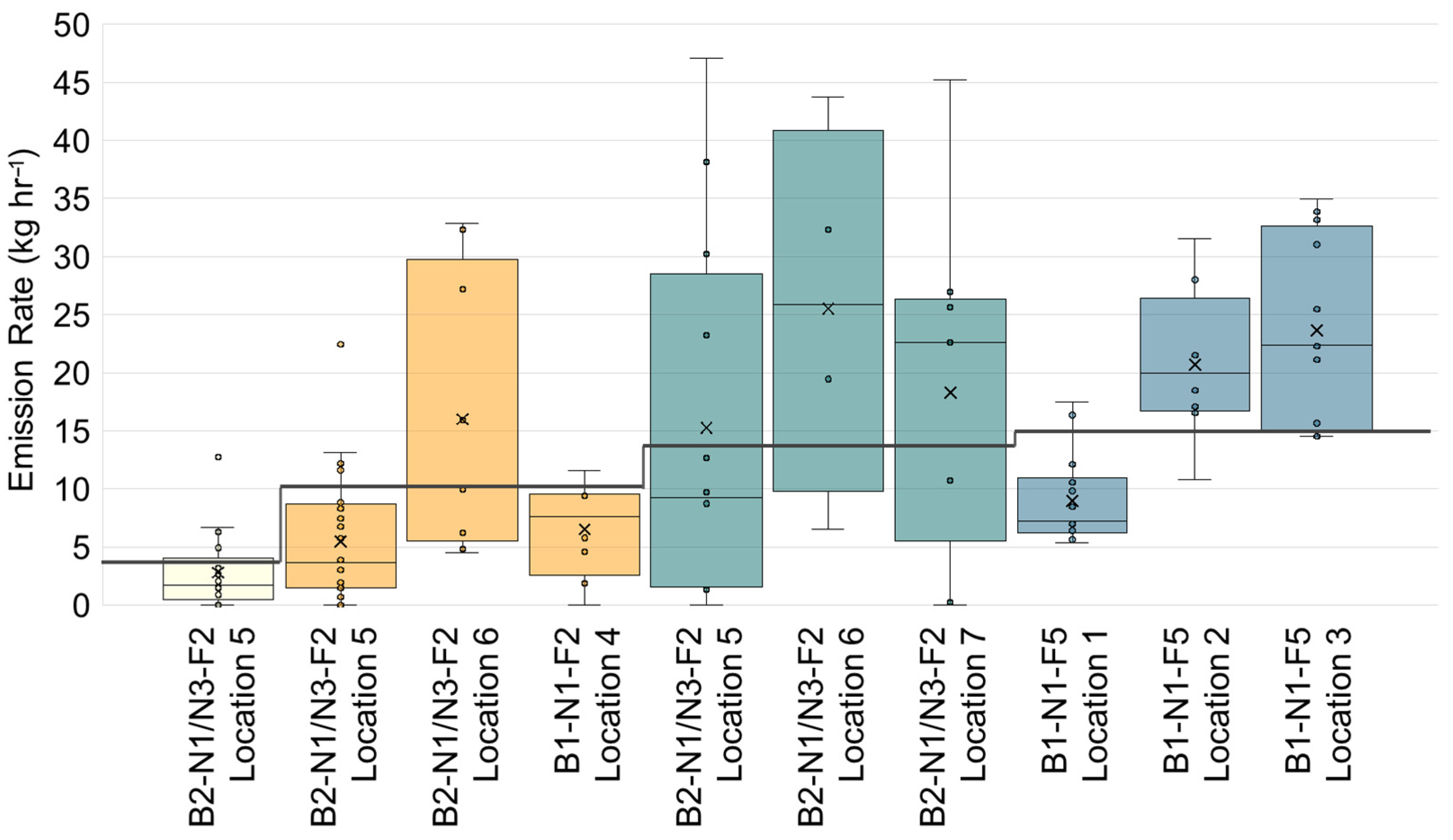
In all test cases, the average and median emission rates matched well with the expected rates (Figure 4). The overall difference between the controlled release rates and the average and median emission rates was less than 10%. The sensitivity test showed a change in fit to the data of 1% for tests greater than 3.5 h in duration and 2% for tests less than 3.5 h in duration. The slope of a line fit to the true and average reported rates was 1.2 (R2 = 0.9). For the median of the data, the slope was 1.0 (R2 = 0.83). The variation in the agreement included all variation due to spatiotemporal variability in the baseline emission rate as well as uncertainties in the actual flow of gas from the controlled release point.
The Basin 2 testing targeted tall emission source testing. Location 5 was 6 m above the ground at the top of a stairway up to a tank battery; Location 6 was 1.5 m above the ground near the same battery; and Location 7 was 7.6 m above the ground, midway across a walkway at the top of the tanks.
The goal of the tall emission source challenge tests was to identify whether tall emission sources were consistently detected by LongPath. The test results were assessed based on comparison of the LongPath-reported emission rate with the estimated rate from the metered release.
The blind testing was performed with dual monitoring from separate laser systems (see Supplementary Materials). This allowed for an effective doubling of the test duration that could be achieved without doubling personnel time or gas loss to the atmosphere. All results were processed at the edge on independent computing devices with no capacity for data or results sharing.
At location 5, a 6 m tall leak above the tanks, and location 6, a 1.5 m tall leak near the base of the tanks, increased emission rates were observed in the LongPath data in 100% of blind tests. At location 7, a 7.6 m leak height on the catwalk above the tanks, 80% of tests showed heightened rates. Of the 22 total tests, 20 showed elevated emissions during controlled testing for a 91% true positive rate and a <10% false negative rate. When test results were filtered to only include >2 h duration tests, the true positive rate increased to 95% and the false negative rate decreased to 5%. Full test results are found in the Supplementary Materials. These tests validate the consistency with which LongPath CEMM provided the operator with immediate information about emission sources that were elevated above ground level.

3.4. Detection Validation: Third-Party Test Facility Blind Test Controlled Releases

The blind test protocols for TADI followed ADED 2.0 [17], and the blind test protocols for Stanford followed the Stanford Large Release Facility protocols, which, at the time of writing, were in preparation for publication. Both protocols concealed the number or timing of controlled releases to performers ahead of time.
At TADI, a total of 33 blind tests were administered: 28 tests with a single steady release (Difficulty A), 3 tests with multiple steady releases (Difficulty B), and 2 tests of non-methane gases (C4H10 and N2), which the LongPath system correctly identified as true negative detections for methane. LongPath performed with a 100% true positive rate, 100% true negative rate, 0% false positive rate, and 0% false negative rate. The average test duration was 57 min, with a minimum duration of 25 min and a maximum duration of 3.2 h. The average time-to-detect, or start-time accuracy, of the LongPath system was 37 s, and the LongPath system event duration accuracy was within 3% the true duration on average, a critical metric for fugitive event reporting. Of the 33 tests with accurate detection, 2 were not quantified because they were correctly identified as not being releases of methane gas, and 1 was not quantified because the wind speeds were below 1 m s−1 [6,11].
At Stanford, a total of 216 tests were administered, with an average test duration of 21 min. The minimum test duration was 1 min, and the maximum test duration was 9.8 h (see Supplementary Materials). Standard LongPath monitoring assesses emissions over roughly 15 min windows. More than 50% of the Stanford-defined tests were shorter than 15 min in duration, so the Stanford data were binned in 15 min intervals prior to comparison with the LongPath data. The LongPath data were submitted to Stanford in this manner and yielded a 100% true positive rate, calculated using Stanford-defined events as defined by Chen et al. with a minimum overlap of 25% between Stanford positive events and LongPath 15 min binned detection windows [14]. At the time of this publication, the official time windows of defined negative events have not been released; therefore, official FP and TN rates cannot be defined. Preliminary metrics for these rates can be found in the Supplementary Materials. A series of sensitivity tests is also found in the Supplementary Materials.
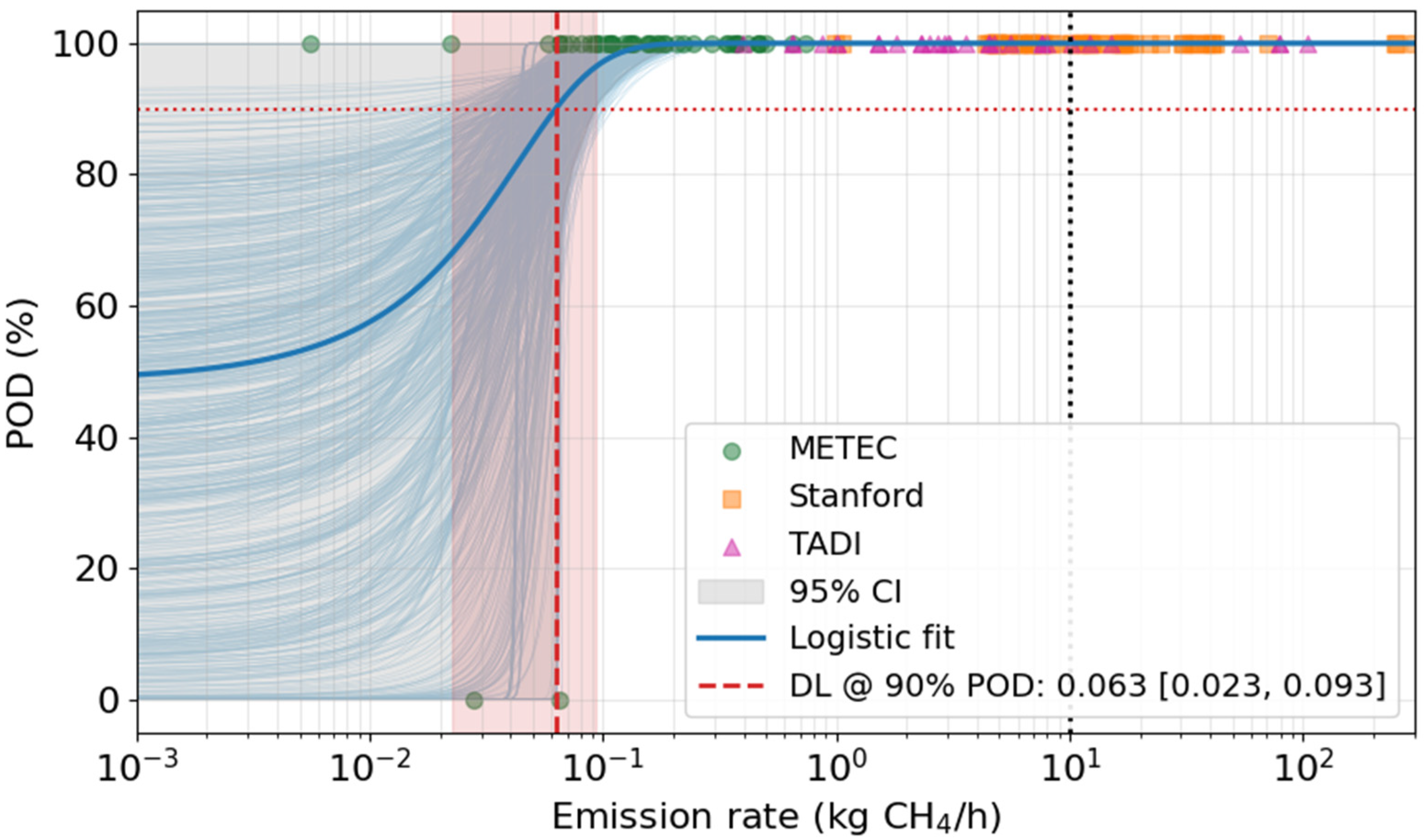
The probability of detection curve was calculated using all >15 min duration tests from Stanford, yielding 63 tests ranging in rate from 0.98 to 301.4 kg hr−1, as well as all 31 tests in the TADI trial ranging in rate from 0.40 kg hr−1 to 104.4 kg hr−1, and all 48 tests in METEC trials ranging in rate from 0.01 to 0.74 kg hr−1.
We estimated the POD as a function of emission rate using a generalized linear model with binomial errors and logit link, following standard practice [21]. The only two false negative results were from the low-rate METEC testing; a 100% detection success rate was achieved in both Stanford and TADI testing. The dataset therefore had 140 true positive cases and only 2 false negative cases (pending Stanford negative time window results), exhibiting separation of the outcome by emission rate, which is known to yield unstable or non-existent maximum-likelihood estimates in logistic regression [22]. The maximum false negative emission rate value was 0.065 kg hr−1. Sensitivity tests demonstrated that inclusion of true positive values above this rate had no tangible impact on the POD up until the point of separation. Therefore, following [23], the logistic regression fit was restricted to the range of data at or below 10× the maximum false negative rate, which included 50 data points ranging from 0 to 0.65 kg hr−1 [24]. The result of the logistic regression was a 90% probability of detection level of 0.06 kg hr−1 (Figure 5). As a sensitivity test, the maximum of the fit range was increased to 1.0 kg hr−1 (53 data points used in the fit) and 10 kg hr−1 (103 data points used in the fit). These sensitivity tests showed that the identical PoD result was returned.

3.5. Quantification Validation: Third-Party Blind and Challenge Test Controlled Releases

Quantification accuracy was assessed by combining the following: (1) the challenge test controlled releases on active oil and gas sites described in Section 3.3, (2) the 30 quantification results from TADI, (3) the 6 quantification results from Stanford, and (4) the 55 quantification results from METEC.
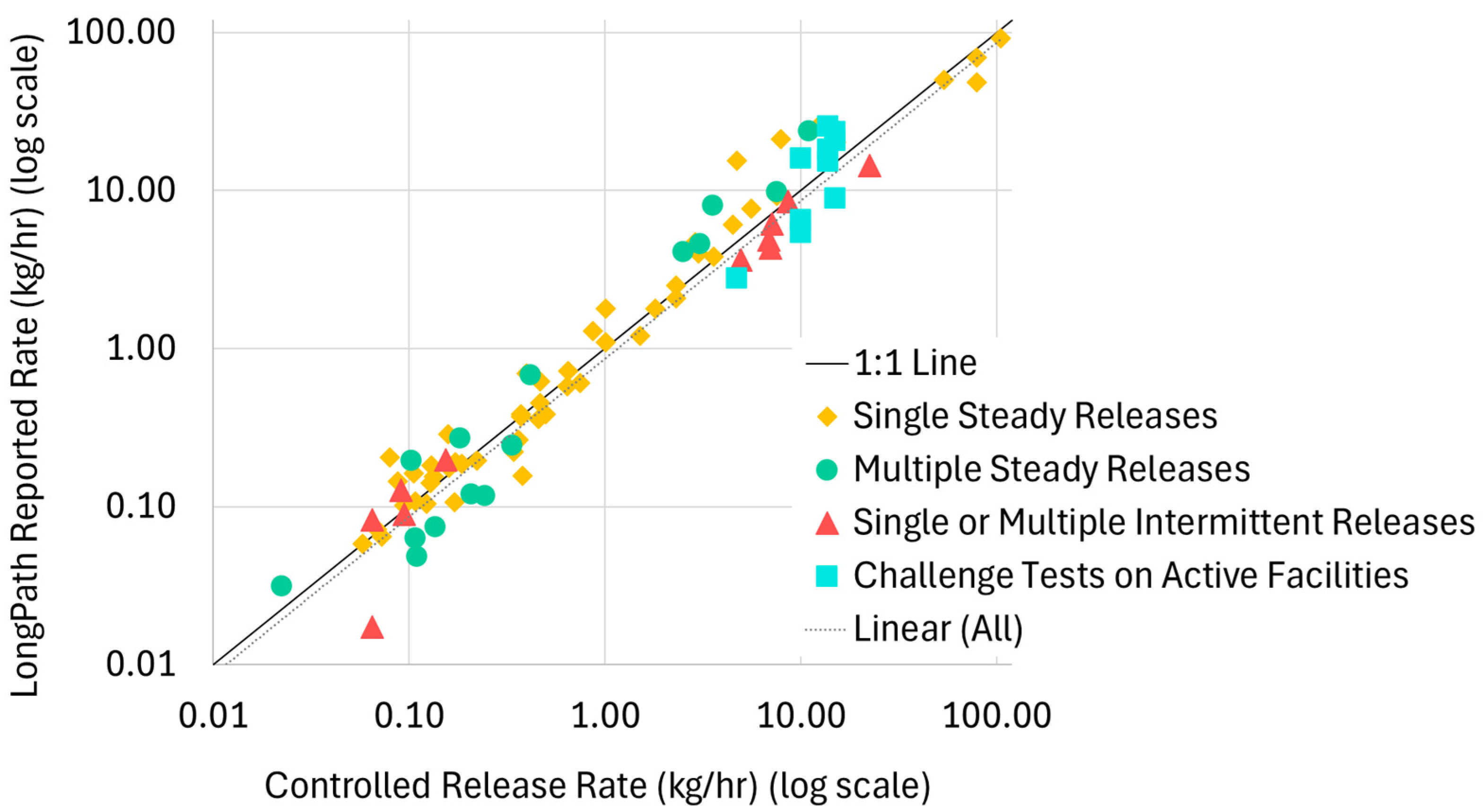
The number and rate for all results were as submitted in blind testing with the exceptions described in the Supplementary Materials. The results in Figure 6, below, are for test difficulty spanning single, steady emission points (Difficulty A), multiple, steady emission points (Difficulty B), single or multiple intermittent rates (Difficulty C), and challenge testing (Difficulty D). In all, 43% of tests were multi-source releases. Ordinary least squares fitting of all test results yields a slope of 0.9 and an R2 value of 0.92, indicating agreement between controlled release rates and LongPath provided rates across five orders of magnitude in emission rate.
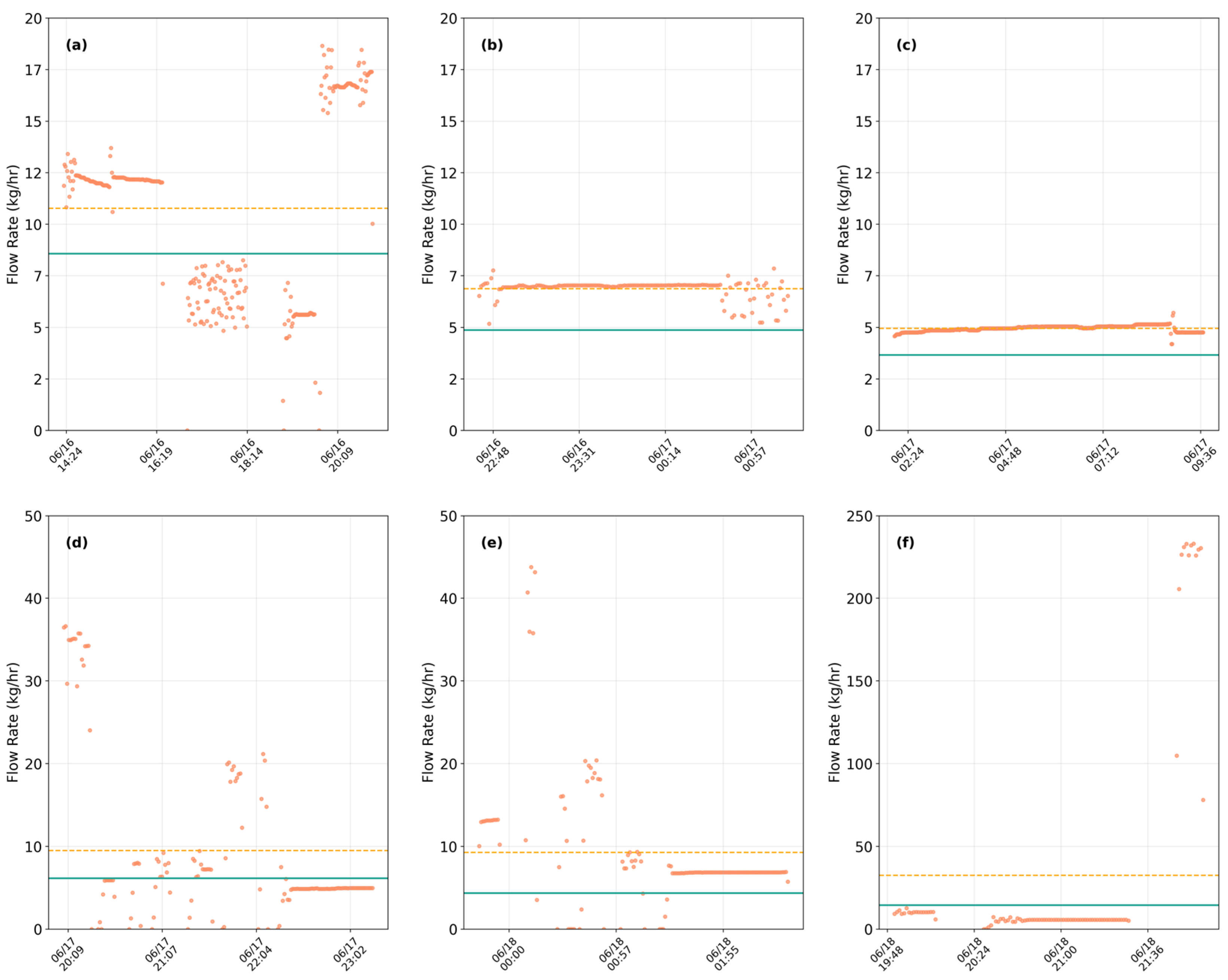
The Stanford Large Release center testing protocol was to withhold information from testing solutions about the duration, rate, variability, and intermittency of emissions ahead of time. Therefore, when LongPath submitted the blind testing results to Stanford, the six tests where quantification was provided to Stanford had incorrectly assumed steady state emissions for all of the 2 h periods for which blind data was submitted. When the results were unblinded by Stanford, it became evident that these test periods in fact showed a high degree of intermittency (Figure 7). Because emissions from real, operational oil and gas infrastructure do demonstrate a high degree of rate variability and intermittency, this test result allowed for an opportunity to test the effects of quantification window duration on quantification accuracy.
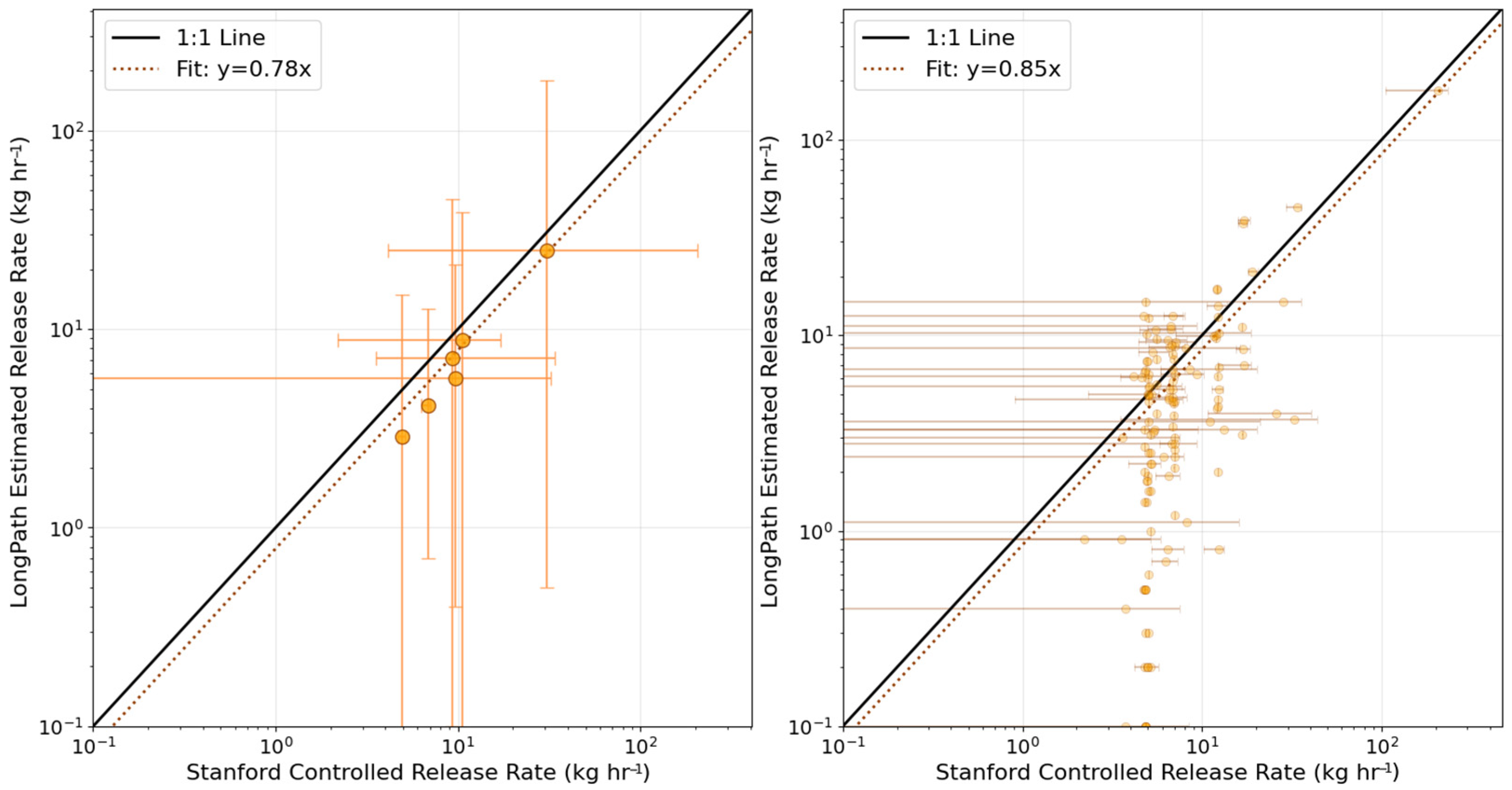
To assess the effect of quantification duration time on quantification accuracy, the data were compared again in two different ways. First, the LongPath raw emission rates were averaged across the same 2 h windows as were submitted in the blind phase and compared with the average Stanford rates in those same 2 h windows. Second, the LongPath raw emission rates during those same 2 h windows were compared with the raw Stanford emission rates, averaged to the same start and stop times as the LongPath data, across the same 2 h windows (a team-defined event window definition). Without any changes to the blind submitted quantification using all data in 2 h windows, the slope of an ordinary least squares fit through the LongPath data (x-axis) and Stanford data (y-axis) and the origin was 0.70 with an R2 value of 0.97. When the LongPath raw data were averaged across the same 2 h windows and compared to the averaged Stanford rates, the slope of the fit was 0.78 with an R2 of 0.99. Finally, when the raw LongPath data were treated as team-event data, and the Stanford raw data were averaged to the same time windows as the LongPath raw data, the slope of the fit was 0.85 with an R2 value of 0.90 (Figure 8).
These results are not particularly surprising; the LongPath system typically uses raw rate data in calculation of emission rates (see, for example, the EPA approval of the LongPath system, which uses a collection of raw data points collected over time) [6]. Emission rates from oil and gas may vary rapidly through time, but as the results from Section 3.2 demonstrate, real fugitive emissions due to process failures and malfunctions have durations of less than a few hours—and the event durations measured in this paper were cut drastically shorter because LongPath alerted the operator who performed repair. When the LongPath system was deployed at the Stanford Large Release center, the expectation was therefore that longer-duration leak tests would take place to more accurately simulate real-world emissions. However, when the results were unblinded, it became evident that instead the Stanford center chose to run extremely short-duration tests, likely tailored to the satellite solutions the test center was originally built to assess.

3.6. Quantification Agreement Between Independent Laser Systems

Four sites had two independent laser systems measuring the same emissions for a period of 6 months in Basin 2. The systems were entirely decoupled, from laser transceiver equipment and location to mirror equipment and locations. To minimize the effects of sampling bias due to higher frequency of readings in the presence of abnormal emission rates, the smoothed daily average emission rate values were analyzed. That is, without daily averaging, raw 15 min data points during high-rate emission events would be disproportionately represented, because the raw data sampling frequency increases when indications are found of the possibility of fugitive or high-rate emissions.
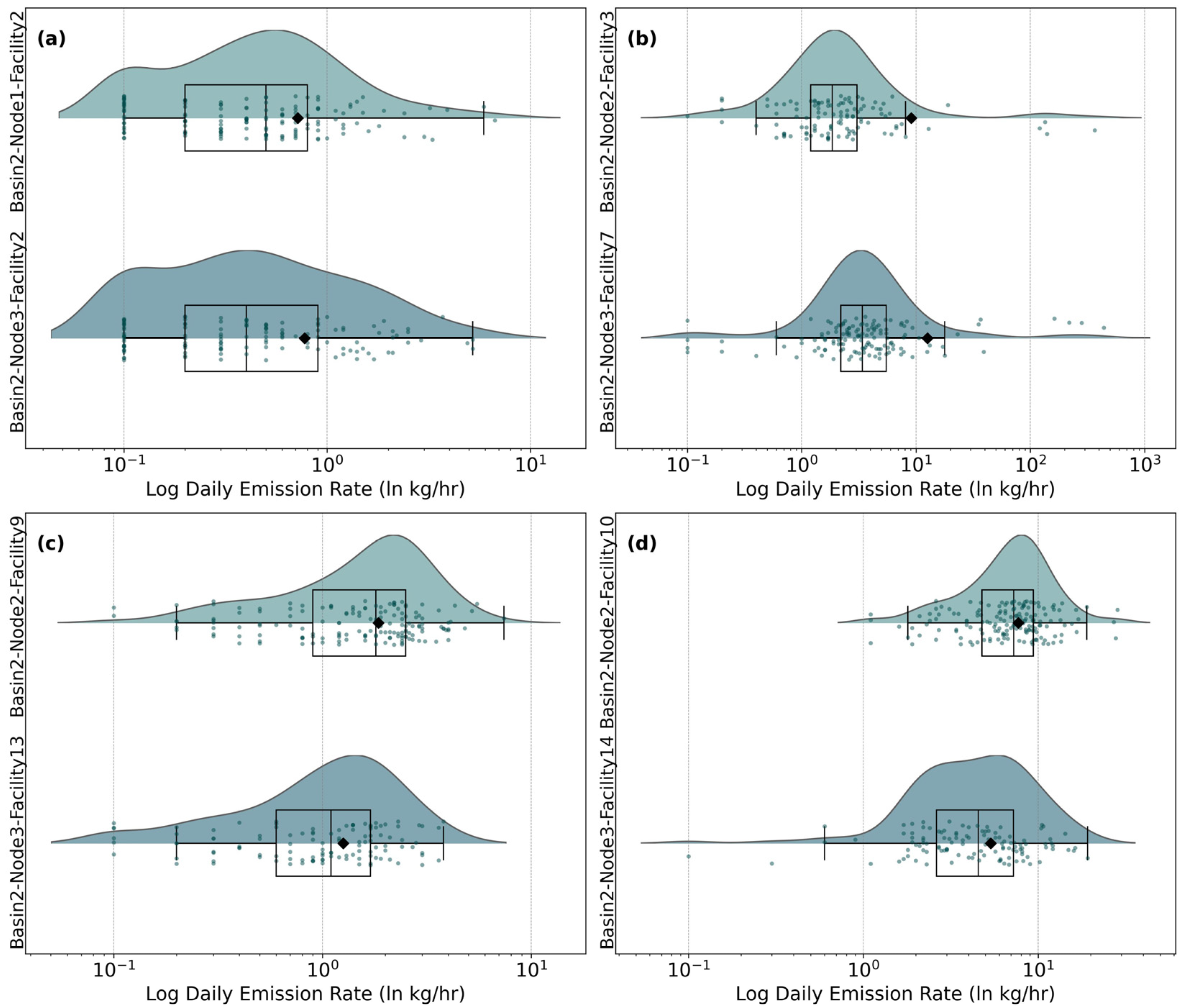
Box plots of the log of the non-zero average daily emission rates show the agreement between the same sites measured from different nodes. Interestingly, the distributions are similar despite the sites having been measured at different times of day and that not all days contained sufficient data density to produce a statistically representative daily average emission rate value.
Comparison of the daily average site-wide emission rates between paired measurements of the same site showed that the 25th and 75th quartiles overlap between distributions and the mean values agree within 1 standard deviation (Table 5). When the datasets were filtered to only include days when daily values were made for both sites, the Spearman correlation coefficients (chosen because the distributions are non-normal and contain outliers) were positive and statistically significant in all cases.

3.7. OGMP 2.0 Level 5 Quantification

Greenhouse gas emissions reporting protocols such as OGMP 2.0 require measurement of the total volume site-wide emissions for the reporting period (e.g., year) across a representative sampling of sites. To assess the precision of the system’s capability to measure site-wide total volume of emissions through time, the paired measurements of the same site from different nodes were used. Comparison of the estimates of the total mass of emitted methane over the course of the 6-month observation period showed that the 95% confidence intervals (CI) overlapped in all cases (Table 6). Several of the sites monitored showed strongly skewed distributions (particularly the pairs with Gaussian distributions in the log plots in Figure 9). Given this characteristic of the emissions profiles on the monitored sites, and the fact that the samples for different pairs were collected at different times of day and night, the agreement between paired measurements suggests that the skewed distribution was adequately characterized by the high-frequency sampling. For example, for Basin2-Facility3, the total emissions calculated using the mean were 14% of the 97.5th CI and the total emissions calculated using the median were 3% and 4% of the 97.5th CI, respectively, from the Node 2 and Node 3 measurements. This finding reveals a very important characteristic of the observed data and observing system, which was that, not only do the two independent observing systems calculate nearly the exact same characteristics of the observed distribution, but also that high frequency and density of measurements are a strict requirement for obtaining accurate information about OGMP 2.0 Level 5 and other site-wide measurement protocol emissions. A full 12 months of data would likely have converged to agreement in the total mass of emissions for an annual reporting period, suggesting that hundreds of samples based on an even higher frequency of raw data are a requirement for accurate reporting.

4. Conclusions and Discussion

This work contributes to the growing body of research on the impacts that measurement and monitoring of emissions at a high frequency and with widespread asset coverage can have on emissions reductions and mitigation success. The results show that operator integration of emissions data and fugitive emissions alerts can drive rapid LDAR activities and drastically limit the duration of preventable methane emissions.
In particular, these findings support the value of oil and gas operators following an LDAR-by-exception program, in which multi-skilled operators and other personnel perform LDAR duties when a known emission event is present rather than on a set schedule. Several states and the EPA have created alternative compliance programs for the use of continuous monitoring in lieu of scheduled AVO and OGI inspections, under the recognition that equivalent or greater emissions reductions can be achieved by an as-needed rather than an on-schedule approach to LDAR.
One can compare, for example, a quarterly (every 90 days) OGI program [16], in which leaks are repaired in 45 days on average, to a continuous monitoring program, which, in this study, demonstrated repair in approximately 1 day or less. Assuming the same sizes and types of leaks are caught with both methods, the duration, and therefore overall volume of gas emitted to the atmosphere, is reduced by 44/45ths or 97.8% by pivoting from a quarterly to a continuous LDAR program. That is, the alert and response timings measured during these tests suggest that the overall volume and duration of emissions could be reduced by 99.7% over a quarterly OGI program based purely on a time-to-detect difference in continuous versus quarterly monitoring. Expanding the thought experiment further, if only 1–3 emission events occur each year, then this program could also enable a 25–75% reduction in personnel time spent driving to sites for LDAR inspections, freeing up skilled operators for other tasks. That is, 4 LDAR-specific visits per year can be reduced to 1–3 LDAR-specific visits per year [16].
Another interesting finding of this work was the difference in the time-to-alert in Basin 1 (3.4 h) compared with Basin 2 (11.1 h). The alert modalities considered emission persistence versus intermittency. Intermittency was notably higher in Basin 2 overall, which appeared to be strongly correlated with the vintage and “build” of the facilities in Basin 2. The facilities in Basin 1 tended to be newer and designed more efficiently than the facilities in Basin 2. Emissions in Basin 1 tended to be low overall, with pronounced changes in emission rate when a fugitive emission started. By contrast, Basin 2 tended to have older facilities with less consistent modifications for emissions mitigation. Emissions in Basin 2 tended to be higher overall and produced higher intermittency in emission rates, such that emission events would persist for a longer duration until the thresholds for alert were reached.
The results of this study further underscore that real-world field testing is essential for validating continuous monitoring technologies and building confidence across the methane measurement ecosystem. Evaluation of platform agreement and data resolution effects under a wide variety of operational conditions can inform technology adoption, regulatory design, and best practices for emissions transparency and accountability. The operators who designed, administered, and evaluated the operational site blind tests in this study compiled a highly varied series of testing methods. Future work to collect up the concepts employed by the operators and formalize a framework could be useful to the community at large.

Supplementary Materials

The following supporting information can be downloaded at: https://www.mdpi.com/article/10.3390/atmos16121409/s1.

Author Contributions

Conceptualization, G.B.R., C.B.A., B.K., A.M., and D.C.; methodology, C.B.A., G.B.R., A.M., B.K., D.W., and D.C.; formal analysis, C.B.A., A.M., and D.Y.; writing—original draft preparation, C.B.A.; writing—review and editing, C.B.A. and G.B.R.; visualization, C.B.A. All authors have read and agreed to the published version of the manuscript.

Funding

This research received no external funding.

Institutional Review Board Statement

Not applicable.

Informed Consent Statement

Not applicable.

Data Availability Statement

Test facility test data and LongPath results are available on request. Operator data is not available for the sake of anonymization.

Acknowledgments

The authors wish to extend their gratitude to the operations and management personnel from the industry partners who provided environment, resources and thought leadership for the extensive testing in this paper to be performed. Special acknowledgement also goes to the LongPath engineering, manufacturing, deployment, and data analytics teams.

Conflicts of Interest

The authors are employed by LongPath Technologies, Inc.

References

  1. Masson-Delmotte, V.; Zhai, P.; Pirani, A.; Connors, S.L.; Pean, C.; Berger, S.; Caud, N.; Chen, Y.; Goldfarb, L.; Gomis, M.I.; et al. Climate Change 2021: The Physical Science Basis; IPCC: Geneva, Switzerland, 2021. [Google Scholar]
  2. Saunois, M.; Martinez, A.; Poulter, B.; Zhang, Z.; Raymond, P.A.; Regnier, P.; Canadell, J.G.; Jackson, R.B.; Patra, P.K.; Bousquet, P.; et al. Global Methane Budget 2000–2020. Earth Syst. Sci. Data 2025, 17, 1873–1958. [Google Scholar] [CrossRef]
  3. Hodshire, A.; Duggan, G.; Zimmerle, D.; Santos, A.; McArthur, T.; Bylsma, J.; Alden, C.; Youngquist, D.; White, A.; Rieker, G. Intermittent Emissions from Oil and Gas Operations: Implications for Detection Effectiveness from Periodic Leak Detection Surveys. ACS EST Air 2025, 2, 2776–2785. [Google Scholar]
  4. Calderon, J.L.; Sorensen, C.; Lemery, J.; Workman, C.F.; Linstadt, H.; Bazilian, M.D. Managing Upstream Oil and Gas Emissions: A Public Health Oriented Approach. J. Environ. Manag. 2022, 310, 114766. [Google Scholar] [CrossRef] [PubMed]
  5. Cusworth, D.H.; Duren, R.M.; Thorpe, A.K.; Olson-Duvall, W.; Heckler, J.; Chapman, J.W.; Eastwood, M.L.; Helmlinger, M.C.; Green, R.O.; Asner, G.P.; et al. Intermittency of Large Methane Emitters in the Permian Basin. Environ. Sci. Technol. Lett. 2021, 8, 567–573. [Google Scholar] [CrossRef]
  6. U.S. Environmental Protection Agency. MATM-005: LongPath Technologies Alternative Test Method; U.S. Environmental Protection Agency: Washington, DC, USA, 2025.
  7. Cutting-Edge Emissions Monitoring Solutions|LongPath Technologies. Available online: https://www.longpathtech.com (accessed on 19 June 2025).
  8. Zimmerle, D.; Bell, C.; Emerson, E.; Levin, E.; Cheptonui, F.; Day, R. Advancing Development of Emissions Detection: DE-FE0031873 Final Report; Colorado State University: Fort Collins, CO, USA, 2025. [Google Scholar]
  9. Coburn, S.; Alden, C.B.; Wright, R.; Cossel, K.; Baumann, E.; Truong, G.-W.; Giorgetta, F.; Sweeney, C.; Newbury, N.R.; Prasad, K.; et al. Regional Trace-Gas Source Attribution Using a Field-Deployed Dual Frequency Comb Spectrometer. Optica 2018, 5, 320. [Google Scholar] [CrossRef]
  10. Rieker, G.B.; Giorgetta, F.R.; Swann, W.C.; Kofler, J.; Zolot, A.M.; Sinclair, L.C.; Baumann, E.; Cromer, C.; Petron, G.; Sweeney, C.; et al. Frequency-Comb-Based Remote Sensing of Greenhouse Gases over Kilometer Air Paths. Optica 2014, 1, 290. [Google Scholar] [CrossRef]
  11. Alden, C.B.; Coburn, S.C.; Wright, R.J.; Baumann, E.; Cossel, K.; Perez, E.; Hoenig, E.; Prasad, K.; Coddington, I.; Rieker, G.B. Single-Blind Quantification of Natural Gas Leaks from 1 Km Distance Using Frequency Combs. Environ. Sci. Technol. 2019, 53, 2908–2917. [Google Scholar] [CrossRef] [PubMed]
  12. Alden, C.B.; Wright, R.J.; Coburn, S.C.; Caputi, D.; Wendland, G.; Rybchuk, A.; Conley, S.; Faloona, I.; Rieker, G.B. Temporal Variability of Emissions Revealed by Continuous, Long-Term Monitoring of an Underground Natural Gas Storage Facility. Environ. Sci. Technol. 2020, 54, 14589–14597. [Google Scholar] [CrossRef] [PubMed]
  13. Alden, C.B.; Chipponeri, D.; Youngquist, D.; Rieker, G.B. Access to Monitoring Data Reduces Methane Emissions at Operational Oil and Gas Facilities. Earth arXiv 2025. [Google Scholar] [CrossRef]
  14. Chen, Z.; El Abbadi, S.H.; Sherwin, E.D.; Burdeau, P.M.; Rutherford, J.S.; Chen, Y.; Zhang, Z.; Brandt, A.R. Comparing Continuous Methane Monitoring Technologies for High-Volume Emissions: A Single-Blind Controlled Release Study. ACS EST Air 2024, 1, 871–884. [Google Scholar] [CrossRef]
  15. Bell, C.; Ilonze, C.; Duggan, A.; Zimmerle, D. Performance of Continuous Emission Monitoring Solutions under a Single-Blind Controlled Testing Protocol. Environ. Sci. Technol. 2023, 57, 5794–5805. [Google Scholar] [CrossRef] [PubMed]
  16. Environmental Protection Agency (EPA). Standards of Performance for New, Reconstructed, and Modified Sources and Emissions Guidelines for Existing Sources: Oil and Natural Gas Sector Climate Review; Environmental Protection Agency: Washington, DC, USA, 2024.
  17. Zimmerle, D.; Levin, E.; Emerson, E.; Juery, C.; Marcarian, X.; Blandin, V. Controlled Test Protocol: Emission Detection and Quantification Protocol. Available online: https://metec.colostate.edu/aded/ (accessed on 19 August 2025).
  18. Coburn, S.; Alden, C.; Wright, R.; Wendland, G.; Rybchuk, A.; Seitz, N.; Coddington, I.; Rieker, G. Long Distance Continuous Methane Emissions Monitoring with Dual Frequency Comb Spectroscopy: Deployment and Blind Testing in Complex Emissions Scenarios. arXiv 2020. [Google Scholar] [CrossRef]
  19. Ilonze, C.; Wang, J.; Ravikumar, A.P.; Zimmerle, D. Methane Quantification Performance of the Quantitative Optical Gas Imaging (QOGI) System Using Single-Blind Controlled Release Assessment. Sensors 2024, 24, 4044. [Google Scholar] [CrossRef] [PubMed]
  20. Homepage|The Oil & Gas Methane Partnership 2.0. Available online: https://www.ogmpartnership.org/ (accessed on 19 June 2025).
  21. Conrad, B.M.; Tyner, D.R.; Johnson, M.R. Robust Probabilities of Detection and Quantification Uncertainty for Aerial Methane Detection: Examples for Three Airborne Technologies. Remote Sens. Environ. 2023, 288, 113499. [Google Scholar] [CrossRef]
  22. Heinze, G.; Schemper, M. A Solution to the Problem of Separation in Logistic Regression. Stat. Med. 2002, 21, 2409–2419. [Google Scholar] [CrossRef] [PubMed]
  23. Buckland, S.T.; Anderson, D.R.; Burnham, K.P.; Laake, J.L.; Borchers, D.L.; Thomas, L. Introduction to Distance Sampling: Estimating Abundance of Biological Populations; Oxford University Press: Oxford, UK, 2001; ISBN 978-0-19-850649-2. [Google Scholar]
  24. Guo, Y.; Yang, K.; Alaeddini, A. A Truncated Logistic Regression Model in Probability of Detection Evaluation. Qual. Eng. 2011, 23, 365–377. [Google Scholar] [CrossRef]
Figure 1. Example site layout for facility Basin1-Node1-Facility2, with teal polygon showing the area of the site and textured background showing non-leased land. The orange lines bounding the site equipment (shown with yellow polygons) show the sensor geometry and are 1–6 m above ground level. The orange arrow shows the direction of the node Basin1-Node1 location of the spectrometer.
Atmosphere 16 01409 g001
Figure 2. True positive rate, true negative rate, precision, accuracy, non-emission identification reliability, false positive rate, and false negative rate are shown, as defined in Table 3.
Atmosphere 16 01409 g002
Figure 3. Daily (thin teal line), weekly (teal line with circles), and monthly (thick teal line with squares) average emission rate per site, across all sites and all time in Basin 1. Black dotted line shows the date of an OGI survey that found small fugitive emissions on four sites. Inset shows daily emission rates for those four sites (symbols) and average rates across those four sites for each day (red horizontal lines).
Atmosphere 16 01409 g003
Figure 4. Box and whisker plots show the upper and lower quartiles as the top and bottom of the shaded box, and maximum and minimum range excluding outliers as vertical capped lines on the top and bottom. Individual points are shown, including outliers. The horizontal line in each box shows the median and the x shows the mean of all data points. Test sites and locations are indicated by the labels across the bottom axis, with B short for Basin, N short for Node, F short for Facility, and Location for the controlled emission location. Boxes are grouped and colored by controlled release test rate, which is also shown with the horizontal gray line (yellow is 4.7 kg hr−1; orange is 10 kg hr−1; teal is 13.8 kg hr−1; blue is 15 kg hr−1).
Atmosphere 16 01409 g004
Figure 5. Probability of detection versus emission rate, fit using logistic regression (thick blue line) and bootstrapped (light blue lines) to produce 95% confidence interval of the regression (gray shaded region) and 90% probability of detection limit and 95% confidence interval (vertical red dotted line and shaded red region). Tests from METEC (green circles), Stanford (orange squares), and TADI (magenta triangles) were used. Data below 10 kg hr−1 (vertical dotted black line) were used to enable logistic regression.
Atmosphere 16 01409 g005
Figure 6. Quantification accuracy of LongPath data (y-axis) compared with controlled release rate data (x-axis), both on the log scale to adequately display the full range of release rates, at the METEC, TADI, Stanford, and in challenge testing described in this report.
Atmosphere 16 01409 g006
Figure 7. Quantification accuracy of LongPath data (solid teal line) compared with controlled release rate data (orange circles) in the Stanford controlled release testing. Each 2 h test window is shown in (af). The variability in emission rates during the Stanford study exceeded hundreds of kg hr−1 in some cases. The orange dotted line shows the average of the Stanford raw data in each test window; the orange and teal lines are the values shown on the scatter plot in Figure 6.
Atmosphere 16 01409 g007
Figure 8. Left-hand panel: Quantification accuracy of averaged LongPath raw data (y-axis) and averaged raw controlled release rate data (x-axis) in the Stanford controlled release testing. Right-hand panel: Quantification accuracy of LongPath raw data (y-axis) and Stanford raw data averaged for the team-defined event windows. Uncertainty bars show the full range (min and max) of the raw data values for each 2 h test window.
Atmosphere 16 01409 g008
Figure 9. Box-and-whisker plots on a log scale showing quartiles and the mean (black diamond), half violin plots show the distribution, and raw values shown jittered around y-axis for each pair of sites measured with different nodes. Panel (a) shows Basin2-Facility2 measured by Node1 (top) and Node 3 (bottom); panel (b) shows Basin2-Facility3 measured by Node 2 (top) and Node 3 (bottom); panel (c) shows Basin2-Facility9 measured by Node 2 (top) and Node 3 (bottom); and panel (d) shows Basin2-Facility10 measured by Node 2 (top) and Node 3 (bottom).
Atmosphere 16 01409 g009
Table 1. LongPath laser nodes and study sites. In Basin 2, there were 5 sites that were monitored by two nodes. Of the 36 unique sites monitored in Basin 2, 19 were well sites and 17 were production facilities. In Basin 1, 8 production facilities, 1 well site, and 1 processing plant were monitored.
LongPath Laser NodeNumber of SitesSite TypesDuration of Testing
Basin1-Node187 Production Facilities and 1 Well Site10 months
Basin1-Node221 Production Facility and 1 Processing Plant10 months
Basin2-Node1104 Production Facilities and 6 Well Sites9 months
Basin2-Node2135 Production Facilities and 8 Well Sites9 months
Basin2-Node31810 Production Facilities and 8 Well Sites9 months
Table 2. Classification of alert or non-alert results for validation testing.
Result ClassificationAlert StatusEmissions Status
True PositiveAlert SentEmissions Abnormal
True NegativeNo Alert SentEmissions Normal
False PositiveAlert SentEmissions Normal
False NegativeNo Alert SentEmissions Abnormal
Table 3. True positive, true negative, false positive, and false negative analysis [14,15].
Result LabelFormulation (%)Description
True Negative Rate
(Non-Emission Accuracy)
T N T N + F P × 100 The percentage of correctly identified operator-confirmed non-emission periods.
Precision
(Emission Identification Reliability)
T P T P + F P × 100 The percentage of reported emissions that were correctly identified according to operator confirmation, or the reliability of the system in reporting emission detection.
Accuracy T P + T N T P + T N + F P + F N × 100 The percentage of system reports that agree with the operator-confirmed state of emissions.
Non-Emission Identification Reliability T N T N + F N × 100 The percentage of reported periods correctly identified as non-emission according to operator confirmation.
False Positive Rate F P F P + T N × 100 The percentage of emission events with operator confirmation of no abnormal emissions.
False Negative Rate F N F N + T P × 100 The percentage of emission events that were not reported but were confirmed by the operator.
Table 4. Production facilities that were measured by separate laser nodes for assessment of emissions quantification precision, with site name, distance of site to measuring node, and notes on tests that were performed.
FacilityNode 1Node 2Node 3Test Nodes
Facility 2Basin2-Node1-Facility2---Basin2-Node3-Facility2
  • Quantification Comparison
  • Blind challenge testing of tall emission sources
940 m1200 m
Facility 3---Basin2-Node2-Facility3Basin2-Node3-Facility3
  • Quantification Comparison
1926 m1439 m
Facility 9---Basin2-Node2-Facility9Basin2-Node3-Facility9
  • Quantification Comparison
1857 m2603 m
Facility 10---Basin2-Node2-Facility10Basin2-Node3-Facility10
  • Quantification Comparison
1848 m2411 m
Table 5. Statistics of the daily average emission rate data are shown for each site. Pairs of the same site measured by different nodes are grouped with thick black lines and Spearman correlation coefficient and p-value are shown, filtered for when both datasets have a daily average emission rate value. Where applicable, 95% confidence intervals (CI) are included in brackets, calculated using bootstrapping with replacement.
BasinFacilityNodeMin
(kg hr−1)
Q1
(kg hr−1)
Median
(kg hr−1)
Symmetric Difference Median (%)Q3
(kg hr−1)
Basin 2Facility 2Node 100.10.40 [0.00, 3.20]28.60%0.7
Node 300.10.30 [0.00, 2.98]0.8
Basin 2Facility 3Node 200.21.40 [0.00, 49.48]80.90%2.6
Node 3023.30 [0.00, 85.55]5.4
Basin 2Facility 9Node 200.81.80 [0.14, 4.31]57.10%2.5
Node 300.41.00 [0.00, 3.00]1.7
Basin 2Facility 10Node 21.14.87.25 [1.84, 17.05]48.90%9.4
Node 302.34.40 [0.37, 14.98]7.2
BasinFacilityNodeMax
(kg hr−1)
Mean
(kg hr−1)
Symmetric Difference Mean (%)Std Dev
(kg hr−1)
nSpearman Corr.
Basin 2Facility 2Node 16.70.61 [0.00, 3.20]1.60%0.9160R = 0.2
(p = 0.01)
Node 35.20.62 [0.00, 2.98]0.9157
Basin 2Facility 3Node 2366.36.96 [0.00, 49.48]53.30%34.9149R = 0.6
(p > 0.01)
Node 3440.612.02 [0.00, 85.55]48146
Basin 2Facility 9Node 27.41.82 [0.14, 4.31]43.50%1.2160R = 0.5
(p < 0.01)
Node 33.81.17 [0.00, 3.00]0.9124
Basin 2Facility 10Node 228.47.70 [1.84, 17.05]37.30%4.4160R = 0.4
(p < 0.01)
Node 319.25.28 [0.37, 14.98]3.7118
Table 6. The total emissions volume over the 6-month interval implied by the mean and median values is calculated for each site pair. Pairs of the same site measured by different nodes are grouped with thick black lines. The 95% confidence intervals (CI) shown in brackets are the 2.75th and 97.5th percentiles of the datasets, calculated 1000 times using bootstrapping with replacement.
BasinFacilityNodeTotal Emissions Based on Mean (t)Total Emissions Based on Median (t)
Basin 2Facility 2Node 12.36 [0.00, 12.30]1.54 [0.00, 12.30]
Node 32.37 [0.00, 11.44]1.15 [0.00, 11.44]
Basin 2Facility 3Node 226.71 [0.00, 190.00]5.38 [0.00, 190.00]
Node 346.14 [0.00, 328.51]12.67 [0.00, 328.51]
Basin 2Facility 9Node 26.98 [0.53, 16.56]6.91 [0.53, 16.56]
Node 34.47 [0.00, 11.52]3.84 [0.00, 11.52]
Basin 2Facility 10Node 229.58 [7.06, 65.47]27.84 [7.06, 65.47]
Node 320.26 [1.40, 57.53]16.90 [1.40, 57.53]
Disclaimer/Publisher’s Note: The statements, opinions and data contained in all publications are solely those of the individual author(s) and contributor(s) and not of MDPI and/or the editor(s). MDPI and/or the editor(s) disclaim responsibility for any injury to people or property resulting from any ideas, methods, instructions or products referred to in the content.