Article

Contribution of Leading Natural Climate Variability Modes to Winter SAT Changes in the Arctic in the Early 20th Century


by
Daria D. Bokuchava
1,*,
Vladimir A. Semenov
1,2,
Tatiana A. Aldonina
1,2,
Mirseid Akperov
1,2,3 and
Ekaterina Y. Shtol
1
1
Institute of Geography RAS, Staromonetny per. 29/4, 119017 Moscow, Russia
2
A.M. Obukhov Institute of Atmospheric Physics RAS, Pyzhevsky per., 3, 119017 Moscow, Russia
3
Moscow Institute of Physics and Technology, Institutskiy per., 9, 141701 Dolgoprudny, Russia
*
Author to whom correspondence should be addressed.
Atmosphere 2025, 16(12), 1391; https://doi.org/10.3390/atmos16121391
Submission received: 24 October 2025 / Revised: 3 December 2025 / Accepted: 5 December 2025 / Published: 9 December 2025
(This article belongs to the Section Climatology)

Abstract

The causes of Arctic surface air temperature rise and the corresponding sea ice decline in the early 20th century are still a matter of debate. One hypothesis, considering the major contribution of the internal variability to the early warming event, is the leading one. This study aims to assess the contributions of the Northern Hemisphere’s leading natural variability modes to winter temperature changes in the Arctic during 20th century. Two methodologies were compared to remove externally forced signals from Arctic SAT observations—linear detrending and subtracting the multi-model ensemble mean, thereby isolating internal variability. The study introduces a novel perspective on regional evaluation across four equal-area Arctic sectors (European, Asian, Pacific, and North Atlantic), uncovering a heterogeneous spatial pattern of the Arctic SAT modulation by climate indices. Statistical analysis reveals northern extratropical modes explain 66% (median) of total variance, with dominance of AMO index in HadCRUT5 detrended observations and only 30% with PDO index prominent in observations-CMIP6 residuals. It is revealed that forced-signal removal data outperforms the detrending procedure in isolating unforced internal dynamics. AMO’s susceptibility to external forcings like greenhouse gases/aerosols is also underscored by the results of the study. Future directions advocate dynamic approaches like large initial-condition ensembles prescribing sea surface temperature/sea ice or isolating modes for causal attribution beyond statistical links.

Graphical Abstract

1. Introduction

During the 20th century, two distinct periods of pronounced surface air temperature (SAT) increase were observed [1,2]. The early 20th century warming (ETCW) from the 1920s to the 1940s and modern warming were separated by a period of SAT decrease between the 1950s and the 1970s. The ETCW event remains of interest, as the mid-20th century global warming trend aligns with the modern SAT rise. This correspondence is supported by recent observational studies, climate model analyses and paleoclimate reconstructions [1,2,3,4,5,6]. Recent research reviews confirm this climate event’s uniqueness and its relevance to recent warming. [5,6,7,8,9].
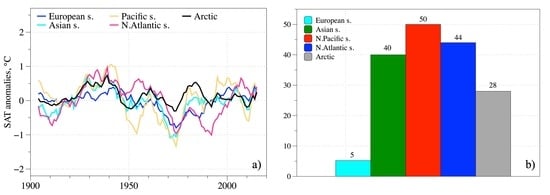
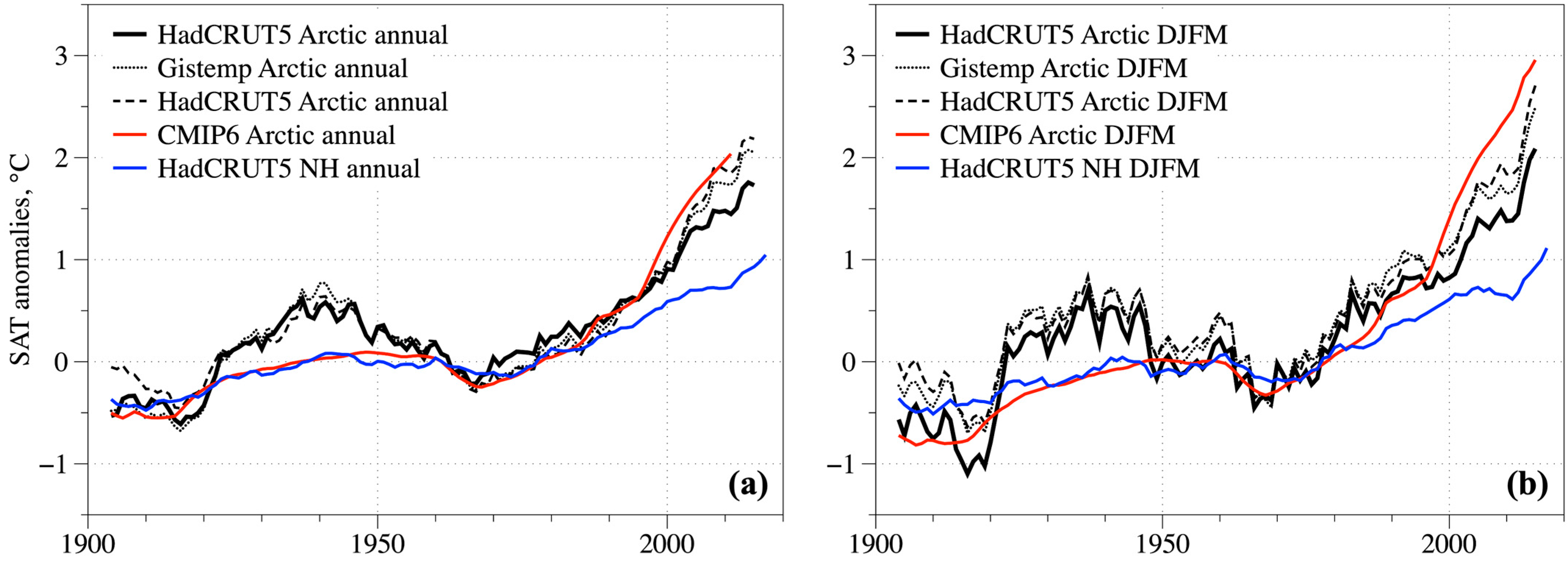
SAT anomalies across the Northern Hemisphere (NH) demonstrate that the amplitude of the early warming increases with higher latitudes, according to observations (Figure 1a). At the northern polar region, ETCW was twice as high as the global warming [8,9,10]—the feature of the modern SAT rise. The Arctic warming also manifested itself most strongly in the winter season within the 20th century (Figure 1b)
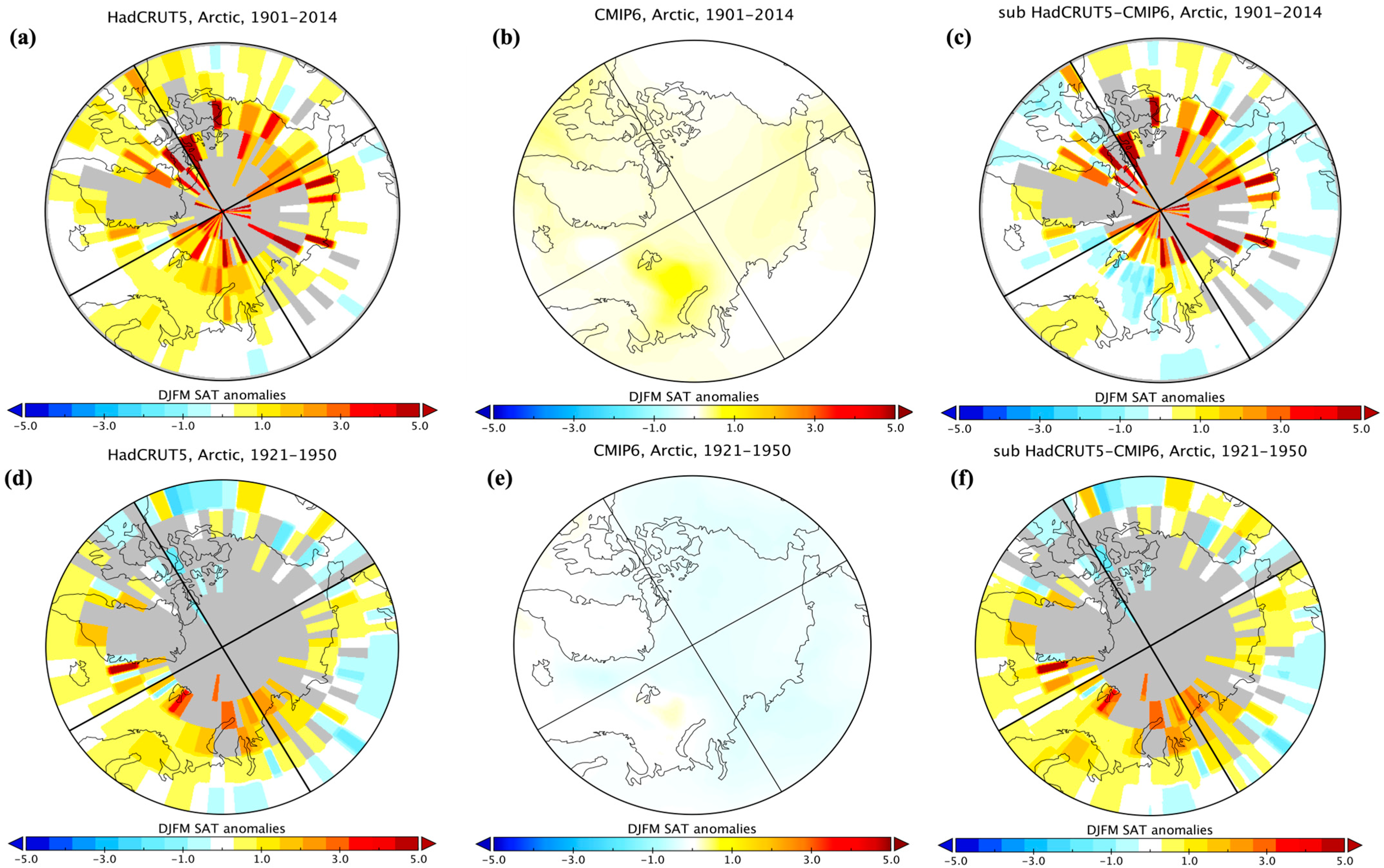
ETCW in the Arctic was also characterized by an uneven spatial structure (Figure 2). Earlier studies revealed positive SAT anomalies during the ETCW in the North Atlantic [11] and from Greenland to eastern Russia [12] between 1920 and the 1940s. HadCRUT5 observations indicate SAT anomalies below 1 °C across northern Europe and Asian northern Pacific land areas (Figure 2a). Peak anomalies of 3–5 °C were observed at 75–80° N along the Arctic Circle. In contrast, the CMIP6 ensemble mean exhibits less SAT variability across the region, with maxima of ~1 °C in the northern Barents Sea (Figure 2b).
Analysis of the period of 1921–1950 shows positive SAT anomalies in Europe and the North Atlantic (Figure 2d). Observations exhibit maximum values of 4–5 °C in the high latitudes north of 70° N alongside negative anomalies over Siberian and North American land areas. Conversely, the CMIP6 ensemble mean displays positive SAT anomalies confined to the Barents Sea and the North Atlantic adjacent to Greenland (Figure 2e).
The mechanisms underlying the pronounced Arctic temperature increase and the associated sea-ice loss remain under debate [1,13,14]. These occurred when the increase in greenhouse gases (GHGs) emissions to the atmosphere was 4–5 times less, compared to recent decades [6,9,15]. Understanding the causes of ETCW and the 1950–1970 subsequent cooling is a key for determining the contributions of internal variability and external forcing to long-term global and regional climate changes.
The latest generations of Phase 6 Coupled Model Intercomparison Project (CMIP6; [16]) model simulations consider such external factors as GHGs and anthropogenic aerosols, solar, and volcano activity. It allows researchers to assess the contributions of external forcings and natural variability to SAT changes in the Arctic during a certain historical period [17,18,19]. The ensemble mean of the CMIP6 models significantly underestimates the amplitude of the Arctic warming, whereas the modern warming is perfectly reproduced compared to observations (Figure 1). According to recent research, CMIP6 models fail to simulate ETCW magnitude, implying a strong role for internal variability, relative to external forcing [9,20].
It is not yet clear whether Arctic SAT and the corresponding sea ice changes in the mid-20th century [14] were caused by regional internal processes or by global climate change. According to recent research, external forcing is a key factor during the modern warming and natural internal variability is the main driver of ETCW [6,17,21]. A prominent hypothesis suggests that leading Northern Hemisphere natural variability modes forced Arctic climate changes in the early 20th century [3,6,9,22].
According to recent research [23] the contribution of internal variability to Arctic sea-ice loss over the second half of 20th century can range from 10% to 75%, depending on month and region. The study described in [17], utilizing CMIP6, links Arctic SAT rise and sea-ice loss during ETCW to internal dynamics along with external natural forcings. Further research [18] with CMIP/DAMIP simulations demonstrates multidecadal internal variability and anthropogenic aerosol forcing contributions to 1950–1970s hiatus.
This study aims to quantify NH leading internal variability modes’ contribution to 20th century Arctic SAT changes, focusing on regional differences. The analysis uses observational gridded data alongside CMIP6 multi-model ensemble means. Internal variability is isolated from external forcings via linear detrending, and model ensemble mean subtraction from observations. Multiple linear regression was applied following correlation analysis and variance inflation factor diagnostics to ensure statistical robustness.
Section 2 of the article provides an overview of the leading hypothesis that may explain ETCW. The major mechanisms of climate variability affecting the Arctic climate during the early 20th century are discussed. Section 3 provides data and methodology of the current study. Section 4 presents the results of statistical analysis on the contribution of leading internal climate variability modes to SAT changes in the Arctic and its individual regions. The following section, Section 5, provides discussion and conclusions based on the results of the study.

2. The Impact of Internal Climate Variability on the Arctic SAT Variations

The most feasible theory of ETCW is the impact of the leading modes of natural variability in the NH extra-tropics [6,7,8,9]. These modes include atmospheric, such as Arctic Oscillation (AO), North Atlantic Oscillation (NAO), Pacific North American oscillation (PNA), and ocean modes—Atlantic Multidecadal Oscillation (AMO) and Pacific Decadal Oscillation (PDO). According to the latest studies, the accelerated sea-ice decline over the several past decades since 1979 was simultaneously caused by effects of global warming, regional Arctic amplification and internal climate variability that includes such teleconnection patterns as AO, NAO, PNA, AMO and PDO [24].
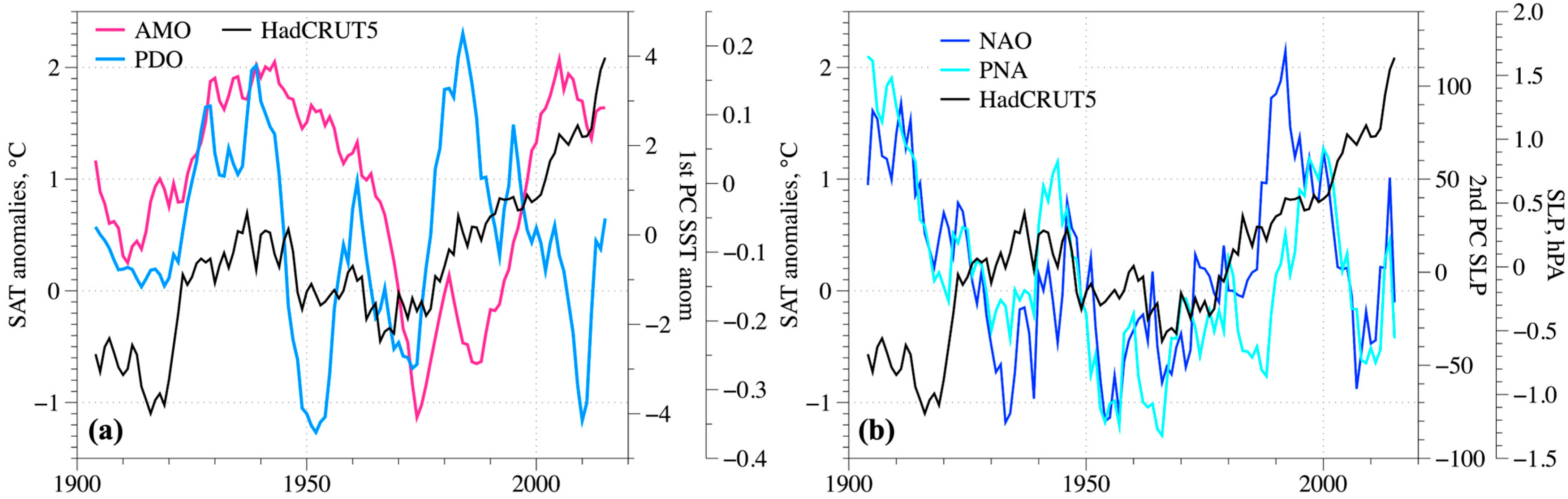
The AO and the closely associated NAO reflect the sea level pressure (SLP) variability in the NH extratropical latitudes, thus determining the weather regimes in this region [25,26,27,28]. The PNA index [25,29] describes the atmospheric circulation in the North Pacific and determines the transfer of air masses from the extratropical Pacific to the Arctic latitudes. An important feature of PNA is that both (positive and negative) PNA phases can contribute to Arctic SAT rise through atmospheric heat advection toward different Arctic regions [6]. In the second half of the 20th century, NAO and PNA can explain from 40% to more than 80% of the SAT variability in NH extra-tropics, according to various estimates [7]. All noted indices have the maximum amplitude in winter months; the temporal fluctuations during the 20th century are illustrated in Figure 3a.
The Arctic SAT variability is strongly linked to AMO [30,31], which is expressed in multidecadal (65–80 years) SST fluctuations in the North Atlantic mid-latitudes [32]. It is also linked to PDO [33], an ocean decadal variability mode, expressed in SST anomalies in the extratropical Pacific, with some 30–40 years cyclicity [34]. The annual mean AMO and PDO fluctuations are shown in Figure 3b for the period of 1900–2015.
The relative contributions of AMO and PDO in historical Arctic variations remain debated. Some model simulations indicate that AMO has a stronger influence on the 20th century Arctic [31] and global [35] SAT changes, compared to PDO. In contrast, other simulations [36,37] emphasize subtropical and tropical Pacific impact as major drivers of the Arctic SAT changes during the mid-20th century. Other studies highlight [38,39] the synchronized shift of AMO and PDO into a positive phase during both ETCW and modern warming as key drivers of Arctic SAT rise. Conversely, study [40], with observational and reanalysis data, revealed that the Arctic sea-ice concentration variability positively correlates with AMO and negatively with PDO. Recent research with seasonal analysis [24] suggests that AMO is a key factor in summer sea ice reduction. Ref. [19] also argues that internal variability, linked to AMO and PDO, dominates the ETCW and subsequent cooling and accounts for ~40% of the modern Arctic warming from 1979 to 2021.
The leading atmosphere and ocean variability modes are strongly interrelated and can affect each other through ocean–atmosphere teleconnections processes [41,42,43]. Research described in [44] pointed to a direct link between the extratropical parts of the Atlantic and Pacific SST. It reveals that AMO transition to a positive phase triggers a regime shift of PDO and PNA a decade later. According to recent studies, North Pacific atmospheric circulation and SST anomalies relate closely to tropical Pacific SST changes associated with the El Niño—Southern Oscillation phenomenon [42,45]. El Niño events induce a positive PDO phase shift, while AMO variations can affect El Niño/La Niña frequency, according to CMIP5 model simulations [42,45]. Studies based on observational data and model simulations show that NAO long-term variations are also affected by AMO and PDO [45].
Ocean variability modes respond differently to external forcings [46,47,48]. GHGs generally enhance SST variance, while stratospheric aerosols tend to suppress it [46,47]. Recent studies indicate that Pacific SST is mainly internally driven, whereas Atlantic SST changes were predominantly shaped by external forcings during the 20th century [49]. The research described in [50] shows that only 30% of AMO variability is internally generated, while external forcings, including aerosols, play a major role. In contrast, over 90% of PDO variability is attributed to internal ocean dynamics. Model simulations further suggest that external forcing is essential to reproduce the amplitude and multidecadal frequency of the 20th-century AMO [51]. These findings underscore the complex interplay between internal dynamics and external influence in ocean–atmosphere interactions.
One likely explanation for ETCW associates it with natural climate variability in the NH extra-tropics, particularly linked to major atmospheric circulation indices and SST cycles. The relative contributions of AMO and PDO remain debated. Some studies emphasize AMO’s stronger role in the mid-20th century Arctic warming, while others highlight influence via PDO and tropical Pacific variability. These natural variability modes are interconnected through ocean–atmosphere teleconnections, with AMO phase shifts potentially inducing PDO and PNA regimes change. External forcings like GHGs and aerosols modulate SST variances differently in the Atlantic and Pacific, complicating the roles of internal dynamics versus external drivers in Arctic climate variations. A fundamental question about quantifying the distinct contributions of AMO and PDO to the Arctic SAT variations, and determining its dependence on the impact of external factors remains unresolved.

3. Data and Methods

3.1. Data

For analysis we use the HadCRUT.5.0.1.0 non-infilled [52] version. Other available observational datasets GISTEMP [53] and BERKLEY [54] showed minimal differences with HadCRUT5 (Figure 1), presumably due to the difference in the interpolation methods, which is consistent with the earlier studies [9,52]. The NAO, PNA, AMO and PDO indices of natural variability were used as predictors in the regression model. The atmospheric indices were calculated with HadSLP2 data [55] and oceanic indices with HadSST4 observations [56].
The NAO index was calculated as the difference between the normalized winter (December–March) SLP between Iceland and Azores. The PNA index was defined as the 2nd PC of the winter SLP variability in the 30–90° N region. The AMO index was calculated as detrended average annual SST anomalies for the Atlantic region 0–60° N, 80° W–0° E. The PDO index was defined as the 1st PC of detrended annual SST anomalies averaged for the region 20–60° N, 120–240° E. Before the regression analysis procedure, the linear trend was removed from the long-term series of indices of atmospheric and oceanic modes.
To exclude the impact of the externally forced signals a linear trend was removed from the Arctic SAT timeseries according to HadCRUT5 data (HadCRUT5-detrended) prior to regression analysis. Earlier research demonstrates that applying linear detrending effectively removes long-term trends caused by external forcings [57,58]. It enables researchers to isolate interannual variability and enhances robustness in interpreting climatic relationships. Linear detrending offers a simpler and distortion-free baseline for climate variability analysis, compared to complex methods like EMD (empirical mode decomposition) or frequency filtering [57].
We also applied regression analysis to HadCRUT5 observational anomalies after subtracting the CMIP6 multi-model ensemble mean (HadCRUT5-CMIP6) over the historical period. The HadCRUT5-CMIP6 residuals represent observations after removing the model-simulated forced climate response (which includes external forcings such as GHGs, aerosols, volcanic eruptions and solar variability) [16]. A total of 505 historical simulations from CMIP6 were utilized for this analysis.
Analysis was conducted for the entire Arctic domain (60–90° N) and its four sub-regions of equal area—European (0–90°), Asian (90–180°), Pacific (180–270°) and North Atlantic (270–360°) for the period 1905–2014.

3.2. Methods

We used the multiple linear regression to quantify the contribution of natural climate variability indices to winter Arctic (60–90° N) SAT changes during the 20th century. The multiple linear regression analysis is a commonly used method in climate research for assessment of the contribution of internal indices to SAT changes [59]. Climate indices are often mutually connected through teleconnection patterns and are exposed to external forcings, violating the strict independence assumption, and causing multicollinearity. Despite these limitations, this approach provides a practical and interpretable framework for quantifying the relative contributions of internal modes. Through preliminary statistical analysis (e.g., VIF) and careful interpretation, this method enables isolation of individual linear effects on the dependent variables, while remaining computationally efficient. This simplification allows researchers to obtain initial information and test hypotheses, thereby serving as a baseline approximation of relationships which can be utilized before using more complex nonlinear or dynamic methods.
The NAO, PNA, AMO and PDO indices serve as predictor variables. As AO and NAO are closely related (e.g., [28]) we do not consider the AO index. The statistical analysis includes Pearson’s correlation and VIF tests to evaluate interrelationships between predictors [59,60]. Correlation analysis is a key statistical method used to evaluate the linear strength and direction of relationships between variables. VIF is a critical diagnostic measure for identifying and quantifying multicollinearity in regression models. Threshold values for the VIF indicative of acceptable multicollinearity are commonly set at ≤5 [59,60].
We implemented bootstrap resampling to quantify the uncertainty of explained variance of each regression coefficient when assessing the influence of climate indices on SAT changes by generating a thousand resampled datasets from the detrended data and observation-multi-model mean residuals, in order to build empirical distributions for confidence intervals.

4. Results

4.1. Contributions of the Leading Atmosphere–Ocean Variability Modes to the Winter SAT Changes in the Arctic

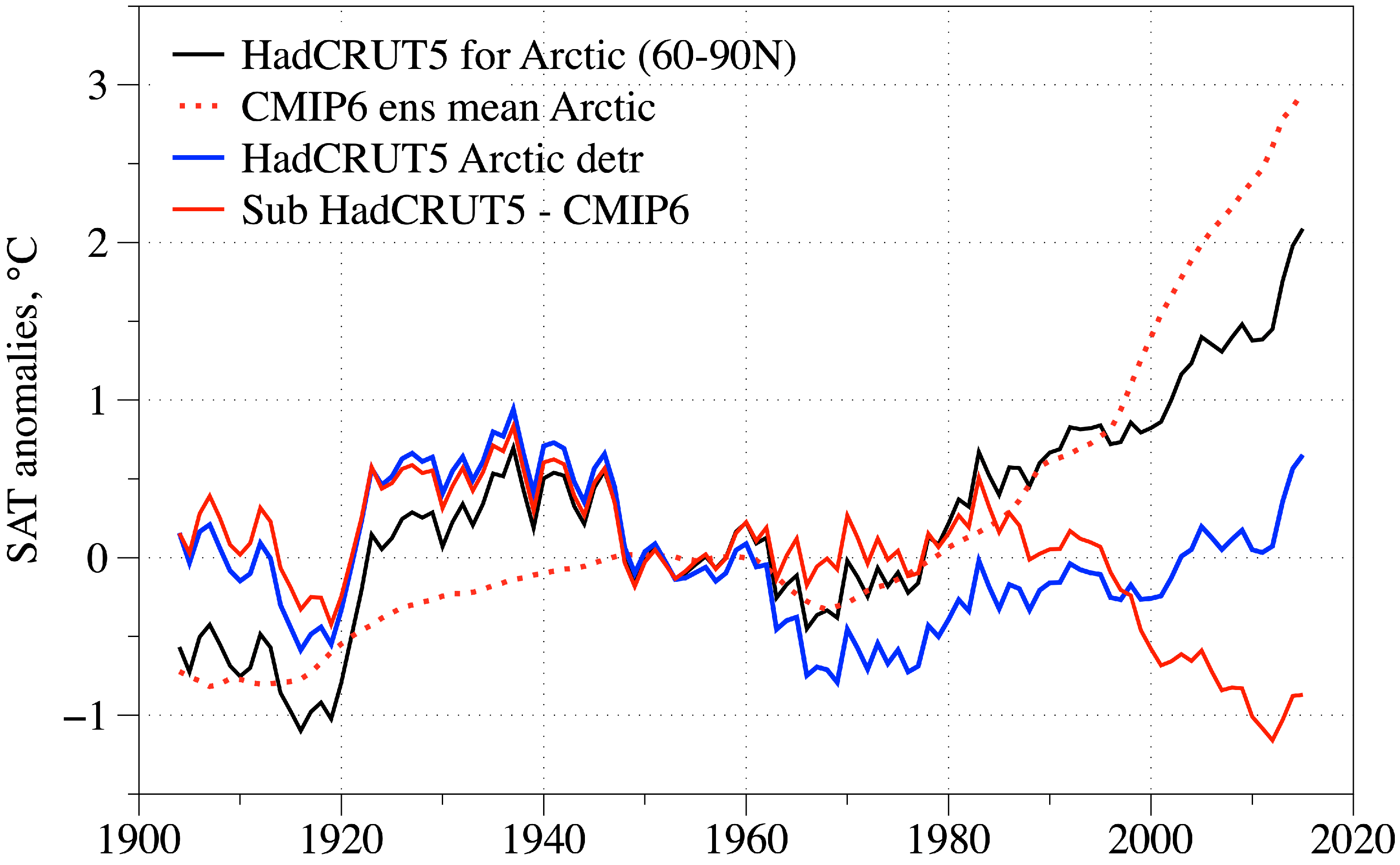
Previous studies suggested the significant role of leading internal climate variability modes in 20th century Arctic climate change [3,6,9,21,24,35,61] alongside anthropogenic and natural external forcings. The current section performs estimates of the contributions of the atmosphere–ocean indices (AMO, PDO, NAO, and PNA) to winter SAT variability across the Arctic and its regions. The analysis was performed using the multiple linear regression method applied to both HadCRUT5-detrended data and to HadCRUT5-CMIP6 data for the period of the 20th century (Figure 4).
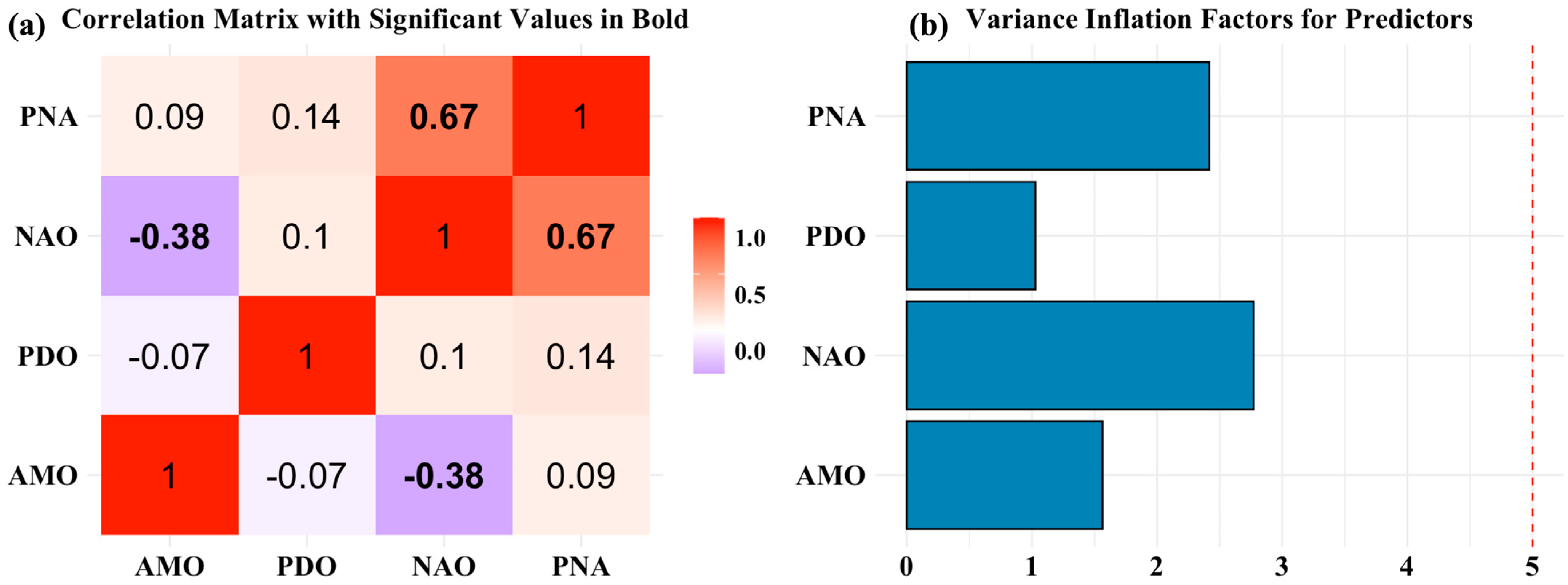
The interdependence of model predictors [41,42,43,44] is often influenced by external factors [46,47,48,49,50], which must be considered when interpreting results derived from regression analysis. To evaluate significant relationships between climate indices, a Pearson correlation and VIF test were used (Figure 5). Correlation coefficients among AMO, PDO, NAO and PNA revealed a strong significant correlation between NAO and PNA (r = 0.67; Figure 5a). VIF results confirmed that all predictors remained below the threshold value of 5 (Figure 5b), indicating the absence of multicollinearity in the regression model. Such differences between correlation and VIF may occur as correlation assesses pairwise linear relationships, whereas VIF measures the degree to which multicollinearity with other predictors increases a regression coefficient’s variance. Based on these findings, the PNA index was included in the subsequent analysis.
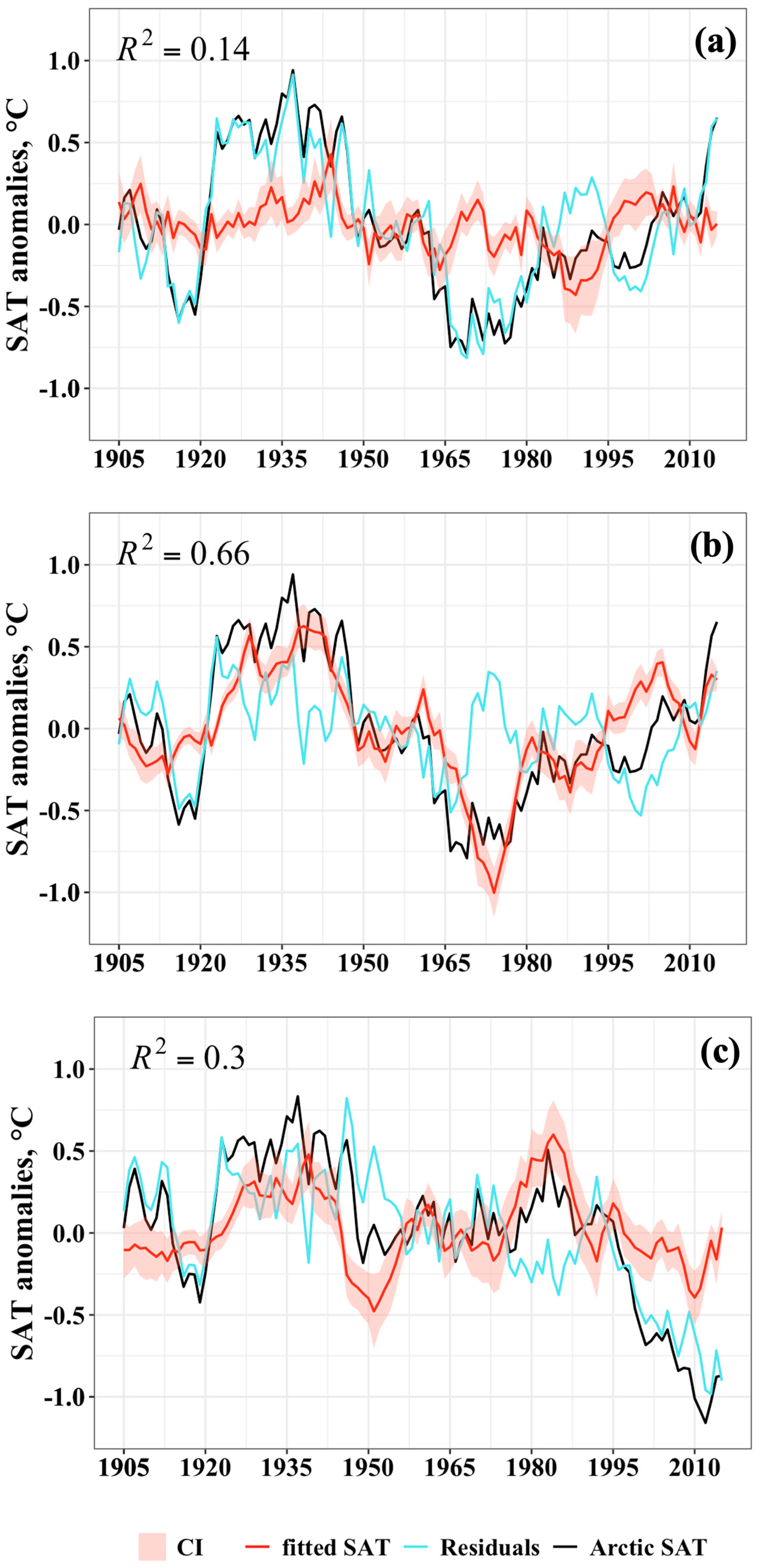
Analysis of the detrended Arctic DJFM SAT time series calculated with the regression model using NAO and PNA indices as predictors (Figure 6a) indicates that NH atmospheric modes explain only 14% of 20th-century detrended winter variability. Whereas a regression model including both atmospheric and oceanic modes increases median explained variance to 65% in HadCRUT5-detrended data (Figure 6b; Table 1). Furthermore, when the ocean indices are included in the regression model, there is a better correspondence of the SAT anomalies to the observations for the period 1965–1980 (Figure 6a,b). This confirms the assumption of ocean variability’s significant contribution to the Arctic SAT fluctuations [2,3,17,24,35,36,37]. Regression analysis using HadCRUT5-CMIP6 data demonstrates different results compared to detrended data, explaining a median of only 30% of DJFM Arctic SAT variability (Figure 6c; Table 1).
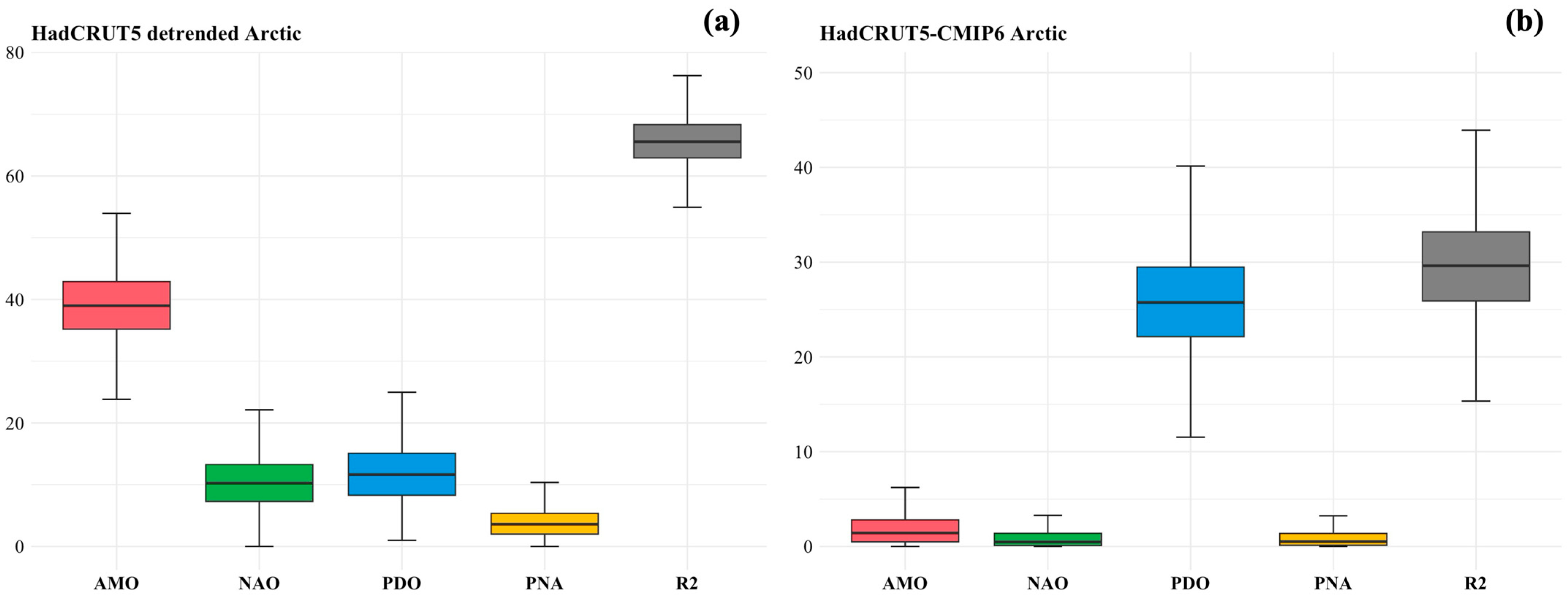
Individual contributions of indices to 20th-century Arctic SAT variability differ markedly depending on dataset (Figure 7a; Table 1). For HadCRUT5-detrended, AMO accounts for ~40% of winter anomalies, PDO for 12%. Atmospheric indices, NAO and PNA, explain 10% and 4% of SAT variability, respectively.
The individual influence of indices also changes when using HadCRUT5-CMIP6 data (Figure 7b; Table 1). PDO index contribution becomes the major one and increases up to 26%, while the role of AMO decreases to maximum of 6%. Such difference in contributions between detrended and forced-signal-removed datasets suggests a significant impact of the external factors on driving SAT variations in the 20th century. As specified above, CMIP6 models consider all external forcings on climate [16]. The AMO impact decrease may indicate a possible connection and dependence of AMO on external factors [48,49], which is more expressed for AMO in comparison to PDO [50,51].

4.2. Assessment of the Potential Contribution of the Leading Modes of Atmosphere–Ocean Variability in Different Sectors of the Arctic

As discussed in Section 1, the ETCW in the Arctic had heterogeneous spatial structure and varied in different northern polar regions [7,11,12]. Analysis of winter SAT evolution based on observations and model data reveals ECTW’s varying amplitude, duration and warming peak in each individual Arctic sector (Figures S1 and S2).
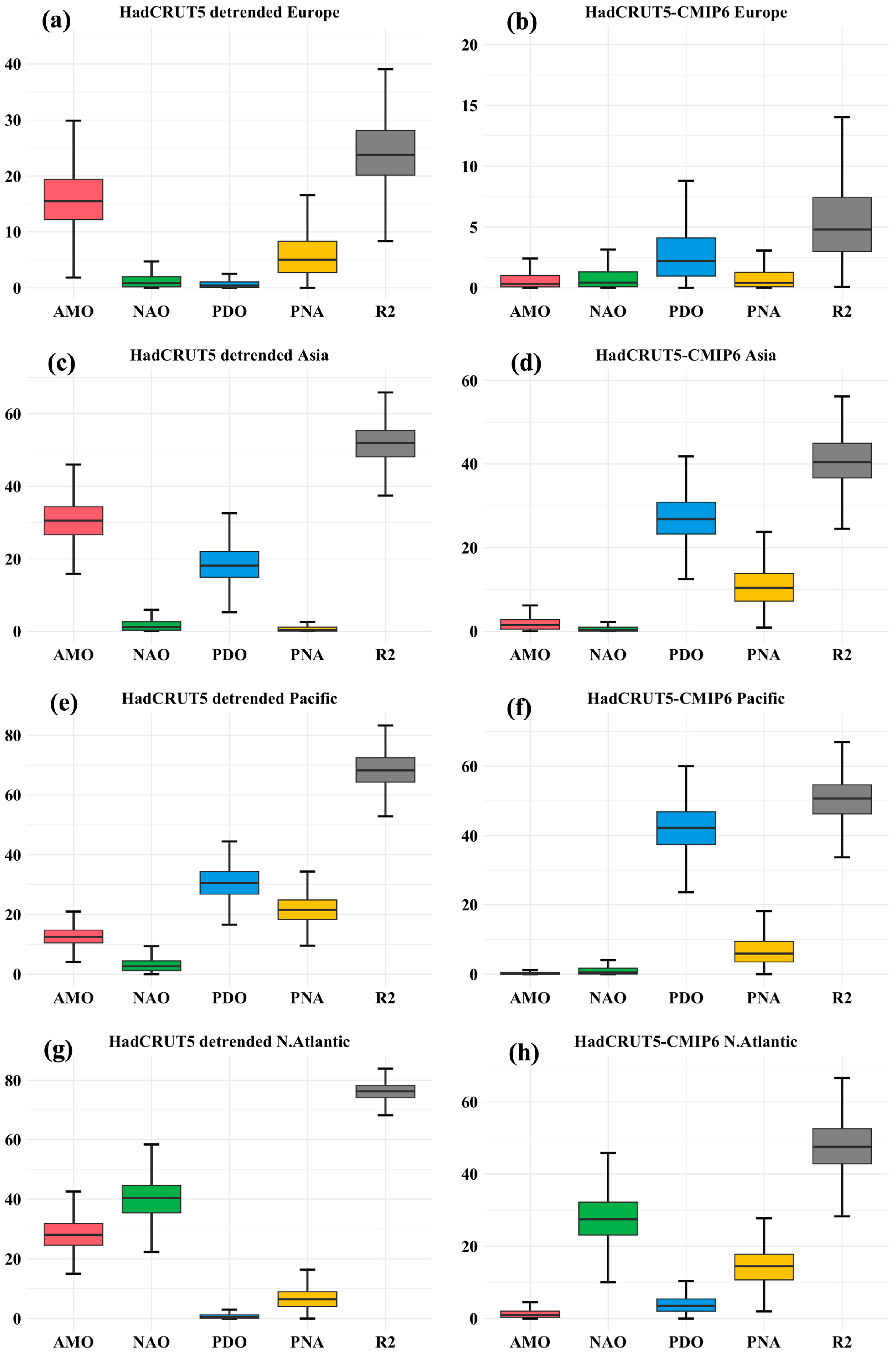
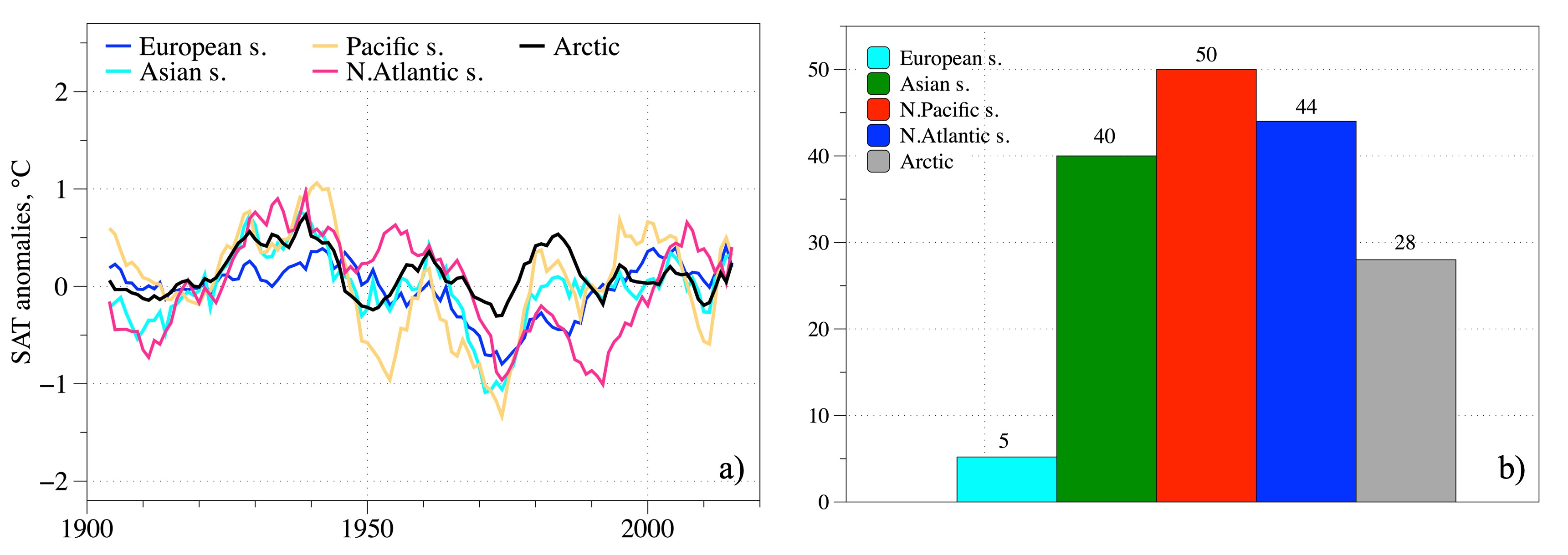
The analysis applied multiple regression to SAT anomaly timeseries averaged over four Arctic sectors (>60° N; Data and methods; Figure S2) for both HadCRUT5-detrended and HadCRUT5-CMIP6 (Figures S3 and S4). The total relative contribution of climate indices to detrended winter Arctic SAT anomalies vary significantly by sector. Median values are almost 25% for Europe and 52%, 68% and 76% for Asian, Pacific and North Atlantic sectors, respectively (Figure 8a,c,e,g; Figures S3 and S5). Regression using HadCRUT5-CMIP6 data shows the lowest total contribution of leading modes at 5% in Europe and ranges of 40–50% in other regions (Figure 8b,d,f,h; Figure S4, Table S1).
Individual relative contributions of each index to 20th-century detrended Arctic SAT variability differ across sectors (Figure 8a,c,e,g; Table S1): AMO ranges from 16 to 31% (peaking in Asian region); PDO and PNA reach 31% and 22% in the Pacific, respectively, with lesser contribution elsewhere; NAO dominates the North Atlantic at 40%, but is minor (1–3%) in other sectors.
The regression analysis applied to HadCRUT5-CMIP6 demonstrates that internal variability modes’ distinct contribution to the SAT variations in Arctic regions are drastically different from detrended data (Figure 8b,d,f,h; Table S1). Among climate indices, PDO exhibits the dominant influence, accounting for 42% in Pacific and 27% in Asian sector. PNA contributes 6–14% across all sectors except Europe, peaking in the North Atlantic; NAO impacts solely the North Atlantic at 27%; and AMO remains negligible (<1.5%) in each region.
Recent studies employ initial-condition large ensembles to isolate internal variability’s effects on Arctic climate [17,18,62,63]. According to the cited research the approach utilized the ensemble model mean to represent the externally forced response, while inter-member deviations quantified unforced internal variability, supporting the methodology of the current study. The study with large ensemble simulations and multi-model analyses confirms that natural forcing along with internal variability drove ETCW [17]. The subsequent research using multi-model mean ensembles demonstrates that increased anthropogenic aerosol forcing and multidecadal internal variability together influenced the mid-20th century cooling [18]. The analysis described in [62] with initial-condition large ensembles clarifies decadal regional climate uncertainties, including Arctic SAT fluctuations driven by climate variability modes. Analysis with ~2000-member initial-condition ensembles have investigated projected Arctic sea-ice loss effects on NH winter climate and extremes [63]. Another study with CESM2 atmosphere-only ensemble, driven by observed SST and sea ice for 1880–2021, confirmed AMO’s impact in Arctic atmospheric river activity and multidecadal SAT variability [64].
Thus, the analysis leads to two key conclusions. First, detrended time series analyses support prior studies positing North Atlantic internal variability as the primary mechanism for ETCW [2,3]. Second, the substantially reduced total explained variance (e.g., from 65% to 28%) in HadCRUT5-CMIP6 residuals relative to detrended data highlights a possible impact of external factors. Furthermore, the strongly reduced AMO influence and enhanced PDO manifestation stem from AMO’s sensitivity to external forcings, unlike PDO. That is consistent with recent findings that Pacific SST is primarily internally driven, whereas Atlantic SST is dominated by external forcings during the 20th century [49,50,51], (see also discussion in next section).
Nonetheless, data limitations must be carefully considered when interpreting results for the Arctic region during the specified period. The observational data for the first half of the 20th century is characterized by spatial–temporal irregularity. This directly affects the climate models quality, with the CMIP6 ensemble mean typically underestimating Arctic warming. Such deficiencies can bias regression model estimates by undermining the reliability of 20th-century model data timeseries.

5. Discussion and Conclusions

ETCW represents a significant and complex climate event characterized by a strong increase in SAT, particularly marked in the Arctic region. The study focuses on quantifying the contribution of natural variability leading modes AMO, PDO, NAO and PNA to DJFM SAT changes in the Arctic region (60–90° N) in 1905–2014. This includes analysis of four individual Arctic sectors based on HadCRUT5 observations and CMIP6 ensemble mean data.
This study delivers comprehensive pan-Arctic and regional assessment of leading natural variability modes on winter SAT changes during the 20th century. The statistical analysis reinforces that leading atmosphere–ocean variability modes substantially contribute to Arctic SAT changes. These modes explain 66% (median) of total variance in detrended observations and 30% in data with the external forcing signal removed. Regional analysis also reveals that AMO emerges as the dominant driver in detrended data, whereas PDO gains prominence in HadCRUT5-CMIP6 residuals. This may indicate a significant role of external factors through the impact on AMO, which is highly susceptible to external influences, forced by GHGs and aerosols, in contrast to PDO index [49,50,51]. Additionally, PDO and PNA signals extending far beyond their origins underscore the complexity of teleconnection patterns.
The novel emphasis demonstrates regional assessment across four equal-area Arctic sectors (European, Asian, Pacific, and North Atlantic). It reveals the impact of the heterogeneous spatial structure of climate indices on SAT changes, which could be a manifestation of teleconnection patterns. The sharp difference between two methodology approaches demonstrates that the data detrending method is insufficient to disentangle natural variability from external forcings. In contrast, the forced-signal-removed data provides a more physically consistent internal variability isolation.
The study advances previous research [2,3,36,38] by delivering a detailed sector-wise evaluation of Arctic SAT variability, highlighting the critical methodological importance of accurately separating forced signals from internal variability. Understanding of ocean variability modes and teleconnection processes is expanded by demonstrating their distinct spatial heterogeneity across Arctic sectors. The analysis robustly confirms and deepens earlier interpretations of Pacific and Atlantic influences on Arctic warming. It incorporates regional distribution and employs greater statistical rigor in isolating forcing mechanisms.
Described limitations (see Section 3) for multiple regression approach may affect quantitative assessments. The regression model assumes linear relationships between the atmosphere–ocean indices and SAT anomalies, which may oversimplify nonlinear physical processes in the climate system. Major NH atmosphere–ocean modes interconnect strongly via ocean–atmosphere teleconnections, with AMO positive phases triggering PDO/PNA shifts and NH extratropical variability including ETCW [44]. Yet, this approach provides a transparent and interpretable framework for assessing the relative contributions of natural variability modes. It serves as a practical baseline prior to nonlinear or dynamic methodologies.
A further challenge is the lack of empirical data, which complicates the comprehensive understanding of ETCW and its regional manifestations. The early warming period is hindered by sparse and low-quality observational records, relying on irregular data with substantial gaps specifically in Arctic region [9]. These limitations undermine climate model data, propagating uncertainties into assimilated datasets and hindcasts. The multi-model CMIP6 ensemble successfully captures modern warming but underestimates the amplitude of ETCW, pointing to constrains in simulating internal variability. Thus, the approach with removed forced signals using climate simulations may introduce biases due to systematic model errors. These limitations may reduce the robustness of HadCRUT5-CMIP6 residuals in effectively isolating internal climate variability.
Future developments should emphasize the use of dynamic climate model experiments, forcing attribution studies to robustly distinguish between internal variability and external forcing impacts. Removing forced signals by subtracting the CMIP6 ensemble mean outperforms linear detrending for isolating internal variability. However, consistent causal attribution requires dynamic modeling to prevent overinterpretation inherent in regression-based methods. Large ensemble simulations that prescribe SST or sea ice patterns and sensitivity experiments that isolate individual variability modes (e.g., AMO or PDO) offer promising approaches [62,63,64]. These experiments enable causal interpretation beyond statistical associations. Such an approach better characterizes nonlinear and potentially nonstationary interactions among modes while validating observational regression results. For example, recent studies use initial-condition large ensembles to isolate internal variability from forced responses in Arctic climate. Ensemble means capture external signals, while member spreads quantify unforced effects [62]. Multi-model ensembles further distinguish decadal Arctic SAT uncertainties linked to modes like AMO [63].

Supplementary Materials

The following supporting information can be downloaded at: https://www.mdpi.com/article/10.3390/atmos16121391/s1, Figure S1: Winter DJFM SAT, °C changes in the Arctic (60–90°N) for the period 1905–2014: (a) European sector; (b) Asian sector; (c) North Pacific sector; (d) North Atlantic sector; according to HadCRUT5 observations (black line), HadCRUT5 detrended data (blue line), CMIP6 model ensemble mean (black dotted line) and HadCRUT5-CMIP6 data (red line); 7-year running mean, base period 1961–1990.; Figure S2: Scheme for the Arctic region (60–90°N): European sector (0–90°); Asian sector (91–180°); North Pacific sector (181–270°); North Atlantic sector (271–360°); Figure S3: Winter DJFM SAT, °C changes in the Arctic (60–90°N) for the period 1905–2014 calculated using multiple regression on NAO, PNA, AMO and PDO for: (a) European sector; (b) Asian sector; (c) North Pacific sector; (d) North Atlantic sector according to HadCRUT5-detrended; detrended original observations (black line), regression model (red line), residuals (blue line), % confidence interval (light-red line); 7-year running mean; Figure S4: Winter DJFM SAT, °C changes in the Arctic (60–90°N) for the period 1905–2014 calculated using multiple regression on NAO, PNA, AMO and PDO for: (a) European sector; (b) Asian sector; (c) North Pacific sector; (d) North Atlantic sector according to HadCRUT5-CMIP6; HadCRUT5-CMIP6 original observations (black line), regression model (red line), residuals (blue line), % confidence interval (light-red line); 7-year running mean; Table S1: Relative contribution (%; Median, Q1 (0.25), Q3 (0.75), Min, Max) of the atmosphere and ocean indices of natural variability—NAO, PNA, AMO and PDO to winter DJFM SAT anomalies, °C for detrended HadCRUT5 data and HadCRUT5-CMIP6 data for Arctic sectors—(1) European (0–90°), (2) Asian (91–180°), (3) Pacific (180–270°) and (4) North Atlantic (271–360°) for 1905–2014.

Author Contributions

Conceptualization, V.A.S. and D.D.B.; methodology, D.D.B. and M.A.; software, D.D.B.; formal analysis, D.D.B. and T.A.A.; investigation, D.D.B.; writing—original draft preparation, D.D.B.; writing—review and editing, D.D.B., V.A.S., T.A.A. and M.A.; visualization, D.D.B. and E.Y.S.; supervision, V.A.S.; project administration, E.Y.S. All authors have read and agreed to the published version of the manuscript.

Funding

This research was funded by Russian Science Foundation grant number 25-27-00327.

Institutional Review Board Statement

Not applicable.

Informed Consent Statement

Not applicable.

Data Availability Statement

HadCRUT5, HadSLP2 and HadSST4 datasets used in this study are available from https://www.metoffice.gov.uk/hadobs/index.html (accessed on 3 December 2025), Gistemp data is available from https://data.giss.nasa.gov/gistemp/ (accessed on 3 December 2025), Berkley Earth data is available from https://berkeleyearth.org/data/ (accessed on 3 December 2025), CMIP6 data can be downloaded at https://help.ceda.ac.uk/article/4801-cmip6-data (accessed on 3 December 2025).

Acknowledgments

This research used the computing resources in the Department of Climatology in the Institute of Geography RAS.

Conflicts of Interest

The authors declare that they have no known competing financial interests or personal relationships that could have appeared to influence the work reported in this paper.

References

  1. Bengtsson, L.; Semenov, V.A.; Johannessen, O.M. The early twentieth-century warming in the Arctic—A possible mechanism. J. Clim. 2004, 17, 4045–4057. [Google Scholar] [CrossRef]
  2. Johannessen, O.M.; Bengtsson, L.; Miles, M.W.; Kuzmina, S.I.; Semenov, V.A.; Alekseev, G.V.; Nagurnyi, A.P.; Zakharov, V.F.; Bobylev, L.P.; Pettersson, L.H.; et al. Arctic climate change: Observed and modelled temperature and sea-ice variability. Tellus A Dyn. Meteorol. Oceanogr. 2004, 56, 328–341. [Google Scholar]
  3. Chylek, P.; Folland, C.K.; Lesins, G.; Dubey, M.K.; Wang, M. Arctic air temperature change amplification and the Atlantic Multidecadal Oscillation. Geophys. Res. Lett. 2009, 36, L14801. [Google Scholar] [CrossRef]
  4. Bokuchava, D.D.; Semenov, V.A. Factors of natural climate variability contributing to the Early 20th Century Warming in the Arctic. IOP Conf. Ser. Earth Environ. Sci. 2020, 606, 012008. [Google Scholar] [CrossRef]
  5. Hegerl, G.C.; Brönnimann, S.; Cowan, T.; Friedman, A.R.; Hawkins, E.; Iles, C.; Müller, W.; Schurer, A.; Undorf, S. Causes of climate change over the historical record. Environ. Res. Lett. 2019, 14, 123006. [Google Scholar] [CrossRef]
  6. Hegerl, G.C.; Brönnimann, S.; Schurer, A.; Cowan, T. The early 20th century warming: Anomalies, causes, and consequences. Wiley Interdiscip. Rev. Clim. Change 2018, 9, e522. [Google Scholar] [CrossRef]
  7. Wood, K.R.; Overland, J.E. Early 20th century Arctic warming in retrospect. Int. J. Climatol. 2010, 30, 1269–1279. [Google Scholar] [CrossRef]
  8. Yamanouchi, T. Early 20th century warming in the Arctic: A review. Polar Sci. 2011, 5, 53–71. [Google Scholar] [CrossRef]
  9. Bokuchava, D.D.; Semenov, V.A. Mechanisms of the early 20th century warming in the Arctic. Earth-Sci. Rev. 2021, 222, 103820. [Google Scholar] [CrossRef]
  10. Bekryaev, R.V.; Polyakov, I.V.; Alexeev, V.A. Role of polar amplification in long-term surface air temperature variations and modern Arctic warming. J. Clim. 2010, 23, 3888–3906. [Google Scholar] [CrossRef]
  11. Jensen, A.S. Concerning a Change of Climate During Recent Decades in the Arctic and Subarctic Regions: From Greenland in the West to Eurasia in the East, and Contemporary Biological and Geophysical Changes; E. Munksgaard: Copenhagen, Denmark, 1939. [Google Scholar]
  12. Ahlmann, H.W. Glaciological Research on the North Atlantic Coast; Royal Geographical Society Research Series; Royal Geographical Society: London, UK, 1948; Volume 1. [Google Scholar]
  13. Semenov, V.A.; Latif, M. The early twentieth century warming and winter Arctic sea ice. Cryosphere 2012, 6, 1231–1237. [Google Scholar] [CrossRef]
  14. Semenov, V.A.; Aldonina, T.A.; Li, F.; Keenlyside, N.S.; Wang, L. Arctic sea ice variations in the first half of the 20th century: A new reconstruction based on hydrometeorological data. Adv. Atmos. Sci. 2024, 41, 1483–1495. [Google Scholar] [CrossRef]
  15. Suo, L.; Otterå, O.H.; Bentsen, M.; Gao, Y.; Johannessen, O.M. External forcing of the early 20th century Arctic warming. Tellus A Dyn. Meteorol. Oceanogr. 2013, 65, 20578. [Google Scholar] [CrossRef]
  16. Eyring, V.; Bony, S.; Meehl, G.A.; Senior, C.A.; Stevens, B.; Stouffer, R.J.; Taylor, K.E. Overview of the Coupled Model Intercomparison Project Phase 6 (CMIP6) experimental design and organization. Geosci. Model Dev. 2016, 9, 1937–1958. [Google Scholar] [CrossRef]
  17. Aizawa, T.; Ishii, M.; Oshima, N.; Yukimoto, S.; Hasumi, H. Arctic warming and associated sea ice reduction in the early 20th century induced by natural forcings in MRI-ESM2.0 climate simulations and multimodel analyses. Geophys. Res. Lett. 2021, 48, e2020GL092336. [Google Scholar] [CrossRef]
  18. Aizawa, T.; Oshima, N.; Yukimoto, S. Contributions of anthropogenic aerosol forcing and multidecadal internal variability to mid-20th century Arctic cooling—CMIP6/DAMIP multimodel analysis. Geophys. Res. Lett. 2022, 49, e2021GL097093. [Google Scholar] [CrossRef]
  19. Chen, X.; Dai, A. Quantifying contributions of external forcing and internal variability to Arctic warming during 1900–2021. Earth’s Future 2024, 12, e2023EF003734. [Google Scholar] [CrossRef]
  20. Latonin, M.M.; Bashmachnikov, I.L.; Bobylev, L.P.; Davy, R. Multi-model ensemble mean of global climate models fails to reproduce early twentieth century Arctic warming. Polar Sci. 2021, 30, 100677. [Google Scholar] [CrossRef]
  21. Zhang, L. The roles of external forcing and natural variability in global warming hiatuses. Clim. Dyn. 2016, 47, 3157–3169. [Google Scholar] [CrossRef]
  22. Chen, L.; Francis, J.; Hanna, E. The “warm-Arctic/cold-continents” pattern during 1901–2010. Int. J. Climatol. 2018, 38, 5245–5254. [Google Scholar] [CrossRef]
  23. England, M.; Jahn, A.; Polvani, L. Nonuniform contribution of internal variability to recent Arctic sea ice loss. J. Clim. 2019, 32, 4039–4053. [Google Scholar] [CrossRef]
  24. Cai, Q.; Wang, J.; Beletsky, D.; Overland, J.; Ikeda, M.; Wan, L. Accelerated decline of summer Arctic sea ice during 1850–2017 and the amplified Arctic warming during the recent decades. Environ. Res. Lett. 2021, 16, 034015. [Google Scholar] [CrossRef]
  25. Barnston, A.G.; Livezey, R.E. Classification, seasonality and persistence of low-frequency atmospheric circulation patterns. Mon. Weather Rev. 1987, 115, 1083–1126. [Google Scholar] [CrossRef]
  26. Hurrell, J.W. Decadal trends in the North Atlantic Oscillation: Regional temperatures and precipitation. Science 1995, 269, 676–679. [Google Scholar] [CrossRef]
  27. Thompson, D.W.J.; Wallace, J.M. The Arctic Oscillation signature in the wintertime geopotential height and temperature fields. Geophys. Res. Lett. 1998, 25, 1297–1300. [Google Scholar] [CrossRef]
  28. Cohen, J.; Barlow, M. The NAO, the AO, and global warming: How closely related? J. Clim. 2005, 18, 4498–4513. [Google Scholar] [CrossRef]
  29. Feldstein, S.B. Fundamental mechanisms of the growth and decay of the PNA teleconnection pattern. Q. J. R. Meteorol. Soc. 2002, 128, 775–796. [Google Scholar] [CrossRef]
  30. Miles, M.W.; Divine, D.V.; Furevik, T.; Jansen, E.; Moros, M.; Ogilvie, A.E. A signal of persistent Atlantic multidecadal variability in Arctic sea ice. Geophys. Res. Lett. 2014, 41, 463–469. [Google Scholar] [CrossRef]
  31. Johannessen, O.M.; Kuzmina, S.I.; Bobylev, L.P.; Miles, M.W. Surface air temperature variability and trends in the Arctic: New amplification assessment and regionalisation. Tellus A Dyn. Meteorol. Oceanogr. 2016, 68, 28234. [Google Scholar] [CrossRef]
  32. Schlesinger, M.E.; Ramankutty, N. An oscillation in the global climate system of period 65–70 years. Nature 1994, 367, 723–726. [Google Scholar] [CrossRef]
  33. Screen, J.A.; Francis, J.A. Contribution of sea-ice loss to Arctic amplification is regulated by Pacific Ocean decadal variability. Nat. Clim. Change 2016, 6, 856–860. [Google Scholar] [CrossRef]
  34. Mantua, N.J.; Hare, S.R. The Pacific decadal oscillation. J. Oceanogr. 2002, 58, 35–44. [Google Scholar] [CrossRef]
  35. Chylek, P.; Klett, J.D.; Dubey, M.K.; Hengartner, N. The role of Atlantic Multi-decadal Oscillation in the global mean temperature variability. Clim. Dyn. 2016, 47, 3271–3279. [Google Scholar] [CrossRef]
  36. Svendsen, L.; Keenlyside, N.; Bethke, I.; Gao, Y.; Omrani, N.E. Pacific contribution to the early twentieth-century warming in the Arctic. Nat. Clim. Change 2018, 8, 793–797. [Google Scholar] [CrossRef]
  37. Kosaka, Y.; Xie, S.P. The tropical Pacific as a key pacemaker of the variable rates of global warming. Nat. Geosci. 2016, 9, 669–673. [Google Scholar] [CrossRef]
  38. Tokinaga, H.; Xie, S.P.; Mukougawa, H. Early 20th-century Arctic warming intensified by Pacific and Atlantic multidecadal variability. Proc. Natl. Acad. Sci. USA 2017, 114, 6227–6232. [Google Scholar] [CrossRef]
  39. Wegmann, M.; Brönnimann, S.; Compo, G.P. Tropospheric circulation during the early twentieth century Arctic warming. Clim. Dyn. 2017, 48, 2405–2418. [Google Scholar] [CrossRef]
  40. Yu, L.; Zhong, S.; Winkler, J.A.; Zhou, M.; Lenschow, D.H.; Li, B.; Wang, X.; Yang, Q. Possible connections of the opposite trends in Arctic and Antarctic sea-ice cover. Sci. Rep. 2017, 7, 45804. [Google Scholar] [CrossRef]
  41. Liu, Z.; Alexander, M. Atmospheric bridge, oceanic tunnel, and global climatic teleconnections. Rev. Geophys. 2007, 45, RG2005. [Google Scholar] [CrossRef]
  42. Ruprich-Robert, Y.; Msadek, R.; Castruccio, F.; Yeager, S.; Delworth, T.; Danabasoglu, G. Assessing the climate impacts of the observed Atlantic multidecadal variability using the GFDL CM2. 1 and NCAR CESM1 global coupled models. J. Clim. 2017, 30, 2785–2810. [Google Scholar] [CrossRef]
  43. Luo, B.; Luo, D.; Dai, A.; Simmonds, I.; Wu, L. Decadal variability of winter warm Arctic-cold Eurasia dipole patterns modulated by Pacific decadal oscillation and Atlantic multidecadal oscillation. Earth’s Future 2022, 10, e2021EF002351. [Google Scholar] [CrossRef]
  44. Zhang, R.; Delworth, T.L. Impact of the Atlantic multidecadal oscillation on North Pacific climate variability. Geophys. Res. Lett. 2007, 34, L23708. [Google Scholar] [CrossRef]
  45. Zhang, W.; Wang, Z.; Stuecker, M.F.; Turner, A.G.; Jin, F.F.; Geng, X. Impact of ENSO longitudinal position on teleconnections to the NAO. Clim. Dyn. 2019, 52, 257–274. [Google Scholar] [CrossRef]
  46. Booth, B.B.; Dunstone, N.J.; Halloran, P.R.; Andrews, T.; Bellouin, N. Aerosols implicated as a prime driver of twentieth-century North Atlantic climate variability. Nature 2012, 484, 228–232. [Google Scholar] [CrossRef]
  47. Rezaei, A.; Karami, K.; Tilmes, S.; Moore, J.C. Changes in global teleconnection patterns under global warming and stratospheric aerosol intervention scenarios. Atmos. Chem. Phys. 2023, 23, 5835–5850. [Google Scholar] [CrossRef]
  48. Otterå, O.H.; Bentsen, M.; Drange, H.; Suo, L. External forcing as a metronome for Atlantic multidecadal variability. Nat. Geosci. 2010, 3, 688–694. [Google Scholar] [CrossRef]
  49. Si, D.; Hu, A. Internally generated and externally forced multidecadal oceanic modes and their influence on the summer rainfall over East Asia. J. Clim. 2017, 30, 8299–8316. [Google Scholar] [CrossRef]
  50. Frankignoul, C.; Gastineau, G.; Kwon, Y.O. Estimation of the SST response to anthropogenic and external forcing and its impact on the Atlantic multidecadal oscillation and the Pacific decadal oscillation. J. Clim. 2017, 30, 9871–9895. [Google Scholar] [CrossRef]
  51. Murphy, L.N.; Bellomo, K.; Cane, M.; Clement, A. The role of historical forcings in simulating the observed Atlantic multidecadal oscillation. Geophys. Res. Lett. 2017, 44, 2472–2480. [Google Scholar] [CrossRef]
  52. Morice, C.P.; Kennedy, J.J.; Rayner, N.A.; Winn, J.P.; Hogan, E.; Killick, R.E.; Dunn, R.J.H.; Osborn, T.J.; Jones, P.D.; Simpson, I.R. An updated assessment of near-surface temperature change from 1850: The HadCRUT5 data set. J. Geophys. Res. Atmos. 2021, 126, e2019JD032361. [Google Scholar] [CrossRef]
  53. Lenssen, N.J.; Schmidt, G.A.; Hansen, J.E.; Menne, M.J.; Persin, A.; Ruedy, R.; Zyss, D. Improvements in the GISTEMP uncertainty model. J. Geophys. Res. Atmos. 2019, 124, 6307–6326. [Google Scholar] [CrossRef]
  54. Rohde, R.; Muller, R.; Jacobsen, R.; Perlmutter, S.; Rosenfeld, A.; Wurtele, J.; Wickham, S.; Curry, J.; Groom, D.; Mosher, S. Berkeley Earth Temperature Averaging Process, Geoinfor. Geostat.: An Overview 1: 2. Geoinform. Geostat. Overv. 2013, 1, 20–100. [Google Scholar]
  55. Allan, R.; Ansell, T. A new globally complete monthly historical gridded mean sea level pressure dataset (HadSLP2): 1850–2004. J. Clim. 2006, 19, 5816–5842. [Google Scholar] [CrossRef]
  56. Kennedy, J.J.; Rayner, N.A.; Atkinson, C.P.; Killick, R.E. An ensemble data set of sea surface temperature change from 1850: The Met Office Hadley Centre HadSST. 4.0. 0.0 data set. J. Geophys. Res. Atmos. 2019, 124, 7719–7763. [Google Scholar] [CrossRef]
  57. Ols, C.; Klesse, S.; Girardin, M.P.; Evans, M.E.; DeRose, R.J.; Trouet, V. Detrending climate data prior to climate–growth analyses in dendroecology: A common best practice? Dendrochronologia 2023, 79, 126094. [Google Scholar] [CrossRef]
  58. Wu, Z.; Huang, N.E.; Long, S.R.; Peng, C.K. On the trend, detrending, and variability of nonlinear and nonstationary time series. Proc. Natl. Acad. Sci. USA 2007, 104, 14889–14894. [Google Scholar] [CrossRef] [PubMed]
  59. Asare, K.; Nyarko, B.K.; Klutse, N.A.B.; Ansah-Narh, T.; Damoah, R.; Koffi, H.A. Quantifying the Influence of Remote Climate Indices on Key Climate Variables in Northern Ghana: A Comprehensive Multivariate Approach. Earth Syst. Environ. 2025, 1–27. [Google Scholar] [CrossRef]
  60. Rasel, H.M.; Imteaz, M.A.; Mekanik, F. Multiple regression modelling approach for rainfall prediction using large-scale climate indices as potential predictors. Int. J. Water 2017, 11, 209–225. [Google Scholar] [CrossRef]
  61. Walsh, J.E. Arctic climate change, variability, and extremes. In Arctic Hydrology, Permafrost and Ecosystems; Springer International Publishing: Cham, Switzerland, 2020; pp. 3–23. [Google Scholar]
  62. Deser, C.; Lehner, F.; Rodgers, K.B.; Ault, T.; Delworth, T.L.; DiNezio, P.N.; Fiore, A.; Frankignoul, C.; Fyfe, G.C.; Horton, D.E.; et al. Insights from Earth system model initial-condition large ensembles and future prospects. Nat. Clim. Change 2020, 10, 277–286. [Google Scholar] [CrossRef]
  63. Ye, K.; Woollings, T.; Sparrow, S.N.; Watson, P.A.; Screen, J.A. Response of winter climate and extreme weather to projected Arctic sea-ice loss in very large-ensemble climate model simulations. npj Clim. Atmos. Sci. 2024, 7, 20. [Google Scholar] [CrossRef]
  64. Ma, W.; Wang, H.; Chen, G.; Leung, L.R.; Lu, J.; Rasch, P.J.; Fu, Q.; Kravitz, B.; Zou, Y.; Cassano, J.J.; et al. The role of interdecadal climate oscillations in driving Arctic atmospheric river trends. Nat. Commun. 2024, 15, 2135. [Google Scholar] [CrossRef] [PubMed]
Figure 1. (a) Annual SAT anomalies, °C and (b) winter (DJFM) season—Northern Hemisphere (0–90° N; dark blue line), Arctic region (60–90° N; black lines) according to the HadCRUT5 dataset (black solid line), GISTEMP (dotted black line), BERKLEY (dashed black line), CMIP6 ensemble mean (red line); 7-year running mean, base period 1961–1990.
Atmosphere 16 01391 g001
Figure 2. Spatial distribution of winter Arctic (60–90° N) SAT anomalies, °C averaged for 1901–2014 according to (a) HadCRUT5 data, (b) CMIP6 ensemble mean, (c) HadCRUT5 after subtraction of CMIP6 ensemble mean; and averaged for ETCW period 1921–1950 according to (d) HadCRUT5 data, (e) CMIP6 ensemble mean, (f) HadCRUT5 after subtraction of CMIP6 ensemble mean.
Atmosphere 16 01391 g002
Figure 3. Winter (December to March) Arctic (60–90° N) SAT anomalies, ° C for 1900–2015 (black line) according to the HadCRUT5 dataset on both panels: (a) the NAO index (dark blue line) and the PNA index (light blue line) for the DJFM season according to the HadSLP2 dataset; (b) annual AMO (pink line) and annual PDO (blue line), according to HadISST4 dataset. A 7-year running mean was applied to all time-series.
Atmosphere 16 01391 g003
Figure 4. Winter DJFM SAT anomalies, °C for the Arctic region (60–90° N): the average value for HadCRUT5 (black line), HadCRUT5 detrended (dark blue line), HadCRUT5-CMIP6 (red line), and CMIP6 ensemble mean (red dotted line); 7-year running mean, base period 1961–1990.
Atmosphere 16 01391 g004
Figure 5. (a) Pearson correlation coefficients among AMO, PDO, NAO and PNA climate indices, with statistically significant correlations (p-value <0.05) marked as bold; (b) VIF values for all predictors for the years 1905–2014, red dashed line marks the threshold of 5.
Atmosphere 16 01391 g005
Figure 6. Winter DJFM SAT anomalies, °C changes in the Arctic (60–90° N) for 1905–2014, calculated using multiple regression on (a) NAO and PNA; (b) NAO, PNA, AMO and PDO according to HadCRUT5-detrended; (c) NAO, PNA, AMO and PDO according to HadCRUT5-CMIP6 data. Detrended original observations (black line), regression model (red line), residuals (blue line), % confidence interval (light-red line); 7-year running mean.
Atmosphere 16 01391 g006
Figure 7. Boxplots illustrating relative contribution (%) of the NAO (greed), PNA (yellow), AMO (red) and PDO (blue) climate indices to the DJFM SAT anomalies in the Arctic (60–90° N) for (a) HadCRUT5-detrended data and (b) HadCRUT5-CMIP6 data; for 1905–2014. The boxplots represent minimum and maximum range shown as whiskers, interquartile ranges (25th(Q1)–75th(Q3) percentiles) shown as lower and upper box edges, median (50th percentile) is shown by the thick horizontal bar inside the boxes.
Atmosphere 16 01391 g007
Figure 8. Boxplots illustrating the relative contributions (%) of NAO (green), PNA (yellow), AMO (red) and PDO (blue) to the DJFM SAT anomalies, °C in the Arctic sectors—(a,b) European (0–90°), (c,d) Asian (91–180°), (e,f) Pacific (180–270°) and (g,h) North Atlantic (271–360°); for HadCRUT5-detrended data (a,c,e,g), for HadCRUT5-CMIP6 data (b,d,f,h), for 1905–2014; the boxplots represent minimum and maximum range shown as whiskers, interquartile ranges (25th(Q1)–75th(Q3) percentiles) shown as lower and upper box edges, median (50th percentile) is shown by the thick horizontal bar inside the boxes.
Atmosphere 16 01391 g008
Table 1. Relative contribution (%; Median, Q1 (0.25), Q3 (0.75), Min, Max) of the atmosphere and ocean indices of natural variability—NAO, PNA, AMO and PDO to winter DJFM SAT anomalies, °C in the Arctic (60–90° N) for HadCRUT5-detrended data and for HadCRUT5-CMIP6 data; for 1905–2014.
PredictorMinQ1MedianQ3Max
HadCRUT5-detrended
PNA0.02.03.65.310.4
NAO0.07.310.213.322.2
PDO1.08.311.615.125.3
AMO23.735.239.042.954.4
R254.962.965.568.376.3
HadCRUT5-CMIP6
PNA0.00.10.51.43.2
NAO0.00.10.51.43.3
PDO11.122.125.729.540.5
AMO0.00.51.42.86.3
R215.025.929.633.244.1
Disclaimer/Publisher’s Note: The statements, opinions and data contained in all publications are solely those of the individual author(s) and contributor(s) and not of MDPI and/or the editor(s). MDPI and/or the editor(s) disclaim responsibility for any injury to people or property resulting from any ideas, methods, instructions or products referred to in the content.