A general analysis of pressure, temperature, geopotential height, and wind provides the dynamic context needed to interpret the Rossby wave source. These variables describe the large-scale circulation in which vorticity and divergence signals emerge, allowing a clearer distinction between the relative contributions of tropical and extratropical regimes.
3.1. General Analisys
The general characteristics of the circulation associated with GF events respond to the typical patterns that the literature has shown for cold-air-outbreaks in South America (e.g., [
7,
26,
27]); the following analysis is aimed at analyzing the circulation that characterizes the lack of persistence.
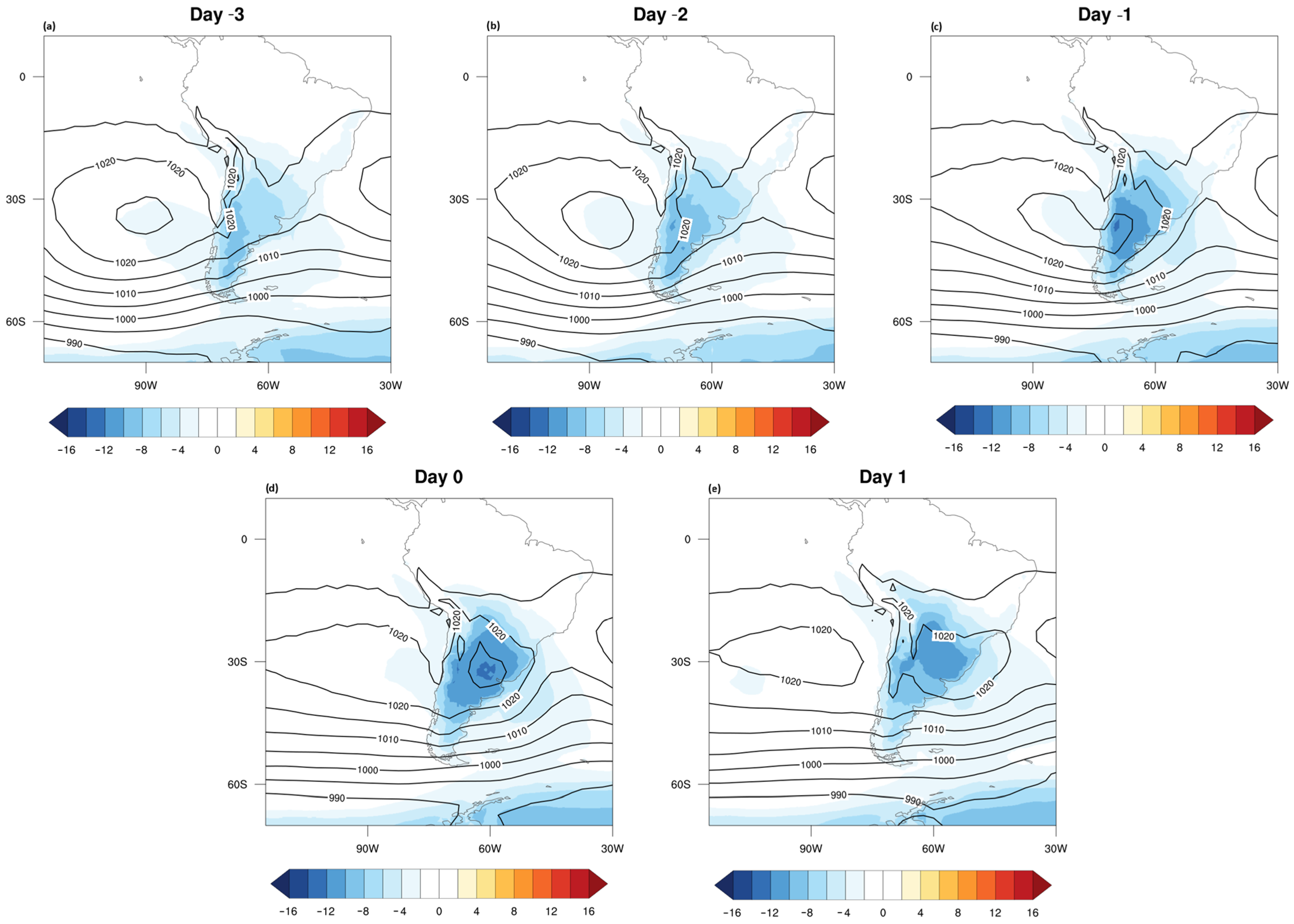
Figure 2 shows the 2 m temperature anomaly and the mean sea level pressure. On day −3 (
Figure 3a) negative temperature anomalies are observed over southern Argentina, and the pressure field suggests the early organization of a frontal system. On day −2 (
Figure 2b) cold air begins to extend northward into the Pampa Húmeda, while a post-frontal anticyclone develops into the continent and starts to advect polar air northward. On day −1 (
Figure 2c) the system is already well established, with negative temperature anomalies over the Pampa Húmeda and the anticyclone entering Argentina, increasing the pressure gradient and directing southerly flow. On day 0 (
Figure 2d) intense negative temperature anomalies develop over the Pampa Húmeda under the influence of an intense anticyclone. This configuration favors clear skies, dry air, and weak winds, creating ideal conditions for GFs formation. From day 1 the anticyclone shifts into the Atlantic Ocean, and the pressure gradient and the cooling start to weaken.
The temporal evolution reveals a typical post-frontal configuration over southern South America, in which the rapid progression of cold fronts is followed by the establishment of a transient continental anticyclone. This pattern is consistent with the third principal component of daily surface pressure fields associated with GF events in the Pampa Húmeda, identified by [
4]. That component represents a post-frontal anticyclonic circulation with a high-pressure center located north of 40° S that favors the advection of cold and dry air over the continent. This configuration was found by [
28] in an analysis of synoptic situations over Argentina related to extreme cold temperatures and by [
29] in the composites of the most intense cold surges that produced frosts over subtropical South America (130° W–20° W–80° S–10° S).
A similar synoptic characteristic was described by [
3,
13], who analyzed the development of persistent and without persistence GF events, respectively. Ref. [
13] showed that less persistent GF events are associated with transient post-frontal anticyclones that reinforce surface pressure and enhance nocturnal cooling through subsidence and clear sky conditions. In turn, ref. [
3] identified the without persistence GF events, characterized by a transient but intense development on surface high pressure that weakens rapidly and shifts eastward after the cold front passage.
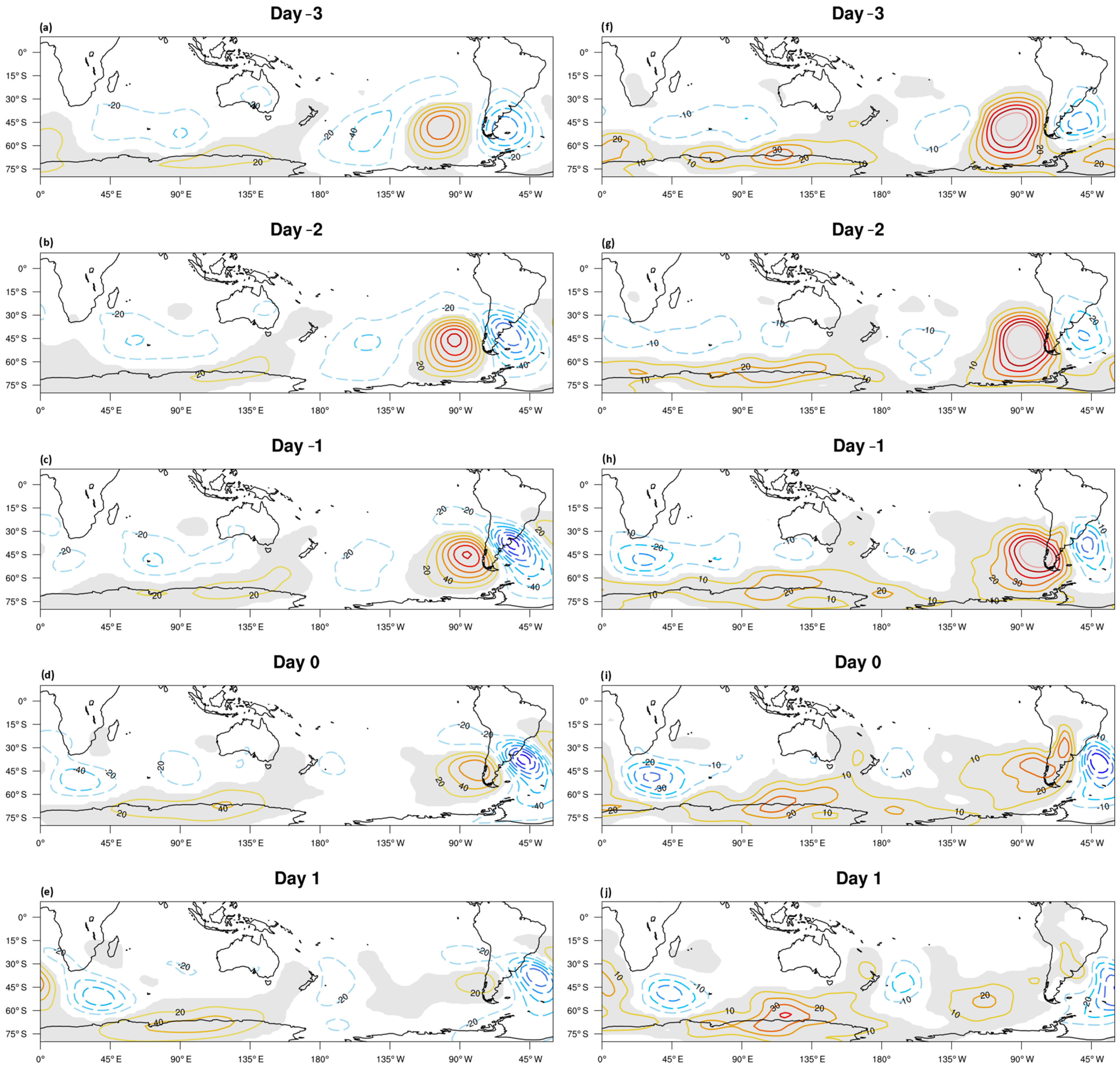
Figure 3 shows the evolution of geopotential height anomalies at 200 hPa (left panels) and 850 hPa (right panels) from day −3 to day 1 of GFs 0DP over the Pampa Húmeda in Argentina. At upper levels (200 hPa), on days −3 (
Figure 3a) and −2 (
Figure 3b), a trough begins to develop over the southeastern Pacific Ocean, east of South America. These upper-level anomalies are typical of short-wave Rossby disturbances that organize the large-scale circulation and enhance upward motion ahead of the trough. On day −1 (
Figure 3c), the trough intensifies and deepens over the southern part of the continent, indicating a marked amplification of the upper-level wave. On day 0, the trough is centered over the southwestern Atlantic Ocean, while a ridge extends over the southeastern Pacific Ocean, west of South America, forming an amplified wave pattern typical of transient baroclinic disturbances. On day 1 (
Figure 3e), the trough weakens and shifts eastward into the Atlantic Ocean, indicating the short-lived character of the disturbance and the reestablishment of zonal flow at upper levels.
Comparable upper-level patterns were also reported by [
3], which identified, on the day previous and on the day of without persistence GF events, the presence of a ridge extending over the south of the continent and the southeastern Pacific Ocean and a trough over South America. However, in their study, the positive anomalies at upper-levels on day 0 are weaker, while the negative anomalies extended over a larger area than in the present results. In addition, these anomalies dissipated on the following day, highlighting the transient nature of the circulation associated with without persistence GF events. In contrast, here, both features remain evident after day 0 (
Figure 3d), although weaker.
At lower levels (850 hPa), on days −3 (
Figure 3f) and −2 (
Figure 3g), the circulation is still weak but begins to show the early development of an anticyclone over the continent, a typical feature preceding cold air advection. From day −1 (
Figure 3h) onward, a well-defined anticyclone becomes established over southern South America and extends northward along the eastern side of the Andes. On day 0 (
Figure 3i), the anticyclone strengthens and expands from the southeastern Pacific Ocean into central South America, consistent with the descending branch of the upper-level trough. The out-of-phase structure between the upper and lower levels systems indicates a baroclinic coupling, typical of transient synoptic disturbances. On day 1 (
Figure 3j), both the anticyclone and the meridional pressure gradient weaken, leading to a rapid decay of cold-air advection and the dissipation of the baroclinic structure over the Pampa Húmeda.
The analyses of the lower-level patterns showed a similar configuration to the synoptic structure described by [
3] for without persistence GF events. In both cases, an anticyclonic anomaly develops over the continent, to the east of the Andes, associated with low-level cold-air advection and the post-frontal development characteristic of these episodes. Similarly, an anticyclone is observed over the southern portion of South America and the southeastern Pacific Ocean, accompanied by a downstream cyclone over the Atlantic Ocean. However,
Figure 3f–i shows that the continental anticyclone extends farther north and exhibits higher amplitudes over central South America, while the cyclonic circulation over the Atlantic Ocean is more extensive and just a little more intense than that reported by [
3].
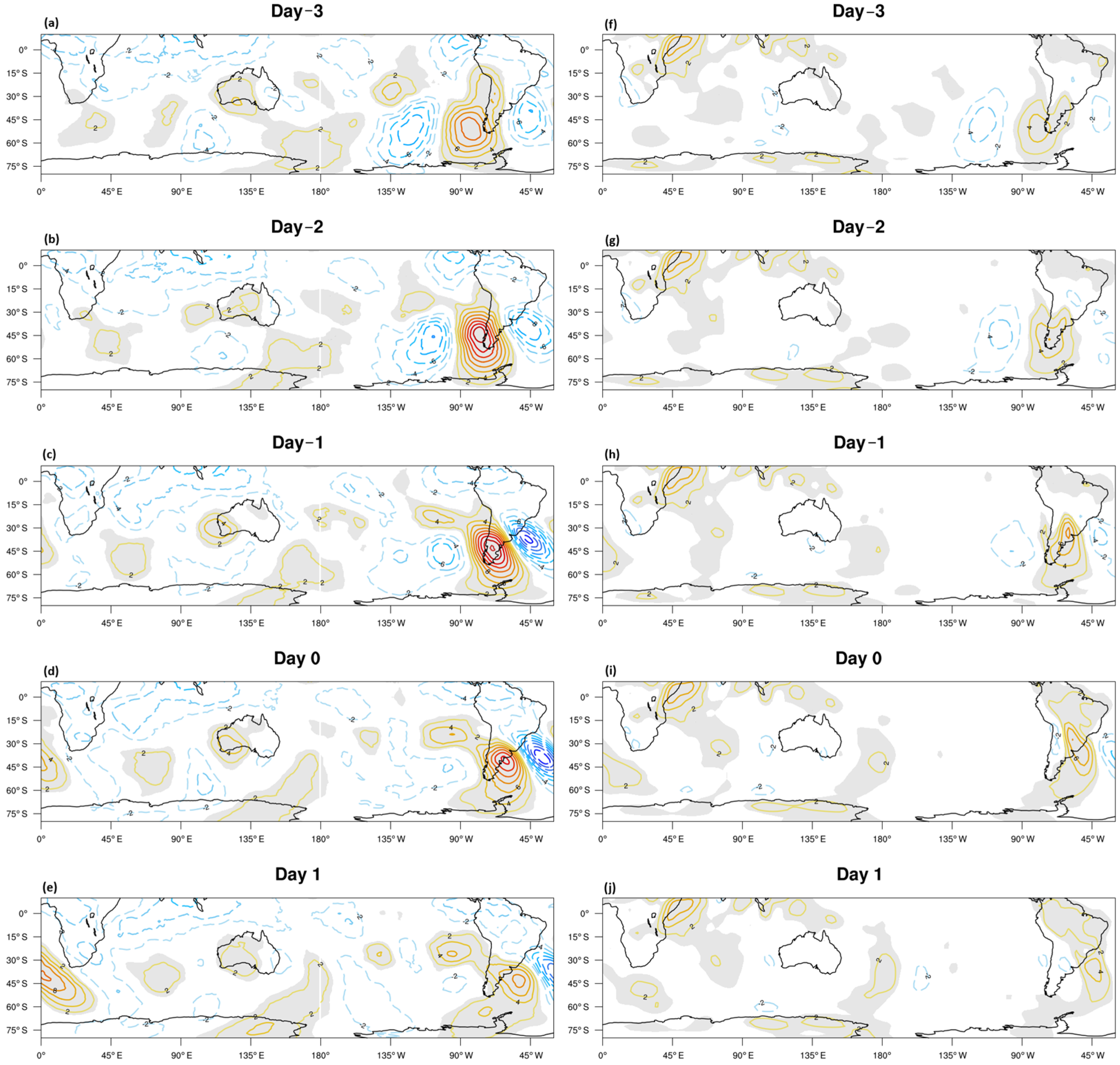
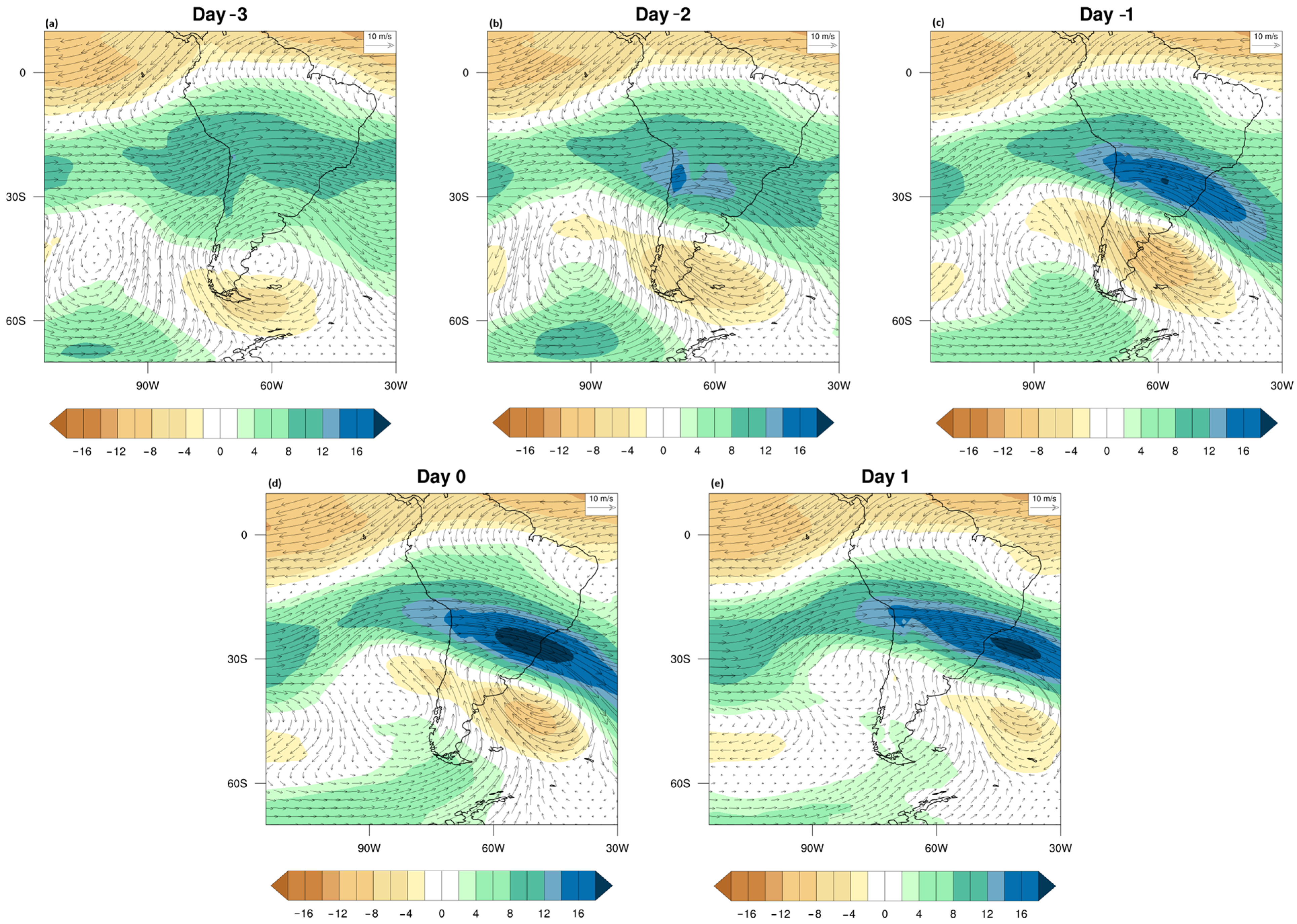
Figure 4 shows the evolution of meridional wind anomalies at 200 hPa (left panels) and 850 hPa (right panels) of 0DP GF events over the Pampa Húmeda. At upper levels (200 hPa), positive meridional wind anomalies are identified over the southeastern Pacific Ocean and the southern portion of South America on day −3 (
Figure 4a), while negative anomalies are located farther east, over the southwestern Atlantic Ocean. On day −2 (
Figure 4b), the positive anomaly intensifies and propagates eastward toward the continent, whereas the negative anomaly over the Atlantic Ocean also strengthens, enhancing the meridional gradient across the region. By day −1 (
Figure 4c) the positive anomaly center is positioned over southern South America, while the negative center extends over the southeastern portion of the continent and adjacent Atlantic Ocean, forming a well-defined dipole. On day 0 (
Figure 4d), both anomalies shift eastward, with the positive center located over the Pampa Húmeda region and the negative one over the South Atlantic Ocean, indicating the eastward propagation of the upper-tropospheric wave. By day 1 (
Figure 4e) the anomalies weaken and shift eastward, confirming the decay and downstream progression of the system.
The spatial configuration of these upper-level anomalies suggests the presence of a single, arc-shaped Rossby wave train propagating from the central-eastern Pacific Ocean toward South America. Its trajectory closely resembles the propagation patterns described in previous studies. Ref. [
13] identified, in the less persistent GF events, an arc-shaped Rossby wave train originating in the central-eastern Pacific Ocean and turning northeastward upon reaching South America. Ref. [
3] showed that without persistence GF events are characterized by two Rossby wave trains, one that follows the subtropical jet with a more zonal orientation and another along the polar jet, with a more meridional and curved path. The arc-shaped propagation identified in
Figure 4b,c is dynamically consistent with the meridional wave path associated with the polar branch showed by [
3].
At lower levels (850 hPa), the meridional wind anomalies are initially weak and unorganized on days −3 (
Figure 4f) and −2 (
Figure 4g), suggesting that the near-surface circulation responds more gradually to the evolving upper-level structure. From day −1 (
Figure 4h) onward, positive (southerly) anomalies begin to develop over the Pampa Húmeda and the southwestern Atlantic Ocean, reaching their maximum amplitude on day 0 (
Figure 4i). The strengthening of these anomalies near the surface reflects the southerly flow and the advection of cold air from higher latitudes, consistent with the evolution of the upper-level signal. By day 1 (
Figure 4j), the anomalies weaken and move eastward, indicating the progressive decay of the low-level disturbance.
The baroclinic coupling between upper-level and lower-level meridional wind anomalies is consistent with the circulation features described by [
3], who associated short-lived frost events with transient post-frontal anticyclones and enhanced meridional gradients that favor transient episodes of cold-air advection over the Pampa Húmeda.
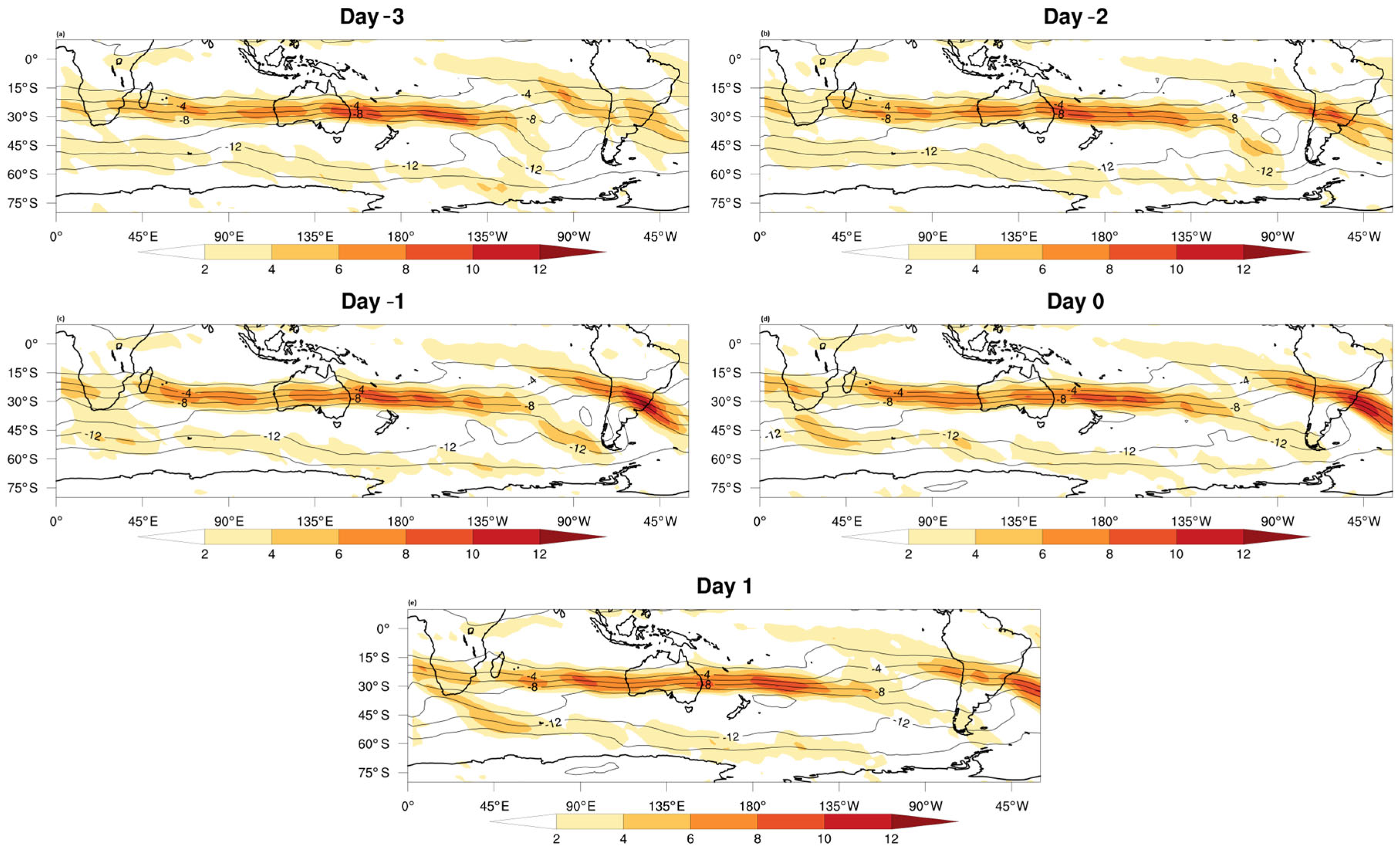
Figure 5 shows the anomaly of zonal wind and wind vector composites at 200 hPa. On days −3 and −2 (
Figure 5a,b), the subtropical jet extends from the Pacific Ocean across central South America to the Atlantic Ocean, characterizing a predominantly zonal flow. On day −2 (
Figure 5b), the jet begins to intensify, and the deepening of the cyclonic anomaly south of the subtropical jet induces a noticeable curvature in the flow, which starts to exhibit southerly winds over the western part of the continent, indicating the onset of wave amplification (
Figure 3b) and the initial organization of the jet structure.
On day −1 (
Figure 5c), the jet axis acquires a more pronounced northwest–southeast orientation, while the cyclone intensifies over the southwestern Atlantic Ocean and an anticyclonic center becomes evident to the west (
Figure 3c). In this configuration, the upper-level flow over the jet region is dominated by southwesterly winds, reflecting a stronger baroclinic coupling between the trough (
Figure 3c) and the jet core.
On day 0 (
Figure 5d), the jet reaches its maximum intensity, with the strongest westerly winds extending over central and southeastern Brazil and the adjacent Atlantic Ocean, while the anticyclone moves eastward (
Figure 3d). Over the Pampa Húmeda, the upper-level flow becomes predominantly southeasterly, placing the region on the cyclonic side of the jet exit. This configuration is consistent with upper-level divergence and ascending motion over subtropical latitudes, indicating the onset of a transient baroclinic adjustment. This process favors the reorganization of the circulation and the surface cooling over the region, as shown in
Figure 2d.
On day 1 (
Figure 5e), the jet weakens, and its core remains over the Atlantic Ocean, with a westerly direction. The wind intensity over the Pampa Húmeda decreases substantially, reflecting the rapid decay of the baroclinic structure.
Comparable upper-level patterns were also reported by [
5], which studied the anomalous cold winters in Pampa Húmeda and identified positive zonal-wind anomalies at 250 hPa over the north of Argentina to the beginning of the GF event. In their analysis, the anomalies are predominantly zonal, extending longitudinally along de jet axis. Similarly, the anomalies found here (
Figure 5c,d) begin with a flow more zonally and then exhibit a northwest-southeast orientation, indicating a greater curvature of the jet and suggesting a more pronounced wave perturbation during 0DP events.
In addition, ref. [
3] analyzed the zonal wind anomalies that occur only for a single-day, i.e., 0DP events, and showed that, on the GF day, a strong zonal-wind anomaly develops over southern South America, while the subtropical jet undergoes a rapid strengthening and subsequent eastward displacement. This configuration is consistent with showed in
Figure 5c,d, but the jet was stronger and almost zonal in orientation, with its maximum located to the west of the continent in the day before the event and shifting eastward on the following day. In contrast, in the present composite (
Figure 5c,d) the maximum values of the jet are positioned over the eastern part of the continent and the adjacent Atlantic Ocean. Moreover, the jet is comparatively weaker and oriented toward the southeast at day −1 (
Figure 5c) and 0 (
Figure 5d). This spatial difference suggests that, in the 0DP events analyzed here, the upper-level wave is already in a more advanced stage of eastward propagation, reflecting a more transient system than in the events examined by [
3].
The fields showed above indicate that 0DP frost events are associated with the simultaneous action of short-wave disturbances at upper levels and a migratory post-frontal high at the surface. The 200 hPa trough organizes the subtropical jet, strengthening both upper-level divergence and anomalous southerly winds, while at 850 hPa and in the sea-level pressure field a ridge develops that drives polar air into the Pampa Humeda. This vertical configuration provides an intense but transient cold air advection, as the system quickly shifts into the Atlantic Ocean. While these analyses present the synoptic structure, they are still valid only for the linear fields of circulation. For this reason, it is important to examine the nonlinear terms of the RWS equation, since they reveal how the interaction between divergent flow and absolute vorticity acts as a direct forcing for wave propagation. The next section expands the interpretation, changing from the description of circulation patterns to the dynamic mechanisms that sustain or limit the development of these events, offering a more complete view of the transient nature of 0DP frosts.
3.2. Rossby Wave Source
A general assessment of the nonlinear terms of the RWS equation provides deeper insight into the dynamical interactions that modulate frost events. These terms capture the interaction between circulation components that cannot be totally represented by linear diagnostics, highlighting processes that modulate the intensity and persistence of cold-air intrusions.
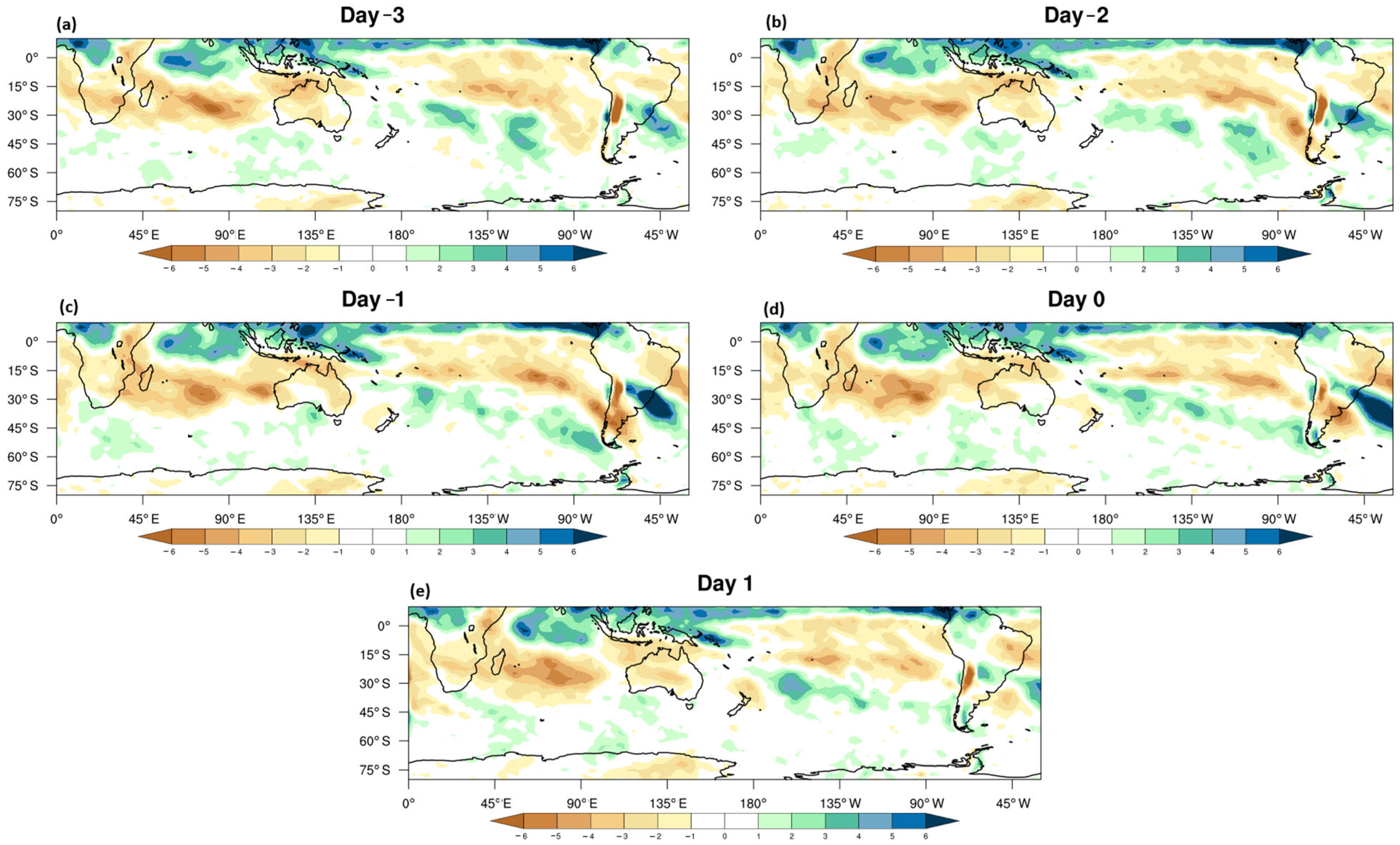
Figure 6 shows the divergence field at 200 hPa for days −3 to 1. In the days before the event (
Figure 6a–c), convergence predominates over Argentina, while divergent regions are seen to the east of this region. This pattern is directly related to the divergent term (term 1 of Equation (4)), in which upper-level convergence couples with the prevailing absolute vorticity at midlatitudes to enhance subsidence [
15]. Also, it can be identified that the convergence over Argentina, coincides with regions of positive absolute vorticity typical for subtropical and extratropical latitudes [
30]. Dynamically, this configuration makes the divergent term positive, where the convergence in a region of positive absolute vorticity intensifies downward motion and reinforces the vertical circulation [
15]. Physically, the enhanced subsidence suppresses upward motion, limits cloud formation, and favors clear-sky conditions, which in turn maximize nocturnal radiative cooling at the surface [
30]. This combination of processes creates the ideal environment for frost formation. Over the Pacific Ocean, divergence–convergence patterns emerge, indicating that the South American signal is embedded within a larger-scale circulation adjustment. On day 0 (
Figure 6d), convergence is still present over the region but begins to weaken and shifts eastward, reducing the persistence of the forcing. On day 1 (
Figure 6e), both convergence and divergence centers are displaced into the Atlantic Ocean, and the continental signal has dissipated, confirming the transient character of the event. Similar transient episodes of upper-level convergence linked to midlatitude absolute vorticity have been associated with the modulation of cold-air outbreaks and surface frost occurrence in other regions [
22,
23].
In
Figure 7, the fields of absolute vorticity and its gradient are presented for days −3 to 1 (
Figure 7a–e), emphasizing the strong role of the subtropical jet. The maxima values of the absolute vorticity follow the midlatitude zonal flow, while strong gradients develop along the jet flanks, indicating areas of shear. These two fields contributed to the divergent term and the advective term (terms 1 and 2 of Equation (4), respectively). Dynamically, large values of absolute vorticity increase the sensitivity of the divergent term, while strong gradients of the latter intensify the advective forcing by allowing the divergent wind to be projected onto shear zones [
15,
23]. This configuration makes the divergent term positive, where the convergence in a region of positive absolute vorticity intensifies descending motion and reinforces the vertical circulation. Physically, the jet stream provides the driver for Rossby wave excitation, as absolute vorticity maxima intensify the modulation by divergence and marked gradients along the jet flanks favor the redistribution of vorticity by the divergent circulation [
30,
31]. The enhanced subsidence suppresses upward motion, limits cloud formation, and favors clear-sky conditions, which in turn maximize nocturnal radiative cooling at the surface, creating favorable conditions for frosts [
13]. Between day −2 and 0 (
Figure 7b–d) it is possible to see over the Pacific Ocean that strong gradients persist along the subtropical jet, indicating an eastward energy flux toward South America. Additionally, in the same period, the jet acts as the primary trigger for the generation of disturbances over the continent and the adjacent Atlantic Ocean. However, the system is not stationary, by day 0 (
Figure 7d) the vorticity maxima and their gradients begin to shift eastward, and by day 1 (
Figure 7e), they have moved significantly away from South America. This transient behavior explains why the atmospheric response occurs only for a short time, highlighting the temporary character of 0DP events.
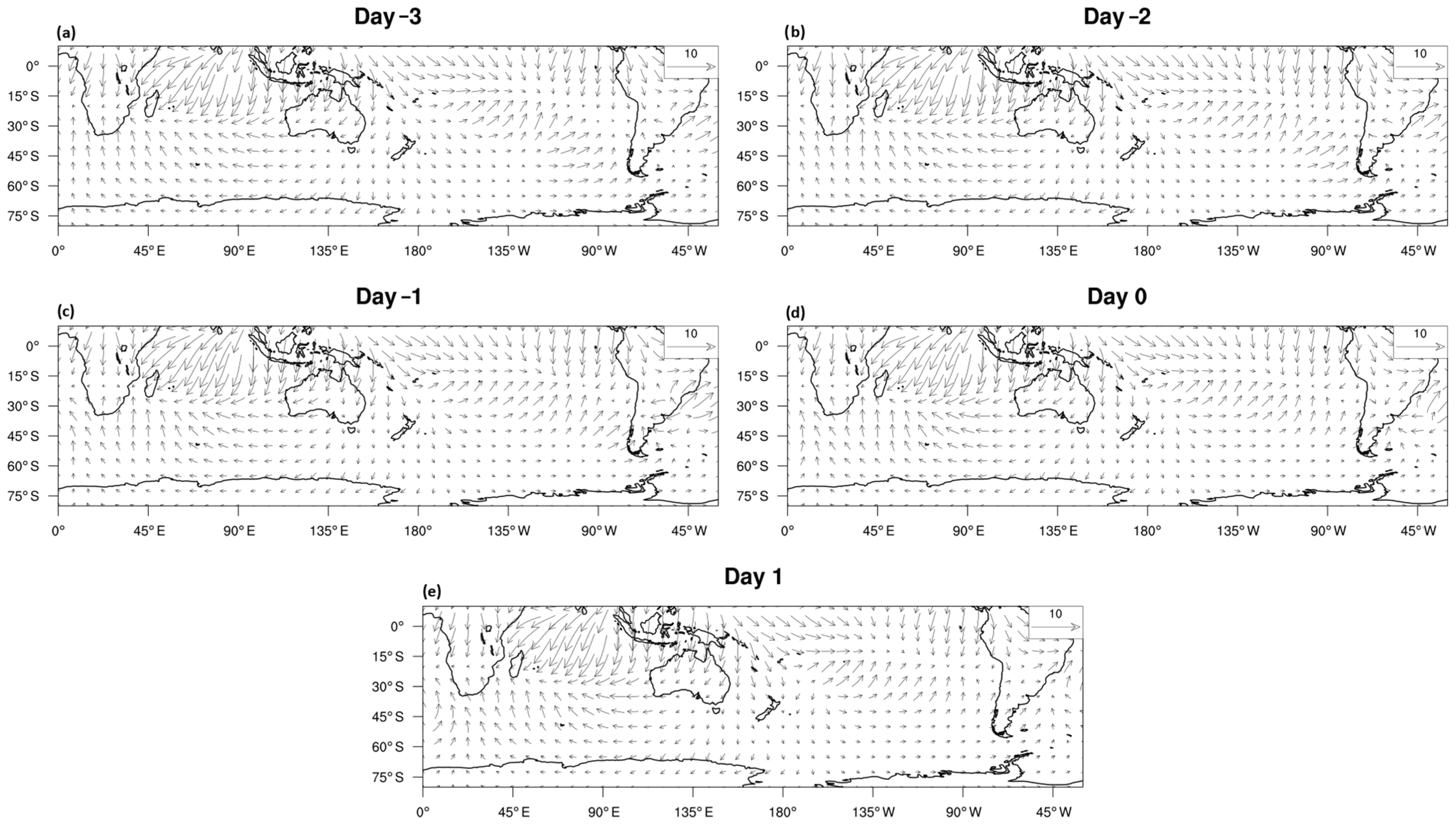
Figure 8 illustrates the divergent wind (term 1 of Equation (3)) at 200 hPa, showing how the circulation organizes the redistribution of energy in the upper troposphere. From days −3 to −1 (
Figure 8a–c), a divergent-convergent dipole becomes evident between the western and eastern Pacific Ocean, suggesting that the circulation anomalies are part of a larger-scale adjustment that extends across the entire region. Consistent with this, it is possible to see convergence over Argentina and divergence over the adjacent Atlantic Ocean, forming a typical upper level-lower-level coupling pattern. Dynamically, this behavior reflects the advective term (term 2 of Equation (4)), in which the divergent wind projects onto regions of strong vorticity gradients and generates localized Rossby wave activity [
15,
23]. Physically, the divergent branch over the Atlantic Ocean and the dipole over the Pacific Ocean favor upward motion and the downstream dispersion of energy [
30]. In contrast, the convergent branch over Argentina enhances subsidence and intensifies surface cooling. On day 0 (
Figure 8d), convergence continues to reinforce surface cooling, but the divergent wind vectors are already reorganizing eastward, and at day 1 (
Figure 8e) the divergent wind field has shifted entirely into the Atlantic Ocean, and the Pacific Ocean branch becomes dominant. This rapid reorganization indicates that the circulation does not remain established over the continent, suppressing the development of frosts.
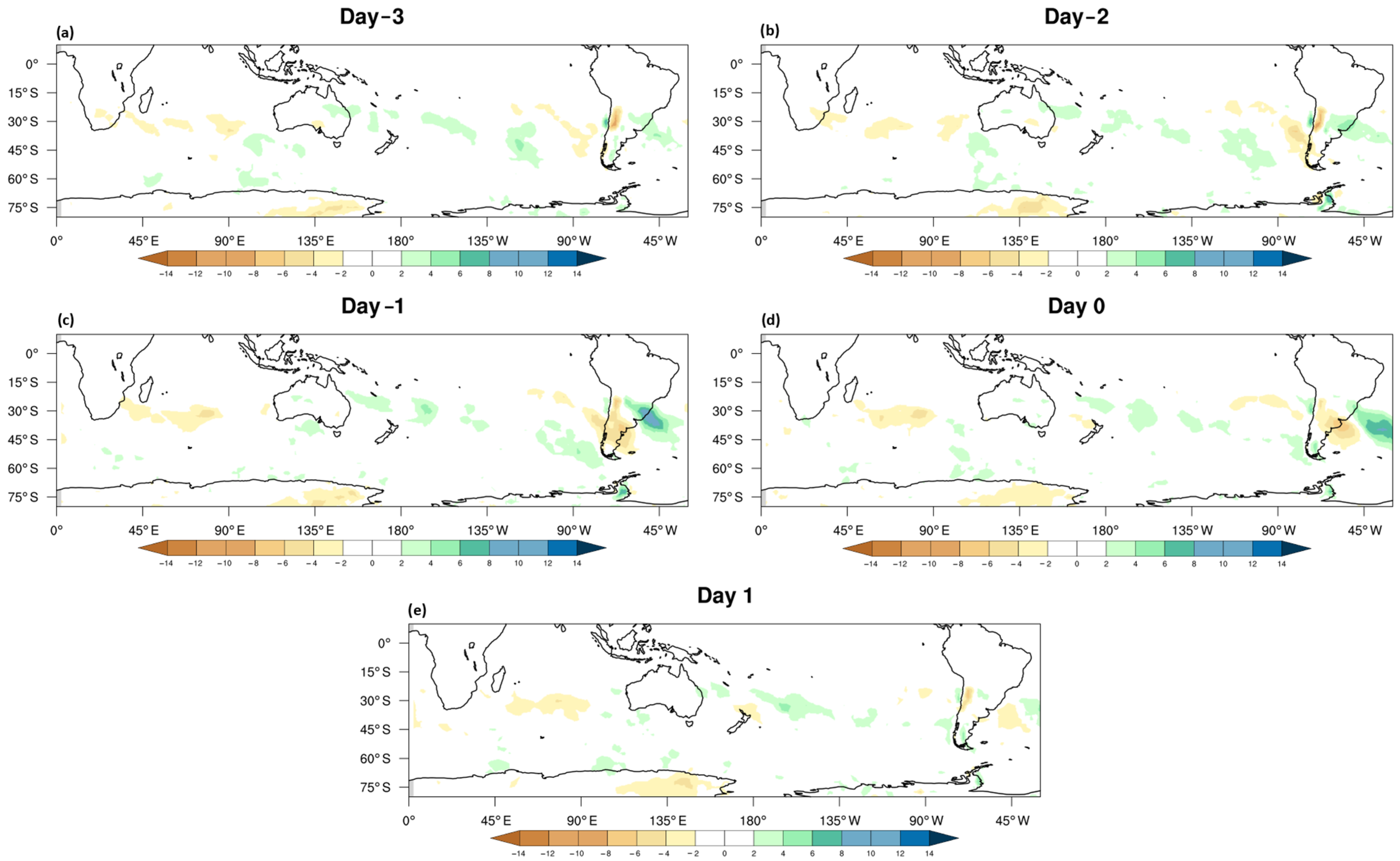
Figure 9 represents the RWS (Equation (4)), which summarizes the nonlinear interactions described above. Between days −3 (
Figure 9a) and −1 (
Figure 9c), localized centers of wave generation appear over Argentina, confirming that the dynamical ingredients, like upper-level convergence, high absolute vorticity, and strong vorticity gradients, are briefly aligned [
15].
At the same time, additional RWS anomalies are observed over the Pacific Ocean, indicating that the continent–ocean system is dynamically connected. On day 0 (
Figure 9d), the RWS anomalies remain over Argentina but are already weakening and shifting eastward, while the Pacific Ocean anomalies intensify, suggesting that the forcing is being transferred downstream. By day 1 (
Figure 9e), the anomalies over South America have almost completely dissipated, with the forcing confined to the Atlantic Ocean and the Pacific Ocean branch dominating the large-scale pattern. Dynamically, this sequence illustrates a transient activation of the RWS over the continent that is quickly overtaken by oceanic anomalies. This explains why generalized frosts without persistence occur in the Pampa Húmeda. The dynamical factors for Rossby wave excitation aligned quickly in the region, but the persistence and large-scale control shift toward the Pacific Ocean. This inhibits the development of a well-defined Rossby wave train, limiting the teleconnection potential of the event [
15,
22].
The joint analysis of
Figure 6,
Figure 7,
Figure 8 and
Figure 9 demonstrates that 0DP events in the Pampa Húmeda originate from a transient configuration of the dynamical ingredients that compose the RWS, including upper-level convergence, high absolute vorticity, strong vorticity gradients, and divergent winds projecting onto those gradients. Over Argentina, this configuration enhances subsidence, reinforces surface cooling, and promotes generalized frost, but the anomalies do not persist. By day 0 they are already shifting eastward, and by day 1 the forcing is confined to the Atlantic Ocean and Pacific Ocean sectors. The migration of these centers toward the ocean demonstrates that continental anomalies are part of a larger-scale circulation adjustment and that the Pacific Ocean plays a central role in redistributing the energy downstream. As a result, the system cannot sustain a well-defined Rossby wave train, limiting the event to a 0DP frost episode without persistent teleconnections [
15,
22,
23].
This evidence highlights the transient character of without persistence frosts. They are dynamically efficient in generating localized RWS anomalies but unable to maintain them long enough to support large-scale wave activity. In the next section, the divergent and advective terms of the RWS are analyzed separately, permitting the identification of the dominant component during 0DP events and offering a clearer understanding of the mechanisms behind their short-lived nature.
3.3. Advective and Divergent Terms
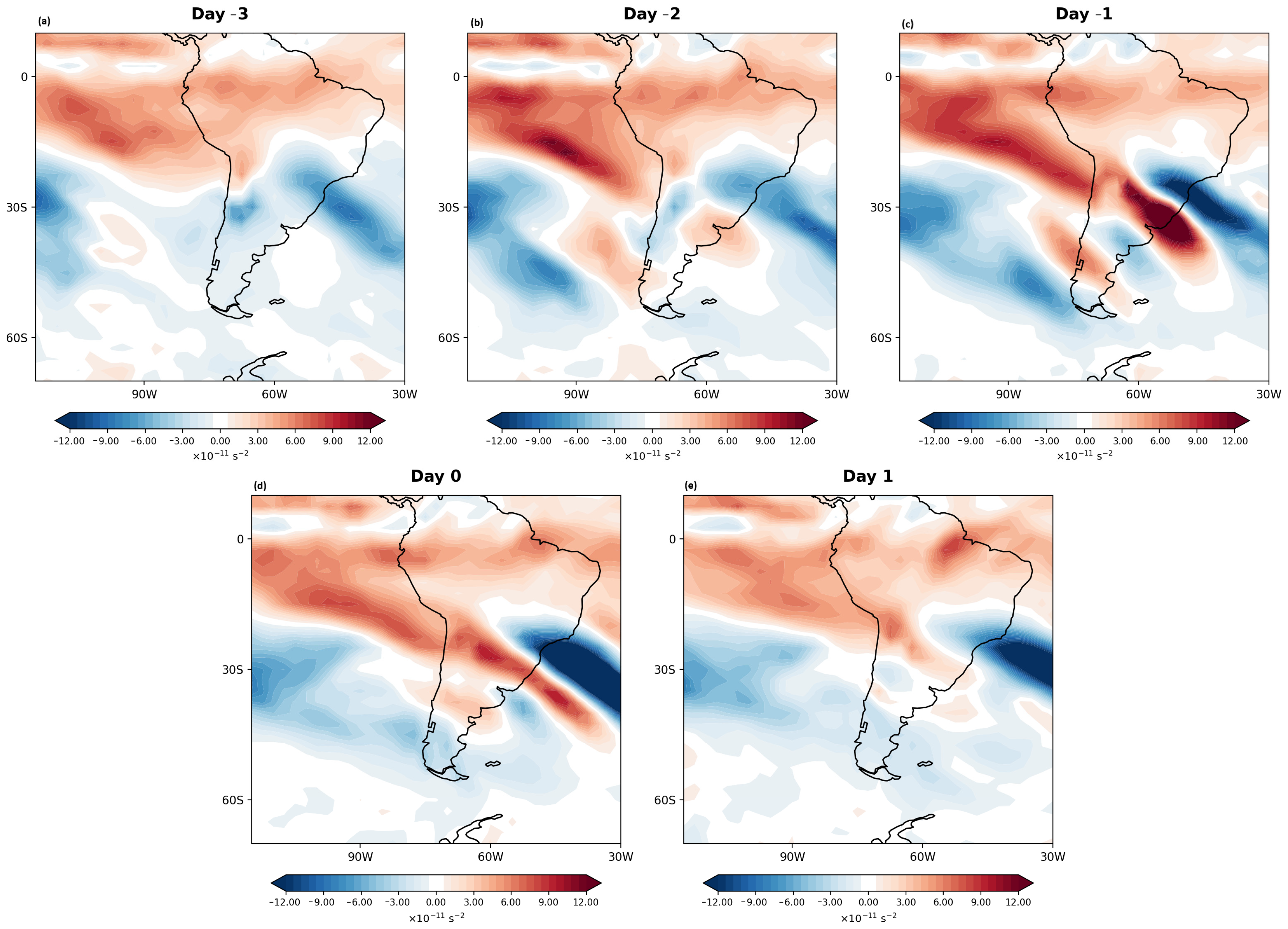
In
Figure 10, it is possible to see that the advective term (term 2 of Equation (4)) acts mainly in the early stages of the synoptic evolution, between day −3 and −1, when a NW-SE dipole pattern is observed, with positive values over northwestern South America and negative values over the southwestern Atlantic Ocean, indicating regions of sources and sinks, respectively. This configuration emphasizes the role of the divergent flow that advects absolute vorticity along the subtropical jet, favoring the beginning of wave activity as the development of an extratropical wave train [
32]. The intensification on day −1 suggests the intensification of the upper-level trough over South América, that is an important condition for advecting cold air from midlatitudes toward the Pampa Húmeda region, although this configuration does not persist. On day 1 the oceanic sinks intensify while the advective term weakens and disperses, at the same time of the weakening of the anomaly. This transient behavior was also found by [
29], who identified upper-level troughs associated with cold-air incursions over southern South America, but without frost occurrence.
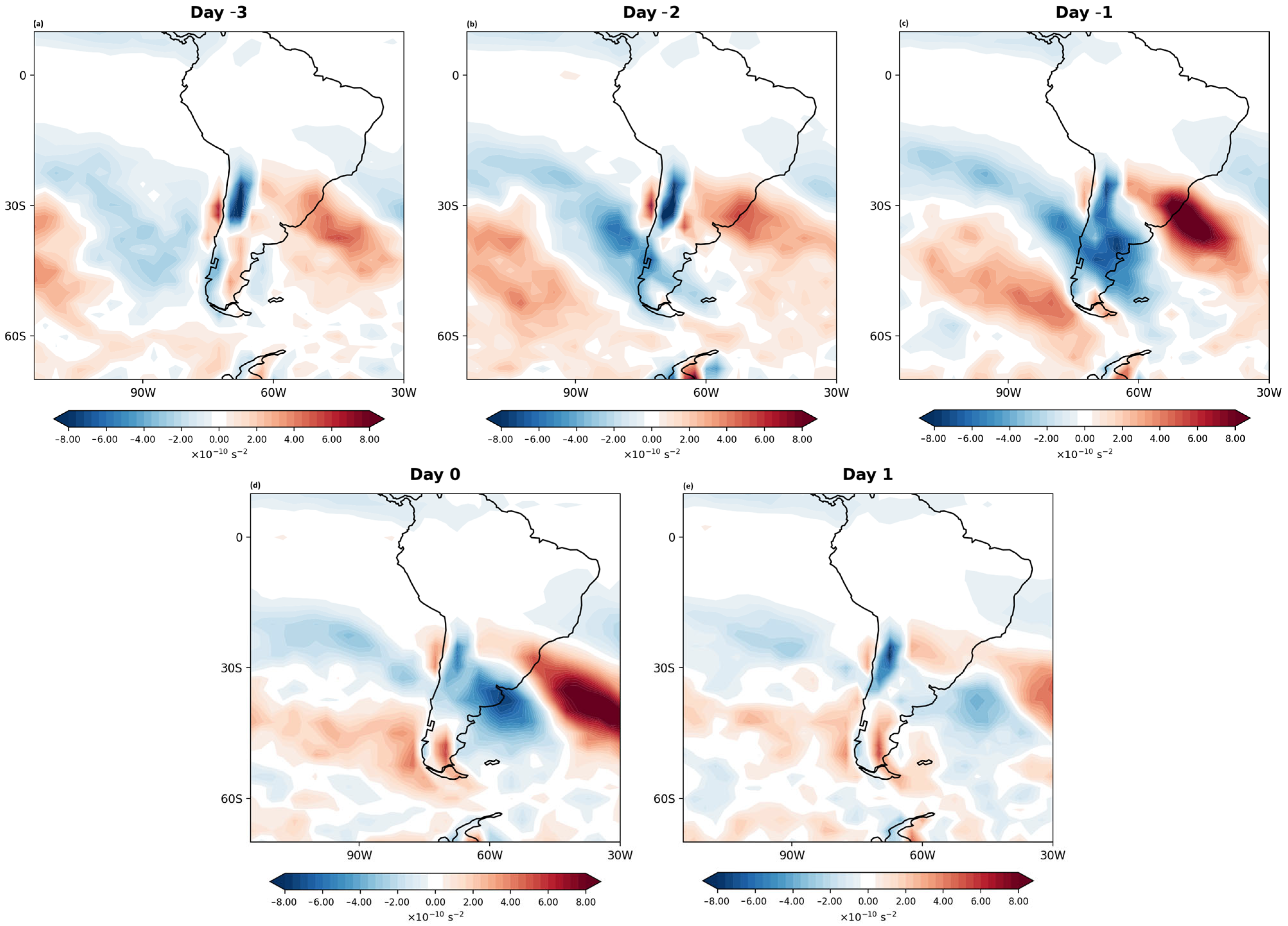
Figure 11 presents the divergent term (term 1 of Equation (4)), which is more intense over the south of South America and persists for a longer period, playing a central role in the development of the event. From day −3 (
Figure 11a) positive values are seen over eastern Argentina and Uruguay and negative values over southern Argentina. This configuration is associated with the coupling between upper-level divergence and extratropical cyclone anomalies. On day −1 (
Figure 11c), the divergent terms reach their maximum, with positive sources over the Atlantic Ocean reinforcing the formation of the upper-level ridge, while the subsidence over the Pampa Húmeda favors clear skies, enhancing nocturnal radiative cooling and leading to a favorable environment for frosts formation. This result is consistent with [
3] that highlighted the role of transient upper-level ridges and clear sky conditions as one of the elements in the 0DP GFs. However, after day 0 (
Figure 11d), negative values are seen over the Atlantic Ocean, making the wave activity dissipate by limiting its persistence. A similar configuration was also suggested by [
29] noting that the rapid downstream propagation of extratropical wave trains over the southwestern Atlantic Ocean results in unfavorable conditions for frost formation.
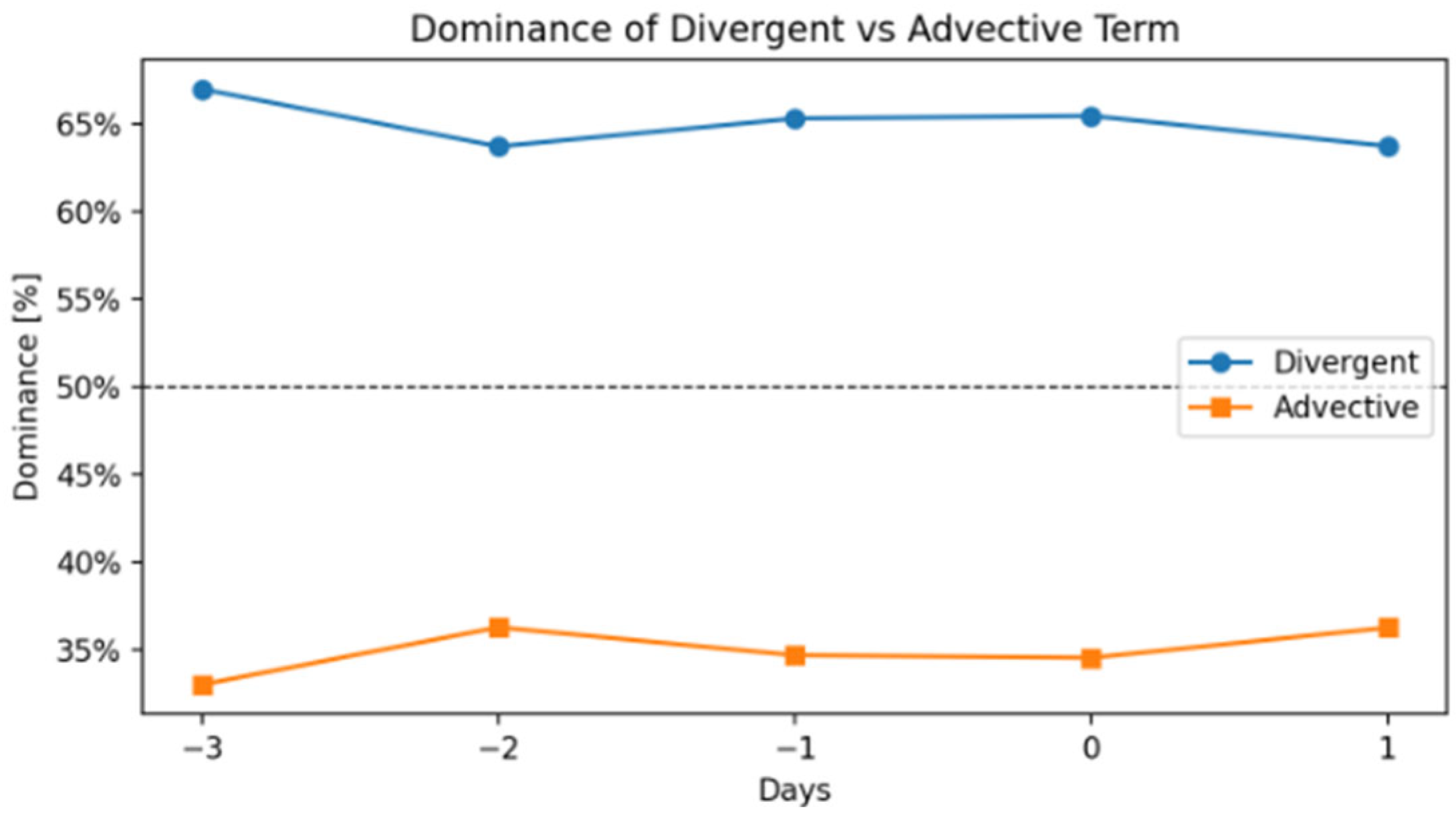
While the advective term triggers the deepening of upper-level troughs, the divergent term acts as the modulating factor that sustains the anticyclonic configuration and the subsidence pattern that induces frost formation. To understand which one of these mechanisms is the dominant one for 0DP events,
Figure 12 shows the daily percentage of dominance of each term in the selected region. The percentage was calculated according to the spatial quantification explained in
Section 2.
The divergent term dominates the region in a consistent way, around 63% and 67%, indicating that the upper-level divergence is the leading mechanism that sustains the synoptic configuration. Conversely, the advective term remains below 40% throughout the period, with only a slight increase on day −2, suggesting a secondary role as an initial trigger rather than the main sustaining factor.
The advection term, even with its smaller contribution, is relevant in the earlier stage of the events. The initial perturbation generated by this term helps to deepen the upper-level trough over South America, enhancing the meridional circulation that advects cold air toward the Pampa Húmeda, making the advective component to act as the trigger of the cold air intrusion. However, without the later dominance of the divergent term, this intrusion alone would not lead the frost occurrence, in contrast, the divergent term acts like a sustaining mechanism. The combination of the positive anomalies over eastern Argentina and Uruguay and the negative anomalies over the south of Argentina, reflect the interaction between upper-level divergence and extratropical cyclonic anomalies. This configuration intensifies an upper-level ridge over the Atlantic Ocean and induces subsidence over the Pampa Húmeda, favoring the most important factors for frost development, i.e., clear sky and strong nocturnal radiative cooling.
In addition to contributing to frost development, the divergent term explains the non-persistence of 0DP events. While positive anomalies strengthen the ridge and favor subsidence and clear sky conditions before and during day 0, negative anomalies over the southwestern Atlantic Ocean become predominant subsequently. These downstream sinks act as absorbers of wave activity, rapidly weakening the ridge and dissipating the synoptic configuration favorable to cooling. In this way, the divergent term not only sustains the environment that enables frost to occur, but also dictates its short-lived character, underscoring its dual role as both the enabler and the limiter of frost events in the Pampa Húmeda. These downstream sinks suppress wave activity, weakening the ridge and dissipating the synoptic configuration favorable to cold air advection. Accordingly, the divergent term not only preserves the environment that favors frost formation but also determines its transient nature, emphasizing its dual role as both a trigger and an inhibitor of frost in the Pampa Húmeda.