Article

Synoptic-Scale Forcing and Its Role in a Rare Severe Rainfall Event over the UAE: A Case Study of 15–16 April 2024

by
Noor AlShamsi
1,*,
Ahmed Al Kaabi
1,
Abdulla Al Mandous
1,
Omar Al Yazeedi
1,
Alya Al Mazrouei
1,
Micheal Weston
1,
Andrew VanderMerwe
2,
Mahmoud Hussein
1,
Esra AlNaqbi
3,
Ahmad Al Kamali
1,
Sufian Farah
1,
Mahra Al Ghafli
1 and
Brandt Maxwell
4
1
Research and Weather Enhancement Department, National Center of Meteorology, Abu Dhabi P.O. Box 4815, United Arab Emirates
2
Technical Services Department, National Center of Meteorology, Abu Dhabi P.O. Box 4815, United Arab Emirates
3
Meteorology Department, National Center of Meteorology, Abu Dhabi P.O. Box 4815, United Arab Emirates
4
Independent Researcher, San Diego, CA 92126, USA
*
Author to whom correspondence should be addressed.
Atmosphere 2025, 16(11), 1267; https://doi.org/10.3390/atmos16111267
Submission received: 27 August 2025 / Revised: 28 October 2025 / Accepted: 4 November 2025 / Published: 7 November 2025
(This article belongs to the Section Meteorology)

Abstract

An intense rainfall event affected the United Arab Emirates (UAE) between 15 and 16 April 2024. This study investigated the atmospheric conditions responsible for the formation of large convective storms during this period. Specifically, we analyzed the atmospheric dynamics and large-scale flow that led to the development of a cut-off low-pressure system (COL) over the Arabian Peninsula on 15 April 2024, triggering a two-day period of intense precipitation over the UAE. Our findings indicate that the storms were driven by upper-air instability, a prolonged moisture influx from the monsoon system into the UAE, and the presence of a surface front. Some regions recorded over 200 mm of precipitation within this period, resulting in flash floods, infrastructure disruptions, and significant impacts on the local population. The unusual development of the rainfall event was linked to the displacement of the subtropical jet (STJ), which facilitated the formation and intensification of a COL traversing the region.

1. Introduction

While large-scale climatic phenomena such as ENSO signals have led to a long-term enhancement of winter rainfall patterns over the eastern Arabian Peninsula [1], precipitation in the United Arab Emirates (UAE) remains generally low, with an annual average of less than 120 mm, and its yearly cloud cover averages approximately 24% [2], characterizing the region as hyperarid. Rainfall is highly variable both spatially and temporally. Recent climatological syntheses indicate area-mean values ranging between approximately 78 and 110 mm yr−1, with sharp contrasts between interior deserts and mountain or coastal stations [3,4,5]. Several studies identify a late-1990s rainfall decline, particularly during February–March, together with a growing share of annual totals contributed by short-lived, intense events [6]. This variability is increasingly linked to large-scale teleconnections, ENSO, Indian Ocean Dipole, and Madden-Julian Oscillation, that influence jet position and moisture pathways across the Peninsula [7,8].
Previous studies [9,10,11] have indicated that extreme precipitation events in the UAE are frequently associated with specific synoptic and larger-scale circulation patterns, often driven by troughs and depressions that induce westerly flows [12]. These atmospheric configurations create conditions that drive extreme precipitation events via the interaction between local and mesoscale factors, triggered by the dynamics of larger-scale systems [13,14].
Cut-off lows (COLs) are isolated upper-tropospheric low-pressure areas, most often detected between 200 and 500 hPa, with horizontal scales of about 600–1200 km and lifetimes of several days [15]. Over the Middle East, the subtropical jet stream (STJ) core typically lies near 200 hPa and migrates from ≈27° N in winter–spring toward ≈34–41° N later in the year, defining jet-exit divergence zones that favor convection [16,17].
This analysis focused on the synoptic and subcontinental scales of circulation, as observed during the UAE rainfall event from 15 to 16 April 2024. The STJ is a narrow zone of strong westerly winds near the tropopause, often exceeding speeds of 50 m s−1 [18,19], which contributes to thunderstorms and squall lines forming south of the jet [20,21]. Climatologically, the jet is mainly located at 200 hPa between approximately 27.5° and 35° N and 35° and 50° E, and it intensifies with a pronounced southward shift from this main region, creating favorable conditions for the formation of cyclones over the northeast Arabian Peninsula [22]. The significant undulations, altitude changes, and meandering of the STJ can produce COLs. These systems are typically slower-moving, carry more moisture, and yield prolonged periods of heavy precipitation compared with typical low-pressure systems [23].
COLs often emerge through Rossby-wave breaking and potential vorticity extrusion along the subtropical waveguide; subsequent diabatic heating from organized convection can reshape potential vorticity and influence COL longevity [24,25].
During spring, interactions between the STJ and the Indian monsoon onset can lead to enhanced moisture transport and the development of atmospheric rivers, which influence regional rainfall patterns in the UAE, Oman, and eastern Saudi Arabia [26,27,28,29,30]. Moisture from the Arabian Sea and Gulf of Aden dominates many extremes; Lagrangian analyses show ≈30–65% source fractions and integrated vapor transport (IVT) frequently between 200–350 kg m−1 s−1 [31,32]. Typically, IVT thresholds near ≈225–250 kg m−1 s−1 are used to define atmospheric rivers in the region [33].
COLs are synoptic-scale, vertically deep, and slow-moving detached cells from the westerly flow [34]. These systems can deepen into the lower atmosphere, stall, and produce prolonged heavy precipitation based on their vertical extent [35], as observed during the UAE event in April 2024 [36]. Researchers have studied the effects of COLs over Iraq and found that these systems strengthen surface low-pressure areas, causing atmospheric instability and significant rainfall when moisture is available, emphasizing the critical role of COLs in heavy rainfall events in the region. During spring, COLs are more frequently found north of the STJ [37], guided by regions of weak zonal winds. The relative positioning of the COL and STJ affects the severity of unstable events [38].
The role of COLs in generating extreme rainfall has been widely documented across various regions. For instance, in September 1987, a COL caused severe flooding in the KwaZulu-Natal coastal areas of South Africa, with rainfall exceeding 900 mm over three days [39,40]. Similarly, in March 2003, a COL moving east along South Africa’s southern coast resulted in over 200 mm of rainfall in just 24 h, sharply contrasting with the March average of 19.5 mm [41]. Another notable event occurred in East London in August 2002, where a COL produced more than 300 mm of rainfall in one day, far surpassing the monthly average of 78 mm [42]. Additionally, on 20 October 1982, a COL brought over 400 mm of rainfall to central Valencia, causing catastrophic flash floods after the Tous dam collapsed during the morning hours [43].
The Indian monsoon, driven by the seasonal migration of the intertropical convergence zone (ITCZ) and amplified by the thermal contrast between land and ocean, establishes prevailing southwesterlies during late spring and summer in South Asia [44,45,46]. This monsoonal flow brings substantial moisture from the Arabian Sea and Indian Ocean toward the UAE [47], sustained by thermal equilibrium and angular momentum conservation in atmospheric circulation [48,49,50]. This meridional flow can interact with middle-latitude systems such as COLs, enhancing moisture transport and strengthening extreme precipitation events.
The relative importance of COL forcing versus STJ-related upper-level divergence and Arabian Sea moisture plumes for UAE spring extremes remains unclear, despite their known capacity to produce intense, prolonged rainfall. This leaves an important knowledge gap in understanding the full spectrum of dynamic and thermodynamic factors driving such rare and severe precipitation episodes. Although COLs, jet-exit divergence, and strong integrated vapor transport often coincide, their individual roles in UAE events have rarely been examined together due to sparse observations and isolated diagnostics [51,52]. Here we build on this gap through an observationally anchored attribution that jointly evaluates COL geometry, STJ quadrants (left/right entrance and exit), and integrated vapor transport/thermodynamics for the April 2024 storm [53].
Recent regional analyses suggest that COL–jet coupling and Arabian Sea moisture transport can materially contribute to high-impact events [14,54]. Motivated by this, we apply an integrated synoptic–mesoscale attribution to the 15–16 April 2024 case. Several concurrent analyses of the 15–16 April 2024 storm [55,56,57] document the influence of an upper-level trough/potential vorticity anomaly with STJ divergence and enhanced Arabian Sea moisture. Building on this literature, we provide an observationally anchored, multi-instrument reconstruction for the UAE domain that integrates automatic weather-station, radar, and sounding/profiler records with ECMWF HRES fields.
This study’s primary objective was to examine the synoptic-scale evolution, dynamics, and interactions between the STJ, COLs, and the Indian monsoon that contributed to the severe unstable weather and heavy rainfall in the UAE from 15 to 16 April 2024; local hydrologic impacts and damage assessments are beyond the scope.
Specifically, this research aimed to achieve the following:
  • Reconstruct the large-scale evolution and placement of the COL-STJ-monsoon system during 15–16 April 2024 (timing, position, and intensity).
  • Quantify moisture transport/convergence, thermodynamic profiles, and vertical motion indicators associated with convection and rainfall.
  • Assess the relative roles of the COL (primary), STJ support, and monsoon moisture as dominant vs. secondary drivers of the event.
Building on these aims, we present a synoptic and mesoscale analysis of the 15–16 April 2024 UAE event. The analysis identifies a COL as the primary driver, with upper-level divergence associated with the STJ and monsoon-sourced moisture as secondary contributors. We quantify moisture transport and convergence, thermodynamic profiles, and vertical motion, and outline implications for forecasting high-impact rainfall in hyperarid, topographically complex settings. An observation-driven, multi-source design was employed, integrating ECMWF-HRES analyses with in situ and remote-sensing observations. The workflow followed a sequential diagnostic framework: (i) define the synoptic evolution from model fields; (ii) characterize mesoscale organization using radar and satellite imagery; and (iii) verify surface signals with automatic weather-station (AWS) records. This integrated design maintains physical consistency across datasets and enables cross-scale attribution of the COL–STJ–monsoon coupling.
We hypothesize that a COL was the primary driver, with upper-level divergence associated with the STJ and monsoon-sourced moisture providing secondary support. We test this attribution in Section 3.

2. Materials and Methods

2.1. Study Area and Overview

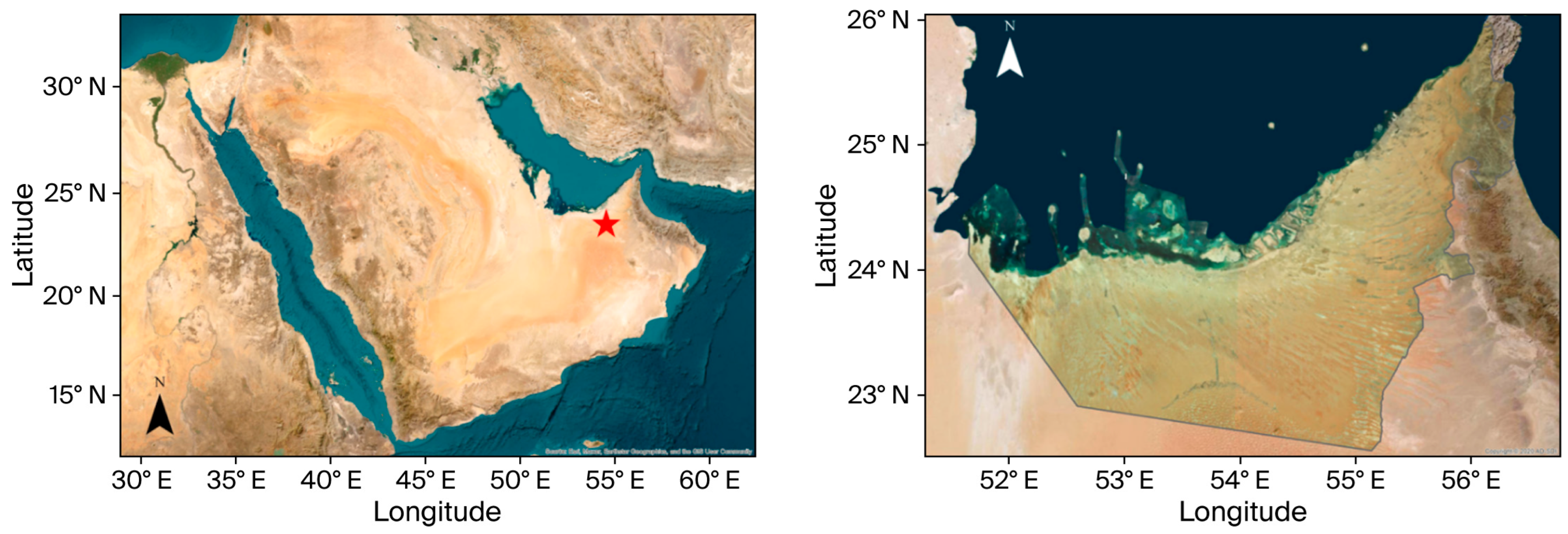
The UAE, located in the southeastern subtropical region of the Arabian Peninsula between latitudes 22.35° and 26.50° N and longitudes 51.35° and 57.10° E, spans an area of approximately 71,024 km2 and has a population exceeding 10 million (Figure 1). The UAE’s climate is predominantly hot desert, classified as “BWh” under the Köppen climate classification system [58,59,60]. More than 75% of the country is covered by sandy deserts and salt flats, with some mountainous regions in the east and northeast. During the summer months (June to August), average temperatures exceed 40 °C in some areas, while winter minimum temperatures fall below 13 °C, except along the coastal margins. All datasets analyzed in this paper cover 12–17 April 2024, with emphasis on the event days 15–16 April 2024.
During 15–16 April 2024, the UAE experienced a rare, high-impact rainfall event. A mid-tropospheric COL closed over the northeast Arabian Peninsula beneath a southward-displaced STJ, producing pronounced upper-level divergence and ascent. Concurrently, a pre-monsoonal southwesterly moisture plume from the Arabian Sea enhanced integrated vapor transport. Low-level convergence, reinforced by orographic lifting along the Hajar Mountains, focused deep convection and widespread heavy rainfall, with embedded thunderstorms, localized flash flooding, hail, and strong surface winds.

2.2. Data Sources

2.2.1. ECMWF Atmospheric Model Data

The European Centre for Medium-Range Weather Forecasts (ECMWF, Reading, UK) has developed the “Atmospheric Model high resolution 10-day forecast (Set I—HRES),” a comprehensive atmospheric model that assimilates extensive observational data from various sources, including satellite sensors, ground-based weather stations, radiosonde measurements, and Doppler radar. For this case, we extracted wind (u, v), geopotential height (Z), temperature (T), mean sea-level pressure (MSLP), and humidity (RH) on standard pressure levels (1000–200 hPa) and at the surface. The native output (~9 km, ~0.08°) was regridded by bilinear interpolation to a 0.1° × 0.1° latitude–longitude grid for analysis and plotting.
Configuration: The model employs 137 hybrid sigma–pressure levels (top at 0.01 hPa). Although global, analysis maps are clipped to 0–50° N and 15–75° E. We used the 00 UTC cycle of 12 April 2024 and examined fields through 17 April 2024, with emphasis on 15–16 April. Output is hourly to +90 h and 3–hourly thereafter to +240 h; HRES runs at 00/12 UTC.
Processing and quality checks: Variables were subset to the event window, units harmonized to SI, and figures rendered on a Plate Carrée projection. Temporal continuity and field orientation/sign conventions were verified; no missing data were detected. No smoothing, filtering, compositing, or additional calculations were applied.
Numerical model outputs are particularly valuable in extreme cases where ground-based and satellite observations may be sparse or unavailable. Unlike reanalysis data based on a fixed model setup, operational forecasts from models such as the ECMWF can capture real-time atmospheric evolution, although with inherent uncertainties [61]. Moreover, evaluations of HRES in flood and heavy-precipitation contexts highlight why real-time HRES is preferable to coarser re-forecasts or reanalysis when analyzing single events in complex terrain: higher native resolution and the preservation of the operational system improve orographic precipitation representation and event depiction [62]. ECMWF-HRES atmospheric model data offer insights into complex meteorological conditions impacting environmental processes, such as dust emission and transport in regions such as West Africa [63]. These insights can be enriched by integrating ECMWF-HRES data with other observational datasets, including National Aeronautics and Space Administration (NASA) Landsat-9 imagery, Spinning Enhanced Visible and Infrared Imager (SEVIRI) Meteosat Second Generation (MSG3) infrared data, and measurements from AWS and radiosonde networks [64,65]. In addition to our approach, a dedicated case study of the September 2019 Spain floods employed ECMWF-HRES in combination with satellite products, showing that the two data sources are complementary for diagnosing high-impact events (HRES for dynamically consistent fields; satellites for spatial/temporal QPE in data-sparse areas), supporting our use of HRES alongside satellite observations [66].
For consistency across datasets, ECMWF-HRES fields were extracted for 15–16 April 2024, regridded to 0.1°, and compared with radar and AWS observations at matching UTC times to ensure temporal alignment.

2.2.2. Space-Borne Observations

The National Aeronautics and Space Administration (NASA, Washington, DC, USA) Landsat-9 satellite (Operational Land Imager 2) provides high-resolution multispectral imagery, capturing approximately 740 scenes daily [67] with a moderate spatial resolution of 30 m [68]. These data are valuable for mapping and monitoring land use and land cover changes, which play a critical role in understanding interactions between the land surface and overlying atmosphere. Landsat-9 scenes were obtained online via the NASA Earth Observatory [69].
The SEVIRI onboard the MSG3 satellite operated by EUMETSAT (Darmstadt, Germany) provides imagery with a temporal resolution of 15 min and a spatial resolution of 3 × 3 km at nadir [70,71]. The 13.4 µm infrared channel, located within the CO2 absorption band, is sensitive to the absorption and emission of radiation by water vapor and other greenhouse gases in the upper and lower stratosphere. This study leveraged the high spatiotemporal resolution of SEVIRI MSG3 IR134 imagery was analyzed within the study scope to track the evolution and propagation of convective weather systems and to distinguish cirrus cloud cover [72].
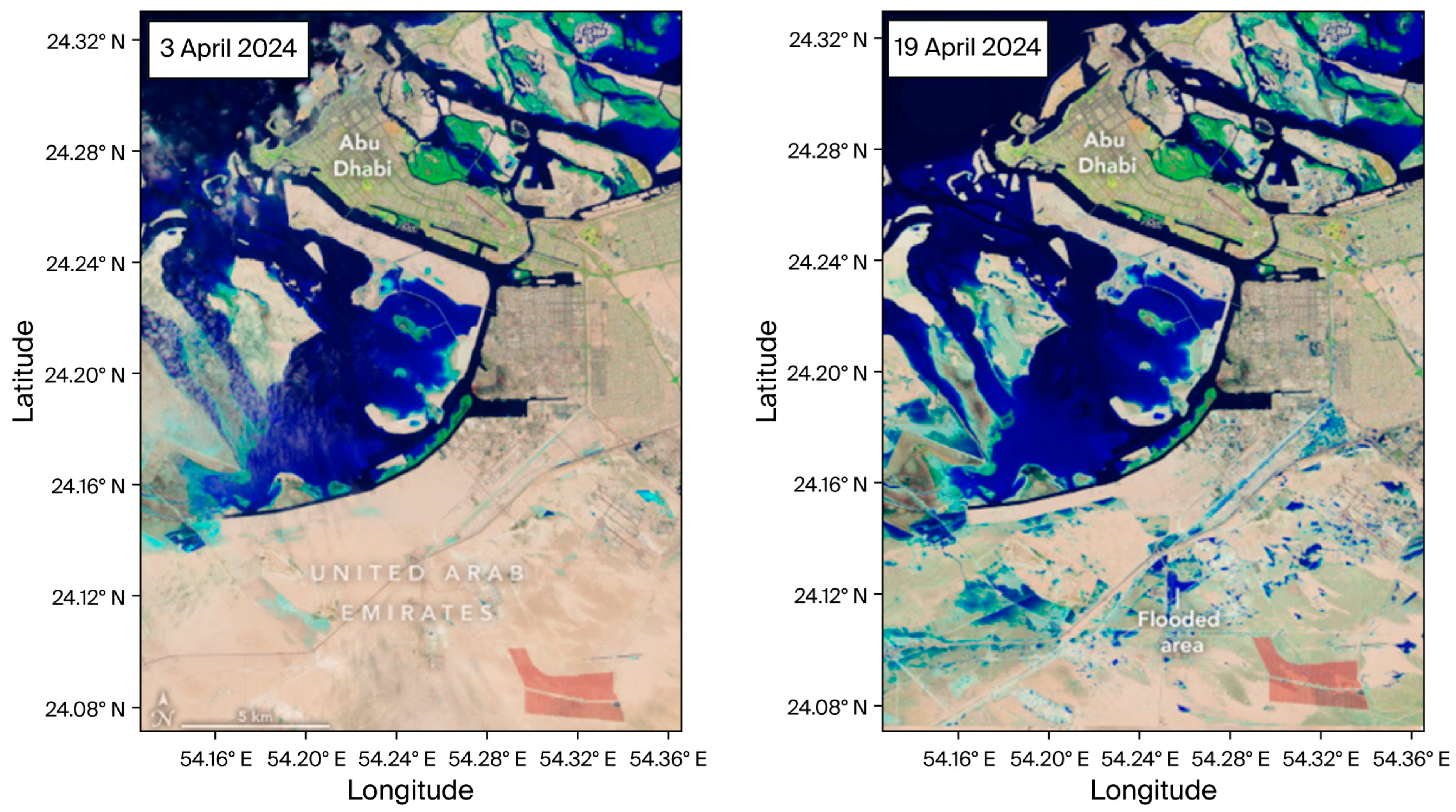
SEVIRI IR 13.4 µm images were sampled every 15 min to match radar volume-scan timing, while Landsat-9 scenes provided pre- and post-event surface context used qualitatively in Section 3.5.

2.2.3. Automatic Weather Stations

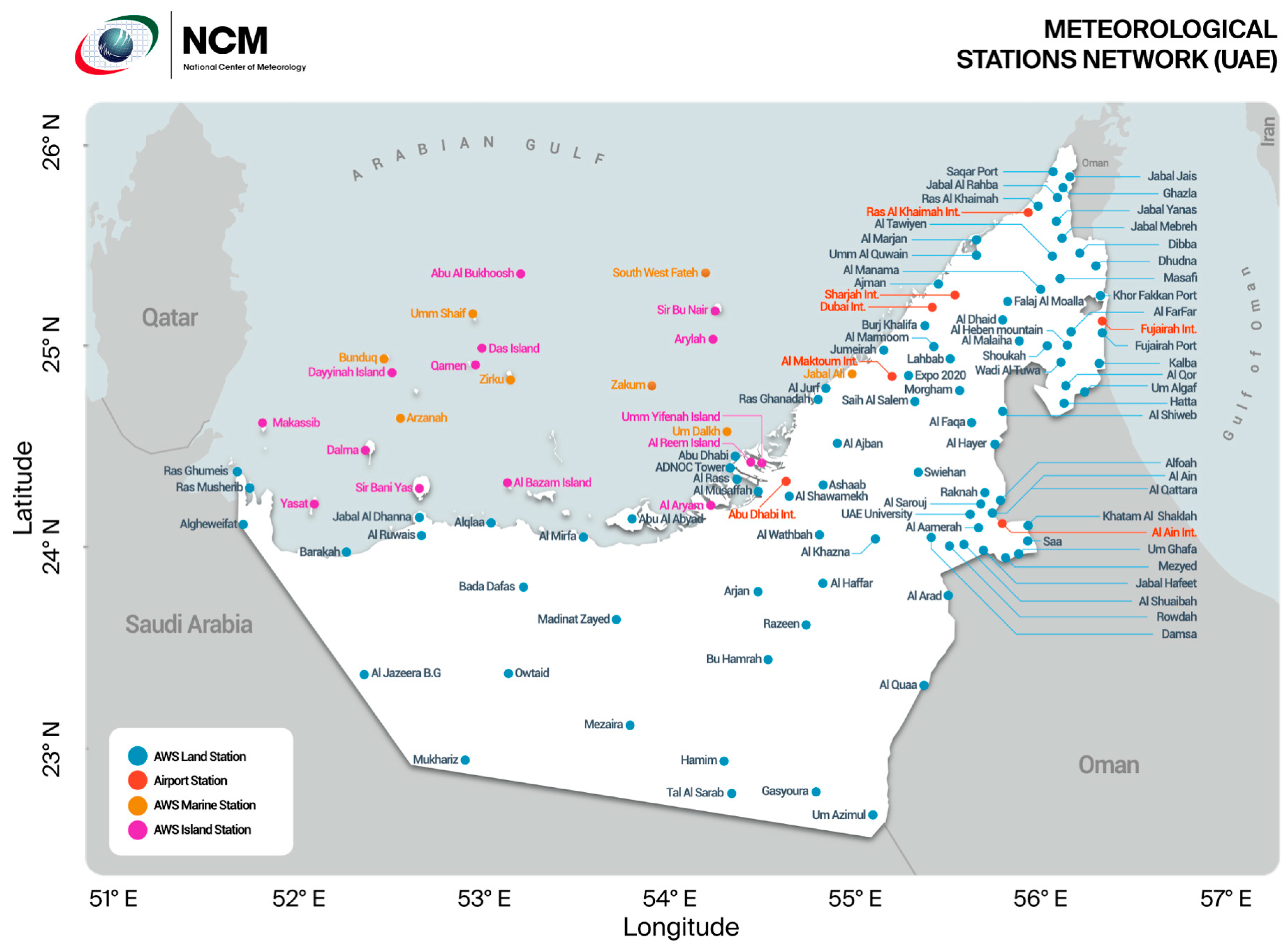
Surface observations from AWS, are curated and quality controlled by the National Center of Meteorology (NCM), provided 15 min in situ measurements of surface meteorological variables including temperature, humidity, wind speed and direction, and rainfall. A total of 133 stations distributed across the UAE contribute to a dense network of surface data (Figure A1), enhancing our understanding of localized weather patterns and supporting the detailed analysis of extreme events. Notably, Al-Nassar et al. (2020) [73] employed a similar approach in analyzing COLs, demonstrating the effectiveness of using extensive AWS datasets for investigating upper-level atmospheric influences on surface conditions.
AWS instrumentation (models/specs) include: Rainfall by Texas Electronics (Dallas, TX, USA) TE525MM-L tipping-bucket gauge (0.1 mm per tip; ±1% ≤ 50 mm h−1); wind by Thies CLIMA (Göttingen, Germany) Compact Wind Speed/Direction Transmitters (0.5–50 m s−1, ±3% or ±0.5 m s−1; 0–360°, ±5°); dry-bulb temperature by Microstep (Bratislava, Slovakia) PT100 RTD (Class F0.1 IEC 60751; ±(0.1 + 0.00167|T|) °C); relative humidity and dew point by Microstep RHT175 RH/T probe (0–100% RH; ±1% RH; dew-point output available).
Fifteen-minute AWS measurements of rainfall, dry-bulb and dew-point temperature, wind speed, and wind direction were retained at their native resolution and aligned with the nearest radar volume scan (6 min) and ECMWF output (hourly/3 hourly) for temporal comparison. No aggregation or averaging was applied. AWS records followed NCM QC flags; only ‘pass’ records were retained.

2.2.4. Radar Data

Radar observations provide spatially and temporally continuous data, offering detailed insights into the fine-scale variations in storm structure, intensity, and evolution, especially over areas with sparse ground stations. Doppler radar systems offer a three-dimensional view of reflectivity, volume, and radial velocity. The UAE’s national radar network consists of seven dual-polarimetric C-band radars operated and managed by NCM, each with a wavelength of 5.3 cm and beam width of 0.98°. The radar volume scans are performed every 6 min, extending to a radius of 250 km with bin range resolution of 150 m (3 Advanced Radar Company radars, Boulder, CO, USA) and 300 m (4 Vaisala radars, Vantaa, Finland).
Storm detection, tracking, and forecasting products are generated using the Lidar Radar Open Software Environment system (LROSE-Colette, version 2025; National Center for Atmospheric Research, Boulder, CO, USA) [74], which incorporates the enhanced Thunderstorm Identification Tracking Analysis and Nowcasting (TITAN; NCAR, Boulder, CO, USA) algorithm [75,76]. A comparable approach was adopted by Olivares and Jordan [77], in which the authors analyzed a major rainfall event in January and February 2019 using radar-based storm tracking techniques.
Radar volume scans were processed through the TITAN algorithm using a minimum 35 dBZ threshold, minimum storm volume of 20 km3, and 6 min update interval, matching NCM’s operational settings; storm tracks and cell properties were then compared with ECMWF and AWS outputs.

2.2.5. Upper-Air Soundings and Thermodynamic Wind Profiler

Abu Dhabi International Airport conducts radiosonde launches twice daily at 0000 UTC and 1200 UTC (0400 and 1600 LT) by NCM, providing vertical profiles of temperature, humidity, and wind from the surface to the upper troposphere. These measurements are obtained using the Vaisala RS41-SG radiosonde system (Vantaa, Finland), a high-precision GPS-aided sensor package that provides vertical profiles of temperature, relative humidity, and wind from the surface to ~30 km. The RS41 system, part of the WMO Integrated Global Upper-Air Observation Network (GUAN, Geneva, Switzerland), contributes to the Global Telecommunication System (GTS); global dissemination occurs via https://weather.uwyo.edu/upperair/sounding.html (accessed on 1 November 2025), while detailed high-resolution data are archived internally at NCM. Radiosonde data undergo Vaisala automatic quality control (pressure, humidity, temperature, and wind consistency checks).
Complementing the radiosonde data, the Radar Wind and Thermodynamic Profiling System (RWTPS) at Abu Dhabi International Airport, operated and provided by NCM, delivers continuous vertical profiles of wind and thermodynamic parameters. The system, developed by Weather Decision Technologies (Norman, OK, USA) and Installed with the technical collaboration of Weather Decision Technologies and Bayanat Airports Engineering and Supplies (Abu Dhabi, UAE), integrates two Radiometrics Corporation (Boulder, CO, USA) sensors, MP-3000A Microwave Profiling Radiometer and a RAPTOR XBS-BL Radar Wind Profiler. Both sensors feed into a redundant Nowcast Product Generator (NPG) that applies automated quality-control algorithms to flag interference and maintain calibration consistency. RWTPS records data every 5 min up to a height of 4876.8 m, offering higher-frequency monitoring of critical atmospheric conditions. NCM archives and disseminates these data for operational and research use.
Radiosonde and profiler soundings at 00 and 12 UTC were used to compute CAPE, inversion strength, and vertical moisture profiles, which were cross-checked against ECMWF-HRES thermodynamic fields to verify stability indices.

2.3. Diagnostics and Definitions

Defining extreme precipitation events can be challenging due to differing metrics, timescales, and spatial scales. The term “extreme” can encompass (1) metrics such as the local frequency of occurrence (e.g., top 1% of events, values exceeding 50 mm, or events with a 5-year recurrence interval), (2) timescales for accumulation (e.g., hourly, daily, or event-based), and (3) spatial scales (e.g., station-based, grid box, or area-averaged contiguous rain areas) [78]. Different aspects of extreme precipitation can correspond to varied impacts, such as flash flooding, riverine flooding, stormwater management challenges, agricultural damage, and water resource issues, with the severity of these impacts varying by season and region.
We focused on precipitation from weather events that are markedly different from typical conditions to identify extreme rainfall amounts from long-term daily rain gauge data. The most significant rainfall amounts were determined by ranking precipitation data in ascending order, selecting values above the 99th percentile distribution (representing the top 1% intensity at each station), and calculating precipitation amounts only on days with measurable rainfall. The frequency of events exceeding the 99th percentile up to the maximum recorded extremes was also assessed. These values, representing the top 1%, indicate infrequent yet severe weather conditions. Table A1 and Table A2 present the highest recorded rainfall values, corresponding dates, and overall frequency from 1974 to 2024.
All analyses use the study scope of 12–17 April 2024 (event days 15–16 April 2024) in Section 2.1. “Extreme precipitation” is defined as daily station totals above the local 99th percentile, computed from the long-term daily gauge record (1974–2024) using wet days only. Pressure levels refer to 250/500/700/850 hPa; units follow SI (m s−1 for wind, m for geopotential height, hPa for pressure, °C for temperature, % for RH). Abbreviations used throughout: COL (cut-off low), STJ (subtropical jet), MSLP (mean sea-level pressure), RH (relative humidity).
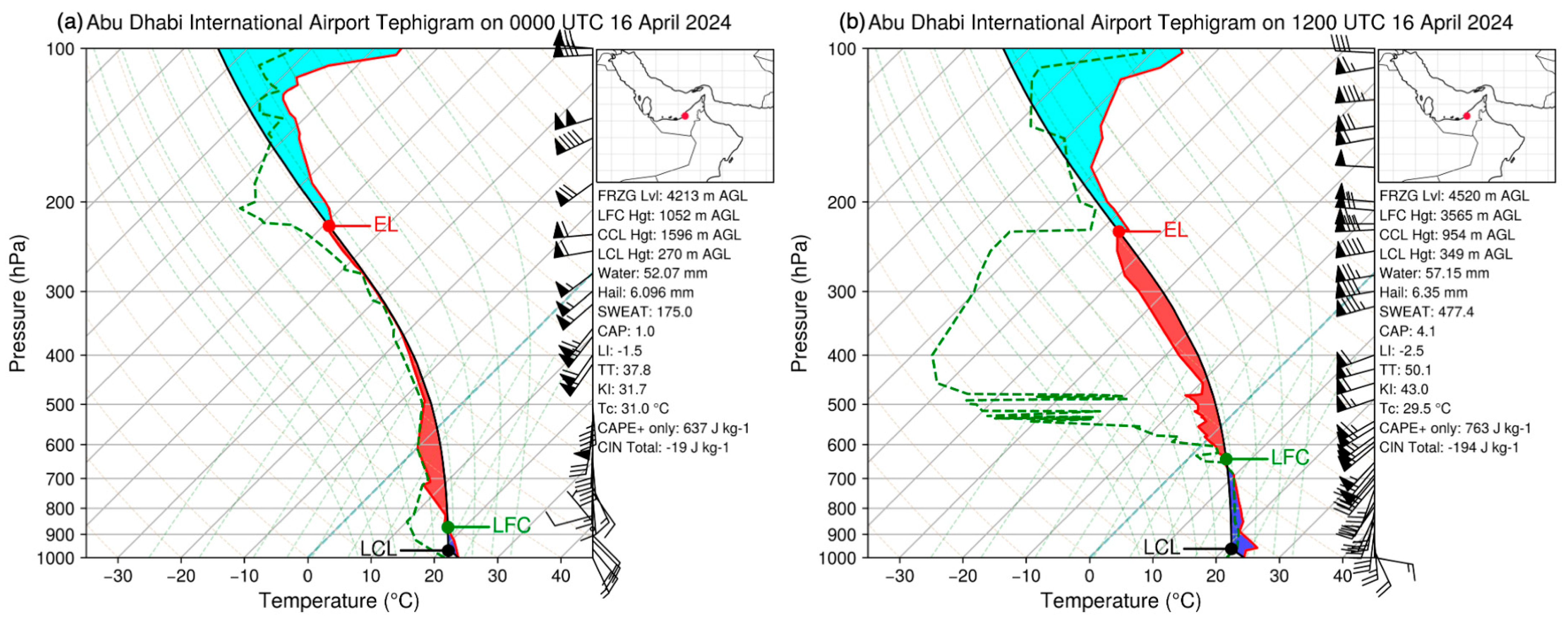
CAPE (Convective Available Potential Energy). CAPE values cited in this study are those reported directly on the radiosonde sounding products (as displayed on the Vaisala/University of Wyoming plots), representing the buoyant energy available to a lifted surface-based parcel between the Level of Free Convection (LFC) and the Equilibrium Level (EL); units are J kg−1.
Diagnostics linked to the research questions:
RQ1—COL–STJ–Monsoon Evolution: To examine the synoptic evolution and the interaction among the COL, STJ, and monsoon flow, ECMWF-HRES data were analyzed for 250-hPa wind to capture jet streaks and entrance/exit regions, and geopotential height at 500, 700, and 850 hPa to characterize the closed-low signature, tilt, and depth within the larger frontal context defined by mean sea-level pressure. SEVIRI imagery was used to track cloud-top evolution and propagation timing relative to upper-level dynamics. Radar data provided 6 min reflectivity and radial velocity fields to determine initiation and propagation phases in relation to the COL, jet phasing, and surface fronts. AWS 15 min records of wind shifts and temperature drops were examined to identify frontal passages and cold-pool outflows (Figure A3 and Figure 8). Upper-air soundings supplied information on tropopause height, shear maxima, and ascent/subsidence signatures, while profiler winds described low- to mid-level flow shifts accompanying the COL–jet interaction.
RQ2—Moisture and Thermodynamic Context: The moisture and thermodynamic environment were diagnosed using ECMWF-HRES temperature and relative-humidity fields at 850, 700, and 500 hPa to distinguish warm- versus cold-core structure, mid-level dry intrusions, and vertical saturation layers. Jet-level winds at 250 hPa were qualitatively assessed for diffluence and divergence patterns. SEVIRI observations were used to document the persistence and evolution of cold cloud tops as indicators of sustained deep convection, while Landsat-9 imagery characterized pre-event land-surface conditions, including land-cover and texture features relevant to convective initiation. AWS surface observations of 2 m temperature, dewpoint, and relative humidity captured pre-storm moistening and post-storm cooling, and upper-air soundings provided CAPE, inversion strength, and mid-level humidity minima. Profiler time–height temperature and humidity fields were analyzed to track boundary-layer recovery and pre-convective moistening.
RQ3—Relative Roles of the COL, STJ, and Monsoon: To assess the relative contributions of each system, periods with deep geopotential minima and a closed circulation in ECMWF-HRES fields were compared with periods showing strong jet-level signatures over a moist lower troposphere but without an overhead deep closed low. Radar TITAN analyses identified and tracked convective cells to evaluate organization, longevity, and areal coverage, distinguishing COL-forced convection from jet-enhanced rainbands. AWS rainfall timing and intensity were compared with radar evolution and ECMWF-HRES fields to attribute dominant forcing mechanisms. Finally, SEVIRI cloud-top motion was analyzed relative to the COL position and jet-exit regions to corroborate the attribution of primary versus secondary dynamical control.

2.4. Quality Control

Before final visualization, all datasets underwent consistency and completeness verification to ensure data integrity across platforms. Temporal continuity and field orientation were spot-checked for each dataset, and coordinate metadata were verified after subsetting and reprojection to prevent sign or alignment errors.
Cross-validation was performed visually by comparing independent sources—for example, matching radar reflectivity with SEVIRI cold-cloud-top signatures and aligning AWS rainfall timing with TITAN storm-tracking outputs—to confirm consistency and physical plausibility.
Completeness checks ensured that no scenes or time steps were missing or corrupted and that no additional smoothing, filtering, or compositing was applied beyond what is described in Section 2.2.1, Section 2.2.2, Section 2.2.3, Section 2.2.4 and Section 2.2.5. Finally, reproducibility was maintained by clearly documenting the software environment and versions in the relevant subsections. All figures were exported at 300 dpi with standardized color bars, contour intervals, and legends to ensure uniform presentation throughout the manuscript. Cross-dataset integration is foundational to the design, ensuring that every component feeds into the attribution of rainfall intensity to synoptic and mesoscale forcing.
Processing and plotting were performed on a Linux HPC (Python 3.9.9) using xarray, numpy, pandas, matplotlib (with matplotlib.colors), mpl_toolkits.basemap, and scipy.ndimage. Sensitivity checks included (i) repeating synoptic maps on the native ECMWF-HRES grid (~0.08°) versus the 0.1° analysis grid and (ii) recalculating extremes using the 95th instead of the 99th percentile (Appendix A, Table A1). Results were consistent across tests, and the forcing attribution remained the same, supporting the robustness of the design. No data gaps were identified during the analysis period, and minor discrepancies between model fields and observations are not expected to affect the attribution findings.
These steps, combined with documented software versions and QC verification, ensure full reproducibility of the analysis workflow.

2.5. Research Design Overview

The analysis proceeded in a top-down sequence: synoptic-scale diagnostics first, followed by mesoscale assessment and, finally, surface-level verification. Each dataset was examined on its own and then cross-checked in space and time. Specifically: (i) the COL–STJ configuration was delineated from ECMWF geopotential height and wind fields (250–850 hPa); (ii) moisture transport and thermodynamic structure were diagnosed from ECMWF humidity, CAPE, and radiosonde profiles; and (iii) convective organization and surface response were evaluated using radar TITAN products and AWS rainfall. This hierarchical design maintains internal consistency and reduces uncertainty associated with reliance on any single dataset.
Dominant forcing was identified using three markers: (i) a closed 500-hPa low near the UAE; (ii) characteristic jet-exit diffluence at 250-hPa indicative of enhanced ascent; and (iii) a ±3 h alignment between increased 850-hPa moisture flux and radar-detected convection. These cross-checks tie the upper-level flow, moisture transport, and rainfall timing into a coherent attribution.

3. Results

3.1. Synoptic-Scale Evolution

To address RQ1 (COL–STJ–monsoon evolution), we examined the large-scale circulation patterns that governed the development and progression of the COL and its interaction with the subtropical jet over the Arabian Peninsula.
The interplay between large-scale atmospheric dynamics and the genesis of severe weather events has been a long-standing area of focus in meteorological research, aimed at understanding the complex mechanisms underlying high-impact phenomena. The STJ—a core of strong winds in the upper troposphere—is pivotal in shaping the synoptic-scale environment conducive to the formation of COLs in the mid-to-lower atmosphere.
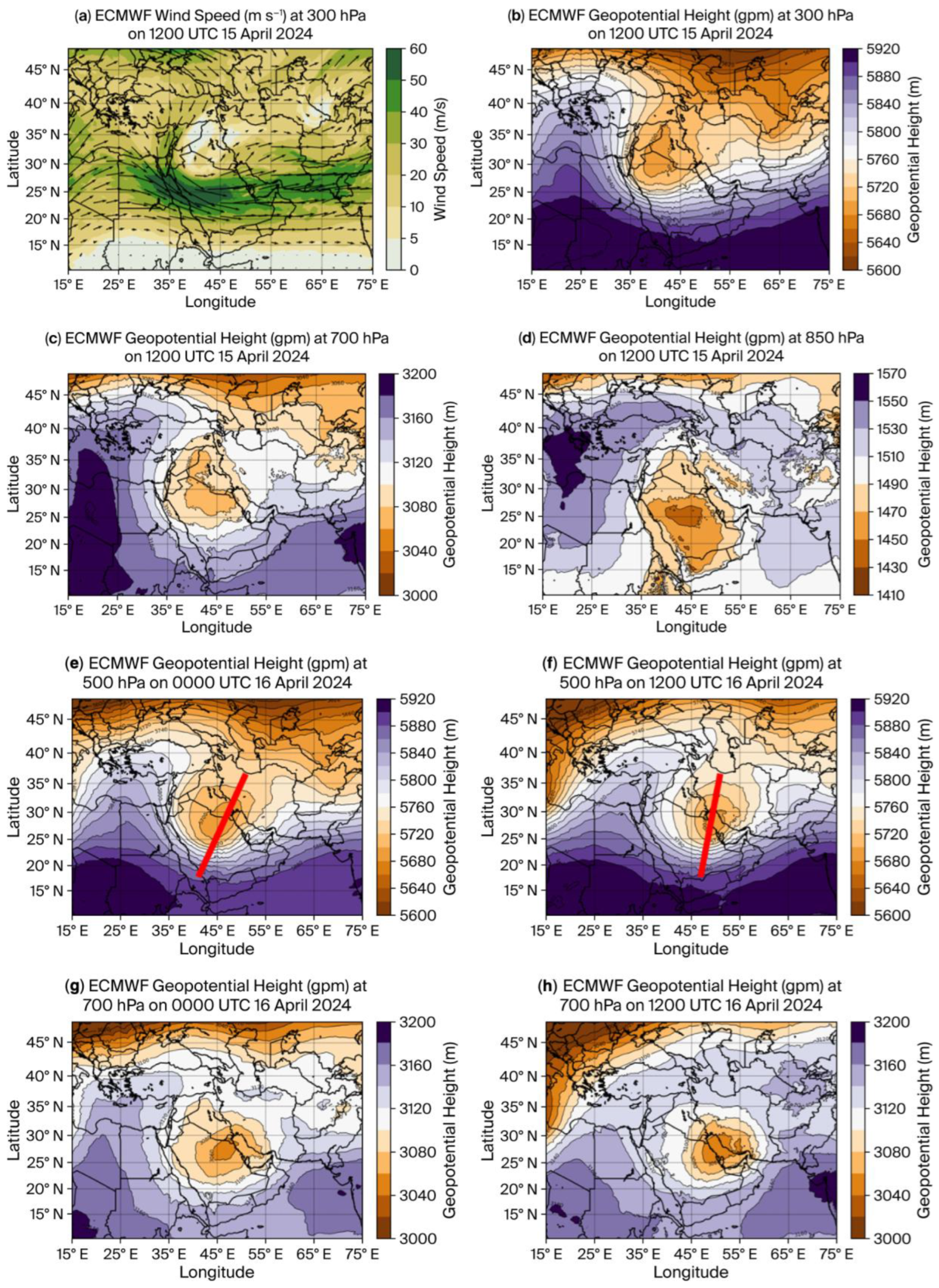
During the event, the southeastern displacement of the STJ at 250 hPa over the Arabian Peninsula initiated the formation of a pronounced upper-level trough. This, in turn, led to the development of a sloped, deep COL that extended from the upper to the lower troposphere. The sloped structure of this COL created significant vertical wind shear, a critical factor in the formation and intensification of convective storms.
On 15 April 2024, at 1200 UTC, a meridional jet streak—the core of maximum wind speed within the jet stream—extended from northeastern Africa to the central Arabian Peninsula, positioning the UAE within the jet streak’s exit region (Figure 2a). This placement resulted in jet-induced divergence and upper-level forcing, which facilitated the rapid formation of a deep COL that extended vertically from the upper to the lower troposphere (Figure 2b–d). This COL exhibited a negative tilt, with its axis oriented northwest-to-southeast, and was marked by strong mid-level isentropic vorticity anomalies, enhancing the instability and vertical motion within the system [79,80,81].
Between the afternoon of 15 and 16 April 2024, the COL shifted from a negative to neutral tilt over the eastern Arabian Peninsula, particularly over the UAE, signaling its maturation and a complete manifestation of baroclinic instability.
As 16 April 2024 ended, the COL tracked northeast toward neighboring countries. With a weakened monsoon flow and a positive tilt extending from the upper to lower atmosphere (Figure 2e–h), the system became less intense, generating broad stratiform precipitation and gradually dissipating over the next 12 to 24 h.
These synoptic features satisfy RQ1 by positioning the UAE beneath jet-exit divergence and a maturing COL, establishing the large-scale ascent needed for convection, Overall, the synoptic analysis confirms that a deep, negatively tilted COL coupled with STJ divergence created the primary large-scale ascent responsible for event initiation; we next examine the associated moisture transport and low-level convergence.

3.2. Moisture Transport and Low-Level Convergence

In response to RQ2 (moisture and thermodynamic context), this section analyzes the transport pathways and low-level convergence associated with the approaching COL and its coupling with monsoon inflow from the Arabian Sea.
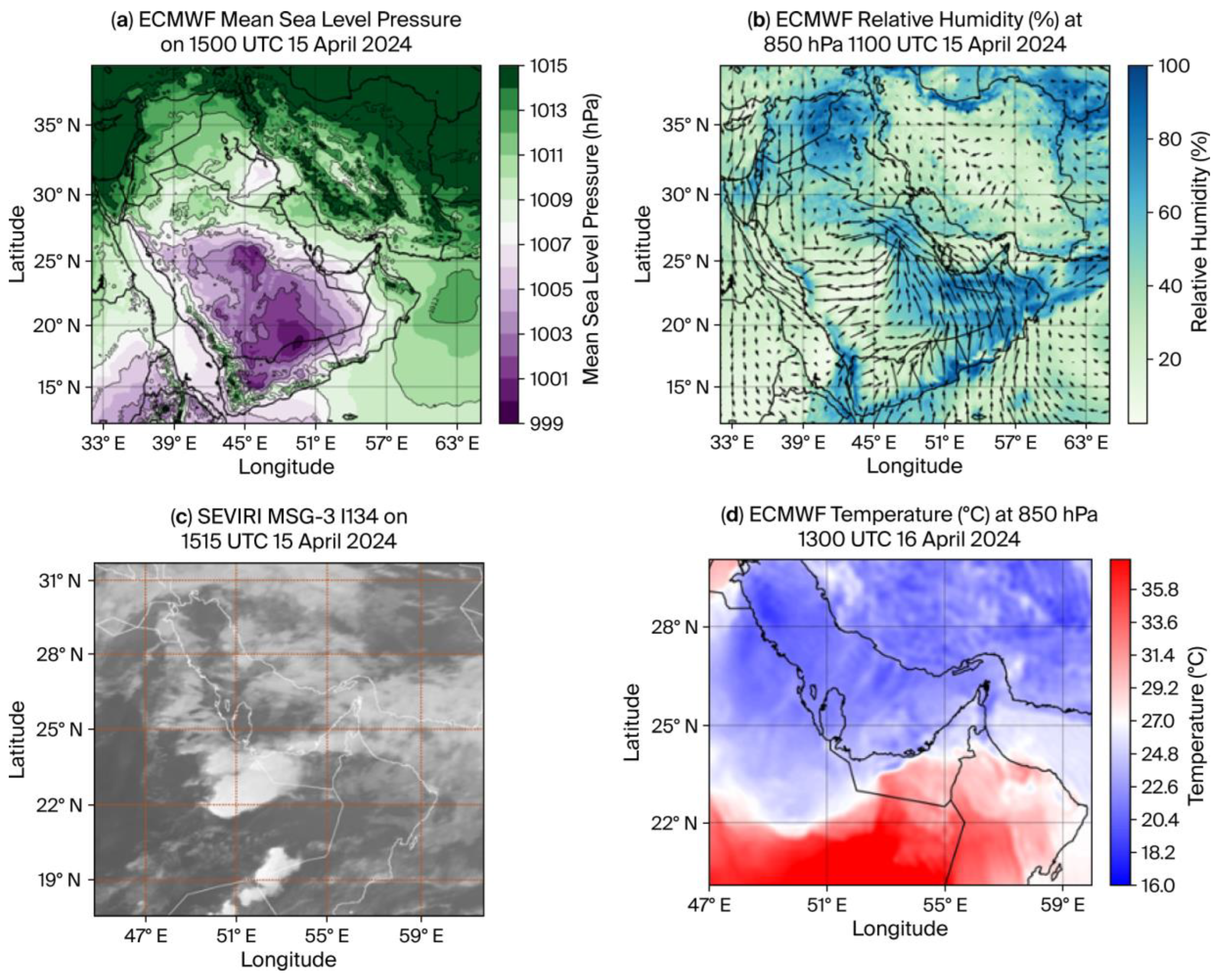
The COL was accompanied by warm, moist air from the southerly monsoon gyre over the Arabian Sea (Figure 3a,b) that extended eastward. This moist air mass was advected northward and interacted with the upper-level trough, creating conditions for intense upward motion and convective instability. Days before the event, the atmosphere was saturated due to the northward advection of humid air by a low-level jet, priming the environment for rapid convective storm formation. This preconditioned atmosphere, combined with the lifting mechanisms of the approaching COL, allowed for the quick formation and intensification of a large, moisture-laden, and organized convective storm.
At the surface, a well-defined, dynamically active cold front formed due to the interaction between a cold air mass from the north and a warm, moist air mass from the south (Figure 3d). The denser cold air sank beneath the warmer air ahead of the front, providing an additional source of uplift. As the system evolved, evaporative cooling from precipitation generated cold pools, characterized by localized dense and cold air that enhanced downdraft motion, further intensifying the convective system. The surface low-pressure system deepened as the frontal system assumed a northwest–southeast orientation [82,83], increasing the storm’s magnitude and intensity along the eastern and southern flanks of the COL.
The moisture plume, frontal lifting, and cold-pool dynamics address RQ2 by preconditioning the lower troposphere for deep ascent; we therefore assess the thermodynamic state and shear profile that governed storm readiness.

3.3. Thermodynamic Environment

Continuing the assessment of RQ2, we evaluate thermodynamic profiles and vertical structure to determine the degree of atmospheric instability and the environmental readiness for deep convection.
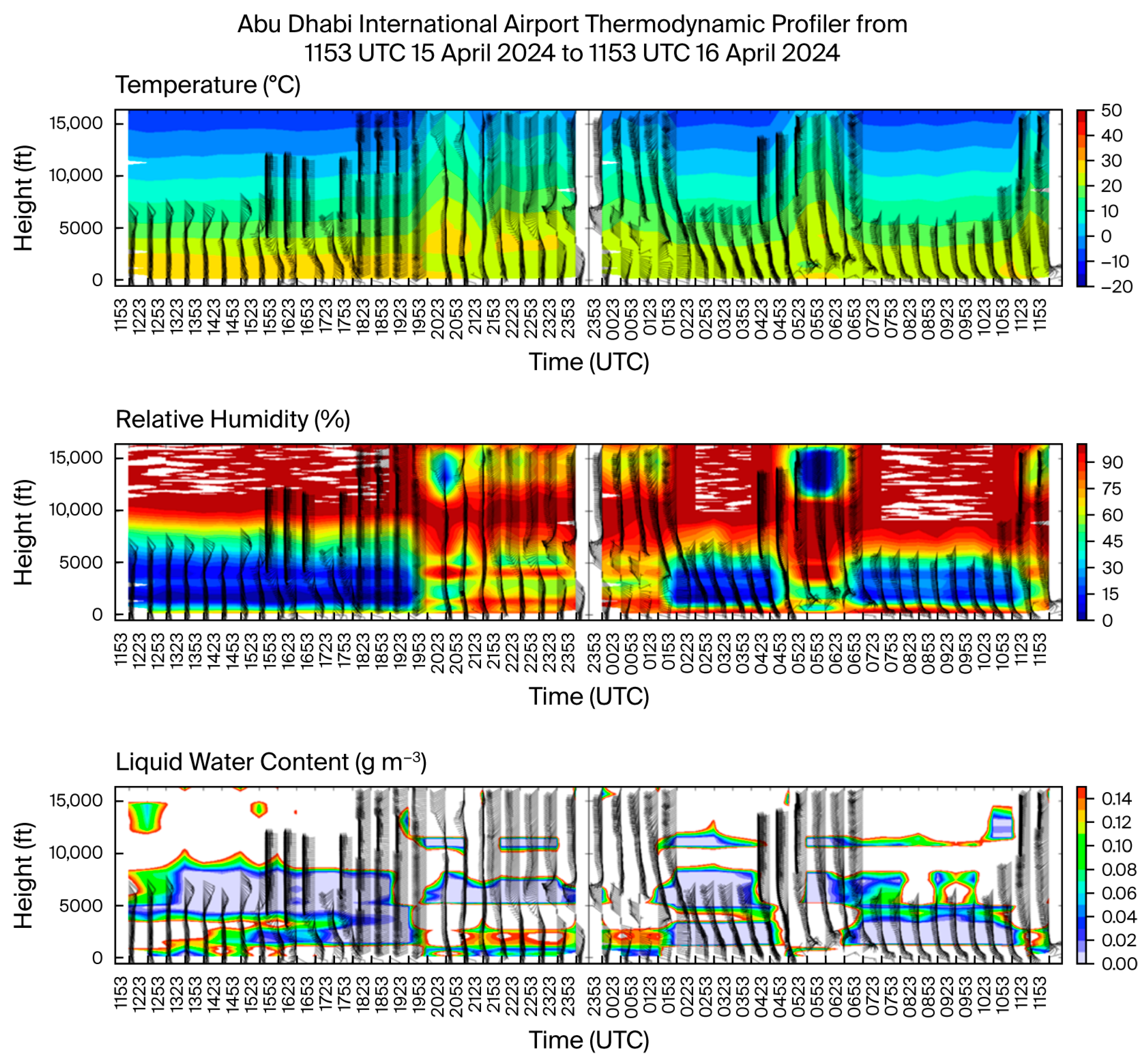
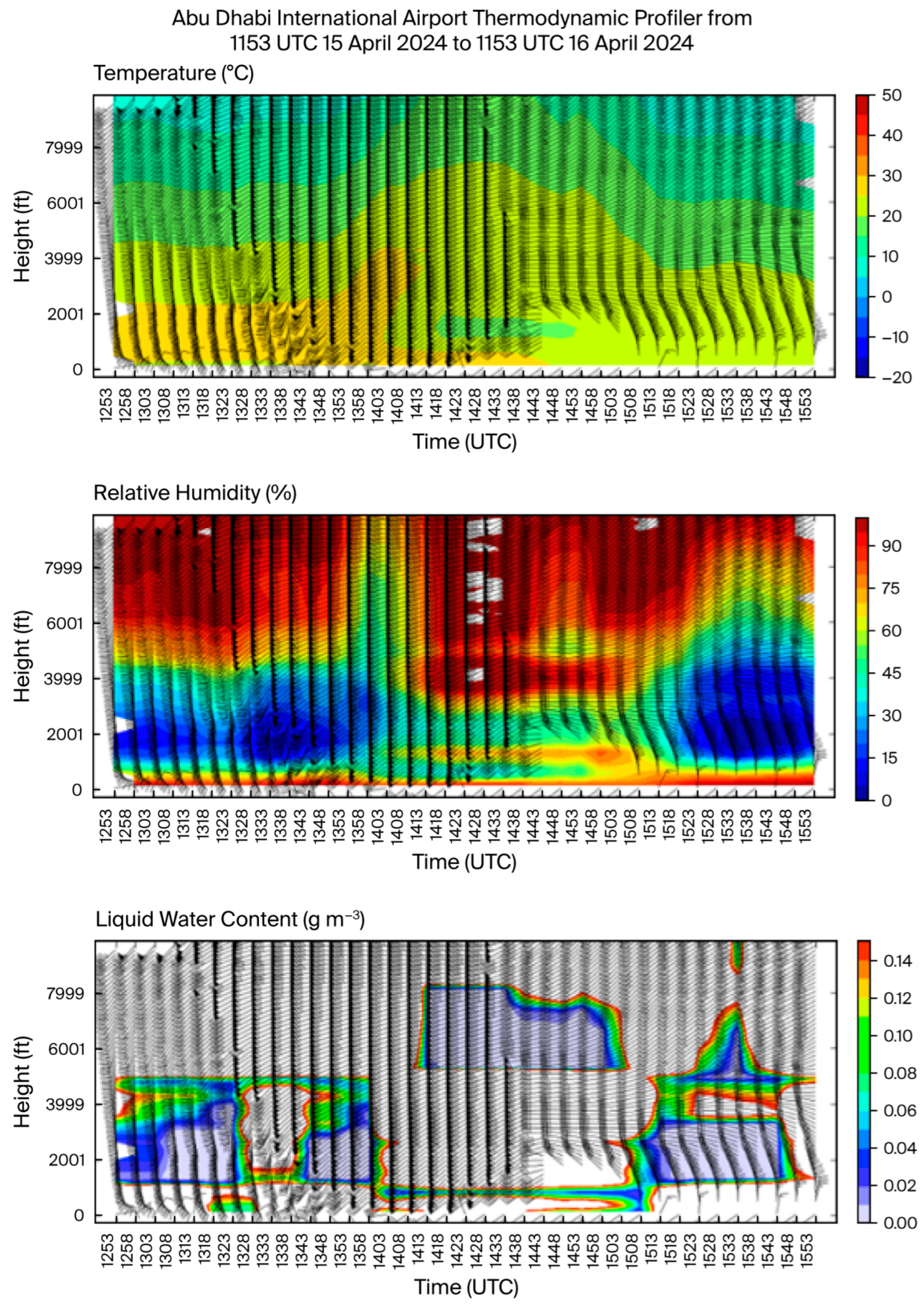
Consistent with this temporary structural adjustment, the thermodynamic wind profiler showed relative-humidity fluctuations in the mid-levels during the same window (Figure 4), suggesting short-lived internal reorganization of the convective columns. See Section 3.6 for the corresponding radar evolution.
Between 2300 UTC on 15 April and 0300 UTC on 16 April 2024, fluctuations in the storm’s parameters reflected internal processes and environmental interactions. Following the earlier intense activity, the convective available potential energy (CAPE) dropped below 1000 J kg−1, signaling a transition to a more stable environment (Figure 5a). The depletion of moisture and latent heat sources, combined with dry air entrainment, reduced buoyancy and limited moisture in the storm’s core at mid-levels, weakening its ability to sustain strong convection.
Changes in wind speed and direction with height expanded the storm horizontally and offset the alignment of updrafts and downdrafts, indicating a strong tilt in the system. This tilt signified reduced dependence on moisture and thermal instability forcings. Consequently, the storm relied more heavily on upper-level dynamics, disconnecting from lower-level moisture sources. This shift was apparent as the storm’s core rose to higher levels to sustain its intensity. During this period, reflectivity and precipitation rates showed modest changes, indicating continuous rainfall but with reduced coverage and variable intensity. A swift dissipation followed as the system lost connection to primary moisture, vertical coherence, and instability sources.
During this period, thermodynamic profiles showed diminished liquid-water content and mid- to upper-level cooling (Figure 4), confirming the depletion of buoyant energy and the complete breakdown of conditions sustaining deep convection.
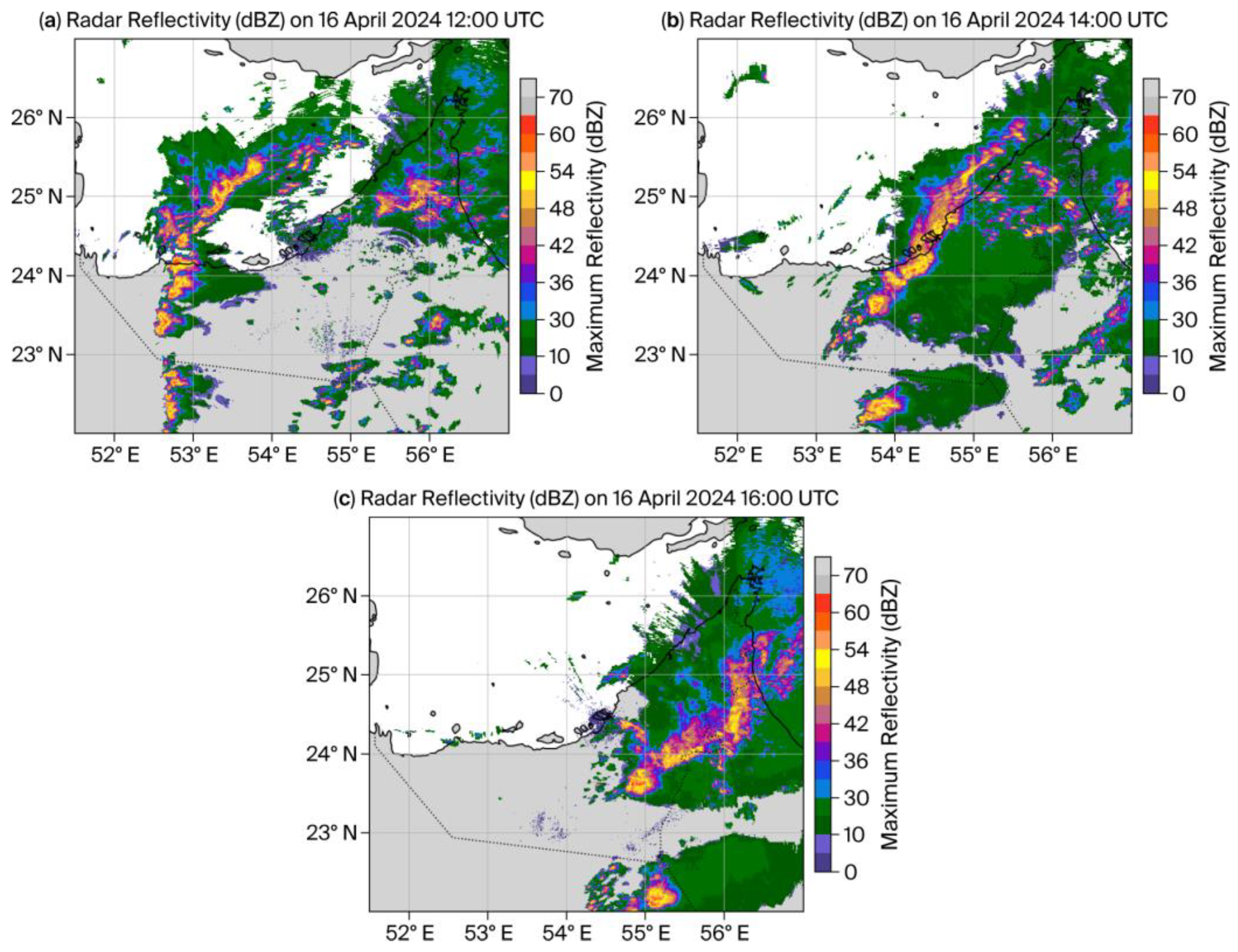
At 1200 UTC on 16 April 2024, the Abu Dhabi sounding indicated deep-convection readiness, with elevated CAPE and a low lifted-condensation level (~945 m) favoring easy parcel lifting (Figure 5b). In the ensuing radar evolution, this thermodynamic support manifests as a strengthening and deepening bow echo, with central reflectivity exceeding 65 dBZ and storm tops approaching ~19 km (Figure 6b,c). The radar morphology and metrics are described in detail in Section 3.6.
As the bow echo moved through Abu Dhabi International Airport, data from the thermodynamic wind profiler (Figure 7) indicated that warm, moist air dominated the lower atmosphere, with a distinct gradient transition zone between this warm air and cooler air aloft. As the storm approached, a mid-level dry intrusion—a critical structural feature—became apparent, marked by cooling between ~610 and 2439 m. The interaction of warm, dry air aloft with cooler, moist surface air triggered evaporational cooling, the development of a gust front, and intense downdrafts, driven by vertical instability.
At the storm’s peak intensity over the profiler, surface cooling caused by the descending rear-inflow jet intensified the storm’s bowing and asymmetric structure. The sharp increase in low-level liquid water content indicated an evaporation-driven downdraft at the trailing edge of the bow echo [84,85]. As the storm progressed, downdrafts spread outward from the low to mid-levels, reducing vertical development and limiting further intensification.
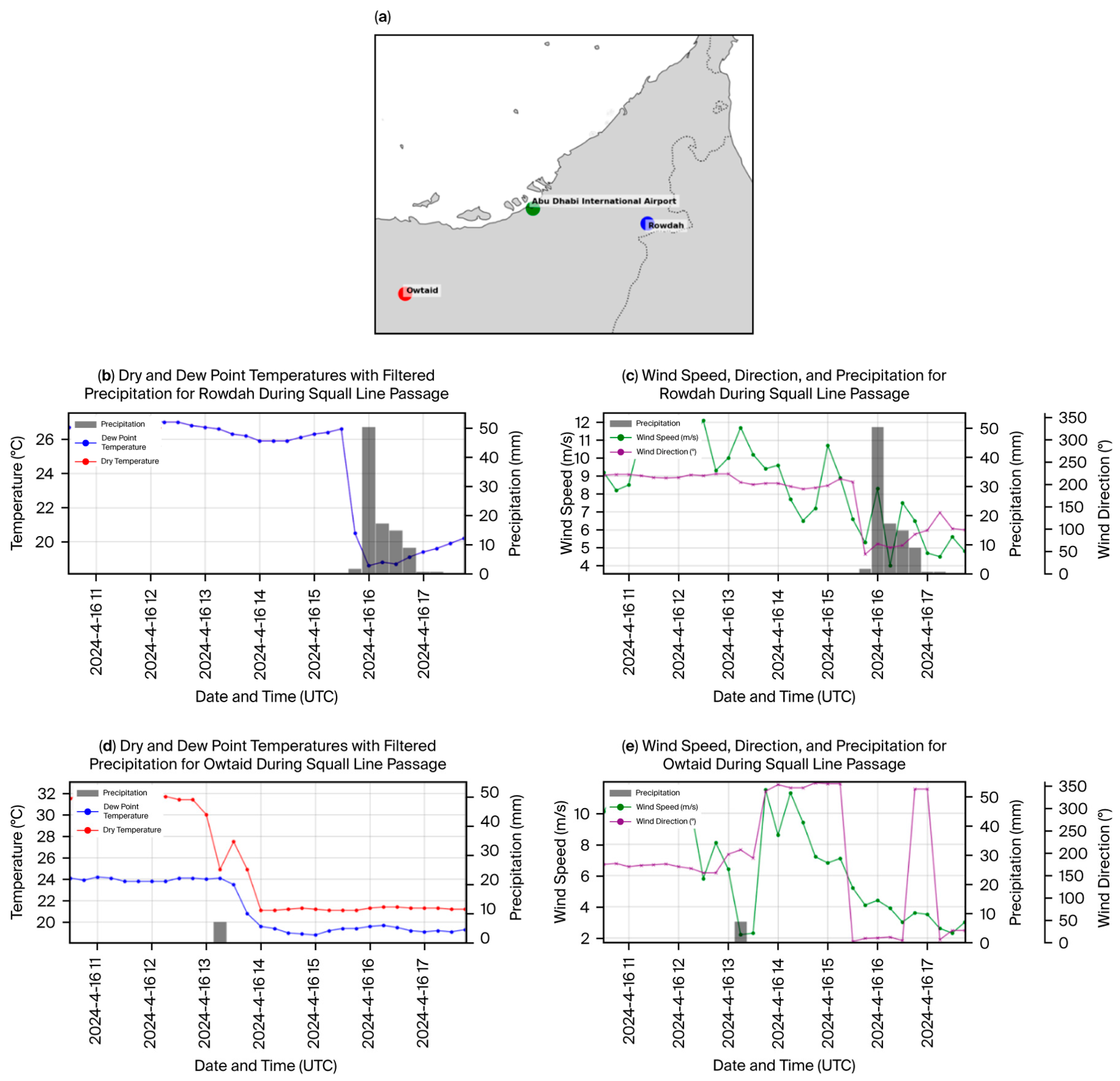
When the storm passed stations west of the Hajar Mountains, such as Rowdah (Table 1), a sudden drop in both temperature and relative humidity occurred just before heavy rainfall began, signaling the cold pool’s advancement from the storm (Figure 8b). Additionally, wind speed dropped sharply before and during heavy rainfall, reflecting gust front effects and interactions between updrafts and downdrafts (Figure 8c). Overall, the passage of the bow echo system was marked by a pattern of heavy rainfall, strong winds, and rapid declines in surface temperature and moisture.
Soundings and profiler data confirm periods of favorable instability and shear consistent with organized convection, linking the environmental setup to the timing of ascent and first echoes; we quantify initiation relative to vertical motion signals next.

3.4. Vertical Motion and Storm Initiation Timing

As part of RQ3 (relative roles of the COL, STJ, and monsoon), this section examines the onset of vertical motion and timing of convective initiation to connect upper-level forcing with early storm development.
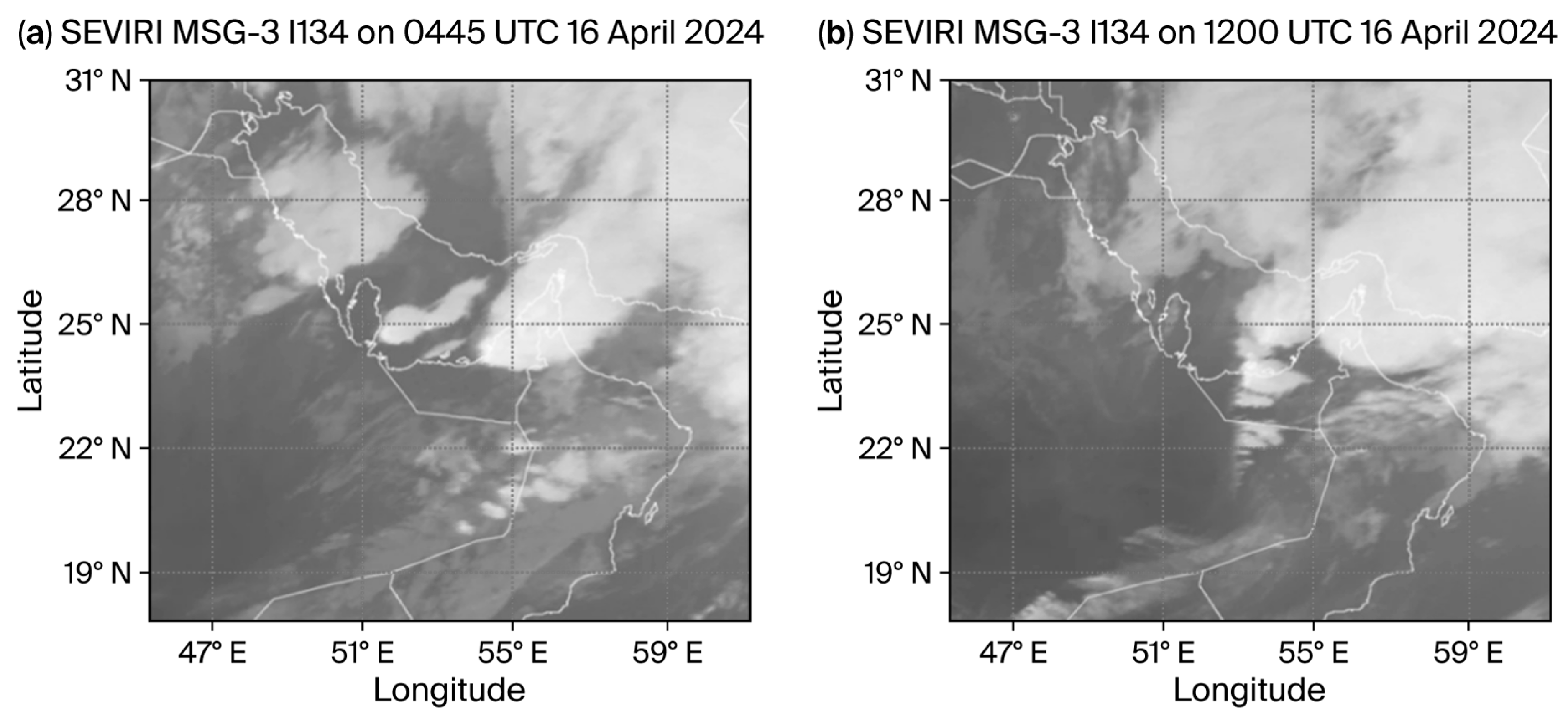
The SEVIRI 13.4 µm imagery showed an expanding plume of cold cloud tops and an extensive cirrus shield east of the COL moving toward the UAE from the central Arabian Peninsula (Figure 3c). The rapid cooling of cloud-top brightness temperatures and downstream cirrus development are consistent with vigorous ascent and upper-level divergence ahead of the trough. Shortly thereafter, radar registered first echoes and rapid deepening, with rising echo tops and increasing maximum reflectivity that marked convective initiation and growth (Figure 9a and Figure 10c).
Thermodynamic readiness for initiation is supported by the 0000 UTC sounding (Figure 5a), while subsequent profiler time–height structure (Figure 4) documents moistening and cooling aloft during the approach. In parallel, intense convective complexes intensified the COL via latent heat release as water vapor condensed into clouds and precipitation. This process enhanced the temperature contrast between the warm core of the low-pressure center and its surrounding environment, further deepening the low-pressure system and maintaining high-instability levels over the region.
Upper-level divergence aligned with the first signs of radar deepening, indicating when convection began (initiation timing) and how it was triggered (initiation mechanism). We then document the resulting surface impacts and rainfall distribution.

3.5. Precipitation Distribution and Surface Signals

To further address RQ3, we compare rainfall distribution, wind shifts, and surface thermodynamic changes to evaluate how large-scale and mesoscale dynamics translated into local impacts.
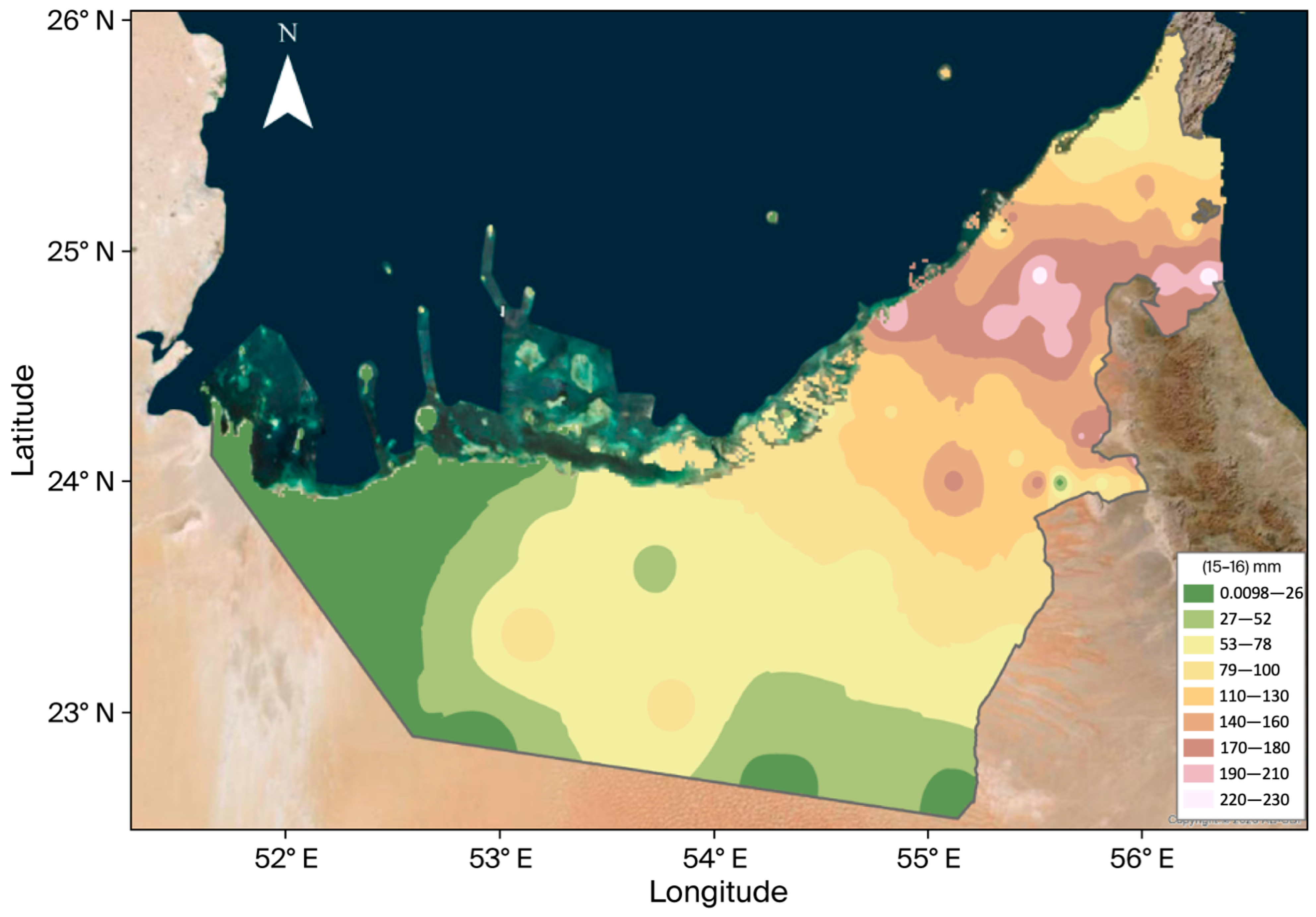
The storm development led to widespread flooding, with accumulated precipitation reaching up to 259.5 mm over the study period (Figure A2 and Figure A3). The temporal evolution shows station peaks clustered between ~18:30–23:30 UTC on 15 April, coincident with intensification in the radar data (Figure 9a).
Notable wind shifts and increased wind speeds were recorded (Figure 8e) as the bow echo passed over an automated weather observation station in Owtaid, located in the UAE’s interior desert region (Table 1). These changes were caused by a moderate downdraft associated with the descending rear-inflow jet, a common feature in such storms.
Station peaks, wind shifts, and temperature drops corroborate the radar chronology and cold-pool evolution, connecting surface signals to the evolving storm structure; we now analyze mesoscale organization and lifecycle using TITAN metrics.

3.6. Mesoscale Organization: Storm Lifecycle and Bow Echo

Completing the analysis of RQ3, we investigate the full storm lifecycle using radar-based TITAN tracking to assess mesoscale organization, intensity evolution, and the dominant forcing mechanisms shaping the bow echo.
A large-scale storm system approached the UAE from the southwest at 1336 UTC on 15 April 2024, sweeping across the country and eventually decaying by 0506 UTC on 16 April 2024. This slow-moving storm displayed characteristics of a synoptic-scale system influenced by the Indian monsoon and enhanced by a COL over the Arabian Peninsula. We examined the storm’s evolution and structure in detail using the TITAN5 storm detection and tracking algorithm.
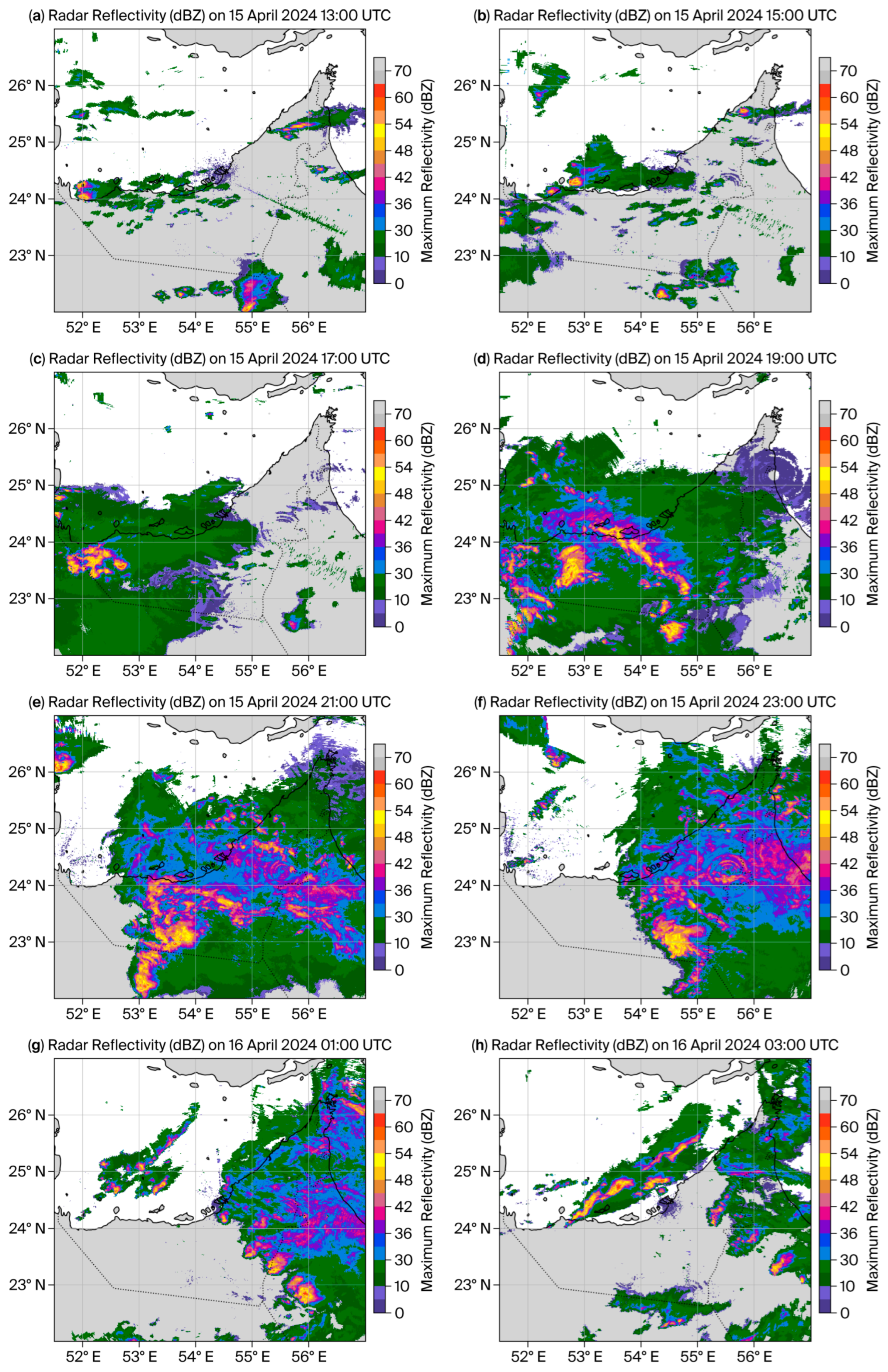
During the storm’s initial phase (~1300–1800 UTC on 15 April 2024) (Figure 9a and Figure 10b,c), large-scale forcing mechanisms, such as lifting along with moisture advection associated with the COL from the southwest, determined the storm’s structure and evolution. These forcings led to a steady increase in maximum reflectivity values, reflecting strong vertical development that reached up to the tropopause.
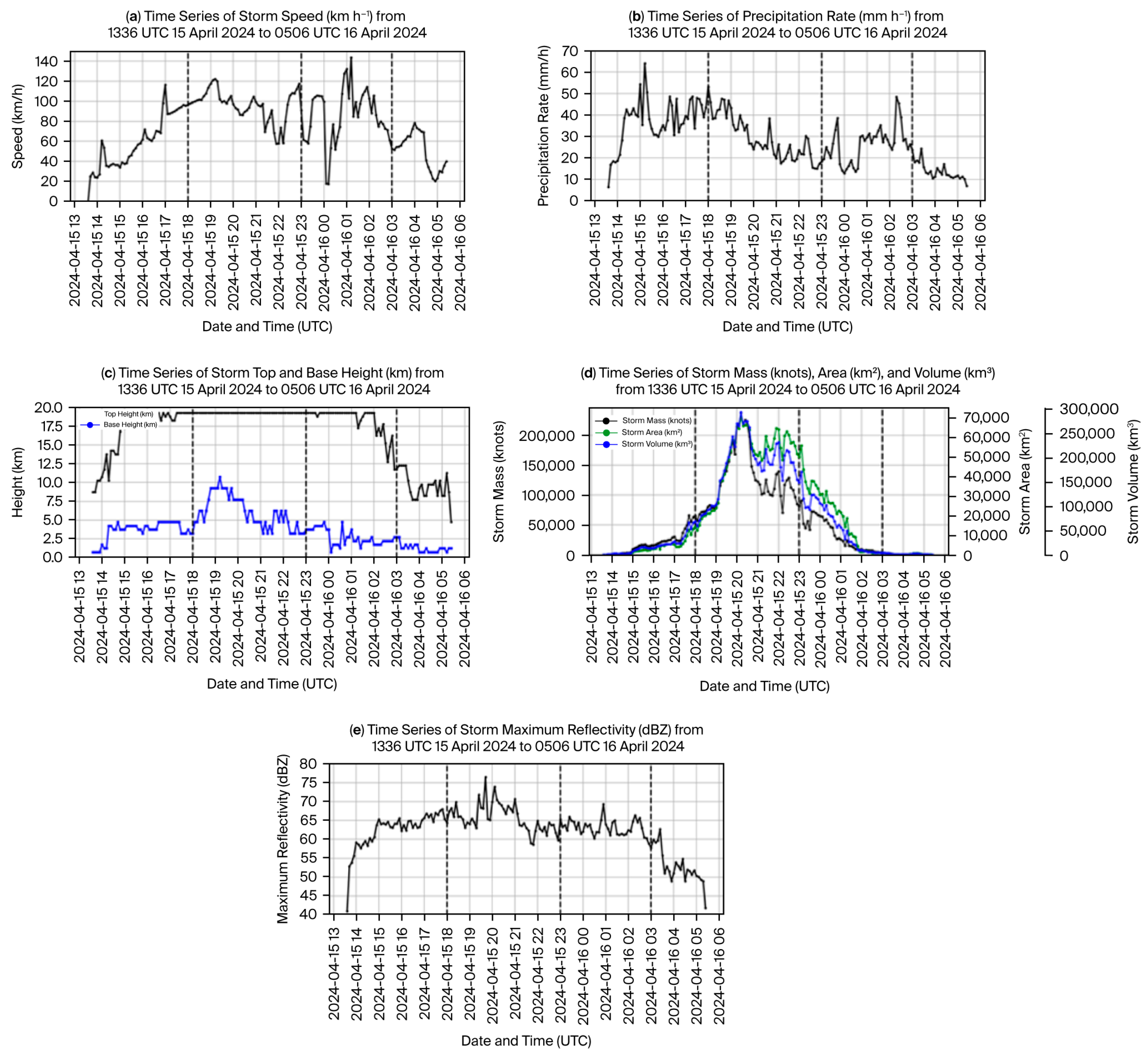
In the storm initial stage, speed gradually increased with strong steering flow from the southwest. Temporary speed spikes were observed (Figure 10a), although the storm generally maintained a steady pace. Variability in the storm’s motion due to changing steering wind patterns led to a broad area of precipitation with a lower rate than typically seen in slower-moving storms. The storm’s depth also temporarily decreased as its energy redistributed from a vertically compact to a more horizontally elongated structure.
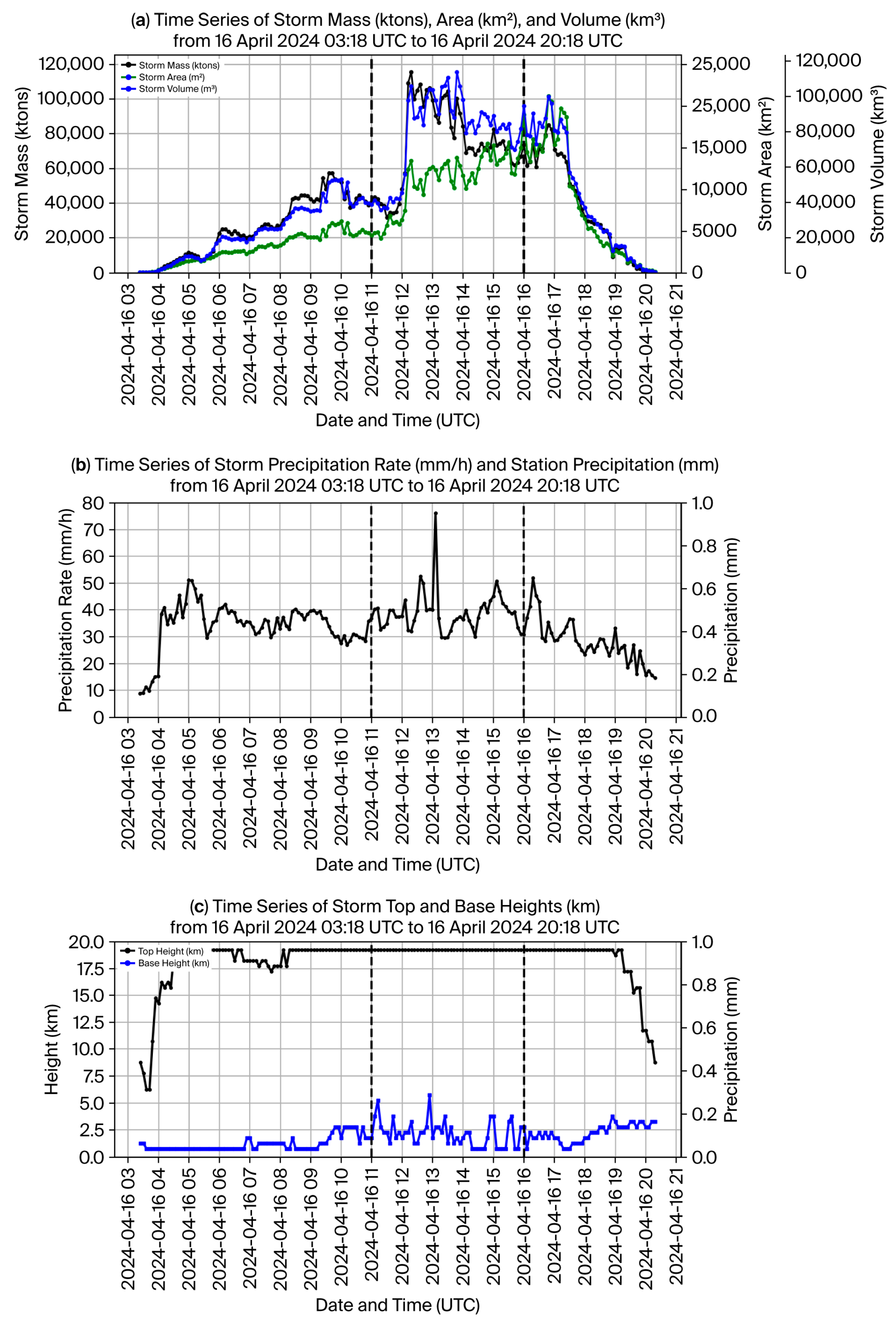
During the peak phase (~1800–2300 UTC on 15 April 2024) (Figure 9e,f and Figure 10d), the cloud depth dipped below 12 km for approximately 2 h before resuming its upward trend (Figure 10c), while maximum reflectivity remained steady. This combination indicates a transient structural adjustment—vertical redistribution without a marked change in overall intensity.
The highest reflectivity value, exceeding 75 dBZ, was recorded at 1930 UTC, followed by an increase in the storm’s volume and mass due to a surge in liquid water content (Figure 10d,e). This peak reflects the production of large raindrops and hail over a concentrated area. Bursts of reflectivity over 65 dBZ were observed throughout the storm’s intensification phase, signifying strong localized updrafts within the storm.
As the storm expanded over a larger area, its average precipitation rate declined from approximately 55 to 25 mm h−1, even as the overall storm volume and mass increased (Figure 10b–d). This well-developed, intense, and organized storm slowed as it became more anchored in the atmosphere with a reduced forward speed [86] leading to a dilution of the precipitation intensity over a wider area.
The peak values of the storm’s volume, mass, and area indicated a robust, organized mesoscale convective system embedded within a larger synoptic-scale storm. This system was driven by strong updrafts, moisture, latent heat release, and atmospheric instability, fueled by multiple sources. As hydrometeor suspension increased, the storm’s spatial coverage further expanded, resulting in a reduced precipitation intensity over individual areas within the system. The increased storm volume, combined with strong vertical velocities, intensified the storm’s internal dynamics and enhanced the likelihood of severe impacts.
As deep convective clouds spread and insolation reduced, the widespread cooling ultimately destabilized and weakened the storm as it moved away. The storm’s core lost intensity, and its structure became increasingly disorganized [87]. Though the storm maintained a broad precipitation area, the intensity declined, with peak reflectivity values falling below 65 dBZ.
Consistent with the thermodynamic analysis, CAPE remained below 1000 J kg−1 while mid-level RH minima were present (Figure 5a), a combination that limits updraft buoyancy and favors broader, more stratiform precipitation coverage. See Section 3.3 for the detailed thermodynamic context.
Between 0300 and 0500 UTC on 16 April 2024, the storm lost structural integrity, and its areal coverage diminished as large-scale forcing factors weakened. The thermodynamic profile (Figure 4) showed a reduction in the liquid water content at higher altitudes and cooling in the mid-to-upper levels. The storm speed decreased as the steering flow weakened, and its shape became more asymmetrical. The precipitation rate dropped from earlier values above 50 mm h−1 to below 20 mm h−1 (Figure 10b), while the maximum reflectivity decreased from 65 to 75 dBZ to approximately 50 dBZ (Figure 10e), signifying the dissipation of the storm’s convective core and energy sources. The storm’s expansion, disorganization, and slowing forward speed signaled the complete breakdown of the environmental conditions that had previously sustained its growth and intensity.
On 16 April 2024, the front extending across the Arabian Gulf, coupled with deep upper-level instability, initiated multiple bow echo systems that propagated eastward and interacted with moisture plumes from the Arabian Sea [88,89]. Satellite imagery (Figure 11) revealed a series of intense, linear mesoscale convective systems forming along this frontal boundary [90,91].
The bow echo initially formed from two clusters of convective cells—one southeast of the UAE and another over the Arabian Gulf—that merged, creating an elongated bow-shaped structure. These isolated convective cells generated intense, localized updrafts, extensive horizontal spread, and significant hydrometeor production, characteristics typical of bow echo morphology [92,93]. As the storm structure developed, organized and intensified updrafts led to moisture accumulation and hydrometeor loading aloft. The increased moisture inflow expanded the storm’s volume and area, while strong vertical accelerations enhanced precipitation production. With the merging of cells, the storm became more cohesive and organized, increasing storm parameters while keeping top and base heights relatively steady [94,95,96,97].
The storm briefly stabilized before reaching the mature phase, indicated by a sharp decrease in vertical velocity, hydrometeor loading, and overall kinetic energy (Figure 6a and Figure 12). At this stage, the storm reorganized into a new and more structured configuration.
During the mature phase (~1100–1600 UTC on 16 April 2024), the bow echo displayed a classic hook/comma morphology with intense low-level rotation and rear-flank divergence [98]. Central reflectivity exceeded 65 dBZ, rainfall rates peaked near 75 mm h−1 (Figure 10b), and the system reached ~19 km tops with 2–5 km bases (Figure 10c). As the structure elongated, volume and mass increased faster than area, indicating concentrated vertical development. The thermodynamic context supporting this intensification is summarized in Section 3.3 (Figure 5b).
At Abu Dhabi International Airport, profiler signatures were consistent with the thermodynamic features summarized in Section 3.3—namely, a moist boundary layer capped by a sharp transition and a mid-level dry intrusion—supporting an interpretation of evaporational cooling, gust-front development, and strong downdrafts during the bow-echo passage (Figure 7).
After 1600 UTC, the storm began to weaken as it lost access to primary low-level moisture sources, and upper-level forcing decreased. As downdrafts overtook the previous updrafts, the influx of cold, descending air inhibited further storm development, leading to disorganized remnants and a decline in the overall storm intensity.
The lifecycle analysis shows a well-organized mesoscale convective system embedded within the synoptic forcing, with peak intensity modulated by jet dynamics and moisture availability, supporting RQ3’s attribution that the COL was primary with STJ support and moisture preconditioning.

4. Discussion

The strong temperature gradient associated with the STJ’s troughing can induce a COL, which is characterized by a closed circulation in the mid-to-lower troposphere, fostering the development deep convection [99,100], consistent with findings from previous studies [101,102]. The coupling between jet-stream dynamics and COL evolution created an unstable environment conducive to mesoscale convective system development [103].
When considered together, the diagnostics indicate that the COL governed the sequence of atmospheric developments. The closed circulation and its progression from negative toward neutral tilt aligned with the strongest ascent, while jet-level divergence alone did not produce organized convection in the absence of a deep closed core. Persistent Arabian Sea moisture advection preconditioned the lower troposphere but was insufficient to reproduce the observed organization or rainfall intensity [104], consistent with studies emphasizing the controlling roles of cutoff-low depth/tilt and jet-streak geometry in ascent efficiency and event longevity [105,106].
As the system intensified, a positive feedback loop developed, promoting sustained thunderstorm activity. The COL, aided by the meandering STJ, was the primary driver of the severe weather [107,108], while the transition from intense, localized rainfall to broader, lower-rate precipitation followed the shift to a neutral or positive tilt.
Regional analyses further confirm that STJ variability and moisture pathways act in tandem during Middle East rainfall extremes. Comparable synoptic–thermodynamic interactions have been documented for Middle East and North African spring storms [109,110,111], further supporting the relevance of COL–STJ coupling and Arabian Sea moisture transport identified here. Studies link southward jet displacement to enhanced severe-weather potential [22], identify the Arabian Sea as a recurrent moisture source [54], and document atmospheric-river-like surges into the Gulf that strengthen convection under synoptic forcing [14]. Assessments for April 2024 similarly point to upper-level troughing and anomalously warm SSTs enhancing moisture supply, consistent with our attribution of a COL-dominated event aided by jet divergence and monsoon inflow [55,56,57].
In summary, the April 2024 UAE rainfall event followed a COL-led pathway in which upper-level dynamics organized ascent, and low-level inflow preconditioned the column. The COL deepened and tilted with baroclinic instability as it crossed the Arabian Peninsula, sustaining vertical development and widespread convection with tops reaching the tropopause (~17.5 km). Operationally, early warning in the UAE benefits from routine monitoring of COL geometry (depth and tilt) in the 500–700 hPa layer, combined with jet-quadrant analysis and low-level humidity surveillance. Jet divergence without an overhead deep COL did not produce organized convection, while the subsequent neutral/positive tilt phase coincided with broader but weaker rainfall, information valuable for timing impacts and short-term forecasts. Similar approaches integrating model-based diagnostics with radar and in situ observations have proven effective in improving situational awareness in regional operations [112,113].
This study demonstrates that COL formation and evolution are central to severe convective activity over the UAE. Our results highlight the complex interplay between upper-level jet dynamics and low-level moisture in amplifying convection and provide guidance for anticipating high-impact weather events in data sparse, hyperarid regions.
Unlike most prior modeling-only investigations, this study integrates multi-source radar and surface observations to diagnose the synoptic and mesoscale mechanisms driving the April 2024 UAE rainfall event. The combined use of radar, satellite, and dense station data provides a rare observational perspective on COL–STJ–moisture coupling in a hyperarid environment, offering process-level insight into the evolution of extreme convection in the Arabian Peninsula.

5. Conclusions

The conclusions are drawn from the combined evidence in Section 3.1, Section 3.2, Section 3.3. Section 3.4, Section 3.5 and Section 3.6 ECMWF-HRES fields, satellite imagery, radar tracking, and AWS records. Taken together, these sources show a consistent linkage between synoptic forcing, mesoscale structure, and the April 2024 rainfall.
A deep, initially negatively tilted COL phased with a south-displaced STJ organized ascent on 15–16 April; as the COL evolved toward a neutral or positive tilt, precipitation broadened and rates declined. Arabian Sea inflow preconditioned the column but did not, by itself, reproduce the observed organization or rain rates. Thermodynamic analysis shows that buoyancy and vertical shear were governed by the evolving COL–STJ interaction rather than local surface heating.
Overall, the COL’s closure, depth, and tilt were the primary drivers, with jet-level divergence and monsoon-sourced moisture acting in supporting roles. The agreement among synoptic, thermodynamic, and radar indicators directly supports the attribution criteria outlined in Section 2.5. Operationally, these verified relationships have direct forecasting implications. Early warning in hyperarid terrain should prioritize COL geometry/tilt, jet-quadrant diagnostics, and IVT/low-level RH monitoring. Looking ahead, a UAE spring catalog contrasting COL and jet-only events, together with quantified IVT thresholds, would provide practical guidance for QPF/QPE.
The NCM of the UAE aims to provide early warnings and improve operational forecasting to mitigate future extreme weather impacts. Further studies are recommended to assess the frequency, trends, and impacts of similar COLs in the region. Investigating the role of atmospheric river connections and interactions with the ITCZ in modulating COLs in the Arabian Peninsula would also be valuable for future research.
By advancing our understanding of the synoptic and mesoscale drivers of extreme weather events, this study contributes to the improvement of seasonal rainfall forecasts. Knowledge of the circulation patterns associated with weather events can be used to assess how changing climate conditions may impact regional rainfall patterns. Incorporating findings into hydrological models can improve simulations of water resource availability in the Arabian Peninsula. Future research could explore how shifts in rainfall patterns affect groundwater recharge, flood risks, and drought cycles.
Linking each conclusion to the underlying evidence shows that combining synoptic diagnostics with mesoscale radar and surface observations provides a consistent physical account of the 15–16 April 2024 event. This provides a solid basis for forecasting, risk management, and future climatological work on COL-driven rainfall in the Arabian Peninsula.

Author Contributions

Conceptualization, A.A.K. (Ahmed Al Kaabi), E.A., A.A.K. (Ahmad Al Kamali), S.F. and B.M.; data curation, N.A. and M.H.; formal analysis, N.A.; investigation, N.A.; methodology, N.A., M.W. and A.V.; project administration, A.A.K. (Ahmed Al Kaabi); resources, A.A.M. (Abdulla Al Mandous), O.A.Y. and A.A.M. (Alya Al Mazrouei); validation, A.A.K. (Ahmad Al Kamali) and M.W.; visualization, N.A. and M.A.G.; writing—original draft, N.A.; writing—review and editing, N.A. and M.W. All authors have read and agreed to the published version of the manuscript.

Funding

This research received no external funding.

Institutional Review Board Statement

Not applicable.

Informed Consent Statement

Not applicable.

Data Availability Statement

The ECMWF’s “atmospheric model high-resolution 10-day forecast (Set I—HRES)” model output is publicly accessible at https://www.ecmwf.int/en/forecasts/datasets/set-i (accessed on 6 October 2025). NASA Landsat-9 data can be accessed at https://landsat.gsfc.nasa.gov/data/data-access/ (accessed on 6 October 2025). The other datasets are archived at the National Center of Meteorology of the United Arab Emirates and are available upon request from the corresponding author. The data are not publicly available due to the policy of our project.

Acknowledgments

We acknowledge the European Centre for Medium-Range Weather Forecasts (ECMWF, Reading, United Kingdom) for access to archived HRES data (expired real-time) made available under the Creative Commons Attribution 4.0 International (CC BY 4.0) license; EUMETSAT (Darmstadt, Germany) for MSG-SEVIRI observations; NASA (Washington, DC, USA) for Landsat-9 imagery. Additionally, we recognize the Climate Section of the National Center of Meteorology for supplying quality-controlled surface observations. The authors used an AI-based language editing tool solely to improve grammar and readability; All scientific ideas, analysis, and interpretations are entirely the work of the authors.

Conflicts of Interest

The authors declare no conflicts of interest.

Abbreviations

The following abbreviations were used in this manuscript:
UAEThe United Arab Emirates
NCMNational Center of Meteorology
COLCut-Off Low Pressure
STJSubtropical Jet
ENSOEl Niño–Southern Oscillation
ECMWFThe European Centre for Medium-Range Weather Forecasts
HRESAtmospheric Model High-Resolution 10-Day Forecast
NASANational Aeronautics and Space Administration
SEVIRISpinning Enhanced Visible and Infrared Imager
MSG3Meteosat Second Generation
AWSAutomatic Weather Station
TITANThunderstorm Identification Tracking Analysis and Nowcasting
RWTPSRadar Wind and Thermodynamic Profiling System
CAPEConvective Available Potential Energy
ITCZIntertropical Convergence zone

Appendix A

Table A1. The extreme rainfall amounts (top 1%) and their times of occurrence.
StationPrecipitation Amounts and Corresponding Time of Occurrence
Abu-Dhabi76.617-04-200390.416-04-2024101.813-12-2009
Al-Faqa91.211-01-2020171.809-03-2016190.116-04-2024
Al-Jazeera-B.G32.901-05-202433.416-01-20083601-03-2010
Al-Malaiha57.209-03-202460.612-02-202464.811-01-2020164.416-04-2024
Al-Shiweb9408-10-201698.611-01-2020141.516-04-2024287.609-03-2016
Alarad83.411-01-202097.716-04-2024109.817-04-2003
Alfoah121.213-12-2009121.611-01-202012517-12-2017
Al-Gheweifat38.615-01-200840.222-03-200356.220-11-2013
Al-Khazna6818-03-2007115.617-04-2003160.816-04-2024
Alqlaa3125-03-201732.602-12-200634.621-11-2013
Alquaa80.817-04-200384.224-04-2013
Al-Wathbah79.217-04-200384.218-03-2007116.216-04-2024
Al-Tawiyen49.311-01-202050.602-03-201050.613-04-201951.415-01-200876.402-12-200691.216-04-2024
Bu-Hamrah59.814-04-20036217-04-200363.810-01-2020
Das-Island47.417-11-202358.116-04-2024
Dalma81.620-11-201311321-11-2013
Dhudna76.223-03-200992.416-04-202497.627-07-2022131.802-12-2006
Falaj-Al-Moalla65.615-01-200895.413-04-201996.316-04-2024100.411-01-2020
Hamim43.516-04-202444.214-01-200967.414-08-2013
Hatta46.817-07-20214711-01-202082.402-12-200610009-03-2016160.116-04-2024
Jabal-Hafeet-GSM60.516-04-202464.218-03-200780.405-09-200688.117-04-2003
Jabal-Jais6424-03-201764.421-03-201777.613-04-2019104.714-04-2019104.816-04-2024
Jabal-Mebreh6221-03-201774.802-12-200685.516-04-202490.813-04-2019
Khatam-Al-Shaklah125.821-11-2013147.311-01-2020148.212-02-2024254.816-04-2024
Madinat-Zayed44.214-04-200344.802-05-20248008-03-2016
Manama45.215-01-200847.325-05-202056.511-01-2020125.216-04-2024
Makassib3415-01-200834.402-12-200648.623-02-200660.821-11-2013
Masafi73.816-11-201389.428-07-202211316-04-2024123.327-07-2022
Mezaira55.809-03-202483.316-04-2024
Mezyed99.809-03-2016104.808-12-201911817-04-2003121.511-01-2020
Mukhariz41.820-01-200545.728-10-2018
Owtaid65.421-11-201368.414-04-200378.316-04-2024
Qarnen49.217-12-201756.912-02-202458.909-03-2024
Raknah97.217-04-200398.813-12-2009102.911-01-2020185.816-04-2024
Razeen7927-12-2004153.617-04-2003
Saih-Al-Salem91.512-02-2024132.801-01-2022198.716-04-2024
Sham51.402-12-200663.406-02-2010
Sir-Bani-Yas40.615-01-200858.802-12-200669.421-11-2013
Swiehan88.609-03-201697.711-01-2020115.916-04-2024
Um-Azimul47.309-03-202455.609-03-2016
Umm-Al-Quwain51.122-03-202052.926-11-201868.609-03-202485.616-04-2024
Table A2. The frequency of rainfall where amounts exceeded 70 mm up to the maximum recorded.
StationAmount (mm)Frequency
Abu-Dhabi73.06–101.80 mm3
Al-Faqa85.60–190.10 mm3
Al-Malaiha70.00–164.40 mm1
Al-Shiweb87.58–287.60 mm4
Alarad80.94–109.80 mm3
Alfoah109.08–125.00 mm3
Al-Khazna70.00–160.80 mm2
Alquaa74.80–84.20 mm2
Al-Wathbah76.34–116.20 mm3
Al-Tawiyen70.00–91.20 mm2
Dalma70.00–113.00 mm2
Dhudna73.60–131.80 mm4
Falaj-Al-Moalla70.00–100.40 mm3
Hatta70.00–160.10 mm3
Jabal-Hafeet-GS70.00–88.10 mm2
Jabal-Jais70.00–104.80 mm3
Jabal-Mebreh70.00–90.80 mm3
Khatam-Al-Shaklah121.96–254.80 mm4
Madinat-Zayed70.00–80.00 mm1
Manama70.00–125.20 mm1
Masafi70.86–123.30 mm4
Mezaira70.00–83.30 mm1
Mezyed96.30–121.50 mm4
Owtaid70.00–78.30 mm1
Raknah95.27–185.80 mm4
Razeen73.79–153.60 mm2
Saih-Al-Salem86.28–198.70 mm3
Swiehan85.56–115.90 mm3
Umm-Al-Quwain70.00–85.60 mm1

Appendix B

Figure A1. Automatic weather station (AWS) network locations across the UAE.
Atmosphere 16 01267 g0a1
Figure A2. NASA Landsat-9 satellite images before and after the floods caused by the extreme rainfall event.
Atmosphere 16 01267 g0a2
Figure A3. Accumulated rainfall (mm) recorded by AWS rain gauges from 15 to 16 April 2024.
Atmosphere 16 01267 g0a3

References

  1. Dasari, H.P.; Desamsetti, S.; Langodan, S.; Attada, R.; Ashok, K.; Hoteit, I. Long-Term Changes in the Arabian Peninsula Rainfall and Their Relationship with the ENSO Signals in the Tropical Indo-Pacific. Clim. Dyn. 2022, 59, 1715–1731. [Google Scholar] [CrossRef]
  2. Yousef, L.A.; Temimi, M.; Wehbe, Y.; Al Mandous, A. Total Cloud Cover Climatology over the United Arab Emirates. Atmos. Sci. Lett. 2019, 20, e883. [Google Scholar] [CrossRef]
  3. Rao, K.K.; Al Mandous, A.; Al Ebri, M.; Al Hameli, N.; Rakib, M.; Al Kaabi, S. Future Changes in the Precipitation Regime over the Arabian Peninsula with Special Emphasis on UAE: Insights from NEX-GDDP CMIP6 Model Simulations. Sci. Rep. 2024, 14, 151. [Google Scholar] [CrossRef]
  4. Fazel-Rastgar, F.; Rostami, M.; Fallah, B.; Sivakumar, V. Torrential Rainfall with Severe Flooding Associated with a Baroclinic Disturbance on 17 November 2023, United Arab Emirates (UAE). Int. J. River Basin Manag. 2025, 23, 1–10. [Google Scholar] [CrossRef]
  5. Sherif, M.; Almulla, M.; Shetty, A.; Chowdhury, R.K. Analysis of Rainfall, PMP and Drought in the United Arab Emirates. Int. J. Climatol. 2014, 34, 1318–1328. [Google Scholar] [CrossRef]
  6. Almazroui, M.; Saeed, S. Contribution of Extreme Daily Precipitation to Total Rainfall over the Arabian Peninsula. Atmos. Res. 2020, 231, 104672. [Google Scholar] [CrossRef]
  7. Sandeep, S.; Ajayamohan, R.S. Modulation of Winter Precipitation Dynamics Over the Arabian Gulf by ENSO. J. Geophys. Res. Atmos. 2018, 123, 198–210. [Google Scholar] [CrossRef]
  8. Almazroui, M. The Influence of the Madden–Julian Oscillation on the Wet Season Rainfall over Saudi Arabia. Earth Syst. Environ. 2023, 7, 1–14. [Google Scholar] [CrossRef]
  9. Kumar, K.N.; Ouarda, T.B.M.J. Precipitation Variability over UAE and Global SST Teleconnections. J. Geophys. Res. 2014, 119, 10313–10322. [Google Scholar] [CrossRef]
  10. Ouarda, T.B.M.J.; Charron, C.; Niranjan Kumar, K.; Marpu, P.R.; Ghedira, H.; Molini, A.; Khayal, I. Evolution of the Rainfall Regime in the United Arab Emirates. J. Hydrol. 2014, 514, 258–270. [Google Scholar] [CrossRef]
  11. Wehbe, Y.; Temimi, M.; Adler, R.F. Enhancing Precipitation Estimates through the Fusion of Weather Radar, Satellite Retrievals, and Surface Parameters. Remote Sens. 2020, 12, 1342. [Google Scholar] [CrossRef]
  12. Airey, M.W.; Nicoll, K.A.; Harrison, R.G.; Marlton, G.J. Characteristics of Desert Precipitation in the UAE Derived from a Ceilometer Dataset. Atmosphere 2021, 12, 1245. [Google Scholar] [CrossRef]
  13. Nelli, N.R.; Francis, D.; Fonseca, R.; Abida, R.; Weston, M.; Wehbe, Y.; Al Hosary, T. The Atmospheric Controls of Extreme Convective Events over the Southern Arabian Peninsula during the Spring Season. Atmos. Res. 2021, 262, 105788. [Google Scholar] [CrossRef]
  14. Francis, D.; Fonseca, R.; Bozkurt, D.; Nelli, N.; Guan, B. Atmospheric River Rapids and Their Role in the Extreme Rainfall Event of April 2023 in the Middle East. Geophys. Res. Lett. 2024, 51, e2024GL109446. [Google Scholar] [CrossRef]
  15. Muñoz, C.; Schultz, D.; Vaughan, G. A Midlatitude Climatology and Interannual Variability of 200- and 500-HPa Cut-Off Lows. J. Clim. 2020, 33, 2201–2222. [Google Scholar] [CrossRef]
  16. Asiri, M.A.; Almazroui, M.; Awad, A.M. Synoptic Features Associated with the Winter Variability of the Subtropical Jet Stream over Africa and the Middle East. Meteorol. Atmos. Phys. 2020, 132, 819–831. [Google Scholar] [CrossRef]
  17. Alizadeh, O.; Babaei, M. Seasonally Dependent Precipitation Changes and Their Driving Mechanisms in Southwest Asia. Clim. Chang. 2022, 171, 20. [Google Scholar] [CrossRef]
  18. Pendergrass, A.G.; Deser, C. Climatological Characteristics of Typical Daily Precipitation. J. Clim. 2017, 30, 5985–6003. [Google Scholar] [CrossRef]
  19. Abish, B.; Joseph, P.V.; Johannessen, O.M. Climate Change in the Subtropical Jetstream during 1950–2009. Adv. Atmos. Sci. 2015, 32, 140–148. [Google Scholar] [CrossRef]
  20. Fang, J.; Wahl, T.; Fang, J.; Sun, X.; Kong, F.; Liu, M. Compound Flood Potential from Storm Surge and Heavy Precipitation in Coastal China: Dependence, Drivers, and Impacts. Hydrol. Earth Syst. Sci. 2021, 25, 4403–4416. [Google Scholar] [CrossRef]
  21. Panagos, P.; Borrelli, P.; Meusburger, K.; Yu, B.; Klik, A.; Jae Lim, K.; Yang, J.E.; Ni, J.; Miao, C.; Chattopadhyay, N.; et al. Global Rainfall Erosivity Assessment Based on High-Temporal Resolution Rainfall Records. Sci. Rep. 2017, 7, 4175. [Google Scholar] [CrossRef]
  22. Alsubhi, Y.H.; Awad, A.M.; Mashat, A.-W.S.; Labban, A.H. Climatology of the Spring Subtropical Jet Stream over the Middle East and Its Effect on the Synoptic Characteristics of Dust Systems over the Northern Arabian Peninsula. Arab. J. Geosci. 2023, 16, 669. [Google Scholar] [CrossRef]
  23. Whitney, L.F. Relationship of the Subtropical Jet Stream to Severe Local Storms. Mon. Weather Rev. 1977, 105, 398–412. [Google Scholar] [CrossRef]
  24. Bukenberger, M.; Rüdisühli, S.; Schemm, S. Jet Stream Dynamics from a Potential Vorticity Gradient Perspective: The Method and Its Application to a Kilometre-Scale Simulation. Q. J. R. Meteorol. Soc. 2023, 149, 2409–2432. [Google Scholar] [CrossRef]
  25. Winters, A.C.; Keyser, D.; Bosart, L.F. Composite Vertical-Motion Patterns near North American Polar–Subtropical Jet Superposition Events. Mon. Weather Rev. 2020, 148, 4565–4585. [Google Scholar] [CrossRef]
  26. Baehr, C.; Pouponneau, B.; Ayrault, F.; Joly, A. Dynamical Characterization of the FASTEX Cyclogenesis Cases. Q. J. R. Meteorol. Soc. 1999, 125, 3469–3494. [Google Scholar] [CrossRef]
  27. Wernli, H.; Dirren, S.; Liniger, M.A.; Zillig, M. Dynamical Aspects of the Life Cycle of the Winter Storm ‘Lothar’ (24–26 December 1999). Q. J. R. Meteorol. Soc. 2002, 128, 405–429. [Google Scholar] [CrossRef]
  28. Holton, J.R.; Staley, D.O. An Introduction to Dynamic Meteorology. Am. J. Phys. 1973, 41, 752–754. [Google Scholar] [CrossRef]
  29. Pokharel, A.K.; Kaplan, M.L.; Fiedler, S. The Role of Jet Adjustment Processes in Subtropical Dust Storms. J. Geophys. Res. Atmos. 2017, 122, 12122–12139. [Google Scholar] [CrossRef]
  30. Sutcliffe, R.C. Cyclonic and Anticyclonic Development. Q. J. R. Meteorol. Soc. 1939, 65, 518–524. [Google Scholar] [CrossRef]
  31. Esmaeili, Z.; Nasr-Esfahani, M.A.; Ghadim, S.E. The Role of the Red Sea in Moisture Feeding of Flood Events of Iran with Emphasis on Atmospheric River Concept. Meteorol. Atmos. Phys. 2022, 134, 46. [Google Scholar] [CrossRef]
  32. Ralph, F.M.; Dettinger, M.D.; Rutz, J.J.; Waliser, D.E. Introduction to Atmospheric Rivers. In Atmospheric Rivers, 1st ed.; Springer: Cham, Switzerland, 2020; pp. 1–252. [Google Scholar] [CrossRef]
  33. Dezfuli, A.; Bosilovich, M.G.; Barahona, D. A Dusty Atmospheric River Brings Floods to the Middle East. Geophys. Res. Lett. 2021, 48, e2021GL095441. [Google Scholar] [CrossRef]
  34. Schwitalla, T.; Branch, O.; Wulfmeyer, V. Sensitivity Study of the Planetary Boundary Layer and Microphysical Schemes to the Initialization of Convection over the Arabian Peninsula. Q. J. R. Meteorol. Soc. 2020, 146, 846–869. [Google Scholar] [CrossRef]
  35. Mishra, S.K.; Rao, V.B. The Energetics of an Upper Tropospheric Cyclonic Vortex over North---east Brazil. Q. J. R. Meteorol. Soc. 2001, 127, 2329–2351. [Google Scholar] [CrossRef]
  36. Jabbar, M.A.R.; Hassan, A.S. A Cut-off Low at 500 HPa Geopotential Height and Rainfall Events over Iraq: Case Studies. Iraqi J. Phys. 2022, 20, 76–85. [Google Scholar] [CrossRef]
  37. Pinheiro, H.R.; Hodges, K.I.; Gan, M.A. Deepening Mechanisms of Cut-off Lows in the Southern Hemisphere and the Role of Jet Streams: Insights from Eddy Kinetic Energy Analysis. Weather Clim. Dyn. 2024, 5, 881–894. [Google Scholar] [CrossRef]
  38. Portmann, R.; Sprenger, M.; Wernli, H. The Three-Dimensional Life Cycles of Potential Vorticity Cutoffs: A Global and Selected Regional Climatologies in ERA-Interim (1979–2018). Weather Clim. Dyn. 2021, 2, 507–534. [Google Scholar] [CrossRef]
  39. Tyson, P.D.; Preston-Whyte, R.A. The Weather and Climate of Southern Africa, 2nd ed.; Oxford Univ. Press: Cape Town, South Africa, 2000; pp. 1–396. ISBN 9780195718065. [Google Scholar]
  40. Meehl, G.A.; Hurrell, J.W.; Loon, H. Van A Modulation of the Mechanism of the Semiannual Oscillation in the Southern Hemisphere. Tellus A Dyn. Meteorol. Oceanogr. 1998, 50, 442–450. [Google Scholar] [CrossRef]
  41. Singleton, A.T.; Reason, C.J.C. A Numerical Model Study of an Intense Cutoff Low Pressure System over South Africa. Mon. Weather Rev. 2007, 135, 1128–1150. [Google Scholar] [CrossRef]
  42. Singleton, A.T.; Reason, C.J.C. Numerical Simulations of a Severe Rainfall Event over the Eastern Cape Coast of South Africa: Sensitivity to Sea Surface Temperature and Topography. Tellus A Dyn. Meteorol. Oceanogr. 2006, 58, 335–367. [Google Scholar] [CrossRef]
  43. Romero, R.; Doswell, C.A.; Ramis, C. Mesoscale Numerical Study of Two Cases of Long-Lived Quasi-Stationary Convective Systems over Eastern Spain. Mon. Weather Rev. 2000, 128, 3731–3751. [Google Scholar] [CrossRef]
  44. Galvin, J.F.P. The Weather and Climate of the Tropics: Part 6—Monsoons. Weather 2008, 63, 129–137. [Google Scholar] [CrossRef]
  45. Gadgil, S. The Indian Monsoon and Its Variability. Annu. Rev. Earth Planet Sci. 2003, 31, 429–467. [Google Scholar] [CrossRef]
  46. Wang, P. Global Monsoon in a Geological Perspective. Sci. Bull. 2009, 54, 1113–1136. [Google Scholar] [CrossRef]
  47. An, Z.; Wu, G.; Li, J.; Sun, Y.; Liu, Y.; Zhou, W.; Cai, Y.; Duan, A.; Li, L.; Mao, J.; et al. Global Monsoon Dynamics and Climate Change. Annu. Rev. Earth Planet Sci. 2015, 43, 29–77. [Google Scholar] [CrossRef]
  48. Schneider, E.K.; Lindzen, R.S. Axially Symmetric Steady-State Models of the Basic State for Instability and Climate Studies. Part I. Linearized Calculations. J. Atmos. Sci. 1977, 34, 263–279. [Google Scholar] [CrossRef]
  49. Schneider, E.K. A Simplified Model of the Modified Hadley Circulation. J. Atmos. Sci. 1987, 44, 3311–3328. [Google Scholar] [CrossRef]
  50. Held, I.M.; Hou, A.Y. Nonlinear Axially Symmetric Circulations in a Nearly Inviscid Atmosphere. J. Atmos. Sci. 1980, 37, 515–533. [Google Scholar] [CrossRef]
  51. de Vries, A.J.; Feldstein, S.B.; Riemer, M.; Tyrlis, E.; Sprenger, M.; Baumgart, M.; Fnais, M.; Lelieveld, J. Dynamics of Tropical–Extratropical Interactions and Extreme Precipitation Events in Saudi Arabia in Autumn, Winter and Spring. Q. J. R. Meteorol. Soc. 2016, 142, 1862–1880. [Google Scholar] [CrossRef]
  52. Wehbe, Y.; Ghebreyesus, D.; Temimi, M.; Milewski, A.; Al Mandous, A. Assessment of the Consistency among Global Precipitation Products over the United Arab Emirates. J. Hydrol. Reg. Stud. 2017, 12, 122–135. [Google Scholar] [CrossRef]
  53. Govardhan, D.; Pathak, R.; Ashok, K.; Asiri, M.I.; Zamreeq, A.; Hoteit, I. Midlatitude Circulations Linked to Seasonal Extreme Precipitation and Extreme Temperature Events in the Arabian Peninsula. Clim. Dyn. 2025, 63, 117. [Google Scholar] [CrossRef]
  54. Horan, M.F.; Batibeniz, F.; Kucharski, F.; Almazroui, M.; Abid, M.A.; Fu, J.S.; Ashfaq, M. Moisture Sources for Precipitation Variability over the Arabian Peninsula. Clim. Dyn. 2023, 61, 4793–4807. [Google Scholar] [CrossRef]
  55. Francis, D.; Fonseca, R.; Nelli, N.; Cherif, C.; Yarragunta, Y.; Zittis, G.; Jan de Vries, A. From Cause to Consequence: Examining the Historic April 2024 Rainstorm in the United Arab Emirates through the Lens of Climate Change. NPJ Clim. Atmos. Sci. 2025, 8, 183. [Google Scholar] [CrossRef]
  56. Sripathi, G.; Osuri, K.K.; Ramu, D.A.; Katru, N. Impact of Arabian Sea Warming on Trough Dynamics and Flooding Intensification over the Dubai Flood 2024. Mausam 2025, 76, 1157–1170. [Google Scholar] [CrossRef]
  57. Halder, S.; Khan, B.; Pauluis, O.; Lachkar, Z.; Paparella, F. On the Role of Sea Surface Temperature Variability in Southern Arabian Peninsula Extreme Rainfall on 16th April 2024. In Proceedings of the EGU25, Vienna, Austria, 27 April–2 May 2025. [Google Scholar] [CrossRef]
  58. Böer, B. An Introduction to the Climate of the United Arab Emirates. J. Arid Environ. 1997, 35, 3–16. [Google Scholar] [CrossRef]
  59. Husain, T.; Chaudhary, J.R. Human Health Risk Assessment Due to Global Warming—A Case Study of the Gulf Countries. Int. J. Environ. Res. Public Health 2008, 5, 204–212. [Google Scholar] [CrossRef] [PubMed]
  60. Beck, H.E.; Zimmermann, N.E.; McVicar, T.R.; Vergopolan, N.; Berg, A.; Wood, E.F. Present and Future Köppen-Geiger Climate Classification Maps at 1-Km Resolution. Sci. Data 2018, 5, 180214. [Google Scholar] [CrossRef]
  61. Yang, D.; Wang, W.; Hong, T. A Historical Weather Forecast Dataset from the European Centre for Medium-Range Weather Forecasts (ECMWF) for Energy Forecasting. Sol. Energy 2022, 232, 263–274. [Google Scholar] [CrossRef]
  62. Schauwecker, S.; Schwarb, M.; Rohrer, M.; Stoffel, M. Heavy Precipitation Forecasts over Switzerland—An Evaluation of Bias-Corrected ECMWF Predictions. Weather Clim. Extrem. 2021, 34, 100372. [Google Scholar] [CrossRef]
  63. Heinold, B.; Knippertz, P.; Marsham, J.H.; Fiedler, S.; Dixon, N.S.; Schepanski, K.; Laurent, B.; Tegen, I. The Role of Deep Convection and Nocturnal Low—Level Jets for Dust Emission in Summertime West Africa: Estimates from Convection—Permitting Simulations. J. Geophys. Res. Atmos. 2013, 118, 4385–4400. [Google Scholar] [CrossRef] [PubMed]
  64. Cappelaere, B.; Feurer, D.; Vischel, T.; Ottlé, C.; Issoufou, H.B.-A.; Saux-Picart, S.; Maïnassara, I.; Oï, M.; Chazarin, J.-P.; Barral, H.; et al. Modeling Land Surface Fluxes from Uncertain Rainfall: A Case Study in the Sahel with Field-Driven Stochastic Rainfields. Atmosphere 2020, 11, 465. [Google Scholar] [CrossRef]
  65. Zhang, L.; Montuoro, R.; McKeen, S.A.; Baker, B.; Bhattacharjee, P.S.; Grell, G.A.; Henderson, J.; Pan, L.; Frost, G.J.; McQueen, J.; et al. Development and Evaluation of the Aerosol Forecast Member in the National Center for Environment Prediction (NCEP)’s Global Ensemble Forecast System (GEFS-Aerosols V1). Geosci. Model. Dev. 2022, 15, 5337–5369. [Google Scholar] [CrossRef]
  66. Tapiador, F.J.; Marcos, C.; Sancho, J.M.; Santos, C.; Núñez, J.Á.; Navarro, A.; Kummerow, C.; Adler, R.F. The September 2019 Floods in Spain: An Example of the Utility of Satellite Data for the Analysis of Extreme Hydrometeorological Events. Atmos. Res. 2021, 257, 105588. [Google Scholar] [CrossRef]
  67. Masek, J.G.; Wulder, M.A.; Markham, B.; McCorkel, J.; Crawford, C.J.; Storey, J.; Jenstrom, D.T. Landsat 9: Empowering Open Science and Applications through Continuity. Remote Sens. Environ. 2020, 248, 111968. [Google Scholar] [CrossRef]
  68. Xu, H.; Ren, M.; Lin, M. Cross-Comparison of Landsat-8 and Landsat-9 Data: A Three-Level Approach Based on Underfly Images. GIsci. Remote Sens. 2024, 61, 2318071. [Google Scholar] [CrossRef]
  69. Deluge in the United Arab Emirates. Available online: https://earthobservatory.nasa.gov/images/152703/deluge-in-the-united-arab-emirates (accessed on 9 October 2025).
  70. Stengel, M.; Kniffka, A.; Meirink, J.F.; Lockhoff, M.; Tan, J.; Hollmann, R. CLAAS: The CM SAF Cloud Property Dataset Using SEVIRI. Atmos. Chem. Phys. Discuss. 2013, 13, 4297–4311. [Google Scholar]
  71. Benas, N.; Finkensieper, S.; Stengel, M.; van Zadelhoff, G.-J.; Hanschmann, T.; Hollmann, R.; Meirink, J.F. The MSG-SEVIRI-Based Cloud Property Data Record CLAAS-2. Earth Syst. Sci. Data 2017, 9, 415–434. [Google Scholar] [CrossRef]
  72. Schmid, J. The SEVIRI Instrument. In Proceedings of the 2000 EUMETSAT Meteorological Satellite Data User’s Conference, Bologna, Italy, 29 May–2 June 2000; Volume 29, pp. 13–32. [Google Scholar]
  73. Al-Nassar, A.R.; Pelegrí, J.L.; Sangrà, P.; Alarcon, M.; Jansa, A. Cut-off Low Systems over Iraq: Contribution to Annual Precipitation and Synoptic Analysis of Extreme Events. Int. J. Climatol. 2020, 40, 908–926. [Google Scholar] [CrossRef]
  74. DeHart, J.; Dixon, M.; Javornik, B.; Bell, M.; Cha, T.-Y.; DesRosiers, A.; Lee, W.-C. Nsf-Lrose/Lrose-Releases: Lrose-Colette- 20250105 (lrose-colette-20250105). Zenodo. 2025. Available online: https://doi.org/10.5281/zenodo.14624762 (accessed on 1 November 2025).
  75. Han, L.; Fu, S.; Zhao, L.; Zheng, Y.; Wang, H.; Lin, Y. 3D Convective Storm Identification, Tracking, and Forecasting—An Enhanced TITAN Algorithm. J. Atmos. Ocean Technol. 2009, 26, 719–732. [Google Scholar] [CrossRef]
  76. Dixon, M.; Wiener, G. TITAN: Thunderstorm Identification, Tracking, Analysis, and Nowcasting—A Radar-Based Methodology. J. Atmos. Ocean Technol. 1993, 10, 785–797. [Google Scholar] [CrossRef]
  77. Olivares, L.; Jordan, T.E. Contributions by Extreme Rain Events to Long-Term Hyperarid Landscape Evolution. Quat. Sci. Rev. 2024, 332, 108658. [Google Scholar] [CrossRef]
  78. Schär, C.; Ban, N.; Fischer, E.M.; Rajczak, J.; Schmidli, J.; Frei, C.; Giorgi, F.; Karl, T.R.; Kendon, E.J.; Tank, A.M.G.K.; et al. Percentile Indices for Assessing Changes in Heavy Precipitation Events. Clim. Chang. 2016, 137, 201–216. [Google Scholar] [CrossRef]
  79. Tai-Jen Chen, G.; Chou, L.-F. An Investigation of Cold Vortices in the Upper Troposphere over the Western North Pacific during the Warm Season. Mon. Weather Rev. 1994, 122, 1436–1448. [Google Scholar] [CrossRef]
  80. Bell, G.D.; Keyser, D. Shear and Curvature Vorticity and Potential-Vorticity Interchanges: Interpretation and Application to a Cutoff Cyclone Event. Mon. Weather Rev. 1993, 121, 76–102. [Google Scholar] [CrossRef]
  81. Pinheiro, H.R.; Hodges, K.I.; Gan, M.A.; Ferreira, S.H.S.; Andrade, K.M. Contributions of Downstream Baroclinic Development to Strong Southern Hemisphere Cut-off Lows. Q. J. R. Meteorol. Soc. 2022, 148, 214–232. [Google Scholar] [CrossRef]
  82. Lie, H.; Cho, C.; Lee, S. Tongue-shaped Frontal Structure and Warm Water Intrusion in the Southern Yellow Sea in Winter. J. Geophys. Res. Ocean. 2009, 114, C01003. [Google Scholar] [CrossRef]
  83. Luo, X.; Xue, M.; Fei, J. Simulation and Analysis of the Initiation of a Squall Line within a Meiyu Frontal System in East China. Atmosphere 2018, 9, 183. [Google Scholar] [CrossRef]
  84. Browning, K.A.; Roberts, N.M. Structure of a Frontal Cyclone. Q. J. R. Meteorol. Soc. 1994, 120, 1535–1557. [Google Scholar] [CrossRef]
  85. Kotroni, V.; Lemaitre, Y.; Petitdidier, M. Dynamics of a Low-level Jet Observed during the Fronts 87 Experiment. Q. J. R. Meteorol. Soc. 1994, 120, 277–303. [Google Scholar] [CrossRef]
  86. Weisman, M.L.; Klemp, J.B. Characteristics of Isolated Convective Storms. In Mesoscale Meteorology and Forecasting; Ray, P.S., Ed.; American Meteorological Society: Boston, MA, USA, 1986; pp. 331–358. ISBN 978-1-935704-20-1. [Google Scholar]
  87. Houze, R.A.; Smull, B.F.; Dodge, P. Mesoscale Organization of Springtime Rainstorms in Oklahoma. Mon. Weather Rev. 1990, 118, 613–654. [Google Scholar] [CrossRef]
  88. Tian, Y.; Yao, R.; Zhao, E.; Yao, Q.; Pan, X. The Space Conceptual Models and Water Vapor Characteristics of Typical Rainstorms during Plum Rain Season. Adv. Meteorol. 2022, 2022, 6971110. [Google Scholar] [CrossRef]
  89. Chen, Y.; Li, Y. Analysis of a Late-Autumn Rainstorm in the Sichuan Basin on the Eastern Side of the Tibetan Plateau. Adv. Meteorol. 2019, 2019, 8797368. [Google Scholar] [CrossRef]
  90. Schenkman, A.D.; Xue, M. Bow-Echo Mesovortices: A Review. Atmos. Res. 2016, 170, 1–13. [Google Scholar] [CrossRef]
  91. Przybylinski, R.W. The Bow Echo: Observations, Numerical Simulations, and Severe Weather Detection Methods. Weather Forecast. 1995, 10, 203–218. [Google Scholar] [CrossRef]
  92. Al-Zadjali, S.; Al-Rawahi, Z.; Al-Brashdi, H. The Impact of Tropical Cyclones in Premonsoonal Season on Local Convection over the Al-Hajar Mountains in Oman during 2007–2018. Adv. Meteorol. 2021, 2021, 5543205. [Google Scholar] [CrossRef]
  93. Weisman, M.L. Bow Echoes: A Tribute to T. T. Fujita. Bull. Am. Meteorol. Soc. 2001, 82, 97–116. [Google Scholar] [CrossRef]
  94. Keenan, T.D.; Ferrier, B.; Simpson, J. Development and Structure of a Maritime Continent Thunderstorm. Meteorol. Atmos. Phys. 1994, 53, 185–222. [Google Scholar] [CrossRef]
  95. French, A.J.; Parker, M.D. Observations of Mergers between Squall Lines and Isolated Supercell Thunderstorms. Weather Forecast. 2012, 27, 255–278. [Google Scholar] [CrossRef]
  96. Westcott, N.E.; Kennedy, P.C. Cell Development and Merger in an Illinois Thunderstorm Observed by Doppler Radar. J. Atmos. Sci. 1989, 46, 117–131. [Google Scholar] [CrossRef]
  97. Sinkevich, A.A.; Krauss, T.W. Changes in Thunderstorm Characteristics Due to Feeder Cloud Merging. Atmos. Res. 2014, 142, 124–132. [Google Scholar] [CrossRef]
  98. Atkins, N.T.; St. Laurent, M. Bow Echo Mesovortices. Part II: Their Genesis. Mon. Weather Rev. 2009, 137, 1514–1532. [Google Scholar] [CrossRef]
  99. Porcù, F.; Carrassi, A.; Medaglia, C.M.; Prodi, F.; Mugnai, A. A Study on Cut-off Low Vertical Structure and Precipitation in the Mediterranean Region. Meteorol. Atmos. Phys. 2007, 96, 121–140. [Google Scholar] [CrossRef]
  100. Fuenzalida, H.A.; Sánchez, R.; Garreaud, R.D. A Climatology of Cutoff Lows in the Southern Hemisphere. J. Geophys. Res. Atmos. 2005, 110, 1–10. [Google Scholar] [CrossRef]
  101. Zhao, S.; Sun, J. Study on Cut-off Low-Pressure Systems with Floods over Northeast Asia. Meteorol. Atmos. Phys. 2007, 96, 159–180. [Google Scholar] [CrossRef]
  102. Sinclair, V.A.; Catto, J.L. The Relationship between Extra-Tropical Cyclone Intensity and Precipitation in Idealised Current and Future Climates. Weather Clim. Dyn. 2023, 4, 567–589. [Google Scholar] [CrossRef]
  103. Yang, S.C.; Chen, S.H.; Chang, C.C. Understanding the Impact of Assimilating FORMOSAT-7/COSMIC-2 Radio Occultation Refractivity on Tropical Cyclone Genesis: Observing System Simulation Experiments Using Hurricane Gordon (2006) as a Case Study. Q. J. R. Meteorol. Soc. 2023, 149, 1293–1318. [Google Scholar] [CrossRef]
  104. Small, R.J.; Kurian, J.; Chang, P.; Xu, G.; Tsujino, H.; Yeager, S.; Danabasoglu, G.; Kim, W.M.; Altuntas, A.; Castruccio, F. Eastern Boundary Upwelling Systems in Ocean–Sea Ice Simulations Forced by CORE and JRA55-Do: Mean State and Variability at the Surface. J. Clim. 2024, 37, 2821–2848. [Google Scholar] [CrossRef]
  105. Massoud, E.; Massoud, T.; Guan, B.; Sengupta, A.; Espinoza, V.; De Luna, M.; Raymond, C.; Waliser, D. Atmospheric Rivers and Precipitation in the Middle East and North Africa (MENA). Water 2020, 12, 2863. [Google Scholar] [CrossRef]
  106. Röthlisberger, M.; Scherrer, B.; De Vries, A.J.; Portmann, R. The Role of Cyclones and Potential Vorticity Cutoffs for the Occurrence of Unusually Long Wet Spells in Europe. Weather Clim. Dyn. 2022, 3, 733–754. [Google Scholar] [CrossRef]
  107. Kumar, K.N.; Entekhabi, D.; Molini, A. Hydrological Extremes in Hyperarid Regions: A Diagnostic Characterization of Intense Precipitation over the Central Arabian Peninsula. J. Geophys. Res. Atmos. 2015, 120, 1637–1650. [Google Scholar] [CrossRef]
  108. Zanchettin, D. Volcanic Eruptions: A Source of Irreducible Uncertainty for Future Climates. Geophys. Res. Lett. 2023, 50, e2023GL105482. [Google Scholar] [CrossRef]
  109. Kukulies, J.; Li, W.; Chen, D. Mean Flow and Eddy Summer Moisture Transport over East Asia in Reanalysis Data and a Regional Climate Simulation. Clim. Dyn. 2024, 62, 8073–8097. [Google Scholar] [CrossRef]
  110. Mishra, A.N.; Maraun, D.; Schiemann, R.; Hodges, K.; Zappa, G.; Ossó, A. Long-Lasting Intense Cut-off Lows to Become More Frequent in the Northern Hemisphere. Commun. Earth Environ. 2025, 6, 115. [Google Scholar] [CrossRef]
  111. Xulu, N.G.; Chikoore, H.; Bopape, M.J.M.; Ndarana, T.; Muofhe, T.P.; Mbokodo, I.L.; Munyai, R.B.; Singo, M.V.; Mohomi, T.; Mbatha, S.M.S.; et al. Cut-Off Lows over South Africa: A Review. Climate 2023, 11, 59. [Google Scholar] [CrossRef]
  112. Gopalakrishnan, D.; Taraphdar, S.; Pauluis, O.M.; Xue, L.; Ajayamohan, R.S.; Al Shamsi, N.; Chen, S.; Lee, J.A.; Grabowski, W.W.; Liu, C.; et al. Anatomy of a Summertime Convective Event over the Arabian Region. Mon. Weather Rev. 2023, 151, 989–1004. [Google Scholar] [CrossRef]
  113. Hu, W.; Liu, J.; Wang, H.; Miao, D.; Shao, D.; Gu, W. Retrieval of TP Concentration from UAV Multispectral Images Using IOA-ML Models in Small Inland Waterbodies. Remote Sens. 2023, 15, 1250. [Google Scholar] [CrossRef]
Figure 1. Geographical map showing the Arabian Peninsula (left) and the United Arab Emirates (right).
Atmosphere 16 01267 g001
Figure 2. (a) Wind speed (m s−1, shaded) and wind vectors at 300 hPa at 1200 UTC on 15 April 2024. Geopotential height (gpm, shaded and contoured) at (b) 300 hPa, (c) 700 hPa, and (d) 850 hPa on 15 April 2024. Geopotential height (gpm, shaded and contoured) at (e) 0000 UTC and (f) 1200 UTC on 16 April 2024 at 500 hPa and (g,h) at 700 hPa.
Atmosphere 16 01267 g002
Figure 3. (a) Mean sea level pressure (hPa, shaded and contoured) at 1200 UTC on 15 April 2024. (b) Relative humidity (shaded) and wind vectors at 850 hPa at 1100 UTC on 15 April 2024. (c) SEVIRI MSG3 Infrared 13.4 µm satellite imagery. (d) Temperature (shaded) at 850 hPa at 1300 UTC on 16 April 2024.
Atmosphere 16 01267 g003
Figure 4. Thermodynamic profile at Abu Dhabi International Airport from 1153 UTC on 15 April 2024 to 1153 UTC on 16 April 2024.
Atmosphere 16 01267 g004
Figure 5. Upper-air sounding at Abu Dhabi International Airport at (a) 0000 UTC on 16 April 2024 and (b) 1200 UTC on 16 April 2024. The red shading indicates CAPE (positive buoyancy); the blue shading denotes CIN (negative buoyancy); the cyan shading marks saturated layers within the profile.
Atmosphere 16 01267 g005
Figure 6. TITAN parameters from 0318 UTC to 2018 UTC on 16 April 2024, divided by phase: (a) storm mass (ktons), area (km2), and volume (km3); (b) precipitation rate (mm h−1); and (c) top and base height (km).
Atmosphere 16 01267 g006
Figure 7. Thermodynamic profile at Abu Dhabi International Airport from 1223 UTC to 1553 UTC on 16 April 2024.
Atmosphere 16 01267 g007
Figure 8. (a) Study station locations, (b) dry (red) and dew point (blue) temperatures over Rowdah with precipitation (gray), (c) wind speed (green) and direction (purple) over Rowdah with precipitation (gray), (d) dry (red) and dew point (blue) temperatures over Owtaid with precipitation (gray), and (e) wind speed (green) and direction (purple) over Owtaid with precipitation (gray).
Atmosphere 16 01267 g008
Figure 9. Maximum radar reflectivity (dBZ) during different storm phases: (ac) initial, (df) peak, (g) fluctuation, and (h) decay.
Atmosphere 16 01267 g009
Figure 10. TITAN parameters from 1336 UTC on 15 April 2024 to 0506 UTC on 16 April 2024, divided by phase: (a) storm wind speed (km h−1), (b) precipitation rate (mm h−1), (c) top and base height (km), (d) mass (ktons), area (km2), volume (km3), and (e) maximum reflectivity (dBZ).
Atmosphere 16 01267 g010
Figure 11. SEVIRI MSG3 Infrared 13.4 µm satellite imagery at (a) 0445 UTC and (b) 1200 UTC on 16 April 2024.
Atmosphere 16 01267 g011
Figure 12. Maximum radar reflectivity (dBZ) during the storm’s mature phase.
Atmosphere 16 01267 g012
Table 1. Locations and elevations of AWS examined.
Gauge NameLatitude (°N) × Longitude (°E)Elevation (m)
Abu Dhabi Airport24.25 × 54.3927
Rowdah24.06 × 55.32212
Owtaid23.23 × 53.06160
Disclaimer/Publisher’s Note: The statements, opinions and data contained in all publications are solely those of the individual author(s) and contributor(s) and not of MDPI and/or the editor(s). MDPI and/or the editor(s) disclaim responsibility for any injury to people or property resulting from any ideas, methods, instructions or products referred to in the content.