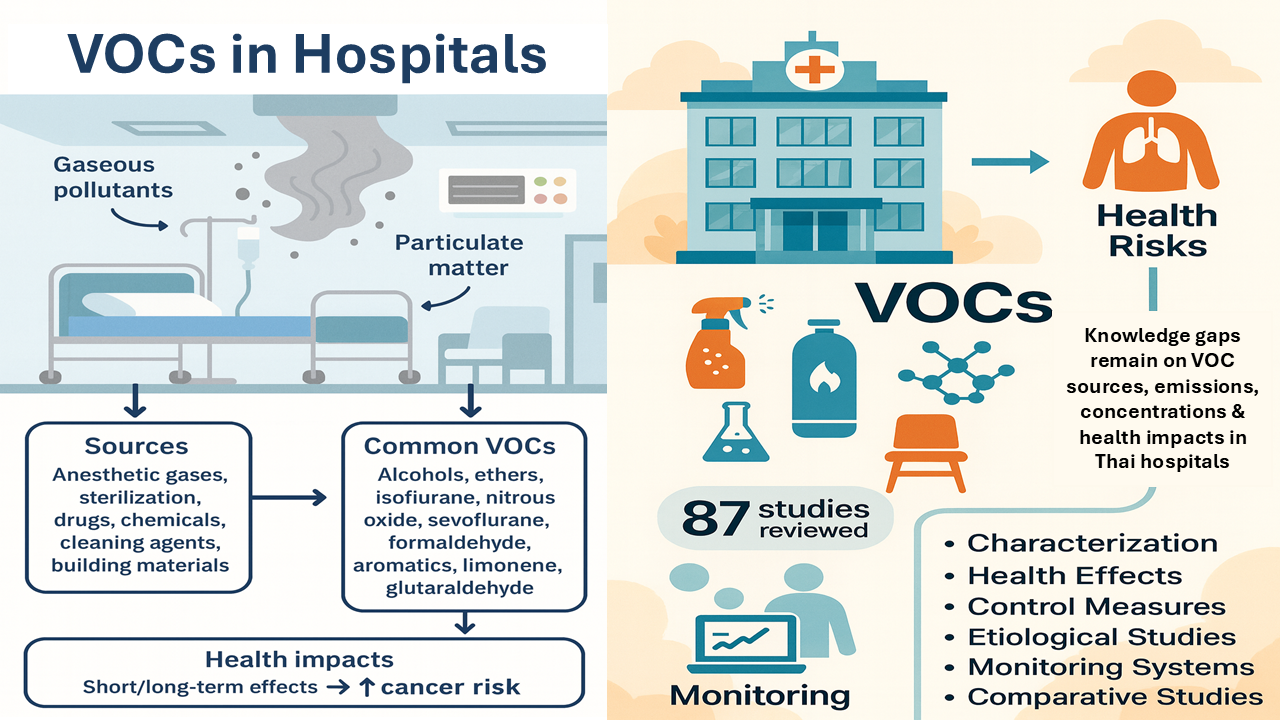
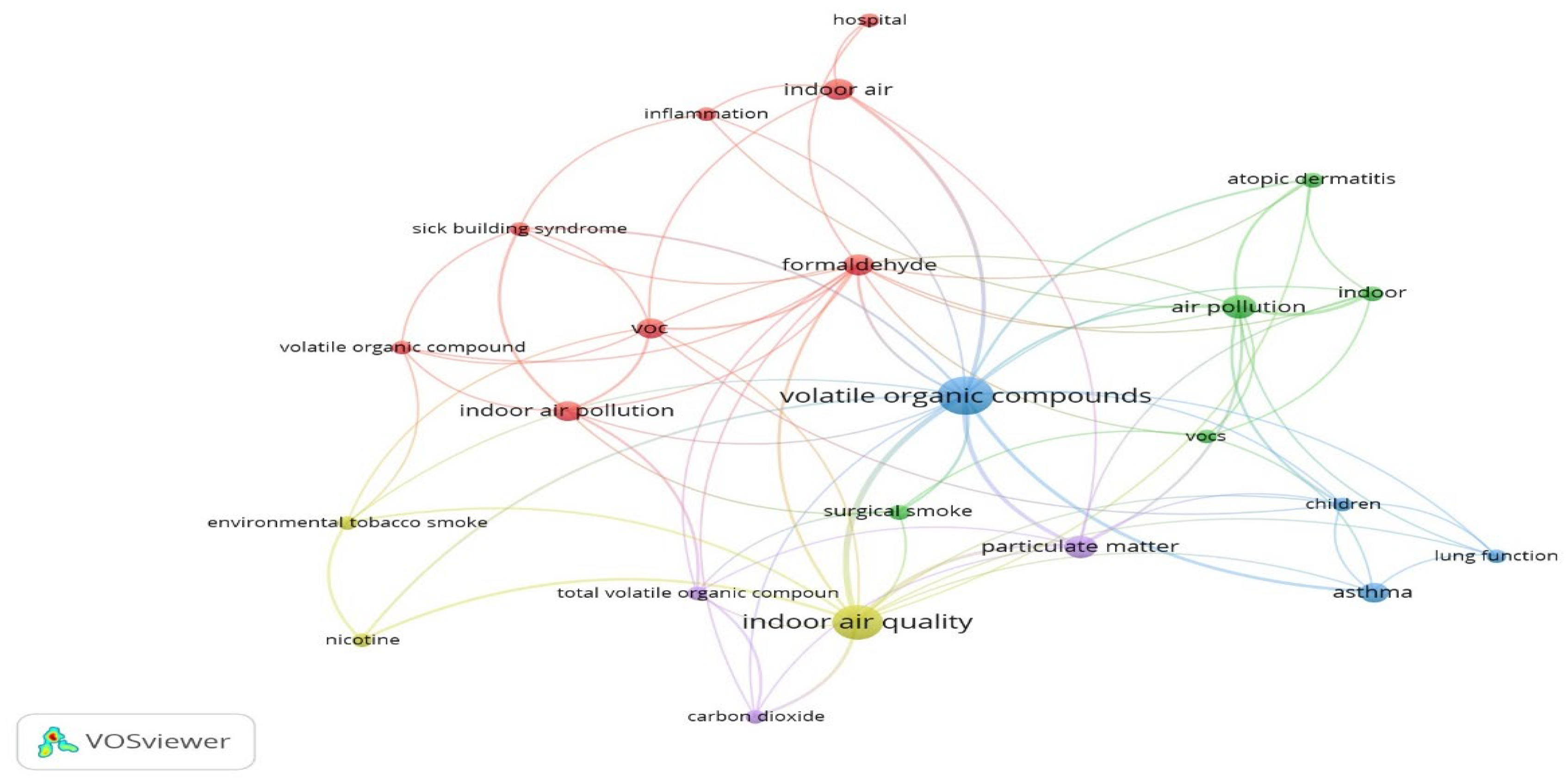
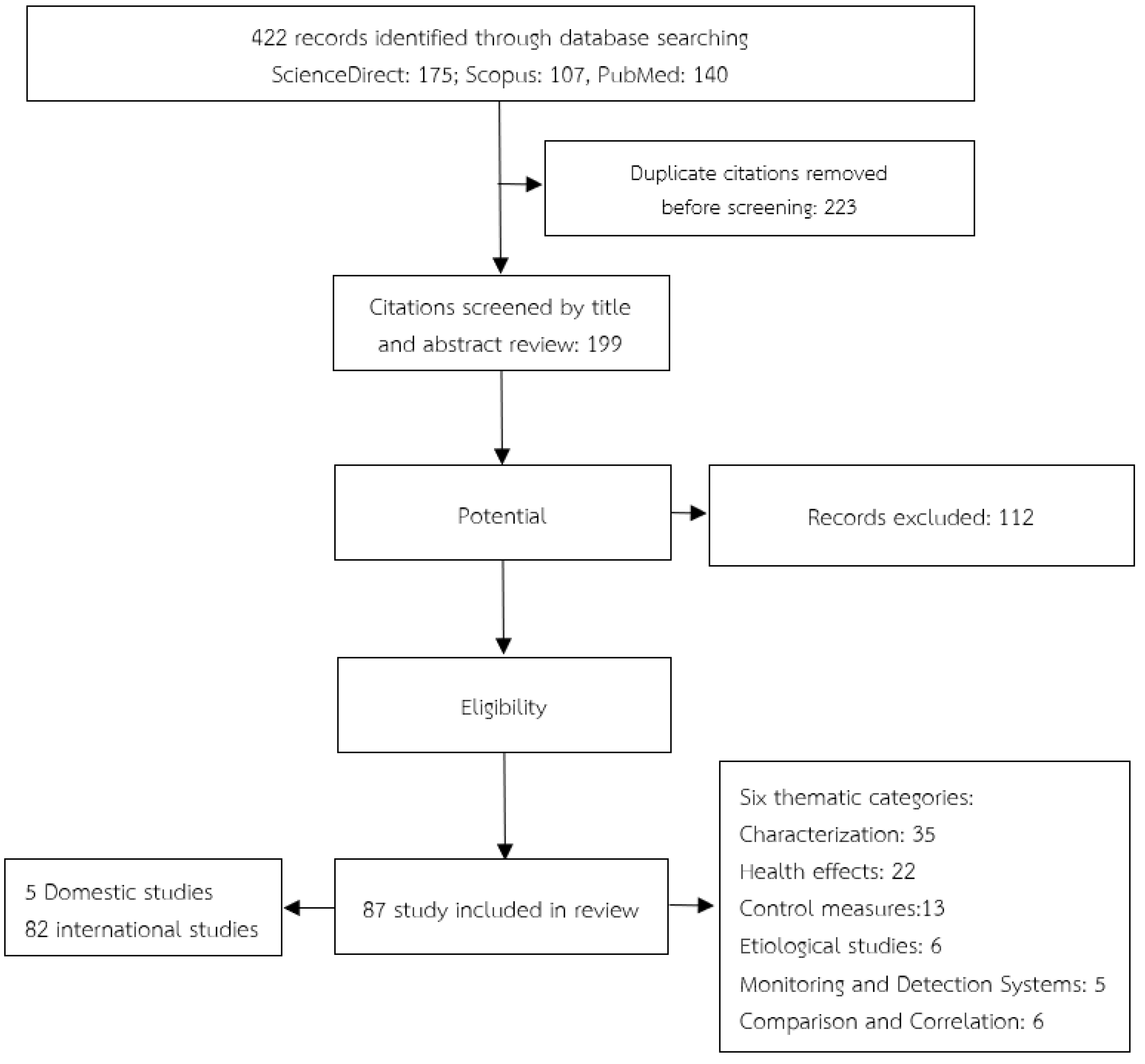
Indoor Air Pollution of Volatile Organic Compounds (VOCs) in Hospitals in Thailand: Review of Current Practices, Challenges, and Recommendations


Abstract
Featured Application
Abstract
1. Introduction
2. Methodology
2.1. Search Strategy and Selection Criteria
2.2. Study Selection, Data Extraction, and Analysis
3. Results
3.1. Overall Results for Indoor VOCs in Hospital Setting
3.2. Indoor VOCs in Hospital in Thailand
4. Discussion
5. Recommendation
5.1. Monitoring Parameters
5.2. Monitoring Instruments
5.3. Exposure Risk Determination
5.4. Prevention and Mitigation
5.5. Futures Studies
6. Conclusions
Supplementary Materials
Author Contributions
Funding
Institutional Review Board Statement
Informed Consent Statement
Data Availability Statement
Acknowledgments
Conflicts of Interest
Abbreviations
| VOC | Volatile Organic Compound |
| TVOCs | Total Volatile Organic Compounds |
| IAQ | Indoor Air Quality |
| SBS | Sick Building Syndrome |
| HEPA | High-Efficiency Particulate Air |
| PID | Photoionization Detector |
| FID | Flame Ionization Detector |
| GC | Gas Chromatography |
| GC-MS | Gas Chromatography-Mass Spectrometry |
| WHO | World Health Organization |
| OEL | Occupational Exposure Limit |
| SECA | Smart Energy and Climate Action |
| SDG | Sustainable Development Goals |
| PM | Particulate Matter |
| CO | Carbon Monoxide |
| CO2 | Carbon Dioxide |
| RH | Relative Humidity |
| AT | Air Temperature |
| AM | Air Movement |
| HCHO | Formaldehyde |
| NICU | Neonatal Intensive Care Unit |
| HPLC | High-Performance Liquid Chromatography |
| TD-GC-MS | Thermal Desorption Gas Chromatography–Mass Spectrometry |
| LTCR | Lifetime Cancer Risk |
| HQ | Hazard Quotient |
| HI | Hazard Index |
Appendix A

| Sources and Activities | Individual VOCs | Potential Health Impacts | |
|---|---|---|---|
| Short-Term | Long-Term | ||
| Operating rooms | anesthetic gases, aromatic hydrocarbons, formaldehyde, glutaraldehyde, other aldehydes, oxides, alcohols | dizziness, nausea, fatigue, headache, respiratory irritation, irritation of eyes, skin; asthma exacerbation | central nervous system, liver, kidney damage; reproductive issues; increased risk of leukemia and miscarriage, hematological disorders, carcinogenicity (nasopharyngeal and sinonasal cancer), respiratory issues, allergic reactions, occupational asthma, dermatitis, cardiovascular disease, blindness (in severe cases), addiction (in the case of ethanol) |
| Disinfection rooms | glutaraldehyde, formaldehyde, other aldehydes, alcohols, aromatic hydrocarbons, aliphatic hydrocarbons, halogenated hydrocarbons, ketones, ethers, limonene | irritation of eyes, nose, throat, skin, respiratory symptoms, headache, dizziness, | respiratory issues (e.g., asthma), potential carcinogenic effects, liver and kidney damage, neurological effects, respiratory irritation, central nervous system effects, potential sensitization |
| Laboratories | formaldehyde, other aldehydes, alcohols, aromatic hydrocarbons, aliphatic hydrocarbons, halogenated hydrocarbons, ketones, ethers, limonene | irritation of eyes, nose, throat, skin, respiratory symptoms, headache, dizziness | respiratory issues (e.g., asthma), potential carcinogenic effects, liver and kidney damage, neurological effects, |
| Nursing rooms | aromatic, aromatic hydrocarbons (PAH) | eye irritation, nausea, and vomiting | increased risks of lung cancer, cardiovascular diseases, and respiratory disorders like asthma, developmental issues on child, reproductive toxicity |
| Sterilization of medical equipment (disinfection and sterilization) | ethylene oxide, glutaraldehyde | respiratory irritation, nausea, headaches, central nervous system, skin irritation | blood cancer (e.g., leukemia) and breast cancer, reproductive, neurological, respiratory effects (e.g., asthma) |
| Disinfectants and preserving specimens | formaldehyde | respiratory irritation, allergic reactions, headaches, dizziness, difficulty breathing | nasopharyngeal cancer and leukemia, respiratory issues, reproductive, developmental, neurological effects |
| Painting and renovation | toluene, xylene, formaldehyde, benzene, ethylene glycol ethers, acetone | respiratory irritation, eye irritation, headaches, dizziness, nausea, allergic reactions | neurological effects (e.g., headaches, dizziness), CNS depression, liver and kidney damage, respiratory issues (e.g., asthma), potential carcinogenic effects (leukemia and other blood disorders), potential reproductive and developmental toxicity |
| Building materials | trichloroethylene | irritating to the eyes, skin and respiratory tract. | Several cancers, including non-Hodgkin’s lymphoma, renal cell carcinoma and livers tumors |
| Alcohol-based hand sanitizer | ethanol, 2-propanol | skin irritation and allergic reactions, particularly in individuals with sensitive skin or pre-existing skin disorder | Excessive use of ABHS may result in a rise in other viral diseases and antimicrobial resistance due to the selection of resistant strains, particularly for bacteria |
| Building materials and occupants, personal care products, decoration materials and pharmaceutical products | acetone, various siloxanes, aldehydes (most abundant VOCs measured in hospitals) | irritation of the eyes, nose, and throat, headaches, dizziness, nausea, respiratory symptoms (e.g., coughing, wheezing), allergic reactions | chronic respiratory irritation, central nervous system effects with prolonged exposure, developmental and reproductive toxicity, potential hormonal disruption. |
| Cleaning products | terpene (D-limonene) | skin irritation | skin sensitization if the substance has been oxidized |
| diethyl phthalate (DEP) | skin irritation, headache, dizziness, nausea | androgen-independent male reproductive toxicity (i.e., sperm effects) | |
| acetaldehyde | skin allergy | possible carcinogens | |
| Pesticides | xylene, toluene, ethylbenzene, methyl ethyl ketone (MEK), dichloromethane (methylene chloride), acetone, hexane, chloroform | respiratory irritation, eye and skin irritation, headaches and dizziness, neurological effects, allergic reactions: | neurological disorders, respiratory diseases, liver and kidney damage, cancer risk |
| Study | VOC Sources | Indoor Quality (Parameter and Concentration) | Measuring and Analytical Instruments (VOCs) | Concentrations Standards/Guidelines and Occupational Exposure Limits (OEL) of VOCs | Clinical Symptoms or Health Risk Assessment (Non-Cancer, Cancer) | Challenges and Limitations |
|---|---|---|---|---|---|---|
| [7] Germany | Alcohol-based disinfectants, cleaning products, building materials and furnishings, medical furniture and incubator materials, Human presence (staff and visitors) | Temperature, humidity, particulate matter (PM), * VOCs average in incubator: 1.1 [0.35–1.3] ppm, and odorous gases (OG) | U-Monitor, a monitoring device from U-Earth Biotech, London, UK to provide real-time data | Federal Environmental Agency (Germany) sets a total concentration limit of VOC at 25 mg/m3, equivalent to 0.4 ppm, which can lead to headaches and neurotoxicity. The study reported that the measured VOC concentrations significantly exceeded the regulatory limit over extended periods, indicating potential health risks for individuals | Headaches and neurotoxicity | Measurements being performed in an empty incubator and the data being collected in only one neonatal intensive care unit (NICU), which may limit the generalizability of the findings. The study also did not measure the density of staff and visitors. Additionally, the standard for measuring fine dust in the outside air is the gravimetric measurement, which was not used in this study |
| [88] European (Italy and Spain) | Human occupancy, the administration of pharmaceutical products, and the use of disinfectants and cleaning products, wood products, occasional external infiltration ambient air, secondary organic aerosol (SOA) | Concentration peaks of TVOCs (0.60–1.40 ppm), PM2.5, and CO2 were observed during hours of higher human occupancy, particularly during scheduled chemotherapy treatments. AT and RH were also recorded | TVOCs, PM2.5, and CO2 were measured in high temporal resolution to assess indoor air quality. For TVOCs used Corvus IAQ Monitor (Ion Science, UK) with a photo-ionization detector (PID) | N/A | N/A | Spatial distribution analysis omitted, issues with low-cost sensor accuracy, influence of environmental parameters (like humidity) on sensors, insufficient data from multiple monitoring points |
| [36] Bangladesh | Indoor air pollution in hospitals can be caused by various sources such as disinfectants, sterilizers, laboratory materials, medical procedures, medical wastes, construction, cooling towers, humidifiers, contaminated carpets, and outdoor sources (Chemicals like alcohol, chlorhexidine gluconate, and aldehydes used for handwashing and disinfection purposes in hospitals) | Average concentrations of IAQ indicators in hospitals were 67.6–104.1 (PM1.0), 89.2–137.4 (PM2.5), 103.3–159.0 (PM10) mgm−3; 0.02–0.11 (NO2), 234.2–1047.1 (CO2), and 117.7–176.5 (TVOC) ppm | Aeroqual 500 series sampler for trace gas measurement, including TVOCs, and the use of a photoionization detector for TVOC measurement | Specific concentration standards for VOCs were not mentioned in the provided sources. But, Indoor TVOC levels were about two times higher than outdoor levels and higher in the post-monsoon season compared to winter. | N/A | Limited research on VOCs specifically, absence of health risk assessments and concentration standards, and variations in pollutant levels across different locations within hospitals. |
| [10] Taiwan | Ward and pharmacy departments (cleaning agents and disinfectants, medical treatments and solutions, building materials and furnishings, sterilization chemicals) | CO, CO2, O3, Mean TVOC = 0.54 ppm, HCHO = 0.02 ppm, PM2.5, PM10, airborne bacteria and fungus | RAE/PGM-730 instrument (ppbRAE 3000 real-time monitor) for TVOC and DNHP tube, analyzed by HPLC with UV detection at 254 nm for HCHO | TVOC and HCHO remained below limits in most areas based on Taiwan IAQ Standards | TVOC exposure causes eye irritation, and respiratory issues depending on the compound (e.g., ethers). | Seasonal bias (winter), lack of chemical speciation, limited spatial scope, population density not controlled, sampling limitation (only spot sampling) |
| [11] Finland | Building materials (PVC flooring materials, adhesive and filling), alcohol-based cleaning chemicals and hand disinfectants, Medical and laboratory activities (especially in pathology wards), office equipment and hygiene products | TVOC and individual VOC such as 2-ethyl-1-hexanol, toluene, ethylbenzene, octane, decane, xylenes (A total of 123 different VOCs were detected in all the samples combined. From the materials samples 79 VOCs were detected while 84 were detected in indoor air samples) as well as AT, RH, AM. | Tenax TA tubes (Active) and TD-GC-MS system | TVOC > 1200 µg/m3 as threshold contributing to symptoms | MM-40 survey (e.g., skin reactions, upper respiratory, headaches) | Limitations in identifying exact reasons for symptoms, outdated building service engineering and ventilation systems, as well as aged plumbing, were identified as major factors contributing to indoor air quality problems in hospitals, relationships between indoor environmental quality, psychosocial issues, working conditions, and symptoms are complex and not completely understood, presence of certain compounds, such as 2-ethyl-1-hexanol, in the hospital environment can also be found in other indoor environments, indicating that the compounds may not be specific to hospitals, sampling method (Tenax TA) was not suitable for detecting some alcohol-based |
| [12] Finland | Disinfectants and cleaning products, exhaust air terminal, building materials and furnishings (e.g., floor), occupant-related sources (e.g., silicon-based VOCs from personal care products) | Mean TVOC < 55 µg/m3, individual VOCs | Tenax TA tubes were used to collect and analyzed with Thermal Desorption and GC-MS | Finnish Indoor Classification M1 standard: TVOC emission target: <200 µg/m2h | N/A | Measurement uncertainty, emission area assumptions, weak predictive models (R2 < 0.10), room size effects |
| [9] France | Building-related sources (building and decoration materials), different products (laboratory chemicals, cleaning/disinfectant, alcohol-based, pharmaceutical products/antiseptics, anesthetic gases), personal care products. post-anesthesia care unit (PACU), patient room, and nursing care had highest alcohol levels. Disinfection unit had highest levels of chloroform and other halogenated hydrocarbons. | More than 40 volatile organic compounds (VOCs) including aliphatic, aromatic and halogenated hydrocarbons, aldehydes, alcohols (ethanol = 928 µg/m3, isopropanol = 47.9 µg/m3), ketones, ethers = 75.6 µg/m3, terpenes and acetone = 22.6 µg/m3, HCHO = 5.8 µg/m3, Limonene = 8.7 µg/m3 | Multi-sorbent tubes (Carbopack C/B, Carboxen 1000; Tenax TA), DNPH cartridges for aldehyde sampling, ATD/GC/MS methods for VOCs, and HPLC with diode array detector for aldehydes | Although concentrations were below occupational exposure limits set in France, European Union and United States of America, the complex mixture of VOCs present in indoor air poses a potential risk to healthcare workers and patients due to the variety of chemical products. HCHO and benzene based on WHO guideline. | N/A | Single-site study, sampling method (stationary sampling at fixed points, which may not accurately reflect the real exposure of workers and patients to VOCs), lack of assessment of clinical symptoms, and the need for further research on OELs, temporal limitation |
| [8] China | Waiting areas (construction materials, furnishings, diesel emission, cleaning products, and industrial emission) | More than 100 VOCs in indoor and outdoor with average VOCs = 123.6–713.2 µg/m3. Toluene, xylenes, ethylene, and benzene were the most abundant aromatics with indoor concentrations significantly higher than outdoors except benzene. Toluene and xylenes were found exceeding the indoor air standard of China | Preconcentrator-GC/MS system | Specific VOCs like toluene, xylenes, ethylene, and benzene were the most abundant aromatics, with concentrations exceeding the indoor air standard of China (2003) in some areas | N/A | VOCs in hospital waiting areas in China varied, there are outdoor air factors involved for benzene, n-hexane, and toluene, VOCs such as n-nonane, decane, undecane, m/p-xylene, and tetrachlorethylene were about 3–4 times more concentrated indoors compared to outdoors |
| [13] United Kingdom | Consultation rooms (pediatric admissions unit and pediatric respiratory physiology laboratory); anesthesia, alcohol-based product (hand-sanitiser), building materials or related to ingress of vehicle emissions | TVOC, 36 VOCs (alcohols, ketones, aromatic hydrocarbons, aliphatic hydrocarbons, aldehyde, terpenes and terpenoids, halogenated hydrocarbons, ethers phthalate, siloxanes, acetone, hexane); highest concentrations for 2-propanol and ethyl chloride | Tenax/TA sorbent tubes with Carbograph 1TD sorbent tubes were used to collect and analyzed with TD-GC × GC-MS/FID analysis | Ethyl chloride concentrations were four times higher than the US EPA (environmental health guidelines), USEPA and OEHHA inhalation exposure limit values; naphthalene and ethyl chloride > USEPA | Non-cancer health hazard of all VOCs was negligible (hazard quotients < 1), ethyl chloride exceeds non-cancer guideline, trichloroethylene was identified as a potential risk to healthcare workers with long-term exposure, as the cancer risk (CR) exceeded the threshold of 10- | Further investigations on trichloroethylene exposure cancer risk may be considered to ensure the safety of healthcare workers, convenience samples (no repeated set-time samples), sorbent tubes used were not able to capture such a small VOC with high volatility (CHCO, acetaldehyde), short sampling time (underestimation), absence of information about specific healthcare activities |
| [119] Iran | Anesthetic gases in operating rooms | Isoflurane = 17.5–23.6, ppm, and sevoflurane = 1.5–7.8 ppm | Sorbent tube and analyzed with GC/FID | Within the range recommended by Iran’s Occupational and Environmental Health but long-term exposure to anesthetic gases may endanger the health | Non-carcinogenic risk based on US EPA, HQ < 1; acceptable | Limited sample size, short duration of sampling, potential variability in exposure, risk assessment methodology used the HQ only (not accounting for all potential health effects, possibly underestimating the overall risk), long-term health implications |
References
- Kumar, P.; Singh, A.B.; Arora, T.; Singh, S.; Singh, R. Critical review on emerging health effects associated with the indoor air quality and its sustainable management. Sci. Total Environ. 2023, 872, 162163. [Google Scholar] [CrossRef]
- Ekpanyaskul, C. Etiological investigation of unintentional solvent exposure among university hospital staffs. Indian J. Occup. Environ. Med. 2010, 14, 100–103. [Google Scholar] [CrossRef]
- Klepeis, N.E.; Nelson, W.C.; Ott, W.R.; Robinson, J.P.; Tsang, A.M.; Switzer, P.; Behar, J.V.; Hern, S.C.; Engelmann, W.H. The National Human Activity Pattern Survey (NHAPS): A resource for assessing exposure to environmental pollutants. J. Expo. Sci. Environ. Epidemiol. 2001, 11, 231–252. [Google Scholar] [CrossRef] [PubMed]
- Jones, A.P. Indoor air quality and health. Atmos. Environ. 1999, 33, 4535–4564. [Google Scholar] [CrossRef]
- Surawattanasakul, V.; Sirikul, W.; Sapbamrer, R.; Wangsan, K.; Panumasvivat, J.; Assavanopakun, P.; Muangkaew, S. Respiratory Symptoms and Skin Sick Building Syndrome among Office Workers at University Hospital, Chiang Mai, Thailand: Associations with Indoor Air Quality, AIRMED Project. Int. J. Environ. Res. Public Health 2022, 19, 10850. [Google Scholar] [CrossRef]
- Choi, S.H.; Kwon, T.G.; Chung, S.K.; Kim, T.H. Surgical smoke may be a biohazard to surgeons performing laparoscopic surgery. Surg. Endosc. 2014, 28, 2374–2380. [Google Scholar] [CrossRef]
- Wolf, M.; Diehl, T.; Zanni, S.; Singer, D.; Deindl, P. Indoor Climate and Air Quality in a Neonatal Intensive Care Unit. Neonatology 2020, 117, 453–459. [Google Scholar] [CrossRef]
- Luo, N.; Liu, Z.; Liu, X.; Xie, P.; Luo, C. Characteristics of Volatile Organic Compounds: Concentrations and Source Identification for Indoor and Outdoor Hospital Waiting Areas in China. Epidemiology 2011, 22, S209–S210. [Google Scholar] [CrossRef]
- Bessonneau, V.; Mosqueron, L.; Berrubé, A.; Mukensturm, G.; Buffet-Bataillon, S.; Gangneux, J.P.; Thomas, O. VOC contamination in hospital, from stationary sampling of a large panel of compounds, in view of healthcare workers and patients exposure assessment. PLoS ONE 2013, 8, e55535. [Google Scholar] [CrossRef]
- Jung, C.-C.; Wu, P.-C.; Tseng, C.-H.; Su, H.-J. Indoor air quality varies with ventilation types and working areas in hospitals. Build. Environ. 2015, 85, 190–195. [Google Scholar] [CrossRef]
- Rautiainen, P.; Hyttinen, M.; Ruokolainen, J.; Saarinen, P.; Timonen, J.; Pasanen, P. Indoor air-related symptoms and volatile organic compounds in materials and air in the hospital environment. Int. J. Environ. Health Res. 2019, 29, 479–488. [Google Scholar] [CrossRef]
- Hyttinen, M.; Rautiainen, P.; Ruokolainen, J.; Sorvari, J.; Pasanen, P. VOCs concentrations and emission rates in hospital environment and the impact of sampling locations. Sci. Technol. Built Environ. 2021, 27, 986–994. [Google Scholar] [CrossRef]
- Riveron, T.P.; Wilde, M.J.; Ibrahim, W.; Carr, L.; Monks, P.S.; Greening, N.J.; Gaillard, E.A.; Brightling, C.E.; Siddiqui, S.; Hansell, A.L.; et al. Characterisation of volatile organic compounds in hospital indoor air and exposure health risk determination. Build. Environ. 2023, 242, 110513. [Google Scholar] [CrossRef]
- Onmek, N.; Kongcharoen, J.; Singtong, A.; Penjumrus, A.; Junnoo, S. Environmental Factors and Ventilation Affect Concentrations of Microorganisms in Hospital Wards of Southern Thailand. J. Environ. Public Health 2020, 2020, 7292198. [Google Scholar] [CrossRef] [PubMed]
- Boonphikham, N.; Singhakant, C.; Kanchanasuta, S.; Patthanaissaranukool, W.; Prechthai, T. Indoor Air Quality in Public Health Centers: A Case Study of Public Health Centers Located on Main and Secondary Roadsides, Bangkok. Environ. Nat. Resour. J. 2022, 20, 527–533. [Google Scholar] [CrossRef]
- Chokwinyou, P.; Pensuk, C.; Paweenkitiporn, W. Indoor air quality in hospitals and hotels, Thailand. J. Environ. Health 2014, 16, 51–66. [Google Scholar]
- Tinochai, P.; Tealek, M.; Kongpran, J. Indoor Air Quality in Hospital: A Case Study for a Community Hospital in Nakhon Si Thammarat Province. J. Health Sci. Thail. 2019, 28, 325–333. [Google Scholar]
- Mohammadyan, M.; Keyvani, S.; Bahrami, A.; Heibati, B.; Godri Pollitt, K. Assessment of indoor air pollution exposure in urban hospital microenvironments. Air Qual. Atmos. Health 2019, 12, 151–159. [Google Scholar] [CrossRef]
- De Maria, L.; Sponselli, S.; Caputi, A.; Delvecchio, G.; Giannelli, G.; Pipoli, A.; Cafaro, F.; Zagaria, S.; Cavone, D.; Sardone, R.; et al. Indoor Radon Concentration Levels in Healthcare Settings: The Results of an Environmental Monitoring in a Large Italian University Hospital. Int. J. Environ. Res. Public Health 2023, 20, 4685. [Google Scholar] [CrossRef]
- Fox, J.T.; Ni, P.; Urrutia, A.R.; Huynh, H.T.; Worrilow, K.C. Modelling the equilibrium partitioning of low concentrations of airborne volatile organic compounds in human IVF laboratories. Reprod. Biomed. Online 2023, 46, 54–68. [Google Scholar] [CrossRef]
- Li, A.J.; Pal, V.K.; Kannan, K. A review of environmental occurrence, toxicity, biotransformation and biomonitoring of volatile organic compounds. J. Environ. Chem. Ecotoxicol. 2021, 3, 91–116. [Google Scholar] [CrossRef]
- Ohura, T.; Amagai, T.; Shen, X.; Li, S.; Zhang, P.; Zhu, L. Comparative study on indoor air quality in Japan and China: Characteristics of residential indoor and outdoor VOCs. Atmos. Environ. 2009, 43, 6352–6359. [Google Scholar] [CrossRef]
- David, E.; Niculescu, V.C. Volatile Organic Compounds (VOCs) as Environmental Pollutants: Occurrence and Mitigation Using Nanomaterials. Int. J. Environ. Res. Public Health 2021, 18, 13147. [Google Scholar] [CrossRef] [PubMed]
- Kalender Smajlović, S.; Kukec, A.; Dovjak, M. Association between Sick Building Syndrome and Indoor Environmental Quality in Slovenian Hospitals: A Cross-Sectional Study. Int. J. Environ. Res. Public Health 2019, 16, 3224. [Google Scholar] [CrossRef] [PubMed]
- Kirchner, S.; Mandin, C.; Derbez, M.; Ramalho, O. Quality of Indoor Air, Quality of life, a Decade of Research to Breathe Better, Breathe Easier; French Indoor Air Quality Observatory: Champs-sur-Marne, France, 2013; Volume 2011. [Google Scholar]
- Billionnet, C.; Gay, E.; Kirchner, S.; Leynaert, B.; Annesi-Maesano, I. Quantitative assessments of indoor air pollution and respiratory health in a population-based sample of French dwellings. Environ. Res. 2011, 111, 425–434. [Google Scholar] [CrossRef] [PubMed]
- Chin, J.Y.; Godwin, C.; Parker, E.; Robins, T.; Lewis, T.; Harbin, P.; Batterman, S. Levels and sources of volatile organic compounds in homes of children with asthma. Indoor Air 2014, 24, 403–415. [Google Scholar] [CrossRef]
- Colareta Ugarte, U.; Prazad, P.; Puppala, B.L.; Schweig, L.; Donovan, R.; Cortes, D.R.; Gulati, A. Emission of volatile organic compounds from medical equipment inside neonatal incubators. J. Perinatol. 2014, 34, 624–628. [Google Scholar] [CrossRef]
- LeBouf, R.F.; Virji, M.A.; Saito, R.; Henneberger, P.K.; Simcox, N.; Stefaniak, A.B. Exposure to volatile organic compounds in healthcare settings. Occup. Environ. Med. 2014, 71, 642–650. [Google Scholar] [CrossRef]
- Ogbodo, J.O.; Arazu, A.V.; Iguh, T.C.; Onwodi, N.J.; Ezike, T.C. Volatile organic compounds: A proinflammatory activator in autoimmune diseases. Front. Immunol. 2022, 13, 928379. [Google Scholar] [CrossRef]
- Spatari, G.; Allegra, A.; Carrieri, M.; Pioggia, G.; Gangemi, S. Epigenetic Effects of Benzene in Hematologic Neoplasms: The Altered Gene Expression. Cancers 2021, 13, 2392. [Google Scholar] [CrossRef]
- Wang, M.; Dingler, F.A.; Patel, K.J. The Journal of the American Society of Hematology. Genotoxic aldehydes in the hematopoietic system. Blood 2022, 139, 2119–2129. [Google Scholar] [CrossRef]
- Natsheh, H.; Touitou, E. Phospholipid Vesicles for Dermal/Transdermal and Nasal Administration of Active Molecules: The Effect of Surfactants and Alcohols on the Fluidity of Their Lipid Bilayers and Penetration Enhancement Properties. Molecules 2020, 25, 2959. [Google Scholar] [CrossRef]
- Rouadi, P.W.; Idriss, S.A.; Naclerio, R.M.; Peden, D.B.; Ansotegui, I.J.; Canonica, G.W.; Gonzalez-Diaz, S.N.; Rosario Filho, N.A.; Ivancevich, J.C.; Hellings, P.W.; et al. Immunopathological features of air pollution and its impact on inflammatory airway diseases (IAD). World Allergy Organ. J. 2020, 13, 100467. [Google Scholar] [CrossRef]
- Department of Health. Notification of the Department of Health Regarding Indoor Air Surveillance in Public Buildings B.E. 2565 (2022); Ministry of Public Health of Thailand: Nonthaburi, Thailand, 2022. [Google Scholar]
- Zaman, S.U.; Yesmin, M.; Pavel, M.R.S.; Jeba, F.; Salam, A. Indoor air quality indicators and toxicity potential at the hospitals’ environment in Dhaka, Bangladesh. Environ. Sci. Pollut. Res. Int. 2021, 28, 37727–37740. [Google Scholar] [CrossRef]
- Sun, J.; Wang, J.; Yang, J.; Shi, X.; Li, S.; Cheng, J.; Chen, S.; Sun, K.; Wu, Y. Association between maternal exposure to indoor air pollution and offspring congenital heart disease: A case-control study in East China. BMC Public Health 2022, 22, 767. [Google Scholar] [CrossRef]
- Tang, H.; Ding, J.; Lin, Z. On-site measurement of indoor environment quality in a Chinese healthcare facility with a semi-closed hospital street. Build. Environ. 2020, 173, 106637. [Google Scholar] [CrossRef]
- Zhang, B.; Xia, Z.; Jiang, X.; Yuan, Y.; Yin, C.; Chen, T. Indoor environment in relation to recurrent childhood asthma in Yancheng, China: A hospital-based case-control study. Environ. Sci. Pollut. Res. Int. 2023, 30, 102212–102221. [Google Scholar] [CrossRef]
- Tang, H.; Ding, J.; Li, C.; Li, J. A field study on indoor environment quality of Chinese inpatient buildings in a hot and humid region. Build. Environ. 2019, 151, 156–167. [Google Scholar] [CrossRef]
- Zhou, Y.; Yang, G. Real-time monitoring of pollutants in occupied indoor environments: A pilot study of a hospital in China. J. Build. Eng. 2022, 59, 105105. [Google Scholar] [CrossRef]
- Yang, K.; Zhang, C.; Zhu, K.; Qian, Z.; Yang, Z.; Wu, L.; Zong, S.; Cui, Y.; Wang, Z. A Programmable Plasmonic Gas Microsystem for Detecting Arbitrarily Combinated Volatile Organic Compounds (VOCs) with Ultrahigh Resolution. ACS Nano 2022, 16, 19335–19345. [Google Scholar] [CrossRef]
- Wang, F.; Li, C.; Liu, W.; Jin, Y. Potential mechanisms of neurobehavioral disturbances in mice caused by sub-chronic exposure to low-dose VOCs. Inhal. Toxicol. 2014, 26, 250–258. [Google Scholar] [CrossRef]
- Gao, Y.; Zhang, Y.; Kamijima, M.; Sakai, K.; Khalequzzaman, M.; Nakajima, T.; Shi, R.; Wang, X.; Chen, D.; Ji, X.; et al. Quantitative assessments of indoor air pollution and the risk of childhood acute leukemia in Shanghai. Environ. Pollut. 2014, 187, 81–89. [Google Scholar] [CrossRef]
- Tang, H.; Li, C.; Ding, J. Field study of indoor environment quality in an open atrium with ETFE membrane in a healthcare facility. E3S Web Conf. 2019, 111, 02035. [Google Scholar] [CrossRef]
- Yao, J.; Zhong, J.; Yang, N. Indoor air quality test and air distribution CFD simulation in hospital consulting room. Int. J. Low-Carbon Technol. 2021, 17, 33–37. [Google Scholar] [CrossRef]
- Lü, H.; Cai, Q.Y.; Wen, S.; Chi, Y.; Guo, S.; Sheng, G.; Fu, J.; Katsoyiannis, A. Carbonyl compounds and BTEX in the special rooms of hospital in Guangzhou, China. J. Hazard. Mater. 2010, 178, 673–679. [Google Scholar] [CrossRef]
- Yan, L.; Liu, Y.; Zhang, J.; Chen, X.; Li, J.; Zhu, X. In vivo and in vitro study of the potential hazards of surgical smoke during cervical cancer treatment with an ultrasonic scalpel. Gynecol. Oncol. 2022, 164, 587–595. [Google Scholar] [CrossRef]
- Rao, R.S.; Sasiharan, G.M.; Ganapathy, S. Estimating Air Pollution in Operation Rooms Generated from Cautery, Drills, and Other Equipment, Utilizing a Particulate Counter and Gas Analyzer. Indian J. Occup. Environ. Med. 2023, 27, 310–316. [Google Scholar] [CrossRef]
- Nandan, A.; Mondal, P.; Kumar, S.; Siddiqui, N.A.; Sinha, S.; Subramani, S.; Singh, A.K.; Raja, S.; Hussain, C.M. Investigation of indoor air pollutants in different environmental settings and their health impact: A case study of Dehradun, India. Air Qual. Atmos. Health 2023, 16, 2377–2400. [Google Scholar] [CrossRef]
- Veysi, R.; Heibati, B.; Jahangiri, M.; Kumar, P.; Latif, M.T.; Karimi, A. Indoor air quality-induced respiratory symptoms of a hospital staff in Iran. Environ. Monit. Assess. 2019, 191, 50. [Google Scholar] [CrossRef]
- Kheirmand, M.; Barkhordari, A.; Mosaddegh, M.; Farajzadegan, Z. Determination of benzene, toluene, ethyl benzene and xylene in administration room’s air of hospitals using solid phase micro extraction/gas chromatography/flame ionization detector. Int. J. Environ. Health Eng. 2014, 3, 27. [Google Scholar] [CrossRef]
- Moslem, A.R.; Rezaei, H.; Yektay, S.; Miri, M. Comparing BTEX concentration related to surgical smoke in different operating rooms. Ecotoxicol. Environ. Saf. 2020, 203, 111027. [Google Scholar] [CrossRef]
- Baqer, N.S.; Albahri, A.S.; Mohammed, H.A.; Zaidan, A.A.; Amjed, R.A.; Al-Bakry, A.M.; Albahri, O.S.; Alsattar, H.A.; Alnoor, A.; Alamoodi, A.H.; et al. Indoor air quality pollutants predicting approach using unified labelling process-based multi-criteria decision making and machine learning techniques. Telecommun. Syst. 2022, 81, 591–613. [Google Scholar] [CrossRef]
- Baqer, N.S.; Mohammed, H.A.; Albahri, A.S. Development of a real-time monitoring and detection indoor air quality system for intensive care unit and emergency department. Signa Vitae 2022, 19, 77–92. [Google Scholar] [CrossRef]
- Wakui, N.; Ookubo, T.; Iwasaki, Y.; Ito, R.; Mitui, M.; Yano, Y.; Saito, K.; Nakazawa, H. Determination of exposure of dispensary drug preparers to cyclophosphamide by passive sampling and liquid chromatography with tandem mass spectrometry. J. Oncol. Pharm. Pract. 2013, 19, 31–37. [Google Scholar] [CrossRef]
- Chamseddine, A.; Alameddine, I.; Hatzopoulou, M.; El-Fadel, M. Seasonal variation of air quality in hospitals with indoor–outdoor correlations. Build. Environ. 2019, 148, 689–700. [Google Scholar] [CrossRef]
- Seng, K.T.; Shen, L.C.; Ling, N.S.; Chin, S.P.; Xin, T.J.; En, T.K.; Jama, A.A.; Hariri, A.; Nasir, N.F. Comparative Study on the Indoor Air Quality in Critical Areas of Hospitals in Malaysia. Nat. Environ. Pollut. Technol. 2023, 22, 921–927. [Google Scholar] [CrossRef]
- Ahmad, S.; Hamid, E.; Ithnin, A.; Pain, I. Indoor Air Quality Level at Medical Clinics, University Hospital in Klang Valley, Malaysia. Malays. J. Med. Health Sci. 2022, 18, 158–165. [Google Scholar] [CrossRef]
- Al Qasmi, N.N.; Al-Thaiban, H.; Helaleh, M.I.H. Indoor phthalates from household dust in Qatar: Implications for non-dietary human exposure. Sci. Pollut. Res. Int. 2019, 26, 421–430. [Google Scholar] [CrossRef]
- Lee, H.J.; Lee, K.H.; Kim, D.K. Evaluation and comparison of the indoor air quality in different areas of the hospital. Medicine 2020, 99, e23942. [Google Scholar] [CrossRef]
- Bang, C.S.; Lee, K.; Yang, Y.J.; Baik, G.H. Ambient air pollution in gastrointestinal endoscopy unit. Surg. Endosc. 2020, 34, 3795–3804. [Google Scholar] [CrossRef]
- Hwang, S.H.; Roh, J.; Park, W.M. Evaluation of PM10, CO2, airborne bacteria, TVOCs, and formaldehyde in facilities for susceptible populations in South Korea. Environ. Pollut. 2018, 242 Pt A, 700–708. [Google Scholar] [CrossRef]
- Choi, D.H.; Choi, S.H.; Kang, D.H. Influence of Surgical Smoke on Indoor Air Quality in Hospital Operating Rooms. Aerosol Air Qual. Res. 2017, 17, 821–830. [Google Scholar] [CrossRef]
- Kwon, J.W.; Park, H.W.; Kim, W.J.; Kim, M.G.; Lee, S.J. Exposure to volatile organic compounds and airway inflammation. Environ. Health 2018, 17, 65. [Google Scholar] [CrossRef] [PubMed]
- Kang, M.S.; Hong, J.R.; Gil, H.W.; Yang, J.O.; Lee, E.Y.; Hong, S.Y.; Jun, Y.T.; Son, B.S. Benzene and toluene concentrations in a hemodialysis room in a medium sized South Korean city. Korean J. Intern. Med. 2008, 23, 111–115. [Google Scholar] [CrossRef] [PubMed]
- Choi, S.H.; Choi, D.H.; Kang, D.H.; Ha, Y.S.; Lee, J.N.; Kim, B.S.; Kim, H.T.; Yoo, E.S.; Kwon, T.G.; Chung, S.K.; et al. Activated carbon fiber filters could reduce the risk of surgical smoke exposure during laparoscopic surgery: Application of volatile organic compounds. Surg. Endosc. 2018, 32, 4290–4298. [Google Scholar] [CrossRef]
- Liu, M.H.; Tung, T.H.; Chung, F.F.; Chuang, L.C.; Wan, G.H. High total volatile organic compounds pollution in a hospital dental department. Environ. Monit. Assess. 2017, 189, 571. [Google Scholar] [CrossRef]
- Shen, J.H.; Wang, Y.S.; Lin, J.P.; Wu, S.H.; Horng, J.J. Improving the indoor air quality of respiratory type of medical facility by zeolite filtering. J. Air Waste Manag. Assoc. 2014, 64, 13–18. [Google Scholar] [CrossRef]
- Wang, F.-J.; Lee, M.; Cheng, T.; Law, Y. Field evaluation of thermal comfort and indoor environment quality for a hospital in a hot and humid climate. HVACR Res. 2012, 18, 671–680. [Google Scholar] [CrossRef]
- Chen, T.-L.; Chen, Y.-H.; Zhao, Y.-L.; Chiang, P.-C. Application of Gaseous ClO2 on Disinfection and Air Pollution Control: A Mini Review. Aerosol Air Qual. Res. 2020, 20, 2289–2298. [Google Scholar] [CrossRef]
- Hsu, Y.-C.; Kung, P.-Y.; Wu, T.-N.; Shen, Y.-H. Characterization of Indoor-Air Bioaerosols in Southern Taiwan. Aerosol Air Qual. Res. 2012, 12, 651–661. [Google Scholar] [CrossRef]
- Chung, F.F.; Lin, H.L.; Liu, H.E.; Lien, A.S.; Hsiao, H.F.; Chou, L.T.; Wan, G.H. Aerosol distribution during open suctioning and long-term surveillance of air quality in a respiratory care center within a medical center. Respir. Care 2015, 60, 30–37. [Google Scholar] [CrossRef]
- Chang, C.-J.; Yang, H.-H.; Wang, Y.-F.; Li, M.-S. Prevalence of Sick Building Syndrome-Related Symptoms among Hospital Workers in Confined and Open Working Spaces. Aerosol Air Qual. Res. 2015, 15, 2378–2384. [Google Scholar] [CrossRef]
- Chang, P.-K.; Chuang, H.-H.; Hsiao, T.-C.; Chuang, H.-C.; Chen, P.-C. Investigating the invisible threat: An exploration of air exchange rates and ultrafine particle dynamics in hospital operating rooms. Build. Environ. 2023, 245, 110870. [Google Scholar] [CrossRef]
- El-Sharkawy, M.F.; Noweir, M.E. Indoor air quality levels in a University Hospital in the Eastern Province of Saudi Arabia. J. Fam. Community Med. 2014, 21, 39–47. [Google Scholar] [CrossRef]
- Otgonbyamba, O.-E.; Ganbat, G.; Khuyag, S.-O.; Altangerel, E.; Ganbold, B.; Bayanjargal, A.; Bat-Erdene, A.; Chuluunbaatar, B.; Badrakh, B.; Batbaatar, S. Health Risk Assessment of Volatile Organic Compounds for Children in Indoor Air, Ulaanbaatar, Mongolia. Aerosol Air Qual. Res. 2023, 23, 230028. [Google Scholar] [CrossRef]
- Lasomsri, P.; Yanbuaban, P.; Kerdpoca, O.; Ouypornkochagorn, T. A Development of Low-Cost Devices for Monitoring Indoor Air Quality in a Large-Scale Hospital. In Proceedings of the 2018 15th International Conference on Electrical Engineering/Electronics, Computer, Telecommunications and Information Technology (ECTI-CON), Chiang Rai, Thailand, 18–21 July 2018; pp. 282–285. [Google Scholar] [CrossRef]
- Thongsumrit, J.; Chantara, S.; Naksen, W.; Bootdee, S.; Payam, M.; Wiriya, W. Indoor air quality assessment to design a model for indoor air quality management and health impact assessment in Northern Thailand. In Proceedings of the 11th International Conference on Indoor Air Quality, Ventilation & Energy Conservation in Buildings (IAQVEC2023), Tokyo, Japan, 20–23 May 2023; E3S Web of Conferences. Volume 396. [Google Scholar] [CrossRef]
- Tungjai, A.; Kubaha, K. Indoor Air Quality Evaluation of Isolation Room for Hospital in Thailand. Energy Procedia 2017, 138, 858–863. [Google Scholar] [CrossRef]
- Wallenius, K.; Hovi, H.; Remes, J.; Mahiout, S.; Liukkonen, T. Volatile Organic Compounds in Finnish Office Environments in 2010-2019 and Their Relevance to Adverse Health Effects. Int. J. Environ. Res. Public Health 2022, 19, 4411. [Google Scholar] [CrossRef]
- Baudet, A.; Baurès, E.; Blanchard, O.; Le Cann, P.; Gangneux, J.P.; Florentin, A. Indoor Carbon Dioxide, Fine Particulate Matter and Total Volatile Organic Compounds in Private Healthcare and Elderly Care Facilities. Toxics 2022, 10, 136. [Google Scholar] [CrossRef]
- Baurès, E.; Blanchard, O.; Mercier, F.; Surget, E.; le Cann, P.; Rivier, A.; Gangneux, J.P.; Florentin, A. Indoor air quality in two French hospitals: Measurement of chemical and microbiological contaminants. Sci. Total Environ. 2018, 642, 168–179. [Google Scholar] [CrossRef]
- Tzoutzas, I.; Maltezou, H.C.; Barmparesos, N.; Tasios, P.; Efthymiou, C.; Assimakopoulos, M.N.; Tseroni, M.; Vorou, R.; Tzermpos, F.; Antoniadou, M.; et al. Indoor Air Quality Evaluation Using Mechanical Ventilation and Portable Air Purifiers in an Academic Dentistry Clinic during the COVID-19 Pandemic in Greece. Int. J. Environ. Res. Public Health 2021, 18, 8886. [Google Scholar] [CrossRef]
- Tzoutzas, I.; Karoussis, I.; Maltezou, H.C. Air Quality in Dental Care Facilities: Update to Current Management and Control Strategies Implementing New Technologies: A Comprehensive Review. Vaccines 2022, 10, 847. [Google Scholar] [CrossRef]
- Dascalaki, E.G.; Lagoudi, A.; Balaras, C.A.; Gaglia, A.G. Air quality in hospital operating rooms. Build. Environ. 2008, 43, 1945–1952. [Google Scholar] [CrossRef]
- Settimo, G.; Gola, M.; Capolongo, S. VOC concentrations in healing environments: A protocol for monitoring activities in inpatient wards and its application on some case studies. IOP Conf. Ser. Mater. Sci. Eng. 2019, 609, 042107. [Google Scholar] [CrossRef]
- Palmisani, J.; Gilio, A.; Viana, M.; de gennaro, G.; Ferro, A. Indoor air quality evaluation in oncology units at two European hospitals: Low-cost sensors for TVOCs, PM2.5 and CO2 real-time monitoring. Build. Environ. 2021, 205, 108237. [Google Scholar] [CrossRef]
- Gola, M.; Settimo, G.; Capolongo, S. How Can Design Features and Other Factors Affect the Indoor Air Quality in Inpatient Rooms? Check-Lists for the Design Phase, Daily Procedures and Maintenance Activities for Reducing the Air Concentrations of Chemical Pollution. Int. J. Environ. Res. Public Health 2020, 17, 4280. [Google Scholar] [CrossRef]
- Santarsiero, A.; Fuselli, S.; Morlino, R.; Minniti, G.; De Felice, M.; Ortolani, E. Air pollution/working activity correlation: A case study in a dental hospital. Int. J. Environ. Health Res. 2011, 21, 22–40. [Google Scholar] [CrossRef]
- Scheepers, P.T.J.; Van Wel, L.; Beckmann, G.; Anzion, R.B.M. Chemical Characterization of the Indoor Air Quality of a University Hospital: Penetration of Outdoor Air Pollutants. Int. J. Environ. Res. Public Health 2017, 14, 497. [Google Scholar] [CrossRef]
- Nyrud, A.Q.; Bringslimark, T.; Englund, F. Wood use in a hospital environment: VOC emissions and air quality. Eur. J. Wood Wood Prod. 2012, 70, 541–543. [Google Scholar] [CrossRef]
- Macedo, A.C.; Mota, V.T.; Tavares, J.M.; Machado, O.L.; Malcata, F.X.; Cristo, M.P.; Mayan, O.N. Work environment and occupational risk assessment for small animal Portuguese veterinary activities. J. Occup. Environ. Hyg. 2018, 15, D19–D28. [Google Scholar] [CrossRef]
- Belo, J.; Carreiro-Martins, P.; Papoila, A.L.; Palmeiro, T.; Caires, I.; Alves, M.; Nogueira, S.; Aguiar, F.; Mendes, A.; Cano, M.; et al. The impact of indoor air quality on respiratory health of older people living in nursing homes: Spirometric and exhaled breath condensate assessments. J. Environ. Sci. Health Part A Toxic/Hazard. Subst. Environ. Eng. 2019, 54, 1153–1158. [Google Scholar] [CrossRef]
- Nastase, I.; Croitoru, C.V.; Vartires, A.A.; Gustiuc, M.; Bosschaerts, W. Measurement and questionnaires survey of the indoor environment quality in an emergency hospital from bucharest. In Proceedings of the 13th International Conference on Indoor Air Quality and Climate (Indoor Air 2014), Hong Kong, China, 7–12 July 2014; pp. 956–963. [Google Scholar]
- Sundkvist, B.; Myronycheva, O.; Langer, S.; Liljelind, I.; Glas, B.; Nord, T.; Nordin, B. Cross-laminated wood panels in a patient room and studies of interior environment. In Proceedings of the 13th World Conference on Timber Engineering (WCTE 2023): Timber for a Livable Future, Oslo, Norway, 19–22 June 2023; pp. 1062–1066. [Google Scholar] [CrossRef]
- López, A.; Fuentes, E.; Yusà, V.; López-Labrador, F.X.; Camaró, M.; Peris-Martinez, C.; Llácer, M.; Ortolá, S.; Coscollà, C. Indoor Air Quality including Respiratory Viruses. Toxics 2021, 9, 274. [Google Scholar] [CrossRef]
- Veenaas, C.; Ripszam, M.; Haglund, P. Analysis of volatile organic compounds in indoor environments using thermal desorption with comprehensive two-dimensional gas chromatography and high-resolution time-of-flight mass spectrometry. J. Sep. Sci. 2020, 43, 1489–1498. [Google Scholar] [CrossRef]
- Reale, E.; Hopf, N.B.; Breider, F.; Grandjean, D.; Pirard, C.; Charlier, C.; Koch, H.M.; Berthet, A.; Suarez, G.; Borgatta, M. Repeated Human Exposure to Semivolatile Organic Compounds by Inhalation: Novel Protocol for a Nonrandomized Study. JMIR Res. Protoc. 2023, 12, e51020. [Google Scholar] [CrossRef]
- Kocher, G.J.; Sesia, S.B.; Lopez-Hilfiker, F.; Schmid, R.A. Surgical smoke: Still an underestimated health hazard in the operating theatre. Eur. J. Cardiothorac. Surg. 2019, 55, 626–631. [Google Scholar] [CrossRef]
- Güntner, A.T.; Schenk, F.M. Environmental formaldehyde sensing at room temperature by smartphone-assisted and wearable plasmonic nanohybrids. Nanoscale 2023, 15, 3967–3977. [Google Scholar] [CrossRef]
- Chikwem, C.; Nwakanma, C.; Egedigwe-Ekeleme, A.C.; Effiong, J.A.; Mbagwu, C.F. Physicochemical Assessment of Ambient Indoor Air Quality of a Tertiary Health Care Institution in South-Eastern Nigeria. Aerosol Sci. Eng. 2022, 6, 335–348. [Google Scholar] [CrossRef]
- Erdoǧan, M.S.; Yurtseven, E.; Erginoz, E.; VehİD, S.; Köksal, S.; Yüceokur, A.A. Total Volatile Organic Compounds (TVOC), Carbon Monoxide (CO), Carbon Dioxide (CO2) concentrations in the Hospital Building of a Medical Faculty in Istanbul, Turkey. Nobel Med. 2010, 6, 66–72. [Google Scholar]
- Gedikoglu, Y.; Gedikoglu, G.; Berkin, G.; Ceyhan, T.; Altinoz, M.A. Employing volcanic tuff minerals in interior architecture design to reduce microbial contaminants and airborne fungal carcinogens of indoor environments. Toxicol. Ind. Health 2012, 28, 708–719. [Google Scholar] [CrossRef]
- Bello, A.; Quinn, M.M.; Perry, M.J.; Milton, D.K. Quantitative assessment of airborne exposures generated during common cleaning tasks: A pilot study. Environ. Health 2010, 9, 76. [Google Scholar] [CrossRef]
- Worrilow, K.; Stawicki, S.; Schlener, S.; Urrutia, A.; Kimble, C. The Effects of Air Purification Technology on Environmental and Clinical Metrics in Two Healthcare Settings. ASHRAE Trans. 2022, 128, 1–10. [Google Scholar]
- Rantas, J.; Wang, D.; Jarrard, W.; Sterchi, J.; Wang, A.; Varnosfaderani, M.P.; Heydarian, A. A User Interface Informing Medical Staff on Continuous Indoor Environmental Quality to Support Patient Care and Airborne Disease Mitigation. In Proceedings of the 2021 Systems and Information Engineering Design Symposium (SIEDS), Charlottesville, VA, USA, 29–30 April 2021; pp. 1–6. [Google Scholar] [CrossRef]
- LeBouf, R.F.; Stefaniak, A.B.; Virji, M.A. Validation of evacuated canisters for sampling volatile organic compounds in healthcare settings. J. Environ. Monit. 2012, 14, 977–983. [Google Scholar] [CrossRef]
- Prazad, P.; Cortes, D.R.; Puppala, B.L.; Donovan, R.; Kumar, S.; Gulati, A. Airborne concentrations of volatile organic compounds in neonatal incubators. J. Perinatol. 2008, 28, 534–540. [Google Scholar] [CrossRef]
- Benson, S.M.; Maskrey, J.R.; Nembhard, M.D.; Unice, K.M.; Shirley, M.A.; Panko, J.M. Evaluation of Personal Exposure to Surgical Smoke Generated from Electrocautery Instruments: A Pilot Study. Ann. Work. Expo. Health 2019, 63, 990–1003. [Google Scholar] [CrossRef]
- Ismail, S.A.; Jalaludin, J.; Norhafizalina, O.; Azman, A.; Jusoff, K. Indoor Air Quality and Sick Building Syndrome in Malaysian Buildings. Glob. J. Health Sci. 2024, 1, 126. [Google Scholar] [CrossRef]
- Baudet, A.; Baurès, E.; Guegan, H.; Blanchard, O.; Guillaso, M.; Le Cann, P.; Gangneux, J.-P.; Florentin, A. Indoor Air Quality in Healthcare and Care Facilities: Chemical Pollutants and Microbiological Contaminants. Atmosphere 2021, 12, 1337. [Google Scholar] [CrossRef]
- Zuraimi, M.S.; Tham, K.W.; Chew, F.T.; Ooi, P.L. The effect of ventilation strategies of child care centers on indoor air quality and respiratory health of children in Singapore. Indoor Air 2007, 17, 317–327. [Google Scholar] [CrossRef]
- López, A.; Yusà, V.; Villoldo, E.; Corpas-Burgos, F.; Coscollà, C. Indoor air pesticide in dwellings of breastfeeding mothers of the Valencian Region (Spain): Levels, exposure and risk assessment. Atmos. Environ. 2021, 248, 118231. [Google Scholar] [CrossRef]
- Gabriel, M.F.; Felgueiras, F.; Batista, R.; Ribeiro, C.; Ramos, E.; Mourão, Z.; de Oliveira Fernandes, E. Indoor environmental quality in households of families with infant twins under 1 year of age living in Porto. Environ. Res. 2021, 198, 110477. [Google Scholar] [CrossRef]
- Institute of Environmental Epidemiology. Guidelines for Good Indoor Air Quality in Office Premises, 1st ed.; Institute of Environmental Epidemiology, Ministry of the Environment: Singapore, 1996. [Google Scholar]
- Invernizzi, M.; Roveda, L.; Polvara, E.; Sironi, S. Lights and Shadows of the Voc Emission Quantification. Chem. Eng. Trans. 2021, 85, 109–114. [Google Scholar] [CrossRef]
- Pacchiarotta, T.; Nevedomskaya, E.; Carrasco-Pancorbo, A.; Deelder, A.M.; Mayboroda, O.A. Evaluation of GC-APCI/MS and GC-FID as a complementary platform. J. Biomol. Tech. 2010, 21, 205–213. [Google Scholar]
- Kiani, F.; Jorfi, S.; Soltani, F.; Ghanbari, S.; Rezaee, R.; Mohammadi, M.J. Exposure to anesthetic gases in the operating rooms and assessment of non-carcinogenic risk among health care workers. Toxicol. Rep. 2023, 11, 1–8. [Google Scholar] [CrossRef]


| Inclusion Criteria | Exclusion Criteria |
|---|---|
| Studies published between 2008 and 2023 | Studies published prior to 2008 |
| Articles written in English or Thai | Articles not available in English or Thai |
| Peer-reviewed publications, reports, and gray literature that addressed VOCs in hospital environments | Publications with insufficient data, unclear methodologies, or lacking key findings relevant to VOCs in hospitals |
| Studies focusing on VOC sources, concentrations, health impacts, mitigation strategies, or measurement methods | Duplicate publications |
| Study | VOC Sources | Indoor Quality (Parameter and Concentration) | Measuring and Analytical Instruments (VOCs) | Concentrations Standards/Guidelines and Occupational Exposure Limits (OEL) of VOCs | Clinical Symptoms or Health risk Assessment (Non-Cancer, Cancer) | Challenges and Limitations |
|---|---|---|---|---|---|---|
| [2]; Thailand | Solvent | TVOCs = 9.5 ppm (avg) | DirectSense TVOC TG502, not the total weight average of the toluene (portable) | Biological monitoring (via urinary hippuric acid) | Irritation, lethargy, loss of concentration, irritability, and dizziness | Lacked specific toluene concentration data, measurements taken after peak exposure, single biomarker used, no symptom-biomarker link, lack of a control group, small sample size |
| [80]; Thailand | Isolation room | VOCs = 0.4 ppm, CO = 0.4 ppm, * Max CO2 = 1151 ppm (1 out of 11), RH, AT, and AM | Gray Wolf’s indoor air quality (portable) | NEA Guidelines (Singapore) | High CO2, humidity, and low airspeed, can cause sick building syndrome (SBS), discomfort from extremes | Aging ac systems, inconsistent environmental control, limited sample (11 hospitals), energy cost impact |
| [78]; Thailand | Structural renovation, medical materials and pharmaceuticals in waiting area, emergency room, pharmacy | Average TVOC of waiting area = 95.61, emergency room = 206.45, * outpatient pharmacy = 796.77 ppb, AT, RH, CO2 | BME680 and CCS811 for TVOC (portable) | OSHA (USA); TVOC Limit 750 ppb for 8 h, WHO; TVOC Limit 81 ppb for 30 min and 100 ppb for short/long-term | Sensory irritation (eyes, nose, throat), Respiratory tract irritation | poor ventilation, occupancy influence, presence of structural renovation, sensor limitations, measurement constraints only morning hours |
| [5]; Thailand | Formaldehyde; old age of the offices, building materials, and the use of high formaldehyde-emitting materials and consumer products and TVOC and formaldehyde emitted by furniture, working equipment (e.g., computers, and construction materials | Mean CO2 = 795, HCHO = 0.36 ppm, CO = ND, TVOC = ND, PM2.5 = 21 µg/m3, AT, RH, AM, Total viable bacterial count | Q-TRAK™ Indoor Air Quality Monitor for TVOC (portable) and MIRAN SapphIRe XL portable interface ambient air analyzer for HCHO | HCHO; Singapore Standard SS554, WHO | nasal and throat symptoms, lower respiratory, dermal, sick building syndrome (SBS) | Cross-sectional design, self-reported symptoms and recall bias, limited sample size, uncontrolled confounding variables, short measurement duration, single-season measurement |
| [79]; Thailand | Office buildings (human activities, outdoor infiltration) | TVOC = ND, HCHO = ND, * PM2.5, * PM10, CO2, CO, O3, AT, RH, AM, and Total bacterial and fungal | Gas Detector (MiniRAE) for TVOCs (portable) and Formal Demeter htV for HCHO | Thailand’s Department of Health guidelines and US EPA | health risk assessment (Hazard quotient and hazard index used to assess non-carcinogenic risk) | Despite improvements via positive pressure and HEPA-filter air purifiers, CO2 accumulation remained an issue, likely due to inadequate ventilation, uncontrolled outdoor sources, no detection of VOCs and formaldehyde, which may require more sensitive or long-term sampling to confirm |
Disclaimer/Publisher’s Note: The statements, opinions and data contained in all publications are solely those of the individual author(s) and contributor(s) and not of MDPI and/or the editor(s). MDPI and/or the editor(s) disclaim responsibility for any injury to people or property resulting from any ideas, methods, instructions or products referred to in the content. |
© 2025 by the authors. Licensee MDPI, Basel, Switzerland. This article is an open access article distributed under the terms and conditions of the Creative Commons Attribution (CC BY) license (https://creativecommons.org/licenses/by/4.0/).
Share and Cite
Malakan, W.; KC, S.; Jalearnkittiwut, T.; Samniang, W. Indoor Air Pollution of Volatile Organic Compounds (VOCs) in Hospitals in Thailand: Review of Current Practices, Challenges, and Recommendations. Atmosphere 2025, 16, 1135. https://doi.org/10.3390/atmos16101135
Malakan W, KC S, Jalearnkittiwut T, Samniang W. Indoor Air Pollution of Volatile Organic Compounds (VOCs) in Hospitals in Thailand: Review of Current Practices, Challenges, and Recommendations. Atmosphere. 2025; 16(10):1135. https://doi.org/10.3390/atmos16101135
Chicago/Turabian StyleMalakan, Wissawa, Sarin KC, Thanakorn Jalearnkittiwut, and Wilasinee Samniang. 2025. "Indoor Air Pollution of Volatile Organic Compounds (VOCs) in Hospitals in Thailand: Review of Current Practices, Challenges, and Recommendations" Atmosphere 16, no. 10: 1135. https://doi.org/10.3390/atmos16101135
APA StyleMalakan, W., KC, S., Jalearnkittiwut, T., & Samniang, W. (2025). Indoor Air Pollution of Volatile Organic Compounds (VOCs) in Hospitals in Thailand: Review of Current Practices, Challenges, and Recommendations. Atmosphere, 16(10), 1135. https://doi.org/10.3390/atmos16101135