Article

Evaluation of Wave Contributions in Hurricane Irma Storm Surge Hindcast
Department of Mechanical and Manufacturing Engineering, Tennessee State University, Nashville, TN 37209, USA
*
Author to whom correspondence should be addressed.
Atmosphere 2022, 13(3), 404; https://doi.org/10.3390/atmos13030404
Submission received: 10 January 2022 / Revised: 18 February 2022 / Accepted: 23 February 2022 / Published: 1 March 2022

Abstract

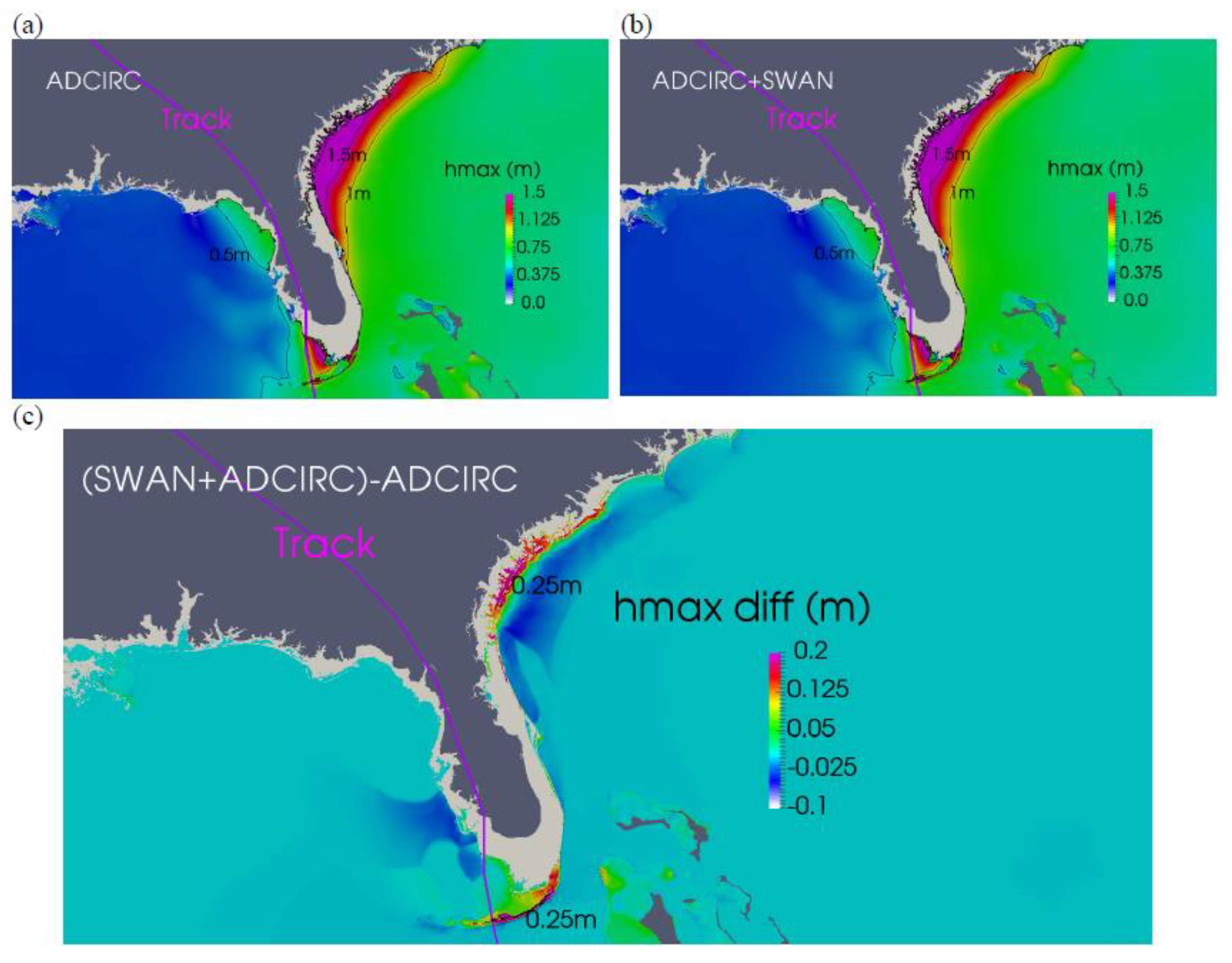
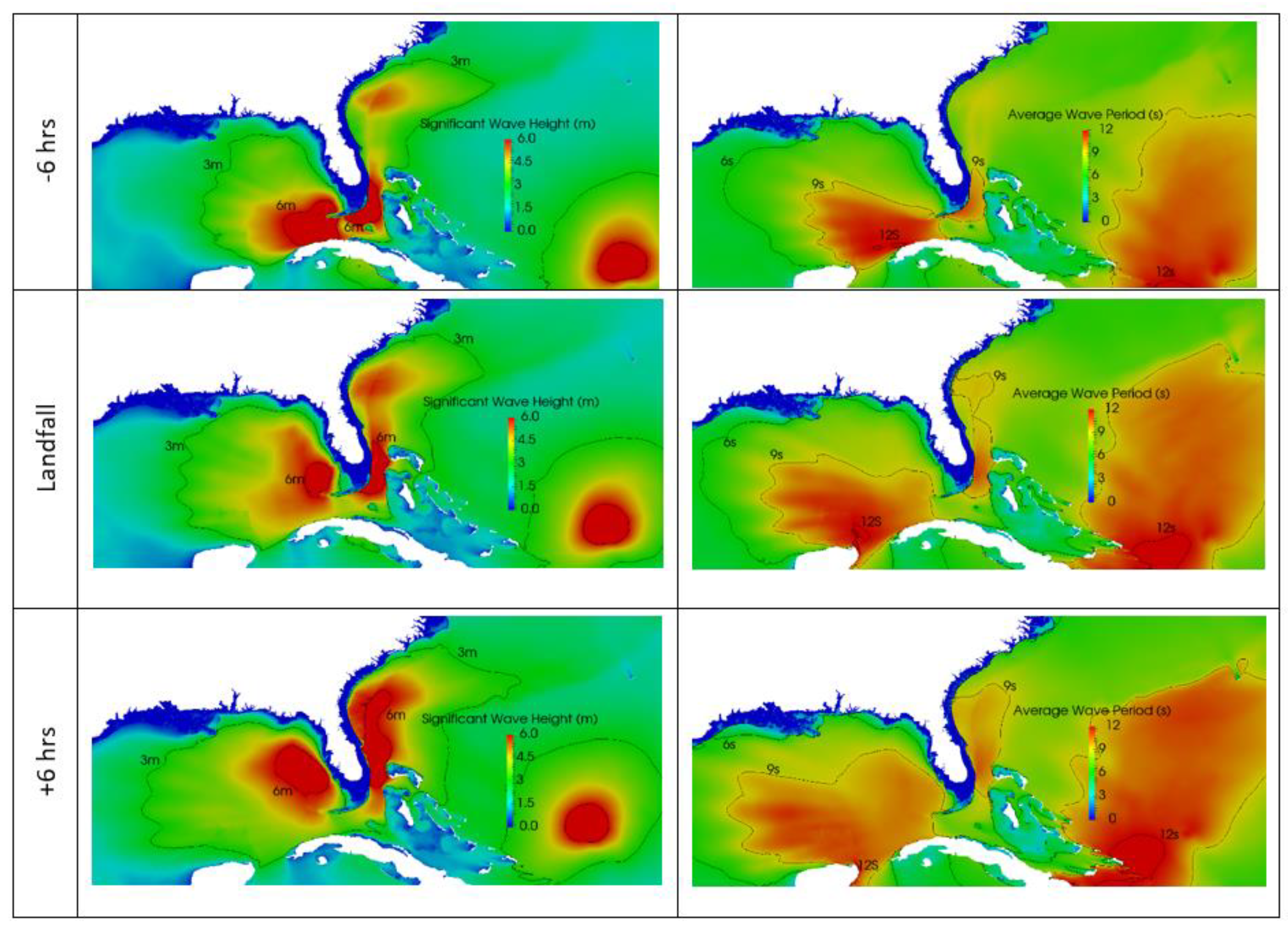
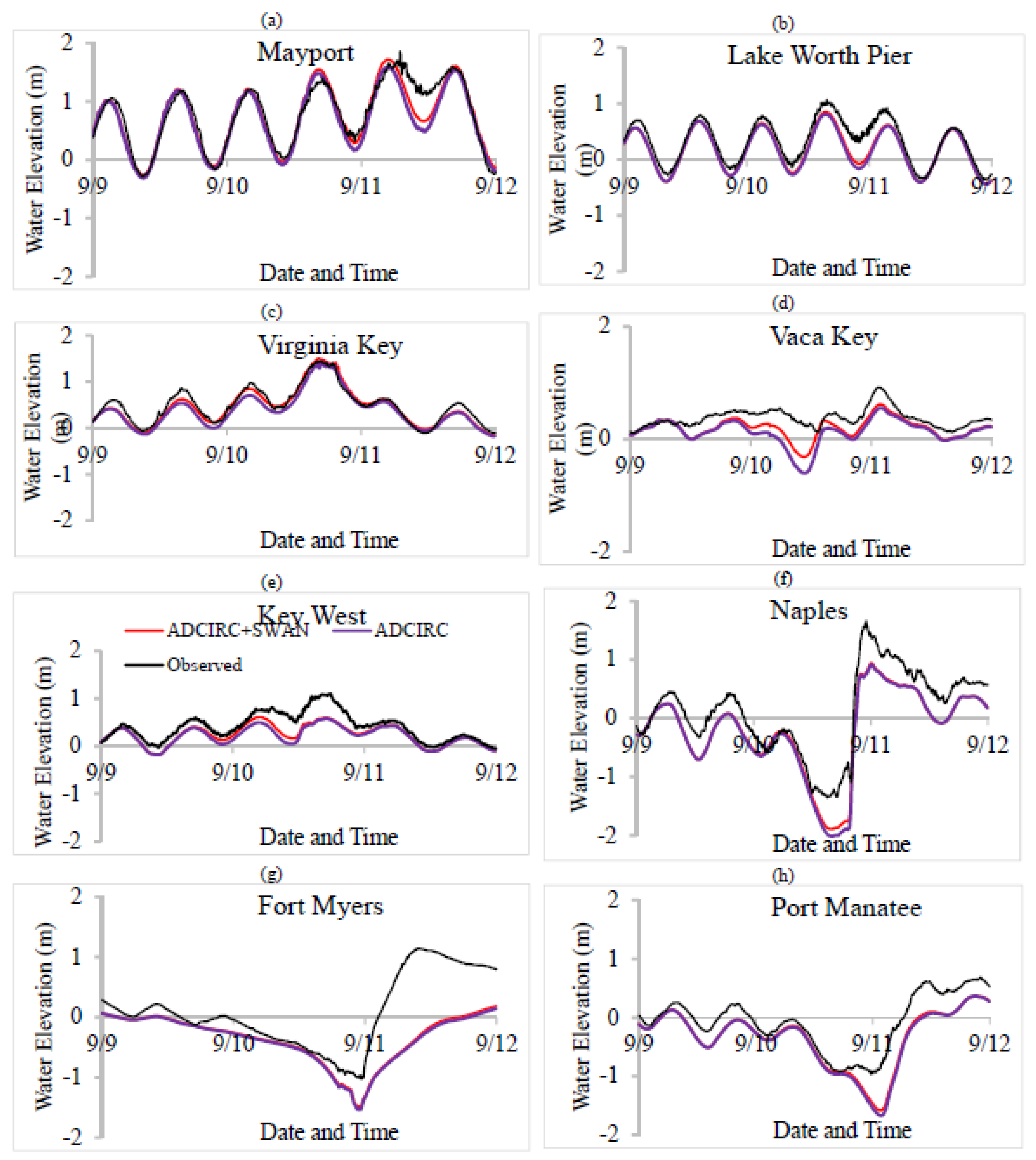
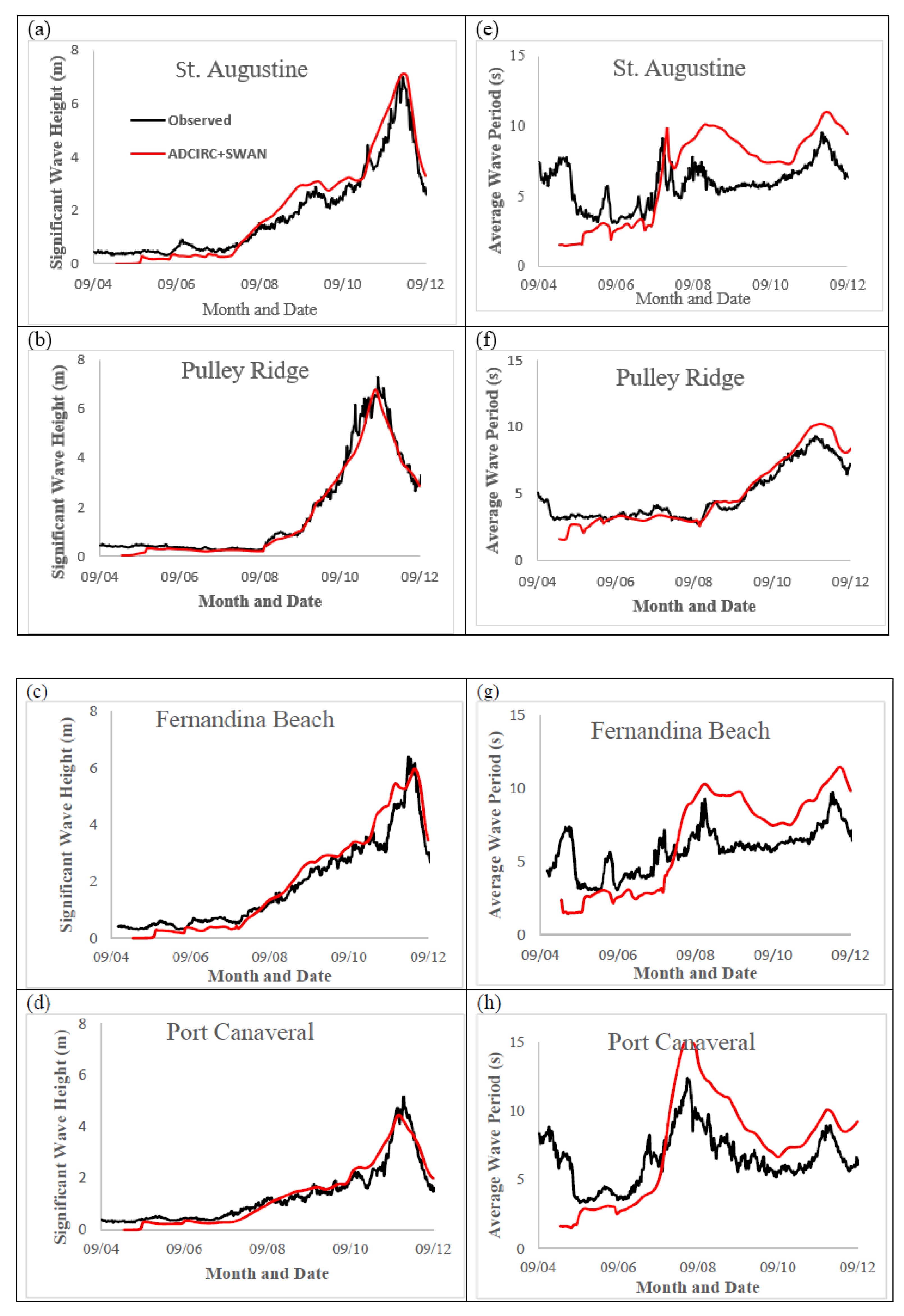
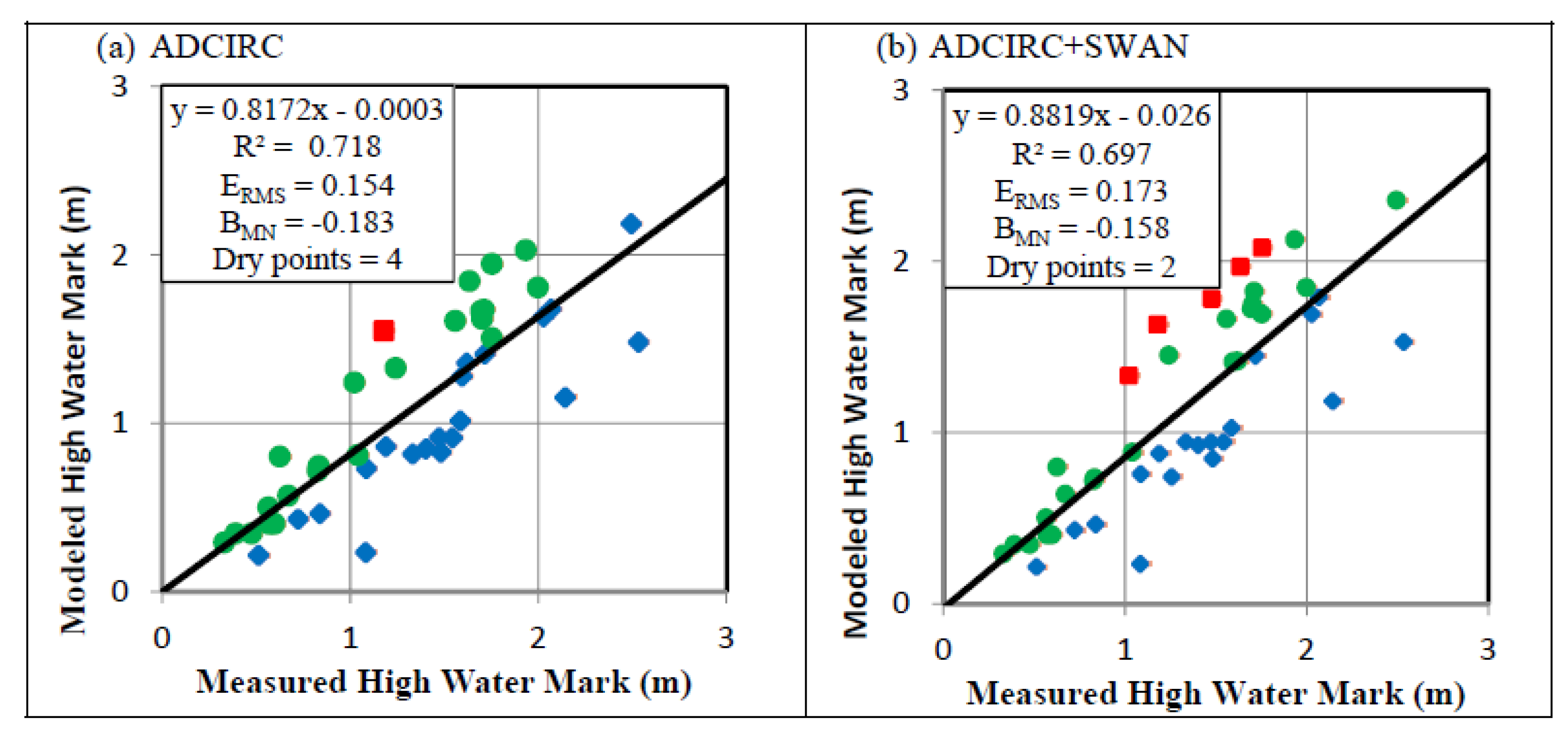
This paper evaluates the contribution of waves to the total predicted storm surges in a Hurricane Irma hindcast, using ADCIRC+SWAN and ADCIRC models. The contribution of waves is quantified by subtracting the water levels hindcasted by ADCIRC from those hindcasted by ADCIRC+SWAN, using OWI meteorological forcing in both models. Databases of water level time series, wave characteristic time series, and high-water marks are used to validate the model performance. Based on the application of our methodology to the coastline around Florida, a peninsula with unique geomorphic characteristics, we find that wave runup has the largest contribution to the total water levels on the south and northeast coasts. Waves increase the surge on the south and northeast coasts, due to large fetch and wave runups. On the west coast, the wave effect is not significant, due to limited fetch. However, significant wave heights become greater as the waves propagate into the deep inner gulf. The continental shelf on Florida’s west coast plays a critical role in decreasing the significant wave height and sheltering the coastal areas from large wave effects. Both models underpredict the high-water marks, but ADCIRC+SWAN reduces the underprediction and improves the parity with the observed data, although the scatter is slightly higher than that of ADCIRC.
Keywords: storm surge; waves; SWAN+ADCIRC; Hurricane Irma storm surge; waves; SWAN+ADCIRC; Hurricane Irma