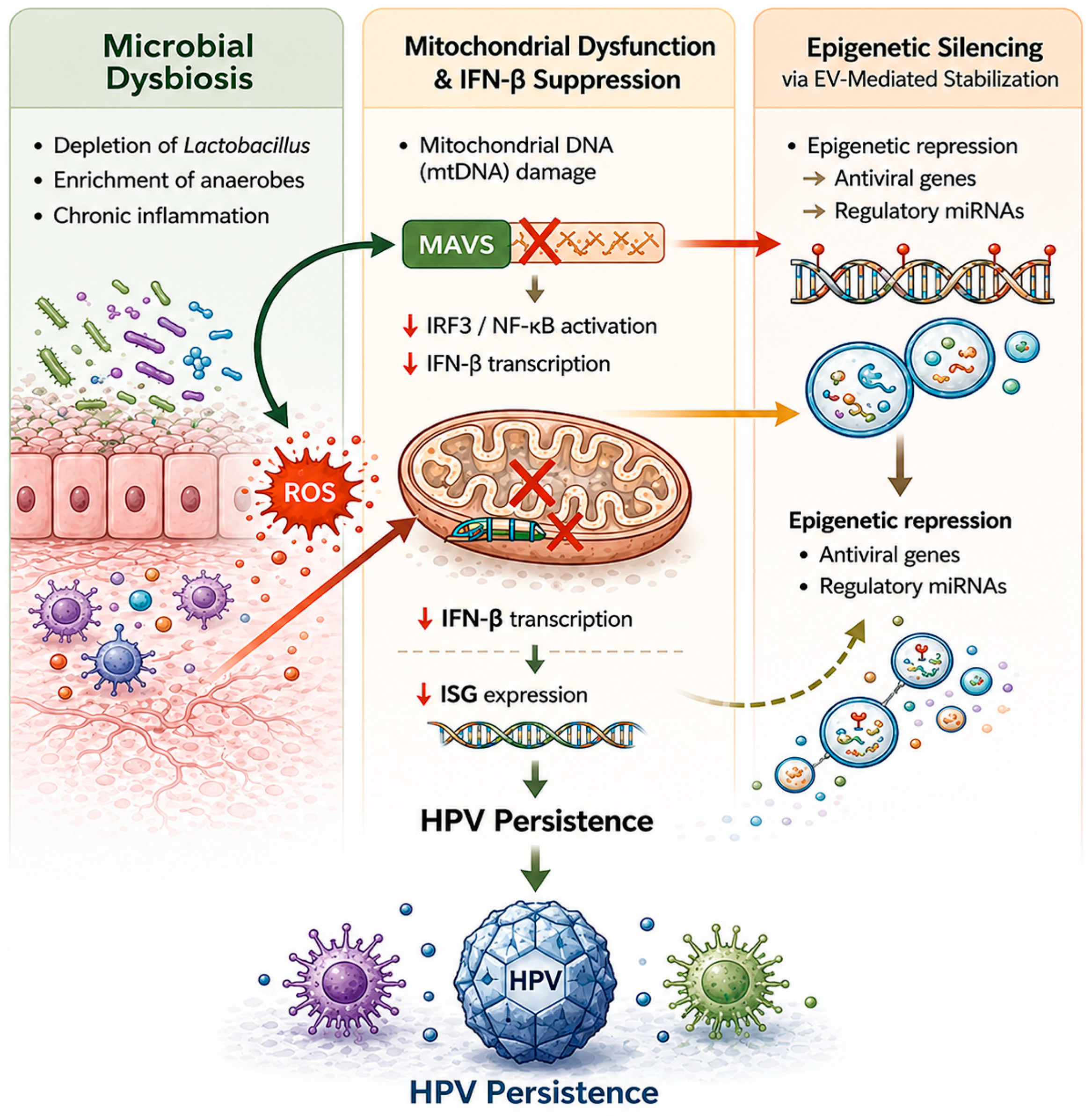
The Microbiome–Mitochondria–Extracellular Vesicle Axis in HPV Persistence and Cervical Carcinogenesis

 , , , and
Abstract
1. Introduction
2. Literature Search Strategy
3. Natural History of HPV Infection and Determinants of Persistence
4. Cervicovaginal Microbiome and HPV Persistence
5. Microbiome-Driven Inflammation and OS in HPV Persistence
6. Mitochondrial Dysfunction and Failure of Antiviral Surveillance
7. EVs as Amplifiers of HPV Persistence and Microenvironmental Reprogramming
7.1. EV Biogenesis and Functional Heterogeneity
7.2. EVs in Viral Infection: Immune Evasion and Signal Dissemination
7.3. HPV-Associated EVs: Cargo, Immune Modulation, and Oncogenic Conditioning
7.4. EV miRNAs and Non-Coding RNAs in Long-Range Gene Regulation
7.5. The EV–Mitochondria Axis: Metabolic and Redox Reprogramming
7.6. EV-Mediated Immune Regulation in Cancer and Infection
7.7. Clinical Translation: EVs as Biomarkers and Liquid Biopsy Tools
8. Integrated Microbiome–Mitochondria–EV Crosstalk in HPV Persistence
8.1. From Microbial Community Structure to Mucosal Immune Tone

| System Level | Key Alterations | Mechanistic Consequences | Impact on Antiviral Defense | Relevance to HPV Persistence |
|---|---|---|---|---|
| Microbiome composition [14,54,55] | Lactobacillus depletion; anaerobe enrichment; increased diversity | Chronic inflammation; epithelial barrier disruption | Altered mucosal immunity and cytokine profiles | Promotes hrHPV persistence and progression |
| Inflammatory and redox state [70,81] | Elevated ROS; chronic inflammatory signaling | Oxidative microenvironment; epithelial stress | Impaired immune coordination | Supports persistence-promoting tissue remodeling |
| EV communication [17,70] | Transfer of regulatory RNAs, proteins, metabolic signals | Spread of immunosuppressive and metabolic reprogramming signals | Amplified suppression of local immune responses | Reinforces persistence niche across tissue |
| Tissue microenvironment [18,79] | Immune modulation; metabolic reprogramming; epithelial stress | Crosstalk between epithelial, immune, and stromal cells | Reduced antiviral competence at tissue level | Facilitates immune evasion and persistence |
| Disease progression [60,90] | Viral genome instability and integration | Oncogenic transformation pathways activation | Loss of immune surveillance | Drives progression to cervical cancer |
| Clinical implications [79,118] | Composite biomarkers (microbiome profiles, EV cargo, OS markers) | Improved risk stratification and targeted interventions | Potential restoration of antiviral responses | Supports elimination strategies beyond vaccination |
8.2. OS Linking Dysbiosis to Mitochondrial Dysfunction
8.3. EVs in the HPV Persistence Microenvironment
8.4. A Stepwise Model for HPV Persistence and Progression
8.5. From Persistence Biology to HPV Elimination Strategies
9. Biomarkers, Risk Stratification and Therapeutic Opportunities
10. Future Directions and Outstanding Questions
11. Conclusions
Author Contributions
Funding
Institutional Review Board Statement
Informed Consent Statement
Data Availability Statement
Acknowledgments
Conflicts of Interest
Abbreviations
| HPV | Human papillomavirus |
| ROS | Reactive oxygen species |
| EVs | Extracellular vesicles |
| OS | Oxidative stress |
| miRNAs | microRNAs |
| MAVS | Mitochondrial antiviral signaling |
| CIN | Cervical intraepithelial neoplasia |
| ISGs | Interferon-stimulated genes |
| CSTs | Community state types |
References
- Włoszek, E.; Krupa, K.; Skrok, E.; Budzik, M.P.; Deptała, A.; Badowska-Kozakiewicz, A. HPV and Cervical Cancer—Biology, Prevention, and Treatment Updates. Curr. Oncol. 2025, 32, 122. [Google Scholar] [CrossRef]
- Zhang, S.; Xu, H.; Zhang, L.; Qiao, Y. Cervical Cancer: Epidemiology, Risk Factors and Screening. Chin. J. Cancer Res. 2020, 32, 720–728. [Google Scholar] [CrossRef]
- Ojha, P.S.; Maste, M.M.; Tubachi, S.; Patil, V.S. Human Papillomavirus and Cervical Cancer: An Insight Highlighting Pathogenesis and Targeting Strategies. VirusDisease 2022, 33, 132–154. [Google Scholar] [CrossRef]
- Huber, J.; Mueller, A.; Sailer, M.; Regidor, P.-A. Human Papillomavirus Persistence or Clearance after Infection in Reproductive Age. What Is the Status? Review of the Literature and New Data of a Vaginal Gel Containing Silicate Dioxide, Citric Acid, and Selenite. Womens Health 2021, 17, 17455065211020702. [Google Scholar] [CrossRef]
- Wang, C.-C.J.; Palefsky, J.M. Human Papillomavirus (HPV) Infections and the Importance of HPV Vaccination. Curr. Epidemiol. Rep. 2015, 2, 101–109. [Google Scholar] [CrossRef]
- Lin, Y.; Zhu, Y.; Jing, L.; Lei, X.; Xie, Z. Regulation of Viral Replication by Host Restriction Factors. Front. Immunol. 2025, 16, 1484119. [Google Scholar] [CrossRef]
- Liu, Z.; Song, S. Reprogramming Innate Immunity through Viral Interference: A Double-Edged Strategy for Enhancing and Containing Gene Therapies. Mol. Ther. Nucleic Acids 2026, 37, 102911. [Google Scholar] [CrossRef]
- Mlynarczyk-Bonikowska, B.; Rudnicka, L. HPV Infections—Classification, Pathogenesis, and Potential New Therapies. Int. J. Mol. Sci. 2024, 25, 7616. [Google Scholar] [CrossRef] [PubMed]
- Akbari, E.; Milani, A.; Seyedinkhorasani, M.; Bolhassani, A. HPV Co-infections with Other Pathogens in Cancer Development: A Comprehensive Review. J. Med. Virol. 2023, 95, e29236. [Google Scholar] [CrossRef]
- Bodily, J.; Laimins, L.A. Persistence of Human Papillomavirus Infection: Keys to Malignant Progression. Trends Microbiol. 2011, 19, 33–39. [Google Scholar] [CrossRef] [PubMed]
- Alizhan, D.; Ukybassova, T.; Bapayeva, G.; Aimagambetova, G.; Kongrtay, K.; Kamzayeva, N.; Terzic, M. Cervicovaginal Microbiome: Physiology, Age-Related Changes, and Protective Role Against Human Papillomavirus Infection. J. Clin. Med. 2025, 14, 1521. [Google Scholar] [CrossRef]
- Gao, H.; Liu, Q.; Wang, X.; Li, T.; Li, H.; Li, G.; Tan, L.; Chen, Y. Deciphering the Role of Female Reproductive Tract Microbiome in Reproductive Health: A Review. Front. Cell. Infect. Microbiol. 2024, 14, 1351540. [Google Scholar] [CrossRef] [PubMed]
- Wang, Y.; Wang, X.; Zhu, M.; Ge, L.; Liu, X.; Su, K.; Chen, Z.; Zhao, W. The Interplay Between Cervicovaginal Microbial Dysbiosis and Cervicovaginal Immunity. Front. Immunol. 2022, 13, 857299. [Google Scholar] [CrossRef] [PubMed]
- Dong, M.; Dong, Y.; Bai, J.; Li, H.; Ma, X.; Li, B.; Wang, C.; Li, H.; Qi, W.; Wang, Y.; et al. Interactions between Microbiota and Cervical Epithelial, Immune, and Mucus Barrier. Front. Cell. Infect. Microbiol. 2023, 13, 1124591. [Google Scholar] [CrossRef]
- Eslami, M.; Naderian, R.; Ahmadpour, A.; Shushtari, A.; Maleki, S.; Mohammadian, P.; Amiri, A.; Janbazi, M.; Memarian, M.; Yousefi, B. Microbiome Structure in Healthy and Pregnant Women and Importance of Vaginal Dysbiosis in Spontaneous Abortion. Front. Cell. Infect. Microbiol. 2024, 14, 1401610. [Google Scholar] [CrossRef]
- Gholiof, M.; Adamson-De Luca, E.; Wessels, J.M. The Female Reproductive Tract Microbiotas, Inflammation, and Gynecological Conditions. Front. Reprod. Health 2022, 4, 963752. [Google Scholar] [CrossRef]
- Bautista, J.; Altamirano-Colina, A.; López-Cortés, A. The Vaginal Microbiome in HPV Persistence and Cervical Cancer Progression. Front. Cell. Infect. Microbiol. 2025, 15, 1634251. [Google Scholar] [CrossRef]
- Pérez, S.E.; Gooz, M.; Maldonado, E.N. Mitochondrial Dysfunction and Metabolic Disturbances Induced by Viral Infections. Cells 2024, 13, 1789. [Google Scholar] [CrossRef]
- Chowdhury, A.; Witte, S.; Aich, A. Role of Mitochondrial Nucleic Acid Sensing Pathways in Health and Patho-Physiology. Front. Cell Dev. Biol. 2022, 10, 796066. [Google Scholar] [CrossRef]
- Wu, Z.; Qu, J.; Zhang, W.; Liu, G.-H. Stress, Epigenetics, and Aging: Unraveling the Intricate Crosstalk. Mol. Cell 2024, 84, 34–54. [Google Scholar] [CrossRef]
- Belkozhayev, A.; Al-Yozbaki, M.; Ashirbekov, Y.; Satken, K.; Abaildayev, A.; Yeleussizov, A.; Jainakbayev, N.; Sharipov, K.; Wilson, C.M. Advances in the Role of Extracellular Vesicles in Circulating microRNA Biomarker Discovery for Lung Cancer. Front. Cell Dev. Biol. 2025, 13, 1676530. [Google Scholar] [CrossRef]
- Kumar, A.; Kodidela, S.; Tadrous, E.; Cory, T.J.; Walker, C.M.; Smith, A.M.; Mukherjee, A.; Kumar, S. Extracellular Vesicles in Viral Replication and Pathogenesis and Their Potential Role in Therapeutic Intervention. Viruses 2020, 12, 887. [Google Scholar] [CrossRef] [PubMed]
- Raab-Traub, N.; Dittmer, D.P. Viral Effects on the Content and Function of Extracellular Vesicles. Nat. Rev. Microbiol. 2017, 15, 559–572. [Google Scholar] [CrossRef]
- Kumar, M.A.; Baba, S.K.; Sadida, H.Q.; Marzooqi, S.A.; Jerobin, J.; Altemani, F.H.; Algehainy, N.; Alanazi, M.A.; Abou-Samra, A.-B.; Kumar, R.; et al. Extracellular Vesicles as Tools and Targets in Therapy for Diseases. Signal Transduct. Target. Ther. 2024, 9, 27. [Google Scholar] [CrossRef]
- Harper, D.M.; Navarro-Alonso, J.A.; Bosch, F.X.; Paavonen, J.; Stanley, M.; Sasieni, P.; Yébenes, M.; Martínez-Martínez, N.; Rodriguez, Á.; García, A.; et al. Impact of Human Papillomavirus Vaccines in the Reduction of Infection, Precursor Lesions, and Cervical Cancer: A Systematic Literature Review. Hum. Vaccines Immunother. 2025, 21, 2497608. [Google Scholar] [CrossRef]
- Cangelosi, G.; Sacchini, F.; Mancin, S.; Petrelli, F.; Amendola, A.; Fappani, C.; Sguanci, M.; Morales Palomares, S.; Gravante, F.; Caggianelli, G. Papillomavirus Vaccination Programs and Knowledge Gaps as Barriers to Implementation: A Systematic Review. Vaccines 2025, 13, 460. [Google Scholar] [CrossRef]
- Paul, P.; Hammer, A.; Rositch, A.F.; Burke, A.E.; Viscidi, R.P.; Silver, M.I.; Campos, N.; Youk, A.O.; Gravitt, P.E. Rates of New Human Papillomavirus Detection and Loss of Detection in Middle-Aged Women by Recent and Past Sexual Behavior. J. Infect. Dis. 2021, 223, 1423–1432. [Google Scholar] [CrossRef]
- Wolf, J.; Kist, L.F.; Pereira, S.B.; Quessada, M.A.; Petek, H.; Pille, A.; Maccari, J.G.; Mutlaq, M.P.; Nasi, L.A. Human Papillomavirus Infection: Epidemiology, Biology, Host Interactions, Cancer Development, Prevention, and Therapeutics. Rev. Med. Virol. 2024, 34, e2537. [Google Scholar] [CrossRef] [PubMed]
- Radley, D.; Saah, A.; Stanley, M. Persistent Infection with Human Papillomavirus 16 or 18 Is Strongly Linked with High-Grade Cervical Disease. Hum. Vaccines Immunother. 2016, 12, 768–772. [Google Scholar] [CrossRef] [PubMed]
- Chen, S.; Yao, C.; Tian, N.; Zhang, C.; Chen, Y.; Wang, X.; Jiang, Y.; Zhang, T.; Zeng, T.; Song, Y. The Interplay between Persistent Pathogen Infections with Tumor Microenvironment and Immunotherapy in Cancer. Cancer Med. 2024, 13, e70154. [Google Scholar] [CrossRef]
- Jouya, S.; Shahabinia, Z.; Mazidimoradi, A.; Allahqoli, L.; Salehiniya, H.; Lee, D.-Y. Cervical Cancer Epidemiology: Global Incidence, Mortality, Survival, Risk Factors, and Equity in HPV Screening and Vaccination. J. Clin. Med. 2026, 15, 1079. [Google Scholar] [CrossRef] [PubMed]
- Rouse, B.T.; Sehrawat, S. Immunity and Immunopathology to Viruses: What Decides the Outcome? Nat. Rev. Immunol. 2010, 10, 514–526. [Google Scholar] [CrossRef] [PubMed]
- Herbert, J.A.; Panagiotou, S. Immune Response to Viruses. In Encyclopedia of Infection and Immunity; Elsevier: Amsterdam, The Netherlands, 2022; pp. 429–444. ISBN 978-0-323-90303-5. [Google Scholar]
- Teijaro, J.R. Type I Interferons in Viral Control and Immune Regulation. Curr. Opin. Virol. 2016, 16, 31–40. [Google Scholar] [CrossRef]
- Castro-Muñoz, L.J.; Rocha-Zavaleta, L.; Lizano, M.; Ramírez-Alcántara, K.M.; Madrid-Marina, V.; Manzo-Merino, J. Alteration of the IFN-Pathway by Human Papillomavirus Proteins: Antiviral Immune Response Evasion Mechanism. Biomedicines 2022, 10, 2965. [Google Scholar] [CrossRef]
- Fuse, S.; Molloy, M.J.; Usherwood, E.J. Immune Responses against Persistent Viral Infections: Possible Avenues for Immunotherapeutic Interventions. Crit. Rev. Immunol. 2008, 28, 159–183. [Google Scholar] [CrossRef] [PubMed]
- Kane, M.; Golovkina, T. Common Threads in Persistent Viral Infections. J. Virol. 2010, 84, 4116–4123. [Google Scholar] [CrossRef]
- Thorley-Lawson, D.A. EBV Persistence--Introducing the Virus. Curr. Top. Microbiol. Immunol. 2015, 390, 151–209. [Google Scholar] [CrossRef]
- Gu, Z.; Zhang, H.; Guo, X.; Cao, Y. Enhanced Glycogen Metabolism Supports the Survival and Proliferation of HPV-Infected Keratinocytes in Condylomata Acuminata. J. Investig. Dermatol. 2020, 140, 1513–1523.e5. [Google Scholar] [CrossRef]
- Tang, Y.-C.; Zhang, E.-F.; Zhong, H.-Z.; Li, M.-Y.; Wei, S.-B. Cervical Human Papillomavirus: The Therapeutic Target of Botanical Drugs. Front. Pharmacol. 2026, 17, 1822976. [Google Scholar] [CrossRef]
- Tsoneva, E.; Yordanov, A. HPV Oncoproteins and Mitochondrial Reprogramming: The Central Role of ROMO1 in Oxidative Stress and Metabolic Shifts. Cells 2025, 14, 1629. [Google Scholar] [CrossRef]
- Iliev, I.D.; Blander, J.M.; Collins, N.; Guo, C.-J.; Longman, R.S.; Sonnenberg, G.F.; Zeng, M.Y.; Artis, D. Microbiota-Mediated Mechanisms of Mucosal Immunity across the Lifespan. Nat. Immunol. 2025, 26, 1645–1659. [Google Scholar] [CrossRef]
- Chen, Y.; Xiao, L.; Zhou, M.; Zhang, H. The Microbiota: A Crucial Mediator in Gut Homeostasis and Colonization Resistance. Front. Microbiol. 2024, 15, 1417864. [Google Scholar] [CrossRef]
- Dong, W.; Wang, S.; Wang, X.; Xu, G.; Liu, Q.; Li, Z.; Lv, N.; Pan, Y.; Xiong, Q.; Liu, D.; et al. Characteristics of Vaginal Microbiota of Women of Reproductive Age with Infections. Microorganisms 2024, 12, 1030. [Google Scholar] [CrossRef]
- Ravel, J.; Gajer, P.; Abdo, Z.; Schneider, G.M.; Koenig, S.S.K.; McCulle, S.L.; Karlebach, S.; Gorle, R.; Russell, J.; Tacket, C.O.; et al. Vaginal Microbiome of Reproductive-Age Women. Proc. Natl. Acad. Sci. USA 2011, 108, 4680–4687. [Google Scholar] [CrossRef] [PubMed]
- Hiratsuka, D.; Matsuo, M.; Hirota, Y. The Reproductive Tract Microbiome and Female Fertility: Dysbiosis, Disease Links, and Emerging Therapeutic Strategies. Fertil. Steril. 2026, 125, 574–582. [Google Scholar] [CrossRef]
- Avitabile, E.; Menotti, L.; Croatti, V.; Giordani, B.; Parolin, C.; Vitali, B. Protective Mechanisms of Vaginal Lactobacilli against Sexually Transmitted Viral Infections. Int. J. Mol. Sci. 2024, 25, 9168. [Google Scholar] [CrossRef]
- Decout, A.; Krasias, I.; Roberts, L.; Gimeno Molina, B.; Charenton, C.; Brown Romero, D.; Tee, Q.Y.; Marchesi, J.R.; Ng, S.; Sykes, L.; et al. Lactobacillus crispatus S-Layer Proteins Modulate Innate Immune Response and Inflammation in the Lower Female Reproductive Tract. Nat. Commun. 2024, 15, 10879. [Google Scholar] [CrossRef]
- Zhao, F.; Hu, X.; Ying, C. Advances in Research on the Relationship between Vaginal Microbiota and Adverse Pregnancy Outcomes and Gynecological Diseases. Microorganisms 2023, 11, 991. [Google Scholar] [CrossRef]
- Mondal, A.S.; Sharma, R.; Trivedi, N. Bacterial Vaginosis: A State of Microbial Dysbiosis. Med. Microecol. 2023, 16, 100082. [Google Scholar] [CrossRef]
- Meng, L.; Xu, Y.; Lin, Z.; Shen, Y.; Zhang, Y.; Liu, S. Microbiota Dynamics in HPV-Infected Individuals: Implications for Cervical Neoplasia Development. Discov. Oncol. 2026, 17, 451. [Google Scholar] [CrossRef]
- Guo, M.; Chen, C.; Wang, W.; Zhang, C.; Ma, J.; Sadike, M.; Niyazi, M.; Feng, X.; Zhu, K. Research on the Relationship between HPV Infection and Alterations in Vaginal Microbial Ecology. Enfermedades Infecc. Microbiol. Clínica 2025, 43, 688–697. [Google Scholar] [CrossRef]
- Sharifian, K.; Shoja, Z.; Jalilvand, S. The Interplay between Human Papillomavirus and Vaginal Microbiota in Cervical Cancer Development. Virol. J. 2023, 20, 73. [Google Scholar] [CrossRef]
- Osei Sekyere, J.; Trama, J.; Adelson, M.; Trikannad, C.; DiBlasi, D.; Schuster, R.; Yang, J.J.; Mordechai, E. Lactobacillus-Rich Cervicovaginal Microbiome Associated with Lower BV, HPV, and Cytology Outcomes in Women. iScience 2025, 28, 113473. [Google Scholar] [CrossRef]
- Ye, J.; Qi, X. Vaginal Microecology and Its Role in Human Papillomavirus Infection and Human Papillomavirus Associated Cervical Lesions. APMIS 2024, 132, 928–947. [Google Scholar] [CrossRef]
- Avsaroglu, E.; Kaleli, B.; Kilic, D.; Kaleli, I.; Guler, T. A Decrease in Lactobacilli in the Vaginal Microbiota Is Independently Associated with HPV Persistence in Women with High-Risk HPV Infection. Cureus 2023, 15, e50907. [Google Scholar] [CrossRef] [PubMed]
- Kay, J.; Thadhani, E.; Samson, L.; Engelward, B. Inflammation-Induced DNA Damage, Mutations and Cancer. DNA Repair. 2019, 83, 102673. [Google Scholar] [CrossRef]
- Despot, A.; Fureš, R.; Despot, A.-M.; Hrgović, Z.; Gredičak, M.; Malinac Malojčić, S.; Ćosić, V.; Mešić, L.; Sinković, N.; Sabol, I. HPV Infection and Oxidative Stress in Cervical Carcinogenesis: Linking Apoptosis, Senescence, SASP, and EMT. Antioxidants 2026, 15, 486. [Google Scholar] [CrossRef] [PubMed]
- Moscicki, A.-B.; Shi, B.; Huang, H.; Barnard, E.; Li, H. Cervical-Vaginal Microbiome and Associated Cytokine Profiles in a Prospective Study of HPV 16 Acquisition, Persistence, and Clearance. Front. Cell. Infect. Microbiol. 2020, 10, 569022. [Google Scholar] [CrossRef] [PubMed]
- Nazarova, V.; Kamzayeva, N.; Ukybassova, T.; Kozhakhmetov, S.; Kushugulova, A. Systems Analysis of the HPV–Microbiome–Biofilm Triad. Front. Cell. Infect. Microbiol. 2026, 16, 1767224. [Google Scholar] [CrossRef]
- Reuter, S.; Gupta, S.C.; Chaturvedi, M.M.; Aggarwal, B.B. Oxidative Stress, Inflammation, and Cancer: How Are They Linked? Free Radic. Biol. Med. 2010, 49, 1603–1616. [Google Scholar] [CrossRef]
- Letafati, A.; Taghiabadi, Z.; Zafarian, N.; Tajdini, R.; Mondeali, M.; Aboofazeli, A.; Chichiarelli, S.; Saso, L.; Jazayeri, S.M. Emerging Paradigms: Unmasking the Role of Oxidative Stress in HPV-Induced Carcinogenesis. Infect. Agent. Cancer 2024, 19, 30. [Google Scholar] [CrossRef] [PubMed]
- Herrera-Quintana, L.; Iturbe-Sanz, P.; Olivares-Arancibia, J.; Vázquez-Lorente, H.; Plaza-Diaz, J. Interplay of Microbiome, Oxidative Stress and Inflammation in Health and Disease. Antioxidants 2026, 15, 222. [Google Scholar] [CrossRef]
- Kunst, C.; Schmid, S.; Michalski, M.; Tümen, D.; Buttenschön, J.; Müller, M.; Gülow, K. The Influence of Gut Microbiota on Oxidative Stress and the Immune System. Biomedicines 2023, 11, 1388. [Google Scholar] [CrossRef]
- McBeth, A.; Miller, E.A.; Thompson, B.; Hanaway, P.; Thexton, A.; Zwickey, H. Balancing Oxidative Stress: How the Gut Microbiome Supports Redox Homeostasis and Mitochondrial Health. J. Restor. Med. 2025, 15, 4–19. [Google Scholar] [CrossRef] [PubMed]
- Ye, J.; Zheng, L.; He, Y.; Qi, X. Human Papillomavirus Associated Cervical Lesion: Pathogenesis and Therapeutic Interventions. MedComm 2023, 4, e368. [Google Scholar] [CrossRef]
- Gavkare, A.M.; Nanaware, N.L.; Sonar, M.N.; Dhotre, S.V.; Mumbre, S.S.; Nagoba, B.S. Gut Microbiome and Viral Infections: A Hidden Nexus for Immune Protection. World J. Virol. 2025, 14, 111912. [Google Scholar] [CrossRef] [PubMed]
- Selvaraj, N.R.; Nandan, D.; Nair, B.G.; Nair, V.A.; Venugopal, P.; Aradhya, R. Oxidative Stress and Redox Imbalance: Common Mechanisms in Cancer Stem Cells and Neurodegenerative Diseases. Cells 2025, 14, 511. [Google Scholar] [CrossRef]
- Liu, S.; Liu, J.; Wang, Y.; Deng, F.; Deng, Z. Oxidative Stress: Signaling Pathways, Biological Functions, and Disease. MedComm 2025, 6, e70268. [Google Scholar] [CrossRef]
- Bellanti, F.; Coda, A.R.D.; Trecca, M.I.; Lo Buglio, A.; Serviddio, G.; Vendemiale, G. Redox Imbalance in Inflammation: The Interplay of Oxidative and Reductive Stress. Antioxidants 2025, 14, 656. [Google Scholar] [CrossRef]
- Ježek, P.; Holendová, B.; Plecitá-Hlavatá, L. Redox Signaling from Mitochondria: Signal Propagation and Its Targets. Biomolecules 2020, 10, 93. [Google Scholar] [CrossRef]
- Foo, J.; Bellot, G.; Pervaiz, S.; Alonso, S. Mitochondria-Mediated Oxidative Stress during Viral Infection. Trends Microbiol. 2022, 30, 679–692. [Google Scholar] [CrossRef]
- Lee, E.; Ozigbo, A.A.; Varon, J.; Halma, M.; Laezzo, M.; Ang, S.P.; Iglesias, J. Mitochondrial Reactive Oxygen Species: A Unifying Mechanism in Long COVID and Spike Protein-Associated Injury: A Narrative Review. Biomolecules 2025, 15, 1339. [Google Scholar] [CrossRef]
- Banoth, B.; Cassel, S.L. Mitochondria in Innate Immune Signaling. Transl. Res. 2018, 202, 52–68. [Google Scholar] [CrossRef]
- Oh, S.; Mandell, M.A. Regulation of Mitochondria-Derived Immune Activation by “Antiviral” TRIM Proteins. Viruses 2024, 16, 1161. [Google Scholar] [CrossRef]
- Wang, X.; Wang, Q.; Zheng, C.; Wang, L. MAVS: The next STING in Cancers and Other Diseases. Crit. Rev. Oncol./Hematol. 2025, 207, 104610. [Google Scholar] [CrossRef]
- Ren, Z.; Ding, T.; Zuo, Z.; Xu, Z.; Deng, J.; Wei, Z. Regulation of MAVS Expression and Signaling Function in the Antiviral Innate Immune Response. Front. Immunol. 2020, 11, 1030. [Google Scholar] [CrossRef]
- Yang, Y.; Zeng, Y.; Liu, Z.; Huang, J. Pathogen-Induced Mitochondrial Dysfunction: Mechanistic Insights, Immune Crosstalk, and Therapeutic Opportunities. Front. Cell. Infect. Microbiol. 2025, 15, 1714998. [Google Scholar] [CrossRef]
- Duan, X.; Liu, R.; Lan, W.; Liu, S. The Essential Role of Mitochondrial Dynamics in Viral Infections. Int. J. Mol. Sci. 2025, 26, 1955. [Google Scholar] [CrossRef]
- Elesela, S.; Lukacs, N.W. Role of Mitochondria in Viral Infections. Life 2021, 11, 232. [Google Scholar] [CrossRef]
- Xu, X.; Pang, Y.; Fan, X. Mitochondria in Oxidative Stress, Inflammation and Aging: From Mechanisms to Therapeutic Advances. Signal Transduct. Target. Ther. 2025, 10, 190. [Google Scholar] [CrossRef]
- Chen, S.; Li, Q.; Shi, H.; Li, F.; Duan, Y.; Guo, Q. New Insights into the Role of Mitochondrial Dynamics in Oxidative Stress-Induced Diseases. Biomed. Pharmacother. 2024, 178, 117084. [Google Scholar] [CrossRef]
- Cakir, M.O.; Selek, M.; Kayhan, G.; Yilmaz, B.; Ozdogan, M.; Ashrafi, G.H. Mitochondrial DNA Alterations in HPV-Related Cancers: Emerging Insights and Future Directions. DNA 2026, 6, 7. [Google Scholar] [CrossRef]
- Angajala, A.; Lim, S.; Phillips, J.B.; Kim, J.-H.; Yates, C.; You, Z.; Tan, M. Diverse Roles of Mitochondria in Immune Responses: Novel Insights Into Immuno-Metabolism. Front. Immunol. 2018, 9, 1605. [Google Scholar] [CrossRef]
- Chun, S.; An, J.; Kim, M.S. Mitochondrial Transfer Between Cancer and T Cells: Implications for Immune Evasion. Antioxidants 2025, 14, 1008. [Google Scholar] [CrossRef]
- Gore, M.; Kabekkodu, S.P.; Chakrabarty, S. Exploring the Metabolic Alterations in Cervical Cancer Induced by HPV Oncoproteins: From Mechanisms to Therapeutic Targets. Biochim. Biophys. Acta Rev. Cancer 2025, 1880, 189292. [Google Scholar] [CrossRef]
- Wang, Z.; Wang, Z.; Jiang, J.; Yang, L.; Li, C.; Deng, X.; Li, Y.; Yuan, J.; Jiang, P.; Wang, J. Reprogramming the Tumor Immune Microenvironment in Cervical Cancer: Synergy between Radiotherapy and Immunotherapy. Mol. Cancer 2026, 25, 80. [Google Scholar] [CrossRef] [PubMed]
- Maleka, M.N.; Mbita, Z.; Morafo, V. Regulation of Granzymes A and B by High-Risk HPV: Impact on Immune Evasion and Carcinogenesis. Viruses 2025, 17, 221. [Google Scholar] [CrossRef]
- Shen, J.; Sun, H.; Chu, J.; Gong, X.; Liu, X. Cervicovaginal Microbiota: A Promising Direction for Prevention and Treatment in Cervical Cancer. Infect. Agent. Cancer 2024, 19, 13. [Google Scholar] [CrossRef] [PubMed]
- Feller, L.; Wood, N.H.; Khammissa, R.A.G.; Lemmer, J. Human Papillomavirus-Mediated Carcinogenesis and HPV-Associated Oral and Oropharyngeal Squamous Cell Carcinoma. Part 1: Human Papillomavirus-Mediated Carcinogenesis. Head. Face Med. 2010, 6, 14. [Google Scholar] [CrossRef]
- Zhou, N.; Bao, W.-Q.; Zhang, C.; Jiang, M.-L.; Liang, T.-L.; Ma, G.-Y.; Liu, L.; Pan, H.-D.; Li, R.-Z. Immunometabolism and Oxidative Stress: Roles and Therapeutic Strategies in Cancer and Aging. npj Aging 2025, 11, 59. [Google Scholar] [CrossRef]
- Yang, H.; Zhao, A.; Chen, Y.; Cheng, T.; Zhou, J.; Li, Z. Exploring the Potential Link between MitoEVs and the Immune Microenvironment of Periodontitis Based on Machine Learning and Bioinformatics Methods. BMC Oral Health 2024, 24, 169. [Google Scholar] [CrossRef]
- Kong, J.; Sun, R.; Du, C.; Tang, Y.; Xie, C.; Li, Q.; Lin, L.; Wang, H. Mitochondrial Extracellular Vesicles: A Novel Approach to Mitochondrial Quality Control. Biomolecules 2025, 15, 1145. [Google Scholar] [CrossRef] [PubMed]
- Berumen Sánchez, G.; Bunn, K.E.; Pua, H.H.; Rafat, M. Extracellular Vesicles: Mediators of Intercellular Communication in Tissue Injury and Disease. Cell Commun. Signal 2021, 19, 104. [Google Scholar] [CrossRef]
- Zaborowski, M.P.; Balaj, L.; Breakefield, X.O.; Lai, C.P. Extracellular Vesicles: Composition, Biological Relevance, and Methods of Study. Bioscience 2015, 65, 783–797. [Google Scholar] [CrossRef]
- Primorac, D.; Brlek, P.; Bulić, L.; Hrvatin, N.; Škaro, V.; Projić, P.; Glavan, M.; Oleru, I.; Rocheteau, P.; Tremolada, C.; et al. Therapeutic Potential of Extracellular Vesicles: From Biogenesis, Isolation and Molecular Characterization to Addressing Translational Gaps and Regulatory Barriers. Int. J. Mol. Sci. 2026, 27, 1676. [Google Scholar] [CrossRef] [PubMed]
- Ovčar, A.; Kovačič, B. Biogenesis of Extracellular Vesicles (EVs) and the Potential Use of Embryo-Derived EVs in Medically Assisted Reproduction. Int. J. Mol. Sci. 2024, 26, 42. [Google Scholar] [CrossRef]
- Rodrigues, M.; Fan, J.; Lyon, C.; Wan, M.; Hu, Y. Role of Extracellular Vesicles in Viral and Bacterial Infections: Pathogenesis, Diagnostics, and Therapeutics. Theranostics 2018, 8, 2709–2721. [Google Scholar] [CrossRef]
- Saleem, M.; Chang, C.-W.; Qadeer, A.; Asiri, M.; Alzahrani, F.M.; Alzahrani, K.J.; Alsharif, K.F.; Chen, C.-C.; Hussain, S. The Emerging Role of Extracellular Vesicles in Viral Transmission and Immune Evasion. Front. Immunol. 2025, 16, 1634758. [Google Scholar] [CrossRef]
- Kumari, S.; Banerjee, A. Extracellular Vesicles: The Double-Edged Sword in Viral Infections. mBio 2026, 17, e0331625. [Google Scholar] [CrossRef]
- Stotz, H.U.; Brotherton, D.; Inal, J. Communication Is Key: Extracellular Vesicles as Mediators of Infection and Defence during Host-Microbe Interactions in Animals and Plants. FEMS Microbiol. Rev. 2022, 46, fuab044. [Google Scholar] [CrossRef] [PubMed]
- Van Der Merwe, M.; Myburgh, K.; Garnis, C.; Towle, R.; Engelbrecht, A.-M. Unravelling the Role of Extracellular Vesicles in Cervical Cancer: Mechanisms of Progression, Resistance, and Emerging Therapeutic Strategies. Gene 2025, 957, 149467. [Google Scholar] [CrossRef]
- Acevedo-Sánchez, V.; Rodríguez-Hernández, R.M.; Aguilar-Ruíz, S.R.; Torres-Aguilar, H.; Romero-Tlalolini, M.D.L.A. Extracellular Vesicles in Cervical Cancer and HPV Infection. Membranes 2021, 11, 453. [Google Scholar] [CrossRef]
- Dong, S.; Zhang, Y.; Wang, Y. Role of Extracellular Vesicle in Human Papillomavirus-Associated Cervical Cancer. J. Cancer Res. Clin. Oncol. 2023, 149, 16203–16212. [Google Scholar] [CrossRef]
- Kaczmarek, M.; Baj-Krzyworzeka, M.; Bogucki, Ł.; Dutsch-Wicherek, M. HPV-Related Cervical Cancer and Extracellular Vesicles. Diagnostics 2022, 12, 2584. [Google Scholar] [CrossRef] [PubMed]
- Mittal, S.; Gupta, P.; Chaluvally-Raghavan, P.; Pradeep, S. Emerging Role of Extracellular Vesicles in Immune Regulation and Cancer Progression. Cancers 2020, 12, 3563. [Google Scholar] [CrossRef]
- Shahsavandi, Y.; Banaeian, F.; Jafarinia, M.; Nasri, F.; Shapoori, S. miRNAs from Mesenchymal-Stem-Cell-Derived Extracellular Vesicles: Emerging Players in Regenerative Medicine and Disease Therapy. Mol. Ther. Nucleic Acids 2025, 36, 102715. [Google Scholar] [CrossRef] [PubMed]
- Cakir, M.O.; Selek, M.; Yilmaz, B.; Ozdogan, M.; Ashrafi, G.H. Exosomes in HPV-Associated Cancers: From Biomarkers to Engineered Therapeutics. Cancers 2025, 17, 3386. [Google Scholar] [CrossRef] [PubMed]
- Zhang, Y.; Tan, J.; Miao, Y.; Zhang, Q. The Effect of Extracellular Vesicles on the Regulation of Mitochondria under Hypoxia. Cell Death Dis. 2021, 12, 358. [Google Scholar] [CrossRef]
- Shahannaz, D.C.; Sugiura, T.; Ferrell, B.E.; Yoshida, T. Targeting Mitochondrial Dynamics via EV Delivery in Regenerative Cardiology: Mechanistic and Therapeutic Perspectives. Cells 2025, 14, 1738. [Google Scholar] [CrossRef]
- Di Mambro, T.; Pellielo, G.; Agyapong, E.D.; Carinci, M.; Chianese, D.; Giorgi, C.; Morciano, G.; Patergnani, S.; Pinton, P.; Rimessi, A. The Tricky Connection between Extracellular Vesicles and Mitochondria in Inflammatory-Related Diseases. Int. J. Mol. Sci. 2023, 24, 8181. [Google Scholar] [CrossRef]
- Amari, L.; Germain, M. Mitochondrial Extracellular Vesicles—Origins and Roles. Front. Mol. Neurosci. 2021, 14, 767219. [Google Scholar] [CrossRef]
- Ju, W.; Yan, B.; Li, D.; Lian, F.; Xiang, S. Mitochondria-Driven Inflammation: A New Frontier in Ovarian Ageing. J. Transl. Med. 2025, 23, 1005. [Google Scholar] [CrossRef]
- Li, Y.; Deng, J.; Liu, Y.; Yu, S. HPV Infection and the Immune Microenvironment in Cervical Cancer. Front. Immunol. 2025, 16, 1645019. [Google Scholar] [CrossRef] [PubMed]
- Senba, M.; Mori, N. Mechanisms of Virus Immune Evasion Lead to Development from Chronic Inflammation to Cancer Formation Associated with Human Papillomavirus Infection. Oncol. Rev. 2012, 6, e17. [Google Scholar] [CrossRef] [PubMed]
- Zhou, X.; An, R.; Li, X. Cervical Cancer Immune Microenvironment: Mechanisms of HPV-Mediated Immune Evasion and Advances in Immunotherapy (Review). Oncol. Lett. 2026, 31, 22. [Google Scholar] [CrossRef] [PubMed]
- Ljungström, M.; Oltra, E. Methods for Extracellular Vesicle Isolation: Relevance for Encapsulated miRNAs in Disease Diagnosis and Treatment. Genes 2025, 16, 330. [Google Scholar] [CrossRef]
- Li, B.; Wu, W.; Xu, W.; Qian, H.; Ji, C. Advances of Extracellular Vesicles Isolation and Detection Frontier Technology: From Heterogeneity Analysis to Clinical Application. J. Nanobiotechnol. 2025, 23, 678. [Google Scholar] [CrossRef]
- Hanada, Y.; Ishihara, N.; Wang, L.; Otera, H.; Ishihara, T.; Koshiba, T.; Mihara, K.; Ogawa, Y.; Nomura, M. MAVS Is Energized by Mff Which Senses Mitochondrial Metabolism via AMPK for Acute Antiviral Immunity. Nat. Commun. 2020, 11, 5711. [Google Scholar] [CrossRef] [PubMed]
- Jiang, M.; Huang, R.; Li, W. From Mitochondria to Heart: The Role and Challenges of Mitochondrial Antiviral Signaling Protein in Cardiovascular Disease. Front. Cardiovasc. Med. 2025, 12, 1572559. [Google Scholar] [CrossRef]
- Schwab, A.; Meyering, S.S.; Lepene, B.; Iordanskiy, S.; van Hoek, M.L.; Hakami, R.M.; Kashanchi, F. Extracellular Vesicles from Infected Cells: Potential for Direct Pathogenesis. Front. Microbiol. 2015, 6, 1132. [Google Scholar] [CrossRef]
- De Sousa, K.P.; Rossi, I.; Abdullahi, M.; Ramirez, M.I.; Stratton, D.; Inal, J.M. Isolation and Characterization of Extracellular Vesicles and Future Directions in Diagnosis and Therapy. WIREs Nanomed. Nanobiotechnol. 2023, 15, e1835. [Google Scholar] [CrossRef]
- Papamentzelopoulou, M.; Pitiriga, V.C. Unlocking the Interactions Between the Whole-Body Microbiome and HPV Infection: A Literature Review. Pathogens 2025, 14, 293. [Google Scholar] [CrossRef]
- Schellekens, H.C.J.; Schmidt, L.M.S.; Morré, S.A.; van Esch, E.M.G.; de Vos van Steenwijk, P.J. Vaginal Microbiota and Local Immunity in HPV-Induced High-Grade Cervical Dysplasia: A Narrative Review. Int. J. Mol. Sci. 2025, 26, 3954. [Google Scholar] [CrossRef] [PubMed]
- Lei, Y.; Moore, C.B.; Liesman, R.M.; O’Connor, B.P.; Bergstralh, D.T.; Chen, Z.J.; Pickles, R.J.; Ting, J.P.-Y. MAVS-Mediated Apoptosis and Its Inhibition by Viral Proteins. PLoS ONE 2009, 4, e5466. [Google Scholar] [CrossRef] [PubMed]
- Hall, M.T.; Hyatt, A.; Smith, M.A.; Torode, J.; Costa, T.; Nguyen, D.T.N.; Balshaw, T.; Grogan, P.; Sweeny, K.; Auste, C.; et al. Elimination of Cervical Cancer: The Impact of HPV Vaccination, Primary HPV Screening, and Expanded Access to Cancer Treatment Services. Mol. Asp. Med. 2026, 107, 101423. [Google Scholar] [CrossRef]
- Ryser, M.D.; Gravitt, P.E.; Myers, E.R. Mechanistic Mathematical Models: An Underused Platform for HPV Research. Papillomavirus Res. 2017, 3, 46–49. [Google Scholar] [CrossRef]
- Martín, E.; Reina, G.; Carlos, S. Advances in Therapeutic Vaccines Against HPV: A Review of Human Clinical Trials. Curr. Oncol. 2025, 32, 600. [Google Scholar] [CrossRef] [PubMed]
- Puagsopa, J.; Tongviseskul, N.; Jaroentomeechai, T.; Meksiriporn, B. Recent Progress in Developing Extracellular Vesicles as Nanovehicles to Deliver Carbohydrate-Based Therapeutics and Vaccines. Vaccines 2025, 13, 285. [Google Scholar] [CrossRef]
- Gisca, T.; Matasariu, D.R.; Ursache, A.; Socolov, D.G.; Scripcariu, I.-S.; Fudulu, A.; Anton, E.T.-T.; Botezatu, A. Integrating Biomarkers into Cervical Cancer Screening—Advances in Diagnosis and Risk Prediction: A Narrative Review. Diagnostics 2025, 15, 3231. [Google Scholar] [CrossRef]
- Merdzhanova-Gargova, Y.; Ivanova, M.; Mollova-Kysebekirova, A.; Mihaylova, A.; Parahuleva-Rogacheva, N.; Uchikova, E.; Koleva-Ivanova, M. Advancements in Cervical Cancer Screening: Enhancing HPV Testing and Triage Strategies for Improved Risk Assessment. Biomedicines 2025, 13, 1768. [Google Scholar] [CrossRef]
- Lorincz, A.; Castanon, A.; Wey Lim, A.W.; Sasieni, P. New Strategies for Human Papillomavirus-Based Cervical Screening. Womens Health 2013, 9, 443–452. [Google Scholar] [CrossRef]
- Mesher, D.; Szarewski, A.; Cadman, L.; Cubie, H.; Kitchener, H.; Luesley, D.; Menon, U.; Hulman, G.; Desai, M.; Ho, L.; et al. Long-Term Follow-up of Cervical Disease in Women Screened by Cytology and HPV Testing: Results from the HART Study. Br. J. Cancer 2010, 102, 1405–1410. [Google Scholar] [CrossRef][Green Version]
- Vahteristo, M.; Leinonen, M.K.; Sarkeala, T.; Anttila, A.; Heinävaara, S. Similar Effectiveness with Primary HPV and Cytology Screening—Long-Term Follow-up of Randomized Cervical Cancer Screening Trial. Gynecol. Oncol. 2024, 180, 146–151. [Google Scholar] [CrossRef]
- Tian, X.; Weng, D.; Chen, Y.; Wang, Y.; Li, X.; Wang, X.; Cao, C.; Gong, D.; Zeng, Z.; Wu, Q.; et al. Risk Assessment and Triage Strategy of Cervical Cancer Primary Screening on HPV Integration Status: 5-Year Follow-up of a Prospective Cohort Study. J. Natl. Cancer Cent. 2024, 4, 311–317. [Google Scholar] [CrossRef]
- Wang, H.-R.; Li, Y.-C.; Guo, H.-Q.; Yu, L.-L.; Wu, Z.; Yin, J.; Liao, G.-D.; Qu, Y.-M.; Jiang, Y.; Wang, D.; et al. A Cocktail of p16INK4a and Ki-67, p16INK4a and Minichromosome Maintenance Protein 2 as Triage Tests for Human Papillomavirus Primary Cervical Cancer Screening. Oncotarget 2017, 8, 83890–83899. [Google Scholar] [CrossRef]
- Ouh, Y.-T.; Kim, H.Y.; Yi, K.W.; Lee, N.-W.; Kim, H.-J.; Min, K.-J. Enhancing Cervical Cancer Screening: Review of P16/Ki-67 Dual Staining as a Promising Triage Strategy. Diagnostics 2024, 14, 451. [Google Scholar] [CrossRef]
- Pirtea, L.; Secosan, C.; Margan, M.; Moleriu, L.; Balint, O.; Grigoras, D.; Sas, I.; Horhat, F.; Jianu, A.; Ilina, R. P16/Ki-67 Dual Staining Has a Better Accuracy than Human Papillomavirus (HPV) Testing in Women with Abnormal Cytology under 30 Years Old. Bosn. J. Basic. Med. Sci. 2019, 19, 336–341. [Google Scholar] [CrossRef]
- Yu, L.; Fei, L.; Liu, X.; Pi, X.; Wang, L.; Chen, S. Application of P16/Ki-67 Dual-Staining Cytology in Cervical Cancers. J. Cancer 2019, 10, 2654–2660. [Google Scholar] [CrossRef]
- García-Giménez, J.L.; Seco-Cervera, M.; Tollefsbol, T.O.; Romá-Mateo, C.; Peiró-Chova, L.; Lapunzina, P.; Pallardó, F.V. Epigenetic Biomarkers: Current Strategies and Future Challenges for Their Use in the Clinical Laboratory. Crit. Rev. Clin. Lab. Sci. 2017, 54, 529–550. [Google Scholar] [CrossRef]
- Faraji, J.; Metz, G.A.S. Environmental Epigenetics: New Horizons in Redefining Biological and Health Outcomes. Environ. Int. 2026, 208, 110072. [Google Scholar] [CrossRef]
- Di Bella, M.A.; Taverna, S. Extracellular Vesicles: Diagnostic and Therapeutic Applications in Cancer. Biology 2024, 13, 716. [Google Scholar] [CrossRef]
- Kermanshahi, A.Z.; Ebrahimi, F.; Taherpoor, A.; Kazemi, E.K.; Nahand, J.S.; Poortahmasebi, V.; Jafari-Sales, A.; Bannazadeh Baghi, H. HPV-Driven Inflammatory Pathways in Ovarian Carcinogenesis: Molecular Mechanisms and Emerging Therapeutic Interventions. J. Ovarian Res. 2025, 19, 24. [Google Scholar] [CrossRef]
- Quintans, R.D.T.; De Freitas, Â.A.; De Souza, M.M.; Dias-Lopes, G.; Silva, R.C.M.C. Molecular Targets for Cancer Immunotherapy: Focusing on (Immune and Tumor) Cell-Derived Metabolites. Appl. Sci. 2026, 16, 2461. [Google Scholar] [CrossRef]
- Du, H.; Xu, T.; Yu, S.; Wu, S.; Zhang, J. Mitochondrial Metabolism and Cancer Therapeutic Innovation. Signal Transduct. Target. Ther. 2025, 10, 245. [Google Scholar] [CrossRef]
- Yao, Y.; Zhu, Y.; Chen, K.; Chen, J.; Li, Y.; Li, D.; Wei, P. Microbiota in Cancer: Current Understandings and Future Perspectives. Signal Transduct. Target. Ther. 2026, 11, 39. [Google Scholar] [CrossRef]
- Wang, Y.; Luo, X.; Xiang, X.; Hao, C.; Ma, D. Roles of Bacterial Extracellular Vesicles in Systemic Diseases. Front. Microbiol. 2023, 14, 1258860. [Google Scholar] [CrossRef]
- Loomans-Kropp, H.A.; Umar, A. Cancer Prevention and Screening: The next Step in the Era of Precision Medicine. npj Precis. Oncol. 2019, 3, 3. [Google Scholar] [CrossRef]

| Microbiome Feature | Key Characteristics | Biological Effects | Impact on Host Defense | Relevance to HPV Outcomes |
|---|---|---|---|---|
| Lactobacillus species-dominated microbiome [47,48,54] | Low diversity; lactic acid production; low vaginal pH | Maintains epithelial barrier integrity; inhibits pathogen colonization | Supports mucosal homeostasis and effective antiviral responses | Associated with viral clearance and lesion regression |
| Anaerobic, high-diversity microbiome [50,52,53] | Enrichment of Gardnerella, Prevotella, Sneathia, Atopobium | Dysbiosis; elevated inflammatory mediators; enzymatic degradation of mucus and ECM | Disrupts immune balance and barrier function | Associated with persistence and progression |
| Reduced Lactobacillus abundance [53,55,56] | Loss of protective acidic environment | Increased epithelial permeability; reduced colonization resistance | Facilitates viral entry into basal keratinocytes | Increases risk of persistent infection |
| Proinflammatory microbial state [13,57,58] | Elevated cytokines and chemokines; immune cell recruitment | Chronic inflammation; OS; genomic instability | Dysregulated antiviral responses | Promotes viral persistence and disease progression |
| Microbial enzymatic activity [12,14,50] | Production of mucin-degrading and proteolytic enzymes | Degradation of mucus and extracellular matrix | Compromised mucosal barrier | Enhances susceptibility to infection and persistence |
| Temporal microbiome instability [51,59,60] | Fluctuation between CST states | Recurrent shifts in epithelial integrity and immune tone | Inconsistent antiviral protection | May contribute to episodic HPV detection |
| Species-specific effects [47,48,54] | Lactobacillus crispatus vs. Lactobacillus iners dominance | Differential stability and immune modulation | Variable effectiveness of mucosal defense | Lactobacillus crispatus: protective; Lactobacillus iners: less protective/transitional |
| Biological Alteration | Molecular/Cellular Consequence | Impact on Antiviral Gene Regulation | Relevance to HPV Persistence |
|---|---|---|---|
| Elevated ROS [58,62,72] | Oxidative damage to nuclear and mitochondrial DNA; disruption of electron transport chain function | Impaired MAVS-dependent IRF3 activation and reduced IFN-β transcription | Promotes genomic instability and a persistence-permissive cellular environment |
| Mitochondrial membrane dysfunction [74,77,80] | Disrupted MAVS platform organization and signaling complex assembly | Reduced type I interferon induction and decreased ISG expression | Weakens antiviral clearance capacity of infected keratinocytes |
| Altered mitochondrial metabolism [41,81,86] | Bioenergetic reprogramming and redox imbalance (OXPHOS/glycolytic shift) | Dysregulated immune cell activation and cytokine gene expression | Supports a chronic infection microenvironment |
| Viral interference with mitochondrial apoptosis (E6/E7-mediated) [41,66,90] | Inhibition of p53-dependent mitochondrial apoptotic pathways | Reduced clearance of infected cells and indirect suppression of antiviral signaling | Extends survival of infected, genomically unstable cells |
| Chronic redox imbalance [58,69,70] | Epigenetic remodeling, including DNA methylation and histone modification changes | Stable repression of interferon-stimulated genes and antigen presentation pathways | Establishes a durable persistence niche |
Disclaimer/Publisher’s Note: The statements, opinions and data contained in all publications are solely those of the individual author(s) and contributor(s) and not of MDPI and/or the editor(s). MDPI and/or the editor(s) disclaim responsibility for any injury to people or property resulting from any ideas, methods, instructions or products referred to in the content. |
© 2026 by the authors. Licensee MDPI, Basel, Switzerland. This article is an open access article distributed under the terms and conditions of the Creative Commons Attribution (CC BY) license.
Share and Cite
Moustakli, E.; Makrydimas, S.; Oikonomou, E.D.; Nakou, A.; Albani, E.; Zagorianakou, N. The Microbiome–Mitochondria–Extracellular Vesicle Axis in HPV Persistence and Cervical Carcinogenesis. Genes 2026, 17, 655. https://doi.org/10.3390/genes17060655
Moustakli E, Makrydimas S, Oikonomou ED, Nakou A, Albani E, Zagorianakou N. The Microbiome–Mitochondria–Extracellular Vesicle Axis in HPV Persistence and Cervical Carcinogenesis. Genes. 2026; 17(6):655. https://doi.org/10.3390/genes17060655
Chicago/Turabian StyleMoustakli, Efthalia, Stylianos Makrydimas, Emmanouil D. Oikonomou, Agni Nakou, Eleni Albani, and Nektaria Zagorianakou. 2026. "The Microbiome–Mitochondria–Extracellular Vesicle Axis in HPV Persistence and Cervical Carcinogenesis" Genes 17, no. 6: 655. https://doi.org/10.3390/genes17060655
APA StyleMoustakli, E., Makrydimas, S., Oikonomou, E. D., Nakou, A., Albani, E., & Zagorianakou, N. (2026). The Microbiome–Mitochondria–Extracellular Vesicle Axis in HPV Persistence and Cervical Carcinogenesis. Genes, 17(6), 655. https://doi.org/10.3390/genes17060655