Molecular Evidence for the Parallel Evolution of Anosmia in Multiple Odontoceti (Toothed Whales) Clades


Abstract
1. Introduction
2. Materials and Methods
2.1. Gene Sampling and Rationale
2.2. Taxon Sampling
2.3. BLAST Searches and Procurement of Molecular Data
2.4. Library Construction and DNA Sequencing
2.5. Alignments and Inactivating Mutations
2.6. Gene Trees
2.7. Selection Analyses
3. Results
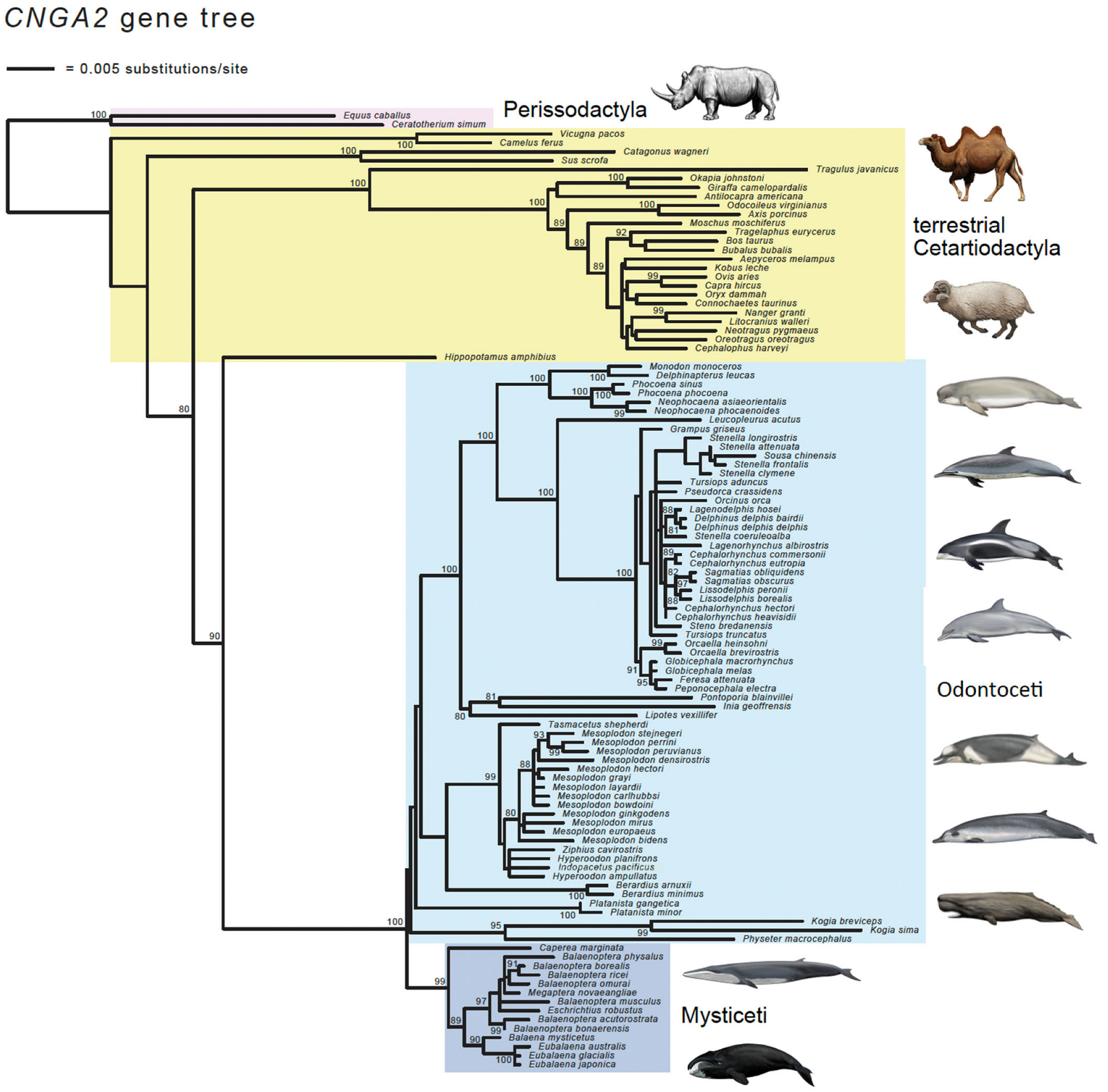
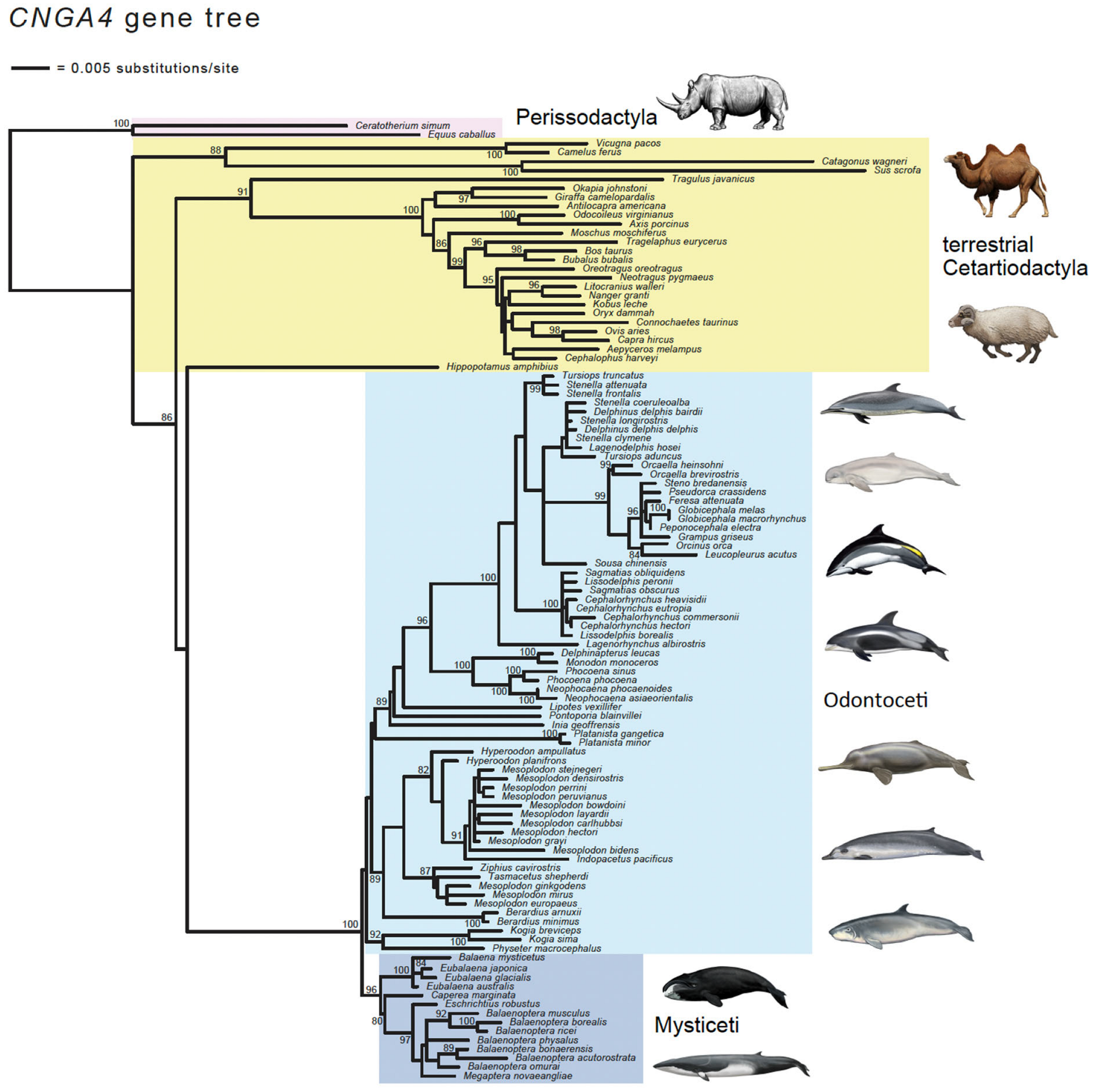
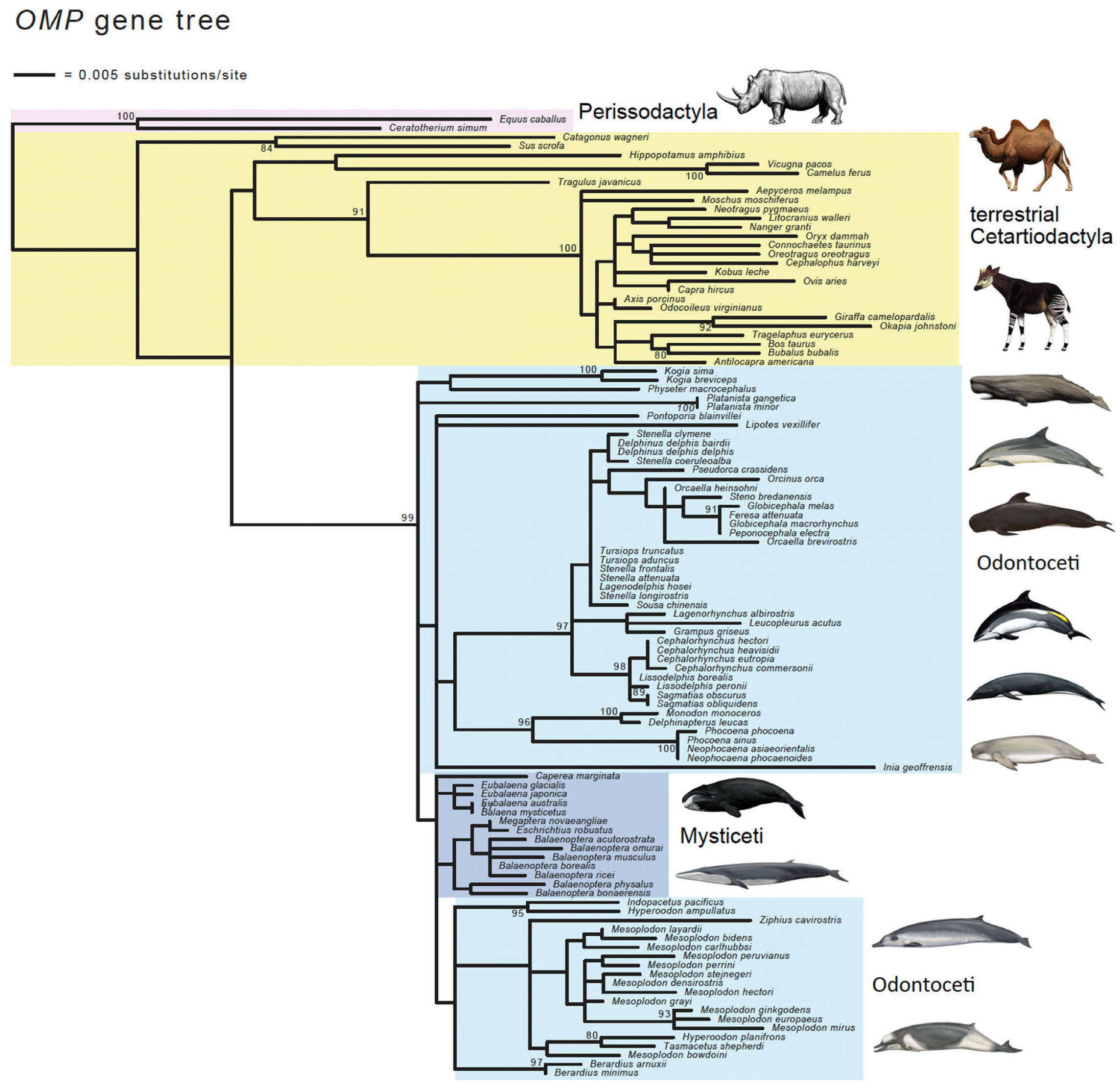
3.1. Alignments and Gene Trees
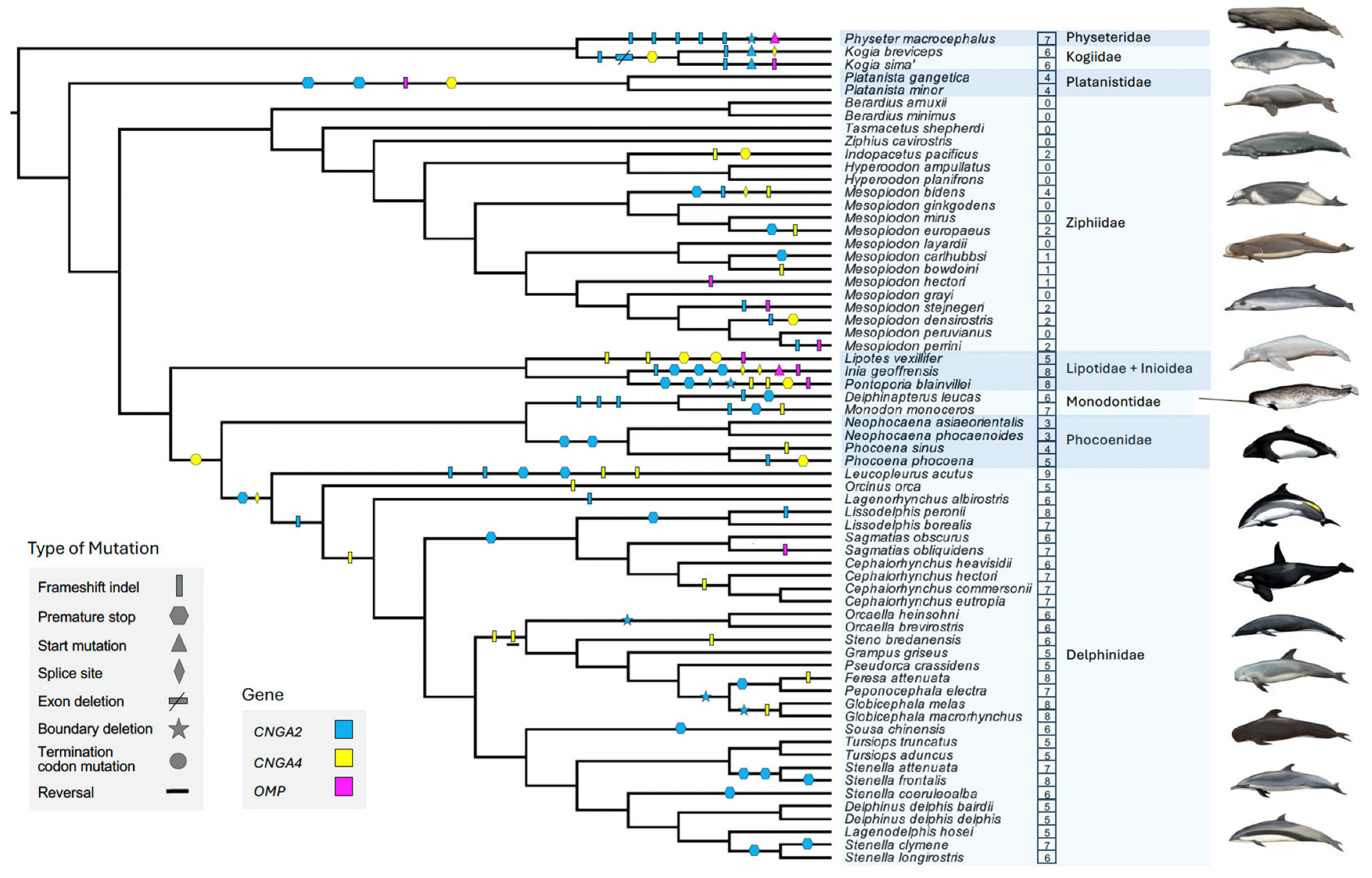
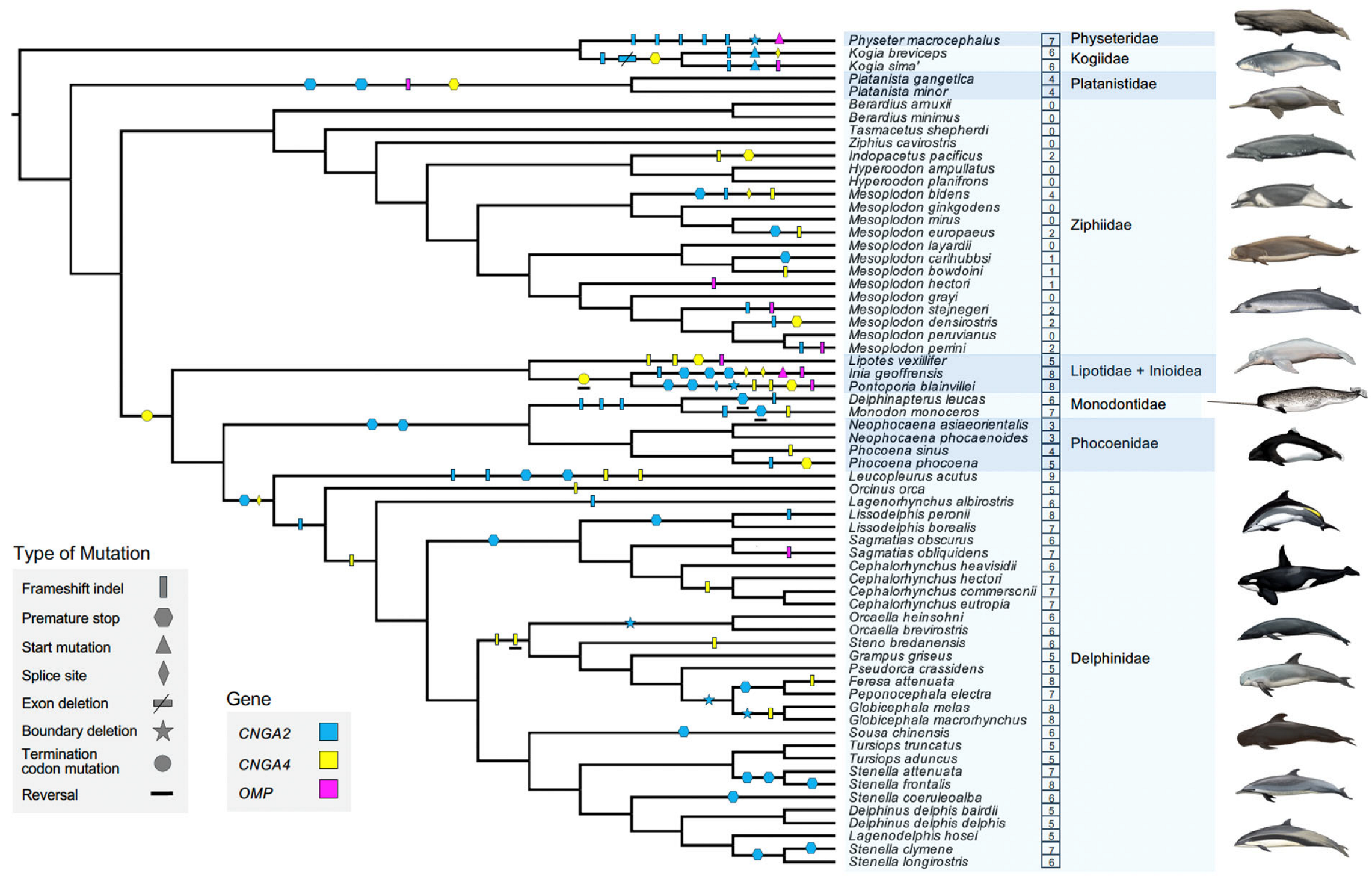
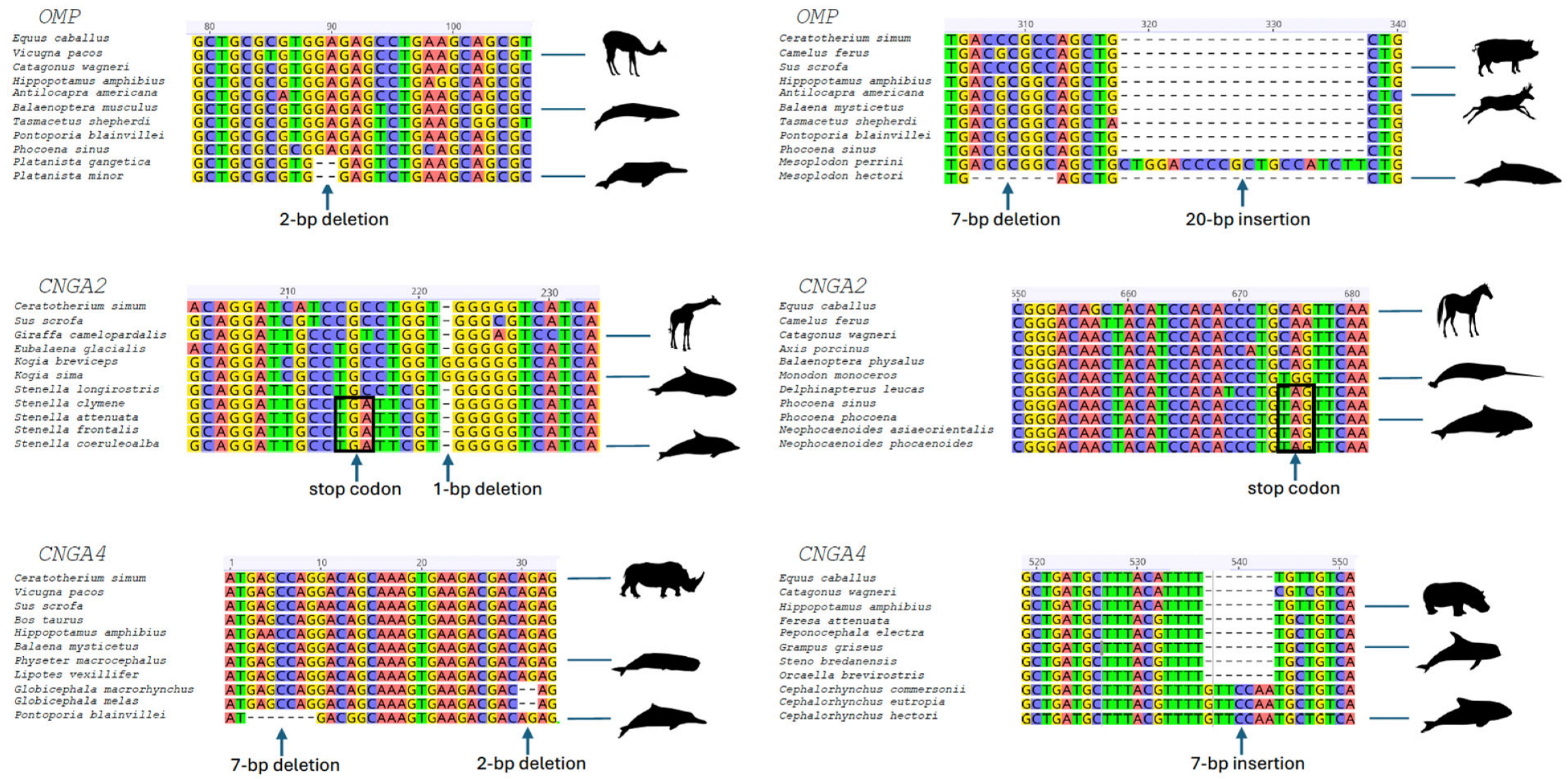
3.2. Inactivating Mutations
3.3. Selection Analyses with All Codons
3.4. Selection Analyses Without CpG Codons
4. Discussion
4.1. Patterns of Gene Inactivation and Neutral Evolution
4.2. Positive Selection?
4.3. Incomplete Lineage Sorting
4.4. Integrating Molecular Results with the Fossil Record
4.5. Evidence for Odontocete Olfaction Based on Behavioral Experiments
4.6. Conclusions
Supplementary Materials
Author Contributions
Funding
Institutional Review Board Statement
Informed Consent Statement
Data Availability Statement
Acknowledgments
Conflicts of Interest
References
- Poncelet, G.; Shimeld, S.M. The evolutionary origins of the vertebrate olfactory system. Open Biol. 2020, 10, 200330. [Google Scholar] [CrossRef] [Scilit] [PubMed]
- Niimura, Y. Olfactory receptor multigene family in vertebrates: From the viewpoint of evolutionary genomics. Curr. Genom. 2012, 13, 103–114. [Google Scholar] [CrossRef] [Scilit] [PubMed]
- Korsching, S.I. Evolution of vertebrate olfactory receptor repertoires and their function. Curr. Opin. Behav. Sci. 2025, 61, 101483. [Google Scholar] [CrossRef] [Scilit]
- Kishida, T. Olfaction of aquatic amniotes. Cell Tissue Res. 2021, 383, 353–365. [Google Scholar] [CrossRef] [Scilit]
- Meyer, A.; Schloissnig, S.; Franchini, P.; Du, K.; Woltering, J.M.; Irisarri, I.; Wong, W.Y.; Nowoshilow, S.; Kneitz, S.; Kawaguchi, A.; et al. Giant lungfish genome elucidates the conquest of land by vertebrates. Nature 2021, 590, 284–289. [Google Scholar] [CrossRef] [Scilit]
- Niimura, Y. On the origin and evolution of vertebrate olfactory receptor genes: Comparative genome analysis among 23 chordate species. Genome Biol. Evol. 2009, 1, 34–44. [Google Scholar] [CrossRef] [Scilit]
- Rowe, T.B.; Macrini, T.E.; Luo, Z.-X. Fossil evidence on origin of the mammalian brain. Science 2011, 332, 955–957. [Google Scholar] [CrossRef] [Scilit] [PubMed]
- Niimura, Y.; Matsui, A.; Touhara, K. Extreme expansion of the olfactory receptor gene repertoire in African elephants and evolutionary dynamics of orthologous gene groups in 13 placental mammals. Genome Res. 2014, 24, 1485–1496. [Google Scholar] [CrossRef] [Scilit]
- Bird, D.J.; Murphy, W.J.; Fox-Rosales, L.; Hamid, I.; Eagle, R.A.; Van Valkenburgh, B. Olfaction written in bone: Cribriform plate size parallels olfactory receptor gene repertoires in Mammalia. Proc. Roy. Soc. B 2018, 285, 20180100. [Google Scholar] [CrossRef] [Scilit]
- Zhang, T.; Jing, H.; Wang, J.; Zhao, L.; Liu, Y.; Rossiter, S.J.; Lu, H.; Li, G. Evolution of olfactory receptor superfamily in bats based on high throughput molecular modeling. Mol. Ecol. Resour. 2024, 24, e13958. [Google Scholar] [CrossRef] [Scilit]
- Boesveldt, S.; Postma, E.M.; Boak, D.; Welge-Luessen, A.; Schöpf, V.; Mainland, J.D.; Martens, J.; Ngai, J.; Duffy, V. Anosmia—A clinical review. Chem. Senses 2017, 42, 513–523. [Google Scholar] [CrossRef] [Scilit]
- Oleszkiewicz, A.; Croy, I.; Hummel, T. The impact of olfactory loss on quality of life: A 2025 review. Chem. Senses 2025, 50, bjaf023. [Google Scholar] [CrossRef] [Scilit] [PubMed]
- Godfrey, S.J. On the olfactory apparatus in the Miocene odontocete Squalodon sp. (Squalodontidae). Comptes Rendus Palevol 2013, 12, 519–530. [Google Scholar] [CrossRef] [Scilit]
- Berta, A.; Ekdale, E.G.; Cranford, T.W. Review of the cetacean nose: Form, function, and evolution. Anat. Rec. 2014, 297, 2205–2215. [Google Scholar] [CrossRef] [Scilit]
- Buono, M.; Fernández, M.S.; Fordyce, R.E.; Reidenberg, J.S. Anatomy of nasal complex in the southern right whale, Eubalaena australis (Cetacea, Mysticeti). J. Anat. 2015, 226, 81–92. [Google Scholar] [CrossRef] [Scilit]
- Ichishima, H. The ethmoid and presphenoid of cetaceans. J. Morphol. 2016, 277, 1661–1674. [Google Scholar] [CrossRef] [Scilit]
- Farnkopf, I.C.; George, J.C.; Kishida, T.; Hillmann, D.J.; Suydam, R.S.; Thewissen, J.G.M. Olfactory epithelium and ontogeny of the nasal chambers in the bowhead whale (Balaena mysticetus). Anat. Rec. 2022, 305, 643–667. [Google Scholar] [CrossRef] [Scilit]
- Hirose, A.; Nakamura, G.; Nikaido, M.; Fujise, Y.; Kato, H.; Kishida, T. Localized expression of olfactory receptor genes in the olfactory organ of common minke whales. Int. J. Mol. Sci. 2024, 25, 3855. [Google Scholar] [CrossRef] [Scilit]
- Thewissen, J.G.M.; George, J.; Rosa, C.; Kishida, T. Olfaction and brain size in the bowhead whale (Balaena mysticetus). Mar. Mamm. Sci. 2011, 27, 282–294. [Google Scholar]
- Kishida, T.; Thewissen, J.G.M.; Hayakawa, T.; Imai, H.; Agata, K. Aquatic adaptation and the evolution of smell and taste in whales. Zool. Lett. 2015, 1, 9. [Google Scholar]
- Cave, A.J.E. Note on olfactory activity in mysticetes. J. Zool. Lond. 1988, 214, 307–311. [Google Scholar] [CrossRef] [Scilit]
- Thewissen, J.G.M. Sensory biology. In Encyclopedia of Marine Mammals, 3rd ed.; Würsig, B., Thewissen, J.G.M., Kovacs, K.M., Eds.; Academic Press: London, UK, 2018; pp. 847–848. [Google Scholar]
- Mead, J.G.; Fordyce, R.E. The therian skull: A lexicon with emphasis on the odontocetes. Smithson. Contrib. Zool. 2009, 627, 1–248. [Google Scholar] [CrossRef] [Scilit]
- Flower, W.H. On the osteology of the cachalot or sperm-whale (Physeter macrocephalus). Trans. Zool. Soc. Lond. 1868, 6, 309–372. [Google Scholar] [CrossRef] [Scilit]
- Flower, W.H. On the recent ziphioid whales, with a description of the skeleton of Berardius arnouxi. Trans. Zool. Soc. Lond. 1872, 8, 203–234. [Google Scholar] [CrossRef] [Scilit]
- Farnkopf, I.; Kishida, T.; Sato, Y.; Reidenberg, J.S.; Niimura, Y.; Thewissen, J.G.M. Cribriform plate size documents loss of olfactory receptor genes in the early evolution of whales, dolphins, and porpoises. Zool. J. Linn. Soc. 2025, 205, zlaf157. [Google Scholar] [CrossRef] [Scilit]
- Oelschläger, H.A.; Buhl, E.H. Development and rudimentation of the peripheral olfactory system in the harbor porpoise Phocoena phocoena (Mammalia: Cetacea). J. Morphol. 1985, 184, 351–360. [Google Scholar] [CrossRef] [Scilit] [PubMed]
- Buhl, E.H.; Oelschläger, H.A. Morphogenesis of the brain in the harbour porpoise. J. Comp. Neurol. 1988, 277, 109–125. [Google Scholar] [CrossRef] [Scilit] [PubMed]
- Yamagiwa, D.; Endo, H.; Nakanishi, I.; Kusanagi, A.; Kurohmaru, M.; Hayashi, Y. Anatomy of the cranial nerve foramina in the Risso’s dolphin (Grampus griseus). Ann. Anat. 1999, 181, 293–297. [Google Scholar] [CrossRef] [Scilit]
- Oelschläger, H.A. The dolphin brain—A challenge for synthetic neurobiology. Brain Res. Bull. 2008, 75, 450–459. [Google Scholar] [CrossRef] [Scilit]
- Kishida, T.; Thewissen, J.G.M. Evolutionary changes of the importance of olfaction in cetaceans based on the olfactory marker protein gene. Gene 2012, 492, 349–353. [Google Scholar] [CrossRef] [Scilit]
- Geisler, J.H.; Colbert, M.W.; Carew, J.L. A new fossil species supports an early origin for toothed whale echolocation. Nature 2014, 508, 383–386. [Google Scholar] [CrossRef] [Scilit]
- Liu, Z.; Qi, F.-Y.; Xu, D.-M.; Zhou, X.; Shi, P. Genomic and functional evidence reveals molecular insights into the origin of echolocation in whales. Sci. Adv. 2018, 4, eaat8821. [Google Scholar] [CrossRef] [Scilit]
- Heyning, J.E. Sperm whale phylogeny revisited: Analysis of the morphological evidence. Mar. Mamm. Sci. 1997, 13, 596–613. [Google Scholar]
- Gatesy, J.; Geisler, J.H.; Chang, J.; Buell, C.; Berta, A.; Meredith, R.W.; Springer, M.S.; McGowen, M.R. A phylogenetic blueprint for a modern whale. Mol. Phylogenet. Evol. 2013, 66, 479–506. [Google Scholar] [CrossRef] [Scilit]
- Springer, M.S.; Gatesy, J. Inactivation of the olfactory marker protein (OMP) gene in river dolphins and other odontocete cetaceans. Mol. Phylogenet. Evol. 2017, 109, 375–387. [Google Scholar] [CrossRef] [Scilit] [PubMed]
- Tanaka, Y.; Ortega, M.; Fordyce, R.E. A new early Miocene archaic dolphin (Odontoceti, Cetacea) from New Zealand, and brain evolution of the Odontoceti. N. Z. J. Geol. Geophys. 2023, 66, 59–73. [Google Scholar]
- Gaetán, C.M.; Buono, M.R.; Gaetano, L.C. Prosqualodon australis (Cetacea: Odontoceti) from the early Miocene of Patagonia, Argentina: Redescription and phylogenetic analysis. Ameghiniana 2019, 56, 1–27. [Google Scholar] [CrossRef] [Scilit]
- Han, W.; Wu, Y.; Zeng, L.; Zhao, S. Building the Chordata Olfactory Receptor Database using more than 400,000 receptors annotated by Genome2OR. Sci. China Life Sci. 2022, 65, 2539–2551. [Google Scholar] [CrossRef] [Scilit]
- Han, W.; Bao, S.; Liu, J.; Wu, Y.; Zeng, L.; Zhang, T.; Chen, N.; Yao, K.; Fan, S.; Huang, A.; et al. The chordata olfactory receptor database. Protein Cell 2025, 16, 283–292. [Google Scholar] [CrossRef] [Scilit]
- Geisler, J.H.; McGowen, M.R.; Yang, G.; Gatesy, J. A supermatrix analysis of genomic, morphological, and paleontological data from crown Cetacea. BMC Evol. Biol. 2011, 11, 112. [Google Scholar] [CrossRef] [Scilit] [PubMed]
- Pyenson, N.D.; Vélez-Juarbe, J.; Gutstein, C.S.; Little, H.; Vigil, D.; O’Dea, A. Isthminia panamensis, a new fossil inioid (Mammalia, Cetacea) from the Chagres Formation of Panama and the evolution of ‘river dolphins’ in the Americas. PeerJ 2015, 3, e1227. [Google Scholar] [CrossRef] [Scilit]
- Hayden, S.; Bekaert, M.; Crider, T.A.; Mariani, S.; Murphy, W.J.; Teeling, E.C. Ecological adaptation determines functional mammalian olfactory subgenomes. Genome Res. 2010, 20, 1–9. [Google Scholar] [CrossRef] [Scilit]
- Jauhal, A.A.; Constantine, R.; Newcomb, R.D. A comparative genomics approach to understanding the evolution of olfaction in cetaceans. J. Mol. Evol. 2024, 92, 912–929. [Google Scholar] [CrossRef] [Scilit]
- Shu, D.-G.; Luo, H.-L.; Conway Morris, S.; Zhang, Z.-L.; Hu, S.-X.; Chen, L.; Han, J.; Zhu, M.; Li, Y.; Chen, L.-Z. Lower Cambrian vertebrates from south China. Nature 1999, 402, 42–46. [Google Scholar] [CrossRef] [Scilit]
- Shu, D.-G.; Conway Morris, S.; Han, J.; Zhang, Z.-F.; Yasui, K.; Janvier, P.; Chen, L.; Zhang, X.-L.; Liu, J.-N.; Li, Y.; et al. Head and backbone of the Early Cambrian vertebrate Haikouichthys. Nature 2003, 421, 526–529. [Google Scholar] [CrossRef] [Scilit]
- Biel, M.; Michalakis, S. Function and dysfunction of CNG channels: Insights from channelopathies and mouse models. Mol. Neurobiol. 2007, 35, 266–277. [Google Scholar] [CrossRef] [Scilit] [PubMed]
- Michalakis, S.; Reisert, J.; Geiger, H.; Wetzel, C.; Zong, X.; Bradley, J.; Spehr, M.; Hüttl, S.; Gerstner, A.; Pfeifer, A.; et al. Loss of CNGB1 protein leads to olfactory dysfunction and subciliary cyclic nucleotide-gated channel trapping. J. Biol. Chem. 2006, 281, 35156–35166. [Google Scholar] [CrossRef] [Scilit] [PubMed]
- Nache, V.; Wongsamitkul, N.; Kusch, J.; Zimmer, T.; Schwede, F.; Benndorf, K. CNGB1b subunit in olfactory CNG channels. Sci. Rep. 2016, 6, 29378. [Google Scholar] [CrossRef] [Scilit]
- Brunet, L.J.; Gold, G.H.; Ngai, J. General anosmia caused by a targeted disruption of the mouse olfactory cyclic nucleotide-gated cation channel. Neuron 1996, 17, 681–693. [Google Scholar] [CrossRef] [Scilit]
- Sailani, M.R.; Jingga, I.; MirMazlomi, S.H.; Bitarafan, F.; Bernstein, J.A.; Snyder, M.P.; Garshasbi, M. Isolated congenital anosmia and CNGA2 mutation. Sci. Rep. 2017, 7, 2667. [Google Scholar] [CrossRef] [Scilit] [PubMed]
- Karstensen, H.G.; Mang, Y.; Fark, T.; Hummel, T.; Tommerup, N. The first mutation in CNGA2 in two brothers with anosmia. Clin. Genet. 2015, 88, 293–296. [Google Scholar] [CrossRef] [Scilit]
- Munger, S.D.; Lane, A.P.; Zhong, H.; Leinders-Zufall, T.; Yau, K.-W.; Zufall, F.; Reed, R.R. Central role of the CNGA4 channel subunit in Ca2+-calmodulin-dependent odor adaptation. Science 2001, 294, 2172–2175. [Google Scholar] [CrossRef] [Scilit]
- Kelliher, K.R.; Ziesmann, J.; Munger, S.D.; Reed, R.R.; Zufall, F. Importance of the CNGA4 channel gene for odor discrimination and adaptation in behaving mice. Proc. Natl. Acad. Sci. USA 2003, 100, 4299–4304. [Google Scholar] [CrossRef] [Scilit]
- Reisert, J.; Yau, K.-W.; Margolis, F.L. Olfactory marker protein modulates the cAMP kinetics of the odour-induced response in cilia of mouse olfactory receptor neurons. J. Physiol. 2007, 585, 731–740. [Google Scholar] [CrossRef] [Scilit]
- Buiakova, O.I.; Baker, H.; Scott, J.W.; Farbman, A.; Kream, R.; Grillo, M.; Franzen, L.; Richman, M.; Davis, L.M.; Abbondanzo, S.; et al. Olfactory marker protein (OMP) gene deletion causes altered physiological activity of olfactory sensory neurons. Proc. Natl. Acad. Sci. USA 1996, 93, 9858–9863. [Google Scholar] [CrossRef] [Scilit]
- Dudchenko, O.; Batra, S.S.; Omer, A.D.; Nyquist, S.K.; Hoeger, M.; Durand, N.C.; Shamim, M.S.; Machol, I.; Lander, E.S.; Aiden, A.P.; et al. De novo assembly of the Aedes aegypti genome using Hi-C yields chromosome-length scaffolds. Science 2017, 356, 92–95. [Google Scholar] [CrossRef] [Scilit]
- Keane, M.; Semeiks, J.; Webb, A.E.; Li, Y.I.; Quesada, V.; Craig, T.; Madsen, L.B.; van Dam, S.; Brawand, D.; Marques, P.I.; et al. Insights into the evolution of longevity from the bowhead whale genome. Cell Rep. 2015, 10, 112–122. [Google Scholar] [CrossRef] [Scilit]
- Kearse, M.; Moir, R.; Wilson, A.; Stones-Havas, S.; Cheung, M.; Sturrock, S.; Buxton, S.; Cooper, A.; Markowitz, S.; Duran, C.; et al. Geneious basic: An integrated and extendable desktop software platform for the organization and analysis of sequence data. Bioinformatics 2012, 28, 1647–1649. [Google Scholar] [CrossRef] [Scilit]
- Katoh, K.; Misawa, K.; Kuma, K.; Miyata, T. MAFFT: A novel method for rapid multiple sequence alignment based on fast Fourier transform. Nucleic Acids Res. 2002, 30, 3059–3066. [Google Scholar] [CrossRef] [Scilit]
- Katoh, K.; Toh, H. Recent developments in the MAFFT multiple sequence alignment program. Brief. Bioinform. 2008, 9, 286–298. [Google Scholar] [CrossRef] [Scilit]
- Katoh, K.; Standley, D.M. MAFFT multiple sequence alignment software version 7: Improvements in performance and usability. Mol. Biol. Evol. 2013, 30, 772–780. [Google Scholar] [CrossRef] [Scilit]
- Swofford, D.L. Phylogenetic Analysis Using Parsimony (* and Other Methods); Sinauer Associates: Sunderland, MA, USA, 2002. [Google Scholar]
- Stamatakis, A. RAxML Version 8: A tool for phylogenetic analysis and postanalysis of large phylogenies. Bioinformatics 2014, 20, 1312–1313. [Google Scholar] [CrossRef] [Scilit]
- McGowen, M.R.; Tsagkogeorga, G.; Álvarez-Carretero, S.; Dos Reis, M.; Struebig, M.; Deaville, R.; Jepson, P.D.; Jarman, S.; Polanowski, A.; Morin, P.A.; et al. Phylogenomic resolution of the cetacean tree of life using target sequence capture. Syst. Biol. 2020, 69, 479–501. [Google Scholar] [CrossRef] [Scilit]
- Meredith, R.W.; Janecka, J.E.; Gatesy, J.; Ryder, O.A.; Fisher, C.A.; Teeling, E.C.; Goodbla, A.; Eizirik, E.; Simao, T.L.L.; Stadler, T.; et al. Impacts of the Cretaceous Terrestrial Revolution and KPg extinction on mammal diversification. Science 2011, 334, 521–524. [Google Scholar] [CrossRef] [Scilit]
- Hassanin, A.; Delsuc, F.; Ropiquet, A.; Hammer, C.; Jansen Van Vuuren, B.; Matthee, C.; Ruiz-Garcia, M.; Catzeflis, F.; Areskoug, V.; Nguyen, T.T.; et al. Pattern and timing of diversification of Cetartiodactyla (Mammalia, Laurasiatheria), as revealed by a comprehensive analysis of mitochondrial genomes. Comptes Rendus Biol. 2012, 335, 32–50. [Google Scholar] [CrossRef] [Scilit]
- Rosel, P.E.; Wilcox, L.A.; Yamada, T.K.; Mullin, K.D. A new species of baleen whale (Balaenoptera) from the Gulf of Mexico, with a review of its geographic distribution. Mar. Mammal Sci. 2021, 37, 577–610. [Google Scholar] [CrossRef] [Scilit]
- McGowen, M.R.; Spaulding, M.; Gatesy, J. Divergence date estimation and a comprehensive molecular tree of extant cetaceans. Mol. Phylogenet. Evol. 2009, 53, 891–906. [Google Scholar] [CrossRef] [Scilit]
- Zurano, J.P.; Magalhães, F.M.; Asato, A.E.; Silva, G.; Bidau, C.J.; Mesquita, D.O.; Costa, G.C. Cetartiodactyla: Updating a time-calibrated molecular phylogeny. Mol. Phylogenet. Evol. 2019, 133, 256–262. [Google Scholar] [CrossRef] [Scilit]
- Yamada, T.K.; Kitamura, S.; Abe, S.; Tajima, Y.; Matsuda, A.; Mead, J.G.; Matsuichi, T.F. Description of a new species of beaked whale (Berardius) found in the North Pacific. Sci. Rep. 2019, 9, 12723. [Google Scholar] [CrossRef] [Scilit]
- Chehida, Y.B.; Thumloup, J.; Schumacher, C.; Harkins, T.; Aguilar, A.; Borrell, A.; Ferreira, M.; Rojas-Bracho, L.; Robertson, K.M.; Taylor, B.L.; et al. Mitochondrial genomics reveals the evolutionary history of the porpoises (Phocoenidae) across the speciation continuum. Sci. Rep. 2020, 10, 15190. [Google Scholar] [CrossRef] [Scilit]
- Yang, Z. PAML 4: Phylogenetic analysis by maximum likelihood. Mol. Biol. Evol. 2007, 24, 1586–1591. [Google Scholar] [CrossRef] [Scilit]
- Elanga, N.; Kim, S.-H.; NISC Comparative Sequencing Program; Vigoda, E.; Yi, S.V. Mutations of different molecular origins exhibit contrasting patterns of regional substitution rate variation. PLoS Comput. Biol. 2008, 4, e1000015. [Google Scholar]
- Springer, M.S.; Gatesy, J. The gene tree delusion. Mol. Phylogenet. Evol. 2016, 94, 1–33. [Google Scholar] [CrossRef] [Scilit]
- Huelsmann, M.; Hecker, N.; Springer, M.S.; Gatesy, J.; Sharma, V.; Hiller, M. Genes lost during the transition from land to water in cetaceans highlight genomic changes associated with aquatic adaptations. Sci. Adv. 2019, 5, eaaw6671. [Google Scholar] [CrossRef] [Scilit]
- Lopes-Marques, M.; Ruivo, R.; Alves, L.Q.; Sousa, N.; Machado, A.M.; Castro, L.F.C. The singularity of Cetacea behavior parallels the complete inactivation of melatonin gene modules. Genes 2019, 10, 121. [Google Scholar] [CrossRef] [Scilit]
- Emerling, C.A.; Springer, M.S.; Gatesy, J.; Jones, Z.; Hamilton, D.; Xia-Zhu, D.; Collin, M.; Delsuc, F. Genomic evidence for the parallel regression of melatonin synthesis and signaling pathways in placental mammals. Open Res. Eur. 2021, 1, 75. [Google Scholar]
- Rahman, S.; Pond, S.L.K.; Webb, A.; Hey, J. Weak selection on synonymous codons substantially inflates dN/dS estimates in bacteria. Proc. Natl. Acad. Sci. USA 2021, 118, e2023575118. [Google Scholar]
- Gu, X. dN/dS-H, a new test to distinguish different selection modes in protein evolution and cancer evolution. J. Mol. Evol. 2022, 90, 342–351. [Google Scholar]
- Hellmann, I.; Zöllner, S.; Enard, W.; Ebersberger, I.; Nickel, B.; Pääbo, S. Selection on human genes as revealed by comparisons to chimpanzee DNA. Genome Res. 2003, 13, 831–837. [Google Scholar] [CrossRef] [Scilit]
- Behura, S.K.; Severson, D.W. Codon usage bias: Causative factors, quantification methods and genome-wide patterns: With emphasis on insect genomes. Biol. Rev. 2013, 88, 49–61. [Google Scholar]
- Zhang, Z.; Gerstein, M. Patterns of nucleotide substitution, insertion and deletion in the human genome inferred from pseudogenes. Nucleic Acids Res. 2003, 31, 5338–5348. [Google Scholar] [CrossRef] [Scilit]
- Avise, J.C.; Robinson, T.J. Hemiplasy: A new term in the lexicon of phylogenetics. Syst. Biol. 2008, 57, 503–507. [Google Scholar] [CrossRef] [Scilit]
- Boessenecker, R.W.; Geisler, J.H. New records of the archaic dolphin Agorophius (Mammalia: Cetacea) from the upper Oligocene Chandler Bridge Formation of South Carolina, USA. PeerJ 2018, 6, e5290. [Google Scholar] [CrossRef] [Scilit]
- Cozzuol, M.A.; Aguilera, O.A. Cetacean remains from the Neogene of northwestern Venezuela. Paläontologische Z. 2008, 82, 196–203. [Google Scholar] [CrossRef] [Scilit]
- Geisler, J.H.; Godfrey, S.J.; Lambert, O. A new genus and species of late Miocene inioid (Cetacea, Odontoceti) from the Meherrin River, North Carolina, U.S.A. J. Vertebr. Paleontol. 2012, 32, 198–211. [Google Scholar] [CrossRef] [Scilit]
- García de los Ríos y Loshuertos, A.; Soler Laguía, M.; Arencibia Espinosa, A.; López Fernández, A.; Covelo Figueiredo, P.; Martínez Gomariz, F.; Sánchez Collado, C.; García Carrillo, N.; Ramírez Zarzosa, G. Comparative anatomy of the nasal cavity in the common dolphin Delphinus delphis L., striped dolphin Stenella coeruleoalba M. and pilot whale Globicephala melas T.: A developmental study. Animals 2021, 11, 441. [Google Scholar] [CrossRef] [Scilit]
- Behrmann, G. The olfactory regions in the nose of the harbour porpoise Phocoena phocoena (Linne, 1758). Aquat. Mamm. 1989, 15, 130–133. [Google Scholar]
- Gruhl, K. Beitriige zur anatomie und physiologie der Cetaceennase. Jena. Z. Fiir Naturwissenschaften 1911, 47, 367–414. [Google Scholar]
- Kremers, D.; Célérier, A.; Schaal, B.; Campagna, S.; Trabalon, M.; Böye, M.; Hausberger, M.; Lemasson, A. Sensory perception in cetaceans: Part II—Promising experimental approaches to study chemoreception in dolphins. Front. Ecol. Evol. 2016, 4, 50. [Google Scholar] [CrossRef] [Scilit]
- Li, Q.; Liberles, S.D. Odor sensing by trace amine-associated receptors. In Chemosensory Transduction: The Detection of Odors, Tastes, and Other Chemostimuli; Zufall, F., Munger, S.D., Eds.; Academic Press: London, UK, 2016; pp. 67–80. [Google Scholar]
- Dewan, A. Olfactory signaling via trace amine-associated receptors. Cell Tissue Res. 2021, 383, 395–407. [Google Scholar] [CrossRef] [Scilit]
- Shackley, M.; Ma, Y.; Tate, E.W.; Brown, A.J.H.; Frost, G.; Hanyaloglu, A.C. Short chain fatty acids enhance expression and activity of the umami taste receptor in enteroendocrine cells via a Gai/o pathway. Front. Nutr. 2020, 7, 568991. [Google Scholar] [CrossRef] [Scilit]
- Hanselman, E.C.; Amado, N.J.; Breslin, P.A.S. Oral signals of short and long chain fatty acids: Parallel taste pathways to identify microbes and triclycerides. Curr. Opin. Physiol. 2021, 20, 126–133. [Google Scholar] [CrossRef] [Scilit] [PubMed]
- Fontanini, A. Taste. Curr. Biol. 2023, 33, R123–R135. [Google Scholar] [CrossRef] [Scilit] [PubMed]



| Odontocetes | ||
|---|---|---|
| Family | Species | Common Name |
| Delphinidae | Cephalorhynchus commersonii (Lacépède, 1804) | Commerson’s dolphin |
| Delphinidae | Cephalorhynchus eutropia (Gray, 1846) | Black dolphin/Chilean dolphin |
| Delphinidae | Cephalorhynchus heavisidii (Gray, 1828) | Heaviside’s dolphin |
| Delphinidae | Cephalorhynchus hectori (Van Beneden, 1881) | Hector’s dolphin |
| Delphinidae | Delphinus delphis bairdii (Dall, 1873) | Long-beaked common dolphin |
| Delphinidae | Delphinus delphis delphis (Linnaeus, 1758) | Common dolphin |
| Delphinidae | Feresa attenuata (Gray, 1874) | Pygmy killer whale |
| Delphinidae | Globicephala macrorhynchus (Gray, 1846) | Short-finned pilot whale |
| Delphinidae | Globicephala melas (Traill, 1809) | Long-finned pilot whale |
| Delphinidae | Grampus griseus (G. Cuvier, 1812) | Risso’s dolphin |
| Delphinidae | Lagenodelphis hosei (Fraser, 1956) | Fraser’s dolphin |
| Delphinidae | Lagenorhynchus albirostris (Gray, 1846) | White-beaked dolphin |
| Delphinidae | Leucopleurus acutus (Gray, 1828) | Atlantic white-sided dolphin |
| Delphinidae | Lissodelphis borealis (Peale, 1849) | Northern right whale dolphin |
| Delphinidae | Lissodelphis peronii (Lacépède, 1804) | Southern right whale dolphin |
| Delphinidae | Orcaella brevirostris (Owen in Gray, 1866) | Irrawaddy dolphin |
| Delphinidae | Orcaella heinsohni (Beasley, Robertson and Arnold, 2005) | Australian snubfin dolphin |
| Delphinidae | Orcinus orca (Linnaeus, 1758) | Killer whale |
| Delphinidae | Peponocephala electra (Gray, 1846) | Melon-headed whale |
| Delphinidae | Pseudorca crassidens (Owen, 1846) | False killer whale |
| Delphinidae | Sagmatias obliquidens (Gill, 1865) | Pacific white-sided dolphin |
| Delphinidae | Sagmatias obscurus (Gray, 1828) | Dusky dolphin |
| Delphinidae | Sousa chinensis (Osbeck, 1765) | Indo-Pacific humpback dolphin |
| Delphinidae | Stenella attenuata (Gray, 1846) | Pantropical spotted dolphin |
| Delphinidae | Stenella clymene (Gray, 1850) | Clymene dolphin |
| Delphinidae | Stenella coeruleoalba (Meyen, 1833) | Striped dolphin |
| Delphinidae | Stenella frontalis (G. Cuvier, 1829) | Atlantic spotted dolphin |
| Delphinidae | Stenella longirostris (Gray, 1828) | Spinner dolphin |
| Delphinidae | Steno bredanensis (Lesson, 1828) | Rough-toothed dolphin |
| Delphinidae | Tursiops aduncus (Ehrenberg, 1832) | Indo-Pacific bottlenose dolphin |
| Delphinidae | Tursiops truncatus (Montagu, 1821) | Common bottlenose dolphin |
| Iniidae | Inia geoffrensis (Blainville, 1817) | Amazon River dolphin |
| Kogiidae | Kogia breviceps (Blainville, 1838) | Pygmy sperm whale |
| Kogiidae | Kogia sima (Owen, 1866) | Dwarf sperm whale |
| Lipotidae | Lipotes vexillifer (Miller, 1918) | Chinese river dolphin/baiji |
| Monodontidae | Delphinapterus leucas (Pallas, 1776) | Beluga |
| Monodontidae | Monodon monoceros (Linnaeus, 1758) | Narwhal |
| Phocoenidae | Neophocaena asiaeorientalis (Pilleri and Gihr, 1972) | Yangtze finless porpoise |
| Phocoenidae | Neophocaena phocaenoides (G. Cuvier, 1829) | Indo-Pacific finless porpoise |
| Phocoenidae | Phocoena phocoena (Linnaeus, 1758) | Harbor porpoise |
| Phocoenidae | Phocoena sinus (Norris and McFarland, 1958) | Vaquita |
| Physeteridae | Physeter macrocephalus (Linnaeus, 1758) | Sperm whale |
| Platanistidae | Platanista gangetica (Lebeck, 1801) | Ganges River dolphin |
| Platanistidae | Platanista minor (Owen, 1853) | Indus River dolphin |
| Pontoporiidae | Pontoporia blainvillei (Gervais and d’Orbigny, 1844) | Franciscana/La Plata dolphin |
| Ziphiidae | Berardius arnuxii (Duvernoy, 1851) | Arnoux’s beaked whale |
| Ziphiidae | Berardius minimus (Yamada, Kitamura and Matsuishi, 2019) | Sato’s beaked whale |
| Ziphiidae | Hyperoodon ampullatus (Forster in Kalm, 1770) | Northern bottlenose whale |
| Ziphiidae | Hyperoodon planifrons (Flower, 1882) | Southern bottlenose whale |
| Ziphiidae | Indopacetus pacificus (Longman, 1926) | Tropical bottlenose whale |
| Ziphiidae | Mesoplodon bidens (Sowerby, 1804) | Sowerby’s beaked whale |
| Ziphiidae | Mesoplodon bowdoini (Andrews, 1908) | Andrew’s beaked whale |
| Ziphiidae | Mesoplodon carlhubbsi (Moore, 1963) | Hubb’s beaked whale |
| Ziphiidae | Mesoplodon densirostris (Desmarest, 1817) | Blainville’s beaked whale |
| Ziphiidae | Mesoplodon europaeus (Gervais, 1855) | Gervais’ beaked whale |
| Ziphiidae | Mesoplodon ginkgodens (Nishiwaki and Kamiya, 1958) | Ginkgo-toothed beaked whale |
| Ziphiidae | Mesoplodon grayi von (Haast, 1876) | Gray’s beaked whale |
| Ziphiidae | Mesoplodon hectori (Gray, 1871) | Hector’s beaked whale |
| Ziphiidae | Mesoplodon layardii (Gray, 1865) | Strap-toothed whale |
| Ziphiidae | Mesoplodon mirus (True, 1913) | True’s beaked whale |
| Ziphiidae | Mesoplodon perrini (Dalebout, Mead, Baker, Baker and van Helden, 2002) | Perrin’s beaked whale |
| Ziphiidae | Mesoplodon peruvianus (Reyes, Mead and Van Waerebeek, 1991) | Pygmy beaked whale |
| Ziphiidae | Mesoplodon stejnegeri (True, 1885) | Stejneger’s beaked whale |
| Ziphiidae | Tasmacetus shepherdi (Oliver, 1937) | Shepherd’s beaked whale |
| Ziphiidae | Ziphius cavirostris (G. Cuvier, 1823) | Cuvier’s beaked whale |
| Mysticeti | ||
| Balaenidae | Balaena mysticetus (Linnaeus, 1758) | Bowhead whale |
| Balaenidae | Eubalaena australis (Desmoulins, 1822) | Southern right whale |
| Balaenidae | Eubalaena glacialis (Müller, 1776) | North Atlantic right whale |
| Balaenidae | Eubalaena japonica (Lacépède, 1818) | North Pacific right whale |
| Balaenopteridae | Balaenoptera acutorostrata (Lacépède, 1804) | Common minke whale |
| Balaenopteridae | Balaenoptera bonaerensis (Burmeister, 1867) | Antarctic minke whale |
| Balaenopteridae | Balaenoptera borealis (Lesson, 1828) | Sei whale |
| Balaenopteridae | Balaenoptera musculus (Linnaeus, 1758) | Blue whale |
| Balaenopteridae | Balaenoptera omurai (Wada, Oishi and Yamada, 2003) | Omura’s whale |
| Balaenopteridae | Balaenoptera physalus (Linnaeus, 1758) | Fin whale |
| Balaenopteridae | Balaenoptera ricei (Rosel, Wilcox, Yamada and Mullin, 2021) | Rice’s whale |
| Balaenopteridae | Megaptera novaeangliae (Borowski, 1781) | Humpback whale |
| Eschrichtiidae | Eschrichtius robustus (Lilljeborg, 1861) | Gray whale |
| Neobalaenidae | Caperea marginata (Gray, 1846) | Pygmy right whale |
| Cetartiodactyl Outgroups | ||
| Antilocapridae | Antilocapra americana (Ord, 1815) | Pronghorn |
| Bovidae | Aepyceros melampus (Lichtenstein, 1812) | Impala |
| Bovidae | Bos taurus (Linnaeus, 1758) | Wild yak |
| Bovidae | Bubalus bubalis (Linnaeus, 1758) | Water buffalo |
| Bovidae | Capra hircus (Linnaeus, 1758) | Domestic goat |
| Bovidae | Cephalophus harveyi (Thomas, 1893) | Harvey’s red duiker |
| Bovidae | Connochaetes taurinus (Burchell, 1824) | Blue wildebeest |
| Bovidae | Kobus leche (Gray, 1850) | Lechwe |
| Bovidae | Litocranius walleri (Brooke, 1879) | Gerenuk |
| Bovidae | Nanger granti (Brooke, 1872) | Grant’s gazelle |
| Bovidae | Neotragus pygmaeus (Linnaeus, 1758) | Royal antelope |
| Bovidae | Oreotragus oreotragus (Zimmermann, 1783) | Klipspringer |
| Bovidae | Oryx dammah (Cretzschmar, 1827) | Scimitar oryx |
| Bovidae | Ovis aries (Linnaeus, 1758) | Domestic sheep |
| Bovidae | Tragelaphus eurycerus (Ogilby, 1837) | Bongo |
| Camelidae | Camelus ferus (Przewalski, 1883) | Wild Bactrian camel |
| Camelidae | Vicugna pacos (Linnaeus, 1758) | Alpaca |
| Cervidae | Axis porcinus (Zimmermann, 1780) | Indian hog deer |
| Cervidae | Odocoileus virginianus (Zimmermann, 1780) | White-tailed deer |
| Giraffidae | Giraffa camelopardalis (Linnaeus, 1758) | Giraffe |
| Giraffidae | Okapia johnstoni (P. L. Sclater, 1851) | Okapi |
| Hippopotamidae | Hippopotamus amphibius (Linnaeus, 1758) | River hippopotamus |
| Moschidae | Moschus moschiferus (Linnaeus, 1758) | Siberian musk deer |
| Suidae | Sus scrofa (Linnaeus, 1758) | Wild boar |
| Tayassuidae | Catagonus wagneri (Rusconi, 1930) | Chacoan peccary |
| Tragulidae | Tragulus javanicus (Osbeck, 1765) | Java mouse-deer |
| Perissodactyl outgroups | ||
| Rhinocerotidae | Ceratotherium simum (Burchell, 1817) | White rhinoceros |
| Equidae | Equus caballus (Linnaeus, 1758) | Horse |
| Odontoceti Taxon | Olfactory Gene | ||
|---|---|---|---|
| CNGA2 | CNGA4 | OMP | |
| Physeter | 265I (E3), I4-E5BD (52 bp of I4 and 6 bp of E5), 648–649I (E6), 674–683D (E6), 698–874D (E6), 1612–1645D (E6) | 1–3SCM (E1) | |
| Kogia | 222I (E3), 604–2019WED (E6) | 339–341S (E4) | |
| Kogia breviceps | 1–3SCM (CTG, E1), 444–465D (E4) | In5Do (AT) | |
| Kogia sima | 1–3SCM (AGG, E1), 445–467D (E4) | 445D (E1) | |
| Platanista | 440–442S (E4) b, 1761–1763S (E6) | 1158–1160S | 89–90D (E1) |
| Indopacetus pacificus | 918–920S (E4), 1006D (E5) | ||
| Mesoplodon bidens | 591–593S (E5), 830I (E6) | In1Do (TT), 843–844D (E4) | |
| Mesoplodon bowdoini | 1151I (E5) | ||
| Mesoplodon carlhubbsi | 440–442S (E4) b | ||
| Mesoplodon densirostris | 284–300D (E3) | 1183–1185S (E5) | |
| Mesoplodon europaeus | 1062–1064S (E6) | 92–93I (E2) | |
| Mesoplodon hectori | 306–312D (E1) | ||
| Mesoplodon perrini | 404–405D (E4) | 318–337I (E1) | |
| Mesoplodon stejnegeri | 176D (E2) | 125I (E1) | |
| Lipotes vexillifer | 529–531S (E4), 768D (E4), 1314–1315I (E6), 1747–1749TCM (GGA, E6) g | 461D (E1) | |
| Inia geoffrensis | 451D (E4), 888–890S (E6), 897–899S (E6), 1809–1811S (E6) | In3Ac (GG), In5Do (GG) | 1–3SCM (E1), 6D (E1) |
| Pontoporia blainvilllei | E1-I1BD (37 bp of E1 and 28 bp of I1), In4Ac (AA), 984–986S (E6), 1638–1640S (E6) f | 3–9D (E1), 1417I (E6), 1723–1725S (E6) | 40I (E1) |
| Delphinida | 1747–1749TCM (GGA, E6) g | ||
| Monodontidae | 370–374I (E3), 1176–1641D (E6), 1961–1964I (E6) | ||
| Delphinapterus leucas | 674–676S (E6) e, 1684D (E6) | ||
| Monodon monoceros | 501–503S (E5) d, 222I (E3) | 879I (E4) | |
| Phocoenidae | 501–503S (E5) d, 674–676S (E6) e | ||
| Phocoena phocoena | 682–752D (E6) | 1558–1560S (E6) | |
| Phocoena sinus | 1132–1133D (E5) | ||
| Delphinidae | 440–442S (E4) | In5Do (GA) | |
| Leucopleurus acutus | 348D (E3), 501–503S (E5) d, 1046–1049D (E6), 1638–1640S (E6) f | 413–416I (E4) i, 1403D (E1) | |
| All delphinids except Leucopleurus acutus | 1458–1467D (E6) | ||
| All delphinids except Leucopleurus acutus and Orcinus orca | 306D (E4) h | ||
| Orcinus orca | 413–416I (E4) i | ||
| Lagenorhynchus albirostris | 1044D (E6) | ||
| Lissodelphis + Sagmatias + Cephalorhynchus | 591–593S (E5) | ||
| Lissodelphis | 1557–1559S (E6) | ||
| Lissodelphis peronii | 487I (E4) | ||
| Sagmatias obliquidens | 107I (E1) | ||
| Cephalorhynchus hectori + C. commersonii + C. eutropia | 537–543I (E4) | ||
| Orcaella + Steno + Grampus + Pseudorca + Feresa + Peponocephala + Globicephala | 413–416I (E4) i | ||
| Orcaella | I1-E2BD (7bp of I1 and 7bp of E2) a | ||
| Steno bredanensis | 1732D (E6) | ||
| Feresa + Peponocephala + Globicephala | I1-E2BD (7bp of I1 and 7bp of E2) a | ||
| Feresa + Peponocephala | 1620–1622S (E6) | ||
| Feresa attenuata | 218D (E3) | ||
| Globicephala | E3-I3BD (14 bp of E3 and 30 bp of I3) | 30–31D (E1) | |
| Sousa chinensis | 501–503S (E5) d | ||
| Stenella attenuata + S. frontalis | 214–216S (E3) c, 501–503S (E5) d | ||
| Stenella frontalis | 1638–1640S (E6) | ||
| Stenella coeruleoalba | 214–216S (E3) c | ||
| Stenella clymene + S. longirostris | 501–503S (E5) d | ||
| Stenella clymene | 214–216S (E3) c | ||
| Branch Category | CNGA2 | CNGA4 | OMP | 3 Genes |
|---|---|---|---|---|
| Non-cetacean | 0.0952 | 0.1019 | 0.1318 | 0.1113 |
| Stem Cetacea | 0.2402 | 0.3189 | 0.1843 | 0.2781 |
| Mysticeti | 0.4531 | 0.2418 | 0.1348 | 0.3067 |
| Intact Odontoceti | 0.8187 | 0.7118 | 0.3477 | 0.7165 |
| Transitional Odontoceti | 1.1429 | 0.8746 | 0.4807 | 0.9538 |
| Fully Pseudogenic | 1.3994 | 1.4558 | 0.7960 | 1.3871 |
Disclaimer/Publisher’s Note: The statements, opinions and data contained in all publications are solely those of the individual author(s) and contributor(s) and not of MDPI and/or the editor(s). MDPI and/or the editor(s) disclaim responsibility for any injury to people or property resulting from any ideas, methods, instructions or products referred to in the content. |
© 2026 by the authors. Licensee MDPI, Basel, Switzerland. This article is an open access article distributed under the terms and conditions of the Creative Commons Attribution (CC BY) license.
Share and Cite
Springer, M.S.; McGowen, M.R.; Gatesy, J. Molecular Evidence for the Parallel Evolution of Anosmia in Multiple Odontoceti (Toothed Whales) Clades. Genes 2026, 17, 651. https://doi.org/10.3390/genes17060651
Springer MS, McGowen MR, Gatesy J. Molecular Evidence for the Parallel Evolution of Anosmia in Multiple Odontoceti (Toothed Whales) Clades. Genes. 2026; 17(6):651. https://doi.org/10.3390/genes17060651
Chicago/Turabian StyleSpringer, Mark S., Michael R. McGowen, and John Gatesy. 2026. "Molecular Evidence for the Parallel Evolution of Anosmia in Multiple Odontoceti (Toothed Whales) Clades" Genes 17, no. 6: 651. https://doi.org/10.3390/genes17060651
APA StyleSpringer, M. S., McGowen, M. R., & Gatesy, J. (2026). Molecular Evidence for the Parallel Evolution of Anosmia in Multiple Odontoceti (Toothed Whales) Clades. Genes, 17(6), 651. https://doi.org/10.3390/genes17060651