Identification of QTL and Candidate Genes Controlling Plant Height and Internode Length in a Newly Characterized Bread Wheat Recombinant Inbred Population


Abstract
1. Introduction
2. Materials and Methods
2.1. Plant Materials
2.2. Field Trials and Phenotyping
2.3. Genotyping and Linkage Map Construction
2.4. QTL Analysis
2.5. Identification of Candidate Genes and RT-qPCR Analysis
2.6. Statistical Analysis
3. Results
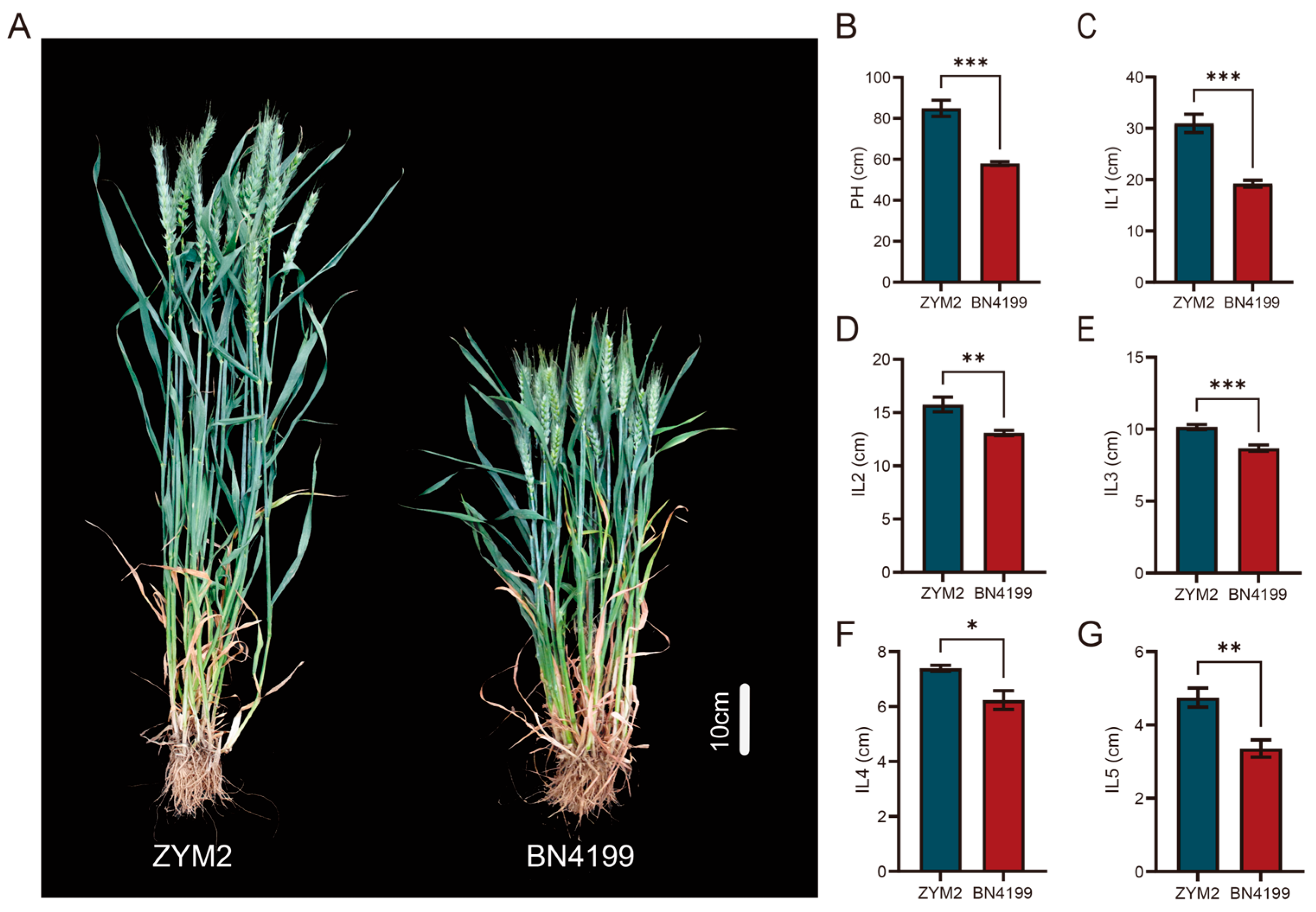
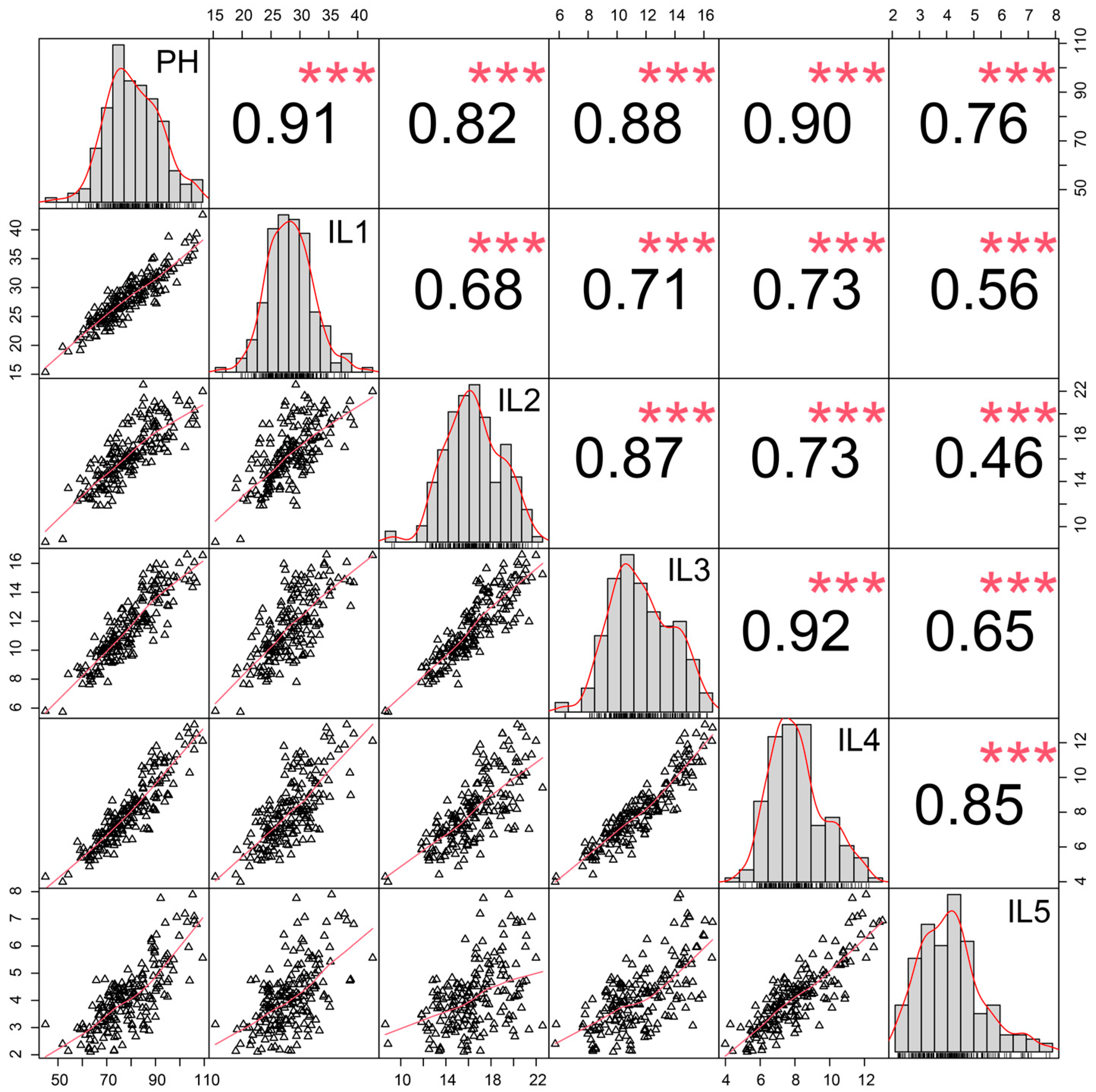
3.1. Phenotypic Evaluation of RIL Population
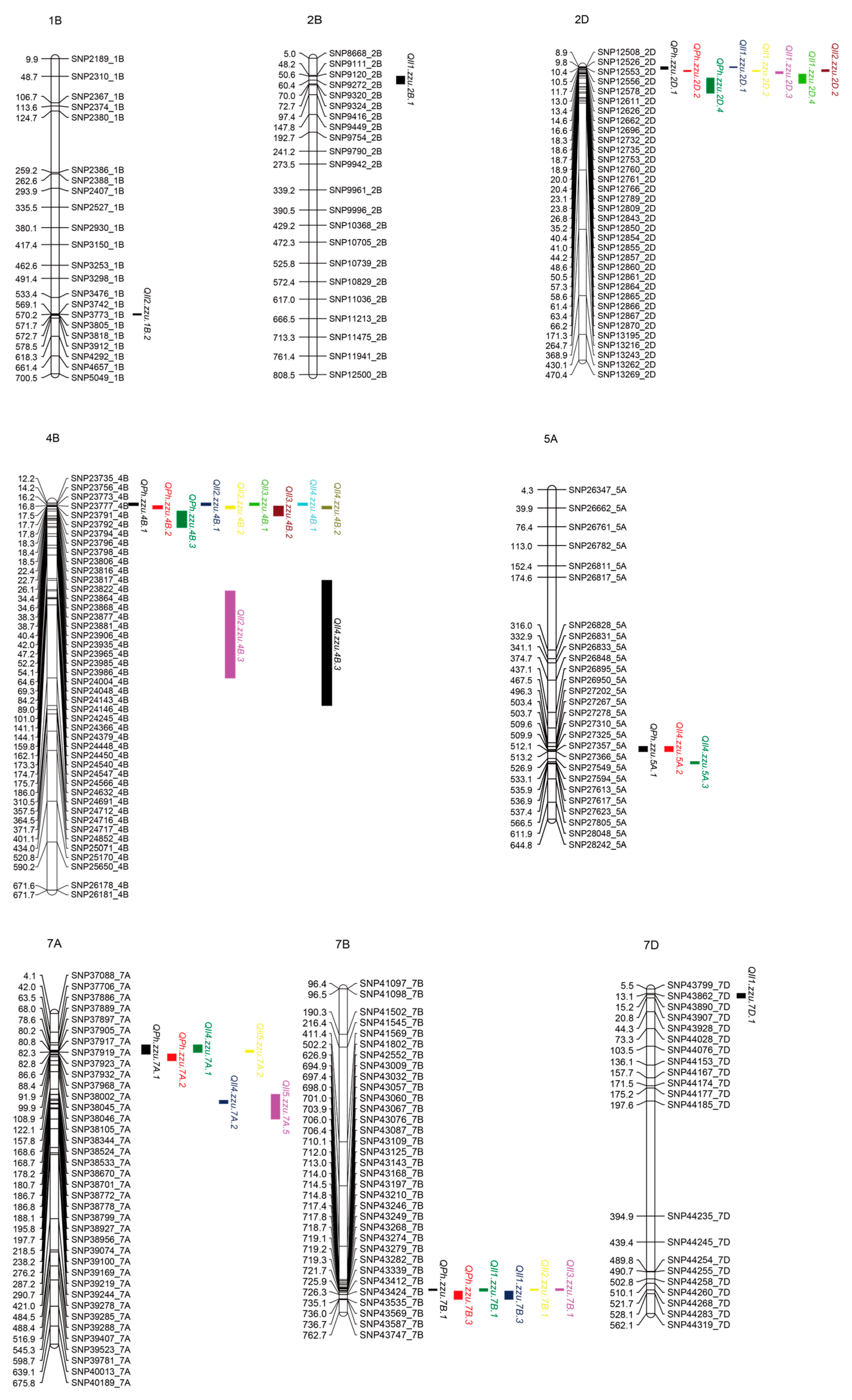
3.2. QTL Mapping for PH and IL Traits
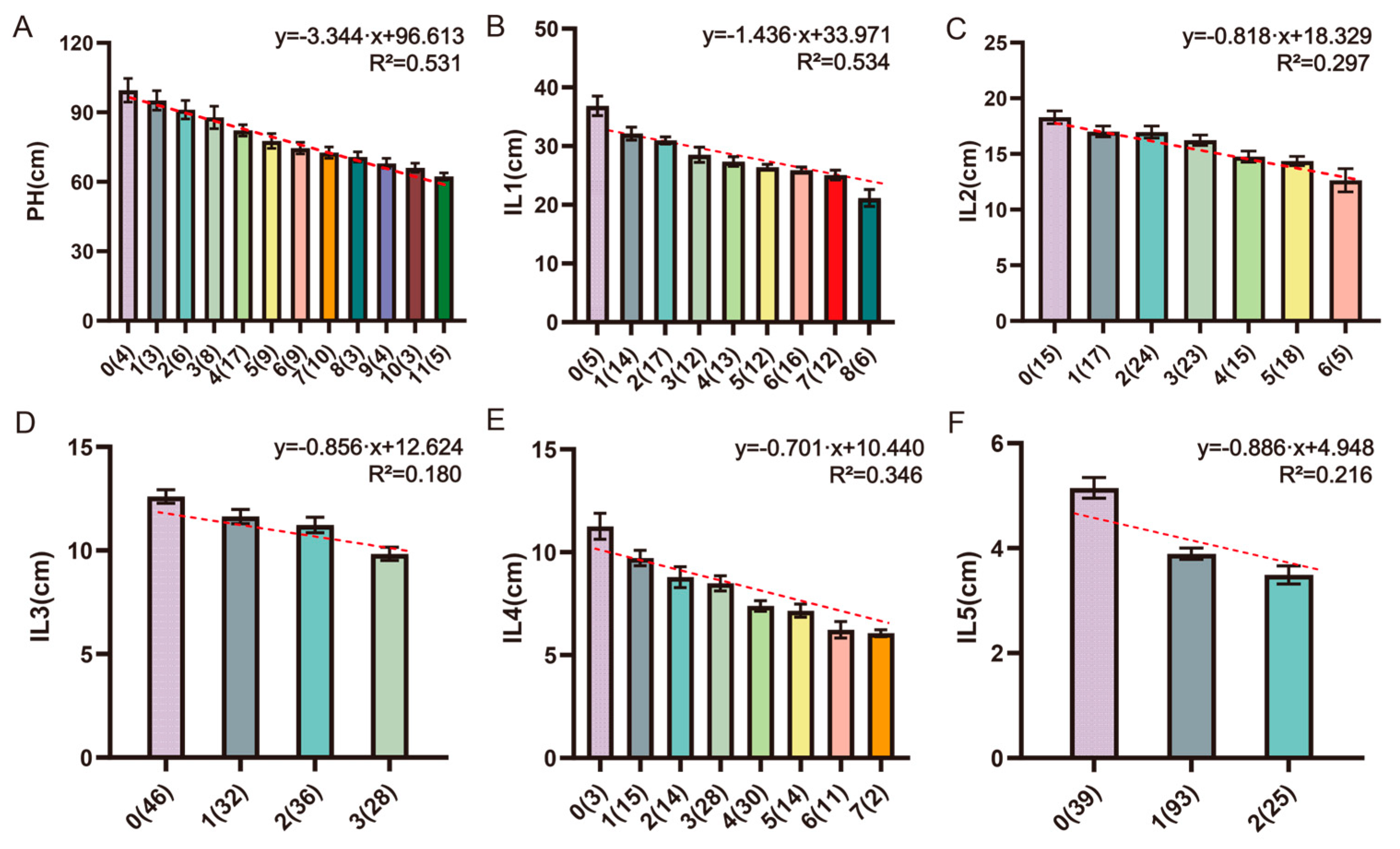
3.3. Additive Effects Analysis of the Stable QTL
3.4. Profiling and Identification of Candidate Genes
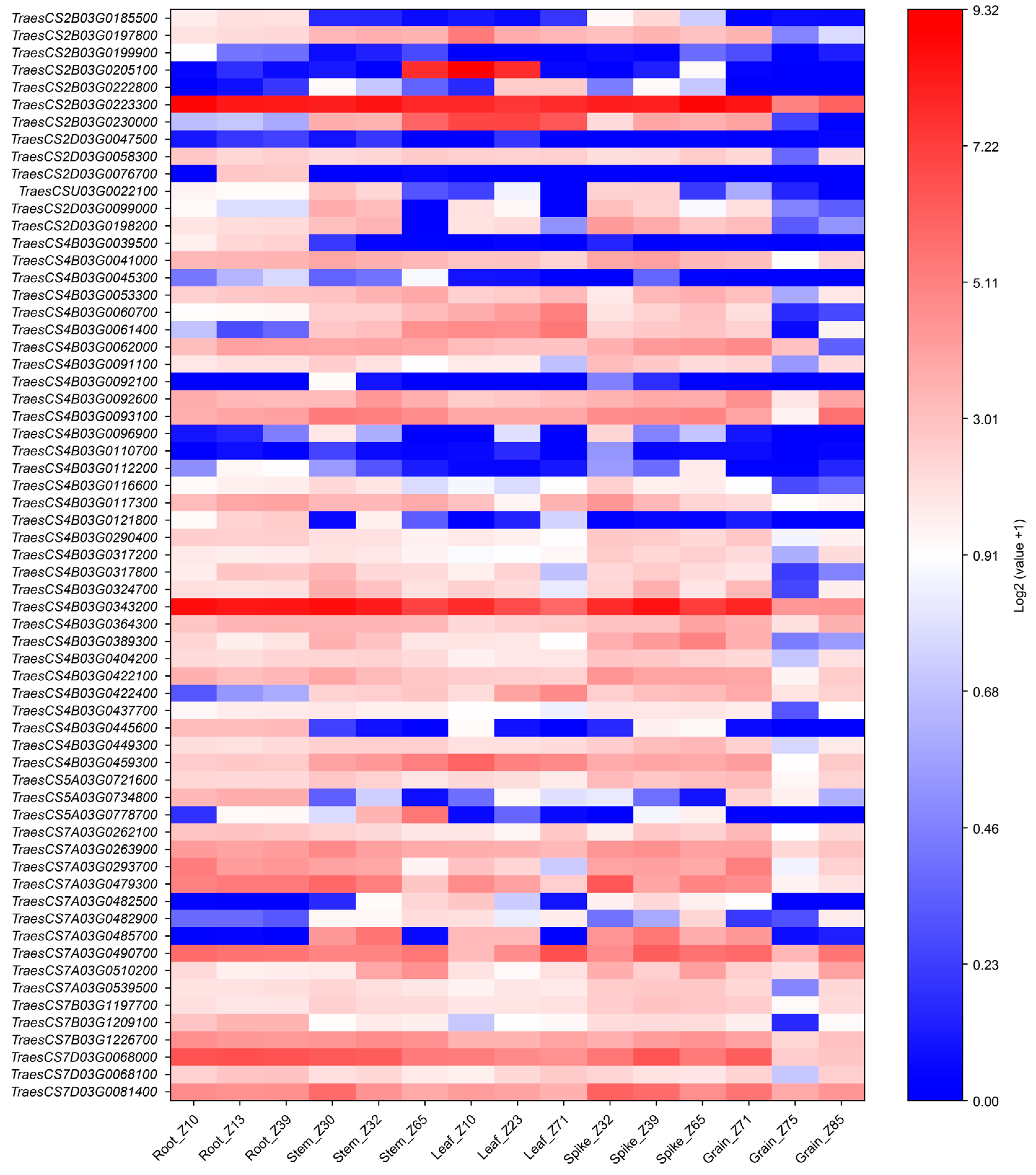
3.5. Expression Pattern Analysis of Candidate Genes
4. Discussion
4.1. QTL Cluster and Co-Localized QTL
4.2. QTL Comparison Analysis and Novel Loci Identification
4.3. Promising Candidate Genes Associated with PH and ILs
5. Conclusions
Supplementary Materials
Author Contributions
Funding
Institutional Review Board Statement
Informed Consent Statement
Data Availability Statement
Acknowledgments
Conflicts of Interest
Abbreviations
| PH | Plant height |
| IL | Internode length |
| SL | Spike length |
| RIL | Recombinant inbred line |
| QTL | Quantitative trait loci |
| IWGSC | International Wheat Genome Sequencing Consortium |
| CS | Chinese Spring |
| MAS | Marker-assisted selection |
References
- Ray, D.K.; Mueller, N.D.; West, P.C.; Foley, J.A. Yield trends are insufficient to double global crop production by 2050. PLoS ONE 2013, 8, 6. [Google Scholar] [CrossRef]
- Peng, J.; Richards, D.E.; Hartley, N.M.; Murphy, G.P.; Devos, K.M.; Flintham, J.E.; Beales, J.; Fish, L.J.; Worland, A.J.; Pelica, F.; et al. ‘Green revolution’ genes encode mutant gibberellin response modulators. Nature 1999, 400, 256–261. [Google Scholar] [CrossRef]
- Carbajal-Friedrich, A.A.J.; Burgess, A.J. The role of the ideotype in future agricultural production. Front. Plant Physiol. 2024, 2, 1341617. [Google Scholar] [CrossRef]
- Flintham, J.E.; Börner, A.; Worland, A.J.; Gale, M.D. Optimizing wheat grain yield: Effects of Rht (gibberellin-insensitive) dwarfing genes. J. Agri. Sci. 1997, 128, 11–25. [Google Scholar] [CrossRef]
- Hedden, P. The genes of the green revolution. Trends. Genet. 2003, 19, 5–9. [Google Scholar] [CrossRef]
- Donald, C.M. The breeding of crop ideotypes. Euphytica 1968, 17, 385–403. [Google Scholar] [CrossRef]
- Saville, R.J.; Gosman, N.; Burt, C.J.; Makepeace, J.; Steed, A.; Corbitt, M.; Chandler, E.; Brown, J.K.M.; Boulton, M.I.; Nicholson, P. The ‘green revolution’ dwarfing genes play a role in disease resistance in Triticum aestivum and Hordeum vulgare. J. Exp. Bot. 2012, 63, 1271–1283. [Google Scholar] [CrossRef] [PubMed]
- Xu, D.; Hao, Q.; Yang, T.; Lv, X.; Qin, H.; Wang, Y.; Jia, C.; Liu, W.; Dai, X.; Zeng, J.; et al. Impact of “green revolution” gene Rht-B1b on coleoptile length of wheat. Front. Plant Sci. 2023, 14, 1147019. [Google Scholar] [CrossRef]
- Song, L.; Liu, J.; Cao, B.; Liu, B.; Zhang, X.; Chen, Z.; Dong, C.; Liu, X.; Zhang, Z.; Wang, W.; et al. Reducing brassinosteroid signalling enhances grain yield in semi-dwarf wheat. Nature 2023, 617, 118–124. [Google Scholar] [CrossRef]
- Gooding, M.J.; Addisu, M.; Uppal, R.K.; Snape, J.W.; Jones, H.E. Effect of wheat dwarfing genes on nitrogen-use efficiency. J. Agric. Sci. 2012, 150, 3–22. [Google Scholar] [CrossRef]
- Dixon, L.E.; Pasquariello, M.; Boden, S.A. TEOSINTE BRANCHED1 regulates height and stem internode length in bread wheat. J. Exp. Bot. 2020, 71, 4742–4750. [Google Scholar] [CrossRef] [PubMed]
- Cui, F.; Li, J.; Ding, A.; Zhao, C.; Wang, L.; Wang, X.; Li, S.; Bao, Y.; Li, X.; Feng, D.; et al. Conditional QTL mapping for plant height with respect to the length of the spike and internode in two mapping populations of wheat. Theor. Appl. Genet. 2011, 122, 1517–1536. [Google Scholar] [CrossRef]
- Moshe, J.P. Lodging in wheat, barley, and oats: The phenomenon, its causes, and preventive measures. Adv. Agron. 1974, 25, 209–263. [Google Scholar] [CrossRef]
- Berry, P.M.; Spink, J.H.; Gay, A.P.; Craigon, J. A comparison of root and stem lodging risks among winter wheat cultivars. J. Agri. Sci. 2003, 141, 191–202. [Google Scholar] [CrossRef]
- Zhai, H.; Feng, Z.; Li, J.; Liu, X.; Xiao, S.; Ni, Z.; Sun, Q. QTL analysis of spike morphological traits and plant height in winter wheat (Triticum aestivum L.) using a high-density SNP and SSR-based linkage map. Front. Plant Sci. 2016, 7, 1617. [Google Scholar] [CrossRef]
- Liu, X.; Zheng, S.; Tian, S.; Si, Y.; Ma, S.; Ling, H.-Q.; Niu, J. Natural variant of Rht27, a dwarfing gene, enhances yield potential in wheat. Theor. Appl. Genet. 2024, 137, 128. [Google Scholar] [CrossRef]
- Liu, Z.; Zhu, J.; Zhao, Q.; Cao, Y.; Wu, Q.; Zhang, J.; Chen, Y.; Sun, Q.; Li, R.; Tang, H.; et al. Genetic mapping and isolation of Rht28, a locus on wheat chromosome arm 2AL affecting plant height, grain size, and grain weight. Theor. Appl. Genet. 2025, 138, 218. [Google Scholar] [CrossRef]
- Li, A.; Yang, W.; Guo, X.; Liu, D.; Sun, J.; Zhang, A. Isolation of a gibberellin-insensitive dwarfing gene, Rht-B1e, and development of an allele-specific PCR marker. Mol. Breed. 2012, 30, 1443–1451. [Google Scholar] [CrossRef]
- Borrill, P.; Mago, R.; Xu, T.; Ford, B.; Williams, S.J.; Derkx, A.; Bovill, W.D.; Hyles, J.; Bhatt, D.; Xia, X.; et al. An autoactive NB-LRR gene causes Rht13 dwarfism in wheat. Proc. Natl. Acad. Sci. USA 2022, 119, e2209875119. [Google Scholar] [CrossRef]
- Buss, W.; Ford, B.A.; Foo, E.; Schnippenkoetter, W.; Borrill, P.; Brooks, B.; Ashton, A.R.; Chandler, P.M.; Spielmeyer, W. Overgrowth mutants determine the causal role of gibberellin GA2oxidaseA13 in Rht12 dwarfism of wheat. J. Exp. Bot. 2020, 71, 7171–7178. [Google Scholar] [CrossRef] [PubMed]
- Chai, L.; Xin, M.; Dong, C.; Chen, Z.; Zhai, H.; Zhuang, J.; Cheng, X.; Wang, N.; Geng, J.; Wang, X.; et al. A natural variation in ribonuclease H-like gene underlies Rht8 to confer “green revolution” trait in wheat. Mol. Plant 2022, 15, 377–380. [Google Scholar] [CrossRef]
- Divashuk, M.G.; Vasilyev, A.V.; Bespalova, L.A.; Karlov, G.I. Identity of the Rht-11 and Rht-B1e reduced plant height genes. Russ. J. Genet. 2012, 48, 761–763. [Google Scholar] [CrossRef]
- Ford, B.A.; Foo, E.; Sharwood, R.; Karafiatova, M.; Vrána, J.; MacMillan, C.; Nichols, D.S.; Steuernagel, B.; Uauy, C.; Doležel, J.; et al. Rht18 semidwarfism in wheat is due to increased GA 2-oxidaseA9 expression and reduced GA content. Plant Physiol. 2018, 177, 168–180. [Google Scholar] [CrossRef] [PubMed]
- Li, Y.; Xiao, J.; Wu, J.; Duan, J.; Liu, Y.; Ye, X.; Zhang, X.; Guo, X.; Gu, Y.; Zhang, L.; et al. A tandem segmental duplication (TSD) in green revolution gene Rht-D1b region underlies plant height variation. New Phytol. 2012, 196, 282–291. [Google Scholar] [CrossRef] [PubMed]
- Pearce, S. Towards the replacement of wheat ‘green revolution’ genes. J. Exp. Bot. 2021, 72, 157–160. [Google Scholar] [CrossRef]
- Pearce, S.; Saville, R.; Vaughan, S.P.; Chandler, P.M.; Wilhelm, E.P.; Sparks, C.A.; Al-Kaff, N.; Korolev, A.; Boulton, M.I.; Phillips, A.L.; et al. Molecular characterization of Rht-1 dwarfing genes in hexaploid wheat. Plant Physiol. 2011, 157, 1820. [Google Scholar] [CrossRef]
- Tian, X.; Xia, X.; Xu, D.; Liu, Y.; Xie, L.; Hassan, M.A.; Song, J.; Li, F.; Wang, D.; Zhang, Y.; et al. Rht24b, an ancient variation of TaGA2ox-A9, reduces plant height without yield penalty in wheat. New Phytol. 2022, 233, 738–750. [Google Scholar] [CrossRef]
- Van De Velde, K.; Thomas, S.G.; Heyse, F.; Kaspar, R.; Van Der Straeten, D.; Rohde, A. N-terminal truncated Rht-1 proteins generated by translational reinitiation cause semi-dwarfing of wheat green revolution alleles. Mol. Plant 2021, 14, 679–687. [Google Scholar] [CrossRef]
- Xiong, H.; Zhou, C.; Fu, M.; Guo, H.; Xie, Y.; Zhao, L.; Gu, J.; Zhao, S.; Ding, Y.; Li, Y.; et al. Cloning and functional characterization of Rht8, a “green revolution” replacement gene in wheat. Mol. Plant 2022, 15, 373–376. [Google Scholar] [CrossRef]
- Zhang, J.; Li, C.; Zhang, W.; Zhang, X.; Mo, Y.; Tranquilli, G.E.; Vanzetti, L.S.; Dubcovsky, J. Wheat plant height locus Rht25 encodes a PLATZ transcription factor that interacts with DELLA (Rht1). Proc. Natl. Acad. Sci. USA 2023, 120, e2300203120. [Google Scholar] [CrossRef]
- Xu, D.; Jia, C.; Lyu, X.; Yang, T.; Qin, H.; Wang, Y.; Hao, Q.; Liu, W.; Dai, X.; Zeng, J.; et al. In Silico curation of QTL-rich clusters and candidate gene identification for plant height of bread wheat. Crop J. 2023, 11, 1480–1490. [Google Scholar] [CrossRef]
- Yu, M.; Liu, Z.-H.; Yang, B.; Chen, H.; Zhang, H.; Hou, D.-B. The contribution of photosynthesis traits and plant height components to plant height in wheat at the individual quantitative trait locus level. Sci. Rep. 2020, 10, 12261. [Google Scholar] [CrossRef]
- Zhao, K.; Xiao, J.; Liu, Y.; Chen, S.; Yuan, C.; Cao, A.; You, F.M.; Yang, D.; An, S.; Wang, H.; et al. Rht23 (5Dq′) likely encodes a Q homeologue with pleiotropic effects on plant height and spike compactness. Theor. Appl. Genet. 2018, 131, 1825–1834. [Google Scholar] [CrossRef] [PubMed]
- Dong, H.; Li, D.; Yang, R.; Zhang, L.; Zhang, Y.; Liu, X.; Kong, X.; Sun, J. GSK3 phosphorylates and regulates the green revolution protein Rht-B1b to reduce plant height in wheat. Plant Cell 2023, 35, 1970–1983. [Google Scholar] [CrossRef] [PubMed]
- Li, Q.; Guo, Q.; Yu, J.; Liu, Q. Brassinosteroid, a prime contributor to the next Green Revolution. Seed Biol. 2023, 2, 7. [Google Scholar] [CrossRef]
- Aboul-Maaty, N.A.-F.; Oraby, H.A.-S. Extraction of high-quality genomic DNA from different plant orders applying a modified CTAB-based method. Bull. Natl. Res. Cent. 2019, 43, 25. [Google Scholar] [CrossRef]
- Meng, L.; Li, H.; Zhang, L.; Wang, J. QTL IciMapping: Integrated software for genetic linkage map construction and quantitative trait locus mapping in biparental populations. Crop J. 2015, 3, 269–283. [Google Scholar] [CrossRef]
- Voorrips, R.E. MapChart: Software for the graphical presentation of linkage maps and QTLs. J. Hered. 2002, 93, 77–78. [Google Scholar] [CrossRef]
- Wang, S.; Basten, C.; Zeng, Z. Windows QTL Cartographer v 2.5; Department of Statistics North Carolina State University Raleigh: Raleigh, NC, USA, 2010; Available online: https://www.readkong.com/page/windows-qtl-cartographer-2-5-user-manual-5968653?p=2 (accessed on 1 June 2024).
- Boden, S.A.; McIntosh, R.A.; Uauy, C.; Krattinger, S.G.; Dubcovsky, J.; Rogers, W.J.; Xia, X.C.; Badaeva, E.D.; Bentley, A.R.; Brown-Guedira, G.; et al. Updated guidelines for gene nomenclature in wheat. Theor. Appl. Genet. 2023, 136, 72. [Google Scholar] [CrossRef]
- McCouch, S.R.; Chen, X.; Panaud, O.; Temnykh, S.; Xu, Y.; Cho, Y.G.; Huang, N.; Ishii, T.; Blair, M. Microsatellite marker development, mapping and applications in rice genetics and breeding. Plant Mol. Biol. 1997, 35, 89–99. [Google Scholar] [CrossRef]
- Ma, S.; Wang, M.; Wu, J.; Guo, W.; Chen, Y.; Li, G.; Wang, Y.; Shi, W.; Xia, G.; Fu, D.; et al. WheatOmics: A platform combining multiple omics data to accelerate functional genomics studies in wheat. Mol. Plant 2021, 14, 1965–1968. [Google Scholar] [CrossRef]
- Chen, Y.; Song, W.; Xie, X.; Wang, Z.; Guan, P.; Peng, H.; Jiao, Y.; Ni, Z.; Sun, Q.; Guo, W. A collinearity-incorporating homology inference strategy for connecting emerging assemblies in the Triticeae Tribe as a pilot practice in the plant pangenomic era. Mol. Plant 2020, 13, 1694–1708. [Google Scholar] [CrossRef] [PubMed]
- Chen, Y.; Guo, Y.; Guan, P.; Wang, Y.; Wang, X.; Wang, Z.; Qin, Z.; Ma, S.; Xin, M.; Hu, Z.; et al. A wheat integrative regulatory network from large-scale complementary functional datasets enables trait-associated gene discovery for crop improvement. Mol. Plant 2023, 16, 393–414. [Google Scholar] [CrossRef]
- Guan, P.; Lu, L.; Jia, L.; Kabir, M.R.; Zhang, J.; Lan, T.; Zhao, Y.; Xin, M.; Hu, Z.; Yao, Y.; et al. Global QTL analysis identifies genomic regions on chromosomes 4A and 4B harboring stable loci for yield-related traits across different environments in wheat (Triticum aestivum L.). Front. Plant Sci. 2018, 9, 529. [Google Scholar] [CrossRef] [PubMed]
- Zhang, N.; Fan, X.; Cui, F.; Zhao, C.; Zhang, W.; Zhao, X.; Yang, L.; Pan, R.; Chen, M.; Han, J.; et al. Characterization of the temporal and spatial expression of wheat (Triticum aestivum L.) plant height at the QTL level and their influence on yield-related traits. Theor. Appl. Genet. 2017, 130, 1235–1252. [Google Scholar] [CrossRef]
- Li, F.; Wen, W.; He, Z.; Liu, J.; Jin, H.; Cao, S.; Geng, H.; Yan, J.; Zhang, P.; Wan, Y.; et al. Genome-wide linkage mapping of yield-related traits in three chinese bread wheat populations using high-density SNP markers. Theor. Appl. Genet. 2018, 131, 1903–1924. [Google Scholar] [CrossRef] [PubMed]
- Li, L.; Peng, Z.; Mao, X.; Wang, J.; Chang, X.; Reynolds, M.; Jing, R. Genome-wide association study reveals genomic regions controlling root and shoot traits at late growth stages in wheat. Ann. Bot. 2019, 124, 993–1006. [Google Scholar] [CrossRef]
- Chen, H.; Semagn, K.; Iqbal, M.; Moakhar, N.P.; Haile, T.; N’Diaye, A.; Yang, R.-C.; Hucl, P.; Pozniak, C.; Spaner, D. Genome-wide association mapping of genomic regions associated with phenotypic traits in Canadian western spring wheat. Mol. Breed. 2017, 37, 141. [Google Scholar] [CrossRef]
- Yan, L.; Fu, D.; Li, C.; Blechl, A.; Tranquilli, G.; Bonafede, M.; Sanchez, A.; Valarik, M.; Yasuda, S.; Dubcovsky, J. The wheat and barley vernalization gene VRN3 is an orthologue of FT. Proc. Natl. Acad. Sci. USA 2006, 103, 19581–19586. [Google Scholar] [CrossRef]
- Würschum, T.; Liu, G.; Boeven, P.H.G.; Longin, C.F.H.; Mirdita, V.; Kazman, E.; Zhao, Y.; Reif, J.C. Exploiting the Rht portfolio for hybrid wheat breeding. Theor. Appl. Genet. 2018, 131, 1433–1442. [Google Scholar] [CrossRef]
- Ellis, M.H.; Rebetzke, G.J.; Azanza, F.; Richards, R.A.; Spielmeyer, W. Molecular mapping of gibberellin-responsive dwarfing genes in bread wheat. Theor. Appl. Genet. 2005, 111, 423–430. [Google Scholar] [CrossRef]
- Assanga, S.O.; Fuentealba, M.; Zhang, G.; Tan, C.; Dhakal, S.; Rudd, J.C.; Ibrahim, A.M.H.; Xue, Q.; Haley, S.; Chen, J.; et al. Mapping of quantitative trait loci for grain yield and its components in a US popular winter wheat TAM111 using 90K SNPs. PLoS ONE 2017, 12, e0189669. [Google Scholar] [CrossRef]
- Würschum, T.; Langer, S.M.; Longin, C.F.H. Genetic control of plant height in european winter wheat cultivars. Theor. Appl. Genet. 2015, 128, 865–874. [Google Scholar] [CrossRef]
- Li, A.; Hao, C.; Wang, Z.; Geng, S.; Jia, M.; Wang, F.; Han, X.; Kong, X.; Yin, L.; Tao, S.; et al. Wheat breeding history reveals synergistic selection of pleiotropic genomic sites for plant architecture and grain yield. Mol. Plant 2022, 15, 504–519. [Google Scholar] [CrossRef]
- Chen, D.; Wu, X.; Wu, K.; Zhang, J.; Liu, W.; Yang, X.; Li, X.; Lu, Y.; Li, L. Novel and favorable genomic regions for spike related traits in a wheat germplasm pubing 3504 with high grain number per spike under varying environments. J. Integr. Agr. 2017, 16, 2386–2401. [Google Scholar] [CrossRef]
- Liu, G.; Jia, L.; Lu, L.; Qin, D.; Zhang, J.; Guan, P.; Ni, Z.; Yao, Y.; Sun, Q.; Peng, H. Mapping qtls of yield-related traits using RIL population derived from common wheat and Tibetan semi-wild wheat. Theor. Appl. Genet. 2014, 127, 2415–2432. [Google Scholar] [CrossRef]
- Niu, Y.; Chen, T.; Zhao, C.; Guo, C.; Zhou, M. Identification of QTL for stem traits in wheat (Triticum aestivum L.). Front. Plant Sci. 2022, 13, 962253. [Google Scholar] [CrossRef]
- Zhang, H.; Li, Y.; Wei, N.; Hao, Y.; Li, X.; Wu, B.; Zheng, X.; Zhao, J.; Zheng, J. Genetic dissection of plant height-related traits by combined methods in wheat (Triticum aestivum L.). BMC Plant Biol. 2025, 25, 988. [Google Scholar] [CrossRef] [PubMed]
- Zhang, X.; Wang, M.; Zhang, C.; Dai, C.; Guan, H.; Zhang, R. Genetic dissection of QTLs for starch content in four maize DH populations. Front. Plant Sci. 2022, 13, 950664. [Google Scholar] [CrossRef] [PubMed]
- Gao, F.; Wen, W.; Liu, J.; Rasheed, A.; Yin, G.; Xia, X.; Wu, X.; He, Z. Genome-wide linkage mapping of QTL for yield components, plant height and yield-related physiological traits in the Chinese wheat cross Zhou 8425B/Chinese Spring. Front. Plant Sci. 2015, 6, 1099. [Google Scholar] [CrossRef] [PubMed]
- Shen, Y.; Xiang, Y.; Xu, E.; Ge, X.; Li, Z. Major co-localized QTL for plant height, branch initiation height, stem diameter, and flowering time in an alien introgression derived Brassica napus DH population. Front. Plant Sci. 2018, 9, 390. [Google Scholar] [CrossRef]
- Wang, L.; Zhong, M.; Li, X.; Yuan, D.; Xu, Y.; Liu, H.; He, Y.; Luo, L.; Zhang, Q. The QTL controlling amino acid content in grains of rice (Oryza Sativa) are co-localized with the regions involved in the amino acid metabolism pathway. Mol. Breed. 2008, 21, 127–137. [Google Scholar] [CrossRef]
- Chai, L.; Chen, Z.; Bian, R.; Zhai, H.; Cheng, X.; Peng, H.; Yao, Y.; Hu, Z.; Xin, M.; Guo, W.; et al. Dissection of two quantitative trait loci with pleiotropic effects on plant height and spike length linked in coupling phase on the short arm of chromosome 2D of common wheat (Triticum aestivum L.). Theor. Appl. Genet. 2018, 131, 2621–2637. [Google Scholar] [CrossRef]
- Yao, Y.; Guo, W.; Gou, J.; Hu, Z.; Liu, J.; Ma, J.; Zong, Y.; Xin, M.; Chen, W.; Li, Q.; et al. Wheat2035: Integrating pan-omics and advanced biotechnology for future wheat design. Mol. Plant 2025, 18, 272–297. [Google Scholar] [CrossRef] [PubMed]
- Waqas, M.; Rasheed, A.; Peng, J. Wheat genomics frontiers for gene discovery and breeding applications. WheatOmics 2025, 1, 3. [Google Scholar] [CrossRef]
- Fang, F.; Ye, S.; Tang, J.; Bennett, M.J.; Liang, W. DWT1/DWL2 act together with OsPIP5K1 to regulate plant uniform growth in rice. New Phytol. 2020, 225, 1234–1246. [Google Scholar] [CrossRef] [PubMed]
- Lu, M.; Liu, M.; Luo, Q.; He, Y.; Tian, Y.; Zhan, H. The brassinosteroid signaling-related ILI–OsAIF–OsbHLH92 transcription factor module antagonistically controls leaf angle and grain size in rice. Plant Physiol. 2025, 197, kiae668. [Google Scholar] [CrossRef]
- Pires, N.; Dolan, L. Origin and diversification of basic-helix-loop-helix proteins in plants. Mol. Biol. Evol. 2010, 27, 862–874. [Google Scholar] [CrossRef]
- Xu, W.; Dubos, C.; Lepiniec, L. Transcriptional control of flavonoid biosynthesis by MYB–bHLH–WDR complexes. Trends Plant Sci. 2015, 20, 176–185. [Google Scholar] [CrossRef]
- Zhang, M.; Su, J.; Zhang, Y.; Xu, J.; Zhang, S. Conveying endogenous and exogenous signals: MAPK cascades in plant growth and defense. Curr. Opin. Plant. Biol. 2018, 45, 1–10. [Google Scholar] [CrossRef] [PubMed]
- Liu, S.; Hua, L.; Dong, S.; Chen, H.; Zhu, X.; Jiang, J.; Zhang, F.; Li, Y.; Fang, X.; Chen, F. OsMAPK6, a mitogen-activated protein kinase, influences rice grain size and biomass production. Plant J. 2015, 84, 672–681. [Google Scholar] [CrossRef] [PubMed]
- Qi, J.; Yang, S.; Salam, A.; Yang, C.; Khan, A.R.; Wu, J.; Azhar, W.; Gan, Y. OsRbohI regulates rice growth and development via jasmonic acid signalling. Plant Cell Physiol. 2023, 64, 686–699. [Google Scholar] [CrossRef] [PubMed]





| Trait | Source | DF | SS | MS | F-Value | PCV | GCV | H2 |
|---|---|---|---|---|---|---|---|---|
| PH | Genotype | 183 | 289,475.1875 | 1581.8317 | 54.1062 *** | 16.95% | 14.23% | 96.57% |
| Environment | 3 | 25,489.6895 | 8496.5635 | 290.6229 *** | ||||
| GE_interaction | 530 | 29,199.0645 | 55.0926 | 1.8844 *** | ||||
| Block/Env | 8 | 5115.3491 | 639.4186 | 21.8712 *** | ||||
| Error | 1367 | 39,965.1953 | 29.2357 | |||||
| IL1 | Genotype | 183 | 37,321.4844 | 203.9425 | 36.316 *** | 20.70% | 13.98% | 92.82% |
| Environment | 3 | 16,399.9805 | 5466.6602 | 973.4479 *** | ||||
| GE_interaction | 530 | 8132.6426 | 15.3446 | 2.7324 *** | ||||
| Block/Env | 8 | 1014.4549 | 126.8069 | 22.5805 *** | ||||
| Error | 1367 | 7676.7583 | 5.6158 | |||||
| IL2 | Genotype | 183 | 14,107.5928 | 77.0907 | 31.8138 *** | 20.05% | 14.77% | 91.28% |
| Environment | 3 | 1555.4806 | 518.4935 | 213.9721 *** | ||||
| GE_interaction | 530 | 3781.9561 | 7.1358 | 2.9448 *** | ||||
| Block/Env | 8 | 154.5643 | 19.3205 | 7.9732 *** | ||||
| Error | 1367 | 3312.4912 | 2.4232 | |||||
| IL3 | Genotype | 183 | 11,218.9746 | 61.3059 | 33.6283 *** | 23.23% | 18.82% | 95.19% |
| Environment | 3 | 545.6771 | 181.8924 | 99.774 *** | ||||
| GE_interaction | 530 | 1593.6311 | 3.0069 | 1.6494 *** | ||||
| Block/Env | 8 | 144.9646 | 18.1206 | 9.9397 *** | ||||
| Error | 1367 | 2492.1011 | 1.823 | |||||
| IL4 | Genotype | 183 | 7947.2256 | 43.4275 | 27.1927 *** | 29.64% | 22.54% | 93.62% |
| Environment | 3 | 758.905 | 252.9683 | 158.3999 *** | ||||
| GE_interaction | 530 | 1510.5769 | 2.8501 | 1.7847 *** | ||||
| Block/Env | 8 | 155.5675 | 19.4459 | 12.1764 *** | ||||
| Error | 1367 | 2183.1313 | 1.597 | |||||
| IL5 | Genotype | 183 | 2958.8389 | 16.1685 | 11.8842 *** | 43.03% | 26.28% | 88.27% |
| Environment | 3 | 714.0789 | 238.0263 | 174.9542 *** | ||||
| GE_interaction | 530 | 1042.528 | 1.967 | 1.4458 *** | ||||
| Block/Env | 8 | 143.5233 | 17.9404 | 13.1866 *** | ||||
| Error | 1324 | 1801.3099 | 1.3605 |
| Trait | QTL Name | Chromosome | Genetic Interval (cM) | Physical Interval (Mb) | LOD | Additive Effect | R2 | Environment | Reference |
|---|---|---|---|---|---|---|---|---|---|
| PH | QPh.zzu.2D.1 | 2D | 1.3~7.8 | 9.7~12.9 | 4.60~7.39 | 3.28~4.71 | 7.93~12.95% | E1, E2, E3, E4, BLUE | |
| QPh.zzu.2D.2 | 2D | 10.8~16.2 | 14.5~16.7 | 5.10~6.51 | 3.70~4.14 | 9.47~10.91% | E2, E4, BLUE | [45] | |
| QPh.zzu.2D.4 | 2D | 33.9~65.5 | 26.8~50.4 | 3.07~3.62 | 3.20~3.44 | 5.14~5.39% | E1, E2 | [21,29] | |
| QPh.zzu.4B.1 | 4B | 2.0~15.4 | 12.2~16.8 | 3.16~3.60 | −3.12~−2.65 | 5.14~5.38% | E1, E3 | ||
| QPh.zzu.4B.2 | 4B | 16.3~24.1 | 16.8~22.4 | 2.62~3.14 | −2.96~−2.46 | 4.61~4.62% | E1, E3 | [46] | |
| QPh.zzu.4B.3 | 4B | 30.7~48 | 26.0~54.0 | 2.90~4.40 | −3.23~−2.62 | 4.64~7.13% | E2, E4, BLUE | [2] | |
| QPh.zzu.5A.1 | 5A | 136.3~141.8 | 503.7~513.2 | 2.79~4.35 | 2.42~3.59 | 3.96~6.63% | E1, E2, BLUE | [32,47,48] | |
| QPh.zzu.7A.1 | 7A | 99.2~116.7 | 68.0~86.5 | 2.58~2.87 | −2.80~−2.48 | 4.16~4.31% | E2, E4 | [49,50] | |
| QPh.zzu.7A.2 | 7A | 116.7~128.8 | 86.5~99.9 | 2.57~2.68 | −2.74~−2.45 | 3.86~4.02% | E2, E4 | [51] | |
| QPh.zzu.7B.1 | 7B | 121.8~135.7 | 714.0~717.1 | 3.53~5.61 | −4.13~−2.90 | 5.59~9.66% | E1, E2, E4, BLUE | ||
| QPh.zzu.7B.3 | 7B | 139.3~149.1 | 719.1~735.9 | 3.94~4.24 | −3.62~−3.20 | 6.84~7.92% | E1, E4, BLUE | [19,52] | |
| IL1 | QIl1.zzu.2B.1 | 2B | 67.4~78.7 | 48.2~69.9 | 3.60~5.49 | 0.94~1.40 | 5.83~8.72% | E3, E4 | [53] |
| QIl1.zzu.2D.1 | 2D | 0.2~4.3 | 8.8~10.3 | 3.91~14.11 | 1.49~2.16 | 5.51~23.60% | E1, E2, BLUE | ||
| QIl1.zzu.2D.2 | 2D | 10.9~14.2 | 14.5~16.5 | 5.55~13.24 | 1.67~2.65 | 10.76~25.97% | E1, E2, BLUE | [45] | |
| QIl1.zzu.2D.3 | 2D | 18.7~23.5 | 16.5~19.9 | 3.51~5.05 | 0.98~1.73 | 5.91~7.18% | E1, E3 | [45] | |
| QIl1.zzu.2D.4 | 2D | 24.8~46.5 | 20.4~35.2 | 3.75~6.27 | 1.32~1.75 | 6.03~13.05% | E1, E3, E4 | [21,29] | |
| QIl1.zzu.7B.1 | 7B | 124.4~134.3 | 714.0~719.2 | 4.43~5.01 | −1.37~−1.06 | 7.35~8.09% | E3, E4 | ||
| QIl1.zzu.7B.3 | 7B | 138.6~148.6 | 719.1~735.9 | 3.13~6.14 | −1.64~−0.92 | 5.62~11.59% | E2, E3, E4 | [19,52] | |
| QIl1.zzu.7D.1 | 7D | 8.6~23.3 | 13.0~28 | 3.03~4.66 | 0.91~1.31 | 5.60~7.76% | E3, E4 | [54] | |
| IL2 | QIl2.zzu.1B.2 | 1B | 146.7~155.8 | 569.1~572.7 | 3.49 | −0.80~−0.65 | 6.50~6.70% | E2, E4 | [55] |
| QIl2.zzu.2D.2 | 2D | 8.6~16.2 | 13.4~16.5 | 2.53~3.33 | 0.57~0.73 | 5.18~5.30% | E1, E4 | [45] | |
| QIl2.zzu.4B.1 | 4B | 5.1~15.9 | 12.2~16.8 | 3.66~5.00 | −0.87~−0.71 | 6.50~7.89% | E1, E2, BLUE | ||
| QIl2.zzu.4B.2 | 4B | 17.9~23.9 | 17.4~22.7 | 2.73~4.25 | −0.82~−0.64 | 5.03~6.89% | E1, E2, BLUE | [46] | |
| QIl2.zzu.4B.3 | 4B | 64.1~68.8 | 162.1~310.5 | 3.65~4.83 | −0.94~−0.64 | 6.12~9.27% | E3, E4, BLUE | [56,57] | |
| QIl2.zzu.7B.1 | 7B | 120.8~135.7 | 714.0~718.7 | 2.79~6.38 | −1.00~−0.69 | 5.27~11.33% | E1, E3, BLUE | ||
| IL3 | QIl3.zzu.4B.1 | 4B | 4.7~15.7 | 12.2~16.8 | 3.38~7.62 | −1.02~−0.59 | 6.14~14.17% | E1, E2, E3, E4, BLUE | |
| QIl3.zzu.4B.2 | 4B | 18.1~32.5 | 17.7~28.0 | 4.17~6.94 | −1.04~−0.67 | 7.96~12.72% | E1, E2, E3, E4, BLUE | [46] | |
| QIl3.zzu.7B.1 | 7B | 124.8~135.7 | 714.0~718.7 | 2.98~6.32 | −0.76~−0.52 | 5.10~10.77% | E1, E4, BLUE | ||
| IL4 | QIl4.zzu.4B.1 | 4B | 7.6~16.3 | 12.2~16.8 | 3.20~4.72 | −0.70~−0.51 | 5.65~8.00% | E1, E3 | |
| QIl4.zzu.4B.2 | 4B | 19.2~23.9 | 17.7~22.4 | 3.37~3.74 | −0.65~−0.52 | 5.97~6.86% | E1, E3 | [46] | |
| QIl4.zzu.4B.3 | 4B | 63.9~68.4 | 144.0~357.5 | 3.10~4.12 | −0.55~−0.46 | 5.16~7.15% | E2, E4 | [56,57] | |
| QIl4.zzu.5A.2 | 5A | 136.6~141.8 | 503.7~513.2 | 3.92~5.33 | 0.57~0.77 | 6.92~9.09% | E1, E3 | [32,47,48] | |
| QIl4.zzu.5A.3 | 5A | 145.4~148.9 | 533.0~535.8 | 3.64~4.05 | 0.55~0.67 | 6.40~7.01% | E1, E3 | ||
| QIl4.zzu.7A.1 | 7A | 97.8~107.4 | 68.0~82.7 | 5.14~7.31 | −0.73~−0.63 | 9.24~13.09% | E2, E4 | [49,50] | |
| QIl4.zzu.7A.2 | 7A | 159.8~171.9 | 180.6~206.7 | 2.53~5.15 | 0.41~0.63 | 4.31~9.17% | E2, E4 | [55] | |
| IL5 | QIl5.zzu.7A.3 | 7A | 99.2~107.9 | 78.5~82.7 | 6.23~11.90 | −0.55~−0.45 | 11.09~20.33% | E1, E2, E4, BLUE | [49,50] |
| QIl5.zzu.7A.6 | 7A | 160.3~169.3 | 168.7~218.5 | 3.30~6.25 | 0.32~0.44 | 7.14~11.11% | E2, E4, BLUE | [55] |
| Chromosome | Trait | Genetic Interval (cM) | Physical Interval (Mb) | QTL Name |
|---|---|---|---|---|
| 1B | IL3, IL4 | 159.9~170.8 | 578.4~592.8 | QIl3.zzu.1B.1; QIl4.zzu.1B.1 |
| 1D | PH, IL1, IL3 | 145.4~154.6 | 401.3~414.1 | QPh.zzu.1D; QIl1.zzu.1D.2; QIl3.zzu.1D |
| 2D | PH, IL1, IL2, IL4, IL5 | 0~7.8 | 8.8~12.9 | QPh.zzu.2D.1; QIl1.zzu.2D.1; QIl2.zzu.2D.1; QIl4.zzu.2D.1; QIl5.zzu.2D.1 |
| 2D | PH, IL1, IL2, IL5 | 8.5~16.2 | 13.4~16.5 | QPh.zzu.2D.2; QIl1.zzu.2D.2; QIl2.zzu.2D.2; QIl5.zzu.2D.2 |
| 2D | PH, IL1, IL5 | 18.7–29.5 | 16.5~26.8 | QPh.zzu.2D.3; QIl1.zzu.2D.3; QIl5.zzu.2D.3 |
| 2D | PH, IL1, IL4, IL5 | 23.5–65.5 | 26.8~50.4 | QPh.zzu.2D.4; QIl1.zzu.2D.4; QIl4.zzu.2D.2; QIl5.zzu.2D.4 |
| 2D | IL4, IL5 | 78.1~91.9 | 58.5~67.7 | QIl4.zzu.2D.3; QIl5.zzu.2D.5 |
| 4A | PH, IL2, IL3, IL4 | 85.5~98.6 | 598.7~610.9 | QPh.zzu.4A.1; QIl2.zzu.4A; QIl3.zzu.4A; QIl4.zzu.4A |
| 4B | PH, IL1, IL2, IL3, IL4 | 2~16.3 | 12.2~16.8 | QPh.zzu.4B.1; QIl1.zzu.4B.1; QIl2.zzu.4B.1; QIl3.zzu.4B.1; QIl4.zzu.4B.1 |
| 4B | PH, IL1, IL2, IL3, IL4 | 16.3~32.5 | 16.8~28 | QPh.zzu.4B.2; QIl1.zzu.4B.2; QIl2.zzu.4B.2; QIl3.zzu.4B.2; QIl4.zzu.4B.2 |
| 4B | PH, IL3 | 30.3~48 | 28.0~54.0 | QPh.zzu.4B.3; QIl3.zzu.4B.3 |
| 4B | IL1, IL2, IL3, IL4 | 63.1~68.9 | 144.0~357.5 | QIl1.zzu.4B.3; QIl2.zzu.4B.3; QIl3.zzu.4B.4; QIl4.zzu.4B.3 |
| 4D | PH, IL3, IL4 | 0~1.4 | 37.3~42.5 | QPh.zzu.4D.1; QIl3.zzu.4D.1; QIl4.zzu.4D |
| 5A | PH, IL3, IL4 | 136.3~141.8 | 503.7~513.2 | QPh.zzu.5A.1; QIl3.zzu.5A.1; QIl4.zzu.5A.2 |
| 5A | IL4, IL5 | 145.4~148.9 | 525.6~535.8 | QIl4.zzu.5A.3; QIl5.zzu.5A.2 |
| 5A | PH, IL2, IL3 | 151.2~157 | 539.6~550.0 | QPh.zzu.5A.3; QIl2.zzu.5A; QIl3.zzu.5A.2 |
| 6B | IL1, IL3, IL4 | 195.7~206.6 | 703.6~714.7 | QIl1.zzu.6B.3; QIl3.zzu.6B; QIl4.zzu.6B |
| 6D | IL2, IL3, IL4 | 156.1~172.3 | 454.6~469.8 | QIl2.zzu.6D; QIl3.zzu.6D; QIl4.zzu.6D |
| 7A | PH, IL4, IL5 | 96.2~116.7 | 68.0~86.5 | QPh.zzu.7A.1; QIl4.zzu.7A.1; QIl5.zzu.7A.2 |
| 7A | PH, IL1, IL3, IL4, IL5 | 159.8~176.8 | 143.2~237.1 | QPh.zzu.7A.3; QIl1.zzu.7A.1; QIl3.zzu.7A; QIl4.zzu.7A.2; QIl5.zzu.7A.6 |
| 7A | PH, IL4 | 203.3~210.5 | 613.2~639.1 | QPh.zzu.7A.6; QIl4.zzu.7A.4 |
| 7B | PH, IL1, IL2, IL3, IL4 | 120.7~135.7 | 714.8~717.7 | QPh.zzu.7B.1; QIl1.zzu.7B.1; QIl2.zzu.7B.1; QIl3.zzu.7B.1; QIl4.zzu.7B |
| 7B | PH, IL1, IL2, IL3 | 139.3~149.1 | 719.1~735.9 | QPh.zzu.7B.3; QIl1.zzu.7B.3; QIl2.zzu.7B.3; QIl3.zzu.7B.2 |
| Gene ID | Gene Name | Location (IWGSC RefSeqv2.1) | Description | Oryza Sativa |
|---|---|---|---|---|
| TraesCS2B03G0185500 | chr2B:51952971-51956065 (−) | Transcription factor MYB36 | Os08g0433400 | |
| TraesCS2B03G0197800 | chr2B:56466313-56470936 (−) | GDT1-like protein 2, chloroplastic | Os11g0544500 | |
| TraesCS2B03G0199900 | chr2B:57026094-57027547 (+) | UDP-glycosyltransferase 79 | Os04g0206700 | |
| TraesCS2B03G0205100 | chr2B:58334563-58335201 (+) | Germin-like protein 8–14 | Os08g0460000 | |
| TraesCS2B03G0222800 | chr2B:63367187-63468933 (−) | Two-component response regulator-like PRR37 | Os07g0695100 | |
| TraesCS2B03G0223300 | chr2B:63771237-63775184 (+) | L-ascorbate peroxidase 2, cytosolic | Os07g0694700 | |
| TraesCS2B03G0230000 | chr2B:66373336-66376648 (−) | Omega-3 fatty acid desaturase, chloroplastic | Os07g0693800 | |
| TraesCS2D03G0047500 | chr2D:11057729-11060001 (−) | Probably inactive receptor-like protein kinase At2g46850 | Os10g0351500 | |
| TraesCS2D03G0058300 | chr2D:12785126-12799210 (−) | ABC transporter B family member 25, mitochondrial | Os06g0128300 | |
| TraesCS2D03G0076700 | chr2D:15339456-15341024 (+) | S-adenosylmethionine synthase 1 | Os01g0323600 | |
| TraesCSU03G0022100 | Rht8 | chrUn:18733736-18737027 (−) | Ribonuclease H-Like 1 | Os04g0261400 |
| TraesCS2D03G0099000 | chr2D:20858057-20860133 (+) | Tricetin 3′,4′,5′-O-trimethyltransferase | Os08g0157500 | |
| TraesCS2D03G0198200 | chr2D:49296329-49297483 (+) | Transcription factor bHLH148 | Os03g0311600 | |
| TraesCS4B03G0039500 | chr4B:15737018-15740036 (−) | Fe(2+) transport protein 1 | Os03g0667500 | |
| TraesCS4B03G0041000 | chr4B:15848203-15853551 (−) | Guanine nucleotide-binding protein subunit beta | Os03g0669200 | |
| TraesCS4B03G0045300 | chr4B:17485639-17488430 (+) | Endo-1,4-beta-xylanase 1 | Os03g0672900 | |
| TraesCS4B03G0053300 | chr4B:19889929-19895453 (−) | BEL1-like homeodomain protein 6 | Os03g0680800 | |
| TraesCS4B03G0060700 | chr4B:23432237-23437771 (+) | Magnesium transporter MRS2-A, chloroplastic | Os03g0684400 | |
| TraesCS4B03G0061400 | chr4B:23847772-23850308 (+) | Ferredoxin C 2, chloroplastic | Os03g0685000 | |
| TraesCS4B03G0062000 | chr4B:23945006-23948825 (+) | Gamma-glutamyl peptidase 5 | Os03g0685300 | |
| TraesCS4B03G0091100 | chr4B:32026724-32033370 (−) | Phosphatidylinositol 4-phosphate 5-kinase 1 | Os03g0705300 | |
| TraesCS4B03G0092100 | TB1 | chr4B:33121434-33122498 (+) | Transcription factor TB1 | Os03g0706500 |
| TraesCS4B03G0092600 | ZnF-B | chr4B:33478324-33487967 (−) | RING-type E3 ligase | Os03g0706900 |
| TraesCS4B03G0093100 | Rht1 | chr4B:33614435-33616890 (+) | DELLA protein RHT-1 | Os03g0707600 |
| TraesCS4B03G0096900 | chr4B:34988758-34989243 (−) | Chemocyanin | Os03g0709100 | |
| TraesCS4B03G0110700 | chr4B:42801164-42805060 (−) | ATP-dependent DNA helicase DDM1 | Os03g0722400 | |
| TraesCS4B03G0112200 | chr4B:43560903-43567074 (−) | Phytochrome A type 3 | Os03g0719800 | |
| TraesCS4B03G0116600 | chr4B:45598303-45600496 (−) | SCARECROW-LIKE protein 7 | Os03g0723000 | |
| TraesCS4B03G0117300 | chr4B:45930921-45934993 (−) | Uncharacterized sugar kinase slr0537 | Os01g0105900 | |
| TraesCS4B03G0121800 | chr4B:48378594-48380754 (+) | 7-methyl-GTP pyrophosphatase | Os03g0724700 | |
| TraesCS4B03G0290400 | chr4B:155152087-155157174 (−) | OBERON-like protein | Os12g0514400 | |
| TraesCS4B03G0317200 | chr4B:181393820-181403278 (−) | E3 SUMO-protein ligase SIZ2 | Os03g0719100 | |
| TraesCS4B03G0317800 | chr4B:182163392-182169863 (+) | Protein DWARF 53 | Os11g0104300 | |
| TraesCS4B03G0324700 | chr4B:186822081-186825362 (−) | GDSL esterase/lipase CPRD49 | Os11g0708400 | |
| TraesCS4B03G0343200 | chr4B:202475060-202477534 (+) | UDP-arabinopyranose mutase 1 | Os03g0599800 | |
| TraesCS4B03G0364300 | chr4B:224505364-224506622 (−) | Protein ELF4-LIKE 4 | Os11g0621500 | |
| TraesCS4B03G0389300 | chr4B:254960827-254974470 (−) | Villin-2 | Os03g0356700 | |
| TraesCS4B03G0404200 | chr4B:277078935-277090963 (−) | Ubiquitin-like-specific protease ESD4 | Os03g0344300 | |
| TraesCS4B03G0422100 | chr4B:306200080-306210987 (+) | Histone chaperone domain CHZ | Os11g0544600 | |
| TraesCS4B03G0422400 | chr4B:306823340-306826867 (−) | Inactive purple acid phosphatase-like protein | Os11g0586300 | |
| TraesCS4B03G0437700 | chr4B:319887960-319893701 (+) | RNA polymerase II C-terminal domain phosphatase-like 3 | Os11g0521900 | |
| TraesCS4B03G0445600 | chr4B:327792210-327794025 (+) | Probable serine/threonine-protein kinase PBL15 | Os03g0364400 | |
| TraesCS4B03G0449300 | chr4B:335351963-335359341 (−) | Phosphatidate phosphatase PAH2 | Os11g0615000 | |
| TraesCS4B03G0459300 | chr4B:346726523-346748266 (−) | ATP-dependent Clp protease proteolytic subunit 6, chloroplastic | Os03g0411500 | |
| TraesCS5A03G0721600 | chr5A:505345139-505349040 (+) | Hsp70 nucleotide exchange factor fes1 | Os09g0512700 | |
| TraesCS5A03G0734800 | chr5A:511126101-511128863 (−) | Respiratory burst oxidase homolog protein C | Os11g0537400 | |
| TraesCS5A03G0778700 | chr5A:534224114-534227378 (−) | Protein ODORANT1 | Os09g0532900 | |
| TraesCS7A03G0262100 | chr7A:70990291-70993190 (−) | F-box/LRR-repeat MAX2 homolog | Os06g0154200 | |
| TraesCS7A03G0263900 | chr7A:71403697-71411075 (−) | Mitogen-activated protein kinase 1 | Os06g0154500 | |
| TraesCS7A03G0293700 | chr7A:83704628-83709372 (+) | Protein disulfide isomerase-like 1-5 | Os06g0163400 | |
| TraesCS7A03G0479300 | chr7A:172295262-172296871 (−) | Ribonucleoside-diphosphate reductase small chain | Os06g0257450 | |
| TraesCS7A03G0482500 | chr7A:174101472-174102770 (+) | Zinc finger protein CONSTANS-LIKE 16 | Os06g0264200 | |
| TraesCS7A03G0482900 | chr7A:174308926-174314065 (+) | Protein NRT1/ PTR FAMILY 3.1 | Os06g0264500 | |
| TraesCS7A03G0485700 | chr7A:175963414-175964402 (−) | Gibberellin-regulated protein 4 | Os06g0266800 | |
| TraesCS7A03G0490700 | chr7A:178822117-178827345 (+) | Aldehyde dehydrogenase family 2 member B4, mitochondrial | Os06g0270900 | |
| TraesCS7A03G0510200 | chr7A:191343804-191349225 (−) | Zinc finger protein CONSTANS-LIKE 9 | Os06g0298200 | |
| TraesCS7A03G0539500 | chr7A:209112211-209132047 (+) | Ubiquitin-like-specific protease 1D | Os06g0487900 | |
| TraesCS7B03G1197700 | chr7B:717798428-717806399 (−) | Zinc finger CCCH domain-containing protein 7 | Os06g0638000 | |
| TraesCS7B03G1209100 | chr7B:720834549-720838034 (−) | Receptor-like cytoplasmic kinase 176 | Os05g0110900 | |
| TraesCS7B03G1226700 | chr7B:725133900-725140584 (+) | Protein MEMO1 | Os08g0299000 | |
| TraesCS7D03G0068000 | chr7D:16298182-16301159 (−) | 6-phosphogluconate dehydrogenase, decarboxylating 1 | Os06g0111500 | |
| TraesCS7D03G0068100 | chr7D:16346353-16351684 (+) | Extra-large guanine nucleotide-binding protein 3 | Os06g0111400 | |
| TraesCS7D03G0081400 | chr7D:19316635-19322955 (−) | Protein argonaute 1B | Os04g0566500 |
Disclaimer/Publisher’s Note: The statements, opinions and data contained in all publications are solely those of the individual author(s) and contributor(s) and not of MDPI and/or the editor(s). MDPI and/or the editor(s) disclaim responsibility for any injury to people or property resulting from any ideas, methods, instructions or products referred to in the content. |
© 2026 by the authors. Licensee MDPI, Basel, Switzerland. This article is an open access article distributed under the terms and conditions of the Creative Commons Attribution (CC BY) license.
Share and Cite
Wan, Z.; Ge, S.; Li, M.; Wang, X.; Cui, D.; Chi, Q.; Li, B.; Xu, H.; Lu, J.; Jiao, Z.; et al. Identification of QTL and Candidate Genes Controlling Plant Height and Internode Length in a Newly Characterized Bread Wheat Recombinant Inbred Population. Genes 2026, 17, 567. https://doi.org/10.3390/genes17050567
Wan Z, Ge S, Li M, Wang X, Cui D, Chi Q, Li B, Xu H, Lu J, Jiao Z, et al. Identification of QTL and Candidate Genes Controlling Plant Height and Internode Length in a Newly Characterized Bread Wheat Recombinant Inbred Population. Genes. 2026; 17(5):567. https://doi.org/10.3390/genes17050567
Chicago/Turabian StyleWan, Zidong, Shuai Ge, Mengxin Li, Xinyan Wang, Dongjie Cui, Qing Chi, Bing Li, Hangbo Xu, Jialing Lu, Zhen Jiao, and et al. 2026. "Identification of QTL and Candidate Genes Controlling Plant Height and Internode Length in a Newly Characterized Bread Wheat Recombinant Inbred Population" Genes 17, no. 5: 567. https://doi.org/10.3390/genes17050567
APA StyleWan, Z., Ge, S., Li, M., Wang, X., Cui, D., Chi, Q., Li, B., Xu, H., Lu, J., Jiao, Z., Wei, W., & Guan, P. (2026). Identification of QTL and Candidate Genes Controlling Plant Height and Internode Length in a Newly Characterized Bread Wheat Recombinant Inbred Population. Genes, 17(5), 567. https://doi.org/10.3390/genes17050567