
Review

DNA Methylation Dynamics in Plant Abiotic Stress Response: Mechanisms, Memory, and Breeding Applications

1
School of Geography and Environment Engineering, Pingdingshan University, Pingdingshan 467000, China
2
Henan Province Key Laboratory of Germplasm Innovation and Utilization of Eco-Economic Woody Plant, School of Chemistry and Environmental Engineering, Pingdingshan University, Pingdingshan 467000, China
3
Postdoctoral Station of Crop Science, Henan Agricultural University, Zhengzhou 450046, China
*
Author to whom correspondence should be addressed.
Genes 2026, 17(3), 301; https://doi.org/10.3390/genes17030301
Submission received: 9 February 2026 / Revised: 26 February 2026 / Accepted: 27 February 2026 / Published: 28 February 2026
(This article belongs to the Special Issue 5Gs in Crop Genetic and Genomic Improvement: 2025–2026)

Abstract

Abiotic stresses such as drought, salinity, extreme temperatures, and heavy metal contamination severely limit global crop productivity and threaten food security. Plants have evolved epigenetic strategies, particularly DNA methylation, to perceive, adapt to, and memorize environmental challenges. This review systematically elucidates the dynamic regulatory mechanisms of DNA methylation—including establishment via RNA-directed DNA methylation (RdDM), maintenance by methyltransferases (MET1, CMT), and active removal by demethylases (ROS1)—in plant responses to diverse abiotic stresses. We highlight how stress-induced methylation reprogramming modulates gene expression, chromatin states, and physiological adaptations, contributing to both somatic and transgenerational stress memory. Furthermore, we discuss advanced detection technologies for profiling methylation patterns and evaluate their applications in epigenetic breeding, such as exploiting heritable epialleles, RdDM-based gene silencing, and methylation markers for heterosis prediction. Despite significant progress, translating epigenetic insights into predictable breeding tools remains challenging. Future efforts should focus on establishing causal links between methylation changes and stress phenotypes, improving epigenome editing precision, and integrating multi-omics approaches for the development of climate-resilient crops. This work provides a comprehensive epigenetic perspective for enhancing crop adaptability and sustainable agriculture.

1. Introduction

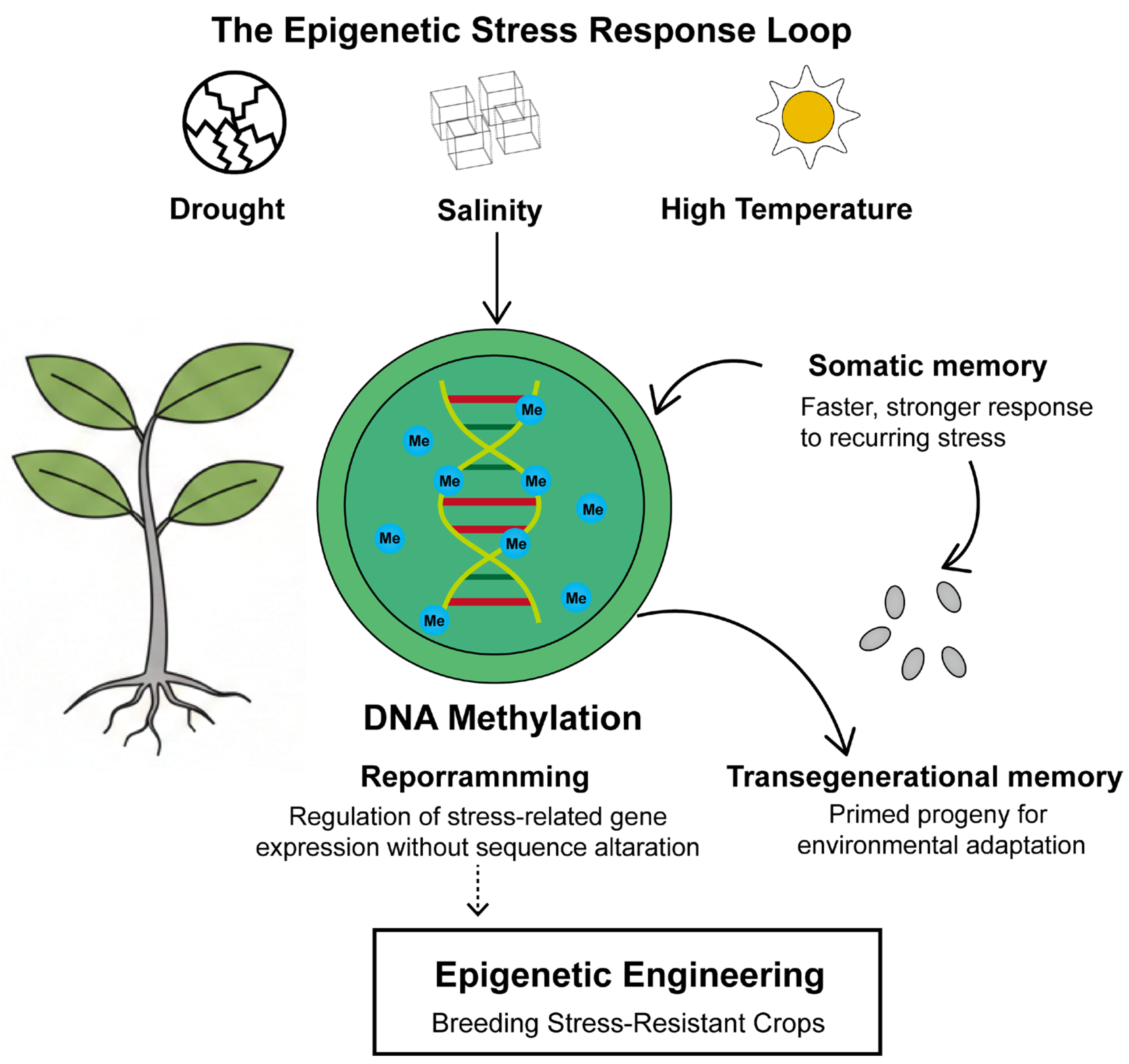
Plants are constantly challenged by abiotic stresses such as drought, salinity, and extreme temperatures, which are major drivers of global crop yield losses and threaten food security [1,2,3,4]. To cope with these environmental fluctuations, plants have evolved sophisticated adaptive strategies, among which epigenetic regulation—particularly DNA methylation—has emerged as a central mechanism [5,6]. As a stable yet dynamic epigenetic mark, DNA methylation regulates gene expression without altering the DNA sequence, enabling rapid and reversible responses to stress [7]. For example, drought memory genes in Arabidopsis thaliana remain poised during recovery [8]. Transgenerational memory transmits stress information to offspring, enhancing their adaptability [9]. Various abiotic stresses have been shown to induce genome-wide reprogramming of DNA methylation patterns, thereby modulating the expression of stress-responsive genes and contributing to plant tolerance [10,11,12]. Therefore, systematically elucidating the mechanisms of DNA methylation in plant abiotic stress responses not only deepens our understanding of plant environmental adaptation from an epigenetic perspective but also provides a theoretical foundation for developing stress-resistant crop varieties through epigenetic engineering and breeding strategies (Figure 1).
This figure outlines the central role of DNA methylation in plant abiotic stress responses, encompassing stress signal perception, dynamic methylation changes (establishment, maintenance, removal), gene expression reprogramming, stress memory formation, and breeding applications.

2. The Dynamic Regulatory System of Plant DNA Methylation

2.1. Establishment, Maintenance, and Removal of Plant DNA Methylation

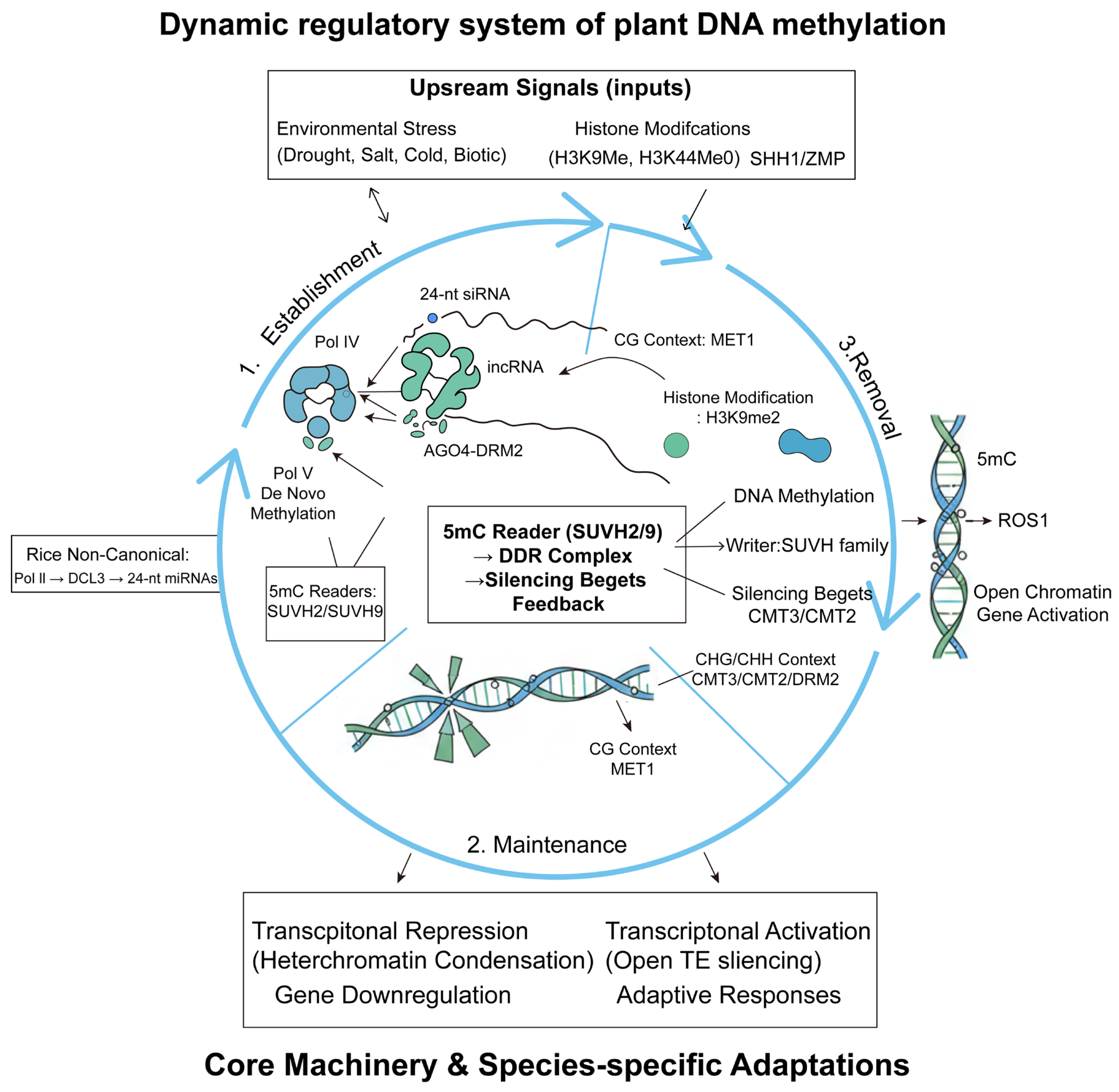
Plant DNA methylation is a highly complex and dynamically regulated epigenetic process, exhibiting both conservation and specificity across different plant lineages [13,14]. Its establishment primarily relies on the RNA-directed DNA methylation pathway, which utilizes plant-specific RNA Polymerase IV to produce 24-nt siRNAs and Pol V to generate scaffold lncRNAs, thereby recruiting the AGO4-DRM2 complex for de novo methylation [15,16]. In cereal crops, the RdDM pathway shows species-specific variations. For instance, in rice, besides the canonical pathway, a non-canonical pathway exists where Pol II transcripts are processed by DCL3 into 24-nt miRNAs to guide methylation [17]. In maize, the loss of Pol IV leads to the upregulation of genes with nearby transposable elements, highlighting RdDM’s core role in maintaining chromatin boundaries. Meanwhile, a Pol II–RDR6-dependent pathway can partially compensate for TE silencing upon Pol IV loss, and the RdDM pathway is closely linked to subgenome dominance [18] DNA methylation maintenance differs by sequence context. At CG sites, it is primarily maintained by MET1 homologs post-replication [19]. At non-CG sites, a reinforcing loop exists between DNA methylation and histone H3K9 methylation in Arabidopsis: CMT3 and CMT2 mediate CHG and CHH maintenance in long TEs, respectively, while RdDM mainly maintains CHH at short TEs and TE edges [20]. This feedback mechanism is conserved but specialized in cereals. For example, maize MET2 prefers linker DNA [21,22], and the chromatin remodeler DDM1 facilitates maintenance by promoting DNA accessibility in heterochromatin [23,24].
DNA demethylation is primarily mediated by ROS1 family DNA glycosylases, which excise 5mC and initiate base excision repair to prevent aberrant methylation spread [25,26]. In rice, OsROS1 also participates in erasing methylation at specific gene regions. This process coordinates with histone acetylation and chromatin remodeling. In summary, the core machinery of plant DNA methylation is conserved but exhibits species-specific adaptations, which likely contribute to differential environmental adaptation.

2.2. Regulatory Logic: Signal Input, Dynamic Properties, and the Reader–Writer Network

2.2.1. Molecular Basis of Dynamicity and Memory

The “dynamicity” and “memorability” of plant DNA methylation stem from the interplay of three key processes: de novo establishment writes new information, post-replicative maintenance ensures inheritance during cell division, and active removal allows erasure and correction [27]. The symmetry of CG and CHG sequences enables the precise restoration of their methylation states using the parental strand as a template, enabling short-term somatic memory. More profoundly, in heterochromatin, a self-reinforcing positive feedback loop exists between DNA methylation and histone H3K9 methylation: DNA methylation is recognized by SUVH family “readers” that guide new H3K9me deposition [28,29], while H3K9me is specifically recognized by the chromodomains of methyltransferases like CMT2/3, recruiting them to maintain or reinforce DNA methylation [21]. The10refore, this self-reinforcing cycle not only stabilizes gene silencing but also establishes a form of long-term epigenetic memory that can be transmitted across cell generations.

2.2.2. Upstream Signal Input and Targeting

The plant DNA methylation system achieves spatiotemporal specificity and self-maintenance through the precise decoding of upstream molecular signals, with core inputs originating from endogenous chromatin environments and system products. As crucial developmental signals, specific histone modification patterns directly regulate the activation of RNA-directed DNA methylation pathways. For instance, the SHH1 protein functions as an integration factor whose SAWADEE domain simultaneously recognizes histone H3 lysine 9 methylation and lysine 4 non-methylation states, thereby guiding RNA polymerase IV complexes to heterochromatic regions to establish site-specific de novo methylation [30,31]. Concurrent studies show that proteins such as ZMP perform analogous regulatory functions in specific genomic regions by recognizing H3K4me0 modifications, further enriching the chromatin state-based targeting network [32].
Notably, DNA methylation modifications themselves constitute self-reinforcing signaling circuits. SUVH2 and SUVH9, as methylated cytosine recognition proteins, specifically bind methylated DNA via their SRA domains, subsequently recruiting the DDR chromatin remodeling complex composed of DRD1, DMS3, and RDM1 to target RNA polymerase V for transposon silencing [33]. This “silencing begets deeper silencing” positive feedback mechanism enhances heterochromatin stability and environmental resilience. Research demonstrates that DNA methylation dynamically responds to various environmental stresses. Under biotic stress, pathogen infection induces hypomethylation in specific host genomic regions, regulating defense gene expression [34,35,36]. Abiotic stresses similarly trigger methylome reprogramming: salt stress alters methylation states of LCR and TPS4 genes in Brassica napus [37]; drought induces hypomethylation in the Asr2 gene promoter in tomato [38]; cold stress modifies CHH-context methylation patterns in Arabidopsis [39,40,41]; heavy metal stress regulates DNA methylation states in ferns and algae [42,43]; and light dynamics optimize photosynthetic function through methylation remodeling in transposable element regions [44]. Stress signals drive specific epigenome reprogramming by modulating the activities of methyltransferases (MET1, DRM2) and demethylases (ROS1, DME) [45]. This dynamic regulatory mechanism enables plants to develop highly specific epigenetic response strategies tailored to distinct stress characteristics. For example, methylation remodeling induced by drought versus salt stress exhibits significant differences in target gene selection, physiological pathway regulation, and hormonal network interactions, reflecting the precision and plasticity of plant environmental adaptation.

2.2.3. From Epigenetic Modification to Functional Output: The Regulatory Loop

Through upstream signal integration and the operation of the internal “reader–writer” network, changes in DNA methylation are ultimately translated into stable biological outputs. Whether through newly established methylation via RdDM [46,47,48,49] or structural changes triggered by methylation “readers” (e.g., SUVH2/9) recruiting chromatin remodeling complexes (e.g., DDR) [50,51,52], the common outcome is the shaping of the local chromatin environment. High levels of DNA methylation, particularly in coordination with repressive histone marks such as H3K9me2, lead to chromatin condensation into transcriptionally inaccessible heterochromatin. This state stably suppresses transposable element activity, safeguarding genome integrity [53,54]. When such modifications occur in promoter or enhancer regions, they impede transcription factor binding and result in the downregulation of associated genes [55].
Conversely, active demethylation mediated by ROS1 removes repressive marks and drives chromatin toward an active state. ROS1 functions as a bifunctional DNA glycosylase/lyase that directly excises 5mC and restores unmethylated status through base excision repair, a process potentially coordinated with downstream repair enzymes (e.g., APE1L, ZDP) to promote local chromatin opening [56,57,58]. The loci of core transcriptional activators often maintain an open chromatin state, providing space for regulator binding—a basis for rapid and tunable gene expression [59].
Collectively, the studies reviewed here demonstrate that the dynamic DNA methylation system—comprising establishment (RdDM), maintenance (MET1/CMT), and removal (ROS1)—provides a versatile molecular basis for plants to perceive, integrate, and memorize environmental signals. This epigenetic programmability allows for stress-specific reprogramming of the methylome, which in turn drives adaptive transcriptional responses. Therefore, harnessing this system—through targeting key regulators like DRM2, CMTs, or ROS1—represents a promising epigenetic engineering strategy for developing crop varieties with enhanced resilience to diverse abiotic stresses. Future research should focus on decoding how specific stress signals (e.g., drought, salinity, temperature) are transduced into precise methylation remodeling instructions to enable predictive and precise manipulation for breeding (Figure 2).
This figure illustrates the core regulatory mechanisms of plant DNA methylation: RdDM-mediated establishment, MET1/CMT-catalyzed maintenance, and ROS1-mediated active demethylation, along with the regulatory logic of upstream signal input and chromatin state output.

3. The Role of DNA Methylation in Various Abiotic Stresses

3.1. Drought Stress

DNA methylation serves as a core epigenetic mechanism in plant responses to drought stress. Drought signals trigger epigenomic reprogramming, establishing new methylation marks at specific gene loci via the RdDM pathway [60,61,62]. Subsequently, methylation in different sequence contexts is maintained by specialized enzymatic systems: MET1 maintains CG methylation, CMT3 collaborates with SUVH4 to sustain CHG methylation, while CMT2 and ongoing RdDM activity are responsible for CHH site maintenance [63]. Similar mechanisms are observed in other species: decreased global 5-mC content in Arabidopsis is linked to the DCL2/DCL3 pathway [64]; reduced genome-wide methylation in Populus tomentosa correlates with an altered expression of genes like GATA9, promoting ABA and osmolyte accumulation [65]; and differential methylation in the ZmEXP2 gene promoter influences root architecture in maize [66]. These changes coordinately regulate multiple physiological processes including ABA signaling, ROS scavenging, osmotic balance, and root development, enhancing plant drought tolerance. Importantly, some drought-induced methylation variants can be stably inherited, forming transgenerational stress memory that confers stronger adaptive capacity in progeny [67].

3.2. Salt Stress

Salt stress induces tissue-specific methylation changes in rice, with significant hypomethylation in roots and more subtle alterations in leaves [68]. This response exhibits cultivar specificity: salt-tolerant genotypes (e.g., Nonabokra) often display hypermethylation, whereas sensitive ones (e.g., IR64) show demethylation [69]. Molecularly, RdDM pathway components such as RDM16 modulate DNA methylation by affecting Pol V transcript levels, thereby enhancing salt tolerance [70]. Methylation status directly influences the expression of salt tolerance-related genes; for instance, the OsBZ8 locus is hypomethylated and highly expressed in the tolerant Nonabokra cultivar [71]. These methylation variations likely help maintain ion homeostasis by regulating the expression of Na+ transporters (e.g., OsHKT1;5) and ABA signaling pathway genes, offering potential targets for breeding salt-tolerant varieties.

3.3. Temperature Stress (Cold/Heat)

Under both high- and low-temperature stress, DNA methylation, as a dynamic and reversible epigenetic modification, plays a crucial role in plant stress response and memory. This system responds to temperature signals, achieving stress-specific methylation remodeling, which in turn regulates gene expression and crop adaptability. Cold stress widely induces DNA methylation changes involved in cold acclimation. In Populus simonii and Chorispora bungeana, cold stress-induced DNA methylation alterations at specific gene loci are directly related to enhanced freezing tolerance [72,73]. In Arabidopsis, DNA methylation cooperates with histone modifications to regulate cold responses. For instance, the histone deacetylase HDA6 plays a key role in cold acclimation by modifying chromatin states [74]. Genome-wide studies confirm that cold-induced changes in chromatin accessibility are closely associated with dynamic alterations of histone marks (e.g., H3K4me3 and H3K27me3) at cold-responsive genes [75]. In rice, cold stress similarly triggers dynamic methylation responses. Altered methylation status in the OST1 gene promoter of cold-tolerant cultivars mediates the ICE-CBF-COR cold signaling pathway, activating cold-resistant gene expression. Genome-wide analysis also identified 51 genes whose methylation and expression levels change synchronously in cold-tolerant varieties [76].
Heat stress also activates dynamic methylation responses. In Arabidopsis, heat can trigger active demethylation at regulatory regions of heat shock genes (e.g., HSPs), promoting their expression [77]. Rice studies show that heat stress alters the methylation status of genes related to heat shock proteins and antioxidant enzymes, affecting their transcriptional plasticity [78]. Significant DNA methylation differences exist between heat-tolerant and heat-sensitive wheat genotypes, directly correlating with thermotolerance [79]. The RdDM pathway is essential for maintaining basal thermotolerance [80]. Furthermore, heat stress activates retrotransposons (e.g., ONSEN in Arabidopsis), whose transcription is regulated by the methylation status of HSEs in their promoters. This activation can be maintained in progeny of siRNA biogenesis-deficient mutants, demonstrating the transgenerational potential of heat stress epigenetic memory [81,82]. Regarding rice responses to high temperature, research shows that the expression of the heat-sensitive gene OsFIE1 is temperature-regulated, involving changes in both DNA methylation and histone H3K9me2 modifications. Heat also causes the disruption of CHH methylation patterns in anthers, and inhibition of DNA methylation can lead to pollen sterility in heat-sensitive varieties [83]. These findings indicate that temperature stress regulates crop stress tolerance by altering the methylation status of key genes. The DNA methylation system can decode different temperature signals to achieve specific epigenetic remodeling. This dynamic and heritable mechanism serves as a core molecular foundation for plants to build stress memory and rapidly adapt to environmental changes.

3.4. Carbon Stress

The rising atmospheric CO2 concentration has established elevated CO2 as a significant abiotic stress factor affecting plant growth and development [84]. Similar to traditional stresses like drought and heat, high CO2 can trigger not only immediate physiological responses but also potentially induce transgenerationally heritable “stress memory” [85,86]. In plants, DNA methylation serves as a core molecular carrier of this epigenetic memory, playing a pivotal role in responding to the stress signal and in the establishment and maintenance of memory marks [87,88]. Recent research reveals that plant transgenerational epigenetic adaptation to high CO2 follows a precise two-step cooperative regulatory model. Firstly, the establishment of high CO2-induced DNA methylation marks is primarily driven by the RdDM pathway. Studies in Arabidopsis show that exposure to high CO2 induces widespread hypermethylation across the genome simultaneously in CG, CHG, and CHH sequence contexts, a pattern characteristic of the RdDM pathway. Genetic experiments confirm that this DNA hypermethylation response is completely abolished in mutants lacking core RdDM components (e.g., pol IV mutants). This directly proves that RdDM acts as the critical bridge linking the high CO2 stress signal to the establishment of DNA methylation marks [89]. Secondly, the transgenerational inheritance of newly established methylation marks by RdDM requires the function of maintenance methyltransferases CMT2 and CMT3. Observations in Arabidopsis CMT2/CMT3 double mutants show that, although stressed parental plants can still generate a partial (albeit weakened) increase in methylation via RdDM, these newly established marks fail to transmit to the progeny. Concurrently, the progeny lose the transgenerational accelerated growth phenotype. This result clearly indicates that CMT2 and CMT3, as key “maintainers,” are essential for converting the initial “written” stress memory by RdDM into a heritable long-term memory [90]. It is worth noting that epigenetic regulation triggered by exogenous carbon nanomaterials (e.g., Carbon Dots, CDs), also related to “carbon,” follows a similar molecular logic. In rice, CDs treatment similarly induces genome-wide DNA hypermethylation (particularly in CHG/CHH contexts), accompanied by the upregulated expression of maintenance methyltransferase genes like OsCMT1 and OsCMT2 [91]. This further corroborates the central executor role of CMT family enzymes in integrating carbon-related environmental signals and remodeling the DNA methylation landscape.

3.5. Nutrient Stress

3.5.1. Nitrogen Stress

Nitrogen stress affects plant growth via epigenetic mechanisms. In Arabidopsis, low-nitrogen treatment influences methylation at eight SNP sites on chromosome 1 related to shoot growth, affecting the identified gene regions. The participation of key RdDM components like RDR2 is associated with biomass accumulation under low nitrogen [92]. In rice, low nitrogen upregulates methyltransferase genes (e.g., MET1, DRM1, DRM2), leading to altered genome-wide methylation patterns that are heritable and enhance low-nitrogen tolerance in offspring [93]. Chronic (one-generation) exposure to low-nitrogen stress in rice induces alterations in DNA methylation patterns, with approximately 50% of these changes being heritable to non-stressed progeny [89]. The process of transgenesis and tissue culture also induces DNA methylation changes in progeny rice, as observed in lines carrying OsNAR2.1-related constructs [94]. Reduced nitrogen content in parental seeds also causes DNA methylation changes in progeny rice [95]. Cytosine methylation changes around transposable elements under natural nitrogen stress are significantly higher than in other genomic regions, suggesting TEs are sensitive targets in nutrient stress response [96].

3.5.2. Phosphorus Stress

Phosphorus starvation leads to genome-wide methylation alterations. In Arabidopsis, 20% and 86% of differentially methylated regions in shoots and roots, respectively, are hypermethylated, closely correlating with the expression patterns of phosphorus stress-responsive genes [97]. The deubiquitinase OTU5 is crucial for establishing DNA methylation patterns under phosphorus stress [98]. In tomato, phosphorus stress increases overall methylation levels, with differentially methylated sites highly correlated with TE distribution [99]. In Populus trichocarpa, differential methylation associates with locus-dependent microRNAs [100]. In soybean, low-phosphorus-induced CHH methylation changes are particularly prominent in TE regions and are precisely guided by siRNAs [101]. In rice, phosphate starvation-induced methylation changes preferentially occur in TE regions; in the absence of DCL3a, these TEs become hypermethylated to suppress their transcription [102].

3.5.3. Trace Element Stress

Maize experiences an extensive loss of DNA methylation, primarily in TE regions, alongside the suppressed activity of maintenance methyltransferases and a sharp decrease in small RNAs associated with DNA methylation [103]. Under iron deficiency, rice exhibits widespread hypermethylation, especially in CHH contexts. The transcriptional abundance of iron deficiency-induced genes positively correlates with 24nt siRNA abundance, suggesting siRNA-guided methylation may participate in iron homeostasis regulation [104]. In barley, iron deficiency causes differential methylation in 11 DNA bands, and the methylation/demethylation pattern upon iron resupply closely resembles that under continuous deficiency, indicating the potential heritability of this modification [105]. Using MSAP analysis, researchers found that silicon treatment alters both total methylation levels and the patterns of hemimethylation versus symmetric methylation in a zinc concentration-dependent manner. These findings suggest that silicon can reshape the plant’s epigenomic landscape, thereby influencing molecular stress responses and potentially contributing to the establishment of “epigenetic memory” for enhanced heavy metal tolerance [106]. A similar pattern emerged under salt stress, where barley plants also exhibited significant changes in DNA methylation levels following exogenous silicon application. MSAP analysis showed that foliar sprays of moderate (0.1%) and high (0.2%) silicon concentrations markedly reduced total methylation compared to plants treated with NaCl alone, accompanied by distinct shifts in hemimethylation and symmetric methylation. This epigenetic response aligned with improved physiological traits—such as higher chlorophyll content, gas exchange, and chlorophyll fluorescence—suggesting that silicon may enhance salt tolerance through DNA demethylation and the activation of stress-related genes, potentially laying the groundwork for “epigenetic memory” [107]. Iron stress can induce DNA methylation changes in plants, with this epigenetic regulation documented across multiple species. In rice, iron deficiency leads to accumulation of CHH methylation in both roots and shoots, with hypermethylation occurring at the promoter regions of key iron homeostasis regulators OsIRO2 and OsbHLH159, thereby affecting their expression; treatment with methyltransferase inhibitors represses genes involved in the iron signaling pathway, and rice mutants with reduced CHH methylation levels exhibit growth inhibition under iron-deficient conditions, indicating that DNA methylation plays a crucial role in rice adaptation to iron stress [108]. In Arabidopsis, cadmium exposure induces DNA methylation changes in roots, and the inhibition of DNA demethylation enhances plant tolerance to cadmium toxicity, an effect associated with improved iron nutrition, revealing an additional link between iron homeostasis regulation and epigenetic modifications under heavy metal stress [104]. Furthermore, in barley, iron deficiency leads to a general reduction in CG methylation, and the methylation/demethylation pattern upon iron resupply closely resembles that under continuous deficiency, indicating the potential heritability of this modification [109]. In Arabidopsis, SKB1-mediated histone H4R3 symmetric dimethylation negatively regulates the expression of Ib subgroup bHLH genes, thereby participating in the maintenance of iron homeostasis, further expanding our understanding of the mechanisms underlying epigenetic regulation of iron homeostasis [105].

3.6. Light Stress

Light stress, particularly dynamic fluctuations in light intensity, is an important environmental signal influencing plant DNA methylation. Variations in light can trigger epigenetic reprogramming by inducing reactive oxygen species (ROS) production, triggering chloroplast signals, and regulating small RNA expression. Tobacco mutants overproducing H2O2 exhibit genome-wide DNA hypomethylation [110], and loss of the chloroplast signal protein MSH1 also causes genome-wide methylation reprogramming [111]. Small RNAs induced by high light can influence methylation patterns via the RdDM pathway [112]. Notably, in Arabidopsis, short-term repetitive excess light stress did not induce significant methylation changes, with only a small number of stress-related differentially methylated regions observed [113], indicating that short-term, minor light fluctuations have a limited overall impact on methylation. Different light qualities (e.g., white, blue, red light, and darkness) can induce specific changes in genomic DNA methylation. In tomato 7B-1 male-sterile mutants and their wild type, the methylation status of various functional genes changes differentially under different light qualities, and these alterations are more pronounced in mutants defective in light signaling pathways [114]. Methylation levels under darkness and red light are generally higher than under white and blue light, suggesting that light quality may finely tune gene expression through differential methylation mechanisms.
Recent research indicates that light fluctuation patterns are a primary driver of DNA methylation reprogramming. The induced differentially methylated regions are significantly enriched in transposable elements (especially retrotransposons) and regulate physiological adaptation by affecting the expression networks of neighboring genes. Functional validation shows that the loss of CG methylation specifically enhances photosynthetic efficiency under fluctuating light, and the key gene MCCA, regulated by light patterns, is involved in energy partitioning within the photosynthetic apparatus. This establishes a complete regulatory chain: “light dynamic signal–TE methylation remodeling–neighboring gene regulation–photosynthetic physiological adaptation.”

3.7. Ozone Stress

Recent research has significantly advanced our understanding of how elevated tropospheric ozone (O3) impacts plant systems, particularly through epigenetic modifications. As a potent phytotoxic pollutant, O3 induces oxidative stress by generating ROS upon entering plant tissues through stomata, leading to cellular damage, reduced photosynthetic efficiency, and ultimately compromised growth and yield [115,116]. For instance, studies on wheat cultivars have demonstrated that elevated O3 increases stomatal flux and the accumulation of superoxide radicals (O2) and hydrogen peroxide (H2O2), resulting in significant lipid peroxidation [116]. Rice (Oryza sativa L.), a critical global food crop, demonstrates high sensitivity to O3 exposure, with studies in East Asia indicating potential yield losses exceeding 40% under polluted conditions, posing substantial risks to agricultural productivity and food security. In response to such environmental challenges, plants deploy complex adaptive strategies where epigenetic regulation, especially dynamic DNA methylation changes, plays a fundamental role in modulating gene expression and phenotypic plasticity without altering the primary DNA sequence [117,118]. Investigations into the epigenetic dimensions of O3 stress have revealed concentration-dependent effects on both physiological traits and molecular patterns in rice. Experimental studies utilizing open-top chamber systems to simulate different O3 levels (80, 160, and 200 nmol·mol−1) showed that lower concentrations (80 nmol·mol−1) could transiently promote certain agronomic parameters such as flag leaf length and panicle length, whereas higher concentrations (160 and 200 nmol·mol−1) consistently caused visible leaf injury, including chlorosis and necrotic lesions, alongside the significant suppression of growth metrics like hundred-grain weight [119]. At the molecular level, methylation-sensitive amplified polymorphism analyses conducted across these treatments detected rapid and widespread alterations in genomic DNA methylation, affecting approximately 15% of the assayed sites within days of exposure. Notably, the overall methylation landscape shifted towards reduced methylation levels (demethylation) over a 30-day exposure period, with these changes being more pronounced at higher O3 concentrations. Sequence context analysis further indicated that CNG sites (specifically CHG methylation) were predominant hotspots for these stress-induced methylation variations, corroborating earlier observations that such genomic contexts are particularly labile under abiotic stress conditions [120]. The functional implications of these epigenetic alterations were explored by isolating and sequencing differentially methylated DNA fragments. Among 153 cloned sequences showing methylation polymorphism, nine demonstrated high homology to known rice genes, eight of which were in a demethylated state under O3 stress. This bias towards demethylation suggests the potential for the transcriptional activation of associated genes. The annotated functions of these sequences point to a coordinated stress response network: genes like purple acid phosphatase and L-isoaspartate methyltransferase are involved in ROS detoxification and the repair of oxidative damage to proteins; phosphoenolpyruvate carboxylase plays roles in carbon metabolism and stomatal regulation; zinc finger proteins and KH-domain-containing proteins are often implicated in transcriptional regulation and RNA metabolism; and even transposon-related sequences showed altered methylation, hinting at possible genome-wide destabilization or adaptive mobilization under severe stress. This pattern indicates that O3 stress triggers not just random epigenetic noise but a directed, albeit complex, reprogramming likely aimed at activating defense pathways, enhancing metabolite synthesis for osmotic adjustment, and potentially repairing oxidative damage.
This body of work establishes DNA methylation as a dynamic and responsive layer of regulation in rice confronting O3 pollution. The observed demethylation, particularly at specific functional loci, may facilitate the expression of a suite of adaptive genes, thereby modulating the plant’s physiological response to oxidative stress. These findings significantly enrich the molecular narrative of plant-O3 interactions, moving beyond descriptive toxicology to reveal active epigenetic adaptation mechanisms. They provide a crucial conceptual framework and candidate gene targets for future research aimed at unraveling the precise signaling pathways linking O3 perception to epigenetic remodeling.

3.8. Heavy Metal Stress

Heavy metal stress (particularly cadmium, Cd) induces significant DNA methylation changes in rice. Cd stress leads to the detection of numerous differentially methylated regions (DMRs) genome-wide, with over 2320 non-redundant DMRs identified, and hypermethylated genes constituting a higher proportion [121]. These methylation changes are closely linked to the expression of heavy metal transporter genes. For example, the transcribed region of the metal detoxification transporter gene OsZIP1 is demethylated, and its overexpression reduces Cd accumulation in rice [122]. Overexpression of the heavy metal-responsive protein OsHMP also involves altered DNA methylation status, enhancing rice growth under Cd stress [123]. Notably, some heavy metal stress-induced methylation variants can be inherited across generations, forming epigenetic memory. For instance, the methylation status of the heavy metal transporter-related retrotransposon Tos17 remains stable over multiple generations [124]. This heritable methylation modification provides an epigenetic basis for long-term adaptation to heavy metal-contaminated environments.
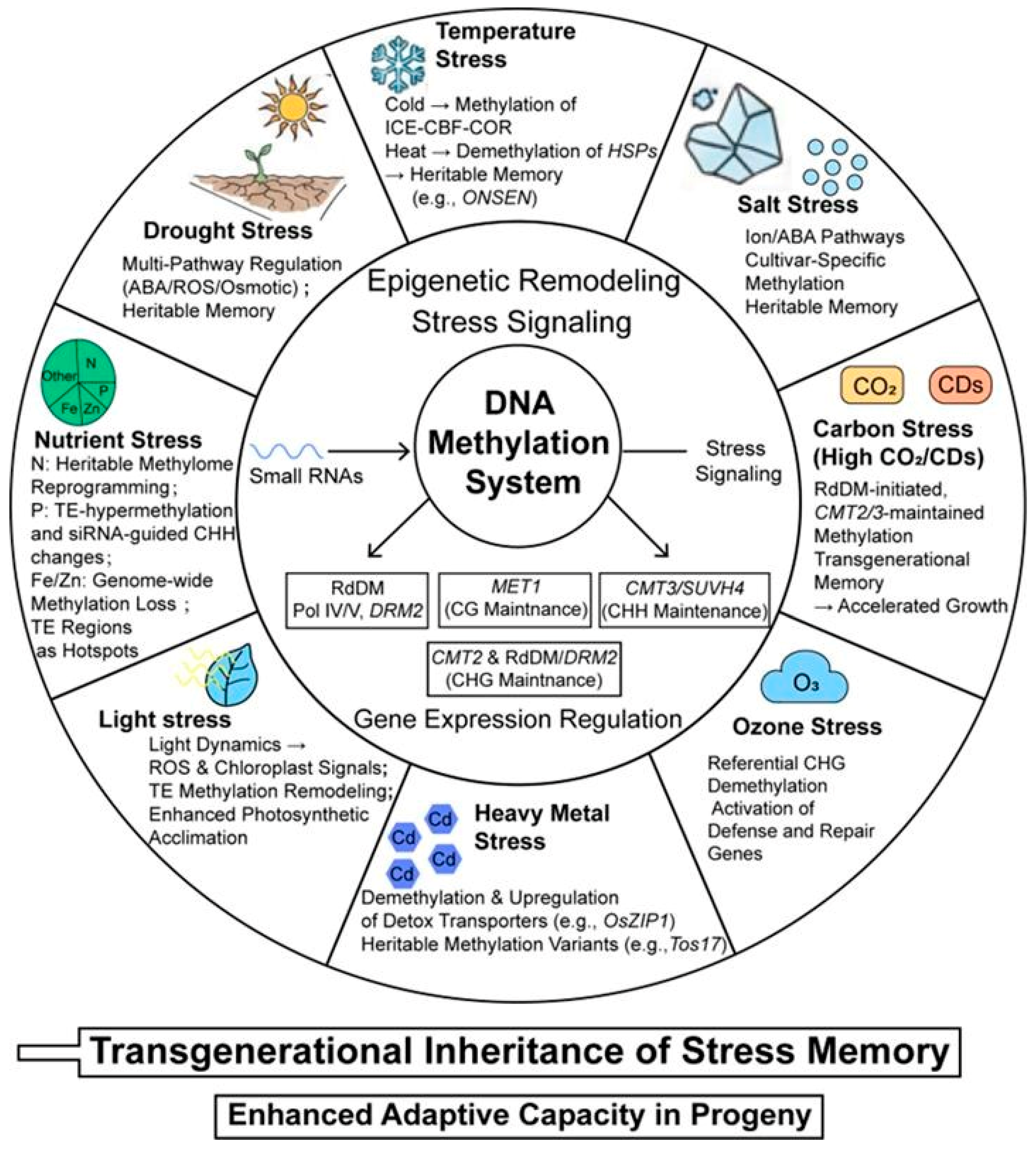
In summary, DNA methylation serves as a universal yet highly plastic epigenetic interface through which plants perceive and adapt to a wide spectrum of abiotic stresses. The case studies from drought to heavy metal exposure demonstrate a common theme: stress signals are transduced into specific methylation patterns—often involving the RdDM pathway for establishment and CMTs for maintenance—that fine-tune the expression of key adaptive genes. Crucially, this reprogramming is not merely a transient response; it can be somatically memorized and, in many instances, transmitted across generations, thereby providing progeny with a heritable “priming” advantage. The collective evidence underscores that the DNA methylation system functions as a central decoder of environmental cues, enabling plants to implement precise, stress-tailored epigenetic strategies for survival and productivity (Figure 3).
This figure summarizes DNA methylation changes induced by eight abiotic stress types (drought, salinity, temperature, carbon, nutrient, light, ozone, and heavy metal stress), and their roles in establishing somatic and transgenerational memory.

4. Crop DNA Methylation Detection Technology Systems: Principles, Selection, and Integration Strategies

The accuracy and applicability of DNA methylation detection technologies are pivotal for translating epigenetic research into practical breeding applications. Based on throughput and target scope, existing techniques can be broadly classified into two main categories: targeted validation and panoramic scanning. The selection of an appropriate method hinges on balancing specific research objectives (e.g., candidate gene validation, epigenome mapping, or screening for population epigenetic variation) with the inherent characteristics of the technologies, including genomic coverage, base resolution, throughput, and cost [125].

4.1. Targeted Validation Technologies: High-Resolution Precision Guidance

These technologies are designed for analyzing the methylation status of specific genes or genomic loci, forming the foundation for functional validation studies. Their core principle predominantly relies on bisulfite conversion, a process that selectively deaminates unmethylated cytosines (C) to uracils (U, read as thymine, T, during sequencing) while leaving 5-methylcytosine (5mC) intact, thereby enabling the specific identification of methylated sites [126]. Bisulfite Sequencing PCR, based on this principle, is a commonly used method for validating dynamic methylation changes in key genes (e.g., stress-responsive genes) in crops like rice, owing to its technical maturity, relatively low cost, and reliability [127,128,129]. To circumvent potential issues associated with bisulfite treatment, such as DNA degradation, Methylation-Sensitive Restriction Enzyme analysis (e.g., MSRE-PCR) employs isoschizomers with differing sensitivity to methylation for DNA digestion, followed by PCR for rapid qualitative screening, making it suitable for the preliminary screening of large sample sets [130]. Furthermore, Methylation-Sensitive Amplification Polymorphism technology, based on the amplified fragment length polymorphism principle, allows semi-quantitative detection by exploiting differential enzyme sensitivity and was widely applied in early plant epigenetic research [131,132]. With the growing understanding of the functional roles of oxidized modifications like 5-hydroxymethylcytosine (5hmC), derivative techniques such as Oxidative Bisulfite Sequencing (oxBS-seq) and TET-Assisted Bisulfite Sequencing (TAB-seq) have been developed. These methods can specifically discriminate between 5mC and 5hmC, facilitating the study of more complex epigenetic dynamics [133,134]. Newer bisulfite-free techniques, including TET-Assisted Pyridine Borane Sequencing (TAPS) and Enzymatic Methyl Sequencing (EM-seq), replace chemical conversion with enzymatic reactions, minimizing DNA damage and improving both detection fidelity and the efficient use of DNA input [135,136]. The shared advantages of these targeted approaches are high resolution, strong specificity, and relatively straightforward data analysis. Their primary limitation lies in their restricted coverage, categorizing them as “hypothesis-driven” research tools that are less adept at discovering novel, unanticipated regulatory sites.

4.2. Panoramic Scanning Technologies: Genome-Wide Methylation Mapping

In contrast to targeted methods, panoramic scanning technologies aim to unbiasedly profile DNA methylation across the entire genome, which is crucial for discovering novel regulatory regions and constructing global epigenetic networks. Whole-Genome Bisulfite Sequencing (WGBS), capable of providing single-base resolution methylation information with near-complete genome coverage, is considered the “gold standard” for methylation analysis. It has been successfully employed to investigate tissue-specific methylation patterns in rice and epigenetic variations associated with domestication [137,138]. However, its high cost, complex bioinformatics analysis requirements, and the need for high DNA input pose limitations for its large-scale application in certain studies [139]. Reduced Representation Bisulfite Sequencing (RRBS) selectively enriches genomic regions rich in CpG dinucleotides and functionally relevant for gene regulation (e.g., CpG islands) using restriction enzymes (e.g., MspI), followed by bisulfite treatment and sequencing. This approach offers an efficient and cost-effective strategy for assessing methylation in key regulatory regions, making it suitable for population-level epigenome-wide association studies [140]. Another strategy is based on affinity enrichment. Techniques like Methylated DNA Immunoprecipitation Sequencing (MeDIP-seq) and its derivatives (e.g., Methyl-Capture Sequencing, MCS) utilize specific antibodies against 5mC or Methyl-CpG Binding Domain (MBD) proteins to capture methylated DNA fragments for subsequent sequencing [141,142]. The advantages of these methods include lower cost and reduced DNA input requirements. However, their spatial resolution is limited (typically in the range of 100–500 bp), rendering them more suitable for the rapid genome-wide identification and comparison of large differentially methylated regions [143].

4.3. Technology Integration Strategies and Future Perspectives

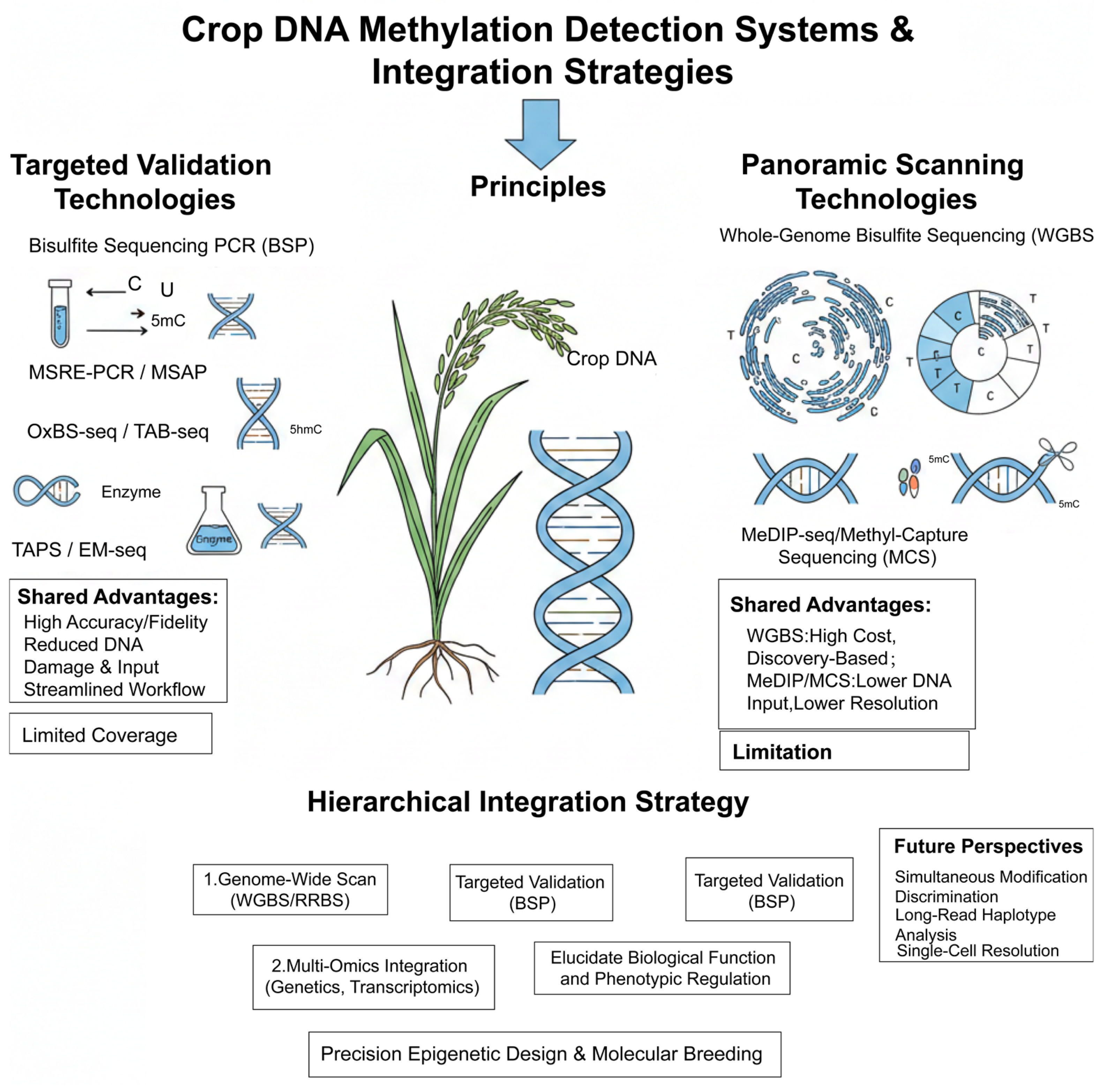
Currently, no single technology perfectly balances the demands of high coverage, high resolution, and low cost. Consequently, a hierarchical integration strategy has become a mainstream paradigm in crop epigenetics, particularly for dissecting complex agronomic traits in species like rice. A typical workflow involves: first, conducting a genome-wide scan using WGBS or RRBS to identify trait-associated Differentially Methylated Regions (DMRs); second, employing targeted techniques like BSP for the fine validation and quantitative analysis of candidate DMRs; and, finally, integrating multi-omics data (e.g., genetics, transcriptomics) to systematically elucidate the biological function and phenotypic regulatory mechanisms of these methylation changes [144,145,146]. This “discovery–validation–mechanistic elucidation” closed-loop research model has significantly advanced our understanding of the epigenetic regulation underlying complex traits such as crop development and stress resistance. Future advancements in detection technology will likely focus on several key areas: first, developing sequencing methods capable of simultaneously and efficiently discriminating between various DNA modifications, including 5mC, 5hmC, and 5fC; second, leveraging third-generation long-read sequencing to enable methylation haplotype analysis at the single-molecule level, thereby addressing challenges in regions like repetitive sequences; third, advancing epigenomic techniques suitable for ultra-low input or even single-cell resolution to unravel precise epigenetic regulatory networks during processes involving tissue heterogeneity and dynamic development. These technological progresses will directly empower precision epigenetic design and molecular breeding in crops (Figure 4).
This figure presents the features of targeted validation technologies (BSP, MSAP, etc.) and panoramic scanning technologies (WGBS, RRBS, etc.), along with the “discovery–validation–mechanistic elucidation” closed-loop research strategy.

5. Applications of DNA Methylation in Plant Breeding

5.1. Breeding Resistant Cultivars Using Stress-Induced Heritable Epialleles

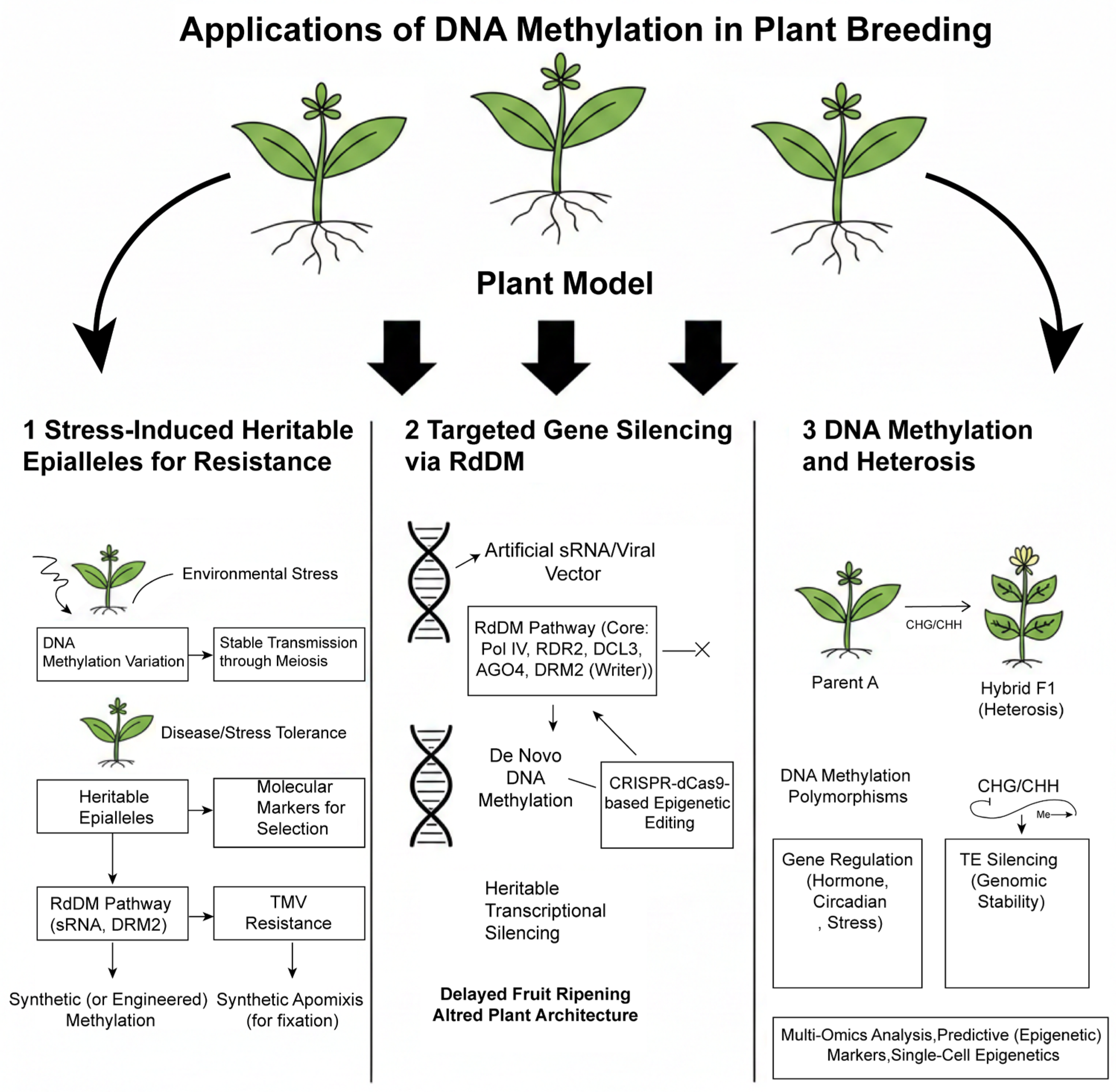
Environmental stresses can induce DNA methylation variations that are stably transmitted through meiosis, forming “epialleles,” which provide novel genetic resources for resistance breeding. Representative examples include, in rice, the hypomethylation state of the bacterial blight resistance gene Xa21G promoter, induced by either 5-azadeoxycytidine treatment or pathogen infection, and the conferred resistance can be stably inherited for at least nine generations [147]. Similarly, Tobacco mosaic virus (TMV) infection-induced genomic methylation changes and acquired resistance can also be transmitted to progeny [148]. These findings indicate that screening for or inducing favorable, heritable epialleles under stress conditions is an effective strategy for developing new disease-resistant and stress-tolerant varieties. Stress-induced epigenetic reprogramming often involves the RdDM pathway. This pathway can utilize stress-responsive small RNAs (sRNAs) to guide methyltransferases (e.g., DRM2) to specific genomic loci, thereby establishing or erasing DNA methylation marks [149,150]. Although many stress-induced epigenetic changes are dynamic, emerging synthetic apomixis technology offers a theoretical route to bypass meiosis and sexual recombination, enabling the direct cloning and fixation of F1 genotypes possessing desirable stress-resistant epigenetic states [151,152].

5.2. Targeted Gene Silencing Technologies Based on the RdDM Pathway and Methylation “Writers”

RdDM is a plant-specific pathway that utilizes small RNAs to guide de novo methylation at specific sequences [153]. The core enzymatic action of this pathway is carried out by methyltransferases like DOMAINS REARRANGED METHYLTRANSFERASE 2 (DRM2), which function as the “writers” of DNA methylation [154,155]. Leveraging this principle, virus-induced gene silencing (VIGS) technology has been adapted to direct the RdDM machinery to endogenous gene promoters, achieving heritable transcriptional silencing [156,157]. This provides a clear technical pathway for deliberately silencing genes detrimental to agronomic traits (e.g., genes delaying fruit ripening) through designed artificial sRNAs or viral vectors. The mechanistic details of the RdDM pathway are well elucidated, providing a foundation for more precise targeting. The core steps involve: the transcription of precursor RNA by Pol IV assisted by proteins like SHH1 and CLSY; processing by RDR2 and DCL3 into 24-nt siRNAs; the loading of siRNAs into AGO4/6/9 protein complexes for guiding to target sites; and the final recruitment of Pol V and the methyltransferase DRM2 to establish de novo methylation at the target locus [158,159]. This process is tightly coupled with chromatin remodeling; for instance, SUVH2/9 proteins recognize histone marks and cooperate with the DDR complex to recruit Pol V. These molecular insights pave the way for developing next-generation targeted silencing tools. Engineering key components of the RdDM pathway (e.g., DRM2, AGO proteins, or Pol V) holds promise for creating gene silencing systems with higher specificity and efficiency than conventional VIGS. Furthermore, given that RdDM often functions in concert with other epigenetic modifications like histone marks [160], future targeting strategies could consider simultaneous manipulation of both DNA methylation and histone modification states. This approach could achieve more stable and profound gene silencing, enabling the precise regulation of complex traits such as crop maturity, plant architecture, or secondary metabolite synthesis.

5.3. Harnessing DNA Methylation Polymorphisms to Decipher and Utilize Heterosis

Extensive DNA methylation polymorphisms exist between hybrid parents and in their hybrid offspring, and these epigenetic differences are likely implicated in heterosis (hybrid vigor). For example, methylation-sensitive amplification polymorphism (MSAP) analysis in rice hybrids and their parents revealed that hybrids exhibit significantly different methylation patterns at specific loci compared to their parents. In maize intra-species hybrids, approximately 6.59% to 11.92% of methylation sites display non-parental patterns [161]. Recent methylation analysis of soybean hybrid seeds (F0 generation) identified a large number of non-additive differentially methylated sites enriched in gene regions associated with transcriptional regulation and hormonal functions, suggesting their potential role in the early establishment of heterosis [162]. These findings indicate that whole-genome methylation profiles have potential as molecular markers for parental selection and heterosis prediction.
In-depth studies suggest that DNA methylation polymorphisms influence hybrid performance primarily through two mechanisms. First, hybridization-induced DNA methylation reprogramming can directly regulate the expression of a suite of genes associated with heterosis. In Arabidopsis and maize, methylation changes at specific sites (particularly in CHG and CHH contexts) post-hybridization are significantly correlated with trait advantages such as biomass and flowering time [163,164]. The affected genes are involved in key pathways including hormone signaling (e.g., IAA, SAUR), circadian rhythms (e.g., CCA1, OsGI), photosynthesis, and stress responses (e.g., HSP70, WRKY) [165]. Second, DNA methylation helps maintain post-hybridization genomic stability by effectively silencing transposable elements (TEs). Suppressing harmful TE activation is considered a conserved mechanism contributing to heterosis [166,167]. Therefore, integrating methylation profile analysis with multi-omics data (e.g., transcriptomics, epigenomics) enables a more systematic dissection of the complex regulatory network underlying heterosis.
Looking forward, utilizing single-cell omics technologies and CRISPR-dCas9-based epigenetic editing tools [168], will allow researchers to precisely manipulate the methylation state of candidate loci in specific cell types or developmental stages. This will directly test the role of specific methylation variations in heterosis and ultimately guide precision parental selection and cross-design based on epigenetic markers (Figure 5).
This figure outlines three major pathways for translating DNA methylation research into breeding practices: the utilization of heritable epialleles, RdDM-based targeted gene silencing, and methylation marker-assisted heterosis prediction.

6. From Mechanisms to Applications: Translating DNA Methylation Research into Breeding Strategies

As the value of epigenetics in crop breeding becomes increasingly apparent, the central challenge lies in transforming frontier discoveries into predictable and operable breeding tools. Research on DNA methylation has advanced our understanding of how plants adapt to environmental stresses, yet its applied potential remains largely untapped. At present, this translational process faces critical hurdles in three interconnected areas: mechanistic understanding, technological capacity, and breeding integration.

6.1. From Correlation to Causation: Toward a Deeper Mechanistic Understanding

Existing studies have established broad correlations between DNA methylation patterns and stress phenotypes. For instance, mCG methylation near transcription start sites shows the strongest association with gene silencing, whereas the relationship between promoter methylation and gene expression is more complex, often defying simple repression–activation models [169,170]. However, among the numerous differentially methylated regions (DMRs) identified to date, distinguishing functionally relevant sites that actively contribute to stress adaptation from those that merely accompany stress responses remains a major challenge. Moving beyond correlative descriptions toward causal mechanistic insights will require new experimental paradigms. Single-cell epigenomics, for example, offers the possibility to trace the initiation and propagation of methylation dynamics across cell lineages and developmental timelines, thereby establishing temporal and causal links between epigenetic changes, downstream gene expression, and ultimately, stress phenotypes.
How environmental signals are “translated” into specific methylation patterns also remains an open question. Do different stresses—such as drought versus salinity—activate distinct upstream signaling pathways that differentially recruit or modulate components of the RdDM pathway (e.g., Pol IV/V, DRM2) or demethylases (e.g., ROS1)? Resolving these signaling nodes will be key to understanding the regulatory origins of epigenetic plasticity. For heritable epialleles that have been documented—such as those engineered at the OsFIE1 or ACT1 loci [171]—the molecular basis of their stability across generations is still poorly understood. This involves dissecting how epigenetic marks are erased, maintained, and re-established during meiosis. Only by clarifying these fundamental mechanisms can we begin to assess the long-term reliability of epigenetically modified traits in breeding programs.

6.2. Bridging the Technological Divide: Developing and Integrating Precision Tools

Technological limitations currently constrain both basic research and breeding applications. On the detection side, existing methods struggle to strike an ideal balance between genomic coverage, single-base resolution, and cost [172,173]. While emerging technologies such as long-read sequencing offer the potential to simultaneously capture multiple modifications—including 5mC, 5hmC, and others—along with their haplotype distribution, achieving functional interpretation of these marks within their three-dimensional chromatin context will require continued methodological innovation.
On the manipulation side, CRISPR-dCas9-based epigenome editing has proven feasible, but its translation into a robust breeding tool faces multiple hurdles related to efficiency, specificity, and persistence. Editing efficiencies in plants remain relatively low, and off-target effects—along with the stability of edited states during mitosis and meiosis—are difficult to predict with current tools [174,175,176]. A further layer of complexity arises from the fact that DNA methylation often functions in concert with other epigenetic marks such as histone modifications, and existing technologies cannot easily disentangle their respective contributions in vivo [177]. Developing next-generation editors that incorporate more specific effector domains, or exploring alternative delivery systems, will be essential for achieving precise reprogramming of defined chromatin states.

6.3. Building the Application Bridge: Toward an Epigenetic-Assisted Breeding Framework

Translating basic research and technological tools into breeding practice requires a clear integration pathway. A logical first step is the development of crop epigenomic resources and knowledge bases. This involves deep epigenome sequencing of core breeding germplasm to construct public resources akin to “epigenome reference panels” [178,179]. By combining genetic linkage analysis with genome-wide association studies, it is possible to systematically identify methylation quantitative trait loci (meQTLs)—genetic loci that control variation in specific methylation patterns [180]. Such efforts can anchor epigenetic variation to genomic coordinates and pinpoint stable, heritable epigenetic markers that may contribute to agronomic traits. For instance, population-wide methylome analysis in cotton has identified millions of cis-meQTLs and numerous trait-associated epigenetic loci independent of genetic variation, demonstrating the feasibility of integrating such markers into breeding strategies [180].
Building on this foundation, multi-layered breeding interventions become conceivable. For epigenetic targets with well-defined mechanisms and pronounced phenotypic effects—such as gene loci known to be involved in cold acclimation—editing tools can be deployed for directed optimization. For complex polygenic traits, identified epigenetic markers can be used for early prediction and selection. In hybrid breeding, parent-of-origin methylation differences might serve as novel predictors of heterosis. Looking further ahead, integrating genomic, epigenomic, and transcriptomic data into systems biology models could eventually enable a network-level understanding of complex traits such as broad adaptability, paving the way for more intelligent multi-environment selection strategies.
Taken together, the systematic elucidation of the complete pathway—from epigenetic signal perception to methylation remodeling, gene network regulation, physiological adaptation, and transgenerational inheritance—provides a theoretical foundation for molecular design breeding and signals a broader transition in DNA methylation research from a descriptive discipline toward a predictive engineering science. Although significant challenges remain, including gaps in mechanistic understanding and limitations in technological precision, the applied potential of epigenetics is gradually coming into view. By integrating epigenetic marker-assisted selection with epigenome editing and other advanced tools, it may become possible to develop next-generation stress-resilient crop varieties tailored to future climate scenarios, offering new solutions for global food security [181,182,183].

Author Contributions

Conceptualization, H.H. and C.G.; methodology, Z.W.; software, Z.W.; validation, S.C.; formal analysis, C.G.; investigation, H.H.; resources, Z.W.; data curation, Z.W.; writing—original draft preparation, H.H. and C.G.; writing—review and editing, all authors; visualization, C.G.; supervision, Z.W.; project administration, S.C.; funding acquisition, Z.W. All authors have read and agreed to the published version of the manuscript.

Funding

This study was supported by the Foundation for the invigorating forestry through science and technology in Henan Province (YLK202413) and the Henan Province Science and Technology Research Project (252102110338).

Institutional Review Board Statement

Not applicable.

Informed Consent Statement

Not applicable.

Data Availability Statement

No new data were created or analyzed in this study. Data sharing is not applicable to this article.

Acknowledgments

We would like to thank Haifang Liu and Lihua Xie for their preliminary discussion and technical support in the early stages of this work.

Conflicts of Interest

The authors declare no conflicts of interest. The funders had no role in the design of the study; in the collection, analyses, or interpretation of data; in the writing of the manuscript; or in the decision to publish the results.

References

  1. Chaudhry, A.; Hassan, A.U.; Khan, S.H.; Abbasi, A.; Hina, A.; Khan, M.T.; Abdelsalam, N.R. The Changing Landscape of Agriculture: Role of Precision Breeding in Developing Smart Crops. Funct. Integr. Genom. 2023, 23, 167. [Google Scholar] [CrossRef]
  2. Ciura, J.; Kruk, J. Phytohormones as Targets for Improving Plant Productivity and Stress Tolerance. J. Plant Physiol. 2018, 229, 32–40. [Google Scholar] [CrossRef]
  3. IPCC. 2023: Climate Change 2023: Synthesis Report. Contribution of Working Groups I, II and III to the Sixth Assessment Report of the Intergovernmental Panel on Climate Change; IPCC: Geneva, Switzerland, 2023; pp. 35–115. [Google Scholar] [CrossRef]
  4. Wing, I.S.; De Cian, E.; Mistry, M.N. Global vulnerability of crop yields to climate change. J. Environ. Econ. Manag. 2021, 109, 102462. [Google Scholar] [CrossRef]
  5. Espinas, N.A.; Saze, H.; Saijo, Y. Epigenetic Control of Defense Signaling and Priming in Plants. Front. Plant Sci. 2016, 7, 1201. [Google Scholar] [CrossRef] [PubMed]
  6. Lämke, J.; Bäurle, I. Epigenetic and Chromatin-Based Mechanisms in Environmental Stress Adaptation and Stress Memory in Plants. Genome Biol. 2017, 18, 124. [Google Scholar] [CrossRef]
  7. Xia, H.; Huang, W.; Xiong, J.; Yan, S.; Tao, T.; Li, J.; Wu, J.; Luo, L. Differentially Methylated Epiloci Generated from Numerous Genotypes of Contrasting Tolerances Are Associated with Osmotic-Tolerance in Rice Seedlings. Front. Plant Sci. 2017, 8, 11. [Google Scholar] [CrossRef] [PubMed]
  8. Ding, Y.; Fromm, M.; Avramova, Z. Multiple Exposures to Drought “train” Transcriptional Responses in Arabidopsis. Nat. Commun. 2012, 3, 740. [Google Scholar] [CrossRef]
  9. Boyko, A.; Blevins, T.; Yao, Y.; Golubov, A.; Bilichak, A.; Ilnytskyy, Y.; Hollander, J.; Meins, F.; Kovalchuk, I. Transgenerational Adaptation of Arabidopsis to Stress Requires DNA Methylation and the Function of Dicer-Like Proteins. PLoS ONE 2010, 5, e9514. [Google Scholar] [CrossRef]
  10. Baulcombe, D.C.; Dean, C. Epigenetic Regulation in Plant Responses to the Environment. Cold Spring Harb. Perspect. Biol. 2014, 6, a019471. [Google Scholar] [CrossRef]
  11. Chang, Y.-N.; Zhu, C.; Jiang, J.; Zhang, H.; Zhu, J.-K.; Duan, C.-G. Epigenetic Regulation in Plant Abiotic Stress Responses. J. Integr. Plant Biol. 2020, 62, 563–580. [Google Scholar] [CrossRef]
  12. Folsom, J.J.; Begcy, K.; Hao, X.; Wang, D.; Walia, H. Rice Fertilization-Independent Endosperm1 Regulates Seed Size under Heat Stress by Controlling Early Endosperm Development. Plant Physiol. 2014, 165, 238–248. [Google Scholar] [CrossRef]
  13. Ali, S.; Tang, Y. Noncoding RNA-Mediated Regulation of DNA Methylation: Insights into Plant Epigenetic Mechanisms. J. Plant Growth Regul. 2024, 44, 373–388. [Google Scholar] [CrossRef]
  14. Morales-Nebreda, L.; McLafferty, F.S.; Singer, B.D. DNA Methylation as a Transcriptional Regulator of the Immune System. Transl. Res. 2019, 204, 1–18. [Google Scholar] [CrossRef] [PubMed]
  15. Matzke, M.A.; Kanno, T.; Matzke, A.J.M. RNA-Directed DNA Methylation: The Evolution of a Complex Epigenetic Pathway in Flowering Plants. Annu. Rev. Plant Biol. 2015, 66, 243–267. [Google Scholar] [CrossRef] [PubMed]
  16. Matzke, M.A.; Mosher, R.A. RNA-Directed DNA Methylation: An Epigenetic Pathway of Increasing Complexity. Nat. Rev. Genet. 2014, 15, 394–408. [Google Scholar] [CrossRef]
  17. Wu, L.; Zhou, H.; Zhang, Q.; Zhang, J.; Ni, F.; Liu, C.; Qi, Y. DNA Methylation Mediated by a MicroRNA Pathway. Mol. Cell 2010, 38, 465–475. [Google Scholar] [CrossRef]
  18. Forestan, C.; Farinati, S.; Cigliano, R.A.; Lunardon, A.; Sanseverino, W.; Varotto, S. Maize RNA PolIV Affects the Expression of Genes with Nearby TE Insertions and Has a Genome-Wide Repressive Impact on Transcription. BMC Plant Biol. 2017, 17, 161. [Google Scholar] [CrossRef]
  19. Kankel, M.W.; Ramsey, D.E.; Stokes, T.L.; Flowers, S.K.; Haag, J.R.; Jeddeloh, J.A.; Riddle, N.C.; Verbsky, M.L.; Richards, E.J. Arabidopsis MET1 Cytosine Methyltransferase Mutants. Genetics 2003, 163, 1109–1122. [Google Scholar] [CrossRef]
  20. Stroud, H.; Do, T.; Du, J.; Zhong, X.; Feng, S.; Johnson, L.; Patel, D.J.; Jacobsen, S.E. Non-CG Methylation Patterns Shape the Epigenetic Landscape in Arabidopsis. Nat. Struct. Mol. Biol. 2014, 21, 64–72. [Google Scholar] [CrossRef]
  21. Du, J.; Zhong, X.; Bernatavichute, Y.V.; Stroud, H.; Feng, S.; Caro, E.; Vashisht, A.A.; Terragni, J.; Chin, H.G.; Tu, A.; et al. Dual Binding of Chromomethylase Domains to H3K9me2-Containing Nucleosomes Directs DNA Methylation in Plants. Cell 2012, 151, 167–180. [Google Scholar] [CrossRef]
  22. Fang, J.; Jiang, J.; Leichter, S.M.; Liu, J.; Biswal, M.; Khudaverdyan, N.; Zhong, X.; Song, J. Mechanistic Basis for Maintenance of CHG DNA Methylation in Plants. Nat. Commun. 2022, 13, 3877. [Google Scholar] [CrossRef]
  23. Liu, Y.; Zhang, Z.; Hu, H.; Chen, W.; Zhang, F.; Wang, Q.; Wang, C.; Yan, K.; Du, J. Molecular Basis of Chromatin Remodelling by DDM1 Involved in Plant DNA Methylation. Nat. Plants 2024, 10, 374–380. [Google Scholar] [CrossRef] [PubMed]
  24. Zemach, A.; Kim, M.Y.; Hsieh, P.-H.; Coleman-Derr, D.; Eshed-Williams, L.; Thao, K.; Harmer, S.L.; Zilberman, D. The Arabidopsis Nucleosome Remodeler DDM1 Allows DNA Methyltransferases to Access H1-Containing Heterochromatin. Cell 2013, 153, 193–205. [Google Scholar] [CrossRef] [PubMed]
  25. Du, X.; Yang, Z.; Xie, G.; Wang, C.; Zhang, L.; Yan, K.; Yang, M.; Li, S.; Zhu, J.-K.; Du, J. Molecular Basis of the Plant ROS1-Mediated Active DNA Demethylation. Nat. Plants 2023, 9, 271–279. [Google Scholar] [CrossRef] [PubMed]
  26. Zhang, H.; Gong, Z.; Zhu, J.-K. Active DNA Demethylation in Plants: 20 Years of Discovery and Beyond. J. Integr. Plant Biol. 2022, 64, 2217–2239. [Google Scholar] [CrossRef]
  27. Law, J.A.; Jacobsen, S.E. Establishing, Maintaining and Modifying DNA Methylation Patterns in Plants and Animals. Nat. Rev. Genet. 2010, 11, 204–220. [Google Scholar] [CrossRef]
  28. Du, J.; Johnson, L.M.; Groth, M.; Feng, S.; Hale, C.J.; Li, S.; Vashisht, A.A.; Gallego-Bartolome, J.; Wohlschlegel, J.A.; Patel, D.J.; et al. Mechanism of DNA Methylation-Directed Histone Methylation by KRYPTONITE. Mol. Cell 2014, 55, 495–504. [Google Scholar] [CrossRef]
  29. Li, X.; Harris, C.J.; Zhong, Z.; Chen, W.; Liu, R.; Jia, B.; Wang, Z.; Li, S.; Jacobsen, S.E.; Du, J. Mechanistic Insights into Plant SUVH Family H3K9 Methyltransferases and Their Binding to Context-Biased Non-CG DNA Methylation. Proc. Natl. Acad. Sci. USA 2018, 115, E8793–E8802. [Google Scholar] [CrossRef]
  30. Law, J.A.; Du, J.; Hale, C.J.; Feng, S.; Krajewski, K.; Palanca, A.M.S.; Strahl, B.D.; Patel, D.J.; Jacobsen, S.E. Polymerase IV Occupancy at RNA-Directed DNA Methylation Sites Requires SHH1. Nature 2013, 498, 385–389. [Google Scholar] [CrossRef]
  31. Zhang, H.; Ma, Z.-Y.; Zeng, L.; Tanaka, K.; Zhang, C.-J.; Ma, J.; Bai, G.; Wang, P.; Zhang, S.-W.; Liu, Z.-W.; et al. DTF1 Is a Core Component of RNA-Directed DNA Methylation and May Assist in the Recruitment of Pol IV. Proc. Natl. Acad. Sci. USA 2013, 110, 8290–8295. [Google Scholar] [CrossRef]
  32. Wang, Y.; Le, B.H.; Wang, J.; You, C.; Zhao, Y.; Galli, M.; Xu, Y.; Gallavotti, A.; Eulgem, T.; Mo, B.; et al. ZMP Recruits and Excludes Pol IV–Mediated DNA Methylation in a Site-Specific Manner. Sci. Adv. 2022, 8, eadc9454. [Google Scholar] [CrossRef]
  33. Zhong, S.; Xu, Y.; Yu, C.; Zhang, X.; Li, L.; Ge, H.; Ren, G.; Wang, Y.; Ma, J.; Zheng, Y.; et al. Anaphase-Promoting Complex/Cyclosome Regulates RdDM Activity by Degrading DMS3 in Arabidopsis. Proc. Natl. Acad. Sci. USA 2019, 116, 3899–3908. [Google Scholar] [CrossRef]
  34. Dowen, R.H.; Pelizzola, M.; Schmitz, R.J.; Lister, R.; Dowen, J.M.; Nery, J.R.; Dixon, J.E.; Ecker, J.R. Widespread Dynamic DNA Methylation in Response to Biotic Stress. Proc. Natl. Acad. Sci. USA 2012, 109, E2183–E2191. [Google Scholar] [CrossRef]
  35. Sánchez, A.L.; Stassen, J.H.M.; Furci, L.; Smith, L.M.; Ton, J. The Role of DNA (de)Methylation in Immune Responsiveness of Arabidopsis. Plant J. 2016, 88, 361–374. [Google Scholar] [CrossRef] [PubMed]
  36. Hewezi, T.; Lane, T.; Piya, S.; Rambani, A.; Rice, J.H.; Staton, M. Cyst Nematode Parasitism Induces Dynamic Changes in the Root Epigenome. Plant Physiol. 2017, 174, 405–420. [Google Scholar] [CrossRef] [PubMed]
  37. Marconi, G.; Pace, R.; Traini, A.; Raggi, L.; Lutts, S.; Chiusano, M.; Guiducci, M.; Falcinelli, M.; Benincasa, P.; Albertini, E. Use of MSAP Markers to Analyse the Effects of Salt Stress on DNA Methylation in Rapeseed (Brassica napus Var. Oleifera). PLoS ONE 2013, 8, e75597. [Google Scholar] [CrossRef] [PubMed]
  38. González, R.M.; Ricardi, M.M.; Iusem, N.D. Epigenetic Marks in an Adaptive Water Stress-Responsive Gene in Tomato Roots under Normal and Drought Conditions. Epigenetics 2013, 8, 864–872. [Google Scholar] [CrossRef]
  39. Dubin, M.J.; Zhang, P.; Meng, D.; Remigereau, M.-S.; Osborne, E.J.; Casale, F.P.; Drewe, P.; Kahles, A.; Jean, G.; Vilhjálmsson, B.; et al. DNA Methylation in Arabidopsis has a Genetic Basis and Shows Evidence of Local Adaptation. eLife 2015, 4, e05255. [Google Scholar] [CrossRef]
  40. Hashida, S.; Kitamura, K.; Mikami, T.; Kishima, Y. Temperature Shift Coordinately Changes the Activity and the Methylation State of Transposon Tam3 in Antirrhinum Majus. Plant Physiol. 2003, 132, 1207–1216. [Google Scholar] [CrossRef]
  41. Steward, N.; Ito, M.; Yamaguchi, Y.; Koizumi, N.; Sano, H. Periodic DNA Methylation in Maize Nucleosomes and Demethylation by Environmental Stress. J. Biol. Chem. 2002, 277, 37741–37746. [Google Scholar] [CrossRef]
  42. Ferrari, M.; Torelli, A.; Marieschi, M.; Cozza, R. Role of DNA Methylation in the Chromium Tolerance of Scenedesmus Acutus (Chlorophyceae) and Its Impact on the Sulfate Pathway Regulation. Plant Sci. 2020, 301, 110680. [Google Scholar] [CrossRef] [PubMed]
  43. Zemanová, V.; Popov, M.; Pavlíková, D.; Kotrba, P.; Hnilička, F.; Česká, J.; Pavlík, M. Effect of Arsenic Stress on 5-Methylcytosine, Photosynthetic Parameters and Nutrient Content in Arsenic Hyperaccumulator Pteris cretica (L.) Var. Albo-lineata. BMC Plant Biol. 2020, 20, 130. [Google Scholar] [CrossRef] [PubMed]
  44. Emmerson, R.A.; Davey, P.; Kandjoze, M.; Bechtold, U.; Zabet, N.R.; Lawson, T. DNA Methylation Contributes to Plant Acclimation to Naturally Fluctuating Light. New Phytol. 2025, 248, 2361–2375. [Google Scholar] [CrossRef] [PubMed]
  45. Lucibelli, F.; Valoroso, M.C.; Aceto, S. Plant DNA Methylation: An Epigenetic Mark in Development, Environmental Interactions, and Evolution. Int. J. Mol. Sci. 2022, 23, 8299. [Google Scholar] [CrossRef]
  46. Huang, K.; Wu, X.-X.; Fang, C.-L.; Xu, Z.-G.; Zhang, H.-W.; Gao, J.; Zhou, C.-M.; You, L.-L.; Gu, Z.-X.; Mu, W.-H.; et al. Pol IV and RDR2: A Two-RNA-Polymerase Machine That Produces Double-Stranded RNA. Science 2021, 374, 1579–1586. [Google Scholar] [CrossRef]
  47. Pontier, D.; Yahubyan, G.; Vega, D.; Bulski, A.; Saez-Vasquez, J.; Hakimi, M.-A.; Lerbs-Mache, S.; Colot, V.; Lagrange, T. Reinforcement of Silencing at Transposons and Highly Repeated Sequences Requires the Concerted Action of Two Distinct RNA Polymerases IV in Arabidopsis. Genes Dev. 2005, 19, 2030–2040. [Google Scholar] [CrossRef]
  48. Wierzbicki, A.T.; Ream, T.S.; Haag, J.R.; Pikaard, C.S. RNA Polymerase V Transcription Guides ARGONAUTE4 to Chromatin. Nat. Genet. 2009, 41, 630–634. [Google Scholar] [CrossRef]
  49. Xie, G.; Du, X.; Hu, H.; Du, J. Molecular Mechanisms of the RNA Polymerases in Plant RNA-Directed DNA Methylation. Trends Biochem. Sci. 2024, 49, 247–256. [Google Scholar] [CrossRef]
  50. Johnson, L.M.; Du, J.; Hale, C.J.; Bischof, S.; Feng, S.; Chodavarapu, R.K.; Zhong, X.; Marson, G.; Pellegrini, M.; Segal, D.J.; et al. SRA- and SET-Domain-Containing Proteins Link RNA Polymerase V Occupancy to DNA Methylation. Nature 2014, 507, 124–128. [Google Scholar] [CrossRef]
  51. Liu, Z.-W.; Shao, C.-R.; Zhang, C.-J.; Zhou, J.-X.; Zhang, S.-W.; Li, L.; Chen, S.; Huang, H.-W.; Cai, T.; He, X.-J. The SET Domain Proteins SUVH2 and SUVH9 Are Required for Pol V Occupancy at RNA-Directed DNA Methylation Loci. PLoS Genet. 2014, 10, e1003948. [Google Scholar] [CrossRef]
  52. Zhong, X.; Hale, C.J.; Law, J.A.; Johnson, L.M.; Feng, S.; Tu, A.; Jacobsen, S.E. DDR Complex Facilitates Global Association of RNA Polymerase V to Promoters and Evolutionarily Young Transposons. Nat. Struct. Mol. Biol. 2012, 19, 870–875. [Google Scholar] [CrossRef] [PubMed]
  53. Cokus, S.J.; Feng, S.; Zhang, X.; Chen, Z.; Merriman, B.; Haudenschild, C.D.; Pradhan, S.; Nelson, S.F.; Pellegrini, M.; Jacobsen, S.E. Shotgun Bisulphite Sequencing of the Arabidopsis Genome Reveals DNA Methylation Patterning. Nature 2008, 452, 215–219. [Google Scholar] [CrossRef] [PubMed]
  54. Ohtani, H.; Iwasaki, Y.W. Rewiring of Chromatin State and Gene Expression by Transposable Elements. Dev. Growth Differ. 2021, 63, 262–273. [Google Scholar] [CrossRef] [PubMed]
  55. Zhang, H.; Lang, Z.; Zhu, J.-K. Dynamics and Function of DNA Methylation in Plants. Nat. Rev. Mol. Cell Biol. 2018, 19, 489–506. [Google Scholar] [CrossRef]
  56. Li, Y.; Córdoba-Cañero, D.; Qian, W.; Zhu, X.; Tang, K.; Zhang, H.; Ariza, R.R.; Roldán-Arjona, T.; Zhu, J.-K. An AP Endonuclease Functions in Active DNA Demethylation and Gene Imprinting in Arabidopsis. PLoS Genet. 2015, 11, e1004905. [Google Scholar] [CrossRef]
  57. Li, Y.; Duan, C.-G.; Zhu, X.; Qian, W.; Zhu, J.-K. A DNA Ligase Required for Active DNA Demethylation and Genomic Imprinting in Arabidopsis. Cell Res. 2015, 25, 757–760. [Google Scholar] [CrossRef]
  58. Martínez-Macías, M.I.; Qian, W.; Miki, D.; Pontes, O.; Liu, Y.; Tang, K.; Liu, R.; Morales-Ruiz, T.; Ariza, R.R.; Roldán-Arjona, T.; et al. A DNA 3′ Phosphatase Functions in Active DNA Demethylation in Arabidopsis. Mol. Cell 2012, 45, 357–370. [Google Scholar] [CrossRef]
  59. Truskina, J.; Han, J.; Chrysanthou, E.; Galvan-Ampudia, C.S.; Lainé, S.; Brunoud, G.; Macé, J.; Bellows, S.; Legrand, J.; Bågman, A.-M.; et al. A Network of Transcriptional Repressors Modulates Auxin Responses. Nature 2021, 589, 116–119. [Google Scholar] [CrossRef]
  60. Hu, G.; Xu, Q. Mechanism of de Novo DNA Methylation in Plants. Chin. Sci. Bull. Chin. Version 2020, 66, 1821–1834. [Google Scholar] [CrossRef]
  61. Smith, L.M.; Pontes, O.; Searle, I.; Yelina, N.; Yousafzai, F.K.; Herr, A.J.; Pikaard, C.S.; Baulcombe, D.C. An SNF2 Protein Associated with Nuclear RNA Silencing and the Spread of a Silencing Signal between Cells in Arabidopsis. Plant Cell 2007, 19, 1507–1521. [Google Scholar] [CrossRef]
  62. Zhai, J.; Bischof, S.; Wang, H.; Feng, S.; Lee, T.; Teng, C.; Chen, X.; Park, S.Y.; Liu, L.; Gallego-Bartolome, J.; et al. A One Precursor One siRNA Model for Pol IV-Dependent siRNA Biogenesis. Cell 2015, 163, 445–455. [Google Scholar] [CrossRef] [PubMed]
  63. Finnegan, E.J.; Kovac, K.A. Plant DNA Methyltransferases. Plant Mol. Biol. 2000, 43, 189–201. [Google Scholar] [CrossRef] [PubMed]
  64. Ahmad, F.; Farman, K.; Waseem, M.; Rana, R.M.; Nawaz, M.A.; Rehman, H.M.; Abbas, T.; Baloch, F.S.; Akrem, A.; Huang, J.; et al. Genome-Wide Identification, Classification, Expression Profiling and DNA Methylation (5mC) Analysis of Stress-Responsive ZFP Transcription Factors in Rice (Oryza sativa L.). Gene 2019, 718, 144018. [Google Scholar] [CrossRef] [PubMed]
  65. Zhou, J.; Xiao, L.; Huang, R.; Song, F.; Li, L.; Li, P.; Fang, Y.; Lu, W.; Lv, C.; Quan, M.; et al. Local Diversity of Drought Resistance and Resilience in Populus Tomentosa Correlates with the Variation of DNA Methylation. Plant Cell Environ. 2023, 46, 479–497. [Google Scholar] [CrossRef]
  66. Rehman, Z. Drought Stress Induces Differential DNA Methylation Shift at Symmetric and Asymmetric Cytosine Sites in the Promoter Region of ZmEXPB2 Gene in Maize. Int. J. Agric. Biol. 2021, 25, 319–326. [Google Scholar] [CrossRef]
  67. Williams, B.P.; Gehring, M. Stable Transgenerational Epigenetic Inheritance Requires a DNA Methylation-Sensing Circuit. Nat. Commun. 2017, 8, 2124. [Google Scholar] [CrossRef]
  68. Wang, W.; Huang, F.; Qin, Q.; Zhao, X.; Li, Z.; Fu, B. Comparative Analysis of DNA Methylation Changes in Two Rice Genotypes under Salt Stress and Subsequent Recovery. Biochem. Biophys. Res. Commun. 2015, 465, 790–796. [Google Scholar] [CrossRef]
  69. Wang, H.; Wang, L.; Yang, M.; Zhang, N.; Li, J.; Wang, Y.; Wang, Y.; Wang, X.; Ruan, Y.; Xu, S. Growth and DNA Methylation Alteration in Rice (Oryza sativa L.) in Response to Ozone Stress. Genes 2023, 14, 1888. [Google Scholar] [CrossRef]
  70. Huang, C.-F.; Miki, D.; Tang, K.; Zhou, H.-R.; Zheng, Z.; Chen, W.; Ma, Z.-Y.; Yang, L.; Zhang, H.; Liu, R.; et al. A Pre-mRNA-Splicing Factor Is Required for RNA-Directed DNA Methylation in Arabidopsis. PLoS Genet. 2013, 9, e1003779. [Google Scholar] [CrossRef]
  71. Paul, A.; Dasgupta, P.; Roy, D.; Chaudhuri, S. Comparative Analysis of Histone Modifications and DNA Methylation at OsBZ8 Locus under Salinity Stress in IR64 and Nonabokra Rice Varieties. Plant Mol. Biol. 2017, 95, 63–88. [Google Scholar] [CrossRef]
  72. Song, Y.; Liu, L.; Feng, Y.; Wei, Y.; Yue, X.; He, W.; Zhang, H.; An, L. Chilling- and Freezing-Induced Alterations in Cytosine Methylation and Its Association with the Cold Tolerance of an Alpine Subnival Plant, Chorispora Bungeana. PLoS ONE 2015, 10, e0135485. [Google Scholar] [CrossRef]
  73. Song, Y.; Ci, D.; Tian, M.; Zhang, D. Stable Methylation of a Non-Coding RNA Gene Regulates Gene Expression in Response to Abiotic Stress in Populus Simonii. J. Exp. Bot. 2015, 67, 1477–1492. [Google Scholar] [CrossRef] [PubMed]
  74. To, T.K.; Nakaminami, K.; Kim, J.-M.; Morosawa, T.; Ishida, J.; Tanaka, M.; Yokoyama, S.; Shinozaki, K.; Seki, M. Arabidopsis HDA6 Is Required for Freezing Tolerance. Biochem. Biophys. Res. Commun. 2011, 406, 414–419. [Google Scholar] [CrossRef] [PubMed]
  75. Zeng, Z.; Zhang, W.; Marand, A.P.; Zhu, B.; Buell, C.R.; Jiang, J. Cold Stress Induces Enhanced Chromatin Accessibility and Bivalent Histone Modifications H3K4me3 and H3K27me3 of Active Genes in Potato. Genome Biol. 2019, 20, 123. [Google Scholar] [CrossRef] [PubMed]
  76. Guo, H.; Wu, T.; Li, S.; He, Q.; Yang, Z.; Zhang, W.; Gan, Y.; Sun, P.; Xiang, G.; Zhang, H.; et al. The Methylation Patterns and Transcriptional Responses to Chilling Stress at the Seedling Stage in Rice. Int. J. Mol. Sci. 2019, 20, 5089. [Google Scholar] [CrossRef]
  77. Korotko, U.; Chwiałkowska, K.; Sańko-Sawczenko, I.; Kwasniewski, M. DNA Demethylation in Response to Heat Stress in Arabidopsis thaliana. Int. J. Mol. Sci. 2021, 22, 1555. [Google Scholar] [CrossRef]
  78. Lin, M.; Chai, K.; Ko, S.; Kuang, L.; Lur, H.-S.; Charng, Y. A Positive Feedback Loop between HEAT SHOCK PROTEIN101 and HEAT STRESS-ASSOCIATED 32-KD PROTEIN Modulates Long-Term Acquired Thermotolerance Illustrating Diverse Heat Stress Responses in Rice Varieties. Plant Physiol. 2014, 164, 2045–2053. [Google Scholar] [CrossRef]
  79. Gao, G.; Li, J.; Li, H.; Li, F.; Xu, K.; Yan, G.; Chen, B.; Qiao, J.; Wu, X. Comparison of the Heat Stress Induced Variations in DNA Methylation between Heat-Tolerant and Heat-Sensitive Rapeseed Seedlings. Breed. Sci. 2014, 64, 125–133. [Google Scholar] [CrossRef]
  80. Popova, O.V.; Dinh, H.Q.; Aufsatz, W.; Jonak, C. The RdDM Pathway Is Required for Basal Heat Tolerance in Arabidopsis. Mol. Plant 2013, 6, 396–410. [Google Scholar] [CrossRef]
  81. Cavrak, V.V.; Lettner, N.; Jamge, S.; Kosarewicz, A.; Bayer, L.M.; Scheid, O.M. How a Retrotransposon Exploits the Plant’s Heat Stress Response for Its Activation. PLoS Genet. 2014, 10, e1004115. [Google Scholar] [CrossRef]
  82. Ito, H.; Gaubert, H.; Bucher, E.; Mirouze, M.; Vaillant, I.; Paszkowski, J. An siRNA Pathway Prevents Transgenerational Retrotransposition in Plants Subjected to Stress. Nature 2011, 472, 115–119. [Google Scholar] [CrossRef] [PubMed]
  83. Ma, Y.; Min, L.; Wang, M.; Wang, C.; Zhao, Y.; Li, Y.; Fang, Q.; Wu, Y.; Xie, S.; Ding, Y.; et al. Disrupted Genome Methylation in Response to High Temperature Has Distinct Affects on Microspore Abortion and Anther Indehiscence. Plant Cell 2018, 30, 1387–1403. [Google Scholar] [CrossRef] [PubMed]
  84. Austen, N.; Walker, H.J.; Lake, J.A.; Phoenix, G.K.; Cameron, D.D. The Regulation of Plant Secondary Metabolism in Response to Abiotic Stress: Interactions Between Heat Shock and Elevated CO2. Front. Plant Sci. 2019, 10, 1463. [Google Scholar] [CrossRef] [PubMed]
  85. Bäurle, I.; Trindade, I. Chromatin Regulation of Somatic Abiotic Stress Memory. J. Exp. Bot. 2020, 71, 5269–5279. [Google Scholar] [CrossRef]
  86. Wibowo, A.; Becker, C.; Marconi, G.; Durr, J.; Price, J.; Hagmann, J.; Papareddy, R.; Putra, H.; Kageyama, J.; Becker, J.; et al. Hyperosmotic Stress Memory in Arabidopsis is Mediated by Distinct Epigenetically Labile Sites in the Genome and Is Restricted in the Male Germline by DNA Glycosylase Activity. eLife 2016, 5, e13546. [Google Scholar] [CrossRef]
  87. Mathieu, O.; Reinders, J.; Čaikovski, M.; Smathajitt, C.; Paszkowski, J. Transgenerational Stability of the Arabidopsis Epigenome is Coordinated by CG Methylation. Cell 2007, 130, 851–862. [Google Scholar] [CrossRef]
  88. Saze, H.; Scheid, O.M.; Paszkowski, J. Maintenance of CpG Methylation Is Essential for Epigenetic Inheritance during Plant Gametogenesis. Nat. Genet. 2003, 34, 65–69. [Google Scholar] [CrossRef]
  89. Kou, H.P.; Li, Y.; Song, X.X.; Ou, X.F.; Xing, S.C.; Ma, J.; Wettstein, D.V.; Liu, B. Heritable Alteration in DNA Methylation Induced by Nitrogen-Deficiency Stress Accompanies Enhanced Tolerance by Progenies to the Stress in Rice (Oryza sativa L.). J. Plant Physiol. 2011, 168, 1685–1693. [Google Scholar] [CrossRef]
  90. Panda, K.; Mohanasundaram, B.; Gutierrez, J.; McLain, L.; Castillo, S.E.; Sheng, H.; Casto, A.; Gratacós, G.; Chakrabarti, A.; Fahlgren, N.; et al. The Plant Response to High CO2 Levels Is Heritable and Orchestrated by DNA Methylation. New Phytol. 2023, 238, 2427–2439. [Google Scholar] [CrossRef]
  91. Huang, R.; Huang, H.; Tao, S.; Luo, Z.; Zhao, Y.; She, L.; Yang, J.; Lei, Y.; Li, Q.; Liu, Y.; et al. Carbon Dots—Driven Epigenome Reprogramming Reshapes DNA Methylation Landscapes in Rice. Carbon 2025, 242, 120464. [Google Scholar] [CrossRef]
  92. Kuhlmann, M.; Meyer, R.C.; Jia, Z.; Klose, D.; Krieg, L.-M.; von Wirén, N.; Altmann, T. Epigenetic Variation at a Genomic Locus Affecting Biomass Accumulation under Low Nitrogen in Arabidopsis thaliana. Agronomy 2020, 10, 636. [Google Scholar] [CrossRef]
  93. Meyer, R.C.; Gryczka, C.; Neitsch, C.; Müller, M.; Bräutigam, A.; Schlereth, A.; Schön, H.; Weigelt-Fischer, K.; Altmann, T. Genetic Diversity for Nitrogen Use Efficiency in Arabidopsis thaliana. Planta 2019, 250, 41–57. [Google Scholar] [CrossRef] [PubMed]
  94. Fan, X.; Chen, J.; Wu, Y.; Teo, C.; Xu, G.; Fan, X. Genetic and Global Epigenetic Modification, Which Determines the Phenotype of Transgenic Rice? Int. J. Mol. Sci. 2020, 21, 1819. [Google Scholar] [CrossRef] [PubMed]
  95. Fan, X.; Liu, L.; Qian, K.; Chen, J.; Zhang, Y.; Xie, P.; Xu, M.; Hu, Z.; Yan, W.; Wu, Y.; et al. Plant DNA Methylation Is Sensitive to Parent Seed N Content and Influences the Growth of Rice. BMC Plant Biol. 2021, 21, 211. [Google Scholar] [CrossRef] [PubMed]
  96. Yu, Y.; Yang, X.; Wang, H.; Shi, F.; Liu, Y.; Liu, J.; Li, L.; Wang, D.; Liu, B. Cytosine Methylation Alteration in Natural Populations of Leymus Chinensis Induced by Multiple Abiotic Stresses. PLoS ONE 2013, 8, e55772. [Google Scholar] [CrossRef]
  97. Yong-Villalobos, L.; González-Morales, S.I.; Wrobel, K.; Gutiérrez-Alanis, D.; Cervantes-Peréz, S.A.; Hayano-Kanashiro, C.; Oropeza-Aburto, A.; Cruz-Ramírez, A.; Martínez, O.; Herrera-Estrella, L. Methylome Analysis Reveals an Important Role for Epigenetic Changes in the Regulation of the Arabidopsis Response to Phosphate Starvation. Proc. Natl. Acad. Sci. USA 2015, 112, E7293–E7302. [Google Scholar] [CrossRef]
  98. Yen, M.-R.; Suen, D.-F.; Hsu, F.-M.; Tsai, Y.-H.; Fu, H.; Schmidt, W.; Chen, P.-Y. Deubiquitinating Enzyme OTU5 Contributes to DNA Methylation Patterns and Is Critical for Phosphate Nutrition Signals. Plant Physiol. 2017, 175, 1826–1838. [Google Scholar] [CrossRef]
  99. Tian, P.; Lin, Z.; Lin, D.; Dong, S.; Huang, J.; Huang, T. The Pattern of DNA Methylation Alteration, and Its Association with the Changes of Gene Expression and Alternative Splicing during Phosphate Starvation in Tomato. Plant J. 2021, 108, 841–858. [Google Scholar] [CrossRef]
  100. Schönberger, B.; Chen, X.; Mager, S.; Ludewig, U. Site-Dependent Differences in DNA Methylation and Their Impact on Plant Establishment and Phosphorus Nutrition in Populus Trichocarpa. PLoS ONE 2016, 11, e0168623. [Google Scholar] [CrossRef]
  101. Chu, S.; Zhang, X.; Yu, K.; Lv, L.; Sun, C.; Liu, X.; Zhang, J.; Jiao, Y.; Zhang, D. Genome-Wide Analysis Reveals Dynamic Epigenomic Differences in Soybean Response to Low-Phosphorus Stress. Int. J. Mol. Sci. 2020, 21, 6817. [Google Scholar] [CrossRef]
  102. Secco, D.; Wang, C.; Shou, H.; Schultz, M.D.; Chiarenza, S.; Nussaume, L.; Ecker, J.R.; Whelan, J.; Lister, R. Stress Induced Gene Expression Drives Transient DNA Methylation Changes at Adjacent Repetitive Elements. eLife 2015, 4, e09343. [Google Scholar] [CrossRef] [PubMed]
  103. Mager, S.; Schönberger, B.; Ludewig, U. The Transcriptome of Zinc Deficient Maize Roots and Its Relationship to DNA Methylation Loss. BMC Plant Biol. 2018, 18, 372. [Google Scholar] [CrossRef] [PubMed]
  104. Sun, S.; Zhu, J.; Guo, R.; Whelan, J.; Shou, H. DNA Methylation Is Involved in Acclimation to Iron-Deficiency in Rice (Oryza sativa). Plant J. 2021, 107, 727–739. [Google Scholar] [CrossRef] [PubMed]
  105. Bocchini, M.; Bartucca, M.L.; Ciancaleoni, S.; Mimmo, T.; Cesco, S.; Pii, Y.; Albertini, E.; Buono, D.D. Iron Deficiency in Barley Plants: Phytosiderophore Release, Iron Translocation, and DNA Methylation. Front. Plant Sci. 2015, 6, 514. [Google Scholar] [CrossRef]
  106. Villagómez-Aranda, A.L.; García-Ortega, L.F.; Torres-Pacheco, I.; Guevara-González, R.G. Whole-Genome DNA Methylation Analysis in Hydrogen Peroxide Overproducing Transgenic Tobacco Resistant to Biotic and Abiotic Stresses. Plants 2021, 10, 178. [Google Scholar] [CrossRef]
  107. Mazurek, M.; Tobiasz-Salach, R.; Stadnik, B.; Migut, D. Silicon-Mitigated Effect on Zinc-Induced Stress Conditions: Epigenetic, Morphological, and Physiological Screening of Barley Plants. Int. J. Mol. Sci. 2024, 26, 104. [Google Scholar] [CrossRef]
  108. Stadnik, B.; Tobiasz-Salach, R.; Mazurek, M. Physiological and Epigenetic Reaction of Barley (Hordeum vulgare L.) to the Foliar Application of Silicon under Soil Salinity Conditions. Int. J. Mol. Sci. 2022, 23, 1149. [Google Scholar] [CrossRef]
  109. Fan, S.K.; Ye, J.Y.; Zhang, L.L.; Chen, H.S.; Zhang, H.H.; Zhu, Y.X.; Liu, X.X.; Jin, C.W. Inhibition of DNA Demethylation Enhances Plant Tolerance to Cadmium Toxicity by Improving Iron Nutrition. Plant Cell Environ. 2020, 43, 275–291. [Google Scholar] [CrossRef]
  110. Fan, H.; Zhang, Z.; Wang, N.; Cui, Y.; Sun, H.; Liu, Y.; Wu, H.; Zheng, S.; Bao, S.; Ling, H.-Q. SKB1/PRMT5-Mediated Histone H4R3 Dimethylation of Ib Subgroup bHLH Genes Negatively Regulates Iron Homeostasis in Arabidopsis thaliana. Plant J. 2013, 77, 209–221. [Google Scholar] [CrossRef]
  111. Virdi, K.S.; Laurie, J.D.; Xu, Y.-Z.; Yu, J.; Shao, M.-R.; Sanchez, R.; Kundariya, H.; Wang, D.; Riethoven, J.-J.M.; Wamboldt, Y.; et al. Arabidopsis MSH1 Mutation Alters the Epigenome and Produces Heritable Changes in Plant Growth. Nat. Commun. 2015, 6, 6386. [Google Scholar] [CrossRef]
  112. Tiwari, B.; Habermann, K.; Arif, M.A.; Top, O.; Frank, W. Identification of Small RNAs during High Light Acclimation in Arabidopsis thaliana. Front. Plant Sci. 2021, 12, 656657. [Google Scholar] [CrossRef] [PubMed]
  113. Ganguly, D.R.; Crisp, P.A.; Eichten, S.R.; Pogson, B.J. Maintenance of Pre-existing DNA Methylation States through Recurring Excess-light Stress. Plant Cell Environ. 2018, 41, 1657–1672. [Google Scholar] [CrossRef] [PubMed]
  114. Omidvar, V.; Fellner, M. DNA Methylation and Transcriptomic Changes in Response to Different Lights and Stresses in 7B-1 Male-Sterile Tomato. PLoS ONE 2015, 10, e0121864. [Google Scholar] [CrossRef] [PubMed]
  115. Feng, Z.; Xu, Y.; Kobayashi, K.; Dai, L.; Zhang, T.; Agathokleous, E.; Calatayud, V.; Paoletti, E.; Mukherjee, A.; Agrawal, M.; et al. Ozone Pollution Threatens the Production of Major Staple Crops in East Asia. Nat. Food 2022, 3, 47–56. [Google Scholar] [CrossRef]
  116. Yadav, D.S.; Rai, R.; Mishra, A.K.; Chaudhary, N.; Mukherjee, A.; Agrawal, S.B.; Agrawal, M. ROS Production and Its Detoxification in Early and Late Sown Cultivars of Wheat under Future O3 Concentration. Sci. Total Environ. 2019, 659, 200–210. [Google Scholar] [CrossRef]
  117. Zhang, Q.; Liang, Z.; Cui, X.; Ji, C.; Li, Y.; Zhang, P.; Liu, J.; Riaz, A.; Yao, P.; Liu, M.; et al. N6-Methyladenine DNA Methylation in Japonica and Indica Rice Genomes and Its Association with Gene Expression, Plant Development, and Stress Responses. Mol. Plant 2018, 11, 1492–1508. [Google Scholar] [CrossRef]
  118. Mirouze, M.; Paszkowski, J. Epigenetic Contribution to Stress Adaptation in Plants. Curr. Opin. Plant Biol. 2011, 14, 267–274. [Google Scholar] [CrossRef]
  119. Wang, Y.; Xu, S.; Li, B.; Chen, W.; Li, Y.; He, X.; Wang, N. Responses of Spring Leaf Phenological and Functional Traits of Two Urban Tree Species to Air Warming and/or Elevated Ozone. Plant Physiol. Biochem. 2022, 179, 158–167. [Google Scholar] [CrossRef]
  120. Finnegan, E.J. Epialleles—A Source of Random Variation in Times of Stress. Curr. Opin. Plant Biol. 2002, 5, 101–106. [Google Scholar] [CrossRef]
  121. Feng, S.J.; Liu, X.S.; Tao, H.; Tan, S.K.; Chu, S.S.; Oono, Y.; Zhang, X.D.; Chen, J.; Yang, Z.M. Variation of DNA Methylation Patterns Associated with Gene Expression in Rice (Oryza sativa) Exposed to Cadmium. Plant Cell Environ. 2016, 39, 2629–2649. [Google Scholar] [CrossRef]
  122. Liu, X.S.; Feng, S.J.; Zhang, B.Q.; Wang, M.Q.; Cao, H.W.; Rono, J.K.; Chen, X.; Yang, Z.M. OsZIP1 Functions as a Metal Efflux Transporter Limiting Excess Zinc, Copper and Cadmium Accumulation in Rice. BMC Plant Biol. 2019, 19, 283. [Google Scholar] [CrossRef] [PubMed]
  123. Feng, S.J.; Liu, X.S.; Cao, H.W.; Yang, Z.M. Identification of a Rice Metallochaperone for Cadmium Tolerance by an Epigenetic Mechanism and Potential Use for Clean up in Wetland. Environ. Pollut. 2021, 288, 117837. [Google Scholar] [CrossRef] [PubMed]
  124. Cong, W.; Miao, Y.; Xu, L.; Zhang, Y.; Yuan, C.; Wang, J.; Zhuang, T.; Lin, X.; Jiang, L.; Wang, N.; et al. Transgenerational Memory of Gene Expression Changes Induced by Heavy Metal Stress in Rice (Oryza sativa L.). BMC Plant Biol. 2019, 19, 282. [Google Scholar] [CrossRef] [PubMed]
  125. Xue, Y.; Cao, X.; Chen, X.; Deng, X.; Deng, X.W.; Ding, Y.; Dong, A.; Duan, C.-G.; Fang, X.; Gong, L.; et al. Epigenetics in the Modern Era of Crop Improvements. Sci. China Life Sci. 2025, 68, 1570–1609. [Google Scholar] [CrossRef]
  126. Frommer, M.; McDonald, L.E.; Millar, D.S.; Collis, C.M.; Watt, F.; Grigg, G.W.; Molloy, P.L.; Paul, C.L. A Genomic Sequencing Protocol That Yields a Positive Display of 5-Methylcytosine Residues in Individual DNA Strands. Proc. Natl. Acad. Sci. USA 1992, 89, 1827–1831. [Google Scholar] [CrossRef]
  127. Hu, J.; Chen, X.; Zhang, H.; Ding, Y. Genome-Wide Analysis of DNA Methylation in Photoperiod- and Thermo-Sensitive Male Sterile Rice Peiai 64S. BMC Genom. 2015, 16, 102. [Google Scholar] [CrossRef]
  128. Rajkumar, M.S.; Shankar, R.; Garg, R.; Jain, M. Bisulphite Sequencing Reveals Dynamic DNA Methylation under Desiccation and Salinity Stresses in Rice Cultivars. Genomics 2020, 112, 3537–3548. [Google Scholar] [CrossRef]
  129. Zhang, L.; Cheng, Z.; Qin, R.; Qiu, Y.; Wang, J.-L.; Cui, X.; Gu, L.; Zhang, X.; Guo, X.; Wang, D.; et al. Identification and Characterization of an Epi-Allele of FIE1 Reveals a Regulatory Linkage between Two Epigenetic Marks in Rice. Plant Cell 2012, 24, 4407–4421. [Google Scholar] [CrossRef]
  130. Dasgupta, P.; Chaudhuri, S. Analysis of DNA Methylation Profile in Plants by Chop-PCR. Methods Mol. Biol. 2019, 1991, 79–90. [Google Scholar] [CrossRef]
  131. Chwialkowska, K.; Korotko, U.; Kosinska, J.; Szarejko, I.; Kwasniewski, M. Methylation Sensitive Amplification Polymorphism Sequencing (MSAP-Seq)-A Method for High-Throughput Analysis of Differentially Methylated CCGG Sites in Plants with Large Genomes. Front. Plant Sci. 2017, 8, 2056. [Google Scholar] [CrossRef]
  132. Schulz, B.; Eckstein, R.L.; Durka, W. Scoring and Analysis of Methylation-Sensitive Amplification Polymorphisms for Epigenetic Population Studies. Mol. Ecol. Resour. 2013, 13, 642–653. [Google Scholar] [CrossRef] [PubMed]
  133. Booth, M.J.; Branco, M.R.; Ficz, G.; Oxley, D.; Krueger, F.; Reik, W.; Balasubramanian, S. Quantitative Sequencing of 5-Methylcytosine and 5-Hydroxymethylcytosine at Single-Base Resolution. Science 2012, 336, 934–937. [Google Scholar] [CrossRef] [PubMed]
  134. Yu, M.; Hon, G.C.; Szulwach, K.E.; Song, C.-X.; Zhang, L.; Kim, A.; Li, X.; Dai, Q.; Shen, Y.; Park, B.; et al. Base-Resolution Analysis of 5-Hydroxymethylcytosine in the Mammalian Genome. Cell 2012, 149, 1368–1380. [Google Scholar] [CrossRef] [PubMed]
  135. Liu, Y.; Siejka-Zielińska, P.; Velikova, G.; Bi, Y.; Yuan, F.; Tomkova, M.; Bai, C.; Chen, L.; Schuster-Böckler, B.; Song, C.-X. Bisulfite-Free Direct Detection of 5-Methylcytosine and 5-Hydroxymethylcytosine at Base Resolution. Nat. Biotechnol. 2019, 37, 424–429. [Google Scholar] [CrossRef]
  136. Vaisvila, R.; Ponnaluri, V.K.C.; Sun, Z.; Langhorst, B.W.; Saleh, L.; Guan, S.; Dai, N.; Campbell, M.A.; Sexton, B.S.; Marks, K.; et al. Enzymatic Methyl Sequencing Detects DNA Methylation at Single-Base Resolution from Picograms of DNA. Genome Res. 2021, 31, 1280–1289. [Google Scholar] [CrossRef]
  137. Cao, S.; Chen, K.; Lu, K.; Chen, S.; Zhang, X.; Shen, C.; Zhu, S.; Niu, Y.; Fan, L.; Chen, Z.J.; et al. Asymmetric Variation in DNA Methylation during Domestication and De-Domestication of Rice. Plant Cell 2023, 35, 3429–3443. [Google Scholar] [CrossRef]
  138. Li, X.; Zhu, B.; Lu, Y.; Zhao, F.; Liu, Q.; Wang, J.; Ye, M.; Chen, S.; Nie, J.; Xiong, L.; et al. DNA Methylation Remodeling and the Functional Implication during Male Gametogenesis in Rice. Genome Biol. 2024, 25, 84. [Google Scholar] [CrossRef]
  139. Lentini, A.; Nestor, C.E. Mapping DNA Methylation in Mammals: The State of the Art. Methods Mol. Biol. 2020, 2198, 37–50. [Google Scholar] [CrossRef]
  140. Gu, H.; Smith, Z.D.; Bock, C.; Boyle, P.; Gnirke, A.; Meissner, A. Preparation of Reduced Representation Bisulfite Sequencing Libraries for Genome-Scale DNA Methylation Profiling. Nat. Protoc. 2011, 6, 468–481. [Google Scholar] [CrossRef]
  141. Down, T.A.; Rakyan, V.K.; Turner, D.J.; Flicek, P.; Li, H.; Kulesha, E.; Gräf, S.; Johnson, N.; Herrero, J.; Tomazou, E.M.; et al. A Bayesian Deconvolution Strategy for Immunoprecipitation-Based DNA Methylome Analysis. Nat. Biotechnol. 2008, 26, 779–785. [Google Scholar] [CrossRef]
  142. Lippman, Z.; Gendrel, A.-V.; Colot, V.; Martienssen, R. Profiling DNA Methylation Patterns Using Genomic Tiling Microarrays. Nat. Methods 2005, 2, 219–224. [Google Scholar] [CrossRef] [PubMed]
  143. Weber, M.; Davies, J.J.; Wittig, D.; Oakeley, E.J.; Haase, M.; Lam, W.L.; Schübeler, D. Chromosome-Wide and Promoter-Specific Analyses Identify Sites of Differential DNA Methylation in Normal and Transformed Human Cells. Nat. Genet. 2005, 37, 853–862. [Google Scholar] [CrossRef] [PubMed]
  144. Chodavarapu, R.K.; Feng, S.; Bernatavichute, Y.V.; Chen, P.-Y.; Stroud, H.; Yu, Y.; Hetzel, J.A.; Kuo, F.; Kim, J.; Cokus, S.J.; et al. Relationship between Nucleosome Positioning and DNA Methylation. Nature 2010, 466, 388–392. [Google Scholar] [CrossRef] [PubMed]
  145. Li, J.; Yang, D.-L.; Huang, H.; Zhang, G.; He, L.; Pang, J.; Lozano-Durán, R.; Lang, Z.; Zhu, J.-K. Epigenetic Memory Marks Determine Epiallele Stability at Loci Targeted by de Novo DNA Methylation. Nat. Plants 2020, 6, 661–674. [Google Scholar] [CrossRef]
  146. Song, X.; Tang, S.; Liu, H.; Meng, Y.; Luo, H.; Wang, B.; Hou, X.-L.; Yan, B.; Yang, C.; Guo, Z.; et al. Inheritance of Acquired Adaptive Cold Tolerance in Rice through DNA Methylation. Cell 2025, 188, 4213–4224.e12. [Google Scholar] [CrossRef]
  147. Akimoto, K.; Katakami, H.; Kim, H.-J.; Ogawa, E.; Sano, C.M.; Wada, Y.; Sano, H. Epigenetic Inheritance in Rice Plants. Ann. Bot. 2007, 100, 205–217. [Google Scholar] [CrossRef]
  148. Boyko, A.; Kathiria, P.; Zemp, F.J.; Yao, Y.; Pogribny, I.; Kovalchuk, I. Transgenerational Changes in the Genome Stability and Methylation in Pathogen-Infected Plants: (Virus-Induced Plant Genome Instability). Nucleic Acids Res. 2007, 35, 1714–1725. [Google Scholar] [CrossRef]
  149. Kakoulidou, I.; Johannes, F. DNA Methylation Remodeling in F1 Hybrids. Plant J. 2023, 118, 671–681. [Google Scholar] [CrossRef]
  150. Shen, Y.; Sun, S.; Hua, S.; Shen, E.; Ye, C.-Y.; Cai, D.; Timko, M.P.; Zhu, Q.-H.; Fan, L. Analysis of Transcriptional and Epigenetic Changes in Hybrid Vigor of Allopolyploid Brassica napus Uncovers Key Roles for Small RNAs. Plant J. 2017, 91, 874–893. [Google Scholar] [CrossRef]
  151. Liu, C.; He, Z.; Zhang, Y.; Hu, F.; Li, M.; Liu, Q.; Huang, Y.; Wang, J.; Zhang, W.; Wang, C.; et al. Synthetic Apomixis Enables Stable Transgenerational Transmission of Heterotic Phenotypes in Hybrid Rice. Plant Commun. 2023, 4, 100470. [Google Scholar] [CrossRef]
  152. Zhan, Y.; Xia, Y.; Wang, Y.; Liu, S.; Zhang, X.; Xiong, S.; Lv, Q.; Cao, M. Efficient Clonal Seeds Sorting for Apomictic Hybrid Rice Using a Pollen-Specific Gene Switch System. Plant Biotechnol. J. 2025, 23, 2266–2275. [Google Scholar] [CrossRef]
  153. Liu, W.; Duttke, S.H.; Hetzel, J.; Groth, M.; Feng, S.; Gallego-Bartolome, J.; Zhong, Z.; Kuo, H.Y.; Wang, Z.; Zhai, J.; et al. RNA-Directed DNA Methylation Involves Co-Transcriptional Small-RNA-Guided Slicing of Polymerase V Transcripts in Arabidopsis. Nat. Plants 2018, 4, 181–188. [Google Scholar] [CrossRef] [PubMed]
  154. Cao, X.; Jacobsen, S.E. Locus-Specific Control of Asymmetric and CpNpG Methylation by the DRM and CMT3 Methyltransferase Genes. Proc. Natl. Acad. Sci. USA 2002, 99, 16491–16498. [Google Scholar] [CrossRef] [PubMed]
  155. Shaikh, A.; Chachar, S.; Chachar, M.; Ahmed, N.; Guan, C.; Zhang, P. Recent Advances in DNA Methylation and Their Potential Breeding Applications in Plants. Horticulturae 2022, 8, 562. [Google Scholar] [CrossRef]
  156. Bond, D.M.; Baulcombe, D.C. Epigenetic Transitions Leading to Heritable, RNA-Mediated de Novo Silencing in Arabidopsis thaliana. Proc. Natl. Acad. Sci. USA 2015, 112, 917–922. [Google Scholar] [CrossRef]
  157. Kanazawa, A.; Inaba, J.; Shimura, H.; Otagaki, S.; Tsukahara, S.; Matsuzawa, A.; Kim, B.M.; Goto, K.; Masuta, C. Virus-Mediated Efficient Induction of Epigenetic Modifications of Endogenous Genes with Phenotypic Changes in Plants. Plant J. 2010, 65, 156–168. [Google Scholar] [CrossRef]
  158. Singh, J.; Mishra, V.; Wang, F.; Huang, H.-Y.; Pikaard, C.S. Reaction Mechanisms of Pol IV, RDR2, and DCL3 Drive RNA Channeling in the siRNA-Directed DNA Methylation Pathway. Mol. Cell 2019, 75, 576–589.e5. [Google Scholar] [CrossRef]
  159. Xun, H.; Lian, L.; Yuan, J.; Hong, J.; Hao, S.; Zhao, H.; Liu, S.; Feng, W.; Yin, H.; Liu, B.; et al. Domains Rearranged Methyltransferases (DRMs)-mediated DNA Methylation Plays Key Roles in Modulating Gene Expression and Maintaining Transposable Element Silencing in Soybean. J. Integr. Plant Biol. 2025, 67, 1501–1514. [Google Scholar] [CrossRef]
  160. Qi, T.; Wang, M.; Wang, P.; Wang, L.; Wang, J. Insights into Heterosis from Histone Modifications in the Flag Leaf of Inter-Subspecific Hybrid Rice. BMC Plant Biol. 2024, 24, 767. [Google Scholar] [CrossRef]
  161. Zhao, X.; Chai, Y.; Liu, B. Epigenetic Inheritance and Variation of DNA Methylation Level and Pattern in Maize Intra-Specific Hybrids. Plant Sci. 2007, 172, 930–938. [Google Scholar] [CrossRef]
  162. Chen, L.; Zhu, Y.; Ren, X.; Yao, D.; Song, Y.; Fan, S.; Li, X.; Zhang, Z.; Yang, S.; Zhang, J.; et al. Heterosis and Differential DNA Methylation in Soybean Hybrids and Their Parental Lines. Plants 2022, 11, 1136. [Google Scholar] [CrossRef] [PubMed]
  163. Ng, D.W.-K.; Miller, M.; Yu, H.H.; Huang, T.-Y.; Kim, E.-D.; Lu, J.; Xie, Q.; McClung, C.R.; Chen, Z.J. A Role for CHH Methylation in the Parent-of-Origin Effect on Altered Circadian Rhythms and Biomass Heterosis in Arabidopsis Intraspecific Hybrids. Plant Cell 2014, 26, 2430–2440. [Google Scholar] [CrossRef] [PubMed]
  164. Zhou, Z.; Lu, X.; Zhang, C.; Li, M.; Hao, Z.; Zhang, D.; Yong, H.; Han, J.; Li, X.; Weng, J. A Differentially Methylated Region of the ZmCCT10 Promoter Affects Flowering Time in Hybrid Maize. Crop J. 2023, 11, 1380–1389. [Google Scholar] [CrossRef]
  165. Wang, D.; Tang, X.; Yu, C.; Hua, J.; Chen, T.; Xie, Y. DNA Methylation in Plant Heterosis: Mechanisms and Prospects. Funct. Integr. Genom. 2025, 25, 232. [Google Scholar] [CrossRef]
  166. Hamid, R.; Jacob, F.; Ghorbanzadeh, Z.; Jafari, L.; Alishah, O. Dynamic Roles of Small RNAs and DNA Methylation Associated with Heterosis in Allotetraploid Cotton (Gossypium hirsutum L.). BMC Plant Biol. 2023, 23, 488. [Google Scholar] [CrossRef]
  167. Shen, H.; He, H.; Li, J.; Chen, W.; Wang, X.; Guo, L.; Peng, Z.; He, G.; Zhong, S.; Qi, Y.; et al. Genome-Wide Analysis of DNA Methylation and Gene Expression Changes in Two Arabidopsis Ecotypes and Their Reciprocal Hybrids. Plant Cell 2012, 24, 875–892. [Google Scholar] [CrossRef]
  168. Mo, Y.; Jiao, Y. Advances and Applications of Single-Cell Omics Technologies in Plant Research. Plant J. 2022, 110, 1551–1563. [Google Scholar] [CrossRef]
  169. Bewick, A.J.; Schmitz, R.J. Gene Body DNA Methylation in Plants. Curr. Opin. Plant Biol. 2017, 36, 103–110. [Google Scholar] [CrossRef]
  170. Lang, Z.; Wang, Y.; Tang, K.; Tang, D.; Datsenka, T.; Cheng, J.; Zhang, Y.; Handa, A.K.; Zhu, J.-K. Critical Roles of DNA Demethylation in the Activation of Ripening-Induced Genes and Inhibition of Ripening-Repressed Genes in Tomato Fruit [Plant Biology]. Proc. Natl. Acad. Sci. USA 2017, 114, E4511–E4519. [Google Scholar] [CrossRef]
  171. Tang, S.; Yang, C.; Wang, D.; Deng, X.; Cao, X.; Song, X. Targeted DNA Demethylation Produces Heritable Epialleles in Rice. Sci. China Life Sci. 2021, 65, 753–756. [Google Scholar] [CrossRef]
  172. Sigurpalsdottir, B.D.; Stefansson, O.A.; Holley, G.; Beyter, D.; Zink, F.; Hardarson, M.Þ.; Sverrisson, S.Þ.; Kristinsdottir, N.; Magnusdottir, D.N.; Magnusson, O.Þ.; et al. A Comparison of Methods for Detecting DNA Methylation from Long-Read Sequencing of Human Genomes. Genome Biol. 2024, 25, 69. [Google Scholar] [CrossRef]
  173. Liu, J.; Zhong, X. Population Epigenetics: DNA Methylation in the Plant Omics Era. Plant Physiol. 2024, 194, 2039–2048. [Google Scholar] [CrossRef] [PubMed]
  174. Rozov, S.M.; Permyakova, N.V.; Deineko, E.V. The Problem of the Low Rates of CRISPR/Cas9-Mediated Knock-Ins in Plants: Approaches and Solutions. Int. J. Mol. Sci. 2019, 20, 3371. [Google Scholar] [CrossRef] [PubMed]
  175. Gong, Z.; Previtera, D.A.; Wang, Y.; Botella, J.R. Geminiviral-Induced Genome Editing Using Miniature CRISPR/Cas12j (CasΦ) and Cas12f Variants in Plants. Plant Cell Rep. 2024, 43, 71. [Google Scholar] [CrossRef] [PubMed]
  176. Tang, X.; Ren, Q.; Yan, X.; Zhang, R.; Liu, L.; Han, Q.; Zheng, X.; Qi, Y.; Song, H.; Zhang, Y. Boosting Genome Editing in Plants with Single Transcript Unit Surrogate Reporter Systems. Plant Commun. 2024, 5, 100921. [Google Scholar] [CrossRef]
  177. Aussel, C.; Cathomen, T.; Fuster-García, C. The Hidden Risks of CRISPR/Cas: Structural Variations and Genome Integrity. Nat. Commun. 2025, 16, 7208. [Google Scholar] [CrossRef]
  178. Yan, T.; Kuang, L.; Gao, F.; Chen, J.; Li, L.; Wu, D. Differentiation of Genome-wide DNA Methylation between Japonica and Indica Rice. Plant J. 2025, 121, e17218. [Google Scholar] [CrossRef]
  179. Ren, X.; Chen, L.; Deng, L.; Zhao, Q.; Yao, D.; Li, X.; Cong, W.; Zang, Z.; Zhao, D.; Zhang, M.; et al. Comparative Transcriptomic Analysis Reveals the Molecular Mechanism Underlying Seedling Heterosis and Its Relationship with Hybrid Contemporary Seeds DNA Methylation in Soybean. Front. Plant Sci. 2024, 15, 1364284. [Google Scholar] [CrossRef]
  180. Zhao, T.; Guan, X.; Hu, Y.; Zhang, Z.; Yang, H.; Shi, X.; Han, J.; Mei, H.; Wang, L.; Shao, L.; et al. Population-Wide DNA Methylation Polymorphisms at Single-Nucleotide Resolution in 207 Cotton Accessions Reveal Epigenomic Contributions to Complex Traits. Cell Res. 2024, 34, 859–872. [Google Scholar] [CrossRef]
  181. Hu, J.; Sun, Y.; Li, B.; Liu, Z.; Wang, Z.; Gao, Q.; Guo, M.; Liu, G.; Zhao, K.T.; Gao, C. Strand-Preferred Base Editing of Organellar and Nuclear Genomes Using CyDENT. Nat. Biotechnol. 2023, 42, 936–945. [Google Scholar] [CrossRef]
  182. Jin, S.; Lin, Q.; Gao, Q.; Gao, C. Optimized Prime Editing in Monocot Plants Using PlantPegDesigner and Engineered Plant Prime Editors (ePPEs). Nat. Protoc. 2022, 18, 831–853. [Google Scholar] [CrossRef]
  183. Li, S.; Lin, D.; Zhang, Y.; Deng, M.; Chen, Y.; Lv, B.; Li, B.; Lei, Y.; Wang, Y.; Zhao, L.; et al. Genome-Edited Powdery Mildew Resistance in Wheat without Growth Penalties. Nature 2022, 602, 455–460. [Google Scholar] [CrossRef]
Figure 1. Epigenetic regulation of plant responses to abiotic stress.
Genes 17 00301 g001
Figure 2. The dynamic regulatory system of plant DNA methylation: molecular mechanisms of establishment, maintenance, and removal, and their regulatory networks.
Genes 17 00301 g002
Figure 3. Landscape of stress-specific DNA methylation reprogramming and adaptive memory in plants under diverse abiotic stresses.
Genes 17 00301 g003
Figure 4. Framework for selection and integration of DNA methylation detection technologies in crop epigenetics and breeding.
Genes 17 00301 g004
Figure 5. From epigenetic mechanisms to breeding applications: utilizing heritable epialleles, targeted silencing, and heterosis.
Genes 17 00301 g005
Disclaimer/Publisher’s Note: The statements, opinions and data contained in all publications are solely those of the individual author(s) and contributor(s) and not of MDPI and/or the editor(s). MDPI and/or the editor(s) disclaim responsibility for any injury to people or property resulting from any ideas, methods, instructions or products referred to in the content.