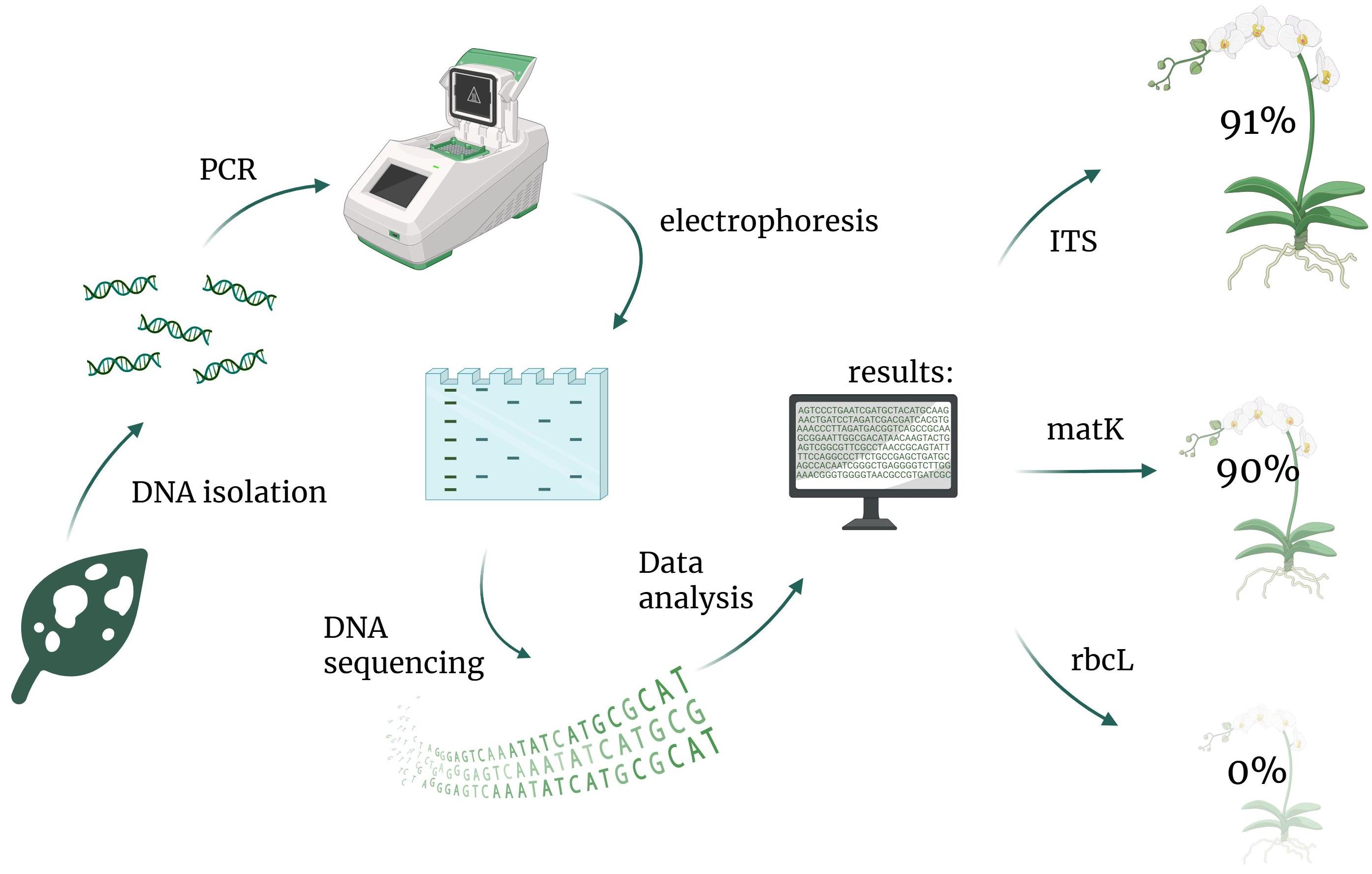
DNA Barcoding Protocol for Masdevallia Orchids: A Tool for CITES-Based Identification and Trade Control


Abstract
1. Introduction
2. Materials and Methods
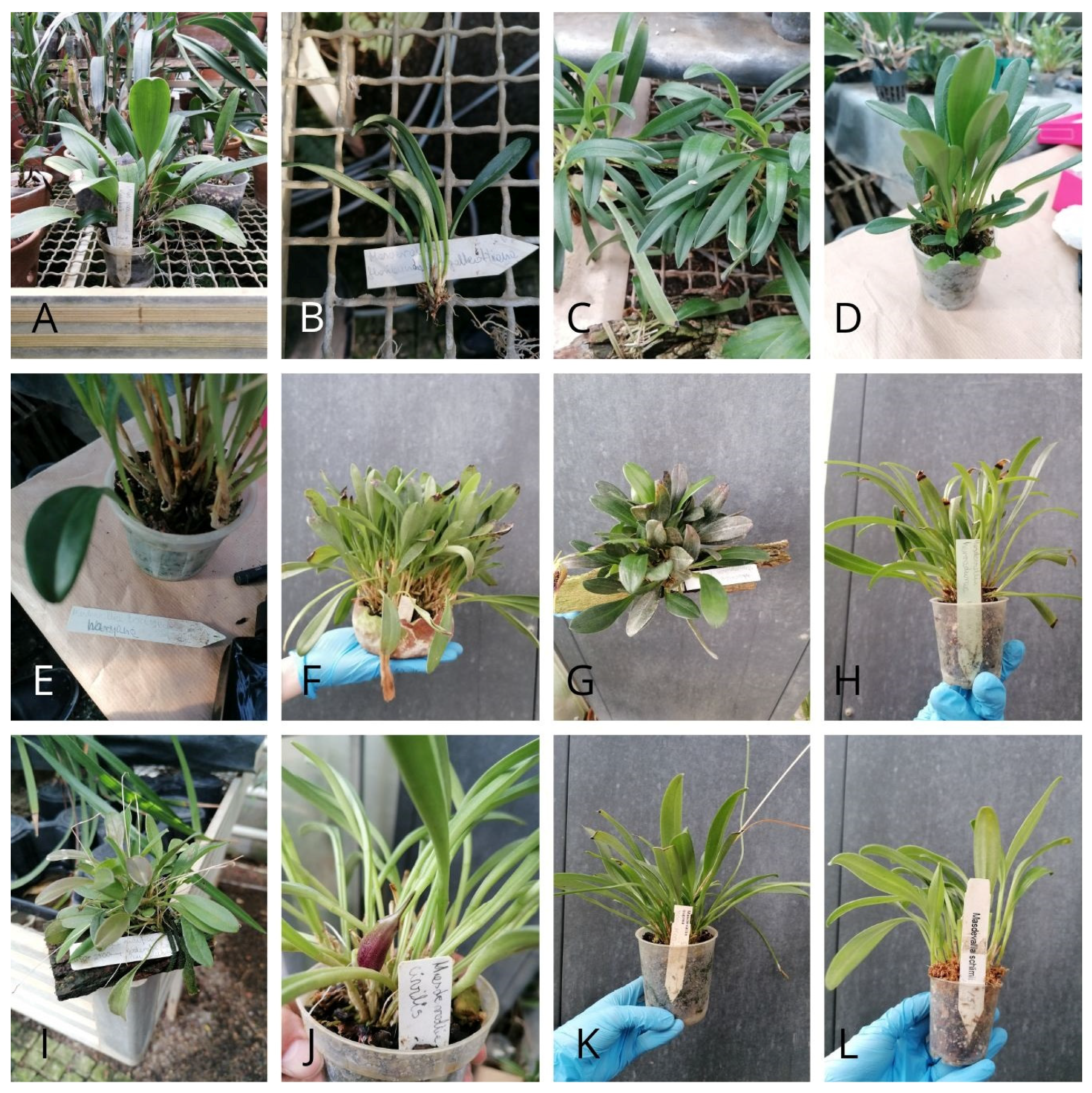
2.1. Sampling
2.2. DNA Isolation
2.3. Polymerase Chain Reaction (PCR) and Agarose Gel Electrophoresis
2.4. Sequencing and Data Analysis
3. Results and Discussion
4. Conclusions
Author Contributions
Funding
Institutional Review Board Statement
Informed Consent Statement
Data Availability Statement
Acknowledgments
Conflicts of Interest
References
- Grzywacz, A.; Bogdanowicz, W. Możliwości wykorzystania barkodingu w ochronie przyrody. Stud. Mater. Cent. Eduk. Przyr.-Leśnej 2009, 11, 38–44. [Google Scholar]
- Hebert, P.D.; Cywinska, A.; Ball, S.L.; DeWaard, J.R. Biological identifications through DNA barcodes. Proc. R. Soc. Lond. B 2003, 270, 313–321. [Google Scholar] [CrossRef]
- Kowalska, Z.; Pniewski, F.; Latała, A. Barkoding DNA—Nowoczesne podejście do identyfikacji organizmów. Kosmos 2019, 68, 89–96. [Google Scholar] [CrossRef]
- Hollingsworth, P.M.; Grahan, S.W.; Little, D.P. Choosing and using a plant DNA barcode. PLoS ONE 2011, 6, e19254. [Google Scholar] [CrossRef]
- Wang, Y.; Xiang, Z.; Liu, K.; Lin, Y.; Dong, S. Complete Chloroplast Genome and Phylogenomic Analysis of Davallia trichomanoides (Polypodiaceae). Genes 2025, 16, 1310. [Google Scholar] [CrossRef] [PubMed]
- Hong, Z.; He, W.; Liu, X.; Tembrock, L.R.; Wu, Z.; Xu, D.; Liao, X. Comparative Analyses of 35 Complete Chloroplast Genomes from the Genus Dalbergia (Fabaceae) and the Identification of DNA Barcodes for Tracking Illegal Logging and Counterfeit Rosewood. Forests 2022, 13, 626. [Google Scholar] [CrossRef]
- Delpiani, S.M.; Delpiani, G.E.; Cruz, V.P.; Di Prinzio, C.; Mabragaña, E.; Oliveira, C.; Hanner, R.; Díaz de Astarloa, J.M. How can DNA Barcoding be Useful in the Conservation of Marine Organisms? In Marine Ecology: An Ecosystemic View of Anthropogenic Impacts; Molina, J.M., Blasina, G.E., Eds.; CRC Press: London, UK, 2025; Volume 2, pp. 231–249. [Google Scholar] [CrossRef]
- Parmentier, I.; Duminil, J.; Kuzmina, M.; Philippe, M.; Thomas, D.W.; Kenfack, D.; Chuyong, G.B.; Cruaud, C.; Hardy, O.J. How Effective Are DNA Barcodes in the Identification of African Rainforest Trees? PLoS ONE 2013, 8, e54921. [Google Scholar] [CrossRef] [PubMed]
- Neetika, K.; Nidhi, B.; Sunil, P. DNA Barcoding for Plant Identification and Characterization. In Biotechnological Innovations for Sustainable Biodiversity and Development; Sobti, R.C., Ed.; CRC Press: London, UK, 2025; pp. 42–58. [Google Scholar] [CrossRef]
- Plants of the World Online. Available online: https://powo.science.kew.org/taxon/urn:lsid:ipni.org:names:30000945-2 (accessed on 17 August 2024).
- Archila Morales, F.L.; Lipińska, M.M.; Szlachetko, D.L. Masdevallia × urbanae (Orchidaceae)—A new, natural hybrid between M. floribunda and M. tuerckheimii from Guatemala. Diversity 2021, 13, 108. [Google Scholar] [CrossRef]
- Collantes, B.; Atausinchi, F.I.; Valer, J.C.; Paucar, E.C.; Martel, C. Masdevallia bastantei (Orchidaceae), a new species from Machupicchu, Peru. Syst. Bot. 2021, 46, 732–738. [Google Scholar] [CrossRef]
- IUCN RED LIST. Available online: https://www.iucnredlist.org/search/list?query=masdevallia&searchType=species (accessed on 2 May 2025).
- CITES. Available online: https://cites.org/eng/taxonomy/term/29327 (accessed on 27 November 2025).
- CITES. Available online: https://cites.org/eng/node/130903 (accessed on 27 November 2025).
- BOLD Systems v4. Available online: https://bench.boldsystems.org/index.php/Taxbrowser_Taxonpage?taxon=Masdevallia&searchTax=Search+T (accessed on 27 October 2025).
- Selina Wamucii. Available online: https://www.selinawamucii.com/plants/orchidaceae/masdevallia/ (accessed on 7 October 2025).
- Raskoti, B.B.; Ale, R. DNA barcoding of medicinal orchids in Asia. Sci. Rep. 2021, 11, 23651. [Google Scholar] [CrossRef]
- Ghorbani, A.; Gravendeel, B.; Zarre, S.; de Boer, H. Illegal wild collection and international trade of CITES-listed terrestrial. Traffic Bull. 2014, 26, 52–58. [Google Scholar]
- Eaton, M.J.; Meyers, G.L.; Kolokotronis, S.O.; Leslie, M.S.; Martin, A.P.; Amato, G. Barcoding bushmeat: Molecular identification of Central African and South American harvested vertebrates. Conserv. Genet. 2010, 11, 1389–1404. [Google Scholar] [CrossRef]
- Rehman, A.; Jafar, S.; Raja, N.A.; Mahar, J. Use of DNA barcoding to control the illegal wildlife trade: A CITES case report from Pakistan. J. Bioresour. Manag. 2015, 2, 3. [Google Scholar] [CrossRef]
- Barcode of Wildlife Project. Available online: https://barcodeofwildlife.org/ (accessed on 28 October 2025).
- CITES. Available online: https://cites.org/eng/parties/country-profiles/pl (accessed on 27 October 2025).
- IEEP; Bio Intelligence Service; Ecologic Institute. Information Collection and Impact Assessment of Possible Requirements for Environmental Inspections in the Area of EU Legislation on Water, Nature Protection and Trade in Certain Environmentally Sensitive Goods. Final Report for the European Commission, DG Environment; Institute for European Environmental Policy: Brussels, Belgium; London, UK, 2013; p. 70. Available online: https://ieep.eu/wp-content/uploads/2022/12/Enhancing_enforcement_obligations_for_EU_environmental_law.pdf (accessed on 28 October 2025).
- CITES. Available online: https://cites.org/eng/prog/imp/Wildlife_forensics (accessed on 27 October 2025).
- Ueland, M.; Brown, A.; Bartos, C.; Frankham, G.J.; Johnson, R.N.; Forbes, S.L. Profiling volatilomes: A novel forensic method for identification of confiscated illegal wildlife items. Separations 2020, 7, 5. [Google Scholar] [CrossRef]
- Materials for the Identification of Specimens of CITES-Listed Species. Resolution Conf. 19.4–1. p. 1. Available online: https://cites.org/sites/default/files/documents/COP/19/resolution/E-Res-19-04.pdf (accessed on 28 October 2025).
- Skuza, L.; Demska, K.; Adamczyk, A. Barkoding DNA jako nowoczesne narzędzie biologii molekularnej. Postępy Biol. Komórki 2015, 42, 621–632. [Google Scholar]
- Hollingsworth, P.M.; Forrest, L.L.; Spouge, J.L.; Hajibabaei, M.; Ratnasingham, S.; van der Bank, M.; Chase, M.W.; Cowan, R.S.; Erickson, D.L.; Fazekas, A.J.; et al. A DNA barcode for land plants. Proc. Natl. Acad. Sci. USA 2009, 106, 12794–12797. [Google Scholar] [CrossRef]
- BOLD Systems v5. Available online: https://boldsystems.org/resource-hub/faq/ (accessed on 27 October 2025).
- Letsiou, S.; Madesis, P.; Vasdekis, E.; Montemurro, C.; Grigoriou, M.E.; Skavdis, G.; Moussis, V.; Koutelidakis, A.E.; Tzakos, A.G. DNA Barcoding as a plant identification method. Appl. Sci. 2024, 14, 1415. [Google Scholar] [CrossRef]
- Ahmed, S.S.; Rahman, M.O.; Ali, M.A.; Al Hemaid, F.; Lee, J. Molecular phylogenetics and dating of Arecaceae in Bangladesh inferred from matK and genes. J. Plant Taxon. 2023, 30, 213–232. [Google Scholar] [CrossRef]
- Kress, W.J.; Erickson, D.L. A two-locus global DNA barcode for land plants: The coding rbcL gene complements the non-coding trnH-psbA spacer region. PLoS ONE 2007, 2, e508. [Google Scholar] [CrossRef]
- Walker, T. Plant diversity and evolution. Genotypic and Phenotypic Variation in Higher Plants. Exp. Agric. 2005, 42, 121. [Google Scholar] [CrossRef]
- Dunning, L.T.; Savolainen, V. Broad-scale amplification of matK for DNA barcoding plants, a technical note. Bot. J. Linn. Soc. 2010, 164, 1–9. [Google Scholar] [CrossRef]
- Ahmed, S.; Lghtbown, J.; Rutter, S.R.; Basu, N.; Nicholson, C.E.; Perry, J.J.; Dean, J.R. Use of remote sensing and image processing for identification of wild orchids. Front. Environ. Sci. 2024, 12, 1371445. [Google Scholar] [CrossRef]
- Karbarz, M.; Szlachcikowska, D.; Zapał, A.; Leśko, A. Unlocking the Genetic Identity of Endangered Paphiopedilum Orchids: A DNA Barcoding Approach. Genes 2024, 15, 689. [Google Scholar] [CrossRef] [PubMed]
- Antil, S.; Abraham, J.S.; Sripoorna, S.; Maurya, S.; Dagar, J.; Makhija, S.; Bhagat, P.; Gupta, R.; Sood, U.; Lal, R.; et al. DNA barcoding, an efective tool for species identifcation: A review. Mol. Biol. Rep. 2023, 50, 761–775. [Google Scholar] [CrossRef] [PubMed]
- Doyle, J. DNA Protocols for Plants. In Molecular Techniques in Taxonomy; Hewitt, G.M., Johnston, A.W.B., Young, J.P.W., Eds.; Springer: Berlin/Heidelberg, Germany, 1991; pp. 283–293. [Google Scholar] [CrossRef]
- Srivastava, D.; Manjunath, K. DNA barcoding of endemic and endangered orchids of India: A molecular method of species identification. Phcog. Mag. 2020, 16, 90–99. [Google Scholar] [CrossRef]
- Hall, T.A. BioEdit: A User-Friendly Biological Sequence Alignment Editor and Analysis Program for Windows 95/98/NT; Oxfordlink błedny podany przez stronę, wkleiłam obok sam doi, ale nie usuwałam, żeby komentarz od mdpi się nie usunąl University Press: Oxford, UK, 1999; pp. 95–98. [Google Scholar]
- BOLD Systems v5. Available online: https://id.boldsystems.org/ (accessed on 27 October 2025).
- Fazekas, A.J.; Kuzmina, M.L.; Newmaster, S.G.; Hollingsworth, P.M. DNA barcoding methods for land plants. In DNA Barcodes; Kress, W.J., Erickson, D.L., Eds.; Methods in Molecular Biology; Humana Press: Totowa, NJ, USA, 2012; Volume 858, pp. 223–252. [Google Scholar]
- BOLD Systems v4. Available online: https://bench.boldsystems.org/index.php/TaxBrowser_TaxonPage/SpeciesSummary?taxid=214012 (accessed on 27 October 2025).
- Chattopadhyay, P.; Banerjee, G.; Banerjee, N. Distinguishing orchid species by DNA barcoding: Increasing the resolution of population studies in plant biology. OMICS 2017, 21, 711–720. [Google Scholar] [CrossRef]


| Region | Cycle Stage | Initial Denaturation | Denaturation | Annealing | Elongation | Final Elongation |
|---|---|---|---|---|---|---|
| matK | Temperature [°C] Time Number of cycles | 94 4 min 1× | 94 1 min 32× | 48 40 s 32× | 72 50 s 32× | 72 7 min 1× |
| rbcL | Temperature [°C] Time Number of cycles | 94 1 min 1× | 94 30 s 35× | 52 1 min 35× | 72 1 min 35× | 72 7 min 1× |
| ITS | Temperature [°C] Time Number of cycles | 95 4 min 1× | 94 45 s 35× | 59 1 min 35× | 72 1 min 35× | 72 7 min 1× |
| Species | Sequences BOLD Systems | Barcodes > 500 bp |
|---|---|---|
| M. pelecaniceps (P. pelecaniceps) * | 3 | 1 |
| M. floribunda | 5 | 4 |
| M. picea | 0 | 0 |
| M. schroederiana | 1 | 0 |
| M.coccinea | 4 | 1 |
| M. stenorhynchos | 0 | 0 |
| M. herradurae | 1 | 0 |
| M. nidifica | 4 | 2 |
| M. civilis | 1 | 0 |
| M. cuprea | 0 | 0 |
| M. schlimii | 0 | 0 |
| Sequenced Orchids | matK | |||||
|---|---|---|---|---|---|---|
| Sequence ID * | Process ID * | Tax Rank | TaxName | Confidence * | Supporting Recs * | |
| M. pelecaniceps | M.pelecaniceps_matK | MASD002-25 | SUBFAMILY | Epidendroideae | 100 | 10 |
| M. floribunda var. Galleottiana | M.floribunda_matK | MASD003-25 | GENUS | Masdevallia | 81.24 | 20 |
| M. picea | M.picea_matK | MASD004-25 | GENUS | Masdevallia | 87.82 | 21 |
| M. schroederiana | M.schroederiana_matK | MASD005-25 | GENUS | Masdevallia | 82.72 | 20 |
| M. coccinea var. harryana | M.coccineaharryana_matK | MASD006-25 | GENUS | Masdevallia | 81.64 | 20 |
| M. coccinea f. alba Hermans | M.coccineaalba_matK | MASD007-25 | GENUS | Masdevallia | 81.02 | 20 |
| M. herradurae | M.herradurae_matK | MASD008-25 | GENUS | Masdevallia | 84.61 | 21 |
| M. nidifica | M.nidifica_matK | MASD009-25 | GENUS | Masdevallia | 91.76 | 22 |
| M. civilis | M.civilis_matK | MASD010-25 | GENUS | Masdevallia | 84.82 | 21 |
| Sequenced Orchids | rbcL | |||||
|---|---|---|---|---|---|---|
| Sequence ID * | Process ID * | Tax Rank | TaxName | Confidence * | Supporting Recs * | |
| M. pelecaniceps | M.pelecaniceps_rbcL | MASD012-25 | SUBFAMILY | Epidendroideae | 100 | 9 |
| M. floribunda var. Galleottiana | M.floribunda_rbcL | MASD013-25 | SUBFAMILY | Epidendroideae | 100 | 8 |
| M. picea | M.picea_rbcL | MASD014-25 | SUBFAMILY | Epidendroideae | 100 | 9 |
| M. schroederiana | M.schroederiana_rbcL | MASD015-25 | SUBFAMILY | Epidendroideae | 100 | 9 |
| M. coccinea var. harryana | M.coccineaharryana_rbcL | MASD016-25 | SUBFAMILY | Epidendroideae | 100 | 8 |
| M. coccinea f. alba Hermans | M.coccineaalba_rbcL | MASD017-25 | SUBFAMILY | Epidendroideae | 100 | 8 |
| M. stenorhynchos | M.stenorhynchos_rbcL | MASD018-25 | SUBFAMILY | Epidendroideae | 100 | 10 |
| M. herradurae | M.herradurae_rbcL | MASD019-25 | SUBFAMILY | Epidendroideae | 100 | 10 |
| M. nidifica | M.nidifica_rbcL | MASD020-25 | SUBFAMILY | Epidendroideae | 100 | 8 |
| M. civilis | M.civilis_rbcL | MASD021-25 | SUBFAMILY | Epidendroideae | 100 | 8 |
| M. cuprea | M.cuprea_rbcL | MASD022-25 | SUBFAMILY | Epidendroideae | 100 | 8 |
| M. schlimii | M.schlimii_rbcL | MASD023-25 | SUBFAMILY | Epidendroideae | 100 | 8 |
| Sequenced Orchids | ITS | |||||
|---|---|---|---|---|---|---|
| Sequence ID * | Process ID * | Tax Rank | TaxName | Confidence * | Supporting Recs * | |
| M. pelecaniceps | M.pelecaniceps_ITS | MASD001-25 | SPECIES | Phloeophila pelecaniceps | 100 | 2 |
| M. picea | M.picea_ITS | MASD024-25 | GENUS | Masdevallia | 100 | 5 |
| M. schroederiana | M.schroederiana_ITS | MASD025-25 | GENUS | Masdevallia | 97.44 | 9 |
| M. coccinea var. harryana | M.coccineaharryana_ITS | MASD026-25 | GENUS | Masdevallia | 100 | 18 |
| M. coccinea f. alba Hermans | M.coccineaalba_ITS | MASD027-25 | GENUS | Masdevallia | 100 | 15 |
| M. stenorhynchos | M.stenorhynchos_ITS | MASD028-25 | GENUS | Masdevallia | 95.47 | 23 |
| M. herradurae | M.herradurae_ITS | MASD029-25 | GENUS | Masdevallia | 100 | 8 |
| M. nidifica | M.nidifica_ITS | MASD030-25 | GENUS | Masdevallia | 97.8 | 12 |
| M. civilis | M.civilis_ITS | MASD031-25 | GENUS | Masdevallia | 100 | 15 |
| M. cuprea | M.cuprea_ITS | MASD032-25 | GENUS | Masdevallia | 94.8 | 12 |
| M. schlimii | M.schlimii_ITS | MASD033-25 | GENUS | Masdevallia | 93.81 | 13 |
Disclaimer/Publisher’s Note: The statements, opinions and data contained in all publications are solely those of the individual author(s) and contributor(s) and not of MDPI and/or the editor(s). MDPI and/or the editor(s) disclaim responsibility for any injury to people or property resulting from any ideas, methods, instructions or products referred to in the content. |
© 2025 by the authors. Licensee MDPI, Basel, Switzerland. This article is an open access article distributed under the terms and conditions of the Creative Commons Attribution (CC BY) license (https://creativecommons.org/licenses/by/4.0/).
Share and Cite
Karbarz, M.; Lebioda, E.; Leśko, A. DNA Barcoding Protocol for Masdevallia Orchids: A Tool for CITES-Based Identification and Trade Control. Genes 2025, 16, 1423. https://doi.org/10.3390/genes16121423
Karbarz M, Lebioda E, Leśko A. DNA Barcoding Protocol for Masdevallia Orchids: A Tool for CITES-Based Identification and Trade Control. Genes. 2025; 16(12):1423. https://doi.org/10.3390/genes16121423
Chicago/Turabian StyleKarbarz, Małgorzata, Eliza Lebioda, and Agnieszka Leśko. 2025. "DNA Barcoding Protocol for Masdevallia Orchids: A Tool for CITES-Based Identification and Trade Control" Genes 16, no. 12: 1423. https://doi.org/10.3390/genes16121423
APA StyleKarbarz, M., Lebioda, E., & Leśko, A. (2025). DNA Barcoding Protocol for Masdevallia Orchids: A Tool for CITES-Based Identification and Trade Control. Genes, 16(12), 1423. https://doi.org/10.3390/genes16121423