Article

Cognitive Capacity Genome-Wide Polygenic Scores Identify Individuals with Slower Cognitive Decline in Aging

by
Yoonjung Yoonie Joo
1,2,3,4,*,
Jiook Cha
2,4,5,
Jeremy Freese
6 and
M. Geoffrey Hayes
1,7,8,*
1
Division of Endocrinology, Metabolism, and Molecular Medicine, Department of Medicine, Northwestern University Feinberg School of Medicine, Chicago, IL 60611, USA
2
Department of Psychology, College of Social Sciences, Seoul National University, Seoul 08825, Korea
3
Institute of Data Science, Korea University, Seoul 02841, Korea
4
AI Institute, Seoul National University, Seoul 08825, Korea
5
Department of Brain and Cognitive Sciences, College of Natural Sciences, Seoul National University, Seoul 08825, Korea
6
Department of Sociology, School of Humanities and Sciences, Stanford University, Palo Alto, CA 94305, USA
7
Center for Genetic Medicine, Northwestern University Feinberg School of Medicine, Chicago, IL 60611, USA
8
Department of Anthropology, Northwestern University, Evanston, IL 60208, USA
*
Authors to whom correspondence should be addressed.
Genes 2022, 13(8), 1320; https://doi.org/10.3390/genes13081320
Submission received: 10 May 2022 / Revised: 23 June 2022 / Accepted: 20 July 2022 / Published: 24 July 2022
(This article belongs to the Section Bioinformatics)

Highlights

What are the main findings?
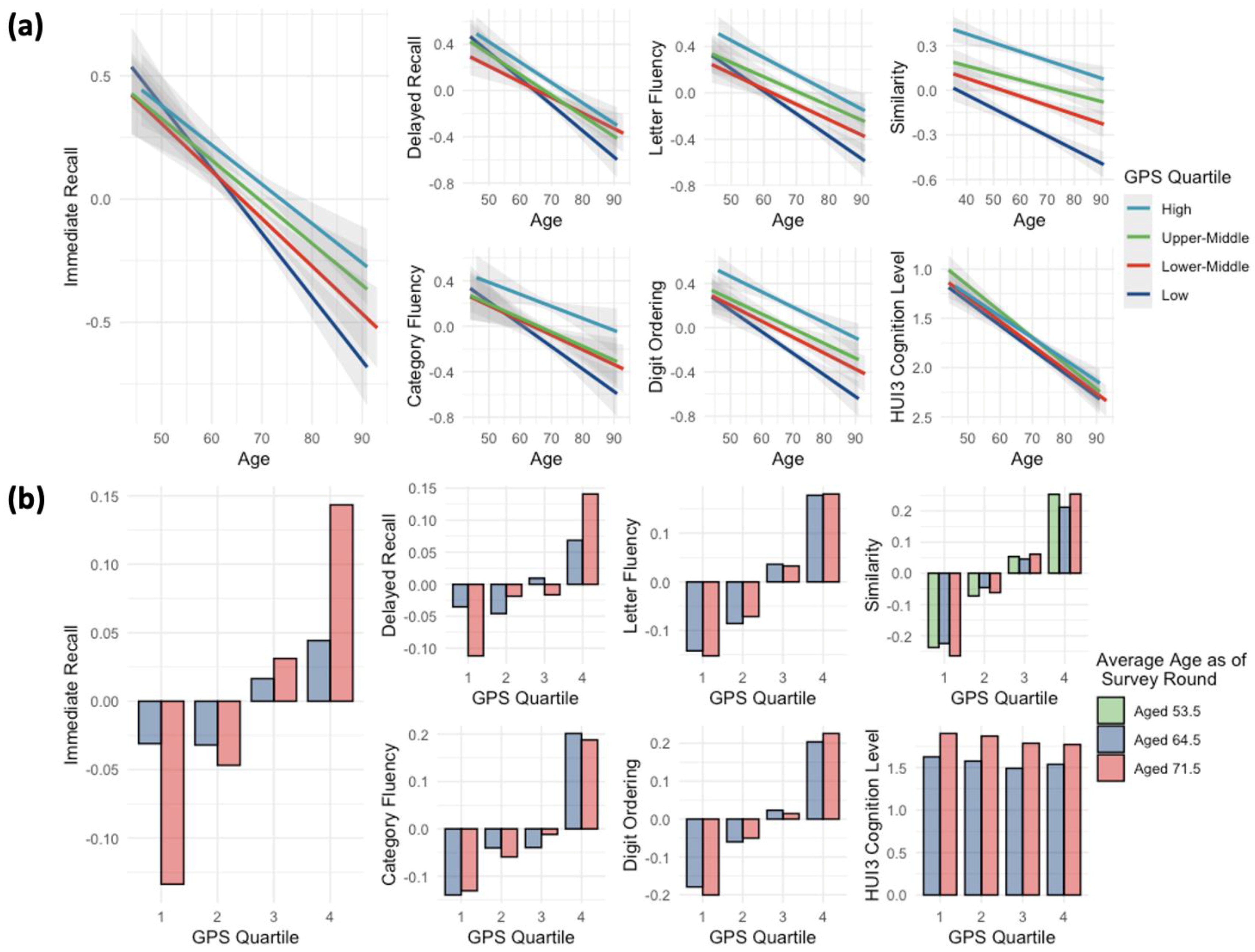
  • Higher genome-wide polygenic scores (GPSs) for cognitive capacity are significantly associated with slower cognitive decline during aging, particularly in the domain of immediate memory recall.
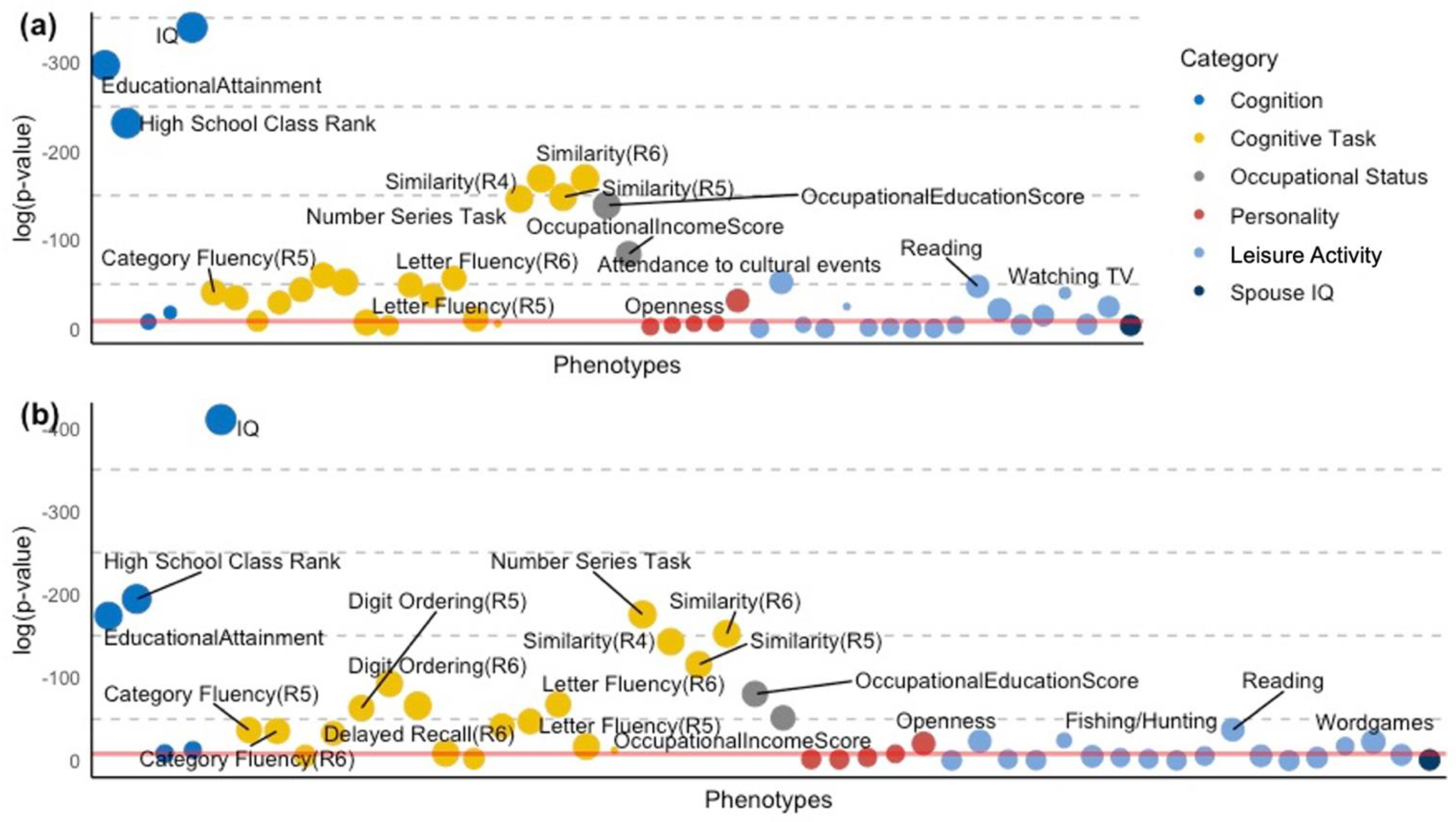
  • The study finds several associations between cognitive trait GPSs and other cognitive phenotypes, including IQ scores, educational attainment, and performance in tasks such as similarities and number series.
  • The study identified significant interactions between age and cognitive capacity GPSs, indicating that individuals with higher GPSs exhibit better cognitive resilience over time.
  • GPSs are also associated with several behavioral and personality traits, such as openness from the BIG 5 personality factors, leisure activities such as reading books, attending cultural events, and watching TV.
What is the implication of the main finding?
  • This study is the first to conduct a phenome-wide association study (PheWAS) using 60 years of longitudinal sociobehavioral data, spanning an individual's lifetime from high school to elderly; this highlights the potential of GPS to predict and identify individuals at a lower risk of cognitive decline.
  • The discovery of a link between GPS and an individual's rate of cognitive decline emphasizes the importance of considering genetic factors in understanding cognitive decline and developing tailored interventions to maintain cognitive health in aging populations.
  • The strong associations between GPS and leisure activities, as well as personality traits, open up new avenues for sociogenomic research into how genetics influence the social and behavioral domains.

Abstract

The genetic protective factors for cognitive decline in aging remain unknown. Predicting an individual’s rate of cognitive decline—or with better cognitive resilience—using genetics will allow personalized intervention for cognitive enhancement and the optimal selection of target samples in clinical trials. Here, using genome-wide polygenic scores (GPS) of cognitive capacity as the genomic indicators for variations of human intelligence, we analyzed the 18-year records of cognitive and behavioral data of 8511 European-ancestry adults from the Wisconsin Longitudinal Study (WLS), specifically focusing on the cognitive assessments that were repeatedly administered to the participants with their average ages of 64.5 and 71.5. We identified a significant interaction effect between age and cognitive capacity GPS, which indicated that a higher cognitive capacity GPS significantly correlated with a slower cognitive decline in the domain of immediate memory recall (β = 1.86 × 10⁻¹, p-value = 1.79 × 10⁻³). The additional phenome-wide analyses identified several associations between cognitive capacity GPSs and cognitive/behavioral phenotypes, such as similarities task (β = 1.36, 95% CI = (1.22, 1.51), p-value = 3.59 × 10−74), number series task (β = 0.94, 95% CI = (0.85, 1.04), p-value = 2.55 × 10−78), IQ scores (β = 1.42, 95% CI = (1.32, 1.51), p-value = 7.74 × 10−179), high school classrank (β = 1.86, 95% CI = (1.69, 2.02), p-value = 3.07 × 10−101), Openness from the BIG 5 personality factor (p-value = 2.19 × 10⁻¹⁴, β = 0.57, 95% CI = (0.42, 0.71)), and leisure activity of reading books (β = 0.50, 95% CI = (0.40, 0.60), p-value = 2.03 × 10⁻²¹), attending cultural events, such as concerts, plays, or museums (β = 0.60, 95% CI = (0.49, 0.72), p-value = 2.06 × 10⁻²³), and watching TV (β = −0.48, 95% CI = (−0.59, −0.37), p-value = 4.16 × 10⁻¹⁸). As the first phenome-wide analysis of cognitive and behavioral phenotypes, this study presents the novel genetic protective effects of cognitive ability on the decline of memory recall in an aging population.
Keywords: cognitive genetics; aging genetics; phenome-wide association study; genome-wide polygenic score; sociogenomics cognitive genetics; aging genetics; phenome-wide association study; genome-wide polygenic score; sociogenomics