A Sequence-Based Novel Approach for Quality Evaluation of Third-Generation Sequencing Reads

Abstract
1. Introduction
2. Materials and Methods
2.1. Data Availability
2.2. Methods
2.3. Evaluation Method
3. Results
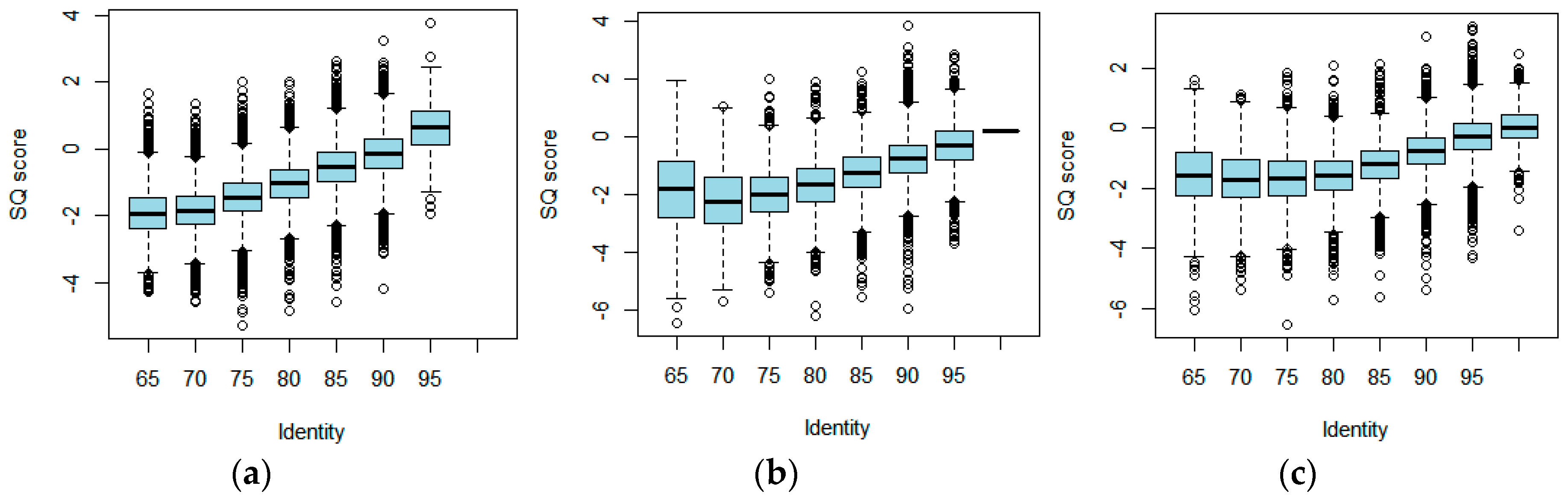
3.1. High-Quality and Low-Quality Reads Show Different Patterns of Nucleotide Combination Content
3.2. Experimental Results
3.2.1. Results of Escherichia coli
3.2.2. Results of Yersinia pestis
3.2.3. Results of Drosophila biarmipes
4. Discussion
Author Contributions
Funding
Acknowledgments
Conflicts of Interest
References
- Treangen, T.J.; Salzberg, S.L. Repetitive DNA and next-generation sequencing: computational challenges and solutions. Nat. Rev. Genet. 2012, 13, 36–46. [Google Scholar] [CrossRef] [Scilit]
- Alkan, C.; Sajjadian, S.; Eichler, E.E. Limitations of next-generation genome sequence assembly. Nat. Methods 2010, 8, 61. [Google Scholar] [CrossRef] [Scilit] [PubMed]
- Abnizova, I.; Leonard, S.; Skelly, T.; Brown, A.; Jackson, D.; Gourtovaia, M.; Qi, G.; Te, B.R.; Faruque, N.; Lewis, K. Analysis of context-dependent errors for Illumina sequencing. J. Bioinform. Comput. Biol. 2012, 10, 1241005. [Google Scholar] [CrossRef] [Scilit] [PubMed]
- Abnizova, I.; Skelly, T.; Naumenko, F.; Whiteford, N.; Brown, C.; Cox, T. Statistical comparison of methods to estimate the error probability in short-read Illumina sequencing. J. Bioinform. Comput. Biol. 2010, 8, 579–591. [Google Scholar] [CrossRef] [Scilit] [PubMed]
- Lu, H.; Giordano, F.; Ning, Z. Oxford Nanopore MinION Sequencing and Genome Assembly. Genom. Proteom. Bioinform. 2016, 14, 265–279. [Google Scholar] [CrossRef] [Scilit] [PubMed]
- Li, C.; Lin, F.; An, D.; Wang, W.; Huang, R. Genome Sequencing and Assembly by Long Reads in Plants. Genes 2018, 9, 6. [Google Scholar] [CrossRef] [Scilit] [PubMed]
- Li, M.; Tang, L.; Liao, Z.; Luo, J.; Wu, F.; Pan, Y.; Wang, J. A novel scaffolding algorithm based on contig error correction and path extension. IEEE/ACM Trans. Comput. Biol. Bioinform. 2018. [Google Scholar] [CrossRef] [Scilit] [PubMed]
- Li, M.; Tang, L.; Wu, F.; Pan, Y.; Wang, J. SCOP: A novel scaffolding algorithm based on contig classification and optimization. Bioinformatics 2018. [Google Scholar] [CrossRef] [Scilit]
- Liao, X.; Li, M.; Luo, J.; Zou, Y.; Wu, F.; Pan, Y.; Luo, F.; Wang, J. Improving de novo assembly based on read classification. IEEE/ACM Trans. Comput. Biol. Bioinform. 2018. [Google Scholar] [CrossRef] [Scilit] [PubMed]
- Prazsák, I.; Tombácz, D.; Szűcs, A.; Dénes, B.; Snyder, M.; Boldogkői, Z. Full Genome Sequence of the Western Reserve Strain of Vaccinia Virus Determined by Third-Generation Sequencing. Genome Announc. 2018, 6, e01570-01517. [Google Scholar]
- Jenjaroenpun, P.; Wongsurawat, T.; Pereira, R.; Patumcharoenpol, P.; Ussery, D.W.; Nielsen, J.; Nookaew, I. Complete genomic and transcriptional landscape analysis using third-generation sequencing: A case study of Saccharomyces cerevisiae CEN.PK113-7D. Nucleic Acids Res. 2018, 46, e38. [Google Scholar] [CrossRef] [Scilit] [PubMed]
- Lu, P.; Jin, J.; Li, Z.; Cao, P.; Fan, K.; Xu, Y. Genome assembly based on the third-generation sequencing technology and its application in tobacco. Tobacco Sci. Technol. 2017, 51, 87–94. [Google Scholar]
- Ip, C.L.; Loose, M.; Tyson, J.R.; De, C.M.; Brown, B.L.; Jain, M.; Leggett, R.M.; Eccles, D.A.; Zalunin, V.; Urban, J.M. MinION Analysis and Reference Consortium: Phase 1 data release and analysis. F1000Research 2015, 4, 1075. [Google Scholar] [CrossRef] [Scilit] [PubMed]
- Wu, B.; Wang, J.; Luo, J.; Li, M.; Wu, F.; Pan, Y. MEC: Misassembly error correction in contigs using a combination of paired-end reads and GC-contents. IEEE/ACM Trans. Comput. Biol. Bioinform. 2018. [Google Scholar] [CrossRef] [Scilit]
- Li, M.; Wu, B.; Yan, X.; Luo, J.; Pan, Y.; Wu, F.; Wang, J. PECC: Correcting contigs based on paired-end read distribution. Comput. Biol. Chem. 2017, 69, 178–184. [Google Scholar] [CrossRef] [Scilit] [PubMed]
- Langmead, B.; Trapnell, C.; Pop, M.; Salzberg, S.L. Ultrafast and memory-efficient alignment of short DNA sequences to the human genome. Genome Biol. 2009, 10, R25. [Google Scholar] [CrossRef] [Scilit] [PubMed]
- Daehwan, K.; Ben, L.; Salzberg, S.L. HISAT: A fast spliced aligner with low memory requirements. Nat. Methods 2015, 12, 357–360. [Google Scholar]
- Kent, W.J. BLAT—The BLAST-like alignment tool. Genome Res. 2002, 12, 656–664. [Google Scholar] [CrossRef] [Scilit] [PubMed]
- Kim, D.; Pertea, G.; Trapnell, C.; Pimentel, H.; Kelley, R.; Salzberg, S.L. TopHat2: Accurate alignment of transcriptomes in the presence of insertions, deletions and gene fusions. Genome Biol. 2013, 14, R36. [Google Scholar] [CrossRef] [Scilit] [PubMed]
- Sović, I.; Križanović, K.; Skala, K.; Šikić, M. Evaluation of hybrid and non-hybrid methods for de novo assembly of nanopore reads. Bioinformatics 2016, 32, btw237. [Google Scholar]
- Zhang, Z.; Wang, J.; Luo, J.; Ding, X.; Zhong, J.; Wang, J.; Wu, F.; Pan, Y. Sprites: Detection of deletions from sequencing data by re-aligning split reads. Bioinformatics 2016, 32, 1788–1796. [Google Scholar] [CrossRef] [Scilit] [PubMed]
- Leena, S.; Eric, R. LoRDEC: Accurate and efficient long read error correction. Bioinformatics 2014, 30, 3506–3514. [Google Scholar]
- Kin Fai, A.; Underwood, J.G.; Lawrence, L.; Wing Hung, W. Improving PacBio long read accuracy by short read alignment. PLoS ONE 2012, 7, e46679. [Google Scholar]
- Hackl, T.; Hedrich, R.; Schultz, J.; Förster, F. proovread: Large-scale high-accuracy PacBio correction through iterative short read consensus. Bioinformatics 2014, 30, 3004. [Google Scholar] [CrossRef] [Scilit] [PubMed]
- Hu, R.; Sun, G.; Sun, X. LSCplus: A fast solution for improving long read accuracy by short read alignment. BMC Bioinform. 2016, 17, 451. [Google Scholar] [CrossRef] [Scilit]
- Sameith, K.; Roscito, J.G.; Hiller, M. Iterative error correction of long sequencing reads maximizes accuracy and improves contig assembly. Brief. Bioinform. 2017, 18, 1–8. [Google Scholar] [CrossRef] [Scilit]
- Chin, C.S.; Peluso, P.; Sedlazeck, F.J.; Nattestad, M.; Concepcion, G.T.; Clum, A.; Dunn, C.; O’Malley, R.; Figueroabalderas, R.; Moralescruz, A. Phased diploid genome assembly with single-molecule real-time sequencing. Nat. Methods 2016, 13, 1050–1054. [Google Scholar] [CrossRef] [Scilit]
- Koren, S.; Schatz, M.C.; Walenz, B.P.; Martin, J.; Howard, J.T.; Ganapathy, G.; Wang, Z.; Rasko, D.A.; Mccombie, W.R.; Jarvis, E.D. Hybrid error correction and de novo assembly of single-molecule sequencing reads. Nat. Biotechnol. 2012, 30, 693–700. [Google Scholar] [CrossRef] [Scilit]
- Berlin, K.; Koren, S.; Chin, C.S.; Drake, J.P.; Landolin, J.M.; Phillippy, A.M. Assembling large genomes with single-molecule sequencing and locality-sensitive hashing. Nat. Biotechnol. 2015, 33, 623–630. [Google Scholar] [CrossRef] [Scilit]
- Li, H. Minimap2: Pairwise alignment for nucleotide sequences. Bioinformatics 2017. [Google Scholar] [CrossRef] [Scilit]
- Chaisson, M.J.; Tesler, G. Mapping single molecule sequencing reads using basic local alignment with successive refinement (BLASR): Application and theory. BMC Bioinform. 2012, 13, 238. [Google Scholar] [CrossRef] [Scilit] [PubMed]
- Xiao, C.L.; Chen, Y.; Xie, S.Q.; Chen, K.N.; Wang, Y.; Han, Y.; Luo, F.; Xie, Z. MECAT: Fast mapping, error correction, and de novo assembly for single-molecule sequencing reads. Nat. Methods 2017, 14. [Google Scholar] [CrossRef] [Scilit] [PubMed]
- Gurevich, A.; Saveliev, V.; Vyahhi, N.; Tesler, G. QUAST: Quality assessment tool for genome assemblies. Bioinformatics 2013, 29, 1072–1075. [Google Scholar] [CrossRef] [Scilit] [PubMed]
- Li, M.; Liao, X.; He, Y.; Wang, J.; Luo, J.; Pan, Y. ISEA: Iterative Seed-Extension Algorithm for De Novo Assembly Using Paired-End Information and Insert Size Distribution. IEEE/ACM Trans. Comput. Biol. Bioinform. 2017, 14, 916–925. [Google Scholar] [CrossRef] [Scilit] [PubMed]
- Luo, J.; Wang, J.; Shang, J.; Luo, H.; Li, M.; Wu, F.X.; Pan, Y. GapReduce: A gap filling algorithm based on partitioned read sets. IEEE/ACM Trans. Comput. Biol. Bioinform. 2018. [Google Scholar] [CrossRef] [Scilit] [PubMed]
- Luo, J.; Wang, J.; Zhang, Z.; Li, M.; Wu, F.X. BOSS: A novel scaffolding algorithm based on an optimized scaffold graph. Bioinformatics 2016, 33, 169. [Google Scholar] [CrossRef] [Scilit] [PubMed]

| P (%) | Num | Max | Min | Mean | n | R (%) | Mean I | Median I | ||
|---|---|---|---|---|---|---|---|---|---|---|
| Read Alignment | All reads | 100 | 31,858 | 64,218 | 99 | 7668 | 27,869 | 87.48 | 84.16 | 88.33 |
| Random | 95 | 30,265 | 62,072 | 99 | 7669 | 26,471 | 87.50 | 84.16 | 88.33 | |
| 90 | 28,672 | 62,072 | 99 | 7670 | 25,078 | 87.50 | 84.16 | 88.32 | ||
| 85 | 27,079 | 61,357 | 100 | 7670 | 23,685 | 87.51 | 84.15 | 88.32 | ||
| 80 | 25,486 | 59,926 | 100 | 7671 | 22,288 | 87.50 | 84.15 | 88.32 | ||
| REQUEST | 95 | 30,265 | 64,218 | 99 | 7875 | 27,238 | 90.00 | 84.46 | 88.60 | |
| 90 | 28,672 | 64,218 | 99 | 7964 | 26,192 | 91.35 | 84.98 | 89.07 | ||
| 85 | 27,079 | 64,218 | 99 | 8028 | 25,016 | 92.38 | 85.52 | 89.48 | ||
| 80 | 25,486 | 64,218 | 99 | 8082 | 23,766 | 93.25 | 86.06 | 89.88 | ||
| Read Correction | All reads | 100 | 26,034 | 33,912 | 2000 | 8144 | 25,775 | 99.01 | 96.67 | 98.36 |
| Random | 95 | 24,252 | 33,882 | 2000 | 8147 | 24,011 | 99.01 | 96.78 | 98.36 | |
| 90 | 22,943 | 33,817 | 2001 | 8143 | 22,715 | 99.01 | 96.76 | 98.34 | ||
| 85 | 21,626 | 33,724 | 2001 | 8137 | 21,411 | 99.00 | 96.73 | 98.31 | ||
| 80 | 20,303 | 33,519 | 2001 | 8130 | 20,101 | 99.00 | 96.70 | 98.28 | ||
| REQUEST | 95 | 25,715 | 33,886 | 2001 | 8162 | 25,469 | 99.04 | 96.51 | 98.25 | |
| 90 | 24,906 | 33,886 | 2001 | 8224 | 24,670 | 99.05 | 96.59 | 98.29 | ||
| 85 | 23,968 | 33,880 | 2001 | 8279 | 23,731 | 99.01 | 96.68 | 98.33 | ||
| 80 | 22,883 | 33,880 | 2000 | 8335 | 22,673 | 99.08 | 96.76 | 98.38 | ||
| Contig Assembly | P (%) | Num | Max(kb) | MA | Largest alignment (kb) | N50 (kb) | NA50(kb) | GF (%) | ||
| All reads | 100 | 2 | 4636 | 6 | 2305 | 4636 | 1655.60 | 99.86 | ||
| Random | 95 | 3 | 3724 | 3 | 3294 | 3724 | 3201.91 | 99.98 | ||
| 90 | 4 | 2958 | 3 | 2606 | 2947 | 2438.54 | 99.97 | |||
| 85 | 5 | 3463 | 3 | 3153 | 3380 | 3032.37 | 99.92 | |||
| 80 | 7 | 2496 | 3 | 2444 | 1970 | 1864.48 | 99.81 | |||
| REQUEST | 95 | 2 | 4641 | 5 | 2530 | 4641 | 2529.56 | 100.00 | ||
| 90 | 2 | 4639 | 7 | 3587 | 4639 | 3587.13 | 99.89 | |||
| 85 | 3 | 4635 | 5 | 3956 | 4635 | 3956.42 | 100.00 | |||
| 80 | 3 | 4636 | 5 | 3957 | 4636 | 3956.57 | 100.00 | |||
| P (%) | Num | Max | Min | Mean | n | R (%) | Mean I | Median I | ||
|---|---|---|---|---|---|---|---|---|---|---|
| Read Alignment | All reads | 100 | 28,429 | 61,191 | 125 | 7679 | 26,989 | 94.93 | 83.44 | 86.70 |
| Random | 95 | 27,007 | 61,191 | 125 | 7680 | 25,628 | 94.90 | 83.44 | 86.70 | |
| 90 | 25,586 | 61,191 | 125 | 7689 | 24,277 | 94.88 | 83.44 | 86.70 | ||
| 85 | 24,164 | 61,191 | 145 | 7679 | 22,928 | 94.89 | 83.44 | 86.70 | ||
| 80 | 22,743 | 53,492 | 125 | 7686 | 21,573 | 94.86 | 83.44 | 86.70 | ||
| REQUEST | 95 | 27,008 | 61,191 | 184 | 7785 | 26,181 | 96.94 | 83.84 | 86.87 | |
| 90 | 25,586 | 61,191 | 184 | 7827 | 25,024 | 97.80 | 84.32 | 87.08 | ||
| 85 | 24,164 | 61,191 | 184 | 7869 | 23,750 | 98.29 | 84.73 | 87.29 | ||
| 80 | 22,743 | 61,191 | 184 | 7904 | 22,402 | 98.50 | 85.08 | 87.45 | ||
| Read Correction | All reads | 100 | 25,776 | 57,301 | 2000 | 7229 | 24,769 | 96.09 | 96.96 | 98.09 |
| Random | 95 | 23,953 | 33,843 | 2001 | 7170 | 23,946 | 99.97 | 97.12 | 98.14 | |
| 90 | 22,633 | 33,587 | 2001 | 7157 | 22,627 | 99.97 | 97.11 | 98.12 | ||
| 85 | 21,315 | 33,289 | 2000 | 7139 | 21,310 | 99.98 | 97.11 | 98.10 | ||
| 80 | 19,974 | 33,730 | 2001 | 7117 | 19,969 | 99.98 | 97.10 | 98.09 | ||
| REQUEST | 95 | 25,357 | 56,560 | 2000 | 7263 | 25,350 | 99.97 | 96.86 | 98.03 | |
| 90 | 24,449 | 56,560 | 2000 | 7336 | 24,442 | 99.97 | 96.93 | 98.07 | ||
| 85 | 23,312 | 56,587 | 2000 | 7399 | 23,305 | 99.97 | 97.04 | 98.12 | ||
| 80 | 22,028 | 57,044 | 2000 | 7468 | 22,022 | 99.97 | 97.10 | 98.16 | ||
| Contig Assembly | P (%) | Num | Max(kb) | MA | Largest alignment (kb) | N50(kb) | NA50(kb) | GF (%) | ||
| All reads | 100 | 4 | 4646 | 30 | 940 | 4646 | 377.69 | 99.96 | ||
| Random | 95 | 5 | 2749 | 28 | 835 | 2310 | 370.53 | 99.72 | ||
| 90 | 8 | 2174 | 25 | 816 | 1642 | 345.93 | 99.55 | |||
| 85 | 11 | 1756 | 28 | 771 | 1141 | 301.66 | 99.28 | |||
| 80 | 19 | 1194 | 27 | 593 | 471 | 224.73 | 98.54 | |||
| REQUEST | 95 | 6 | 4641 | 31 | 1012 | 4641 | 377.70 | 99.96 | ||
| 90 | 4 | 4658 | 31 | 798 | 4658 | 377.69 | 99.96 | |||
| 85 | 4 | 4645 | 29 | 1012 | 4645 | 377.69 | 99.96 | |||
| 80 | 7 | 2571 | 30 | 798 | 2571 | 282.40 | 99.73 | |||
| P (%) | Num | Max | Min | Mean | n | R (%) | Mean I | Median I | ||
|---|---|---|---|---|---|---|---|---|---|---|
| Read Alignment | All reads | 100 | 1,375,649 | 93,368 | 61 | 4102 | 845,134 | 61.44 | 79.57 | 82.58 |
| Random | 95 | 1,306,867 | 93,368 | 61 | 4102 | 802,968 | 61.44 | 79.57 | 82.24 | |
| 90 | 1,260,870 | 93,368 | 61 | 4101 | 760,614 | 60.32 | 79.57 | 82.58 | ||
| 85 | 1,192,229 | 93,368 | 61 | 4101 | 718,489 | 60.26 | 79.57 | 82.58 | ||
| 80 | 1,123,446 | 93,368 | 61 | 4102 | 676,352 | 60.20 | 79.57 | 82.58 | ||
| REQUEST | 95 | 1,306,867 | 93,368 | 83 | 4298 | 844,504 | 64.62 | 79.58 | 82.58 | |
| 90 | 1,260,870 | 93,368 | 83 | 4503 | 841,439 | 66.73 | 79.61 | 82.61 | ||
| 85 | 1,192,229 | 93,368 | 83 | 4725 | 833,911 | 69.95 | 79.65 | 82.67 | ||
| 80 | 1,123,446 | 93,368 | 105 | 4950 | 818,457 | 72.85 | 79.72 | 82.79 | ||
| Read Correction | All reads | 100 | 628,180 | 53,163 | 2000 | 6743 | 625,472 | 99.57 | 89.25 | 94.68 |
| Random | 95 | 594,932 | 52,702 | 2000 | 6654 | 592,270 | 99.55 | 89.22 | 94.67 | |
| 90 | 571,876 | 52,531 | 2000 | 6579 | 558,019 | 97.58 | 89.21 | 94.68 | ||
| 85 | 536,463 | 49,260 | 2000 | 6452 | 522,184 | 97.34 | 89.19 | 94.68 | ||
| 80 | 498,685 | 47,746 | 2000 | 6297 | 483,630 | 96.98 | 89.19 | 94.69 | ||
| REQUEST | 95 | 634,003 | 53,154 | 2000 | 6713 | 630,933 | 99.52 | 89.10 | 94.55 | |
| 90 | 633,478 | 53,154 | 2000 | 6715 | 629,206 | 99.33 | 89.11 | 94.56 | ||
| 85 | 632,026 | 53,154 | 2000 | 6719 | 629,206 | 99.55 | 89.14 | 94.56 | ||
| 80 | 627,427 | 53,157 | 2000 | 6731 | 575,145 | 91.67 | 89.25 | 94.72 | ||
| Contig Assembly | P (%) | Num | Max(kb) | MA | Largest alignment (kb) | N50(kb) | NA50(kb) | GF (%) | ||
| All reads | 100 | 2185 | 673 | 10,602 | 304 | 67 | 31.00 | 55.65 | ||
| Random | 95 | 2051 | 530 | 9689 | 216 | 57 | 27.00 | 46.36 | ||
| 90 | 1868 | 301 | 8973 | 176 | 50 | 23.00 | 36.92 | |||
| 85 | 1635 | 226 | 8165 | 160 | 43 | 16.00 | 28.09 | |||
| 80 | 1385 | 191 | 7376 | 112 | 39 | 10.00 | 20.90 | |||
| REQUEST | 95 | 2164 | 552 | 10,815 | 307 | 68 | 31.00 | 55.82 | ||
| 90 | 2142 | 552 | 10,732 | 234 | 68 | 31.00 | 55.75 | |||
| 85 | 2132 | 552 | 10,616 | 234 | 68 | 31.00 | 55.57 | |||
| 80 | 2113 | 552 | 10,734 | 234 | 67 | 31.00 | 54.95 | |||
© 2019 by the authors. Licensee MDPI, Basel, Switzerland. This article is an open access article distributed under the terms and conditions of the Creative Commons Attribution (CC BY) license (http://creativecommons.org/licenses/by/4.0/).
Share and Cite
Zhang, W.; Huang, N.; Zheng, J.; Liao, X.; Wang, J.; Li, H.-D. A Sequence-Based Novel Approach for Quality Evaluation of Third-Generation Sequencing Reads. Genes 2019, 10, 44. https://doi.org/10.3390/genes10010044
Zhang W, Huang N, Zheng J, Liao X, Wang J, Li H-D. A Sequence-Based Novel Approach for Quality Evaluation of Third-Generation Sequencing Reads. Genes. 2019; 10(1):44. https://doi.org/10.3390/genes10010044
Chicago/Turabian StyleZhang, Wenjing, Neng Huang, Jiantao Zheng, Xingyu Liao, Jianxin Wang, and Hong-Dong Li. 2019. "A Sequence-Based Novel Approach for Quality Evaluation of Third-Generation Sequencing Reads" Genes 10, no. 1: 44. https://doi.org/10.3390/genes10010044
APA StyleZhang, W., Huang, N., Zheng, J., Liao, X., Wang, J., & Li, H.-D. (2019). A Sequence-Based Novel Approach for Quality Evaluation of Third-Generation Sequencing Reads. Genes, 10(1), 44. https://doi.org/10.3390/genes10010044