Review

Microglia in Epilepsy: From Molecular Mechanism to Therapeutic Strategy

by
Yam Nath Paudel
1,*,
Efthalia Angelopoulou
2,
Sai Kulkarni
3,
Robert E. Blair
1 and
Laxmikant S. Deshpande
1,4,*
1
Department of Neurology, School of Medicine, Virginia Commonwealth University, Richmond, VA 23298, USA
2
1st Department of Neurology, Eginition Hospital, National and Kapodistrian University of Athens, 11528 Athens, Greece
3
Department of Pharmacotherapy and Outcomes Sciences, School of Pharmacy, Virginia Commonwealth University, Richmond, VA 23298, USA
4
Department of Pharmacology and Toxicology, School of Medicine, Virginia Commonwealth University, Richmond, VA 23298, USA
*
Authors to whom correspondence should be addressed.
Cells 2026, 15(9), 835; https://doi.org/10.3390/cells15090835
Submission received: 9 April 2026 / Revised: 28 April 2026 / Accepted: 30 April 2026 / Published: 2 May 2026

Highlights

  • Microglia, a resident immune cell of the CNS, have been widely acknowledged as a driver of neuroinflammatory cascades and possess a pathogenic and beneficial role in epileptic seizures.
  • In recent years, a large body of data has arisen regarding depleting (eliminating) microglia either via pharmacological or pharmacogenetic elimination.
  • Targeting microglial activation/modulating microglial phenotype against experimental seizure models has produced encouraging data.
  • Lack of robust and clinical data from microglia-targeted therapies warrants further understanding of epilepsy, investigating microglia in a real animal model of epilepsy.

Abstract

The limit of disease-modifying therapeutic strategies against epilepsy has prompted mainstream epilepsy research toward understanding the pathways contributing to epileptic seizures. Microglia, the powerhouse of the brain’s innate immune system, is known for its role in epileptic seizures, contributing via neuroinflammation, neuronal death, and neurogenesis. Therapeutic targeting of microglia with its inhibitor and therapeutic compounds modulating its activation reduces the development of spontaneous recurrent seizure after status epilepticus in a pre-clinical model. Herein, we review various aspects of microglia in epilepsy, including their contribution to seizure-induced neuronal death and neurogenesis, the outcome of depleting microglia (both pharmacologically and genetically), the aspects of microglia–astrocyte interaction, and promising therapeutic outcomes achieved by targeting microglia.

1. Introduction

Epilepsy is a devastating central nervous system (CNS) disorder characterized by the repeated occurrence of seizures impacting over 70 million of the global population; however, the underlying mechanism of seizure generation has not been entirely understood [1,2]. Spontaneous recurrent seizures (SRSs), the significant hallmark of epilepsy, have been reported to be associated with increased neuronal excitability and hypersynchrony, and are mostly caused by brain trauma and genetic factors [3]. Plethora of CNS insults, including status epilepticus (SE), traumatic brain injury (TBI), and stroke, might be the leading cause of acquired epilepsy accounting for 20–30% of total epilepsy cases [4,5].
The development of epilepsy and spontaneous seizures is known as epileptogenesis [6], and its underlying mechanism is still elusive. There is an urgent need to develop novel therapies against epilepsy that can overcome the limitations of mainstream anti-seizure medications (ASMs), as they only provide symptomatic relief, leaving one-third of epileptic patients resistant to ASMs [7]. The plausible reason behind the therapeutic ineffectiveness of ASMs might be attributed to the fact that they do not target crucial mechanisms, including those involving non-neuronal cells [8,9]. Hence, as brain-resident immune cells of the CNS, microglia have attracted much attention in recent years in epilepsy research with potential to represent an emerging novel anti-epileptic therapy [10,11,12,13,14,15,16,17].
Microglia account for around 10% of the total adult CNS cells [18,19]. Microglia possess beneficial roles, including brain surveillance, neurogenesis, synaptic remodeling, neuronal excitability, vascularization, formation and maintenance of the blood–brain barrier (BBB), glial support, etc. [20,21,22,23]. During physiological conditions, microglia are mostly ramified cells with dynamic processes that safeguard their surrounding environment to monitor neural homeostasis [24]. On the contrary, during pathological conditions (including seizures), microglia turn to a reactive state, gain amoeboid shapes, and produce diverse inflammatory mediators such as cytokines, chemokines, and complement proteins [25].
Microgliosis is among the common process that contributes to epileptogenesis, as evident in an animal model of acquired epilepsy and drug-resistant epilepsy patients [26,27]. The role of microglia in epileptogenesis has been acknowledged since neuronal injury causes microglial activation and neuroinflammation, which likely contribute to epilepsy [28]. Interestingly, based on the stages of pathogenesis, microglia may have a differential role in epilepsy, and they exert both pro-epileptic and anti-epileptic effects [29]. For example, after temporal activation post-SE, microglia may inhibit the formation of aberrant neural circuits, neuronal death, and hyperactivation of neurons, exerting anti-epileptic effects [17,30]. On the contrary, the pro-epileptic effect of microglia is attributed to prompting neuronal hyperactivity and neuronal cell loss via inflammatory phenomena [31].
A deeper understanding of the role of microglia in seizure and epilepsy is needed, which is discussed in this review based on the recent advances and covers different aspects, including the role of microglia in seizure and its underlying mechanism, microglia dynamics in seizure, pre-clinical evidence targeting microglia in epilepsy, and its future translational implications.

2. Literature Review Strategy

The literature search was carried out on the PubMed database and Google Scholar using the following keywords: “Epilepsy”, “Microglia”, “Seizure”, “Minocycline”, “Neurodegeneration”, “Neurogenesis”, “Microglia depletion”. A combination of these keywords was used to gather high-quality relevant publications ranging from 1992 to 2026, mainly selected based on their relevance to the topic. However, most references were published between 2010 and 2026, accounting for more than 75% of the total references.

3. Microglia and Epilepsy

A mounting amount of evidence supports the role of neuroinflammation in the pathogenesis of epilepsy [31,32,33]. Microglia are highly reactive during SE [17], which are characterized by an ameboid morphology [34,35], increased production of pro-inflammatory cytokines [36,37,38], proliferation, and increased K+ conductance [39]. A compelling link between microglia and epilepsy has been implicated in the past decades of research [17,40]; however, the underlying mechanism of microglia contribution to the pathogenesis of epilepsy is yet to be fully understood.

3.1. Microglial Responses to Epileptic Seizures

It is largely understood that microglial activation occurs post-seizure induction in a pre-clinical model of epileptic seizures. Microglial activation is characterized by changes in cell morphology and biochemistry [41]. The size and shape of the cell body, the number, length and orientation of cellular processes, and the number and length of the branches are among the criteria that characterize microglial modifications during their activation [42]. Hippocampal microglia become activated after SE induction, even before the onset of neurodegeneration [43].
Intraperitoneal (I.P.) Kainic acid (KA)-induced SE leads to an acute (24 h) and sustained (7 days) activation of microglia as evident by an upregulation in the area of fluorescent cells in the hippocampal region (hilus), microglial cell numbers, and microglial aggregates in the CA3 region of KA-treated mice when compared to normal controls [44]. Significant upregulation in IBA1 immunoreactivity in the hippocampal CA3 region was observed on day 3 and day 7 after intracerebroventricular (ICV) KA administration, and Western blot evaluation (12 h., 1 d, 2 d, and 3 d; hippocampal tissues) showed that starting at 1 day, the IBA1 content was two-fold more significant than in artificial colony-stimulating factor (aCSF)-injected control mice [13]. The degree of seizure severity is correlated with microgliosis and microglia activation, as evident by increased upregulation of IBA1-positive cells (peaked at 3 d and returned to normal at 14 days) following SE [16]. In the I.P. KA-induced SE model, no microglial activation was observed in PN9 rats 4 h and 24 h after seizure onset, whereas strong microglial immunoreactivity (OX-42) was detected in PN21 rats, reflecting activated microglia accompanied by round to oval shape and developed process [45]. In an animal model of epileptogenesis induced by intrahippocampal KA (IHKA) injection, IBA1-positive cell activation was prevalent for 24 h and 3 months, and was accompanied by round to oval-shaped, hypertrophic processes with a reduction in distal ramifications [10]. An electrical-induced partial SE model in rats led to significant hippocampal microglial activation, and was accompanied by increased microglial cell numbers and the presence of activated microglial phenotypes (1 week after SE). Upon morphological analysis, ramified/surveying, intermediate, and round/ameboid morphologies were observed, reflecting an activated phenotype [46].
In a Pilocarpine-induced TLE model, hypertrophied IBA1-labeled microglial cells were observed in the hippocampal region (CA1 and CA3) and dentate gyrus (DG) (1 day after TLE) [47]. Microglia at this time point were activated as evidenced by pleomorphic, thickened processes and increased branch points. Further morphometric analysis revealed significant differences in the mean area of IBA1-labeled processes and IBA1-labeled processes after seizures. In addition, the densiometric analysis revealed increased IBA1 immunoreactivity in hilus, CA1, and CA3 regions (1 day after seizure) [47]. The density of microglial activation in the hippocampus increased post-birth and reaches peaks at the second week of life, which is the age when animals are acknowledged to be more susceptible to seizure triggers (LPS-induced Febrile seizures and KA-induced SE). Interestingly, these animals showed increased microglia activation in the hippocampus after seizures compared to the other ages [48]. An increased number of OX-42-positive microglial cells (amoeboid morphology) reflecting microglial activation has been observed after 12, 24, and 48 h after Pilocarpine-induced SE [49].
Rapid and persistent activation of microglia/macrophages in the hippocampal CA1 region following KA-induced SE was evident based on morphological analysis of density, cell volume, ramification index, and process length of IBA1-positive cells [50]. In a recent study with an in vitro KA-induced seizure model, quantitative and morphological evaluation of microglia in the CA3 region suggests significant morphological alterations of microglia in the KA group, accompanied by a thicker cytoplasmic projection of microglia, and larger and amoeboid cell bodes, reflecting a reactive/activated microglia [51]. However, electro-convulsive seizures (ECSs) do not change the morphology or activation state of resting microglia as evidenced by no effect of ECS on branch length, the number of endpoints, or the calculated fractal dimension during morphological analysis [52]. It is worth mentioning that all these microglia changes after SE induced with different experimental models are descriptively lacking the precise dynamics of microglia activation in specific brain regions. A better understanding of microglial activation patterns will indeed expand our knowledge of the short- and long-term consequences of SE [53].
The very first study investigating real-time microglial dynamics after severe seizures (ICV-KA) reported the formation of microglial process pouches (MPPs) that target but rarely engulf beaded neuronal dendrites [12]. These MPPs increase their motility/chemoattractant properties and do not possess phagocytic activity; most MPPs (70%) are maintained rather than engulfed, and formation and maintenance of MPPs are independent of chemotactic (CX3XR1 and P2Y12) and phagocytic (TREM2 and P2Y6R) receptors [12]. In a similar line of study by the same research group, daily rearrangement of the microglial landscape has been documented in young adults using in vivo two-photon imaging, and this microglial landscape can be modulated by severe seizures. Precisely, the microglial rearrangement was increased within the first 24 h of KA-induced seizures, whereas after the third day of KA-induced seizures, the basal levels were restored and maintained for a month [54]. A similar increase in microglial rearrangement was observed within 24 h of Pilocarpine-induced seizures. These findings reflect that the global increases in neuronal activity due to seizures lead to increased microglial somatic rearrangements [54].

3.2. Microglial Proliferation in Seizures

Microglial proliferation is a natural response to insult and a crucial prerequisite for microglia to execute their functions [55]. However, inappropriate microglial proliferation (too much or too little) may result in negative CNS health [55]. Timely manipulation of microglial proliferation, particularly via CSF-1R signaling, might represent a potential target for improving epilepsy outcomes [10].
The differential role of microglial proliferation in distinct phases of diseases, i.e., in the early disease phase and established chronic epilepsy, has been reported, where blockade of microglial proliferation with GW2580 during intra-amygdala KA-induced SE and early thereafter neither impacts SE nor halts epilepsy development [10]. However, GW2580 administration during the chronic phase of epilepsy contributes to seizures as evidenced by a reduction in spontaneous seizures [10]. Blockade of microglial proliferation with GW2580 is associated with reduced hippocampal leukocyte infiltration observed within 1 week of SE. Microglia proliferation during the early post-injury period does not contribute to neuronal network hyperexcitability underlying seizure generation because GW2580-treated naive mice did not exert any changes in the basal excitatory neurotransmission and neuronal excitability [10]. Nevertheless, the factors driving microglial proliferation during seizures are not yet fully understood.
Only resident microglia, but not monocytes, proliferate in the hippocampus after SE. In an ICV KA-induced SE model, significant Ki67 and BrdU staining co-localized with IBA1-positive cells were observed in the CA1 and CA3 hippocampal region after KA-induced seizures (1 d, 2 d, 3 d, and 7 d) [16]. Moreover, only GFP+ cells were positive for Ki67 in CX3CR1GFP/+: CCR2RFP/+ mice and it was found that around 59.2% and 45.1% of microglia were Ki67+: GFP+ in CA1 and CA3 (3 d after KA), respectively. In addition, Ki67 localization was only in observed in CD11b+: Tdtomato+ resident microglia, but not in CD11b+: Tdtomato–monocytes, and no co-labeling of CD169 (monocyte marker) with Ki67 was observed. This finding suggests that only resident microglia, but not infiltrating monocytes, proliferate after seizures in the hippocampus, and proliferation of resident microglia is the major source of microgliosis after SE [16].
In the quest for understanding an underlying mechanism of microglial proliferation and its correlation with KA-induced SE, it was found that microglial proliferation is CSF-1R-dependent, as evidenced by a significant reduction in microglial proliferation (Ki67 staining) (3 d after SE) after treatment with CSF-1 antibody and GW2580 [16]. GW2580 treatment affected microglial morphology, accompanied by reduced primary microglial branch numbers, microglial soma size, and reduced monocyte (CD169+ cells) infiltration compared with untreated mice after KA treatment. However, no microglia apoptosis with cleaved caspase-3 staining was observed post-CSF-1Ab treatment, and it was confirmed that GW2580 and CSF-1Ab reduce microglial proliferation via BrdU labeling [16]. However, an earlier study has reported the crucial role of toll-like receptor 2 (TLR2) in KA-induced microglial proliferation as evident by the reduction in Iba1-IR observed in TLR2 KO mice compared with WT mice, and this difference was mainly due to differences in microglia proliferation and activation, but not differences in macrophage infiltration [56].
It is worth noting here that inhibiting microglial proliferation (with GW2580 and a CSF-1 antibody) reduced neuronal death induced by KA, as evidenced by reduced FJC-positive cells, but it did not alter seizure behavior [16].

3.3. Microglia and Neurodegeneration in Seizures

Neurodegeneration is the most widely discussed topic in relation to epilepsy and has been widely acknowledged in the disease pathogenesis [57,58,59]. In an experimental seizure model, neurodegeneration has been associated with innate immune activation and upregulated expression of pro-inflammatory cytokines [60,61]. Unarguably, direct and indirect interactions between neuronal damage and cell death have been prevalent in animal models of SE and in human patients [62,63,64,65,66], and delineating the mechanism of SE-induced neuronal death might help to suppress the deleterious effects of SE [67]. The widely accepted mechanism of neuronal cell death in SE includes apoptosis, necroptosis, pyroptosis, ferroptosis, and autophagy [67].
There is an increased understanding that microglia exert a crucial role in seizure-induced neurodegeneration mainly via the CX3CR1 receptor, which is evident by the reduction in seizure-induced neurodegeneration (reduced FJC+ cells in the hippocampus 1 week after SE) upon treatment with CX3CR1 antibody [46].
The complement pathway (C3-C3aR) has been reported to mediate seizure-induced neurodegeneration in the ICV KA-induced SE model. Reduced FJC+ neurons (in the hippocampal CA3 region) were observed in C3−/− mice but not in C3aR−/− mice when compared to the WT mice [13], reflecting that C3−/− can rescue against KA-induced neurodegeneration. The disparities in the findings between KA-induced neurodegeneration in C3−/− mice and C3aR−/− might be due to the fact that C3 cleavage generates C3b, correlating with apoptotic neurons via CR3 [68], and ultimately, C3b production might result in cleavage of C5, which can contribute to neuroinflammation in epilepsy [69,70].
In an experimental model of Pilocarpine-induced MTLE, microglial activation only partially correlates with segmental neurodegeneration, as most of the neuronal death in the hilus, CA3, and CA1 regions correlates with an increased number of CD11b. In addition, microglial activation is observed in the region, including molecular and granule layers of DG that do not feature neurodegeneration [71].
Microglial function in neurodegeneration and seizures has been mostly validated using pharmacological approaches, such as minocycline and microglia deletion (both pharmacological and genetic). Minocycline, an inhibitor of microglial activation, reduced SE-induced neuronal loss and reduced production of pro-inflammatory cytokines IL-1β and TNF-α (in the hippocampal CA1 and the adjacent cortex), without affecting astrocytic activation [72]. Inhibition of TNF-α levels has been associated with reduced epileptic activity [73], and IL-1β plays a role in neuronal excitability by increasing glutamate concentration [74], potentiating the function of the neuronal NMDA receptor [75], etc. The disease-modifying effects (reduction in frequency, duration, and severity of SRS) observed with Minocycline treatment may be partially due to its inhibitory effect on SE-induced IL-1β and TNF-α production [72]. Moreover, Minocycline exerted neuroprotective effects as evident by increased NeuN+ cells in the Minocycline-treated group compared to the SE group (14 days post-SE), and these neuroprotective effects may be in part mediated by the ability of Minocycline to suppress the SE-induced activation of microglia and the related pro-inflammatory cytokine production [72].
Minocycline, via inhibiting both caspase-dependent and -independent apoptotic pathways, contribute to the reduction in hippocampal damage after KA [76]. Treatment with Minocycline reduced DNA fragmentation, reflecting apoptosis and hippocampal cell damage after KA treatment. Further, Minocycline inhibited both caspase-dependent pathways, i.e., release of cytochrome c and cleavage of caspase-3, and the caspase-independent pathway, i.e., translocation of apoptosis-inducing factor (AIF) and large-scale DNA fragmentation post KA-induced seizure [76].
Neuronal damage was observed in the ICV KA-induced SE as evidenced by significant staining of FJC in the CA3 and CA1 regions during severe seizures, and microgliosis was reported as neuronal loss was accompanied by an increased number of IBA1+ cells. CSF-1 antibody and GW2580 treatment significantly reduced KA-induced neuronal death [16]. Genetic depletion of microglia worsened KA-induced neuronal loss as evidenced by increased FJC+ neurons in the hippocampal region of iDTA, iDTR, and CSF1R mice [14]. Microglia protect neurons from excitotoxicity-induced degeneration, which is evident by the fact that microglial depletion by CSF-1R inhibitor (PLX3397) aggravates excitotoxicity-induced neuronal degeneration after Pilocarpine-induced SE, as evident by increased FJC+ cells in the DG of PLX3397-treated group compared to the vehicle-treated group [11].
What can be conferred here is that, despite the method of microglia depletion, microglia are beneficial for maintaining neuronal survival and are naturally available to quench acute seizures and further protect neurons against excitotoxicity-induced degeneration [11]. However, it would be indeed interesting to know more about how microglia can immediately respond to neuronal overexcitation and take a protective role against seizures and neuronal excitotoxicity, and what might be the underlying mechanism [11].

3.4. Interaction Between Microglia and Infiltration of Peripheral Immune Cells

Circulating monocytes penetrate the damaged or diseased brain in response to the injury instead of penetrating the healthy CNS and further contribute to an immune response [38]. Epileptic seizures lead to activation of the neuroinflammatory response, disruption of the BBB, upregulation of chemokine production (CCL2), infiltration of monocytes into the CNS, and activation of brain-resident microglia and reactive astrogliosis. Infiltrating monocytes, by interacting with their microglial counterpart, drive microgliosis and neuronal cell death in a pre-clinical SE model [16,77].
A better understanding of the fate of peripheral monocytes infiltrating the brain following SE is very crucial in developing therapies, as they might be a promising cellular target ameliorating SE-related neurodegeneration and neurobehavioral comorbidities. The KA and Pilocarpine-induced SE model triggers blood-borne C-C chemokine receptor type 2 positive (CCR2+) monocyte recruitment into the brain [38,78]. On the contrary, blocking the recruitment of monocytes using global CCR2 ko or systemic CCR2 antagonist (INCB3344) attenuates SE-induced significant neuronal loss, alleviates long-term recognition memory deficits, and reduces SE-induced deficits in working memory [38,78].
In an experimental model of IHKA-induced new-onset refractory status epilepticus (NORSE), robust hippocampal microglial and immune activation has been observed. Using Cx3Cr1 GFP/+ Ccr2 RFP/+ reporter mice that separate resident microglia from infiltrating monocytes, simultaneous activation of resident microglia (GFP+) and infiltration of peripheral monocytes (RFP+) has been observed in the hilus at day 7 post-IHKA [79]. Furthermore, profound upregulation of RFP+ monocytes in the hippocampi (hilus) of IHKA-injected mice compared to sham mice indicates plausible BBB disruption and recruitment of peripheral immune cells [79].
Infiltrating monocytes exert their anti-inflammatory phenotype during an early phase of epileptogenesis or via reactivating it during the course of epilepsy, reflecting it as a promising therapeutic avenue [80]. Infiltrating monocytes penetrate the brain 24 h post-SE, where microglia plausibly regulate an early pro-inflammatory response, as evidenced by a 14-fold upregulated TNFα transcript level in microglia when compared to monocytes [80]. However, at 24 h post-SE, infiltrating monocytes display an anti-inflammatory and neuroprotective phenotype.
Plasma sample analysis from drug-resistant epilepsy (DRE) patients exhibited an upregulated percentage of monocytes expressing activation marker CD11b, when compared to psychogenic non-epileptic seizures (PNESs). In addition, an increased number of “classical” monocytes (CD14++CD16−) and reduced levels of “non-classical” monocyte (CD14−CD16+) subsets were observed in the DRE group [81]. The DRE monocytes express CD11b and P2X7R, reflecting an activated state, suggesting that pro-inflammatory peripheral immune alterations occur in DRE patients compared with the PNES controls [81].
Taken together, preventing CNS infiltration of monocytes is neuroprotective, resulting in ameliorating BBB damage, suppressing neurodegeneration, ameliorating neurobehavioral comorbidities, etc., representing a promising translational opportunity for developing therapies.

3.5. Microglia, Neurogenesis, and Seizure

Microglia contribute to regulating each stage of adult neurogenesis (proliferation, survival, and maturation) in both homeostasis and epileptic conditions [82]; however, the underlying mechanism behind the role in the integration of new cells is yet to be fully understood. Microglia contribute to the epileptogenic process plausibly via neurogenesis and modulation of the neuronal network [83].
An animal model of SE enhances adult neurogenesis, resulting in an increased number of newborn granule cells [84,85], and microglia engulf viable neurons after SE in the hippocampus [86]. After SE, microglia regulate neurogenesis, mainly by engulfing excess newborn cells in the DG. In addition, inhibiting microglial activation using Minocycline promoted the survival of the newborn cells [30].
In the adult hippocampal subventricular zone (SVZ), non-inflammatory microglia maintain homeostasis by removing excess newborn cells via apoptosis-coupled phagocytosis [87]. However, after KA-induced TLE, microglia could not remove newborn apoptotic cells, leading to their accumulation in the DG region [86], where phagocytic impairment is paralleled by reduced motility, decreased levels of Trem2, MerTK and CR3, and upregulated expression of inflammatory cytokines [86]. Despite decreased phagocytosis of apoptotic cells, microglial engulfment of viable non-apoptotic cells was reported in the DG during epileptogenesis [30,86]. Apoptotic and viable newborn cells in the DG are phagocytosed and eliminated by microglia post-SE, indicating the crucial role of microglia in neurogenesis and in maintaining homeostasis of the dentate circuitry after epileptic seizures [30].
In the KA-induced SE model, upregulation of BrdU-retaining and doublecortin (DCX) (marker of immature neuron)-expressing new and immature neurons was detected in the DG (both the subgranular zone and the hilus) of TLR9-KO mice, indicating that loss of TLR9 promotes KA-induced aberrant neurogenesis [88]. Minocycline treatment leads to an exacerbation of seizure-induced aberrant neurogenesis via TLR9 signaling, reaching the BrdU and DCX levels similar to those of the TLR9-KO mice treated with KA alone [88]. On the contrary, TNF-α derived from microglia alleviates seizure-induced aberrant neurogenesis [88]. This might be because microglia used their receptor TLR9 to sense self-DNA, which might be released from the dead neurons, and then secreted TNF-α, suppressing the proliferation of neural stem cells [88].
Minocycline treatment in the Pilocarpine-induced SE model reduced aberrant migration of newborn neurons at 14 days after SE and further reduced the ectopic hilar processes of newborn neurons, preventing them from extending deeply into the dentate hilus [89]. In the ICV KA-induced seizure model, increased expression of DCX-positive cells, Ki67-positive cells, and DCX +: Ki67+ double-positive cells were observed at 3 d and peaking at 7 d after ICV KA. A similar line of increment was observed with DCX+: BrdU+-positive cells 7 d after SE. All these suggest a KA-induced increase in DG neurogenesis and report that KA-induced SE significantly increases the projections of DCX-immature neurons [15].
Furthermore, to explore the role of microglia in neurogenesis and immature neuronal projections after SE, a genetic microglial ablation approach was used. The results showed that DCX- and Ki67-positive cells were significantly reduced compared to the non-ablated group, suggesting a role for microglia in promoting ongoing neurogenesis in the steady state. Microglia promote both basal and seizure-induced neurogenesis in the adult DG and steady-state and seizure-induced projection of immature neurons after SE [15]. in terms of molecular mechanisms, it seems that microglial P2Y12 plays a role in promoting seizure-induced neurogenesis and immature neuronal projections [15]. However, it is still unknow how microglial P2Y12 activation triggers neurogenesis. Future studies are needed to address which microglial factors are involved in neurogenesis. Microglial activation may be an effective way to remove ectopic newborn cells, providing aberrant excitatory networks in the DG post-SE, which in turn may prevent the resultant epileptogenic processes [82].

3.6. Microglia–Astrocytes Communications in Epilepsy

Microglia–astrocyte communication resembles a delicate balance that regulates neuronal cell functions during health and disease and maintains homeostasis during physiological conditions [90].
Hypertrophied GFAP-labeled astrocytes have been observed in the hippocampal CA1 and CA3 regions and DG after 1 day of Pilocarpine-induced TLE [47]. Similarly, astrocytes in the mouse dentate hilus degenerate in an animal model of Pilocarpine-induced SE [91]. In an IHKA-induced MTLE model, significant astrocyte immunoreactivity was observed in the ipsilateral hippocampus region and increased astrocyte activation during epileptogenesis, which was further sustained until the chronic phase of the diseases [92].
In an experimental model of Pilocarpine-induced SE, microglia and astrocyte activation both contribute to epileptogenesis collaboratively. Astrocyte activation was followed by microglial activation, where the area of IBA1+ microglia (1–7 days after SE) and GFAP+ astrocytes (3–28 days after SE) was increased in the CA1 region [93]. Furthermore, reactive astrocytes exhibiting greater IP3R2-mediated Ca2+ signals emerged after microglial activation (after SE), and genetic deletion of IP3R2 ameliorated both the aberrant Ca2+ signals in astrocytes and the increased seizure susceptibility. Pharmacological inhibition of microglial activation with Minocycline at the early phase after SE suppressed astrogliosis, accompanied by aberrant Ca2+ signals in astrocytes, and increased seizure susceptibility [93].
Interaction between microglia and astrocytes has been observed in the ICV KA-induced SE model, where IBA1 and GFAP immunoreactivity have been extensively increased at 3 d and 7 d after SE when compared to normal controls [13]. Confocal imaging suggests close spatial overlap between IBA1 and GFAP immunoreactivities in the KA group, providing compelling evidence of a physical microglia–astrocyte interaction after SE. More interestingly, microglial ablation with PLX3397 also reduced astrocyte activation as evidenced by fewer GFAP-positive cells in the PLX3397 group [13].
Microglia–astrocyte communication has been implicated in a plethora of neuroinflammation-mediated pathologies [94,95]. The bidirectional interaction between microglia and astrocytes is driven via their molecular secretions, which include TNF-α, Nitric oxide, Type 1 IFN-A, NADPH oxidase-derived H2O2, TGF-α, C1q, MCP-1, TGF-β, C3, CCL2, GDNF, etc. [96]. An ample amount of studies report microglia and astrocyte activation in an animal model of seizure; however, the precise mechanism regulating microglia–astrocyte crosstalk during a seizure is not yet fully understood. However, early upregulated C1q plays a crucial role in initiating microglia–astrocyte communication, which in turn drives synaptic disruptions, neuronal loss, and formation of disrupted neuronal networks [97]. Cytokines (IL-1β, TNF-α, and IL-6) have been acknowledged as a crucial mediator driving microglia and astrocyte communication [98]. Voltage-gated microglial receptor (HV1) and astrocytic IFN-IFN-γ mediates microglia–astrocyte interaction [99]. SE leads to microglial activation, leading to secondary astrocyte activation, which in turn secretes C3, activating microglia through C3aR signaling. Complement C3-C3aR signaling has been reported to regulate microglia–astrocyte interaction in KA-induced SE as evident by lower IBA1 and GFAP-positive cells and less co-localization of IBA1 and GFAP staining in C3−/− and C3aR−/− mice in comparison to WT mice [13].
The interlinkage among the mitochondrion–immunity–metabolism signaling axis mediates neuronal mitochondrial damage to chronic epileptic seizures [100]. Z-mitochondrial DNA (mtDNA)-facilitated activation of cyclic GMP-AMP synthase (cGAS)-STING and D-serine are crucial drivers of epilepsy initiation, unraveling insights into mechanistic neuron–microglia–astrocyte communication [100]. Single-nucleus RNA sequencing analysis from human brain tissues of TLE patients reveals that the SPP1-CD44 axis has emerged as a driver mediating microglia and astrocytes signaling, where reactive microglia and reactive astrocytes act as primary SPP1 senders and CD44 receivers [101]. Though limited, these pathways driving microglia–astrocyte crosstalk not only unravel pathological microglia-mediated astrocyte activation and its consequences, but also provide an opportunity for future potential treatment avenues.

3.7. Microglial Ca2+ Signaling and Neuronal Activity in Epilepsy

Microglia contribute to the regulation of neuronal activity directly via communicating with neurons, or indirectly, through astrocytes, manipulating neurotransmission and synaptic function [102,103]. Microglia have an ability to sense neuronal activity changes under both hypoactivity and hyperactivity and much has already been reviewed [104]. A recent study has unraveled the distinct microglial dynamics driving neuronal network activity under awake and anesthetized conditions and reported that microglia in awake mice have reduced surveillance territory with decreased process area and motility, and reduced responsiveness to an acute injury compared to those in anesthetized conditions (with isoflurane or a fentanyl cocktail) [105,106].
Microglial Ca2+ signaling might plausibly contribute to microglia activation after CNS injury [107]. Recent findings have advanced this understanding by reporting that microglial Ca2+ signaling responds to the changes in neuronal hyperactivity in seizures [108]. Neuronal hyperactivity induced by KA increased excitatory Ca2+ activity immediately after administration (15–30 min) and after the first observed seizure, which was accompanied by increased microglial process Ca2+ activity. In case of KA-induced SE, altered morphology, as evident by increased process ramification, was exhibited by layer I microglia. Increased microglial Ca2+ was observed in microglial somata and processes, where Ca2+ signaling lasts up to 10 days. All these reflect the dynamic nature of microglial Ca2+ activity that can be changed after excitotoxicity [108]. Microglial process extension is temporally correlated and strongly associated with their Ca2+ activity. Furthermore, with a designer receptor exclusively activated by designer drugs (DREADD) approach using Gq DREADD activation in CaMKIIa to increase neuronal activity, DREADD ligand, Clozapine N-oxide (CNO) administration leads to greater microglial process Ca2+ activity and extension [108]. Findings form this study provide compelling evidence that microglial Ca2+ signaling might be implicated in excitotoxicity and other pathological conditions, including epilepsy [108,109].
ATP/ADP and purinergic receptors have been acknowledged as the agonist and transducers of microglia Ca2+ signaling [107,110,111], and Kainate and Gq DREDD system might plausibly increase the release of purinergic molecules [112], increasing both process growth [17,113] and process Ca2+ activity [114]. Though how microglia sense and regulate neuronal hyperactivity has been well discussed before [104], what is not well understood is the receptor mechanism mediating microglial Ca2+ signaling in seizures.

4. Beneficial Role of Microglia in Epilepsy

4.1. P2Y12 and CX3CL1/CX3CR1 Signaling Axis

The very pioneering study led by Eyo and the team reported the neuroprotective effect of microglial P2Y12 in an acute epilepsy model. The purinergic receptor P2Y12 is expressed in microglia but not in macrophages [115], and P2Y12l loss lead to the morphological transformation of microglia from a highly ramified to an amoeboid state [113]. Microglial P2Y12R detects synaptic release of ATP following neuronal activity and regulates chemotaxis and microglial motility, which are acknowledged to regulate microglia-mediated suppression of neuronal activity [116,117,118,119]. P2Y12 receptors may plausibly mediate microglial landscape rearrangement mainly via translocation mechanisms, and P2Y12 receptors are crucial for housekeeping surveillance of microglia [54].
Microglial process numbers were increased after acute seizure induced by ICV and I.P. KA administration, as evidenced by increased numbers of primary processes originating from microglial soma and increased microglial cell area [17]. Interestingly, acute seizure induction in P2Y12 KO mice resulted in decreased seizure-induced increases in the microglial process numbers and exacerbated KA-induced seizure phenotypes [17]. These neuroprotective effects of microglial P2Y12 in acute seizures might be because hyperactive neurons release ATP, which leads to microglia–neuron interactions mediated by P2Y12R during the acute seizure and, in turn, reduces neuronal activity via A1 receptors [118,120]. Moreover, an earlier study has unraveled the mechanism of microglia–neuronal interaction in acute epilepsy via modulation of microglial morphology in an NMDA-dependent manner [17]. The same research group has termed microglial process convergence (MPC) a novel form of microglial–neuronal interaction. Using in vivo 2-photon microscopy, they observed that a reduction in extracellular Ca2+ causes microglial processes to converge at distinct sites, termed MPC, and this MPC targets neuronal dendrites that are not dependent on neuronal action potential firing and are mediated by ATP release and microglial receptors (P2Y12) [121]. Global P2Y12 (gKO) and microglial-specific P2Y12 deficiency exacerbates a chemoconvulsive (KA)-induced seizure model, as seizure persisted in gKO mice compared to the WT; increased seizure score was also observed in P2RY12 cKO mice compared to littermate P2RY12 cWT mice [122]. P2RY12 signaling maintains microglial structural complexity in epileptic seizure, as evidenced by a substantial reduction in process branching in gKO microglia in comparison to WT microglia. P2RY12 deficiency increased neuronal activation, demonstrating exaggerated cFos response in P2RY12 KO mice, reflecting that microglial P2RY12 activity is required to limit excessive neuronal firing during KA-induced hyperexcitability. P2RY12 signaling regulates inhibitory synaptic coverage (in the absence and presence of seizure activity) as evidenced by the significant reduction in VGAT-positive area in gKO mice [122]. CX3CL1 (Fractalkine) is a transmembrane chemokine that is expressed by both neurons and glia, whereas its receptor, CX3CR1, is mainly expressed in microglia [46]. The reciprocal interaction between the microglial chemokine receptor and the neuronal ligand CX3CL1 leads to microglia–neuron communication that plausibly regulates an array of brain functions including neuronal networks, synapse maturation and plasticity, regulation of the immune process, and cognitive function [123,124,125]. CX3CL1 acts on the G protein-coupled receptors (CX3CR1) expressed on microglial cells, and in turn regulates their activation, migration, and phagocytic activity [126,127]. The CX3CL1/CX3CR1 signaling axis exerts a crucial role in SE-induced neuronal damage via neuron–microglia interactions [128]. In the Pilocarpine-induced model of SE, increased CX3CR1 immunoreactivity was observed in the hippocampal neurons (between 1 h and 1 day) post-SE. CX3CR1 neutralization, in turn, decreased the number of FJB+ neurons and alleviated microglial activation post-SE, reflecting that neuronal CX3CR1 expression may contribute to neurodegeneration after SE through the promotion of microglial function [128]. In the electrically induced partial SE model, increased hippocampal microglial activation was accompanied by increased microglial cell numbers, and activated microglial phenotypes were observed one week after SE. In the SE group, a reduced percentage of surveying/ramified microglia (by about 85%) increased intermediate and round morphology, reflecting that an activated phenotype was observed in the GCL, molecular layer, and dentate hilus. Hippocampal cell death occurred in the granule cell layer and the dentate hilus of the SE group, as evidenced by the increased numbers of FJC+ cells. Moreover, the non-significant difference in expression of CX3CL1 was observed in the GCL and dentate hilus of the SE group, whereas significantly increased CX3CR1 expression was observed in the DG of SE rats. CX3CL1 infusion after SE did not affect IBA1+ cell counts, the percentage of IBA1+ microglial cells expressing ED1, and several proliferating Ki67+ cells. On the contrary, infusion with a lower dose of CX3CR1 antibody one week after SE reduced IBA1+ cell counts, the percentage of IBA1+ microglial cells expressing ED1, and the number of proliferating Ki67+ cells in the granule cell layer, molecular layer, and dentate hilus. These findings strongly reflect the role of the CX3CL1/CX3CR1 signaling axis in limbic seizure-induced hippocampal pathologies ranging from microglial activation to neurodegeneration [46]. CX3CL1 signaling has been shown to regulate physical microglial–neuronal interactions or MPC post-SE. The experimental seizure model (induced by I.P. KA and Pilocarpine) triggered MPCs, and these MPC events were independent of the ionotropic glutamate receptor function and firing of an action potential. However, these MPCs were significantly reduced when NMDA receptors were antagonized, reflecting the need for NMDA receptors for the induction of seizure-induced MPC events [129]. CX3CL1 signaling is sufficient for the initiation of MPC and is required for glutamate- and seizure-induced MPCs, suggesting that molecular regulation of MPC depends on CX3CL1 signaling via IL-1β release. Moreover, CX3CR1 deficiency led to increased seizure phenotypes and animal mortality, correlating with decreased MPCs, which reflects the neuroprotective potential of MPCs [129].
All the studies discussed above demonstrate the neuroprotective nature of microglia as evidenced by the fact that genetic deletion of P2Y12 exacerbates acute seizures and genetic depletion of microglia worsens SE and chronic seizures [14,128,130]. The mechanism underlying microglial neuroprotection during seizure onset is mediated by microglial Gi-Dreadd (expressing Gi-Dreadd in microglia with CX3CR1 as inducible promoter) as evidenced by reduced seizure severity in the ICV KA model of SE [131].

4.2. Microglia Depletion (Pharmacogenetic and Pharmacological Elimination)

Microglia depletion is an effective and emerging strategy for studying the role of microglia in health and disease, as well as microglial repopulation in the CNS [132,133]. In the context of epilepsy, several pharmacological and genetic strategies have been used to deplete microglia [10,14]. Microglial survival, maintenance, and proliferation mainly depend on the colony-stimulating factor 1-receptor (CSF-1R) [134,135], and CSF-1R inhibitors have been widely used to deplete microglia in the CNS [136]. The extensively used CSF-1R inhibitors include PLX-3397, PLX-5622, and GW2580 [10,14,132].
Multiple genetic strategies of microglia depletion using iDTA mice (expressing diphtheria toxin A in CX3CR1+ cells in CX3CR1CreER/+: R26iDTA/+ mice), CSF-1R mice (CSF-1R knocked out using CX3CR1CreER/+: Csf1rFlox/Flox mice), and iDTR mice (CX3CR1CreER/+: R26iDTR/) showed that microglia possess a protective role both in acute and chronic seizure models [14]. In an acute seizure model induced via ICV administration of KA, microglia depletion aggravates seizure severity and increased mortality in all iDTA, CSF-1R, and iDTR mice. In addition, significant neuronal loss was observed as evidenced by the FJC-positive neurons in the hippocampal region (CA1 and CA3) of iDTA, CSF-1R, and iDTR mice. Similarly, microglia depletion has promoted KA-induced SRS in chronic epilepsy models induced with IHKA injection. It is worth mentioning that, microglia, when repopulated upon ceasing Tamoxifen injection, reversed the detrimental effect of microglia depletion on seizure, as evidenced by no significant difference in seizure score among iDTR and CSF-1R mice and their respective controls [14]. This reflects the beneficial effect of microglia on regulating seizure severity induced by KA. Similar lines of findings have been reported for microglia depletion via PLX3397 treatment in a Pilocarpine and PTZ-induced model of seizure [11]. Seizure severity was worsened in the PLX3397-treated group in the Pilocarpine model, whereas the number of mice reaching generalized seizures and the number of EEG spike discharges was higher in the PTZ model [11].
PLX3397 administration has provided an anti-epileptic effect in an array of pre-clinical epilepsy models [137]. Administration of PLX3397 (3 or 30 mg/kg per day; for 14 days) in the Pilocarpine-induced TLE led to significant suppression of seizure frequency. Moreover, PLX3397 administration (3 or 30 mg/kg per day; for 4 days) reduced the duration of hippocampal paroxysmal discharges (HPDs) in an IHKA model of TLE. Consistently, treatment with PLX3397 (1μM for 14 days) in the organotypic hippocampal slice culture (OHSC) model of epilepsy also reduced epileptiform activity measured by multi-electrode arrays [137]. On the contrary, neither single acute dose PLX3397 treatment nor chronic (for 5 days) pre-treatment with PLX3397 exerts an anti-convulsant effect in any of the acute seizure models, including the maximal electroshock model (MES), Pentylenetetrazol (PTZ), and 6 Hz psychomotor seizure models [137]. This finding reflects that the anti-convulsant effects of PLX3397 are disease context-specific [137].
Along with microglia, a depletion strategy using PLX3397 also reduces astrocyte activation as evidenced by reduced IBA1 and GFAP-positive cells in the PLX3397-treated group, reflecting the potential of PLX3397 to reduce KA-induced astrocyte activation simultaneously with microglia depletion [13].
PLX5622 administration facilitated seizure occurrence and hippocampal damage in the viral encephalitis-induced seizure model, reflecting the protective role of microglia, at least during the initial phase of virus infection [138]. Researchers have hypothesized that increased IL-6 in the brain and IFNγ expression in the spinal cord might contribute to neurodegeneration and underlie the increased seizure susceptibility [138]. Microglia depletion with PLX5622 makes mice more sensitive to CNS infection with Theiler’s murine encephalomyelitis virus (TMEV), leading to the development of seizures and paralysis in PLX5622-treated mice, accompanied by demyelination and axonal damage [139]. Microglia depletion using PLX5622 in a Pilocarpine-induced model of SE reduced astrogliosis and reduced increased seizure susceptibility during the early phase after SE [93]. However, all these studies did not investigate the effect of repopulated microglia on seizures. Nevertheless, these findings suggest the protective and beneficial role of microglia in regulating seizures and epilepsy.
There have been discrepancies in the findings with PLX5622 in terms of the study investigating microglial contribution in epileptogenesis. PLX5622 is a more specific and brain-penetrant CSF-1R inhibitor compared to PLX3397 [140]; however, PLX5622 administration only partially depleted microglia in the unilateral intracortical KA-induced TLE-hippocampal sclerosis (HS) model [50]. More importantly, microglia depletion decreases the severity of KA-induced SE, as evidenced by significantly fewer seizures, reduced time spent in ictal activity, reduced spike number, and high-frequency activity in the PLX5622-treated group. This finding is different from other studies, which have reported that microglia depletion worsens/aggravates seizures [14]. This might be due to the fact that partial microglia depletion by PLX5622 prevents the phenotypic changes in microglia, resulting in a beneficial effect of PLX5622 on KA-induced SE [50]. Moreover, the discrepancy might plausibly be attributed to several factors including the differences in animal models and the efficiency of microglial depletion [50].
Despite the extensive use of PLX3397 and PLX5622 to deplete microglia, emerging evidence reports off-target effects of PLX3397 on oligodendrocyte progenitor cell (OPC) viability [141]. Treatment with high concentrations of PLX3397 and PLX5622 showed cytotoxic effects to OPCs ex vivo and in vitro, as evidenced by a reduction in NG2+ or PDGFRα+ cells. However, treatment with PLX3397 but not with PLX5622 resulted in a significant reduction in NG2+ cells (in cortex, striatum, and spinal cord), reflecting the selective effect of microglia depletion on OPC viability in vivo [141]. PLX5622 has low binding affinity for PDGFRα, which is crucial for OPC development and maintenance [142]; hence, PLX5622 does not interfere with OPC viability at low concentrations (in vitro, ex vivo, or in vivo) [141]. Before precisely assessing the microglial role in epilepsy via depleting microglia with CSF-1R inhibitors, its effect on border-associated macrophages (BAMs), some peripheral immune subsets, its non-CNS effects, and its effect on CNS development and homeostasis should be analyzed [143,144]. This limitation of pharmacological depletion strategies is overcome by genetic depletion strategies, offering higher efficiency and fewer side effects on peripheral immune cells [145].
The difference in the phenotypes of PLX3397 and PLX5622 and genetic depletion used in the above-discussed study is crucial to know. The study reporting the anti-epileptic effect of PLX3397 on acute and chronic seizure models [137] only used one-sixth of the doses needed for microglia depletion [135,146], raising the question of effective microglia depletion and impacting microglia activation and its morphology [137]. However, based on the neuroprotective effect of PLX5622 against seizures [138,139], it can be hypothesized that CSF1R inhibition might have an anti-seizure effect, whereas microglia deletion might be neuroprotective [14]. The activation phenotype of repopulated microglial cells after their depletion, i.e., whether they exist in an activated phenotype or adopt a resting phenotype, possibly promoting the regenerative environment and ameliorating seizure pathogenesis, is also yet to be fully understood [147].

5. Dual Effects in Epilepsy: Pro-Epileptic and Anti-Epileptic Effects

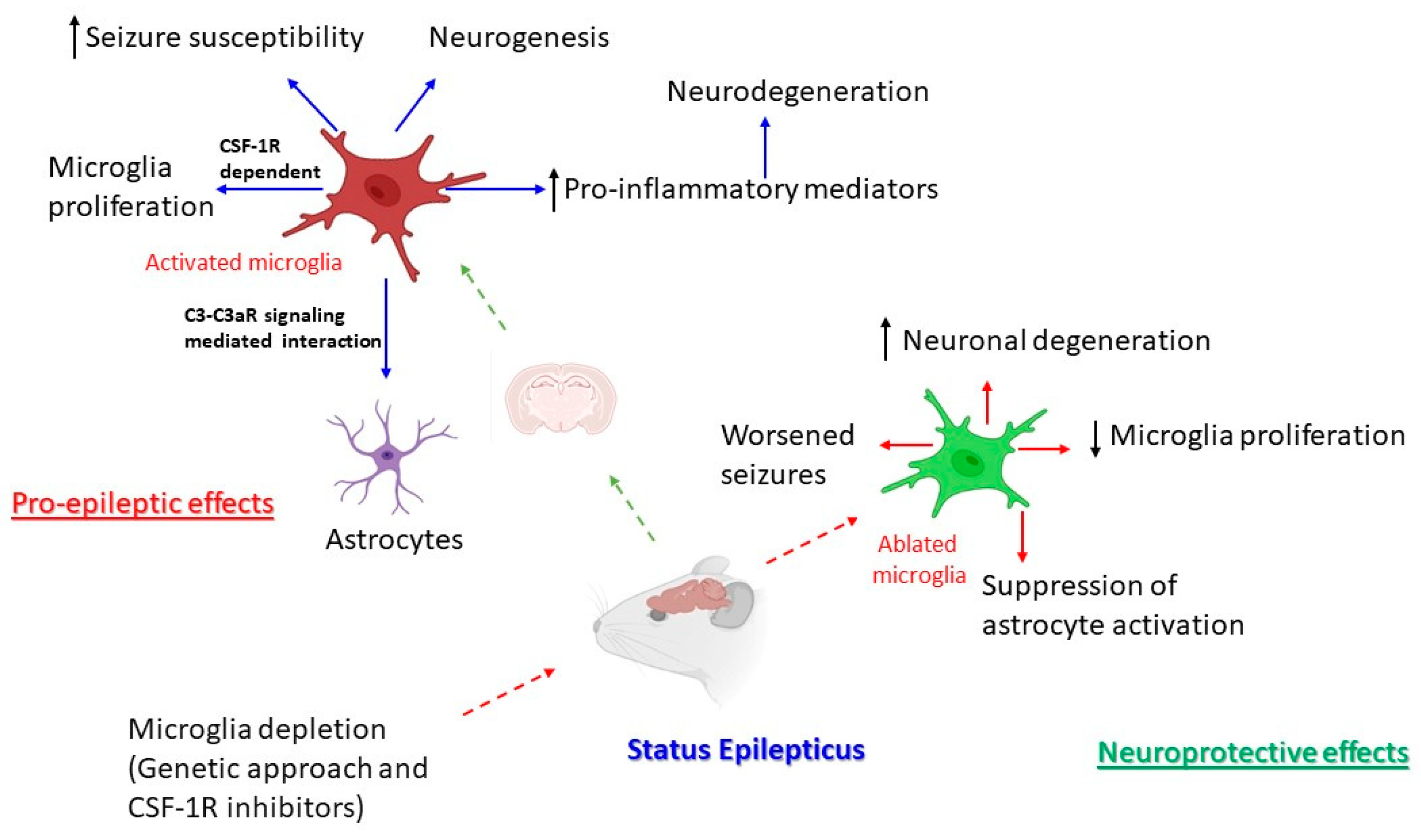
Microglia are acknowledged to contribute to epileptogenesis mainly via their activation and morphological changes (hyper-ramified or ameboid), in turn contributing to neuroinflammation and subsequent neurodegeneration [26,60]. However, microglia can also trigger an epileptic seizure in a manner not dependent on neuroinflammation [28]. In contrast to the current understanding, where microglia have detrimental effects during epilepsy mainly via contributing to chronic neuroinflammation [148], neuroprotective aspects of microglia have been documented as evident by worsened SE-induced seizures upon genetic depletion of microglia [14]. A similar line of effects has also been observed upon pharmacological depletion of microglia using CSF-1R inhibitors (PLX3397, PLX5622, and GW2580) [10,50,93,137]. The pro-epileptic and anti-epileptic phenotypes of microglia (Figure 1) depend on their activation state, meaning that short-term microglial activation is beneficial [130,149] whereas long-term microglial activation is detrimental [150]. It is also crucial to consider that the aspect of microglial activation might be different from the difference in the seizure model induced by different pro-convulsants. Moreover, these dual effects of microglia might be attributed to a direct mechanism in which microglia confer a protective role by maintaining glucose homeostasis and inhibiting ictogenesis, and to an indirect mechanism in which microglia depletion causes nonspecific effects and may plausibly increase seizure susceptibility [147]. One plausible reason might be the dual effects of microglia on BBB permeability, since microglia protect the integrity of the BBB by migrating to the BBB, and later initiate leakage by phagocytosis of BBB components, leading to neuroinflammation [151].

6. Therapeutic Targeting of Microglia in Epilepsy

Chronic microglial activation is a hallmark of many CNS disorders, including epilepsy, where the activated microglia contribute to neuroinflammation via releasing pre-inflammatory and neurotoxic mediators, in turn leading to exacerbation of neurotoxicity and neurodegeneration [152]. Several key molecular pathways relevant to the therapeutic targeting of microglia have been identified. These include inflammation inhibiting Minocycline, inhibitors of cytokine pathways and complement cascade, the antagonist of purinergic signaling, and modulators of CX3CL1 signaling, CSF-1R inhibitors, activators of TREM2, etc. [20]. Broadly, microglia depletion, microglia repopulation, and microglia replacement have emerged as therapeutic tools to manipulate microglia [153]. Among these, the widely used strategy to target microglia is to change the microglia landscape with CSF-1R inhibitors via depleting microglia and Minocycline to inhibit microglia activation. More detailed discussion can be found in Section 4 regarding microglia depletion with CSF-1R inhibitors and its effect on seizure outcome. However, repopulated microglia might sometimes be detrimental [154,155], which could be plausibly due to global macrophage depletion by CSF-1R inhibitors. Assessing the short-term and long-term impact of microglia deletion, repopulation, and replacement (with optimal timing) on brain function and cellular interactions can maximize the beneficial effects and minimize the adverse effects [153].
Minocycline has gained more attention as a broad inhibitor of microglia and is a widely used drug in the clinic and has been investigated in the context of epilepsy [156,157]. Minocycline is a semisynthetic tetracycline antibiotic analog and is known for its inhibitory effect on microglial activation, inhibition of microglial phagocytosis of the synapse, and penetration of BBB effectively [22,158]. Minocycline has demonstrated its neuroprotective effects in many neurodegenerative diseases (NDs) including TBI [159], Alzheimer’s disease (AD) [160], Parkinson’s disease (PD) [161], depression [158], etc., mainly via inhibiting microglial activation.
Minocycline has inhibited SE-induced microglial activation without affecting astrocyte activation, inhibited SE-induced hippocampal neuronal loss, and reduced SE-induced activation of the inflammatory mediator (IL-1β and TNF-α) [72]. More importantly, Minocycline treatment reduced the SRS parameter (frequency, duration, and severity), reflecting that Minocycline might exert disease modification against epilepsy [72]. In addition, Minocycline administration has suppressed the long-term anti-epileptogenic effects of early-life seizures mainly by attenuating increased seizure susceptibility and increased activation of microglia [44]. Via its caspase-dependent and independent mechanism, Minocycline treatment has exerted a neuroprotective effect via inhibited KA-induced hippocampal cell death [76]. In the IQSEC3-KD seizure model, Minocycline inhibited DG granule neuron cell death and spontaneous seizures without interfering with GABAergic synapse deficits or somatostatin loss [162]. On a different note, Minocycline treatment does not exert strong anti-convulsive effects in a PTZ kindling model [163], MES [164], and Subcutaneous Metrazol seizure threshold test [164]. No significant protective effect in seizure progression and survival was observed in Tsc1GFAPCKO mice upon Minocycline treatment despite its potential to inhibit microglial activation in the early stage of diseases [165]. More details on the studies evaluating Minocycline effects against the experimental seizure model are provided in Table 1.
These findings on Minocycline treatment provide compelling evidence that therapeutic treatment targeting activated microglia will not only represent a novel therapeutic strategy to ameliorate neuronal function but also has the potential to halt epileptogenesis via its disease-modifying effect. Before repurposing Minocycline as a future “anti-epileptic therapy” based on its effect from pre-clinical studies, Minocycline is not microglia-specific and having said that, microglia exists in multiple phenotypes, so which phenotypes of microglial activation are inhibited by Minocycline should be fully understood first [167]. The underlying mechanism by which Minocycline acts on microglia rather than on myeloid and non-myeloid peripheral cells remains elusive [167].
Regarding the clinical aspects, several clinical trials targeting microglia with several investigational agents in NDs have emerged rapidly. Clinical trials of several diseases associated with microglial genes, including TREM2, CD33, and progranulin (PGRN), via targeting microglia-specific dysfunction have been reported [168]. Several investigational agents of TREM2 (AL002-NCT04592874; VHB937-NCT06643481; VG-3927-NCT06343636; VGL101-NCT05677659), CD33 (AL003-NCT03822208), PGRN (AVB101-NCT06064890; DNL593-NCT05262023), ApoE2 (LX1001-NCT03634007), C1q (ANX005-NCT04569435), CSF-1R (JNJ40346527-NCT04121208), IL-1β (Canakinumab-NCT04795466), NF-kβ (NE3107-NCT04669028), NLRP3 (OLT1177-ISRCTN16806940), TLR2 (NPT52034-NCT03954600), and TNF-α (XPro1595-NCT05318976) have been investigated against several NDs including AD, PD, frontotemporal dementia (FTD), amyotrophic lateral sclerosis (ALS), etc. [168,169,170,171,172,173,174]. Despite promising pre-clinical outcomes of microglia-targeting therapies, translating into clinical settings remains very challenging. This challenge includes less understanding on long-term consequences of microglial depletion, time window, and duration of treatment, along with what stages of disease progression favor microglia transplantation and possible off-target effects [175,176]. Advancement of imaging techniques and development and discovery of biomarker will indeed aid in monitoring microglial dynamics and treatment responses [175].

7. Conclusions and Future Implications

The role of microglia in the context of epileptic seizure and its plausible underlying mechanism is complex, warranting future studies. A better understanding of the glial cells, especially microglia, might pave the way forward in delineating the microglial role in seizure generation, which might plausibly represent microglia as a promising therapeutic target against epilepsy. Understanding microglial dynamics, morphologies, and related inflammatory/phagocytic phenotypes during seizure after SE is crucial in developing therapies to manage SE [35]. Many more caveats need to be completely answered before moving to microglia-based therapy as a disease-modifying anti-epileptic strategy. These include the following: (1) A precise understanding of the microglial role in initiating, maintaining, and terminating seizure. (2) Does therapeutically manipulating microglial function prevent seizure occurrence or halt the progression of seizure? (3) What might be the critical window of microglia-based therapeutic intervention against epileptic seizures? [148].
Future microglia-targeting therapies should focus more on reducing the off-target effects, which can be achieved via differentiating individual myeloid populations with the use of advanced tools, and precise understanding of the interaction of different microglial states in health and disease would plausibly drive microglia-targeting therapy [20]. For this, effective microglia-targeting strategies to modulate microglia states (with its receptors, signaling pathways, and channels) that could target activities including phagocytosis, inflammation, process motility, energy metabolism, etc., are needed [20]. Genetic differences among an individual might lead to different microglial responses, and manipulating microglial activity without disrupting microglial normal immune functions remains challenging [177].

Author Contributions

Y.N.P. conceptualized the idea and performed the literature search and drafted the original manuscript. L.S.D., E.A., R.E.B. and S.K. provide critical inputs and edited the final draft. L.S.D. was involved in supervision and reviewed and edited the final draft. All authors have read and agreed to the published version of the manuscript.

Funding

This work was supported by the funding from the Countermeasures Against Chemical Threats (CounterACT) Program, the National Institutes of Health (NIH) Office of the Director (OD), and the National Institute of Neurological Disorders and Stroke (NINDS) [Grant Number- UG3 NS133630].

Institutional Review Board Statement

Not applicable.

Informed Consent Statement

Not applicable.

Data Availability Statement

No new data were created or analyzed in this study.

Conflicts of Interest

The authors declare no conflicts of interest.

Abbreviations

The following abbreviations are used in this manuscript:
CNSCentral nervous system
SRSsSpontaneous recurrent seizures;
ASMsAnti-seizure medications
SEStatus epilepticus
DREDrug-resistant epilepsy
MTLEMesial temporal lobe epilepsy
BBBBlood–brain barrier
NDsNeurodegenerative diseases
SVZSubventricular zone
OPCsOligodendrocyte progenitor cells
CSF1-RColony-stimulating factor 1-receptor
HPDsHippocampal paroxysmal discharges
OHSCOrganotypic hippocampal slice culture
KAKainic acid
PTZPentylenetetrazol
MESMaximal electroshock model
ICVIntracerebroventricular
I.P.Intraperitoneal
HSHippocampal sclerosis
aCSFArtificial cerebrospinal fluid
DGDentate gyrus
ECSsElectro-convulsive seizures
TLR2Toll-like receptor 2
MPPMicroglial process pouches
MPCMicroglial process convergence
DREADDDesigner receptor exclusively activated by designer drugs
CCR2C-C chemokine receptor type 2
PNESPsychogenic non-epileptic seizures
NORSENew-onset refractory status epilepticus
CNOClozapine N-oxide

References

  1. Yuen, A.W.; Keezer, M.R.; Sander, J.W. Epilepsy is a neurological and a systemic disorder. Epilepsy Behav. 2018, 78, 57–61. [Google Scholar] [CrossRef]
  2. Thijs, R.D.; Surges, R.; O’Brien, T.J.; Sander, J.W. Epilepsy in adults. Lancet 2019, 393, 689–701. [Google Scholar] [CrossRef]
  3. Devinsky, O.; Lai, G. Spirituality and religion in epilepsy. Epilepsy Behav. 2008, 12, 636–643. [Google Scholar] [CrossRef] [PubMed]
  4. DeLorenzo, R.J.; Sun, D.A.; Deshpande, L.S. Cellular mechanisms underlying acquired epilepsy: The calcium hypothesis of the induction and maintenance of epilepsy. Pharmacol. Ther. 2005, 105, 229–266, Erratum in Pharmacol. Ther. 2006, 111, 288–325.. [Google Scholar] [CrossRef]
  5. Hildebrand, M.S.; Dahl, H.-H.M.; Damiano, J.A.; Smith, R.J.; Scheffer, I.E.; Berkovic, S.F. Recent advances in the molecular genetics of epilepsy. J. Med. Genet. 2013, 50, 271–279. [Google Scholar] [CrossRef]
  6. Pitkänen, A.; Engel, J. Past and present definitions of epileptogenesis and its biomarkers. Neurotherapeutics 2014, 11, 231–241. [Google Scholar] [CrossRef] [PubMed]
  7. Kwan, P.; Brodie, M.J. Early identification of refractory epilepsy. N. Engl. J. Med. 2000, 342, 314–319. [Google Scholar] [CrossRef] [PubMed]
  8. Barath, A.S.; Wu, L.J. Microglial phagocytosis in epilepsy: Mechanisms and impact. J. Physiol. 2026, 604, 1575–1591. [Google Scholar] [CrossRef]
  9. Bazhanova, E.D.; Kozlov, A.A.; Litovchenko, A.V. Mechanisms of drug resistance in the pathogenesis of epilepsy: Role of neuroinflammation. A literature review. Brain Sci. 2021, 11, 663. [Google Scholar] [CrossRef]
  10. Di Nunzio, M.; Di Sapia, R.; Sorrentino, D.; Kebede, V.; Cerovic, M.; Gullotta, G.S.; Bacigaluppi, M.; Audinat, E.; Marchi, N.; Ravizza, T. Microglia proliferation plays distinct roles in acquired epilepsy depending on disease stages. Epilepsia 2021, 62, 1931–1945. [Google Scholar] [CrossRef]
  11. Liu, M.; Jiang, L.; Wen, M.; Ke, Y.; Tong, X.; Huang, W.; Chen, R. Microglia depletion exacerbates acute seizures and hippocampal neuronal degeneration in mouse models of epilepsy. Am. J. Physiol.-Cell Physiol. 2020, 319, C605–C610. [Google Scholar] [CrossRef]
  12. Eyo, U.B.; Haruwaka, K.; Mo, M.; Campos-Salazar, A.B.; Wang, L.; Speros, X.S., IV; Sabu, S.; Xu, P.; Wu, L.-J. Microglia provide structural resolution to injured dendrites after severe seizures. Cell Rep. 2021, 35, 109080. [Google Scholar] [CrossRef]
  13. Wei, Y.; Chen, T.; Bosco, D.B.; Xie, M.; Zheng, J.; Dheer, A.; Ying, Y.; Wu, Q.; Lennon, V.A.; Wu, L.J. The complement C3-C3aR pathway mediates microglia–astrocyte interaction following status epilepticus. Glia 2021, 69, 1155–1169. [Google Scholar] [CrossRef] [PubMed]
  14. Wu, W.; Li, Y.; Wei, Y.; Bosco, D.B.; Xie, M.; Zhao, M.-G.; Richardson, J.R.; Wu, L.-J. Microglial depletion aggravates the severity of acute and chronic seizures in mice. Brain. Behav. Immun. 2020, 89, 245–255. [Google Scholar] [CrossRef] [PubMed]
  15. Mo, M.; Eyo, U.B.; Xie, M.; Peng, J.; Bosco, D.B.; Umpierre, A.D.; Zhu, X.; Tian, D.-S.; Xu, P.; Wu, L.-J. Microglial P2Y12 receptor regulates seizure-induced neurogenesis and immature neuronal projections. J. Neurosci. 2019, 39, 9453–9464. [Google Scholar] [CrossRef] [PubMed]
  16. Feng, L.; Murugan, M.; Bosco, D.B.; Liu, Y.; Peng, J.; Worrell, G.A.; Wang, H.L.; Ta, L.E.; Richardson, J.R.; Shen, Y. Microglial proliferation and monocyte infiltration contribute to microgliosis following status epilepticus. Glia 2019, 67, 1434–1448. [Google Scholar] [CrossRef]
  17. Eyo, U.B.; Peng, J.; Swiatkowski, P.; Mukherjee, A.; Bispo, A.; Wu, L.-J. Neuronal hyperactivity recruits microglial processes via neuronal NMDA receptors and microglial P2Y12 receptors after status epilepticus. J. Neurosci. 2014, 34, 10528–10540. [Google Scholar] [CrossRef]
  18. Wolf, S.A.; Boddeke, H.; Kettenmann, H. Microglia in physiology and disease. Annu. Rev. Physiol. 2017, 79, 619–643. [Google Scholar] [CrossRef]
  19. Masuda, T.; Prinz, M. Microglia: A unique versatile cell in the central nervous system. ACS Chem. Neurosci. 2016, 7, 428–434. [Google Scholar] [CrossRef]
  20. Šimončičová, E.; de Andrade, E.G.; Vecchiarelli, H.A.; Awogbindin, I.O.; Delage, C.I.; Tremblay, M.-È. Present and future of microglial pharmacology. Trends Pharmacol. Sci. 2022, 43, 669–685. [Google Scholar] [CrossRef]
  21. Sierra, A.; Paolicelli, R.C.; Kettenmann, H. Cien Años de Microglía: Milestones in a century of microglial research. Trends Neurosci. 2019, 42, 778–792. [Google Scholar] [CrossRef]
  22. Tay, T.L.; Béchade, C.; D’Andrea, I.; St-Pierre, M.-K.; Henry, M.S.; Roumier, A.; Tremblay, M.-E. Microglia gone rogue: Impacts on psychiatric disorders across the lifespan. Front. Mol. Neurosci. 2018, 10, 421. [Google Scholar] [CrossRef]
  23. Paolicelli, R.C.; Sierra, A.; Stevens, B.; Tremblay, M.-E.; Aguzzi, A.; Ajami, B.; Amit, I.; Audinat, E.; Bechmann, I.; Bennett, M. Microglia states and nomenclature: A field at its crossroads. Neuron 2022, 110, 3458–3483. [Google Scholar] [CrossRef]
  24. Prinz, M.; Jung, S.; Priller, J. Microglia biology: One century of evolving concepts. Cell 2019, 179, 292–311. [Google Scholar] [CrossRef]
  25. Van Vliet, E.; Aronica, E.; Vezzani, A.; Ravizza, T. Neuroinflammatory pathways as treatment targets and biomarker candidates in epilepsy: Emerging evidence from preclinical and clinical studies. Neuropathol. Appl. Neurobiol. 2018, 44, 91–111. [Google Scholar] [CrossRef] [PubMed]
  26. Morin-Brureau, M.; Milior, G.; Royer, J.; Chali, F.; Le Duigou, C.; Savary, E.; Blugeon, C.; Jourdren, L.; Akbar, D.; Dupont, S. Microglial phenotypes in the human epileptic temporal lobe. Brain 2018, 141, 3343–3360. [Google Scholar] [CrossRef]
  27. Böttcher, C.; Schlickeiser, S.; Sneeboer, M.A.; Kunkel, D.; Knop, A.; Paza, E.; Fidzinski, P.; Kraus, L.; Snijders, G.J.; Kahn, R.S. Human microglia regional heterogeneity and phenotypes determined by multiplexed single-cell mass cytometry. Nat. Neurosci. 2019, 22, 78–90. [Google Scholar] [CrossRef]
  28. Zhao, X.; Liao, Y.; Morgan, S.; Mathur, R.; Feustel, P.; Mazurkiewicz, J.; Qian, J.; Chang, J.; Mathern, G.W.; Adamo, M.A. Noninflammatory changes of microglia are sufficient to cause epilepsy. Cell Rep. 2018, 22, 2080–2093. [Google Scholar] [CrossRef] [PubMed]
  29. Kinoshita, S.; Koyama, R. Pro-and anti-epileptic roles of microglia. Neural Regen. Res. 2021, 16, 1369. [Google Scholar] [PubMed]
  30. Luo, C.; Koyama, R.; Ikegaya, Y. Microglia engulf viable newborn cells in the epileptic dentate gyrus. Glia 2016, 64, 1508–1517. [Google Scholar] [CrossRef]
  31. Vezzani, A.; Conti, M.; De Luigi, A.; Ravizza, T.; Moneta, D.; Marchesi, F.; De Simoni, M.G. Interleukin-1β immunoreactivity and microglia are enhanced in the rat hippocampus by focal kainate application: Functional evidence for enhancement of electrographic seizures. J. Neurosci. 1999, 19, 5054–5065. [Google Scholar] [CrossRef]
  32. Vezzani, A.; Balosso, S.; Ravizza, T. Neuroinflammatory pathways as treatment targets and biomarkers in epilepsy. Nat. Rev. Neurol. 2019, 15, 459–472. [Google Scholar] [CrossRef]
  33. Vezzani, A.; Moneta, D.; Richichi, C.; Aliprandi, M.; Burrows, S.J.; Ravizza, T.; Perego, C.; De Simoni, M.G. Functional role of inflammatory cytokines and antiinflammatory molecules in seizures and epileptogenesis. Epilepsia 2002, 43, 30–35. [Google Scholar] [CrossRef]
  34. De Simoni, M.G.; Perego, C.; Ravizza, T.; Moneta, D.; Conti, M.; Marchesi, F.; De Luigi, A.; Garattini, S.; Vezzani, A. Inflammatory cytokines and related genes are induced in the rat hippocampus by limbic status epilepticus. Eur. J. Neurosci. 2000, 12, 2623–2633. [Google Scholar] [CrossRef]
  35. Wyatt-Johnson, S.K.; Herr, S.A.; Brewster, A.L. Status epilepticus triggers time-dependent alterations in microglia abundance and morphological phenotypes in the hippocampus. Front. Neurol. 2017, 8, 700. [Google Scholar] [CrossRef]
  36. Benson, M.J.; Manzanero, S.; Borges, K. Complex alterations in microglial M1/M2 markers during the development of epilepsy in two mouse models. Epilepsia 2015, 56, 895–905. [Google Scholar] [CrossRef]
  37. Aronica, E.; Boer, K.; Van Vliet, E.; Redeker, S.; Baayen, J.; Spliet, W.; Van Rijen, P.; Troost, D.; Da Silva, F.L.; Wadman, W. Complement activation in experimental and human temporal lobe epilepsy. Neurobiol. Dis. 2007, 26, 497–511. [Google Scholar] [CrossRef] [PubMed]
  38. Varvel, N.H.; Neher, J.J.; Bosch, A.; Wang, W.; Ransohoff, R.M.; Miller, R.J.; Dingledine, R. Infiltrating monocytes promote brain inflammation and exacerbate neuronal damage after status epilepticus. Proc. Natl. Acad. Sci. USA 2016, 113, E5665–E5674. [Google Scholar] [CrossRef]
  39. Avignone, E.; Ulmann, L.; Levavasseur, F.; Rassendren, F.; Audinat, E. Status epilepticus induces a particular microglial activation state characterized by enhanced purinergic signaling. J. Neurosci. 2008, 28, 9133–9144. [Google Scholar] [CrossRef] [PubMed]
  40. Gibbs-Shelton, S.; Benderoth, J.; Gaykema, R.P.; Straub, J.; Okojie, K.A.; Uweru, J.O.; Lentferink, D.H.; Rajbanshi, B.; Cowan, M.N.; Patel, B. Microglia play beneficial roles in multiple experimental seizure models. Glia 2023, 71, 1699–1714. [Google Scholar] [CrossRef] [PubMed]
  41. Madry, C.; Attwell, D. Receptors, ion channels, and signaling mechanisms underlying microglial dynamics. J. Biol. Chem. 2015, 290, 12443–12450. [Google Scholar] [CrossRef]
  42. Jonas, R.A.; Yuan, T.-F.; Liang, Y.-X.; Jonas, J.B.; Tay, D.K.; Ellis-Behnke, R.G. The spider effect: Morphological and orienting classification of microglia in response to stimuli in vivo. PLoS ONE 2012, 7, e30763. [Google Scholar] [CrossRef]
  43. Bedner, P.; Dupper, A.; Hüttmann, K.; Müller, J.; Herde, M.K.; Dublin, P.; Deshpande, T.; Schramm, J.; Häussler, U.; Haas, C.A. Astrocyte uncoupling as a cause of human temporal lobe epilepsy. Brain 2015, 138, 1208–1222. [Google Scholar] [CrossRef]
  44. Abraham, J.; Fox, P.D.; Condello, C.; Bartolini, A.; Koh, S. Minocycline attenuates microglia activation and blocks the long-term epileptogenic effects of early-life seizures. Neurobiol. Dis. 2012, 46, 425–430. [Google Scholar] [CrossRef]
  45. Ravizza, T.; Rizzi, M.; Perego, C.; Richichi, C.; Velískǒvá, J.; Moshé, S.L.; De Simoni, M.G.; Vezzani, A. Inflammatory response and glia activation in developing rat hippocampus after status epilepticus. Epilepsia 2005, 46, 113–117. [Google Scholar] [CrossRef] [PubMed]
  46. Ali, I.; Chugh, D.; Ekdahl, C.T. Role of fractalkine–CX3CR1 pathway in seizure-induced microglial activation, neurodegeneration, and neuroblast production in the adult rat brain. Neurobiol. Dis. 2015, 74, 194–203. [Google Scholar] [CrossRef]
  47. Shapiro, L.A.; Wang, L.; Ribak, C.E. Rapid astrocyte and microglial activation following pilocarpine-induced seizures in rats. Epilepsia 2008, 49, 33–41. [Google Scholar] [CrossRef]
  48. Kim, I.; Mlsna, L.M.; Yoon, S.; Le, B.; Yu, S.; Xu, D.; Koh, S. A postnatal peak in microglial development in the mouse hippocampus is correlated with heightened sensitivity to seizure triggers. Brain Behav. 2015, 5, e00403. [Google Scholar] [CrossRef]
  49. Kubova, H.; Druga, R.; Lukasiuk, K.; Suchomelova, L.; Haugvicova, R.; Jirmanová, I.; Pitkänen, A. Status epilepticus causes necrotic damage in the mediodorsal nucleus of the thalamus in immature rats. J. Neurosci. 2001, 21, 3593–3599. [Google Scholar] [CrossRef] [PubMed]
  50. Henning, L.; Antony, H.; Breuer, A.; Müller, J.; Seifert, G.; Audinat, E.; Singh, P.; Brosseron, F.; Heneka, M.T.; Steinhäuser, C. Reactive microglia are the major source of tumor necrosis factor alpha and contribute to astrocyte dysfunction and acute seizures in experimental temporal lobe epilepsy. Glia 2022, 71, 168–186. [Google Scholar] [CrossRef] [PubMed]
  51. Landucci, E.; Mazzantini, C.; Lana, D.; Calvani, M.; Magni, G.; Giovannini, M.G.; Pellegrini-Giampietro, D.E. Cannabidiol inhibits microglia activation and mitigates neuronal damage induced by kainate in an in-vitro seizure model. Neurobiol. Dis. 2022, 174, 105895. [Google Scholar] [CrossRef] [PubMed]
  52. Goldfarb, S.; Fainstein, N.; Ganz, T.; Vershkov, D.; Lachish, M.; Ben-Hur, T. Electric neurostimulation regulates microglial activation via retinoic acid receptor α signaling. Brain. Behav. Immun. 2021, 96, 40–53. [Google Scholar] [CrossRef]
  53. López-Meraz, M.L.; Álvarez-Croda, D.M. Microglia and Status Epilepticus in the Immature Brain. Epilepsia Open 2022, 8, S73–S81. [Google Scholar] [CrossRef] [PubMed]
  54. Eyo, U.B.; Mo, M.; Yi, M.-H.; Murugan, M.; Liu, J.; Yarlagadda, R.; Margolis, D.J.; Xu, P.; Wu, L.-J. P2Y12R-dependent translocation mechanisms gate the changing microglial landscape. Cell Rep. 2018, 23, 959–966. [Google Scholar] [CrossRef]
  55. Hammond, B.P.; Manek, R.; Kerr, B.J.; Macauley, M.S.; Plemel, J.R. Regulation of microglia population dynamics throughout development, health, and disease. Glia 2021, 69, 2771–2797. [Google Scholar] [CrossRef]
  56. Hong, J.; Cho, I.-H.; Kwak, K.I.; Suh, E.C.; Seo, J.; Min, H.J.; Choi, S.-Y.; Kim, C.-H.; Park, S.H.; Jo, E.-K. Microglial Toll-like receptor 2 contributes to kainic acid-induced glial activation and hippocampal neuronal cell death. J. Biol. Chem. 2010, 285, 39447–39457. [Google Scholar] [CrossRef]
  57. Kulikov, A.A.; Naumova, A.A.; Dorofeeva, N.A.; Ivlev, A.P.; Glazova, M.V.; Chernigovskaya, E.V. Dynamics of neurodegeneration in the hippocampus of Krushinsky-Molodkina rats correlates with the progression of limbic seizures. Epilepsy Behav. 2022, 134, 108846. [Google Scholar] [CrossRef]
  58. Wolinski, P.; Ksiazek-Winiarek, D.; Glabinski, A. Cytokines and Neurodegeneration in Epileptogenesis. Brain Sci. 2022, 12, 380. [Google Scholar] [CrossRef] [PubMed]
  59. Pitkänen, A. Efficacy of current antiepileptics to prevent neurodegeneration in epilepsy models. Epilepsy Res. 2002, 50, 141–160. [Google Scholar] [CrossRef]
  60. Borges, K.; Gearing, M.; McDermott, D.L.; Smith, A.B.; Almonte, A.G.; Wainer, B.H.; Dingledine, R. Neuronal and glial pathological changes during epileptogenesis in the mouse pilocarpine model. Exp. Neurol. 2003, 182, 21–34. [Google Scholar] [CrossRef]
  61. Ravizza, T.; Gagliardi, B.; Noé, F.; Boer, K.; Aronica, E.; Vezzani, A. Innate and adaptive immunity during epileptogenesis and spontaneous seizures: Evidence from experimental models and human temporal lobe epilepsy. Neurobiol. Dis. 2008, 29, 142–160. [Google Scholar] [CrossRef]
  62. Xie, M.; Wu, X.; Liu, X.; Li, L.; Gu, F.; Tao, X.; Song, B.; Bai, L.; Li, D.; Shen, H. GrpEL1 overexpression mitigates hippocampal neuron damage via mitochondrial unfolded protein response after experimental status epilepticus. Neurobiol. Dis. 2025, 206, 106838. [Google Scholar] [CrossRef] [PubMed]
  63. Kang, J.; Mo, S.; Shu, X.; Cheng, S. Effects of Baicalein Pretreatment on the NLRP3/GSDMD Pyroptosis Pathway and Neuronal Injury in Pilocarpine-Induced Status Epilepticus in the Mice. Eneuro 2025, 12, ENEURO.0319-24.2024. [Google Scholar] [CrossRef] [PubMed]
  64. DeGiorgio, C.M.; Tomiyasu, U.; Gott, P.S.; Treiman, D.M. Hippocampal pyramidal cell loss in human status epilepticus. Epilepsia 1992, 33, 23–27. [Google Scholar] [CrossRef]
  65. Thom, M.; Zhou, J.; Martinian, L.; Sisodiya, S. Quantitative post-mortem study of the hippocampus in chronic epilepsy: Seizures do not inevitably cause neuronal loss. Brain 2005, 128, 1344–1357. [Google Scholar] [CrossRef]
  66. Cartagena, A.; Young, G.; Lee, D.; Mirsattari, S. Reversible and irreversible cranial MRI findings associated with status epilepticus. Epilepsy Behav. 2014, 33, 24–30. [Google Scholar] [CrossRef]
  67. Du, K.; He, M.; Zhao, D.; Wang, Y.; Ma, C.; Liang, H.; Wang, W.; Min, D.; Xue, L.; Guo, F. Mechanism of cell death pathways in status epilepticus and related therapeutic agents. Biomed. Pharmacother. 2022, 149, 112875. [Google Scholar] [CrossRef]
  68. Elward, K.; Gasque, P. “Eat me” and “don’t eat me” signals govern the innate immune response and tissue repair in the CNS: Emphasis on the critical role of the complement system. Mol. Immunol. 2003, 40, 85–94. [Google Scholar] [CrossRef]
  69. Leslie, J.D.; Mayor, R. Complement in animal development: Unexpected roles of a highly conserved pathway. In Proceedings of the Seminars in Immunology; Academic Press: Cambridge, MA, USA, 2013; pp. 39–46. [Google Scholar]
  70. Schartz, N.D.; Wyatt-Johnson, S.K.; Price, L.R.; Colin, S.A.; Brewster, A.L. Status epilepticus triggers long-lasting activation of complement C1q-C3 signaling in the hippocampus that correlates with seizure frequency in experimental epilepsy. Neurobiol. Dis. 2018, 109, 163–173. [Google Scholar] [CrossRef] [PubMed]
  71. Papageorgiou, I.E.; Fetani, A.F.; Lewen, A.; Heinemann, U.; Kann, O. Widespread activation of microglial cells in the hippocampus of chronic epileptic rats correlates only partially with neurodegeneration. Brain Struct. Funct. 2015, 220, 2423–2439. [Google Scholar] [CrossRef]
  72. Wang, N.; Mi, X.; Gao, B.; Gu, J.; Wang, W.; Zhang, Y.; Wang, X. Minocycline inhibits brain inflammation and attenuates spontaneous recurrent seizures following pilocarpine-induced status epilepticus. Neuroscience 2015, 287, 144–156. [Google Scholar] [CrossRef]
  73. Rao, R.; Medhi, B.; Saikia, U.; Arora, S.; Toor, J.S.; Khanduja, K.; Pandhi, P. Experimentally induced various inflammatory models and seizure: Understanding the role of cytokine in rat. Eur. Neuropsychopharmacol. 2008, 18, 760–767. [Google Scholar] [CrossRef]
  74. Hu, S.; Sheng, W.S.; Ehrlich, L.C.; Peterson, P.K.; Chao, C.C. Cytokine effects on glutamate uptake by human astrocytes. Neuroimmunomodulation 2000, 7, 153–159. [Google Scholar] [CrossRef]
  75. Viviani, B.; Bartesaghi, S.; Gardoni, F.; Vezzani, A.; Behrens, M.; Bartfai, T.; Binaglia, M.; Corsini, E.; Di Luca, M.; Galli, C. Interleukin-1β enhances NMDA receptor-mediated intracellular calcium increase through activation of the Src family of kinases. J. Neurosci. 2003, 23, 8692–8700. [Google Scholar] [CrossRef]
  76. Heo, K.; Cho, Y.-J.; Cho, K.-J.; Kim, H.-W.; Kim, H.-J.; Shin, H.Y.; Lee, B.I.; Kim, G.W. Minocycline inhibits caspase-dependent and-independent cell death pathways and is neuroprotective against hippocampal damage after treatment with kainic acid in mice. Neurosci. Lett. 2006, 398, 195–200. [Google Scholar] [CrossRef] [PubMed]
  77. Tian, D.-S.; Peng, J.; Murugan, M.; Feng, L.-J.; Liu, J.-L.; Eyo, U.B.; Zhou, L.-J.; Mogilevsky, R.; Wang, W.; Wu, L.-J. Chemokine CCL2–CCR2 signaling induces neuronal cell death via STAT3 activation and IL-1β production after status epilepticus. J. Neurosci. 2017, 37, 7878–7892. [Google Scholar] [CrossRef]
  78. Pourkhodadad, S.; Wang, W.; Dingledine, R.; Varvel, N.H. Brain-invading monocytes promote seizure-associated cognitive deficits and neurodegeneration. Neuropharmacology 2025, 279, 110625. [Google Scholar] [CrossRef]
  79. Shen, H.-Y.; Balzekas, I.; Jung, Y.; Kim, S.; Kang, J.W.; Xu, D.; White, J.; Jeong, J.; Ferris, N.; Koh, S. A model of new-onset refractory status epilepticus (NORSE) using intrahippocampal kainic acid in adolescent mice. Epilepsy Res. 2026, 222, 107754. [Google Scholar] [CrossRef] [PubMed]
  80. Grabon, W.; Gasmi, N.; Lang, A.; Ruiz, A.; Georges, B.; Blot, V.; Ogier, M.; Rheims, S.; Navarro, F.P.; Bezin, L. Brain-infiltrated monocyte macrophages in a rat model of temporal lobe epilepsy: Revisiting the pro-inflammatory paradigm. Front. Immunol. 2025, 16, 1695856. [Google Scholar] [CrossRef]
  81. Tan, T.H.-L.; Sequeira, R.P.; Perucca, P.; Kwan, P.; O’Brien, T.J.; Monif, M. Peripheral cytokine and monocyte phenotype associations in drug-resistant epilepsy. Sci. Rep. 2025, 15, 29654. [Google Scholar] [CrossRef] [PubMed]
  82. Luo, C.; Ikegaya, Y.; Koyama, R. Microglia and neurogenesis in the epileptic dentate gyrus. Neurogenesis 2016, 3, e1235525. [Google Scholar] [CrossRef] [PubMed]
  83. Victor, T.R.; Hage, Z.; Tsirka, S.E. Prophylactic administration of cannabidiol reduces microglial inflammatory response to kainate-induced seizures and neurogenesis. Neuroscience 2022, 500, 1–11. [Google Scholar] [CrossRef]
  84. Parent, J.M.; Timothy, W.Y.; Leibowitz, R.T.; Geschwind, D.H.; Sloviter, R.S.; Lowenstein, D.H. Dentate granule cell neurogenesis is increased by seizures and contributes to aberrant network reorganization in the adult rat hippocampus. J. Neurosci. 1997, 17, 3727–3738. [Google Scholar] [CrossRef]
  85. Jessberger, S.; Römer, B.; Babu, H.; Kempermann, G. Seizures induce proliferation and dispersion of doublecortin-positive hippocampal progenitor cells. Exp. Neurol. 2005, 196, 342–351. [Google Scholar] [CrossRef]
  86. Abiega, O.; Beccari, S.; Diaz-Aparicio, I.; Nadjar, A.; Laye, S.; Leyrolle, Q.; Gómez-Nicola, D.; Domercq, M.; Pérez-Samartín, A.; Sánchez-Zafra, V. Neuronal hyperactivity disturbs ATP microgradients, impairs microglial motility, and reduces phagocytic receptor expression triggering apoptosis/microglial phagocytosis uncoupling. PLoS Biol. 2016, 14, e1002466. [Google Scholar] [CrossRef]
  87. Sierra, A.; Encinas, J.M.; Deudero, J.J.; Chancey, J.H.; Enikolopov, G.; Overstreet-Wadiche, L.S.; Tsirka, S.E.; Maletic-Savatic, M. Microglia shape adult hippocampal neurogenesis through apoptosis-coupled phagocytosis. Cell Stem Cell 2010, 7, 483–495. [Google Scholar] [CrossRef] [PubMed]
  88. Matsuda, T.; Murao, N.; Katano, Y.; Juliandi, B.; Kohyama, J.; Akira, S.; Kawai, T.; Nakashima, K. TLR9 signalling in microglia attenuates seizure-induced aberrant neurogenesis in the adult hippocampus. Nat. Commun. 2015, 6, 6514. [Google Scholar] [CrossRef] [PubMed]
  89. Yang, F.; Liu, Z.R.; Chen, J.; Zhang, S.J.; Quan, Q.Y.; Huang, Y.G.; Jiang, W. Roles of astrocytes and microglia in seizure-induced aberrant neurogenesis in the hippocampus of adult rats. J. Neurosci. Res. 2010, 88, 519–529. [Google Scholar] [CrossRef]
  90. Liddelow, S.A.; Marsh, S.E.; Stevens, B. Microglia and astrocytes in disease: Dynamic duo or partners in crime? Trends Immunol. 2020, 41, 820–835. [Google Scholar] [CrossRef]
  91. Borges, K.; McDermott, D.; Irier, H.; Smith, Y.; Dingledine, R. Degeneration and proliferation of astrocytes in the mouse dentate gyrus after pilocarpine-induced status epilepticus. Exp. Neurol. 2006, 201, 416–427. [Google Scholar] [CrossRef]
  92. Pernot, F.; Heinrich, C.; Barbier, L.; Peinnequin, A.; Carpentier, P.; Dhote, F.; Baille, V.; Beaup, C.; Depaulis, A.; Dorandeu, F. Inflammatory changes during epileptogenesis and spontaneous seizures in a mouse model of mesiotemporal lobe epilepsy. Epilepsia 2011, 52, 2315–2325. [Google Scholar] [CrossRef] [PubMed]
  93. Sano, F.; Shigetomi, E.; Shinozaki, Y.; Tsuzukiyama, H.; Saito, K.; Mikoshiba, K.; Horiuchi, H.; Cheung, D.L.; Nabekura, J.; Sugita, K. Reactive astrocyte-driven epileptogenesis is induced by microglia initially activated following status epilepticus. JCI Insight 2021, 6, e135391. [Google Scholar] [CrossRef]
  94. Tang, J.; Jila, S.; Luo, T.; Zhang, B.; Miao, H.; Feng, H.; Chen, Z.; Zhu, G. C3/C3aR inhibition alleviates GMH-IVH-induced hydrocephalus by preventing microglia-astrocyte interactions in neonatal rats. Neuropharmacology 2022, 205, 108927. [Google Scholar] [CrossRef]
  95. Lian, H.; Litvinchuk, A.; Chiang, A.C.-A.; Aithmitti, N.; Jankowsky, J.L.; Zheng, H. Astrocyte-microglia cross talk through complement activation modulates amyloid pathology in mouse models of Alzheimer’s disease. J. Neurosci. 2016, 36, 577–589. [Google Scholar] [CrossRef]
  96. Jha, M.K.; Jo, M.; Kim, J.-H.; Suk, K. Microglia-astrocyte crosstalk: An intimate molecular conversation. Neurosci. 2019, 25, 227–240. [Google Scholar] [CrossRef] [PubMed]
  97. Jeong, Y.; Lim, H.K.; Kim, H.; Lee, J.; Lee, S.; Suh, M. C1q neutralization during epileptogenesis attenuates complement-mediated synaptic elimination and epileptiform activity. Epilepsia 2026, 67, 908–922. [Google Scholar] [CrossRef] [PubMed]
  98. Matejuk, A.; Ransohoff, R.M. Crosstalk between astrocytes and microglia: An overview. Front. Immunol. 2020, 11, 1416. [Google Scholar] [CrossRef]
  99. Peng, J.; Yi, M.-H.; Jeong, H.; McEwan, P.P.; Zheng, J.; Wu, G.; Ganatra, S.; Ren, Y.; Richardson, J.R.; Oh, S.B. The voltage-gated proton channel Hv1 promotes microglia-astrocyte communication and neuropathic pain after peripheral nerve injury. Mol. Brain 2021, 14, 99. [Google Scholar] [CrossRef]
  100. Jiang, J.; Zuo, M.; Zhao, K.; Ling, Z.; Wu, Z.; Xue, D.; Mo, S.; Liu, Y.; Chen, Y.; Wang, J. mtDNA leakage promotes neuron–glia crosstalk to induce epilepsy by cGAS–STING-driven neuroinflammation and serine metabolic reprogramming. Proc. Natl. Acad. Sci. USA 2026, 123, e2522313123. [Google Scholar] [CrossRef]
  101. Xu, Y.; Zhang, M.; Zhou, K.; Wang, L. Single-Cell Dissection of the SPP1-CD44 Axis Reveals Microglia-Astrocyte Crosstalk Driving Neuroinflammation in Temporal Lobe Epilepsy. Mol. Neurobiol. 2026, 63, 376. [Google Scholar] [CrossRef] [PubMed]
  102. Wake, H.; Moorhouse, A.J.; Miyamoto, A.; Nabekura, J. Microglia: Actively surveying and shaping neuronal circuit structure and function. Trends Neurosci. 2013, 36, 209–217. [Google Scholar] [CrossRef]
  103. Verkhratsky, A.; Sun, D.; Tanaka, J. Snapshot of microglial physiological functions. Neurochem. Int. 2021, 144, 104960. [Google Scholar] [CrossRef]
  104. Umpierre, A.D.; Wu, L.J. How microglia sense and regulate neuronal activity. Glia 2021, 69, 1637–1653. [Google Scholar] [CrossRef]
  105. Liu, Y.U.; Ying, Y.; Li, Y.; Eyo, U.B.; Chen, T.; Zheng, J.; Umpierre, A.D.; Zhu, J.; Bosco, D.B.; Dong, H. Neuronal network activity controls microglial process surveillance in awake mice via norepinephrine signaling. Nat. Neurosci. 2019, 22, 1771–1781. [Google Scholar] [CrossRef] [PubMed]
  106. Stowell, R.D.; Sipe, G.O.; Dawes, R.P.; Batchelor, H.N.; Lordy, K.A.; Whitelaw, B.S.; Stoessel, M.B.; Bidlack, J.M.; Brown, E.; Sur, M. Noradrenergic signaling in the wakeful state inhibits microglial surveillance and synaptic plasticity in the mouse visual cortex. Nat. Neurosci. 2019, 22, 1782–1792. [Google Scholar] [CrossRef] [PubMed]
  107. Färber, K.; Kettenmann, H. Functional role of calcium signals for microglial function. Glia 2006, 54, 656–665. [Google Scholar] [CrossRef] [PubMed]
  108. Umpierre, A.D.; Bystrom, L.L.; Ying, Y.; Liu, Y.U.; Worrell, G.; Wu, L.-J. Microglial calcium signaling is attuned to neuronal activity in awake mice. eLife 2020, 9, e56502. [Google Scholar] [CrossRef] [PubMed]
  109. Peng, J.; Pan, B.-X. Microglial Calcium: An Exquisite Sensor for Neuronal Activity. Neurosci. Bull. 2021, 37, 582–584. [Google Scholar] [CrossRef]
  110. Eichhoff, G.; Brawek, B.; Garaschuk, O. Microglial calcium signal acts as a rapid sensor of single neuron damage in vivo. Biochim. Biophys. Acta (BBA)-Mol. Cell Res. 2011, 1813, 1014–1024. [Google Scholar] [CrossRef]
  111. Pozner, A.; Xu, B.; Palumbos, S.; Gee, J.M.; Tvrdik, P.; Capecchi, M.R. Intracellular calcium dynamics in cortical microglia responding to focal laser injury in the PC:: G5-tdT reporter mouse. Front. Mol. Neurosci. 2015, 8, 12. [Google Scholar] [CrossRef]
  112. Engel, T.; Alves, M.; Sheedy, C.; Henshall, D.C. ATPergic signalling during seizures and epilepsy. Neuropharmacology 2016, 104, 140–153. [Google Scholar] [CrossRef]
  113. Haynes, S.E.; Hollopeter, G.; Yang, G.; Kurpius, D.; Dailey, M.E.; Gan, W.-B.; Julius, D. The P2Y12 receptor regulates microglial activation by extracellular nucleotides. Nat. Neurosci. 2006, 9, 1512–1519. [Google Scholar] [CrossRef] [PubMed]
  114. Koizumi, S.; Shigemoto-Mogami, Y.; Nasu-Tada, K.; Shinozaki, Y.; Ohsawa, K.; Tsuda, M.; Joshi, B.V.; Jacobson, K.A.; Kohsaka, S.; Inoue, K. UDP acting at P2Y6 receptors is a mediator of microglial phagocytosis. Nature 2007, 446, 1091–1095. [Google Scholar] [CrossRef]
  115. Mildner, A.; Huang, H.; Radke, J.; Stenzel, W.; Priller, J. P2Y12 receptor is expressed on human microglia under physiological conditions throughout development and is sensitive to neuroinflammatory diseases. Glia 2017, 65, 375–387. [Google Scholar] [CrossRef]
  116. Illes, P.; Rubini, P.; Ulrich, H.; Zhao, Y.; Tang, Y. Regulation of microglial functions by purinergic mechanisms in the healthy and diseased CNS. Cells 2020, 9, 1108. [Google Scholar] [CrossRef]
  117. Illes, P.; Xu, G.-Y.; Tang, Y. Purinergic signaling in the central nervous system in health and disease. Neurosci. Bull. 2020, 36, 1239–1241. [Google Scholar] [CrossRef]
  118. Eyo, U.B.; Murugan, M.; Wu, L.J. Microglia–neuron communication in epilepsy. Glia 2017, 65, 5–18. [Google Scholar] [CrossRef] [PubMed]
  119. Dong, Y.-T.; Tang, Y. Purinergic signalling mediates the inhibitory effect of microglia on neuronal activity in the brain. Purinergic Signal. 2020, 16, 477–478. [Google Scholar] [CrossRef]
  120. Illes, P.; Verkhratsky, A.; Tang, Y. Surveilling microglia dampens neuronal activity: Operation of a purinergically mediated negative feedback mechanism. Signal Transduct. Target. Ther. 2021, 6, 160. [Google Scholar] [CrossRef]
  121. Eyo, U.B.; Gu, N.; De, S.; Dong, H.; Richardson, J.R.; Wu, L.-J. Modulation of microglial process convergence toward neuronal dendrites by extracellular calcium. J. Neurosci. 2015, 35, 2417–2422. [Google Scholar] [CrossRef] [PubMed]
  122. Fremuth, L.E.; Gibbs-Shelton, S.; Doceti, M.; Lopez-Ortiz, A.O.; Duffy, A.; Gaykema, R.P.; Singh, K.; Nguyen, A.; Cheng, S.; Perez-Reyes, E. Microglia and its P2RY12 Receptors Regulate Seizure Severity. bioRxiv 2025. [Google Scholar] [CrossRef]
  123. Yamagata, M.; Sanes, J.R.; Weiner, J.A. Synaptic adhesion molecules. Curr. Opin. Cell Biol. 2003, 15, 621–632. [Google Scholar] [CrossRef] [PubMed]
  124. Paolicelli, R.C.; Bolasco, G.; Pagani, F.; Maggi, L.; Scianni, M.; Panzanelli, P.; Giustetto, M.; Ferreira, T.A.; Guiducci, E.; Dumas, L. Synaptic pruning by microglia is necessary for normal brain development. Science 2011, 333, 1456–1458. [Google Scholar] [CrossRef]
  125. Lauro, C.; Catalano, M.; Trettel, F.; Limatola, C. Fractalkine in the nervous system: Neuroprotective or neurotoxic molecule? Ann. N. Y. Acad. Sci. 2015, 1351, 141–148. [Google Scholar] [CrossRef]
  126. Fuhrmann, M.; Bittner, T.; Jung, C.K.; Burgold, S.; Page, R.M.; Mitteregger, G.; Haass, C.; LaFerla, F.M.; Kretzschmar, H.; Herms, J. Microglial Cx3cr1 knockout prevents neuron loss in a mouse model of Alzheimer’s disease. Nat. Neurosci. 2010, 13, 411–413. [Google Scholar] [CrossRef]
  127. Noda, M.; Doi, Y.; Liang, J.; Kawanokuchi, J.; Sonobe, Y.; Takeuchi, H.; Mizuno, T.; Suzumura, A. Fractalkine attenuates excito-neurotoxicity via microglial clearance of damaged neurons and antioxidant enzyme heme oxygenase-1 expression. J. Biol. Chem. 2011, 286, 2308–2319. [Google Scholar] [CrossRef]
  128. Yeo, S.-I.; Kim, J.-E.; Ryu, H.; Seo, C.; Lee, B.; Choi, I.-G.; Kim, D.-S.; Kang, T.-C. The roles of fractalkine/CX3CR1 system in neuronal death following pilocarpine-induced status epilepticus. J. Neuroimmunol. 2011, 234, 93–102. [Google Scholar] [CrossRef] [PubMed]
  129. Eyo, U.B.; Peng, J.; Murugan, M.; Mo, M.; Lalani, A.; Xie, P.; Xu, P.; Margolis, D.J.; Wu, L.-J. Regulation of physical microglia–neuron interactions by fractalkine signaling after status epilepticus. Eneuro 2016, 3, ENEURO.0209-16.2016. [Google Scholar] [CrossRef] [PubMed]
  130. Mirrione, M.M.; Konomos, D.K.; Gravanis, I.; Dewey, S.L.; Aguzzi, A.; Heppner, F.L.; Tsirka, S.E. Microglial ablation and lipopolysaccharide preconditioning affects pilocarpine-induced seizures in mice. Neurobiol. Dis. 2010, 39, 85–97. [Google Scholar] [CrossRef]
  131. Dheer, A.; Bosco, D.B.; Zheng, J.; Wang, L.; Zhao, S.; Haruwaka, K.; Yi, M.-H.; Barath, A.; Tian, D.-S.; Wu, L.-J. Chemogenetic approaches reveal dual functions of microglia in seizures. Brain Behav. Immun. 2024, 115, 406–418. [Google Scholar] [CrossRef]
  132. Hamner, M.A.; McDonough, A.; Gong, D.C.; Todd, L.J.; Rojas, G.; Hodecker, S.; Ransom, C.B.; Reh, T.A.; Ransom, B.R.; Weinstein, J.R. Microglial depletion abolishes ischemic preconditioning in white matter. Glia 2022, 70, 661–674. [Google Scholar] [CrossRef]
  133. McKinney, J.E.; Bennett, M.L.; Bennett, F.C. Basic Microglial Functions and How They Go Awry in Neurodegenerative Disease. Annu. Rev. Pathol. Mech. Dis. 2026, 21, 59–80. [Google Scholar] [CrossRef]
  134. Oosterhof, N.; Kuil, L.E.; van der Linde, H.C.; Burm, S.M.; Berdowski, W.; van Ijcken, W.F.; van Swieten, J.C.; Hol, E.M.; Verheijen, M.H.; van Ham, T.J. Colony-stimulating factor 1 receptor (CSF1R) regulates microglia density and distribution, but not microglia differentiation in vivo. Cell Rep. 2018, 24, 1203–1217. e1206. [Google Scholar] [CrossRef] [PubMed]
  135. Elmore, M.R.; Najafi, A.R.; Koike, M.A.; Dagher, N.N.; Spangenberg, E.E.; Rice, R.A.; Kitazawa, M.; Matusow, B.; Nguyen, H.; West, B.L. Colony-stimulating factor 1 receptor signaling is necessary for microglia viability, unmasking a microglia progenitor cell in the adult brain. Neuron 2014, 82, 380–397. [Google Scholar] [CrossRef] [PubMed]
  136. Ferreira, A.F.F.; Santos-Silva, A.C.; Muratori, B.G.; Britto, L.R. The impact of CSF1R inhibitor-mediated microglial depletion in rodent models of Alzheimer’s and Parkinson’s disease: A systematic review and meta-analysis. Front. Aging Neurosci. 2026, 18, 1733682. [Google Scholar] [CrossRef] [PubMed]
  137. Srivastava, P.K.; van Eyll, J.; Godard, P.; Mazzuferi, M.; Delahaye-Duriez, A.; Van Steenwinckel, J.; Gressens, P.; Danis, B.; Vandenplas, C.; Foerch, P. A systems-level framework for drug discovery identifies Csf1R as an anti-epileptic drug target. Nat. Commun. 2018, 9, 3561. [Google Scholar] [CrossRef]
  138. Waltl, I.; Käufer, C.; Gerhauser, I.; Chhatbar, C.; Ghita, L.; Kalinke, U.; Löscher, W. Microglia have a protective role in viral encephalitis-induced seizure development and hippocampal damage. Brain. Behav. Immun. 2018, 74, 186–204. [Google Scholar] [CrossRef]
  139. Sanchez, J.M.S.; DePaula-Silva, A.B.; Doty, D.J.; Truong, A.; Libbey, J.E.; Fujinami, R.S. Microglial cell depletion is fatal with low level picornavirus infection of the central nervous system. J. Neurovirol. 2019, 25, 415–421. [Google Scholar] [CrossRef]
  140. Acharya, M.M.; Green, K.N.; Allen, B.D.; Najafi, A.R.; Syage, A.; Minasyan, H.; Le, M.T.; Kawashita, T.; Giedzinski, E.; Parihar, V.K. Elimination of microglia improves cognitive function following cranial irradiation. Sci. Rep. 2016, 6, 31545. [Google Scholar] [CrossRef]
  141. Liu, Y.; Given, K.S.; Dickson, E.L.; Owens, G.P.; Macklin, W.B.; Bennett, J.L. Concentration-dependent effects of CSF1R inhibitors on oligodendrocyte progenitor cells ex vivo and in vivo. Exp. Neurol. 2019, 318, 32–41. [Google Scholar] [CrossRef]
  142. Nishiyama, A.; Komitova, M.; Suzuki, R.; Zhu, X. Polydendrocytes (NG2 cells): Multifunctional cells with lineage plasticity. Nat. Rev. Neurosci. 2009, 10, 9–22. [Google Scholar] [CrossRef] [PubMed]
  143. Han, J.; Chitu, V.; Stanley, E.R.; Wszolek, Z.K.; Karrenbauer, V.D.; Harris, R.A. Inhibition of colony stimulating factor-1 receptor (CSF-1R) as a potential therapeutic strategy for neurodegenerative diseases: Opportunities and challenges. Cell. Mol. Life Sci. 2022, 79, 219. [Google Scholar] [CrossRef]
  144. Han, J.; Zhu, K.; Zhang, X.M.; Harris, R.A. Enforced microglial depletion and repopulation as a promising strategy for the treatment of neurological disorders. Glia 2019, 67, 217–231. [Google Scholar] [CrossRef]
  145. Jäkel, S.; Dimou, L. Glial cells and their function in the adult brain: A journey through the history of their ablation. Front. Cell. Neurosci. 2017, 11, 24. [Google Scholar] [CrossRef] [PubMed]
  146. Sosna, J.; Philipp, S.; Albay, R.; Reyes-Ruiz, J.M.; Baglietto-Vargas, D.; LaFerla, F.M.; Glabe, C.G. Early long-term administration of the CSF1R inhibitor PLX3397 ablates microglia and reduces accumulation of intraneuronal amyloid, neuritic plaque deposition and pre-fibrillar oligomers in 5XFAD mouse model of Alzheimer’s disease. Mol. Neurodegener. 2018, 13, 11. [Google Scholar] [CrossRef] [PubMed]
  147. Jones, N.C. Microglial cells in epilepsy: Not that bad after All? Epilepsy Curr. 2021, 21, 54–56. [Google Scholar] [CrossRef]
  148. Devinsky, O.; Vezzani, A.; Najjar, S.; De Lanerolle, N.C.; Rogawski, M.A. Glia and epilepsy: Excitability and inflammation. Trends Neurosci. 2013, 36, 174–184. [Google Scholar] [CrossRef]
  149. Vinet, J.; van Weering, H.R.; Heinrich, A.; Kälin, R.E.; Wegner, A.; Brouwer, N.; Heppner, F.L.; van Rooijen, N.; Boddeke, H.W.; Biber, K. Neuroprotective function for ramified microglia in hippocampal excitotoxicity. J. Neuroinflamm. 2012, 9, 27. [Google Scholar] [CrossRef]
  150. Qin, L.; Wu, X.; Block, M.L.; Liu, Y.; Breese, G.R.; Hong, J.S.; Knapp, D.J.; Crews, F.T. Systemic LPS causes chronic neuroinflammation and progressive neurodegeneration. Glia 2007, 55, 453–462. [Google Scholar] [CrossRef]
  151. Haruwaka, K.; Ikegami, A.; Tachibana, Y.; Ohno, N.; Konishi, H.; Hashimoto, A.; Matsumoto, M.; Kato, D.; Ono, R.; Kiyama, H. Dual microglia effects on blood brain barrier permeability induced by systemic inflammation. Nat. Commun. 2019, 10, 5816. [Google Scholar] [CrossRef]
  152. Gupta, N.; Shyamasundar, S.; Patnala, R.; Karthikeyan, A.; Arumugam, T.V.; Ling, E.-A.; Dheen, S.T. Recent progress in therapeutic strategies for microglia-mediated neuroinflammation in neuropathologies. Expert Opin. Ther. Targets 2018, 22, 765–781. [Google Scholar] [CrossRef] [PubMed]
  153. Parajuli, B.; Koizumi, S. Strategies for Manipulating Microglia to Determine Their Role in the Healthy and Diseased Brain. Neurochem. Res. 2022, 48, 1066–1076. [Google Scholar] [CrossRef]
  154. Nissen, J.C.; Thompson, K.K.; West, B.L.; Tsirka, S.E. Csf1R inhibition attenuates experimental autoimmune encephalomyelitis and promotes recovery. Exp. Neurol. 2018, 307, 24–36. [Google Scholar] [CrossRef]
  155. Rubino, S.J.; Mayo, L.; Wimmer, I.; Siedler, V.; Brunner, F.; Hametner, S.; Madi, A.; Lanser, A.; Moreira, T.; Donnelly, D. Acute microglia ablation induces neurodegeneration in the somatosensory system. Nat. Commun. 2018, 9, 4578. [Google Scholar] [CrossRef]
  156. Postnikova, T.Y.; Diespirov, G.P.; Griflyuk, A.V.; Zaitsev, A.V. Minocycline-induced microglial remodeling restores hippocampal NMDA-dependent synaptic plasticity and reduces anxiety-like behavior in juvenile rats with temporal lobe epileptogenesis. Life Sci. 2026, 388, 124193. [Google Scholar] [CrossRef] [PubMed]
  157. Singh, T.; Thapliyal, S.; Bhatia, S.; Singh, V.; Singh, M.; Singh, H.; Kumar, A.; Mishra, A. Reconnoitering the transformative journey of minocycline from an antibiotic to an antiepileptic drug. Life Sci. 2022, 293, 120346. [Google Scholar] [CrossRef]
  158. Han, Q.-Q.; Shen, S.-Y.; Chen, X.-R.; Pilot, A.; Liang, L.-F.; Zhang, J.-R.; Li, W.-H.; Fu, Y.; Le, J.-M.; Chen, P.-Q. Minocycline alleviates abnormal microglial phagocytosis of synapses in a mouse model of depression. Neuropharmacology 2022, 220, 109249. [Google Scholar] [CrossRef]
  159. Celorrio, M.; Shumilov, K.; Payne, C.; Vadivelu, S.; Friess, S.H. Acute minocycline administration reduces brain injury and improves long-term functional outcomes after delayed hypoxemia following traumatic brain injury. Acta Neuropathol. Commun. 2022, 10, 10. [Google Scholar] [CrossRef]
  160. El-Shimy, I.A.; Heikal, O.A.; Hamdi, N. Minocycline attenuates Aβ oligomers-induced pro-inflammatory phenotype in primary microglia while enhancing Aβ fibrils phagocytosis. Neurosci. Lett. 2015, 609, 36–41. [Google Scholar] [CrossRef]
  161. Du, Y.; Ma, Z.; Lin, S.; Dodel, R.C.; Gao, F.; Bales, K.R.; Triarhou, L.C.; Chernet, E.; Perry, K.W.; Nelson, D.L. Minocycline prevents nigrostriatal dopaminergic neurodegeneration in the MPTP model of Parkinson’s disease. Proc. Natl. Acad. Sci. USA 2001, 98, 14669–14674. [Google Scholar] [CrossRef] [PubMed]
  162. Park, D.; Kim, S.; Kim, H.; Shin, J.; Jung, H.; Um, J.W. Seizure progression triggered by IQSEC3 loss is mitigated by reducing activated microglia in mice. Glia 2020, 68, 2661–2673. [Google Scholar] [CrossRef]
  163. Ahmadirad, N.; Shojaei, A.; Javan, M.; Pourgholami, M.H.; Mirnajafi-Zadeh, J. Effect of minocycline on pentylenetetrazol-induced chemical kindled seizures in mice. Neurol. Sci. 2014, 35, 571–576. [Google Scholar] [CrossRef]
  164. Wang, D.D.; Englot, D.J.; Garcia, P.A.; Lawton, M.T.; Young, W.L. Minocycline-and tetracycline-class antibiotics are protective against partial seizures in vivo. Epilepsy Behav. 2012, 24, 314–318. [Google Scholar] [CrossRef]
  165. Zhang, B.; Zou, J.; Han, L.; Rensing, N.; Wong, M. Microglial activation during epileptogenesis in a mouse model of tuberous sclerosis complex. Epilepsia 2016, 57, 1317–1325. [Google Scholar] [CrossRef]
  166. Nasr, S.M.B.; Moghimi, A.; Mohammad-Zadeh, M.; Shamsizadeh, A.; Noorbakhsh, S.M. The effect of minocycline on seizures induced by amygdala kindling in rats. Seizure 2013, 22, 670–674. [Google Scholar] [CrossRef] [PubMed]
  167. Möller, T.; Bard, F.; Bhattacharya, A.; Biber, K.; Campbell, B.; Dale, E.; Eder, C.; Gan, L.; Garden, G.A.; Hughes, Z.A. Critical data-based re-evaluation of minocycline as a putative specific microglia inhibitor. Glia 2016, 64, 1788–1794. [Google Scholar] [CrossRef] [PubMed]
  168. Noh, M.-Y.; Kwon, H.S.; Kwon, M.-S.; Nahm, M.; Jin, H.K.; Bae, J.-s.; Kim, S.H. Biomarkers and therapeutic strategies targeting microglia in neurodegenerative diseases: Current status and future directions. Mol. Neurodegener. 2025, 20, 82. [Google Scholar] [CrossRef] [PubMed]
  169. Paul, R.; Jackson, S.; Ward, M.; Joshi, A.; Castro, A.; Yeh, F.L.; Liao, Y.; Morrison, G. INVOKE-2: A phase 2 randomized, double-blind, placebo-controlled study to evaluate the efficacy and safety of AL002 in participants with early Alzheimer’s disease. Alzheimer’s Dement. 2021, 17, e054615. [Google Scholar] [CrossRef]
  170. Mayorga, A.J.; Burgess, B.; Nguyen, T.; Gao, J.; Salvadore, G.; Romano, G. Baseline characteristics for INVOKE-2: A phase 2 randomized, double-blind, placebo-controlled study evaluating AL002 in early Alzheimer’s disease. Alzheimer’s Dement. 2024, 20, e095594. [Google Scholar]
  171. Stangel, M.; Feuerbach, D.; Shimshek, D.; Gasparini, F.; Galimberti, I.; George, N.; Peraus, G.; Sovago, J. VHB937, a TREM2 stabilizing and activating antibody strongly reduces pathology after peripheral administration in a broad range of animal models for neuroinflammation and neurodegeneration (P4-4.004). In Proceedings of the Neurology; Lippincott Williams & Wilkins (Wolters Kluwer): Hagerstown, MD, USA, 2024; p. 5160. [Google Scholar]
  172. Maslyar, D.; Paul, R.; Long, H.; Rhinn, H.; Tassi, I.; Morrison, G.; Yeh, F.; Schwabe, T.; Ward, M. A phase 1 study of AL003 in healthy volunteers and participants with Alzheimer’s disease (P5-3.002). Neurology 2022, 98, 3582. [Google Scholar] [CrossRef]
  173. Huang, Y.G.; Chan, J.Y.; Sartaj, R.; Powell, C.M.; Zabek, M.; Klodowska, G.; Ratajczak, M.; Cooper, D.L. ASPIRE-FTD Study Update: A Phase 1/2 Clinical Study to Evaluate AVB-101 in FTD with GRN Mutations. Alzheimer’s Dement. 2025, 21, e102193. [Google Scholar] [CrossRef]
  174. Reading, C.L.; Ahlem, C.N.; Murphy, M.F. NM101 Phase III study of NE3107 in Alzheimer’s disease: Rationale, design and therapeutic modulation of neuroinflammation and insulin resistance. Neurodegener. Dis. Manag. 2021, 11, 289–298. [Google Scholar] [CrossRef] [PubMed]
  175. Zhou, K.; Wang, Y.; Xu, Y.; Zhang, Y.; Zhu, C. Exploring microglial replacement: From disease models to clinical translation. Brain Behav. Immun. 2025, 129, 179–185. [Google Scholar] [CrossRef] [PubMed]
  176. Walsh, A.E.; Lukens, J.R. Harnessing microglia-based cell therapies for the treatment of neurodegenerative diseases. Curr. Opin. Immunol. 2025, 94, 102552. [Google Scholar] [CrossRef]
  177. Zhao, W.; Liu, Z.; Wu, J.; Liu, A.; Yan, J. Potential targets of microglia in the treatment of neurodegenerative diseases: Mechanism and therapeutic implications. Neural Regen. Res. 2026, 21, 1497–1511. [Google Scholar] [CrossRef] [PubMed]
Figure 1. Microglia dual effects in seizure. Microglia have gained much attention in pre-clinical epilepsy research due to their pro-epileptic and anti-epileptic/neuroprotective roles. Acquired epilepsy or chemoconvulsive-induced SE leads to the activation of microglia and astrocytes, leading to C3-C3aR signaling-mediated microglia–astrocyte interaction, CSF-1R-dependent microglia proliferation, increased seizure susceptibility, increased neurogenesis, and increased pro-inflammatory mediators leading to neurodegeneration. On the contrary, the beneficial effects of microglia have been outlined upon microglia depletion using pharmacogenetic and pharmacological techniques (CSF-1R inhibitors). This leads to significant ablation of microglia, worsened seizure outcomes, suppression of astrocyte activation, reduced microglial proliferation, and increased neuronal degeneration.
Cells 15 00835 g001
Table 1. Summary of studies reporting the neuroprotective effect of Minocycline against experimental seizure models.
S.N.Seizure ModelMinocycline DoseObservationsReferences
1Pilocarpine (40 mg/kg, I.P.) induced SE in SD rats45 mg/kg, I.P.; for 14 days post-SE
  • Minocycline treatment inhibited SE-induced microglial activation and SE-induced brain inflammation as evidenced by reduced IBA1-positive microglia and reduced IL-1β and TNF-α respectively in the CA1 and cortex regions without interfering with astrocyte activation.
  • Minocycline treatment prevents SE-induced neuronal loss as evidenced by increased NeuN-positive cells in CA1 and cortex regions.
  • Minocycline treatment attenuates the development of SRS after SE as evidenced by the reduced frequency and duration of SRS and less percentage of stage 5 seizures.
[72]
2KA (20 mg/kg, I.P.) induced SE in CX3CR1GFP/+ mice20 mg/kg, I.P. 3 h post-KA-SE induction; for 6 consecutive days
  • Minocycline post-treatment inhibited early-life seizure-induced activation of microglial cells.
  • Treatment with Minocycline prevented the priming effect of an initial seizure and reduced exacerbation of microglia activation, reflecting that Minocycline administration suppressed the increased predisposition to the second seizure later in life.
[44]
3Intrahippocampal KA (0.4 µL, 1 mg/mL) induced TLE model in male ICR mice.45 mg/kg, I.P. injected 12 h prior to KA
  • Minocycline treatment inhibits hippocampal cell death induced by KA as evidenced by increased surviving cells and reduced TUNEL-positive cells (after KA) in the CA1 and CA3 regions in the Minocycline-treated group when compared to vehicle-treated control mice.
  • The underlying mechanism behind this neuroprotection by Minocycline is plausible via inhibition of caspase-dependent and -independent apoptotic pathways.
[76]
4Amygdala kindling seizure model in male Wistar rats50, 25, and 12.5 mg/kg, I.P., 60-min before kindling
  • Minocycline possesses an anti-convulsant effect in fully kindled rats and reduced electrophysiological parameters of after-discharge duration plausibly via inhibiting the neuronal circuits in the amygdala region.
  • Minocycline treatment (50 mg/kg) 1 h after kindling reduced after-discharge duration, the inverse of latency to onset of stage 4, duration of stage 5, and seizure duration. Minocycline (25 mg/kg) treatment reduced after-discharge duration and duration of stage 5, whereas Minocycline (12.5 mg/kg) treatment reduced the duration of stage 5 when compared to the vehicle-treated group.
  • Minocycline treatment (50, 25, and 12.5 mg/kg) 24 h after kindling reduced the duration of stage 5 but did not change the duration of seizure duration and latency to the onset of stage 4.
[166]
5Animal model of partial, tonic, and tonic–clonic seizure (6 hz test, MES model, and Subcutaneous Metrazol seizure threshold test)75, 100 and 150 mg/kg, I.P.
  • Minocycline treatment (75, 100, and 150 mg/kg) was protected from clonic seizures in the 6 hz test, and the effect mainly peaked at 30 min.
  • Minocycline treatment does not exert protection in other seizure models including MES and Subcutaneous Metrazol seizure threshold test.
[164]
6Mouse model of tuberous–sclerosis complex in Tsc1GFAPCKO mice50 mg/kg, I.P./day for 6 days
  • Treatment with Minocycline inhibited microglial activation in 4-week-old Tsc1GFAPCKO mice as evidenced by the reduced microglial cell sizes and their number but does not exert any effect on astrocyte proliferation in Tsc1GFAPCKO mice, reflecting that Minocycline is only selective to microglia.
  • Despite its potential to inhibit microglial activation, Minocycline does not exert any protective effect on seizure progression and survival in Tsc1GFAPCKO mice.
[165]
7IQSEC3-KD seizure model50 mg/kg, I.P.
  • Minocycline treatment (for 2 weeks) effectively blocked microglial activation as evidenced by reduced IBA1 and CD68-positive cells.
  • Treatment with Minocycline decreased the number and duration of spontaneous ictal seizures and the number of ictal events, reflecting that microglial activation contributes to the occurrence of seizures in IQSEC3-KD mice.
[162]
8PTZ (37.5 mg/kg, I.P.) induced seizure in NMRI mice25 mg/kg, I.P.; 1 h. after or before PTZ
  • Minocycline showed a weak anti-epileptogenic effect via inhibiting the increase in GABAA and NMDA receptor subunits, which is further associated with the reduction in TNF-α receptor expression.
[163]
9KA (30 mg/kg, I.P.)-induced SE75 and 50 mg/kg, I.P.; 4 days after SE
  • Minocycline treatment promoted the survival of the newborn cells mainly via inhibiting microglial activation as evidenced by a reduced number of engulfed newborn cells after SE.
[30]
Disclaimer/Publisher’s Note: The statements, opinions and data contained in all publications are solely those of the individual author(s) and contributor(s) and not of MDPI and/or the editor(s). MDPI and/or the editor(s) disclaim responsibility for any injury to people or property resulting from any ideas, methods, instructions or products referred to in the content.