MDM2 Drives Proteasome Inhibitor Resistance and Represents a TP53-Independent Therapeutic Vulnerability in Multiple Myeloma
 , , , , , , ,
  , , , , and
Highlights
- Functional screens identify MDM2 as a driver of carfilzomib resistance in multiple myeloma.
- MDM2 inhibition synergizes with proteasome inhibitors independently of TP53 status.
- MDM2 is a therapeutically actionable vulnerability in proteasome inhibitor-resistant and TP53-deficient multiple myeloma.
- Dual MDM2/proteasome targeting induces synthetic lethality via cell-cycle arrest and impaired DNA damage response.
Abstract
1. Introduction
2. Materials and Methods
2.1. Cell Culture Conditions and Reagents
2.2. Lentivirus Production and In Vitro Transduction
2.3. CRISPR Activation (CRISPRa) Screening
2.4. Drug Screening
2.5. MDM2 sgRNA and shRNA Constructs
2.6. DNA Sequencing
2.7. Cell Viability and Cell-Cycle Analysis
2.8. MM/BMSCs 2D Co-Culture
2.9. Cells Isolated from Healthy Donors and MM Patients
2.10. Purification of Total RNA and Reverse Transcription-Quantitative Polymerase Chain Reaction (RT-qPCR)
2.11. Western Blotting
2.12. Statistical Analysis
3. Results
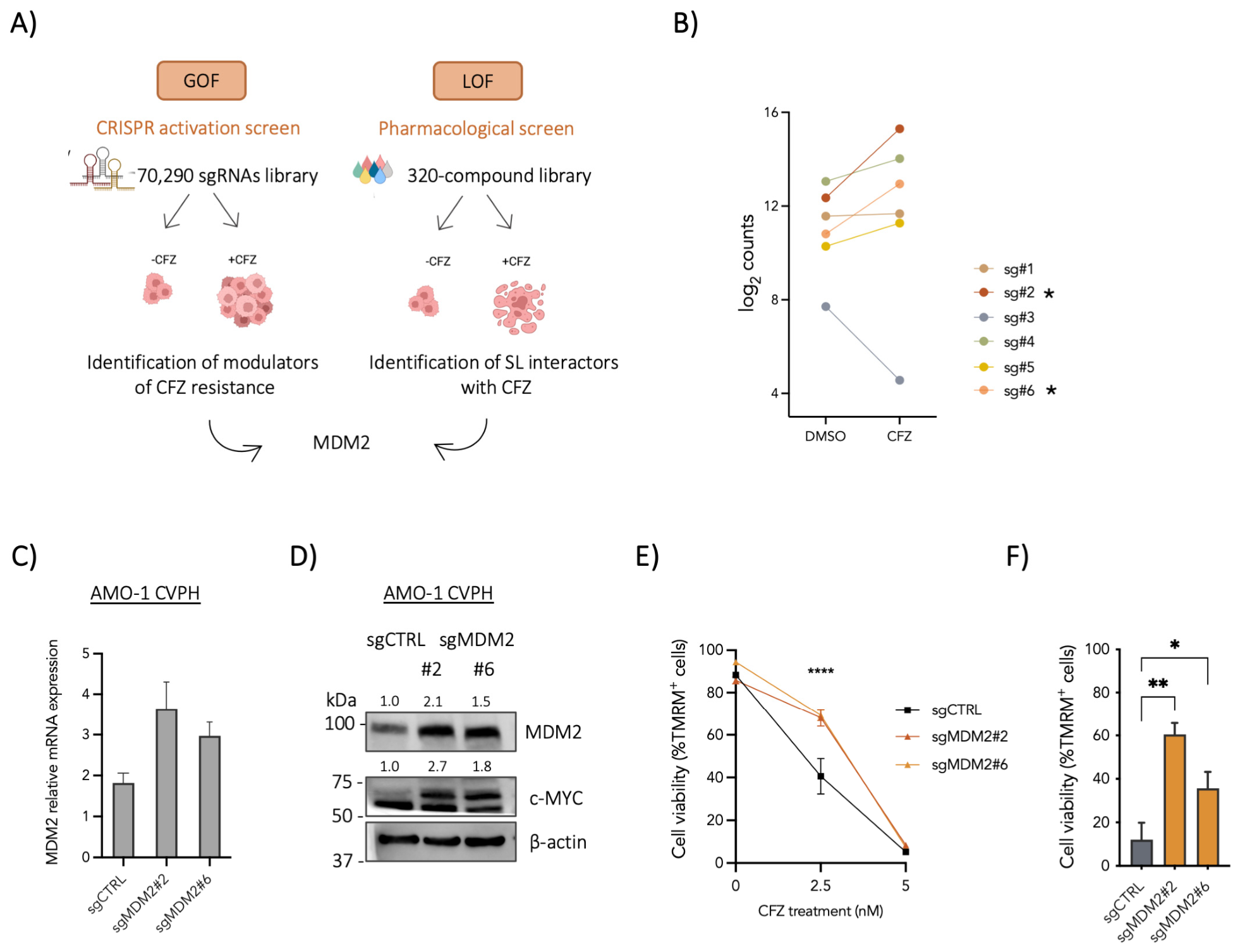
3.1. Functional Screenings Converge on MDM2 as a Modulator of Proteasome Inhibitor Resistance in Multiple Myeloma
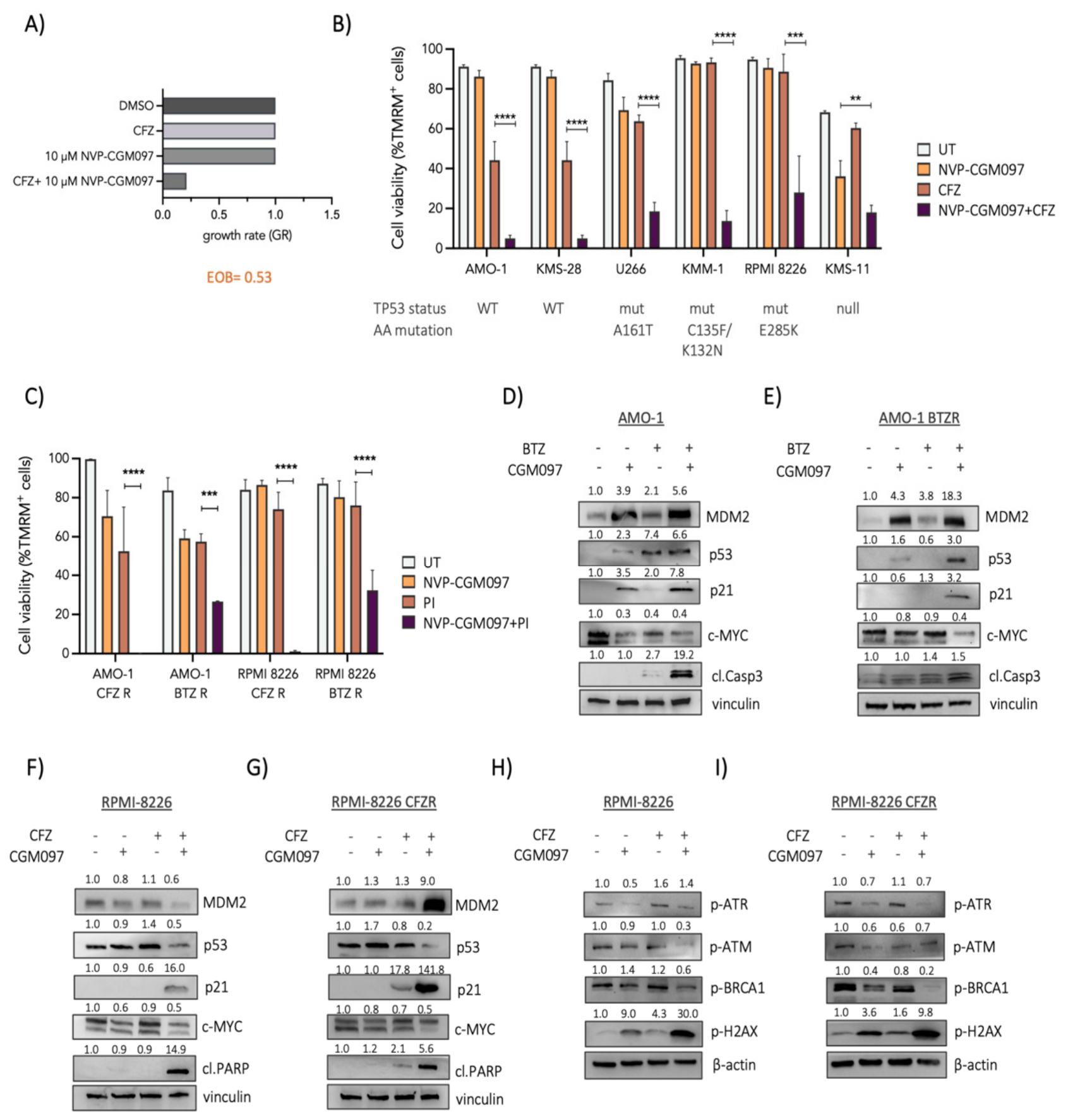
3.2. Therapeutic Potential and Molecular Mechanisms Underlying NVP-CGM097/PI Combination
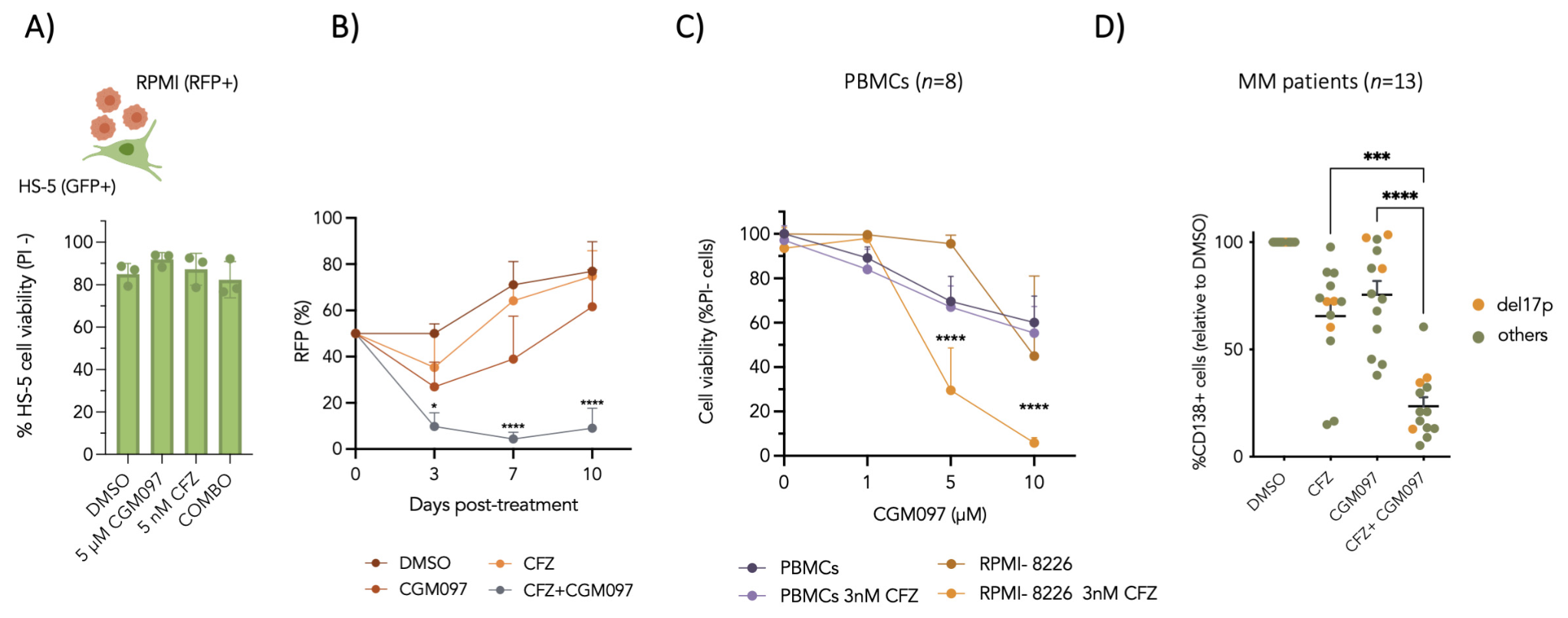
3.3. Preclinical Efficacy and Safety Profile of NVP-CGM097/CFZ Combination
4. Discussion
5. Conclusions
Supplementary Materials
Author Contributions
Funding
Institutional Review Board Statement
Informed Consent Statement
Data Availability Statement
Acknowledgments
Conflicts of Interest
Abbreviations
| ATF4 | Activating transcription factor 4 |
| ATM | Ataxia telangiectasia mutated |
| ATR | Ataxia telangiectasia and Rad3-related protein |
| BLC-2 | B-cell lymphoma 2 |
| BM | Bone marrow |
| BMSCs | Bone marrow stromal cells |
| BRCA1 | Breast cancer type 1 susceptibility protein |
| BTZ | Bortezomib |
| BTZ-R | Bortezomib-resistant |
| CFZ | Carfilzomib |
| CFZ-R | CFZ-resistant |
| CRISPR | Clustered regularly interspaced short palindromic repeat |
| CRISPRa | CRISPR activation |
| Ct | Cycle threshold |
| CTRL | Control |
| CVPH | dCas9-VP64-MS2-p65-HSF1 |
| DDR | DNA damage response |
| DMEM | Dulbecco’s modified Eagle medium |
| DMSO | Dimethyl sulfoxide |
| EOB | Excess over Bliss |
| FACS | Fluorescence-activated cell sorting |
| GFP | Green fluorescent protein |
| GOF | Gain of function |
| GR | Growth rate |
| JAK2 | Janus kinase 2 |
| LOF | Loss of function |
| MDM2 | Mouse double minute 2 homolog |
| MM | Multiple myeloma |
| MRN | MRE11-RAD50-NBS1 complex |
| NDMM | Newly diagnosed multiple myeloma |
| NGS | Next generation sequencing |
| PBMCs | Peripheral blood mononuclear cells |
| PDX | Patient-derived xenograft |
| PI | Propidium iodide |
| PIR | Proteasome inhibitor resistance |
| PIs | Proteasome inhibitors |
| PROTAC | Proteolysis-targeting chimera |
| PSMB5 | Proteasome subunit beta 5 |
| RB | Retinoblastoma protein |
| RFP | Red fluorescent protein |
| RT-qPCR | Reverse transcription quantitative polymerase chain reaction |
| RRMM | Relapse refractory multiple myeloma |
| SAM | Synergistic activator mediator |
| sgRNA | Single-guide RNA |
| shRNA | Short hairpin RNA |
| SMM | Smoldering multiple myeloma |
| TMRM | Tetramethylrhodamine methyl ester |
| TP53 | Tumor protein p53 gene |
| UPR | Unfolded protein response |
| UPS | Ubiquitin proteasome system |
| XIAP | X-linked inhibitor of apoptosis protein |
| γH2AX | Phosphorylated histone H2AX |
References
- Malard, F.; Neri, P.; Bahlis, N.J.; Terpos, E.; Moukalled, N.; Hungria, V.T.M.; Manier, S.; Mohty, M. Multiple myeloma. Nat. Rev. Dis. Primers 2024, 10, 45. [Google Scholar] [CrossRef] [PubMed]
- Kumar, S.K.; Callander, N.S.; Adekola, K.; Anderson, L.D.; Baljevic, M.; Baz, R.; Campagnaro, E.; Costello, C.; D’Angelo, C.; Derman, B.; et al. NCCN Guidelines® Insights: Multiple Myeloma, Version 1.2025: Featured Updates to the NCCN Guidelines®. J. Natl. Compr. Cancer Netw. 2025, 23, 132–140. [Google Scholar] [CrossRef]
- Manasanch, E.E.; Orlowski, R.Z. Proteasome inhibitors in cancer therapy. Nat. Rev. Clin. Oncol. 2017, 14, 417–433. [Google Scholar] [CrossRef] [PubMed]
- Fricker, L.D. Proteasome Inhibitor Drugs. Annu. Rev. Pharmacol. Toxicol. 2020, 60, 457–476. [Google Scholar] [CrossRef]
- Mitsiades, C.S. Proteasome Inhibitors in Multiple Myeloma: Biological Insights on Mechanisms of Action or Resistance Informed by Functional Genomics. Hematol. Oncol. Clin. N. Am. 2024, 38, 321–336. [Google Scholar] [CrossRef]
- Bianchi, G.; Oliva, L.; Cascio, P.; Pengo, N.; Fontana, F.; Cerruti, F.; Orsi, A.; Pasqualetto, E.; Mezghrani, A.; Calbi, V.; et al. The proteasome load versus capacity balance determines apoptotic sensitivity of multiple myeloma cells to proteasome inhibition. Blood 2009, 113, 3040–3049. [Google Scholar] [CrossRef]
- Patiño-Escobar, B.; Talbot, A.; Wiita, A.P. Overcoming proteasome inhibitor resistance in the immunotherapy era. Trends Pharmacol. Sci. 2023, 44, 507–518. [Google Scholar] [CrossRef]
- Paradzik, T.; Bandini, C.; Mereu, E.; Labrador, M.; Taiana, E.; Amodio, N.; Neri, A.; Piva, R. The Landscape of Signaling Pathways and Proteasome Inhibitors Combinations in Multiple Myeloma. Cancers 2021, 13, 1235. [Google Scholar] [CrossRef]
- Cohen, Y.C.; Zada, M.; Wang, S.Y.; Bornstein, C.; David, E.; Moshe, A.; Li, B.; Shlomi-Loubaton, S.; Gatt, M.E.; Gur, C.; et al. Identification of resistance pathways and therapeutic targets in relapsed multiple myeloma patients through single-cell sequencing. Nat. Med. 2021, 27, 491–503. [Google Scholar] [CrossRef] [PubMed]
- Giesen, N.; Paramasivam, N.; Toprak, U.H.; Huebschmann, D.; Xu, J.; Uhrig, S.; Samur, M.; Bähr, S.; Fröhlich, M.; Mughal, S.S.; et al. Comprehensive genomic analysis of refractory multiple myeloma reveals a complex mutational landscape associated with drug resistance and novel therapeutic vulnerabilities. Haematologica 2022, 107, 1891–1901. [Google Scholar] [CrossRef]
- Mettias, S.; ElSayed, A.; Moore, J.; Berenson, J.R. Multiple Myeloma: Improved Outcomes Resulting from a Rapidly Expanding Number of Therapeutic Options. Target. Oncol. 2025, 20, 247–267. [Google Scholar] [CrossRef]
- Juven-Gershon, T.; Oren, M. Mdm2: The ups and downs. Mol. Med. 1999, 5, 71–83. [Google Scholar] [CrossRef]
- Li, Q.; Lozano, G. Molecular pathways: Targeting Mdm2 and Mdm4 in cancer therapy. Clin. Cancer Res. 2013, 19, 34–41. [Google Scholar] [CrossRef] [PubMed]
- Klein, A.M.; de Queiroz, R.M.; Venkatesh, D.; Prives, C. The roles and regulation of MDM2 and MDMX: It is not just about p53. Genes Dev. 2021, 35, 575–601. [Google Scholar] [CrossRef] [PubMed]
- Teoh, G.; Urashima, M.; Ogata, A.; Chauhan, D.; DeCaprio, J.A.; Treon, S.P.; Schlossman, R.L.; Anderson, K.C. MDM2 protein overexpression promotes proliferation and survival of multiple myeloma cells. Blood 1997, 90, 1982–1992. [Google Scholar] [CrossRef] [PubMed]
- Li, C.; Su, R.; Wang, X.; Huang, G.; Liu, Y.; Yang, J.; Yin, Z.; Gu, C.; Fei, J. Discovery of the oncogenic MDM2, a direct binding target of berberine and a potential therapeutic, in multiple myeloma. Funct. Integr. Genom. 2022, 22, 1031–1041. [Google Scholar] [CrossRef]
- Saha, M.N.; Jiang, H.; Chang, H. Molecular mechanisms of nutlin-induced apoptosis in multiple myeloma: Evidence for p53-transcription-dependent and -independent pathways. Cancer Biol. Ther. 2010, 10, 567–578. [Google Scholar] [CrossRef]
- Walker, B.A.; Mavrommatis, K.; Wardell, C.P.; Ashby, T.C.; Bauer, M.; Davies, F.; Rosenthal, A.; Wang, H.; Qu, P.; Hoering, A.; et al. A high-risk, Double-Hit, group of newly diagnosed myeloma identified by genomic analysis. Leukemia 2019, 33, 159–170. [Google Scholar] [CrossRef]
- Bergaggio, E.; Riganti, C.; Garaffo, G.; Vitale, N.; Mereu, E.; Bandini, C.; Pellegrino, E.; Pullano, V.; Omedè, P.; Todoerti, K.; et al. IDH2 inhibition enhances proteasome inhibitor responsiveness in hematological malignancies. Blood 2019, 133, 156–167. [Google Scholar] [CrossRef]
- Bandini, C.; Mereu, E.; Paradzik, T.; Labrador, M.; Maccagno, M.; Cumerlato, M.; Oreglia, F.; Prever, L.; Manicardi, V.; Taiana, E.; et al. Lysin (K)-specific demethylase 1 inhibition enhances proteasome inhibitor response and overcomes drug resistance in multiple myeloma. Exp. Hematol. Oncol. 2023, 12, 71. [Google Scholar] [CrossRef]
- Besse, L.; Besse, A.; Mendez-Lopez, M.; Vasickova, K.; Sedlackova, M.; Vanhara, P.; Kraus, M.; Bader, J.; Ferreira, R.B.; Castellano, R.K.; et al. A metabolic switch in proteasome inhibitor-resistant multiple myeloma ensures higher mitochondrial metabolism, protein folding and sphingomyelin synthesis. Haematologica 2019, 104, e415–e419. [Google Scholar] [CrossRef]
- Soriano, G.P.; Besse, L.; Li, N.; Kraus, M.; Besse, A.; Meeuwenoord, N.; Bader, J.; Everts, B.; den Dulk, H.; Overkleeft, H.S.; et al. Proteasome inhibitor-adapted myeloma cells are largely independent from proteasome activity and show complex proteomic changes, in particular in redox and energy metabolism. Leukemia 2016, 30, 2198–2207. [Google Scholar] [CrossRef]
- Joung, J.; Konermann, S.; Gootenberg, J.S.; Abudayyeh, O.O.; Platt, R.J.; Brigham, M.D.; Sanjana, N.E.; Zhang, F. Genome-scale CRISPR-Cas9 knockout and transcriptional activation screening. Nat. Protoc. 2017, 12, 828–863. [Google Scholar] [CrossRef] [PubMed]
- Gobbi, G.; Donati, B.; Do Valle, I.F.; Reggiani, F.; Torricelli, F.; Remondini, D.; Castellani, G.; Ambrosetti, D.C.; Ciarrocchi, A.; Sancisi, V. The Hippo pathway modulates resistance to BET proteins inhibitors in lung cancer cells. Oncogene 2019, 38, 6801–6817. [Google Scholar] [CrossRef] [PubMed]
- Mereu, E.; Abbo, D.; Paradzik, T.; Cumerlato, M.; Bandini, C.; Labrador, M.; Maccagno, M.; Ronchetti, D.; Manicardi, V.; Neri, A.; et al. Euchromatic Histone Lysine Methyltransferase 2 Inhibition Enhances Carfilzomib Sensitivity and Overcomes Drug Resistance in Multiple Myeloma Cell Lines. Cancers 2023, 15, 2199. [Google Scholar] [CrossRef] [PubMed]
- Wang, S.; Oliveira-Silveira, J.; Fang, G.; Kang, J. High-content analysis identified synergistic drug interactions between INK128, an mTOR inhibitor, and HDAC inhibitors in a non-small cell lung cancer cell line. BMC Cancer 2024, 24, 335. [Google Scholar] [CrossRef]
- Cumerlato, M.; Maccagno, M.; Labrador, M.; Luciano, B.; Mereu, E.; Porro, M.; Bandini, C.; Furlan, M.; Maisano, D.; D’Agostino, M.; et al. Bedaquiline Amplifies Proteasome Inhibitor Efficacy and Overcomes Resistance in Multiple Myeloma. Haematologica 2026. Online ahead of printing. [Google Scholar] [CrossRef]
- Faruq, O.; Zhao, D.; Shrestha, M.; Vecchione, A.; Zacksenhaus, E.; Chang, H. Targeting an MDM2/MYC Axis to Overcome Drug Resistance in Multiple Myeloma. Cancers 2022, 14, 1592. [Google Scholar] [CrossRef]
- Zhang, Z.; Wang, H.; Li, M.; Agrawal, S.; Chen, X.; Zhang, R. MDM2 is a negative regulator of p21WAF1/CIP1, independent of p53. J. Biol. Chem. 2004, 279, 16000–16006. [Google Scholar] [CrossRef]
- Kussie, P.H.; Gorina, S.; Marechal, V.; Elenbaas, B.; Moreau, J.; Levine, A.J.; Pavletich, N.P. Structure of the MDM2 oncoprotein bound to the p53 tumor suppressor transactivation domain. Science 1996, 274, 948–953. [Google Scholar] [CrossRef]
- Stühmer, T.; Chatterjee, M.; Hildebrandt, M.; Herrmann, P.; Gollasch, H.; Gerecke, C.; Theurich, S.; Cigliano, L.; Manz, R.A.; Daniel, P.T.; et al. Nongenotoxic activation of the p53 pathway as a therapeutic strategy for multiple myeloma. Blood 2005, 106, 3609–3617. [Google Scholar] [CrossRef]
- Gu, D.; Wang, S.; Kuiatse, I.; Wang, H.; He, J.; Dai, Y.; Jones, R.J.; Bjorklund, C.C.; Yang, J.; Grant, S.; et al. Inhibition of the MDM2 E3 Ligase induces apoptosis and autophagy in wild-type and mutant p53 models of multiple myeloma, and acts synergistically with ABT-737. PLoS ONE 2014, 9, e103015. [Google Scholar] [CrossRef] [PubMed]
- Holzer, P.; Masuya, K.; Furet, P.; Kallen, J.; Valat-Stachyra, T.; Ferretti, S.; Berghausen, J.; Bouisset-Leonard, M.; Buschmann, N.; Pissot-Soldermann, C.; et al. Discovery of a Dihydroisoquinolinone Derivative (NVP-CGM097): A Highly Potent and Selective MDM2 Inhibitor Undergoing Phase 1 Clinical Trials in p53wt Tumors. J. Med. Chem. 2015, 58, 6348–6358. [Google Scholar] [CrossRef]
- Chauhan, D.; Tian, Z.; Zhou, B.; Kuhn, D.; Orlowski, R.; Raje, N.; Richardson, P.; Anderson, K.C. In vitro and in vivo selective antitumor activity of a novel orally bioavailable proteasome inhibitor MLN9708 against multiple myeloma cells. Clin. Cancer Res. 2011, 17, 5311–5321. [Google Scholar] [CrossRef] [PubMed]
- Bouska, A.; Eischen, C.M. Mdm2 affects genome stability independent of p53. Cancer Res. 2009, 69, 1697–1701. [Google Scholar] [CrossRef]
- Klein, A.M.; Biderman, L.; Tong, D.; Alaghebandan, B.; Plumber, S.A.; Mueller, H.S.; van Vlimmeren, A.; Katz, C.; Prives, C. MDM2, MDMX, and p73 regulate cell-cycle progression in the absence of wild-type p53. Proc. Natl. Acad. Sci. USA 2021, 118, e2102420118. [Google Scholar] [CrossRef]
- Zeng, X.; Chen, L.; Jost, C.A.; Maya, R.; Keller, D.; Wang, X.; Kaelin, W.G.; Oren, M.; Chen, J.; Lu, H. MDM2 suppresses p73 function without promoting p73 degradation. Mol. Cell Biol. 1999, 19, 3257–3266. [Google Scholar] [CrossRef]
- Ongkeko, W.M.; Wang, X.Q.; Siu, W.Y.; Lau, A.W.; Yamashita, K.; Harris, A.L.; Cox, L.S.; Poon, R.Y. MDM2 and MDMX bind and stabilize the p53-related protein p73. Curr. Biol. 1999, 9, 829–832. [Google Scholar] [CrossRef]
- Alt, J.R.; Bouska, A.; Fernandez, M.R.; Cerny, R.L.; Xiao, H.; Eischen, C.M. Mdm2 binds to Nbs1 at sites of DNA damage and regulates double strand break repair. J. Biol. Chem. 2005, 280, 18771–18781. [Google Scholar] [CrossRef] [PubMed]
- Carrillo, A.M.; Hicks, M.; Khabele, D.; Eischen, C.M. Pharmacologically Increasing Mdm2 Inhibits DNA Repair and Cooperates with Genotoxic Agents to Kill p53-Inactivated Ovarian Cancer Cells. Mol. Cancer Res. 2015, 13, 1197–1205. [Google Scholar] [CrossRef]
- Ludwig, M.P.; Galbraith, M.D.; Eduthan, N.P.; Hill, A.A.; Clay, M.R.; Tellez, C.M.; Wilky, B.A.; Elias, A.; Espinosa, J.M.; Sullivan, K.D. Proteasome Inhibition Sensitizes Liposarcoma to MDM2 Inhibition with Nutlin-3 by Activating the ATF4/CHOP Stress Response Pathway. Cancer Res. 2023, 83, 2543–2556. [Google Scholar] [CrossRef]
- Gluck, W.L.; Gounder, M.M.; Frank, R.; Eskens, F.; Blay, J.Y.; Cassier, P.A.; Soria, J.C.; Chawla, S.; de Weger, V.; Wagner, A.J.; et al. Phase 1 study of the MDM2 inhibitor AMG 232 in patients with advanced P53 wild-type solid tumors or multiple myeloma. Investig. New Drugs 2020, 38, 831–843. [Google Scholar] [CrossRef]
- Stein, E.M.; DeAngelo, D.J.; Chromik, J.; Chatterjee, M.; Bauer, S.; Lin, C.C.; Suarez, C.; de Vos, F.; Steeghs, N.; Cassier, P.A.; et al. Results from a First-in-Human Phase I Study of Siremadlin (HDM201) in Patients with Advanced Wild-Type TP53 Solid Tumors and Acute Leukemia. Clin. Cancer Res. 2022, 28, 870–881. [Google Scholar] [CrossRef]
- Weisberg, E.; Halilovic, E.; Cooke, V.G.; Nonami, A.; Ren, T.; Sanda, T.; Simkin, I.; Yuan, J.; Antonakos, B.; Barys, L.; et al. Inhibition of Wild-Type p53-Expressing AML by the Novel Small Molecule HDM2 Inhibitor CGM097. Mol. Cancer Ther. 2015, 14, 2249–2259. [Google Scholar] [CrossRef] [PubMed]
- Aguilar, A.; Yang, J.; Li, Y.; McEachern, D.; Huang, L.; Razzouk, S.; Wang, S. Discovery of MD-265: A Potent MDM2 Degrader That Achieves Complete Tumor Regression and Improves Long-Term Survival of Mice with Leukemia. J. Med. Chem. 2024, 67, 19503–19518. [Google Scholar] [CrossRef] [PubMed]
- Goerg, A.; Piendl, G.; Albert, V.; Ortmann, O.; Wege, A.K.; Brockhoff, G. Mdm2 targeting via PROteolysis TArgeting Chimeras (PROTAC) is efficient in p53 wildtype, p53-mutated, and abemaciclib-resistant estrogen receptor-positive cell lines and superior to mdm2 inhibition. BMC Cancer 2025, 25, 978. [Google Scholar] [CrossRef] [PubMed]
- Adams, C.M.; Mitra, R.; Xiao, Y.; Michener, P.; Palazzo, J.; Chao, A.; Gour, J.; Cassel, J.; Salvino, J.M.; Eischen, C.M. Targeted MDM2 Degradation Reveals a New Vulnerability for p53-Inactivated Triple-Negative Breast Cancer. Cancer Discov. 2023, 13, 1210–1229. [Google Scholar] [CrossRef]
- Kandarpa, M.; Peterson, L.F.; Potu, H.; Ramappan, M.; Liu, Y.; Polk, A.; Wang, S.; Talpaz, M. Activity of PROTAC MDM2 degrader in primary leukemia cells and PDX models. Leukemia 2026. Online ahead of printing. [Google Scholar] [CrossRef]
- Gollner, A.; Rudolph, D.; Weyer-Czernilofsky, U.; Baumgartinger, R.; Jung, P.; Weinstabl, H.; Ramharter, J.; Grempler, R.; Quant, J.; Rinnenthal, J.; et al. Discovery and Characterization of Brigimadlin, a Novel and Highly Potent MDM2-p53 Antagonist Suitable for Intermittent Dose Schedules. Mol. Cancer Ther. 2024, 23, 1689–1702. [Google Scholar] [CrossRef]


Disclaimer/Publisher’s Note: The statements, opinions and data contained in all publications are solely those of the individual author(s) and contributor(s) and not of MDPI and/or the editor(s). MDPI and/or the editor(s) disclaim responsibility for any injury to people or property resulting from any ideas, methods, instructions or products referred to in the content. |
© 2026 by the authors. Licensee MDPI, Basel, Switzerland. This article is an open access article distributed under the terms and conditions of the Creative Commons Attribution (CC BY) license.
Share and Cite
Labrador, M.; Cozzubbo, S.; Porro, M.; Cumerlato, M.; Bandini, C.; Mereu, E.; Paradzik, T.; Donati, B.; Manicardi, V.; Ronchetti, D.; et al. MDM2 Drives Proteasome Inhibitor Resistance and Represents a TP53-Independent Therapeutic Vulnerability in Multiple Myeloma. Cells 2026, 15, 831. https://doi.org/10.3390/cells15090831
Labrador M, Cozzubbo S, Porro M, Cumerlato M, Bandini C, Mereu E, Paradzik T, Donati B, Manicardi V, Ronchetti D, et al. MDM2 Drives Proteasome Inhibitor Resistance and Represents a TP53-Independent Therapeutic Vulnerability in Multiple Myeloma. Cells. 2026; 15(9):831. https://doi.org/10.3390/cells15090831
Chicago/Turabian StyleLabrador, María, Sara Cozzubbo, Mariangela Porro, Michela Cumerlato, Cecilia Bandini, Elisabetta Mereu, Tina Paradzik, Benedetta Donati, Veronica Manicardi, Domenica Ronchetti, and et al. 2026. "MDM2 Drives Proteasome Inhibitor Resistance and Represents a TP53-Independent Therapeutic Vulnerability in Multiple Myeloma" Cells 15, no. 9: 831. https://doi.org/10.3390/cells15090831
APA StyleLabrador, M., Cozzubbo, S., Porro, M., Cumerlato, M., Bandini, C., Mereu, E., Paradzik, T., Donati, B., Manicardi, V., Ronchetti, D., D’Agostino, M., Larocca, A., Gay, F., Bruno, B., Ciarrocchi, A., Chatr-Aryamontri, A., Neri, A., Morelli, E., & Piva, R. (2026). MDM2 Drives Proteasome Inhibitor Resistance and Represents a TP53-Independent Therapeutic Vulnerability in Multiple Myeloma. Cells, 15(9), 831. https://doi.org/10.3390/cells15090831