The Significance of Angiopoietin Valency in Vascular Health and Disease




Highlights
- F-domain valency determines the activity of Ang 1 and Ang 2 in the Tie2 pathway;
- Synthetically designed proteins precisely control Tie2 activity;
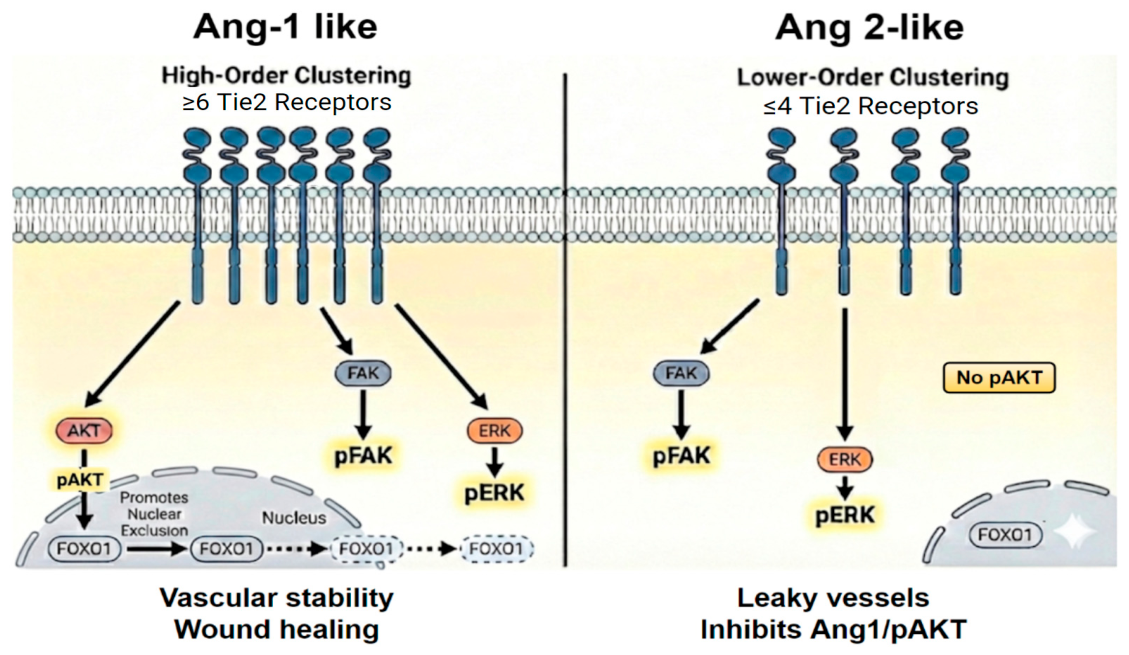
- F-domain valency of four or fewer is Ang 2-like, whereas six or more demonstrates Ang 1-like activity.
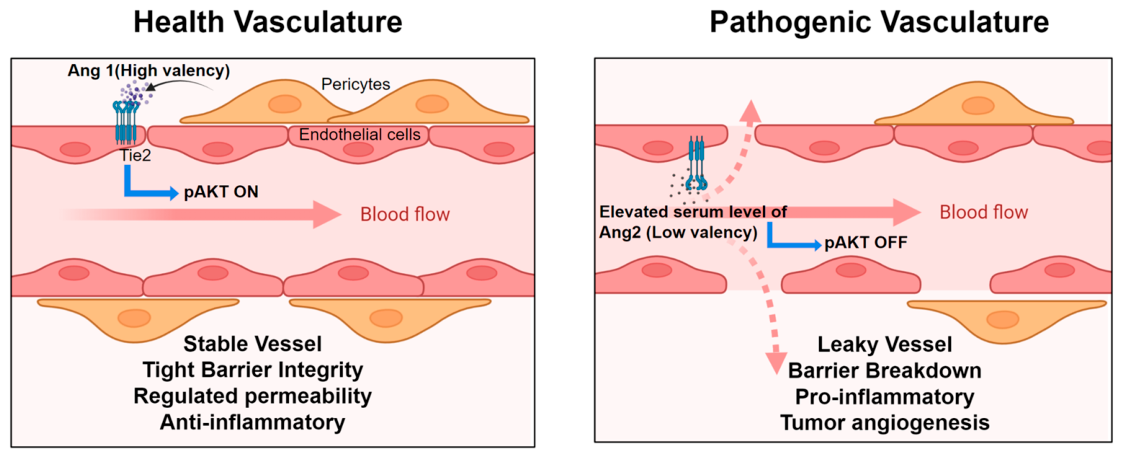
- Angiopoietins and Tie2 signaling play a critical role in regulating vascular health.
- Well-defined ligand valency enables precise control of Tie2 signaling for treating vascular diseases.
Abstract
1. Introduction: The Angiopoietin–Tie Pathway in Vascular Development and Diseases
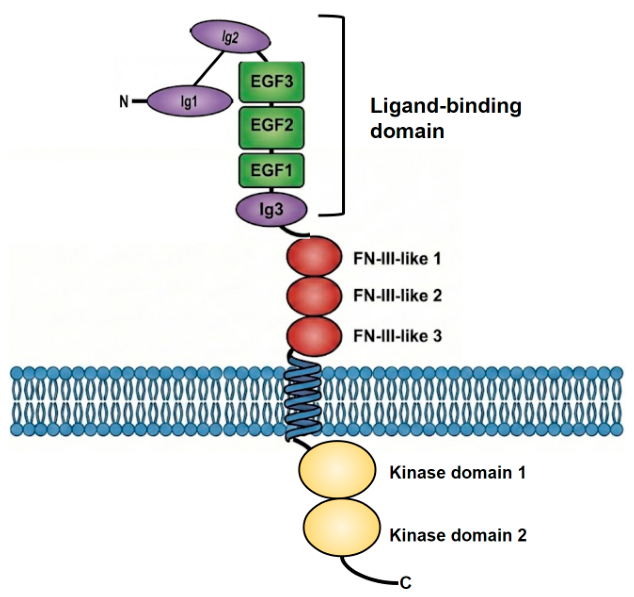
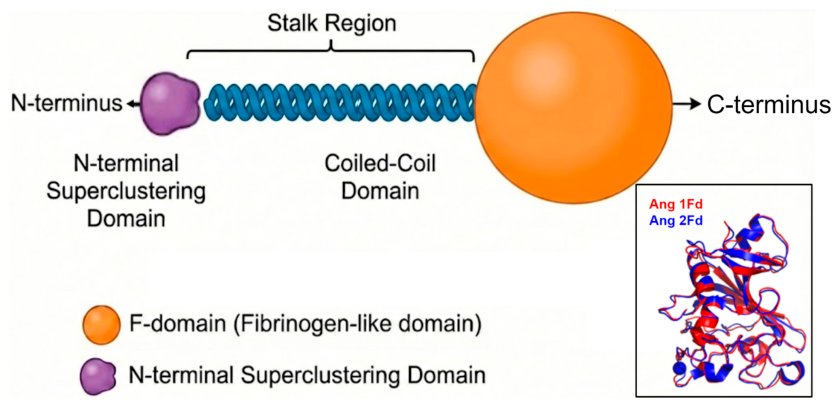
2. Angiopoietin–Tie2 Pathway: Structure and Signaling
3. Protein Design Can Precisely Control Ligand Valency and Signaling Outcome
4. Therapeutic Application of Design Proteins in Tie2-Mediated Vascular Dysfunction
4.1. Acute Vascular Failure (Sepsis, ARDS, and TBI)
4.2. Chronic Vascular Disorders and Inflammation
4.3. Oncogenesis and the Tumor Microenvironment
5. Conclusions
Author Contributions
Funding
Institutional Review Board Statement
Informed Consent Statement
Data Availability Statement
Acknowledgments
Conflicts of Interest
Abbreviations
| Fd | Ang 1 F-domain |
| Ang 1-Fc | 2 Ang 1 F-domains fused with the antibody Fc domain |
| CA1-3 | CMP-Ang variants, coiled-coil domain of Ang1 replaced with a short, trimeric coiled-coil domain of cartilage matrix protein |
| GCN4-Ang 1 | Ang 1 F-domain fused to coiled-coil domains of GCN4 |
| GCN4-Ang2 | Ang 2 F-domain fused to coiled-coil domains of GCN4 |
| CA1-1 and CA1-2 | CMP-Ang variants, coiled-coil domain of Ang1 replaced with a short, trimeric coiled-coil domain of cartilage matrix protein |
| C4 | Modified tpr1C4F to form tetramer and presents 4 Ang 1 F-domains |
| AkC4 | Tetramer formed by 4 ankyrin domain repeats presenting 4 Ang 1 F-domain |
| MAT-Ang 1 or MAT-Ang 2 | Matrilin-1 protein fused with Ang 1 or Ang 2 F-domain |
| Comp-Ang 1 or Com-Ang 2 | Cartilage Oligomeric Matrix Protein with Fd of Ang 1 or Ang 2 |
| H3, H6, or H8 | Helical bundles conjugated with 3, 6, or 8 Ang 1 F-domains |
| Tet1 & Tet2 | Tetrahedral nanocage 1 or 2 conjugated with 12 Ang 1 F-domains |
| Tet1A | Trimeric subunit of Tet1 presenting 3 Ang 1 F-domains |
| O42.1 | Octahedral nanocage formed with Ang 1-Fc to present 24 Ang 1 F-domains |
| Icos1 & Icos2 | Icosahedral nanocage 1 or 2 conjugated with 60 Ang 1 F-domains |
| Icos1-A | Trimeric subunit of Icos 1 |
| Cap-Fd | De novo-designed capsid cage conjugated with 60 Ang 1 F-domains |
| I52.6 | Icosahedral nanocage formed with Ang 1-Fc to present 50 Ang 1 F-domains |
References
- Brindle, N.P.J.; Saharinen, P.; Alitalo, K. Signaling and Functions of Angiopoietin-1 in Vascular Protection. Circ. Res. 2006, 98, 1014–1023. [Google Scholar] [CrossRef] [Scilit] [PubMed]
- Lee, H.J.; Cho, C.-H.; Hwang, S.-J.; Choi, H.-H.; Kim, K.-T.; Ahn, S.Y.; Kim, J.-H.; Oh, J.-L.; Lee, G.M.; Koh, G.Y. Biological characterization of angiopoietin-3 and angiopoietin-4. FASEB J. 2004, 18, 1200–1208. [Google Scholar] [PubMed]
- Sato, T.N.; Tozawa, Y.; Deutsch, U.; Wolburg-Buchholz, K.; Fujiwara, Y.; Gendron-Maguire, M.; Gridley, T.; Wolburg, H.; Risau, W.; Qin, Y. Distinct roles of the receptor tyrosine kinases Tie-1 and Tie-2 in blood vessel formation. Nature 1995, 376, 70–74. [Google Scholar] [CrossRef] [Scilit]
- Suri, C.; Jones, P.F.; Patan, S.; Bartunkova, S.; Maisonpierre, P.C.; Davis, S.; Sato, T.N.; Yancopoulos, G.D. Requisite Role of Angiopoietin-1, a Ligand for the TIE2 Receptor, during Embryonic Angiogenesis. Cell 1996, 87, 1171–1180. [Google Scholar] [CrossRef] [Scilit] [PubMed]
- Dumont, D.J.; Gradwohl, G.; Fong, G.H.; Puri, M.C.; Gertsenstein, M.; Auerbach, A.; Breitman, M.L. Dominant-negative and targeted null mutations in the endothelial receptor tyrosine kinase, tek, reveal a critical role in vasculogenesis of the embryo. Gene Dev. 1994, 8, 1897–1909. [Google Scholar] [CrossRef] [Scilit]
- Gale, N.W.; Thurston, G.; Hackett, S.F.; Renard, R.; Wang, Q.; McClain, J.; Martin, C.; Witte, C.; Witte, M.H.; Jackson, D.; et al. Angiopoietin-2 Is Required for Postnatal Angiogenesis and Lymphatic Patterning, and Only the Latter Role Is Rescued by Angiopoietin-1. Dev. Cell 2002, 3, 411–423. [Google Scholar]
- Hackett, S.F.; Wiegand, S.; Yancopoulos, G.; Campochiaro, P.A. Angiopoietin-2 plays an important role in retinal angiogenesis. J. Cell. Physiol. 2002, 192, 182–187. [Google Scholar] [CrossRef] [Scilit]
- Dellinger, M.; Hunter, R.; Bernas, M.; Gale, N.; Yancopoulos, G.; Erickson, R.; Witte, M. Defective remodeling and maturation of the lymphatic vasculature in Angiopoietin-2 deficient mice. Dev. Biol. 2008, 319, 309–320. [Google Scholar] [CrossRef] [Scilit]
- Stoeltzing, O.; Ahmad, S.A.; Liu, W.; McCarty, M.F.; Wey, J.S.; Parikh, A.A.; Fan, F.; Reinmuth, N.; Kawaguchi, M.; Bucana, C.D.; et al. Angiopoietin-1 inhibits vascular permeability, angiogenesis, and growth of hepatic colon cancer tumors. Cancer Res. 2003, 63, 3370–3377. [Google Scholar]
- Fukuhara, S.; Sako, K.; Noda, K.; Zhang, J.; Minami, M.; Mochizuki, N. Angiopoietin-1/Tie2 receptor signaling in vascular quiescence and angiogenesis. Histol. Histopathol. 2010, 25, 387–396. [Google Scholar]
- Gamble, J.R.; Drew, J.; Trezise, L.; Underwood, A.; Parsons, M.; Kasminkas, L.; Rudge, J.; Yancopoulos, G.; Vadas, M.A. Angiopoietin-1 Is an Antipermeability and Anti-Inflammatory Agent In Vitro and Targets Cell Junctions. Circ. Res. 2000, 87, 603–607. [Google Scholar] [CrossRef] [Scilit] [PubMed]
- Hashizume, H.; Falcón, B.L.; Kuroda, T.; Baluk, P.; Coxon, A.; Yu, D.; Bready, J.V.; Oliner, J.D.; McDonald, D.M. Complementary Actions of Inhibitors of Angiopoietin-2 and VEGF on Tumor Angiogenesis and Growth. Cancer Res. 2010, 70, 2213–2223. [Google Scholar] [CrossRef] [Scilit]
- Ali, E.A.M.; Altaie, A.M.; Talaat, I.M.; Hamoudi, R. Putative Role of Tie2-Expressing Monocytes/Macrophages in Colorectal Cancer Progression Through Enhancement of Angiogenesis and Metastasis. Cancers 2025, 17, 2856. [Google Scholar] [CrossRef] [Scilit]
- Chen, L.; Li, J.; Wang, F.; Dai, C.; Wu, F.; Liu, X.; Li, T.; Glauben, R.; Zhang, Y.; Nie, G.; et al. Tie2 Expression on Macrophages Is Required for Blood Vessel Reconstruction and Tumor Relapse after Chemotherapy. Cancer Res. 2016, 76, 6828–6838. [Google Scholar] [CrossRef] [Scilit]
- Matsubara, T.; Kanto, T.; Kuroda, S.; Yoshio, S.; Higashitani, K.; Kakita, N.; Miyazaki, M.; Sakakibara, M.; Hiramatsu, N.; Kasahara, A.; et al. TIE2-expressing monocytes as a diagnostic marker for hepatocellular carcinoma correlates with angiogenesis. Hepatology 2013, 57, 1416–1425. [Google Scholar] [CrossRef] [Scilit] [PubMed]
- Palma, M.D.; Naldini, L. Angiopoietin-2 TIEs Up Macrophages in Tumor Angiogenesis. Clin. Cancer Res. 2011, 17, 5226–5232. [Google Scholar] [CrossRef] [Scilit]
- Xing, Y.; Su, T.T.; Ruohola-Baker, H. Tie-mediated signal from apoptotic cells protects stem cells in Drosophila melanogaster. Nat. Commun. 2015, 6, 7058. [Google Scholar] [CrossRef] [Scilit]
- Brodsky, J.; Tashi, Z.; Christopher, S.K.; Kruitoff, R.; Abbasi, M.; Cerna, G.; Gohsman, S.B.; Mana, M.D.; Bartelle, B.B. Microglia express Tie2 in a longitudinal imaging study of acute neural injury in mice. Mol. Biol. Cell 2025, 36, ar112. [Google Scholar] [CrossRef] [Scilit]
- Fiusa, M.M.L.; Costa-Lima, C.; de Souza, G.R.; Vigorito, A.C.; Aranha, F.J.P.; Lorand-Metze, I.; Annichino-Bizzacchi, J.M.; de Souza, C.A.; Paula, E.V.D. A high angiopoietin-2/angiopoietin-1 ratio is associated with a high risk of septic shock in patients with febrile neutropenia. Crit. Care 2013, 17, R169. [Google Scholar] [CrossRef] [Scilit]
- Orfanos, S.E.; Kotanidou, A.; Glynos, C.; Athanasiou, C.; Tsigkos, S.; Dimopoulou, I.; Sotiropoulou, C.; Zakynthinos, S.; Armaganidis, A.; Papapetropoulos, A.; et al. Angiopoietin-2 is increased in severe sepsis: Correlation with inflammatory mediators. Crit. Care Med. 2007, 35, 199–206. [Google Scholar] [CrossRef] [Scilit] [PubMed]
- Zhao, Y.T.; Fallas, J.A.; Saini, S.; Ueda, G.; Somasundaram, L.; Zhou, Z.; Raj, I.X.; Xu, C.; Carter, L.; Wrenn, S.; et al. F-domain valency determines outcome of signaling through the angiopoietin pathway. EMBO Rep. 2021, 22, e53471. [Google Scholar] [PubMed]
- Hu, E.; Hu, W.; Yang, A.; Zhou, H.; Zhou, J.; Luo, J.; Wang, Y.; Tang, T.; Cui, H. Thrombin promotes pericyte coverage by Tie2 activation in a rat model of intracerebral hemorrhage. Brain Res. 2019, 1708, 58–68. [Google Scholar] [CrossRef] [Scilit]
- Tai, C.; Ling, C.; Yang, Y.; Zhang, B.; Sun, J.; Mo, N.; Sun, T.; Huang, L.; Yao, C.; Wang, H.; et al. Tie2-expressing monocytes/macrophages promote angiogenesis in chronically ischaemic brain tissue. Cell Biosci. 2025, 15, 62. [Google Scholar] [CrossRef] [Scilit] [PubMed]
- Parikh, S.M. Dysregulation of the angiopoietin–Tie-2 axis in sepsis and ARDS. Virulence 2013, 4, 517–524. [Google Scholar] [CrossRef] [Scilit]
- Su, L.; Zhai, R.; Sheu, C.-C.; Gallagher, D.C.; Gong, M.N.; Tejera, P.; Thompson, B.T.; Christiani, D.C. Genetic variants in the angiopoietin-2 gene are associated with increased risk of ARDS. Intensiv. Care Med. 2009, 35, 1024–1030. [Google Scholar] [CrossRef] [Scilit] [PubMed]
- Kim, W.-Y.; Hong, S.-B. Sepsis and Acute Respiratory Distress Syndrome: Recent Update. Tuberc. Respir. Dis. 2015, 79, 53–57. [Google Scholar] [CrossRef] [Scilit]
- Sack, K.D.; Kellum, J.A.; Parikh, S.M. The Angiopoietin-Tie2 Pathway in Critical Illness. Crit. Care Clin. 2020, 36, 201–216. [Google Scholar] [CrossRef] [Scilit]
- Chang, F.-C.; Liu, C.-H.; Luo, A.-J.; Huang, T.T.-M.; Tsai, M.-H.; Chen, Y.-J.; Lai, C.-F.; Chiang, C.-K.; Lin, T.-H.; Chiang, W.-C.; et al. Angiopoietin-2 inhibition attenuates kidney fibrosis by hindering chemokine C-C motif ligand 2 expression and apoptosis of endothelial cells. Kidney Int. 2022, 102, 780–797. [Google Scholar] [CrossRef] [Scilit]
- David, S.; John, S.G.; Jefferies, H.J.; Sigrist, M.K.; Kümpers, P.; Kielstein, J.T.; Haller, H.; McIntyre, C.W. Angiopoietin-2 levels predict mortality in CKD patients. Nephrol. Dial. Transplant. 2012, 27, 1867–1872. [Google Scholar] [PubMed]
- Sayed, S.Z.; Mohamed, E.R.; Moustafa, M.T.; Ali, L.H.; Mahgoob, M.H. Assessing Vascular Biomarkers and Their Association with Hypertension in Paediatric Chronic Kidney Disease. Sultan Qaboos Univ. Méd. J. 2024, 25, 66–73. [Google Scholar]
- Jian, W.; Li, L.; Wei, X.-M.; Guan, J.-H.; Yang, G.-L.; Gui, C. Serum angiopoietin-2 concentrations of post-PCI are correlated with the parameters of renal function in patients with coronary artery disease. Medicine 2019, 98, e13960. [Google Scholar] [CrossRef] [Scilit] [PubMed]
- David, S.; Kümpers, P.; Lukasz, A.; Fliser, D.; Martens-Lobenhoffer, J.; Bode-Böger, S.M.; Kliem, V.; Haller, H.; Kielstein, J.T. Circulating angiopoietin-2 levels increase with progress of chronic kidney disease. Nephrol. Dial. Transplant. 2010, 25, 2571–2579. [Google Scholar] [CrossRef] [Scilit] [PubMed]
- Abumrad, N.A.; Cabodevilla, A.G.; Samovski, D.; Pietka, T.; Basu, D.; Goldberg, I.J. Endothelial Cell Receptors in Tissue Lipid Uptake and Metabolism. Circ. Res. 2021, 128, 433–450. [Google Scholar] [CrossRef] [Scilit]
- Endothelial tyrosine kinase Tie2 counteracts atherosclerosis development. Nat. Cardiovasc. Res. 2023, 2, 232–233. [CrossRef] [Scilit]
- Anisimov, A.; Fang, S.; Hemanthakumar, K.A.; Örd, T.; van Avondt, K.; Chevre, R.; Toropainen, A.; Singha, P.; Gilani, H.; Nguyen, S.D.; et al. The angiopoietin receptor Tie2 is atheroprotective in arterial endothelium. Nat. Cardiovasc. Res. 2023, 2, 307–321. [Google Scholar] [CrossRef] [Scilit]
- Saharinen, P.; Eklund, L.; Alitalo, K. Therapeutic targeting of the angiopoietin–TIE pathway. Nat. Rev. Drug Discov. 2017, 16, 635–661. [Google Scholar]
- Jones, N.; Chen, S.H.; Sturk, C.; Master, Z.; Tran, J.; Kerbel, R.S.; Dumont, D.J. A Unique Autophosphorylation Site on Tie2/Tek Mediates Dok-R Phosphotyrosine Binding Domain Binding and Function. Mol. Cell. Biol. 2003, 23, 2658–2668. [Google Scholar] [CrossRef] [Scilit] [PubMed]
- Kontos, C.D.; Stauffer, T.P.; Yang, W.-P.; York, J.D.; Huang, L.; Blanar, M.A.; Meyer, T.; Peters, K.G. Tyrosine 1101 of Tie2 Is the Major Site of Association of p85 and Is Required for Activation of Phosphatidylinositol 3-Kinase and Akt Downloaded from. Mol. Cell. Biol. 1998, 18, 4131–4140. [Google Scholar] [CrossRef] [Scilit]
- Jones, N.; Dumont, D.J. The Tek/Tie2 receptor signals through a novel Dok-related docking protein, Dok-R. Oncogene 1998, 17, 1097–1108. [Google Scholar] [CrossRef] [Scilit]
- Partanen, J.; Armstrong, E.; Mäkelä, T.P.; Korhonen, J.; Sandberg, M.; Renkonen, R.; Knuutila, S.; Huebner, K.; Alitalo, K. A novel endothelial cell surface receptor tyrosine kinase with extracellular epidermal growth factor homology domains. Mol. Cell. Biol. 1992, 12, 1698–1707. [Google Scholar]
- Puri, M.C.; Rossant, J.; Alitalo, K.; Bernstein, A.; Partanen, J. The receptor tyrosine kinase TIE is required for integrity and survival of vascular endothelial cells. EMBO J. 1995, 14, 5884–5891. [Google Scholar] [CrossRef] [Scilit]
- Kim, I.; Kim, H.G.; Moon, S.-O.; Chae, S.W.; So, J.-N.; Koh, K.N.; Ahn, B.C.; Koh, G.Y. Angiopoietin-1 Induces Endothelial Cell Sprouting Through the Activation of Focal Adhesion Kinase and Plasmin Secretion. Circ. Res. 2000, 86, 952–959. [Google Scholar] [CrossRef] [Scilit]
- Kim, I.; Kim, J.-H.; Moon, S.-O.; Kwak, H.J.; Kim, N.-G.; Koh, G.Y. Angiopoietin-2 at high concentration can enhance endothelial cell survival through the phosphatidylinositol 3′-kinase/Akt signal transduction pathway. Oncogene 2000, 19, 4549–4552. [Google Scholar] [CrossRef] [Scilit] [PubMed]
- Kim, I.; Kim, H.G.; So, J.-N.; Kim, J.H.; Kwak, H.J.; Koh, G.Y. Angiopoietin-1 Regulates Endothelial Cell Survival Through the Phosphatidylinositol 3′-Kinase/Akt Signal Transduction Pathway. Circ. Res. 2000, 86, 24–29. [Google Scholar] [CrossRef] [Scilit] [PubMed]
- Han, S.; Lee, S.-J.; Kim, K.E.; Lee, H.S.; Oh, N.; Park, I.; Ko, E.; Oh, S.J.; Lee, Y.-S.; Kim, D.; et al. Amelioration of sepsis by TIE2 activation–induced vascular protection. Sci. Transl. Med. 2016, 8, 335ra55. [Google Scholar] [CrossRef] [Scilit]
- Master, Z.; Jones, N.; Tran, J.; Jones, J.; Kerbel, R.S.; Dumont, D.J. Dok-R plays a pivotal role in angiopoietin-1-dependent cell migration through recruitment and activation of Pak. EMBO J. 2001, 20, 5919–5928. [Google Scholar] [CrossRef] [Scilit] [PubMed]
- Yu, X.; Seegar, T.C.M.; Dalton, A.C.; Tzvetkova-Robev, D.; Goldgur, Y.; Rajashankar, K.R.; Nikolov, D.B.; Barton, W.A. Structural basis for angiopoietin-1–mediated signaling initiation. Proc. Natl. Acad. Sci. USA 2013, 110, 7205–7210. [Google Scholar]
- Kim, H.-Z.; Jung, K.; Kim, H.M.; Cheng, Y.; Koh, G.Y. A designed angiopoietin-2 variant, pentameric COMP-Ang2, strongly activates Tie2 receptor and stimulates angiogenesis. Biochim. Biophys. Acta BBA-Mol. Cell Res. 2009, 1793, 772–780. [Google Scholar] [CrossRef] [Scilit]
- Parikh, S.M. The Angiopoietin-Tie2 Signaling Axis in Systemic Inflammation. J. Am. Soc. Nephrol. 2017, 28, 1973–1982. [Google Scholar] [CrossRef] [Scilit]
- Milam, K.E.; Parikh, S.M. The angiopoietin-Tie2 signaling axis in the vascular leakage of systemic inflammation. Tissue Barriers 2015, 3, e957508. [Google Scholar] [CrossRef] [Scilit]
- Dalton, A.C.; Shlamkovitch, T.; Papo, N.; Barton, W.A. Constitutive Association of Tie1 and Tie2 with Endothelial Integrins is Functionally Modulated by Angiopoietin-1 and Fibronectin. PLoS ONE 2016, 11, e0163732, Erratum in PLoS ONE 2017, 12, e0179059.. [Google Scholar]
- Felcht, M.; Luck, R.; Schering, A.; Seidel, P.; Srivastava, K.; Hu, J.; Bartol, A.; Kienast, Y.; Vettel, C.; Loos, E.K.; et al. Angiopoietin-2 differentially regulates angiogenesis through TIE2 and integrin signaling. J. Clin. Investig. 2012, 122, 1991–2005. [Google Scholar] [CrossRef] [Scilit] [PubMed]
- Koblizek, T.I.; Weiss, C.; Yancopoulos, G.D.; Deutsch, U.; Risau, W. Angiopoietin-1 induces sprouting angiogenesis in vitro. Curr. Biol. 1998, 8, 529–532. [Google Scholar] [CrossRef] [Scilit] [PubMed]
- Maisonpierre, P.C.; Suri, C.; Jones, P.F.; Bartunkova, S.; Wiegand, S.J.; Radziejewski, C.; Compton, D.; McClain, J.; Aldrich, T.H.; Papadopoulos, N.; et al. Angiopoietin-2, a Natural Antagonist for Tie2 That Disrupts in vivo Angiogenesis. Science 1997, 277, 55–60. [Google Scholar] [CrossRef] [Scilit]
- Yuan, H.T.; Khankin, E.V.; Karumanchi, S.A.; Parikh, S.M. Angiopoietin 2 Is a Partial Agonist/Antagonist of Tie2 Signaling in the Endothelium. Mol. Cell. Biol. 2009, 29, 2011–2022. [Google Scholar]
- Souma, T.; Thomson, B.R.; Heinen, S.; Carota, I.A.; Yamaguchi, S.; Onay, T.; Liu, P.; Ghosh, A.K.; Li, C.; Eremina, V.; et al. Context-dependent functions of angiopoietin 2 are determined by the endothelial phosphatase VEPTP. Proc. Natl. Acad. Sci. USA 2018, 115, 1298–1303. [Google Scholar]
- Carota, I.A.; Kenig-Kozlovsky, Y.; Onay, T.; Scott, R.; Thomson, B.R.; Souma, T.; Bartlett, C.S.; Li, Y.; Procissi, D.; Ramirez, V.; et al. Targeting VE-PTP phosphatase protects the kidney from diabetic injury. J. Exp. Med. 2019, 216, 936–949. [Google Scholar] [CrossRef] [Scilit]
- Barton, W.A.; Tzvetkova-Robev, D.; Miranda, E.P.; Kolev, M.V.; Rajashankar, K.R.; Himanen, J.P.; Nikolov, D.B. Crystal structures of the Tie2 receptor ectodomain and the angiopoietin-2–Tie2 complex. Nat. Struct. Mol. Biol. 2006, 13, 524–532. [Google Scholar] [CrossRef] [Scilit]
- Kim, K.-T.; Choi, H.-H.; Steinmetz, M.O.; Maco, B.; Kammerer, R.A.; Ahn, S.Y.; Kim, H.-Z.; Lee, G.M.; Koh, G.Y. Oligomerization and Multimerization Are Critical for Angiopoietin-1 to Bind and Phosphorylate Tie2. J. Biol. Chem. 2005, 280, 20126–20131. [Google Scholar] [CrossRef] [Scilit]
- Procopio, W.N.; Pelavin, P.I.; Lee, W.M.F.; Yeilding, N.M. Angiopoietin-1 and -2 Coiled Coil Domains Mediate Distinct Homo-oligomerization Patterns, but Fibrinogen-like Domains Mediate Ligand Activity. J. Biol. Chem. 1999, 274, 30196–30201. [Google Scholar]
- Cho, C.-H.; Kammerer, R.A.; Lee, H.J.; Steinmetz, M.O.; Ryu, Y.S.; Lee, S.H.; Yasunaga, K.; Kim, K.-T.; Kim, I.; Choi, H.-H.; et al. COMP-Ang1: A designed angiopoietin-1 variant with nonleaky angiogenic activity. Proc. Natl. Acad. Sci. USA 2004, 101, 5547–5552. [Google Scholar]
- Oh, N.; Kim, K.; Kim, S.J.; Park, I.; Lee, J.-E.; Seo, Y.S.; An, H.J.; Kim, H.M.; Koh, G.Y. A Designed Angiopoietin-1 Variant, Dimeric CMP-Ang1 Activates Tie2 and Stimulates Angiogenesis and Vascular Stabilization in N-glycan Dependent Manner. Sci. Rep. 2015, 5, 15291. [Google Scholar] [CrossRef] [Scilit]
- Divine, R.; Dang, H.V.; Ueda, G.; Fallas, J.A.; Vulovic, I.; Sheffler, W.; Saini, S.; Zhao, Y.T.; Raj, I.X.; Morawski, P.A.; et al. Designed proteins assemble antibodies into modular nanocages. Science 2021, 372, eabd9994. [Google Scholar] [CrossRef] [Scilit]
- Lutz, I.D.; Wang, S.; Norn, C.; Courbet, A.; Borst, A.J.; Zhao, Y.T.; Dosey, A.; Cao, L.; Xu, J.; Leaf, E.M.; et al. Top-down design of protein architectures with reinforcement learning. Science 2023, 380, 266–273. [Google Scholar] [CrossRef] [Scilit] [PubMed]
- Liu, F.-Y.; Cho, Y.-L.; Fridayana, F.R.; Niloofar, L.; Vo, M.N.; Huang, Y.; Limanjaya, A.; Kwon, M.-H.; Ock, J.; Lee, S.-J.; et al. MT-100, a human Tie2-agonistic antibody, improves penile neurovasculature in diabetic mice via the novel target Srpx2. Exp. Mol. Med. 2025, 57, 104–117. [Google Scholar] [CrossRef] [Scilit]
- Jo, G.; Bae, J.; Hong, H.J.; Han, A.; Kim, D.-K.; Hong, S.P.; Kim, J.A.; Lee, S.; Koh, G.Y.; Kim, H.M. Structural insights into the clustering and activation of Tie2 receptor mediated by Tie2 agonistic antibody. Nat. Commun. 2021, 12, 6287. [Google Scholar] [CrossRef] [Scilit] [PubMed]
- Cao, L.; Coventry, B.; Goreshnik, I.; Huang, B.; Sheffler, W.; Park, J.S.; Jude, K.M.; Marković, I.; Kadam, R.U.; Verschueren, K.H.G.; et al. Design of protein-binding proteins from the target structure alone. Nature 2022, 605, 551–560. [Google Scholar] [CrossRef] [Scilit] [PubMed]
- Watson, J.L.; Juergens, D.; Bennett, N.R.; Trippe, B.L.; Yim, J.; Eisenach, H.E.; Ahern, W.; Borst, A.J.; Ragotte, R.J.; Milles, L.F.; et al. De novo design of protein structure and function with RFdiffusion. Nature 2023, 620, 1089–1100. [Google Scholar] [CrossRef] [Scilit]
- Dallabrida, S.M.; Ismail, N.; Oberle, J.R.; Himes, B.E.; Rupnick, M.A. Angiopoietin-1 Promotes Cardiac and Skeletal Myocyte Survival Through Integrins. Circ. Res. 2005, 96, e8–e24. [Google Scholar] [CrossRef] [Scilit]
- Dallabrida, S.M.; Ismail, N.S.; Pravda, E.A.; Parodi, E.M.; Dickie, R.; Durand, E.M.; Lai, J.; Cassiola, F.; Rogers, R.A.; Rupnick, M.A. Integrin binding angiopoietin-1 monomers reduce cardiac hypertrophy. FASEB J. 2008, 22, 3010–3023. [Google Scholar]
- Boeynaems, S.; Alberti, S.; Fawzi, N.L.; Mittag, T.; Polymenidou, M.; Rousseau, F.; Schymkowitz, J.; Shorter, J.; Wolozin, B.; Bosch, L.V.D.; et al. Protein Phase Separation: A New Phase in Cell Biology. Trends Cell Biol. 2018, 28, 420–435. [Google Scholar] [PubMed]
- Su, X.; Ditlev, J.A.; Hui, E.; Xing, W.; Banjade, S.; Okrut, J.; King, D.S.; Taunton, J.; Rosen, M.K.; Vale, R.D. Phase separation of signaling molecules promotes T cell receptor signal transduction. Science 2016, 352, 595–599. [Google Scholar] [CrossRef] [Scilit]
- D’Amico, G.; Korhonen, E.A.; Waltari, M.; Saharinen, P.; Laakkonen, P.; Alitalo, K. Loss of Endothelial Tie1 Receptor Impairs Lymphatic Vessel Development. Arterioscler. Thromb. Vasc. Biol. 2010, 30, 207–209. [Google Scholar] [CrossRef] [Scilit] [PubMed]
- Korhonen, E.A.; Lampinen, A.; Giri, H.; Anisimov, A.; Kim, M.; Allen, B.; Fang, S.; D’Amico, G.; Sipilä, T.J.; Lohela, M.; et al. Tie1 controls angiopoietin function in vascular remodeling and inflammation. J. Clin. Investig. 2016, 126, 3495–3510. [Google Scholar] [CrossRef] [Scilit]
- Song, S.-H.; Kim, K.L.; Lee, K.-A.; Suh, W. Tie1 regulates the Tie2 agonistic role of angiopoietin-2 in human lymphatic endothelial cells. Biochem. Biophys. Res. Commun. 2012, 419, 281–286. [Google Scholar] [CrossRef] [Scilit]
- Mueller, S.B.; Kontos, C.D. Tie1: An orphan receptor provides context for angiopoietin-2/Tie2 signaling. J. Clin. Investig. 2016, 126, 3188–3191. [Google Scholar] [CrossRef] [Scilit]
- Seegar, T.C.M.; Eller, B.; Tzvetkova-Robev, D.; Kolev, M.V.; Henderson, S.C.; Nikolov, D.B.; Barton, W.A. Tie1-Tie2 Interactions Mediate Functional Differences between Angiopoietin Ligands. Mol. Cell 2010, 37, 643–655. [Google Scholar]
- Patan, S. TIE1 and TIE2 Receptor Tyrosine Kinases Inversely Regulate Embryonic Angiogenesis by the Mechanism of Intussusceptive Microvascular Growth. Microvasc. Res. 1998, 56, 1–21. [Google Scholar] [CrossRef] [Scilit]
- Wang, X.; Guillem-Marti, J.; Kumar, S.; Lee, D.S.; Cabrerizo-Aguado, D.; Werther, R.; Alamo, K.A.E.; Zhao, Y.T.; Nguyen, A.; Kopyeva, I.; et al. De Novo Design of Integrin α5β1 Modulating Proteins to Enhance Biomaterial Properties. Adv. Mater. 2025, 37, 2500872. [Google Scholar] [CrossRef] [Scilit] [PubMed]
- Edman, N.I.; Phal, A.; Redler, R.L.; Schlichthaerle, T.; Srivatsan, S.R.; Ehnes, D.D.; Etemadi, A.; An, S.J.; Favor, A.; Li, Z.; et al. Modulation of FGF Pathway Signaling and Vascular Differentiation Using Designed Oligomeric Assemblies. Cell 2024, 187, 3726–3740.e43. [Google Scholar] [CrossRef] [Scilit]
- Yang, W.; Hicks, D.R.; Ghosh, A.; Schwartze, T.A.; Conventry, B.; Goreshnik, I.; Allen, A.; Halabiya, S.F.; Kim, C.J.; Hinck, C.S.; et al. Design of High-Affinity Binders to Immune Modulating Receptors for Cancer Immunotherapy. Nat. Commun. 2025, 16, 2001. [Google Scholar] [CrossRef] [Scilit]
- Wang, X.; Cardoso, S.; Cai, K.; Venkatesh, P.; Hung, A.; Ng, M.; Hall, C.; Coventry, B.; Lee, D.S.; Chowhan, R.; et al. Tuning Insulin Receptor Signaling Using de Novo-Designed Agonists. Mol. Cell 2025, 85, 4064–4081.e9. [Google Scholar]
- David, S.; Park, J.-K.; van Meurs, M.; Zijlstra, J.G.; Koenecke, C.; Schrimpf, C.; Shushakova, N.; Gueler, F.; Haller, H.; Kümpers, P. Acute Administration of Recombinant Angiopoietin-1 Ameliorates Multiple-Organ Dysfunction Syndrome and Improves Survival in Murine Sepsis. Cytokine 2011, 55, 251–259. [Google Scholar] [CrossRef] [Scilit]
- Wang, R.; Li, H.; Xie, Z.; Huang, M.; Xu, P.; Yuan, C.; Li, J.; Flaumenhaft, R.; Huang, M.; Jiang, L. Development of a Recombinant Ang1 Variant with Enhanced Tie2 Binding and Its Application to Attenuate Sepsis in Mice. Sci. Adv. 2025, 11, eads1796. [Google Scholar] [CrossRef] [Scilit]
- Ghosh, C.C.; David, S.; Zhang, R.; Berghelli, A.; Milam, K.; Higgins, S.J.; Hunter, J.; Mukherjee, A.; Wei, Y.; Tran, M.; et al. Gene Control of Tyrosine Kinase TIE2 and Vascular Manifestations of Infections. Proc. Natl. Acad. Sci. 2016, 113, 2472–2477. [Google Scholar] [CrossRef] [Scilit] [PubMed]
- David, S.; Mukherjee, A.; Ghosh, C.C.; Yano, M.; Khankin, E.V.; Wenger, J.B.; Karumanchi, S.A.; Shapiro, N.I.; Parikh, S.M. Angiopoietin-2 may contribute to multiple organ dysfunction and death in sepsis. Crit. Care Med. 2012, 40, 3034–3041. [Google Scholar] [CrossRef] [Scilit] [PubMed]
- Stiehl, T.; Thamm, K.; Kaufmann, J.; Schaeper, U.; Kirsch, T.; Haller, H.; Santel, A.; Ghosh, C.C.; Parikh, S.M.; David, S. Lung-Targeted RNA Interference Against Angiopoietin-2 Ameliorates Multiple Organ Dysfunction and Death in Sepsis. Crit. Care Med. 2014, 42, e654–e662. [Google Scholar] [CrossRef] [Scilit]
- Thomas, M.; Felcht, M.; Kruse, K.; Kretschmer, S.; Deppermann, C.; Biesdorf, A.; Rohr, K.; Benest, A.V.; Fiedler, U.; Augustin, H.G. Angiopoietin-2 Stimulation of Endothelial Cells Induces αvβ3 Integrin Internalization and Degradation. J. Biol. Chem. 2010, 285, 23842–23849. [Google Scholar] [CrossRef] [Scilit]
- Higgins, S.J.; Ceunynck, K.D.; Kellum, J.; Chen, X.; Gu, X.; Chaudhry, S.A.; Schulman, S.; Libermann, T.A.; Lu, S.; Shapiro, N.I.; et al. Tie2 protects the vasculature against thrombus formation in systemic inflammation. J. Clin. Investig. 2018, 128, 1471–1484. [Google Scholar] [CrossRef] [Scilit] [PubMed]
- Palud, A.; Parmentier-Decrucq, E.; Pastre, J.; Caires, N.D.F.; Lassalle, P.; Mathieu, D. Evaluation of endothelial biomarkers as predictors of organ failures in septic shock patients. Cytokine 2015, 73, 213–218. [Google Scholar] [CrossRef] [Scilit]
- Duyen, L.T.T.; Manh, B.V.; Thao, T.T.P.; Khanh, L.V.; Trang, B.N.L.; Giang, N.T.; Quang, H.V.; Viet, N.T.; Hang, N.T.; Mao, C.V.; et al. Prognostic significance of the angiopoietin-2 for early prediction of septic shock in severe sepsis patients. Futur. Sci. OA 2022, 8, FSO825. [Google Scholar] [CrossRef] [Scilit] [PubMed]
- Parikh, S.M.; Mammoto, T.; Schultz, A.; Yuan, H.-T.; Christiani, D.; Karumanchi, S.A.; Sukhatme, V.P. Excess Circulating Angiopoietin-2 May Contribute to Pulmonary Vascular Leak in Sepsis in Humans. PLoS Med. 2006, 3, e46. [Google Scholar] [CrossRef] [Scilit]
- Gibson, P.G.; Qin, L.; Puah, S.H. COVID-19 acute respiratory distress syndrome (ARDS): Clinical features and differences from typical pre-COVID-19 ARDS. Méd. J. Aust. 2020, 213, 54–56.e1. [Google Scholar] [CrossRef] [Scilit]
- Bauer, T.T.; Ewig, S.; Rodloff, A.C.; Müller, E.E. Acute Respiratory Distress Syndrome and Pneumonia: A Comprehensive Review of Clinical Data. Clin. Infect. Dis. 2006, 43, 748–756. [Google Scholar] [CrossRef] [Scilit]
- McCarter, S.D.; Mei, S.H.J.; Lai, P.F.H.; Zhang, Q.W.; Parker, C.H.; Suen, R.S.; Hood, R.D.; Zhao, Y.D.; Deng, Y.; Han, R.N.N.; et al. Cell-based Angiopoietin-1 Gene Therapy for Acute Lung Injury. Am. J. Respir. Crit. Care Med. 2007, 175, 1014–1026. [Google Scholar] [CrossRef] [Scilit]
- Bhandari, V.; Choo-Wing, R.; Lee, C.G.; Zhu, Z.; Nedrelow, J.H.; Chupp, G.L.; Zhang, X.; Matthay, M.A.; Ware, L.B.; Homer, R.J.; et al. Hyperoxia causes angiopoietin 2–mediated acute lung injury and necrotic cell death. Nat. Med. 2006, 12, 1286–1293. [Google Scholar] [CrossRef] [Scilit]
- Shao, Y.; Shen, J.; Zhou, F.; He, D. Mesenchymal stem cells overexpressing Ang1 attenuates phosgene-induced acute lung injury in rats. Inhal. Toxicol. 2018, 30, 313–320. [Google Scholar] [CrossRef] [Scilit]
- Shen, J.; Wang, J.; Shao, Y.-R.; He, D.-K.; Zhang, L.; Nadeem, L.; Xu, G. Adenovirus-delivered angiopoietin-1 treatment for phosgene-induced acute lung injury. Inhal. Toxicol. 2013, 25, 272–279. [Google Scholar]
- Lomas-Neira, J.L.; Heffernan, D.S.; Ayala, A.; Monaghan, S.F. Blockade of Endothelial Growth Factor, Angiopoietin-2, Reduces Indices of Ards and Mortality in Mice Resulting from the Dual-Insults of Hemorrhagic Shock and Sepsis. SHOCK 2016, 45, 157–165. [Google Scholar] [PubMed]
- Ganter, M.T.; Cohen, M.J.; Brohi, K.; Chesebro, B.B.; Staudenmayer, K.L.; Rahn, P.; Christiaans, S.C.; Bir, N.D.; Pittet, J.-F. Angiopoietin-2, Marker and Mediator of Endothelial Activation With Prognostic Significance Early After Trauma? Ann. Surg. 2008, 247, 320–326. [Google Scholar] [CrossRef] [Scilit]
- Fremont, R.D.; Koyama, T.; Calfee, C.S.; Wu, W.; Dossett, L.A.; Bossert, F.R.; Mitchell, D.; Wickersham, N.; Bernard, G.R.; Matthay, M.A.; et al. Acute Lung Injury in Patients With Traumatic Injuries: Utility of a Panel of Biomarkers for Diagnosis and Pathogenesis. J. Trauma Inj. Infect. Crit. Care 2010, 68, 1121–1127. [Google Scholar]
- Zhou, M.-T.; Chen, C.-S.; Chen, B.-C.; Zhang, Q.-Y.; Andersson, R. Acute lung injury and ARDS in acute pancreatitis: Mechanisms and potential intervention. World J. Gastroenterol. 2010, 16, 2094–2099. [Google Scholar] [CrossRef] [Scilit] [PubMed]
- Brickler, T.R.; Hazy, A.; Correa, F.G.; Dai, R.; Kowalski, E.J.A.; Dickerson, R.; Chen, J.; Wang, X.; Morton, P.D.; Whittington, A.; et al. Angiopoietin/Tie2 Axis Regulates the Age-at-Injury Cerebrovascular Response to Traumatic Brain Injury. J. Neurosci. 2018, 38, 9618–9634. [Google Scholar] [CrossRef] [Scilit] [PubMed]
- Nunez, A.; Thomas, R.; Brecker, K.; Demos, C.; Jain, S.; Sun, X.; Giacino, J.; McCrea, M.; Okonkwo, D.; Robertson, C.; et al. Angiopoietin2 (Ang2) Levels are Associated with Increased Severity and Unfavorable Outcomes in Traumatic Brain Injury (TBI): A TRACK-TBI Study (S17.001). Neurology 2025, 104, 3980. [Google Scholar] [CrossRef] [Scilit]
- Gu, H.; Fei, Z.-H.; Wang, Y.-Q.; Yang, J.-G.; Zhao, C.-H.; Cai, Y.; Zhong, X.-M. Angiopoietin-1 and Angiopoietin-2 Expression Imbalance Influence in Early Period After Subarachnoid Hemorrhage. Int. Neurourol. J. 2016, 20, 288–295. [Google Scholar] [CrossRef] [Scilit]
- Fiedler, U.; Augustin, H.G. Angiopoietins: A link between angiogenesis and inflammation. Trends Immunol. 2006, 27, 552–558. [Google Scholar] [CrossRef] [Scilit]
- Wu, Q.; Xu, W.-D.; Huang, A.-F. Role of angiopoietin-2 in inflammatory autoimmune diseases: A comprehensive review. Int. Immunopharmacol. 2020, 80, 106223. [Google Scholar] [CrossRef] [Scilit]
- Chu, C.; Chen, X.; Hasan, A.A.; Szakallova, A.; Krämer, B.K.; Tepel, M.; Hocher, B. Angiopoietin-2 predicts all-cause mortality in male but not female end-stage kidney disease patients on hemodialysis. Nephrol. Dial. Transplant. 2021, 37, 1348–1356. [Google Scholar] [CrossRef] [Scilit] [PubMed]
- Bontekoe, J.; Lee, J.; Bansal, V.; Syed, M.; Hoppensteadt, D.; Maia, P.; Walborn, A.; Liles, J.; Brailovsky, E.; Fareed, J. Biomarker Profiling in Stage 5 Chronic Kidney Disease Identifies the Relationship between Angiopoietin-2 and Atrial Fibrillation. Clin. Appl. Thromb. Hemost. 2018, 24, 269S–276S. [Google Scholar]
- Singh, S.; Manson, S.R.; Lee, H.; Kim, Y.; Liu, T.; Guo, Q.; Geminiani, J.J.; Austin, P.F.; Chen, Y.M. Tubular Overexpression of Angiopoietin-1 Attenuates Renal Fibrosis. PLoS ONE 2016, 11, e0158908. [Google Scholar]
- Zhao, Y.; Li, Z.; Wang, R.; Wei, J.; Li, G.; Zhao, H. Angiopoietin 1 counteracts vascular endothelial growth factor-induced blood–brain barrier permeability and alleviates ischemic injury in the early stages of transient focal cerebral ischemia in rats. Neurol. Res. 2010, 32, 748–755. [Google Scholar] [CrossRef] [Scilit]
- Hwang, J.-A.; Lee, E.H.; Lee, S.D.; Park, J.B.; Jeon, B.H.; Cho, C.-H. COMP-Ang1 ameliorates leukocyte adhesion and reinforces endothelial tight junctions during endotoxemia. Biochem. Biophys. Res. Commun. 2009, 381, 592–596. [Google Scholar] [CrossRef] [Scilit]
- Rask-Madsen, C.; King, G.L. Vascular Complications of Diabetes: Mechanisms of Injury and Protective Factors. Cell Metab. 2013, 17, 20–33. [Google Scholar] [CrossRef] [Scilit]
- Yao, D.; Taguchi, T.; Matsumura, T.; Pestell, R.; Edelstein, D.; Giardino, I.; Suske, G.; Rabbani, N.; Thornalley, P.J.; Sarthy, V.P.; et al. High Glucose Increases Angiopoietin-2 Transcription in Microvascular Endothelial Cells through Methylglyoxal Modification of mSin3A. J. Biol. Chem. 2007, 282, 31038–31045. [Google Scholar] [CrossRef] [Scilit] [PubMed]
- Li, L.; Qian, L.; Yu, Z.-Q. Serum angiopoietin-2 is associated with angiopathy in type 2 diabetes mellitus. J. Diabetes Complicat. 2015, 29, 568–571. [Google Scholar]
- Li, Y.; Liu, Y.; Liu, S.; Gao, M.; Wang, W.; Chen, K.; Huang, L.; Liu, Y. Diabetic vascular diseases: Molecular mechanisms and therapeutic strategies. Signal Transduct. Target. Ther. 2023, 8, 152. [Google Scholar] [CrossRef] [Scilit] [PubMed]
- Yun, J.-H.; Park, S.W.; Kim, J.H.; Park, Y.-J.; Cho, C.-H.; Kim, J.H. Angiopoietin 2 induces astrocyte apoptosis via αvβ5-integrin signaling in diabetic retinopathy. Cell Death Dis. 2016, 7, e2101. [Google Scholar] [PubMed]
- Rangasamy, S.; Srinivasan, R.; Maestas, J.; McGuire, P.G.; Das, A. A Potential Role for Angiopoietin 2 in the Regulation of the Blood–Retinal Barrier in Diabetic Retinopathy. Investig. Opthalmol. Vis. Sci. 2011, 52, 3784. [Google Scholar]
- Canonica, J.; Foxton, R.; Garrido, M.G.; Lin, C.-M.; Uhles, S.; Shanmugam, S.; Antonetti, D.A.; Abcouwer, S.F.; Westenskow, P.D. Delineating effects of angiopoietin-2 inhibition on vascular permeability and inflammation in models of retinal neovascularization and ischemia/reperfusion. Front. Cell. Neurosci. 2023, 17, 1192464. [Google Scholar] [CrossRef] [Scilit]
- Borrelli, E.; Boscia, F.; Lanzetta, P.; Lupidi, M.; Mastropasqua, R.; Nicolò, M.; Parravano, M.; Ricci, F.; Staurenghi, G.; Vadalà, M.; et al. Intravitreal faricimab for diabetic macular oedema and neovascular age-related macular degeneration: General considerations and practical recommendations by an expert panel of Italian retina specialists. Eye 2025, 39, 3005–3014. [Google Scholar] [CrossRef] [Scilit]
- Iwagawa, T.; Inokuchi, Y.; Saita, K.; Soeda, T.; Usui-Ouchi, A.; Aihara, M.; Watanabe, S. Effects of VEGFA and ANGPT2 Antibodies on the Activation of Microglia in the Early Stages of Streptozotocin-Induced Pathogenesis of Diabetic Retinopathy. Genes Cells 2025, 30, e70036. [Google Scholar]
- Wykoff, C.C.; Abreu, F.; Adamis, A.P.; Basu, K.; Eichenbaum, D.A.; Haskova, Z.; Lin, H.; Loewenstein, A.; Mohan, S.; Pearce, I.A.; et al. Efficacy, durability, and safety of intravitreal faricimab with extended dosing up to every 16 weeks in patients with diabetic macular oedema (YOSEMITE and RHINE): Two randomised, double-masked, phase 3 trials. Lancet 2022, 399, 741–755. [Google Scholar] [CrossRef] [Scilit] [PubMed]
- Lee, S.; Kim, W.; Moon, S.-O.; Sung, M.J.; Kim, D.H.; Kang, K.P.; Jang, K.Y.; Lee, S.Y.; Park, B.H.; Koh, G.Y.; et al. Renoprotective effect of COMP-angiopoietin-1 in db/db mice with type 2 diabetes. Nephrol. Dial. Transplant. 2007, 22, 396–408. [Google Scholar] [CrossRef] [Scilit]
- Cahoon, J.M.; Rai, R.R.; Carroll, L.S.; Uehara, H.; Zhang, X.; O’Neil, C.L.; Medina, R.J.; Das, S.K.; Muddana, S.K.; Olson, P.R.; et al. Intravitreal AAV2.COMP-Ang1 Prevents Neurovascular Degeneration in a Murine Model of Diabetic Retinopathy. Diabetes 2015, 64, 4247–4259. [Google Scholar]
- Rochfort, K.D.; Carroll, L.S.; Barabas, P.; Curtis, T.M.; Ambati, B.K.; Barron, N.; Cummins, P.M. COMP-Ang1 Stabilizes Hyperglycemic Disruption of Blood-Retinal Barrier Phenotype in Human Retinal Microvascular Endothelial Cells. Investig. Ophthalmol. Vis. Sci. 2019, 60, 3547–3555. [Google Scholar] [CrossRef] [Scilit]
- Poznyak, A.; Grechko, A.V.; Poggio, P.; Myasoedova, V.A.; Alfieri, V.; Orekhov, A.N. The Diabetes Mellitus–Atherosclerosis Connection: The Role of Lipid and Glucose Metabolism and Chronic Inflammation. Int. J. Mol. Sci. 2020, 21, 1835. [Google Scholar] [CrossRef] [Scilit] [PubMed]
- Hauer, A.D.; Habets, K.L.L.; van Wanrooij, E.J.A.; de Vos, P.; Krueger, J.; Reisfeld, R.A.; van Berkel, T.J.C.; Kuiper, J. Vaccination against TIE2 reduces atherosclerosis. Atherosclerosis 2009, 204, 365–371. [Google Scholar] [CrossRef] [Scilit]
- Anderson, N.M.; Simon, M.C. The tumor microenvironment. Curr. Biol. 2020, 30, R921–R925. [Google Scholar] [CrossRef] [Scilit]
- Elebiyo, T.C.; Rotimi, D.; Evbuomwan, I.O.; Maimako, R.F.; Iyobhebhe, M.; Ojo, O.A.; Oluba, O.M.; Adeyemi, O.S. Reassessing vascular endothelial growth factor (VEGF) in anti-angiogenic cancer therapy. Cancer Treat. Res. Commun. 2022, 32, 100620. [Google Scholar] [CrossRef] [Scilit] [PubMed]
- Liu, Z.-L.; Chen, H.-H.; Zheng, L.-L.; Sun, L.-P.; Shi, L. Angiogenic signaling pathways and anti-angiogenic therapy for cancer. Signal Transduct. Target. Ther. 2023, 8, 198. [Google Scholar] [CrossRef] [Scilit]
- Scholz, A.; Harter, P.N.; Cremer, S.; Yalcin, B.H.; Gurnik, S.; Yamaji, M.; Tacchio, M.D.; Sommer, K.; Baumgarten, P.; Bähr, O.; et al. Endothelial cell-derived angiopoietin-2 is a therapeutic target in treatment-naive and bevacizumab-resistant glioblastoma. EMBO Mol. Med. 2016, 8, 39–57. [Google Scholar] [PubMed]
- Munakata, S.; Ueyama, T.; Ishihara, H.; Komiyama, H.; Tsukamoto, R.; Kawai, M.; Takahashi, M.; Kojima, Y.; Tomiki, Y.; Sakamoto, K. Angiopoietin-2 as a Prognostic Factor in Patients with Incurable Stage IV Colorectal Cancer. J. Gastrointest. Cancer 2021, 52, 237–242. [Google Scholar] [CrossRef] [Scilit] [PubMed]
- Danza, K.; Pilato, B.; Lacalamita, R.; Addati, T.; Giotta, F.; Bruno, A.; Paradiso, A.; Tommasi, S. Angiogenetic axis angiopoietins/Tie2 and VEGF in familial breast cancer. Eur. J. Hum. Genet. 2013, 21, 824–830. [Google Scholar]
- Rigamonti, N.; Kadioglu, E.; Keklikoglou, I.; Wyser Rmili, C.; Leow, C.C.; De Palma, M. Role of Angiopoietin-2 in Adaptive Tumor Resistance to VEGF Signaling Blockade. Cell Rep. 2014, 8, 696–706. [Google Scholar] [PubMed]
- Park, J.-S.; Kim, I.K.; Han , S.; Park, I.; Kim, C.; Bae, J.; Oh, S.J.; Lee, S.; Kim, J.H.; Woo, D.C.; et al. Normalization of Tumor Vessels by Tie2 Activation and Ang2 Inhibition Enhances Drug Delivery and Produces a Favorable Tumor Microenvironment. Cancer Cell 2016, 30, 953–967. [Google Scholar] [CrossRef] [Scilit]
- Coxon, A.; Bready, J.; Min, H.; Kaufman, S.; Leal, J.; Yu, D.; Lee, T.A.; Sun, J.-R.; Estrada, J.; Bolon, B.; et al. Context-Dependent Role of Angiopoietin-1 Inhibition in the Suppression of Angiogenesis and Tumor Growth: Implications for AMG 386, an Angiopoietin-1/2–Neutralizing Peptibody. Mol. Cancer Ther. 2010, 9, 2641–2651. [Google Scholar]
- Peterson, T.E.; Kirkpatrick, N.D.; Huang, Y.; Farrar, C.T.; Marijt, K.A.; Kloepper, J.; Datta, M.; Amoozgar, Z.; Seano, G.; Jung, K.; et al. Dual inhibition of Ang-2 and VEGF receptors normalizes tumor vasculature and prolongs survival in glioblastoma by altering macrophages. Proc. Natl. Acad. Sci. USA 2016, 113, 4470–4475. [Google Scholar]
- Coutelle, O.; Schiffmann, L.M.; Liwschitz, M.; Brunold, M.; Goede, V.; Hallek, M.; Kashkar, H.; Hacker, U.T. Dual targeting of Angiopoetin-2 and VEGF potentiates effective vascular normalisation without inducing empty basement membrane sleeves in xenograft tumours. Br. J. Cancer 2015, 112, 495–503. [Google Scholar] [CrossRef] [Scilit]
- Tourneau, C.L.; Becker, H.; Claus, R.; Elez, E.; Ricci, F.; Fritsch, R.; Silber, Y.; Hennequin, A.; Tabernero, J.; Jayadeva, G.; et al. Two phase I studies of BI 836880, a vascular endothelial growth factor/angiopoietin-2 inhibitor, administered once every 3 weeks or once weekly in patients with advanced solid tumors. ESMO Open 2022, 7, 100576. [Google Scholar] [CrossRef] [Scilit]
- Helaine, C.; Ferré, A.E.; Leblond, M.M.; Pérès, E.A.; Bernaudin, M.; Valable, S.; Petit, E. Angiopoietin-2 Combined with Radiochemotherapy Impedes Glioblastoma Recurrence by Acting in an Autocrine and Paracrine Manner: A Preclinical Study. Cancers 2020, 12, 3585. [Google Scholar] [CrossRef] [Scilit]
- Lee, E.; Lee, E.-A.; Kong, E.; Chon, H.; Llaiqui-Condori, M.; Park, C.H.; Park, B.Y.; Kang, N.R.; Yoo, J.-S.; Lee, H.-S.; et al. An agonistic anti-Tie2 antibody suppresses the normal-to-tumor vascular transition in the glioblastoma invasion zone. Exp. Mol. Med. 2023, 55, 470–484. [Google Scholar]
- Machein, M.R.; Knedla, A.; Knoth, R.; Wagner, S.; Neuschl, E.; Plate, K.H. Angiopoietin-1 Promotes Tumor Angiogenesis in a Rat Glioma Model. Am. J. Pathol. 2004, 165, 1557–1570. [Google Scholar] [CrossRef] [Scilit]
- Liu, X.; Liang, H.; Fang, H.; Xiao, J.; Yang, C.; Zhou, Z.; Feng, J.; Chen, C. Angiopoietin-1 promotes triple-negative breast cancer cell proliferation by upregulating carboxypeptidase A4. Acta Biochim. Biophys. Sin. 2023, 55, 1487–1495. [Google Scholar] [PubMed]
- Kitajima, D.; Kasamatsu, A.; Nakashima, D.; Miyamoto, I.; Kimura, Y.; Endo-Sakamoto, Y.; Shiiba, M.; Tanzawa, H.; Uzawa, K. Evidence for critical role of Tie2/Ang1 interaction in metastatic oral cancer. Oncol. Lett. 2018, 15, 7237–7242. [Google Scholar] [CrossRef] [Scilit]
- Turrini, R.; Pabois, A.; Xenarios, I.; Coukos, G.; Delaloye, J.-F.; Doucey, M.-A. TIE-2 expressing monocytes in human cancers. OncoImmunology 2017, 6, e1303585. [Google Scholar] [CrossRef] [Scilit] [PubMed]
- Seok, S.H.; Heo, J.-I.; Hwang, J.-H.; Na, Y.-R.; Yun, J.-H.; Lee, E.H.; Park, J.-W.; Cho, C.-H. Angiopoietin-1 elicits pro-inflammatory responses in monocytes and differentiating macrophages. Mol. Cells 2013, 35, 550–556. [Google Scholar] [CrossRef] [Scilit]
- Kovaleva, O.V.; Rashidova, M.A.; Sinyov, V.V.; Malashenko, O.S.; Gratchev, A. M1 macrophages—Unexpected contribution to tumor progression. Front. Immunol. 2025, 16, 1638102. [Google Scholar]
- Coffelt, S.B.; Tal, A.O.; Scholz, A.; Palma, M.D.; Patel, S.; Urbich, C.; Biswas, S.K.; Murdoch, C.; Plate, K.H.; Reiss, Y.; et al. Angiopoietin-2 Regulates Gene Expression in TIE2-Expressing Monocytes and Augments Their Inherent Proangiogenic Functions. Cancer Res. 2010, 70, 5270–5280. [Google Scholar] [CrossRef] [Scilit]
- Du, S.; Qian, J.; Tan, S.; Li, W.; Liu, P.; Zhao, J.; Zeng, Y.; Xu, L.; Wang, Z.; Cai, J. Tumor cell-derived exosomes deliver TIE2 protein to macrophages to promote angiogenesis in cervical cancer. Cancer Lett. 2022, 529, 168–179. [Google Scholar] [CrossRef] [Scilit]
- Kim, O.-H.; Kang, G.-H.; Noh, H.; Cha, J.-Y.; Lee, H.-J.; Yoon, J.-H.; Mamura, M.; Nam, J.-S.; Lee, D.H.; Kim, Y.A.; et al. Proangiogenic TIE2+/CD31+ macrophages are the predominant population of tumor-associated macrophages infiltrating metastatic lymph nodes. Mol. Cells 2013, 36, 432–438. [Google Scholar]
- Wang, X.; Zhu, Q.; Lin, Y.; Wu, L.; Wu, X.; Wang, K.; He, Q.; Xu, C.; Wan, X.; Wang, X. Crosstalk between TEMs and endothelial cells modulates angiogenesis and metastasis via IGF1-IGF1R signalling in epithelial ovarian cancer. Br. J. Cancer 2017, 117, 1371–1382. [Google Scholar] [CrossRef] [Scilit] [PubMed]
- Jakab, M.; Rostalski, T.; Lee, K.H.; Mogler, C.; Augustin, H.G. Tie2 Receptor in Tumor-Infiltrating Macrophages Is Dispensable for Tumor Angiogenesis and Tumor Relapse after ChemotherapyTEMs Do Not Express Tie2. Cancer Res. 2022, 82, 1353–1364. [Google Scholar] [CrossRef] [Scilit] [PubMed]
- Mazzieri, R.; Pucci, F.; Moi, D.; Zonari, E.; Ranghetti, A.; Berti, A.; Politi, L.S.; Gentner, B.; Brown, J.L.; Naldini, L.; et al. Targeting the ANG2/TIE2 Axis Inhibits Tumor Growth and Metastasis by Impairing Angiogenesis and Disabling Rebounds of Proangiogenic Myeloid Cells. Cancer Cell 2011, 19, 512–526. [Google Scholar] [CrossRef] [Scilit]
- Duran, C.L.; Surve, C.R.; Ye, X.; Chen, X.; Lin, Y.; Harney, A.S.; Wang, Y.; Sharma, V.P.; Stanley, E.R.; Cox, D.; et al. Targeting CSF-1 signaling between tumor cells and macrophages at TMEM doorways inhibits breast cancer dissemination. Oncogene 2025, 44, 3297–3309. [Google Scholar] [CrossRef] [Scilit] [PubMed]





| Valency | Constructs | Signaling Activity | Observed Oligomeric State |
|---|---|---|---|
| 1 | F-domain (Fd) | no Tie2 activity [21,64] | Homogeneous |
| 2 | Ang 1-Fc | no Tie2 activity [63] | Homogeneous |
| CA1-3 | pTie2 and pAKT [62] | Heterogeneous | |
| GCN4-Ang 1 | No Tie2 activity [61] | Heterogeneous | |
| Fc-A1 | no Tie2 activity [62] | Heterogeneous | |
| 3 | GCN4-Ang2 | no Tie2 activity [48] | Heterogeneous |
| CA1-1 | pTie2, pAKT [62] | Heterogeneous | |
| CA1-2 | no Tie2 activity [62] | Heterogeneous | |
| H3, Tet1A, Icos1-A | pERK, pFAK [21] | Homogeneous | |
| 4 | C4, AkC4 | pERK, pFAK [21] | Homogeneous |
| MAT-Ang2 | pAKT [48] | Heterogeneous | |
| MAT-Ang 1 | pTie2, pAKT [61] | Heterogeneous | |
| 5 | Comp-Ang 1 | pTie2, pAKT [61,62] | Heterogeneous |
| Comp-Ang 2 | pTie2, pAKT [48] | Heterogeneous | |
| 6 | H6 | pAKT, pERK, pFAK [21] | Homogeneous |
| 8 | H8 | pAKT, pERK, pFAK [21] | Homogeneous |
| 12 | Tet1 & Tet2 | pAKT, pERK, pFAK [21] | Homogeneous |
| 24 | O42.1 | pAKT, pERK [63] | Homogeneous |
| 60 | Icos1 & Icos2 | pAKT, pERK, pFAK [21] | Homogeneous |
| Cap-Fd | pAKT [64] | Homogeneous | |
| I52.6 | pAKT, pERK [63] | Homogeneous | |
| Variable | Ang 1, Ang 2 | pAKT, pTie2, pFAK, pERK [21,42,43,44,48,51,54,55] | Heterogeneous |
| De Novo Binders | Target Receptor | Activity |
|---|---|---|
| mb7 | FGFR1 | Inhibits FGFR1 as a monomer Activates pFGFR1/pERK/calcium release when linked to a hexameric scaffold [80] |
| IR agonists | insulin | Activate pAKT/pERK and promote cell proliferation in C2C12-IR cells [82] |
| Neonectin | Integrin α5β1 | Inhibits integrin-mediated cell adhesion, angiogenesis, and cell migration [79] |
| 5HCS binder | TGFβRI | Inhibit SMAD signaling [81] |
Disclaimer/Publisher’s Note: The statements, opinions and data contained in all publications are solely those of the individual author(s) and contributor(s) and not of MDPI and/or the editor(s). MDPI and/or the editor(s) disclaim responsibility for any injury to people or property resulting from any ideas, methods, instructions or products referred to in the content. |
© 2026 by the authors. Licensee MDPI, Basel, Switzerland. This article is an open access article distributed under the terms and conditions of the Creative Commons Attribution (CC BY) license.
Share and Cite
Zhao, Y.T.; Ehnes, D.D.; Mathieu, J.; Ruohola-Baker, H. The Significance of Angiopoietin Valency in Vascular Health and Disease. Cells 2026, 15, 820. https://doi.org/10.3390/cells15090820
Zhao YT, Ehnes DD, Mathieu J, Ruohola-Baker H. The Significance of Angiopoietin Valency in Vascular Health and Disease. Cells. 2026; 15(9):820. https://doi.org/10.3390/cells15090820
Chicago/Turabian StyleZhao, Yan Ting, Devon D. Ehnes, Julie Mathieu, and Hannele Ruohola-Baker. 2026. "The Significance of Angiopoietin Valency in Vascular Health and Disease" Cells 15, no. 9: 820. https://doi.org/10.3390/cells15090820
APA StyleZhao, Y. T., Ehnes, D. D., Mathieu, J., & Ruohola-Baker, H. (2026). The Significance of Angiopoietin Valency in Vascular Health and Disease. Cells, 15(9), 820. https://doi.org/10.3390/cells15090820