Obesity, Inflammation, and Tumor Microenvironment in Three-Dimensional Models of Breast Cancer

 ,
, 
 ,
,  and
and 
Highlights
- Obesity reprograms adipose tissue dynamics.
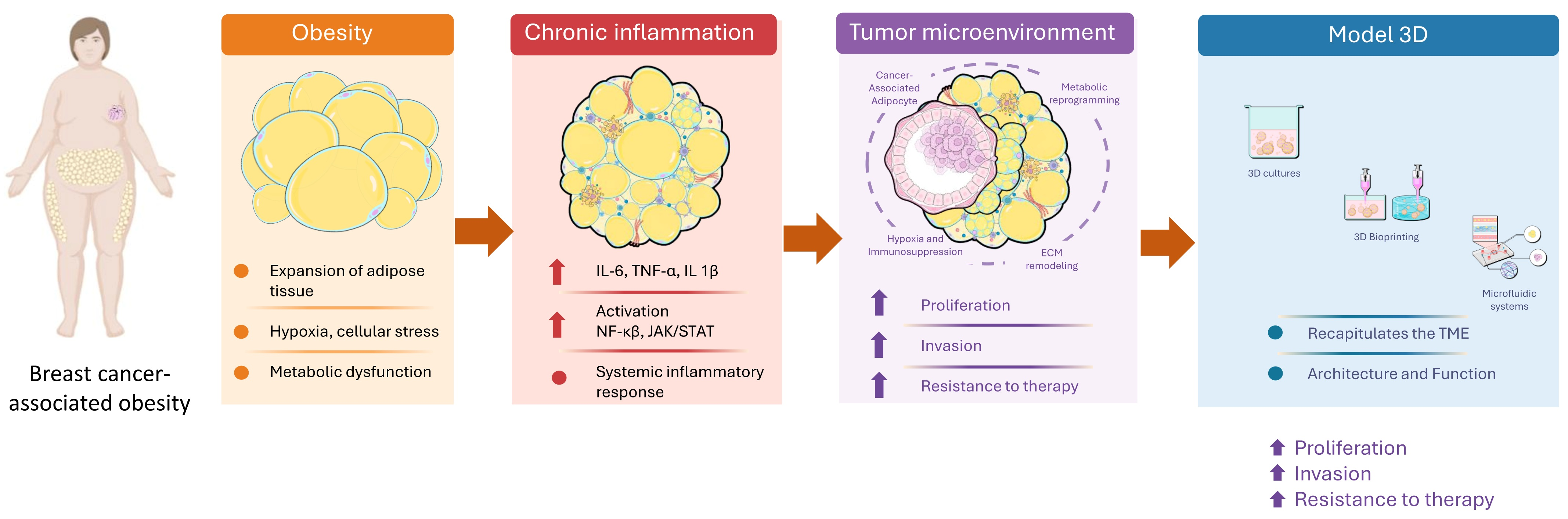
- This process involves systemic and local inflammation, metabolic changes, and hormonal alterations, which impact breast cancer development and progression.
- The review emphasizes the use of three-dimensional co-culture models, which more accurately replicate the breast tumor microenvironment, providing a better platform for studying adipocyte–tumor cell interactions.
- Targeting the obesity-induced changes in adipose tissue could provide new therapeutic opportunities for treating breast cancer associated with patient obesity.
- The use of 3D co-culture models of adipocytes/cancer cells highlights the need for advanced experimental platforms that better mimic the complexity of the tumor microenvironment.
- This could potentially lead to the discovery of novel targets for more effective and personalized treatments for obese breast cancer patients.
Abstract
1. Introduction
2. Obesity and Low-Grade Chronic Inflammation
2.1. Obesity-Associated Adipose Tissue Dysfunction
2.2. Systemic Inflammatory Mediators
2.3. Endocrine and Metabolic Alterations
3. Tumor Microenvironment in Breast Cancer and Obesity
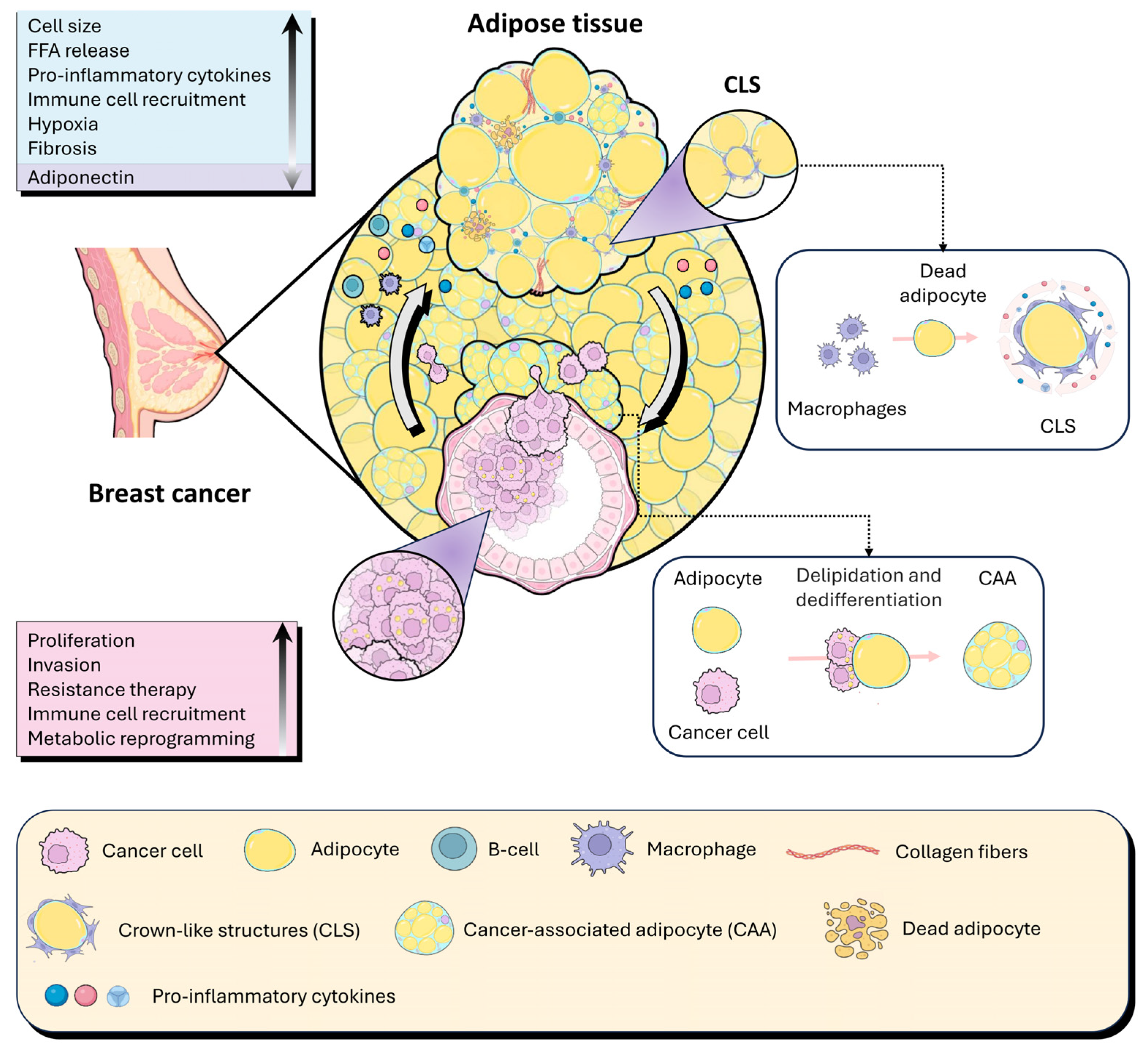
3.1. Reprogramming of Mammary Adipocytes and Formation of Cancer-Associated Adipocytes in Obesity
3.2. Spatial Organization of Inflammation Within the Mammary TME
3.3. Metabolic Coupling Between Adipocytes and Tumor Cells
3.4. Extracellular Matrix Remodeling
3.5. Local Hypoxia and Tumor Adaptation Induced by the Obesogenic Tumor Microenvironment
4. Limitations of Conventional Models
4.1. Limitations of Two-Dimensional (2D) Models
4.2. Strengths and Limitations of Animal Models
4.3. Translational Gaps and the Need for Advanced Experimental Systems
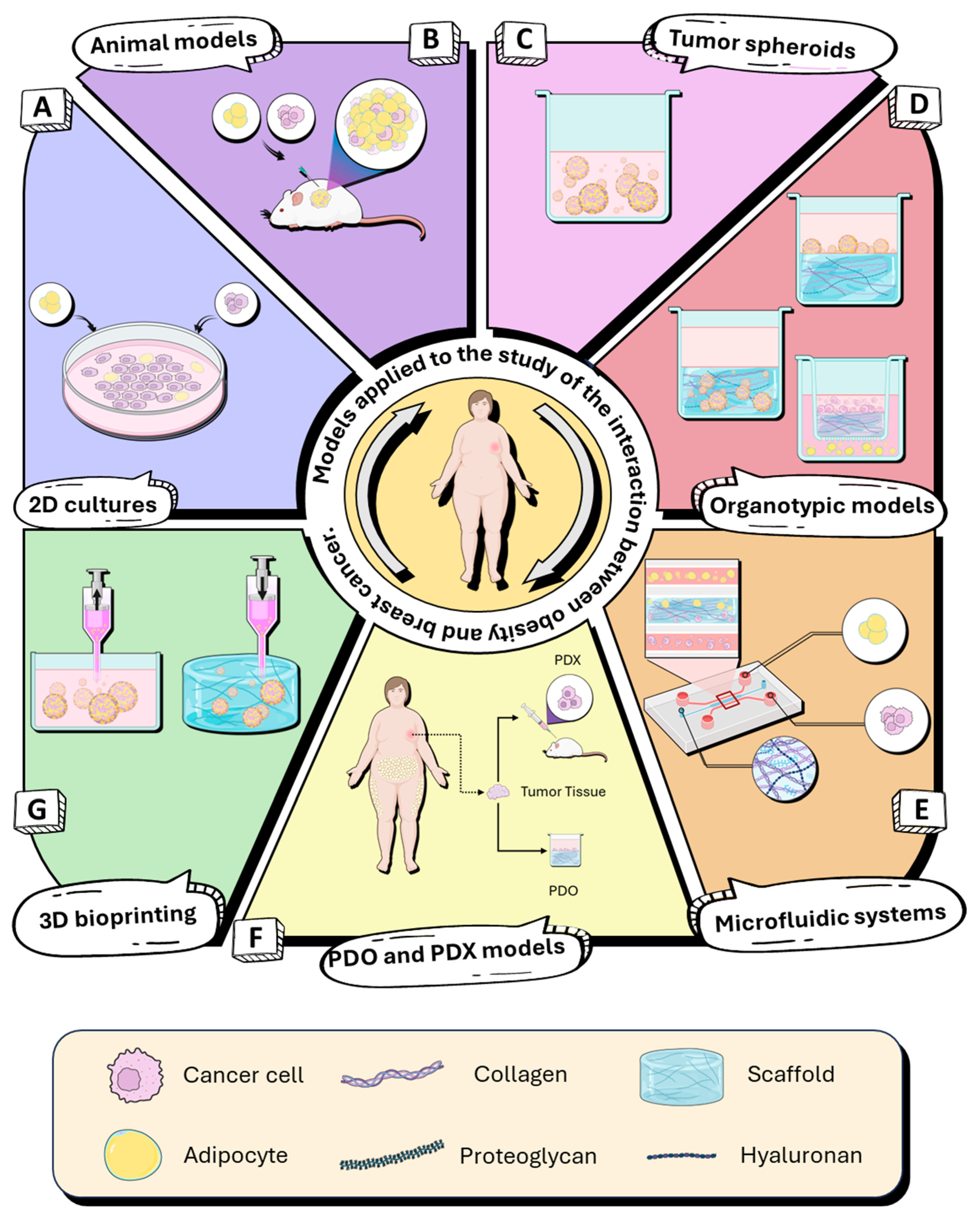
5. Three-Dimensional Models Applied to the Study of Obesity and Inflammation
5.1. Tumor Spheroids Co-Cultured with Adipocytes
5.2. Organotypic Cultures of Tumor Cells in Co-Culture with Adipocytes
5.3. Three-Dimensional Adipocyte Cultures in Interaction with Breast Cancer Cells
5.4. Microfluidic “On-a-Chip” Systems
5.5. Patient-Derived Organoids (PDOs) and Patient-Derived Xenograft (PDX) Models
5.6. Three-Dimensional Bioprinting of Adipocyte–Breast Cancer Co-Cultures

| Model | Advantages | Limitations | Applications | References |
|---|---|---|---|---|
| 2D Co-culture | Allows direct study of cell–adipocyte communication. Additionally, it is low-cost and easy to handle. | Lacks 3D complexity and extracellular matrix (ECM) and does not replicate metabolic and spatial gradients. | Study of crosstalk between adipocytes and tumor cells, metabolic changes, and inflammatory pathways | [10,67] |
| Animal Models (Diet-Induced Obesity) | Replicate the metabolic and systemic context, including tumor interaction with the obesogenic environment. | Species differences, ethical concerns, and difficulty replicating the TME. | Metastasis, systemic obesity and inflammation, estrogen signaling studies | [70,72] |
| 3D Tumor spheroids | Better physiological representation allows gradients of oxygen and nutrients closer to in vivo conditions. | Lacks a scaffold that mimics the extracellular matrix (ECM) and size variability. | Tumor progression, metabolic coupling, inflammatory signaling, and invasion studies | [77,78] |
| 3D Organotypic Cultures | Replicates tissue architecture and ECM–cell interactions. | Expensive, technically challenging, and requires complex materials such as Matrigel or hydrogels. | Study of tumor-adipocyte interaction, adipocyte differentiation, and ECM remodeling | [10,82] |
| Microfluidic “On-a-Chip” Systems | High precision in gradient control; realistic simulation of adipocyte–tumor communication. | Technical complexity, costly equipment, and scalability limitations. | Modeling metabolic and inflammatory crosstalk, invasion, migration, and therapeutic testing | [96] |
| PDOs and PDX | High clinical relevance, tumor heterogeneity is maintained, and reflects in vivo behavior. | Expensive, time-consuming, and limited tissue availability. | Potential for studying adipocyte–stroma–tumor interactions, metabolic reprogramming, and therapeutic responses. | [99,101] |
| 3D Bioprinting Models | Spatial precision in cell organization allows recreation of the tumor and adipose microenvironment. | Requires advanced equipment, a complex setup, and a high cost. | Adipocyte–tumor interaction, ECM remodeling, metabolic reprogramming, and therapeutic response testing | [104] |
6. Conclusions and Limitations
Author Contributions
Funding
Institutional Review Board Statement
Informed Consent Statement
Data Availability Statement
Acknowledgments
Conflicts of Interest
Abbreviations
| 2D | Two-Dimensional |
| 3D | Three-Dimensional |
| ADIPOQ | Adiponectin |
| ADSC | Adipose-Derived Stem Cell |
| ASC | Adipose Tissue-Derived Stromal Cell |
| ATMs | Adipose Tissue Macrophages |
| BC | Breast Cancer |
| BCCs | Breast Cancer Cells |
| CAA | Cancer-Associated Adipocyte |
| CA9 | Carbonic Anhydrase 9 |
| CDC42 | Cell Division Control Protein 42 Homolog |
| C/EBPα | CCAAT/enhancer-binding protein alpha |
| CCL2 | C-C Motif Chemokine Ligand 2 |
| CCL5 | C-C Motif Chemokine Ligand 5 |
| CCR1 | C-C Motif Chemokine Receptor 1 |
| CLS | Crown-Like Structures |
| COL1A1 | Collagen Type I Alpha 1 Chain |
| COL6A1 | Collagen Type IV Alpha 1 Chain |
| DAMPs | Damage-Associated Molecular Patterns |
| ECM | Extracellular Matrix |
| EMT | Epithelial–Mesenchymal Transition |
| FABPs | Fatty Acid-Binding Proteins |
| FAK | Focal Adhesion Kinase |
| FFA | Free Fatty Acids |
| FASN | Fatty Acid Synthase |
| FN1 | Fibronectin 1 |
| GLUT1 | Glucose Transporter 1 |
| HIF-1α | Hypoxia-Inducible Factor 1-alpha |
| HIF-2α | Hypoxia-Inducible Factor 2-alpha |
| HSL | Hormone-Sensitive Lipase |
| ICAM-1 | Intercellular Adhesion Molecule-1 |
| IL-1β | Interleukin-1 beta |
| IL-6 | Interleukin 6 |
| IL-8 | Interleukin 8 |
| JAK/STAT3 | Janus kinases/Signal Transducers and Activators of Transcription |
| LDW | Laser Direct-Write |
| LPL | Lipoprotein Lipase |
| MAPK | Mitogen-Activated Protein Kinase |
| MET | Mesenchymal–Epithelial Transition |
| MMPs | Metalloproteinases |
| NF-κB | Nuclear Factor kappa B |
| obASCs | Obesity-Altered Adipose Stem Cells |
| PDOs | Patient-derived organoids |
| PDXs | Patient-derived xenografts |
| PI3K | Phosphatidylinositol 3-kinase |
| PPARγ | Peroxisome Proliferator-Activated Receptor Gamma |
| PLIN1 | Perilipin 1 |
| PTGS2 | Prostaglandin–Endoperoxide Synthase 2 |
| RAC1 | Ras-Related C3 Botulinum Toxin Substrate 1 |
| TAMs | Tumor-Associated Macrophages |
| TME | Tumor Microenvironment |
| TNF-α | Tumor necrosis factor alpha |
| UCP1 | Uncoupling Protein 1 |
| VCAM-1 | Vascular Cell Adhesion Molecule-1 |
| VEGF | Vascular Endothelial Growth Factor |
References
- Siegel, R.L.; Giaquinto, A.N.; Jemal, A. Cancer statistics, 2024. CA Cancer J. Clin. 2024, 74, 12–49. [Google Scholar] [CrossRef]
- Hillers-Ziemer, L.E.; Kuziel, G.; Williams, A.E.; Moore, B.N.; Arendt, L.M. Breast cancer microenvironment and obesity: Challenges for therapy. Cancer Metastasis Rev. 2022, 41, 627–647. [Google Scholar] [CrossRef] [PubMed] [PubMed Central]
- Solsona-Vilarrasa, E.; Vousden, K.H. Obesity, white adipose tissue and cancer. FEBS J. 2025, 292, 2189–2207. [Google Scholar] [CrossRef] [PubMed] [PubMed Central]
- Bapat, S.P.; Whitty, C.; Mowery, C.T.; Liang, Y.; Yoo, A.; Jiang, Z.; Peters, M.C.; Zhang, L.-J.; Vogel, I.; Zhou, C.; et al. Obesity alters pathology and treatment response in inflammatory disease. Nature 2022, 604, 337–342. [Google Scholar] [CrossRef] [PubMed] [PubMed Central]
- Kim, D.S.; Scherer, P.E. Obesity, Diabetes, and Increased Cancer Progression. Diabetes Metab. J. 2021, 45, 799–812. [Google Scholar] [CrossRef] [PubMed] [PubMed Central]
- Morris, P.G.; Hudis, C.A.; Giri, D.; Morrow, M.; Falcone, D.J.; Zhou, X.K.; Du, B.; Brogi, E.; Crawford, C.B.; Kopelovich, L.; et al. Inflammation and Increased Aromatase Expression Occur in the Breast Tissue of Obese Women with Breast Cancer. Cancer Prev. Res. 2011, 4, 1021–1029. [Google Scholar] [CrossRef]
- Hanahan, D.; Weinberg, R.A. Hallmarks of cancer: The next generation. Cell 2011, 144, 646–674. [Google Scholar] [CrossRef] [PubMed]
- Quail, D.F.; Dannenberg, A.J. The obese adipose tissue microenvironment in cancer development and progression. Nat. Rev. Endocrinol. 2019, 15, 139–154. [Google Scholar] [CrossRef] [PubMed] [PubMed Central]
- Abuwatfa, W.H.; Pitt, W.G.; Husseini, G.A. Scaffold-based 3D cell culture models in cancer research. J. Biomed. Sci. 2024, 31, 7. [Google Scholar] [CrossRef] [PubMed] [PubMed Central]
- Salinas-Vera, Y.M.; Valdés, J.; Pérez-Navarro, Y.; Mandujano-Lazaro, G.; Marchat, L.A.; Ramos-Payán, R.; Nuñez-Olvera, S.I.; Pérez-Plascencia, C.; López-Camarillo, C. Three-Dimensional 3D Culture Models in Gynecological and Breast Cancer Research. Front. Oncol. 2022, 12, 826113. [Google Scholar] [CrossRef] [PubMed] [PubMed Central]
- Wu, X.; Su, J.; Wei, J.; Jiang, N.; Ge, X. Recent Advances in Three-Dimensional Stem Cell Culture Systems and Applications. Stem Cells Int. 2021, 2021, 9477332. [Google Scholar] [CrossRef] [PubMed] [PubMed Central]
- Rutkowski, J.M.; Stern, J.H.; Scherer, P.E. The cell biology of fat expansion. J. Cell Biol. 2015, 208, 501–512. [Google Scholar] [CrossRef]
- Sun, K.; Kusminski, C.M.; Scherer, P.E. Adipose tissue remodeling and obesity. J. Clin. Invest. 2011, 121, 2094–2101. [Google Scholar] [CrossRef] [PubMed] [PubMed Central]
- Cinti, S.; Mitchell, G.; Barbatelli, G.; Murano, I.; Ceresi, E.; Faloia, E.; Wang, S.; Fortier, M.; Greenberg, A.S.; Obin, M.S. Adipocyte death defines macrophage localization and function in adipose tissue of obese mice and humans. J. Lipid Res. 2005, 46, 2347–2355. [Google Scholar] [CrossRef] [PubMed]
- Lumeng, C.N.; Saltiel, A.R. Inflammatory links between obesity and metabolic disease. J. Clin. Investig. 2011, 121, 2111–2117. [Google Scholar] [CrossRef] [PubMed] [PubMed Central]
- Brown, K.A. Metabolic pathways in obesity-related breast cancer. Nat. Rev. Endocrinol. 2021, 17, 350–363. [Google Scholar] [CrossRef] [PubMed] [PubMed Central]
- Yu, H.; Pardoll, D.; Jove, R. STATs in cancer inflammation and immunity: A leading role for STAT3. Nat. Rev. Cancer 2009, 9, 798–809. [Google Scholar] [CrossRef] [PubMed] [PubMed Central]
- Kolb, R.; Zhang, W. Obesity and Breast Cancer: A Case of Inflamed Adipose Tissue. Cancers 2020, 12, 1686. [Google Scholar] [CrossRef] [PubMed] [PubMed Central]
- Iyengar, N.M.; Hudis, C.A.; Dannenberg, A.J. Obesity and inflammation: New insights into breast cancer development and progression. Am. Soc. Clin. Oncol. Educ. Book 2013, 33, 46–51. [Google Scholar] [CrossRef] [PubMed] [PubMed Central]
- Park, J.Y.; Kang, S.E.; Ahn, K.S.; Um, J.Y.; Yang, W.M.; Yun, M.; Lee, S.-G. Inhibition of the PI3K-AKT-mTOR pathway suppresses the adipocyte-mediated proliferation and migration of breast cancer cells. J. Cancer 2020, 11, 2552–2559. [Google Scholar] [CrossRef] [PubMed] [PubMed Central]
- Goodwin, P.J.; Stambolic, V. Impact of the obesity epidemic on cancer. Annu. Rev. Med. 2015, 66, 281–296. [Google Scholar] [CrossRef] [PubMed]
- Qureshi, R.; Picon-Ruiz, M.; Aurrekoetxea-Rodriguez, I.; Nunes de Paiva, V.; D’Amico, M.; Yoon, H.; Radhakrishnan, R.; Morata-Tarifa, C.; Ince, T.; Lippman, M.E.; et al. The Major Pre- and Postmenopausal Estrogens Play Opposing Roles in Obesity-Driven Mammary Inflammation and Breast Cancer Development. Cell Metab. 2020, 31, 1154–1172.e9. [Google Scholar] [CrossRef]
- Yang, Z.; Sun, Z. Influence of obesity on breast cancer development in relation to menopausal status (Review). Mol. Clin. Oncol. 2026, 24, 23. [Google Scholar] [CrossRef]
- Andò, S.; Gelsomino, L.; Panza, S.; Giordano, C.; Bonofiglio, D.; Barone, I.; Catalano, S. Obesity, Leptin and Breast Cancer: Epidemiological Evidence and Proposed Mechanisms. Cancers 2019, 11, 62. [Google Scholar] [CrossRef]
- Habanjar, O.; Nehme, R.; Goncalves-Mendes, N.; Cueff, G.; Blavignac, C.; Aoun, J.; Decombat, C.; Auxenfans, C.; Diab-Assaf, M.; Caldefie-Chézet, F.; et al. The obese inflammatory microenvironment may promote breast DCIS progression. Front. Immunol. 2024, 15, 1384354. [Google Scholar] [CrossRef] [PubMed] [PubMed Central]
- Lagarde, C.B.; Thapa, K.; Cullen, N.M.; Hawes, M.L.; Salim, K.; Benz, M.C.; Dietrich, S.R.; Burow, B.E.; Bunnell, B.A.; Martin, E.C.; et al. Obesity and leptin in breast cancer angiogenesis. Front. Endocrinol. 2024, 15, 1465727. [Google Scholar] [CrossRef] [PubMed]
- Kisar Tunca, S.; Unal, R. Adipocyte-derived fatty acid uptake induces obesity-related breast cancer progression: A review. Mol. Biol. Rep. 2024, 52, 39. [Google Scholar] [CrossRef] [PubMed]
- Suárez-Nájera, L.E.; Chanona-Pérez, J.J.; Valdivia-Flores, A.; Marrero-Rodríguez, D.; Salcedo-Vargas, M.; García-Ruiz, D.I.; Castro-Reyes, M.A. Morphometric study of adipocytes on breast cancer by means of photonic microscopy and image analysis. Microsc. Res. Tech. 2018, 81, 240–249. [Google Scholar] [CrossRef] [PubMed]
- Dirat, B.; Bochet, L.; Dabek, M.; Daviaud, D.; Dauvillier, S.; Majed, B.; Wang, Y.Y.; Meulle, A.; Salles, B.; Le Gonidec, S.; et al. Cancer-Associated Adipocytes Exhibit an Activated Phenotype and Contribute to Breast Cancer Invasion. Cancer Res. 2011, 71, 2455–2465. [Google Scholar] [CrossRef] [PubMed]
- Rybinska, I.; Agresti, R.; Trapani, A.; Tagliabue, E.; Triulzi, T. Adipocytes in Breast Cancer, the Thick and the Thin. Cells 2020, 9, 560. [Google Scholar] [CrossRef] [PubMed] [PubMed Central]
- Bochet, L.; Lehuédé, C.; Dauvillier, S.; Wang, Y.Y.; Dirat, B.; Laurent, V.; Dray, C.; Guiet, R.; Maridonneau-Parini, I.; Le Gonidec, S.; et al. Adipocyte-derived fibroblasts promote tumor progression and contribute to the desmoplastic reaction in breast cancer. Cancer Res. 2013, 73, 5657–5668. [Google Scholar] [CrossRef] [PubMed]
- Attané, C.; Muller, C. Drilling for Oil: Tumor-Surrounding Adipocytes Fueling Cancer. Trends Cancer 2020, 6, 593–604. [Google Scholar] [CrossRef] [PubMed]
- Wang, Y.Y.; Attané, C.; Milhas, D.; Dirat, B.; Dauvillier, S.; Guerard, A.; Gilhodes, J.; Lazar, I.; Alet, N.; Laurent, V.; et al. Mammary adipocytes stimulate breast cancer invasion through metabolic remodeling of tumor cells. JCI Insight 2017, 2, e87489. [Google Scholar] [CrossRef] [PubMed] [PubMed Central]
- Lee-Rueckert, M.; Canyelles, M.; Tondo, M.; Rotllan, N.; Kovanen, P.T.; Llorente-Cortes, V.; Escolà-Gil, J.C. Obesity-induced changes in cancer cells and their microenvironment: Mechanisms and therapeutic perspectives to manage dysregulated lipid metabolism. Semin. Cancer Biol. 2023, 93, 36–51. [Google Scholar] [CrossRef]
- Rybinska, I.; Mangano, N.; Tagliabue, E.; Triulzi, T. Cancer-Associated Adipocytes in Breast Cancer: Causes and Consequences. Int. J. Mol. Sci. 2021, 22, 3775. [Google Scholar] [CrossRef] [PubMed] [PubMed Central]
- Han, J.M.; Levings, M.K. Immune regulation in obesity-associated adipose inflammation. J. Immunol. 2013, 191, 527–532. [Google Scholar] [CrossRef] [PubMed]
- DeNardo, D.G.; Ruffell, B. Macrophages as regulators of tumour immunity and immunotherapy. Nat. Rev. Immunol. 2019, 19, 369–382. [Google Scholar] [CrossRef] [PubMed] [PubMed Central]
- Iyengar, N.M.; Gucalp, A.; Dannenberg, A.J.; Hudis, C.A. Obesity and Cancer Mechanisms: Tumor Microenvironment and Inflammation. J. Clin. Oncol. 2016, 34, 4270–4276. [Google Scholar] [CrossRef] [PubMed] [PubMed Central]
- Fuentes-Mattei, E.; Velazquez-Torres, G.; Phan, L.; Zhang, F.; Chou, P.C.; Shin, J.H.; Choi, H.H.; Chen, J.-S.; Zhao, R.; Chen, J.; et al. Effects of Obesity on Transcriptomic Changes and Cancer Hallmarks in Estrogen Receptor–Positive Breast Cancer. J. Natl. Cancer Inst. 2014, 106, dju158. [Google Scholar] [CrossRef]
- Ma, A.; Xiang, L.; Yuan, J.; Wang, Q.; Zhao, L.; Yan, H.; Ma, A.; Xiang, L.; Yuan, J.; Wang, Q.; et al. Spatial Transcriptomics Decodes Breast Cancer Microenvironment Heterogeneity: From Multidimensional Dynamic Profiling to Precision Therapy Blueprint Construction. Biomolecules 2025, 15, 1067. [Google Scholar] [CrossRef]
- Balaban, S.; Lee, L.S.; Schreuder, M.; Hoy, A.J. Obesity and Cancer Progression: Is There a Role of Fatty Acid Metabolism? Biomed. Res. Int. 2015, 2015, 274585. [Google Scholar] [CrossRef] [PubMed] [PubMed Central]
- Nieman, K.M.; Kenny, H.A.; Penicka, C.V.; Ladanyi, A.; Buell-Gutbrod, R.; Zillhardt, M.R.; Romero, I.L.; Carey, M.S.; Mills, G.B.; Hotamisligil, G.S.; et al. Adipocytes promote ovarian cancer metastasis and provide energy for rapid tumor growth. Nat. Med. 2011, 17, 1498–1503. [Google Scholar] [CrossRef] [PubMed] [PubMed Central]
- Horder, H.; Böhringer, D.; Endrizzi, N.; Hildebrand, L.S.; Cianciosi, A.; Stecher, S.; Dusi, F.; Schweinitzer, S.; Watzling, M.; Groll, J.; et al. Cancer cell migration depends on adjacent ASC and adipose spheroids in a 3D bioprinted breast cancer model. Biofabrication 2024, 16, 035031. [Google Scholar] [CrossRef]
- Martinez-Outschoorn, U.E.; Sotgia, F.; Lisanti, M.P. Power surge: Supporting cells “fuel” cancer cell mitochondria. Cell Metab. 2012, 15, 4–5. [Google Scholar] [CrossRef] [PubMed]
- Martinez-Outschoorn, U.E.; Pestell, R.G.; Howell, A.; Tykocinski, M.L.; Nagajyothi, F.; Machado, F.S.; Tanowitz, H.B.; Sotgia, F.; Lisanti, M.P. Energy transfer in “parasitic” cancer metabolism: Mitochondria are the powerhouse and Achilles’ heel of tumor cells. Cell Cycle 2011, 10, 4208–4216. [Google Scholar] [CrossRef] [PubMed] [PubMed Central]
- Kolb, R.; Kluz, P.; Tan, Z.W.; Borcherding, N.; Bormann, N.; Vishwakarma, A.; Balcziak, L.; Zhu, P.; Davies, B.S.; Gourronc, F.; et al. Obesity-associated inflammation promotes angiogenesis and breast cancer via angiopoietin-like 4. Oncogene 2019, 38, 2351–2363. [Google Scholar] [CrossRef] [PubMed] [PubMed Central]
- Dana, N.; Ferns, G.A.; Nedaeinia, R.; Haghjooy Javanmard, S. Leptin signaling in breast cancer and its crosstalk with peroxisome proliferator-activated receptors α and γ. Clin. Transl. Oncol. 2023, 25, 601–610. [Google Scholar] [CrossRef] [PubMed]
- Nakatsuji, M.; Fujimori, K. Adipocyte-conditioned medium induces tamoxifen resistance by activating PI3K/Akt/mTOR pathway in estrogen receptor-positive breast cancer cells. Biochim. Biophys. Acta Mol. Cell Res. 2024, 1871, 119821. [Google Scholar] [CrossRef] [PubMed]
- Lu, P.; Weaver, V.M.; Werb, Z. The extracellular matrix: A dynamic niche in cancer progression. J. Cell Biol. 2012, 196, 395–406. [Google Scholar] [CrossRef] [PubMed] [PubMed Central]
- Pickup, M.W.; Mouw, J.K.; Weaver, V.M. The extracellular matrix modulates the hallmarks of cancer. EMBO Rep. 2014, 15, 1243–1253. [Google Scholar] [CrossRef] [PubMed] [PubMed Central]
- Mariman, E.C.M.; Wang, P. Adipocyte extracellular matrix composition, dynamics and role in obesity. Cell Mol. Life Sci. 2010, 67, 1277–1292. [Google Scholar] [CrossRef] [PubMed] [PubMed Central]
- Miles, F.L.; Sikes, R.A. Insidious Changes in Stromal Matrix Fuel Cancer Progression. Mol. Cancer Res. 2014, 12, 297–312. [Google Scholar] [CrossRef] [PubMed] [PubMed Central]
- Wang, K.; Wu, F.; Seo, B.R.; Fischbach, C.; Chen, W.; Hsu, L.; Gourdon, D. Breast cancer cells alter the dynamics of stromal fibronectin-collagen interactions. Matrix Biol. 2017, 60–61, 86–95. [Google Scholar] [CrossRef] [PubMed] [PubMed Central]
- Dupont, S.; Morsut, L.; Aragona, M.; Enzo, E.; Giulitti, S.; Cordenonsi, M.; Zanconato, F.; Le Digabel, J.; Forcato, M.; Bicciato, S.; et al. Role of YAP/TAZ in mechanotransduction. Nature 2011, 474, 179–183. [Google Scholar] [CrossRef] [PubMed]
- Levental, K.R.; Yu, H.; Kass, L.; Lakins, J.N.; Egeblad, M.; Erler, J.T.; Fong, S.F.T.; Csiszar, K.; Giaccia, A.; Weninger, W.; et al. Matrix crosslinking forces tumor progression by enhancing integrin signaling. Cell 2009, 139, 891–906. [Google Scholar] [CrossRef] [PubMed] [PubMed Central]
- Salinas-Vera, Y.M.; Gallardo-Rincón, D.; Ruíz-García, E.; Silva-Cázares, M.B.; de la Peña-Cruz, C.S.; López-Camarillo, C. The Role of Hypoxia in Endometrial Cancer. Curr. Pharm. Biotechnol. 2022, 23, 221–234. [Google Scholar] [CrossRef] [PubMed]
- Chen, Z.; Han, F.; Du, Y.; Shi, H.; Zhou, W. Hypoxic microenvironment in cancer: Molecular mechanisms and therapeutic interventions. Signal Transduct. Target. Ther. 2023, 8, 70. [Google Scholar] [CrossRef] [PubMed] [PubMed Central]
- Rankin, E.B.; Giaccia, A.J. Hypoxic control of metastasis. Science 2016, 352, 175–180. [Google Scholar] [CrossRef] [PubMed] [PubMed Central]
- Semenza, G.L. Regulation of the breast cancer stem cell phenotype by hypoxia-inducible factors. Clin. Sci. 2015, 129, 1037–1045. [Google Scholar] [CrossRef] [PubMed]
- Furuta, E.; Pai, S.K.; Zhan, R.; Bandyopadhyay, S.; Watabe, M.; Mo, Y.Y.; Hirota, S.; Hosobe, S.; Tsukada, T.; Miura, K.; et al. Fatty acid synthase gene is up-regulated by hypoxia via activation of Akt and sterol regulatory element binding protein-1. Cancer Res. 2008, 68, 1003–1011. [Google Scholar] [CrossRef] [PubMed]
- Gilles, F.; Gressens, P.; Dammann, O.; Leviton, A. Hypoxia–ischemia is not an antecedent of most preterm brain damage: The illusion of validity. Dev. Med. Child Neurol. 2018, 60, 120–125. [Google Scholar] [CrossRef] [PubMed] [PubMed Central]
- Sharma, M.; Boytard, L.; Hadi, T.; Koelwyn, G.; Simon, R.; Ouimet, M.; Seifert, L.; Spiro, W.; Yan, B.; Hutchison, S.; et al. Enhanced glycolysis and HIF-1α activation in adipose tissue macrophages sustains local and systemic interleukin-1β production in obesity. Sci. Rep. 2020, 10, 5555. [Google Scholar] [CrossRef]
- Wang, K.; Zhu, X.; Zhang, K.; Yin, Y.; Chen, Y.; Zhang, T. Interleukin-6 contributes to chemoresistance in MDA-MB-231 cells via targeting HIF-1α. J. Biochem. Mol. Toxicol. 2018, 32, e22039. [Google Scholar] [CrossRef] [PubMed]
- Mirabelli, M.; Misiti, R.; Sicilia, L.; Brunetti, F.S.; Chiefari, E.; Brunetti, A.; Foti, D.P.; Mirabelli, M.; Misiti, R.; Sicilia, L.; et al. Hypoxia in Human Obesity: New Insights from Inflammation towards Insulin Resistance—A Narrative Review. Int. J. Mol. Sci. 2024, 25, 9802. [Google Scholar] [CrossRef]
- Gilkes, D.M.; Semenza, G.L.; Wirtz, D. Hypoxia and the extracellular matrix: Drivers of tumour metastasis. Nat. Rev. Cancer 2014, 14, 430–439. [Google Scholar] [CrossRef] [PubMed] [PubMed Central]
- Weigelt, B.; Ghajar, C.M.; Bissell, M.J. The need for complex 3D culture models to unravel novel pathways and identify accurate biomarkers in breast cancer. Adv. Drug Deliv. Rev. 2014, 69–70, 42–51. [Google Scholar] [CrossRef] [PubMed] [PubMed Central]
- Kapałczyńska, M.; Kolenda, T.; Przybyła, W.; Zajączkowska, M.; Teresiak, A.; Filas, V.; Ibbs, M.; Bliźniak, R.; Łuczewski, Ł.; Lamperska, K. 2D and 3D cell cultures—A comparison of different types of cancer cell cultures. Arch. Med. Sci. 2018, 14, 910–919. [Google Scholar] [CrossRef] [PubMed] [PubMed Central]
- Langhans, S.A. Three-Dimensional in Vitro Cell Culture Models in Drug Discovery and Drug Repositioning. Front. Pharmacol. 2018, 9, 6. [Google Scholar] [CrossRef]
- Rebeaud, M.; Bouche, C.; Dauvillier, S.; Attané, C.; Arellano, C.; Vaysse, C.; Fallone, F.; Muller, C. A novel 3D culture model for human primary mammary adipocytes to study their metabolic crosstalk with breast cancer in lean and obese conditions. Sci. Rep. 2023, 13, 4707. [Google Scholar] [CrossRef] [PubMed]
- Barrett, P.; Mercer, J.G.; Morgan, P.J. Preclinical models for obesity research. Dis. Model. Mech. 2016, 9, 1245–1255. [Google Scholar] [CrossRef] [PubMed] [PubMed Central]
- Cranford, T.L.; Velázquez, K.T.; Enos, R.T.; Sougiannis, A.T.; Bader, J.E.; Carson, M.S.; Bellone, R.R.; Chatzistamou, I.; Nagarkatti, M.; Murphy, E.A. Effects of high fat diet-induced obesity on mammary tumorigenesis in the PyMT/MMTV murine model. Cancer Biol. Ther. 2019, 20, 487–496. [Google Scholar] [CrossRef] [PubMed] [PubMed Central]
- Li, J.; Wu, H.; Liu, Y.; Yang, L. High fat diet induced obesity model using four strainsof mice: Kunming, C57BL/6, BALB/c and ICR. Exp. Anim. 2020, 69, 326–335. [Google Scholar] [CrossRef] [PubMed] [PubMed Central]
- Day, C.P.; Merlino, G.; Van Dyke, T. Preclinical mouse cancer models: A maze of opportunities and challenges. Cell 2015, 163, 39–53. [Google Scholar] [CrossRef] [PubMed] [PubMed Central]
- Carter, E.P.; Roozitalab, R.; Gibson, S.V.; Grose, R.P. Tumour microenvironment 3D-modelling: Simplicity to complexity and back again. Trends Cancer 2021, 7, 1033–1046. [Google Scholar] [CrossRef] [PubMed]
- Blyth, R.R.R.; Birts, C.N.; Beers, S.A. The role of three-dimensional in vitro models in modelling the inflammatory microenvironment associated with obesity in breast cancer. Breast Cancer Res. 2023, 25, 104. [Google Scholar] [CrossRef] [PubMed] [PubMed Central]
- Mertz, D.; Sentosa, J.; Luker, G.; Takayama, S. Studying Adipose Tissue in the Breast Tumor Microenvironment In Vitro: Progress and Opportunities. Tissue Eng. Regen. Med. 2020, 17, 773–785. [Google Scholar] [CrossRef] [PubMed] [PubMed Central]
- Cui, X.; Hartanto, Y.; Zhang, H. Advances in multicellular spheroids formation. J. R. Soc. Interface 2017, 14, 20160877. [Google Scholar] [CrossRef] [PubMed] [PubMed Central]
- Di Stefano, A.B.; Urrata, V.; Trapani, M.; Moschella, F.; Cordova, A.; Toia, F. Systematic review on spheroids from adipose-derived stem cells: Spontaneous or artefact state? J. Cell Physiol. 2022, 237, 4397–4411. [Google Scholar] [CrossRef] [PubMed] [PubMed Central]
- Miki, Y.; Ono, K.; Hata, S.; Suzuki, T.; Kumamoto, H.; Sasano, H. The advantages of co-culture over mono cell culture in simulating in vivo environment. J. Steroid Biochem. Mol. Biol. 2012, 131, 68–75. [Google Scholar] [CrossRef] [PubMed]
- Xin, X.; Yang, H.; Zhang, F.; Yang, S.T. 3D cell coculture tumor model: A promising approach for future cancer drug discovery. Process Biochem. 2019, 78, 148–160. [Google Scholar] [CrossRef]
- Watzling, M.; Klaus, L.; Weidemeier, T.; Horder, H.; Ebert, R.; Blunk, T.; Bauer-Kreisel, P.; Watzling, M.; Klaus, L.; Weidemeier, T.; et al. Three-Dimensional Breast Cancer Model to Investigate CCL5/CCR1 Expression Mediated by Direct Contact between Breast Cancer Cells and Adipose-Derived Stromal Cells or Adipocytes. Cancers 2023, 15, 3501. [Google Scholar] [CrossRef] [PubMed]
- Fröhlich, E. The Variety of 3D Breast Cancer Models for the Study of Tumor Physiology and Drug Screening. Int. J. Mol. Sci. 2023, 24, 7116. [Google Scholar] [CrossRef] [PubMed] [PubMed Central]
- Huang, Z.; Yu, P.; Tang, J. Characterization of Triple-Negative Breast Cancer MDA-MB-231 Cell Spheroid Model. Onco Targets Ther. 2020, 13, 5395–5405. [Google Scholar] [CrossRef] [PubMed] [PubMed Central]
- Asante, E.C.; Pallegar, N.K.; Viloria-Petit, A.M.; Christian, S.L. Three-Dimensional Co-Culture Method for Studying Interactions Between Adipocytes, Extracellular Matrix, and Cancer Cells. Methods Mol. Biol. 2022, 2508, 69–77. [Google Scholar] [CrossRef] [PubMed]
- Paré, M.; Darini, C.Y.; Yao, X.; Chignon-Sicard, B.; Rekima, S.; Lachambre, S.; Virolle, V.; Aguilar-Mahecha, A.; Basik, M.; Dani, C.; et al. Breast cancer mammospheres secrete Adrenomedullin to induce lipolysis and browning of adjacent adipocytes. BMC Cancer 2020, 20, 784. [Google Scholar] [CrossRef] [PubMed] [PubMed Central]
- Huss, F.R.; Kratz, G. Mammary epithelial cell and adipocyte co-culture in a 3-D matrix: The first step towards tissue-engineered human breast tissue. Cells Tissues Organs 2001, 169, 361–367. [Google Scholar] [CrossRef] [PubMed]
- Tong, J.; Mou, S.; Xiong, L.; Wang, Z.; Wang, R.; Weigand, A.; Yuan, Q.; Horch, R.E.; Sun, J.; Yang, J. Adipose-derived mesenchymal stem cells formed acinar-like structure when stimulated with breast epithelial cells in three-dimensional culture. PLoS ONE 2018, 13, e0204077. [Google Scholar] [CrossRef] [PubMed] [PubMed Central]
- Pallegar, N.K.; Garland, C.J.; Mahendralingam, M.; Viloria-Petit, A.M.; Christian, S.L. A Novel 3-Dimensional Co-culture Method Reveals a Partial Mesenchymal to Epithelial Transition in Breast Cancer Cells Induced by Adipocytes. J. Mammary Gland Biol. Neoplasia 2019, 24, 85–97. [Google Scholar] [CrossRef] [PubMed]
- Hume, R.D.; Pensa, S.; Brown, E.J.; Kreuzaler, P.A.; Hitchcock, J.; Husmann, A.; Campbell, J.J.; Lloyd-Thomas, A.O.; Cameron, R.E.; Watson, C.J. Tumour cell invasiveness and response to chemotherapeutics in adipocyte invested 3D engineered anisotropic collagen scaffolds. Sci. Rep. 2018, 8, 12658. [Google Scholar] [CrossRef] [PubMed] [PubMed Central]
- Tovar-Hernández, K.; Salinas-Vera, Y.M.; Carlos-Reyes, Á.; García-Hernández, A.P.; Marchat, L.A.; Mandujano-Lázaro, G.; Ríos-Castro, E.; Velasco-Suárez, A.; Mendez-Gómez, I.; Tecalco-Cruz, Á.C.; et al. Adipocytes reprogram the proteome of breast cancer cells in organotypic three-dimensional cell cultures. Sci. Rep. 2024, 14, 27029. [Google Scholar] [CrossRef] [PubMed] [PubMed Central]
- Blyth, R.R.R.; Laversin, S.A.; Foxall, R.B.; Savva, C.; Copson, E.; Cutress, R.I.; Birts, C.N.; Beers, S.A. Development and characterisation of a novel 3D in vitro model of obesity-associated breast cancer as a tool for drug testing. NPJ Breast Cancer 2025, 11, 50. [Google Scholar] [CrossRef] [PubMed] [PubMed Central]
- Haykal, M.M.; Nahmias, C.; Varon, C.; Martin, O.C.B. Organotypic Modeling of the Tumor Landscape. Front. Cell Dev. Biol. 2020, 8, 606039. [Google Scholar] [CrossRef] [PubMed] [PubMed Central]
- Balaban, S.; Shearer, R.F.; Lee, L.S.; van Geldermalsen, M.; Schreuder, M.; Shtein, H.C.; Cairns, R.; Thomas, K.C.; Fazakerley, D.J.; Grewal, T.; et al. Adipocyte lipolysis links obesity to breast cancer growth: Adipocyte-derived fatty acids drive breast cancer cell proliferation and migration. Cancer Metab. 2017, 5, 1. [Google Scholar] [CrossRef] [PubMed] [PubMed Central]
- Endo, K.; Sato, T.; Umetsu, A.; Watanabe, M.; Hikage, F.; Ida, Y.; Ohguro, H.; Furuhashi, M. 3D culture induction of adipogenic differentiation in 3T3-L1 preadipocytes exhibits adipocyte-specific molecular expression patterns and metabolic functions. Heliyon 2023, 9, e20713. [Google Scholar] [CrossRef] [PubMed] [PubMed Central]
- Soták, M.; Rajan, M.R.; Clark, M.; Harms, M.; Rani, A.; Kraft, J.D.; Tandio, D.; Shen, T.; Borkowski, K.; Fiehn, O.; et al. Lipoxins reduce obesity-induced adipose tissue inflammation in 3D-cultured human adipocytes and explant cultures. iScience 2022, 25, 104602. [Google Scholar] [CrossRef] [PubMed] [PubMed Central]
- Sung, K.E.; Beebe, D.J. Microfluidic 3D models of cancer. Adv. Drug Deliv. Rev. 2014, 79–80, 68–78. [Google Scholar] [CrossRef] [PubMed]
- Yang, F.; Carmona, A.; Stojkova, K.; Huitron, E.I.G.; Goddi, A.; Bhushan, A.; Cohen, R.N.; Brey, E.M. A 3D human adipose tissue model within a microfluidic device. Lab. Chip 2021, 21, 435–446. [Google Scholar] [CrossRef] [PubMed]
- Bahcecioglu, G.; Basara, G.; Ellis, B.W.; Ren, X.; Zorlutuna, P. Breast cancer models: Engineering the tumor microenvironment. Acta Biomater. 2020, 106, 1–21. [Google Scholar] [CrossRef] [PubMed] [PubMed Central]
- Leung, D.; Kaur, J.; Richardson, G.; Jardé, T. Breast cancer organoids: Advancements and applications in precision medicine. Crit. Rev. Oncol. Hematol. 2025, 214, 104914. [Google Scholar] [CrossRef] [PubMed]
- Wu, H.; Wang, W.; Zhang, Y.; Chen, Y.; Shan, C.; Li, J.; Jia, Y.; Li, C.; Du, C.; Cai, Y.; et al. Establishment of patient-derived organoids for guiding personalized therapies in breast cancer patients. Int. J. Cancer 2024, 155, 324–338. [Google Scholar] [CrossRef] [PubMed]
- Hou, X.; Du, C.; Lu, L.; Yuan, S.; Zhan, M.; You, P.; Du, H. Opportunities and challenges of patient-derived models in cancer research: Patient-derived xenografts, patient-derived organoid and patient-derived cells. World J. Surg. Oncol. 2022, 20, 37. [Google Scholar] [CrossRef] [PubMed] [PubMed Central]
- Sabol, R.A.; Bowles, A.C.; Côté, A.; Wise, R.; O’Donnell, B.; Matossian, M.D.; Hossain, F.M.; Burks, H.E.; Del Valle, L.; Miele, L.; et al. Leptin produced by obesity-altered adipose stem cells promotes metastasis but not tumorigenesis of triple-negative breast cancer in orthotopic xenograft and patient-derived xenograft models. Breast Cancer Res. 2019, 21, 67. [Google Scholar] [CrossRef] [PubMed] [PubMed Central]
- Levato, R.; Jungst, T.; Scheuring, R.G.; Blunk, T.; Groll, J.; Malda, J. From Shape to Function: The Next Step in Bioprinting. Adv. Mater. 2020, 32, e1906423. [Google Scholar] [CrossRef] [PubMed] [PubMed Central]
- Zhang, Z.; Chen, X.; Gao, S.; Fang, X.; Ren, S. 3D bioprinted tumor model: A prompt and convenient platform for overcoming immunotherapy resistance by recapitulating the tumor microenvironment. Cell Oncol. 2024, 47, 1113–1126. [Google Scholar] [CrossRef] [PubMed] [PubMed Central]
- Vinson, B.T.; Phamduy, T.B.; Shipman, J.; Riggs, B.; Strong, A.L.; Sklare, S.C.; Murfee, W.L.; Burow, M.E.; Bunnell, B.A.; Huang, Y.; et al. Laser direct-write based fabrication of a spatially-defined, biomimetic construct as a potential model for breast cancer cell invasion into adipose tissue. Biofabrication 2017, 9, 025013. [Google Scholar] [CrossRef] [PubMed]
- Horder, H.; Guaza Lasheras, M.; Grummel, N.; Nadernezhad, A.; Herbig, J.; Ergün, S.; Teßmar, J.; Groll, J.; Fabry, B.; Bauer-Kreisel, P.; et al. Bioprinting and Differentiation of Adipose-Derived Stromal Cell Spheroids for a 3D Breast Cancer-Adipose Tissue Model. Cells 2021, 10, 803. [Google Scholar] [CrossRef] [PubMed] [PubMed Central]
- Huang, X.; Liu, B.; Shen, S. Lipid Metabolism in Breast Cancer: From Basic Research to Clinical Application. Cancers 2025, 17, 650. [Google Scholar] [CrossRef] [PubMed] [PubMed Central]
- Kuhajda, F.P. Fatty-acid synthase and human cancer: New perspectives on its role in tumor biology. Nutrition 2000, 16, 202–208. [Google Scholar] [CrossRef] [PubMed]
- Menendez, J.A.; Vellon, L.; Lupu, R. Targeting fatty acid synthase-driven lipid rafts: A novel strategy to overcome trastuzumab resistance in breast cancer cells. Med. Hypotheses 2005, 64, 997–1001. [Google Scholar] [CrossRef] [PubMed]
- Menendez, J.A.; Mehmi, I.; Verma, V.A.; Teng, P.K.; Lupu, R. Pharmacological inhibition of fatty acid synthase (FAS): A novel therapeutic approach for breast cancer chemoprevention through its ability to suppress Her-2/neu (erbB-2) oncogene-induced malignant transformation. Mol. Carcinog. 2004, 41, 164–178. [Google Scholar] [CrossRef] [PubMed]
- Fu, Y.; Zou, T.; Shen, X.; Nelson, P.J.; Li, J.; Wu, C.; Yang, J.; Zheng, Y.; Bruns, C.; Zhao, Y.; et al. Lipid metabolism in cancer progression and therapeutic strategies. MedComm 2021, 2, 27–59. [Google Scholar] [CrossRef] [PubMed]


Disclaimer/Publisher’s Note: The statements, opinions and data contained in all publications are solely those of the individual author(s) and contributor(s) and not of MDPI and/or the editor(s). MDPI and/or the editor(s) disclaim responsibility for any injury to people or property resulting from any ideas, methods, instructions or products referred to in the content. |
© 2026 by the authors. Licensee MDPI, Basel, Switzerland. This article is an open access article distributed under the terms and conditions of the Creative Commons Attribution (CC BY) license.
Share and Cite
Salinas-Vera, Y.M.; Pérez-Navarro, Y.; Puente-Rivera, J.; Álvarez-Sánchez, M.E.; López-Camarillo, C. Obesity, Inflammation, and Tumor Microenvironment in Three-Dimensional Models of Breast Cancer. Cells 2026, 15, 761. https://doi.org/10.3390/cells15090761
Salinas-Vera YM, Pérez-Navarro Y, Puente-Rivera J, Álvarez-Sánchez ME, López-Camarillo C. Obesity, Inflammation, and Tumor Microenvironment in Three-Dimensional Models of Breast Cancer. Cells. 2026; 15(9):761. https://doi.org/10.3390/cells15090761
Chicago/Turabian StyleSalinas-Vera, Yarely M., Yussel Pérez-Navarro, Jonathan Puente-Rivera, María Elizbeth Álvarez-Sánchez, and César López-Camarillo. 2026. "Obesity, Inflammation, and Tumor Microenvironment in Three-Dimensional Models of Breast Cancer" Cells 15, no. 9: 761. https://doi.org/10.3390/cells15090761
APA StyleSalinas-Vera, Y. M., Pérez-Navarro, Y., Puente-Rivera, J., Álvarez-Sánchez, M. E., & López-Camarillo, C. (2026). Obesity, Inflammation, and Tumor Microenvironment in Three-Dimensional Models of Breast Cancer. Cells, 15(9), 761. https://doi.org/10.3390/cells15090761