Human iPSC-Derived Dorsal Root Ganglion Organoid Modeling of Chemotherapy-Induced Peripheral Neuropathy
 ,
,
Highlights
- Human iPSC-derived dorsal root ganglion organoids (iDRGOs) recapitulate key neuronal and glial features of native DRG tissue and support quantitative neurite outgrowth assays for modeling chemotherapy-induced peripheral neuropathy (CIPN).
- Bortezomib, paclitaxel, and vincristine induce dose-dependent neurite degeneration in iDRGOs, with distinct microtubule-associated protein (MAP2) responses compared to monolayer sensory neuron cultures.
- Three-dimensional organoid architecture and cellular heterogeneity influence measurable neurotoxic phenotypes, highlighting important differences between 2D and 3D human sensory neuron models.
- The iDRGO platform provides a physiologically relevant human system for mechanistic studies and therapeutic screening in chemotherapy-induced neurotoxicity.
Abstract
1. Introduction
2. Materials and Methods
2.1. Human iPSC Cell Culture, iSN Differentiation, and iDRGO Differentiation
2.2. Chemotherapy Treatment
2.3. Immunofluorescence and Microscopy
2.4. Protein Quantification Analysis
2.5. Quantitative RT-PCR
2.6. Neurite Length Analysis
2.7. Statistical Analysis
3. Results
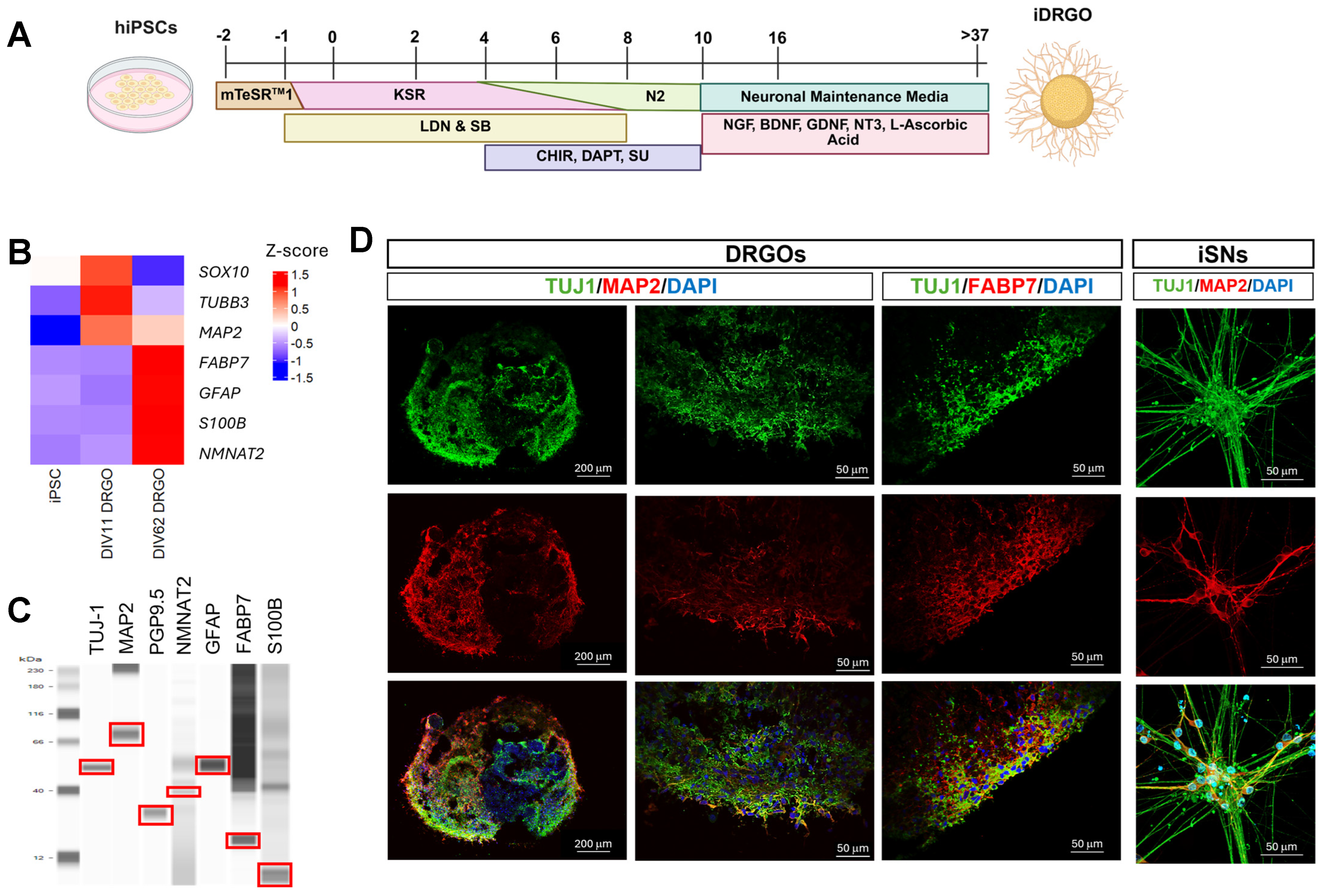
3.1. Generation and Characterization of Dorsal Root Ganglion Organoids (iDRGOs)
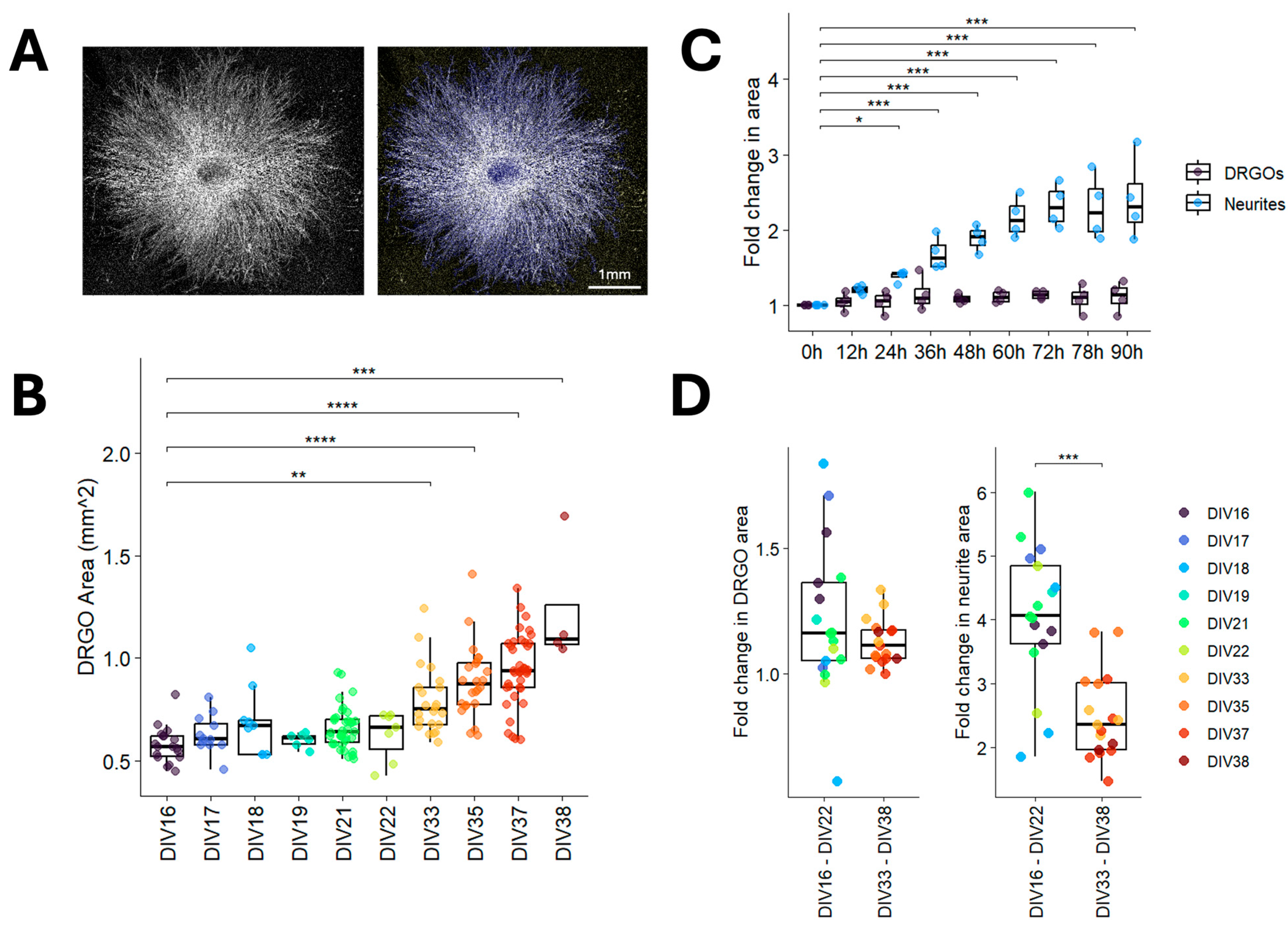
3.2. Developmental Stage Influences Neurite Outgrowth and iDRGO Size
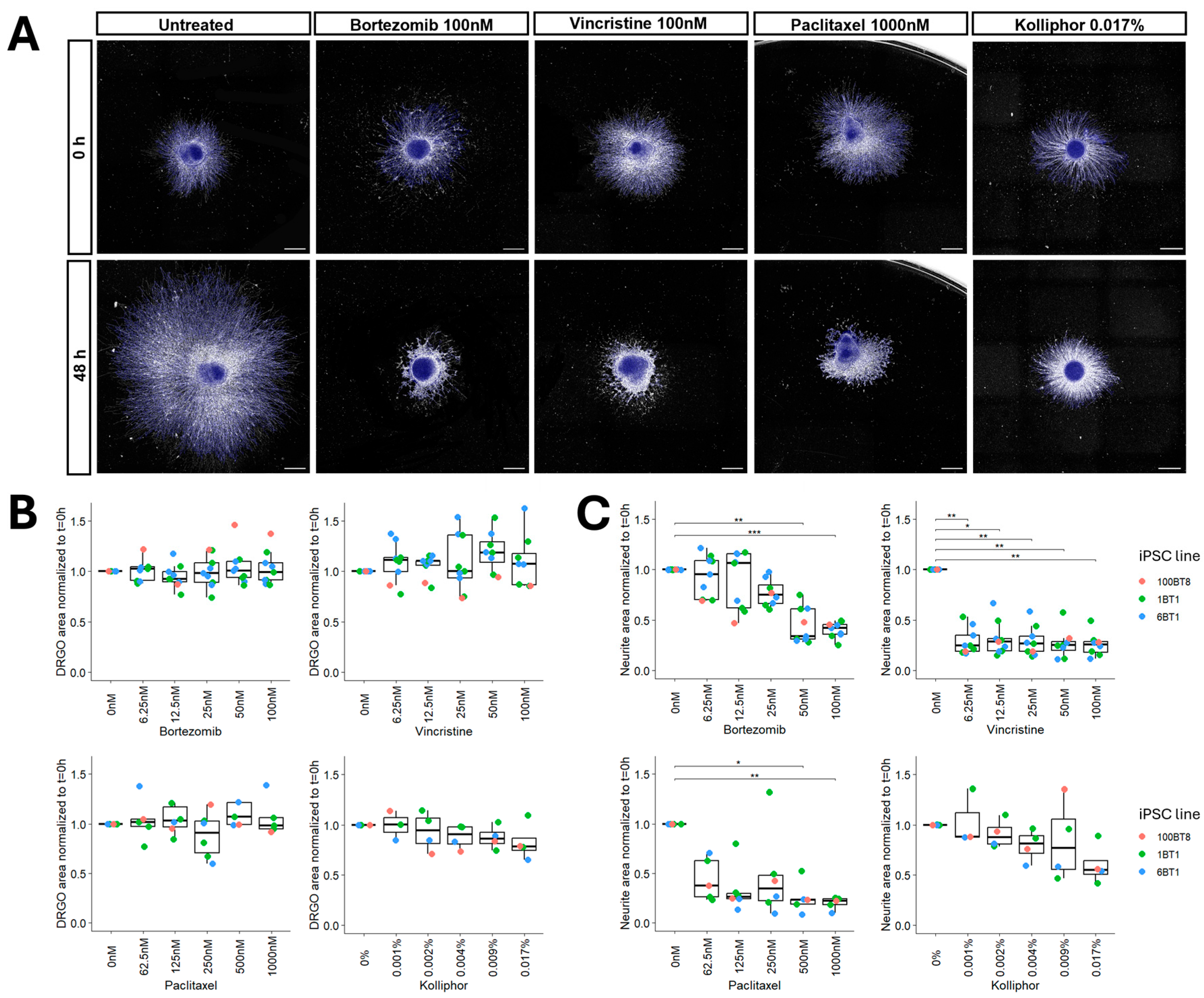
3.3. Chemotherapy Drug Exposure Affects DRGO Neurite Outgrowth
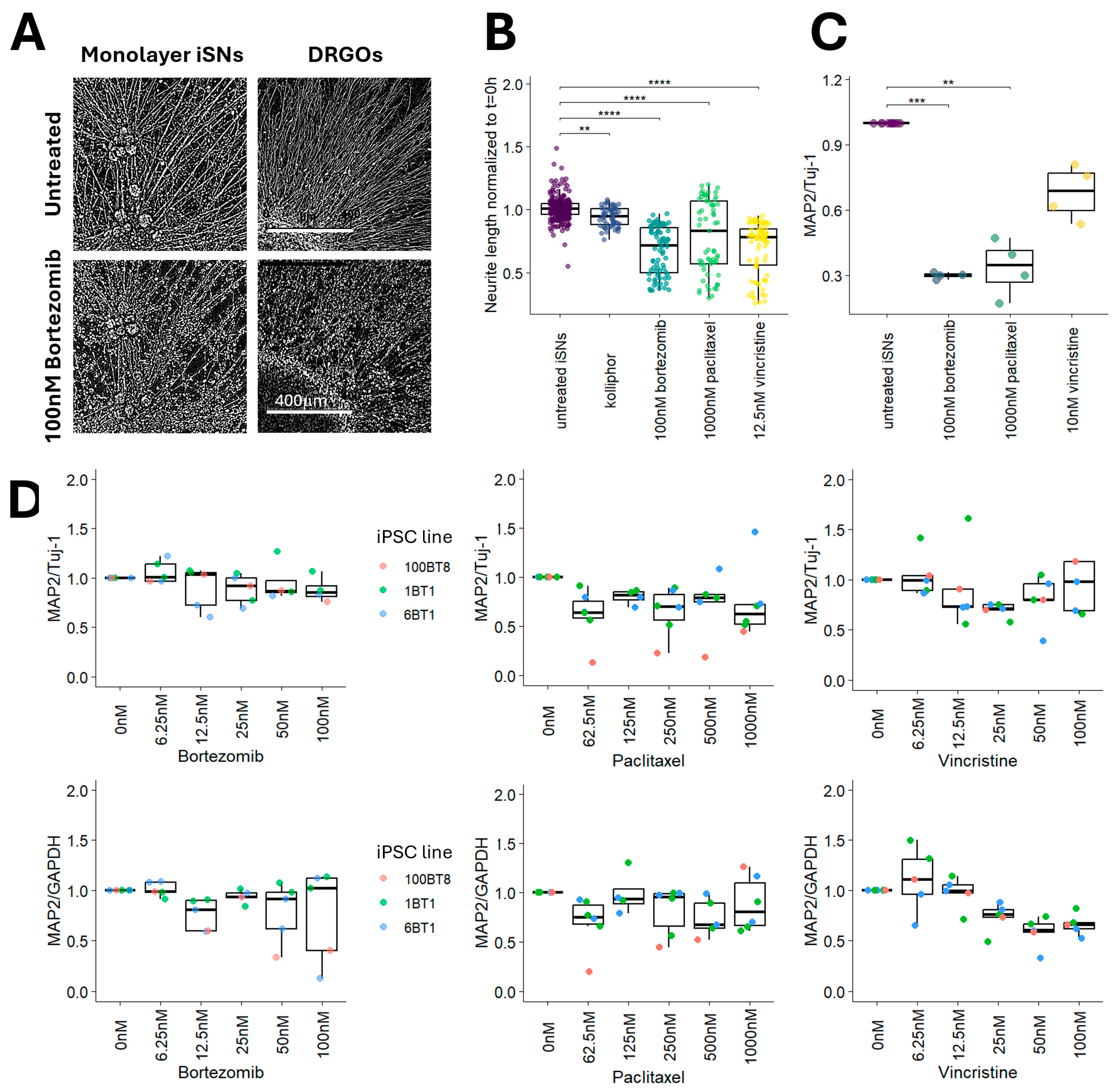
3.4. Microtubule Dysregulation from Chemotherapy Drug Exposure in Sensory Neurons Differs Between Monolayer and Organoid-Based Model Systems
4. Discussion
4.1. iDRGOs as a Human Sensory Dorsal-Root-Ganglion-Relevant System for CIPN Modeling
4.2. Developmental Stage and Assay Window Are Major Determinants of Neurite Outgrowth
4.3. Chemotherapy Exposure Produces Neurite-Predominant Injury Consistent with Early Axonopathy
4.4. Divergent MAP2 Responses Between 2D iSNs and iDRGOs Highlight Context-Dependent Phenotypes and Measurement Considerations
4.5. Synthesizing iDRGO Findings with Recent Human DRG and iPSC-Based CIPN Studies
4.6. Limitations and Future Directions
Supplementary Materials
Author Contributions
Funding
Institutional Review Board Statement
Informed Consent Statement
Data Availability Statement
Conflicts of Interest
References
- Staff, N.P.; Grisold, A.; Grisold, W.; Windebank, A.J. Chemotherapy-induced peripheral neuropathy: A current review. Ann. Neurol. 2017, 81, 772–781. [Google Scholar] [CrossRef] [Scilit]
- Boehmerle, W.; Huehnchen, P.; Peruzzaro, S.; Balkaya, M.; Endres, M. Electrophysiological, behavioral and histological characterization of paclitaxel, cisplatin, vincristine and bortezomib-induced neuropathy in C57Bl/6 mice. Sci. Rep. 2015, 4, 6370. [Google Scholar] [CrossRef] [Scilit] [PubMed]
- Gadgil, S.; Ergün, M.; Heuvel, S.A.v.D.; van der Wal, S.E.; Scheffer, G.J.; Hooijmans, C.R. A systematic summary and comparison of animal models for chemotherapy induced (peripheral) neuropathy (CIPN). PLoS ONE 2019, 14, e0221787. [Google Scholar] [CrossRef] [Scilit] [PubMed]
- Lehmann, H.C.; Staff, N.P.; Hoke, A. Modeling chemotherapy induced peripheral neuropathy (CIPN) in vitro: Prospects and limitations. Exp. Neurol. 2019, 326, 113140. [Google Scholar] [CrossRef] [Scilit] [PubMed]
- Schinke, C.; Maierhof, S.K.; Hew, L.; Vallone, V.F.; Frahm, S.; Telugu, N.S.; Diecke, S.; Ivanov, A.; Kovács, R.; Beule, D.; et al. Time-resolved multi-omic analysis of paclitaxel exposure in human iPSC-derived sensory neurons unveils mechanisms of chemotherapy-induced peripheral neuropathy. Cell Death Dis. 2026, 17, 211. [Google Scholar] [CrossRef] [Scilit]
- Smulders, P.S.; Heikamp, K.; Hermanides, J.; Hollmann, M.W.; Hoope, W.T.; Weber, N.C. Chemotherapy-induced peripheral neuropathy models constructed from human induced pluripotent stem cells and directly converted cells: A systematic review. Pain 2024, 165, 1914–1925. [Google Scholar] [CrossRef] [Scilit]
- Staff, N.P.; Podratz, J.L.; Grassner, L.; Bader, M.; Paz, J.; Knight, A.M.; Loprinzi, C.L.; Trushina, E.; Windebank, A.J. Bortezomib alters microtubule polymerization and axonal transport in rat dorsal root ganglion neurons. NeuroToxicology 2013, 39, 124–131. [Google Scholar] [CrossRef] [Scilit]
- Ankam, S.; Rovini, A.; Baheti, S.; Hrstka, R.; Wu, Y.; Schmidt, K.; Wang, H.; Madigan, N.; Koenig, L.-S.; Stelzig, K.; et al. DNA methylation patterns in human iPSC-derived sensory neuronal differentiation. Epigenetics 2019, 14, 927–937. [Google Scholar] [CrossRef] [Scilit]
- Hrstka, S.C.; Ankam, S.; Agac, B.; Klein, J.P.; Moore, R.A.; Narapureddy, B.; Schneider, I.; Hrstka, R.F.; Dasari, S.; Staff, N.P. Proteomic analysis of human iPSC-derived sensory neurons implicates cell stress and microtubule dynamics dysfunction in bortezomib-induced peripheral neurotoxicity. Exp. Neurol. 2021, 335, 113520. [Google Scholar] [CrossRef] [Scilit]
- Cantor, E.L.; Shen, F.; Jiang, G.; Philips, S.; Schneider, B.P. Optimization of a human induced pluripotent stem cell-derived sensory neuron model for the in vitro evaluation of taxane-induced neurotoxicity. Sci. Rep. 2024, 14, 19075. [Google Scholar] [CrossRef] [Scilit]
- Mortensen, C.; Thomsen, M.T.; Chua, K.C.; Hammer, H.S.; Nielsen, F.; Pötz, O.; Svenningsen, A.F.; Kroetz, D.L.; Stage, T.B. Modeling mechanisms of chemotherapy-induced peripheral neuropathy and chemotherapy transport using induced pluripotent stem cell-derived sensory neurons. Neuropharmacology 2024, 258, 110062. [Google Scholar] [CrossRef] [Scilit]
- Schinke, C.; Vallone, V.F.; Ivanov, A.; Peng, Y.; Körtvelyessy, P.; Nolte, L.; Huehnchen, P.; Beule, D.; Stachelscheid, H.; Boehmerle, W.; et al. Modeling chemotherapy induced neurotoxicity with human induced pluripotent stem cell (iPSC) -derived sensory neurons. Neurobiol. Dis. 2021, 155, 105391. [Google Scholar] [CrossRef] [Scilit]
- Labau, J.I.; Andelic, M.; Faber, C.G.; Waxman, S.G.; Lauria, G.; Dib-Hajj, S.D. Recent advances for using human induced-pluripotent stem cells as pain-in-a-dish models of neuropathic pain. Exp. Neurol. 2022, 358, 114223. [Google Scholar] [CrossRef] [Scilit]
- Mortensen, C.; Andersen, N.E.; Stage, T.B. Bridging the Translational Gap in Chemotherapy-Induced Peripheral Neuropathy with iPSC-Based Modeling. Cancers 2022, 14, 3939. [Google Scholar] [CrossRef] [Scilit]
- Lislien, M.; Kuchovska, E.; Kapr, J.; Duale, N.; Andersen, J.M.; Dirven, H.; Myhre, O.; Fritsche, E.; Koch, K.; Wojewodzic, M.W. Transcriptomic characterization of 2D and 3D human induced pluripotent stem cell-based in vitro models as New Approach Methodologies for developmental neurotoxicity testing. Toxicology 2024, 510, 154000. [Google Scholar] [CrossRef] [Scilit]
- Struzyna, L.A.; Watt, M.L. The Emerging Role of Neuronal Organoid Models in Drug Discovery: Potential Applications and Hurdles to Implementation. Mol. Pharmacol. 2021, 99, 256–265. [Google Scholar] [CrossRef] [Scilit] [PubMed]
- Mazzara, P.G.; Muggeo, S.; Luoni, M.; Massimino, L.; Zaghi, M.; Valverde, P.T.-T.; Brusco, S.; Marzi, M.J.; Palma, C.; Colasante, G.; et al. Frataxin gene editing rescues Friedreich’s ataxia pathology in dorsal root ganglia organoid-derived sensory neurons. Nat. Commun. 2020, 11, 4178. [Google Scholar] [CrossRef] [Scilit] [PubMed]
- LeBlang, C.J.; Pazyra-Murphy, M.F.; Silagi, E.S.; Dasgupta, S.; Tsolias, M.; Miller, T.; Petrova, V.; Zhen, S.; Jovanovic, V.M.; Castellano, D.; et al. Satellite glial contact enhances differentiation and maturation of human iPSC-derived sensory neurons. Stem Cell Rep. 2025, 20, 102639. [Google Scholar] [CrossRef] [Scilit] [PubMed]
- Snavely, A.R.; Heo, K.; Petrova, V.; Ho, T.S.-Y.; Huang, X.; Hermawan, C.; Kagan, R.; Deng, T.; Singeç, I.; Chen, L.; et al. Bortezomib-induced neurotoxicity in human neurons is the consequence of nicotinamide adenine dinucleotide depletion. Dis. Model. Mech. 2022, 15, dmm049358. [Google Scholar] [CrossRef] [Scilit]
- Carpenter, A.E.; Jones, T.R.; Lamprecht, M.R.; Clarke, C.; Kang, I.H.; Friman, O.; Guertin, D.A.; Chang, J.H.; Lindquist, R.A.; Moffat, J.; et al. CellProfiler: Image analysis software for identifying and quantifying cell phenotypes. Genome Biol. 2006, 7, R100. [Google Scholar] [CrossRef] [Scilit]
- Livni, L.; Lees, J.G.; Barkl-Luke, M.E.; Goldstein, D.; Moalem-Taylor, G. Dorsal root ganglion explants derived from chemotherapy-treated mice have reduced neurite outgrowth in culture. Neurosci. Lett. 2019, 694, 14–19. [Google Scholar] [CrossRef] [Scilit] [PubMed]
- Scuteri, A.; Nicolini, G.; Miloso, M.; Bossi, M.; Cavaletti, G.; Windebank, A.J.; Tredici, G. Paclitaxel toxicity in post-mitotic dorsal root ganglion (DRG) cells. Anticancer Res. 2006, 26, 1065–1070. [Google Scholar] [PubMed]
- Islam, B.; Lustberg, M.; Staff, N.P.; Kolb, N.; Alberti, P.; Argyriou, A.A. Vinca alkaloids, thalidomide and eribulin-induced peripheral neurotoxicity: From pathogenesis to treatment. J. Peripher. Nerv. Syst. 2019, 24, S63–S73. [Google Scholar] [CrossRef] [Scilit] [PubMed]
- Tamburin, S.; Park, S.B.; Alberti, P.; Demichelis, C.; Schenone, A.; Argyriou, A.A. Taxane and epothilone-induced peripheral neurotoxicity: From pathogenesis to treatment. J. Peripher. Nerv. Syst. 2019, 24, S40–S51. [Google Scholar] [CrossRef] [Scilit]
- Velasco, R.; Alberti, P.; Bruna, J.; Psimaras, D.; Argyriou, A.A. Bortezomib and other proteosome inhibitors—Induced peripheral neurotoxicity: From pathogenesis to treatment. J. Peripher. Nerv. Syst. 2019, 24, S52–S62. [Google Scholar] [CrossRef] [Scilit]
- Lu, T.; Wang, M.; Zhou, W.; Ni, Q.; Yue, Y.; Wang, W.; Shi, Y.; Liu, Z.; Li, C.; Hong, B.; et al. Decoding transcriptional identity in developing human sensory neurons and organoid modeling. Cell 2024, 187, 7374–7393.e28. [Google Scholar] [CrossRef] [Scilit]
- Geisler, S.; Doan, R.A.; Cheng, G.C.; Cetinkaya-Fisgin, A.; Huang, S.X.; Höke, A.; Milbrandt, J.; DiAntonio, A. Vincristine and bortezomib use distinct upstream mechanisms to activate a common SARM1-dependent axon degeneration program. J. Clin. Investig. 2019, 4, e129920. [Google Scholar] [CrossRef] [Scilit]
- Petrova, V.; Snavely, A.R.; Splaine, J.; Zhen, S.; Singh, B.; Pandey, R.; Chen, K.; Cheng, A.; Hermawan, C.; Barrett, L.B.; et al. Identification of novel neuroprotectants against vincristine-induced neurotoxicity in iPSC-derived neurons. Cell. Mol. Life Sci. 2024, 81, 315. [Google Scholar] [CrossRef] [Scilit]


Disclaimer/Publisher’s Note: The statements, opinions and data contained in all publications are solely those of the individual author(s) and contributor(s) and not of MDPI and/or the editor(s). MDPI and/or the editor(s) disclaim responsibility for any injury to people or property resulting from any ideas, methods, instructions or products referred to in the content. |
© 2026 by the authors. Licensee MDPI, Basel, Switzerland. This article is an open access article distributed under the terms and conditions of the Creative Commons Attribution (CC BY) license.
Share and Cite
Hrstka, S.C.L.; Jahnke, M.; Meng-Lin, K.; Lindorfer, S.; Noma, H.; Hrstka, R.F.; Staff, N.P. Human iPSC-Derived Dorsal Root Ganglion Organoid Modeling of Chemotherapy-Induced Peripheral Neuropathy. Cells 2026, 15, 724. https://doi.org/10.3390/cells15080724
Hrstka SCL, Jahnke M, Meng-Lin K, Lindorfer S, Noma H, Hrstka RF, Staff NP. Human iPSC-Derived Dorsal Root Ganglion Organoid Modeling of Chemotherapy-Induced Peripheral Neuropathy. Cells. 2026; 15(8):724. https://doi.org/10.3390/cells15080724
Chicago/Turabian StyleHrstka, Sybil C. L., Maya Jahnke, Kylie Meng-Lin, Sarah Lindorfer, Henry Noma, Ronald F. Hrstka, and Nathan P. Staff. 2026. "Human iPSC-Derived Dorsal Root Ganglion Organoid Modeling of Chemotherapy-Induced Peripheral Neuropathy" Cells 15, no. 8: 724. https://doi.org/10.3390/cells15080724
APA StyleHrstka, S. C. L., Jahnke, M., Meng-Lin, K., Lindorfer, S., Noma, H., Hrstka, R. F., & Staff, N. P. (2026). Human iPSC-Derived Dorsal Root Ganglion Organoid Modeling of Chemotherapy-Induced Peripheral Neuropathy. Cells, 15(8), 724. https://doi.org/10.3390/cells15080724