Article

Elevation of Mitochondrial Ca2+ Above a Plateau Level Impairs Force Production and Accelerates Fatigue in Mouse Soleus Muscle


1
Department of Physiology and Pharmacology, Karolinska Institutet, 171 77 Stockholm, Sweden
2
Department of Medical Biochemistry and Biophysics, Karolinska Institutet, 171 77 Stockholm, Sweden
*
Author to whom correspondence should be addressed.
Cells 2026, 15(8), 713; https://doi.org/10.3390/cells15080713
Submission received: 5 March 2026 / Revised: 10 April 2026 / Accepted: 16 April 2026 / Published: 17 April 2026

Abstract

Soleus muscle fibres display modest changes in tetanic force and [Ca2+]i during repeated contractions. In this study, we investigate whether increasing mitochondrial Ca2+ load during repeated contractions could induce premature fatigue. Intact, single fibres were dissected from the soleus muscles of adult mice. Mitochondrial Ca2+ was measured with rhod-2 in intact fibres. Fatigue was induced by 70 Hz, 350 ms tetani given at 2 s intervals in the absence and presence of 10 µM CGP-37157, a potent inhibitor of the mitochondrial Na+-Ca2+ exchanger. In soleus fibres fatigued in the absence of CGP-37157, tetanic force was significantly reduced by about 30% at the end of the fatiguing stimulation, while mitochondrial [Ca2+] increased to a maximum after about 50 tetani and returned to its resting level within 20 min after the end of the stimulation. In the presence of CGP-37157, the maximal mitochondrial [Ca2+] increase was more than twice that in control fibres. In addition, fatigue developed more rapidly and force remained depressed after the end of the stimulation. No difference in mitochondrial membrane potential or ROS production was seen between control and CGP-37157 conditions. We conclude that while modest increases in mitochondrial Ca2 may be beneficial, excessive mitochondrial Ca2 loading depresses muscle function.

1. Introduction

In mammalian postural muscles, fibres are rich in mitochondria with a higher density of mitochondria found closer to the sarcolemma than deeper in the fibre [1,2]. The soleus is an archetypical slow-twitch muscle where mitochondria contribute 5% to 10% of the total fibre volume, greater than that seen in type IIb fast-twitch, glycolytic muscles such as the EDL (2–3%). It should also be noted that the highest density of mitochondria is found close to the sarcolemma and the transverse tubules. Both type I and type IIa fibres have a similar arrangement of mitochondrial columns arranged across the long axis of the fibre. Type I fibres have additional prominent rows of longitudinally orientated connected mitochondria [3]. Due to the dense packing of the myofibrils and the calcium-packed sarcoplasmic reticulum, mitochondria have little room for movement. Unlike other tissues, where mitochondria have a dynamic ever-changing interconnected tubular network (mediated by members of the dynamin superfamily), mitochondria in mature skeletal muscles form relatively stable networks [4]. In addition to mitochondria clustering near the transverse tubules that conduct the action potential deep into the muscle fibre, close contacts between mitochondria, transverse tubules as well as the sarcoplasmic/endoplasmic reticulum (SR) have been described [5]. Extensive connections between the SR and the outer mitochondrial membrane with the assistance of a chaperone protein have been described in heart and other tissues. Separate distinct membrane contacts exist between the transverse tubules and mitochondria. Tunnelling or transfer of Ca2+ in rested, non-stimulated mitochondria has been visualised using mitochondrial-targeted indicators [6]. In muscle, mitochondria are perfectly placed to respond to action-potential induced Ca2+ release through the ryanodine receptors of the SR by taking up calcium via the uniporter which permits increased mitochondrial enzyme production of ATP [7,8,9]. Several mitochondrial dehydrogenases involved in the tricarboxylic acid cycle are known to require Ca2+ [10,11]. Training is known to enhance mitochondrial number and function and thus, to improve ATP generation in muscle and brain [12,13]. During demanding exercise, the muscles’ energy demands exceed the mitochondria’s capacity to produce ATP via oxidative phosphorylation and anaerobic respiration becomes more important. A consequence of this is accumulation of lactate, hydrogen and phosphate ions which together with an increased mitochondrial reactive oxygen species (ROS) production may contribute to the development of muscle fatigue [14,15,16]. However, whether excessive entry of calcium into mitochondria plays a role in muscle fatigue has not been examined previously.
It is well documented that mitochondria take up limited amounts of Ca2+ and thus modulate cytosolic-free calcium concentration ([Ca2+]i) in nerves [17], kidneys [18], and muscle [19,20]. A prolonged or uncontrolled increase in mitochondrial Ca2+ is considered likely to induce a decline in cellular function and accelerate senescence either directly or by increasing reactive oxygen species (ROS) generation [21,22], which in turn impairs muscle function and damage [23,24,25,26]. Mitochondria isolated from skeletal muscle after exhaustive exercise where force production is impaired contain more Ca2+ than those isolated from non-exercised muscle [27,28]. However, even after prolonged periods of stimulation of the nerve or muscle, mitochondrial Ca2+ accumulation is limited, reaching a plateau level and thus indicating perfect balance between uptake and extrusion mechanisms [20,29]. It may be speculated that this asymptotic behaviour is a protective mechanism that keeps mitochondrial Ca2+ below dangerous levels that would trigger excessive production of ROS or initiate apoptosis. In many tissues including nerve and muscle, extrusion of Ca2+ from the mitochondria is predominantly mediated by a Na+-Ca2+ exchanger that is inhibited by the benzothiazepine compound, CGP-37157 [29,30]. We hypothesise that blocking mitochondrial Na+-Ca2+ exchange during repeated tetanic contractions would result in excessively elevated levels of mitochondrial Ca2+ and thus accelerate fatigue development. We used fibres from the NMRI mouse soleus muscle because it is composed almost entirely of oxidative type I and oxidative-glycolytic type IIa fibres that are resistant to the development of fatigue due to the relative abundance of mitochondria. With abundant mitochondria to accumulate Ca2+, soleus fibres would provide a good model to investigate whether excessive accumulation of mitochondrial Ca2+ promotes faster development of fatigue.

2. Materials and Methods

Young (3–5 months) NMRI male mice were supplied by B & K Universal, Sollentuna, Sweden. Twenty mice were used in the experiments reported here. The studies were approved by the Swedish Ethical Review Authority (1) N117/06 Approval Date: 29 March 2006 and (2) N152/11 Approval Date: 13 May 2011. Mice were euthanized by rapid neck disarticulation, and the soleus muscles were removed. The soleus muscle in NMRI mice is composed of type I and type IIa fibres [31]. Single fibres were isolated from the muscles and mounted in a muscle bath as described previously [32]. Fibres were used only if tetanic force was greater than 350 kPa and remained stable (±5%) during the 30 min equilibration period prior to the start of the experiment.
Tetanic contractions were evoked using 70 Hz, 500 ms stimulus trains and fibres were stimulated with up to 700 tetani given at 2 s intervals. Stimulation was stopped when force fell to 40% of the initial force.

2.1. Solutions

Muscle fibres were superfused with a Tyrode solution containing (mM) NaCl 121, KCl 5, MgCl2 0.5, Na2HPO4 0.4, CaCl2 1.8, EDTA 0.1, NaHCO3 24, glucose 5.5 and foetal calf serum (0.2%, Gibco, Billings, MT, USA) and bubbled with 95% O2/5% CO2 (pH 7.4). All experiments were performed at room temperature (24–26 °C). A stock solution of 10 mM CGP-37157 (CGP, Tocris Bioscience, Bristol, UK) in DMSO was prepared and 10 µM CGP was applied for 15 min before induction of fatigue. Control fatigue runs were performed in a Tyrode solution containing 0.1% DMSO.

2.2. Measurement of Mitochondrial Ca2+, Reactive Oxygen Species, and Mitochondrial Membrane Potential Using Indicators and Laser Confocal Microscopy

To measure mitochondrial Ca2+, soleus fibres were incubated in 5 µM rhod-2-AM (Molecular Probes, Leiden, The Netherlands) for 90–120 min at room temperature. Rhod-2 preferentially loads into mitochondria with relatively little left in the myoplasm. It is resistant to photobleaching and gives a large increase in fluorescence upon binding to calcium [32,33]. In a separate series of experiments, soleus fibres were incubated for 10 min at room temperature with 5 µM MitoSox Red (Molecular Probes) which is a specific mitochondrial dye used to monitor mitochondrial reactive oxygen species (ROS). To measure mitochondrial membrane potential, soleus fibres were loaded with 2.6 µM rhodamine 123 (R123; Molecular Probes) for 10 min at room temperature. Following loading with the AM indicators, fibres were washed for at least 30 min. An X-Y (1024 × 1024 pixels) confocal image of the rested fibre was first obtained and fifteen min later, a second confocal image of the rested fibre in either the absence or presence of CGP was obtained and then the fibre was fatigued with a train of repeated tetanic contractions. Stimulation was paused for 6 s and images were taken after 10, 25, 50, 100, 200, 300 and 500 tetani and lastly when the stimulation was ended. During the recovery period after stimulation had ended, X-Y images were taken at regular intervals until the mitochondrial signal returned to its pre-fatigue level.
A BioRad MRC 1024 unit (Biorad Microscopy Division, Hertfordshire, UK) with a krypton/argon mixed-gas laser run at 5 mW and attached to a Nikon Diaphot 200 inverted microscope (Nikon Europe B.V. Amsterdam, The Netherlands) was used. In most experiments, a Nikon Plan Apo 40x oil immersion objective lens (N.A. 1.3, Nikon Europe B.V. Amsterdam, The Netherlands) was used. rhod-2 was excited with 568 nm light and the emitted light collected through a 585 nm long-pass filter. Both MitoSox Red and Rhodamine 123 were excited with 488 nm light and the emitted fluorescence was collected through a 522 nm bandpass filter. The minimum laser power required for acceptable images was 3% of the maximum, although up to 10% power was used. Images were stored and analysed offline with FIJI (NIH, Bethesda, MD, USA, https://hpc.nih.gov/apps/Fiji.html), accessed on 14 April 2026. No noise correction or smoothing was applied to the acquired images. To measure changes in mitochondrial fluorescence, regions of interest were defined in areas containing visible mitochondria close to the sarcolemma and the mean pixel density was calculated. Typically, at least three such regions (1000–2500 µm2) were measured in each fibre. Background fluorescence (the result of intrinsic fluorescence of proteins) was defined as that measured in the myoplasm which had no visible mitochondria. It should be noted that the intrinsic noise of the PMT and the rest of the acquisition system is low and is assumed to be equal in measured regions. Repeated tetanic contractions caused a clear increase in mitochondrial Rhod-2 fluorescence in soleus fibres, while the myoplasm, i.e., background intensity, showed little change. At each time point, the myoplasmic intensity was subtracted from the mitochondrial intensity. Changes in mitochondrial fluorescence intensity at each time point (F) were expressed as a ratio of that measured in the rested fibre (F0). This procedure allowed comparison of the mitochondrial fluorescence signal recorded in different fibres.

2.3. Statistics

No randomisation regarding fibre allocation to the control group or drug group was done. Experiments were done sequentially, i.e., control, drug, control, etc. All data are expressed as mean ± s.e.m. Student’s t-test (unpaired or paired as necessary) and a repeated-measures ANOVA (when appropriate) were used to check for statistically significant differences (Sigmaplot, 12.5 Systat Software Inc., San Jose, CA, USA). The significance level was set at p < 0.05. As part of the analysis process, a Sigmaplot check was done for the assumptions of the chosen statistic. Data presented here were analysed as follows: For Figures 2, 3A and 4, a one-way repeated measures ANOVA was employed. The Holm–Sidak method was used for post hoc analyses. In Figure 3B, a paired Student’s t-test was used and in Figure 5 an unpaired Student’s t-test was used.

3. Results

Changes in Mitochondrial Ca2+ Induced by Repeated Tetani Are Increased by the Presence of CGP-37157

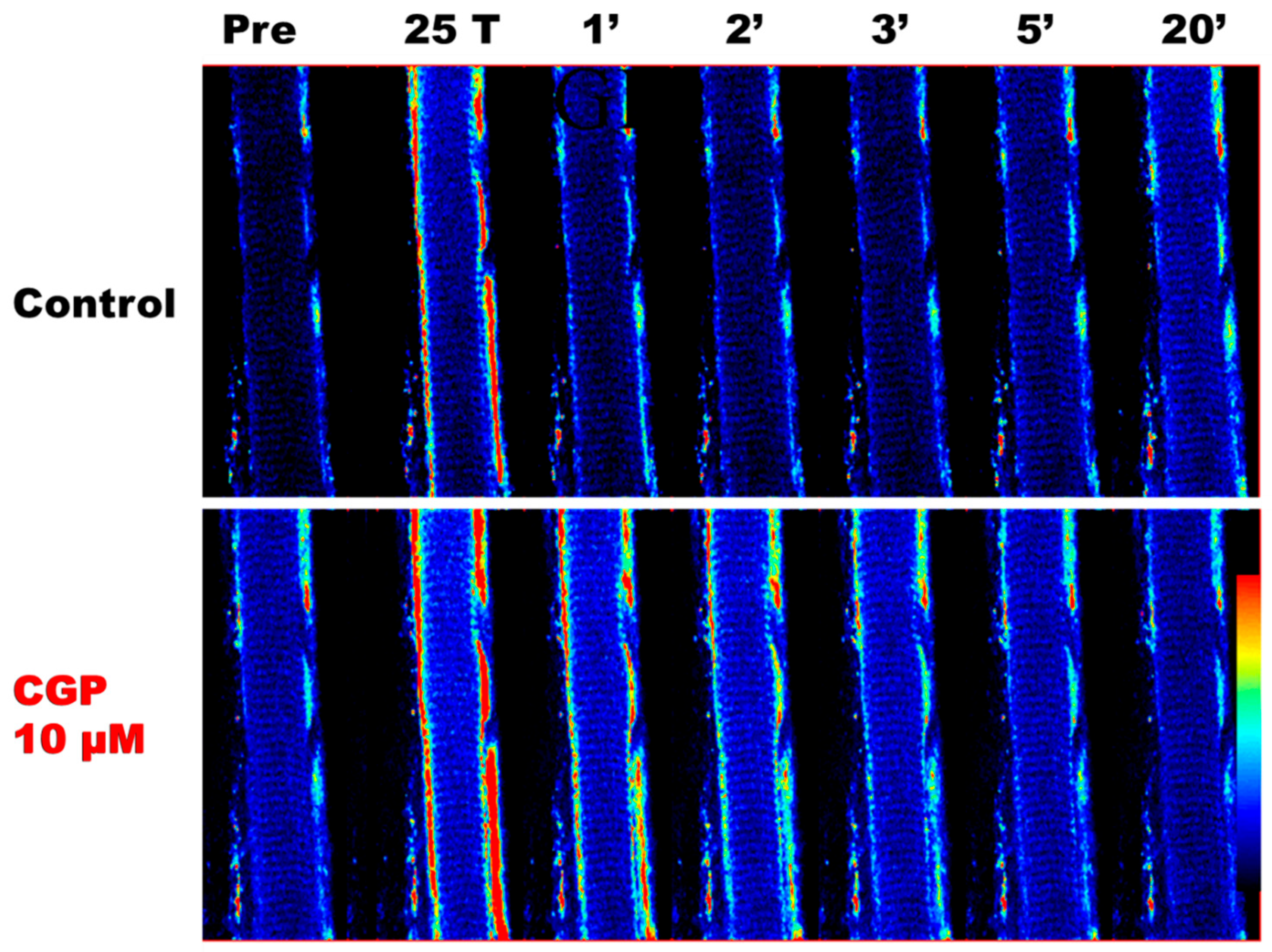
To demonstrate that CGP-37157 could increase mitochondrial Ca2+ uptake, soleus fibres loaded with rhod-2 were subjected to two series of 25 tetani, the first in Tyrode only and the second series one hour later in the presence of CGP-37157. Figure 1 shows that there was an increase in the rhod-2 signal, indicating increased mitochondrial Ca2+, in the mitochondria close to the sarcolemma in both series of 25 tetani. This increase was more pronounced in the presence of CGP-37157 than in Tyrode. After the series of 25 tetani, the mitochondrial Ca2+ signal returned to the resting level more rapidly in the Tyrode solution than in the presence of CGP-37157, a further demonstration of the inhibitory effect of CGP-37157 on Ca2+ extrusion from the mitochondria.
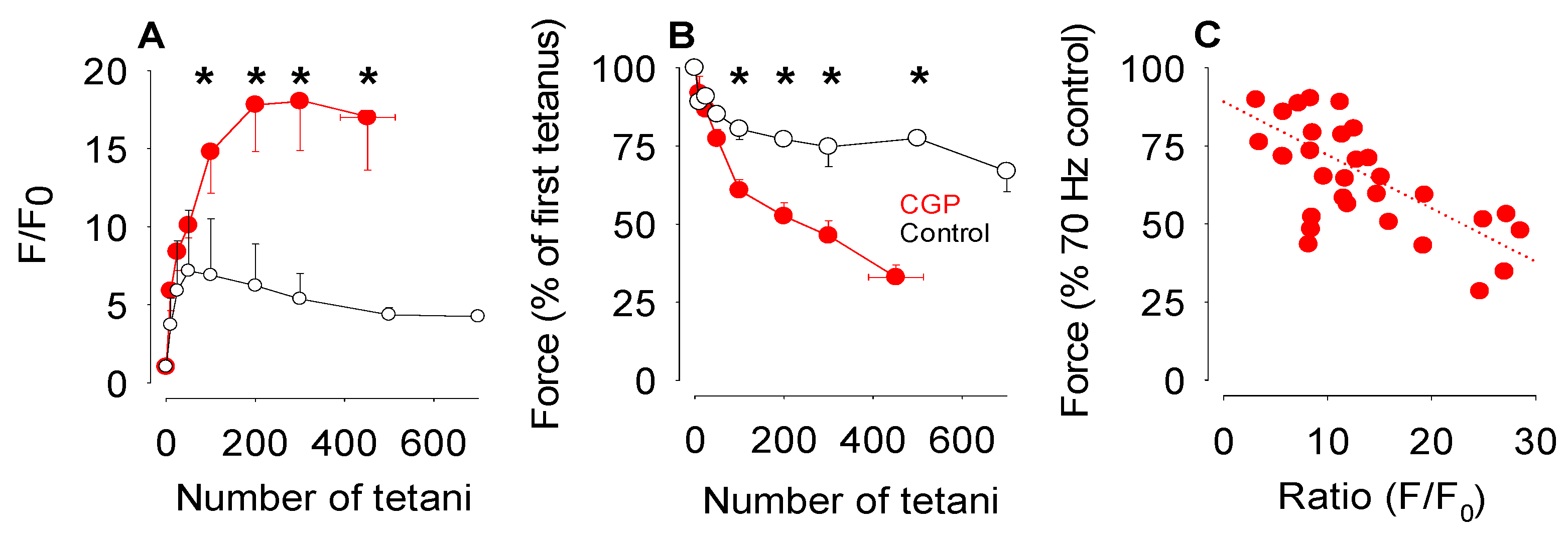
Next, soleus fibres loaded with rhod-2 were subjected to a longer series of repeated tetanic contractions to induce muscle fatigue. In control fibres fatigued in Tyrode solution, mitochondrial rhod-2 F/F0 reached its maximum value of 7.4 ± 3.6 after 50 tetani (Figure 2A). Thereafter, mitochondrial Ca2+ declined slightly throughout the rest of the series and at the end of the stimulation, mitochondrial rhod-2 F/F0 had fallen to 57 ± 1% of its maximum value. At the end of the stimulation, force had decreased to 66 ± 6% of initial tetanic force (Figure 2B). In soleus fibres exposed to CGP-37157, the changes in both mitochondrial Ca2+ and tetanic force were more pronounced. After 50 tetani, the mitochondrial rhod-2 signal was already above 10, and it continued to increase until at 300 tetani, mitochondrial rhod-2 F/F0 had peaked at 18.0 ± 3.2 and tetanic force had declined to 46 ± 5% (Figure 2A). In contrast to the control fibres, none of the six soleus fibres exposed to CGP-37157 were able to maintain tetanic force above the cutoff of 40% (Figure 2B) and the stimulation ended on average after 452 ± 62 tetani. When the stimulation ended, the mitochondrial rhod-2 F/F0 was 17.0 ± 3.4, 94% of its peak value while tetanic force had decreased to 33 ± 4% of its starting value. A scatterplot of tetanic force versus mitochondrial rhod-2 signal (Figure 2C) showed a general trend for a reduced tetanic force as the rhod-2 signal increased.
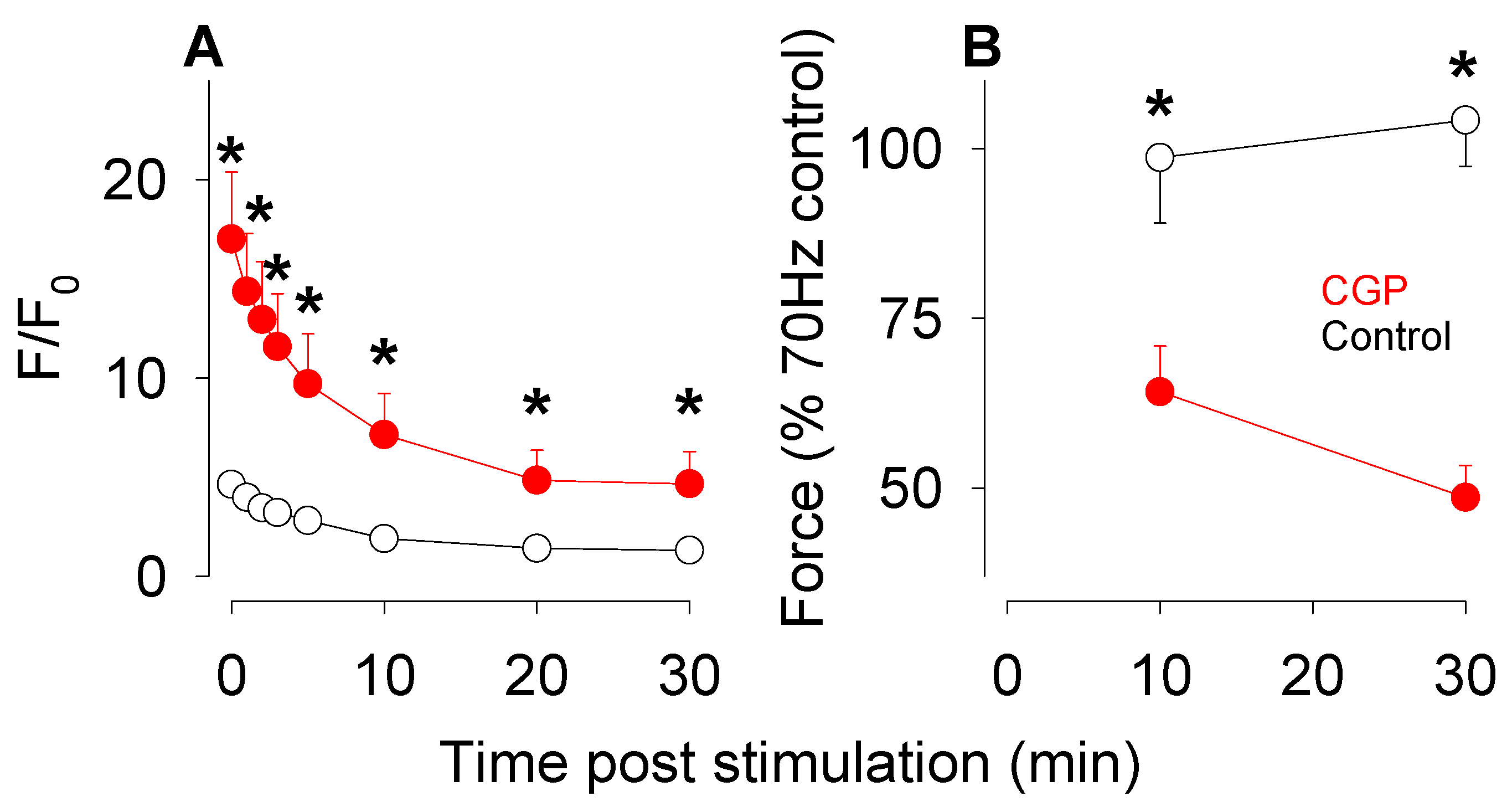
In control fibres after the end of the stimulation, mitochondrial rhod-2 F/F0 returned to its resting value within 20 min (Figure 3A). Tetanic force measured at 10 min post stimulation was 88 ± 8% and recovered completely to its resting value after 30 min (Figure 3B). The situation in CGP-37157 exposed soleus fibres was very different where mitochondrial rhod-2 F/F0 remained elevated (5.0 ± 1.5) even 30 min after the end of the stimulation and when tetanic force had recovered to only 48 ± 2% of its pre-fatigue value. Thus, the excessive Ca2+ loading of the mitochondria that occurred in the presence of CGP-37157 results in a rapid decline of force during fatigue and poor recovery of force afterwards.
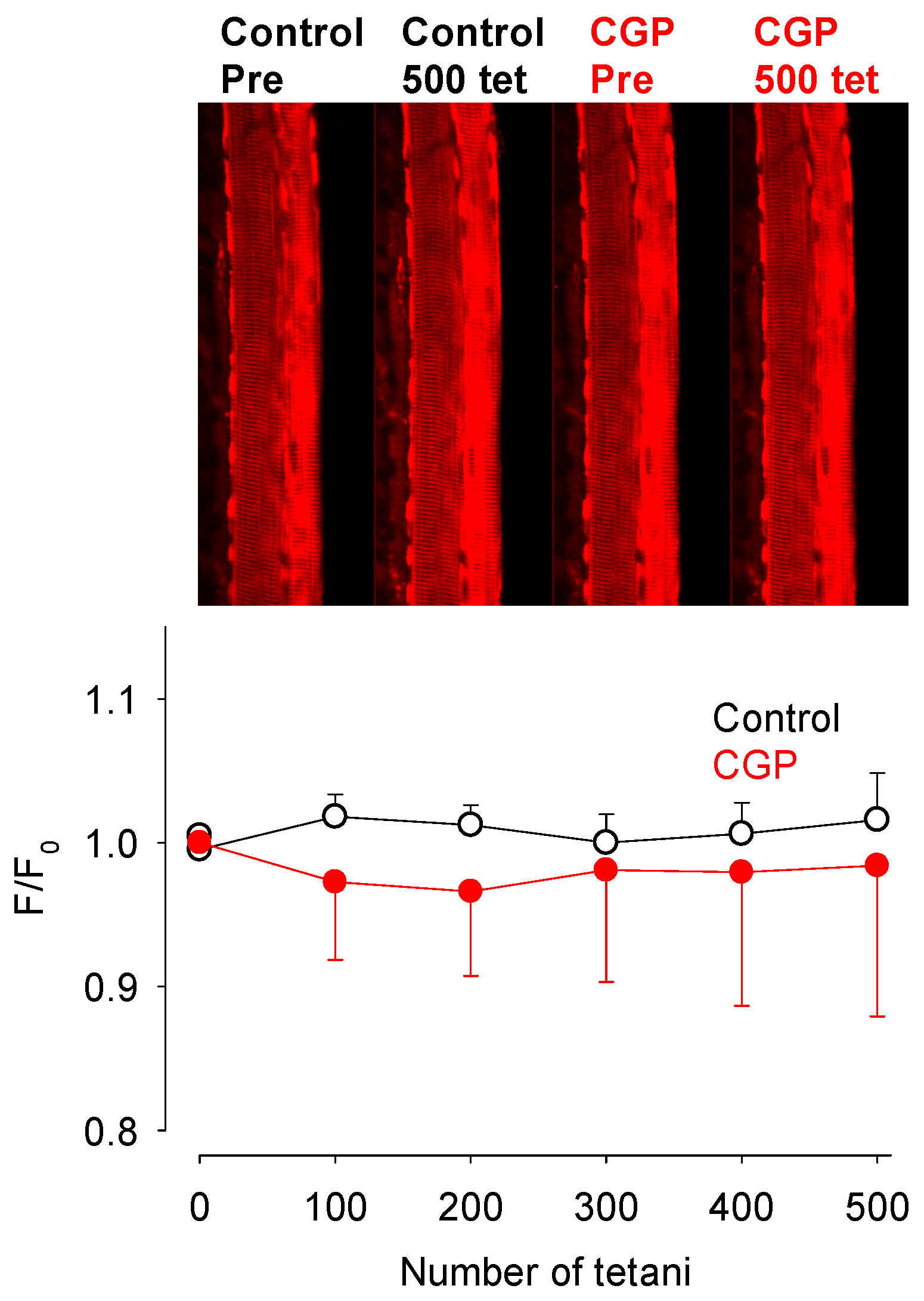
The above experiments demonstrate that repeated tetanic stimulation induced Ca2+ loading of the mitochondria and this Ca2+ load could be markedly increased with CGP-37157 present. Thus, we investigated whether this increased Ca2+ load had altered the mitochondrial membrane potential which would impact the mitochondrial ATP production [34]. Using the mitochondrial membrane potential probe rhodamine 123, we found that there was little change in the mitochondrial membrane potential in the soleus fibres during a series of 500 tetani in either the absence or presence of CGP-37157 (Figure 4).
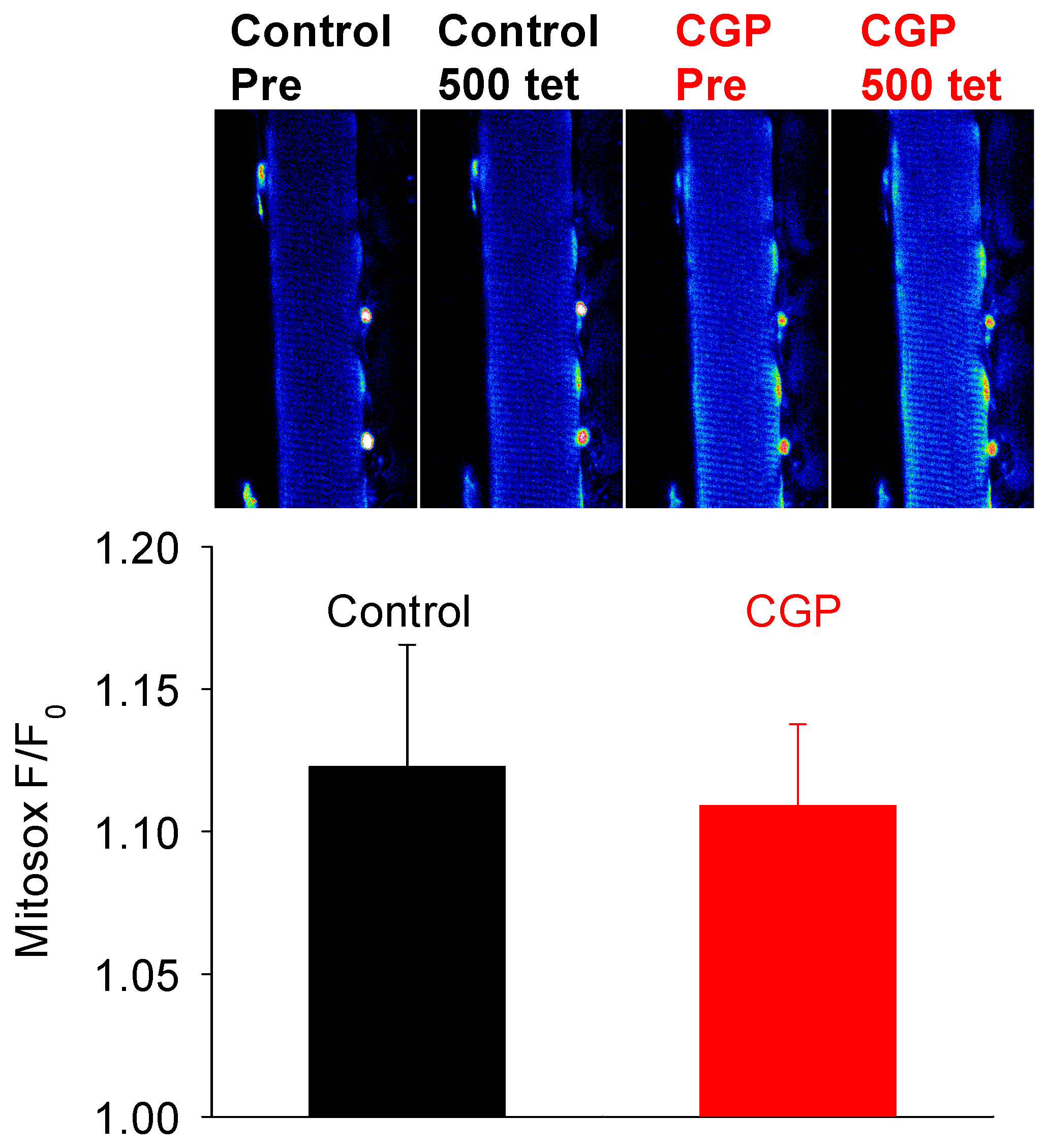
Lastly, we investigated whether the greater mitochondrial Ca2+ loading in the presence of CGP-37157 was associated with greater levels of ROS. At the end of the fatiguing protocol, there was a modest non-significant change in ROS in the soleus fibres (Figure 5). Importantly, there was no difference in the ROS signal between the control soleus fibres and those exposed to CGP-37157. Thus, excessive Ca2+ loading was not associated with greater levels of ROS production in soleus fibres.

4. Discussion

The major results of this study show that (i) mitochondrial Ca2+ increased during periods of stimulation in mouse soleus fibres and this was augmented by CGP-37157 and (ii) this increased mitochondrial Ca2+ accumulation was accompanied by a marked impairment of contractile function. The direct stimulation of the muscle sarcolemma with brief electrical pulses allows one to be sure that these effects are happening within the muscle fibre itself and are not due to failure of transmission at the neuromuscular junction.
Removal of Ca2+ from the mitochondria is accomplished predominantly by a Na+-Ca2+ exchanger, which is at least ten times slower than the uniporter-mediated uptake in skeletal muscle [19,35]. Thus, significant mitochondrial Ca2+ uptake via the mitochondrial uniporter can occur during repeated electrical stimulation [35], such as used in the present study, due to the high [Ca2+]i (>1 µM) achieved in each tetanus coupled with the slower extrusion of Ca2+ from the mitochondria. Some degree of Ca2+ uptake by muscle mitochondria during activity appears essential for metabolic function as mitochondrial calcium uniporter knockout mice show a reduced exercise capacity [36]. The decline in mitochondrial [Ca2+] that occurred after 100 tetani of the series is not due to reduced [Ca2+]i as the Ca2+ transient amplitude shows no decrease during this period [32]. The decline might reflect significant buffering within the mitochondria via Ca2+-binding proteins such as calmitine found in the mitochondrial matrix [37,38] or cardiolipin, a negatively charged phospholipid found on the inner mitochondrial membrane [24]. It has been suggested previously that high levels of mitochondrial Ca2+ may bind to phosphate and form calcium phosphate compounds [29] and thus limit the free mitochondrial [Ca2+] in neuronal mitochondria. In the soleus fibres in the present study, the relatively rapid reversal of the mitochondrial rhod-2 signal in soleus fibres immediately after the end of stimulation suggests that the majority of the Ca2+ exists in the free form in the matrix of the mitochondria. On balance, it seems probable that the decline reflects increased activity of the Na+-Ca2+ exchange stimulated by the increased intracellular Na+ that occurs during repeated tetani [39]. CGP-37157, which inhibits the mitochondrial Na+-Ca2+ exchanger, both increased peak mitochondrial Ca2+ during the series of repeated tetani and slowed the rate of extrusion of Ca2+ after the stimulation had stopped (see Figure 2A and Figure 3A). CGP-37157 has a protective effect in neuronal excitotoxicity by blocking voltage-gated, including L-type, Ca2+ channels [40]. However, while L-type voltage-gated Ca2+ channels are present in both neurons and muscle, they differ in structure [41] and no evidence that CGP-37157 affects L-type Ca2+ channels in skeletal muscle has been reported (e.g., [30]).
One interesting finding of this study is the accelerated force decline observed during the induction of fatigue in the presence of CGP-37157. Tetanic force generation is governed by the amount of calcium released from the sarcoplasmic reticulum (SR). Since we demonstrate an increase in mitochondrial Ca2+, it can be asked if this reduces the SR-releasable Ca2+. Previous studies in rat cardiomyocytes [42] and skeletal muscle [43] have estimated that mitochondrial Ca2+ uptake is small and even during repeated contractions is not more than 1% of the total amount of SR Ca2+ released into the cytosol [30]. Thus, it appears unlikely that Ca2+ accumulation in the mitochondria can explain the decline in tetanic force.
Previously, Madsen et al. [28] reported that the elevations in mitochondrial Ca2+ induced by exhaustive exercise persisted for at least 60 min after the end of exercise in human muscle. In contrast, the present study finds that mitochondrial Ca2+ returned to control levels within 20 min of the end of repetitive activity. It should be noted that in the earlier study on human muscle, total mitochondrial Ca2+ was measured [28] while the rhod-2 used in the present study reports only the presence of free Ca2+ and not Ca2+ complexed with ions such as phosphate or bound to mitochondrial buffering proteins such as calmitine.
Mitochondrial Ca2+ uptake is implicated in both dissipation of the mitochondrial membrane potential and augmented ROS production and it is widely accepted that excessive ROS production exerts deleterious effects on cellular function [24,25,44]. Several groups have pointed out that ROS production can be considered physiologically vital as it is needed both to modify force production and modulate expression of genes involved in membranes and structural protein remodelling and metabolism [21,23,45]. Indeed, in the rat, strenuous exercise has little effect on ROS production in the soleus muscle [46]. In the present study, there were no differences in mitochondrial ROS production between soleus fibres exposed only to the Tyrode solution and those exposed to the Na+-Ca2+ exchange inhibitor, CGP-37157. This suggests that mitochondrial Ca2+ is of little importance in ROS generation in soleus fibres.
Little change in the mitochondrial membrane potential was observed after induction of fatigue under control conditions or exposure to CGP-37157. This is in line with results of a previous study on fast-twitch muscle fibres showing that there was no change in mitochondrial membrane potential in association with mitochondrial Ca2+ uptake in fast-twitch muscle fibres [20]. Thus, mitochondrial Ca2+ has little or no effect on mitochondrial potential possibly due to cations such as chloride accompanying Ca2+ entry into the mitochondria, although this needs to be confirmed by further research.

Study Limitations

Caution must be used in extrapolating these results. First, rhod-2 is a non-ratiometric indicator and this limits our knowledge as to the exact magnitude of the increase in mitochondrial Ca2+. Second, the study examined only soleus fibres from NMRI mice without taking into consideration whether they were oxidative (type I) or oxidative-glycolytic (type IIb) fibres. It is not certain that glycolyic type IIb or type IIx fibres would behave the same. Third, CGP-37157 was used as a “gold-standard” inhibitor of the mitochondrial Na+-Ca2+ exchanger. However, CGP-37157 has been reported to affect other ion channels and Ca2+ pumps and exchangers. While resting tension and tetanic force was unchanged after the 15 min equilibration period, subtle non-specific off-target effects of CGP-37157 cannot be entirely ruled out.

5. Conclusions

In conclusion, during extended periods of contractile activity in soleus fibres, mitochondrial Ca2+ is tightly regulated and exerts a stimulatory role in mitochondrial respiration. In the presence of CGP-37157, there is increased Ca2+ accumulation in mitochondria which results in impaired skeletal muscle force production, although the precise mechanism remains to be elucidated.

Author Contributions

The actual experiments were undertaken by J.B. Both J.B. and K.J. contributed to hypothesis development, data interpretation and writing of the manuscript. All authors have read and agreed to the published version of the manuscript.

Funding

This work was funded by the Swedish National Centre for Sports Research and funds at the Karolinska Institute.

Institutional Review Board Statement

The studies were approved by the Swedish Ethical Review Authority (1) N117/06 Approval Date: 29 March 2006 and (2) N152/11 Approval Date: 13 May 2011.

Informed Consent Statement

Not applicable.

Data Availability Statement

All original data presented in this study are available on request from the corresponding author.

Conflicts of Interest

The authors have no conflicting interests.

References

  1. Chen, G.; Carroll, S.; Racay, P.; Dick, J.; Pette, D.; Traub, I.; Vrbova, G.; Eggli, P.; Celio, M.; Schwaller, B. Deficiency in parvalbumin increases fatigue resistance in fast-twitch muscle and upregulates mitochondria. Am. J. Physiol. 2001, 281, C114–C122. [Google Scholar] [CrossRef]
  2. Nakae, Y.; Stoward, P.J.; Shono, M.; Matsuzaki, T. Localisation and quantification of dehydrogenase activities in single muscle fibers of mdx gastrocnemius. Histochem. Cell Biol. 1999, 112, 427–436. [Google Scholar] [CrossRef]
  3. Mishra, P.; Varuzhanyan, G.; Pham, A.H.; Chan, D.C. Mitochondrial dynamics is a distinguishing feature of skeletal muscle fiber types and regulates organellar compartmentalization. Cell Metab. 2015, 22, 1033–1044. [Google Scholar] [CrossRef]
  4. Katti, P.; Ajayi, P.T.; Aponte, A.; Bleck, C.K.E.; Glancy, B. Identification of evolutionarily conserved regulators of muscle mitochondrial network organization. Nat. Commun. 2022, 13, 6622. [Google Scholar] [CrossRef] [PubMed]
  5. Franzini-Armstrong, C.; Boncompagni, S. The evolution of the mitochondria-to-calcium release units relationship in vertebrate skeletal muscles. J. Biomed. Biotechnol. 2011, 2011, 830573. [Google Scholar] [CrossRef] [PubMed]
  6. Cartes-Saavedra, B.; Ghosh, A.; Hajnóczky, G. The roles of mitochondria in global and local intracellular calcium signalling. Nat. Rev. Mol. Cell Biol. 2025, 26, 456–475. [Google Scholar] [CrossRef]
  7. Dong, H.; Tsai, S.Y. Mitochondrial properties in skeletal muscle fiber. Cells 2023, 12, 2183. [Google Scholar] [CrossRef]
  8. Protasi, F.; Serano, M.; Brasile, A.; Pietrangelo, L. Exercise protects skeletal muscle fibers from age-related dysfunctional remodeling of mitochondrial network and sarcotubular system. Cells 2026, 15, 248. [Google Scholar] [CrossRef]
  9. Rizzuto, R.; Pinton, P.; Carrington, W.; Fay, F.S.; Fogarty, K.E.; Lifshitz, L.M.; Tuft, R.A.; Pozzan, T. Close contacts with the endoplasmic reticulum as determinants of mitochondrial Ca2+ responses. Science 1998, 280, 1763–1766. [Google Scholar] [CrossRef]
  10. Kavanagh, N.I.; Ainscow, E.; Brand, M.D. Calcium regulation of oxidative phosphorylation in rat skeletal muscle mitochondria. Biochim. Biophys. Acta 2000, 1457, 57–70. [Google Scholar] [CrossRef] [PubMed]
  11. Lee, S.H.; Duron, H.E.; Chaudhuri, D. Beyond the TCA cycle: New insights into mitochondrial calcium regulation of oxidative phosphorylation. Biochem. Soc. Trans. 2023, 51, 1661–1673. [Google Scholar] [CrossRef]
  12. Holloszy, J.O. Biochemical adaptations in muscle. Effects of exercise on mitochondrial oxygen uptake and respiratory enzyme activity in skeletal muscle. J. Biol. Chem. 1967, 242, 2278–2282. [Google Scholar] [CrossRef]
  13. Ruegsegger, G.N.; Vanderboom, P.M.; Dasari, S.; Klaus, K.A.; Kabiraj, P.; McCarthy, C.B.; Lucchinetti, C.F.; Nair, K.S. Exercise and metformin counteract altered mitochondrial function in the insulin-resistant brain. JCI Insight 2019, 4, e130681. [Google Scholar] [CrossRef]
  14. Allen, D.G.; Lamb, G.D.; Westerblad, H. Skeletal muscle fatigue: Cellular mechanisms. Physiol. Rev. 2008, 88, 287–332. [Google Scholar] [CrossRef]
  15. Constantin-Teodosiu, D.; Constantin, D. Molecular mechanisms of muscle fatigue. Int. J. Mol. Sci. 2021, 22, 11587. [Google Scholar] [CrossRef]
  16. Debold, E.P.; Westerblad, H. New insights into the cellular and molecular mechanisms of skeletal muscle fatigue: The Marion J. Siegman Award Lectureships. Am. J. Physiol. 2024, 327, C946–C958. [Google Scholar] [CrossRef]
  17. Groten, C.J.; MacVicar, B.A. Mitochondrial Ca2+ uptake by the MCU facilitates pyramidal neuron excitability and metabolism during action potential firing. Commun. Biol. 2022, 5, 900. [Google Scholar] [CrossRef] [PubMed]
  18. Wilson, D.R.; Arnold, P.E.; Burke, T.J.; Schrier, R.W. Mitochondrial calcium accumulation and respiration in ischemic acute renal failure in the rat. Kidney Int. 1984, 25, 519–526. [Google Scholar] [CrossRef]
  19. Sembrowich, W.L.; Quintinskie, J.J.; Li, G. Calcium uptake in mitochondria from different skeletal muscle types. J. Appl. Physiol. 1985, 59, 137–141. [Google Scholar] [CrossRef] [PubMed]
  20. Lännergren, J.; Westerblad, H.; Bruton, J.D. Changes in mitochondrial Ca2+ detected with Rhod-2 in single frog and mouse skeletal muscle fibres during and after repeated tetanic contractions. J. Muscle Res. Cell Motil. 2001, 22, 265–275. [Google Scholar] [CrossRef] [PubMed]
  21. Brookes, P.S.; Yoon, Y.; Robotham, J.L.; Anders, M.W.; Sheu, S.S. Calcium, ATP, and ROS: A mitochondrial love-hate triangle. Am. J. Physiol. 2004, 287, C817–C833. [Google Scholar] [CrossRef]
  22. Matuz-Mares, D.; González-Andrade, M.; Araiza-Villanueva, M.G.; Vilchis-Landeros, M.M.; Vázquez-Meza, H. Mitochondrial calcium: Effects of its imbalance in disease. Antioxidants 2022, 11, 801. [Google Scholar] [CrossRef]
  23. Reid, M.B.; Durham, W.J. Generation of reactive oxygen and nitrogen species in contracting skeletal muscle. Ann. N. Y. Acad. Sci. 2002, 959, 108–116. [Google Scholar] [CrossRef] [PubMed]
  24. Grijalba, M.T.; Vercesi, A.E.; Schreier, S. Ca2+-induced increased lipid packing and domain formation in submitochondrial particles. A possible early step in the mechanism of Ca2+-stimulated generation of reactive oxygen species by the respiratory chain. Biochemistry 1999, 38, 13279–13287. [Google Scholar] [CrossRef] [PubMed]
  25. Peng, T.I.; Jou, M.J. Oxidative stress caused by mitochondrial calcium overload. Ann. N. Y. Acad. Sci. 2010, 1201, 183–188. [Google Scholar] [CrossRef] [PubMed]
  26. Prylutskyy, Y.I.; Vereshchaka, I.V.; Maznychenko, A.V.; Bulgakova, N.V.; Gonchar, O.O.; Kyzyma, O.A.; Ritter, U.; Scharff, P.; Tomiak, T.; Nozdrenko, D.M.; et al. C60 fullerene as promising therapeutic agent for correcting and preventing skeletal muscle fatigue. J. Nanobiotechnol. 2017, 15, 8. [Google Scholar] [CrossRef]
  27. Duan, C.; Delp, M.D.; Hayes, D.A.; Delp, P.D.; Armstrong, R.B. Rat skeletal muscle mitochondrial [Ca2+] and injury from downhill walking. J. Appl. Physiol. 1990, 68, 1241–1251. [Google Scholar] [CrossRef]
  28. Madsen, K.; Ertbjerg, P.; Djurhuus, M.S.; Pedersen, P.K. Calcium content and respiratory control index of skeletal muscle mitochondria during exercise and recovery. Am. J. Physiol. 1996, 271, E1044–E1050. [Google Scholar] [CrossRef]
  29. David, G.; Talbot, J.; Barrett, E.F. Quantitative estimate of mitochondrial [Ca2+] in stimulated motor nerve terminals. Cell Calcium 2003, 33, 197–206. [Google Scholar] [CrossRef]
  30. Scorzeto, M.; Giacomello, M.; Toniolo, L.; Canato, M.; Blaauw, B.; Paolini, C.; Protasi, F.; Reggiani, C.; Stienen, G.J. Mitochondrial Ca2+-handling in fast skeletal muscle fibers from wild type and calsequestrin-null mice. PLoS ONE 2013, 8, e74919. [Google Scholar] [CrossRef]
  31. Maréchal, G.; Beckers-Bleukx, G. Force-velocity relation and isomyosins in soleus muscles from two strains of mice (C57 and NMRI). Pflüg. Arch. 1993, 424, 478–487. [Google Scholar] [CrossRef] [PubMed]
  32. Bruton, J.; Tavi, P.; Aydin, J.; Westerblad, H.; Lännergren, J. Mitochondrial and myoplasmic [Ca2+] in single fibres from mouse limb muscles during repeated tetanic contractions. J. Physiol. 2003, 551, 179–190. [Google Scholar] [CrossRef] [PubMed]
  33. Babcock, D.F.; Herrington, J.; Goodwin, P.C.; Park, Y.B.; Hille, B. Mitochondrial participation in the intracellular Ca2+ network. J. Cell Biol. 1997, 136, 833–844. [Google Scholar] [CrossRef]
  34. Zorova, L.D.; Popkov, V.A.; Plotnikov, E.Y.; Silachev, D.N.; Pevzner, I.B.; Jankauskas, S.S.; Babenko, V.A.; Zorov, S.D.; Balakireva, A.V.; Juhaszova, M.; et al. Mitochondrial membrane potential. Anal. Biochem. 2018, 552, 50–59. [Google Scholar] [CrossRef] [PubMed]
  35. Rizzuto, R.; Pinton, P.; Brini, M.; Chiesa, A.; Filippin, L.; Pozzan, T. Mitochondria as biosensors of calcium microdomains. Cell Calcium 1999, 26, 193–199. [Google Scholar] [CrossRef]
  36. Roman, B.; Mastoor, Y.; Zhang, Y.; Gross, D.; Springer, D.; Liu, C.; Glancy, B.; Murphy, E. Loss of mitochondrial Ca2+ uptake protein 3 impairs skeletal muscle calcium handling and exercise capacity. J. Physiol. 2024, 602, 113–128. [Google Scholar] [CrossRef]
  37. Lestienne, P.; Bataille, N.; Lucas-Heron, B. Role of the mitochondrial DNA and calmitine in myopathies. Biochim. Biophys. Acta 1995, 1271, 159–163. [Google Scholar] [CrossRef]
  38. Lucas-Heron, B.; Le Ray, B.; Schmitt, N. Does calmitine, a protein specific for the mitochondrial matrix of skeletal muscle, play a key role in mitochondrial function? FEBS Lett. 1995, 374, 309–311. [Google Scholar] [CrossRef]
  39. Juel, C. Potassium and sodium shifts during in vitro isometric muscle contraction, and the time course of the ion-gradient recovery. Pflüg. Arch. 1986, 406, 458–463. [Google Scholar] [CrossRef]
  40. Ruiz, A.; Alberdi, E.; Matute, C. CGP37157, an inhibitor of the mitochondrial Na+/Ca2+ exchanger, protects neurons from excitotoxicity by blocking voltage-gated Ca2+ channels. Cell Death Dis. 2014, 5, e1156. [Google Scholar] [CrossRef]
  41. Striessnig, J.; Hoda, J.C.; Koschak, A.; Zaghetto, F.; Müllner, C.; Sinnegger-Brauns, M.J.; Wild, C.; Watschinger, K.; Trockenbacher, A.; Pelster, G. L-type Ca2+ channels in Ca2+ channelopathies. Biochem. Biophys. Res. Commun. 2004, 322, 1341–1346. [Google Scholar] [CrossRef]
  42. Andrienko, T.N.; Picht, E.; Bers, D.M. Mitochondrial free calcium regulation during sarcoplasmic reticulum calcium release in rat cardiac myocytes. J. Mol. Cell. Cardiol. 2009, 46, 1027–1036. [Google Scholar] [CrossRef]
  43. Baylor, S.M.; Hollingworth, S. Simulation of Ca2+ movements within the sarcomere of fast-twitch mouse fibers stimulated by action potentials. J. Gen. Physiol. 2007, 130, 283–302. [Google Scholar] [CrossRef]
  44. Suski, J.; Lebiedzinska, M.; Bonora, M.; Pinton, P.; Duszynski, J.; Wieckowski, M.R. Relation between mitochondrial membrane potential and ROS formation. Methods Mol. Biol. 2018, 1782, 357–381. [Google Scholar] [CrossRef] [PubMed]
  45. Wei, Y.; Jia, S.; Ding, Y.; Xia, S.; Giunta, S. Balanced basal-levels of ROS (redox-biology), and very-low-levels of pro-inflammatory cytokines (cold-inflammaging), as signaling molecules can prevent or slow-down overt-inflammaging, and the aging-associated decline of adaptive-homeostasis. Exp. Gerontol. 2023, 172, 112067. [Google Scholar] [CrossRef] [PubMed]
  46. Yoo, S.Z.; No, M.H.; Heo, J.W.; Park, D.H.; Kang, J.H.; Kim, J.H.; Seo, D.Y.; Han, J.; Jung, S.J.; Kwak, H.B. Effects of acute exercise on mitochondrial function, dynamics, and mitophagy in rat cardiac and skeletal muscles. Int. Neurourol. J. 2019, 23, S22–S31. [Google Scholar] [CrossRef] [PubMed]
Figure 1. Confocal images of the changes in mitochondrial Ca2+ in a soleus fibre subjected to 25 tetani in Tyrode solution without (control) or with CGP-37157 (CGP). Mitochondrial rhod-2 fluorescence is shown before (Pre), after 25 tetani (25 T) and during recovery over 20 min (1′ to 20′). Mitochondrial Ca2+ increased more when the fibre was in the presence of CGP-37157 than in the presence of Tyrode only. In addition, the mitochondrial Ca2+ signal decreased more slowly after the end of stimulation in the presence of CGP-37157 than in Tyrode solution. Fibre diameter is 45 µm. Coloured bar at the bottom right indicates the level of Ca2+ with blue denoting low Ca2+ levels and red high Ca2+ levels.
Cells 15 00713 g001
Figure 2. There was an increased mitochondrial Ca2+ and decreased tetanic force production during the induction of fatigue with repeated 70 Hz tetani. (A) Mean data from seven soleus fibres in the absence (open symbols) or six fibres in the presence of CGP-37157 (red filled symbols) showing the changes in the mitochondrial rhod-2 F/F0 during a series of up to 700 tetani. In the control fibres in the absence of CGP-37157, mitochondrial Ca2+ achieved a maximum after 50 tetani and thereafter declined during the remaining period of stimulation. In fibres exposed to CGP-37157, mitochondrial Ca2+ increased further and reached a plateau value after 200 tetani. (B) Tetanic force declined more rapidly in fibres exposed to CGP-37157 than in control fibres. Values in (A,B) represent mean ± s.e.m., control n = 7, CGP n = 6, * indicates statistically significant difference p < 0.05. (C) Scatterplot of tetanic force versus mitochondrial rhod-2 F/F0 recorded in fibres during induction of fatigue when exposed to CGP-37157, R2 = 0.369.
Cells 15 00713 g002
Figure 3. Reversal of mitochondrial Ca2+ changes and recovery of tetanic force following fatigue induced by repeated 70 Hz tetani. (A) Following the end of the stimulation protocol to induce fatigue, mitochondrial Ca2+ declined more rapidly in control fibres (open symbols) than in fibres exposed to CGP-37157 (red filled symbols). (B) Tetanic force recovered completely to its pre-fatigue in control fibres (open symbols) but not in fibres that were exposed to CGP-37157 (red filled symbols). Values represent mean ± s.e.m., control n = 7, CGP n = 6, * indicates statistically significant difference p < 0.05.
Cells 15 00713 g003
Figure 4. Mitochondrial membrane potential changed little during a series of repeated tetani. Top panel shows the same soleus fibre before (Pre) and at the end of a series of 500 repeated tetani (500 tet) in either Tyrode (control, open symbols) or exposed to 10 µM CGP-37157 (CGP, red filled symbols). Note that there was a 90 min recovery interval between the two series of tetani. The mitochondrial R123 showed little change in either series. Bottom panel is a graph of mean data showing that soleus mitochondrial membrane potential as measured by R123 changed little during a series of 500 repeated tetani undertaken in either Tyrode solution (control, black) or when exposed to 10 µM CGP-37157 (CGP, red). Values represent mean ± s.e.m. and n = 3 for both groups.
Cells 15 00713 g004
Figure 5. Mitochondrial ROS production in soleus fibres at the end of a series of 500 repeated tetani. Top panel shows a soleus fibre before (Pre) and at the end of a series of 500 repeated tetani (500 tet) in only Tyrode (control) or exposed to 10 µM CGP-37157 (CGP). There was a 60 min recovery interval between the two series of tetani. Bottom panel shows that mean mitochondrial ROS measured at the end of fatigue was similar in soleus fibres fatigued in Tyrode solution (control) and those exposed to 10 µM CGP-37157 (CGP). Values represent mean ± s.e.m. (control n = 7, CGP = 6).
Cells 15 00713 g005
Disclaimer/Publisher’s Note: The statements, opinions and data contained in all publications are solely those of the individual author(s) and contributor(s) and not of MDPI and/or the editor(s). MDPI and/or the editor(s) disclaim responsibility for any injury to people or property resulting from any ideas, methods, instructions or products referred to in the content.