New PPARG Exons: Cell-Specific Expression of Their RNAs in the Human Placenta

Highlights
- The PPARG gene comprises fourteen exons, ten previously described and four new ones.
- Cell-type-specific and placental environment-specific expression of PPARG transcripts in the human placenta.
- Two new exons are specifically expressed in villous cytotrophoblasts and may be involved in oxygen adaptation during the first trimester of pregnancy.
Abstract
1. Introduction
2. Materials and Methods
2.1. Ethical Statement
2.2. In Silico Analysis
2.3. Isolation of Chorionic Villi and Trophoblastic Cell Cultures
2.4. RNA Extraction, Reverse Transcription, PCR, and Real-Time Quantitative PCR
2.5. Statistics
3. Results
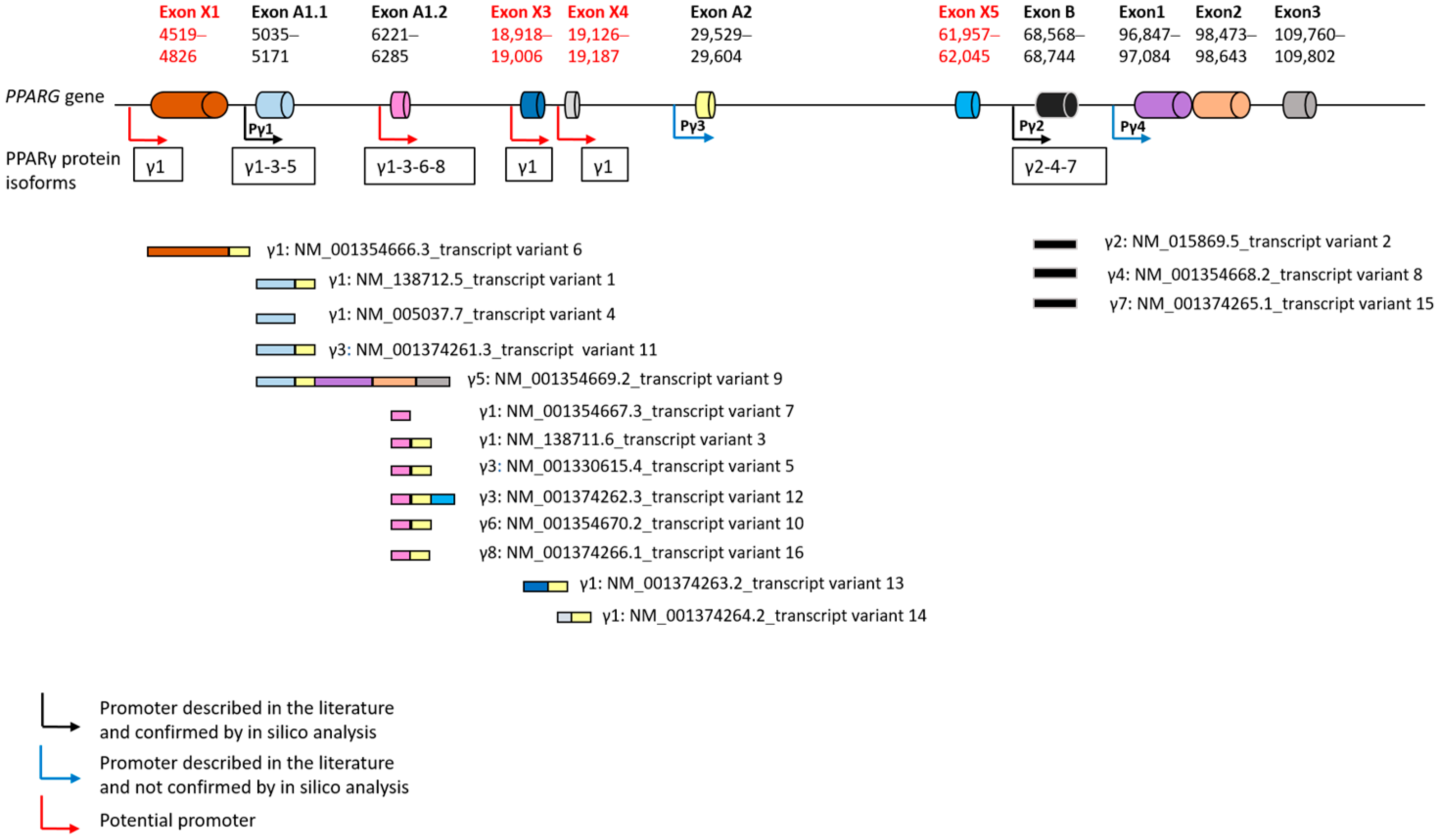
3.1. In Silico Analysis of 5′UTR PPARG NCBI Transcripts Reveals Four New Exons and Four New Potential Promoters on the PPARG Gene
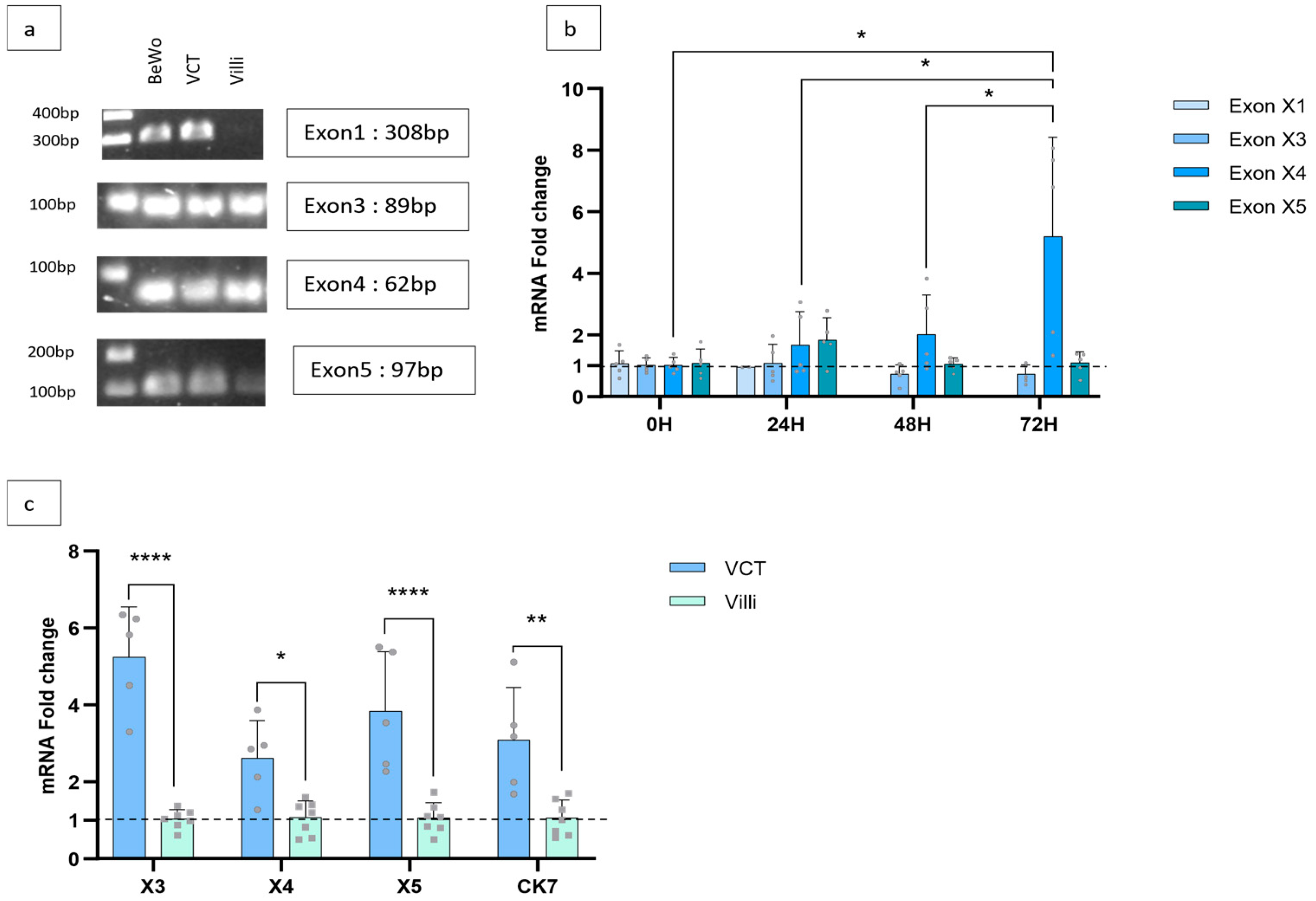
3.2. Trophoblast-Specific Expression of X3, X4, and X5 Exons and Possible Involvement of X4 in Villous Cytotrophoblast Differentiation
3.3. Evolution of Expression of New PPARG Exons of During the First Trimester
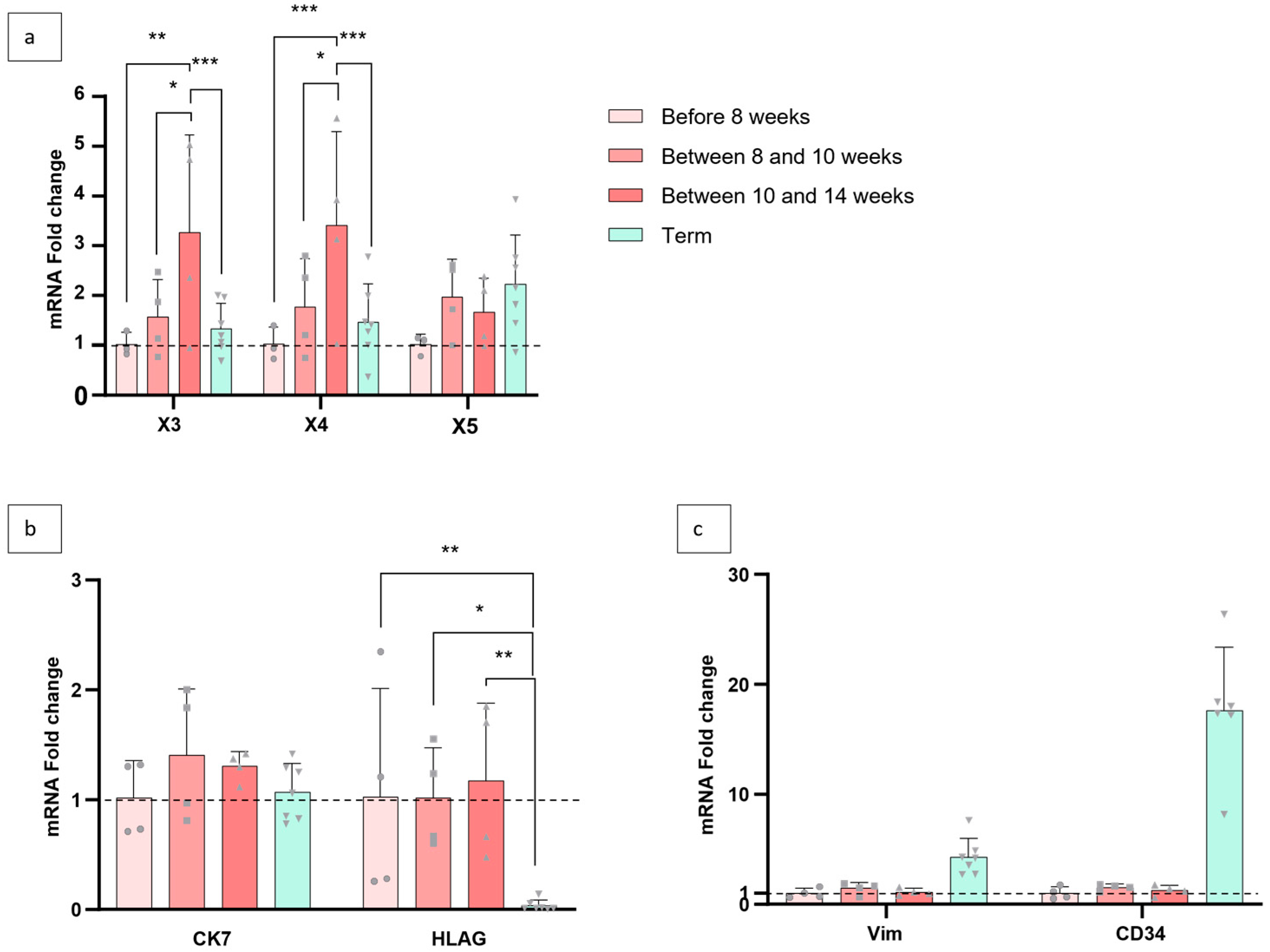
3.3.1. Placental Oxygen Levels During the First Trimester of Pregnancy Have an Impact on Expression of New X3 and X4 Exons
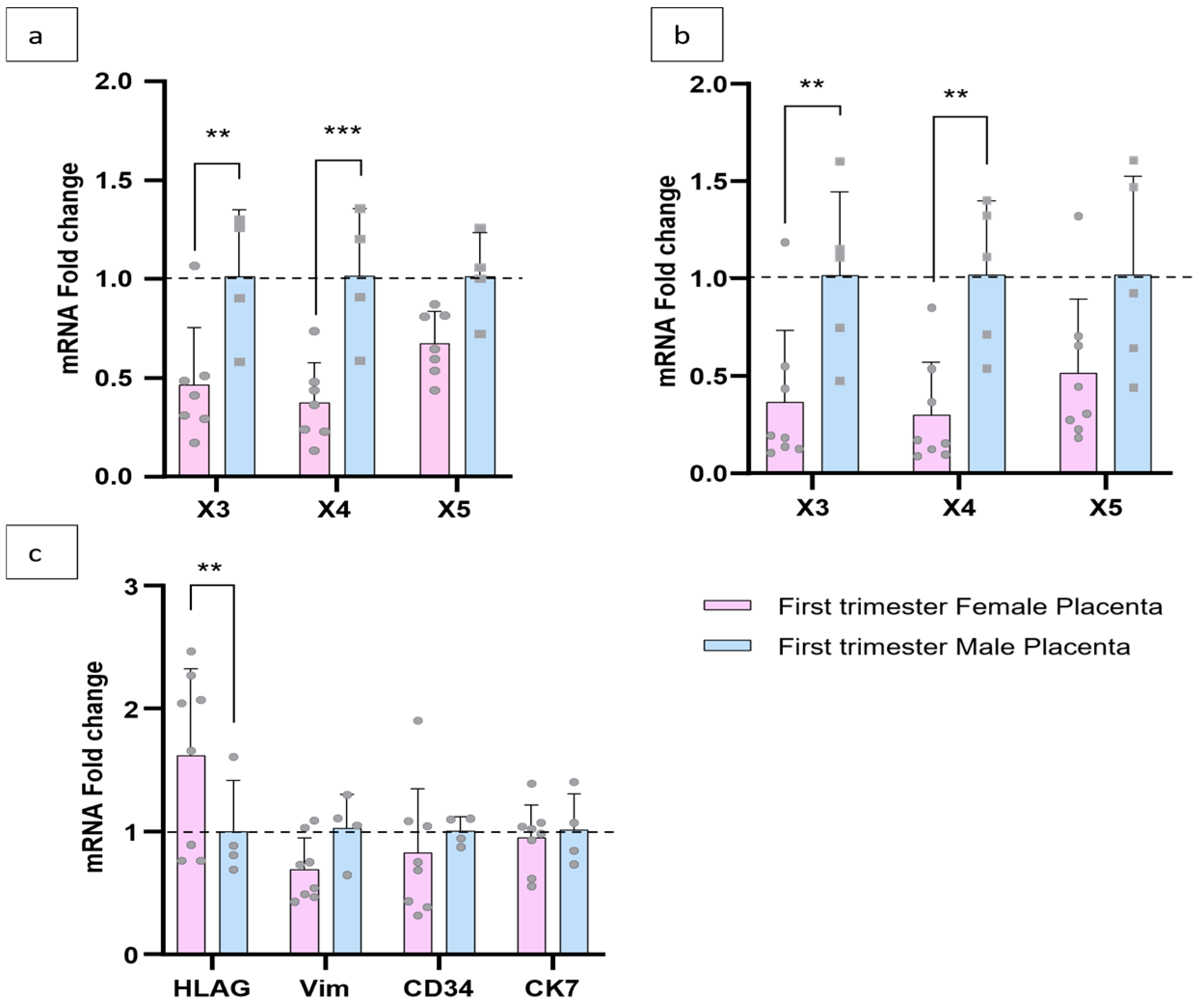
3.3.2. Overexpression of X3 and X4 in the Male Placenta Correlates with Their Specific Expression in Villous Cytotrophoblasts
4. Discussion
5. Conclusions
Supplementary Materials
Author Contributions
Funding
Institutional Review Board Statement
Informed Consent Statement
Data Availability Statement
Acknowledgments
Conflicts of Interest
Abbreviations
| CK7 | Cytokeratin 7 |
| DMEM | Dulbecco′s modified Eagle′s medium |
| EVT | Extravillous cytotrophoblast |
| FCS | Fetal calf serum |
| HLA | Human leukocyte antigen |
| HBSS | Hank’s balanced salt solution |
| PPARG | Peroxisome proliferator-activated receptor gamma RNA |
| PPARG | Peroxisome proliferator-activated receptor gamma human gene |
| PPARγ | Peroxisome proliferator-activated receptor gamma protein |
| RPLP0 | Ribosomal protein lateral stalk subunit P0 |
| SDHA | Succinate dehydrogenase complex flavoprotein subunit A |
| ST | Syncytiotrophoblast |
| VCT | Villous cytotrophoblast |
References
- Fournier, T.; Guibourdenche, J.; Handschuh, K.; Tsatsaris, V.; Rauwel, B.; Davrinche, C.; Evain-Brion, D. PPARγ and Human Trophoblast Differentiation. J. Reprod. Immunol. 2011, 90, 41–49. [Google Scholar] [CrossRef]
- Hernandez-Quiles, M.; Broekema, M.F.; Kalkhoven, E. PPARgamma in Metabolism, Immunity, and Cancer: Unified and Diverse Mechanisms of Action. Front. Endocrinol. 2021, 12, 624112. [Google Scholar] [CrossRef]
- Lehrke, M.; Lazar, M.A. The Many Faces of PPARγ. Cell 2005, 123, 993–999. [Google Scholar] [CrossRef]
- Kadam, L.; Kohan-Ghadr, H.R.; Drewlo, S. The Balancing Act—PPAR-γ’s Roles at the Maternal-Fetal Interface. Syst. Biol. Reprod. Med. 2015, 61, 65–71. [Google Scholar] [CrossRef]
- Pavan, L.; Hermouet, A.; Tsatsaris, V.; Thérond, P.; Sawamura, T.; Evain-Brion, D.; Fournier, T. Lipids from Oxidized Low-Density Lipoprotein Modulate Human Trophoblast Invasion: Involvement of Nuclear Liver X Receptors. Endocrinology 2004, 145, 4583–4591. [Google Scholar] [CrossRef]
- Barak, Y.; Nelson, M.C.; Ong, E.S.; Jones, Y.Z.; Ruiz-Lozano, P.; Chien, K.R.; Koder, A.; Evans, R.M. PPAR γ Is Required for Placental, Cardiac, and Adipose Tissue Development. Mol. Cell 1999, 4, 585–595. [Google Scholar] [CrossRef]
- Barak, Y.; Sadovsky, Y.; Shalom-Barak, T. PPAR Signaling in Placental Development and Function. PPAR Res. 2008, 2008, 142082. [Google Scholar] [CrossRef]
- Nadra, K.; Quignodon, L.; Sardella, C.; Joye, E.; Mucciolo, A.; Chrast, R.; Desvergne, B. PPARγ in Placental Angiogenesis. Endocrinology 2010, 151, 4969–4981. [Google Scholar] [CrossRef] [PubMed]
- Kubota, N.; Terauchi, Y.; Miki, H.; Tamemoto, H.; Yamauchi, T.; Komeda, K.; Satoh, S.; Nakano, R.; Ishii, C.; Sugiyama, T.; et al. PPAR γ Mediates High-Fat Diet-Induced Adipocyte Hypertrophy and Insulin Resistance. Mol. Cell 1999, 4, 597–609. [Google Scholar] [CrossRef] [PubMed]
- Peng, L.; Yang, H.; Ye, Y.; Ma, Z.; Kuhn, C.; Rahmeh, M.; Mahner, S.; Makrigiannakis, A.; Jeschke, U.; von Schönfeldt, V. Role of Peroxisome Proliferator-Activated Receptors (PPARs) in Trophoblast Functions. Int. J. Mol. Sci. 2021, 22, 433. [Google Scholar] [CrossRef] [PubMed]
- Wieser, F.; Waite, L.; Depoix, C.; Taylor, R.N. PPAR Action in Human Placental Development and Pregnancy and Its Complications. PPAR Res. 2008, 2008, 527048. [Google Scholar] [CrossRef] [PubMed]
- Gosseaume, C.; Fournier, T.; Jéru, I.; Vignaud, M.-L.; Missotte, I.; Archambeaud, F.; Debussche, X.; Droumaguet, C.; Fève, B.; Grillot, S.; et al. Perinatal, Metabolic, and Reproductive Features in PPARG-Related Lipodystrophy. Eur. J. Endocrinol. 2023, 188, 273–281. [Google Scholar] [CrossRef]
- Peeters, L.L.H.; Vigne, J.-L.; Tee, M.K.; Zhao, D.; Waite, L.L.; Taylor, R.N. PPAR Gamma Represses VEGF Expression in Human Endometrial Cells: Implications for Uterine Angiogenesis. Angiogenesis 2005, 8, 373–379. [Google Scholar] [CrossRef]
- Madhra, M.; Noh, R.M.; Zammitt, N.N.; Patrick, A.W.; Love, C.D.B. A Complicated Pregnancy in a Patient with Lipodystrophic Diabetes Attributable to a Peroxisome Proliferator-Activated Receptor Gamma (PPARG) Mutation. Diabet. Med. 2012, 29, e398–e401. [Google Scholar] [CrossRef] [PubMed]
- Omi, T.; Brenig, B.; Spilar Kramer, S.; Iwamoto, S.; Stranzinger, G.; Neuenschwander, S. Identification and Characterization of Novel Peroxisome Proliferator-Activated Receptor-Gamma (PPAR-γ) Transcriptional Variants in Pig and Human. J. Anim. Breed. Genet. 2005, 122, 45–53. [Google Scholar] [CrossRef] [PubMed]
- Chen, Y.; Jimenez, A.R.; Medh, J.D. Identification and Regulation of Novel PPAR-γ Splice Variants in Human THP-1 Macrophages. Biochim. Biophys. Acta (BBA)-Gene Struct. Expr. 2006, 1759, 32–43. [Google Scholar] [CrossRef] [PubMed]
- Sundvold, H.; Brzozowska, A.; Lien, S. Characterisation of Bovine Peroxisome Proliferator-Activated Receptors γ1 and γ2: Genetic Mapping and Differential Expression of the Two Isoforms. Biochem. Biophys. Res. Commun. 1997, 239, 857–861. [Google Scholar] [CrossRef]
- Sundvold, H.; Lien, S. Identification of a Novel Peroxisome Proliferator-Activated Receptor (PPAR) γ Promoter in Man and Transactivation by the Nuclear Receptor RORα1. Biochem. Biophys. Res. Commun. 2001, 287, 383–390. [Google Scholar] [CrossRef]
- Howe, F.S.; Fischl, H.; Murray, S.C.; Mellor, J. Is H3K4me3 Instructive for Transcription Activation? Bioessays 2017, 39, 1–12. [Google Scholar] [CrossRef]
- Bannister, A.J.; Kouzarides, T. Regulation of Chromatin by Histone Modifications. Cell Res. 2011, 21, 381–395. [Google Scholar] [CrossRef]
- Creyghton, M.P.; Cheng, A.W.; Welstead, G.G.; Kooistra, T.; Carey, B.W.; Steine, E.J.; Hanna, J.; Lodato, M.A.; Frampton, G.M.; Sharp, P.A.; et al. Histone H3K27ac Separates Active from Poised Enhancers and Predicts Developmental State. Proc. Natl. Acad. Sci. USA 2010, 107, 21931–21936. [Google Scholar] [CrossRef]
- Deval, G.; Nedder, M.; Degrelle, S.; Rogozarski, J.; Vignaud, M.-L.; Chissey, A.; Colzin, S.; Laguillier-Morizot, C.; Coumoul, X.; Boland, S.; et al. Benzo(a)Pyrene and Cerium Dioxide Nanoparticles in Co-Exposure Impair Human Trophoblast Cell Stress Signaling. Int. J. Mol. Sci. 2023, 24, 5439. [Google Scholar] [CrossRef] [PubMed]
- Arnaiz-Villena, A.; Suarez-Trujillo, F.; Juarez, I.; Rodríguez-Sainz, C.; Palacio-Gruber, J.; Vaquero-Yuste, C.; Molina-Alejandre, M.; Fernández-Cruz, E.; Martin-Villa, J.M. Evolution and Molecular Interactions of Major Histocompatibility Complex (MHC)-G, -E and -F Genes. Cell Mol. Life Sci. 2022, 79, 464. [Google Scholar] [CrossRef] [PubMed]
- Degrelle, S.A.; Fournier, T. Fetal-Sex Determination of Human Placental Tissues. Placenta 2018, 61, 103–105. [Google Scholar] [CrossRef] [PubMed]
- Ong, C.-T.; Corces, V.G. Enhancer Function: New Insights into the Regulation of Tissue-Specific Gene Expression. Nat. Rev. Genet. 2011, 12, 283–293. [Google Scholar] [CrossRef]
- Li, L.; Schust, D.J. Isolation, Purification and in Vitro Differentiation of Cytotrophoblast Cells from Human Term Placenta. Reprod. Biol. Endocrinol. 2015, 13, 71. [Google Scholar] [CrossRef]
- Jiang, H.; Derisoud, E.; Parreira, D.; Taebnia, N.; Jannig, P.R.; Zandi Shafagh, R.; Zhao, A.; Li, C.; Ortiz, M.; Maliqueo, M.A.; et al. Decoding Human Placental Cellular and Molecular Responses to Maternal Obesity and Fetal Growth. Adv. Sci. 2025, 13, e09691. [Google Scholar] [CrossRef]
- Maldonado-Estrada, J.; Menu, E.; Roques, P.; Barré-Sinoussi, F.; Chaouat, G. Evaluation of Cytokeratin 7 as an Accurate Intracellular Marker with Which to Assess the Purity of Human Placental Villous Trophoblast Cells by Flow Cytometry. J. Immunol. Methods 2004, 286, 21–34. [Google Scholar] [CrossRef]
- Huppertz, B. Placental Physioxia Is Based on Spatial and Temporal Variations of Placental Oxygenation Throughout Pregnancy. J. Reprod. Immunol. 2023, 158, 103985. [Google Scholar] [CrossRef]
- Jauniaux, E.; Watson, A.L.; Hempstock, J.; Bao, Y.P.; Skepper, J.N.; Burton, G.J. Onset of Maternal Arterial Blood Flow and Placental Oxidative Stress. A Possible Factor in Human Early Pregnancy Failure. Am. J. Pathol. 2000, 157, 2111–2122. [Google Scholar] [CrossRef]
- Rodesch, F.; Simon, P.; Donner, C.; Jauniaux, E. Oxygen Measurements in Endometrial and Trophoblastic Tissues During Early Pregnancy. Obstet. Gynecol. 1992, 80, 283–285. [Google Scholar]
- Lin, X.-X.; Xie, Y.-M.; Zhao, S.-J.; Liu, C.-Y.; Mor, G.; Liao, A.-H. Human Leukocyte Antigens: The Unique Expression in Trophoblasts and Their Crosstalk with Local Immune Cells. Int. J. Biol. Sci. 2022, 18, 4043–4052. [Google Scholar] [CrossRef]
- Fina, L.; Molgaard, H.V.; Robertson, D.; Bradley, N.J.; Monaghan, P.; Delia, D.; Sutherland, D.R.; Baker, M.A.; Greaves, M.F. Expression of the CD34 Gene in Vascular Endothelial Cells. Blood 1990, 75, 2417–2426. [Google Scholar] [CrossRef] [PubMed]
- Ostrowska-Podhorodecka, Z.; McCulloch, C.A. Vimentin Regulates the Assembly and Function of Matrix Adhesions. Wound Repair Regen. 2021, 29, 602–612. [Google Scholar] [CrossRef] [PubMed]
- Gonzalez, T.L.; Willson, B.E.; Wang, E.T.; Taylor, K.D.; Novoa, A.; Swarna, A.; Ortiz, J.C.; Zeno, G.J.; Jefferies, C.A.; Lawrenson, K.; et al. Sexually Dimorphic DNA Methylation and Gene Expression Patterns in Human First Trimester Placenta. Biol. Sex Differ. 2024, 15, 63. [Google Scholar] [CrossRef] [PubMed]
- Couture, C.; Brien, M.-E.; Piché, J.; Cervantes, E.; Luu, T.M.; Girard, S. Adverse Neonatal Outcomes Are Associated with a Sex-Specific Placental Inflammatory Profile†. Biol. Reprod. 2025, 113, 1266–1273. [Google Scholar] [CrossRef]
- Paparini, D.E.; Grasso, E.; Aguilera, F.; Arslanian, M.A.; Lella, V.; Lara, B.; Schafir, A.; Gori, S.; Merech, F.; Hauk, V.; et al. Sex-Specific Phenotypical, Functional and Metabolic Profiles of Human Term Placenta Macrophages. Biol. Sex Differ. 2024, 15, 80. [Google Scholar] [CrossRef]
- Asami-Miyagishi, R.; Iseki, S.; Usui, M.; Uchida, K.; Kubo, H.; Morita, I. Expression and Function of PPARγ in Rat Placental Development. Biochem. Biophys. Res. Commun. 2004, 315, 497–501. [Google Scholar] [CrossRef]
- Tarrade, A.; Schoonjans, K.; Pavan, L.; Auwerx, J.; Rochette-Egly, C.; Evain-Brion, D.; Fournier, T. PPARγ/RXRα Heterodimers Control Human Trophoblast Invasion. J. Clin. Endocrinol. Metab. 2001, 86, 5017–5024. [Google Scholar] [CrossRef][Green Version]
- Aprile, M.; Cataldi, S.; Ambrosio, M.R.; D’Esposito, V.; Lim, K.; Dietrich, A.; Bluher, M.; Savage, D.B.; Formisano, P.; Ciccodicola, A.; et al. PPARγΔ5, a Naturally Occurring Dominant-Negative Splice Isoform, Impairs PPARγ Function and Adipocyte Differentiation. Cell Rep. 2018, 25, 1577–1592.e6. [Google Scholar] [CrossRef]
- Bryant, C.; Webb, A.; Banks, A.S.; Chandler, D.; Govindarajan, R.; Agrawal, S. Alternatively Spliced Landscape of PPARγ mRNA in Podocytes Is Distinct from Adipose Tissue. Cells 2022, 11, 3455. [Google Scholar] [CrossRef] [PubMed]
- Chen, Z.; He, P.; Ding, X.; Huang, Y.; Gu, H.; Ni, X. PPARγ Stimulates Expression of L-Type Amino Acid and Taurine Transporters in Human Placentas: The Evidence of PPARγ Regulating Fetal Growth. Sci. Rep. 2015, 5, 12650. [Google Scholar] [CrossRef] [PubMed]
- Tarrade, A.; Schoonjans, K.; Guibourdenche, J.; Bidart, J.M.; Vidaud, M.; Auwerx, J.; Rochette-Egly, C.; Evain-Brion, D. PPAR γ/RXR α Heterodimers Are Involved in Human CG β Synthesis and Human Trophoblast Differentiation. Endocrinology 2001, 142, 4504–4514. [Google Scholar] [CrossRef]
- Fajas, L.; Auboeuf, D.; Raspe, E.; Schoonjans, K.; Lefebvre, A.M.; Saladin, R.; Najib, J.; Laville, M.; Fruchart, J.C.; Deeb, S.; et al. The Organization, Promoter Analysis, and Expression of the Human PPARγ Gene. J. Biol. Chem. 1997, 272, 18779–18789. [Google Scholar] [CrossRef]
- Fajas, L.; Fruchart, J.C.; Auwerx, J. PPARγ3 mRNA: A Distinct PPARγ mRNA Subtype Transcribed from an Independent Promoter. FEBS Lett. 1998, 438, 55–60. [Google Scholar] [CrossRef]
- Fournier, T.; Handschuh, K.; Tsatsaris, V.; Evain-Brion, D. Involvement of PPARγ in Human Trophoblast Invasion. Placenta 2007, 28, S76–S81. [Google Scholar] [CrossRef]
- Bilban, M.; Haslinger, P.; Prast, J.; Klinglmüller, F.; Woelfel, T.; Haider, S.; Sachs, A.; Otterbein, L.E.; Desoye, G.; Hiden, U.; et al. Identification of Novel Trophoblast Invasion-Related Genes: Heme Oxygenase-1 Controls Motility via Peroxisome Proliferator-Activated Receptor γ. Endocrinology 2009, 150, 1000–1013. [Google Scholar] [CrossRef]
- Handschuh, K.; Guibourdenche, J.; Guesnon, M.; Laurendeau, I.; Evain-Brion, D.; Fournier, T. Modulation of PAPP-A Expression by PPARγ in Human First Trimester Trophoblast. Placenta 2006, 27, 127–134. [Google Scholar] [CrossRef]
- Fiatte, C.; Huin, C.; Bertin, I.; Lesuffleur, T.; Pluvinet, A.; Touche, N.; Plénat, F.; Dauça, M.; Domenjoud, L.; Schohn, H. Genetic Analysis of Peroxisome Proliferator-Activated Receptor γ1 Splice Variants in Human Colorectal Cell Lines. Int. J. Oncol. 2006, 29, 1601–1610. [Google Scholar] [CrossRef]
- Ding, L.; Jiang, H.; Shen, L.; Xu, Y. The Role of PPARγ in Cancer Cachexia: Friend or Foe? Front. Endocrinol. 2025, 16, 1717134. [Google Scholar] [CrossRef] [PubMed]
- Green, S. Peroxisome Proliferators: A Model for Receptor Mediated Carcinogenesis. Cancer Surv. 1992, 14, 221–232. [Google Scholar]
- Apostoli, A.J.; Skelhorne-Gross, G.E.A.; Rubino, R.E.; Peterson, N.T.; Di Lena, M.A.; Schneider, M.M.; SenGupta, S.K.; Nicol, C.J.B. Loss of PPARγ Expression in Mammary Secretory Epithelial Cells Creates a Pro-Breast Tumorigenic Environment. Int. J. Cancer 2014, 134, 1055–1066. [Google Scholar] [CrossRef]
- Simsek, D.; Hassan, G.S.; Sotgia, F.; Lisanti, M.P. Investigating the Role of Peroxisomes in Regulating Breast Cancer Stem Cell Mechanisms. Int. J. Mol. Sci. 2025, 26, 11389. [Google Scholar] [CrossRef] [PubMed]
- Parejo-Alonso, B.; Mascaraque, M.; Royo-García, A.; Sancho, P. The Emerging Role of Peroxisome Proliferator-Activated Receptors in Cancer Stemness. Cells 2025, 14, 1610. [Google Scholar] [CrossRef] [PubMed]
- Ding, N.; Harlow, S.D.; Randolph, J.F., Jr.; Loch-Caruso, R.; Park, S.K. Perfluoroalkyl and Polyfluoroalkyl Substances (PFAS) and Their Effects on the Ovary. Hum. Reprod. Update 2020, 26, 724–752. [Google Scholar] [CrossRef] [PubMed]
- Meister, S.; Hahn, L.; Beyer, S.; Paul, C.; Mitter, S.; Kuhn, C.; von Schönfeldt, V.; Corradini, S.; Sudan, K.; Schulz, C.; et al. Regulation of Epigenetic Modifications in the Placenta during Preeclampsia: PPARγ Influences H3K4me3 and H3K9ac in Extravillous Trophoblast Cells. Int. J. Mol. Sci. 2021, 22, 12469. [Google Scholar] [CrossRef]



| Gestational Age | |||
|---|---|---|---|
| Sex | Before 8 Weeks | Between 8 and 10 Weeks | Between 10 and 14 Weeks |
| Female | 2 | 2 | 3 |
| Male | 1 | 2 | 2 |
| Target | Forward Primer | Reverse Primer | Tm | Expected Size of Amplicon | Location on the PPARG Gene | |
|---|---|---|---|---|---|---|
| X1seq | AACTTACAAACGCAAGGAACTCTG | CTGGTGTCGTTTGCTCCTC | 60/59 | 308 | 4519 | 4826 |
| X3 | CAAAGAAGTGCCCTGCTAGACAC | TCAAATCTGTTTCAGTTCTTTATCC | 61/58 | 89 | 18,918 | 19,006 |
| X4 | AGAGCTTCTGTAGCTACGAGATTAT | CTGTTTCAACACTACCCCTTCTT | 59/59 | 62 | 19,126 | 19,187 |
| X5 | GACGCTGATTTATTTAAATCATCTCT | GGTCATTTCTGGGTTTGCATTCAAG | 55/61 | 97 | 61,957 | 62,045 |
| X1 | AACTTACAAACGCAAGGAACTCTG | AGTGGCTTGCCCTTCACAC | 60/60 | 164 | 4519 | 4683 |
| RPLP0 | AACATCTCCCCCTTCTCCT | ACTCGTTTGTACCCGTTGAT | 58/58 | 209 | ||
| SDHA | TGGGAACAACAGGGCATCTG | CCACCACTGCATCAAATTCATG | 60/59 | 86 | ||
| CK7 | GGACATCGAGATCGCCACCT | ACCGCCACTGCTACTGCCA | 61/63 | 124 | ||
| HLA-G_1234 | ATGGAAGCAGTCTTCCCTGC | TCTTTCTCCACAGCACAGCA | 60/60 | 113 | ||
| VIM | CAGGAGGAGATGCTTCAGAT | TGAGGTCAGGCTTGGAAAC | 60/58 | 229 | ||
| CD34 | GACCCTGATTGCACTGGTCA | GGTTCCAGCTCCAGCCTTT | 60/60 | 117 | ||
| Chr X-YF_XR | ATTTGTTCTAAGTCGCCATATTCTCT | GAACACACTACTGAGCAAAATGTATA | 59/58 | 488 | ||
| Chr X-YF_YR | ATTTGTTCTAAGTCGCCATATTCTCT | CATCTTTACAAGCTTGTAGACACACT | 59/60 | 340 | ||
Disclaimer/Publisher’s Note: The statements, opinions and data contained in all publications are solely those of the individual author(s) and contributor(s) and not of MDPI and/or the editor(s). MDPI and/or the editor(s) disclaim responsibility for any injury to people or property resulting from any ideas, methods, instructions or products referred to in the content. |
© 2026 by the authors. Licensee MDPI, Basel, Switzerland. This article is an open access article distributed under the terms and conditions of the Creative Commons Attribution (CC BY) license.
Share and Cite
Vignaud, M.-L.; Morin, N.; Fournier, T. New PPARG Exons: Cell-Specific Expression of Their RNAs in the Human Placenta. Cells 2026, 15, 639. https://doi.org/10.3390/cells15070639
Vignaud M-L, Morin N, Fournier T. New PPARG Exons: Cell-Specific Expression of Their RNAs in the Human Placenta. Cells. 2026; 15(7):639. https://doi.org/10.3390/cells15070639
Chicago/Turabian StyleVignaud, Marie-Léone, Nathalie Morin, and Thierry Fournier. 2026. "New PPARG Exons: Cell-Specific Expression of Their RNAs in the Human Placenta" Cells 15, no. 7: 639. https://doi.org/10.3390/cells15070639
APA StyleVignaud, M.-L., Morin, N., & Fournier, T. (2026). New PPARG Exons: Cell-Specific Expression of Their RNAs in the Human Placenta. Cells, 15(7), 639. https://doi.org/10.3390/cells15070639