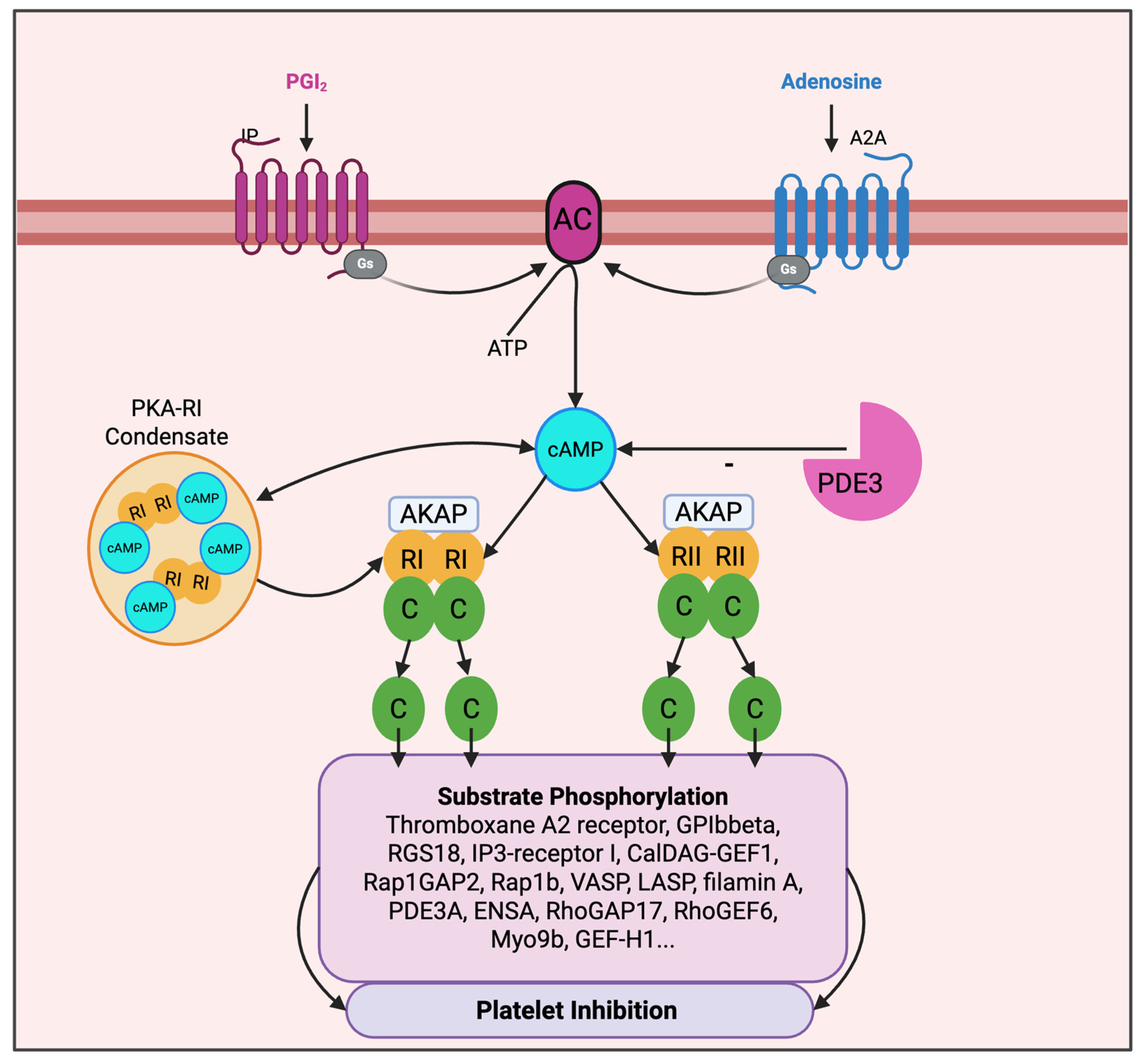
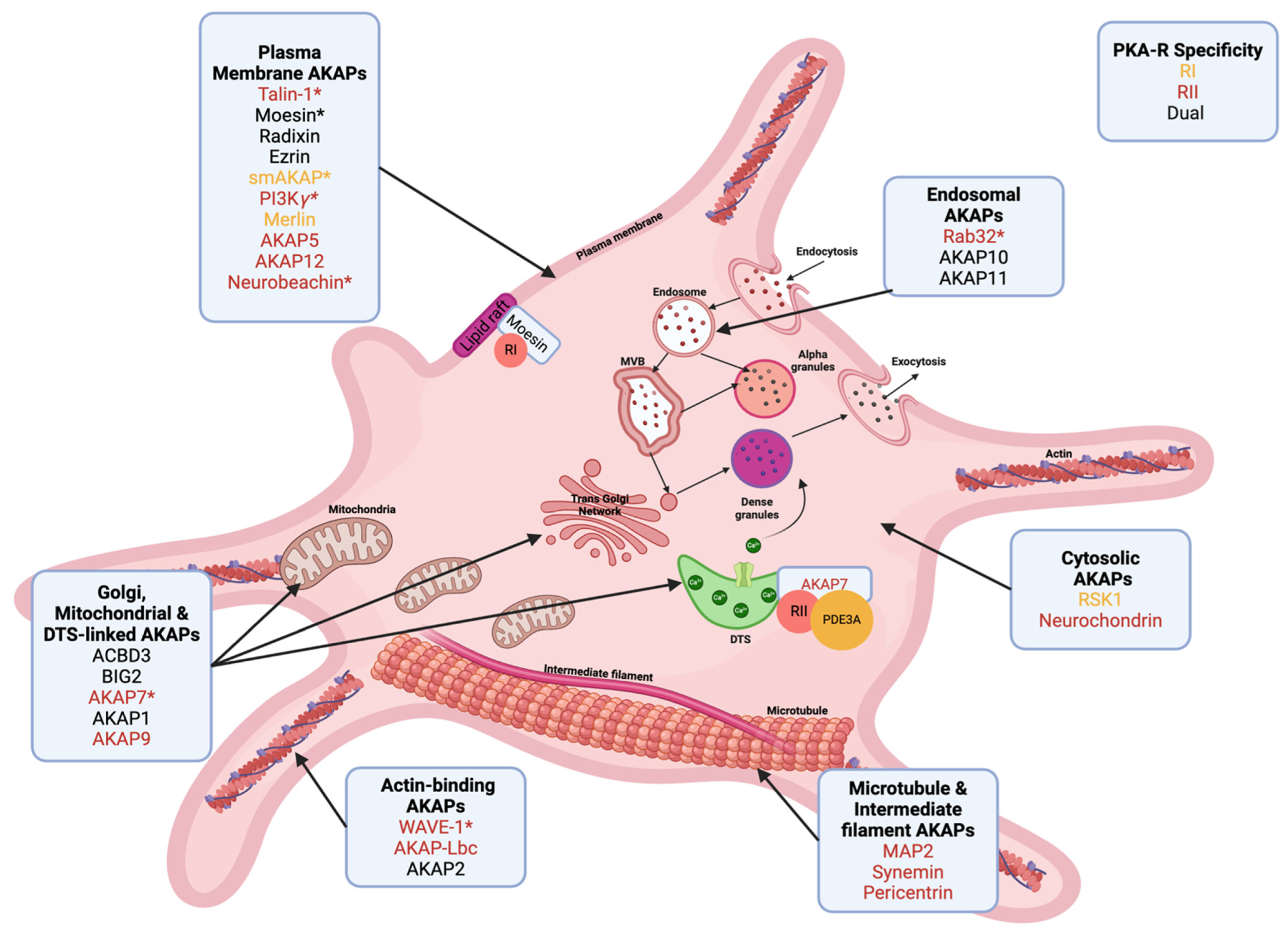
The Role of A-Kinase Anchoring Proteins for Inhibitory cAMP Signalling in Platelets

Highlights
- A-kinase anchoring proteins (AKAP) are expressed in human platelets.
- AKAPs provide spatial and temporal coordination of cAMP signalling and platelet inhibition.
- AKAPs fine-tune endothelium-dependent platelet regulation.
- AKAPs could be new therapeutic targets that prevent thrombus formation through endogenous cAMP signalling.
Abstract
1. Introduction
2. Platelet Function and Signalling
2.1. Overview of Platelet Structure and Function
2.2. Platelet Activation
2.3. Platelet Inhibitory Pathways
3. Overview of cAMP Signalling in Platelets
3.1. cAMP, a Key Inhibitory Pathway
3.2. Protein Kinase A
4. A-Kinase Anchoring Proteins: General Structure and Roles
5. AKAP Expression in Platelets
5.1. Plasma Membrane AKAPs
5.1.1. Talin-1 (RII)
5.1.2. Ezrin/Radixin/Moesin (Dual)
5.1.3. smAKAP (RI)
5.1.4. PI3Kγ (RII)
5.1.5. Merlin (RI)
5.1.6. AKAP5 (RII)
5.1.7. AKAP12 (RII)
5.1.8. Neurobeachin (RII)
5.2. Endosomal AKAPs
5.2.1. Rab32 (RII)
5.2.2. AKAP10 (Dual)
5.2.3. AKAP11 (Dual)
5.3. Golgi, Mitochondria, and DTS-Linked AKAPs
5.3.1. ACBD3 (Dual)
5.3.2. BIG2 (Dual)
5.3.3. AKAP7 (RII)
5.3.4. AKAP1 (Dual)
5.3.5. AKAP9 (RII)
5.4. AKAPs Linked to the Actin Cytoskeleton
5.4.1. WAVE1 (RII)
5.4.2. AKAP-Lbc (RII)
5.4.3. AKAP2 (Dual)
5.5. AKAPs Linked to Microtubules and Intermediate Filaments
5.5.1. MAP2 (RII)
5.5.2. Pericentrin (RII)
5.5.3. Synemin (RII)
5.6. Cytosolic AKAPs
5.6.1. RSK1 (RI)
5.6.2. Neurochondrin (RII)
6. Conclusions and Future Directions
- What is the exact identity, expression level, R specificity, and subcellular localisation of platelet AKAPs?
- 2.
- How are AKAP-directed subcellular compartments linked to PKA-mediated substrate phosphorylation and platelet inhibition?
- 3.
- What is the role of dynamic PKA redistribution between different AKAPs?
- 4.
- How are PDEs integrated into AKAP functions in platelets?
- 5.
- What is the role of RI phase separation for the compartmentalisation of cAMP signalling in platelets?
- 6.
- Are AKAPs involved in the coordination of cAMP/PKA and cGMP/PKG pathways?
- 7.
- How are AKAPs integrated into platelet-activating signalling pathways?
- 8.
- What is the role of AKAPs in the increased PGI2 sensitivity of platelets in response to physical exercise?
Author Contributions
Funding
Data Availability Statement
Acknowledgments
Conflicts of Interest
Abbreviations
| AC | Adenylyl cyclase |
| ADP | Adenosine diphosphate |
| AKAP | A-kinase anchoring protein |
| AKAR1 | A-kinase reporter 1 |
| AKB | A-kinase binding domain |
| C | Catalytic subunit of protein kinase A |
| Ca2+ | Calcium |
| cAMP | Cyclic adenosine monophosphate |
| D/D | Docking dimerization domain |
| DAG | Diacylglycerol |
| DTS | Dense tubular system |
| ERM | Ezrin/radixin/moesin |
| FRET | Förster resonance energy transfer |
| GAP | GTPase-activating protein |
| GPCR | G-protein coupled receptor |
| IP3 | Inositol 1,4,5-triphosphate |
| ITIM | Immunoreceptor tyrosine-based inhibition motif |
| MAM | Mitochondria-associated membranes |
| MVB | Multivesicular body |
| NF2 | Neuorfibromin-2 |
| NO | Nitric oxide |
| OCS | Open canicular system |
| OPTN | Optineurin |
| PAR | Protease-activated receptor |
| PDE | Phosphodiesterase |
| PECAM-1 | Platelet endothelial cell adhesion molecule 1 |
| PGI2 | Prostacyclin |
| PH | Pleckstrin homology |
| PIP2 | Phosphatidylinositol, 4,5-biphosphate |
| PIP3 | Phosphatidylinositol 3,4,5-triphosphate |
| PKA | Protein kinase A |
| PKC | Protein kinase C |
| PKG | Protein kinase G |
| PP2B | Protein phosphatase 2B |
| R | Regulatory subunit of protein kinase A |
| RAIN | Receptor associated independent cAMP nanodomains |
| RGS | Regulator of G-protein signalling |
| TGN | Trans-Golgi network |
| TNF | Tumour necrosis factor |
| TxA2 | Thromboxane A2 |
| TRAP | Thrombin receptor activating peptide |
| VASP | Vasodilator-stimulated phosphoprotein |
| VWF | Von Willebrand Factor |
References
- Gremmel, T.; Frelinger, A.; Michelson, A. Platelet Physiology. Semin. Thromb. Hemost. 2016, 42, 191–204. [Google Scholar] [CrossRef] [PubMed]
- Smolenski, A. Novel roles of cAMP/cGMP-dependent signaling in platelets. J. Thromb. Haemost. 2012, 10, 167–176. [Google Scholar] [CrossRef] [PubMed]
- Bye, A.P.; Unsworth, A.J.; Gibbins, J.M. Platelet signaling: A complex interplay between inhibitory and activatory networks. J. Thromb. Haemost. 2016, 14, 918–930. [Google Scholar] [CrossRef]
- Stefanini, L.; Bergmeier, W. Negative regulators of platelet activation and adhesion. J. Thromb. Haemost. 2018, 16, 220–230. [Google Scholar] [CrossRef]
- Raslan, Z.; Aburima, A.; Naseem, K.M. The Spatiotemporal Regulation of cAMP Signaling in Blood Platelets—Old Friends and New Players. Front. Pharmacol. 2015, 6, 266. [Google Scholar] [CrossRef]
- Yadav, R.; Zaccolo, M. GPCR signaling via cAMP nanodomains. Biochem. J. 2025, 482, 519–533. [Google Scholar] [CrossRef]
- Bock, A.; Irannejad, R.; Scott, J.D. cAMP signaling: A remarkably regional affair. Trends Biochem. Sci. 2024, 49, 305–317. [Google Scholar] [CrossRef]
- Gresele, P.; Momi, S. Novel approaches to antiplatelet therapy. Biochem. Pharmacol. 2022, 206, 115297. [Google Scholar] [CrossRef]
- Mackman, N.; Bergmeier, W.; Stouffer, G.A.; Weitz, J.I.; Mackman, N.; Bergmeier, W.; Stouffer, G.A.; Weitz, J.I. Therapeutic strategies for thrombosis: New targets and approaches. Nat. Rev. Drug Discov. 2020, 19, 333–352. [Google Scholar] [CrossRef]
- Thon, J.N.; Italiano, J.E. Platelets: Production, Morphology and Ultrastructure. In Handbook of Experimental Pharmacology; Springer: Berlin/Heidelberg, Germany, 2012; pp. 3–22. [Google Scholar] [CrossRef]
- Brewer, D. Max Schultze (1865), G. Bizzozero (1882) and the discovery of the platelet. Br. J. Haematol. 2006, 133, 251–258. [Google Scholar] [CrossRef] [PubMed]
- Ribatti, D.; Crivellato, E. Giulio Bizzozero and the discovery of platelets. Leuk. Res. 2007, 31, 1339–1341. [Google Scholar] [CrossRef] [PubMed]
- Selvadurai, M.; Hamilton, J. Structure and function of the open canalicular system—The platelet’s specialized internal membrane network. Platelets 2018, 29, 319–325. [Google Scholar] [CrossRef]
- Banerjee, M.; Whiteheart, S.W. The Ins and Outs of Endocytic Trafficking in Platelet Functions. Curr. Opin. Hematol. 2017, 24, 467–474. [Google Scholar] [CrossRef]
- Yao, H.H.Y.; Kahr, W.H.A. Molecular basis of platelet granule defects. J. Thromb. Haemost. 2025, 23, 381–393. [Google Scholar] [CrossRef] [PubMed]
- Rosado, J.A. Acidic Ca2+ stores in platelets. Cell Calcium 2011, 50, 168–174. [Google Scholar] [CrossRef] [PubMed]
- Gay, L.; Felding-Habermann, B. Contribution of platelets to tumour metastasis. Nat. Rev. Cancer 2011, 11, 123–134. [Google Scholar] [CrossRef]
- Engelmann, B.; Massberg, S. Thrombosis as an intravascular effector of innate immunity. Nat. Rev. Immunol. 2013, 13, 34–45. [Google Scholar] [CrossRef]
- Suzuki-Inoue, K.; Tsukiji, N. A role of platelet C-type lectin-like receptor-2 and its ligand podoplanin in vascular biology. Curr. Opin. Hematol. 2024, 31, 130–139. [Google Scholar] [CrossRef]
- Offermanns, S. Activation of platelet function through G protein-coupled receptors. Circ. Res. 2006, 99, 1293–1304. [Google Scholar] [CrossRef]
- Nonne, C.; Lenain, N.; Hechler, B.; Mangin, P.; Cazenave, J.; Gachet, C.; Lanza, F. Importance of platelet phospholipase Cgamma2 signaling in arterial thrombosis as a function of lesion severity. Arterioscler. Thromb. Vasc. Biol. 2005, 25, 1293–1298. [Google Scholar] [CrossRef]
- Bill, C.A.; Vines, C.M. Phospholipase C. In Advances in Experimental Medicine and Biology; Springer: Cham, Switzerland, 2020; Volume 1131, pp. 215–242. [Google Scholar] [CrossRef]
- Clemetson, K. Platelets and primary haemostasis. Thromb. Res. 2012, 129, 220–224. [Google Scholar] [CrossRef]
- Tomaiuolo, M.; Brass, L.F.; Stalker, T.J. Regulation of platelet activation and coagulation and its role in vascular injury and arterial thrombosis. Interv. Cardiol. Clin. 2017, 6, 1–12. [Google Scholar] [CrossRef] [PubMed]
- Scridon, A. Platelets and Their Role in Hemostasis and Thrombosis—From Physiology to Pathophysiology and Therapeutic Implications. Int. J. Mol. Sci. 2022, 23, 12772. [Google Scholar] [CrossRef] [PubMed]
- Ma, Y.Q.; Qin, J.; Plow, E.F. Platelet integrin αIIbβ3: Activation mechanisms. J. Thromb. Haemost. 2007, 5, 1345–1352. [Google Scholar] [CrossRef] [PubMed]
- Coxon, C.H.; Geer, M.J.; Senis, Y.A. ITIM receptors: More than just inhibitors of platelet activation. Blood 2017, 129, 3407–3418. [Google Scholar] [CrossRef]
- Mazharian, A.; Senis, Y.A. Defining and Harnessing the Megakaryocyte/Platelet Checkpoint. Mol. Cell. Biol. 2025, 45, 116–128. [Google Scholar] [CrossRef]
- Makhoul, S.; Trabold, K.; Gambaryan, S.; Tenzer, S.; Pillitteri, D.; Walter, U.; Jurk, K.; Makhoul, S.; Trabold, K.; Gambaryan, S.; et al. cAMP- and cGMP-elevating agents inhibit GPIbα-mediated aggregation but not GPIbα-stimulated Syk activation in human platelets. Cell Commun. Signal. 2019, 17, 122. [Google Scholar] [CrossRef]
- Murata, T.; Ushikubi, F.; Matsuoka, T.; Hirata, M.; Yamasaki, A.; Sugimoto, Y.; Ichikawa, A.; Aze, Y.; Tanaka, T.; Yoshida, N.; et al. Altered pain perception and inflammatory response in mice lacking prostacyclin receptor. Nature 1997, 388, 678–682. [Google Scholar] [CrossRef]
- Ledent, C.; Vaugeois, J.-M.; NSchiffmann, S.; Pedrazzini, T.; Yacoubi, M.E.; Van der haeghen, J.-J.; Costentin, J.; Heath, J.K.; Vassart, G.; Parmentier, M. Aggressiveness, hypoalgesia and high blood pressure in mice lacking the adenosine A2a receptor. Nature 1997, 388, 674–678. [Google Scholar] [CrossRef]
- Yang, D.; Chen, H.; Koupenova, M.; Carroll, S.H.; Eliades, A.; Freedman, J.; Toselli, P.; Ravid, K. A new role for the A2b adenosine receptor in regulating platelet function. J. Thromb. Haemost. 2010, 8, 817–827. [Google Scholar] [CrossRef]
- Hiratsuka, T.; Sano, T.; Kato, H.; Komatsu, N.; Imajo, M.; Kamioka, Y.; Sumiyama, K.; Banno, F.; Miyata, T.; Matsuda, M. Live imaging of extracellular signal-regulated kinase and protein kinase A activities during thrombus formation in mice expressing biosensors based on Förster resonance energy transfer. J. Thromb. Haemost. 2017, 15, 1487–1499. [Google Scholar] [CrossRef]
- Wen, L.; Feil, S.; Wolters, M.; Thunemann, M.; Regler, F.; Schmidt, K.; Friebe, A.; Olbrich, M.; Langer, H.; Gawaz, M.; et al. A shear-dependent NO-cGMP-cGKI cascade in platelets acts as an auto-regulatory brake of thrombosis. Nat. Commun. 2018, 9, 4301. [Google Scholar] [CrossRef] [PubMed]
- Webb, B.; Cheah, L.; Khalil, J.; Hindle, M.; McKay, M.; Turner, N.; Kearney, M.; Ariens, R.; Duval, C.; Naseem, K. The critical role of platelet adenylyl cyclase 6 in hemostasis and thrombosis. J. Thromb. Haemost. 2025, 23, 2604–2617. [Google Scholar] [CrossRef] [PubMed]
- Dunkern, T.R.; Hatzelmann, A. The effect of Sildenafil on human platelet secretory function is controlled by a complex interplay between phosphodiesterases 2, 3 and 5. Cell. Signal. 2005, 17, 331–339. [Google Scholar] [CrossRef]
- Hochuli, R.; Dicenta, V.; Laspa, Z.; Sigle, M.; Harm, T.; Castor, T.; Rohlfing, A.-K.; Gawaz, M.P. Effect of phosphodiesterase inhibitors on platelet function. Biochem. Biophys. Rep. 2025, 43, 102115. [Google Scholar] [CrossRef]
- Hunter, R.W.; Mackintosh, C.; Hers, I. Protein kinase C-mediated phosphorylation and activation of PDE3A regulate cAMP levels in human platelets. J. Biol. Chem. 2009, 284, 12339–12348. [Google Scholar] [CrossRef]
- Raslan, Z.; Naseem, K.M. The control of blood platelets by cAMP signalling. Biochem. Soc. Trans. 2014, 42, 289–294. [Google Scholar] [CrossRef]
- Gold, M.G. Swimming regulations for protein kinase A catalytic subunit. Biochem. Soc. Trans. 2019, 47, 1355–1366. [Google Scholar] [CrossRef]
- Aye, T.T.; Scholten, A.; Taouatas, N.; Varro, A.; Veen, T.A.B.V.; Vos, M.A.; Heck, A.J.R. Proteome-wide protein concentrations in the human heart. Mol. Biosyst. 2010, 6, 1917–1927. [Google Scholar] [CrossRef]
- Walker-Gray, R.; Stengel, F.; Gold, M.G.; Walker-Gray, R.; Stengel, F.; Gold, M.G. Mechanisms for restraining cAMP-dependent protein kinase revealed by subunit quantitation and cross-linking approaches. Proc. Natl. Acad. Sci. USA 2017, 114, 10414–10419. [Google Scholar] [CrossRef] [PubMed]
- Huang, J.; Swieringa, F.; Solari, F.A.; Provenzale, I.; Grassi, L.; Simone, I.D.; Baaten, C.C.F.M.J.; Cavill, R.; Sickmann, A.; Frontini, M.; et al. Assessment of a complete and classified platelet proteome from genome-wide transcripts of human platelets and megakaryocytes covering platelet functions. Sci. Rep. 2021, 11, 12358. [Google Scholar] [CrossRef]
- Gambaryan, S.; Kobsar, A.; Rukoyatkina, N.; Herterich, S.; Geiger, J.; Smolenski, A.; Lohmann, S.M.; Walter, U. Thrombin and Collagen Induce a Feedback Inhibitory Signaling Pathway in Platelets Involving Dissociation of the Catalytic Subunit of Protein Kinase A from an NFκB-IκB Complex. J. Biol. Chem. 2010, 285, 18352–18363. [Google Scholar] [CrossRef]
- Bock, A.; Annibale, P.; Konrad, C.; Hannawacker, A.; Anton, S.E.; Maiellaro, I.; Zabel, U.; Sivaramakrishnan, S.; Falcke, M.; Lohse, M.J. Optical Mapping of cAMP Signaling at the Nanometer Scale. Cell 2020, 182, 1519–1530.e17. [Google Scholar] [CrossRef]
- Pool, E.; Glebov-McCloud, A.; Lee, L.; Hardy, J.; Pane, V.; Herberg, F.; Taylor, S.; Mehta, S.; Strack, S.; Zhang, Z. Aberrant phase separation of two PKA RIβ neurological disorder mutants leads to mechanistically distinct signaling deficits. Cell Rep. 2025, 44, 115797. [Google Scholar] [CrossRef]
- Zhang, J.Z.; Lu, T.-W.; Stolerman, L.M.; Tenner, B.; Yang, J.R.; Zhang, J.-F.; Falcke, M.; Rangamani, P.; Taylor, S.S.; Mehta, S.; et al. Phase Separation of a PKA Regulatory Subunit Controls cAMP Compartmentation and Oncogenic Signaling. Cell 2020, 182, 1531–1544.e15. [Google Scholar] [CrossRef] [PubMed]
- Isensee, J.; Kaufholz, M.; Knape, M.J.; Hasenauer, J.; Hammerich, H.; Gonczarowska-Jorge, H.; Zahedi, R.P.; Schwede, F.; Herberg, F.W.; Hucho, T. PKA-RII subunit phosphorylation precedes activation by cAMP and regulates activity termination. J. Cell Biol. 2018, 217, 2167–2184. [Google Scholar] [CrossRef]
- Gegenbauer, K.; Nagy, Z.; Smolenski, A. Cyclic Nucleotide Dependent Dephosphorylation of Regulator of G-Protein Signaling 18 in Human Platelets. PLoS ONE 2013, 8, e80251. [Google Scholar] [CrossRef] [PubMed]
- O’Donoghue, L.; Smolenski, A. Roles of G proteins and their GTPase-activating proteins in platelets. Biosci. Rep. 2024, 44, BSR20231420. [Google Scholar] [CrossRef]
- Nagy, Z.; Smolenski, A. Cyclic nucleotide-dependent inhibitory signaling interweaves with activating pathways to determine platelet responses. Res. Pract. Thromb. Haemost. 2018, 2, 558–571. [Google Scholar] [CrossRef]
- Lee, D.-H.; Kim, H.-H.; Cho, H.-J.; Bae, J.-S.; Yu, Y.-B.; Park, H.-J. Antiplatelet Effects of Caffeic Acid Due to Ca2+ MobilizationInhibition Via cAMP-Dependent Inositol-1, 4, 5-Trisphosphate Receptor Phosphorylation. J. Atheroscler. Thromb. 2014, 21, 23–37. [Google Scholar] [CrossRef] [PubMed]
- Butt, E.; Gambaryan, S.; Göttfert, N.; Galler, A.; Marcus, K.; Meyer, H.E. Actin Binding of Human LIM and SH3 Protein Is Regulated by cGMP- and cAMP-dependent Protein Kinase Phosphorylation on Serine 146. J. Biol. Chem. 2003, 278, 15601–15607. [Google Scholar] [CrossRef]
- Comer, S.; Nagy, Z.; Bolado, A.; von Kriegsheim, A.; Gambaryan, S.; Walter, U.; Pagel, O.; Zahedi, R.; Jurk, K.; Smolensk, I.A. The RhoA regulators Myo9b and GEF-H1 are targets of cyclic nucleotide-dependent kinases in platelets. J. Thromb. Haemost. 2020, 18, 3002–3012. [Google Scholar] [CrossRef] [PubMed]
- Nagy, Z.; Wynne, K.; Kriegsheim, A.V.; Gambaryan, S.; Smolenski, A. Cyclic Nucleotide-dependent Protein Kinases Target ARHGAP17 and ARHGEF6 Complexes in Platelets. J. Biol. Chem. 2015, 290, 29974–29983. [Google Scholar] [CrossRef] [PubMed]
- Aburima, A.; Walladbegi, K.; Wake, J.D.; Naseem, K.M. cGMP signaling inhibits platelet shape change through regulation of the RhoA-Rho Kinase-MLC phosphatase signaling pathway. J. Thromb. Haemost. 2017, 15, 1668–1678. [Google Scholar] [CrossRef] [PubMed]
- Murányi, A.; MacDonald, J.A.; Deng, J.T.; Wilson, D.P.; Haystead, T.A.J.; Walsh, M.P.; Erdodi, F.; Kiss, E.; Wu, Y.; Hartshorne, D.J. Phosphorylation of the myosin phosphatase target subunit by integrin-linked kinase. Biochem. J. 2002, 366, 211–216. [Google Scholar] [CrossRef]
- Kumm, E.J.; Pagel, O.; Gambaryan, S.; Walter, U.; Zahedi, R.P.; Smolenski, A.; Jurk, K. The Cell Cycle Checkpoint System MAST(L)-ENSA/ARPP19-PP2A is Targeted by cAMP/PKA and cGMP/PKG in Anucleate Human Platelets. Cells 2020, 9, 472. [Google Scholar] [CrossRef]
- Beck, F.; Geiger, J.; Gambaryan, S.; Veit, J.; Vaudel, M.; Nollau, P.; Kohlbacher, O.; Martens, L.; Walter, U.; Sickmann, A.; et al. Time-resolved characterization of cAMP/PKA-dependent signaling reveals that platelet inhibition is a concerted process involving multiple signaling pathways. Blood 2014, 123, e1–e10. [Google Scholar] [CrossRef]
- Pidoux, G.; Taskén, K. Specificity and spatial dynamics of protein kinase A signaling organized by A-kinase-anchoring proteins. J. Mol. Endocrinol. 2010, 44, 271–284. [Google Scholar] [CrossRef]
- Bucko, P.J.; Scott, J.D. Drugs That Regulate Local Cell Signaling: AKAP Targeting as a Therapeutic Option. Annu. Rev. Pharmacol. Toxicol. 2021, 61, 361–379. [Google Scholar] [CrossRef]
- Ercu, M.; Klussmann, E. Roles of A-Kinase Anchoring Proteins and Phosphodiesterases in the Cardiovascular System. J. Cardiovasc. Dev. Dis. 2018, 5, 14. [Google Scholar] [CrossRef]
- Kinderman, F.S.; Kim, C.; Daake, S.V.; Ma, Y.; Pham, B.Q.; Spraggon, G.; Xuong, N.-H.; Jennings, P.A.; Taylor, S.S. A dynamic mechanism for AKAP binding to RII isoforms of cAMP-dependent protein kinase. Mol. Cell 2006, 24, 397–408. [Google Scholar] [CrossRef]
- Gold, M.G.; Lygren, B.; Dokurno, P.; Hoshi, N.; McConnachie, G.; Taskén, K.; Carlson, C.R.; Scott, J.D.; Barford, D. Molecular Basis of AKAP Specificity for PKA Regulatory Subunits. Mol. Cell 2006, 24, 383–395. [Google Scholar] [CrossRef]
- Burgers, P.P.; van der Heyden, M.A.G.; Kok, B.; Heck, A.J.R.; Scholten, A. A Systematic Evaluation of Protein Kinase A–A-Kinase Anchoring Protein Interaction Motifs. Biochemistry 2015, 54, 11–21. [Google Scholar] [CrossRef]
- Falcone, J.I.; Cleveland, K.H.; Kang, M.; Odle, B.J.; Forbush, K.A.; Scott, J.D. The evolution of AKAPs and emergence of PKA isotype selective anchoring determinants. J. Biol. Chem. 2025, 301, 108480. [Google Scholar] [CrossRef] [PubMed]
- Dema, A.; Perets, E.; Schulz, M.S.; Deák, V.A.; Klussmann, E. Pharmacological targeting of AKAP-directed compartmentalized cAMP signalling. Cell. Signal. 2015, 27, 2474–2487. [Google Scholar] [CrossRef] [PubMed]
- Subramanian, H.; Nikolaev, V.O.; Subramanian, H.; Nikolaev, V.O. A-Kinase Anchoring Proteins in Cardiac Myocytes and Their Roles in Regulating Calcium Cycling. Cells 2023, 12, 436. [Google Scholar] [CrossRef] [PubMed]
- Gold, M.G.; Gonen, T.; Scott, J.D. Local cAMP signaling in disease at a glance. J. Cell Sci. 2013, 126, 4537–4543. [Google Scholar] [CrossRef]
- Margarucci, L.; Roest, M.; Preisinger, C.; Bleijerveld, O.B.; Holten, T.C.V.; Heck, A.J.R.; Scholten, A. Collagen stimulation of platelets induces a rapid spatial response of cAMP and cGMP signaling scaffolds. Mol. Biosyst. 2011, 7, 2311–2319. [Google Scholar] [CrossRef]
- Petrich, B.; Marchese, P.; Ruggeri, Z.; Spiess, S.; Weichert, P.; Ye, F.; Tiedt, R.; Skoda, R.; Monkley, S.; Critchley, D.; et al. Talin is required for integrin-mediated platelet function in hemostasis and thrombosis. J. Exp. Med. 2007, 204, 3103–3111. [Google Scholar] [CrossRef]
- Venkatesh, B.; Golla, K.; Hong, F.; Haage, A.; Kim, H.; Tanentzapf, G. Talin autoinhibition is required for normal hemostasis. Platelets 2025, 36, 2555197. [Google Scholar] [CrossRef]
- Lagarrigue, F.; Paul, D.S.; Gingras, A.R.; Valadez, A.J.; Sun, H.; Lin, J.; Cuevas, M.N.; Ablack, J.N.; Lopez-Ramirez, M.A.; Bergmeier, W.; et al. Talin-1 is the principal platelet Rap1 effector of integrin activation. Blood 2020, 136, 1180–1190. [Google Scholar] [CrossRef] [PubMed]
- Nieswandt, B.; Moser, M.; Pleines, I.; Varga-Szabo, D.; Monkley, S.; Critchley, D.; Fässler, R. Loss of talin1 in platelets abrogates integrin activation, platelet aggregation, and thrombus formation in vitro and in vivo. J. Exp. Med. 2007, 204, 3113–3118. [Google Scholar] [CrossRef]
- Raslan, Z.; Magwenzi, S.; Aburima, A.; Taskén, K.; Naseem, K. Targeting of type I protein kinase A to lipid rafts is required for platelet inhibition by the 3′,5′-cyclic adenosine monophosphate-signaling pathway. J. Thromb. Haemost. 2015, 13, 1721–1734. [Google Scholar] [CrossRef]
- Burgers, P.P.; Ma, Y.; Margarucci, L.; Mackey, M.; van der Heyden, M.A.G.; Ellisman, M.; Scholten, A.; Taylor, S.S.; Heck, A.J.R. A Small Novel A-Kinase Anchoring Protein (AKAP) That Localizes Specifically Protein Kinase A-Regulatory Subunit I (PKA-RI) to the Plasma Membrane. J. Biol. Chem. 2012, 287, 43789–43797. [Google Scholar] [CrossRef]
- Burgers, P.P.; Bruystens, J.; Burnley, R.J.; Nikolaev, V.O.; Keshwani, M.; Wu, J.; Janssen, B.J.C.; Taylor, S.S.; Heck, A.J.R.; Scholten, A. Structure of smAKAP and its regulation by PKA-mediated phosphorylation. FEBS J. 2016, 283, 2132–2148. [Google Scholar] [CrossRef]
- Schoenwaelder, S.M.; Ono, A.; Sturgeon, S.; Chan, S.M.; Mangin, P.; Maxwell, M.J.; Turnbull, S.; Mulchandani, M.; Anderson, K.; Kauffenstein, G.; et al. Identification of a unique co-operative phosphoinositide 3-kinase signaling mechanism regulating integrin alpha IIb beta 3 adhesive function in platelets. J. Biol. Chem. 2007, 282, 28648–28658. [Google Scholar] [CrossRef]
- Guidetti, G.F.; Canobbio, I.; Torti, M. PI3K/Akt in platelet integrin signaling and implications in thrombosis. Adv. Biol. Regul. 2015, 59, 36–52. [Google Scholar] [CrossRef] [PubMed]
- Nuytens, K.; Tuand, K.; Michele, M.D.; Boonen, K.; Waelkens, E.; Freson, K.; Creemers, J. Platelets of mice heterozygous for neurobeachin, a candidate gene for autism spectrum disorder, display protein changes related to aberrant protein kinase A activity. Mol. Autism 2013, 4, 43. [Google Scholar] [CrossRef]
- Oda, A.; Miki, H.; Wada, I.; Yamaguchi, H.; Yamazaki, D.; Suetsugu, S.; Nakajima, M.; Nakayama, A.; Okawa, K.; Miyazaki, H.; et al. WAVE/Scars in platelets. Blood 2005, 105, 3141–3148. [Google Scholar] [CrossRef] [PubMed][Green Version]
- Calaminus, S.D.J.; McCarty, O.J.T.; Auger, J.M.; Pearce, A.C.; Insall, R.H.; Watson, S.P.; Machesky, L.M. A major role for Scar/WAVE-1 downstream of GPVI in platelets. J. Thromb. Haemost. 2007, 5, 535–541. [Google Scholar] [CrossRef]
- Khalil, J.S.; Law, R.; Raslan, Z.; Cheah, L.T.; Hindle, M.S.; Aburima, A.A.; Kearney, M.T.; Naseem, K.M. Protein Kinase A Regulates Platelet Phosphodiesterase 3A through an A-Kinase Anchoring Protein Dependent Manner. Cells 2024, 13, 1104. [Google Scholar] [CrossRef]
- Moser, M.; Legate, K.R.; Zent, R.; Fässler, R. The tail of integrins, talin, and kindlins. Science 2009, 324, 895–899. [Google Scholar] [CrossRef]
- Dedden, D.; Schumacher, S.; Kelley, C.F.; Zacharias, M.; Biertümpfel, C.; Fässler, R.; Mizuno, N. The Architecture of Talin1 Reveals an Autoinhibition Mechanism. Cell 2019, 179, 120–131. [Google Scholar] [CrossRef]
- Zhu, L.; Yang, J.; Bromberger, T.; Holly, A.; Lu, F.; Liu, H.; Sun, K.; Klapproth, S.; Hirbawi, J.; Byzova, T.V.; et al. Structure of Rap1b bound to talin reveals a pathway for triggering integrin activation. Nat. Commun. 2017, 8, 1744. [Google Scholar] [CrossRef] [PubMed]
- Kang, M.; Otani, Y.; Guo, Y.; Yan, J.; Goult, B.T.; Howe, A.K.; Kang, M.; Otani, Y.; Guo, Y.; Yan, J.; et al. The focal adhesion protein talin is a mechanically gated A-kinase anchoring protein. Proc. Natl. Acad. Sci. USA 2024, 121, e2314947121. [Google Scholar] [CrossRef] [PubMed]
- Guidetti, G.F.; Manganaro, D.; Consonni, A.; Canobbio, I.; Balduini, C.; Torti, M. Phosphorylation of the guanine-nucleotide-exchange factor CalDAG-GEFI by protein kinase A regulates Ca2+-dependent activation of platelet Rap1b GTPase. Biochem. J. 2013, 453, 115–123. [Google Scholar] [CrossRef]
- Schultess, J.; Danielewski, O.; Smolenski, A.P. Rap1GAP2 is a new GTPase-activating protein of Rap1 expressed in human platelets. Blood 2005, 105, 3185–3192. [Google Scholar] [CrossRef]
- McClatchey, A.I. ERM proteins at a glance. J. Cell Sci. 2014, 127, 3199–3204. [Google Scholar] [CrossRef] [PubMed]
- Gamulescu, M.; Seifert, K.; Tingart, M.; Falet, H.; Hoffmeister, K. Platelet moesin interacts with PECAM-1 (CD31). Platelets 2003, 14, 211–217. [Google Scholar] [CrossRef]
- Nakamura, F.; Huang, L.; Pestonjamasp, K.; Luna, E.J.; Furthmayr, H. Regulation of F-actin binding to platelet moesin in vitro by both phosphorylation of threonine 558 and polyphosphatidylinositides. Mol. Biol. Cell 1999, 10, 2669–2685. [Google Scholar] [CrossRef]
- Dransfield, D.T.; Bradford, A.J.; Smith, J.; Martin, M.; Roy, C.; Mangeat, P.H.; Goldenring, J.R. Ezrin is a cyclic AMP-dependent protein kinase anchoring protein. EMBO J. 1997, 16, 35–43. [Google Scholar] [CrossRef]
- Ruppelt, A.; Mosenden, R.; Grönholm, M.; Aandahl, E.M.; Tobin, D.T.; Carlson, C.R.; Abrahamsen, H.; Herberg, F.W.; Carpén, O.; Taskén, K. Inhibition of T cell activation by cyclic adenosine 5′-monophosphate requires lipid raft targeting of protein kinase A type I by the A-kinase anchoring protein ezrin. J. Immunol. 2007, 179, 5159–5168. [Google Scholar] [CrossRef]
- Deming, P.B.; Campbell, S.L.; Stone, J.B.; Rivard, R.L.; Mercier, A.L.; Howe, A.K. Anchoring of Protein Kinase A by ERM (Ezrin-Radixin-Moesin) Proteins Is Required for Proper Netrin Signaling through DCC (Deleted in Colorectal Cancer). J. Biol. Chem. 2015, 290, 5783–5796. [Google Scholar] [CrossRef]
- Dukic, A.R.; Haugen, L.H.; Pidoux, G.; Leithe, E.; Bakke, O.; Taskén, K. A protein kinase A-ezrin complex regulates connexin 43 gap junction communication in liver epithelial cells. Cell. Signal. 2017, 32, 1–11. [Google Scholar] [CrossRef][Green Version]
- Javed, E.; Nayak, A.; Jannu, A.; Cohen, A.; Dewes, I.; Wang, R.; Tang, D.; Deshpande, D.; Penn, R. A-Kinase-Anchoring Protein Subtypes Differentially Regulate GPCR Signaling and Function in Human Airway Smooth Muscle. Am. J. Respir. Cell Mol. Biol. 2025, 72, 133–144. [Google Scholar] [CrossRef] [PubMed]
- Leiphrakpam, P.D.; Brattain, M.G.; Black, J.D.; Wang, J. TGFβ and IGF1R signaling activates protein kinase A through differential regulation of ezrin phosphorylation in colon cancer cells. J. Biol. Chem. 2018, 293, 8242–8254. [Google Scholar] [CrossRef] [PubMed]
- Perino, A.; Ghigo, A.; Ferrero, E.; Morello, F.; Santulli, G.; Baillie, G.; Damilano, F.; Dunlop, A.J.; Pawson, C.; Walser, R.; et al. Integrating cardiac PIP3 and cAMP signaling through a PKA anchoring function of p110γ. Mol. Cell 2011, 42, 84–95. [Google Scholar] [CrossRef] [PubMed]
- Ghigo, A.; Perino, A.; Mehel, H.; Zahradníková, A.; Morello, F.; Leroy, J.; Nikolaev, V.; Damilano, F.; Cimino, J.; Luca, E.D.; et al. Phosphoinositide 3-kinase γ protects against catecholamine-induced ventricular arrhythmia through protein kinase A-mediated regulation of distinct phosphodiesterases. Circulation 2012, 126, 2073–2083. [Google Scholar] [CrossRef]
- Ghigo, A.; Murabito, A.; Sala, V.; Pisano, A.R.; Bertolini, S.; Gianotti, A.; Caci, E.; Montresor, A.; Premchandar, A.; Pirozzi, F.; et al. A PI3Kγ mimetic peptide triggers CFTR gating, bronchodilation, and reduced inflammation in obstructive airway diseases. Sci. Transl. Med. 2022, 14, eabl6328. [Google Scholar] [CrossRef]
- Ribes, A.; Oprescu, A.; Viaud, J.; Hnia, K.; Chicanne, G.; Xuereb, J.-M.; Severin, S.; Gratacap, M.-P.; Payrastre, B. Phosphoinositide 3-kinases in platelets, thrombosis and therapeutics. Biochem. J. 2020, 477, 4327–4342. [Google Scholar] [CrossRef]
- Durrant, T.N.; Hers, I. PI3K inhibitors in thrombosis and cardiovascular disease. Clin. Transl. Med. 2020, 9, 8. [Google Scholar] [CrossRef]
- Curto, M.; McClatchey, A.I. Nf2/Merlin: A coordinator of receptor signalling and intercellular contact. Br. J. Cancer 2008, 98, 256–262. [Google Scholar] [CrossRef]
- Sekido, Y.; Sato, T. NF2 alteration in mesothelioma. Front. Toxicol. 2023, 5, 1161995. [Google Scholar] [CrossRef]
- Grönholm, M.; Vossebein, L.; Carlson, C.R.; Kuja-Panula, J.; Teesalu, T.; Alfthan, K.; Vaheri, A.; Rauvala, H.; Herberg, F.W.; Taskén, K.; et al. Merlin links to the cAMP neuronal signaling pathway by anchoring the RIbeta subunit of protein kinase A. J. Biol. Chem. 2003, 278, 41167–41172. [Google Scholar] [CrossRef]
- Penny, C.J.; Gold, M.G. Mechanisms for localising calcineurin and CaMKII in dendritic spines. Cell. Signal. 2018, 49, 46–58. [Google Scholar] [CrossRef] [PubMed]
- Murphy, J.G.; Sanderson, J.L.; Gorski, J.A.; Scott, J.D.; Catterall, W.A.; Sather, W.A.; Dell’Acqua, M.L. AKAP-anchored PKA maintains neuronal L-type calcium channel activity and NFAT transcriptional signaling. Cell Rep. 2014, 7, 1577–1588. [Google Scholar] [CrossRef] [PubMed]
- Simmons, S.C.; Flerlage, W.J.; Langlois, L.D.; Shepard, R.D.; Bouslog, C.; Thomas, E.H.; Gouty, K.M.; Sanderson, J.L.; Gouty, S.; Cox, B.M.; et al. AKAP150-anchored PKA regulates synaptic transmission and plasticity, neuronal excitability and CRF neuromodulation in the mouse lateral habenula. Commun. Biol. 2024, 7, 345. [Google Scholar] [CrossRef] [PubMed]
- Church, T.W.; Tewatia, P.; Hannan, S.; Antunes, J.; Eriksson, O.; Smart, T.G.; Kotaleski, J.H.; Gold, M.G. AKAP79 enables calcineurin to directly suppress protein kinase A activity. eLife 2021, 10, e68164. [Google Scholar] [CrossRef]
- Nichols, C.B.; Rossow, C.F.; Navedo, M.F.; Westenbroek, R.E.; Catterall, W.A.; Santana, L.F.; McKnight, G.S. Sympathetic Stimulation of Adult Cardiomyocytes Requires Association of AKAP5 with a Subpopulation of L-Type Calcium Channels. Circ. Res. 2010, 107, 747–756. [Google Scholar] [CrossRef]
- Qasim, H.; McConnell, B.K. AKAP12 Signaling Complex: Impacts of Compartmentalizing cAMP-Dependent Signaling Pathways in the Heart and Various Signaling Systems. J. Am. Heart Assoc. 2020, 9, e016615. [Google Scholar] [CrossRef]
- Smith, M.R.; Costa, G. Insights into the regulation of mRNA translation by scaffolding proteins. Biochem. Soc. Trans. 2024, 52, 2569–2578. [Google Scholar] [CrossRef]
- Repetto, D.; Brockhaus, J.; Rhee, H.J.; Lee, C.; Kilimann, M.W.; Rhee, J.; Northoff, L.M.; Guo, W.; Reissner, C.; Missler, M. Molecular Dissection of Neurobeachin Function at Excitatory Synapses. Front. Synaptic Neurosci. 2018, 10, 28. [Google Scholar] [CrossRef]
- Lützenkirchen, F.P.; Zhu, Y.; Maric, H.M.; Boeck, D.S.; Gromova, K.V.; Kneussel, M.; Lützenkirchen, F.P.; Zhu, Y.; Maric, H.M.; Boeck, D.S.; et al. Neurobeachin regulates receptor downscaling at GABAergic inhibitory synapses in a protein kinase A-dependent manner. Commun. Biol. 2024, 7, 1635. [Google Scholar] [CrossRef]
- Alto, N.M.; Soderling, J.; Scott, J.D. Rab32 is an A-kinase anchoring protein and participates in mitochondrial dynamics. J. Cell Biol. 2002, 158, 659–668. [Google Scholar] [CrossRef] [PubMed]
- Bui, M.; Gilady, S.Y.; Fitzsimmons, R.E.B.; Benson, M.D.; Lynes, E.M.; Gesson, K.; Alto, N.M.; Strack, S.; Scott, J.D.; Simmen, T. Rab32 Modulates Apoptosis Onset and Mitochondria-associated Membrane (MAM) Properties. J. Biol. Chem. 2010, 285, 31590–31602. [Google Scholar] [CrossRef] [PubMed]
- Johnson, K.M.; Marley, M.G.; Drizyte-Miller, K.; Chen, J.; Cao, H.; Mostafa, N.; Schott, M.B.; McNiven, M.A.; Razidlo, G.L. Rab32 regulates Golgi structure and cell migration through Protein Kinase A-mediated phosphorylation of Optineurin. Proc. Natl. Acad. Sci. USA 2025, 122, e250291122. [Google Scholar] [CrossRef]
- Drizyte-Miller, K.; Chen, J.; Cao, H.; Schott, M.B.; McNiven, M.A. The small GTPase Rab32 resides on lysosomes to regulate mTORC1 signaling. J. Cell Sci. 2020, 133, jcs236661. [Google Scholar] [CrossRef] [PubMed]
- Ambrosio, A.L.; Boyle, J.A.; Pietro, S.M.D. Mechanism of platelet dense granule biogenesis: Study of cargo transport and function of Rab32 and Rab38 in a model system. Blood 2012, 120, 4072–4081. [Google Scholar] [CrossRef]
- Huang, L.J.-s.; Durick, K.; Weiner, J.A.; Chun, J.; Taylor, S.S. D-AKAP2, a novel protein kinase A anchoring protein with a putative RGS domain. Proc. Natl. Acad. Sci. USA 1997, 94, 11184–11189. [Google Scholar] [CrossRef]
- Sarma, G.; Moody, I.; Ilouz, R.; Phan, R.; Sankaran, B.; Hall, R.; Taylor, S. D-AKAP2:PKA RII:PDZK1 ternary complex structure: Insights from the nucleation of a polyvalent scaffold. Protein Sci. 2015, 24, 105–116. [Google Scholar] [CrossRef]
- Eggers, C.T.; Schafer, J.C.; Goldenring, J.R.; Taylor, S.S. D-AKAP2 interacts with Rab4 and Rab11 through its RGS domains and regulates transferrin receptor recycling. J. Biol. Chem. 2009, 284, 32869–32880. [Google Scholar] [CrossRef]
- Sorvina, A.; Shandala, T.; Brooks, D.A. Drosophila Pkaap regulates Rab4/Rab11-dependent traffic and Rab11 exocytosis of innate immune cargo. Biol. Open 2016, 5, 678–688. [Google Scholar] [CrossRef]
- Sherpa, R.T.; Moshal, K.S.; Agarwal, S.R.; Ostrom, R.S.; Harvey, R.D. Role of protein kinase A and A kinase anchoring proteins in buffering and compartmentation of cAMP signalling in human airway smooth muscle cells. Br. J. Pharmacol. 2024, 181, 2622–2635. [Google Scholar] [CrossRef]
- Shirakawa, R.; Yoshioka, A.; Horiuchi, H.; Nishioka, H.; Tabuchi, A.; Kita, T. Small GTPase Rab4 regulates Ca2+-induced alpha-granule secretion in platelets. J. Biol. Chem. 2000, 275, 33844–33849. [Google Scholar] [CrossRef]
- Segura-Roman, A.; Citron, Y.; Shin, M.; Sindoni, N.; Maya-Romero, A.; Rapp, S.; Goul, C.; Mancias, J.; Zoncu, R. Autophagosomes anchor an AKAP11-dependent regulatory checkpoint that shapes neuronal PKA signaling. EMBO J. 2025, 44, 3150–3179. [Google Scholar] [CrossRef] [PubMed]
- Logue, J.S.; Whiting, J.L.; Tunquist, B.; Sacks, D.B.; Langeberg, L.K.; Wordeman, L.; Scott, J.D. AKAP220 protein organizes signaling elements that impact cell migration. J. Biol. Chem. 2011, 286, 39269–39281. [Google Scholar] [CrossRef] [PubMed]
- Stalder, D.; Yakunin, I.; Pereira, C.; Eden, J.; Gershlick, D.C. Recruitment of PI4KIIIβ to the Golgi by ACBD3 is dependent on an upstream pathway of a SNARE complex and golgins. Mol. Biol. Cell 2024, 35, ar20. [Google Scholar] [CrossRef] [PubMed]
- Yue, X.; Qian, Y.; Gim, B.; Lee, I.; Yue, X.; Qian, Y.; Gim, B.; Lee, I. Acyl-CoA-Binding Domain-Containing 3 (ACBD3; PAP7; GCP60): A Multi-Functional Membrane Domain Organizer. Int. J. Mol. Sci. 2019, 20, 2028. [Google Scholar] [CrossRef]
- Liu, J.; Li, H.; Papadopoulos, V. PAP7, a PBR/PKA-RIalpha-associated protein: A new element in the relay of the hormonal induction of steroidogenesis. J. Steroid Biochem. Mol. Biol. 2003, 85, 275–283. [Google Scholar] [CrossRef]
- Sherpa, R.; Fiore, C.; Moshal, K.; Wadsworth, A.; Rudokas, M.; Agarwal, S.; Harvey, R. Mitochondrial A-kinase anchoring proteins in cardiac ventricular myocytes. Physiol. Rep. 2021, 9, e15015. [Google Scholar] [CrossRef]
- Walton, K.; Leier, A.; Sztul, E. Regulating the regulators: Role of phosphorylation in modulating the function of the GBF1/BIG family of Sec7 ARF-GEFs. FEBS Lett. 2020, 594, 2213–2226. [Google Scholar] [CrossRef]
- Li, H.; Adamik, R.; Pacheco-Rodriguez, G.; Moss, J.; Vaughan, M. Protein kinase A-anchoring (AKAP) domains in brefeldin A-inhibited guanine nucleotide-exchange protein 2 (BIG2). Proc. Natl. Acad. Sci. USA 2003, 100, 1627–1632. [Google Scholar] [CrossRef]
- Islam, A.; Jones, H.; Hiroi, T.; Lam, J.; Zhang, J.; Moss, J.; Vaughan, M.; Levine, S.J. cAMP-dependent protein kinase A (PKA) signaling induces TNFR1 exosome-like vesicle release via anchoring of PKA regulatory subunit RIIbeta to BIG2. J. Biol. Chem. 2008, 283, 25364–25371. [Google Scholar] [CrossRef]
- Puxeddu, E.; Uhart, M.; Li, C.-C.; Ahmad, F.; Pacheco-Rodriguez, G.; Manganiello, V.C.; Moss, J.; Vaughan, M.; Puxeddu, E.; Uhart, M.; et al. Interaction of phosphodiesterase 3A with brefeldin A-inhibited guanine nucleotide-exchange proteins BIG1 and BIG2 and effect on ARF1 activity. Proc. Natl. Acad. Sci. USA 2009, 106, 6158–6163. [Google Scholar] [CrossRef]
- Kuroda, F.; Moss, J.; Vaughan, M. Regulation of brefeldin A-inhibited guanine nucleotide-exchange protein 1 (BIG1) and BIG2 activity via PKA and protein phosphatase 1gamma. Proc. Natl. Acad. Sci. USA 2007, 104, 3201–3206. [Google Scholar] [CrossRef]
- Hong, E.-H.; Kim, J.-Y.; Kim, J.-H.; Lim, D.-S.; Kim, M.; Kim, J.-Y.; Hong, E.-H.; Kim, J.-Y.; Kim, J.-H.; Lim, D.-S.; et al. BIG2-ARF1-RhoA-mDia1 Signaling Regulates Dendritic Golgi Polarization in Hippocampal Neurons. Mol. Neurobiol. 2018, 55, 7701–7716. [Google Scholar] [CrossRef]
- Johnson, K.R.; Nicodemus-Johnson, J.; Carnegie, G.K.; Danziger, R.S. Molecular evolution of a-kinase anchoring protein (AKAP)-7: Implications in comparative PKA compartmentalization. BMC Evol. Biol. 2012, 12. [Google Scholar] [CrossRef] [PubMed]
- Jones, B.W.; Brunet, S.; Gilbert, M.L.; Nichols, C.B.; Su, T.; Westenbroek, R.E.; Scott, J.D.; Catterall, W.A.; McKnight, G.S.; Jones, B.W.; et al. Cardiomyocytes from AKAP7 knockout mice respond normally to adrenergic stimulation. Proc. Natl. Acad. Sci. USA 2012, 109, 17099–17104. [Google Scholar] [CrossRef]
- Park, T.; Forbush, K.; Li, Y.; Vivas, O.; Rosenthal, K.J.; Falcone, J.; Wong, C.J.; Bruce, J.E.; Moreno, C.; Dessauer, C.W.; et al. Long AKAP18 isoforms anchor ubiquitin specific proteinases and coordinate calcium reuptake at the sarcoplasmic reticulum. J. Biol. Chem. 2025, 301, 110317. [Google Scholar] [CrossRef] [PubMed]
- Singh, A.; Rigatti, M.; Le, A.V.; Carlson, C.R.; Moraru, I.I.; Dodge-Kafka, K.L. Analysis of AKAP7γ Dimerization. J. Signal Transduct. 2015, 2015, 371626. [Google Scholar] [CrossRef] [PubMed]
- Lin, R.-Y.; Moss, S.B.; Rubin, C.S. Characterization of S-AKAP84, a Novel Developmentally Regulated A Kinase Anchor Protein of Male Germ Cells. J. Biol. Chem. 1995, 270, 27804–27811. [Google Scholar] [CrossRef] [PubMed]
- Huang, L.J.-S.; Durick, K.; Weiner, J.A.; Chun, J.; Taylor, S.S. Identification of a novel protein kinase A anchoring protein that binds both type I and type II regulatory subunits. J. Biol. Chem. 1997, 272, 8057–8064. [Google Scholar] [CrossRef]
- Ma, Y.; Taylor, S. A 15-Residue Bifunctional Element in d-AKAP1 Is Required for Both Endoplasmic Reticulum and Mitochondrial Targeting. J. Biol. Chem. 2002, 277, 27328–27336. [Google Scholar] [CrossRef]
- Huang, L.J.-S.; Wang, L.; Ma, Y.; Durick, K.; Perkins, G.; Deerinck, T.J.; Ellisman, M.H.; Taylor, S.S. NH2-Terminal Targeting Motifs Direct Dual Specificity A-Kinase–anchoring Protein 1 (D-AKAP1) to Either Mitochondria or Endoplasmic Reticulum. J. Cell Biol. 1999, 145, 951–959. [Google Scholar] [CrossRef]
- Chaudhry, A.; Zhang, C.; Granneman, J.G. Characterization of RII(beta) and D-AKAP1 in differentiated adipocytes. Am. J. Physiol. Cell Physiol. 2002, 282, 205–212. [Google Scholar] [CrossRef] [PubMed]
- Meiri, D.; Greeve, M.; Brunet, A.; Finan, D.; Wells, C.; LaRose, J.; Rottapel, R. Modulation of Rho guanine exchange factor Lfc activity by protein kinase A-mediated phosphorylation. Mol. Cell. Biol. 2009, 29, 5963–5973. [Google Scholar] [CrossRef] [PubMed]
- Wu, S.; Li, L.; Wu, X.; Wong, C.K.; Sun, F.; Cheng, C.Y. AKAP9 supports spermatogenesis through its effects on microtubule and actin cytoskeletons in the rat testis. FASEB J. 2021, 35, e21925. [Google Scholar] [CrossRef]
- Sehrawat, S.; Ernandez, T.; Cullere, X.; Takahashi, M.; Ono, Y.; Komarova, Y.; Mayadas, T.N. AKAP9 regulation of microtubule dynamics promotes Epac1-induced endothelial barrier properties. Blood 2010, 117, 708–718. [Google Scholar] [CrossRef]
- Fu, Y.; Huang, S.; Pan, R.; Chen, X.; Liu, T.; Zhang, R.; Zhu, F.; Fang, Q.; Wu, L.; Dai, J.; et al. The PDE4DIP-AKAP9 axis promotes lung cancer growth through modulation of PKA signalling. Commun. Biol. 2025, 8, 178. [Google Scholar] [CrossRef]
- Burianek, L.E.; Soderling, S.H. Under lock and key: Spatiotemporal regulation of WASP family proteins coordinates separate dynamic cellular processes. Semin. Cell Dev. Biol. 2013, 24, 258–266. [Google Scholar] [CrossRef] [PubMed]
- Alekhina, O.; Burstein, E.; Billadeau, D.D. Cellular functions of WASP family proteins at a glance. J. Cell Sci. 2017, 130, 2235–2241. [Google Scholar] [CrossRef]
- Westphal, R.S.; Soderling, S.H.; Alto, N.M.; Langeberg, L.K.; Scott, J.D. Scar/WAVE-1, a Wiskott–Aldrich syndrome protein, assembles an actin-associated multi-kinase scaffold. EMBO J. 2000, 19, 4589–4600. [Google Scholar] [CrossRef] [PubMed]
- Matt, U.; Sharif, O.; Martins, R.; Furtner, T.; Langeberg, L.; Gawish, R.; Elbau, I.; Zivkovic, A.; Lakovits, K.; Oskolkova, O.; et al. WAVE1 mediates suppression of phagocytosis by phospholipid-derived DAMPs. J. Clin. Investig. 2013, 123, 3014–3024. [Google Scholar] [CrossRef]
- Diviani, D.; Soderling, J.; Scott, J.D. AKAP-Lbc anchors protein kinase A and nucleates Galpha 12-selective Rho-mediated stress fiber formation. J. Biol. Chem. 2001, 276, 44247–44257. [Google Scholar] [CrossRef]
- Diviani, D.; Baisamy, L.; Appert-Collin, A. AKAP-Lbc: A molecular scaffold for the integration of cyclic AMP and Rho transduction pathways. Eur. J. Cell Biol. 2006, 85, 603–610. [Google Scholar] [CrossRef] [PubMed]
- Martin, J.W.; Cavagnini, K.S.; Brawley, D.N.; Berkley, C.Y.; Smolski, W.C.; Garcia, R.D.; Towne, A.L.; Sims, J.R.; Meigs, T.E.; Martin, J.W.; et al. A Gα12-specific Binding Domain in AKAP-Lbc and p114RhoGEF. J. Mol. Signal. 2016, 11, 3. [Google Scholar] [CrossRef] [PubMed]
- Delaunay, M.; Paterek, A.; Gautschi, I.; Scherler, G.; Diviani, D. AKAP2-anchored extracellular signal-regulated kinase 1 (ERK1) regulates cardiac myofibroblast migration. Biochim. Biophys. Acta (BBA)-Mol. Cell Res. 2024, 1871, 119674. [Google Scholar] [CrossRef]
- Gold, M.; Reichow, S.; O’Neill, S.; Weisbrod, C.; Langeberg, L.; Bruce, J.; Gonen, T.; Scott, J. AKAP2 anchors PKA with aquaporin-0 to support ocular lens transparency. EMBO Mol. Med. 2012, 4, 15–26. [Google Scholar] [CrossRef]
- Aye, T.; Mohammed, S.; Toorn, H.V.D.; Veen, T.V.; Heyden, M.D.; Scholten, A.; Heck, A. Selectivity in enrichment of cAMP-dependent protein kinase regulatory subunits type I and type II and their interactors using modified cAMP affinity resins. Mol. Cell. Proteom. 2009, 8, 1016–1028. [Google Scholar] [CrossRef]
- Kurosu, T.; Hernández, A.I.; Wolk, J.; Liu, J.; Schwartz, J.H. α/β-tubulin are A kinase anchor proteins for type I PKA in neurons. Brain Res. 2009, 1251, 53–64. [Google Scholar] [CrossRef]
- Lyu, J.; DeMarco, A.G.; Sweet, R.A.; Grubisha, M.J. MAP2 phosphorylation: Mechanisms, functional consequences, and emerging insights. Front. Cell. Neurosci. 2025, 19, 1610371. [Google Scholar] [CrossRef]
- Theurkauf, W.E.; Vallee, R.B. molecular characterization of the cAMP-dependent protein kinase bound to microtubule-associated protein 2. J. Biol. Chem. 1982, 257, 3284–3290. [Google Scholar] [CrossRef]
- Lohmann, S.M.; DeCamilli, P.; Einig, I.; Walter, U. High-affinity binding of the regulatory subunit (RII) of cAMP-dependent protein kinase to microtubule-associated and other cellular proteins. Proc. Natl. Acad. Sci. USA 1984, 81, 6723–6727. [Google Scholar] [CrossRef]
- Zhong, H.; Sia, G.-M.; Sato, T.R.; Gray, N.W.; Mao, T.; Khuchua, Z.; Huganir, R.L.; Svoboda, K. Subcellular Dynamics of Type II PKA in Neurons. Neuron 2009, 62, 363–374. [Google Scholar] [CrossRef]
- Ashburner, M.; Ball, C.; Blake, J.; Botstein, J.; Butler, H.; Cherry, J.; Davis, A.; Dolinski, K.; Dwight, S.; Eppig, J.; et al. Gene ontology: Tool for the unification of biology. The Gene Ontology Consortium. Nat. Genet. 2000, 25, 25–29. [Google Scholar] [CrossRef]
- Delaval, B.; Doxsey, S.J. Pericentrin in cellular function and disease. J. Cell Biol. 2010, 188, 181–190. [Google Scholar] [CrossRef]
- Diviani, D.; Langeberg, L.K.; Doxsey, S.J.; Scott, J.D. Pericentrin anchors protein kinase A at the centrosome through a newly identified RII-binding domain. Curr. Biol. 2000, 10, 417–420. [Google Scholar] [CrossRef] [PubMed]
- Kolobova, E.; Roland, J.T.; Lapierre, L.A.; Williams, J.A.; Mason, T.A.; Goldenring, J.R. The C-terminal region of A-kinase anchor protein 350 (AKAP350A) enables formation of microtubule-nucleation centers and interacts with pericentriolar proteins. J. Biol. Chem. 2017, 292, 20394–20409. [Google Scholar] [CrossRef] [PubMed]
- Russell, M.A. Synemin Redefined: Multiple Binding Partners Results in Multifunctionality. Front. Cell Dev. Biol. 2020, 8, 159. [Google Scholar] [CrossRef]
- Russell, M.A.; Lund, L.M.; Haber, R.; McKeegan, K.; Cianciola, N.; Bond, M. The intermediate filament protein, synemin, is an AKAP in the heart. Arch. Biochem. Biophys. 2006, 456, 204–215. [Google Scholar] [CrossRef] [PubMed]
- Kimmerlin, Q.; Strassel, C.; Eckly, A.; Lanza, F. The tubulin code in platelet biogenesis. Semin. Cell Dev. Biol. 2023, 137, 63–73. [Google Scholar] [CrossRef] [PubMed]
- Begonja, A.J.; Gambaryan, S.; Schulze, H.; Patel-Hett, S.; Italiano, J.E.; Hartwig, J.H.; Walter, U. Differential roles of cAMP and cGMP in megakaryocyte maturation and platelet biogenesis. Exp. Hematol. 2013, 41, 91–101. [Google Scholar] [CrossRef]
- Choi, S.R.; Blum, T.B.; Giono, M.; Roy, B.; Vakonakis, I.; Schmid, D.; Oelgarth, N.; Ranganathan, A.; Gossert, A.D.; Shivashankar, G.V.; et al. Structural basis of microtubule-mediated signal transduction. Cell 2026, 189, 461–477. [Google Scholar] [CrossRef]
- Chaturvedi, D.; Poppleton, H.; Stringfield, T.; Barbier, A.; Patel, T. Subcellular Localization and Biological Actions of Activated RSK1 Are Determined by Its Interactions with Subunits of Cyclic AMP-Dependent Protein Kinase. Mol. Cell. Biol. 2006, 26, 4586–4600. [Google Scholar] [CrossRef]
- Houles, T.; Roux, P.P. Defining the role of the RSK isoforms in cancer. Semin. Cancer Biol. 2018, 48, 53–61. [Google Scholar] [CrossRef]
- Manne, B.; Münzer, P.; Badolia, R.; Walker-Allgaier, B.; Campbell, R.; Middleton, E.; Weyrich, A.; Kunapuli, S.; Borst, O.; Rondina, M. PDK1 governs thromboxane generation and thrombosis in platelets by regulating activation of Raf1 in the MAPK pathway. J. Thromb. Haemost. 2018, 16, 1211–1225. [Google Scholar] [CrossRef]
- Schwarz, U.R.; Kobsar, A.L.; Koksch, M.; Walter, U.; Eigenthaler, M. Inhibition of agonist-induced p42 and p38 mitogen-activated protein kinase phosphorylation and CD40 ligand/P-selectin expression by cyclic nucleotide-regulated pathways in human platelets. Biochem. Pharmacol. 2000, 60, 1399–1407. [Google Scholar] [CrossRef]
- Fatima, A.; Hoeber, J.; Schuster, J.; Koshimizu, E.; Maya-Gonzalez, C.; Keren, B.; Mignot, C.; Akram, T.; Ali, Z.; Miyatake, S.; et al. Monoallelic and bi-allelic variants in NCDN cause neurodevelopmental delay, intellectual disability, and epilepsy. Am. J. Hum. Genet. 2021, 108, 739–748. [Google Scholar] [CrossRef]
- Hermann, J.S.; Skroblin, P.; Bertinetti, D.; Hanold, L.E.; von der Heide, E.K.; Wagener, E.-M.; Zenn, H.-M.; Klussmann, E.; Kennedy, E.J.; Herberg, F.W. Neurochondrin is an atypical RIIα-specific A-kinase anchoring protein. Biochim. et Biophys. Acta 2015, 1854, 1667–1675. [Google Scholar] [CrossRef] [PubMed]
- Faulkner, E.L.; Pike, J.A.; Garlick, E.; Neely, R.K.; Styles, I.B.; Watson, S.P.; Poulter, N.S.; Thomas, S.G. Expansion microscopy allows quantitative characterization of structural organization of platelet aggregates. J. Thromb. Haemost. 2025, 23, 2618–2633. [Google Scholar] [CrossRef] [PubMed]
- Yarman, Y.; Zhao, X.; Ahn, H.; Thomson, H.A.; Sarkar, A.; Yuan, T.; Roberts, M.E.; Wurtzel, J.; Diamond, S.L.; Tesmer, J.J.G.; et al. Understanding how a highly prevalent GRK5 polymorphism affects platelets and enhances thrombotic risk. Blood, 2026; in press. [Google Scholar] [CrossRef]
- Baillie, G.S.; Tejeda, G.S.; Kelly, M.P.; Baillie, G.S.; Tejeda, G.S.; Kelly, M.P. Therapeutic targeting of 3′,5′-cyclic nucleotide phosphodiesterases: Inhibition and beyond. Nat. Rev. Drug Discov. 2019, 18, 770–796. [Google Scholar] [CrossRef]
- S., G. The Role of NO/sGC/cGMP/PKG Signaling Pathway in Regulation of Platelet Function. Cells 2022, 11, 3704. [Google Scholar] [CrossRef]
- Slingsby, M.H.L.; Nyberg, M.; Egelund, J.; Mandrup, C.M.; Frikke-Schmidt, R.; Kirkby, N.S.; Hellsten, Y. Aerobic exercise training lowers platelet reactivity and improves platelet sensitivity to prostacyclin in pre- and postmenopausal women. J. Thromb. Haemost. 2017, 15, 2419–2431. [Google Scholar] [CrossRef] [PubMed]
- O’Donoghue, L.; Crognale, D.; Delahunt, E.; Smolenski, A.; O’Donoghue, L.; Crognale, D.; Delahunt, E.; Smolenski, A. Effects of exercise on cAMP-mediated platelet inhibition in young women: A pilot study. Eur. J. Appl. Physiol. 2024, 125, 1283–1296. [Google Scholar] [CrossRef]
- Wickham, K.A.; Nørregaard, L.B.; Slingsby, M.H.L.; Cheung, S.S.; Hellsten, Y. High-Intensity Exercise Training Improves Basal Platelet Prostacyclin Sensitivity and Potentiates the Response to Dual Anti-Platelet Therapy in Postmenopausal Women. Biomolecules 2022, 12, 1501. [Google Scholar] [CrossRef]
- Gautam, D.; Goggi, G.; Battinelli, E.M.; Gautam, D.; Goggi, G.; Battinelli, E.M. Platelet Subpopulations in Health and Disease: Heterogeneity, Clinical Associations, and Therapeutic Targeting. Cells 2026, 15, 11. [Google Scholar] [CrossRef] [PubMed]
- Ruseska, I.; Zimmer, A. Internalization mechanisms of cell-penetrating peptides. Beilstein J. Nanotechnol. 2020, 11, 101–123. [Google Scholar] [CrossRef]
- Trory, J.S.; Vautrinot, J.; May, C.J.; Hers, I. PROTACs in platelets: Emerging antithrombotic strategies and future perspectives. Curr. Opin. Hematol. 2025, 32, 34–42. [Google Scholar] [CrossRef]
- Soini, L.; Leysen, S.; Davis, J.; Ottmann, C. Molecular glues to stabilise protein–protein interactions. Curr. Opin. Chem. Biol. 2022, 69, 102169. [Google Scholar] [CrossRef]
- King, E.A.; Meyers, M.; Nomura, D.K.; King, E.A.; Meyers, M.; Nomura, D.K. Induced proximity-based therapeutic modalities. Nat. Rev. Drug Discov. 2025, 25, 175–203. [Google Scholar] [CrossRef] [PubMed]



| Gene Name | Protein Name(s) | UniProtKb | Platelet RNA | Platelet Proteome | cAMP Beads | Copy Number | PKA-R Specificity | Subcellular Location | Platelet Papers |
|---|---|---|---|---|---|---|---|---|---|
| Plasma membrane AKAPs | |||||||||
| TLN1 | Talin-1 | Q9Y490 | ✔ | ✔ | ✔ | 115,816 | RII | Plasma membrane | [71,72,73,74] |
| MSN | Moesin | P26038 | ✔ | ✔ | ✔ | 34,798 | Dual | Plasma membrane | [75] |
| RDX | Radixin | P35241 | ✔ | ✔ | - | 15,522 | Dual | Plasma membrane | |
| EZR | Ezrin | P16311 | ✔ | ✔ | - | 13,326 | Dual | Plasma membrane | |
| C2orf88 | smAKAP, AKAP19 | Q9BSF0 | ✔ | ✔ | - | 5140 | RI | Plasma membrane | [76,77] |
| PIK3CG | PI3Kγ | P48736 | ✔ | ✔ | - | 1254 | RII | Plasma membrane | [78,79] |
| NF2 | Merlin | P35240 | ✔ | ✔ | - | 934 | RI | Plasma membrane | |
| AKAP5 | AKAP5, AKAP79, H21 | P24588 | ✔ | ✔ | - | No copy | RII | Plasma membrane | |
| AKAP12 | AKAP12, AKAP250, Gravin | Q02952 | ✔ | ✔ | - | No copy | RII | Plasma membrane | |
| NBEA | Neurobeachin | Q8NFP9 | ✔ | ✔ | - | v | RII | Plasma membrane | [80] |
| Endosomal AKAPs | |||||||||
| RAB32 | Rab32 | Q13637 | ✔ | ✔ | - | 8860 | RII | Dense granules, Endosomes | [74] |
| AKAP10 | AKAP10, D-AKAP2 | O43572 | ✔ | ✔ | ✔ | 819 | Dual | Endosomes, Mitochondria | |
| AKAP11 | AKAP11, AKAP220 | Q9UKA4 | ✔ | - | ✔ | No copy | Dual | Endosomes | |
| Golgi, Mitochondria, and DTS-linked AKAPs | |||||||||
| ACBD3 | ACBD3, GCP60, PAP7 | Q9H3P7 | ✔ | ✔ | - | 1586 | Dual | Golgi, Mitochondria | |
| ARFGEF2 | BIG2 | Q9Y6D5 | ✔ | ✔ | - | 1003 | Dual | Golgi, Endosomes | |
| AKAP7 | AKAP 7, AKAP18 | O43687 | ✔ | ✔ | ✔ | v | RII | DTS | [72] |
| AKAP1 | AKAP1, D-AKAP1, S-AKAP84, AKAP149 | Q92667 | ✔ | ✔ | ✔ | v | Dual | Mitochondria | |
| AKAP9 | AKAP9, AKAP350, AKAP450, CG-NAP | Q99996 | ✔ | ✔ | ✔ | v | RII | Golgi, Centrosome | |
| Actin-binding AKAPs | |||||||||
| WASF1 | WAVE-1 | Q92558 | ✔ | ✔ | - | 1353 | RII | Cytoskeleton | [81,82] |
| AKAP13 | AKAP-Lbc, AKAP13 | Q12802 | ✔ | ✔ | - | 612 | RII | Cytoskeleton | |
| PALM2AKAP2 | AKAP2, Paralemmin-2-AKAP2, AKAP-KL | Q9Y2D5 | ✔ | ✔ | ✔ | No Copy | Dual | Cytoskeleton | |
| Microtubule and intermediate filament binding AKAPs | |||||||||
| MAP2 | MAP2 | P11137 | ✔ | ✔ | ✔ | No copy | RII | Microtubules | |
| SYNM | Synemin | O15061 | ✔ | ✔ | - | No copy | RII | Intermediate filaments | |
| PCNT | Pericentrin, Kendrin | O95613 | ✔ | ✔ | - | v | RII | Microtubules | |
| Cytosolic AKAPs | |||||||||
| RPS6KA1 | RSK1, MAPKAPK-1a | Q15418 | ✔ | ✔ | - | 1320 | RI | Cytosol | |
| NCDN | Neurochondrin | Q9UBB6 | ✔ | ✔ | - | v | RII | Cytosol | |
Disclaimer/Publisher’s Note: The statements, opinions and data contained in all publications are solely those of the individual author(s) and contributor(s) and not of MDPI and/or the editor(s). MDPI and/or the editor(s) disclaim responsibility for any injury to people or property resulting from any ideas, methods, instructions or products referred to in the content. |
© 2026 by the authors. Licensee MDPI, Basel, Switzerland. This article is an open access article distributed under the terms and conditions of the Creative Commons Attribution (CC BY) license.
Share and Cite
Barkey, S.; Smolenski, A. The Role of A-Kinase Anchoring Proteins for Inhibitory cAMP Signalling in Platelets. Cells 2026, 15, 553. https://doi.org/10.3390/cells15060553
Barkey S, Smolenski A. The Role of A-Kinase Anchoring Proteins for Inhibitory cAMP Signalling in Platelets. Cells. 2026; 15(6):553. https://doi.org/10.3390/cells15060553
Chicago/Turabian StyleBarkey, Shannon, and Albert Smolenski. 2026. "The Role of A-Kinase Anchoring Proteins for Inhibitory cAMP Signalling in Platelets" Cells 15, no. 6: 553. https://doi.org/10.3390/cells15060553
APA StyleBarkey, S., & Smolenski, A. (2026). The Role of A-Kinase Anchoring Proteins for Inhibitory cAMP Signalling in Platelets. Cells, 15(6), 553. https://doi.org/10.3390/cells15060553