Microglial-Targeted GCPII Inhibition Reverses Neurocognitive Impairment and Synaptic Loss After EcoHIV Infection

 , ,
, ,  , , and
Highlights
- D-2-PMPA preferentially accumulates in brain microglia and increases NAAG levels in EcoHIV-infected mice.
- D-2-PMPA reverses EcoHIV-induced cognitive, social, and synaptic deficits.
- Targeting microglial GCPII represents a promising approach for treating HIV-associated neurocognitive disorders.
Abstract
1. Introduction
2. Materials and Methods
2.1. Synthesis of D-2-PMPA and Cy5-Labeled Dendrimer–Conjugated 2-PMPA (Cy5-D-2-PMPA)
2.2. Animals
2.3. EcoHIV Infection
2.4. Dosing Paradigm
2.4.1. Co-Localization Studies
2.4.2. Efficacy Studies
2.5. Behavioral Studies
2.5.1. OFT
2.5.2. LDB
2.5.3. NORT
2.5.4. SIT
2.5.5. FCT
2.6. NAAG Analysis in Cerebrospinal Fluid (CSF)
2.7. Immunofluorescence Staining
2.8. Statistical Analysis
3. Results
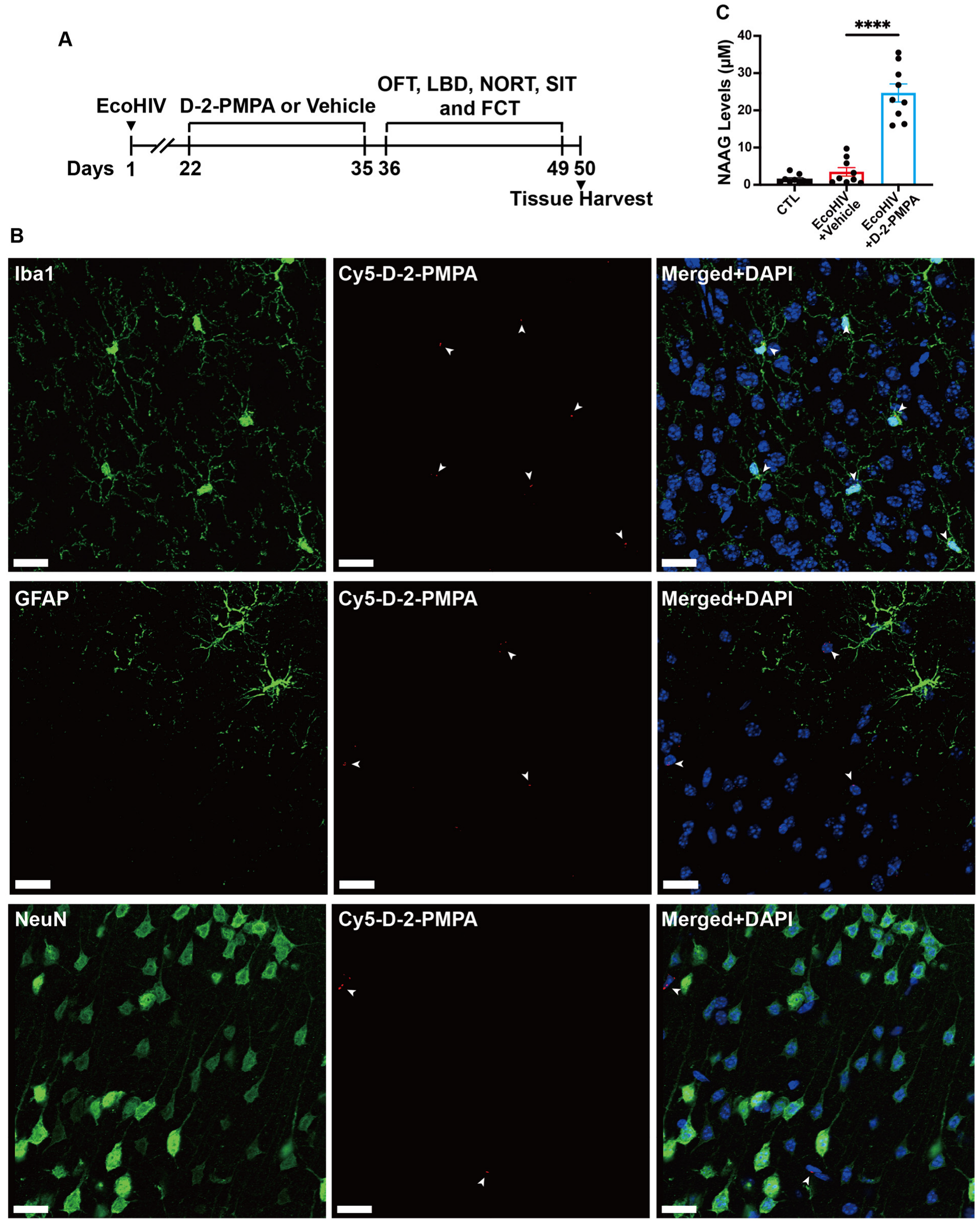
3.1. D-2-PMPA Is Preferentially Taken up by Microglia in EcoHIV-Infected Mice
3.2. D-2-PMPA Increases Brain NAAG Levels >600% in EcoHIV-Infected Mice
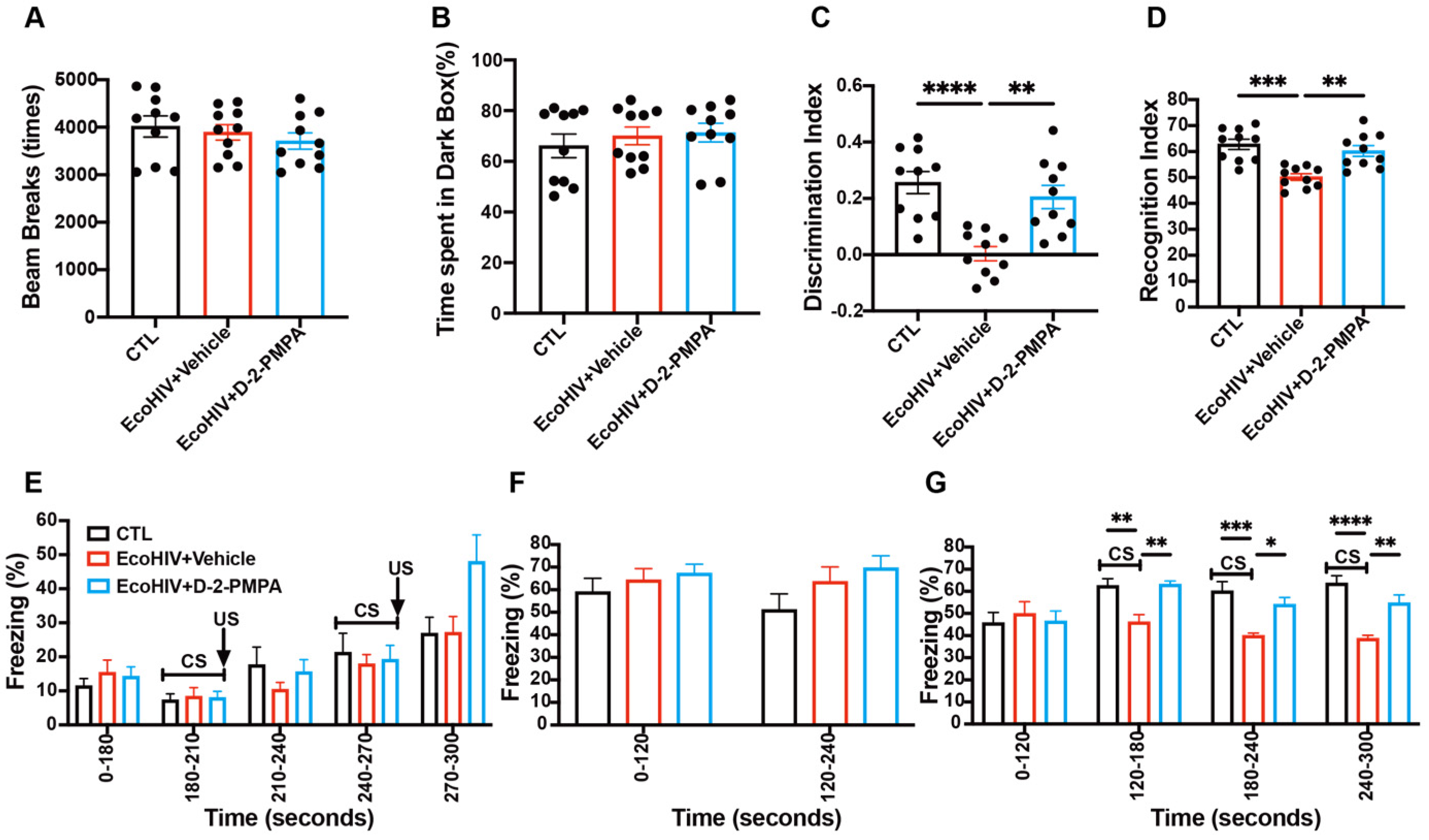
3.3. D-2-PMPA Improves Recognition and Learning Memory Without Affecting Motor Function
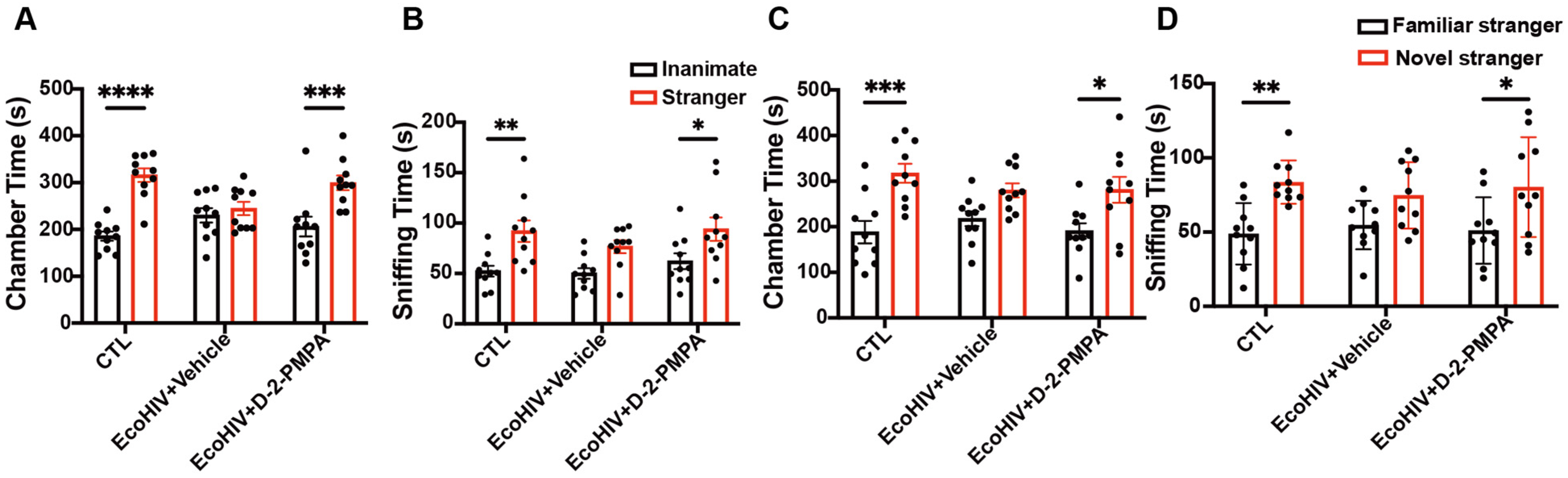
3.4. D-2-PMPA Rescues Social Behavior Deficits in EcoHIV-Infected Mice
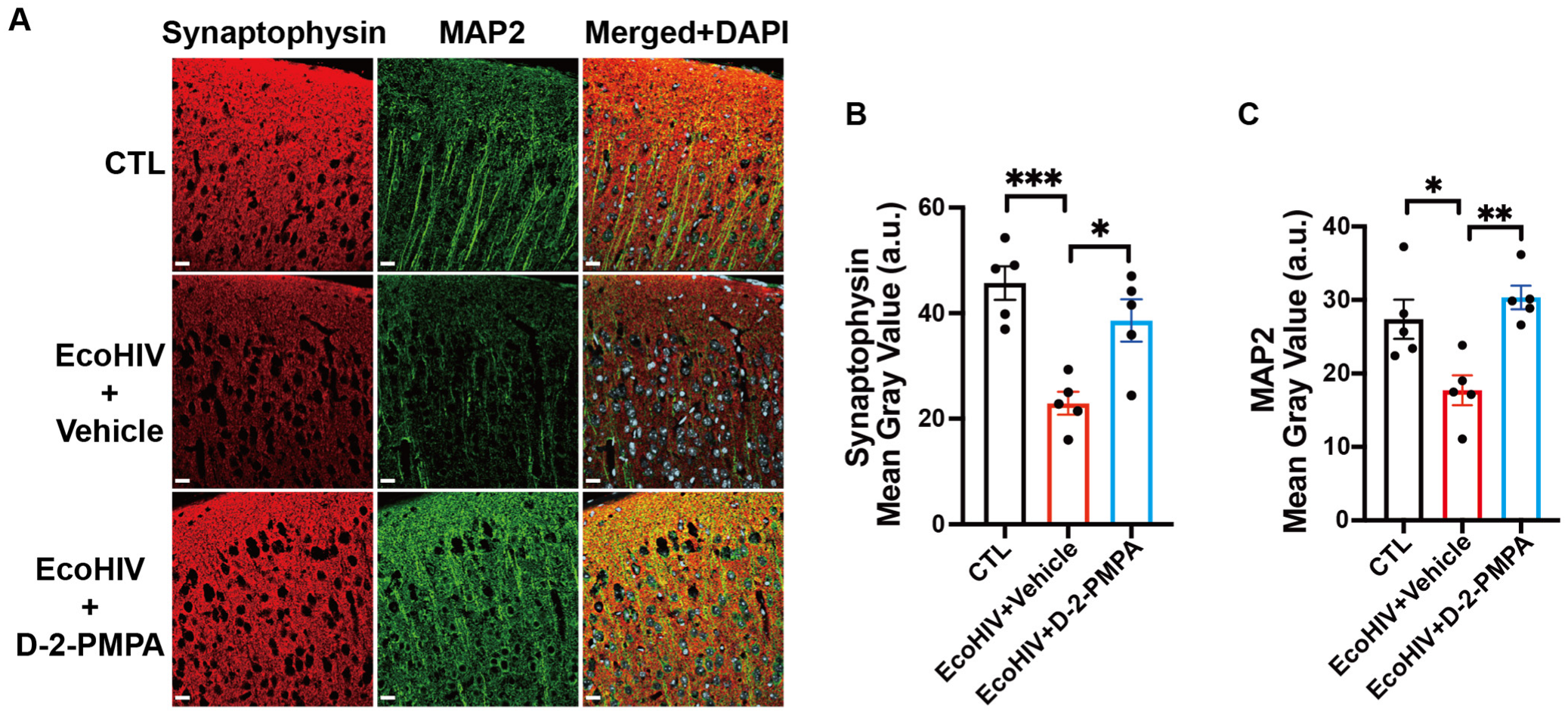
3.5. D-2-PMPA Reverses Synaptic Deficits in EcoHIV-Infected Mice
4. Discussion
Author Contributions
Funding
Institutional Review Board Statement
Informed Consent Statement
Data Availability Statement
Acknowledgments
Conflicts of Interest
References
- Heaton, R.K.; Franklin, D.R.; Ellis, R.J.; McCutchan, J.A.; Letendre, S.L.; Leblanc, S.; Corkran, S.H.; Duarte, N.A.; Clifford, D.B.; Woods, S.P.; et al. HIV-Associated Neurocognitive Disorders before and during the Era of Combination Antiretroviral Therapy: Differences in Rates, Nature, and Predictors. J. Neurovirol. 2011, 17, 3–16. [Google Scholar] [CrossRef] [PubMed]
- Nyamayaro, P.; Gouse, H.; Hakim, J.; Robbins, R.N.; Chibanda, D. Neurocognitive Impairment in Treatment-Experienced Adults Living with HIV Attending Primary Care Clinics in Zimbabwe. BMC Infect. Dis. 2020, 20, 383. [Google Scholar] [CrossRef] [PubMed]
- Vance, D.E.; Lang, L.; Maki, P.M.; Yu, D.; Dastgheyb, R.; Wang, Y.; Springer, G.; Anastos, K.; Gustafson, D.R.; Weber, K.M.; et al. Cognitive Predictors of Everyday Functioning in Women with HIV: Findings from the Women’s Interagency HIV Study. BMC Neurol. 2025, 25, 317. [Google Scholar] [CrossRef]
- Elendu, C.; Aguocha, C.M.; Okeke, C.V.; Okoro, C.B.; Peterson, J.C. HIV-Related Neurocognitive Disorders: Diagnosis, Treatment, and Mental Health Implications: A Review. Medicine 2023, 102, e35652. [Google Scholar] [CrossRef]
- Neale, J.H.; Bzdega, T.; Wroblewska, B. N-Acetylaspartylglutamate: The Most Abundant Peptide Neurotransmitter in the Mammalian Central Nervous System. J. Neurochem. 2000, 75, 443–452. [Google Scholar] [CrossRef] [PubMed]
- Olszewski, R.T.; Bzdega, T.; Neale, J.H. mGluR3 and Not mGluR2 Receptors Mediate the Efficacy of NAAG Peptidase Inhibitor in Validated Model of Schizophrenia. Schizophr. Res. 2012, 136, 160–161. [Google Scholar] [CrossRef] [PubMed]
- Neale, J.H.; Yamamoto, T. N-Acetylaspartylglutamate (NAAG) and Glutamate Carboxypeptidase II: An Abundant Peptide Neurotransmitter-Enzyme System with Multiple Clinical Applications. Prog. Neurobiol. 2020, 184, 101722. [Google Scholar] [CrossRef] [PubMed]
- Wiseman, R.L.; Bigos, K.L.; Dastgheyb, R.M.; Barker, P.B.; Rubin, L.H.; Slusher, B.S. Brain N-Acetyl-Aspartyl-Glutamate Is Associated with Cognitive Function in Older Virally Suppressed People with HIV. AIDS 2024, 38, 1003–1011. [Google Scholar] [CrossRef]
- Chandra, A.; Alt, J.; Dastgheyb, R.M.; Veenhuis, R.T.; Rais, R.; Coughlin, J.M.; Slusher, B.S.; Rubin, L.H. Associations between Cerebrospinal Fluid N-Acetyl-Aspartyl-Glutamate and Cognitive Function in People with HIV. AIDS 2026, 40, 58–63. [Google Scholar] [CrossRef]
- Goldmann, T.; Wieghofer, P.; Jordão, M.J.C.; Prutek, F.; Hagemeyer, N.; Frenzel, K.; Amann, L.; Staszewski, O.; Kierdorf, K.; Krueger, M.; et al. Origin, Fate and Dynamics of Macrophages at Central Nervous System Interfaces. Nat. Immunol. 2016, 17, 797–805. [Google Scholar] [CrossRef] [PubMed]
- Polazzi, E.; Monti, B. Microglia and Neuroprotection: From In Vitro Studies to Therapeutic Applications. Prog. Neurobiol. 2010, 92, 293–315. [Google Scholar] [CrossRef] [PubMed]
- Réu, P.; Khosravi, A.; Bernard, S.; Mold, J.E.; Salehpour, M.; Alkass, K.; Perl, S.; Tisdale, J.; Possnert, G.; Druid, H.; et al. The Lifespan and Turnover of Microglia in the Human Brain. Cell Rep. 2017, 20, 779–784. [Google Scholar] [CrossRef] [PubMed]
- Tay, T.L.; Mai, D.; Dautzenberg, J.; Fernández-Klett, F.; Lin, G.; Sagar; Datta, M.; Drougard, A.; Stempfl, T.; Ardura-Fabregat, A.; et al. A New Fate Mapping System Reveals Context-Dependent Random or Clonal Expansion of Microglia. Nat. Neurosci. 2017, 20, 793–803. [Google Scholar] [CrossRef]
- Cenker, J.J.; Stultz, R.D.; McDonald, D. Brain Microglial Cells Are Highly Susceptible to HIV-1 Infection and Spread. AIDS Res. Hum. Retroviruses 2017, 33, 1155–1165. [Google Scholar] [CrossRef]
- Cosenza, M.A.; Zhao, M.-L.; Si, Q.; Lee, S.C. Human Brain Parenchymal Microglia Express CD14 and CD45 and Are Productively Infected by HIV-1 in HIV-1 Encephalitis. Brain Pathol. 2002, 12, 442–455. [Google Scholar] [CrossRef] [PubMed]
- Wallet, C.; De Rovere, M.; Van Assche, J.; Daouad, F.; De Wit, S.; Gautier, V.; Mallon, P.W.G.; Marcello, A.; Van Lint, C.; Rohr, O.; et al. Microglial Cells: The Main HIV-1 Reservoir in the Brain. Front. Cell Infect. Microbiol. 2019, 9, 362. [Google Scholar] [CrossRef] [PubMed]
- Schlachetzki, J.C.; Gianella, S.; Ouyang, Z.; Lana, A.J.; Yang, X.; O’Brien, S.; Challacombe, J.F.; Gaskill, P.J.; Jordan-Sciutto, K.L.; Chaillon, A.; et al. Gene Expression and Chromatin Conformation of Microglia in Virally Suppressed People with HIV. Life Sci. Alliance 2024, 7, e202402736. [Google Scholar] [CrossRef] [PubMed]
- Ko, A.; Kang, G.; Hattler, J.B.; Galadima, H.I.; Zhang, J.; Li, Q.; Kim, W.-K. Macrophages but Not Astrocytes Harbor HIV DNA in the Brains of HIV-1-Infected Aviremic Individuals on Suppressive Antiretroviral Therapy. J. Neuroimmune Pharmacol. 2019, 14, 110–119. [Google Scholar] [CrossRef]
- Murray, J.; Meloni, G.; Cortes, E.P.; KimSilva, A.; Jacobs, M.; Ramkissoon, A.; Crary, J.F.; Morgello, S. Frontal Lobe Microglia, Neurodegenerative Protein Accumulation, and Cognitive Function in People with HIV. Acta Neuropathol. Commun. 2022, 10, 69. [Google Scholar] [CrossRef] [PubMed]
- Kong, W.; Frouard, J.; Xie, G.; Corley, M.J.; Helmy, E.; Zhang, G.; Schwarzer, R.; Montano, M.; Sohn, P.; Roan, N.R.; et al. Neuroinflammation Generated by HIV-Infected Microglia Promotes Dysfunction and Death of Neurons in Human Brain Organoids. PNAS Nexus 2024, 3, pgae179. [Google Scholar] [CrossRef] [PubMed]
- Narasipura, S.D.; Zayas, J.P.; Ash, M.K.; Reyes, A.F.; Shull, T.; Gambut, S.; Szczerkowski, J.L.A.; McKee, C.; Schneider, J.R.; Lorenzo-Redondo, R.; et al. Inflammatory Responses Revealed through HIV Infection of Microglia-Containing Cerebral Organoids. J. Neuroinflamm. 2025, 22, 36. [Google Scholar] [CrossRef]
- Zheng, Y.; Huang, M.; Maragakis, R.M.; Pietri, P.; Su, Y.; Alt, J.; Wu, Y.; Finney, C.; Peters, D.E.; Zhu, X.; et al. Targeting NAAG Metabolism Restores Cognition and Synaptic Integrity in EcoHIV-Infected Mice. Neurotherapeutics 2025, 23, e00782. [Google Scholar] [CrossRef]
- Hollinger, K.R.; Sharma, A.; Tallon, C.; Lovell, L.; Thomas, A.G.; Zhu, X.; Wiseman, R.; Wu, Y.; Kambhampati, S.P.; Liaw, K.; et al. Dendrimer-2PMPA Selectively Blocks Upregulated Microglial GCPII Activity and Improves Cognition in a Mouse Model of Multiple Sclerosis. Nanotheranostics 2022, 6, 126–142. [Google Scholar] [CrossRef] [PubMed]
- Huang, M.; Li, Y.; Thomas, A.G.; Sharma, A.; Liyanage, W.; Tichý, T.; Tenora, L.; Su, Y.; Ha, J.; Hin, N.; et al. Inhibition of Microglial Glutaminase Alleviates Chronic Stress-Induced Neurobehavioral and Cognitive Deficits. Neurotherapeutics 2025, 22, e00759. [Google Scholar] [CrossRef] [PubMed]
- Huang, M.; Tallon, C.; Zhu, X.; Huizar, K.D.J.; Picciolini, S.; Thomas, A.G.; Tenora, L.; Liyanage, W.; Rodà, F.; Gualerzi, A.; et al. Microglial-Targeted nSMase2 Inhibitor Fails to Reduce Tau Propagation in PS19 Mice. Pharmaceutics 2023, 15, 2364. [Google Scholar] [CrossRef] [PubMed]
- Zhang, F.; Zhang, Z.; Alt, J.; Kambhampati, S.P.; Sharma, A.; Singh, S.; Nance, E.; Thomas, A.G.; Rojas, C.; Rais, R.; et al. Dendrimer-Enabled Targeted Delivery Attenuates Glutamate Excitotoxicity and Improves Motor Function in a Rabbit Model of Cerebral Palsy. J. Control Release 2023, 358, 27–42. [Google Scholar] [CrossRef]
- Henningfield, C.M.; Soni, N.; Lee, R.W.; Sharma, R.; Cleland, J.L.; Green, K.N. Selective Targeting and Modulation of Plaque Associated Microglia via Systemic Hydroxyl Dendrimer Administration in an Alzheimer’s Disease Mouse Model. Alzheimers Res. Ther. 2024, 16, 101. [Google Scholar] [CrossRef]
- Tallon, C.; Sharma, A.; Zhang, Z.; Thomas, A.G.; Ng, J.; Zhu, X.; Donoghue, A.; Schulte, M.; Joe, T.R.; Kambhampati, S.P.; et al. Dendrimer-2PMPA Delays Muscle Function Loss and Denervation in a Murine Model of Amyotrophic Lateral Sclerosis. Neurotherapeutics 2022, 19, 274–288. [Google Scholar] [CrossRef]
- Potash, M.J.; Chao, W.; Bentsman, G.; Paris, N.; Saini, M.; Nitkiewicz, J.; Belem, P.; Sharer, L.; Brooks, A.I.; Volsky, D.J. A Mouse Model for Study of Systemic HIV-1 Infection, Antiviral Immune Responses, and Neuroinvasiveness. Proc. Natl. Acad. Sci. USA 2005, 102, 3760–3765. [Google Scholar] [CrossRef] [PubMed]
- Kim, B.-H.; Chao, W.; Hadas, E.; Borjabad, A.; Potash, M.J.; Volsky, D.J. EcoHIV Infection of Primary Murine Brain Cell Cultures to Model HIV Replication and Neuropathogenesis. Viruses 2024, 16, 693. [Google Scholar] [CrossRef] [PubMed]
- Barbour, A.J.; Hoag, K.; Cornblath, E.J.; Chavez, A.; Lucas, A.; Li, X.; Zebrowitz, S.; Hassman, C.; Vazquez, O.; Xie, S.X.; et al. Hyperactive Neuronal Networks Enhance Tau Spread in an Alzheimer’s Disease Mouse Model. bioRxiv, 2025; preprint. [Google Scholar] [CrossRef]
- Keady, J.V.; Hessing, M.C.; Songrady, J.C.; McLaurin, K.; Turner, J.R. Sex Differences in Contextual Fear Conditioning and Extinction After Acute and Chronic Nicotine Treatment. Biol. Sex. Differ. 2024, 15, 88. [Google Scholar] [CrossRef] [PubMed]
- Pichinin, L.S.; Guernelli, M.; Cecyn, M.N.; Sorigotto, B.D.; Abrahao, K.P. Repeated Early Adolescence Ethanol Intoxication Promotes Riskier Decision-Making in Adult Males and Increases Drinking in Adult Female Mice. Physiol. Behav. 2026, 309, 115277. [Google Scholar] [CrossRef] [PubMed]
- Capucho, A.M.; de Leão, J.P.; Flor, K.C.; Melo, G.M.; Fernandes, M.V.; Sacramento, J.F.; Conde, S.V. Chronic Caffeine Consumption Prevents Obesity-Induced Cognitive and Memory Impairments by Reducing Neuroinflammation and Enhancing Neuronal Activity in the Hippocampus. Pharmacol. Res. 2026, 225, 108140. [Google Scholar] [CrossRef] [PubMed]
- Kuang, X.-J.; Zhang, C.-Y.; Yan, B.-Y.; Cai, W.-Z.; Lu, C.-L.; Xie, L.-J.; Li, S.-J.; Kong, P.-L.; Fan, J.; Pan, S.-M.; et al. P2X2 Receptors in Pyramidal Neurons Are Critical for Regulating Vulnerability to Chronic Stress. Theranostics 2022, 12, 3703–3718. [Google Scholar] [CrossRef]
- Noordenbos, W. Some Historical Aspects. Pain 1987, 29, 141–150. [Google Scholar] [CrossRef]
- Sarkar, S.; Dammer, E.B.; Malovic, E.; Olsen, A.L.; Raza, S.A.; Gao, T.; Xiao, H.; Oliver, D.L.; Duong, D.; Joers, V.; et al. Molecular Signatures of Neuroinflammation Induced by αSynuclein Aggregates in Microglial Cells. Front. Immunol. 2020, 11, 33. [Google Scholar] [CrossRef] [PubMed]
- Saylor, D.; Dickens, A.M.; Sacktor, N.; Haughey, N.; Slusher, B.; Pletnikov, M.; Mankowski, J.L.; Brown, A.; Volsky, D.J.; McArthur, J.C. HIV-Associated Neurocognitive Disorder—Pathogenesis and Prospects for Treatment. Nat. Rev. Neurol. 2016, 12, 234–248. [Google Scholar] [CrossRef] [PubMed]
- Wang, Y.; Liu, M.; Lu, Q.; Farrell, M.; Lappin, J.M.; Shi, J.; Lu, L.; Bao, Y. Global Prevalence and Burden of HIV-Associated Neurocognitive Disorder: A Meta-Analysis. Neurology 2020, 95, e2610–e2621. [Google Scholar] [CrossRef] [PubMed]
- Wei, J.; Hou, J.; Su, B.; Jiang, T.; Guo, C.; Wang, W.; Zhang, Y.; Chang, B.; Wu, H.; Zhang, T. The Prevalence of Frascati-Criteria-Based HIV-Associated Neurocognitive Disorder (HAND) in HIV-Infected Adults: A Systematic Review and Meta-Analysis. Front. Neurol. 2020, 11, 581346. [Google Scholar] [CrossRef]
- Heaton, R.K.; Clifford, D.B.; Franklin, D.R.; Woods, S.P.; Ake, C.; Vaida, F.; Ellis, R.J.; Letendre, S.L.; Marcotte, T.D.; Atkinson, J.H.; et al. HIV-Associated Neurocognitive Disorders Persist in the Era of Potent Antiretroviral Therapy: CHARTER Study. Neurology 2010, 75, 2087–2096. [Google Scholar] [CrossRef] [PubMed]
- Flatt, A.; Gentry, T.; Kellett-Wright, J.; Eaton, P.; Joseph, M.; Urasa, S.; Howlett, W.; Dekker, M.; Kisoli, A.; Rogathe, J.; et al. Prevalence and 1-Year Incidence of HIV-Associated Neurocognitive Disorder (HAND) in Adults Aged ≥50 Years Attending Standard HIV Clinical Care in Kilimanjaro, Tanzania. Int. Psychogeriatr. 2023, 35, 339–350. [Google Scholar] [CrossRef]
- Wiseman, R.; Bigos, K.L.; Arnsten, A.F.T.; Slusher, B.S. Inhibition of Brain Glutamate Carboxypeptidase II (GCPII) to Enhance Cognitive Function. Adv. Pharmacol. 2025, 102, 27–63. [Google Scholar] [CrossRef]
- Bathla, S.; Datta, D.; Liang, F.; Barthelemy, N.; Wiseman, R.; Slusher, B.S.; Asher, J.; Zeiss, C.; Ekanayake-Alper, D.; Holden, D.; et al. Chronic GCPII (Glutamate-Carboxypeptidase-II) Inhibition Reduces pT217Tau Levels in the Entorhinal and Dorsolateral Prefrontal Cortices of Aged Macaques. Alzheimers Dement. 2023, 9, e12431. [Google Scholar] [CrossRef]
- Rowland, L.M.; Kontson, K.; West, J.; Edden, R.A.; Zhu, H.; Wijtenburg, S.A.; Holcomb, H.H.; Barker, P.B. In Vivo Measurements of Glutamate, GABA, and NAAG in Schizophrenia. Schizophr. Bull. 2013, 39, 1096–1104. [Google Scholar] [CrossRef]
- Jaarsma, D.; Veenma-van der Duin, L.; Korf, J. N-Acetylaspartate and N-Acetylaspartylglutamate Levels in Alzheimer’s Disease Post-Mortem Brain Tissue. J. Neurol. Sci. 1994, 127, 230–233. [Google Scholar] [CrossRef]
- Hollinger, K.R.; Alt, J.; Rais, R.; Kaplin, A.I.; Slusher, B.S. The NAAG’ing Concerns of Modeling Human Alzheimer’s Disease in Mice. J. Alzheimers Dis. 2019, 68, 939–945. [Google Scholar] [CrossRef] [PubMed]
- Passani, L.A.; Vonsattel, J.P.; Carter, R.E.; Coyle, J.T. N-Acetylaspartylglutamate, N-Acetylaspartate, and N-Acetylated Alpha-Linked Acidic Dipeptidase in Human Brain and Their Alterations in Huntington and Alzheimer’s Diseases. Mol. Chem. Neuropathol. 1997, 31, 97–118. [Google Scholar] [CrossRef] [PubMed]
- Rahn, K.A.; Watkins, C.C.; Alt, J.; Rais, R.; Stathis, M.; Grishkan, I.; Crainiceau, C.M.; Pomper, M.G.; Rojas, C.; Pletnikov, M.V.; et al. Inhibition of Glutamate Carboxypeptidase II (GCPII) Activity as a Treatment for Cognitive Impairment in Multiple Sclerosis. Proc. Natl. Acad. Sci. USA 2012, 109, 20101–20106. [Google Scholar] [CrossRef]
- Jessen, F.; Fingerhut, N.; Sprinkart, A.M.; Kühn, K.-U.; Petrovsky, N.; Maier, W.; Schild, H.-H.; Block, W.; Wagner, M.; Träber, F. N-Acetylaspartylglutamate (NAAG) and N-Acetylaspartate (NAA) in Patients with Schizophrenia. Schizophr. Bull. 2013, 39, 197–205. [Google Scholar] [CrossRef]
- Olszewski, R.T.; Janczura, K.J.; Bzdega, T.; Der, E.K.; Venzor, F.; O’Rourke, B.; Hark, T.J.; Craddock, K.E.; Balasubramanian, S.; Moussa, C.; et al. NAAG Peptidase Inhibitors Act via mGluR3: Animal Models of Memory, Alzheimer’s, and Ethanol Intoxication. Neurochem. Res. 2017, 42, 2646–2657. [Google Scholar] [CrossRef]
- Gurkoff, G.G.; Feng, J.-F.; Van, K.C.; Izadi, A.; Ghiasvand, R.; Shahlaie, K.; Song, M.; Lowe, D.A.; Zhou, J.; Lyeth, B.G. NAAG Peptidase Inhibitor Improves Motor Function and Reduces Cognitive Dysfunction in a Model of TBI with Secondary Hypoxia. Brain Res. 2013, 1515, 98–107. [Google Scholar] [CrossRef]
- Olszewski, R.T.; Janczura, K.J.; Ball, S.R.; Madore, J.C.; Lavin, K.M.; Lee, J.C.-M.; Lee, M.J.; Der, E.K.; Hark, T.J.; Farago, P.R.; et al. NAAG Peptidase Inhibitors Block Cognitive Deficit Induced by MK-801 and Motor Activation Induced by d-Amphetamine in Animal Models of Schizophrenia. Transl. Psychiatry 2012, 2, e145. [Google Scholar] [CrossRef] [PubMed]
- Cai, Z.; Lin, S.; Rhodes, P.G. Neuroprotective Effects of N-Acetylaspartylglutamate in a Neonatal Rat Model of Hypoxia-Ischemia. Eur. J. Pharmacol. 2002, 437, 139–145. [Google Scholar] [CrossRef]
- Slusher, B.S.; Vornov, J.J.; Thomas, A.G.; Hurn, P.D.; Harukuni, I.; Bhardwaj, A.; Traystman, R.J.; Robinson, M.B.; Britton, P.; Lu, X.C.; et al. Selective Inhibition of NAALADase, Which Converts NAAG to Glutamate, Reduces Ischemic Brain Injury. Nat. Med. 1999, 5, 1396–1402. [Google Scholar] [CrossRef]
- Su, Y.; Huang, M.; Thomas, A.G.; Maragakis, J.; Huizar, K.D.J.; Zheng, Y.; Wu, Y.; Farah, M.H.; Slusher, B.S. GCPII Inhibition Promotes Remyelination after Peripheral Nerve Injury in Aged Mice. Int. J. Mol. Sci. 2024, 25, 6893. [Google Scholar] [CrossRef] [PubMed]
- Thomas, A.G.; Bodner, A.; Ghadge, G.; Roos, R.P.; Slusher, B.S. GCP II Inhibition Rescues Neurons from gp120IIIB-Induced Neurotoxicity. J. Neurovirol. 2009, 15, 449–457. [Google Scholar] [CrossRef]
- Jackson, P.F.; Cole, D.C.; Slusher, B.S.; Stetz, S.L.; Ross, L.E.; Donzanti, B.A.; Trainor, D.A. Design, Synthesis, and Biological Activity of a Potent Inhibitor of the Neuropeptidase N-Acetylated Alpha-Linked Acidic Dipeptidase. J. Med. Chem. 1996, 39, 619–622. [Google Scholar] [CrossRef]
- Zhang, Z.; Bassam, B.; Thomas, A.G.; Williams, M.; Liu, J.; Nance, E.; Rojas, C.; Slusher, B.S.; Kannan, S. Maternal Inflammation Leads to Impaired Glutamate Homeostasis and Up-Regulation of Glutamate Carboxypeptidase II in Activated Microglia in the Fetal/Newborn Rabbit Brain. Neurobiol. Dis. 2016, 94, 116–128. [Google Scholar] [CrossRef] [PubMed]
- Sah, N.; Zhang, Z.; Chime, A.; Fowler, A.; Mendez-Trendler, A.; Sharma, A.; Kannan, R.M.; Slusher, B.; Kannan, S. Dendrimer-Conjugated Glutamate Carboxypeptidase II Inhibitor Restores Microglial Changes in a Rabbit Model of Cerebral Palsy. Dev. Neurosci. 2023, 45, 268–275. [Google Scholar] [CrossRef]
- Datta, D.; Leslie, S.N.; Woo, E.; Amancharla, N.; Elmansy, A.; Lepe, M.; Mecca, A.P.; Slusher, B.S.; Nairn, A.C.; Arnsten, A.F.T. Glutamate Carboxypeptidase II in Aging Rat Prefrontal Cortex Impairs Working Memory Performance. Front. Aging Neurosci. 2021, 13, 760270. [Google Scholar] [CrossRef]
- Tang, Y.; Chaillon, A.; Gianella, S.; Wong, L.M.; Li, D.; Simermeyer, T.L.; Porrachia, M.; Ignacio, C.; Woodworth, B.; Zhong, D.; et al. Brain Microglia Serve as a Persistent HIV Reservoir despite Durable Antiretroviral Therapy. J. Clin. Investig. 2023, 133, e167417. [Google Scholar] [CrossRef]
- Filippidis, P.; Corley, M.J. Single Cell Analyses of the HIV Reservoir in the CNS and CSF: Recent Insights and Implications. Curr. Opin. HIV AIDS 2025, 20, 493–501. [Google Scholar] [CrossRef]
- Yang, X.; Han, P.; Li, M.; Xue, Y.; Yu, X.; Jiang, M.; Wang, H.; Zhang, J.; Liu, H.; Bao, D. HIV-1 Tat Mediates Microglial NLRP3 Inflammasome Activation and Neurotoxicity by Inducing Cytosolic mtDNA Stress. Int. J. Biol. Macromol. 2025, 318, 145093. [Google Scholar] [CrossRef]
- He, X.; Yang, W.; Zeng, Z.; Wei, Y.; Gao, J.; Zhang, B.; Li, L.; Liu, L.; Wan, Y.; Zeng, Q.; et al. NLRP3-Dependent Pyroptosis Is Required for HIV-1 Gp120-Induced Neuropathology. Cell Mol. Immunol. 2020, 17, 283–299. [Google Scholar] [CrossRef] [PubMed]
- Xu, L.; Zhao, Z.; Zhang, Y.; Ma, C. The Interplay Between Metabolism and Neuroinflammation in Epilepsy: Mechanisms and Therapeutic Perspectives. J. Neuroinflamm. 2025, 22, 265. [Google Scholar] [CrossRef]
- Shen, Y.; Xu, T.; Sun, Y.; Zhang, K.; Cao, X.; Shen, L.; Tang, M. Metformin Promotes PEN2 Expression to Attenuate Microglia-Mediated Neurotoxicity Induced by HIV-1 Tat. J. Neurovirol. 2025, 31, 376–388. [Google Scholar] [CrossRef]
- Rubin, L.H.; Sacktor, N.; Creighton, J.; Du, Y.; Endres, C.J.; Pomper, M.G.; Coughlin, J.M. Microglial Activation Is Inversely Associated with Cognition in Individuals Living with HIV on Effective Antiretroviral Therapy. AIDS 2018, 32, 1661–1667. [Google Scholar] [CrossRef] [PubMed]
- Garvey, L.J.; Pavese, N.; Politis, M.; Ramlackhansingh, A.; Brooks, D.J.; Taylor-Robinson, S.D.; Winston, A. Increased Microglia Activation in Neurologically Asymptomatic HIV-Infected Patients Receiving Effective ART. AIDS 2014, 28, 67–72. [Google Scholar] [CrossRef]
- Alnasser, Y.; Kambhampati, S.P.; Nance, E.; Rajbhandari, L.; Shrestha, S.; Venkatesan, A.; Kannan, R.M.; Kannan, S. Preferential and Increased Uptake of Hydroxyl-Terminated PAMAM Dendrimers by Activated Microglia in Rabbit Brain Mixed Glial Culture. Molecules 2018, 23, 1025. [Google Scholar] [CrossRef] [PubMed]
- Janaszewska, A.; Ciolkowski, M.; Wróbel, D.; Petersen, J.F.; Ficker, M.; Christensen, J.B.; Bryszewska, M.; Klajnert, B. Modified PAMAM Dendrimer with 4-Carbomethoxypyrrolidone Surface Groups Reveals Negligible Toxicity Against Three Rodent Cell-Lines. Nanomedicine 2013, 9, 461–464. [Google Scholar] [CrossRef] [PubMed]
- Janaszewska, A.; Lazniewska, J.; Trzepiński, P.; Marcinkowska, M.; Klajnert-Maculewicz, B. Cytotoxicity of Dendrimers. Biomolecules 2019, 9, 330. [Google Scholar] [CrossRef] [PubMed]
- Kannan, S.; Dai, H.; Navath, R.S.; Balakrishnan, B.; Jyoti, A.; Janisse, J.; Romero, R.; Kannan, R.M. Dendrimer-Based Postnatal Therapy for Neuroinflammation and Cerebral Palsy in a Rabbit Model. Sci. Transl. Med. 2012, 4, 130ra46. [Google Scholar] [CrossRef]
- Khoury, E.S.; Patel, R.V.; O’Ferrall, C.; Fowler, A.; Sah, N.; Sharma, A.; Gupta, S.; Scafidi, S.; Kurtz, J.S.; Olmstead, S.J.; et al. Dendrimer Nanotherapy Targeting of Glial Dysfunction Improves Inflammation and Neurobehavioral Phenotype in Adult Female Mecp2-Heterozygous Mouse Model of Rett Syndrome. J. Neurochem. 2024, 168, 841–854. [Google Scholar] [CrossRef] [PubMed]


Disclaimer/Publisher’s Note: The statements, opinions and data contained in all publications are solely those of the individual author(s) and contributor(s) and not of MDPI and/or the editor(s). MDPI and/or the editor(s) disclaim responsibility for any injury to people or property resulting from any ideas, methods, instructions or products referred to in the content. |
© 2026 by the authors. Licensee MDPI, Basel, Switzerland. This article is an open access article distributed under the terms and conditions of the Creative Commons Attribution (CC BY) license.
Share and Cite
Zheng, Y.; Huang, M.; Maragakis, R.M.; Pietri, P.; Su, Y.; Alt, J.; Tenora, L.; Liyanage, W.; Wu, Y.; Thomas, M.-A.; et al. Microglial-Targeted GCPII Inhibition Reverses Neurocognitive Impairment and Synaptic Loss After EcoHIV Infection. Cells 2026, 15, 502. https://doi.org/10.3390/cells15060502
Zheng Y, Huang M, Maragakis RM, Pietri P, Su Y, Alt J, Tenora L, Liyanage W, Wu Y, Thomas M-A, et al. Microglial-Targeted GCPII Inhibition Reverses Neurocognitive Impairment and Synaptic Loss After EcoHIV Infection. Cells. 2026; 15(6):502. https://doi.org/10.3390/cells15060502
Chicago/Turabian StyleZheng, Yuxin, Meixiang Huang, R. Michael Maragakis, Peter Pietri, Yu Su, Jesse Alt, Lukáš Tenora, Wathsala Liyanage, Ying Wu, Mary-Anne Thomas, and et al. 2026. "Microglial-Targeted GCPII Inhibition Reverses Neurocognitive Impairment and Synaptic Loss After EcoHIV Infection" Cells 15, no. 6: 502. https://doi.org/10.3390/cells15060502
APA StyleZheng, Y., Huang, M., Maragakis, R. M., Pietri, P., Su, Y., Alt, J., Tenora, L., Liyanage, W., Wu, Y., Thomas, M.-A., Kannan, R. M., Zhu, X., Rais, R., & Slusher, B. S. (2026). Microglial-Targeted GCPII Inhibition Reverses Neurocognitive Impairment and Synaptic Loss After EcoHIV Infection. Cells, 15(6), 502. https://doi.org/10.3390/cells15060502