Axial Identity of Spinal Cord Neural Progenitor Cell Grafts Is Dispensable for Regeneration and Functional Recovery After Spinal Cord Injury
 , , , and
Abstract
1. Introduction
2. Methods
2.1. Ethics Statement
2.2. Animals
2.3. Neural Progenitor Cell Isolation
2.4. Spinal Cord Injury and Transplantation Surgeries
2.5. Cortical Injections
2.6. Pseudorabies Virus Injections
2.7. Post-Operative Care
2.8. Behavioral Assessments
2.9. Quantitative Real-Time PCR (qPCR)
2.10. Tissue Processing and Immunohistochemistry
2.11. Image Acquisition
2.12. Image Analysis
2.13. Statistical Analysis
3. Results
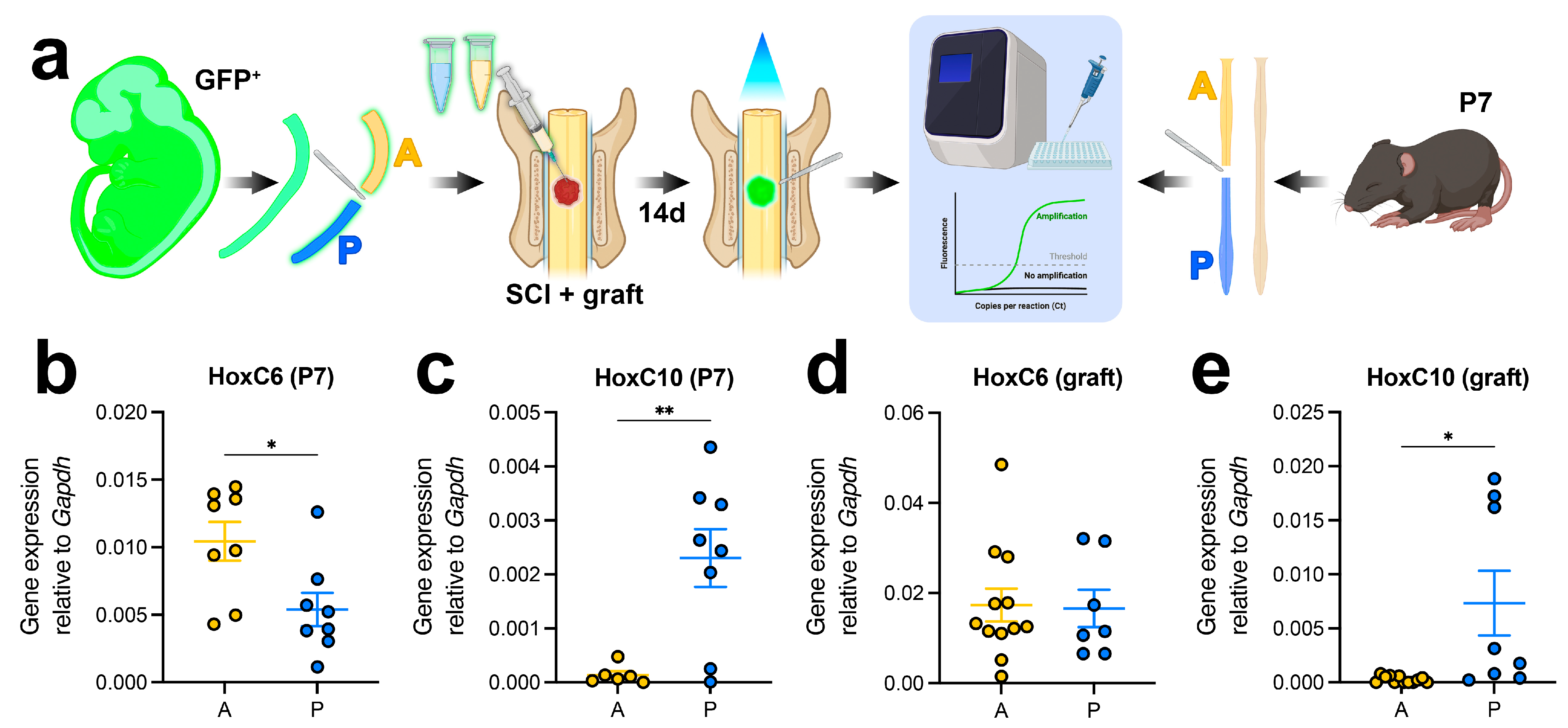
3.1. Region-Specific Hox Gene Expression in NPC Grafts

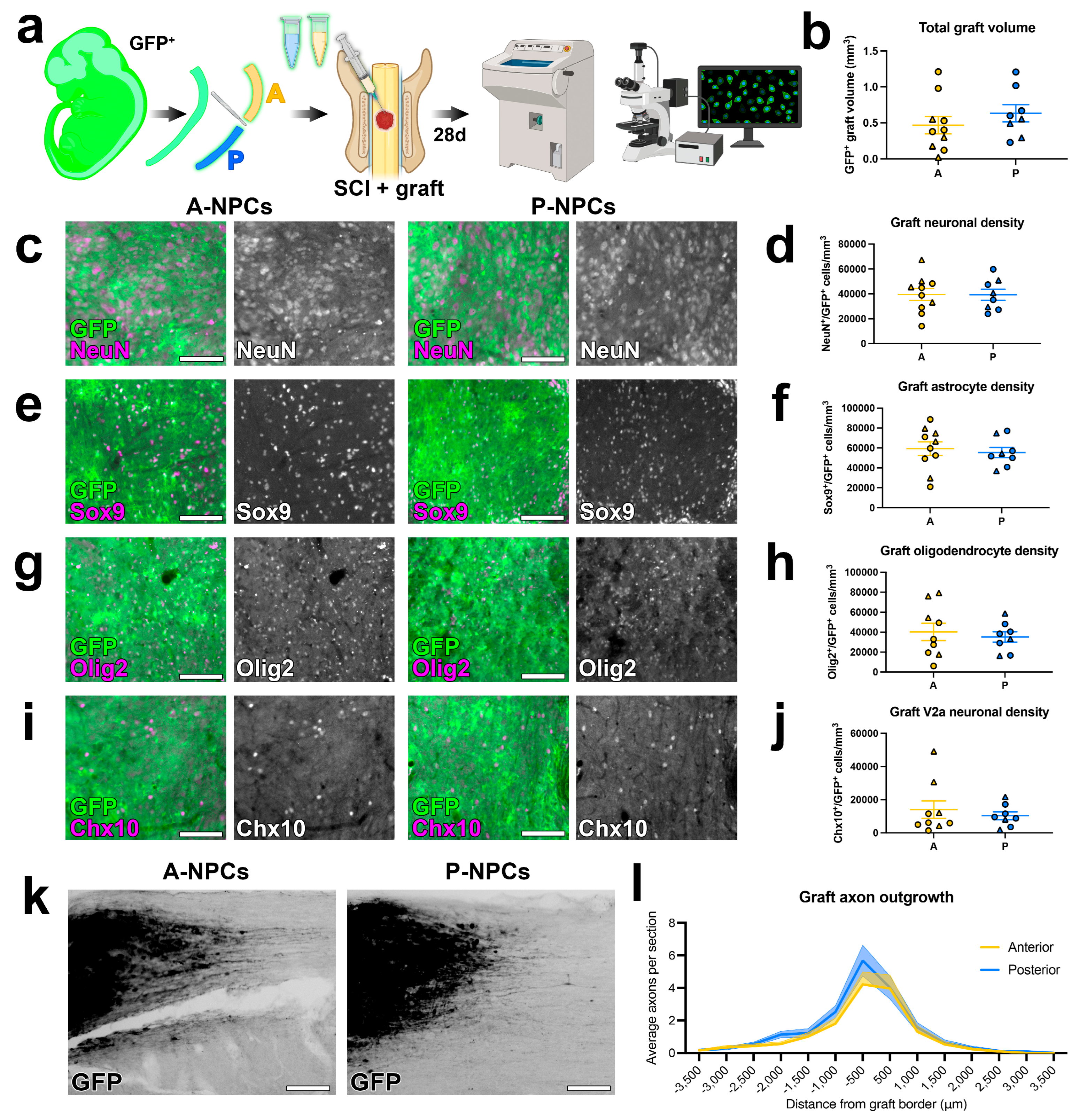
3.2. Graft Axial Identity Does Not Affect Graft Neuronal or Glial Composition

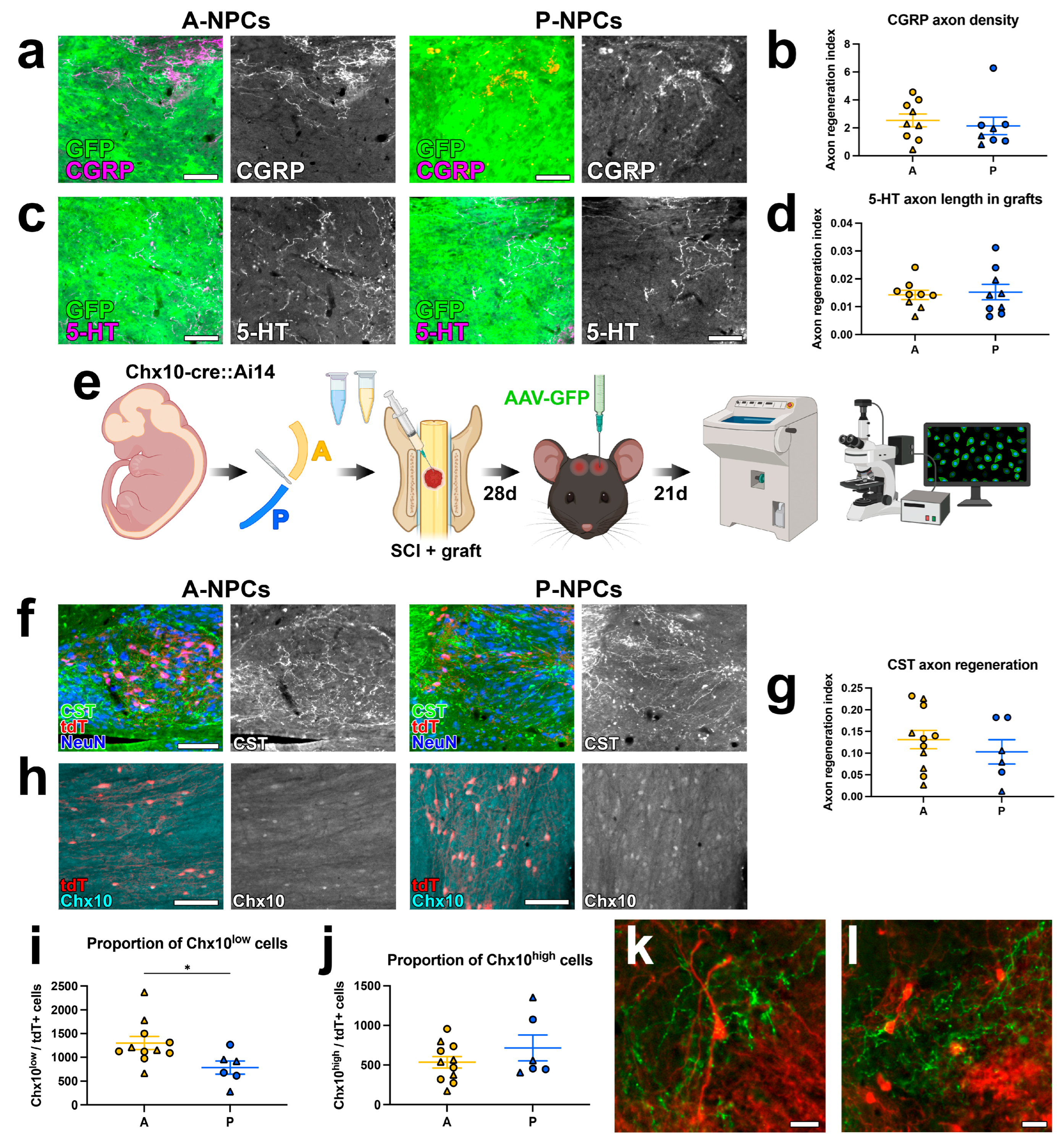
3.3. Graft Axial Identity Does Not Influence Host Axon Regeneration into Grafts

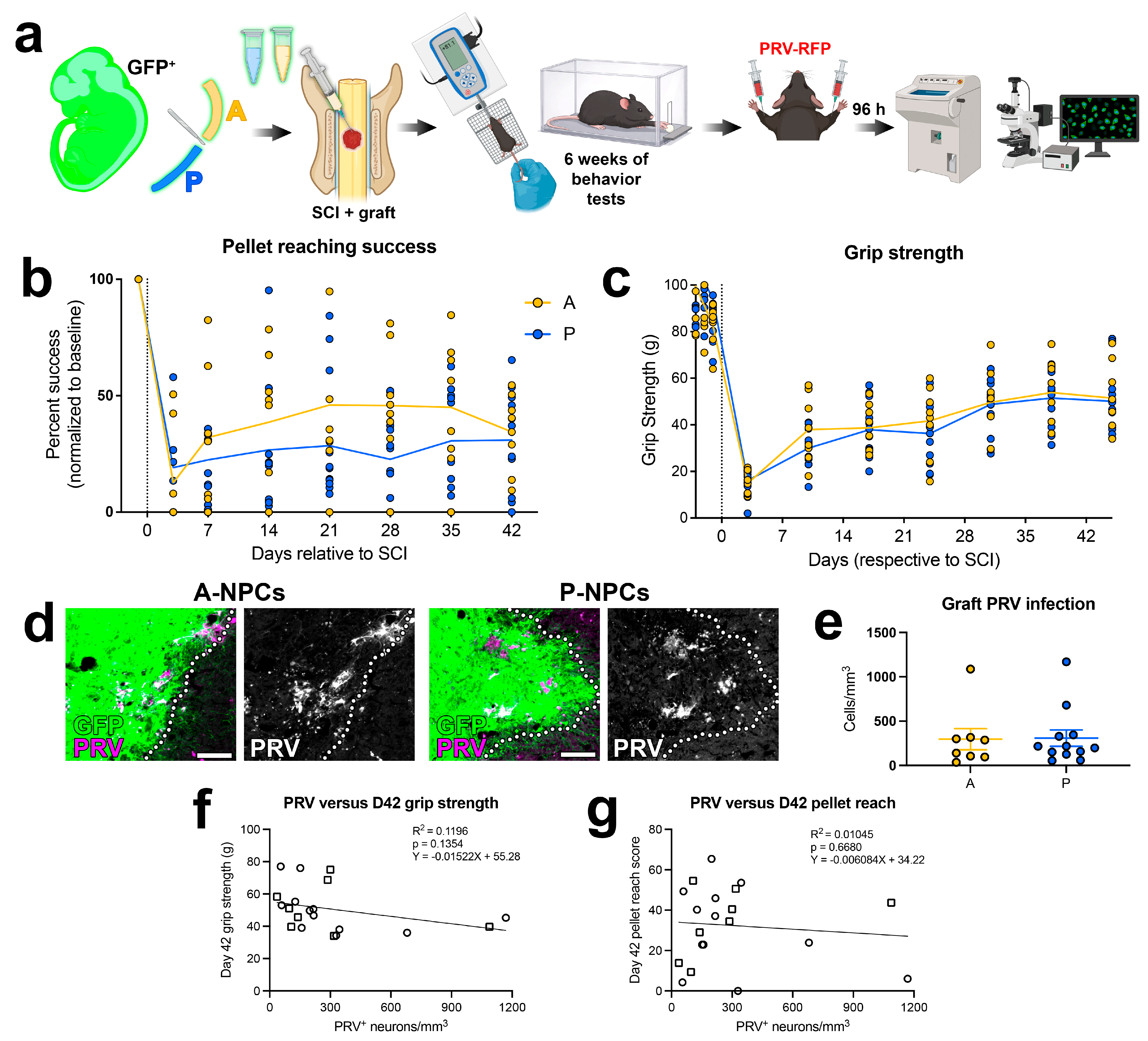
3.4. Graft Axial Identity Does Not Affect Recovery of Forelimb Motor Function After SCI
4. Discussion
Supplementary Materials
Author Contributions
Funding
Institutional Review Board Statement
Informed Consent Statement
Data Availability Statement
Acknowledgments
Conflicts of Interest
References
- Aceves, M.; Tucker, A.; Chen, J.; Vo, K.; Moses, J.; Amar Kumar, P.; Thomas, H.; Miranda, D.; Dampf, G.; Dietz, V.; et al. Developmental stage of transplanted neural progenitor cells influences anatomical and functional outcomes after spinal cord injury in mice. Commun. Biol. 2023, 6, 544. [Google Scholar] [CrossRef] [PubMed]
- Baltazar, A.; Tucker, A.; Jang, J.; Vo, K.; Dulin, J. Differences in anatomical outcomes between early chronic and far chronic time points after transplantation of spinal cord neural progenitor cells in mice. J. Neurotrauma 2023, 40, 2487–2499. [Google Scholar] [CrossRef] [PubMed]
- Fischer, I.; Dulin, J.N.; Lane, M.A. Transplanting neural progenitor cells to restore connectivity after spinal cord injury. Nat. Rev. Neurosci. 2020, 21, 366–383. [Google Scholar] [CrossRef] [PubMed]
- Bonner, J.F.; Connors, T.M.; Silverman, W.F.; Kowalski, D.P.; Lemay, M.A.; Fischer, I. Grafted neural progenitors integrate and restore synaptic connectivity across the injured spinal cord. J. Neurosci. 2011, 31, 4675–4686. [Google Scholar] [CrossRef]
- Bonner, J.F.; Blesch, A.; Neuhuber, B.; Fischer, I. Promoting directional axon growth from neural progenitors grafted into the injured spinal cord. J. Neurosci. Res. 2010, 88, 1182–1192. [Google Scholar] [CrossRef]
- Mitsui, T.; Shumsky, J.S.; Lepore, A.C.; Murray, M.; Fischer, I. Transplantation of neuronal and glial restricted precursors into contused spinal cord improves bladder and motor functions, decreases thermal hypersensitivity, and modifies intraspinal circuitry. J. Neurosci. 2005, 25, 9624–9636. [Google Scholar] [CrossRef]
- Zholudeva, L.V.; Fortino, T.; Agrawal, A.; Vila, O.F.; Williams, M.; McDevitt, T.; Lane, M.A.; Srivastava, D. Human spinal interneurons repair the injured spinal cord through synaptic integration. bioRxiv 2024, preprints. [Google Scholar] [CrossRef]
- Spruance, V.M.; Zholudeva, L.V.; Hormigo, K.M.; Randelman, M.L.; Bezdudnaya, T.; Marchenko, V.; Lane, M.A. Integration of Transplanted Neural Precursors with the Injured Cervical Spinal Cord. J. Neurotrauma 2018, 35, 1781–1799. [Google Scholar] [CrossRef]
- Zholudeva, L.V.; Iyer, N.; Qiang, L.; Spruance, V.M.; Randelman, M.L.; White, N.W.; Bezdudnaya, T.; Fischer, I.; Sakiyama-Elbert, S.E.; Lane, M.A. Transplantation of Neural Progenitors and V2a Interneurons after Spinal Cord Injury. J. Neurotrauma 2018, 35, 2883–2903. [Google Scholar] [CrossRef]
- White, T.E.; Lane, M.A.; Sandhu, M.S.; O’Steen, B.E.; Fuller, D.D.; Reier, P.J. Neuronal progenitor transplantation and respiratory outcomes following upper cervical spinal cord injury in adult rats. Exp. Neurol. 2010, 225, 231–236. [Google Scholar] [CrossRef]
- Khazaei, M.; Ahuja, C.S.; Rodgers, C.E.; Chan, P.; Fehlings, M.G. Generation of Definitive Neural Progenitor Cells from Human Pluripotent Stem Cells for Transplantation into Spinal Cord Injury. Methods Mol. Biol. 2019, 1919, 25–41. [Google Scholar] [CrossRef] [PubMed]
- Suzuki, H.; Ahuja, C.S.; Salewski, R.P.; Li, L.; Satkunendrarajah, K.; Nagoshi, N.; Shibata, S.; Fehlings, M.G. Neural stem cell mediated recovery is enhanced by Chondroitinase ABC pretreatment in chronic cervical spinal cord injury. PLoS ONE 2017, 12, e0182339. [Google Scholar] [CrossRef] [PubMed]
- Wilcox, J.T.; Satkunendrarajah, K.; Zuccato, J.A.; Nassiri, F.; Fehlings, M.G. Neural precursor cell transplantation enhances functional recovery and reduces astrogliosis in bilateral compressive/contusive cervical spinal cord injury. Stem Cells Transl. Med. 2014, 3, 1148–1159. [Google Scholar] [CrossRef] [PubMed]
- Lu, P.; Freria, C.M.; Graham, L.; Tran, A.N.; Villarta, A.; Yassin, D.; Huie, J.R.; Ferguson, A.R.; Tuszynski, M.H. Rehabilitation combined with neural progenitor cell grafts enables functional recovery in chronic spinal cord injury. JCI Insight 2022, 7, e158000. [Google Scholar] [CrossRef]
- Kitagawa, T.; Nagoshi, N.; Kamata, Y.; Kawai, M.; Ago, K.; Kajikawa, K.; Shibata, R.; Sato, Y.; Imaizumi, K.; Shindo, T.; et al. Modulation by DREADD reveals the therapeutic effect of human iPSC-derived neuronal activity on functional recovery after spinal cord injury. Stem Cell Rep. 2022, 17, 127–142. [Google Scholar] [CrossRef]
- Tashiro, S.; Nishimura, S.; Shinozaki, M.; Takano, M.; Konomi, T.; Tsuji, O.; Nagoshi, N.; Toyama, Y.; Liu, M.; Okano, H.; et al. The Amelioration of Pain-Related Behavior in Mice with Chronic Spinal Cord Injury Treated with Neural Stem/Progenitor Cell Transplantation Combined with Treadmill Training. J. Neurotrauma 2018, 35, 2561–2571. [Google Scholar] [CrossRef]
- Yokota, K.; Kobayakawa, K.; Kubota, K.; Miyawaki, A.; Okano, H.; Ohkawa, Y.; Iwamoto, Y.; Okada, S. Engrafted neural stem/progenitor cells promote functional recovery through synapse reorganization with spared host neurons after spinal cord injury. Stem Cell Rep. 2015, 5, 264–277. [Google Scholar] [CrossRef]
- Tucker, A.; Baltazar, A.; Eisdorfer, J.T.; Thackray, J.K.; Vo, K.; Thomas, H.; Tandon, A.; Moses, J.; Singletary, B.; Gillespie, T.; et al. Functional synaptic connectivity of engrafted spinal cord neurons with hindlimb motor circuitry in the injured spinal cord. Nat. Commun. 2025, 16, 10423. [Google Scholar] [CrossRef]
- Sugai, K.; Sumida, M.; Shofuda, T.; Yamaguchi, R.; Tamura, T.; Kohzuki, T.; Abe, T.; Shibata, R.; Kamata, Y.; Ito, S.; et al. First-in-human clinical trial of transplantation of iPSC-derived NS/PCs in subacute complete spinal cord injury: Study protocol. Regen. Ther. 2021, 18, 321–333. [Google Scholar] [CrossRef]
- Amar Kumar, P.; Dulin, J.N. Implications of regional identity for neural stem and progenitor cell transplantation in the injured or diseased nervous system. Neural Regen. Res. 2024, 19, 715–716. [Google Scholar] [CrossRef]
- Espuny-Camacho, I.; Michelsen, K.A.; Linaro, D.; Bilheu, A.; Acosta-Verdugo, S.; Herpoel, A.; Giugliano, M.; Gaillard, A.; Vanderhaeghen, P. Human Pluripotent Stem-Cell-Derived Cortical Neurons Integrate Functionally into the Lesioned Adult Murine Visual Cortex in an Area-Specific Way. Cell Rep. 2018, 23, 2732–2743. [Google Scholar] [CrossRef]
- Michelsen, K.A.; Acosta-Verdugo, S.; Benoit-Marand, M.; Espuny-Camacho, I.; Gaspard, N.; Saha, B.; Gaillard, A.; Vanderhaeghen, P. Area-specific reestablishment of damaged circuits in the adult cerebral cortex by cortical neurons derived from mouse embryonic stem cells. Neuron 2015, 85, 982–997. [Google Scholar] [CrossRef] [PubMed]
- Espuny-Camacho, I.; Michelsen, K.A.; Gall, D.; Linaro, D.; Hasche, A.; Bonnefont, J.; Bali, C.; Orduz, D.; Bilheu, A.; Herpoel, A.; et al. Pyramidal neurons derived from human pluripotent stem cells integrate efficiently into mouse brain circuits in vivo. Neuron 2013, 77, 440–456. [Google Scholar] [CrossRef] [PubMed]
- Adler, A.F.; Cardoso, T.; Nolbrant, S.; Mattsson, B.; Hoban, D.B.; Jarl, U.; Wahlestedt, J.N.; Grealish, S.; Bjorklund, A.; Parmar, M. hESC-Derived Dopaminergic Transplants Integrate into Basal Ganglia Circuitry in a Preclinical Model of Parkinson’s Disease. Cell Rep. 2019, 28, 3462–3473.e5. [Google Scholar] [CrossRef] [PubMed]
- Cardoso, T.; Adler, A.F.; Mattsson, B.; Hoban, D.B.; Nolbrant, S.; Wahlestedt, J.N.; Kirkeby, A.; Grealish, S.; Bjorklund, A.; Parmar, M. Target-specific forebrain projections and appropriate synaptic inputs of hESC-derived dopamine neurons grafted to the midbrain of parkinsonian rats. J. Comp. Neurol. 2018, 526, 2133–2146. [Google Scholar] [CrossRef] [PubMed]
- Kadoya, K.; Lu, P.; Nguyen, K.; Lee-Kubli, C.; Kumamaru, H.; Yao, L.; Knackert, J.; Poplawski, G.; Dulin, J.N.; Strobl, H.; et al. Spinal cord reconstitution with homologous neural grafts enables robust corticospinal regeneration. Nat. Med. 2016, 22, 479–487. [Google Scholar] [CrossRef]
- Kumamaru, H.; Lu, P.; Rosenzweig, E.S.; Kadoya, K.; Tuszynski, M.H. Regenerating Corticospinal Axons Innervate Phenotypically Appropriate Neurons within Neural Stem Cell Grafts. Cell Rep. 2019, 26, 2329–2339.e4. [Google Scholar] [CrossRef]
- Sweeney, L.B.; Bikoff, J.B.; Gabitto, M.I.; Brenner-Morton, S.; Baek, M.; Yang, J.H.; Tabak, E.G.; Dasen, J.S.; Kintner, C.R.; Jessell, T.M. Origin and Segmental Diversity of Spinal Inhibitory Interneurons. Neuron 2018, 97, 341–355.e3. [Google Scholar] [CrossRef]
- Mendelsohn, A.I.; Dasen, J.S.; Jessell, T.M. Divergent Hox Coding and Evasion of Retinoid Signaling Specifies Motor Neurons Innervating Digit Muscles. Neuron 2017, 93, 792–805.e794. [Google Scholar] [CrossRef]
- Bikoff, J.B.; Gabitto, M.I.; Rivard, A.F.; Drobac, E.; Machado, T.A.; Miri, A.; Brenner-Morton, S.; Famojure, E.; Diaz, C.; Alvarez, F.J.; et al. Spinal inhibitory interneuron diversity delineates variant motor microcircuits. Cell 2016, 165, 207–219. [Google Scholar] [CrossRef]
- Crone, S.A.; Quinlan, K.A.; Zagoraiou, L.; Droho, S.; Restrepo, C.E.; Lundfald, L.; Endo, T.; Setlak, J.; Jessell, T.M.; Kiehn, O.; et al. Genetic ablation of V2a ipsilateral interneurons disrupts left-right locomotor coordination in mammalian spinal cord. Neuron 2008, 60, 70–83. [Google Scholar] [CrossRef]
- Crone, S.A.; Viemari, J.C.; Droho, S.; Mrejeru, A.; Ramirez, J.M.; Sharma, K. Irregular Breathing in Mice following Genetic Ablation of V2a Neurons. J. Neurosci. 2012, 32, 7895–7906. [Google Scholar] [CrossRef] [PubMed]
- Crone, S.A.; Zhong, G.; Harris-Warrick, R.; Sharma, K. In mice lacking V2a interneurons, gait depends on speed of locomotion. J. Neurosci. 2009, 29, 7098–7109. [Google Scholar] [CrossRef] [PubMed]
- Azim, E.; Jiang, J.; Alstermark, B.; Jessell, T.M. Skilled reaching relies on a V2a propriospinal internal copy circuit. Nature 2014, 508, 357–363. [Google Scholar] [CrossRef]
- Haring, M.; Zeisel, A.; Hochgerner, H.; Rinwa, P.; Jakobsson, J.E.T.; Lonnerberg, P.; La Manno, G.; Sharma, N.; Borgius, L.; Kiehn, O.; et al. Neuronal atlas of the dorsal horn defines its architecture and links sensory input to transcriptional cell types. Nat. Neurosci. 2018, 21, 869–880. [Google Scholar] [CrossRef] [PubMed]
- Kiehn, O. Development and functional organization of spinal locomotor circuits. Curr. Opin. Neurobiol. 2011, 21, 100–109. [Google Scholar] [CrossRef]
- Pitonak, M.; Aceves, M.; Amar Kumar, P.; Dampf, G.; Green, P.; Tucker, A.; Dietz, V.; Miranda, D.; Letchuman, S.; Jonika, M.M.; et al. Effects of biological sex mismatch on neural progenitor cell transplantation for spinal cord injury in mice. Nat. Commun. 2022, 13, 5380. [Google Scholar] [CrossRef]
- Letchuman, S.; Tucker, A.; Miranda, D.; Adkins, R.L.; Aceves, M.; Dietz, V.; Jagrit, V.; Leonards, A.; Lee, Y.I.; Dulin, J.N. Transcription Factor Hb9 Is Expressed in Glial Cell Lineages in the Developing Mouse Spinal Cord. eNeuro 2022, 9, 1–15. [Google Scholar] [CrossRef]
- Dulin, J.N.; Adler, A.F.; Kumamaru, H.; Poplawski, G.H.D.; Lee-Kubli, C.; Strobl, H.; Gibbs, D.; Kadoya, K.; Fawcett, J.W.; Lu, P.; et al. Injured adult motor and sensory axons regenerate into appropriate organotypic domains of neural progenitor grafts. Nat. Commun. 2018, 9, 84. [Google Scholar] [CrossRef]
- Tigner, T.J.; Dampf, G.; Tucker, A.; Huang, Y.C.; Jagrit, V.; Clevenger, A.J.; Mohapatra, A.; Raghavan, S.A.; Dulin, J.N.; Alge, D.L. Clickable Granular Hydrogel Scaffolds for Delivery of Neural Progenitor Cells to Sites of Spinal Cord Injury. Adv. Healthc. Mater. 2024, 13, e2303912. [Google Scholar] [CrossRef]
- Whishaw, I.Q. An endpoint, descriptive, and kinematic comparison of skilled reaching in mice (Mus musculus) with rats (Rattus norvegicus). Behav. Brain Res. 1996, 78, 101–111. [Google Scholar] [CrossRef] [PubMed]
- Wang, X.; Spandidos, A.; Wang, H.; Seed, B. PrimerBank: A PCR primer database for quantitative gene expression analysis, 2012 update. Nucleic Acids Res. 2012, 40, D1144–D1149. [Google Scholar] [CrossRef] [PubMed]
- Spandidos, A.; Wang, X.; Wang, H.; Seed, B. PrimerBank: A resource of human and mouse PCR primer pairs for gene expression detection and quantification. Nucleic Acids Res. 2010, 38, D792–D799. [Google Scholar] [CrossRef] [PubMed]
- Bernsen, J. Dynamic thresholding of gray-level images. In Proceedings of the 8th International Conference on Pattern Recognition, Paris, France, 27–31 October 1986; IEEE Computer Society Press: Los Alamitos, CA, USA, 1986; pp. 1251–1255. [Google Scholar]
- Dasen, J.S.; Liu, J.P.; Jessell, T.M. Motor neuron columnar fate imposed by sequential phases of Hox-c activity. Nature 2003, 425, 926–933. [Google Scholar] [CrossRef]
- Choe, A.; Phun, H.Q.; Tieu, D.D.; Hu, Y.H.; Carpenter, E.M. Expression patterns of Hox10 paralogous genes during lumbar spinal cord development. Gene Expr. Patterns 2006, 6, 730–737. [Google Scholar] [CrossRef]
- Lai, H.C.; Seal, R.P.; Johnson, J.E. Making sense out of spinal cord somatosensory development. Development 2016, 143, 3434–3448. [Google Scholar] [CrossRef]
- Poplawski, G.H.D.; Kawaguchi, R.; van Niekerk, E.; Lu, P.; Mehta, N.; Canete, P.; Lie, R.; Dragatsis, I.; Meves, J.M.; Zheng, B.; et al. Injured adult neurons regress to an embryonic transcriptional growth state. Nature 2020, 581, 77–82. [Google Scholar] [CrossRef]
- Ueno, M.; Nakamura, Y.; Li, J.; Gu, Z.; Niehaus, J.; Maezawa, M.; Crone, S.A.; Goulding, M.; Baccei, M.L.; Yoshida, Y. Corticospinal Circuits from the Sensory and Motor Cortices Differentially Regulate Skilled Movements through Distinct Spinal Interneurons. Cell Rep. 2018, 23, 1286–1300.e7. [Google Scholar] [CrossRef]
- Hayashi, M.; Hinckley, C.A.; Driscoll, S.P.; Moore, N.J.; Levine, A.J.; Hilde, K.L.; Sharma, K.; Pfaff, S.L. Graded Arrays of Spinal and Supraspinal V2a Interneuron Subtypes Underlie Forelimb and Hindlimb Motor Control. Neuron 2018, 97, 869–884.e5. [Google Scholar] [CrossRef]
- Hollis, E.R., 2nd; Ishiko, N.; Yu, T.; Lu, C.C.; Haimovich, A.; Tolentino, K.; Richman, A.; Tury, A.; Wang, S.H.; Pessian, M.; et al. Ryk controls remapping of motor cortex during functional recovery after spinal cord injury. Nat. Neurosci. 2016, 19, 697–705. [Google Scholar] [CrossRef]
- Li, Y.; Hollis, E.R., II. Nicotinic acetylcholine signaling is required for motor learning but not for rehabilitation from spinal cord injury. Neural Regen. Res. 2023, 18, 364–367. [Google Scholar] [CrossRef]
- Anderson, K.D.; Gunawan, A.; Steward, O. Spinal pathways involved in the control of forelimb motor function in rats. Exp. Neurol. 2007, 206, 318–331. [Google Scholar] [CrossRef]
- Anderson, K.D.; Gunawan, A.; Steward, O. Quantitative assessment of forelimb motor function after cervical spinal cord injury in rats: Relationship to the corticospinal tract. Exp. Neurol. 2005, 194, 161–174. [Google Scholar] [CrossRef]
- Zholudeva, L.V.; Karliner, J.S.; Dougherty, K.J.; Lane, M.A. Anatomical Recruitment of Spinal V2a Interneurons into Phrenic Motor Circuitry after High Cervical Spinal Cord Injury. J. Neurotrauma 2017, 34, 3058–3065. [Google Scholar] [CrossRef]
- Squair, J.W.; Milano, M.; de Coucy, A.; Gautier, M.; Skinnider, M.A.; James, N.D.; Cho, N.; Lasne, A.; Kathe, C.; Hutson, T.H.; et al. Recovery of walking after paralysis by regenerating characterized neurons to their natural target region. Science 2023, 381, 1338–1345. [Google Scholar] [CrossRef]
- Adler, A.F.; Lee-Kubli, C.; Kumamaru, H.; Kadoya, K.; Tuszynski, M.H. Comprehensive monosynaptic rabies virus mapping of host connectivity with neural progenitor grafts after spinal cord injury. Stem Cell Rep. 2017, 8, 1525–1533. [Google Scholar] [CrossRef]
- Lu, P.; Kadoya, K.; Tuszynski, M.H. Axonal growth and connectivity from neural stem cell grafts in models of spinal cord injury. Curr. Opin. Neurobiol. 2014, 27, 103–109. [Google Scholar] [CrossRef]
- Lu, P.; Wang, Y.; Graham, L.; McHale, K.; Gao, M.; Wu, D.; Brock, J.; Blesch, A.; Rosenzweig, E.S.; Havton, L.A.; et al. Long-distance growth and connectivity of neural stem cells after severe spinal cord injury. Cell 2012, 150, 1264–1273. [Google Scholar] [CrossRef] [PubMed]
Disclaimer/Publisher’s Note: The statements, opinions and data contained in all publications are solely those of the individual author(s) and contributor(s) and not of MDPI and/or the editor(s). MDPI and/or the editor(s) disclaim responsibility for any injury to people or property resulting from any ideas, methods, instructions or products referred to in the content. |
© 2026 by the authors. Licensee MDPI, Basel, Switzerland. This article is an open access article distributed under the terms and conditions of the Creative Commons Attribution (CC BY) license.
Share and Cite
Smith, A.; Dietz, V.; Hoppe, J.D.; Imrie, G.; Lee, G.; Leonards, A.; Jagrit, V.; Evans, A.; Gillespie, T.; Gottschall, B.; et al. Axial Identity of Spinal Cord Neural Progenitor Cell Grafts Is Dispensable for Regeneration and Functional Recovery After Spinal Cord Injury. Cells 2026, 15, 497. https://doi.org/10.3390/cells15060497
Smith A, Dietz V, Hoppe JD, Imrie G, Lee G, Leonards A, Jagrit V, Evans A, Gillespie T, Gottschall B, et al. Axial Identity of Spinal Cord Neural Progenitor Cell Grafts Is Dispensable for Regeneration and Functional Recovery After Spinal Cord Injury. Cells. 2026; 15(6):497. https://doi.org/10.3390/cells15060497
Chicago/Turabian StyleSmith, Ashley, Valerie Dietz, Joseph D. Hoppe, Gillian Imrie, Grant Lee, Amy Leonards, Vipin Jagrit, Abigail Evans, Tucker Gillespie, Bryson Gottschall, and et al. 2026. "Axial Identity of Spinal Cord Neural Progenitor Cell Grafts Is Dispensable for Regeneration and Functional Recovery After Spinal Cord Injury" Cells 15, no. 6: 497. https://doi.org/10.3390/cells15060497
APA StyleSmith, A., Dietz, V., Hoppe, J. D., Imrie, G., Lee, G., Leonards, A., Jagrit, V., Evans, A., Gillespie, T., Gottschall, B., Inskeep, B., Amar Kumar, P., Friedrich, L., Blackmore, M. G., Farhy-Tselnicker, I., & Dulin, J. N. (2026). Axial Identity of Spinal Cord Neural Progenitor Cell Grafts Is Dispensable for Regeneration and Functional Recovery After Spinal Cord Injury. Cells, 15(6), 497. https://doi.org/10.3390/cells15060497