Preclinical Tumorigenicity Study of an Advanced Therapy Medicinal Product for Diffuse Cartilage Lesions in an Osteoarthritic Environment

 ,
,  ,
,  , , ,
, , ,  , and
, and 
Highlights
- Spheroids of cartilage cells expanded at low density with human platelet lysate demonstrated genetic stability and non-tumorigenicity in vivo.
- Long-term implantation in immunodeficient mice shows no cell migration or persistence in tissues.
- These results support the biological safety of cartilage cell spheroids for treating cartilage lesions.
- The study provides clear preclinical evidence to support clinical translation of cell-based cartilage therapies.
Abstract
1. Introduction
2. Materials and Methods
2.1. Isolation of Cartilage Cells and Production of Spheroids from Cartilage Cells
2.2. Production of Spheroids from NIH/3T3 Cells
2.3. Production of Spheroids from Caco-2
2.4. Evaluation of Karyotype Stability of Cartilage Cells
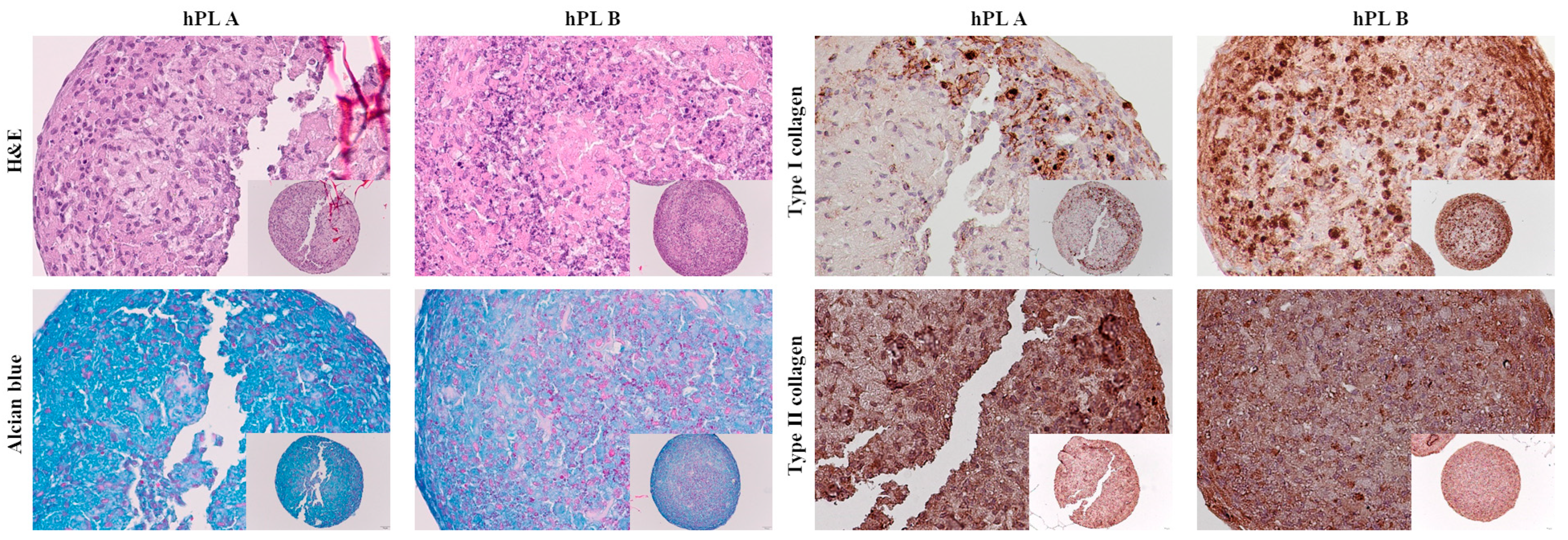
2.5. Histological Analysis of Spheroids from Cartilage Cells Cultured with hPL A and B
2.6. Mouse Model and Ethical Statement
2.7. Spheroid Implantation in Mice
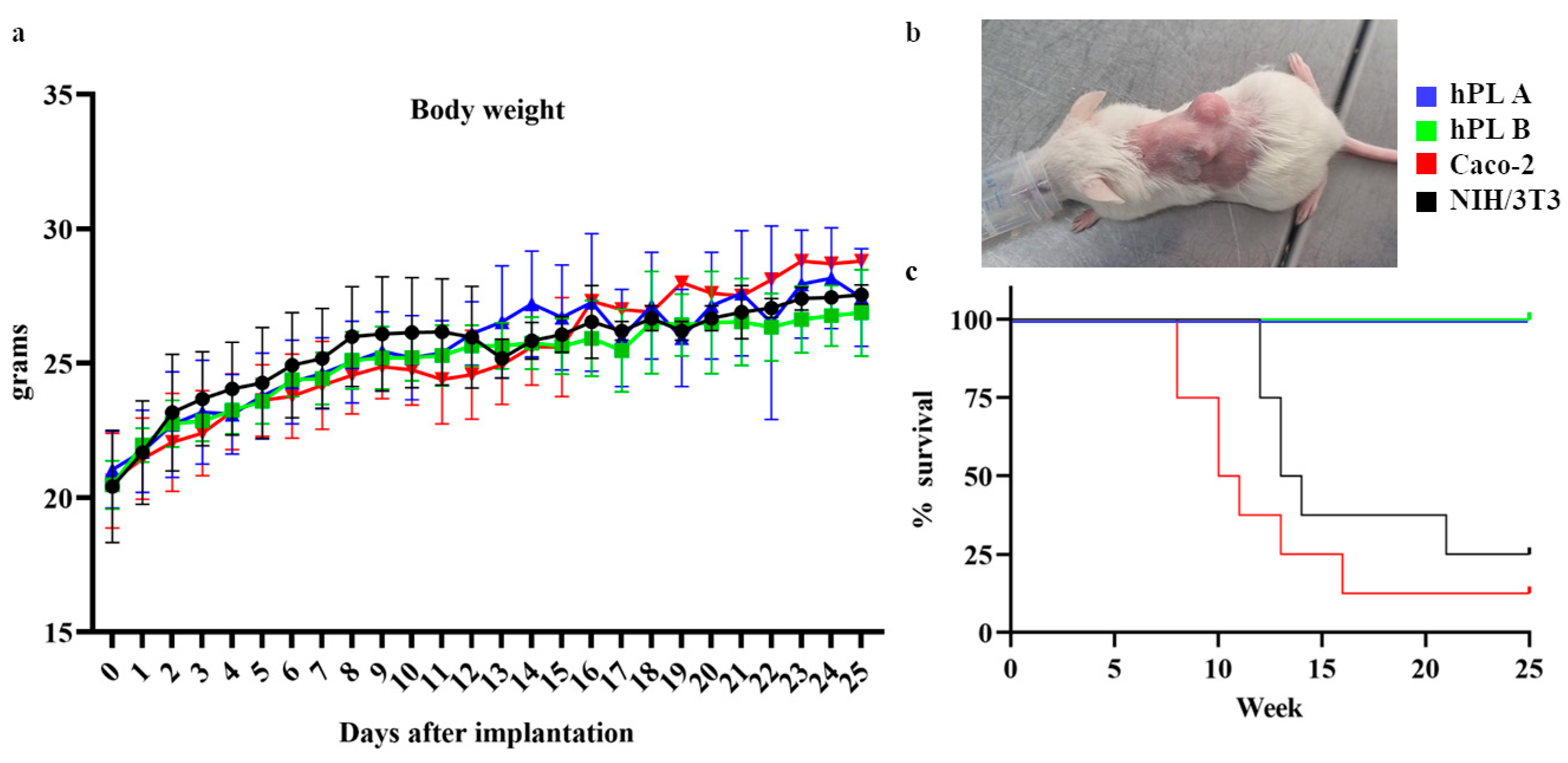
- Group hPL A: Spheroids from cartilage cells cultured in hPL A (5 spheroids/mouse, n = 8 mice);
- Group hPL B: Spheroids from cartilage cells cultured in hPL B (5 spheroids/mouse, n = 5 mice);
- Group Caco-2: Spheroids from Caco-2 cells, positive control for tumorigenicity assessment (20 spheroids/mouse, n = 8 mice);
- Group NIH/3T3: Spheroids from NIH/3T3 cells, negative control for tumorigenicity assessment (5 spheroids/mouse, n = 8 mice).
2.8. Histological Analysis of Explants
2.9. Immunohistochemical Detection of Residual Human Cells
2.10. Statistical Analyses
3. Results
3.1. Karyotype Stability of Cartilage Cells

| Age (Years) | Sex | hPL A | hPL B |
|---|---|---|---|
| 83 | F | 30 metaphases: 46, XX | 22 metaphases: mos 47, XX, +10 [4]/46, XX [13] 20 metaphases (repeat test, passage 1): 46, XX |
| 78 | F | 20 metaphases: 46, XX | 20 metaphases: 46, XX |
| 70 | M | 20 metaphases: mos 45, X [6]/46, XY [12] | 20 metaphases: mos 45, X [6]/46, XY [12] 20 metaphases (repeat test, passage 1): mos 45, X [6]/46, XY [12] |
| 71 | F | 20 metaphases: 46, XX | 21 metaphases: 46, XX |
3.2. Characterization of Spheroids of Cartilage Cells Cultured with hPL A and B
3.3. Body Weight Monitoring and Survival Rate of Mice
3.4. Histological Findings
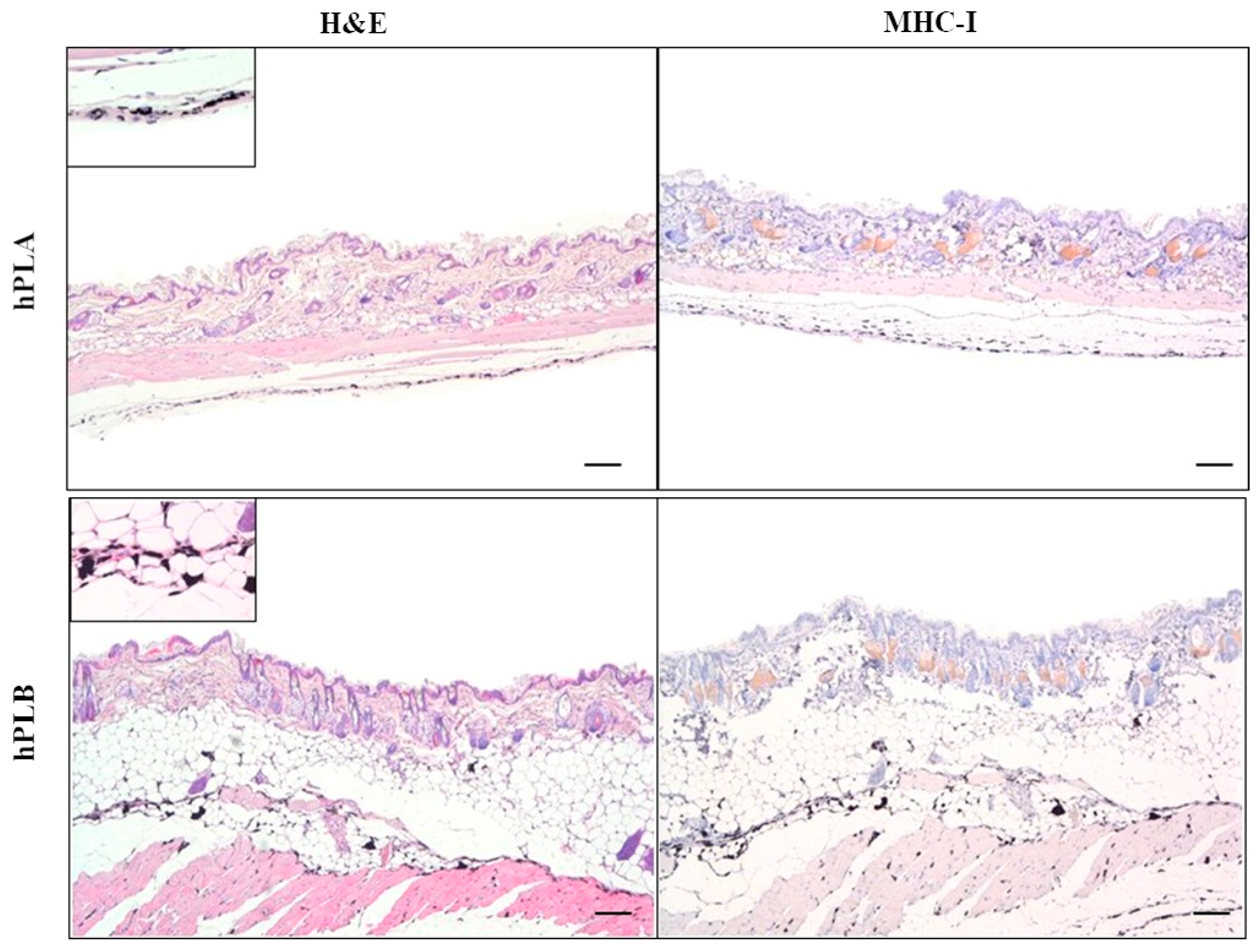
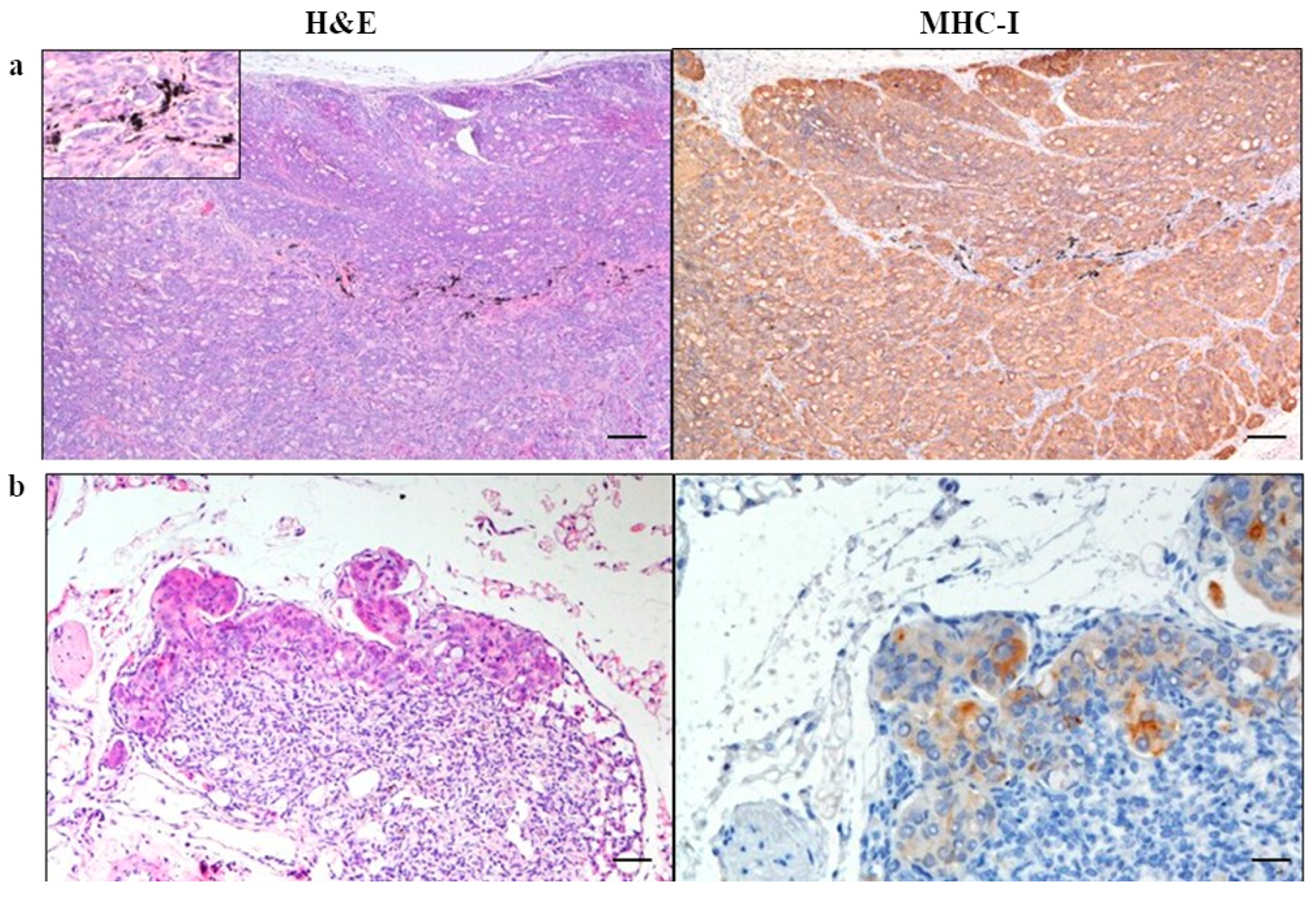
3.4.1. Subcutaneous Implantation Site
3.4.2. Lymph Nodes
3.4.3. Organs
3.5. Immunohistochemical Findings of Residual Human Cells at the Subcutaneous Implantation Site
4. Discussion
5. Conclusions
Supplementary Materials
Author Contributions
Funding
Institutional Review Board Statement
Informed Consent Statement
Data Availability Statement
Conflicts of Interest
Abbreviations
| EMA | European Medicines Agency |
| FDA | Food and Drug Administration |
| ATMPs | Advanced Therapy Medicinal Products |
| hPL | human platelet lysate |
| OA | osteoarthritis |
| DMEM | Dulbecco’s Modified Eagle’s Medium |
| HE | Hematoxylin–Eosin |
| GMP | Good Manufacturing Practice |
| MHC | Major Histocompatibility Complex |
| MSC | Mesenchymal Stem Cells |
| GLP | Good Laboratory Practice |
| DNA | Deoxyribonucleic Acid |
References
- European Medicines Agency (EMA). Guideline on Safety and Efficacy Follow-up—Risk Management of Advanced Therapy Medicinal Products. 2008. Available online: https://www.ema.europa.eu/en/guideline-safety-efficacy-follow-risk-management-advanced-therapy-medicinal-products-scientific-guideline?utm (accessed on 27 January 2026).
- Risk-based approach according to Annex I, part IV of Directive 2001/83/EC applied to Advanced Therapy Medicinal Products - Scientific guideline. Available online: https://www.ema.europa.eu/en/risk-based-approach-according-annex-i-part-iv-directive-2001-83-ec-applied-advanced-therapy-medicinal-products-scientific-guideline?utm (accessed on 27 January 2026).
- Erben, R.G.; Silva-Lima, B.; Reischl, I.; Steinhoff, G.; Tiedemann, G.; Dalemans, W.; Vos, A.; Janssen, R.T.; Le Blanc, K.; van Osch, G.J.; et al. White Paper on How to Go Forward with Cell-Based Advanced Therapies in Europe. Tissue Eng. Part A 2014, 20, 2549–2554. [Google Scholar] [CrossRef] [PubMed]
- Kennedy, S.; Tambiah, J.R.S.; Lane, N.E. Osteoarthritis today: Lost in translation? Best Pract. Res. Clin. Rheumatol. 2022, 36, 101810. [Google Scholar] [CrossRef] [PubMed]
- Zscharnack, M.; Krause, C.; Aust, G.; Thümmler, C.; Peinemann, F.; Keller, T.; Smink, J.J.; Holland, H.; Somerson, J.S.; Knauer, J.; et al. Preclinical good laboratory practice-compliant safety study to evaluate biodistribution and tumorigenicity of a cartilage advanced therapy medicinal product (ATMP). J. Transl. Med. 2015, 13, 160. [Google Scholar] [CrossRef] [PubMed]
- Ito, M.; Hiramatsu, H.; Kobayashi, K.; Suzue, K.; Kawahata, M.; Hioki, K.; Ueyama, Y.; Koyanagi, Y.; Sugamura, K.; Tsuji, K.; et al. NOD/SCID/γcnull mouse: An excellent recipient mouse model for engraftment of human cells. Blood 2002, 100, 3175–3182. [Google Scholar] [CrossRef] [PubMed]
- Sykes, J.G.; Kuiper, J.H.; Richardson, J.B.; Roberts, S.; Wright, K.T.; Kuiper, N.J. Impact of human platelet lysate on the expansion and chondrogenic capacity of cultured human chondrocytes for cartilage cell therapy. Eur. Cells Mater. 2018, 35, 255–267. [Google Scholar] [CrossRef] [PubMed]
- De Luca, P.; Kouroupis, D.; Viganò, M.; Perucca-Orfei, C.; Kaplan, L.; Zagra, L.; de Girolamo, L.; Correa, D.; Colombini, A. Human Diseased Articular Cartilage Contains a Mesenchymal Stem Cell-Like Population of Chondroprogenitors with Strong Immunomodulatory Responses. J. Clin. Med. 2019, 8, 423. [Google Scholar] [CrossRef] [PubMed]
- Colombini, A.; Lopa, S.; Libonati, F.; Talò, G.; Mareschi, K.; Marini, E.; Mangiavini, L.; Raffo, V.; Moretti, M.; de Girolamo, L. Low-density cultured cartilage cells expanded in platelet lysate present distinct features to develop an innovative clinical treatment for diffuse cartilage lesions. Knee Surg. Sports Traumatol. Arthrosc. Off. J. ESSKA 2024, 32, 2859–2873. [Google Scholar] [CrossRef] [PubMed]
- Mareschi, K.; Banche Niclot, A.G.S.; Marini, E.; Bari, E.; Labanca, L.; Lucania, G.; Ferrero, I.; Perteghella, S.; Torre, M.L.; Fagioli, F. A New Human Platelet Lysate for Mesenchymal Stem Cell Production Compliant with Good Manufacturing Practice Conditions Preserves the Chemical Characteristics and Biological Activity of Lyo-Secretome Isolated by Ultrafiltration. Int. J. Mol. Sci. 2022, 23, 4318. [Google Scholar] [CrossRef] [PubMed]
- Castiglia, S.; Mareschi, K.; Labanca, L.; Lucania, G.; Leone, M.; Sanavio, F.; Castello, L.; Rustichelli, D.; Signorino, E.; Gunetti, M.; et al. Inactivated human platelet lysate with psoralen: A new perspective for mesenchymal stromal cell production in Good Manufacturing Practice conditions. Cytotherapy 2014, 16, 750–763. [Google Scholar] [CrossRef] [PubMed]
- Mayer, N.; Lopa, S.; Talò, G.; Lovati, A.B.; Pasdeloup, M.; Riboldi, S.A.; Moretti, M.; Mallein-Gerin, F. Interstitial Perfusion Culture with Specific Soluble Factors Inhibits Type I Collagen Production from Human Osteoarthritic Chondrocytes in Clinical-Grade Collagen Sponges. PLoS ONE 2016, 11, e0161479. [Google Scholar] [CrossRef] [PubMed]
- Rubin, H. Dynamics of cell transformation in culture and its significance for tumor development in animals. Proc. Natl. Acad. Sci. USA 2017, 114, 12237–12242. [Google Scholar] [CrossRef] [PubMed]
- Osiecka-Iwan, A.; Hyc, A.; Malejczyk, J.; Moskalewski, S. A Comprehensive Review of Auto- and Allogeneic Chondrocyte Transplantation in Animals and Humans from 1965 to 2025. Cartilage, 2025; online ahead of print. [Google Scholar]
- Lopa, S.; Piraino, F.; Kemp, R.J.; Di Caro, C.; Lovati, A.B.; Di Giancamillo, A.; Moroni, L.; Peretti, G.M.; Rasponi, M.; Moretti, M. Fabrication of multi-well chips for spheroid cultures and implantable constructs through rapid prototyping techniques: Multi-Well PDMS Chips and Fibrin Constructs. Biotechnol. Bioeng. 2015, 112, 1457–1471. [Google Scholar] [CrossRef] [PubMed]
- Hulme, C.H.; Garcia, J.K.; Mennan, C.; Perry, J.; Roberts, S.; Norris, K.; Baird, D.; Rix, L.; Banerjee, R.; Meyer, C.; et al. The Upscale Manufacture of Chondrocytes for Allogeneic Cartilage Therapies. Tissue Eng. Part C Methods 2023, 29, 424–437. [Google Scholar] [CrossRef] [PubMed]
- Kurenkova, A.D.; Li, L.; Usanova, A.P.; Feng, X.; Zhou, B.; Nedorubov, A.A.; Lychagin, A.V.; Chagin, A.S. Notch Signaling Regulates the Chondrogenic Potential of Both Articular Chondrocytes and Their Progenitors During Expansion. Stem Cells Dayt. Ohio 2023, 41, 658–671. [Google Scholar] [CrossRef] [PubMed]
- Gruppo di lavoro ocietà Italiana di Genetica Umana (SIGU). Documento di Buona Pratica per la Diagnosi Citogenetica e Citogenomica Costituzionale; Gruppo di lavoro ocietà Italiana di Genetica Umana (SIGU): Rome, Italy, 2023. [Google Scholar]
- Gardner, O.F.W.; Agabalyan, N.; Weil, B.; Ali, M.H.I.; Lowdell, M.W.; Bulstrode, N.W.; Ferretti, P. Human platelet lysate enhances proliferation but not chondrogenic differentiation of pediatric mesenchymal progenitors. Cytotherapy 2023, 25, 286–297. [Google Scholar] [CrossRef] [PubMed]
- Kachroo, U.; Zachariah, S.M.; Thambaiah, A.; Tabasum, A.; Livingston, A.; Rebekah, G.; Srivastava, A.; Vinod, E. Comparison of Human Platelet Lysate versus Fetal Bovine Serum for Expansion of Human Articular Cartilage-Derived Chondroprogenitors. Cartilage 2021, 13, 107S–116S. [Google Scholar] [CrossRef] [PubMed]
- Barkholt, L.; Flory, E.; Jekerle, V.; Lucas-Samuel, S.; Ahnert, P.; Bisset, L.; Büscher, D.; Fibbe, W.; Foussat, A.; Kwa, M.; et al. Risk of tumorigenicity in mesenchymal stromal cell-based therapies—bridging scientific observations and regulatory viewpoints. Cytotherapy 2013, 15, 753–759. [Google Scholar] [CrossRef] [PubMed]
- Yoon, J.Y.; Vu, H.T.; Lee, J.H.; Shin, J.S.; Kim, H.W.; Lee, H.H.; Kim, J.-B.; Lee, J.-H. Evaluation of Human Platelet Lysate as an Alternative to Fetal Bovine Serum for Potential Clinical Applications of Stem Cells from Human Exfoliated Deciduous Teeth. Cells 2024, 13, 847. [Google Scholar] [CrossRef] [PubMed]
- De Moor, L.; Beyls, E.; Declercq, H. Scaffold Free Microtissue Formation for Enhanced Cartilage Repair. Ann. Biomed. Eng. 2020, 48, 298–311. [Google Scholar] [CrossRef] [PubMed]
- Ryu, N.E.; Lee, S.H.; Park, H. Spheroid Culture System Methods and Applications for Mesenchymal Stem Cells. Cells 2019, 8, 1620. [Google Scholar] [CrossRef] [PubMed]


| Aspect | Score |
|---|---|
| Body Weight | |
| Sustained 15% loss for 72 h | 6 |
| Loss ≥ 20% | 6 |
| Coat Condition | |
| Piloerection | 1 |
| Body Functions | |
| Dyspnea (difficult and slow breathing) | 6 |
| Environment | |
| Diarrhea | 2 |
| Blood in stools | 6 |
| Behavior | |
| Tense and nervous when handled | 1 |
| Highly distressed by handling (e.g., agitated, vocalizing, aggressive) | 3 |
| Locomotion/Movements | |
| Abnormal posture/gait | 5 |
| Significant mobility issues | 6 |
| Procedure-Specific Indicators | |
| Tumor size: largest diameter ≥ 1 cm | 6 |
| Tumor ulceration | 6 |
| Movements hindered by the tumor | 6 |
| Finding | Description |
|---|---|
| Prevalent pattern of growth | Solid; cords; lobules; glandular (tubule-acinar structures); bundles; packets, etc. |
| Capsule | 0 = absent |
| 1 = present, partial | |
| 2 = present, complete | |
| Peripheral invasion | 0 = absent |
| 1 = focal | |
| 2 = multifocal | |
| 3 = diffuse | |
| Stroma | 0 = no stroma |
| 1 = scant amount of stroma, mainly characterized by delicate fibrovascular septa separating groups of neoplastic cells | |
| 2 = scant amount of stroma, mainly characterized by delicate fibrovascular septa separating groups of neoplastic cells associated with occasional broad bundles of fibrous connective tissue | |
| 3 = moderate amount of stroma characterized by a combination of delicate fibrovascular septa and broad bundles of fibrous connective tissue separating and embedding groups of neoplastic cells | |
| 4 = abundant stroma mainly composed of broad bundles of fibrous connective tissue separating and embedding groups of neoplastic cells | |
| Necrosis | 0 = no intra-tumoral necrotic foci |
| 1 = necrotic foci accounting for less than 20% of tumor extension | |
| 2 = necrotic foci comprised between 20% and 50% of tumor extension | |
| 3 = necrotic foci comprised between 50% and 70% of tumor extension | |
| 4 = necrotic foci accounting for more than 70% of tumor extension | |
| Mitoses | Number of mitoses in 3 randomly selected high-power fields (HPF = 400×) |
| Peritumoral inflammatory cell infiltrate | 0 = absent |
| 1 = minimal | |
| 2 = mild | |
| 3 = moderate | |
| 4 = marked |
Disclaimer/Publisher’s Note: The statements, opinions and data contained in all publications are solely those of the individual author(s) and contributor(s) and not of MDPI and/or the editor(s). MDPI and/or the editor(s) disclaim responsibility for any injury to people or property resulting from any ideas, methods, instructions or products referred to in the content. |
© 2026 by the authors. Licensee MDPI, Basel, Switzerland. This article is an open access article distributed under the terms and conditions of the Creative Commons Attribution (CC BY) license.
Share and Cite
Colombini, A.; Raffo, V.; Pennone, V.; Mareschi, K.; Labanca, L.; Mangiavini, L.; Moretti, M.; Recordati, C.; Armando, F.; Girolamo, L.d.; et al. Preclinical Tumorigenicity Study of an Advanced Therapy Medicinal Product for Diffuse Cartilage Lesions in an Osteoarthritic Environment. Cells 2026, 15, 429. https://doi.org/10.3390/cells15050429
Colombini A, Raffo V, Pennone V, Mareschi K, Labanca L, Mangiavini L, Moretti M, Recordati C, Armando F, Girolamo Ld, et al. Preclinical Tumorigenicity Study of an Advanced Therapy Medicinal Product for Diffuse Cartilage Lesions in an Osteoarthritic Environment. Cells. 2026; 15(5):429. https://doi.org/10.3390/cells15050429
Chicago/Turabian StyleColombini, Alessandra, Vincenzo Raffo, Vincenzo Pennone, Katia Mareschi, Luciana Labanca, Laura Mangiavini, Matteo Moretti, Camilla Recordati, Federico Armando, Laura de Girolamo, and et al. 2026. "Preclinical Tumorigenicity Study of an Advanced Therapy Medicinal Product for Diffuse Cartilage Lesions in an Osteoarthritic Environment" Cells 15, no. 5: 429. https://doi.org/10.3390/cells15050429
APA StyleColombini, A., Raffo, V., Pennone, V., Mareschi, K., Labanca, L., Mangiavini, L., Moretti, M., Recordati, C., Armando, F., Girolamo, L. d., & Lovati, A. B. (2026). Preclinical Tumorigenicity Study of an Advanced Therapy Medicinal Product for Diffuse Cartilage Lesions in an Osteoarthritic Environment. Cells, 15(5), 429. https://doi.org/10.3390/cells15050429