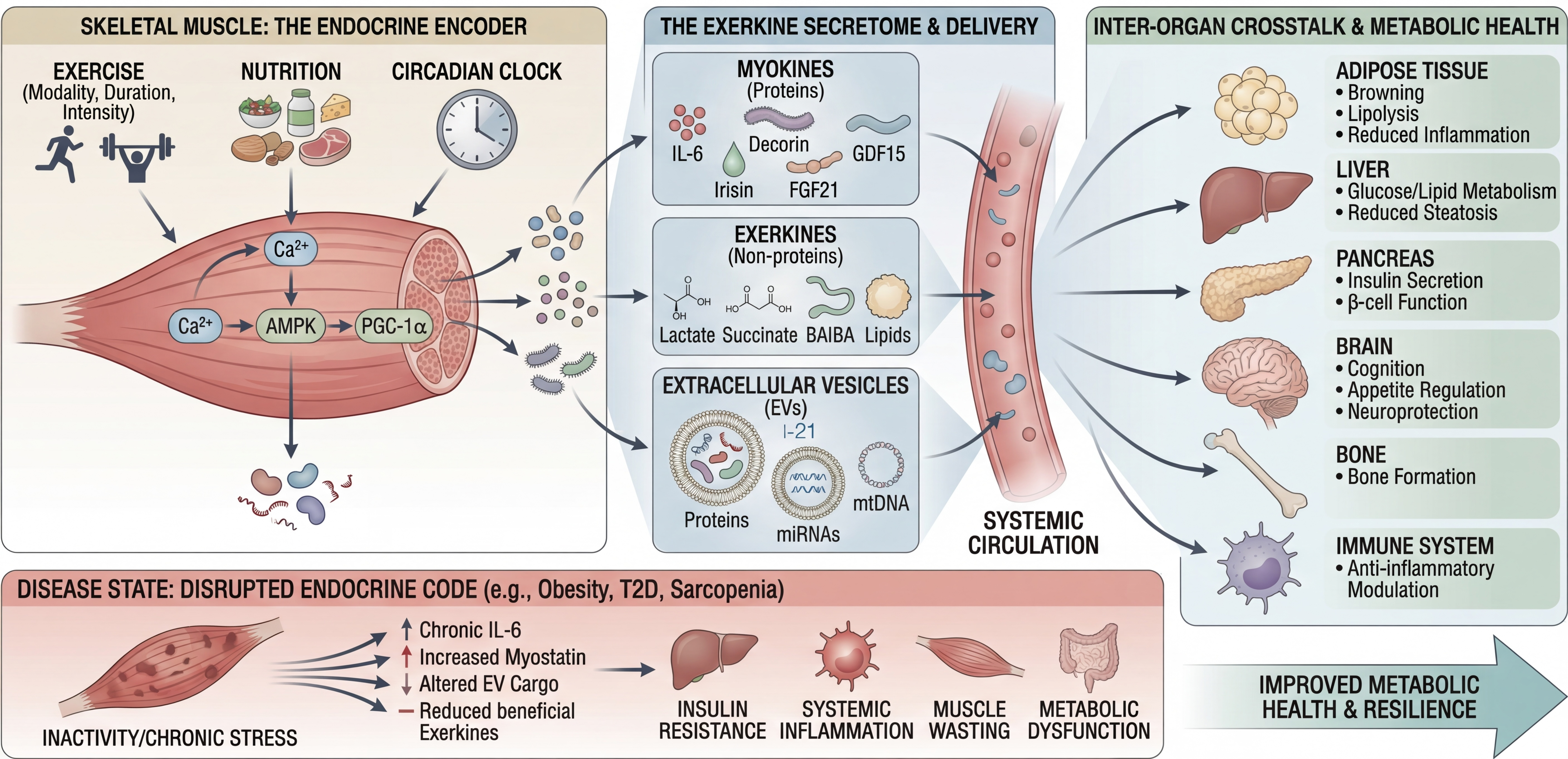
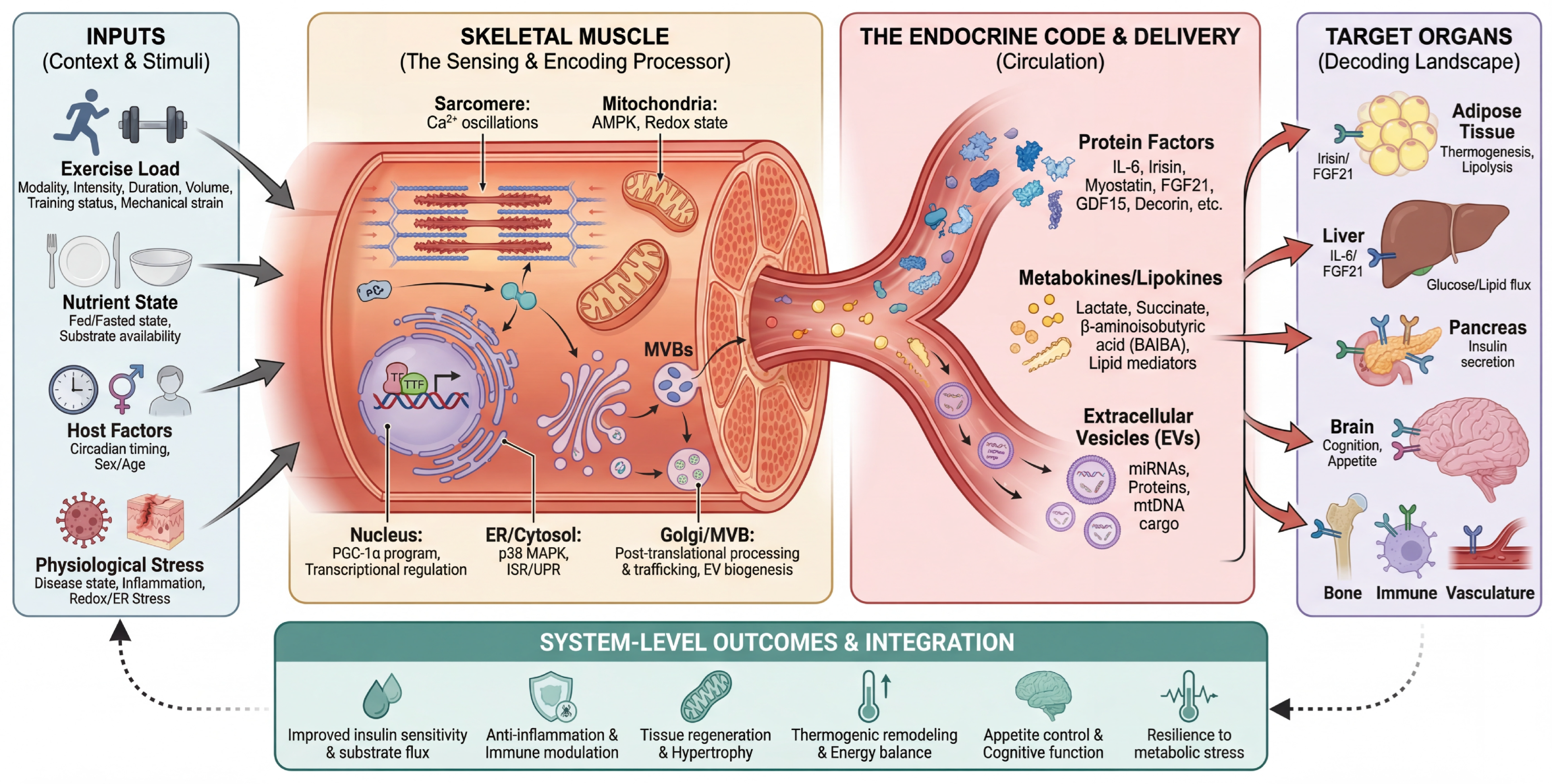
Decoding the Endocrine Code of Skeletal Muscle: Myokines, Exerkines, and Inter-Organ Crosstalk in Metabolic Health and Disease



Abstract
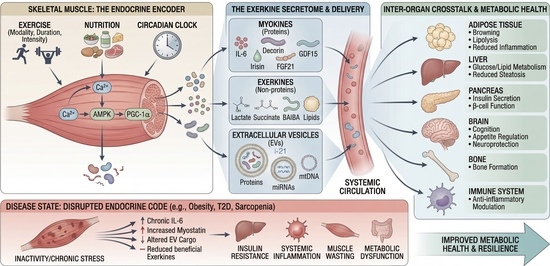
1. Introduction
2. Defining the Myokinome and Establishing Causality
- (1)
- Demonstrable expression in skeletal muscle fibers or myotubes, with contraction- and/or metabolic stress-responsive regulation.
- (2)
- Evidence of secretion from muscle (e.g., increased release in conditioned media, EV preparations, or arteriovenous gradients).
- (3)
- Identifiable receptor(s) and signaling pathway(s) in target tissue(s) consistent with physiological concentrations.
- (4)
- Causal linkage to phenotype by muscle-specific genetic manipulation, neutralization, or receptor perturbation.
- (5)
- Consideration of confounding sources (adipose, immune, liver) and pre-analytical/analytical variability (sampling time, processing, assay specificity).
- (6)
3. Regulation of Myokine Expression and Secretion
3.1. Exercise Modality and Dose as Primary Determinants
3.2. Intracellular Transcriptional and Post-Transcriptional Gateways
4. Autocrine and Paracrine Functions Within Skeletal Muscle
4.1. Control of Muscle Mass, Regeneration, and Remodeling
4.2. Local Metabolic Reprogramming and Insulin Sensitivity
5. Systemic Myokine-Mediated Crosstalk Across Organs
5.1. Muscle–Adipose Axis: Adipose Browning, Lipolysis, and Inflammation
5.2. Muscle–Liver Axis: Hepatic Glucose and Lipid Flux
5.3. Muscle–Pancreas Axis: β-Cell Function and Insulin Secretion
5.4. Muscle–Brain Axis: Cognition, Mood, and Appetite Control
5.5. Additional Axes: Bone, Immune System, and Cancer-Related Signaling
6. Beyond Proteins: Metabokines, Lipokines, and Extracellular Vesicles
6.1. Metabokines: Lactate, Succinate, and Related Intermediates
6.2. Lipokines and Lipid Mediators
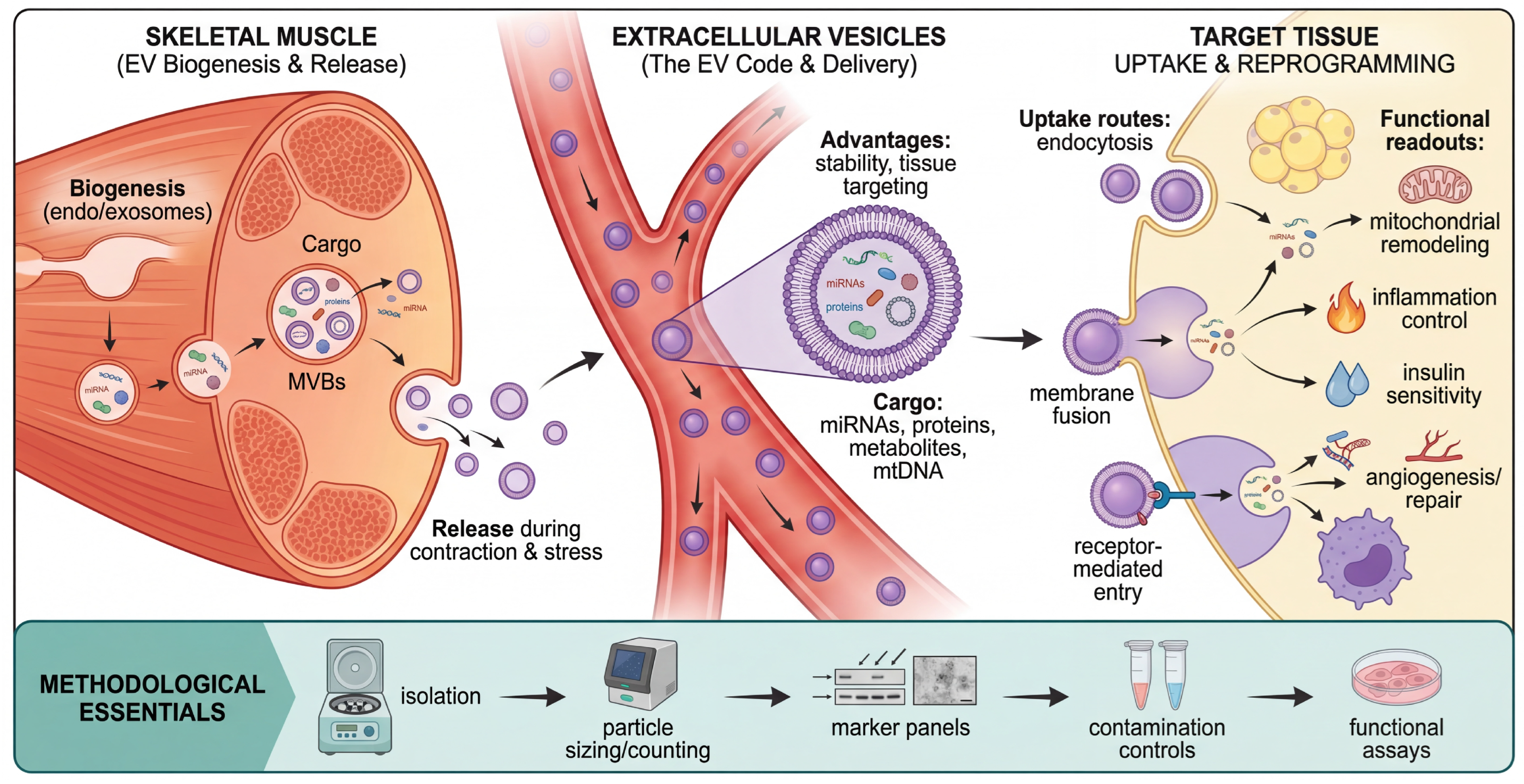
6.3. Extracellular Vesicles as Delivery Vehicles
7. Myokine Network Disruption in Metabolic and Muscle-Related Pathologies
7.1. Obesity, Insulin Resistance, and Type 2 Diabetes
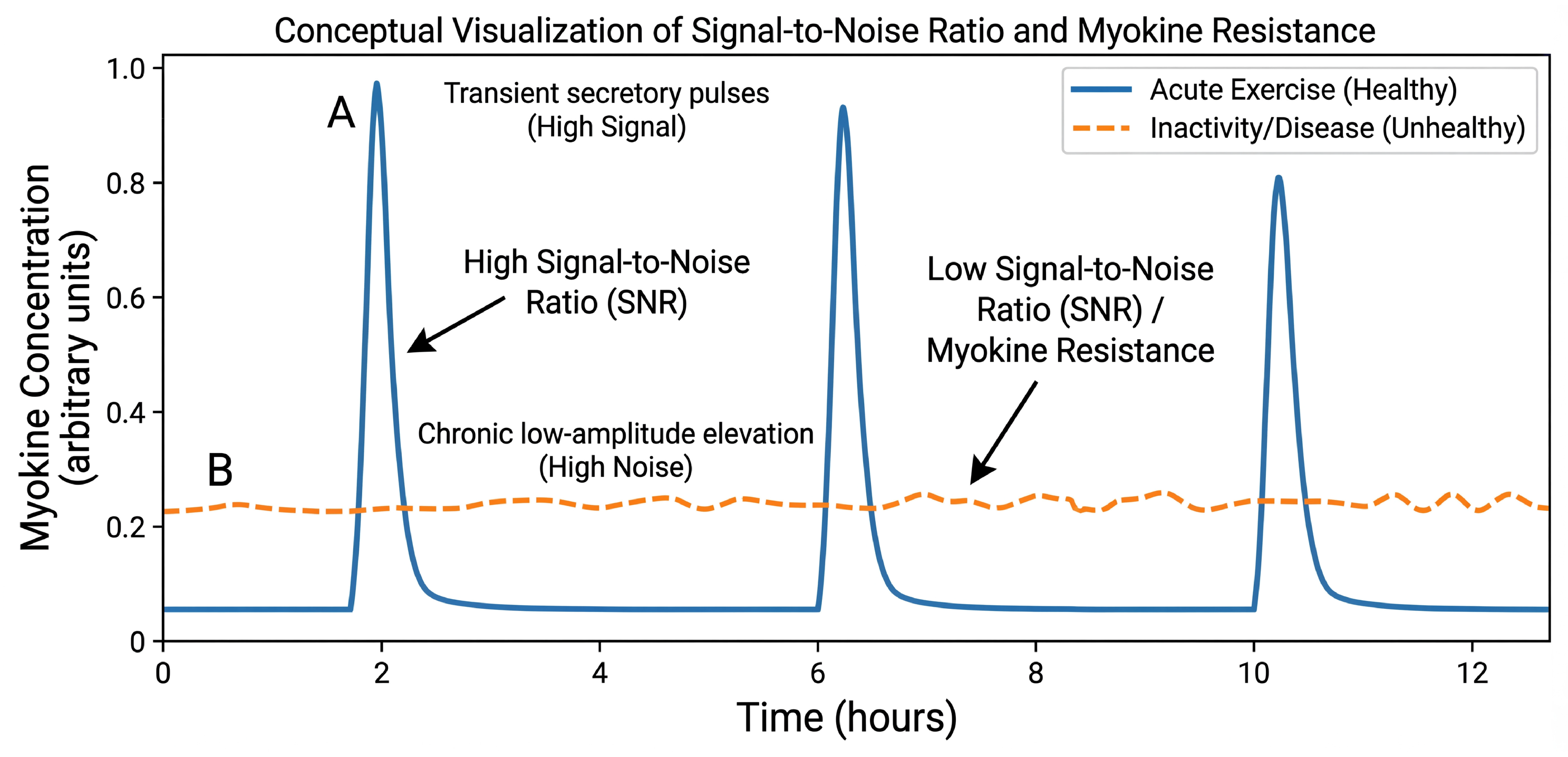
7.2. Myokine Resistance and Exercise Non-Responsiveness
7.3. Sarcopenia, Cachexia, and Systemic Catabolism
8. Translation: Biomarkers, Therapeutics, and Precision Exercise
8.1. Biomarker Panels and Analytical Standardization
8.2. Therapeutic Targeting of Myokine Pathways
8.3. Precision Exercise as a Systems Intervention
9. Conclusions and Research Priorities
Author Contributions
Funding
Institutional Review Board Statement
Informed Consent Statement
Data Availability Statement
Acknowledgments
Conflicts of Interest
Abbreviations
| ActRII | Activin receptor type II |
| AMPK | AMP-activated protein kinase |
| BAIBA | β-aminoisobutyric acid |
| BDNF | Brain-derived neurotrophic factor |
| ECM | Extracellular matrix |
| EV | Extracellular vesicle |
| FGF21 | Fibroblast growth factor 21 |
| FFA | Free fatty acid |
| FNDC5 | Fibronectin type III domain-containing protein 5 |
| GDF15 | Growth differentiation factor 15 |
| GLP-1 | Glucagon-like peptide-1 |
| HIIT | High-intensity interval training |
| IGF-1 | Insulin-like growth factor 1 |
| IL-6 | Interleukin-6 |
| ISR | Integrated stress response |
| LIF | Leukemia inhibitory factor |
| MAPK | Mitogen-activated protein kinase |
| Metrnl | Meteorin-like |
| miRNA | microRNA |
| MISEV | Minimal Information for Studies of Extracellular Vesicles |
| mtDNA | Mitochondrial DNA |
| NASH | Non-alcoholic steatohepatitis |
| OSTN | Osteocrin (musclin) |
| PGC-1α | Peroxisome proliferator-activated receptor γ coactivator 1α |
| SEC | Size-exclusion chromatography |
| SOCS | Suppressor of cytokine signaling |
| SUCNR1 | Succinate receptor 1 (GPR91) |
| T2D | Type 2 diabetes |
| TGF-β | Transforming growth factor-beta |
References
- Pedersen, B.K. Muscle as a secretory organ. Compr. Physiol. 2013, 3, 1337–1362. [Google Scholar] [CrossRef]
- Schnyder, S.; Handschin, C. Skeletal muscle as an endocrine organ: PGC-1α, myokines and exercise. Bone 2015, 80, 115–125. [Google Scholar] [CrossRef] [PubMed]
- Pedersen, B.K.; Akerström, T.C.; Nielsen, A.R.; Fischer, C.P. Role of myokines in exercise and metabolism. J. Appl. Physiol. 2007, 103, 1093–1098. [Google Scholar] [CrossRef]
- Pedersen, B.K.; Febbraio, M.A. Muscle as an endocrine organ: Focus on muscle-derived interleukin-6. Physiol. Rev. 2008, 88, 1379–1406. [Google Scholar] [CrossRef]
- Chow, L.S.; Gerszten, R.E.; Taylor, J.M.; Pedersen, B.K.; van Praag, H.; Trappe, S.; Febbraio, M.A.; Galis, Z.S.; Gao, Y.; Haus, J.M.; et al. Exerkines in health, resilience and disease. Nat. Rev. Endocrinol. 2022, 18, 273–289. [Google Scholar] [CrossRef]
- Hoffmann, C.; Weigert, C. Skeletal Muscle as an Endocrine Organ: The Role of Myokines in Exercise Adaptations. Cold Spring Harb. Perspect. Med. 2017, 7, a029793. [Google Scholar] [CrossRef]
- Karstoft, K.; Pedersen, B.K. Exercise and type 2 diabetes: Focus on metabolism and inflammation. Immunol. Cell Biol. 2016, 94, 146–150. [Google Scholar] [CrossRef]
- Severinsen, M.C.K.; Pedersen, B.K. Muscle-Organ Crosstalk: The Emerging Roles of Myokines. Endocr. Rev. 2020, 41, 594–609. [Google Scholar] [CrossRef] [PubMed]
- Egan, B.; Zierath, J.R. Exercise metabolism and the molecular regulation of skeletal muscle adaptation. Cell Metab. 2013, 17, 162–184. [Google Scholar] [CrossRef]
- Frontera, W.R.; Ochala, J. Skeletal muscle: A brief review of structure and function. Calcif. Tissue Int. 2015, 96, 183–195. [Google Scholar] [CrossRef] [PubMed]
- Fiuza-Luces, C.; Garatachea, N.; Berger, N.A.; Lucia, A. Exercise is the real polypill. Physiology 2013, 28, 330–358. [Google Scholar] [CrossRef]
- Raschke, S.; Eckel, J. Adipo-myokines: Two sides of the same coin--mediators of inflammation and mediators of exercise. Mediat. Inflamm. 2013, 2013, 320724. [Google Scholar] [CrossRef]
- Vechetti, I.J., Jr.; Valentino, T.; Mobley, C.B.; McCarthy, J.J. The role of extracellular vesicles in skeletal muscle and systematic adaptation to exercise. J. Physiol. 2021, 599, 845–861. [Google Scholar] [CrossRef]
- Lippi, G.; Salvagno, G.L.; Brocco, G.; Guidi, G.C. Preanalytical variability in laboratory testing: Influence of the blood drawing technique. Clin. Chem. Lab. Med. 2005, 43, 319–325. [Google Scholar] [CrossRef]
- Lombardi, G.; Sansoni, V.; Banfi, G. Measuring myokines with cardiovascular functions: Pre-analytical variables affecting the analytical output. Ann. Transl. Med. 2017, 5, 299. [Google Scholar] [CrossRef]
- Militello, R.; Luti, S.; Modesti, A. Omics Sciences in Regular Physical Activity. Int. J. Mol. Sci. 2025, 26, 5529. [Google Scholar] [CrossRef]
- Arabzadeh, E.; Khanzadeh, F.; Kalhor, A. Artificial intelligence in decoding muscle–organ crosstalk: Unveiling myokine networks and therapeutic frontiers. J. Exerc. Organ Cross Talk 2024, 4, 292–297. [Google Scholar]
- Chambers, T.L.; Murach, K.A. A history of omics discoveries reveals the correlates and mechanisms of loading-induced hypertrophy in adult skeletal muscle. 2024 CaMPS young investigator award invited review. Am. J. Physiol. Cell Physiol. 2025, 328, C1535–C1557. [Google Scholar] [CrossRef] [PubMed]
- Théry, C.; Witwer, K.W.; Aikawa, E.; Alcaraz, M.J.; Anderson, J.D.; Andriantsitohaina, R.; Antoniou, A.; Arab, T.; Archer, F.; Atkin-Smith, G.K.; et al. Minimal information for studies of extracellular vesicles 2018 (MISEV2018): A position statement of the International Society for Extracellular Vesicles and update of the MISEV2014 guidelines. J. Extracell Vesicles 2018, 7, 1535750. [Google Scholar] [CrossRef] [PubMed]
- Whitham, M.; Febbraio, M.A. The ever-expanding myokinome: Discovery challenges and therapeutic implications. Nat. Rev. Drug Discov. 2016, 15, 719–729. [Google Scholar] [CrossRef] [PubMed]
- Pedersen, B.K.; Febbraio, M.A. Muscles, exercise and obesity: Skeletal muscle as a secretory organ. Nat. Rev. Endocrinol. 2012, 8, 457–465. [Google Scholar] [CrossRef] [PubMed]
- Senn, J.J.; Klover, P.J.; Nowak, I.A.; Mooney, R.A. Interleukin-6 induces cellular insulin resistance in hepatocytes. Diabetes 2002, 51, 3391–3399. [Google Scholar] [CrossRef]
- Steensberg, A.; Keller, C.; Starkie, R.L.; Osada, T.; Febbraio, M.A.; Pedersen, B.K. IL-6 and TNF-alpha expression in, and release from, contracting human skeletal muscle. Am. J. Physiol. Endocrinol. Metab. 2002, 283, E1272–E1278. [Google Scholar] [CrossRef]
- Jia, S.; Yu, Z.; Bai, L. Exerkines and osteoarthritis. Front. Physiol. 2023, 14, 1302769. [Google Scholar] [CrossRef]
- Steensberg, A.; Febbraio, M.A.; Osada, T.; Schjerling, P.; van Hall, G.; Saltin, B.; Pedersen, B.K. Interleukin-6 production in contracting human skeletal muscle is influenced by pre-exercise muscle glycogen content. J. Physiol. 2001, 537, 633–639. [Google Scholar] [CrossRef]
- Pedersen, B.K.; Steensberg, A.; Fischer, C.; Keller, C.; Keller, P.; Plomgaard, P.; Febbraio, M.; Saltin, B. Searching for the exercise factor: Is IL-6 a candidate? J. Muscle Res. Cell Motil. 2003, 24, 113–119. [Google Scholar] [CrossRef]
- Pedersen, B.K.; Steensberg, A.; Schjerling, P. Muscle-derived interleukin-6: Possible biological effects. J. Physiol. 2001, 536, 329–337. [Google Scholar] [CrossRef] [PubMed]
- Ellingsgaard, H.; Hauselmann, I.; Schuler, B.; Habib, A.M.; Baggio, L.L.; Meier, D.T.; Eppler, E.; Bouzakri, K.; Wueest, S.; Muller, Y.D.; et al. Interleukin-6 enhances insulin secretion by increasing glucagon-like peptide-1 secretion from L cells and alpha cells. Nat. Med. 2011, 17, 1481–1489. [Google Scholar] [CrossRef] [PubMed]
- Boström, P.; Wu, J.; Jedrychowski, M.P.; Korde, A.; Ye, L.; Lo, J.C.; Rasbach, K.A.; Boström, E.A.; Choi, J.H.; Long, J.Z.; et al. A PGC1-α-dependent myokine that drives brown-fat-like development of white fat and thermogenesis. Nature 2012, 481, 463–468. [Google Scholar] [CrossRef]
- Liu, P.Z.; Nusslock, R. Exercise-Mediated Neurogenesis in the Hippocampus via BDNF. Front. Neurosci. 2018, 12, 52. [Google Scholar] [CrossRef]
- Moon, H.Y.; Becke, A.; Berron, D.; Becker, B.; Sah, N.; Benoni, G.; Janke, E.; Lubejko, S.T.; Greig, N.H.; Mattison, J.A.; et al. Running-Induced Systemic Cathepsin B Secretion Is Associated with Memory Function. Cell Metab. 2016, 24, 332–340. [Google Scholar] [CrossRef] [PubMed]
- Vaynman, S.; Ying, Z.; Gomez-Pinilla, F. Hippocampal BDNF mediates the efficacy of exercise on synaptic plasticity and cognition. Eur. J. Neurosci. 2004, 20, 2580–2590. [Google Scholar] [CrossRef]
- Bertholdt, L.; Gudiksen, A.; Schwartz, C.L.; Knudsen, J.G.; Pilegaard, H. Lack of skeletal muscle IL-6 influences hepatic glucose metabolism in mice during prolonged exercise. Am. J. Physiol. Regul. Integr. Comp. Physiol. 2017, 312, R626–R636. [Google Scholar] [CrossRef]
- He, Z.; Tian, Y.; Valenzuela, P.L.; Huang, C.; Zhao, J.; Hong, P.; He, Z.; Yin, S.; Lucia, A. Myokine Response to High-Intensity Interval vs. Resistance Exercise: An Individual Approach. Front. Physiol. 2018, 9, 1735. [Google Scholar] [CrossRef]
- Bettariga, F.; Taaffe, D.R.; Galvão, D.A.; Lopez, P.; Bishop, C.; Markarian, A.M.; Natalucci, V.; Kim, J.S.; Newton, R.U. Exercise training mode effects on myokine expression in healthy adults: A systematic review with meta-analysis. J. Sport Health Sci. 2024, 13, 764–779. [Google Scholar] [CrossRef] [PubMed]
- Nieman, D.C.; Henson, D.A.; Smith, L.L.; Utter, A.C.; Vinci, D.M.; Davis, J.M.; Kaminsky, D.E.; Shute, M. Cytokine changes after a marathon race. J. Appl. Physiol. 2001, 91, 109–114. [Google Scholar] [CrossRef]
- Reddy, A.; Bozi, L.H.M.; Yaghi, O.K.; Mills, E.L.; Xiao, H.; Nicholson, H.E.; Paschini, M.; Paulo, J.A.; Garrity, R.; Laznik-Bogoslavski, D.; et al. pH-Gated Succinate Secretion Regulates Muscle Remodeling in Response to Exercise. Cell 2020, 183, 62–75.e17. [Google Scholar] [CrossRef] [PubMed]
- Kanzleiter, T.; Rath, M.; Görgens, S.W.; Jensen, J.; Tangen, D.S.; Kolnes, A.J.; Kolnes, K.J.; Lee, S.; Eckel, J.; Schürmann, A.; et al. The myokine decorin is regulated by contraction and involved in muscle hypertrophy. Biochem. Biophys. Res. Commun. 2014, 450, 1089–1094. [Google Scholar] [CrossRef]
- Broholm, C.; Pedersen, B.K. Leukaemia inhibitory factor—An exercise-induced myokine. Exerc. Immunol. Rev. 2010, 16, 77–85. [Google Scholar]
- Chakravarthy, M.V.; Booth, F.W. Eating, exercise, and “thrifty” genotypes: Connecting the dots toward an evolutionary understanding of modern chronic diseases. J. Appl. Physiol. 2004, 96, 3–10. [Google Scholar] [CrossRef]
- Norheim, F.; Raastad, T.; Thiede, B.; Rustan, A.C.; Drevon, C.A.; Haugen, F. Proteomic identification of secreted proteins from human skeletal muscle cells and expression in response to strength training. Am. J. Physiol. Endocrinol. Metab. 2011, 301, E1013–E1021. [Google Scholar] [CrossRef]
- Pedersen, B.K. Edward F. Adolph distinguished lecture: Muscle as an endocrine organ: IL-6 and other myokines. J. Appl. Physiol. 2009, 107, 1006–1014. [Google Scholar] [CrossRef]
- Han, Y.; Ye, S.; Liu, B. Roles of extracellular vesicles derived from healthy and obese adipose tissue in inter-organ crosstalk and potential clinical implication. Front. Endocrinol. 2024, 15, 1409000. [Google Scholar] [CrossRef] [PubMed]
- Leal, L.G.; Lopes, M.A.; Batista, M.L., Jr. Physical Exercise-Induced Myokines and Muscle-Adipose Tissue Crosstalk: A Review of Current Knowledge and the Implications for Health and Metabolic Diseases. Front. Physiol. 2018, 9, 1307. [Google Scholar] [CrossRef] [PubMed]
- Pedersen, B.K.; Febbraio, M. Exercise and interleukin-6 action. Expert. Rev. Endocrinol. Metab. 2006, 1, 319–321. [Google Scholar] [CrossRef] [PubMed]
- Assyov, Y.; Chechev, K.; Gateva, A.; Vera, K.; Gatev, T.; Popov, D.; Naydenov, Y.; Zaharieva, E.; Konova, N.; Yordanova, S. The impact of dietary intervention on myokines: A narrative review. Pharmacia 2024, 71, 1–10. [Google Scholar] [CrossRef]
- Gleeson, M.; Bishop, N.C.; Stensel, D.J.; Lindley, M.R.; Mastana, S.S.; Nimmo, M.A. The anti-inflammatory effects of exercise: Mechanisms and implications for the prevention and treatment of disease. Nat. Rev. Immunol. 2011, 11, 607–615. [Google Scholar] [CrossRef]
- Inagaki, T.; Dutchak, P.; Zhao, G.; Ding, X.; Gautron, L.; Parameswara, V.; Li, Y.; Goetz, R.; Mohammadi, M.; Esser, V.; et al. Endocrine regulation of the fasting response by PPARalpha-mediated induction of fibroblast growth factor 21. Cell Metab. 2007, 5, 415–425. [Google Scholar] [CrossRef]
- Hojman, P.; Brolin, C.; Nørgaard-Christensen, N.; Dethlefsen, C.; Lauenborg, B.; Olsen, C.K.; Åbom, M.M.; Krag, T.; Gehl, J.; Pedersen, B.K. IL-6 release from muscles during exercise is stimulated by lactate-dependent protease activity. Am. J. Physiol. Endocrinol. Metab. 2019, 316, E940–E947. [Google Scholar] [CrossRef]
- Castillo-Quan, J.I. From white to brown fat through the PGC-1α-dependent myokine irisin: Implications for diabetes and obesity. Dis. Model. Mech. 2012, 5, 293–295. [Google Scholar] [CrossRef]
- Choi, Y.K.; Kim, M.K.; Bae, K.H.; Seo, H.A.; Jeong, J.Y.; Lee, W.K.; Kim, J.G.; Lee, I.K.; Park, K.G. Serum irisin levels in new-onset type 2 diabetes. Diabetes Res. Clin. Pract. 2013, 100, 96–101. [Google Scholar] [CrossRef]
- Ciałowicz, M.; Woźniewski, M.; Murawska-Ciałowicz, E.; Dzięgiel, P. The Influence of Irisin on Selected Organs-The Liver, Kidneys, and Lungs: The Role of Physical Exercise. Cells 2025, 14, 1228. [Google Scholar] [CrossRef]
- Szaroszyk, M.; Kattih, B.; Martin-Garrido, A.; Trogisch, F.A.; Dittrich, G.M.; Grund, A.; Abouissa, A.; Derlin, K.; Meier, M.; Holler, T.; et al. Skeletal muscle derived Musclin protects the heart during pathological overload. Nat. Commun. 2022, 13, 149. [Google Scholar] [CrossRef] [PubMed]
- Subbotina, E.; Sierra, A.; Zhu, Z.; Gao, Z.; Koganti, S.R.; Reyes, S.; Stepniak, E.; Walsh, S.A.; Acevedo, M.R.; Perez-Terzic, C.M.; et al. Musclin is an activity-stimulated myokine that enhances physical endurance. Proc. Natl. Acad. Sci. USA 2015, 112, 16042–16047. [Google Scholar] [CrossRef] [PubMed]
- McPherron, A.C.; Lawler, A.M.; Lee, S.J. Regulation of skeletal muscle mass in mice by a new TGF-beta superfamily member. Nature 1997, 387, 83–90. [Google Scholar] [CrossRef]
- Lan, X.Q.; Deng, C.J.; Wang, Q.Q.; Zhao, L.M.; Jiao, B.W.; Xiang, Y. The role of TGF-β signaling in muscle atrophy, sarcopenia and cancer cachexia. Gen. Comp. Endocrinol. 2024, 353, 114513. [Google Scholar] [CrossRef]
- Broniec, M.N.; Norland, K.; Thomas, J.; Wang, X.; Harris, R.A. The decorin and myostatin response to acute whole body vibration: Impact of adiposity, sex, and race. Int. J. Obes. 2024, 48, 1803–1808. [Google Scholar] [CrossRef]
- Zhu, J.; Li, Y.; Shen, W.; Qiao, C.; Ambrosio, F.; Lavasani, M.; Nozaki, M.; Branca, M.F.; Huard, J. Relationships between transforming growth factor-beta1, myostatin, and decorin: Implications for skeletal muscle fibrosis. J. Biol. Chem. 2007, 282, 25852–25863. [Google Scholar] [CrossRef]
- Besse-Patin, A.; Montastier, E.; Vinel, C.; Castan-Laurell, I.; Louche, K.; Dray, C.; Daviaud, D.; Mir, L.; Marques, M.A.; Thalamas, C.; et al. Effect of endurance training on skeletal muscle myokine expression in obese men: Identification of apelin as a novel myokine. Int. J. Obes. 2014, 38, 707–713. [Google Scholar] [CrossRef] [PubMed]
- Kilpiö, T.; Skarp, S.; Perjés, Á.; Swan, J.; Kaikkonen, L.; Saarimäki, S.; Szokodi, I.; Penninger, J.M.; Szabó, Z.; Magga, J.; et al. Apelin regulates skeletal muscle adaptation to exercise in a high-intensity interval training model. Am. J. Physiol. Cell Physiol. 2024, 326, C1437–C1450. [Google Scholar] [CrossRef]
- Vinel, C.; Lukjanenko, L.; Batut, A.; Deleruyelle, S.; Pradère, J.P.; Le Gonidec, S.; Dortignac, A.; Geoffre, N.; Pereira, O.; Karaz, S.; et al. The exerkine apelin reverses age-associated sarcopenia. Nat. Med. 2018, 24, 1360–1371. [Google Scholar] [CrossRef]
- Kitase, Y.; Vallejo, J.A.; Gutheil, W.; Vemula, H.; Jähn, K.; Yi, J.; Zhou, J.; Brotto, M.; Bonewald, L.F. β-aminoisobutyric Acid, l-BAIBA, Is a Muscle-Derived Osteocyte Survival Factor. Cell Rep. 2018, 22, 1531–1544. [Google Scholar] [CrossRef]
- Roberts, L.D.; Boström, P.; O’Sullivan, J.F.; Schinzel, R.T.; Lewis, G.D.; Dejam, A.; Lee, Y.K.; Palma, M.J.; Calhoun, S.; Georgiadi, A.; et al. β-Aminoisobutyric acid induces browning of white fat and hepatic β-oxidation and is inversely correlated with cardiometabolic risk factors. Cell Metab. 2014, 19, 96–108. [Google Scholar] [CrossRef]
- Zhang, Y.; Xie, C.; Wang, H.; Foss, R.M.; Clare, M.; George, E.V.; Li, S.; Katz, A.; Cheng, H.; Ding, Y.; et al. Irisin exerts dual effects on browning and adipogenesis of human white adipocytes. Am. J. Physiol. Endocrinol. Metab. 2016, 311, E530–E541. [Google Scholar] [CrossRef]
- Curovic, I. The role of resistance exercise-induced local metabolic stress in mediating systemic health and functional adaptations: Could condensed training volume unlock greater benefits beyond time efficiency? Front. Physiol. 2025, 16, 1549609. [Google Scholar] [CrossRef] [PubMed]
- Rao, R.R.; Long, J.Z.; White, J.P.; Svensson, K.J.; Lou, J.; Lokurkar, I.; Jedrychowski, M.P.; Ruas, J.L.; Wrann, C.D.; Lo, J.C.; et al. Meteorin-like is a hormone that regulates immune-adipose interactions to increase beige fat thermogenesis. Cell 2014, 157, 1279–1291. [Google Scholar] [CrossRef]
- Chen, Q.; Zheng, Y.; Jiang, X.; Wang, Y.; Chen, Z.; Wu, D. Nature’s carriers: Leveraging extracellular vesicles for targeted drug delivery. Drug Deliv. 2024, 31, 2361165. [Google Scholar] [CrossRef]
- Chui, Z.S.W.; Shen, Q.; Xu, A. Current status and future perspectives of FGF21 analogues in clinical trials. Trends Endocrinol. Metab. 2024, 35, 371–384. [Google Scholar] [CrossRef] [PubMed]
- Kim, K.H.; Kim, S.H.; Min, Y.K.; Yang, H.M.; Lee, J.B.; Lee, M.S. Acute exercise induces FGF21 expression in mice and in healthy humans. PLoS ONE 2013, 8, e63517. [Google Scholar] [CrossRef]
- Jena, J.; García-Peña, L.M.; Pereira, R.O. The roles of FGF21 and GDF15 in mediating the mitochondrial integrated stress response. Front. Endocrinol. 2023, 14, 1264530. [Google Scholar] [CrossRef] [PubMed]
- Ahmed, D.S.; Isnard, S.; Lin, J.; Routy, B.; Routy, J.P. GDF15/GFRAL Pathway as a Metabolic Signature for Cachexia in Patients with Cancer. J. Cancer 2021, 12, 1125–1132. [Google Scholar] [CrossRef] [PubMed]
- Breit, S.N.; Brown, D.A.; Tsai, V.W. The GDF15-GFRAL Pathway in Health and Metabolic Disease: Friend or Foe? Annu. Rev. Physiol. 2021, 83, 127–151. [Google Scholar] [CrossRef]
- Aoi, W.; Naito, Y.; Takagi, T.; Tanimura, Y.; Takanami, Y.; Kawai, Y.; Sakuma, K.; Hang, L.P.; Mizushima, K.; Hirai, Y.; et al. A novel myokine, secreted protein acidic and rich in cysteine (SPARC), suppresses colon tumorigenesis via regular exercise. Gut 2013, 62, 882–889. [Google Scholar] [CrossRef] [PubMed]
- Pedersen, L.; Hojman, P. Muscle-to-organ cross talk mediated by myokines. Adipocyte 2012, 1, 164–167. [Google Scholar] [CrossRef]
- Nederveen, J.P.; Warnier, G.; Di Carlo, A.; Nilsson, M.I.; Tarnopolsky, M.A. Extracellular Vesicles and Exosomes: Insights From Exercise Science. Front. Physiol. 2020, 11, 604274. [Google Scholar] [CrossRef]
- Safdar, A.; Saleem, A.; Tarnopolsky, M.A. The potential of endurance exercise-derived exosomes to treat metabolic diseases. Nat. Rev. Endocrinol. 2016, 12, 504–517. [Google Scholar] [CrossRef]
- Brooks, G.A.; Osmond, A.D.; Arevalo, J.A.; Duong, J.J.; Curl, C.C.; Moreno-Santillan, D.D.; Leija, R.G. Lactate as a myokine and exerkine: Drivers and signals of physiology and metabolism. J. Appl. Physiol. 2023, 134, 529–548. [Google Scholar] [CrossRef]
- Lee, T.Y. Lactate: A multifunctional signaling molecule. Yeungnam Univ. J. Med. 2021, 38, 183–193. [Google Scholar] [CrossRef]
- Vavřička, J.; Brož, P.; Follprecht, D.; Novák, J.; Kroužecký, A. Modern Perspective of Lactate Metabolism. Physiol. Res. 2024, 73, 499–514. [Google Scholar] [CrossRef] [PubMed]
- Brooks, G.A. The Science and Translation of Lactate Shuttle Theory. Cell Metab. 2018, 27, 757–785. [Google Scholar] [CrossRef]
- He, W.; Miao, F.J.; Lin, D.C.; Schwandner, R.T.; Wang, Z.; Gao, J.; Chen, J.L.; Tian, H.; Ling, L. Citric acid cycle intermediates as ligands for orphan G-protein-coupled receptors. Nature 2004, 429, 188–193. [Google Scholar] [CrossRef] [PubMed]
- Wang, T.; Xu, Y.Q.; Yuan, Y.X.; Xu, P.W.; Zhang, C.; Li, F.; Wang, L.N.; Yin, C.; Zhang, L.; Cai, X.C.; et al. Succinate induces skeletal muscle fiber remodeling via SUNCR1 signaling. EMBO Rep. 2019, 20, e47892. [Google Scholar] [CrossRef]
- Fernández-Veledo, S.; Ceperuelo-Mallafré, V.; Vendrell, J. Rethinking succinate: An unexpected hormone-like metabolite in energy homeostasis. Trends Endocrinol. Metab. 2021, 32, 680–692. [Google Scholar] [CrossRef]
- Graf, C.; Ferrari, N. Metabolic Health-The Role of Adipo-Myokines. Int. J. Mol. Sci. 2019, 20, 6159. [Google Scholar] [CrossRef]
- López-Ojeda, W.; Hurley, R.A. Myokines and the Brain: A Novel Neuromuscular Endocrine Loop. J. Neuropsychiatry Clin. Neurosci. 2025, 37, A4. [Google Scholar] [CrossRef]
- Hashemi, A.; Ezati, M.; Nasr, M.P.; Zumberg, I.; Provaznik, V. Extracellular Vesicles and Hydrogels: An Innovative Approach to Tissue Regeneration. ACS Omega 2024, 9, 6184–6218. [Google Scholar] [CrossRef]
- Catoire, M.; Mensink, M.; Kalkhoven, E.; Schrauwen, P.; Kersten, S. Identification of human exercise-induced myokines using secretome analysis. Physiol. Genom. 2014, 46, 256–267. [Google Scholar] [CrossRef]
- Lee, J.; Choi, W.G.; Rhee, M.; Lee, S.H. Extracellular Vesicle-Mediated Network in the Pathogenesis of Obesity, Diabetes, Steatotic Liver Disease, and Cardiovascular Disease. Diabetes Metab. J. 2025, 49, 348–367. [Google Scholar] [CrossRef] [PubMed]
- Whitham, M.; Parker, B.L.; Friedrichsen, M.; Hingst, J.R.; Hjorth, M.; Hughes, W.E.; Egan, C.L.; Cron, L.; Watt, K.I.; Kuchel, R.P.; et al. Extracellular Vesicles Provide a Means for Tissue Crosstalk during Exercise. Cell Metab. 2018, 27, 237–251.e234. [Google Scholar] [CrossRef]
- Guescini, M.; Genedani, S.; Stocchi, V.; Agnati, L.F. Astrocytes and Glioblastoma cells release exosomes carrying mtDNA. J. Neural. Transm. 2010, 117, 1–4. [Google Scholar] [CrossRef] [PubMed]
- Zhao, Z.; Yan, K.; Guan, Q.; Guo, Q.; Zhao, C. Mechanism and physical activities in bone-skeletal muscle crosstalk. Front. Endocrinol. 2023, 14, 1287972. [Google Scholar] [CrossRef]
- Cheng, K.; Kalluri, R. Guidelines for clinical translation and commercialization of extracellular vesicles and exosomes based therapeutics. Extracell. Vesicle 2023, 2, 100029. [Google Scholar] [CrossRef]
- Helge, J.W.; Stallknecht, B.; Pedersen, B.K.; Galbo, H.; Kiens, B.; Richter, E.A. The effect of graded exercise on IL-6 release and glucose uptake in human skeletal muscle. J. Physiol. 2003, 546, 299–305. [Google Scholar] [CrossRef]
- Petersen, A.M.; Pedersen, B.K. The anti-inflammatory effect of exercise. J. Appl. Physiol. 2005, 98, 1154–1162. [Google Scholar] [CrossRef]
- Noureddin, M.; Rinella, M.E.; Chalasani, N.P.; Neff, G.W.; Lucas, K.J.; Rodriguez, M.E.; Rudraraju, M.; Patil, R.; Behling, C.; Burch, M.; et al. Efruxifermin in Compensated Liver Cirrhosis Caused by MASH. N. Engl. J. Med. 2025, 392, 2413–2424. [Google Scholar] [CrossRef]
- Johnen, H.; Lin, S.; Kuffner, T.; Brown, D.A.; Tsai, V.W.; Bauskin, A.R.; Wu, L.; Pankhurst, G.; Jiang, L.; Junankar, S.; et al. Tumor-induced anorexia and weight loss are mediated by the TGF-beta superfamily cytokine MIC-1. Nat. Med. 2007, 13, 1333–1340. [Google Scholar] [CrossRef]
- Paris, M.T.; Bell, K.E.; Mourtzakis, M. Myokines and adipokines in sarcopenia: Understanding cross-talk between skeletal muscle and adipose tissue and the role of exercise. Curr. Opin. Pharmacol. 2020, 52, 61–66. [Google Scholar] [CrossRef]
- Lee, J.H.; Jun, H.S. Role of Myokines in Regulating Skeletal Muscle Mass and Function. Front. Physiol. 2019, 10, 42. [Google Scholar] [CrossRef] [PubMed]
- Rooks, D.; Praestgaard, J.; Hariry, S.; Laurent, D.; Petricoul, O.; Perry, R.G.; Lach-Trifilieff, E.; Roubenoff, R. Treatment of Sarcopenia with Bimagrumab: Results from a Phase II, Randomized, Controlled, Proof-of-Concept Study. J. Am. Geriatr. Soc. 2017, 65, 1988–1995. [Google Scholar] [CrossRef] [PubMed]
- Mogiłko, N.; Małgorzewicz, S. The Association Between Myokines, Inflammation, and Nutritional Status in Patients with Multiple Sclerosis. Biomolecules 2025, 15, 703. [Google Scholar] [CrossRef]
- Gao, X.; Chen, Y.; Cheng, P. Unlocking the potential of exercise: Harnessing myokines to delay musculoskeletal aging and improve cognitive health. Front. Physiol. 2024, 15, 1338875. [Google Scholar] [CrossRef] [PubMed]
- Timofte, D.V.; Tudor, R.C.; Mocanu, V.; Labusca, L. Obesity, Osteoarthritis, and Myokines: Balancing Weight Management Strategies, Myokine Regulation, and Muscle Health. Nutrients 2024, 16, 4231. [Google Scholar] [CrossRef]
- Febbraio, M.A.; Pedersen, B.K. Contraction-induced myokine production and release: Is skeletal muscle an endocrine organ? Exerc. Sport Sci. Rev. 2005, 33, 114–119. [Google Scholar] [CrossRef]
- Förster, P.M.; Hogenkamp, J.; Pottgießer, M.F.; Binsch, C.; Humpert, A.D.; Brügge, C.L.; Deatc, M.I.; Ensenauer, R.; Chadt, A.; Thoresen, G.H.; et al. High-resolution analyses of the secretomes from murine C2C12 cells and primary human skeletal muscle cells reveal distinct differences in contraction-regulated myokine secretion. Front. Physiol. 2025, 16, 1549316. [Google Scholar] [CrossRef]
- Florin, A.; Lambert, C.; Sanchez, C.; Zappia, J.; Durieux, N.; Tieppo, A.M.; Mobasheri, A.; Henrotin, Y. The secretome of skeletal muscle cells: A systematic review. Osteoarthr. Cartil. Open 2020, 2, 100019. [Google Scholar] [CrossRef]
- Balakrishnan, R.; Thurmond, D.C. Mechanisms by Which Skeletal Muscle Myokines Ameliorate Insulin Resistance. Int. J. Mol. Sci. 2022, 23, 4636. [Google Scholar] [CrossRef]
- Bouzakri, K.; Plomgaard, P.; Berney, T.; Donath, M.Y.; Pedersen, B.K.; Halban, P.A. Bimodal effect on pancreatic β-cells of secretory products from normal or insulin-resistant human skeletal muscle. Diabetes 2011, 60, 1111–1121, Erratum in Diabetes 2015, 64, 312. https://doi.org/10.2337/db15-er01a.. [Google Scholar] [CrossRef]
- Li, H.; Wang, F.; Yang, M.; Sun, J.; Zhao, Y.; Tang, D. The Effect of Irisin as a Metabolic Regulator and Its Therapeutic Potential for Obesity. Int. J. Endocrinol. 2021, 2021, 6572342. [Google Scholar] [CrossRef] [PubMed]
- Lee, S.J.; Bhasin, S.; Klickstein, L.; Krishnan, V.; Rooks, D. Challenges and Future Prospects of Targeting Myostatin/Activin A Signaling to Treat Diseases of Muscle Loss and Metabolic Dysfunction. J. Gerontol. A Biol. Sci. Med. Sci. 2023, 78, 32–37. [Google Scholar] [CrossRef] [PubMed]
- Broholm, C.; Laye, M.J.; Brandt, C.; Vadalasetty, R.; Pilegaard, H.; Pedersen, B.K.; Scheele, C. LIF is a contraction-induced myokine stimulating human myocyte proliferation. J. Appl. Physiol. 2011, 111, 251–259, Erratum in J. Appl. Physiol. 2015, 118, 505. https://doi.org/10.1152/japplphysiol.zdg-1339.corr.2015.. [Google Scholar] [CrossRef]
- Puigserver, P.; Spiegelman, B.M. Peroxisome proliferator-activated receptor-gamma coactivator 1 alpha (PGC-1 alpha): Transcriptional coactivator and metabolic regulator. Endocr. Rev. 2003, 24, 78–90. [Google Scholar] [CrossRef]
- Kupr, B.; Handschin, C. Complex Coordination of Cell Plasticity by a PGC-1α-controlled Transcriptional Network in Skeletal Muscle. Front. Physiol. 2015, 6, 325. [Google Scholar] [CrossRef]
- Lin, J.; Wu, H.; Tarr, P.T.; Zhang, C.Y.; Wu, Z.; Boss, O.; Michael, L.F.; Puigserver, P.; Isotani, E.; Olson, E.N.; et al. Transcriptional co-activator PGC-1 alpha drives the formation of slow-twitch muscle fibres. Nature 2002, 418, 797–801. [Google Scholar] [CrossRef] [PubMed]
- Lerner, L.; Tao, J.; Liu, Q.; Nicoletti, R.; Feng, B.; Krieger, B.; Mazsa, E.; Siddiquee, Z.; Wang, R.; Huang, L.; et al. MAP3K11/GDF15 axis is a critical driver of cancer cachexia. J. Cachexia Sarcopenia Muscle 2016, 7, 467–482. [Google Scholar] [CrossRef]
- Zhang, B.; Chang, J.Y.; Lee, M.H.; Ju, S.H.; Yi, H.S.; Shong, M. Mitochondrial Stress and Mitokines: Therapeutic Perspectives for the Treatment of Metabolic Diseases. Diabetes Metab. J. 2024, 48, 1–18. [Google Scholar] [CrossRef]
- Jia, J.; Wang, L.; Zhou, Y.; Zhang, P.; Chen, X. Muscle-derived extracellular vesicles mediate crosstalk between skeletal muscle and other organs. Front. Physiol. 2024, 15, 1501957. [Google Scholar] [CrossRef] [PubMed]
- Valadi, H.; Ekström, K.; Bossios, A.; Sjöstrand, M.; Lee, J.J.; Lötvall, J.O. Exosome-mediated transfer of mRNAs and microRNAs is a novel mechanism of genetic exchange between cells. Nat. Cell Biol. 2007, 9, 654–659. [Google Scholar] [CrossRef]
- Lecker, S.H.; Goldberg, A.L.; Mitch, W.E. Protein degradation by the ubiquitin-proteasome pathway in normal and disease states. J. Am. Soc. Nephrol. 2006, 17, 1807–1819. [Google Scholar] [CrossRef]
- Porcu, C.; Dobrowolny, G.; Scicchitano, B.M. Exploring the Role of Extracellular Vesicles in Skeletal Muscle Regeneration. Int. J. Mol. Sci. 2024, 25, 5811. [Google Scholar] [CrossRef]
- Forterre, A.; Jalabert, A.; Chikh, K.; Pesenti, S.; Euthine, V.; Granjon, A.; Errazuriz, E.; Lefai, E.; Vidal, H.; Rome, S. Myotube-derived exosomal miRNAs downregulate Sirtuin1 in myoblasts during muscle cell differentiation. Cell Cycle 2014, 13, 78–89. [Google Scholar] [CrossRef] [PubMed]
- Jørgensen, S.B.; Richter, E.A.; Wojtaszewski, J.F. Role of AMPK in skeletal muscle metabolic regulation and adaptation in relation to exercise. J. Physiol. 2006, 574, 17–31. [Google Scholar] [CrossRef] [PubMed]
- Wang, J.R.; Jurado-Aguilar, J.; Barroso, E.; Rodríguez-Calvo, R.; Camins, A.; Wahli, W.; Palomer, X.; Vázquez-Carrera, M. PPARβ/δ upregulates the insulin receptor β subunit in skeletal muscle by reducing lysosomal activity and EphB4 levels. Cell Commun. Signal 2024, 22, 595. [Google Scholar] [CrossRef]
- Petersen, K.F.; Shulman, G.I. Etiology of insulin resistance. Am. J. Med. 2006, 119, S10–S16. [Google Scholar] [CrossRef]
- Huh, J.Y.; Dincer, F.; Mesfum, E.; Mantzoros, C.S. Irisin stimulates muscle growth-related genes and regulates adipocyte differentiation and metabolism in humans. Int. J. Obes. 2014, 38, 1538–1544. [Google Scholar] [CrossRef]
- Sonoda, J.; Chen, M.Z.; Baruch, A. FGF21-receptor agonists: An emerging therapeutic class for obesity-related diseases. Horm. Mol. Biol. Clin. Investig. 2017, 30, 20170002. [Google Scholar] [CrossRef]
- Sanyal, A.; Charles, E.D.; Neuschwander-Tetri, B.A.; Loomba, R.; Harrison, S.A.; Abdelmalek, M.F.; Lawitz, E.J.; Halegoua-DeMarzio, D.; Kundu, S.; Noviello, S.; et al. Pegbelfermin (BMS-986036), a PEGylated fibroblast growth factor 21 analogue, in patients with non-alcoholic steatohepatitis: A randomised, double-blind, placebo-controlled, phase 2a trial. Lancet 2019, 392, 2705–2717. [Google Scholar] [CrossRef]
- Loomba, R.; Sanyal, A.J.; Nakajima, A.; Neuschwander-Tetri, B.A.; Goodman, Z.D.; Harrison, S.A.; Lawitz, E.J.; Gunn, N.; Imajo, K.; Ravendhran, N.; et al. Pegbelfermin in Patients with Nonalcoholic Steatohepatitis and Stage 3 Fibrosis (FALCON 1): A Randomized Phase 2b Study. Clin. Gastroenterol. Hepatol. 2024, 22, 102–112.e109. [Google Scholar] [CrossRef] [PubMed]
- Islam, M.R.; Valaris, S.; Young, M.F.; Haley, E.B.; Luo, R.; Bond, S.F.; Mazuera, S.; Kitchen, R.R.; Caldarone, B.J.; Bettio, L.E.B.; et al. Exercise hormone irisin is a critical regulator of cognitive function. Nat. Metab. 2021, 3, 1058–1070, Erratum in Nat. Metab. 2021, 3, 1432. https://doi.org/10.1038/s42255-021-00476-7.. [Google Scholar] [CrossRef]
- Pedersen, B.K. The anti-inflammatory effect of exercise: Its role in diabetes and cardiovascular disease control. Essays Biochem. 2006, 42, 105–117. [Google Scholar] [CrossRef]
- van Diepen, J.A.; Robben, J.H.; Hooiveld, G.J.; Carmone, C.; Alsady, M.; Boutens, L.; Bekkenkamp-Grovenstein, M.; Hijmans, A.; Engelke, U.F.H.; Wevers, R.A.; et al. SUCNR1-mediated chemotaxis of macrophages aggravates obesity-induced inflammation and diabetes. Diabetologia 2017, 60, 1304–1313. [Google Scholar] [CrossRef] [PubMed]
- Abdelmoez, A.M.; Dmytriyeva, O.; Zurke, Y.X.; Trauelsen, M.; Marica, A.A.; Savikj, M.; Smith, J.A.B.; Monaco, C.; Schwartz, T.W.; Krook, A.; et al. Cell selectivity in succinate receptor SUCNR1/GPR91 signaling in skeletal muscle. Am. J. Physiol. Endocrinol. Metab. 2023, 324, E289–E298. [Google Scholar] [CrossRef]
- Brooks, G.A. Lactate shuttles in nature. Biochem. Soc. Trans. 2002, 30, 258–264. [Google Scholar] [CrossRef]
- Rubic, T.; Lametschwandtner, G.; Jost, S.; Hinteregger, S.; Kund, J.; Carballido-Perrig, N.; Schwärzler, C.; Junt, T.; Voshol, H.; Meingassner, J.G.; et al. Triggering the succinate receptor GPR91 on dendritic cells enhances immunity. Nat. Immunol. 2008, 9, 1261–1269. [Google Scholar] [CrossRef]
- Fain, J.N. Release of interleukins and other inflammatory cytokines by human adipose tissue is enhanced in obesity and primarily due to the nonfat cells. Vitam. Horm. 2006, 74, 443–477. [Google Scholar] [CrossRef]
- Lopez-Legarrea, P.; de la Iglesia, R.; Crujeiras, A.B.; Pardo, M.; Casanueva, F.F.; Zulet, M.A.; Martinez, J.A. Higher baseline irisin concentrations are associated with greater reductions in glycemia and insulinemia after weight loss in obese subjects. Nutr. Diabetes 2014, 4, e110. [Google Scholar] [CrossRef]
- Osella, A.R.; Colaianni, G.; Correale, M.; Pesole, P.L.; Bruno, I.; Buongiorno, C.; Deflorio, V.; Leone, C.M.; Colucci, S.C.; Grano, M.; et al. Irisin Serum Levels in Metabolic Syndrome Patients Treated with Three Different Diets: A Post-Hoc Analysis from a Randomized Controlled Clinical Trial. Nutrients 2018, 10, 844. [Google Scholar] [CrossRef] [PubMed]
- Takao, N.; Kurose, S.; Miyauchi, T.; Onishi, K.; Tamanoi, A.; Tsuyuguchi, R.; Fujii, A.; Yoshiuchi, S.; Takahashi, K.; Tsutsumi, H.; et al. The relationship between changes in serum myostatin and adiponectin levels in patients with obesity undergoing a weight loss program. BMC Endocr. Disord. 2021, 21, 147. [Google Scholar] [CrossRef] [PubMed]
- Kurose, S.; Onishi, K.; Takao, N.; Miyauchi, T.; Takahashi, K.; Kimura, Y. Association of serum adiponectin and myostatin levels with skeletal muscle in patients with obesity: A cross-sectional study. PLoS ONE 2021, 16, e0245678. [Google Scholar] [CrossRef]
- Lee, Y.J.; Heo, Y.; Choi, J.H.; Park, S.; Kim, K.K.; Shin, D.W.; Kang, J.H. Association of Circulating Irisin Concentrations with Weight Loss after Roux-en-Y Gastric Bypass Surgery. Int. J. Environ. Res. Public Health 2019, 16, 660. [Google Scholar] [CrossRef] [PubMed]
- Steensberg, A.; van Hall, G.; Osada, T.; Sacchetti, M.; Saltin, B.; Klarlund Pedersen, B. Production of interleukin-6 in contracting human skeletal muscles can account for the exercise-induced increase in plasma interleukin-6. J. Physiol. 2000, 529, 237–242. [Google Scholar] [CrossRef]
- Loomba, R.; Sanyal, A.J.; Kowdley, K.V.; Bhatt, D.L.; Alkhouri, N.; Frias, J.P.; Bedossa, P.; Harrison, S.A.; Lazas, D.; Barish, R.; et al. Randomized, Controlled Trial of the FGF21 Analogue Pegozafermin in NASH. N. Engl. J. Med. 2023, 389, 998–1008. [Google Scholar] [CrossRef]
- Chang, J.S.; Kim, T.H.; Nguyen, T.T.; Park, K.S.; Kim, N.; Kong, I.D. Circulating irisin levels as a predictive biomarker for sarcopenia: A cross-sectional community-based study. Geriatr. Gerontol. Int. 2017, 17, 2266–2273. [Google Scholar] [CrossRef] [PubMed]
- Baek, J.Y.; Jang, I.Y.; Jung, H.W.; Park, S.J.; Lee, J.Y.; Choi, E.; Lee, Y.S.; Lee, E.; Kim, B.J. Serum irisin level is independent of sarcopenia and related muscle parameters in older adults. Exp. Gerontol. 2022, 162, 111744. [Google Scholar] [CrossRef]
- Chew, J.; Tay, L.; Lim, J.P.; Leung, B.P.; Yeo, A.; Yew, S.; Ding, Y.Y.; Lim, W.S. Serum Myostatin and IGF-1 as Gender-Specific Biomarkers of Frailty and Low Muscle Mass in Community-Dwelling Older Adults. J. Nutr. Health Aging 2019, 23, 979–986. [Google Scholar] [CrossRef]
- Carey, A.L.; Steinberg, G.R.; Macaulay, S.L.; Thomas, W.G.; Holmes, A.G.; Ramm, G.; Prelovsek, O.; Hohnen-Behrens, C.; Watt, M.J.; James, D.E.; et al. Interleukin-6 increases insulin-stimulated glucose disposal in humans and glucose uptake and fatty acid oxidation in vitro via AMP-activated protein kinase. Diabetes 2006, 55, 2688–2697. [Google Scholar] [CrossRef]
- Febbraio, M.A.; Hiscock, N.; Sacchetti, M.; Fischer, C.P.; Pedersen, B.K. Interleukin-6 is a novel factor mediating glucose homeostasis during skeletal muscle contraction. Diabetes 2004, 53, 1643–1648. [Google Scholar] [CrossRef] [PubMed]
- Garneau, L.; Mulvihill, E.E.; Smith, S.R.; Sparks, L.M.; Aguer, C. Myokine Secretion following an Aerobic Exercise Intervention in Individuals with Type 2 Diabetes with or without Exercise Resistance. Int. J. Mol. Sci. 2024, 25, 4889. [Google Scholar] [CrossRef] [PubMed]
- Kim, J.H.; Yu, S.M.; Son, J.W. Human Tissue-Engineered Skeletal Muscle: A Tool for Metabolic Research. Endocrinol. Metab. 2022, 37, 408–414. [Google Scholar] [CrossRef]
- Zunner, B.E.M.; Wachsmuth, N.B.; Eckstein, M.L.; Scherl, L.; Schierbauer, J.R.; Haupt, S.; Stumpf, C.; Reusch, L.; Moser, O. Myokines and Resistance Training: A Narrative Review. Int. J. Mol. Sci. 2022, 23, 3501. [Google Scholar] [CrossRef]
- Li, B.; Shaikh, F.; Zamzam, A.; Syed, M.H.; Abdin, R.; Qadura, M. The Identification and Evaluation of Interleukin-7 as a Myokine Biomarker for Peripheral Artery Disease Prognosis. J. Clin. Med. 2024, 13, 3583. [Google Scholar] [CrossRef]
- Li, Y.; Li, S.; Qiu, Y.; Zhou, M.; Chen, M.; Hu, Y.; Hong, S.; Jiang, L.; Guo, Y. Circulating FGF21 and GDF15 as Biomarkers for Screening, Diagnosis, and Severity Assessment of Primary Mitochondrial Disorders in Children. Front. Pediatr. 2022, 10, 851534. [Google Scholar] [CrossRef]
- Eckel, J. Myokines in metabolic homeostasis and diabetes. Diabetologia 2019, 62, 1523–1528. [Google Scholar] [CrossRef]
- Garg, V.; Ghay, R.; Goyal, G.; Saini, R.V. Exploring the Role of Acute Exercise-Induced Myokine Release in Glucose Metabolism and Insulin Sensitivity in Healthy and Diabetic Individuals. Cureus 2025, 17, e78991. [Google Scholar] [CrossRef] [PubMed]
- Kwon, J.H.; Moon, K.M.; Min, K.W. Exercise-Induced Myokines can Explain the Importance of Physical Activity in the Elderly: An Overview. Healthcare 2020, 8, 378. [Google Scholar] [CrossRef]
- Lazarus, N.R.; Harridge, S.D.R. A Hypothesis: The Interplay of Exercise and Physiological Heterogeneity as Drivers of Human Ageing. Front. Physiol. 2021, 12, 695392. [Google Scholar] [CrossRef]
- Sun, Z.; Wu, Z.; Zhu, L.; Li, X.; Xu, D.; Tian, X.; Mao, D. Research trends and hotspot evolution of exercise-regulated myokines: A bibliometric analysis from 2003 to 2023. Front. Physiol. 2024, 15, 1410068. [Google Scholar] [CrossRef]
- Arhire, L.I.; Mihalache, L.; Covasa, M. Irisin: A Hope in Understanding and Managing Obesity and Metabolic Syndrome. Front. Endocrinol. 2019, 10, 524. [Google Scholar] [CrossRef]
- Suzuki, T.; Imai, J.; Yamada, T.; Ishigaki, Y.; Kaneko, K.; Uno, K.; Hasegawa, Y.; Ishihara, H.; Oka, Y.; Katagiri, H. Interleukin-6 enhances glucose-stimulated insulin secretion from pancreatic beta-cells: Potential involvement of the PLC-IP3-dependent pathway. Diabetes 2011, 60, 537–547. [Google Scholar] [CrossRef]
- Heymsfield, S.B.; Coleman, L.A.; Miller, R.; Rooks, D.S.; Laurent, D.; Petricoul, O.; Praestgaard, J.; Swan, T.; Wade, T.; Perry, R.G.; et al. Effect of Bimagrumab vs Placebo on Body Fat Mass Among Adults with Type 2 Diabetes and Obesity: A Phase 2 Randomized Clinical Trial. JAMA Netw. Open 2021, 4, e2033457. [Google Scholar] [CrossRef] [PubMed]
- Crawford, T.O.; Servais, L.; Mercuri, E.; Kölbel, H.; Kuntz, N.; Finkel, R.S.; Krueger, J.; Batley, K.; Young, S.D.; Marantz, J.L.; et al. Safety and efficacy of apitegromab in nonambulatory type 2 or type 3 spinal muscular atrophy (SAPPHIRE): A phase 3, double-blind, randomised, placebo-controlled trial. Lancet Neurol. 2025, 24, 727–739. [Google Scholar] [CrossRef] [PubMed]
- Wagner, K.R.; Fleckenstein, J.L.; Amato, A.A.; Barohn, R.J.; Bushby, K.; Escolar, D.M.; Flanigan, K.M.; Pestronk, A.; Tawil, R.; Wolfe, G.I.; et al. A phase I/II trial of MYO-029 in adult subjects with muscular dystrophy. Ann. Neurol. 2008, 63, 561–571. [Google Scholar] [CrossRef] [PubMed]
- Reagan-Shaw, S.; Nihal, M.; Ahmad, N. Dose translation from animal to human studies revisited. FASEB J. 2008, 22, 659–661. [Google Scholar] [CrossRef] [PubMed]
- Huang, Y.; Wang, J.; Wei, X.; Zhang, H.; Shang, W.; Zhang, X.; Zhai, L.; Chen, X.; Li, H.; Qin, S. GB18-06, a nanobody targeting GDF15, effectively alleviates weight loss and restores physical function in cachexia models. MAbs 2024, 16, 2416453. [Google Scholar] [CrossRef]
- Amato, A.A.; Badrising, U.; Benveniste, O.; Needham, M.; Chinoy, H.; Wu, M.; Koumaras, B.; de Vera, A.; Papanicolaou, D.A.; Hanna, M.G. RESILIENT: A Randomized, Double-Blind, Placebo-Controlled Study of Bimagrumab in Patients with Sporadic Inclusion Body Myositis (P1.111). Neurology 2017, 88, P1.111. [Google Scholar] [CrossRef]
- Letukienė, A.; Hendrixson, V.; Ginevičienė, V. Current knowledge and scientific trends in myokines and exercise research in the context of obesity. Front. Med. 2024, 11, 1421962. [Google Scholar] [CrossRef] [PubMed]
- Juguilon, C.; Khosravi, R.; Radisic, M.; Wu, J.C. In Vitro Modeling of Interorgan Crosstalk: Multi-Organ-on-a-Chip for Studying Cardiovascular-Kidney-Metabolic Syndrome. Circ. Res. 2025, 136, 1476–1493. [Google Scholar] [CrossRef]
- Saponaro, F.; Bertolini, A.; Baragatti, R.; Galfo, L.; Chiellini, G.; Saba, A.; D’Urso, G. Myokines and Microbiota: New Perspectives in the Endocrine Muscle-Gut Axis. Nutrients 2024, 16, 4032. [Google Scholar] [CrossRef]
- Xie, T.; Leung, P.S. Fibroblast growth factor 21: A regulator of metabolic disease and health span. Am. J. Physiol. Endocrinol. Metab. 2017, 313, E292–E302. [Google Scholar] [CrossRef]



| Exercise Mode | Characteristic Signals (Myokines/Exerkines) | Dominant Signaling Outcome (The “Message”) | Interpretive Notes | References |
|---|---|---|---|---|
| Prolonged endurance (aerobic, >45 min) | Robust IL-6 increase; FGF21; Apelin; Lactate/FFA flux; Irisin (FNDC5 cleavage); BDNF; Cathepsin B | Substrate Mobilization & Anti-inflammation (Coordinates fuel supply; acute immune modulation) | Contraction-driven secretion of IL-6, with endocrine-like systemic effects. Endurance exercise is also associated with circulating neurotrophic/protease signals linked to neurocognitive adaptation (e.g., BDNF/cathepsin B), potentially reflecting combined muscle and non-muscle contributions depending on context. | [25,26,27,28,29,30,31,32,33] |
| High-intensity interval training (HIIT) | Mixed cytokine/metabolite response; Lactate spikes; Succinate; Irisin; PGC-1α program | Rapid Metabolic Adaptation & Mitochondrial Stress (Signals for mitochondrial biogenesis and stress resilience) | Protocol heterogeneity is high; responses may resemble endurance ‘pulses’ with larger stress signatures. High metabolic flux drives accumulation of signaling metabolites (lactate, succinate). | [34,35,36,37] |
| Resistance/hypertrophy training | LIF, Decorin, IL-15; Suppression of Myostatin | Tissue Remodeling & Growth (Supports myogenesis, ECM turnover, and protein synthesis) | Local remodeling often dominates over large endocrine spikes; outcomes depend on volume and rest intervals | [38,39,40]. |
| Concurrent (endurance + resistance) | Combined oxidative and remodeling signatures | Context-Dependent Interference or Synergy | Order and recovery can influence adaptation; endocrine outputs may be non-additive | [35,41,42] |
| Acute eccentric or damaging bouts | Inflammatory cytokines; Chemokines; EV release | Repair & Immune Recruitment (Initiates regeneration; transient pro-inflammatory phase) | May transiently elevate inflammatory markers; interpretation requires timing controls | [43,44,45] |
| Chronic training adaptations | Shift in basal secretome; Lower basal IL-6/TNF-α | Improved “Signal-to-Noise” Ratio (Lower basal inflammation preserves acute responsiveness) | Chronic adaptations may lower basal inflammation while preserving acute responsiveness | [46,47,48] |
| Signal (Class) | Primary Induction Context | Major Targets | Representative Actions | References |
|---|---|---|---|---|
| IL-6 (cytokine) | Prolonged/endurance exercise; low glycogen | Liver, adipose, immune cells | Coordinates substrate mobilization and contributes to anti-inflammatory reprogramming (acute); chronic elevation associates with insulin resistance | [4,22,49] |
| Irisin/FNDC5 | PGC-1α program; endurance/HIIT | Adipose tissue; brain; liver; kidney; lung | Promotes thermogenic remodeling of white adipose tissue; implicated in neurotrophic adaptation (context-dependent); proposed roles in hepatic metabolic regulation and in kidney/lung protective pathways in exercise-related settings | [29,50,51,52] |
| Musclin (peptide) | Aerobic/Resistance exercise | Muscle; Heart; Adipose | Enhances physical endurance; protects against cardiac overload and fibrosis; promotes mitochondrial biogenesis. | [53,54] |
| Myostatin (TGF-β family) | Basal expression; catabolic states | Muscle (autocrine) | Negative regulator of muscle mass; systemically inhibits adipose tissue browning and lipolysis. | [55,56,57] |
| Decorin (ECM proteoglycan) | Resistance training; mechanical loading | Muscle (local); myostatin pathway | Modulates extracellular matrix; sequesters myostatin to enhance hypertrophy; potential onco-suppressive effects. | [38,58] |
| LIF (cytokine) | Contraction/loading | Muscle progenitors | Stimulates myocyte proliferation; supports regenerative adaptation | [39,40] |
| Apelin (peptide) | Contraction; endurance training | Muscle, vasculature | Supports oxidative adaptation and metabolic remodeling | [59,60,61] |
| BAIBA (metabolite) | Exercise-associated amino acid flux | Adipose, liver, bone | Induces browning and metabolic remodeling; emerging roles in bone cell survival | [62,63,64] |
| Metrnl (protein hormone) | Cold and exercise (context-dependent) | Immune cells, adipose | Regulates immune-cell homeostasis and promotes insulin sensitization | [65,66] |
| Cathepsin B (protease) | Running/endurance | Brain | Associated with exercise-induced memory benefits | [31,33] |
| BDNF (neurotrophin) | Exercise; muscle–brain signaling | Brain; potentially muscle | Supports synaptic plasticity and cognition; links physical activity to neurotrophic adaptation | [30,32] |
| FGF21 (mitokine/endocrine factor) | Energetic/mitochondrial stress; acute exercise | Liver, adipose, CNS | Acts centrally to regulate appetite; enhances insulin sensitivity in adipose tissue; modulates hepatic lipid flux. | [67,68,69] |
| GDF15 (stress cytokine) | Mitochondrial stress; disease states | Brainstem appetite circuits; systemic | Acts on brainstem (GFRAL) to suppress appetite; regulates lipolysis and systemic energy expenditure. | [70,71,72] |
| SPARC (matricellular protein) | Exercise responsiveness | Colon/epithelia; stromal cells | Proposed mediator of exercise-associated colon cancer suppression | [73,74] |
| Muscle-derived EVs (vesicular cargo) | Exercise; remodeling states | Multiple tissues | Multiplexed delivery of proteins/miRNAs/mtDNA; influences metabolism and regeneration | [13,75,76] |
| Mediator | Class/Delivery | Representative Targets | Notes | References |
|---|---|---|---|---|
| Lactate | Metabolite (‘lactormone’ candidate) | Muscle, liver, brain | Links glycolytic flux to cytokine release and systemic adaptation; may act as signal and substrate | [77,78,79,80] |
| Succinate | Metabolite; SUCNR1 ligand | Adipose, immune cells, muscle | pH-gated secretion and SUCNR1 signaling implicated in exercise adaptation; biomarker vs. effector context remains active debate | [37,81,82,83] |
| BAIBA | Metabolite | Adipose, liver, bone | Induces browning and metabolic remodeling; emerging bone-related actions | [62,63,64] |
| Musclin | Peptide (muscle-derived) | Cardiovascular system; metabolism | Reported to modulate physical endurance and cardiometabolic phenotypes | [15,84] |
| EV-associated miRNAs | Extracellular vesicle cargo | Multiple tissues | Candidate mediators of training adaptation; requires stringent EV isolation and functional validation | [19,85,86] |
| EV-associated proteins | Extracellular vesicle cargo | Adipose, liver, vasculature | Proteomic profiling suggests exercise-responsive EV signatures; target selection and uptake are key unknowns | [87,88,89] |
| EV-associated mtDNA | Extracellular vesicles/cell-free mtDNA | Immune system | Mitochondrial DNA can function as an inflammatory signal when released in vesicles or extracellular space | [44,90,91] |
| Exercise-derived exosomes (therapeutic concept) | EV-based intervention | Metabolic disease models | Endurance exercise-derived exosomes reported to treat metabolic disease in preclinical models; translation requires standardized manufacturing and safety evaluation | [43,76,92] |
| Condition | Typical Myokine/Exerkine Alterations | Implications for Phenotype | References |
|---|---|---|---|
| Obesity/T2D | Shift toward pro-inflammatory milieu; altered IL-6 signaling dynamics; variable irisin associations | Contributes to insulin resistance and impaired exercise responsiveness; motivates multi-marker panels | [46,48,51,93] |
| NAFLD/metabolic liver disease | Elevations in stress-associated factors (e.g., FGF21); altered lipid mediators | Potential biomarker utility and therapeutic targeting; muscle–liver source attribution remains important | [68,69,94] |
| Cancer cachexia | Myostatin and stress cytokines may rise; anorexia pathways engaged (e.g., TGF-β family, GDF15) | Muscle wasting and appetite dysregulation; requires careful benefit–risk evaluation for pathway modulation | [71,95,96] |
| Age-related sarcopenia | Changes in growth-regulatory signals (e.g., myostatin) and reduced anabolic responsiveness | Lean mass and function decline; clinical trials targeting activin/myostatin pathways show mixed functional outcomes | [97,98,99] |
| Inflammatory/autoimmune disease (example: multiple sclerosis) | Exercise-related endocrine and immune modulation intersects with neurological pathology | Supports personalized exercise as adjunct therapy; mechanistic work ongoing | [45,47,100] |
| Depression/Cognitive Decline | Blunted BDNF response; altered kynurenine pathway signaling | Impaired neuroplasticity and mood regulation; exercise may restore neurotrophic support | [30,32] |
| Chronic Kidney Disease (CKD) | Reduced circulating Irisin; elevated myostatin and inflammatory cytokines | Loss of renoprotection (fibrosis prevention); contributes to uremic sarcopenia and systemic inflammation | [24,52] |
| Chronic Obstructive Pulmonary Disease (COPD) | Dysregulated Irisin and oxidative stress markers; systemic inflammatory spillover | Disrupted muscle–lung axis; potential loss of anti-inflammatory buffering against pulmonary stress | [52] |
| Osteoarthritis and musculoskeletal comorbidity | Inflammation and altered muscle signaling may influence joint health and activity tolerance | Highlights need for integrated musculoskeletal–metabolic frameworks and tailored exercise prescriptions | [21,24,101,102] |
| Methodological/Interpretive Issue | Best-Practice Recommendation | References |
|---|---|---|
| Context dependence and kinetics | Distinguish acute exercise pulses from chronic baseline elevations; predefine sampling windows aligned to mechanistic hypotheses | [145,146,147] |
| Causal attribution of ‘muscle-derived’ signals | Combine secretion evidence with muscle-specific perturbations and/or advanced human-relevant models (e.g., tissue-engineered muscle) to test necessity/sufficiency | [104,107,148] |
| Heterogeneity of exercise protocols | Report intensity, duration, modality, nutritional state, and training status; interpret findings within modality-specific signature literature | [34,147,149] |
| Pre-analytical and analytical variability | Standardize collection tubes, processing time, storage, and assay platforms; where possible, use orthogonal quantification | [14,15] |
| EV isolation and characterization | Follow minimal information standards; include controls for co-isolated proteins/lipoproteins and report particle metrics and marker panels | [19,85] |
| Biomarker translation and disease stratification | Validate candidate panels across cohorts and disease contexts; consider emerging myokine biomarkers (e.g., IL-7) and stress axis markers (FGF21/GDF15) | [150,151] |
| Synthesis of mechanistic and clinical literature | Use structured narrative frameworks and consolidate evidence on myokines in diabetes/insulin resistance and metabolic homeostasis | [106,152,153,154] |
| Field mapping and horizon scanning | Leverage bibliometric analyses and conceptual frameworks to identify emerging hotspots and gaps (e.g., ageing, EV cargo) | [155,156] |
| Controversies and assay debates (example: irisin) | Interpret associations with attention to assay specificity, population differences, and mechanistic plausibility; triangulate with multi-omics and receptor biology | [108,157] |
| Mechanistic breadth of IL-6 signaling | Account for IL-6 actions on lipolysis and insulin secretion/disposal across tissues when interpreting training studies | [22,28,158] |
| Strategy/Agent | Target Pathway | Clinical/Preclinical Context | Key Considerations | References |
|---|---|---|---|---|
| Myo-029 (antibody) | Myostatin neutralization | Muscular dystrophy (early trials) | Lean-mass effects may not directly translate to functional gains; endpoint selection critical | [109,159] |
| ACE-031/ActRII decoys | Activin receptor ligand trap | Muscle wasting indications | Broad ligand binding may drive efficacy and off-target effects; safety monitoring essential | [118,159] |
| Apitegromab | Pro/latent myostatin | Spinal muscular atrophy and related neuromuscular disorders | Represents later-generation specificity; development pipeline evolving | [99,160] |
| Bimagrumab | ActRII antibody | Obesity/T2D, sarcopenia and myositis | Can increase lean mass and reduce fat mass; functional and metabolic endpoints vary by population | [142,161,164] |
| FGF21 analogs (e.g., pegozafermin and related) | FGF21 signaling | Metabolic liver disease/dyslipidemia | Promising metabolic effects; mechanism and source attribution require careful study; dose translation matters | [68,94,127] |
| GDF15 pathway modulation (e.g., engineered binders) | Stress-associated appetite regulation | Cachexia/anorexia biology; exploratory therapeutics | Potential to influence appetite and energy balance; benefit–risk depends on indication and dosing | [71,72,163] |
| EV-inspired or EV-based interventions | Multiplexed cargo delivery | Preclinical metabolic disease models | Manufacturing, characterization, biodistribution, and safety are major translational hurdles | [19,76,92] |
| Precision exercise prescriptions | Network-level intervention | Across cardiometabolic and musculoskeletal disease | Requires stratification and adaptive dosing; integration with nutrition and pharmacotherapy likely | [34,35,101] |
Disclaimer/Publisher’s Note: The statements, opinions and data contained in all publications are solely those of the individual author(s) and contributor(s) and not of MDPI and/or the editor(s). MDPI and/or the editor(s) disclaim responsibility for any injury to people or property resulting from any ideas, methods, instructions or products referred to in the content. |
© 2026 by the authors. Licensee MDPI, Basel, Switzerland. This article is an open access article distributed under the terms and conditions of the Creative Commons Attribution (CC BY) license.
Share and Cite
Hah, Y.-S.; Hwang, J.; Lee, S.-J.; Kwag, S.-J. Decoding the Endocrine Code of Skeletal Muscle: Myokines, Exerkines, and Inter-Organ Crosstalk in Metabolic Health and Disease. Cells 2026, 15, 318. https://doi.org/10.3390/cells15040318
Hah Y-S, Hwang J, Lee S-J, Kwag S-J. Decoding the Endocrine Code of Skeletal Muscle: Myokines, Exerkines, and Inter-Organ Crosstalk in Metabolic Health and Disease. Cells. 2026; 15(4):318. https://doi.org/10.3390/cells15040318
Chicago/Turabian StyleHah, Young-Sool, Jeongyun Hwang, Seung-Jun Lee, and Seung-Jin Kwag. 2026. "Decoding the Endocrine Code of Skeletal Muscle: Myokines, Exerkines, and Inter-Organ Crosstalk in Metabolic Health and Disease" Cells 15, no. 4: 318. https://doi.org/10.3390/cells15040318
APA StyleHah, Y.-S., Hwang, J., Lee, S.-J., & Kwag, S.-J. (2026). Decoding the Endocrine Code of Skeletal Muscle: Myokines, Exerkines, and Inter-Organ Crosstalk in Metabolic Health and Disease. Cells, 15(4), 318. https://doi.org/10.3390/cells15040318