Unpacking the Tumor Protein D52-like Family: Roles in Intracellular Trafficking and Cancer Progression

 , , , ,
  ,
,  , and
, and 
Abstract
1. Introduction
2. The TPD52-like Family

3. A Brief Overview of Intracellular Vesicle Trafficking
Targeting Intracellular Trafficking in Cancer
4. Mechanistic Functions of TPD52
Implications of TPD52 in Cancer
5. Mechanistic Functions of TPD53
Implications of TPD53 in Cancer
6. Mechanistic Functions of TPD54
Implications of TPD54 in Cancer
7. Mechanistic Functions of TPD55
Implications of the TPD55 in Cancer
8. Summary and Conclusions
Author Contributions
Funding
Data Availability Statement
Conflicts of Interest
References
- Stalder, D.; Gershlick, D.C. Direct trafficking pathways from the Golgi apparatus to the plasma membrane. Semin. Cell Dev. Biol. 2020, 107, 112–125. [Google Scholar] [CrossRef] [PubMed]
- Larocque, G.; Royle, S.J. Integrating intracellular nanovesicles into integrin trafficking pathways and beyond. Cell. Mol. Life Sci. 2022, 79, 335. [Google Scholar] [CrossRef] [PubMed]
- Yarwood, R.; Hellicar, J.; Woodman, P.G.; Lowe, M. Membrane trafficking in health and disease. Dis. Models Mech. 2020, 13, dmm043448. [Google Scholar] [CrossRef] [PubMed]
- Hanahan, D. Hallmarks of cancer: New dimensions. Cancer Discov. 2022, 12, 31–46. [Google Scholar] [CrossRef]
- Yoon, S.-O.; Shin, S.; Mercurio, A.M. Hypoxia stimulates carcinoma invasion by stabilizing microtubules and promoting the Rab11 trafficking of the α6β4 integrin. Cancer Res. 2005, 65, 2761–2769. [Google Scholar] [CrossRef]
- Wilson, S.H.; Bailey, A.M.; Nourse, C.R.; Mattei, M.-G.; Byrne, J.A. Identification of MAL2, a novel member of the mal proteolipid family, though interactions with TPD52-like proteins in the yeast two-hybrid system. Genomics 2001, 76, 81–88. [Google Scholar] [CrossRef]
- Byrne, J.A.; Tomasetto, C.; Garnier, J.-M.; Rouyer, N.; Mattei, M.-G.; Bellocq, J.-P.; Rio, M.C.; Basset, P. A screening method to identify genes commonly overexpressed in carcinomas and the identification of a novel complementary DNA sequence. Cancer Res. 1995, 55, 2896–2903. [Google Scholar]
- Zhang, X.; O’Brien, D.; Zhang, X. Investigation of Transcript Variant 6 of TPD52L2 as a Prognostic and Predictive Biomarker in Basal-like MDA-MB-231 and MDA-MB-453 Cell Lines for Breast Cancer. Oxid. Med. Cell. Longev. 2022, 2022, 7078787. [Google Scholar] [CrossRef]
- Zhang, H.; Wang, J.; Pang, B.; Liang, R.-X.; Li, S.; Huang, P.-T.; Wang, R.; Chung, L.W.; Zhau, H.E.; Huang, C.; et al. PC-1/PrLZ contributes to malignant progression in prostate cancer. Cancer Res. 2007, 67, 8906–8913. [Google Scholar] [CrossRef]
- Abramson, J.; Adler, J.; Dunger, J.; Evans, R.; Green, T.; Pritzel, A.; Ronneberger, O.; Willmore, L.; Ballard, A.J.; Bambrick, J.; et al. Accurate structure prediction of biomolecular interactions with AlphaFold 3. Nature 2024, 630, 493–500. [Google Scholar] [CrossRef]
- Byrne, J.A.; Nourse, C.R.; Basset, P.; Gunning, P. Identification of homo- and heteromeric interactions between members of the breast carcinoma-associated D52 protein family using the yeast two-hybrid system. Oncogene 1998, 16, 873–881. [Google Scholar] [CrossRef][Green Version]
- Shahheydari, H.; Frost, S.; Smith, B.J.; Groblewski, G.E.; Chen, Y.; Byrne, J.A. Identification of PLP2 and RAB5C as novel TPD52 binding partners through yeast two-hybrid screening. Mol. Biol. Rep. 2014, 41, 4565–4572. [Google Scholar] [CrossRef]
- Nourse, C.R.; Mattei, M.-G.; Gunning, P.; Byrne, J.A. Cloning of a third member of the D52 gene family indicates alternative coding sequence usage in D52-like transcripts. Biochim. Biophys. Acta (BBA)-Gene Struct. Expr. 1998, 1443, 155–168. [Google Scholar] [CrossRef]
- Sathasivam, P.; Bailey, A.M.; Crossley, M.; Byrne, J.A. The role of the coiled-coil motif in interactions mediated by TPD52. Biochem. Biophys. Res. Commun. 2001, 288, 56–61. [Google Scholar] [CrossRef]
- Rice, P.; Longden, I.; Bleasby, A. EMBOSS: The European Molecular Biology Open Software Suite. Trends Genet. 2000, 16, 276–277. [Google Scholar] [CrossRef]
- Rechsteiner, M.; Rogers, S.W. PEST sequences and regulation by proteolysis. Trends Biochem. Sci. 1996, 21, 267–271. [Google Scholar] [CrossRef]
- Drin, G.; Casella, J.-F.; Gautier, R.; Boehmer, T.; Schwartz, T.U.; Antonny, B. A general amphipathic α-helical motif for sensing membrane curvature. Nat. Struct. Mol. Biol. 2007, 14, 138–146. [Google Scholar] [CrossRef]
- Reynaud, A.; Magdeleine, M.; Patel, A.; Gay, A.-S.; Debayle, D.; Abelanet, S.; Antonny, B. Tumor protein D54 binds intracellular nanovesicles via an extended amphipathic region. J. Biol. Chem. 2022, 298, 102136. [Google Scholar] [CrossRef]
- Larocque, G.; Moore, D.J.; Sittewelle, M.; Kuey, C.; Hetmanski, J.H.R.; La-Borde, P.J.; Wilson, B.J.; Clarke, N.I.; Caswell, P.T.; Royle, S.J. Intracellular nanovesicles mediate α5β1 integrin trafficking during cell migration. J. Cell Biol. 2021, 220, e202009028. [Google Scholar] [CrossRef]
- Boutros, R.; Fanayan, S.; Shehata, M.; Byrne, J.A. The tumor protein D52 family: Many pieces, many puzzles. Biochem. Biophys. Res. Commun. 2004, 325, 1115–1121. [Google Scholar] [CrossRef]
- Chen, Y.; Peng, C.; Tan, W.; Yu, J.; Zayas, J.; Peng, Y.; Lou, Z.; Pei, H.; Wang, L. Tumor protein D52 (TPD52) affects cancer cell metabolism by negatively regulating AMPK. Cancer Med. 2023, 12, 488–499. [Google Scholar] [CrossRef]
- Dasari, C.; Reddy, K.R.K.; Natani, S.; Murthy, T.; Bhukya, S.; Ummanni, R. Tumor protein D52 (isoform 3) interacts with and promotes peroxidase activity of Peroxiredoxin 1 in prostate cancer cells implicated in cell growth and migration. Biochim. Biophys. Acta (BBA)-Mol. Cell Res. 2019, 1866, 1298–1309. [Google Scholar] [CrossRef] [PubMed]
- Boutros, R.; Bailey, A.M.; Wilson, S.H.; Byrne, J.A. Alternative splicing as a mechanism for regulating 14-3-3 binding: Interactions between hD53 (TPD52L1) and 14-3-3 proteins. J. Mol. Biol. 2003, 332, 675–687. [Google Scholar] [CrossRef] [PubMed]
- Motohashi, H.; Mukudai, Y.; Ito, C.; Kato, K.; Shimane, T.; Kondo, S.; Shirota, T. Tumor protein D52 expression is post-transcriptionally regulated by T-cell intercellular antigen (TIA) 1 and TIA-related protein via mRNA stability. Biochem. J. 2017, 474, 1669–1687. [Google Scholar] [CrossRef]
- Chen, Y.; Frost, S.; Byrne, J.A. Dropping in on the lipid droplet-tumor protein D52 (TPD52) as a new regulator and resident protein. Adipocyte 2016, 5, 326–332. [Google Scholar] [CrossRef] [PubMed]
- Rogers, S.; Wells, R.; Rechsteiner, M. Amino acid sequences common to rapidly degraded proteins: The PEST hypothesis. Science 1986, 234, 364–368. [Google Scholar] [CrossRef]
- van Hilten, N.; Verwei, N.; Methorst, J.; Nase, C.; Bernatavicius, A.; Risselada, H.J. PMIpred: A physics-informed web server for quantitative protein–membrane interaction prediction. Bioinformatics 2024, 40, btae069. [Google Scholar] [CrossRef]
- Buffart, T.E.; Coffa, J.; Hermsen, M.A.J.A.; Carvalho, B.; van der Sijp, J.R.M.; Ylstra, B.; Pals, G.; Schouten, J.P.; Meijer, G.A. DNA Copy Number Changes at 8q11–24 in Metastasized Colorectal Cancer. Anal. Cell. Pathol. 2005, 27, 401607. [Google Scholar] [CrossRef]
- Larocque, G.; La-Borde, P.J.; Clarke, N.I.; Carter, N.J.; Royle, S.J. Tumor protein D54 defines a new class of intracellular transport vesicles. J. Cell Biol. 2020, 219, e201812044. [Google Scholar] [CrossRef]
- Cao, Q.; Chen, J.; Zhu, L.; Liu, Y.; Zhou, Z.; Sha, J.; Wang, S.; Li, J. A testis-specific and testis developmentally regulated tumor protein D52 (TPD52)-like protein TPD52L3/hD55 interacts with TPD52 family proteins. Biochem. Biophys. Res. Commun. 2006, 344, 798–806. [Google Scholar] [CrossRef]
- Byrne, J.A.; Mattei, M.-G.; Basset, P. Definition of the tumor protein D52 (TPD52) gene family through cloning ofD52Homologues in human (hD53) and mouse (mD52). Genomics 1996, 35, 523–532. [Google Scholar] [CrossRef]
- Barbaric, D.; Byth, K.; Dalla-Pozza, L.; Byrne, J.A. Expression of tumor protein D52-like genes in childhood leukemia at diagnosis: Clinical and sample considerations. Leuk. Res. 2006, 30, 1355–1363. [Google Scholar] [CrossRef] [PubMed]
- Cui, L.; Li, H.; Xi, Y.; Hu, Q.; Liu, H.; Fan, J.; Xiang, Y.; Zhang, X.; Shui, W.; Lai, Y. Vesicle trafficking and vesicle fusion: Mechanisms, biological functions, and their implications for potential disease therapy. Mol. Biomed. 2022, 3, 29. [Google Scholar] [CrossRef] [PubMed]
- Stenmark, H. Rab GTPases as coordinators of vesicle traffic. Nat. Rev. Mol. Cell Biol. 2009, 10, 513–525. [Google Scholar] [CrossRef] [PubMed]
- Tzeng, H.-T.; Wang, Y.-C. Rab-mediated vesicle trafficking in cancer. J. Biomed. Sci. 2016, 23, 70. [Google Scholar] [CrossRef]
- Saftig, P.; Klumperman, J. Lysosome biogenesis and lysosomal membrane proteins: Trafficking meets function. Nat. Rev. Mol. Cell Biol. 2009, 10, 623–635. [Google Scholar] [CrossRef]
- Goldenring, J.R. Recycling endosomes. Curr. Opin. Cell Biol. 2015, 35, 117–122. [Google Scholar] [CrossRef]
- Søreng, K.; Neufeld, T.P.; Simonsen, A. Membrane trafficking in autophagy. Int. Rev. Cell Mol. Biol. 2018, 336, 1–92. [Google Scholar]
- Liu, J.; Huang, Y.; Li, T.; Jiang, Z.; Zeng, L.; Hu, Z. The role of the Golgi apparatus in disease. Int. J. Mol. Med. 2021, 47, 38. [Google Scholar] [CrossRef]
- Storrie, B.; White, J.; Röttger, S.; Stelzer, E.H.; Suganuma, T.; Nilsson, T. Recycling of Golgi-resident glycosyltransferases through the ER reveals a novel pathway and provides an explanation for nocodazole-induced Golgi scattering. J. Cell Biol. 1998, 143, 1505–1521. [Google Scholar] [CrossRef]
- Kajimoto, T.; Mohamed, N.N.I.; Badawy, S.M.M.; Matovelo, S.A.; Hirase, M.; Nakamura, S.; Yoshida, D.; Okada, T.; Ijuin, T.; Nakamura, S.-I. Involvement of Gβγ subunits of Gi protein coupled with S1P receptor on multivesicular endosomes in F-actin formation and cargo sorting into exosomes. J. Biol. Chem. 2018, 293, 245–253. [Google Scholar] [CrossRef] [PubMed]
- Sönnichsen, B.; De Renzis, S.; Nielsen, E.; Rietdorf, J.; Zerial, M. Distinct membrane domains on endosomes in the recycling pathway visualized by multicolor imaging of Rab4, Rab5, and Rab11. J. Cell Biol. 2000, 149, 901–914. [Google Scholar] [CrossRef] [PubMed]
- Kaksonen, M.; Roux, A. Mechanisms of clathrin-mediated endocytosis. Nat. Rev. Mol. Cell Biol. 2018, 19, 313–326. [Google Scholar] [CrossRef] [PubMed]
- Posor, Y.; Jang, W.; Haucke, V. Phosphoinositides as membrane organizers. Nat. Rev. Mol. Cell Biol. 2022, 23, 797–816. [Google Scholar] [CrossRef]
- Szatmári, Z.; Kis, V.; Lippai, M.; Hegedűs, K.; Faragó, T.; Lőrincz, P.; Tanaka, T.; Juhász, G.; Sass, M. Rab11 facilitates cross-talk between autophagy and endosomal pathway through regulation of Hook localization. Mol. Biol. Cell 2014, 25, 522–531. [Google Scholar] [CrossRef]
- Wandinger-Ness, A.; Zerial, M. Rab proteins and the compartmentalization of the endosomal system. Cold Spring Harb. Perspect. Biol. 2014, 6, a022616. [Google Scholar] [CrossRef]
- Gillingham, A.K.; Sinka, R.; Torres, I.L.; Lilley, K.S.; Munro, S. Toward a comprehensive map of the effectors of rab GTPases. Dev. Cell 2014, 31, 358–373. [Google Scholar] [CrossRef]
- Klöpper, T.H.; Kienle, N.; Fasshauer, D.; Munro, S. Untangling the evolution of Rab G proteins: Implications of a comprehensive genomic analysis. BMC Biol. 2012, 10, 71. [Google Scholar] [CrossRef]
- Wong, M.; Munro, S. Membrane trafficking. The specificity of vesicle traffic to the Golgi is encoded in the golgin coiled-coil proteins. Science 2014, 346, 1256898. [Google Scholar] [CrossRef]
- Cullen, P.J.; Steinberg, F. To degrade or not to degrade: Mechanisms and significance of endocytic recycling. Nat. Rev. Mol. Cell Biol. 2018, 19, 679–696. [Google Scholar] [CrossRef]
- Adolf, F.; Rhiel, M.; Hessling, B.; Gao, Q.; Hellwig, A.; Béthune, J.; Wieland, F.T. Proteomic Profiling of Mammalian COPII and COPI Vesicles. Cell Rep. 2019, 26, 250–265.e5. [Google Scholar] [CrossRef]
- Schmid, S.L. Clathrin-coated vesicle formation and protein sorting: An integrated process. Annu. Rev. Biochem. 1997, 66, 511–548. [Google Scholar] [CrossRef] [PubMed]
- Proux-Gillardeaux, V.; Galli, T.; Callebaut, I.; Mikhailik, A.; Calothy, G.; Marx, M. D53 is a novel endosomal SNARE-binding protein that enhances interaction of syntaxin 1 with the synaptobrevin 2 complex in vitro. Biochem. J. 2003, 370, 213–221. [Google Scholar] [CrossRef] [PubMed]
- Messenger, S.W.; Thomas, D.D.; Falkowski, M.A.; Byrne, J.A.; Gorelick, F.S.; Groblewski, G.E. Tumor protein D52 controls trafficking of an apical endolysosomal secretory pathway in pancreatic acinar cells. Am. J. Physiol. Gastrointest. Liver Physiol. 2013, 305, G439–G452. [Google Scholar] [CrossRef] [PubMed]
- Kamili, A.; Roslan, N.; Frost, S.; Cantrill, L.C.; Wang, D.; Della-Franca, A.; Bright, R.K.; Groblewski, G.E.; Straub, B.K.; Hoy, A.J.; et al. TPD52 expression increases neutral lipid storage within cultured cells. J. Cell Sci. 2015, 128, 3223–3238. [Google Scholar] [CrossRef]
- Evergren, E.; Mills, I.G.; Kennedy, G. Adaptations of membrane trafficking in cancer and tumorigenesis. J. Cell Sci. 2024, 137, jcs260943. [Google Scholar] [CrossRef]
- Shankaran, H.; Resat, H.; Wiley, H.S. Cell surface receptors for signal transduction and ligand transport: A design principles study. PLoS Comput. Biol. 2007, 3, e101. [Google Scholar] [CrossRef]
- Zhang, M.; Yang, T.; Qian, Y. APOL4-mediated intracellular cholesterol trafficking is essential for glioblastoma cell growth. BMC Cancer 2025, 25, 906. [Google Scholar] [CrossRef]
- Zeng, Z.; Lin, H.; Zhao, X.; Liu, G.; Wang, X.; Xu, R.; Chen, K.; Li, J.; Song, L. Overexpression of GOLPH3 promotes proliferation and tumorigenicity in breast cancer via suppression of the FOXO1 transcription factor. Clin. Cancer Res. 2012, 18, 4059–4069. [Google Scholar] [CrossRef]
- Thomas, D.D.; Martin, C.L.; Weng, N.; Byrne, J.A.; Groblewski, G.E. Tumor protein D52 expression and Ca2+-dependent phosphorylation modulates lysosomal membrane protein trafficking to the plasma membrane. Am. J. Physiol.-Cell Physiol. 2010, 298, C725–C739. [Google Scholar] [CrossRef]
- Thomas, D.D.; Weng, N.; Groblewski, G.E. Secretagogue-induced translocation of CRHSP-28 within an early apical endosomal compartment in acinar cells. Am. J. Physiol.-Gastrointest. Liver Physiol. 2004, 287, G253–G263. [Google Scholar] [CrossRef]
- Messenger, S.W.; Jones, E.K.; Holthaus, C.L.; Thomas, D.D.; Cooley, M.M.; Byrne, J.A.; Mareninova, O.A.; Gukovskaya, A.S.; Groblewski, G.E. Acute acinar pancreatitis blocks vesicle-associated membrane protein 8 (VAMP8)-dependent secretion, resulting in intracellular trypsin accumulation. J. Biol. Chem. 2017, 292, 7828–7839. [Google Scholar] [CrossRef] [PubMed]
- Thomas, D.D.; Kaspar, K.M.; Taft, W.B.; Weng, N.; Rodenkirch, L.A.; Groblewski, G.E. Identification of annexin VI as a Ca2+-sensitive CRHSP-28-binding protein in pancreatic acinar cells. J. Biol. Chem. 2002, 277, 35496–35502. [Google Scholar] [CrossRef] [PubMed]
- Thomas, D.D.; Frey, C.L.; Messenger, S.W.; August, B.K.; Groblewski, G.E. A role for tumor protein TPD52 phosphorylation in endo-membrane trafficking during cytokinesis. Biochem. Biophys. Res. Commun. 2010, 402, 583–587. [Google Scholar] [CrossRef] [PubMed]
- Bai, Y.; Meng, L.; Han, L.; Jia, Y.; Zhao, Y.; Gao, H.; Kang, R.; Wang, X.; Tang, D.; Dai, E. Lipid storage and lipophagy regulates ferroptosis. Biochem. Biophys. Res. Commun. 2019, 508, 997–1003. [Google Scholar] [CrossRef]
- Chen, Y.; Frost, S.; Khushi, M.; Cantrill, L.C.; Yu, H.; Arthur, J.W.; Bright, R.K.; Groblewski, G.E.; Byrne, J.A. Delayed recruiting of TPD52 to lipid droplets–evidence for a “second wave” of lipid droplet-associated proteins that respond to altered lipid storage induced by Brefeldin A treatment. Sci. Rep. 2019, 9, 9790. [Google Scholar] [CrossRef]
- Lai, H.-H.; Jeng, K.-S.; Huang, C.-T.; Chu, A.-J.; Her, G.M. Heightened TPD52 linked to metabolic dysfunction and associated abnormalities in zebrafish. Arch. Biochem. Biophys. 2024, 761, 110166. [Google Scholar] [CrossRef]
- Wang, Z.-Y.; Liu, R.-H.; Meng, Y.; Li, J.-C. Clinical value of the expression levels of tumor protein D52 and miR-133a on prognosis assessment of pancreatic cancer surgery. Pak. J. Med. Sci. 2024, 40, 723–729. [Google Scholar] [CrossRef]
- Wang, Z.; Li, Y.; Fan, L.; Zhao, Q.; Tan, B.; Liu, R.; Li, F. Silencing of TPD52 inhibits proliferation, migration, invasion but induces apoptosis of pancreatic cancer cells by deactivating Akt pathway. Neoplasma 2020, 67, 277–285. [Google Scholar] [CrossRef]
- Wang, Y.; Fang, J.; Gu, F. MiR-125b-5p/TPD52 axis affects proliferation, migration and invasion of breast cancer cells. Mol. Biotechnol. 2022, 64, 1003–1012. [Google Scholar] [CrossRef]
- Cheng, X.; Li, Z.; Jia, X.; Fan, Z.; He, Q.; Zhuang, Z. TPD52 is a prognostic biomarker and potential therapeutic target for ER+/PR+/HER2+ breast cancer. Chin. Clin. Oncol. 2024, 13, 33. [Google Scholar] [CrossRef]
- Shi, R.; Wu, P.; Liu, M.; Chen, B.; Cong, L. Knockdown of lncRNA PCAT6 enhances radiosensitivity in triple-negative breast cancer cells by regulating miR-185-5p/TPD52 axis. OncoTargets Ther. 2020, 13, 3025–3037. [Google Scholar] [CrossRef]
- Roslan, N.; Bièche, I.; Bright, R.K.; Lidereau, R.; Chen, Y.; Byrne, J.A. TPD52 represents a survival factor in ERBB2-amplified breast cancer cells. Mol. Carcinog. 2014, 53, 807–819. [Google Scholar] [CrossRef]
- Shehata, M.; Bièche, I.; Boutros, R.; Weidenhofer, J.; Fanayan, S.; Spalding, L.; Zeps, N.; Byth, K.; Bright, R.K.; Lidereau, R.; et al. Nonredundant Functions for Tumor Protein D52-Like Proteins Support Specific Targeting of TPD52. Clin. Cancer Res. 2008, 14, 5050–5060. [Google Scholar] [CrossRef]
- Khan, K.; Safi, S.; Abbas, A.; Badshah, Y.; Dilshad, E.; Rafiq, M.; Zahra, K.; Shabbir, M. Unravelling structure, localization, and genetic crosstalk of KLF3 in human breast cancer. BioMed Res. Int. 2020, 2020, 1354381. [Google Scholar] [CrossRef]
- Shah, H.; Khan, K.; Badshah, Y.; Trembley, J.H.; Ashraf, N.M.; Shabbir, M.; Afsar, T.; Aldisi, D.; Khan, D.; Razak, S. Unravelling the role of PRKCI and key-cancer related genes in breast cancer development and metastasis. Discov. Oncol. 2025, 16, 350. [Google Scholar] [CrossRef]
- Kumamoto, T.; Seki, N.; Mataki, H.; Mizuno, K.; Kamikawaji, K.; Samukawa, T.; Koshizuka, K.; Goto, Y.; Inoue, H. Regulation of TPD52 by antitumor microRNA-218 suppresses cancer cell migration and invasion in lung squamous cell carcinoma. Int. J. Oncol. 2016, 49, 1870–1880. [Google Scholar] [CrossRef]
- Safi, S.; Badshah, Y.; Shabbir, M.; Zahra, K.; Khan, K.; Dilshad, E.; Afsar, T.; Almajwal, A.; Alruwaili, N.W.; Al-Disi, D.; et al. Predicting 3D structure, cross talks, and prognostic significance of KLF9 in cervical cancer. Front. Oncol. 2022, 11, 797007. [Google Scholar] [CrossRef]
- Lu, W.; Wan, X.; Tao, L.; Wan, J. Long non-coding RNA HULC promotes cervical cancer cell proliferation, migration and invasion via miR-218/TPD52 axis. OncoTargets Ther. 2020, 13, 1109–1118. [Google Scholar] [CrossRef]
- Byrne, J.A.; Balleine, R.L.; Fejzo, M.S.; Mercieca, J.; Chiew, Y.E.; Livnat, Y.; Heaps, L.S.; Peters, G.B.; Byth, K.; Karlan, B.Y.; et al. Tumor protein D52 (TPD52) is overexpressed and a gene amplification target in ovarian cancer. Int. J. Cancer 2005, 117, 1049–1054. [Google Scholar] [CrossRef]
- Zahra, K.; Shabbir, M.; Badshah, Y.; Trembley, J.H.; Badar, Z.; Khan, K.; Afsar, T.; Almajwal, A.; Alruwaili, N.W.; Razak, S. Determining KLF14 tertiary structure and diagnostic significance in brain cancer progression. Sci. Rep. 2022, 12, 8039. [Google Scholar] [CrossRef] [PubMed]
- Dan, W.; Fan, Y.; Wang, Y.; Hou, T.; Wei, Y.; Liu, B.; Li, M.; Chen, J.; Fang, Q.; Que, T.; et al. The Tumor Suppressor TPD52-Governed Endoplasmic Reticulum Stress is Modulated by APCCdc20. Adv. Sci. 2024, 11, 2405441. [Google Scholar] [CrossRef] [PubMed]
- Zhao, J.; Zhang, Q.; Zhu, C.; Yuqi, W.; Zhang, G.; Wang, Q.; Dong, X.; Li, B.; Wang, X. Prognostic feature based on androgen-responsive genes in bladder cancer and screening for potential targeted drugs. BioData Min. 2024, 17, 59. [Google Scholar] [CrossRef] [PubMed]
- Petrova, D.T.; Asif, A.R.; Armstrong, V.W.; Dimova, I.; Toshev, S.; Yaramov, N.; Oellerich, M.; Toncheva, D. Expression of chloride intracellular channel protein 1 (CLIC1) and tumor protein D52 (TPD52) as potential biomarkers for colorectal cancer. Clin. Biochem. 2008, 41, 1224–1236. [Google Scholar] [CrossRef]
- Khilar, P.; Sruthi, K.; Parveen, S.M.A.; Natani, S.; Jadav, S.S.; Ummanni, R. AMPK targets a proto-oncogene TPD52 (isoform 3) expression and its interaction with LKB1 suppress AMPK-GSK3β signaling axis in prostate cancer. J. Cell Commun. Signal. 2023, 17, 957–974. [Google Scholar] [CrossRef]
- Rubin, M.A.; Varambally, S.; Beroukhim, R.; Tomlins, S.A.; Rhodes, D.R.; Paris, P.L.; Hofer, M.D.; Storz-Schweizer, M.; Kuefer, R.; Fletcher, J.A.; et al. Overexpression, amplification, and androgen regulation of TPD52 in prostate cancer. Cancer Res. 2004, 64, 3814–3822. [Google Scholar] [CrossRef]
- Ummanni, R.; Teller, S.; Junker, H.; Zimmermann, U.; Venz, S.; Scharf, C.; Giebel, J.; Walther, R. Altered expression of tumor protein D52 regulates apoptosis and migration of prostate cancer cells. FEBS J. 2008, 275, 5703–5713. [Google Scholar] [CrossRef]
- Wang, R.; Xu, J.; Saramäki, O.; Visakorpi, T.; Sutherland, W.M.; Zhou, J.; Sen, B.; Lim, S.D.; Mabjeesh, N.; Amin, M.; et al. PrLZ, a novel prostate-specific and androgen-responsive gene of the TPD52 family, amplified in chromosome 8q21.1 and overexpressed in human prostate cancer. Cancer Res. 2004, 64, 1589–1594. [Google Scholar] [CrossRef]
- Chen, W.; Liu, Y.; Chen, H.; Ning, H.; Ding, K. Loss of miR-449a-caused PrLZ overexpression promotes prostate cancer metastasis. Int. J. Oncol. 2017, 51, 435–444. [Google Scholar] [CrossRef]
- Alagaratnam, S.; Hardy, J.R.; Lothe, R.A.; Skotheim, R.I.; Byrne, J.A. TPD52, a candidate gene from genomic studies, is overexpressed in testicular germ cell tumours. Mol. Cell. Endocrinol. 2009, 306, 75–80. [Google Scholar] [CrossRef]
- Kang, J.W.; Kim, Y.; Lee, Y.; Myung, K.; Kim, Y.H.; Oh, C.K. AML poor prognosis factor, TPD52, is associated with the maintenance of haematopoietic stem cells through regulation of cell proliferation. J. Cell. Biochem. 2021, 122, 403–412. [Google Scholar] [CrossRef] [PubMed]
- Kang, H.; Wilson, C.S.; Harvey, R.C.; Chen, I.-M.; Murphy, M.H.; Atlas, S.R.; Bedrick, E.J.; Devidas, M.; Carroll, A.J.; Robinson, B.W.; et al. Gene expression profiles predictive of outcome and age in infant acute lymphoblastic leukemia: A Children’s Oncology Group study. Blood J. Am. Soc. Hematol. 2012, 119, 1872–1881. [Google Scholar] [CrossRef] [PubMed]
- Wee, Y.; Wang, T.; Liu, Y.; Li, X.; Zhao, M. A pan-cancer study of copy number gain and up-regulation in human oncogenes. Life Sci. 2018, 211, 206–214. [Google Scholar] [CrossRef] [PubMed]
- Balleine, R.L.; Fejzo, M.S.; Sathasivam, P.; Basset, P.; Clarke, C.L.; Byrne, J.A. The hD52 (TPD52) gene is a candidate target gene for events resulting in increased 8q21 copy number in human breast carcinoma. Genes Chromosomes Cancer 2000, 29, 48–57. [Google Scholar] [CrossRef]
- Lewis, J.D.; Payton, L.A.; Whitford, J.G.; Byrne, J.A.; Smith, D.I.; Yang, L.; Bright, R.K. Induction of tumorigenesis and metastasis by the murine orthologue of tumor protein D52. Mol. Cancer Res. 2007, 5, 133–144. [Google Scholar] [CrossRef]
- Zeng, Z.; Li, Y.; Zhou, H.; Li, M.; Ye, J.; Li, D.; Zhu, Y.; Zhang, Y.; Zhang, X.; Deng, Y.; et al. System-wide identification of novel de-ubiquitination targets for USP10 in gastric cancer metastasis through multi-omics screening. BMC Cancer 2024, 24, 773. [Google Scholar]
- Zhao, Z.; Liu, H.; Hou, J.; Li, T.; Du, X.; Zhao, X.; Xu, W.; Xu, W.; Chang, J. Tumor protein D52 (TPD52) inhibits growth and metastasis in renal cell carcinoma cells through the PI3K/Akt signaling pathway. Oncol. Res. 2017, 25, 773–779. [Google Scholar]
- Wang, Y.; Chen, C.-L.; Pan, Q.-Z.; Wu, Y.-Y.; Zhao, J.-J.; Jiang, S.-S.; Chao, J.; Zhang, X.-F.; Zhang, H.-X.; Zhou, Z.-Q.; et al. Decreased TPD52 expression is associated with poor prognosis in primary hepatocellular carcinoma. Oncotarget 2015, 7, 6323–6334. [Google Scholar] [CrossRef]
- Ha, M.; Han, M.E.; Kim, J.Y.; Jeong, D.C.; Oh, S.O.; Kim, Y.H. Prognostic role of TPD52 in acute myeloid leukemia: A retrospective multicohort analysis. J. Cell. Biochem. 2019, 120, 3672–3678. [Google Scholar] [CrossRef]
- Andersen, M.D.; Wolter, K.; Enemark, M.H.; Lauridsen, K.L.; Hamilton-Dutoit, S.J.; Starklint, J.; D’aMore, F.; Ludvigsen, M.; Honoré, B.; Kamper, P. Proteomic profiling identifies classic Hodgkin lymphoma patients at risk of bleomycin pulmonary toxicity. Leuk. Lymphoma 2025, 66, 656–667. [Google Scholar] [CrossRef]
- Tiacci, E.; Orvietani, P.-L.; Bigerna, B.; Pucciarini, A.; Corthals, G.L.; Pettirossi, V.; Martelli, M.P.; Liso, A.; Benedetti, R.; Pacini, R.; et al. Tumor protein D52 (TPD52): A novel B-cell/plasma-cell molecule with unique expression pattern and Ca2+-dependent association with annexin VI. Blood 2005, 105, 2812–2820. [Google Scholar] [CrossRef] [PubMed]
- Zaravinos, A.; Kanellou, P.; Lambrou, G.Ι.; Spandidos, D.A. Gene set enrichment analysis of the NF-κB/Snail/YY1/RKIP circuitry in multiple myeloma. Tumor Biol. 2014, 35, 4987–5005. [Google Scholar] [CrossRef] [PubMed]
- Olaisen, C.; Røst, L.M.; Sharma, A.; Søgaard, C.K.; Khong, T.; Berg, S.; Jang, M.; Nedal, A.; Spencer, A.; Bruheim, P.; et al. Multiple Myeloma Cells with Increased Proteasomal and ER Stress Are Hypersensitive to ATX-101, an Experimental Peptide Drug Targeting PCNA. Cancers 2024, 16, 3963. [Google Scholar] [CrossRef] [PubMed]
- Crugliano, T.; Quaresima, B.; Gaspari, M.; Faniello, M.C.; Romeo, F.; Baudi, F.; Cuda, G.; Costanzo, F.; Venuta, S. Specific changes in the proteomic pattern produced by the BRCA1-Ser1841Asn missense mutation. Int. J. Biochem. Cell Biol. 2007, 39, 220–226, Corrigendum in Int. J. Biochem. Cell Biol. 2017, 88, 236–237. [Google Scholar]
- Mirshahidi, S.; Kramer, V.G.; Whitney, J.B.; Essono, S.; Lee, S.; Dranoff, G.; Anderson, K.S.; Ruprecht, R.M. Overlapping synthetic peptides encoding TPD52 as breast cancer vaccine in mice: Prolonged survival. Vaccine 2009, 27, 1825–1833. [Google Scholar] [CrossRef]
- Sims, A.H.; Finnon, P.; Miller, C.J.; Bouffler, S.; Howell, A.; Scott, D.; Clarke, R.B. TPD52 and NFKB1 gene expression levels correlate with G2 chromosomal radiosensitivity in lymphocytes of women with and at risk of hereditary breast cancer. Int. J. Radiat. Biol. 2007, 83, 409–420. [Google Scholar] [CrossRef]
- Li, G.; Yao, L.; Zhang, J.; Li, X.; Dang, S.; Zeng, K.; Zhou, Y.; Gao, F. Tumor-suppressive microRNA-34a inhibits breast cancer cell migration and invasion via targeting oncogenic TPD52. Tumor Biol. 2016, 37, 7481–7491. [Google Scholar] [CrossRef]
- Ma, C.; Shi, X.; Guo, W.; Niu, J.; Wang, G. miR-107 enhances the sensitivity of breast cancer cells to paclitaxel. Open Med. 2019, 14, 456–466. [Google Scholar] [CrossRef]
- Duan, A.; Kong, L.; An, T.; Zhou, H.; Yu, C.; Li, Y. Star-PAP regulates tumor protein D52 through modulating miR-449a/34a in breast cancer. Biol. Open 2019, 8, bio045914. [Google Scholar] [CrossRef]
- Wang, J.; Wang, Y.; Xing, P.; Liu, Q.; Zhang, C.; Sui, Y.; Wu, C. Development and validation of a hypoxia-related prognostic signature for breast cancer. Oncol. Lett. 2020, 20, 1906–1914. [Google Scholar] [CrossRef]
- Toda, H.; Seki, N.; Kurozumi, S.; Shinden, Y.; Yamada, Y.; Nohata, N.; Moriya, S.; Idichi, T.; Maemura, K.; Fujii, T.; et al. RNA-sequence-based microRNA expression signature in breast cancer: Tumor-suppressive miR-101-5p regulates molecular pathogenesis. Mol. Oncol. 2020, 14, 426–446. [Google Scholar] [CrossRef] [PubMed]
- Ren, J.; Chen, Y.; Kong, W.; Li, Y.; Lu, F. Tumor protein D52 promotes breast cancer proliferation and migration via the long non-coding RNA NEAT1/microRNA-218-5p axis. Ann. Transl. Med. 2021, 9, 1008. [Google Scholar] [CrossRef] [PubMed]
- Xia, J.; Zhou, X. TPD52 as a Therapeutic Target Identified by Machine Learning Shapes the Immune Microenvironment in Breast Cancer. J. Cell. Mol. Med. 2025, 29, e70333. [Google Scholar] [CrossRef] [PubMed]
- Yu, X.; Tian, Y.; Zhang, R.; Yang, Y. Decoding the Tumor Microenvironment of Myoepithelial Cells in Triple-Negative Breast Cancer Through Single-Cell and Transcriptomic Sequencing and Establishing a Prognostic Model Based on Key Myoepithelial Cell Genes. Int. J. Genom. 2025, 2025, 6454413. [Google Scholar] [CrossRef]
- Chen, Y.; Kamili, A.; Hardy, J.; Groblewski, G.; Khanna, K.K.; Byrne, J. Tumor protein D52 represents a negative regulator of ATM protein levels. Cell Cycle 2013, 12, 3083–3097. [Google Scholar] [CrossRef]
- Bjørklund, S.S.; Panda, A.; Kumar, S.; Seiler, M.; Robinson, D.; Gheeya, J.; Yao, M.; Alnæs, G.I.G.; Toppmeyer, D.; Riis, M.; et al. Widespread alternative exon usage in clinically distinct subtypes of invasive ductal carcinoma. Sci. Rep. 2017, 7, 5568. [Google Scholar] [CrossRef]
- Limoni, S.K.; Moghadam, M.F.; Moazzeni, S.M.; Gomari, H.; Salimi, F. Engineered exosomes for targeted transfer of siRNA to HER2 positive breast cancer cells. Appl. Biochem. Biotechnol. 2019, 187, 352–364. [Google Scholar] [CrossRef]
- Xu, Y.; Liu, M. MicroRNA-1323 downregulation promotes migration and invasion of breast cancer cells by targeting tumour protein D52. J. Biochem. 2020, 168, 83–91. [Google Scholar] [CrossRef]
- Brindisi, M.; Fiorillo, M.; Frattaruolo, L.; Sotgia, F.; Lisanti, M.P.; Cappello, A.R. Cholesterol and mevalonate: Two metabolites involved in breast cancer progression and drug resistance through the ERRα pathway. Cells 2020, 9, 1819. [Google Scholar] [CrossRef]
- Sun, H.; Dai, J.; Chen, M.; Chen, Q.; Xie, Q.; Zhang, W.; Li, G.; Yan, M. miR-139-5p was identified as biomarker of different molecular subtypes of breast carcinoma. Front. Oncol. 2022, 12, 857714. [Google Scholar] [CrossRef]
- Wu, Y.; Huang, J.; Xu, H.; Gong, Z. Over-expression of miR-15a-3p enhances the radiosensitivity of cervical cancer by targeting tumor protein D52. Biomed. Pharmacother. 2018, 105, 1325–1334. [Google Scholar] [CrossRef] [PubMed]
- Shi, P.; Zhang, X.; Lou, C.; Xue, Y.; Guo, R.; Chen, S. Hsa_circ_0084927 regulates cervical cancer advancement via regulation of the miR-634/TPD52 Axis. Cancer Manag. Res. 2020, 12, 9435–9448. [Google Scholar] [CrossRef] [PubMed]
- Shi, Q.; Ma, Y.; Zhang, X.; Yin, C. Circ_0060551 promotes the migration and invasion of cervical cancer by upregulating TPD52. Am. J. Reprod. Immunol. 2022, 88, e13586. [Google Scholar] [CrossRef] [PubMed]
- Ren, H.; Luo, M.; Chen, J.; Zhou, Y.; Li, X.; Zhan, Y.; Shen, D.; Chen, B. Identification of TPD52 and DNAJB1 as two novel bile biomarkers for cholangiocarcinoma by iTRAQ-based quantitative proteomics analysis. Oncol. Rep. 2019, 42, 2622–2634. [Google Scholar] [CrossRef]
- Zhang, J.; Li, Z.; Han, J.; Tian, Z.; Meng, Q.; Niu, W. KLF7 enhances the invasion and migration of colorectal cancer cells via the miR-139-5p/TPD52 axis. Cancer Biol. Ther. 2024, 25, 2385172. [Google Scholar] [CrossRef]
- Zhang, Y.; Li, Y.; Wang, J.; Lei, P. Long non-coding RNA ferritin heavy polypeptide 1 pseudogene 3 controls glioma cell proliferation and apoptosis via regulation of the microRNA-224-5p/tumor protein D52 axis. Mol. Med. Rep. 2018, 18, 4239–4246. [Google Scholar] [CrossRef]
- Su, D.; Ji, Z.; Xue, P.; Guo, S.; Jia, Q.; Sun, H. Long-noncoding RNA FGD5-AS1 enhances the viability, migration, and invasion of glioblastoma cells by regulating the miR-103a-3p/TPD52 axis. Cancer Manag. Res. 2020, 12, 6317–6329. [Google Scholar] [CrossRef]
- Muntiu, A.; Moresi, F.; Vincenzoni, F.; Rossetti, D.V.; Iavarone, F.; Messana, I.; Castagnola, M.; La Rocca, G.; Mazzucchi, E.; Olivi, A.; et al. Proteomic Profiling of Pre- and Post-Surgery Saliva of Glioblastoma Patients: A Pilot Investigation. Int. J. Mol. Sci. 2024, 25, 12984. [Google Scholar] [CrossRef]
- Alkatout, I.; Friemel, J.; Sitek, B.; Anlauf, M.; Eisenach, P.A.; Stühler, K.; Scarpa, A.; Perren, A.; Meyer, H.E.; Knoefel, W.T.; et al. Novel prognostic markers revealed by a proteomic approach separating benign from malignant insulinomas. Mod. Pathol. 2015, 28, 69–79. [Google Scholar] [CrossRef]
- Donzelli, S.; Mori, F.; Bellissimo, T.; Sacconi, A.; Casini, B.; Frixa, T.; Roscilli, G.; Aurisicchio, L.; Facciolo, F.; Pompili, A.; et al. Epigenetic silencing of miR-145-5p contributes to brain metastasis. Oncotarget 2015, 6, 35183–35201. [Google Scholar] [CrossRef]
- Liu, S.; Hu, C.; Li, M.; Zhou, W.; Wang, R.; Xiao, Y. Androgen receptor suppresses lung cancer invasion and increases cisplatin response via decreasing TPD52 expression. Int. J. Biol. Sci. 2023, 19, 3709–3725. [Google Scholar] [CrossRef] [PubMed]
- Mataki, H.; Seki, N.; Mizuno, K.; Nohata, N.; Kamikawaji, K.; Kumamoto, T.; Koshizuka, K.; Goto, Y.; Inoue, H. Dual-strand tumor-suppressor microRNA-145 (miR-145-5p and miR-145-3p) coordinately targeted MTDH in lung squamous cell carcinoma. Oncotarget 2016, 7, 72084–72098. [Google Scholar] [CrossRef] [PubMed]
- Chen, L.; Xiang, T.; Xing, J.; Lu, X.; Wei, S.; Wang, H.; Li, J.; Yu, W. Circular RNA circEZH2 Promotes Lung Adenocarcinoma Progression by Regulating microRNA-495-3p/Tumor Protein D52 Axis and Activating Nuclear Factor-Kappa B Pathway. Int. J. Gen. Med. 2024, 17, 4419–4433. [Google Scholar] [CrossRef] [PubMed]
- Delaidelli, A.; Dunham, C.; Santi, M.; Negri, G.L.; Triscott, J.; Zheludkova, O.; Golanov, A.; Ryzhova, M.; Okonechnikov, K.; Schrimpf, D.; et al. Clinically tractable outcome prediction of non-WNT/non-SHH medulloblastoma based on TPD52 IHC in a multicohort study. Clin. Cancer Res. 2022, 28, 116–128. [Google Scholar] [CrossRef]
- Medic, S.; Rizos, H.; Ziman, M. Differential PAX3 functions in normal skin melanocytes and melanoma cells. Biochem. Biophys. Res. Commun. 2011, 411, 832–837. [Google Scholar] [CrossRef]
- Wang, Y.; Li, M.; Pan, C.; Huang, H.; Hu, X.; Liu, J. Hsa_circ_0007637 facilitates nasopharyngeal carcinoma progression by sponging miR-636/TPD52 Axis. Cancer Manag. Res. 2021, 13, 9439–9452. [Google Scholar] [CrossRef]
- Yin, W.; Shi, L.; Mao, Y. MicroRNA-449b-5p suppresses cell proliferation, migration and invasion by targeting TPD52 in nasopharyngeal carcinoma. J. Biochem. 2019, 166, 433–440. [Google Scholar] [CrossRef]
- Kotapalli, S.S.; Dasari, C.; Duscharla, D.; Kami Reddy, K.R.; Kasula, M.; Ummanni, R. All-Trans-Retinoic Acid Stimulates Overexpression of Tumor Protein D52 (TPD52, Isoform 3) and Neuronal Differentiation of IMR-32 Cells. J. Cell. Biochem. 2017, 118, 4358–4369. [Google Scholar] [CrossRef]
- Abe, Y.; Mukudai, Y.; Kurihara, M.; Houri, A.; Chikuda, J.; Yaso, A.; Kato, K.; Shimane, T.; Shirota, T. Tumor protein D52 is upregulated in oral squamous carcinoma cells under hypoxia in a hypoxia-inducible-factor-independent manner and is involved in cell death resistance. Cell Biosci. 2021, 11, 122. [Google Scholar] [CrossRef]
- Kato, K.; Mukudai, Y.; Motohashi, H.; Ito, C.; Kamoshida, S.; Shimane, T.; Kondo, S.; Shirota, T. Opposite effects of tumor protein D (TPD) 52 and TPD54 on oral squamous cell carcinoma cells. Int. J. Oncol. 2017, 50, 1634–1646. [Google Scholar] [CrossRef]
- Yue, T.-T.; Zhang, N.; Li, J.-H.; Lu, X.-Y.; Wang, X.-C.; Li, X.; Zhang, H.-B.; Cheng, S.-Q.; Wang, B.-B.; Gong, P.-T.; et al. Anti-osteosarcoma effect of antiserum against cross antigen TPD52 between osteosarcoma and Trichinella spiralis. Parasites Vectors 2021, 14, 498. [Google Scholar] [CrossRef]
- Liu, S.; Xi, X. LINC01133 contribute to epithelial ovarian cancer metastasis by regulating miR-495-3p/TPD52 axis. Biochem. Biophys. Res. Commun. 2020, 533, 1088–1094. [Google Scholar] [CrossRef] [PubMed]
- Khan, K.; Zafar, S.; Badshah, Y.; Ashraf, N.M.; Rafiq, M.; Danish, L.; Shabbir, M.; Trembley, J.H.; Afsar, T.; Almajwal, A.; et al. Cross talk of tumor protein D52 (TPD52) with KLF9, PKCε, and MicroRNA 223 in ovarian cancer. J. Ovarian Res. 2023, 16, 202. [Google Scholar] [CrossRef] [PubMed]
- Li, Y.; Zhu, X.; Zhang, C.; Yin, Y.; Chen, L.; Liu, Y.; He, A.; Xia, F. Long noncoding RNA FTX promotes epithelial-mesenchymal transition of epithelial ovarian cancer through modulating miR-7515/TPD52 and activating Met/Akt/mTOR. Histol. Histopathol. 2023, 38, 1487–1498. [Google Scholar] [PubMed]
- Chen, S.-L.; Maroulakou, I.G.; Green, J.E.; Romano-Spica, V.; Modi, W.; Lautenberger, J.; Bhat, N.K. Isolation and characterization of a novel gene expressed in multiple cancers. Oncogene 1996, 12, 741–751. [Google Scholar]
- Miao, L.; Jing, L.; Chen, B.; Zeng, T.; Chen, Y. TPD52 is a Potential Prognostic Biomarker and Correlated with Immune Infiltration: A Pan-cancer Analysis. Curr. Mol. Med. 2024, 24, 1413–1425. [Google Scholar] [CrossRef]
- Tennstedt, P.; Bölch, C.; Strobel, G.; Minner, S.; Burkhardt, L.; Grob, T.; Masser, S.; Sauter, G.; Schlomm, T.; Simon, R. Patterns of TPD52 overexpression in multiple human solid tumor types analyzed by quantitative PCR. Int. J. Oncol. 2014, 44, 609–615. [Google Scholar] [CrossRef]
- Niu, N.; Qin, Y.; Fridley, B.L.; Hou, J.; Kalari, K.R.; Zhu, M.; Wu, T.-Y.; Jenkins, G.D.; Batzler, A.; Wang, L. Radiation pharmacogenomics: A genome-wide association approach to identify radiation response biomarkers using human lymphoblastoid cell lines. Genome Res. 2010, 20, 1482–1492. [Google Scholar] [CrossRef]
- Wang, R.; Xu, J.; Mabjeesh, N.; Zhu, G.; Zhou, J.; Amin, M.; He, D.; Marshall, F.F.; Zhau, H.E.; Chung, L.W. PrLZ is expressed in normal prostate development and in human prostate cancer progression. Clin. Cancer Res. 2007, 13, 6040–6048. [Google Scholar] [CrossRef]
- Li, L.; Zhang, D.; Zhang, L.; Zhu, G.; Sun, Y.; Wu, K.; Wang, X.; He, D. PrLZ expression is associated with the progression of prostate cancer LNCaP cells. Mol. Carcinog. 2009, 48, 432–440. [Google Scholar] [CrossRef]
- Lewis, J.D.; Sullivan, L.A.; Byrne, J.A.; de Riese, W.; Bright, R.K. Memory and cellular immunity induced by a DNA vaccine encoding self antigen TPD52 administered with soluble GM-CSF. Cancer Immunol. Immunother. 2009, 58, 1337–1349. [Google Scholar] [CrossRef]
- Zhang, D.; He, D.; Xue, Y.; Wang, R.; Wu, K.; Xie, H.; Zeng, J.; Wang, X.; Zhau, H.E.; Chung, L.W.; et al. PrLZ protects prostate cancer cells from apoptosis induced by androgen deprivation via the activation of Stat3/Bcl-2 pathway. Cancer Res. 2011, 71, 2193–2202. [Google Scholar] [CrossRef] [PubMed]
- Liu, W.; Xie, C.C.; Thomas, C.Y.; Kim, S.T.; Lindberg, J.; Egevad, L.; Wang, Z.; Zhang, Z.; Sun, J.; Sun, J.; et al. Genetic markers associated with early cancer-specific mortality following prostatectomy. Cancer 2013, 119, 2405–2412. [Google Scholar] [CrossRef] [PubMed]
- Hu, Y.; Zhong, D.; Pang, F.; Ning, Q.; Zhang, Y.; Li, G.; Wu, J.; Mo, Z. HNF1b is involved in prostate cancer risk via modulating androgenic hormone effects and coordination with other genes. Genet. Mol. Res. 2013, 12, 1327–1335. [Google Scholar] [CrossRef] [PubMed]
- Li, L.; Xie, H.; Liang, L.; Gao, Y.; Zhang, D.; Fang, L.; Lee, S.O.; Luo, J.; Chen, X.; Wang, X.; et al. Increased PrLZ-mediated androgen receptor transactivation promotes prostate cancer growth at castration-resistant stage. Carcinogenesis 2013, 34, 257–267. [Google Scholar] [CrossRef]
- Wu, R.; Wang, H.; Wang, J.; Wang, P.; Huang, F.; Xie, B.; Zhao, Y.; Li, S.; Zhou, J. EphA3, induced by PC-1/PrLZ, contributes to the malignant progression of prostate cancer. Oncol. Rep. 2014, 32, 2657–2665. [Google Scholar] [CrossRef]
- Goto, Y.; Nishikawa, R.; Kojima, S.; Chiyomaru, T.; Enokida, H.; Inoguchi, S.; Kinoshita, T.; Fuse, M.; Sakamoto, S.; Nakagawa, M.; et al. Tumour-suppressive microRNA-224 inhibits cancer cell migration and invasion via targeting oncogenic TPD52 in prostate cancer. FEBS Lett. 2014, 588, 1973–1982. [Google Scholar] [CrossRef]
- Yu, L.; Shang, Z.-F.; Wang, J.; Wang, H.; Huang, F.; Zhang, Z.; Wang, Y.; Zhou, J.; Li, S. PC-1/PrLZ confers resistance to rapamycin in prostate cancer cells through increased 4E-BP1 stability. Oncotarget 2015, 6, 20356–20369. [Google Scholar] [CrossRef]
- Ross-Adams, H.; Lamb, A.; Dunning, M.; Halim, S.; Lindberg, J.; Massie, C.; Egevad, L.A.; Russell, R.; Ramos-Montoya, A.; Vowler, S.L.; et al. Integration of copy number and transcriptomics provides risk stratification in prostate cancer: A discovery and validation cohort study. EBioMedicine 2015, 2, 1133–1144, Corrigendum in EBioMedicine 2017, 17, 238. [Google Scholar] [CrossRef]
- Han, G.; Fan, M.; Zhang, X. microRNA-218 inhibits prostate cancer cell growth and promotes apoptosis by repressing TPD52 expression. Biochem. Biophys. Res. Commun. 2015, 456, 804–809. [Google Scholar] [CrossRef]
- Cheong, A.; Zhang, X.; Cheung, Y.-Y.; Tang, W.-Y.; Chen, J.; Ye, S.-H.; Medvedovic, M.; Leung, Y.-K.; Prins, G.S.; Ho, S.-M. DNA methylome changes by estradiol benzoate and bisphenol A links early-life environmental exposures to prostate cancer risk. Epigenetics 2016, 11, 674–689. [Google Scholar] [CrossRef] [PubMed]
- Zeng, J.; Liu, W.; Fan, Y.-Z.; He, D.-L.; Li, L. PrLZ increases prostate cancer docetaxel resistance by inhibiting LKB1/AMPK-mediated autophagy. Theranostics 2018, 8, 109–123. [Google Scholar] [CrossRef] [PubMed]
- Fan, Y.; Hou, T.; Gao, Y.; Dan, W.; Liu, T.; Liu, B.; Chen, Y.; Xie, H.; Yang, Z.; Chen, J.; et al. Acetylation-dependent regulation of TPD52 isoform 1 modulates chaperone-mediated autophagy in prostate cancer. Autophagy 2021, 17, 4386–4400. [Google Scholar] [CrossRef] [PubMed]
- Zhang, H.; Li, M.; Zhang, J.; Shen, Y.; Gui, Q. Exosomal circ-XIAP promotes docetaxel resistance in prostate cancer by regulating miR-1182/TPD52 axis. Drug Des. Dev. Ther. 2021, 15, 1835–1849. [Google Scholar] [CrossRef]
- Shabbir, M.; Mukhtar, H.; Syed, D.; Razak, S.; Afsar, T.; Almajwal, A.; Badshah, Y.; Aldisi, D. Tissue microarray profiling and integrative proteomics indicate the modulatory potential of Maytenus royleanus in inhibition of overexpressed TPD52 in prostate cancers. Sci. Rep. 2021, 11, 11935. [Google Scholar] [CrossRef]
- Ge, J.; Mao, L.; Xu, W.; Fang, W.; Wang, N.; Ye, D.; Dong, Z.; Guan, H.; Guan, C. miR-103a-3p suppresses cell proliferation and invasion by targeting tumor protein D52 in prostate cancer. J. Investig. Surg. 2021, 34, 984–992. [Google Scholar] [CrossRef]
- Fan, Y.; Hou, T.; Dan, W.; Zhu, Y.; Liu, B.; Wei, Y.; Wang, Z.; Gao, Y.; Zeng, J.; Li, L. ERK1/2 inhibits Cullin 3/SPOP-mediated PrLZ ubiquitination and degradation to modulate prostate cancer progression. Cell Death Differ. 2022, 29, 1611–1624. [Google Scholar] [CrossRef]
- Xie, H.; Chen, J.; Ma, Z.; Gao, Y.; Zeng, J.; Chen, Y.; Yang, Z.; Xu, S. PrLZ regulates EMT and invasion in prostate cancer via the TGF-β1/p-smad2/miR-200 family/ZEB1 axis. Prostate 2024, 84, 317–328. [Google Scholar] [CrossRef]
- Khilar, P.; Ummanni, R. TPD52 (isoform 3) promotes resistance to mTOR-targeted inhibitors by regulating c-Myc, PTEN, and direct activation of 4E-BP1 in LNCaP androgen-dependent cells. Biochem. Biophys. Res. Commun. 2025, 753, 151495. [Google Scholar] [CrossRef]
- Shang, Z.; Jin, S.; He, Y.; Zhu, Y.; Zhang, H.; Wu, J.; Hong, Z.; Ye, D. Comprehensive analysis of the LINC01122/TPD52 axis as a predictive biomarker in prostate adenocarcinoma. Sci. Rep. 2025, 15, 16122. [Google Scholar] [CrossRef]
- Wang, J.; Zhang, H.; Liang, R.-X.; Pang, B.; Shi, Q.-G.; Huang, P.-T.; Huang, C.-F.; Zhou, J.-G. Identification and characterization of the novel human prostate cancer-specific PC-1 gene promoter. Biochem. Biophys. Res. Commun. 2007, 357, 8–13. [Google Scholar] [CrossRef] [PubMed]
- Wang, R.; He, H.; Sun, X.; Xu, J.; Marshall, F.F.; Zhau, H.; Chung, L.W.; Fu, H.; He, D. Transcription variants of the prostate-specific PrLZ gene and their interaction with 14-3-3 proteins. Biochem. Biophys. Res. Commun. 2009, 389, 455–460. [Google Scholar] [CrossRef] [PubMed]
- Jaganathan, A.; Chaurasia, P.; Xiao, G.-Q.; Philizaire, M.; Lv, X.; Yao, S.; Burnstein, K.L.; Liu, D.-P.; Levine, A.C.; Mujtaba, S. Coactivator MYST1 regulates nuclear factor-κB and androgen receptor functions during proliferation of prostate cancer cells. Mol. Endocrinol. 2014, 28, 872–885. [Google Scholar] [CrossRef] [PubMed]
- Moritz, T.; Venz, S.; Junker, H.; Kreuz, S.; Walther, R.; Zimmermann, U. Isoform 1 of TPD52 (PC-1) promotes neuroendocrine transdifferentiation in prostate cancer cells. Tumor Biol. 2016, 37, 10435–10446. [Google Scholar] [CrossRef]
- Shang, Z.-F.; Wei, Q.; Yu, L.; Huang, F.; Xiao, B.-B.; Wang, H.; Song, M.; Wang, L.; Zhou, J.; Wang, J.; et al. Suppression of PC-1/PrLZ sensitizes prostate cancer cells to ionizing radiation by attenuating DNA damage repair and inducing autophagic cell death. Oncotarget 2016, 7, 62340–62351. [Google Scholar] [CrossRef][Green Version]
- Dasari, C.; Yaghnam, D.P.; Walther, R.; Ummanni, R. Tumor protein D52 (isoform 3) contributes to prostate cancer cell growth via targeting nuclear factor-κB transactivation in LNCaP cells. Tumor Biol. 2017, 39, 1010428317698382. [Google Scholar] [CrossRef]
- Munkley, J.; Maia, T.M.; Ibarluzea, N.; Livermore, K.E.; Vodak, D.; Ehrmann, I.; James, K.; Rajan, P.; Barbosa-Morais, N.L.; Elliott, D.J. Androgen-dependent alternative mRNA isoform expression in prostate cancer cells. F1000Research 2018, 7, 1189. [Google Scholar] [CrossRef]
- Ali, H.E.; Lung, P.-Y.; Sholl, A.B.; Gad, S.A.; Bustamante, J.J.; Ali, H.I.; Rhim, J.S.; Deep, G.; Zhang, J.; Elmageed, Z.Y.A. Dysregulated gene expression predicts tumor aggressiveness in African-American prostate cancer patients. Sci. Rep. 2018, 8, 16335. [Google Scholar] [CrossRef]
- Rana, M.; Dong, J.; Robertson, M.J.; Basil, P.; Coarfa, C.; Weigel, N.L. Androgen receptor and its splice variant, AR-V7, differentially induce mRNA splicing in prostate cancer cells. Sci. Rep. 2021, 11, 1393, Corrigendum in Sci. Rep. 2021, 11, 10437. [Google Scholar] [CrossRef]
- Sruthi, K.; Natani, S.; Ummanni, R. Tumor protein D52 (isoform 3) induces NF-κB–STAT3 mediated EMT driving neuroendocrine differentiation of prostate cancer cells. Int. J. Biochem. Cell Biol. 2024, 166, 106493. [Google Scholar] [CrossRef]
- Fu, M.; Chen, C.-W.; Yang, L.-Q.; Yang, W.-W.; Du, Z.-H.; Li, Y.-R.; Li, S.; Ge, X. MicroRNA-103a-3p promotes metastasis by targeting TPD52 in salivary adenoid cystic carcinoma. Int. J. Oncol. 2020, 57, 574–586. [Google Scholar] [CrossRef] [PubMed]
- Zhang, C.; Zhou, Y.; Zhang, B.; Sheng, Z.; Sun, N.; Yuan, B.; Wu, X. Identification of lncRNA, miRNA and mRNA expression profiles and ceRNA Networks in small cell lung cancer. BMC Genom. 2023, 24, 217. [Google Scholar] [CrossRef] [PubMed]
- Miao, L.; Chen, B.; Jing, L.; Zeng, T.; Chen, Y. TPD52 as a Potential Prognostic Biomarker and its Correlation with Immune Infiltrates in Uterine Corpus Endometrial Carcinoma: Bioinformatic Analysis and Experimental Verification. Recent Pat. Anti-Cancer Drug Discov. 2025, 20, 71–88. [Google Scholar] [CrossRef] [PubMed]
- Chen, S.-L.; Zhang, X.-K.; Halverson, D.O.; Byeon, M.K.; Schweinfest, C.W.; Ferris, D.K.; Bhat, N.K. Characterization of human N8 protein. Oncogene 1997, 15, 2577–2588. [Google Scholar] [CrossRef][Green Version]
- Grewal, T.; Heeren, J.; Mewawala, D.; Schnitgerhans, T.; Wendt, D.; Salomon, G.; Enrich, C.; Beisiegel, U.; Jäckle, S. Annexin VI Stimulates Endocytosis and Is Involved in the Trafficking of Low Density Lipoprotein to the Prelysosomal Compartment. J. Biol. Chem. 2000, 275, 33806–33813. [Google Scholar] [CrossRef]
- Boutros, R.; Byrne, J.A. D53 (TPD52L1) is a cell cycle-regulated protein maximally expressed at the G2-M transition in breast cancer cells. Exp. Cell Res. 2005, 310, 152–165. [Google Scholar] [CrossRef]
- Cho, R.J.; Huang, M.; Campbell, M.J.; Dong, H.; Steinmetz, L.; Sapinoso, L.; Hampton, G.; Elledge, S.J.; Davis, R.W.; Lockhart, D.J. Transcriptional regulation and function during the human cell cycle. Nat. Genet. 2001, 27, 48–54. [Google Scholar] [CrossRef]
- Wichert, S.; Fokianos, K.; Strimmer, K. Identifying periodically expressed transcripts in microarray time series data. Bioinformatics 2004, 20, 5–20. [Google Scholar] [CrossRef]
- Akhtar, R.A.; Reddy, A.B.; Maywood, E.S.; Clayton, J.D.; King, V.M.; Smith, A.G.; Gant, T.W.; Hastings, M.H.; Kyriacou, C.P. Circadian cycling of the mouse liver transcriptome, as revealed by cDNA microarray, is driven by the suprachiasmatic nucleus. Curr. Biol. 2002, 12, 540–550. [Google Scholar] [CrossRef]
- Yoon, I.K.; Kim, H.K.; Kim, Y.K.; Song, I.-H.; Kim, W.; Kim, S.; Baek, S.-H.; Kim, J.H.; Kim, J.-R. Exploration of replicative senescence-associated genes in human dermal fibroblasts by cDNA microarray technology. Exp. Gerontol. 2004, 39, 1369–1378. [Google Scholar] [CrossRef]
- Cho, S.; Ko, H.M.; Kim, J.M.; Lee, J.A.; Park, J.E.; Jang, M.S.; Park, S.G.; Lee, D.H.; Ryu, S.-E.; Park, B.-C. Positive regulation of apoptosis signal-regulating kinase 1 by hD53L1. J. Biol. Chem. 2004, 279, 16050–16056. [Google Scholar] [CrossRef]
- Abba, M.C.; Sun, H.; Hawkins, K.A.; Drake, J.A.; Hu, Y.; Nunez, M.I.; Gaddis, S.; Shi, T.; Horvath, S.; Sahin, A.; et al. Breast cancer molecular signatures as determined by SAGE: Correlation with lymph node status. Mol. Cancer Res. 2007, 5, 881–890. [Google Scholar] [CrossRef] [PubMed]
- Zhu, V.W.; Upadhyay, D.; Schrock, A.B.; Gowen, K.; Ali, S.M.; Ou, S.-H.I. TPD52L1-ROS1, a new ROS1 fusion variant in lung adenosquamous cell carcinoma identified by comprehensive genomic profiling. Lung Cancer 2016, 97, 48–50. [Google Scholar] [CrossRef] [PubMed]
- Watanabe, M.; Mukudai, Y.; Kindaichi, N.; Nara, M.; Yamada, K.; Abe, Y.; Houri, A.; Shimane, T.; Shirota, T. Tumor Protein D53 (TPD53): Involvement in Malignant Transformation of Low-Malignant Oral Squamous Cell Carcinoma Cells. Biomedicines 2024, 12, 2725. [Google Scholar] [CrossRef] [PubMed]
- Hong, Q.; Li, B.; Cai, X.; Lv, Z.; Cai, S.; Zhong, Y.; Wen, B. Transcriptomic analyses of the adenoma-carcinoma sequence identify hallmarks associated with the onset of colorectal cancer. Front. Oncol. 2021, 11, 704531. [Google Scholar] [CrossRef]
- Chen, X.-Y.; Lai, J.-Y.; Shen, W.-J.; Wang, D.; Wei, Z.-X. Investigation of risk signatures associated with anoikis in thyroid cancer through integrated transcriptome and Mendelian randomization analysis. Front. Endocrinol. 2024, 15, 1458956. [Google Scholar] [CrossRef]
- Gu, C.; Jin, L.; Lv, X.; Wang, C.; Wen, C.; Su, X. Development and validation of a prognostic model for colon cancer based on mitotic gene signatures and immune microenvironment analysis. Discov. Oncol. 2024, 15, 535. [Google Scholar] [CrossRef]
- Zhang, Z.; Li, J.; He, T.; Ouyang, Y.; Huang, Y.; Liu, Q.; Wang, P.; Ding, J. The competitive endogenous RNA regulatory network reveals potential prognostic biomarkers for overall survival in hepatocellular carcinoma. Cancer Sci. 2019, 110, 2905–2923. [Google Scholar] [CrossRef]
- Huang, Z.; Li, W.; Lin, S.; Fang, X.; Zhang, C.; Liao, Z. Identification of novel tumor suppressor genes down-regulated in recurrent nasopharyngeal cancer by DNA microarray. Indian. J. Otolaryngol. Head Neck Surg. 2014, 66, 120–125. [Google Scholar] [CrossRef]
- L’Espérance, S.; Popa, I.; Bachvarova, M.; Plante, M.; Patten, N.; Wu, L.; Têtu, B.; Bachvarov, D. Gene expression profiling of paired ovarian tumors obtained prior to and following adjuvant chemotherapy: Molecular signatures of chemoresistant tumors. Int. J. Oncol. 2006, 29, 5–24. [Google Scholar] [CrossRef]
- Xu, C.; Li, D.; Duan, W.; Tao, M. TPD52L1-ROS1 rearrangement as a new acquired resistance mechanism to osimertinib that responds to crizotinib in combination with osimertinib in lung adenocarcinoma. JTO Clin. Res. Rep. 2020, 1, 100034. [Google Scholar] [CrossRef] [PubMed]
- Pekow, J.; Dougherty, U.; Huang, Y.; Gometz, E.; Nathanson, J.; Cohen, G.; Levy, S.; Kocherginsky, M.; Venu, N.; Westerhoff, M.; et al. Gene signature distinguishes patients with chronic ulcerative colitis harboring remote neoplastic lesions. Inflamm. Bowel Dis. 2013, 19, 461–470. [Google Scholar] [CrossRef] [PubMed]
- Wang, L.; Li, C.; Zhang, X.; Yang, M.; Wei, S.; Huang, Y.; Qin, Q.; Wang, S. The Small GTPase Rab5c Exerts Bi-Function in Singapore Grouper Iridovirus Infections and Cellular Responses in the Grouper, Epinephelus coioides. Front. Immunol. 2020, 11, 2133. [Google Scholar] [CrossRef] [PubMed]
- Sugawara, T.; Kano, F.; Murata, M. Rab2A is a pivotal switch protein that promotes either secretion or ER-associated degradation of (pro)insulin in insulin-secreting cells. Sci. Rep. 2014, 4, 6952. [Google Scholar] [CrossRef]
- Junutula, J.R.; De Maziére, A.M.; Peden, A.A.; Ervin, K.E.; Advani, R.J.; van Dijk, S.M.; Klumperman, J.; Scheller, R.H. Rab14 is involved in membrane trafficking between the Golgi complex and endosomes. Mol. Biol. Cell 2004, 15, 2218–2229. [Google Scholar] [CrossRef]
- Nikoloff, J.M.; Saucedo-Espinosa, M.A.; Kling, A.; Dittrich, P.S. Identifying extracellular vesicle populations from single cells. Proc. Natl. Acad. Sci. USA 2021, 118, e2106630118. [Google Scholar] [CrossRef]
- Lu, M.; Xia, H.; Xu, J.; Liao, Z.; Li, Y.; Peng, H. Overexpression of TPD52L2 in HNSCC: Prognostic significance and correlation with immune infiltrates. BMC Oral Health 2024, 24, 1191. [Google Scholar] [CrossRef]
- Wang, H.; Liu, Z.; Du, Y.; Cheng, X.; Gao, S.; Gao, Y.; Shang, P. TPD52L2 as a potential prognostic and immunotherapy biomarker in clear cell renal cell carcinoma. Front. Oncol. 2023, 13, 1210910. [Google Scholar] [CrossRef]
- Shi, C.; Ding, K.; Li, K.Z.; Long, L.; Li, J.L.; Hu, B.L. Comprehensive analysis of location-specific hub genes related to the pathogenesis of colon cancer. Med. Oncol. 2020, 37, 77. [Google Scholar] [CrossRef]
- Wang, Z.; Sun, J.; Zhao, Y.; Guo, W.; Lv, K.; Zhang, Q. Lentivirus-mediated knockdown of tumor protein D52-like 2 inhibits glioma cell proliferation. Cell. Mol. Biol. 2014, 60, 39–44. [Google Scholar]
- Yu, J.; Wu, S.W.; Wu, W.P. A tumor-suppressive microRNA, miRNA-485-5p, inhibits glioma cell proliferation and invasion by down-regulating TPD52L2. Am. J. Transl. Res. 2017, 9, 3336–3344. [Google Scholar] [PubMed]
- Zhong, A.; Chen, T.; Zhou, T.; Zhang, Z.; Shi, M. TPD52L2 Is a Prognostic Biomarker and Correlated with Immune Infiltration in Lung Adenocarcinoma. Front. Pharmacol. 2021, 12, 728420. [Google Scholar] [CrossRef] [PubMed]
- Chen, Q.; Wang, P.; Fu, Y.; Liu, X.; Xu, W.; Wei, J.; Gao, W.; Jiang, K.; Wu, J.; Miao, Y. MicroRNA-217 inhibits cell proliferation, invasion and migration by targeting Tpd52l2 in human pancreatic adenocarcinoma. Oncol. Rep. 2017, 38, 3567–3573. [Google Scholar] [CrossRef] [PubMed]
- Ren, L.; Chen, J.; Zhang, X. Increased expression of tumor protein D54 is associated with clinical progression and poor prognosis in patients with prostate cancer. Oncol. Lett. 2017, 14, 7739–7744. [Google Scholar] [CrossRef]
- Chi, Y.; Ding, F.; Zhang, W.; Du, L. microRNA-503 suppresses the migration, proliferation and colony formation of prostate cancer cells by targeting tumor protein D52 like 2. Exp. Ther. Med. 2018, 15, 473–478. [Google Scholar] [CrossRef]
- Mukudai, Y.; Kondo, S.; Fujita, A.; Yoshihama, Y.; Shirota, T.; Shintani, S. Tumor protein D54 is a negative regulator of extracellular matrix-dependent migration and attachment in oral squamous cell carcinoma-derived cell lines. Cell. Oncol. 2013, 36, 233–245. [Google Scholar] [CrossRef]
- Qiang, Z.; Jun-Jie, L.; Hai, W.; Hong, L.; Bing-Xi, L.; Lei, C.; Wei, X.; Ya-Wei, L.; Huang, A.; Song-Tao, Q.; et al. TPD52L2 impacts proliferation, invasiveness and apoptosis of glioblastoma cells via modulation of wnt/β-catenin/snail signaling. Carcinogenesis 2018, 39, 214–224. [Google Scholar] [CrossRef]
- Zhuang, Y.; Ly, R.C.; Frazier, C.V.; Yu, J.; Qin, S.; Fan, X.Y.; Goetz, M.P.; Boughey, J.C.; Weinshilboum, R.; Wang, L. The novel function of tumor protein D54 in regulating pyruvate dehydrogenase and metformin cytotoxicity in breast cancer. Cancer Metab. 2019, 7, 1. [Google Scholar] [CrossRef]
- Nakamura, T.; Furukawa, Y.; Nakagawa, H.; Tsunoda, T.; Ohigashi, H.; Murata, K.; Ishikawa, O.; Ohgaki, K.; Kashimura, N.; Miyamoto, M.; et al. Genome-wide cDNA microarray analysis of gene expression profiles in pancreatic cancers using populations of tumor cells and normal ductal epithelial cells selected for purity by laser microdissection. Oncogene 2004, 23, 2385–2400. [Google Scholar] [CrossRef]
- Fox, M.S.; Ares, V.X.; Turek, P.J.; Haqq, C.; Reijo Pera, R.A. Feasibility of global gene expression analysis in testicular biopsies from infertile men. Mol. Reprod. Dev. Inc. Gamete Res. 2003, 66, 403–421. [Google Scholar] [CrossRef]
- Zheng, Y.; Zhang, J.; Wang, L.; Zhou, Z.; Xu, M.; Li, J.; Sha, J.-H. Cloning and characterization of a novel sperm tail protein, NYD-SP28. Int. J. Mol. Med. 2006, 18, 1119–1125. [Google Scholar] [CrossRef][Green Version]
- Rual, J.-F.; Venkatesan, K.; Hao, T.; Hirozane-Kishikawa, T.; Dricot, A.; Li, N.; Berriz, G.F.; Gibbons, F.D.; Dreze, M.; Ayivi-Guedehoussou, N.; et al. Towards a proteome-scale map of the human protein–protein interaction network. Nature 2005, 437, 1173–1178. [Google Scholar] [CrossRef]
- Takematsu, E.; Spencer, A.; Auster, J.; Chen, P.-C.; Graham, A.; Martin, P.; Baker, A.B. Genome wide analysis of gene expression changes in skin from patients with type 2 diabetes. PLoS ONE 2020, 15, e0225267. [Google Scholar] [CrossRef]
- Elizondo, C.R.; Bright, J.D.; Byrne, J.A.; Bright, R.K. Analysis of the CD8+ IL-10+ T cell response elicited by vaccination with the oncogenic tumor-self protein D52. Hum. Vaccines Immunother. 2020, 16, 1413–1423. [Google Scholar] [CrossRef]



| Gene Name | Tumor Protein D52 (TPD52) | Tumor Protein D52-like 1 (TPD52L1) | Tumor Protein D52-like 2 (TPD52L2) | Tumor Protein D52-like 3 (TPD52L3) |
|---|---|---|---|---|
| Alternative names | Protein Leucine Zipper (PrLZ) Human D52 (hD52) N8 Ca2+-regulated heat stable protein (CRHSP-28) Ca2+-sensitive phosphoprotein of 28 kDa (CSPP28) Prostate and colon-associated protein (PC-1) | Tumor protein D53 (TPD53) Human D53 (hD53) | Tumor protein D54 (TPD54) Human D54 (hD54) HCCR-binding protein 2 | Tumor protein D55 (TPD55) Human D55 (hD55) NYD-SP28 |
| Chromosome location | 8q21.13 | 6q22.31 | 20q13.33 | 9p24.1 |
| Amino acid length | 224 | 204 | 206 | 140 |
| Known isoforms | 8 | 5 | 10 | 3 |
| NCBI Gene ID | 7163 | 7164 | 7165 | 89882 |
| UniProt ID | P55327 | Q16890 | O43399 | Q96J77 |
| Expression | Ubiquitous | Ubiquitous | Ubiquitous | Testis |
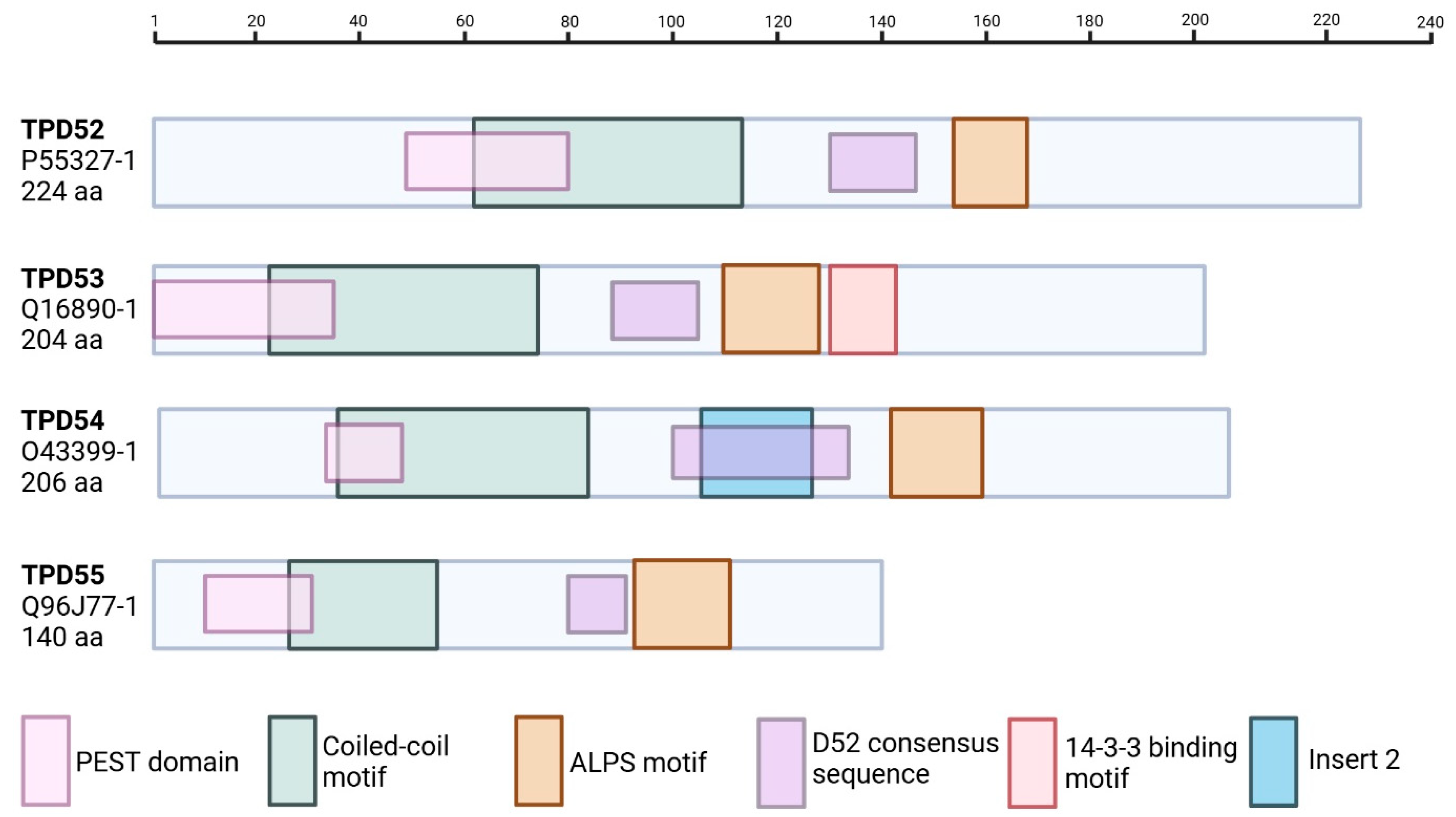
| TPD52-like Protein | PEST Motif | Coiled-Coil Motif | ALPS Motif | D52 Consensus Sequence | 14-3-3 Binding Motif | Insert 2 |
|---|---|---|---|---|---|---|
| TPD52 | 50–80 | 62–114 | 151–168 | 130–143 | – | – |
| TPD53 | 1–36 | 22–73 | 111–128 | 89–103 | 130–142 | – |
| TPD54 | 34–50 | 38–82 | 141–158 | 100–133 | – | 106–125 |
| TPD55 | 16–30 | 28–57 | 95–112 | partial, 83–91 | – | – |
| Cancer Type | Role | Reference |
|---|---|---|
| Brain Cancer | TPD52 upregulated, with expression increasing as cancer stage advances; identified in gene panels with prognostic or diagnostic value; involved in the protein kinase B (Akt) signaling pathway. | [81] |
| Bladder Cancer | TPD52 promotes activating transcription factor 6 (ATF6) activation during ER stress and regulates ER size; activates the unfolded protein response and increases ER stress-induced apoptosis; APCCdc20 marks TPD52 for degradation through polyubiquitination at K179; acts as a tumor suppressor. | [82] |
| Identified in an androgen-responsive gene model for patient prognosis; high TPD52 expression detected in macrophages and T cells; suggested protective role in immune regulation. | [83] | |
| Blood cancers | TPD52 expression is associated with worse outcomes in infant acute lymphoblastic leukemia. | [92] |
| TPD52 is overexpressed in patients with acute myeloid leukemia and associated with poor prognosis. | [99] | |
| TPD52 expression increases in acute myeloid leukemia patients with poor cytogenetic factors; required for hematopoietic stem cell maintenance through regulation of cell proliferation; TPD52 and CD59 expression correlate. | [91] | |
| Lower TPD52 expression is observed in Hodgkin lymphoma patients with bleomycin-induced pulmonary toxicity. | [100] | |
| TPD52 binds annexin VI in a Ca2+-dependent manner in myeloma cell lines; strongest TPD52 expression is detected in plasma cell malignancies; maximal expression occurs during differentiation from B-cells to plasma cells; anti-TPD52 antibody proposed as a diagnostic tool for B-cell malignancies. | [101] | |
| TPD52 is frequently co-expressed with TPD54 in childhood leukemia; decreased TPD52 expression is associated with hyperdiploid acute lymphoblastic leukemia. | [32] | |
| Identified as one of the most co-expressed genes with NFKB1 (encoding the NFκB p50 subunit) in multiple myeloma. | [102] | |
| Identified as one of eleven proteins activated in ATX-101-sensitive multiple myeloma cell lines. | [103] | |
| Breast Cancer | Identified as a potential marker in breast cancer patients carrying a BRCA1 Ser1841Asn mutation. | [104] |
| TPD52 is significantly overexpressed in patient samples and associated with reduced overall survival; TPD52-expressing fibroblasts exhibit increased proliferation and anchorage-independent growth; reduced TPD52 expression increases apoptosis. | [74] | |
| TPD52-overlapping synthetic peptide immunization breaks tolerance of TPD52-expressing tumor cells and induces cytotoxic T-lymphocyte activity; TPD52-vaccinated mice show improved survival when challenged with TPD52-expressing breast cancer cells. | [105] | |
| TPD52 expression in lymphocytes from breast cancer patients strongly correlates with G2 score. | [106] | |
| High TPD52 expression is associated with worse metastasis-free survival; identified as a survival factor in ERBB2-amplified breast cancer cells; evidence suggests complementary cellular functions between TPD52 and ERBB2. | [73] | |
| Higher TPD52 expression is observed in metastatic tumors; TPD52 is a direct target of miR-34a; involved in epithelial-to-mesenchymal transition (EMT), cell invasion, and migration. | [107] | |
| TPD52 is significantly upregulated; a major target of miR-107; miR-107 reduces TPD52 expression and increases sensitivity to paclitaxel. | [108] | |
| Directly regulated by miR-449a and miR-34a; further negatively regulated by Star-PAP; involved in cell proliferation and apoptosis. | [109] | |
| TPD52 is highly expressed in triple-negative breast cancer tissues; a direct target of miR-185-5p; TPD52 downregulation enhances radiosensitivity of triple-negative breast cancer cells. | [72] | |
| Identified in a 14-gene, hypoxia-related prognostic signature. | [110] | |
| TPD52 is increased in patient blood; expression is elevated in metastatic disease, treatment-naïve patients, and higher tumor stages (III–IV). | [75] | |
| High TPD52 expression is associated with poorer survival; it is downregulated by miR-101-5p. | [111] | |
| TPD52 is upregulated; silencing suppresses cell proliferation and migration; TPD52 knockdown reduces tumor growth in vivo; a target of miR-218-5p and involved in an axis with NEAT1. | [112] | |
| TPD52 is highly expressed and associated with worse survival; a downstream target of miR-125b-5p (a cancer repressor); overexpression promotes cell proliferation, invasion, and migration. | [70] | |
| TPD52 interacts with AMPKα to regulate AMPK activation and cellular metabolism in vitro and in vivo; is positively correlated with lipogenesis and glycolysis gene expression. | [21] | |
| TPD52 is overexpressed and associated with unfavorable prognosis, particularly in ER+/PR+/HER2+ patients; associated with immune cell infiltration; high-TPD52 patient groups show negative enrichment of signaling pathways including AMPK, fatty acid, cholesterol, glucose, and alcohol metabolism. | [71] | |
| High TPD52 expression is associated with lower anti-tumorigenic immune cells; involved in cell proliferation and migration; macrophage migration is significantly decreased following coculture with TPD52 knockdown breast cancer cells. | [113] | |
| TPD52 is associated with breast cancer risk; knockdown reduces cell migration and colony formation. | [114] | |
| TPD52 expression is increased in patients; highest expression occurs in luminal A/B subtypes; acts as a regulator of Akt and protein kinase C (PKC) pathways. | [76] | |
| TPD52 sequence was identified; it is expressed in breast cancer cells and tissues. | [7] | |
| TPD52 and TPD53 regulate activities through homo- and heteromeric interactions in breast cancer cells. | [11] | |
| TPD52 locus represents a target for copy number gain. | [94] | |
| TPD52 expression in breast cancer cells compromises ATM-mediated cellular responses to DNA double-strand breaks induced by irradiation; direct interactions occur between TPD52 and ATM; TPD52 is suggested as a negative regulator of ATM protein levels. | [115] | |
| Identified in a panel of genes with alternative splicing and transcriptional events in ER+ HER2− and ER− HER2− patients. | [116] | |
| TPD52 siRNA delivered by HER2/Neu exosomes to breast cancer cells reduces gene expression by up to 70%. | [117] | |
| A direct target of miR-1323; low miR-1323 expression contributes to TPD52 overexpression and breast cancer progression. | [118] | |
| TPD52 expression levels increase through activation of estrogen-related receptor alpha (ERRα) pathway. | [119] | |
| TPD52 is highly expressed in luminal A/B, HER2+, and basal-like breast cancer subtypes; a target of miR-139-5p. | [120] | |
| Cervical Cancer | Direct target of miR-15a-3p; TPD52 expression is significantly increased in cancer compared to normal tissue; TPD52 expression decreases after radiotherapy; TPD52 knockdown suppresses proliferation and increases apoptosis in cells exposed to radiation; miR-15a-3p enhances radiosensitivity of cervical cancer in vivo via TPD52 downregulation. | [121] |
| TPD52 is upregulated in tissues and cells; hsa_circ_0084927 upregulates TPD52 expression by downregulating miR-634; hsa_circ-0084927 inhibition in vivo reduces tumor growth and TPD52 expression. | [122] | |
| TPD52 is significantly upregulated in patient blood; higher TPD52 expression is observed in early stage (I–II) and non-metastatic patients; patients undergoing chemoradiotherapy show the lowest TPD52 expression, indicating a better prognosis. | [78] | |
| Direct target of miR-218; elevated expression is associated with increased cell proliferation, migration, and invasion. | [79] | |
| TPD52 expression is stabilized by circ_006551 via recruitment of ELAVL1; TPD52 overexpression promotes cell migration and invasion capabilities. | [123] | |
| Cholangiocarcinoma | TPD52 is elevated in cell lines, tissues, and bile samples; high expression correlates with poorer patient survival. | [124] |
| Colorectal Cancer | TPD52 is amplified to higher levels in liver metastases compared to corresponding primary tumors. | [28] |
| TPD52 is significantly upregulated in all cases of colorectal cancer investigated, irrespective of localization, stage, and grade. | [84] | |
| TPD52 is highly expressed in tissue and cells; a downstream target of miR-139-5p; TPD52 expression regulated by Krüppel-like factor 7 (KLF7); overexpression of TPD52 increases cell viability, migration, and invasion; KLF7 inhibition in vivo reduces TPD52 expression and thereby restricts tumor growth. | [125] | |
| Gastric Cancer | Identified as a potential substrate of USP10. | [96] |
| Glioma | TPD52 is negatively regulated by miR-244-5p. | [126] |
| Glioblastoma | A target of miR-103a-3p; silencing of FGD5-AS1 (FYVE, RhoGEF, and PH domain-containing 5 antisense RNA 1) in vivo leads to decreased TPD52 expression and reduced tumor volume. | [127] |
| Exclusively detected in recurrent glioblastoma patient saliva and indicative of relapse. | [128] | |
| Insulinoma | Lower TPD52 expression is observed in malignant insulinomas than in benign insulinomas; low expression correlates with poorer patient survival. | [129] |
| Lung Adenocarcinoma | TPD52 expression is significantly upregulated in tumors; TPD52 expression is higher in brain metastases compared to matched primary lung cancer; possible regulation by miR-145-5p. | [130] |
| Direct target of miR-218; all patient samples stain moderately or strongly positive for TPD52 expression; knockdown of TPD52 decreases cell migration and invasion. | [77] | |
| TPD52 expression is regulated by the androgen receptor/circ-SLCO1B7/miR-139-5p axis; lung cancer patients with lower TPD52 expression have higher survival rates; miR-139-5p directly targets the 3′-untranslated region (UTR) of TPD52 to reduce protein expression. | [131] | |
| Identified among seven genes coordinately regulated by miR-145-5p and miR-145-3p. | [132] | |
| TPD52 is upregulated by circEZH2-mediated sponging of miR-495-3p; TPD52 expression activates the NF-κB p65 signaling pathway. | [133] | |
| Medulloblastoma | Positive immunohistochemistry staining for TPD52 is a significant predictor of relapse, death, and poor response to chemotherapy. | [134] |
| Melanoma | TPD52 is identified as a novel PAX3 (paired box gene 3) target regulating cell proliferation in melanoma cells. | [135] |
| Nasopharyngeal Carcinoma | Higher TPD52 expression is observed in tumor tissue compared to normal tissue; a target gene of miR-636. | [136] |
| Direct target of miR-449b-5p that downregulates expression and thereby suppresses cell proliferation, migration, and invasion. | [137] | |
| Neuroblastoma | Expression of TPD52 induces cell differentiation through the Janus Kinase/Signal Transducer and Activator of Transcription (JAK/STAT) signaling pathway; protects cells from apoptosis via Akt and ERK1/2 activation, and arrests cell proliferation by modulating p27Kip1 expression. | [138] |
| Oral Squamous Cell Carcinoma | TPD52 mRNA and protein levels increase under hypoxia independent of hypoxia-inducible factor (HIF); TPD52 plays role in cell proliferation and apoptosis under hypoxia; TPD52 knockdown (and inhibition of HIF) in vivo reduces tumor growth. | [139] |
| TPD52 overexpression in TPD54 knockdown cells increases colony formation. | [140] | |
| Osteosarcoma | Anti-TPD52 serum reduces cell proliferation and increases apoptosis in vitro; anti-TPD52 serum decreases osteosarcoma growth while increasing cytokine secretion (IFN-γ, TNF-α, IL-12) and apoptosis in vivo. | [141] |
| Ovarian Cancer | TPD52 is significantly overexpressed in ovarian carcinomas while normal and benign tissues are negative for expression. | [80] |
| TPD52 is overexpressed in ovarian cancer compared to normal ovarian tissue and predicts worse survival; a downstream target of miR-495-3p; plays a role in cell migration and invasion. | [142] | |
| TPD52 expression is increased in patient blood compared to healthy individuals. | [143] | |
| TPD52 binds to miR-7515, and its expression is regulated by long noncoding RNA FTX; this axis facilitates migration, invasion, and EMT. | [144] | |
| Pan Cancer | TPD52 is expressed at higher levels in tumor-derived cell lines from multiple cancers; higher TPD52 expression is observed in lung tumors compared to normal lung tissue. | [145] |
| Identified as one of eight oncogenes upregulated in 258 tumor samples. | [93] | |
| Low TPD52 expression correlates with poor survival in breast cancer, papillary renal cell carcinoma, acute myeloid leukemia, liver hepatocellular carcinoma, uterine corpus endometrial carcinoma, and uveal melanoma. | [146] | |
| TPD52 is expressed at varying levels in normal tissues; expression is upregulated in 18/29 cancer types, with the strongest TPD52 upregulation in non-seminoma, ductal, and lobular breast cancer; downregulated in papillary renal cell cancer, leiomyosarcoma, clear cell renal cell cancer, and liposarcoma. | [147] | |
| TPD52 knockdown significantly alters radiation sensitivity in pancreatic cancer cells (HuP-T3) and cervical cancer (HeLa). | [148] | |
| Pancreatic Cancer | High TPD52 expression is observed in pancreatic cancer cells; TPD52 silencing reduces cell proliferation, migration, and invasion but induces apoptosis via dephosphorylation of Akt. | [69] |
| High TPD52 expression in patients correlates with poorer outcomes. | [68] | |
| Primary Hepatocellular Carcinoma | Identified as a potential tumor suppressor; TPD52 expression is decreased in tissues and cells; expression correlates with improved overall survival. | [98] |
| Prostate Cancer | Identification of prostate-specific isoform of the TPD52-like family (PrLZ or PC-1); amplified expression in prostate cancer is tumor cell-specific. | [88] |
| TPD52 expression peaks at 24 years of age before declining but reactivates during prostate cancer development; expression increases from primary tumor to bone metastasis; expression accelerates cell growth in vitro and in vivo. | [149] | |
| TPD52 expression improves cancer cell growth, anchorage-independent colony formation, and tumor burden in mice; expression promotes androgen-independent progression and resistance to Casodex; functions in the Akt signaling pathway. | [9] | |
| TPD52 expression enhances cancer cell proliferation, invasion, and tumorigenicity in vivo; TPD52 may regulate androgen receptor expression and increase prostate-specific antigen (PSA) expression. | [150] | |
| Mice immunized with a Tpd52 vaccine are protected from prostate tumors that exogenously express Tpd52; vaccination induces a memory cell immune response. | [151] | |
| TPD52 overexpression promotes androgen-deprived cancer cell growth, colony formation, and tumor growth in castrated mice; TPD52 prevents release of cytochrome c intracellularly and inhibits androgen-depletion-induced apoptosis; TPD52 elevates phosphorylation of Akt and Stat3 and upregulates Bcl-2 expression. | [152] | |
| TPD52 chromosomal region is gained; copy number alterations of TPD52 correlate with early mortality. | [153] | |
| Identified to be associated with prostate cancer risk and HNF1B expression, a major risk gene for prostate cancer susceptibility. | [154] | |
| TPD52 can directly interact with the androgen receptor to enhance transactivation in castration-resistant prostate cancer; TPD52 expression increases after androgen deprivation treatment and in castration-resistant patients; silencing TPD52 suppresses tumor growth. | [155] | |
| TPD52 induces EphA3 expression to promote cell proliferation, survival, and tumor development. | [156] | |
| TPD52 is a direct target of miR-224 regulation; involved in cancer cell migration and invasion. | [157] | |
| TPD52 expression promotes resistance to rapamycin treatment; TPD52 regulates eukaryotic initiation factor 4E-binding protein 1 (4E-BP1). | [158] | |
| TPD52 copy number gain is confirmed in cancer genome; identified in prognostic gene signature that distinguishes five subgroups of prostate cancer. | [159] | |
| miR-218 binds to the 3′-UTR of TPD52 to inhibit expression and suppress cancer cell growth. | [160] | |
| Identified in a 7-gene epigenetic signature (based on methylation status) associated with worse recurrence-free survival; TPD52 methylation inversely correlates with expression. | [161] | |
| TPD52 expression is upregulated in prostate cancer tissues through the loss of miR-499a; TPD52 silencing suppresses in vitro cell proliferation and in vivo tumor growth and metastasis. | [89] | |
| TPD52 increases docetaxel-mediated drug resistance through interactions with LKB1 to inhibit activation of LKB1/AMPK signals. | [162] | |
| TPD52 enhances activation of chaperone-mediated autophagy (CMA) through interactions with HSPA8/HSC70; expression is essential for CMA-mediated proliferation and stress resistance; TPD52 undergoes acetylation-dependent regulation to modulate tumor growth in vivo. | [163] | |
| TPD52 is upregulated in docetaxel-resistant tissues; TPD52 is a direct target of miR-1182, and upregulation reduces docetaxel sensitivity. | [164] | |
| TPD52 downregulation inhibits cancer cell migration and invasion, and reduces tumor growth with a reduction in serum PSA; treatment with an anti-proliferative agent reduces TPD52 expression and slows tumor growth in mice. | [165] | |
| Direct binding of miR-103a-3p to the 3′-UTR of TPD52 reduces expression and inhibits cancer cell migration and invasion. | [166] | |
| TPD52 can be degraded by E3 ubiquitin-ligase substrate-binding adaptor SPOP; TPD52 degradation is regulated by IL-6 and ERK1/2 phosphorylation. | [167] | |
| TPD52 expression initiates EMT by activating TGF-β1/p-SMAD signaling as well as downregulating miR-200 family expression; TPD52-expressing cells lead to the development of metastases in vivo. | [168] | |
| TPD52 has lower methylation levels in prostate cancer tissues; TPD52 isoform 3 overexpression promotes resistance to mTOR drugs through sustained activation of the Akt pathway and increases phosphorylation of c-Myc and 4E-BP1; TPD52 expression prevents restoration of PTEN by mTOR inhibitors. | [169] | |
| TPD52 is identified as part of an axis with LINC01122; hypomethylation of the LINC01122/TPD52 axis abnormally upregulates expression and correlates with patient prognosis. | [170] | |
| TPD52 is highly expressed in prostate cancer tissues and shows increased copy number; TPD52 contains androgen-response elements in its upstream promoter, indicating protein level regulation by androgens. | [86] | |
| Expression of TPD52 is regulated by upstream negative and positive elements in its promoter region. | [171] | |
| TPD52 is overexpressed; depletion leads to cancer cell apoptosis and decreases proliferation; expression promotes cell migration via integrin αvβ3 and activation of the Akt signaling pathway. | [87] | |
| Identification of TPD52 isoforms and their interaction with 14-3-3 proteins. | [172] | |
| TPD52 is identified as a downstream target of MYST1 and the androgen receptor to regulate cell cycle progression and proliferation of cancer cells. | [173] | |
| IL-6 administration upregulates TPD52 isoform 1 (PC-1) expression while other isoforms are not affected; TPD52 overexpression enhances neuroendocrine differentiation of prostate cancer cells, which is associated with castration resistance. | [174] | |
| Depletion of endogenous TPD52 expression increases cancer cell radiosensitivity by reducing DNA double-strand break repair and inducing autophagic-cell death. | [175] | |
| TPD52 isoform 3 confers transactivation of NF-κB to promote the transcription of TNF-α, IL-6, and IL-8, and it activates STAT3; TPD52 is involved in cell proliferation. | [176] | |
| TPD52 isoform (PrLZ) is identified as an androgen-regulated gene in prostate cancer. | [177] | |
| TPD52 is significantly upregulated in African American men compared to Caucasian American men. | [178] | |
| TPD52 interacts with PRDX1 through the C-terminal PEST sequence and regulates peroxidase activity; altered expression of TPD52 affects cancer cell growth, survival, and migration. | [22] | |
| TPD52 preferentially uses androgen-receptor-induced promoter 2 to generate an alternative first-exon event, resulting in a prostate-specific isoform. | [179] | |
| TPD52 overexpression inhibits AMPK activation through interactions with LKB1 to exert an oncogenic role. | [85] | |
| TPD52 isoform 3 induces neuroendocrine differentiation of prostate cancer cells by activation of the STAT3/NF-κB axis; TPD52 positively regulates EMT in cancer cells. | [180] | |
| Renal Cell Carcinoma | Decreased gene and protein expression in cells; TPD52 overexpression inhibits cell proliferation, migration, and invasion, and it reduces EMT phenotypes through the PI3K/Akt pathway; overexpression in vivo decreases tumor growth. | [97] |
| Salivary Adenoid Cystic Carcinoma | Higher TPD52 expression is observed in healthy tissues; TPD52 overexpression significantly suppresses cell migration while knockdown promotes cell migration; TPD52 expression increases epithelial markers; a downstream target of miR-103a-3p. | [181] |
| Small cell lung cancer | Axis between TCONS_00020615, miR-26b-5p, and TPD52 is associated with small-cell lung cancer. | [182] |
| Testicular germ cell tumors | TPD52 is overexpressed at both gene and protein levels within testicular germ cell tumors compared to normal testis. | [90] |
| Uterine Corpus Endometrial Carcinoma | TPD52 overexpression is associated with clinical factors and poor survival; implicated in a network with miR-1-3p; expression is associated with immune infiltration and immune checkpoints. | [183] |
| Cancer Type | Role | Reference |
|---|---|---|
| Breast Cancer | TPD53 is overexpressed in lymph node-positive breast cancer. | [192] |
| 14-3-3 proteins are heterologous binding partners of TPD53; alternative splicing regulates 14-3-3 binding to TPD53. | [23] | |
| TPD53 expression is highly upregulated at the G2-M transition; interactions between TPD53 and 14-3-3 increase in populations enriched for cells in the G2/M phase; TPD53 overexpression produces multinucleated cells, indicating roles in the completion of mitosis. | [186] | |
| Colon Adenocarcinoma | Identified among a 17-gene, mitosis-related model for predicting survival in colon cancer patients. | [197] |
| Colorectal Cancer | Marker of poor prognosis; TPD53 expression promotes malignant behaviors in vitro (cell proliferation, colony formation, migration, and invasion); TPD53 knockdown leads to cell cycle arrest in the S phase. | [195] |
| Identified in a 9-gene panel found to be significantly upregulated with neoplasia in patients with inflammatory bowel disease (linked to increased colorectal cancer risk). | [202] | |
| Hepatocellular carcinoma | TPD53 identified among an 8-gene prognostic model associated with overall patient survival. | [198] |
| Lung adenocarcinoma | Case Report: TPD53-ROS1 fusion variant is identified in a patient that leads to acquired resistance to Osimertinib. | [201] |
| Case Report: Novel TPD53-ROS1 fusion variant is identified in a patient, generated by intra-chromosomal rearrangement. | [193] | |
| Nasopharyngeal cancer | Identified as a novel tumor-suppressor gene (among four others) that is downregulated in recurrent nasopharyngeal cancer patients. | [199] |
| Oral squamous cell carcinoma | TPD53 expression promotes cell invasion, migration, and MMP activity via the Akt pathway; TPD53 overexpression increases cell viability and the percentage of cells in the S phase; TPD53 overexpression in mice enhances tumor formation and growth. | [194] |
| Ovarian Cancer | Identified to be downregulated in tumors following chemotherapy, with links to acquired chemoresistance. | [200] |
| Thyroid cancer | TPD53 identified as part of a 6-gene prognostic signature associated with anoikis (apoptosis triggered by loss or improper attachment to ECM) in thyroid cancer patients. | [196] |
| First Population | Second Population | Third Population | Fourth Population | Intermediate Populations | ||
|---|---|---|---|---|---|---|
| Bound TPD52-like family member(s) | TPD52 TPD53 TPD54 | TPD52 | TPD54 | TPD53 | TPD52 and/or TPD54 | TPD53 and/or TPD54 |
| Bound Rab protein(s) | Rab30 Rab14 Rab1a/b Rab26 | Rab10 Rab17 | Rab3a Rab4a Rab25 | Rab19b Rab33b | Rab11a | Rab12 Rab43 |
| Cancer Type | Role of TPD54 | Reference |
|---|---|---|
| Breast Cancer | TPD54 expression decreases sensitivity to radiation therapy; promotes proliferation, migration, and metastasis; mediates α5β1 integrin trafficking during migration; recognizes binding partners TPD52, TPD53, and Rab GTPases. | [8] |
| Low TPD54 expression is associated with metformin resistance through modulation of pyruvate dehydrogenase enzyme activity; mitochondrial localization. | [218] | |
| TPD54 expression is significantly increased in breast cancer tissue compared to normal breast tissue. | [74] | |
| Clear Cell Renal Cell Carcinoma | TPD54 is overexpressed in tumor tissues and is associated with worse survival; expression regulated by DNA methylation; plays a role in negative regulation of immune-cell infiltration; TPD54 knockdown in vitro reduces cell proliferation, migration, and invasion. | [208] |
| Colon Cancer | Identified among four genes that are overexpressed and strongly influence carcinogenesis. | [209] |
| Glioblastoma | Low TPD54 expression is associated with poor prognosis, enhanced migration, and decreased proliferation rate; regulates EMT status via modulation of the Wnt pathway. | [217] |
| Glioma | TPD54 promotes cell proliferation and colony formation in vitro; knockdown induces G0/G1 cell cycle arrest. | [210] |
| Direct target of miR-484-5p; TPD54 expression reverses miR-485-5p-induced repression of cell proliferation, migration, and invasion. | [211] | |
| Head and Neck Squamous Carcinoma | TPD54 is overexpressed and identified as an independent prognostic marker of overall survival; is associated with immune-related signaling, migration, and cancer-related pathways; TPD54 expression is associated with TP53 mutations. | [207] |
| Lung Adenocarcinoma | TPD54 is overexpressed and associated with worse survival; modulates the TME by recruiting TAMs and Tregs; is associated with immunosuppressive genes (CD274, TGF-β1, and TGF-βR1). | [212] |
| Oral Squamous Cell Carcinoma | TPD54 overexpression negatively regulates ECM-dependent cell attachment and migration; decreases integrin activation (inside-out signaling) via modulation of talin1 expression. | [216] |
| TPD54 reduces cell migration; overexpression attenuates tumor growth in vivo. | [140] | |
| Pancreatic Cancer | TPD54 promotes cell proliferation, invasion, and migration; TPD54 knockdown inhibits PIK3CA/Akt signaling; is a downstream target of miR-217. | [213] |
| Prostate Cancer | TPD54 upregulation is associated with poor prognosis and participates in tumorigenesis and tumor progression. | [214] |
| Increased TPD54 expression is associated with increased cell proliferation, migration, and colony formation; miR-503 downregulates TPD54 expression. | [215] |
Disclaimer/Publisher’s Note: The statements, opinions and data contained in all publications are solely those of the individual author(s) and contributor(s) and not of MDPI and/or the editor(s). MDPI and/or the editor(s) disclaim responsibility for any injury to people or property resulting from any ideas, methods, instructions or products referred to in the content. |
© 2026 by the authors. Licensee MDPI, Basel, Switzerland. This article is an open access article distributed under the terms and conditions of the Creative Commons Attribution (CC BY) license.
Share and Cite
Dorward, E.L.; Ortiz, M.; Weekley, C.M.; Myo Min, K.K.; Duijf, P.H.G.; Barreto, S.G.; Parker, M.W.; Bonder, C.S. Unpacking the Tumor Protein D52-like Family: Roles in Intracellular Trafficking and Cancer Progression. Cells 2026, 15, 252. https://doi.org/10.3390/cells15030252
Dorward EL, Ortiz M, Weekley CM, Myo Min KK, Duijf PHG, Barreto SG, Parker MW, Bonder CS. Unpacking the Tumor Protein D52-like Family: Roles in Intracellular Trafficking and Cancer Progression. Cells. 2026; 15(3):252. https://doi.org/10.3390/cells15030252
Chicago/Turabian StyleDorward, Emma L., Michael Ortiz, Claire M. Weekley, Kay K. Myo Min, Pascal H. G. Duijf, S. George Barreto, Michael W. Parker, and Claudine S. Bonder. 2026. "Unpacking the Tumor Protein D52-like Family: Roles in Intracellular Trafficking and Cancer Progression" Cells 15, no. 3: 252. https://doi.org/10.3390/cells15030252
APA StyleDorward, E. L., Ortiz, M., Weekley, C. M., Myo Min, K. K., Duijf, P. H. G., Barreto, S. G., Parker, M. W., & Bonder, C. S. (2026). Unpacking the Tumor Protein D52-like Family: Roles in Intracellular Trafficking and Cancer Progression. Cells, 15(3), 252. https://doi.org/10.3390/cells15030252