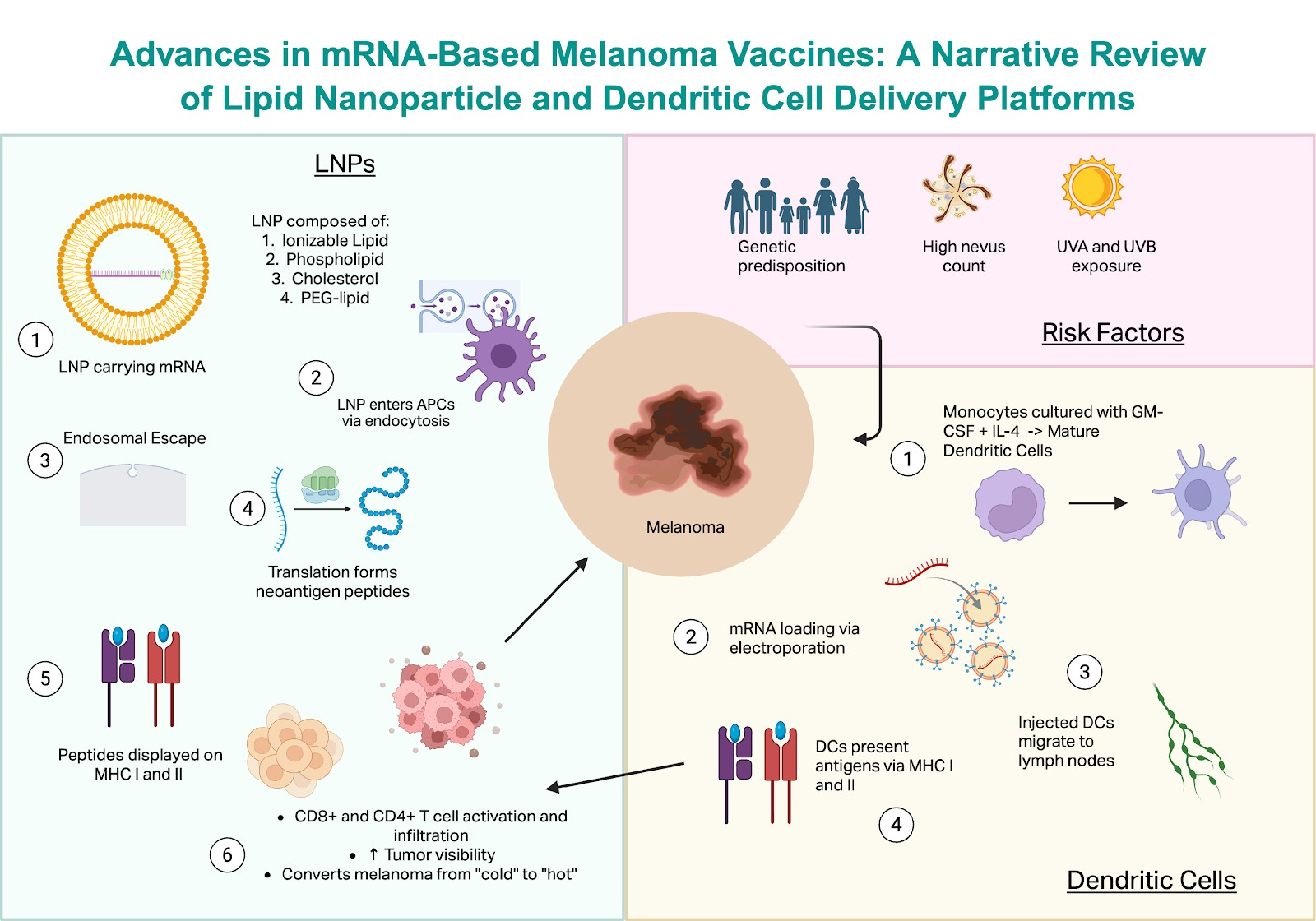
Advances in mRNA-Based Melanoma Vaccines: A Narrative Review of Lipid Nanoparticle and Dendritic Cell Delivery Platforms


Highlights
- mRNA-based melanoma vaccines delivered through lipid nanoparticles (LNPs) or dendritic cells (DCs) generate strong neoantigen-specific T-cell responses.
- Personalized mRNA vaccine platforms show early clinical benefit, especially when combined with immune checkpoint inhibitors.
- Optimizing delivery systems and neoantigen selection may further enhance the therapeutic impact of mRNA melanoma vaccines.
- Hybrid and personalized vaccine strategies represent promising future directions for improving melanoma immunotherapy outcomes.
Abstract
1. Introduction
2. Melanoma and Conventional Treatment Modalities
2.1. Disease Overview
2.2. Pathophysiology and Immune Response
2.3. Conventional Melanoma Therapeutics
3. mRNA Vaccine Overview
3.1. Immunological Mechanisms of mRNA Vaccines
3.2. Advantages of mRNA Vaccines
3.3. Challenges of mRNA Vaccines
4. Types of mRNA Vaccines
4.1. Dendritic Cell-Based mRNA Vaccines Overview and Vaccine Mechanism
4.1.1. Vaccine Preparation and mRNA Loading Techniques
4.1.2. Limitations of Dendritic Cell-Based mRNA Vaccines
4.2. Lipid Nanoparticle mRNA Vaccines
4.2.1. Lipid Nanoparticle mRNA Vaccine Mechanism and Structure
4.2.2. Comparative Advantages
4.2.3. Limitations of Lipid Nanoparticle-Based mRNA Melanoma Vaccines
4.3. Dendritic Cell Vaccines and LNPs in Clinical Melanoma Trials
4.3.1. Lipid Nanoparticle Vaccines—Completed Clinical Trials
4.3.2. Dendritic Cell Vaccines—Completed Clinical Trials
4.3.3. Ongoing Clinical Trials
4.4. Emerging Trends and Hybrid Strategies
4.4.1. Advances in Dendritic Cell-Based Vaccine Engineering
4.4.2. Innovations in LNP Design and mRNA Engineering
4.4.3. Neoantigen-Based Vaccines and Personalization
4.4.4. Artificial Intelligence and Machine Learning
5. Conclusions
Author Contributions
Funding
Institutional Review Board Statement
Informed Consent Statement
Data Availability Statement
Acknowledgments
Conflicts of Interest
Abbreviations
| AE | adverse event |
| AI | artificial intelligence |
| APC | antigen-presenting cell |
| CAR | chimeric antigen receptor |
| cDC | conventional dendritic cell |
| COVID-19 | coronavirus disease 2019 |
| CRISPR | Clustered Regularly Interspaced Short Palindromic Repeats |
| CTL | cytotoxic T lymphocytes |
| CTLA-4 | cytotoxic T-lymphocyte-associated protein 4 |
| DC | dendritic cell |
| DNA | deoxyribonucleic acid |
| DNS | dysplastic nevus syndrome |
| FAMMM | familial atypical multiple mole and melanoma syndrome |
| G-CSF | granulocyte colony-stimulating factor |
| GM-CSF | granulocyte-macrophage colony-stimulating factor |
| HLA | human leukocyte antigen |
| HSV-1 | herpes simplex virus-1 |
| ICI | immune checkpoint inhibitor |
| IFN | interferon |
| IL | interleukin |
| IM | intramuscular |
| IV | intravenous |
| JAK/STAT | Janus kinase/Signal Transducer and Activator of Transcription |
| LNP | lipid nanoparticle |
| MAGE-A6 | melanoma-associated antigen A6 |
| MAPK | mitogen-activated protein kinase |
| MART-1 | Melanoma Antigen Recognized by T cells 1 |
| MC1R | melanocortin-1 receptor |
| MDSC | myeloid-derived suppressor cells |
| MHC | major histocompatibility complex |
| MITF | microopthalmia-associated transcription factor |
| MoDC | monocyte-derived dendritic cell |
| mRNA | messenger ribonucleic acid |
| NF-κB | nuclear factor-κB |
| NK | natural killer |
| pDC | plasmacytoid dendritic cell |
| PD-1 | programmed death-1 |
| PD-L1 | programmed death-ligand 1 |
| TAA | tumor-associated antigen |
| TBVA | tumor blood vessel antigens |
| Tfh | T follicular helper cells |
| TLR | toll-like receptor |
| TLPLDC | Tumor Lysate, Particle-Loaded, Dendritic Cell Vaccine |
| TLPO | tumor lysate, particle only |
| TME | tumor microenvironment |
| TNF-α | tumor necrosis factor-α |
| T-VEC | oncolytic viral therapy |
| TSA | tumor-specific antigen |
| UV | ultraviolet |
References
- Caraviello, C.; Nazzaro, G.; Tavoletti, G.; Boggio, F.; Denaro, N.; Murgia, G.; Passoni, E.; Benzecry Mancin, V.; Marzano, A.V. Melanoma Skin Cancer: A Comprehensive Review of Current Knowledge. Cancers 2025, 17, 2920. [Google Scholar] [CrossRef] [PubMed]
- Gazouli, I.; Bafaloukos, D.; Koutserimpas, C.; Samonis, G. Individualized mRNA Vaccines in Melanoma-Where Do We Stand? Vaccines 2025, 13, 986. [Google Scholar] [CrossRef]
- Duffy, D.L.; Lee, K.J.; Jagirdar, K.; Pflugfelder, A.; Stark, M.S.; McMeniman, E.K.; Soyer, H.P.; Sturm, R.A. High naevus count and MC1R red hair alleles contribute synergistically to increased melanoma risk. Br. J. Dermatol. 2019, 181, 1009–1016. [Google Scholar] [CrossRef] [PubMed]
- White, E.; Kirkpatrick, C.S.; Lee, J.A. Case-control study of malignant melanoma in Washington State. I. Constitutional factors and sun exposure. Am. J. Epidemiol. 1994, 139, 857–868. [Google Scholar] [CrossRef]
- International Agency for Research on Cancer Working Group on artificial ultraviolet (UV) light and skin cancer. The association of use of sunbeds with cutaneous malignant melanoma and other skin cancers: A systematic review. Int. J. Cancer 2007, 120, 1116–1122. [Google Scholar] [CrossRef]
- Soura, E.; Eliades, P.J.; Shannon, K.; Stratigos, A.J.; Tsao, H. Hereditary melanoma: Update on syndromes and management: Emerging melanoma cancer complexes and genetic counseling. J. Am. Acad. Dermatol. 2016, 74, 411–420, quiz 421–422. [Google Scholar] [CrossRef]
- Whiteman, D.C.; Watt, P.; Purdie, D.M.; Hughes, M.C.; Hayward, N.K.; Green, A.C. Melanocytic nevi, solar keratoses, and divergent pathways to cutaneous melanoma. J. Natl. Cancer Inst. 2003, 95, 806–812. [Google Scholar] [CrossRef]
- Ferrone, C.R.; Ben Porat, L.; Panageas, K.S.; Berwick, M.; Halpern, A.C.; Patel, A.; Coit, D.G. Clinicopathological features of and risk factors for multiple primary melanomas. JAMA 2005, 294, 1647–1654. [Google Scholar] [CrossRef]
- Olsen, C.M.; Wilson, L.F.; Green, A.C.; Bain, C.J.; Fritschi, L.; Neale, R.E.; Whiteman, D.C. Cancers in Australia attributable to exposure to solar ultraviolet radiation and prevented by regular sunscreen use. Aust. N. Z. J. Public Health 2015, 39, 471–476. [Google Scholar] [CrossRef] [PubMed]
- Gloster, H.M.; Neal, K. Skin cancer in skin of color. J. Am. Acad. Dermatol. 2006, 55, 741–760, quiz 761–764. [Google Scholar] [CrossRef]
- Holman, C.D.; Armstrong, B.K. Cutaneous malignant melanoma and indicators of total accumulated exposure to the sun: An analysis separating histogenetic types. J. Natl. Cancer Inst. 1984, 73, 75–82. [Google Scholar]
- Slominski, R.M.; Sarna, T.; Płonka, P.M.; Raman, C.; Brożyna, A.A.; Slominski, A.T. Melanoma, Melanin, and Melanogenesis: The Yin and Yang Relationship. Front. Oncol. 2022, 12, 842496. [Google Scholar] [CrossRef]
- Aebischer, V.; Abu-Ghazaleh, A.; Metzler, G.; Riedl, L.; Garbe, C.; Flatz, L.; Eigentler, T.; Forchhammer, S. Histopathologic abundance of pigmentation correlates with disease-specific survival in malignant melanoma but is not independent of current AJCC pT stage. Pigment Cell Melanoma Res. 2023, 36, 512–521. [Google Scholar] [CrossRef]
- Guo, W.; Yin, G.; Liu, H.; Duan, H.; Huang, Z.; Chen, X. Matched analysis of the prognosis of amelanotic and pigmented melanoma in head and neck. Acta Otolaryngol. 2020, 140, 785–788. [Google Scholar] [CrossRef]
- Brożyna, A.A.; Jóźwicki, W.; Roszkowski, K.; Filipiak, J.; Slominski, A.T. Melanin content in melanoma metastases affects the outcome of radiotherapy. Oncotarget 2016, 7, 17844–17853. [Google Scholar] [CrossRef] [PubMed]
- Wehbe, M.; Soudja, S.M.; Mas, A.; Chasson, L.; Guinamard, R.; de Tenbossche, C.P.; Verdeil, G.; Van den Eynde, B.; Schmitt-Verhulst, A.-M. Epithelial-mesenchymal-transition-like and TGFβ pathways associated with autochthonous inflammatory melanoma development in mice. PLoS ONE 2012, 7, e49419. [Google Scholar] [CrossRef] [PubMed]
- Thomas, N.E.; Kricker, A.; Waxweiler, W.T.; Dillon, P.M.; Busman, K.J.; From, L.; Groben, P.A.; Armstrong, B.K.; Anton-Culver, H.; Gruber, S.B.; et al. Comparison of clinicopathologic features and survival of histopathologically amelanotic and pigmented melanomas: A population-based study. JAMA Dermatol. 2014, 150, 1306–1314. [Google Scholar] [CrossRef] [PubMed]
- Strazzulla, L.C.; Li, X.; Zhu, K.; Okhovat, J.-P.; Lee, S.J.; Kim, C.C. Clinicopathologic, misdiagnosis, and survival differences between clinically amelanotic melanomas and pigmented melanomas. J. Am. Acad. Dermatol. 2019, 80, 1292–1298. [Google Scholar] [CrossRef]
- Ben-Akiva, E.; Karlsson, J.; Hemmati, S.; Yu, H.; Tzeng, S.Y.; Pardoll, D.M.; Green, J.J. Biodegradable lipophilic polymeric mRNA nanoparticles for ligand-free targeting of splenic dendritic cells for cancer vaccination. Proc. Natl. Acad. Sci. USA 2023, 120, e2301606120. [Google Scholar] [CrossRef]
- Boehm, D.T.; Landreth, K.M.; Kilic, E.S.; Lee, K.S.; Misra, B.; Bobbala, S.; Damron, F.H.; Liu, T.W. Intratumoral administration of mRNA COVID-19 vaccine delays melanoma growth in mice. Sci. Rep. 2025, 15, 5337. [Google Scholar] [CrossRef]
- Mehta, A.; Motavaf, M.; Nebo, I.; Luyten, S.; Osei-Opare, K.D.; Gru, A.A. Advancements in Melanoma Treatment: A Review of PD-1 Inhibitors, T-VEC, mRNA Vaccines, and Tumor-Infiltrating Lymphocyte Therapy in an Evolving Landscape of Immunotherapy. J. Clin. Med. 2025, 14, 1200. [Google Scholar] [CrossRef]
- Broderick, J.C.; Adams, A.M.; Barbera, E.L.; Van Decar, S.; Clifton, G.T.; Peoples, G.E. Melanoma Vaccines: Comparing Novel Adjuvant Treatments in High-Risk Patients. Vaccines 2025, 13, 656. [Google Scholar] [CrossRef]
- Andtbacka, R.H.I.; Collichio, F.; Harrington, K.J.; Middleton, M.R.; Downey, G.; Öhrling, K.; Kaufman, H.L. Final analyses of OPTiM: A randomized phase III trial of talimogene laherparepvec versus granulocyte-macrophage colony-stimulating factor in unresectable stage III-IV melanoma. J. Immunother. Cancer 2019, 7, 145. [Google Scholar] [CrossRef] [PubMed]
- Adhikary, K.; Paul, A.; Madan, A.; Islam, A.; Ashique, S.; Ramzan, M. Personalized precision: Revolutionizing cancer treatment with mRNA-based vaccines in melanoma therapy. Adv. Immunol. 2025, 166, 137–167. [Google Scholar] [CrossRef] [PubMed]
- Zoroddu, S.; Bagella, L. Next-Generation mRNA Vaccines in Melanoma: Advances in Delivery and Combination Strategies. Cells 2025, 14, 1476. [Google Scholar] [CrossRef]
- Martini, D.J.; Wu, C.J. The Future of Personalized Cancer Vaccines. Cancer Discov. 2025, 15, 1315–1324. [Google Scholar] [CrossRef]
- Fu, J.; Wu, S.; Bao, N.; Wu, L.; Qu, H.; Wang, Z.; Dong, H.; Wu, J.; Jin, Y. A Universal Strategy of Anti-Tumor mRNA Vaccine by Harnessing “Off-the-Shelf” Immunity. Adv. Sci. Weinh. Baden-Wurtt. Ger. 2025, 12, e2401287. [Google Scholar] [CrossRef]
- Estapé Senti, M.; García Del Valle, L.; Schiffelers, R.M. mRNA delivery systems for cancer immunotherapy: Lipid nanoparticles and beyond. Adv. Drug Deliv. Rev. 2024, 206, 115190. [Google Scholar] [CrossRef]
- Chen, J.; Ye, Z.; Huang, C.; Qiu, M.; Song, D.; Li, Y.; Xu, Q. Lipid nanoparticle-mediated lymph node-targeting delivery of mRNA cancer vaccine elicits robust CD8+ T cell response. Proc. Natl. Acad. Sci. USA 2022, 119, e2207841119. [Google Scholar] [CrossRef]
- Ott, P.A.; Hu, Z.; Keskin, D.B.; Shukla, S.A.; Sun, J.; Bozym, D.J.; Zhang, W.; Luoma, A.; Giobbie-Hurder, A.; Peter, L.; et al. An immunogenic personal neoantigen vaccine for patients with melanoma. Nature 2017, 547, 217–221. [Google Scholar] [CrossRef]
- Ning, B.; Liu, Y.; Wang, M.; Li, Y.; Xu, T.; Wei, Y. The Predictive Value of Tumor Mutation Burden on Clinical Efficacy of Immune Checkpoint Inhibitors in Melanoma: A Systematic Review and Meta-Analysis. Front. Pharmacol. 2022, 13, 748674. [Google Scholar] [CrossRef]
- Zwolsman, R.; Darwish, Y.B.; Kluza, E.; van der Meel, R. Engineering Lipid Nanoparticles for mRNA Immunotherapy. Wiley Interdiscip. Rev. Nanomed. Nanobiotechnol. 2025, 17, e70007. [Google Scholar] [CrossRef]
- Dong, C.; Li, Z.; Tan, D.; Sun, H.; Liang, J.; Wei, D.; Zheng, Y.; Zhang, L.; Liu, S.; Zhang, Y.; et al. Research and Clinical Progress of Therapeutic Tumor Vaccines. Vaccines 2025, 13, 672. [Google Scholar] [CrossRef]
- He, W.; Zhang, M.; Zhong, Y.; Gao, Y.; Fan, D.; Lu, X. Diverse nanoparticles deliver mRNA to enhance tumor immunotherapy. BMB Rep. 2025, 58, 124–132. [Google Scholar] [CrossRef]
- Zeng, Q.; Zhang, S.; Leng, N.; Xing, Y. Advancing tumor vaccines: Overcoming TME challenges, delivery strategies, and biomaterial-based vaccine for enhanced immunotherapy. Crit. Rev. Oncol. Hematol. 2025, 205, 104576. [Google Scholar] [CrossRef]
- Yasmin, F.; Najeeb, H.; Naeem, U.; Moeed, A.; Atif, A.R.; Asghar, M.S.; Nimri, N.; Saleem, M.; Bandyopadhyay, D.; Krittanawong, C.; et al. Adverse events following COVID-19 mRNA vaccines: A systematic review of cardiovascular complication, thrombosis, and thrombocytopenia. Immun. Inflamm. Dis. 2023, 11, e807. [Google Scholar] [CrossRef]
- Weber, J.S.; Carlino, M.S.; Khattak, A.; Meniawy, T.; Ansstas, G.; Taylor, M.H.; Kim, K.B.; McKean, M.; Long, G.V.; Sullivan, R.J.; et al. Individualised neoantigen therapy mRNA-4157 (V940) plus pembrolizumab versus pembrolizumab monotherapy in resected melanoma (KEYNOTE-942): A randomised, phase 2b study. Lancet 2024, 403, 632–644. [Google Scholar] [CrossRef] [PubMed]
- Lorentzen, C.L.; Haanen, J.B.; Met, Ö.; Svane, I.M. Clinical advances and ongoing trials on mRNA vaccines for cancer treatment. Lancet Oncol. 2022, 23, e450–e458. [Google Scholar] [CrossRef] [PubMed]
- Chen, P.; Liu, X.; Sun, Y.; Zhou, P.; Wang, Y.; Zhang, Y. Dendritic cell targeted vaccines: Recent progresses and challenges. Hum. Vaccines Immunother. 2016, 12, 612–622. [Google Scholar] [CrossRef] [PubMed]
- Sompayrac, L. How the Immune System Works; John Wiley & Sons: Hoboken, NJ, USA, 2022. [Google Scholar]
- Shen, J.; Xiao, Z.; Zhao, Q.; Li, M.; Wu, X.; Zhang, L.; Hu, W.; Cho, C.H. Anti-cancer therapy with TNFα and IFNγ: A comprehensive review. Cell Prolif. 2018, 51, e12441. [Google Scholar] [CrossRef]
- Zhang, S.; Mo, S.; Huang, W.; Zhong, D.; Yang, X.; Xie, S.; Liu, A.; Mo, F.; Huang, X.; Liu, H.; et al. Dendritic cell vaccines: Current research progress, challenges, and opportunities. Genes Dis. 2025; in press. [Google Scholar] [CrossRef]
- Clemente, B.; Denis, M.; Silveira, C.P.; Schiavetti, F.; Brazzoli, M.; Stranges, D. Straight to the point: Targeted mRNA-delivery to immune cells for improved vaccine design. Front. Immunol. 2023, 14, 1294929. [Google Scholar] [CrossRef] [PubMed]
- Worbs, T.; Hammerschmidt, S.I.; Förster, R. Dendritic cell migration in health and disease. Nat. Rev. Immunol. 2017, 17, 30–48. [Google Scholar] [CrossRef]
- Chandra, S.; Wilson, J.C.; Good, D.; Wei, M.Q. mRNA vaccines: A new era in vaccine development. Oncol. Res. 2024, 32, 1543–1564. [Google Scholar] [CrossRef]
- Markov, O.V.; Mironova, N.L.; Sennikov, S.V.; Vlassov, V.V.; Zenkova, M.A. Prophylactic Dendritic Cell-Based Vaccines Efficiently Inhibit Metastases in Murine Metastatic Melanoma. PLoS ONE 2015, 10, e0136911. [Google Scholar] [CrossRef][Green Version]
- Hiasa, M.; Abe, M.; Nakano, A.; Oda, A.; Amou, H.; Kido, S.; Takeuchi, K.; Kagawa, K.; Yata, K.; Hashimoto, T.; et al. GM-CSF and IL-4 induce dendritic cell differentiation and disrupt osteoclastogenesis through M-CSF receptor shedding by up-regulation of TNF-alpha converting enzyme (TACE). Blood 2009, 114, 4517–4526. [Google Scholar] [CrossRef] [PubMed]
- Ponsaerts, P.; Van Tendeloo, V.F.I.; Berneman, Z.N. Cancer immunotherapy using RNA-loaded dendritic cells. Clin. Exp. Immunol. 2003, 134, 378–384. [Google Scholar] [CrossRef] [PubMed]
- Shadbad, M.A.; Hajiasgharzadeh, K.; Derakhshani, A.; Silvestris, N.; Baghbanzadeh, A.; Racanelli, V.; Baradaran, B. From Melanoma Development to RNA-Modified Dendritic Cell Vaccines: Highlighting the Lessons From the Past. Front. Immunol. 2021, 12, 623639. [Google Scholar] [CrossRef]
- Seretis, A.; Amon, L.; Tripp, C.H.; Cappellano, G.; Hornsteiner, F.; Dieckmann, S.; Vierthaler, J.; Ortner-Tobider, D.; Kanduth, M.; Steindl, R.; et al. Multi-Epitope DC Vaccines with Melanoma Antigens for Immunotherapy of Melanoma. Vaccines 2025, 13, 346. [Google Scholar] [CrossRef]
- Grees, M.; Sharbi-Yunger, A.; Evangelou, C.; Baumann, D.; Cafri, G.; Tzehoval, E.; Eichmüller, S.B.; Offringa, R.; Utikal, J.; Eisenbach, L.; et al. Optimized dendritic cell vaccination induces potent CD8 T cell responses and anti-tumor effects in transgenic mouse melanoma models. Oncoimmunology 2018, 7, e1445457. [Google Scholar] [CrossRef]
- Gupta, R.G.; Li, F.; Roszik, J.; Lizée, G. Exploiting Tumor Neoantigens to Target Cancer Evolution: Current Challenges and Promising Therapeutic Approaches. Cancer Discov. 2021, 11, 1024–1039. [Google Scholar] [CrossRef]
- Bidram, M.; Zhao, Y.; Shebardina, N.G.; Baldin, A.V.; Bazhin, A.V.; Ganjalikhany, M.R.; Zamyatnin, A.A.; Ganjalikhani-Hakemi, M. mRNA-Based Cancer Vaccines: A Therapeutic Strategy for the Treatment of Melanoma Patients. Vaccines 2021, 9, 1060. [Google Scholar] [CrossRef]
- Heine, A.; Juranek, S.; Brossart, P. Clinical and immunological effects of mRNA vaccines in malignant diseases. Mol. Cancer 2021, 20, 52. [Google Scholar] [CrossRef]
- Maier, M.A.; Jayaraman, M.; Matsuda, S.; Liu, J.; Barros, S.; Querbes, W.; Tam, Y.K.; Ansell, S.M.; Kumar, V.; Qin, J.; et al. Biodegradable lipids enabling rapidly eliminated lipid nanoparticles for systemic delivery of RNAi therapeutics. Mol. Ther. J. Am. Soc. Gene Ther. 2013, 21, 1570–1578. [Google Scholar] [CrossRef]
- Hassett, K.J.; Benenato, K.E.; Jacquinet, E.; Lee, A.; Woods, A.; Yuzhakov, O.; Himansu, S.; Deterling, J.; Geilich, B.M.; Ketova, T.; et al. Optimization of Lipid Nanoparticles for Intramuscular Administration of mRNA Vaccines. Mol. Ther. Nucleic Acids 2019, 15, 1–11. [Google Scholar] [CrossRef]
- Zhi, D.; Zhang, S.; Wang, B.; Zhao, Y.; Yang, B.; Yu, S. Transfection efficiency of cationic lipids with different hydrophobic domains in gene delivery. Bioconjug. Chem. 2010, 21, 563–577. [Google Scholar] [CrossRef]
- Fitzgerald, K.; Frank-Kamenetsky, M.; Shulga-Morskaya, S.; Liebow, A.; Bettencourt, B.R.; Sutherland, J.E.; Hutabarat, R.M.; Clausen, V.A.; Karsten, V.; Cehelsky, J.; et al. Effect of an RNA interference drug on the synthesis of proprotein convertase subtilisin/kexin type 9 (PCSK9) and the concentration of serum LDL cholesterol in healthy volunteers: A randomised, single-blind, placebo-controlled, phase 1 trial. Lancet 2014, 383, 60–68. [Google Scholar] [CrossRef] [PubMed]
- Hou, X.; Zaks, T.; Langer, R.; Dong, Y. Lipid nanoparticles for mRNA delivery. Nat. Rev. Mater. 2021, 6, 1078–1094. [Google Scholar] [CrossRef] [PubMed]
- Sen, A.; Singh, V.; Ashique, S.; Jagriti; Biswas, S.; Islam, A.; Ehsan, I.; Mojgani, N. DNA and mRNA vaccines: Significant therapeutic approach against cancer management. Adv. Immunol. 2025, 165, 1–36. [Google Scholar] [CrossRef] [PubMed]
- Chen, Z.; Meng, C.; Mai, J.; Liu, Y.; Li, H.; Shen, H. An mRNA vaccine elicits STING-dependent antitumor immune responses. Acta Pharm. Sin. B 2023, 13, 1274–1286. [Google Scholar] [CrossRef]
- Kaushik, M.; Madeswaraguptha, P.; Vanangamudi, M.; Surendran, V.; Ashique, S.; Islam, A.; Mojgani, N.; Hussain, A. Recent progress, challenges (stability and in vivo distribution), and opportunities of DNA & mRNA vaccine in cancer immunotherapy. Adv. Immunol. 2025, 166, 211–258. [Google Scholar] [CrossRef]
- Hamouda, A.E.I.; Filtjens, J.; Brabants, E.; Kancheva, D.; Debraekeleer, A.; Brughmans, J.; Jacobs, L.; Bardet, P.M.R.; Knetemann, E.; Lefesvre, P.; et al. Intratumoral delivery of lipid nanoparticle-formulated mRNA encoding IL-21, IL-7, and 4-1BBL induces systemic anti-tumor immunity. Nat. Commun. 2024, 15, 10635. [Google Scholar] [CrossRef] [PubMed]
- Hamilton, A.G.; Swingle, K.L.; Thatte, A.S.; Mukalel, A.J.; Safford, H.C.; Billingsley, M.M.; El-Mayta, R.D.; Han, X.; Nachod, B.E.; Joseph, R.A.; et al. High-Throughput In Vivo Screening Identifies Differential Influences on mRNA Lipid Nanoparticle Immune Cell Delivery by Administration Route. ACS Nano 2024, 18, 16151–16165. [Google Scholar] [CrossRef] [PubMed]
- Saber, N.; Senti, M.E.; Schiffelers, R.M. Lipid Nanoparticles for Nucleic Acid Delivery Beyond the Liver. Hum. Gene Ther. 2024, 35, 617–627. [Google Scholar] [CrossRef] [PubMed]
- Gainor, J.F.; Patel, M.R.; Weber, J.S.; Gutierrez, M.; Bauman, J.E.; Clarke, J.M.; Julian, R.; Scott, A.J.; Geiger, J.L.; Kirtane, K.; et al. T-cell Responses to Individualized Neoantigen Therapy mRNA-4157 (V940) Alone or in Combination with Pembrolizumab in the Phase 1 KEYNOTE-603 Study. Cancer Discov. 2024, 14, 2209–2223. [Google Scholar] [CrossRef]
- Butterfield, L.H.; Vujanovic, L.; Santos, P.M.; Maurer, D.M.; Gambotto, A.; Lohr, J.; Li, C.; Waldman, J.; Chandran, U.; Lin, Y.; et al. Multiple antigen-engineered DC vaccines with or without IFNα to promote antitumor immunity in melanoma. J. Immunother. Cancer 2019, 7, 113. [Google Scholar] [CrossRef]
- Storkus, W.J.; Maurer, D.; Lin, Y.; Ding, F.; Bose, A.; Lowe, D.; Rose, A.; DeMark, M.; Karapetyan, L.; Taylor, J.L.; et al. Dendritic cell vaccines targeting tumor blood vessel antigens in combination with dasatinib induce therapeutic immune responses in patients with checkpoint-refractory advanced melanoma. J. Immunother. Cancer 2021, 9, e003675. [Google Scholar] [CrossRef]
- Carpenter, E.L.; Van Decar, S.; Adams, A.M.; O’Shea, A.E.; McCarthy, P.; Chick, R.C.; Clifton, G.T.; Vreeland, T.; Valdera, F.A.; Tiwari, A.; et al. Prospective, randomized, double-blind phase 2B trial of the TLPO and TLPLDC vaccines to prevent recurrence of resected stage III/IV melanoma: A prespecified 36-month analysis. J. Immunother. Cancer 2023, 11, e006665. [Google Scholar] [CrossRef]
- Elios Therapeutics, LLC. Multi-Center Phase I/IIa Trial of an Autologous Tumor Lysate (TL) + Yeast Cell Wall Particles (YCWP) + Dendritic Cells (DC) Vaccine in Addition to Standard of Care Checkpoint Inhibitor of Choice in Metastatic Melanoma Patients with Measurable Disease. clinicaltrials.gov. 2024. Available online: https://clinicaltrials.gov/study/NCT02678741 (accessed on 2 December 2025).
- University of Pennsylvania. Mature Dendritic Cell Vaccination Against Mutated Antigens in Patients with Advanced Melanoma. clinicaltrials.gov. 2024. Available online: https://clinicaltrials.gov/study/NCT03092453 (accessed on 2 December 2025).
- Immatics US, Inc. A First-in-Human, Open-Label Trial to Evaluate the Combination of ACTengine® IMA203 with mRNA-4203 in Previously Treated, Unresectable or Metastatic Cutaneous Melanoma or Synovial Sarcoma Patients (ACTengine® IMA203-102). clinicaltrials.gov. 2025. Available online: https://clinicaltrials.gov/study/NCT06946225 (accessed on 2 December 2025).
- ModernaTX, Inc. A Phase 2 Randomized Study of Adjuvant Immunotherapy with the Personalized Cancer Vaccine mRNA-4157 and Pembrolizumab Versus Pembrolizumab Alone After Complete Resection of High-Risk Melanoma (KEYNOTE-942). clinicaltrials.gov. 2025. Available online: https://clinicaltrials.gov/study/NCT03897881 (accessed on 2 December 2025).
- ModernaTX, Inc. Phase 1/2 Study of mRNA-4359 Administered Alone and in Combination with Immune Checkpoint Blockade in Participants with Advanced Solid Tumors. clinicaltrials.gov. 2025. Available online: https://clinicaltrials.gov/study/NCT05533697 (accessed on 2 December 2025).
- Chung, D.J.; Carvajal, R.D.; Postow, M.A.; Sharma, S.; Pronschinske, K.B.; Shyer, J.A.; Singh-Kandah, S.; Dickson, M.A.; D’Angelo, S.P.; Wolchok, J.D.; et al. Langerhans-type dendritic cells electroporated with TRP-2 mRNA stimulate cellular immunity against melanoma: Results of a phase I vaccine trial. Oncoimmunology 2017, 7, e1372081. [Google Scholar] [CrossRef]
- Yang, J.; Wang, C.; Fu, D.; Ho, L.-L.; Galani, K.; Chen, L.; Gonzalez, J.; Fu, J.; Huang, A.Y.; Frederick, D.T.; et al. Mature and migratory dendritic cells promote immune infiltration and response to anti-PD-1 checkpoint blockade in metastatic melanoma. Nat. Commun. 2025, 16, 8151. [Google Scholar] [CrossRef]
- Lu, J.; Li, S.; Li, X.; Zhao, W.; Duan, X.; Gu, X.; Xu, J.; Yu, B.; Sigal, L.J.; Dong, Z.; et al. Declined miR-181a-5p expression is associated with impaired natural killer cell development and function with aging. Aging Cell 2021, 20, e13353. [Google Scholar] [CrossRef]
- Liu, X.; Wang, Y.; Sun, Q.; Yan, J.; Huang, J.; Zhu, S.; Yu, J. Identification of microRNA transcriptome involved in human natural killer cell activation. Immunol. Lett. 2012, 143, 208–217. [Google Scholar] [CrossRef]
- Zhang, Y.; Liu, X.; Shen, T.; Wang, Q.; Zhou, S.; Yang, S.; Liao, S.; Su, T.; Mei, L.; Zhang, B.; et al. Small circular RNAs as vaccines for cancer immunotherapy. Nat. Biomed. Eng. 2025, 9, 249–267. [Google Scholar] [CrossRef]
- Liu, Z.; Dong, H.; Ye, C.; Yan, J.; Miao, M.; Shao, Y. Small non-coding RNAs: Key regulatory factors and potential therapeutic targets in tumor immunity. Front. Immunol. 2025, 16, 1639763. [Google Scholar] [CrossRef]
- Yang, X.; Zhou, S.; Zeng, J.; Zhang, S.; Li, M.; Yue, F.; Chen, Z.; Dong, Y.; Zeng, Y.; Luo, J. A biodegradable lipid nanoparticle delivers a Cas9 ribonucleoprotein for efficient and safe in situ genome editing in melanoma. Acta Biomater. 2024, 190, 531–547. [Google Scholar] [CrossRef]
- Huang, T.; Peng, L.; Han, Y.; Wang, D.; He, X.; Wang, J.; Ou, C. Lipid nanoparticle-based mRNA vaccines in cancers: Current advances and future prospects. Front. Immunol. 2022, 13, 922301. [Google Scholar] [CrossRef]
- Blank, C.U.; Lucas, M.W.; Scolyer, R.A.; van de Wiel, B.A.; Menzies, A.M.; Lopez-Yurda, M.; Hoeijmakers, L.L.; Saw, R.P.M.; Lijnsvelt, J.M.; Maher, N.G.; et al. Neoadjuvant Nivolumab and Ipilimumab in Resectable Stage III Melanoma. N. Engl. J. Med. 2024, 391, 1696–1708. [Google Scholar] [CrossRef]
- Luo, W.; Song, D.; He, Y.; Song, J.; Ding, Y. Tumor Vaccines for Malignant Melanoma: Progress, Challenges, and Future Directions. Oncol. Res. 2025, 33, 1875–1893. [Google Scholar] [CrossRef] [PubMed]
- Carreno, B.M.; Magrini, V.; Becker-Hapak, M.; Kaabinejadian, S.; Hundal, J.; Petti, A.A.; Ly, A.; Lie, W.-R.; Hildebrand, W.H.; Mardis, E.R.; et al. Cancer immunotherapy. A dendritic cell vaccine increases the breadth and diversity of melanoma neoantigen-specific T cells. Science 2015, 348, 803–808. [Google Scholar] [CrossRef] [PubMed]
- Cui, C.; Ott, P.A.; Wu, C.J. Advances in Vaccines for Melanoma. Hematol. Oncol. Clin. N. Am. 2024, 38, 1045–1060. [Google Scholar] [CrossRef] [PubMed]
- Floudas, C.S.; Sarkizova, S.; Ceccarelli, M.; Zheng, W. Leveraging mRNA technology for antigen based immuno-oncology therapies. J. Immunother. Cancer 2025, 13, e010569. [Google Scholar] [CrossRef]
- Voutouri, C.; Munn, L.L.; Stylianopoulos, T.; Jain, R.K. Biomarkers of mRNA vaccine efficacy derived from mechanistic modeling of tumor-immune interactions. PLoS Comput. Biol. 2025, 21, e1013163. [Google Scholar] [CrossRef] [PubMed]
- Mørk, S.K.; Skadborg, S.K.; Albieri, B.; Draghi, A.; Bol, K.; Kadivar, M.; Westergaard, M.C.W.; Stoltenborg Granhøj, J.; Borch, A.; Petersen, N.V.; et al. Dose escalation study of a personalized peptide-based neoantigen vaccine (EVX-01) in patients with metastatic melanoma. J. Immunother. Cancer 2024, 12, e008817. [Google Scholar] [CrossRef] [PubMed]

| Trial ID and Phase | Title and Population | Intervention | Results |
|---|---|---|---|
| NCT03897881 (Phase IIb) | KEYNOTE-942 [37] Patients with high-risk resected melanoma (stage II–IV) | Individualized neoantigen therapy mRNA-4157 (V940) + pembrolizumab vs. pembrolizumab alone |
|
| NCT03092453 (Phase II) Enrollment: 5 | KEYNOTE-603 [66] Patients with resected cutaneous melanoma or NSCLC | Individualized neoantigen LNP-mRNA vaccine mRNA-4157 ± pembrolizumab |
|
| Trial ID and Phase | Title and Population | Intervention | Results |
|---|---|---|---|
| NCT01876212 (Phase II) | Dendritic Cell Vaccines + Dasatinib for Metastatic Melanoma HLA-2+ patients with metastatic melanoma | Combined DC vaccine targeting TBVAs +/− dastinib (tyrosine kinase inhibitor) [68] Arm A: delayed dastinib Arm B: immediate dasatinib |
|
| NCT03092453 (Phase II) | Dendritic Cell Vaccination in Patients with Advanced Melanoma Stage III and IV melanoma patients | DC vaccine; cyclophosphamide 300 mg given before the first dose; pembrolizumab administered 7–8 weeks after the final DC dose [71] |
|
| NCT02678741 (Phase I + II) | Multi-center Phase I/IIa Trial of an Autologous Tumor Lysate (TL) + Yeast Cell Wall Particles (YCWP) + Dendritic Cells (DC) Vaccine in Addition to Standard of Care Checkpoint Inhibitor of Choice in Metastatic Melanoma Patients With Measurable Disease. Metastatic melanoma patients eligible for CPI (checkpoint inhibitor) therapy | Tumor Lysate, Particle-Loaded, Dendritic Cell Vaccine (TLPLDC) Vaccine [70] |
|
| NCT01622933 (Phase I) | Multiple Antigen-Engineered DC Vaccine for Melanoma Recurrent and inoperable stage III, IV, or metastatic melanoma previously treated with any form of therapy | DC Vaccine + IFN vs. AdVTMM2/DC Vaccine only (contains tyrosinase, MART-1 and MAGE-A6) [67] |
|
| NCT02301611 (Phase IIb) | Phase IIB TL + YCWP + DC in Melanoma Stage III and IV melanoma patients | TLPLDC vs. TLPO vaccine ± G-CSF pretreatment [69] |
|
| Trial ID | Title and Estimated Enrollment | Population | Estimated Enrollment | Intervention | Summary |
|---|---|---|---|---|---|
| NCT06946225 (Phase I) | ACTengine® IMA203 Combined With mRNA-4203 [72] | HLA-A02:01 positive patients with previously treated or unresectable metastatic cutaneous melanoma or synovial sarcoma | 15 | Single infusion of IMA203 followed by 10 days of IL-2 after lymphodepleting chemotherapy; mRNA-4203 administered beginning on day 15 for up to 12 cycles (28-day cycles). | Noncomparative study evaluating safety, tolerability, and antitumor activity of the IMA203 + mRNA-4203 combination in HLA-A02:01-positive melanoma. |
| NCT03897881 (Phase II) | An Efficacy Study of Adjuvant Treatment With the Personalized Cancer Vaccine mRNA-4157 and Pembrolizumab in Participants With High-Risk Melanoma (KEYNOTE-942) [73] | Patients with completely resected cutaneous melanoma at high risk for recurrence | 267 | mRNA-4157 + Pembrolizumab | Comparative study evaluating if mRNA-4157 and pembrolizumab adjuvant improves recurrence-free survival (RFS) compared to pembrolizumab alone. |
| NCT05533697 (Phase I + II) | Study of mRNA-4359 Administered Alone and in Combination With Immune Checkpoint Blockade in Participants With Advanced Solid Tumors [74] | Patients with advanced or metastatic solid tumors, including cutaneous melanoma, NSCLC, non-muscle invasive bladder cancer, head and neck squamous cell carcinoma, MSS colorectal cancer, basal cell carcinoma, and triple-negative breast cancer. | 361 | mRNA-4359 administered alone or in combination with pembrolizumab, or with ipilimumab plus nivolumab. | Study assessing the safety and tolerability of mRNA-4359 administered alone and in combination with immune checkpoint inhibitors. |
Disclaimer/Publisher’s Note: The statements, opinions and data contained in all publications are solely those of the individual author(s) and contributor(s) and not of MDPI and/or the editor(s). MDPI and/or the editor(s) disclaim responsibility for any injury to people or property resulting from any ideas, methods, instructions or products referred to in the content. |
© 2026 by the authors. Licensee MDPI, Basel, Switzerland. This article is an open access article distributed under the terms and conditions of the Creative Commons Attribution (CC BY) license.
Share and Cite
Sisk, C.K.; Turner, L.M.; Meraj, S.; Yusuf, N. Advances in mRNA-Based Melanoma Vaccines: A Narrative Review of Lipid Nanoparticle and Dendritic Cell Delivery Platforms. Cells 2026, 15, 99. https://doi.org/10.3390/cells15020099
Sisk CK, Turner LM, Meraj S, Yusuf N. Advances in mRNA-Based Melanoma Vaccines: A Narrative Review of Lipid Nanoparticle and Dendritic Cell Delivery Platforms. Cells. 2026; 15(2):99. https://doi.org/10.3390/cells15020099
Chicago/Turabian StyleSisk, Connor K., Laci M. Turner, Shafkat Meraj, and Nabiha Yusuf. 2026. "Advances in mRNA-Based Melanoma Vaccines: A Narrative Review of Lipid Nanoparticle and Dendritic Cell Delivery Platforms" Cells 15, no. 2: 99. https://doi.org/10.3390/cells15020099
APA StyleSisk, C. K., Turner, L. M., Meraj, S., & Yusuf, N. (2026). Advances in mRNA-Based Melanoma Vaccines: A Narrative Review of Lipid Nanoparticle and Dendritic Cell Delivery Platforms. Cells, 15(2), 99. https://doi.org/10.3390/cells15020099