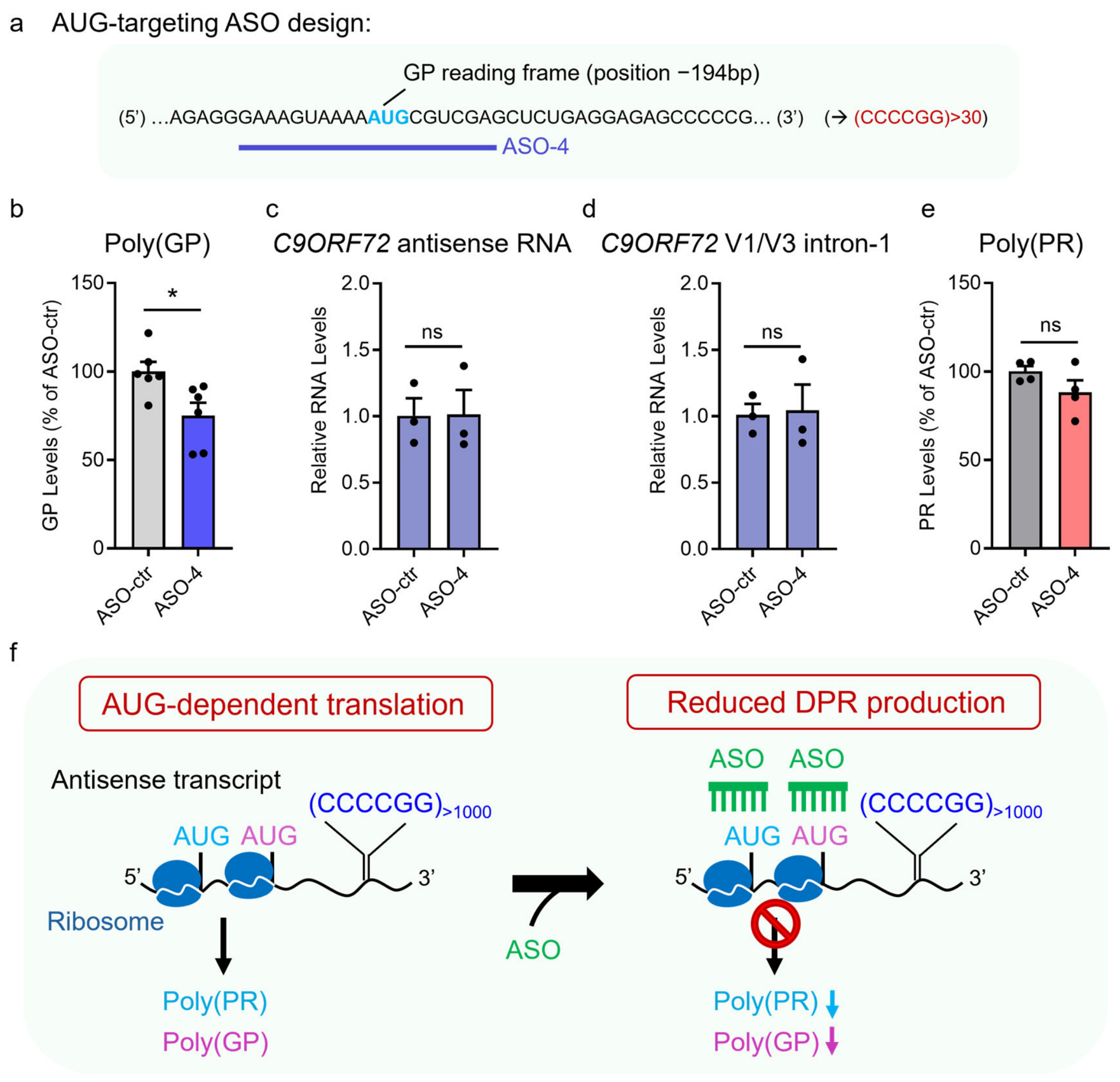
AUG-Dependent Translation of Antisense Repeat Transcripts Contributes to Dipeptide Repeat Protein Production in C9ORF72 Expansion Carriers

Abstract
Share and Cite
Almeida, S.; Gu, Y.; Kankel, M.W. AUG-Dependent Translation of Antisense Repeat Transcripts Contributes to Dipeptide Repeat Protein Production in C9ORF72 Expansion Carriers. Cells 2026, 15, 1701. https://doi.org/10.3390/cells15181701
Almeida S, Gu Y, Kankel MW. AUG-Dependent Translation of Antisense Repeat Transcripts Contributes to Dipeptide Repeat Protein Production in C9ORF72 Expansion Carriers. Cells. 2026; 15(18):1701. https://doi.org/10.3390/cells15181701
Chicago/Turabian StyleAlmeida, Sandra, Yuanzheng Gu, and Mark W. Kankel. 2026. "AUG-Dependent Translation of Antisense Repeat Transcripts Contributes to Dipeptide Repeat Protein Production in C9ORF72 Expansion Carriers" Cells 15, no. 18: 1701. https://doi.org/10.3390/cells15181701
APA StyleAlmeida, S., Gu, Y., & Kankel, M. W. (2026). AUG-Dependent Translation of Antisense Repeat Transcripts Contributes to Dipeptide Repeat Protein Production in C9ORF72 Expansion Carriers. Cells, 15(18), 1701. https://doi.org/10.3390/cells15181701