AUG-Dependent Translation of Antisense Repeat Transcripts Contributes to Dipeptide Repeat Protein Production in C9ORF72 Expansion Carriers

Abstract
1. Introduction
2. Materials and Methods
2.1. Generation of C9ORF72 Antisense (AS)-AUGs-Deletion iPSC Lines
2.2. Motor Neuron Cultures
2.3. Lymphoblastoid Cell Lines (LCLs) Cultures
2.4. Measurement of Poly(GR) and Poly(GP)
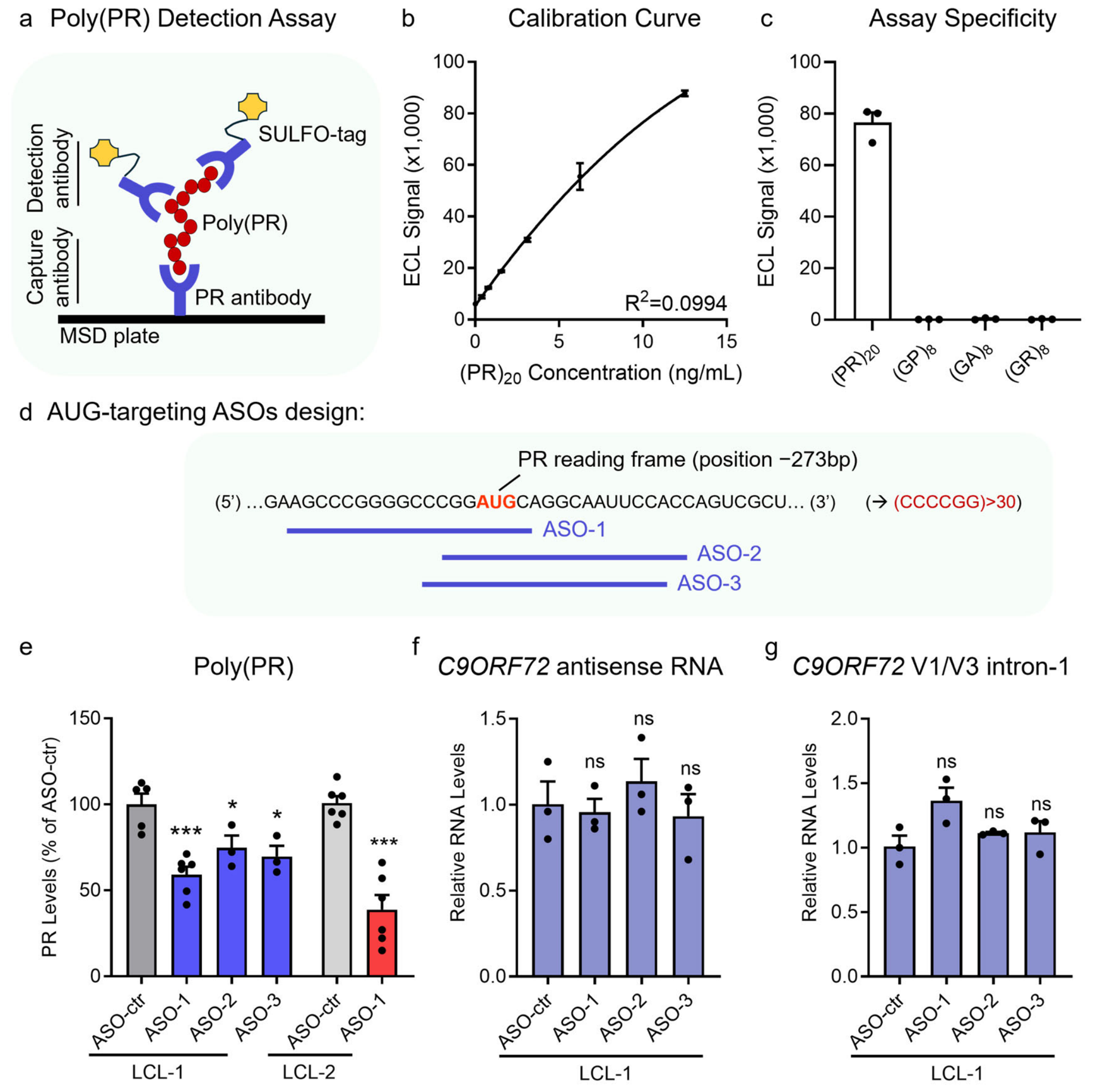
2.5. Measurement of Poly(PR)
2.6. Measurement of Poly(GA)
2.7. Antisense Oligonucleotide (ASO) Treatment
2.8. Gene Expression
2.9. Statistical Analysis
3. Results
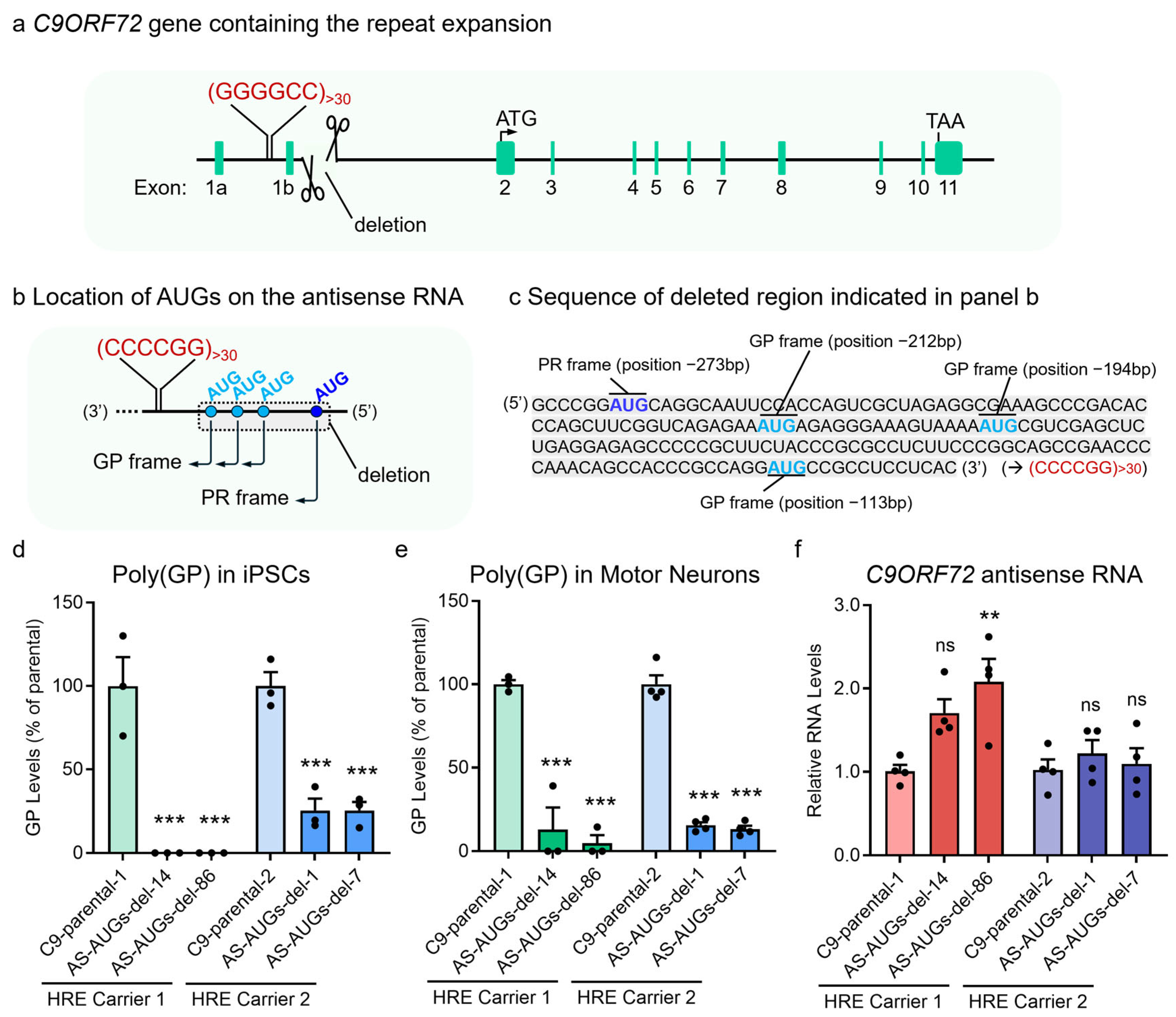
3.1. Deletion of a Region Containing Multiple AUG Initiation Codons in the Antisense Repeat RNA Greatly Reduces Poly(GP) Protein Levels in C9ORF72 iPSC-Derived Motor Neurons
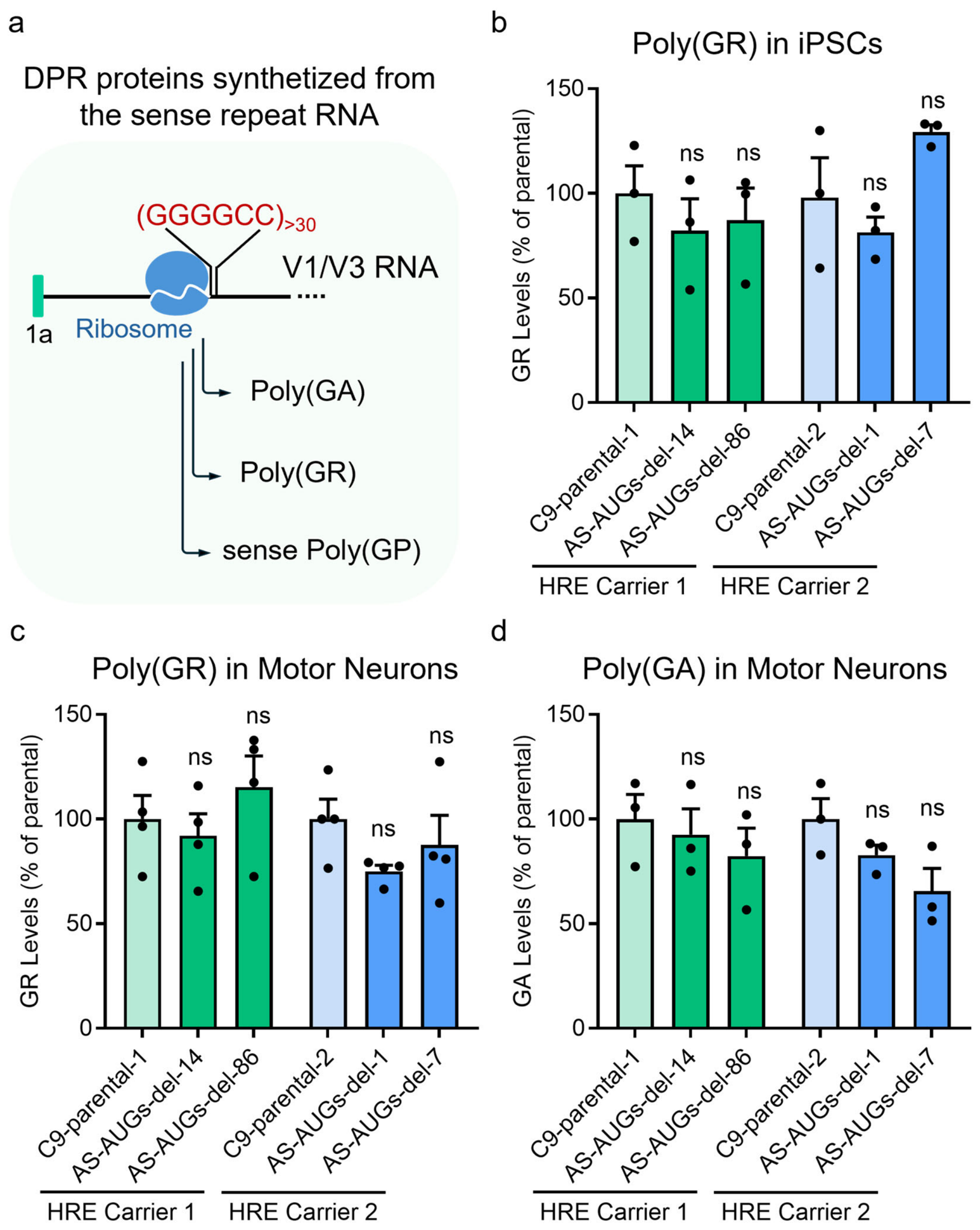
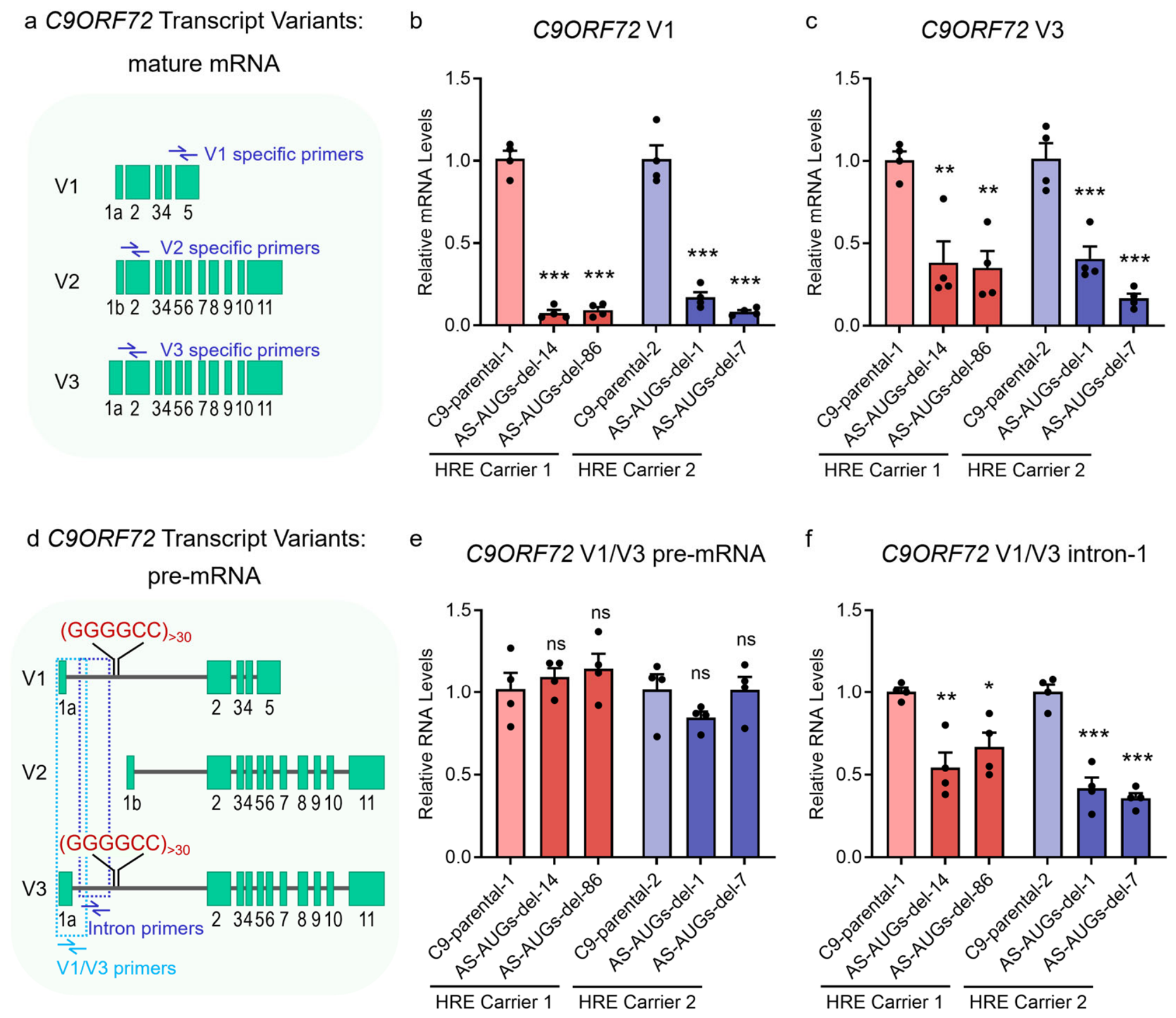
3.2. Unspliced C9ORF72 V1/V3 Pre-mRNAs Containing the Repeat Expansion Serve as Templates for Poly(GA) and Poly(GR) Production
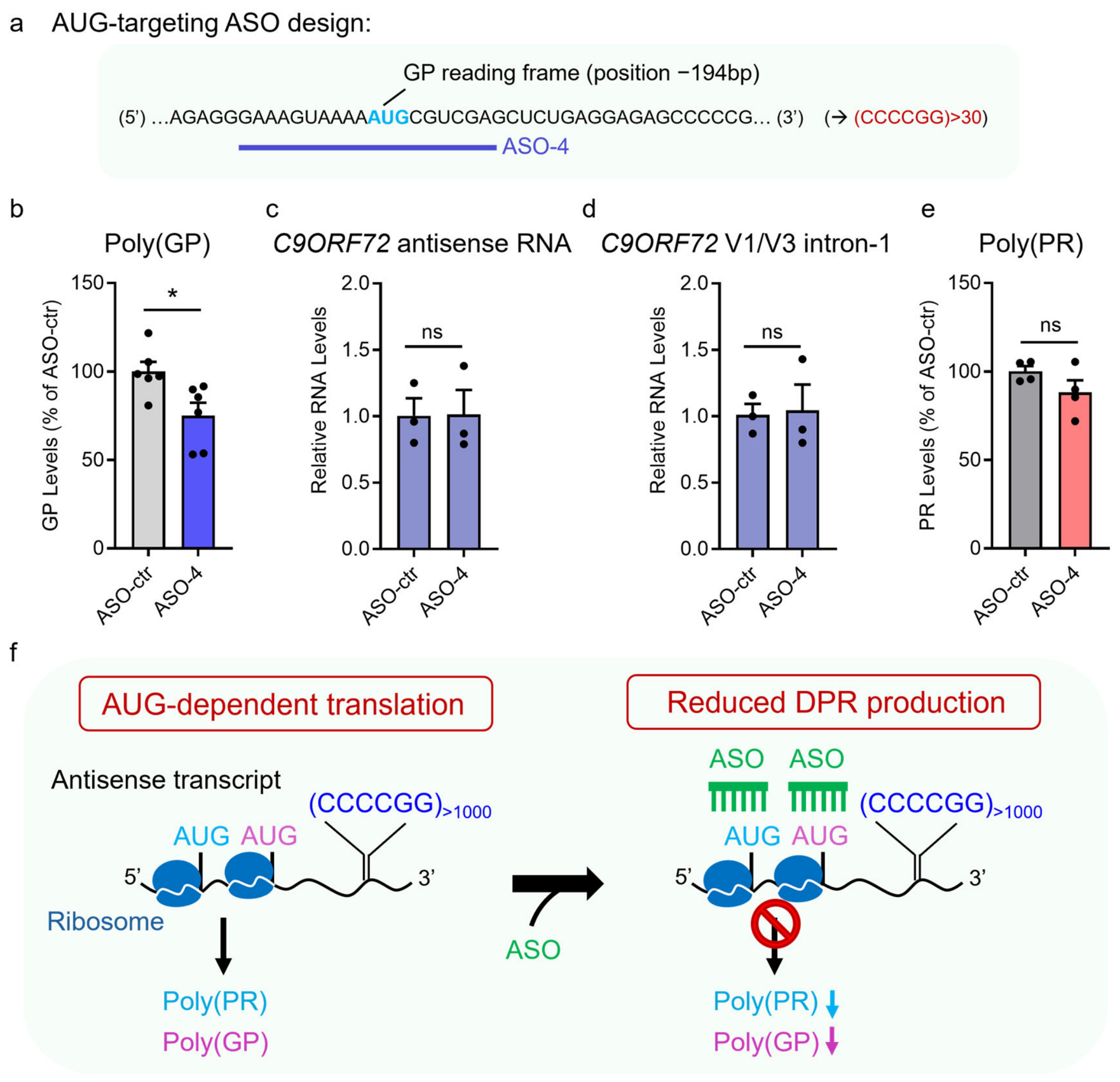
3.3. Poly(PR) Production Depends on an AUG-Containing Sequence Upstream of the Antisense Repeat RNA
4. Discussion
5. Conclusions
Supplementary Materials
Author Contributions
Funding
Institutional Review Board Statement
Informed Consent Statement
Data Availability Statement
Acknowledgments
Conflicts of Interest
References
- DeJesus-Hernandez, M.; Mackenzie, I.R.; Boeve, B.F.; Boxer, A.L.; Baker, M.; Rutherford, N.J.; Nicholson, A.M.; Finch, N.A.; Flynn, H.; Adamson, J.; et al. Expanded GGGGCC hexanucleotide repeat in noncoding region of C9ORF72 causes chromosome 9p-linked FTD and ALS. Neuron 2011, 72, 245–256. [Google Scholar] [CrossRef] [Scilit] [PubMed]
- Renton, A.E.; Majounie, E.; Waite, A.; Simón-Sánchez, J.; Rollinson, S.; Gibbs, J.R.; Schymick, J.C.; Laaksovirta, H.; van Swieten, J.C.; Myllykangas, L.; et al. A hexanucleotide repeat expansion in C9ORF72 is the cause of chromosome 9p21-linked ALS-FTD. Neuron 2011, 72, 257–268. [Google Scholar] [CrossRef] [Scilit] [PubMed]
- Ash, P.E.A.; Bieniek, K.F.; Gendron, T.F.; Caulfield, T.; Lin, W.L.; DeJesus-Hernandez, M.; van Blitterswijk, M.; Jansen-West, K.; Paul, J.W., III; Rademakers, R.; et al. Unconventional translation of C9ORF72 GGGGCC expansion generates insoluble polypeptides specific to c9FTD/ALS. Neuron 2013, 77, 639–646. [Google Scholar] [CrossRef] [Scilit] [PubMed]
- Mori, K.; Arzberger, T.; Grässer, F.A.; Gijselinck, I.; May, S.; Rentzsch, K.; Weng, S.M.; Schludi, M.H.; van der Zee, J.; Cruts, M.; et al. Bidirectional transcripts of the expanded C9orf72 hexanucleotide repeat are translated into aggregating dipeptide repeat proteins. Acta Neuropathol. 2013, 126, 881–893. [Google Scholar] [CrossRef] [Scilit] [PubMed]
- Cleary, J.D.; Ranum, L.P.W. Repeat-associated non-ATG (RAN) translation: New starts in microsatellite expansion disorders. Curr. Opin. Genet. Dev. 2014, 26, 6–15. [Google Scholar] [CrossRef] [Scilit] [PubMed]
- Sellier, C.; Corcia, P.; Vourc’h, P.; Dupuis, L. C9ORF72 hexanucleotide repeat expansion: From ALS and FTD to a broader pathogenic role? Rev. Neurol. 2024, 180, 417–428. [Google Scholar] [CrossRef] [Scilit] [PubMed]
- Kramer, N.J.; Carlomagno, Y.; Zhang, Y.J.; Almeida, S.; Cook, C.N.; Gendron, T.F.; Prudencio, M.; van Blitterswijk, M.; Belzil, V.; Couthouis, J.; et al. Spt4 selectively regulates the expression of C9orf72 sense and antisense mutant transcripts. Science 2016, 353, 708–712. [Google Scholar] [CrossRef] [Scilit] [PubMed]
- Yuva-Aydemir, Y.; Almeida, S.; Krishnan, G.; Gendron, T.F.; Gao, F.B. Transcription elongation factor AFF2/FMR2 regulates expression of expanded GGGGCC repeat-containing C9ORF72 allele in ALS/FTD. Nat. Commun. 2019, 10, 5466. [Google Scholar] [CrossRef] [Scilit] [PubMed]
- Goodman, L.D.; Prudencio, M.; Kramer, N.J.; Martinez-Ramirez, L.F.; Srinivasan, A.R.; Lan, M.; Parisi, M.J.; Zhu, Y.; Chew, J.; Cook, C.N.; et al. Toxic expanded GGGGCC repeat transcription is mediated by the PAF1 complex in C9orf72-associated FTD. Nat. Neurosci. 2019, 22, 863–874. [Google Scholar] [CrossRef] [Scilit] [PubMed]
- Cheng, W.; Wang, S.; Zhang, Z.; Morgens, D.W.; Hayes, L.R.; Lee, S.; Portz, B.; Xie, Y.; Nguyen, B.V.; Haney, M.S.; et al. CRISPR-Cas9 screens identify the RNA helicase DDX3X as a repressor of C9ORF72 (GGGGCC)n repeat-associated non-AUG translation. Neuron 2019, 104, 885–898.e8. [Google Scholar] [CrossRef] [Scilit] [PubMed]
- Yamada, S.B.; Gendron, T.F.; Niccoli, T.; Genuth, N.R.; Grosely, R.; Shi, Y.; Glaria, I.; Kramer, N.J.; Nakayama, L.; Fang, S.; et al. RPS25 is required for efficient RAN translation of C9orf72 and other neurodegenerative disease-associated nucleotide repeats. Nat. Neurosci. 2019, 22, 1383–1388. [Google Scholar] [CrossRef] [Scilit] [PubMed]
- Kearse, M.G.; Green, K.M.; Krans, A.; Rodriguez, C.M.; Linsalata, A.E.; Goldstrohm, A.C.; Todd, P.K. CGG repeat-associated non-AUG translation utilizes a cap-dependent scanning mechanism of initiation to produce toxic proteins. Mol. Cell 2016, 62, 314–322. [Google Scholar] [CrossRef] [Scilit] [PubMed]
- Sellier, C.; Buijsen, R.A.; He, F.; Natla, S.; Jung, L.; Tropel, P.; Gaucherot, A.; Jacobs, H.; Meziane, H.; Vincent, A.; et al. Translation of expanded CGG repeats into FMRpolyG is pathogenic and may contribute to fragile X tremor ataxia syndrome. Neuron 2017, 93, 331–347. [Google Scholar] [CrossRef] [Scilit] [PubMed]
- Boivin, M.; Pfister, V.; Gaucherot, A.; Ruffenach, F.; Negroni, L.; Sellier, C.; Charlet-Berguerand, N. Reduced autophagy upon C9ORF72 loss synergizes with dipeptide repeat protein toxicity in G4C2 repeat expansion disorders. EMBO J. 2020, 39, e100574. [Google Scholar] [CrossRef] [Scilit] [PubMed]
- Green, K.M.; Glineburg, M.R.; Kearse, M.G.; Flores, B.N.; Linsalata, A.E.; Fedak, S.J.; Goldstrohm, A.C.; Barmada, S.J.; Todd, P.K. RAN translation at C9orf72-associated repeat expansions is selectively enhanced by the integrated stress response. Nat. Commun. 2017, 8, 2005. [Google Scholar] [CrossRef] [Scilit] [PubMed]
- Sonobe, Y.; Ghadge, G.; Masaki, K.; Sendoel, A.; Fuchs, E.; Roos, R.P. Translation of dipeptide repeat proteins from the C9ORF72 expanded repeat is associated with cellular stress. Neurobiol. Dis. 2018, 116, 155–165. [Google Scholar] [CrossRef] [Scilit] [PubMed]
- Tabet, R.; Schaeffer, L.; Freyermuth, F.; Jambeau, M.; Workman, M.; Lee, C.-Z.; Lin, C.-C.; Jiang, J.; Jansen-West, K.; Abou-Hamdan, H.; et al. CUG initiation and frameshifting enable production of dipeptide repeat proteins from ALS/FTD C9ORF72 transcripts. Nat. Commun. 2018, 9, 152. [Google Scholar] [CrossRef] [Scilit] [PubMed]
- Almeida, S.; Krishnan, G.; Rushe, M.; Gu, Y.; Kankel, M.W.; Gao, F.-B. Production of poly(GA) in C9ORF72 patient motor neurons derived from induced pluripotent stem cells. Acta Neuropathol. 2019, 138, 1099–1101. [Google Scholar] [CrossRef] [Scilit] [PubMed]
- van ‘t Spijker, H.M.; Stackpole, E.E.; Almeida, S.; Katsara, O.; Liu, B.; Shen, K.; Schneider, R.J.; Gao, F.-B.; Richter, J.D. Ribosome profiling reveals novel regulation of C9ORF72 GGGGCC repeat-containing RNA translation. RNA 2022, 28, 123–138. [Google Scholar] [CrossRef] [Scilit] [PubMed]
- Lampasona, A.; Almeida, S.; Gao, F.B. Translation of the poly(GR) frame in C9ORF72-ALS/FTD is regulated by cis-elements involved in alternative splicing. Neurobiol. Aging 2021, 105, 327–332. [Google Scholar] [CrossRef] [Scilit] [PubMed]
- Van’t Spijker, H.M.; Almeida, S. How villains are made: The translation of dipeptide repeat proteins in C9ORF72-ALS/FTD. Gene 2023, 858, 147167. [Google Scholar] [CrossRef] [Scilit] [PubMed]
- Sonobe, Y.; Lee, S.; Krishnan, G.; Gu, Y.; Kwon, D.Y.; Gao, F.-B.; Roos, R.P.; Kratsios, P. Translation of dipeptide repeat proteins in C9ORF72 ALS/FTD through unique and redundant AUG initiation codons. eLife 2023, 12, e83189. [Google Scholar] [CrossRef] [Scilit] [PubMed]
- Zu, T.; Liu, Y.; Bañez-Coronel, M.; Reid, T.; Pletnikova, O.; Lewis, J.; Miller, T.M.; Harms, M.B.; Falchook, A.E.; Subramony, S.H.; et al. RAN proteins and RNA foci from antisense transcripts in C9ORF72 ALS and frontotemporal dementia. Proc. Natl. Acad. Sci. USA 2013, 110, E4968–E4977. [Google Scholar] [CrossRef] [Scilit] [PubMed]
- Gendron, T.F.; Chew, J.; Stankowski, J.N.; Hayes, L.R.; Zhang, Y.-J.; Prudencio, M.; Carlomagno, Y.; Daughrity, L.M.; Jansen-West, K.; Perkerson, E.A.; et al. Poly(GP) proteins are a useful pharmacodynamic marker for C9ORF72-associated amyotrophic lateral sclerosis. Sci. Transl. Med. 2017, 9, eaai7866. [Google Scholar] [CrossRef] [Scilit] [PubMed]
- Tran, H.; Moazami, M.P.; Yang, H.; McKenna-Yasek, D.; Douthwright, C.L.; Pinto, C.; Metterville, J.; Shin, M.; Sanil, N.; Dooley, C.; et al. Suppression of mutant C9orf72 expression by a potent mixed-backbone antisense oligonucleotide. Nat. Med. 2022, 28, 117–124. [Google Scholar] [CrossRef] [Scilit] [PubMed]
- Zhang, Y.J.; Guo, L.; Gonzales, P.K.; Gendron, T.F.; Wu, Y.; Jansen-West, K.; O’Raw, A.D.; Pickles, S.R.; Prudencio, M.; Carlomagno, Y.; et al. Heterochromatin anomalies and double-stranded RNA accumulation underlie C9orf72 poly(PR) toxicity. Science 2019, 363, eaav2606. [Google Scholar] [CrossRef] [Scilit] [PubMed]
- Xu, L.; Wang, D.; Zhao, L.; Yang, Z.; Liu, X.; Li, X.; Yuan, T.; Wang, Y.; Huang, T.; Bian, N.; et al. C9orf72 poly(PR) aggregation in nucleus induces ALS/FTD-related neurodegeneration in cynomolgus monkeys. Neurobiol. Dis. 2023, 184, 106197. [Google Scholar] [CrossRef] [Scilit] [PubMed]
- Wang, K.S.; Smeyers, J.; Eggan, K.; Budnik, B.; Mordes, D.A. C9ORF72 poly-PR disrupts expression of ALS/FTD-implicated STMN2 through SRSF7. Acta Neuropathol. Commun. 2025, 13, 67. [Google Scholar] [CrossRef] [Scilit] [PubMed]
- Wang, S.M.; Chan, J.C.; Supapatarnun, E.; Tsai, C.Y.; Lan, P.T.N.; Weng, E.F. C9orf72-derived dipeptide repeat proteins poly-PR disrupt membrane excitability and synaptic function in cortical neurons. Neurobiol. Dis. 2026, 221, 107320. [Google Scholar] [CrossRef] [Scilit] [PubMed]
- Cheng, W.; Wang, S.; Mestre, A.A.; Fu, C.; Makarem, A.; Xian, F.; Hayes, L.R.; Lopez-Gonzalez, R.; Drenner, K.; Jiang, J.; et al. C9ORF72 GGGGCC repeat-associated non-AUG translation is upregulated by stress through eIF2α phosphorylation. Nat. Commun. 2018, 9, 51. [Google Scholar] [CrossRef] [Scilit] [PubMed]
- Lopez-Gonzalez, R.; Lu, Y.; Gendron, T.F.; Karydas, A.; Tran, H.; Yang, D.; Petrucelli, L.; Miller, B.L.; Almeida, S.; Gao, F.-B. Poly(GR) in C9ORF72-related ALS/FTD compromises mitochondrial function and increases oxidative stress and DNA damage in iPSC-derived motor neurons. Neuron 2016, 92, 383–391. [Google Scholar] [CrossRef] [Scilit] [PubMed]
- Choi, S.Y.; Lopez-Gonzalez, R.; Krishnan, G.; Phillips, H.L.; Li, A.N.; Seeley, W.W.; Yao, W.-D.; Almeida, S.; Gao, F.-B. C9ORF72-ALS/FTD-associated poly(GR) binds Atp5a1 and compromises mitochondrial function in vivo. Nat. Neurosci. 2019, 22, 851–862. [Google Scholar] [CrossRef] [Scilit] [PubMed]
- Liu, E.Y.; Russ, J.; Wu, K.; Neal, D.; Suh, E.; McNally, A.G.; Irwin, D.J.; Van Deerlin, V.M.; Lee, E.B. C9orf72 hypermethylation protects against repeat expansion-associated pathology in ALS/FTD. Acta Neuropathol. 2014, 128, 525–541. [Google Scholar] [CrossRef] [Scilit] [PubMed]
- Sachdev, A.; Gill, K.; Sckaff, M.; Birk, A.M.; Arogundade, O.A.; Brown, K.A.; Chouhan, R.S.; Issagholian-Lewin, P.O.; Patel, E.; Watry, H.L.; et al. Reversal of C9orf72 mutation-induced transcriptional dysregulation and pathology in cultured human neurons by allele-specific excision. Proc. Natl. Acad. Sci. USA 2024, 121, e2307814121. [Google Scholar] [CrossRef] [Scilit] [PubMed]
- Jiang, X.; Schaeffer, L.; Patni, D.; Russo, T.; Lee, C.Z.; Aguilar, C.; Marques, C.; Jansen-West, K.; Hruska-Plochan, M.; Ray-Soni, A.; et al. Blocking RAN translation without altering repeat RNAs rescues C9ORF72-related ALS and FTD phenotypes. Science 2026, 391, eadv2600. [Google Scholar] [CrossRef] [Scilit] [PubMed]
- White, M.R.; Mitrea, D.M.; Zhang, P.; Stanley, C.B.; Cassidy, D.E.; Nourse, A.; Phillips, A.H.; Tolbert, M.; Taylor, J.P.; Kriwacki, R.W. C9orf72 Poly(PR) Dipeptide Repeats Disturb Biomolecular Phase Separation and Disrupt Nucleolar Function. Mol. Cell 2019, 74, 713–728.e6. [Google Scholar] [CrossRef] [Scilit] [PubMed]
- Cicardi, M.E.; Hallgren, J.H.; Mawrie, D.; Krishnamurthy, K.; Markandaiah, S.S.; Nelson, A.T.; Kankate, V.; Anderson, E.N.; Pasinelli, P.; Pandey, U.B.; et al. C9orf72 poly(PR) mediated neurodegeneration is associated with nucleolar stress. iScience 2023, 26, 107505. [Google Scholar] [CrossRef] [Scilit] [PubMed]
- Suzuki, H.; Shibagaki, Y.; Hattori, S.; Matsuoka, M. The proline-arginine repeat protein linked to C9-ALS/FTD causes neuronal toxicity by inhibiting the DEAD-box RNA helicase-mediated ribosome biogenesis. Cell Death Dis. 2018, 9, 975. [Google Scholar] [CrossRef] [Scilit] [PubMed]
- Sun, Y.; Eshov, A.; Zhou, J.; Isiktas, A.U.; Guo, J.U. C9orf72 arginine-rich dipeptide repeats inhibit UPF1-mediated RNA decay via translational repression. Nat. Commun. 2020, 11, 3354. [Google Scholar] [CrossRef] [Scilit] [PubMed]
- Agnihotri, D.; Lee, C.C.; Lu, P.C.; He, R.Y.; Huang, Y.A.; Kuo, H.C.; Huang, J.J. C9ORF72 poly-PR induces TDP-43 nuclear condensation via NEAT1 and is modulated by HSP70 activity. Cell Rep. 2025, 44, 115173. [Google Scholar] [CrossRef] [Scilit] [PubMed]
- Jafarinia, H.; Van der Giessen, E.; Onck, P.R. Molecular basis of C9orf72 poly-PR interference with the β-karyopherin family of nuclear transport receptors. Sci. Rep. 2022, 12, 21324. [Google Scholar] [CrossRef] [Scilit] [PubMed]
- Lin, C.Y.; Wu, H.C.; Fu, R.H.; Weng, E.F.; Hsieh, W.C.; Su, T.P.; Wu, H.E.; Wang, S.M. Sigma-1R-Pom121 axis preserves nuclear transport and integrity in poly-PR-induced C9orf72 ALS. Neurobiol. Dis. 2025, 212, 106992. [Google Scholar] [CrossRef] [Scilit] [PubMed]
- Ferrari, V.; Tedesco, B.; Cozzi, M.; Pramaggiore, P.; Gagliani, M.C.; Magdalena, R.; Cornaggia, L.; Casarotto, E.; Chierichetti, M.; Mohamed, A.; et al. VCP modulation ameliorates pathological features in C9orf72 models. Cell Death Dis. 2026, 17, 629. [Google Scholar] [CrossRef] [Scilit] [PubMed]
- Hautbergue, G.M.; Cleary, J.D.; Guo, S.; Ranum, L.P.W. Therapeutic strategies for C9orf72 amyotrophic lateral sclerosis and frontotemporal dementia. Curr. Opin. Neurol. 2021, 34, 748–755. [Google Scholar] [CrossRef] [Scilit] [PubMed]
- Cattaneo, M.; Giagnorio, E.; Lauria, G.; Marcuzzo, S. Therapeutic Approaches for C9ORF72-Related ALS: Current Strategies and Future Horizons. Int. J. Mol. Sci. 2025, 26, 6268. [Google Scholar] [CrossRef] [Scilit] [PubMed]
- Yu, Y.J.; Watts, R.J. Developing therapeutic antibodies for neurodegenerative disease. Neurotherapeutics 2013, 10, 459–472. [Google Scholar] [CrossRef] [Scilit] [PubMed]
- Pardridge, W.M. Drug transport across the blood-brain barrier. J. Cereb. Blood Flow Metab. 2012, 32, 1959–1972. [Google Scholar] [CrossRef] [Scilit] [PubMed]
- Wang, D.; Tai, P.W.L.; Gao, G. Adeno-associated virus vector as a platform for gene therapy delivery. Nat. Rev. Drug Discov. 2019, 18, 358–378. [Google Scholar] [CrossRef] [Scilit] [PubMed]
- Colella, P.; Ronzitti, G.; Mingozzi, F. Emerging Issues in AAV-Mediated In Vivo Gene Therapy. Mol. Ther. Methods Clin. Dev. 2018, 8, 87–104. [Google Scholar] [CrossRef] [Scilit] [PubMed]
- Ronzitti, G.; Gross, D.A.; Mingozzi, F. Human Immune Responses to Adeno-Associated Virus (AAV) Vectors. Front. Immunol. 2020, 11, 670. [Google Scholar] [CrossRef] [Scilit] [PubMed]
- Hudry, E.; Vandenberghe, L.H. Therapeutic AAV Gene Transfer to the Nervous System: A Clinical Reality. Neuron 2019, 101, 839–862. [Google Scholar] [CrossRef] [Scilit] [PubMed]
- Miller, T.M.; Cudkowicz, M.E.; Shaw, P.J.; Genge, A.; Sobue, G.; Bucelli, R.C.; Chiò, A.; Van Damme, P.; Ludolph, A.C.; Glass, J.D.; et al. Long-Term Tofersen in SOD1 Amyotrophic Lateral Sclerosis. JAMA Neurol. 2026, 83, 115–125. [Google Scholar] [CrossRef] [Scilit] [PubMed]
- van den Berg, L.H.; Rothstein, J.D.; Shaw, P.J.; Babu, S.; Benatar, M.; Bucelli, R.C.; Genge, A.; Glass, J.D.; Hardiman, O.; Libri, V.; et al. Safety, tolerability, and pharmacokinetics of antisense oligonucleotide BIIB078 in adults with C9orf72-associated amyotrophic lateral sclerosis: A phase 1, randomised, double-blinded, placebo-controlled, multiple ascending dose study. Lancet Neurol. 2024, 23, 901–912. [Google Scholar] [CrossRef] [Scilit] [PubMed]
- Cammack, A.J.; Balendra, R.; Isaacs, A.M. Failure of C9orf72 sense repeat-targeting antisense oligonucleotides: Lessons learned and the path forward. Brain 2024, 147, 2607–2609. [Google Scholar] [CrossRef] [Scilit] [PubMed]
- He, F.; Flores, B.N.; Krans, A.; Frazer, M.; Natla, S.; Niraula, S.; Adefioye, O.; Barmada, S.J.; Todd, P.K. The carboxyl termini of RAN-translated GGGGCC nucleotide repeat expansions modulate toxicity in models of ALS/FTD. Acta Neuropathol. Commun. 2020, 8, 122. [Google Scholar] [CrossRef] [Scilit] [PubMed]



Disclaimer/Publisher’s Note: The statements, opinions and data contained in all publications are solely those of the individual author(s) and contributor(s) and not of MDPI and/or the editor(s). MDPI and/or the editor(s) disclaim responsibility for any injury to people or property resulting from any ideas, methods, instructions or products referred to in the content. |
© 2026 by the authors. Licensee MDPI, Basel, Switzerland. This article is an open access article distributed under the terms and conditions of the Creative Commons Attribution (CC BY) license.
Share and Cite
Almeida, S.; Gu, Y.; Kankel, M.W. AUG-Dependent Translation of Antisense Repeat Transcripts Contributes to Dipeptide Repeat Protein Production in C9ORF72 Expansion Carriers. Cells 2026, 15, 1701. https://doi.org/10.3390/cells15181701
Almeida S, Gu Y, Kankel MW. AUG-Dependent Translation of Antisense Repeat Transcripts Contributes to Dipeptide Repeat Protein Production in C9ORF72 Expansion Carriers. Cells. 2026; 15(18):1701. https://doi.org/10.3390/cells15181701
Chicago/Turabian StyleAlmeida, Sandra, Yuanzheng Gu, and Mark W. Kankel. 2026. "AUG-Dependent Translation of Antisense Repeat Transcripts Contributes to Dipeptide Repeat Protein Production in C9ORF72 Expansion Carriers" Cells 15, no. 18: 1701. https://doi.org/10.3390/cells15181701
APA StyleAlmeida, S., Gu, Y., & Kankel, M. W. (2026). AUG-Dependent Translation of Antisense Repeat Transcripts Contributes to Dipeptide Repeat Protein Production in C9ORF72 Expansion Carriers. Cells, 15(18), 1701. https://doi.org/10.3390/cells15181701