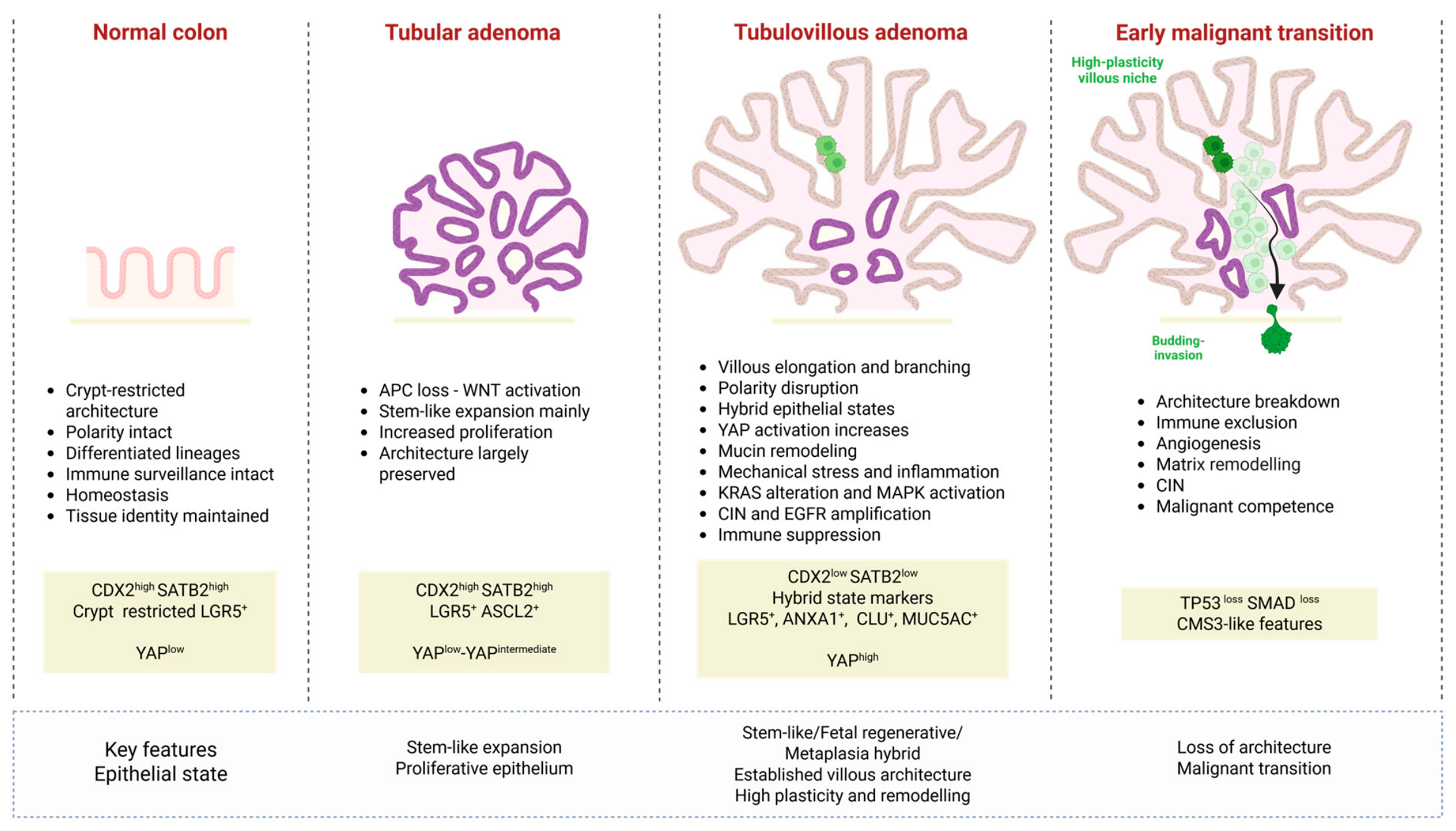
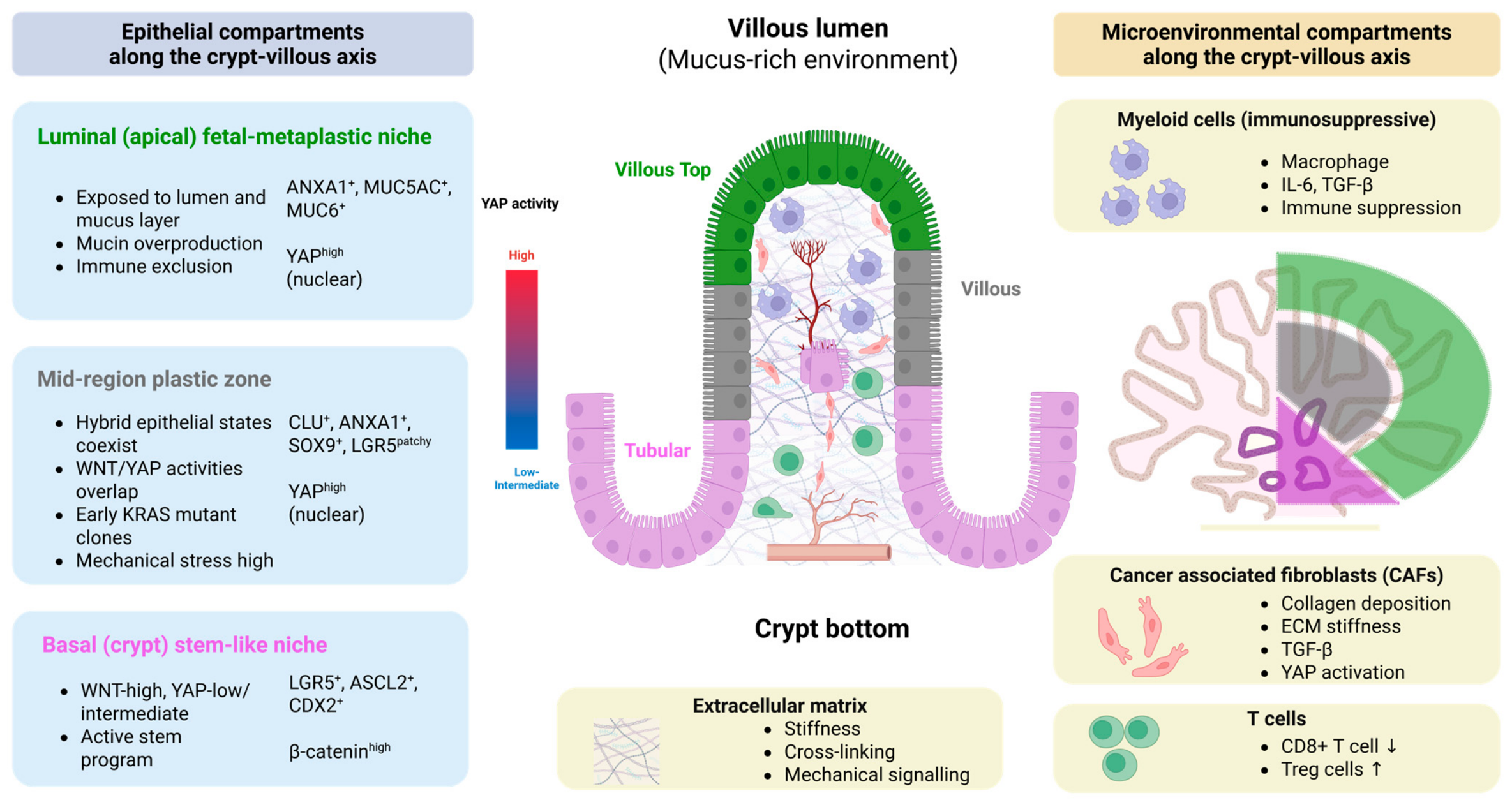
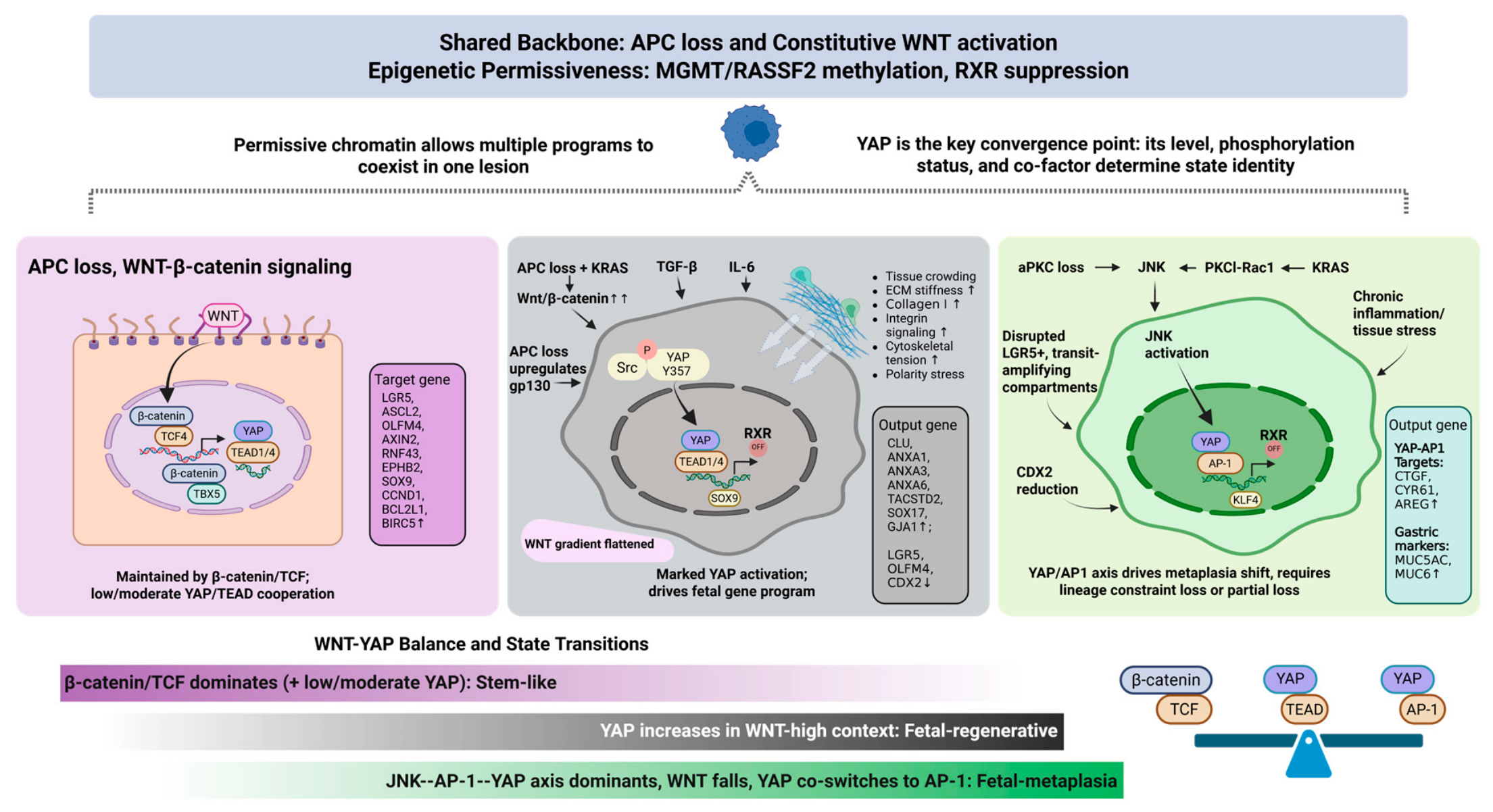
Villous Architecture in Colorectal Adenomas: Molecular Pathogenesis, Epithelial Plasticity, and Malignant Risk
 , , and
Abstract
1. Introduction
2. Materials and Methods
3. Histological Features and Clinical Significance of Villous Architecture
4. Genetic and Epigenetic Determinants of Villous Architecture

| Molecular Feature | Representative Study | Cohort and Assay | Tubular Adenoma | Tubulovillous Adenoma | Villous Adenoma | Statistical Evidence | Main Interpretation |
|---|---|---|---|---|---|---|---|
| APC mutation | De Benedetti et al., 1994 [37] | 58 evaluable sporadic adenomas; SSCP analysis of APC coding regions | 15/45 (33%) | 10/13 (77%) † | — | OR 6.67; p = 0.005; association retained after multivariable adjustment | Detectable APC mutations were enriched in adenomas containing a villous component, although this association has not been uniformly reproduced across studies. |
| APC mutation | Mulkens et al., 1998 [39] | 32 sporadic adenomas; PCR–TGGE screening of the APC mutation cluster region | 36% | 71% † | — | NS for histology; p < 0.05 for adenoma size | Showed the same directional association with villous histology, but the small cohort and restriction to the APC mutation cluster region limit interpretation. |
| KRAS mutation | Maltzman et al., 2001 [47] | 738 adenomas; direct sequencing of codons 12/13 | 48/454 (10.6%) | 78/282 (27.7%) † | 26% (VA n = 42) | OR 3.2 (95% CI 2.1–4.9); adjusted OR 2.3 (1.5–3.7) | Large cohort demonstrating an independent association between KRAS mutation and villous-containing histology. |
| KRAS mutation | Barry et al., 2006 [45] | 303 incident adenomas after a recent clearing colonoscopy; dHPLC followed by sequencing | 2/259 (0.8%) | 7/44 (16%) † | — | RR 20.6 (95% CI 4.4–96.0); GEE RR 10.6 (2.7–41.9) | KRAS mutation was rare in small incident adenomas overall but strongly enriched in lesions with villous architecture, supporting a progression-associated rather than obligatory initiating role. |
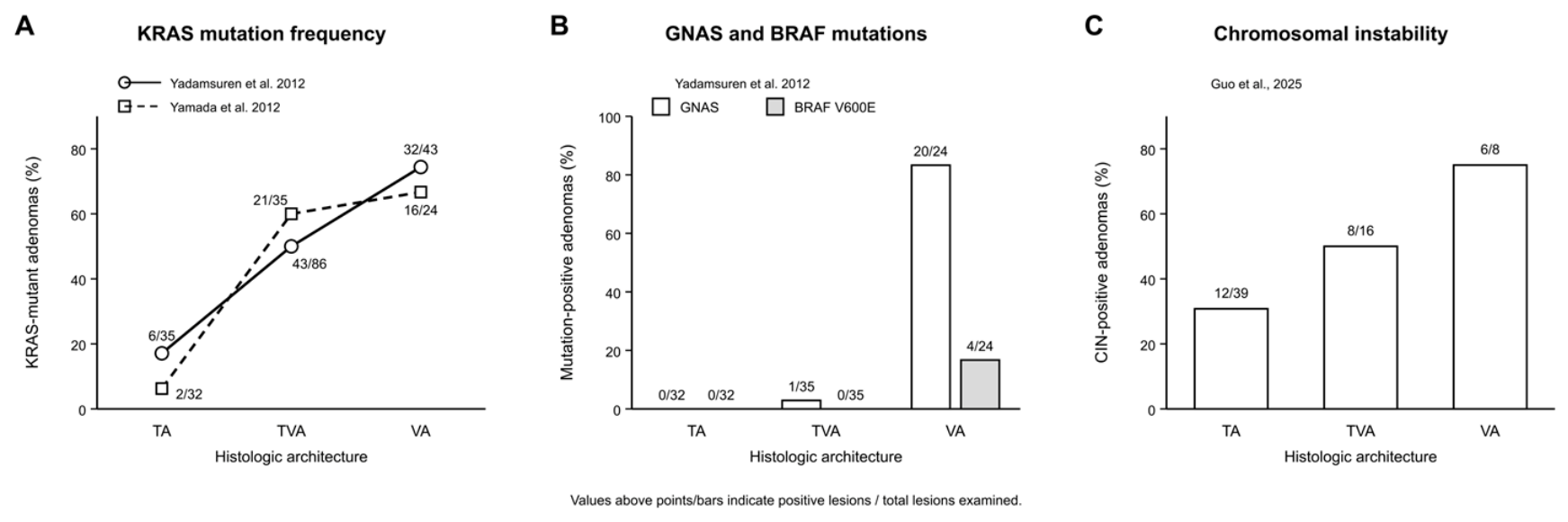
| KRAS mutation | Yadamsuren et al., 2012 [44] | 164 sporadic polypoid adenomas; PCR-RFLP of codons 12/13 | 6/35 (17%) | 43/86 (50%) | 32/43 (74%) | p < 0.0001 | Demonstrated a strong stepwise increase in KRAS mutation frequency with increasing villous architecture. |
| KRAS mutation | Kakar et al., 2008 [57] | 62 conventional adenomas; direct sequencing | 3/30 (10%) | 3/32 (9%) † | — | p = 0.4 | Provides evidence that the KRAS–villosity association is not universal. |
| GNAS mutation | Yamada et al., 2012 [46] | 91 conventional adenomas; direct sequencing of GNAS exon 8 | 0/32 (0%) | 1/35 (3%) | 20/24 (83%) | TA vs. VA p = 1.4 × 10⁻¹¹; TVA vs. VA p = 7.2 × 10⁻¹¹ | Activating GNAS mutation showed marked enrichment in fully villous adenomas in this selected cohort. |
| BRAF V600E | Yamada et al., 2012 [46] | 91 conventional adenomas; direct sequencing of BRAF exon 15 | 0/32 (0%) | 0/35 (0%) | 4/24 (17%) | Significant for VA vs. TA/TVA | BRAF was absent from TA/TVA but present in a minority of fully villous adenomas; in the same study, BRAF was substantially more frequent in serrated lesions. |
| MGMT promoter methylation | Kakar et al., 2008 [57] | Methylation-specific PCR | 11/30 (37%) | 27/31 (87%) † | — | p < 0.01 | Strong enrichment of MGMT methylation in villous-containing adenomas. |
| RASSF2 promoter methylation | Kakar et al., 2008 [57] | Methylation-specific PCR | 21/30 (70%) | 30/32 (94%) † | — | p = 0.02 | RASSF2 methylation increased in adenomas with villous architecture, although a direct morphogenetic role remains unproven. |
| CIMP-positive phenotype | Kakar et al., 2008 [57] | CIMP defined as methylation at ≥3 of 7 assayed loci | 8/30 (27%) | 14/32 (44%) † | — | p = 0.08 | CIMP positivity was numerically enriched but not statistically significant, arguing against a uniform canonical CIMP-high villous state. |
| Chromosomal instability (CIN) | Guo et al., 2025 [76] | 63 histologically classified adenomas; LC-WGS/UCAD | 12/39 (31%) | 8/16 (50%) | 6/8 (75%) | p = 0.049 across histological groups | Suggests increasing CIN with architectural complexity, but evidence derives from a single small cohort, particularly for VA (n = 8). |

5. Transcriptional Organization and Epithelial State Dynamics
6. YAP Integrates Mechanical and Oncogenic Signaling
7. YAP-Dependent Fetal Reprogramming
8. The Villous State in Conventional Adenomas: Evolutionary Routes
9. Immune Remodeling During Villous Progression
10. Malignant Potential of the Villous State
11. Concluding Remarks and Future Perspectives
Supplementary Materials
Author Contributions
Funding
Data Availability Statement
Acknowledgments
Conflicts of Interest
Abbreviations
References
- Hamilton, S.R.; Sekine, S. Conventional Colorectal Adenoma. In WHO Classification of Tumours: Digestive System Tumours, 5th ed.; International Agency for Research on Cancer: Lyon, France, 2019; Volume 1, pp. 170–173. [Google Scholar]
- Strum, W.B. Colorectal Adenomas. N. Engl. J. Med. 2016, 374, 1065–1075. [Google Scholar] [CrossRef] [Scilit] [PubMed]
- Chen, B.; Scurrah, C.R.; McKinley, E.T.; Simmons, A.J.; Ramirez-Solano, M.A.; Zhu, X.; Markham, N.O.; Heiser, C.N.; Vega, P.N.; Rolong, A.; et al. Differential Pre-Malignant Programs and Microenvironment Chart Distinct Paths to Malignancy in Human Colorectal Polyps. Cell 2021, 184, 6262–6280.e26. [Google Scholar] [CrossRef] [Scilit] [PubMed]
- Atkin, W.S.; Morson, B.C.; Cuzick, J. Long-Term Risk of Colorectal Cancer after Excision of Rectosigmoid Adenomas. N. Engl. J. Med. 1992, 326, 658–662. [Google Scholar] [CrossRef] [Scilit] [PubMed]
- Baile-Maxía, S.; Mangas-Sanjuán, C.; Ladabaum, U.; Hassan, C.; Rutter, M.D.; Bretthauer, M.; Medina-Prado, L.; Sala-Miquel, N.; Pomares, O.M.; Zapater, P.; et al. Risk Factors for Metachronous Colorectal Cancer or Advanced Adenomas After Endoscopic Resection of High-Risk Adenomas. Clin. Gastroenterol. Hepatol. 2023, 21, 630–643. [Google Scholar] [CrossRef] [Scilit] [PubMed]
- Turner, J.K.; Williams, G.T.; Morgan, M.; Wright, M.; Dolwani, S. Interobserver Agreement in the Reporting of Colorectal Polyp Pathology among Bowel Cancer Screening Pathologists in Wales. Histopathology 2013, 62, 916–924. [Google Scholar] [CrossRef] [Scilit] [PubMed]
- Osmond, A.; Li-Chang, H.; Kirsch, R.; Divaris, D.; Falck, V.; Liu, D.F.; Marginean, C.; Newell, K.; Parfitt, J.; Rudrick, B.; et al. Interobserver Variability in Assessing Dysplasia and Architecture in Colorectal Adenomas: A Multicentre Canadian Study. J. Clin. Pathol. 2014, 67, 781–786. [Google Scholar] [CrossRef] [Scilit] [PubMed]
- Ishii, T.; Notohara, K.; Umapathy, A.; Matsubara, N.; Jass, J.; Leggett, B. Tubular Adenomas with Minor Villous Changes Show Molecular Features Characteristic of Tubulovillous Adenomas. Am. J. Surg. Pathol. 2011, 35, 212–220. [Google Scholar] [CrossRef] [Scilit] [PubMed]
- Einspahr, J.G.; Martinez, M.E.; Jiang, R.; Hsu, C.-H.; Rashid, A.; Bhattacharrya, A.K.; Ahnen, D.J.; Jacobs, E.T.; Houlihan, P.S.; Webb, C.R.; et al. Associations of Ki-Ras Proto-Oncogene Mutation and P53 Gene Overexpression in Sporadic Colorectal Adenomas with Demographic and Clinicopathologic Characteristics. Cancer Epidemiol. Biomark. Prev. 2006, 15, 1443–1450. [Google Scholar] [CrossRef] [Scilit] [PubMed]
- Van Meer, A.; Gilis, J.; Oosterlinck, B.; Vandamme, T.; De Man, J.; De Winter, B.Y.; Smet, A. Clinicopathological and Prognostic Significance of Mucin Signatures in Lower Gastrointestinal Cancer-a Systematic Review and Meta-Analysis. Br. J. Cancer 2026, 134, 367–376. [Google Scholar] [CrossRef] [Scilit] [PubMed]
- Gao, N.; White, P.; Kaestner, K.H. Establishment of Intestinal Identity and Epithelial-Mesenchymal Signaling by Cdx2. Dev. Cell 2009, 16, 588–599. [Google Scholar] [CrossRef] [Scilit] [PubMed]
- Verzi, M.P.; Shin, H.; He, H.H.; Sulahian, R.; Meyer, C.A.; Montgomery, R.K.; Fleet, J.C.; Brown, M.; Liu, X.S.; Shivdasani, R.A. Differentiation-Specific Histone Modifications Reveal Dynamic Chromatin Interactions and Partners for the Intestinal Transcription Factor CDX2. Dev. Cell 2010, 19, 713–726. [Google Scholar] [CrossRef] [Scilit] [PubMed]
- Simmini, S.; Bialecka, M.; Huch, M.; Kester, L.; Van De Wetering, M.; Sato, T.; Beck, F.; Van Oudenaarden, A.; Clevers, H.; Deschamps, J. Transformation of Intestinal Stem Cells into Gastric Stem Cells on Loss of Transcription Factor Cdx2. Nat. Commun. 2014, 5, 5728. [Google Scholar] [CrossRef] [Scilit] [PubMed]
- Gu, W.; Wang, H.; Huang, X.; Kraiczy, J.; Singh, P.N.P.; Ng, C.; Dagdeviren, S.; Houghton, S.; Pellon-Cardenas, O.; Lan, Y.; et al. SATB2 Preserves Colon Stem Cell Identity and Mediates Ileum-Colon Conversion via Enhancer Remodeling. Cell Stem Cell 2022, 29, 101–115.e10. [Google Scholar] [CrossRef] [Scilit] [PubMed]
- Ensari, A.; Marsh, M.N. Exploring the Villus. Gastroenterol. Hepatol. Bed Bench 2018, 11, 181–190. [Google Scholar] [PubMed]
- Fenoglio, C.M.; Richart, R.M.; Kaye, G.I. Comparative Electron-Microscopic Features of Normal, Hyperplastic, and Adenomatous Human Colonic Epithelium. II. Variations in Surface Architecture Found by Scanning Electron Microscopy. Gastroenterology 1975, 69, 100–109. [Google Scholar] [CrossRef] [Scilit]
- Ioachim, N.-J.; Delaney, W.E.; Madrazo, A. Villous Adenoma of the Colon and Rectum: An Ultrastructural Study. Cancer 1974, 34, 586–596. [Google Scholar] [CrossRef] [Scilit]
- Reissenweber, N.; Ardao, G.; Velazquez, S.; Kliche, I.; Fosman, E.; Almeida, E. The Interrelationship Between Tubular and Papillary Sectors of Tubulo-Villous Colorectal Adenomas: Comparative Morphometric Analysis and Evaluation of Cell Proliferation. Hum. Pathol. 1998, 29, 431–437. [Google Scholar] [CrossRef] [Scilit] [PubMed]
- Rashid, A.; Zahurak, M.; Goodman, S.N.; Hamilton, S.R. Genetic Epidemiology of Mutated K-Ras Proto-Oncogene, Altered Suppressor Genes, and Microsatellite Instability in Colorectal Adenomas. Gut 1999, 44, 826–833. [Google Scholar] [CrossRef] [Scilit] [PubMed][Green Version]
- Ikenaga, M.; Takano, Y.; Ohtani, Y.; Tsukamoto, H.; Hiki, Y.; Kakita, A.; Okayasu, I. Low Levels of Apoptosis and Proliferative Activity in Colorectal Villous Tumors: Comparison with Tubular Tumors. Pathol. Int. 1998, 48, 453–459. [Google Scholar] [CrossRef] [Scilit] [PubMed]
- Wallace, L.; Aikhionbare, K.; Banerjee, S.; Peagler, K.; Pitts, M.; Yao, X.; Aikhionbare, F. Differential Expression Profiles of Mitogenome Associated MicroRNAs Among Colorectal Adenomatous Polyps. Cancer Res. J. 2021, 9, 23. [Google Scholar] [CrossRef] [Scilit]
- Qualtrough, D.; Singh, K.; Banu, N.; Paraskeva, C.; Pignatelli, M. The Actin-Bundling Protein Fascin Is Overexpressed in Colorectal Adenomas and Promotes Motility in Adenoma Cells in Vitro. Br. J. Cancer 2009, 101, 1124–1129. [Google Scholar] [CrossRef] [Scilit] [PubMed][Green Version]
- Rubio, C.A. Atypical Mitoses in Colorectal Adenomas. Pathol. Res. Pract. 1991, 187, 508–513. [Google Scholar] [CrossRef] [Scilit] [PubMed]
- Meijer, G.A.; Baak, J.P.A. Quantification of Proliferative Activity in Colorectal Adenomas by Mitotic Counts: Relationship to Degree of Dysplasia and Histological Type. J. Clin. Pathol. 1995, 48, 620–625. [Google Scholar] [CrossRef] [Scilit] [PubMed][Green Version]
- Molaei, M.; Mansoori, B.K.; Mashayekhi, R.; Vahedi, M.; Pourhoseingholi, M.A.; Fatemi, S.R.; Zali, M.R. Mucins in Neoplastic Spectrum of Colorectal Polyps: Can They Provide Predictions? BMC Cancer 2010, 10, 537. [Google Scholar] [CrossRef] [Scilit] [PubMed]
- Kim, D.H.; Kim, J.W.; Cho, J.H.; Baek, S.H.; Kakar, S.; Kim, G.E.; Sleisenger, M.H.; Kim, Y.S. Expression of Mucin Core Proteins, Trefoil Factors, APC and P21 in Subsets of Colorectal Polyps and Cancers Suggests a Distinct Pathway of Pathogenesis of Mucinous Carcinoma of the Colorectum. Int. J. Oncol. 2005, 27, 957–964. [Google Scholar] [CrossRef] [Scilit]
- Bartman, A.E.; Sanderson, S.J.; Ewing, S.L.; Niehans, G.A.; Wiehr, C.L.; Evans, M.K.; Ho, S.B. Aberrant Expression of MUC5AC and MUC6 Gastric Mucin Genes in Colorectal Polyps. Int. J. Cancer 1999, 80, 210–218. [Google Scholar] [CrossRef]
- Buisine, M.; Janin, A.; Maunoury, V.; Audie, J.; Delescaut, M.; Copin, M.; Colombel, J.; Degand, P.; Aubert, J.; Porchet, N. Aberrant Expression of a Human Mucin Gene (MUC5AC) in Rectosigmoid Villous Adenoma. Gastroenterology 1996, 110, 84–91. [Google Scholar] [CrossRef] [Scilit] [PubMed]
- Shinya, H.; Wolff, W.I. Morphology, Anatomic Distribution and Cancer Potential of Colonic Polyps. Ann. Surg. 1979, 190, 679–683. [Google Scholar] [CrossRef] [Scilit] [PubMed]
- Click, B.; Pinsky, P.F.; Hickey, T.; Doroudi, M.; Schoen, R.E. Association of Colonoscopy Adenoma Findings with Long-Term Colorectal Cancer Incidence. JAMA 2018, 319, 2021. [Google Scholar] [CrossRef] [Scilit] [PubMed]
- Myers, D.J.; Arora, K. Villous Adenoma; Archived; StatPearls Publishing: Treasure Island, FL, USA, 2023. [Google Scholar]
- Emile, S.H.; Garoufalia, Z.; Wignakumar, A.; Wexner, S.D. Cancer-Specific Survival of Colorectal Adenocarcinomas According to the Type of Pre-Existing Adenoma: A Surveillance, Epidemiology, and End Results Registry Analysis. Surgery 2025, 184, 109468. [Google Scholar] [CrossRef] [Scilit] [PubMed]
- Madabhushi, A.; Lee, G. Image Analysis and Machine Learning in Digital Pathology: Challenges and Opportunities. Med. Image Anal. 2016, 33, 170–175. [Google Scholar] [CrossRef] [Scilit] [PubMed]
- Firmbach, D.; Lang-Schwarz, C.; Rubio, C.A.; Hartmann, A.; Vieth, M.; Reitsam, N.; Grosser, B.; Eckstein, M.; Matek, C. Quantitative Analysis of Distinct Colon Crypt Branching Modes Using Interpretable Machine Learning. Inflamm. Bowel Dis. 2025, 31, 3407–3416. [Google Scholar] [CrossRef] [Scilit] [PubMed]
- Ji, M.Y.; Yuan, L.; Lu, S.M.; Gao, M.T.; Zeng, Z.; Zhan, N.; Ding, Y.J.; Liu, Z.R.; Huang, P.X.; Lu, C.; et al. Glandular Orientation and Shape Determined by Computational Pathology Could Identify Aggressive Tumor for Early Colon Carcinoma: A Triple-Center Study. J. Transl. Med. 2020, 18, 129. [Google Scholar] [CrossRef] [Scilit] [PubMed]
- Yang, Y.; Xiao, C.; Zou, D.; Wang, L.; Yang, R.; Zhang, Y.; Zhang, L.; Zhao, Z.; Qiu, S.; Liu, S.; et al. Deep Learning-Enabled Multiphoton Microscopy Predicts Colorectal Cancer Recurrence from Routine FFPE Specimens. npj Digit. Med. 2025, 8, 689. [Google Scholar] [CrossRef] [Scilit] [PubMed]
- De Benedetti, L.; Sciallero, S.; Gismondi, V.; James, R.; Bafico, A.; Biticchi, R.; Masetti, E.; Bonelli, L.; Heouaine, A.; Picasso, M.; et al. Association of APC Gene Mutations and Histological Characteristics of Colorectal Adenomas. Cancer Res. 1994, 54, 3553–3556. [Google Scholar] [PubMed]
- Kim, J.C.; Koo, K.H.; Lee, D.H.; Roh, S.A.; Kim, H.C.; Yu, C.S.; Kang, G.H. Mutations at the APC Exon 15 in the Colorectal Neoplastic Tissues of Serial Array. Int. J. Colorectal Dis. 2001, 16, 102–107. [Google Scholar] [CrossRef] [Scilit] [PubMed]
- Mulkens, J.; Poncin, J.; Arends, J.W.; De Goeij, A.F.P.M. APC Mutations in Human Colorectal Adenomas: Analysis of the Mutation Cluster Region with Temperature Gradient Gel Electrophoresis and Clinicopathological Features. J. Pathol. 1998, 185, 360–365. [Google Scholar] [CrossRef]
- Baker, A.M.; Gabbutt, C.; Williams, M.J.; Cereser, B.; Jawad, N.; Rodriguez-Justo, M.; Jansen, M.; Barnes, C.P.; Simons, B.D.; McDonald, S.A.C.; et al. Crypt Fusion as a Homeostatic Mechanism in the Human Colon. Gut 2019, 68, 1986–1993. [Google Scholar] [CrossRef] [Scilit] [PubMed]
- Sottoriva, A.; Kang, H.; Ma, Z.; Graham, T.A.; Salomon, M.P.; Zhao, J.; Marjoram, P.; Siegmund, K.; Press, M.F.; Shibata, D.; et al. A Big Bang Model of Human Colorectal Tumor Growth. Nat. Genet. 2015, 47, 209–216. [Google Scholar] [CrossRef] [Scilit] [PubMed]
- Cross, W.; Kovac, M.; Mustonen, V.; Temko, D.; Davis, H.; Baker, A.M.; Biswas, S.; Arnold, R.; Chegwidden, L.; Gatenbee, C.; et al. The Evolutionary Landscape of Colorectal Tumorigenesis. Nat. Ecol. Evol. 2018, 2, 1661–1672. [Google Scholar] [CrossRef] [Scilit] [PubMed]
- Bellis, J.; Duluc, I.; Romagnolo, B.; Perret, C.; Faux, M.C.; Dujardin, D.; Formstone, C.; Lightowler, S.; Ramsay, R.G.; Freund, J.N.; et al. The Tumor Suppressor Apc Controls Planar Cell Polarities Central to Gut Homeostasis. J. Cell Biol. 2012, 198, 331–341. [Google Scholar] [CrossRef] [Scilit] [PubMed]
- Yadamsuren, E.A.; Nagy, S.; Pajor, L.; Lacza, A.; Bogner, B. Characteristics of Advanced- and Non Advanced Sporadic Polypoid Colorectal Adenomas: Correlation to KRAS Mutations. Pathol. Oncol. Res. 2012, 18, 1077–1084. [Google Scholar] [CrossRef] [Scilit] [PubMed]
- Barry, E.L.R.; Baron, J.A.; Grau, M.V.; Wallace, K.; Haile, R.W. K-Ras Mutations in Incident Sporadic Colorectal Adenomas. Cancer 2006, 106, 1036–1040. [Google Scholar] [CrossRef] [Scilit] [PubMed]
- Yamada, M.; Sekine, S.; Ogawa, R.; Taniguchi, H.; Kushima, R.; Tsuda, H.; Kanai, Y. Frequent Activating GNAS Mutations in Villous Adenoma of the Colorectum. J. Pathol. 2012, 228, 113–118. [Google Scholar] [CrossRef] [Scilit] [PubMed]
- Maltzman, T.; Knoll, K.; Martinez, M.E.; Byers, T.; Stevens, B.R.; Marshall, J.R.; Reid, M.E.; Einspahr, J.; Hart, N.; Bhattacharyya, A.K.; et al. Ki-Ras Proto-Oncogene Mutations in Sporadic Colorectal Adenomas: Relationship to Histologic and Clinical Characteristics. Gastroenterology 2001, 121, 302–309. [Google Scholar] [CrossRef] [Scilit] [PubMed]
- Neuville, A.; Nicolet, C.; Meyer, N.; Schneider, A.; Legrain, M.; Brigand, C.; Duclos, B.; Bachellier, P.; Oudet, P.; Bellocq, J.P.; et al. Histologic Characteristics of Non-Microsatellite-Instable Colon Adenomas Correlate with Distinct Molecular Patterns. Hum. Pathol. 2011, 42, 244–253. [Google Scholar] [CrossRef] [Scilit] [PubMed]
- Jiri, J.; Marketa, U.; Arnoud, B.; Petr, H.; Petra, B.; Anna, S.; Jiri, S.; Milan, K.; Daniela, T.; Sandra, S.; et al. Mutational Analysis of Driver Genes Defines the Colorectal Adenoma: In Situ Carcinoma Transition. Sci. Rep. 2022, 12, 2570. [Google Scholar] [CrossRef] [Scilit] [PubMed]
- Lourenço, F.C.; Sadien, I.D.; Wong, K.; Adler, S.; Sawle, A.; Santana, L.S.; Hazelwood, L.; Giavara, G.; Nicholson, A.M.; Eldridge, M.D.; et al. Decay of Driver Mutations Shapes the Landscape of Intestinal Transformation. Nature 2025, 649, 729–738. [Google Scholar] [CrossRef] [Scilit] [PubMed]
- Skoufou-Papoutsaki, N.; Kemp, R.; Adler, S.; Marks, K.; Girard, A.-C.; Mehmed, S.; Lourenço, F.C.; Moutin, E.B.; Ten Hoopen, R.; Morrissey, E.; et al. Clonal Biases Dictate Availability of Colonic Cancer Driver Mutations for Transformation. Nat. Commun. 2026, 17, 5295. [Google Scholar] [CrossRef] [Scilit] [PubMed]
- Matas, J.; Kohrn, B.; Fredrickson, J.; Carter, K.; Yu, M.; Wang, T.; Gui, X.; Soussi, T.; Moreno, V.; Grady, W.M.; et al. Colorectal Cancer Is Associated with the Presence of Cancer Driver Mutations in Normal Colon. Cancer Res. 2022, 82, 1492–1502. [Google Scholar] [CrossRef] [Scilit] [PubMed]
- Olpe, C.; Khamis, D.; Chukanova, M.; Skoufou-Papoutsaki, N.; Kemp, R.; Marks, K.; Tatton, C.; Lindskog, C.; Nicholson, A.; Brunton-Sim, R.; et al. A Diffusion-like Process Accommodates New Crypts During Clonal Expansion in Human Colonic Epithelium. Gastroenterology 2021, 161, 548–559.e23. [Google Scholar] [CrossRef] [Scilit] [PubMed]
- Liu, C.; McKeone, D.M.; Walker, N.I.; Bettington, M.L.; Leggett, B.A.; Whitehall, V.L.J. GNAS Mutations Are Present in Colorectal Traditional Serrated Adenomas, Serrated Tubulovillous Adenomas and Serrated Adenocarcinomas with Adverse Prognostic Features. Histopathology 2017, 70, 1079–1088. [Google Scholar] [CrossRef] [Scilit] [PubMed]
- Aiderus, A.; Barker, N.; Tergaonkar, V. Serrated Colorectal Cancer: Preclinical Models and Molecular Pathways. Trends Cancer 2024, 10, 76–91. [Google Scholar] [CrossRef] [Scilit] [PubMed]
- Yuen, S.T.; Davies, H.; Chan, T.L.; Ho, J.W.; Bignell, G.R.; Cox, C.; Stephens, P.; Edkins, S.; Tsui, W.W.; Chan, A.S.; et al. Similarity of the Phenotypic Patterns Associated with BRAF and KRAS Mutations in Colorectal Neoplasia. Cancer Res. 2002, 62, 6451–6455. [Google Scholar] [PubMed]
- Kakar, S.; Deng, G.; Cun, L.; Sahai, V.; Kim, Y.S. CpG Island Methylation Is Frequently Present in Tubulovillous and Villous Adenomas and Correlates with Size, Site, and Villous Component. Hum. Pathol. 2008, 39, 30–36. [Google Scholar] [CrossRef] [Scilit] [PubMed]
- Pan, P.; Li, J.; Wang, B.; Tan, X.; Yin, H.; Han, Y.; Wang, H.; Shi, X.; Li, X.; Xie, C.; et al. Molecular Characterization of Colorectal Adenoma and Colorectal Cancer via Integrated Genomic Transcriptomic Analysis. Front. Oncol. 2023, 13, 1067849. [Google Scholar] [CrossRef] [Scilit] [PubMed]
- Lee, S.H.; Jung, S.H.; Kim, T.M.; Rhee, J.K.; Park, H.C.; Kim, M.S.; Kim, S.S.; An, C.H.; Lee, S.H.; Chung, Y.J. Whole-Exome Sequencing Identified Mutational Profiles of High-Grade Colon Adenomas. Oncotarget 2017, 8, 6579–6588. [Google Scholar] [CrossRef] [Scilit] [PubMed]
- Mancuso, F.M.; Higareda-Almaraz, J.C.; Canal-Noguer, P.; Bertossi, A.; Perera-Lluna, A.; Roehrl, M.H.A.; Kruusmaa, K. Colorectal Adenoma Subtypes Exhibit Signature Molecular Profiles: Unique Insights into the Microenvironment of Advanced Precancerous Lesions for Early Detection Applications. Cancers 2025, 17, 654. [Google Scholar] [CrossRef] [Scilit] [PubMed]
- Fiedler, D.; Hirsch, D.; El Hajj, N.; Yang, H.H.; Hu, Y.; Sticht, C.; Nanda, I.; Belle, S.; Rueschoff, J.; Lee, M.P.; et al. Genome-Wide DNA Methylation Analysis of Colorectal Adenomas with and without Recurrence Reveals an Association between Cytosine-Phosphate-Guanine Methylation and Histological Subtypes. Genes Chromosomes Cancer 2019, 58, 783–797. [Google Scholar] [CrossRef] [Scilit] [PubMed]
- Petko, Z.; Ghiassi, M.; Shuber, A.; Gorham, J.; Smalley, W.; Washington, M.K.; Schultenover, S.; Gautam, S.; Markowitz, S.D.; Grady, W.M. Aberrantly Methylated CDKN2A, MGMT, and MLH1 in Colon Polyps and in Fecal DNA from Patients with Colorectal Polyps. Clin. Cancer Res. 2005, 11, 1203–1209. [Google Scholar] [CrossRef] [Scilit]
- Esteller, M.; Toyota, M.; Sanchez-Cespedes, M.; Capella, G.; Peinado, M.A.; Watkins, D.N.; Issa, J.P.J.; Sidransky, D.; Baylin, S.B.; Herman, J.G. Inactivation of the DNA Repair Gene O6-Methylguanine-DNA Methyltransferase by Promoter Hypermethylation Is Associated with G to A Mutations in K-Ras in Colorectal Tumorigenesis. Cancer Res. 2000, 60, 2368–2371. [Google Scholar] [PubMed]
- de Vogel, S.; Weijenberg, M.P.; Herman, J.G.; Wouters, K.A.D.; de Goeij, A.F.P.M.; van den Brandt, P.A.; de Bruïne, A.P.; van Engeland, M. MGMT and MLH1 Promoter Methylation versus APC, KRAS and BRAF Gene Mutations in Colorectal Cancer: Indications for Distinct Pathways and Sequence of Events. Ann. Oncol. 2009, 20, 1216–1222. [Google Scholar] [CrossRef] [Scilit] [PubMed]
- Nagasaka, T.; Goel, A.; Notohara, K.; Takahata, T.; Sasamoto, H.; Uchida, T.; Nishida, N.; Tanaka, N.; Boland, C.R.; Matsubara, N. Methylation Pattern of the O6-Methylguanine-DNA Methyltransferase Gene in Colon during Progressive Colorectal Tumorigenesis. Int. J. Cancer 2008, 122, 2429–2436. [Google Scholar] [CrossRef] [Scilit] [PubMed]
- Kim, H.C.; Roh, S.A.; Ga, I.H.; Kim, J.S.; Yu, C.S.; Kim, J.C. CpG Island Methylation as an Early Event during Adenoma Progression in Carcinogenesis of Sporadic Colorectal Cancer. J. Gastroenterol. Hepatol. 2005, 20, 1920–1926. [Google Scholar] [CrossRef] [Scilit] [PubMed]
- Rashid, A.; Shen, L.; Morris, J.S.; Issa, J.P.J.; Hamilton, S.R. CpG Island Methylation in Colorectal Adenomas. Am. J. Pathol. 2001, 159, 1129–1135. [Google Scholar] [CrossRef] [Scilit] [PubMed]
- Psofaki, V.; Kalogera, C.; Tzambouras, N.; Stephanou, D.; Tsianos, E.; Seferiadis, K.; Kolios, G. Promoter Methylation Status of HMLH1, MGMT, and CDKN2A/P16 in Colorectal Adenomas. World J. Gastroenterol. 2010, 16, 3553–3560. [Google Scholar] [CrossRef] [Scilit] [PubMed]
- O’Brien, M.J.; Yang, S.; Mack, C.; Xu, H.; Huang, C.S.; Mulcahy, E.; Amorosino, M.; Farraye, F.A. Comparison of Microsatellite Instability, CpG Island Methylation Phenotype, BRAF and KRAS Status in Serrated Polyps and Traditional Adenomas Indicates Separate Pathways to Distinct Colorectal Carcinoma End Points. Am. J. Surg. Pathol. 2006, 30, 1491–1501. [Google Scholar] [CrossRef] [Scilit] [PubMed]
- Praskova, M.; Khoklatchev, A.; Ortiz-Vega, S.; Avruch, J. Regulation of the MST1 Kinase by Autophosphorylation, by the Growth Inhibitory Proteins, RASSF1 and NORE1, and by Ras. Biochem. J. 2004, 381, 453–462. [Google Scholar] [CrossRef] [Scilit] [PubMed]
- Guo, C.; Tommasi, S.; Liu, L.; Yee, J.K.; Dammann, R.; Pfeifer, G.P.P. RASSF1A Is Part of a Complex Similar to the Drosophila Hippo/Salvador/Lats Tumor-Suppressor Network. Curr. Biol. 2007, 17, 700–705. [Google Scholar] [CrossRef] [Scilit] [PubMed]
- Meng, Z.; Moroishi, T.; Guan, K.L. Mechanisms of Hippo Pathway Regulation. Genes Dev. 2016, 30, 1–17. [Google Scholar] [CrossRef] [Scilit] [PubMed]
- Vos, M.D.; Ellis, C.A.; Elam, C.; Ülkü, A.S.; Taylor, B.J.; Clark, G.J. RASSF2 Is a Novel K-Ras-Specific Effector and Potential Tumor Suppressor. J. Biol. Chem. 2003, 278, 28045–28051. [Google Scholar] [CrossRef] [Scilit] [PubMed]
- Akino, K.; Toyota, M.; Suzuki, H.; Mita, H.; Sasaki, Y.; Ohe-Toyota, M.; Issa, J.P.J.; Hinoda, Y.; Imai, K.; Tokino, T. The Ras Effector RASSF2 Is a Novel Tumor-Suppressor Gene in Human Colorectal Cancer. Gastroenterology 2005, 129, 156–169. [Google Scholar] [CrossRef] [Scilit] [PubMed]
- Dhir, M.; Yachida, S.; Neste, L.V.; Glöckner, S.C.; Jeschke, J.; Pappou, E.P.; Montgomery, E.A.; Herman, J.G.; Baylin, S.B.; Iacobuzio-Donahue, C.; et al. Sessile Serrated Adenomas and Classical Adenomas: An Epigenetic Perspective on Premalignant Neoplastic Lesions of the Gastrointestinal Tract. Int. J. Cancer 2011, 129, 1889–1898. [Google Scholar] [CrossRef] [Scilit] [PubMed]
- Guo, Z.; Xue, Y.; Yu, F.; Ren, D.; Zhang, Q.; Liu, J. Application of Low-Coverage Whole-Genome Sequencing Technology in Risk Stratification of Colorectal Adenomas. Front. Oncol. 2025, 15, 1591548. [Google Scholar] [CrossRef] [Scilit] [PubMed]
- Crowell, H.L.; Ruano, I.; Hu, Z.; Hong, Y.; Caratù, G.; Piessevaux, H.; Heck, A.; Liu, R.; Walter, M.; Vandenberg, M.; et al. Tracing Colorectal Malignancy Transformation from Cell to Tissue Scale. bioRxiv 2025. [Google Scholar] [CrossRef] [Scilit]
- Nguyen, A.V.; Albers, C.G.; Holcombe, R.F. Differentiation of Tubular and Villous Adenomas Based on Wnt Pathway-Related Gene Expression Profiles. Int. J. Mol. Med. 2010, 26, 121–125. [Google Scholar] [CrossRef] [Scilit] [PubMed][Green Version]
- Su, T.; Washington, M.K.; Ness, R.M.; Rex, D.K.; Smalley, W.E.; Ulbright, T.M.; Cai, Q.; Zheng, W.; Shrubsole, M.J. Comparison of Biomarker Expression between Proximal and Distal Colorectal Adenomas: The Tennessee-Indiana Adenoma Recurrence Study. Mol. Carcinog. 2017, 56, 761–773. [Google Scholar] [CrossRef] [Scilit] [PubMed]
- Fan, L.; Guo, X.; Washington, M.K.; Shi, J.; Ness, R.M.; Liu, Q.; Wen, W.; Huang, S.; Liu, X.; Cai, Q.; et al. Yes-Associated Protein Plays Oncogenic Roles in Human Sporadic Colorectal Adenomas. Carcinogenesis 2025, 46, bgaf007. [Google Scholar] [CrossRef] [Scilit] [PubMed]
- Baker, A.M.; Graham, T.A.; Elia, G.; Wright, N.A.; Rodriguez-Justo, M. Characterization of LGR5 Stem Cells in Colorectal Adenomas and Carcinomas. Sci. Rep. 2015, 5, 8654. [Google Scholar] [CrossRef] [Scilit] [PubMed]
- Jang, B.G.; Kim, H.S.; Kim, K.J.; Rhee, Y.Y.; Kim, W.H.; Kang, G.H. Distribution of Intestinal Stem Cell Markers in Colorectal Precancerous Lesions. Histopathology 2016, 68, 567–577. [Google Scholar] [CrossRef] [Scilit] [PubMed]
- Heiser, C.N.; Simmons, A.J.; Revetta, F.; McKinley, E.T.; Ramirez-Solano, M.A.; Wang, J.; Kaur, H.; Shao, J.; Ayers, G.D.; Wang, Y.; et al. Molecular Cartography Uncovers Evolutionary and Microenvironmental Dynamics in Sporadic Colorectal Tumors. Cell 2023, 186, 5620–5637.e16. [Google Scholar] [CrossRef] [Scilit] [PubMed]
- Vasquez, E.G.; Nasreddin, N.; Valbuena, G.N.; Mulholland, E.J.; Belnoue-Davis, H.L.; Eggington, H.R.; Schenck, R.O.; Wouters, V.M.; Wirapati, P.; Gilroy, K.; et al. Dynamic and Adaptive Cancer Stem Cell Population Admixture in Colorectal Neoplasia. Cell Stem Cell 2022, 29, 1213–1228.e8. [Google Scholar] [CrossRef] [Scilit] [PubMed]
- de Sousa e Melo, F.; de Sauvage, F.J. Cellular Plasticity in Intestinal Homeostasis and Disease. Cell Stem Cell 2019, 24, 54–64. [Google Scholar] [CrossRef] [Scilit] [PubMed]
- Viragova, S.; Li, D.; Klein, O.D. Activation of Fetal-like Molecular Programs during Regeneration in the Intestine and Beyond. Cell Stem Cell 2024, 31, 949–960. [Google Scholar] [CrossRef] [Scilit] [PubMed]
- Fey, S.K.; Vaquero-Siguero, N.; Jackstadt, R. Dark Force Rising: Reawakening and Targeting of Fetal-like Stem Cells in Colorectal Cancer. Cell Rep. 2024, 43, 114270. [Google Scholar] [CrossRef] [Scilit] [PubMed]
- Pikkupeura, L.M.; Bressan, R.B.; Guiu, J.; Chen, Y.; Maimets, M.; Mayer, D.; Schweiger, P.J.; Hansen, S.L.; Maciag, G.J.; Larsen, H.L.; et al. Transcriptional and Epigenomic Profiling Identifies YAP Signaling as a Key Regulator of Intestinal Epithelium Maturation. Sci. Adv. 2023, 9, eadf9460. [Google Scholar] [CrossRef] [Scilit] [PubMed]
- Hryniuk, A.; Grainger, S.; Savory, J.G.A.; Lohnes, D. Cdx Function Is Required for Maintenance of Intestinal Identity in the Adult. Dev. Biol. 2012, 363, 426–437. [Google Scholar] [CrossRef] [Scilit] [PubMed]
- Kinoshita, H.; Martinez-Ordoñez, A.; Cid-Diaz, T.; Han, Q.; Duran, A.; Muta, Y.; Zhang, X.; Linares, J.F.; Nakanishi, Y.; Kasashima, H.; et al. Epithelial APKC Deficiency Leads to Stem Cell Loss Preceding Metaplasia in Colorectal Cancer Initiation. Dev. Cell 2024, 59, 1972–1987.e8. [Google Scholar] [CrossRef] [Scilit] [PubMed]
- Hageman, J.H.; Yalçin, D.; des Amorie, J.R.B.; Brunner, S.R.; Kluiver, T.A.; Balwierz, A.; Langner, F.L.; Puschhof, M.C.; Bollen, Y.; Margaritis, T.; et al. Stem Cells Actively Suppress Regenerative Plasticity in Human Colon. bioRxiv 2025. [Google Scholar] [CrossRef] [Scilit]
- Bala, P.; Rennhack, J.P.; Aitymbayev, D.; Morris, C.; Moyer, S.M.; Duronio, G.N.; Doan, P.; Li, Z.; Liang, X.; Hornick, J.L.; et al. Aberrant Cell State Plasticity Mediated by Developmental Reprogramming Precedes Colorectal Cancer Initiation. Sci. Adv. 2023, 9, eadf0927. [Google Scholar] [CrossRef] [Scilit] [PubMed]
- Guillermin, O.; Angelis, N.; Sidor, C.M.; Ridgway, R.; Baulies, A.; Kucharska, A.; Antas, P.; Rose, M.R.; Cordero, J.; Sansom, O.; et al. Wnt and Src Signals Converge on YAP-TEAD to Drive Intestinal Regeneration. EMBO J. 2021, 40, e105770. [Google Scholar] [CrossRef] [Scilit] [PubMed]
- Ohara, T.E.; Colonna, M.; Stappenbeck, T.S. Adaptive Differentiation Promotes Intestinal Villus Recovery. Dev. Cell 2022, 57, 166–179.e6. [Google Scholar] [CrossRef] [Scilit] [PubMed]
- Cheung, P.; Xiol, J.; Dill, M.T.; Yuan, W.C.; Panero, R.; Roper, J.; Osorio, F.G.; Maglic, D.; Li, Q.; Gurung, B.; et al. Regenerative Reprogramming of the Intestinal Stem Cell State via Hippo Signaling Suppresses Metastatic Colorectal Cancer. Cell Stem Cell 2020, 27, 590–604.e9. [Google Scholar] [CrossRef] [Scilit] [PubMed]
- Ayyaz, A.; Kumar, S.; Sangiorgi, B.; Ghoshal, B.; Gosio, J.; Ouladan, S.; Fink, M.; Barutcu, S.; Trcka, D.; Shen, J.; et al. Single-Cell Transcriptomes of the Regenerating Intestine Reveal a Revival Stem Cell. Nature 2019, 569, 121–125. [Google Scholar] [CrossRef] [Scilit] [PubMed]
- Yui, S.; Azzolin, L.; Maimets, M.; Pedersen, M.T.; Fordham, R.P.; Hansen, S.L.; Larsen, H.L.; Guiu, J.; Alves, M.R.P.; Rundsten, C.F.; et al. YAP/TAZ-Dependent Reprogramming of Colonic Epithelium Links ECM Remodeling to Tissue Regeneration. Cell Stem Cell 2018, 22, 35–49.e7. [Google Scholar] [CrossRef] [Scilit] [PubMed]
- Nusse, Y.M.; Savage, A.K.; Marangoni, P.; Rosendahl-Huber, A.K.M.; Landman, T.A.; De Sauvage, F.J.; Locksley, R.M.; Klein, O.D. Parasitic Helminths Induce Fetal-like Reversion in the Intestinal Stem Cell Niche. Nature 2018, 559, 109–113. [Google Scholar] [CrossRef] [Scilit] [PubMed]
- Gregorieff, A.; Liu, Y.; Inanlou, M.R.; Khomchuk, Y.; Wrana, J.L. Yap-Dependent Reprogramming of Lgr5+ Stem Cells Drives Intestinal Regeneration and Cancer. Nature 2015, 526, 715–718. [Google Scholar] [CrossRef] [Scilit] [PubMed]
- Imajo, M.; Ebisuya, M.; Nishida, E. Dual Role of YAP and TAZ in Renewal of the Intestinal Epithelium. Nat. Cell Biol. 2015, 17, 7–19. [Google Scholar] [CrossRef] [Scilit] [PubMed]
- Han, T.; Goswami, S.; Hu, Y.; Tang, F.; Zafra, M.P.; Murphy, C.; Cao, Z.; Poirier, J.T.; Khurana, E.; Elemento, O.; et al. Lineage Reversion Drives Wnt Independence in Intestinal Cancer. Cancer Discov. 2020, 10, 1590–1609. [Google Scholar] [CrossRef] [Scilit] [PubMed]
- Koushki, N.; Ghagre, A.; Srivastava, L.K.; Molter, C.; Ehrlicher, A.J. Nuclear Compression Regulates YAP Spatiotemporal Fluctuations in Living Cells. Proc. Natl. Acad. Sci. USA 2023, 120, e2301285120. [Google Scholar] [CrossRef] [Scilit] [PubMed]
- Holland, E.N.; Fernández-Yagüe, M.A.; Zhou, D.W.; O’Neill, E.B.; Woodfolk, A.U.; Mora-Boza, A.; Fu, J.; Schlaepfer, D.D.; García, A.J. FAK, Vinculin, and Talin Control Mechanosensitive YAP Nuclear Localization. Biomaterials 2024, 308, 122542. [Google Scholar] [CrossRef] [Scilit] [PubMed]
- Dasgupta, I.; McCollum, D. Control of Cellular Responses to Mechanical Cues through YAP/TAZ Regulation. J. Biol. Chem. 2019, 294, 17693–17706. [Google Scholar] [CrossRef] [Scilit] [PubMed]
- Panciera, T.; Azzolin, L.; Cordenonsi, M.; Piccolo, S. Mechanobiology of YAP and TAZ in Physiology and Disease. Nat. Rev. Mol. Cell Biol. 2017, 18, 758–770. [Google Scholar] [CrossRef] [Scilit] [PubMed]
- Cai, X.; Wang, K.C.; Meng, Z. Mechanoregulation of YAP and TAZ in Cellular Homeostasis and Disease Progression. Front. Cell Dev. Biol. 2021, 9, 673599. [Google Scholar] [CrossRef] [Scilit] [PubMed]
- Kirino, S.; Uefune, F.; Miyake, K.; Ogasawara, N.; Kobayashi, S.; Watanabe, S.; Hiraguri, Y.; Ito, G.; Akahoshi, K.; Ban, D.; et al. Fetal Reversion from Diverse Lineages Sustains the Intestinal Stem Cell Pool and Confers Stress Resilience. Commun. Biol. 2026, 9, 255. [Google Scholar] [CrossRef] [Scilit] [PubMed]
- Barry, E.R.; Morikawa, T.; Butler, B.L.; Shrestha, K.; De La Rosa, R.; Yan, K.S.; Fuchs, C.S.; Magness, S.T.; Smits, R.; Ogino, S.; et al. Restriction of Intestinal Stem Cell Expansion and the Regenerative Response by YAP. Nature 2013, 493, 106–110. [Google Scholar] [CrossRef] [Scilit] [PubMed]
- Konsavage, W.M.; Kyler, S.L.; Rennoll, S.A.; Jin, G.; Yochum, G.S. Wnt/β-Catenin Signaling Regulates Yes-Associated Protein (YAP) Gene Expression in Colorectal Carcinoma Cells. J. Biol. Chem. 2012, 287, 11730–11739. [Google Scholar] [CrossRef] [Scilit] [PubMed]
- Deng, F.; Peng, L.; Li, Z.; Tan, G.; Liang, E.; Chen, S.; Zhao, X.; Zhi, F. YAP Triggers the Wnt/β-Catenin Signalling Pathway and Promotes Enterocyte Self-Renewal, Regeneration and Tumorigenesis after DSS-Induced Injury. Cell Death Dis. 2018, 9, 153. [Google Scholar] [CrossRef] [Scilit] [PubMed]
- Rosenbluh, J.; Nijhawan, D.; Cox, A.G.; Li, X.; Neal, J.T.; Schafer, E.J.; Zack, T.I.; Wang, X.; Tsherniak, A.; Schinzel, A.C.; et al. β-Catenin-Driven Cancers Require a YAP1 Transcriptional Complex for Survival and Tumorigenesis. Cell 2012, 151, 1457–1473. [Google Scholar] [CrossRef] [Scilit] [PubMed]
- Cai, J.; Maitra, A.; Anders, R.A.; Taketo, M.M.; Pan, D. β-Catenin Destruction Complex-Independent Regulation of Hippo-YAP Signaling by APC in Intestinal Tumorigenesis. Genes Dev. 2015, 29, 1493–1506. [Google Scholar] [CrossRef] [Scilit] [PubMed]
- Taniguchi, K.; Wu, L.W.; Grivennikov, S.I.; De Jong, P.R.; Lian, I.; Yu, F.X.; Wang, K.; Ho, S.B.; Boland, B.S.; Chang, J.T.; et al. A Gp130-Src-YAP Module Links Inflammation to Epithelial Regeneration. Nature 2015, 519, 57–62. [Google Scholar] [CrossRef] [Scilit] [PubMed]
- Taniguchi, K.; Moroishi, T.; De Jong, P.R.; Krawczyk, M.; Grebbin, B.M.; Luo, H.; Xu, R.H.; Golob-Schwarzl, N.; Schweiger, C.; Wang, K.; et al. YAP-IL-6ST Autoregulatory Loop Activated on APC Loss Controls Colonic Tumorigenesis. Proc. Natl. Acad. Sci. USA 2017, 114, 1643–1648. [Google Scholar] [CrossRef] [Scilit] [PubMed]
- Heinz, M.C.; Peters, N.A.; Oost, K.C.; Lindeboom, R.G.H.; van Voorthuijsen, L.; Fumagalli, A.; van der Net, M.C.; de Medeiros, G.; Hageman, J.H.; Verlaan-Klink, I.; et al. Liver Colonization by Colorectal Cancer Metastases Requires YAP-Controlled Plasticity at the Micrometastatic Stage. Cancer Res. 2022, 82, 1953. [Google Scholar] [CrossRef] [Scilit] [PubMed]
- Lee, S.K.; Hwang, J.H.; Choi, K.Y. Interaction of the Wnt/β-Catenin and RAS-ERK Pathways Involving Co-Stabilization of Both β-Catenin and RAS Plays Important Roles in the Colorectal Tumorigenesis. Adv. Biol. Regul. 2018, 68, 46–54. [Google Scholar] [CrossRef] [Scilit] [PubMed]
- Lemieux, E.; Cagnol, S.; Beaudry, K.; Carrier, J.; Rivard, N. Oncogenic KRAS Signalling Promotes the Wnt/β-Catenin Pathway through LRP6 in Colorectal Cancer. Oncogene 2015, 34, 4914–4927. [Google Scholar] [CrossRef] [Scilit] [PubMed]
- Bruens, L.; Ellenbroek, S.I.J.; van Rheenen, J.; Snippert, H.J. In Vivo Imaging Reveals Existence of Crypt Fission and Fusion in Adult Mouse Intestine. Gastroenterology 2017, 153, 674–677.e3. [Google Scholar] [CrossRef] [Scilit] [PubMed]
- Snippert, H.J.; Schepers, A.G.; Van Es, J.H.; Simons, B.D.; Clevers, H. Biased Competition between Lgr5 Intestinal Stem Cells Driven by Oncogenic Mutation Induces Clonal Expansion. EMBO Rep. 2014, 15, 62–69. [Google Scholar] [CrossRef] [Scilit] [PubMed]
- Preston, S.L.; Wong, W.M.; Chan, A.O.O.; Poulsom, R.; Jeffery, R.; Goodlad, R.A.; Mandir, N.; Elia, G.; Novelli, M.; Bodmer, W.F.; et al. Bottom-up Histogenesis of Colorectal Adenomas: Origin in the Monocryptal Adenoma and Initial Expansion by Crypt Fission. Cancer Res. 2003, 63, 3819–3825. [Google Scholar] [PubMed]
- Magudia, K.; Lahoz, A.; Hall, A. K-Ras and B-Raf Oncogenes Inhibit Colon Epithelial Polarity Establishment through up-Regulation of c-Myc. J. Cell Biol. 2012, 198, 185–194. [Google Scholar] [CrossRef] [Scilit] [PubMed]
- Murray, N.R.; Jamieson, L.; Yu, W.; Zhang, J.; Gökmen-Polar, Y.; Sier, D.; Anastasiadis, P.; Gatalica, Z.; Thompson, E.A.; Fields, A.P. Protein Kinase Ciota Is Required for Ras Transformation and Colon Carcinogenesis in Vivo. J. Cell Biol. 2004, 164, 797–802. [Google Scholar] [CrossRef] [Scilit] [PubMed]
- Makrodouli, E.; Oikonomou, E.; Koc, M.; Andera, L.; Sasazuki, T.; Shirasawa, S.; Pintzas, A. BRAF and RAS Oncogenes Regulate Rho GTPase Pathways to Mediate Migration and Invasion Properties in Human Colon Cancer Cells: A Comparative Study. Mol. Cancer 2011, 10, 118. [Google Scholar] [CrossRef] [Scilit] [PubMed]
- Janssen, K.P.; Alberici, P.; Fsihi, H.; Gaspar, C.; Breukel, C.; Franken, P.; Rosty, C.; Abal, M.; El Marjou, F.; Smits, R.; et al. APC and Oncogenic KRAS Are Synergistic in Enhancing Wnt Signaling in Intestinal Tumor Formation and Progression. Gastroenterology 2006, 131, 1096–1109. [Google Scholar] [CrossRef] [Scilit] [PubMed]
- Savas, B.; Ensari, A.; Percinel, S.; Kuzu, I.; Kuzu, M.A.; Bektas, M.; Cetinkaya, H.; Kursun, N. The Significance of Beta-Catenin, E-Cadherin, and P-Cadherin Expressions in Neoplastic Progression of Colorectal Mucosa: An Immunohistochemical Study. Acta Gastroenterol. Belg. 2007, 70, 339–344. [Google Scholar] [PubMed]
- Perera, D.; Venkitaraman, A.R. Oncogenic KRAS Triggers MAPK-Dependent Errors in Mitosis and MYC-Dependent Sensitivity to Anti-Mitotic Agents. Sci. Rep. 2016, 6, 29741. [Google Scholar] [CrossRef] [Scilit] [PubMed]
- Zhang, J.; Ji, J.Y.; Yu, M.; Overholtzer, M.; Smolen, G.A.; Wang, R.; Brugge, J.S.; Dyson, N.J.; Haber, D.A. YAP-Dependent Induction of Amphiregulin Identifies a Non-Cell-Autonomous Component of the Hippo Pathway. Nat. Cell Biol. 2009, 11, 1444–1450. [Google Scholar] [CrossRef] [Scilit] [PubMed]
- Williet, N.; Petcu, C.A.; Rinaldi, L.; Cottier, M.; Del Tedesco, E.; Clavel, L.; Dumas, O.; Jarlot, C.; Bouarioua, N.; Roblin, X.; et al. The Level of Epidermal Growth Factor Receptors Expression Is Correlated with the Advancement of Colorectal Adenoma: Validation of a Surface Biomarker. Oncotarget 2017, 8, 16507–16517. [Google Scholar] [CrossRef] [Scilit] [PubMed][Green Version]
- Nishimura, T.; Andoh, A.; Inatomi, O.; Shioya, M.; Yagi, Y.; Tsujikawa, T.; Fujiyama, Y. Amphiregulin and Epiregulin Expression in Neoplastic and Inflammatory Lesions in the Colon. Oncol. Rep. 2008, 19, 105–110. [Google Scholar] [CrossRef] [Scilit]
- Shyer, A.E.; Tallinen, T.; Nerurkar, N.L.; Wei, Z.; Gil, E.S.; Kaplan, D.L.; Tabin, C.J.; Mahadevan, L. Villification: How the Gut Gets Its Villi. Science 2013, 342, 212–218. [Google Scholar] [CrossRef] [Scilit] [PubMed]
- Shyer, A.E.; Huycke, T.R.; Lee, C.; Mahadevan, L.; Tabin, C.J. Bending Gradients: How the Intestinal Stem Cell Gets Its Home. Cell 2015, 161, 569–580. [Google Scholar] [CrossRef] [Scilit] [PubMed]
- Huycke, T.R.; Häkkinen, T.J.; Miyazaki, H.; Srivastava, V.; Barruet, E.; McGinnis, C.S.; Kalantari, A.; Cornwall-Scoones, J.; Vaka, D.; Zhu, Q.; et al. Patterning and Folding of Intestinal Villi by Active Mesenchymal Dewetting. Cell 2024, 187, 3072–3089.e20. [Google Scholar] [CrossRef] [Scilit] [PubMed]
- Walton, K.D.; Whidden, M.; Kolterud, Å.; Shoffner, S.K.; Czerwinski, M.J.; Kushwaha, J.; Parmar, N.; Chandhrasekhar, D.; Freddo, A.M.; Schnell, S.; et al. Villification in the Mouse: Bmp Signals Control Intestinal Villus Patterning. Development 2016, 143, 427–436. [Google Scholar] [CrossRef] [Scilit] [PubMed]
- Kwon, O.; Han, T.-S.; Son, M.-Y. Intestinal Morphogenesis in Development, Regeneration, and Disease: The Potential Utility of Intestinal Organoids for Studying Compartmentalization of the Crypt-Villus Structure. Front. Cell Dev. Biol. 2020, 8, 593969. [Google Scholar] [CrossRef] [Scilit] [PubMed]
- Chin, A.M.; Hill, D.R.; Aurora, M.; Spence, J.R. Morphogenesis and Maturation of the Embryonic and Postnatal Intestine. Semin. Cell Dev. Biol. 2017, 66, 81–93. [Google Scholar] [CrossRef] [Scilit] [PubMed]
- Wallace, K.; El Nahas, G.J.; Bookhout, C.; Thaxton, J.E.; Lewin, D.N.; Nikolaishvili-Feinberg, N.; Cohen, S.M.; Brazeal, J.G.; Hill, E.G.; Wu, J.D.; et al. Immune Responses Vary in Preinvasive Colorectal Lesions by Tumor Location and Histology. Cancer Prev. Res. 2021, 14, 885–892. [Google Scholar] [CrossRef] [Scilit] [PubMed]
- Takashima, Y.; Costa, A.D.; Akimoto, N.; Ugai, T.; Bell, P.; Väyrynen, J.P.; Hornick, J.L.; Mino-Kenudson, M.; Zhong, Y.; Ugai, S.; et al. T-Cell Subset Features and Distributions Evolve across the Colorectal Precancer-Cancer Spectrum. Cancer Immunol. Res. 2026, 14, 46–59. [Google Scholar] [CrossRef] [Scilit] [PubMed]
- Elsayed, I.; Li, L.; Sheahan, K.; Moran, B.; Bakheit, S.; Wang, X. Adenoma to Carcinoma: A Portrait of Molecular and Immunological Profiles of Colorectal Sporadic Tumors. Int. Immunopharmacol. 2021, 100, 108168. [Google Scholar] [CrossRef] [Scilit] [PubMed]
- Joanito, I.; Wirapati, P.; Zhao, N.; Nawaz, Z.; Yeo, G.; Lee, F.; Eng, C.L.P.; Macalinao, D.C.; Kahraman, M.; Srinivasan, H.; et al. Single-Cell and Bulk Transcriptome Sequencing Identifies Two Epithelial Tumor Cell States and Refines the Consensus Molecular Classification of Colorectal Cancer. Nat. Genet. 2022, 54, 963–975. [Google Scholar] [CrossRef] [Scilit] [PubMed]
- Becker, W.R.; Nevins, S.A.; Chen, D.C.; Chiu, R.; Horning, A.M.; Guha, T.K.; Laquindanum, R.; Mills, M.; Chaib, H.; Ladabaum, U.; et al. Single-Cell Analyses Define a Continuum of Cell State and Composition Changes in the Malignant Transformation of Polyps to Colorectal Cancer. Nat. Genet. 2022, 54, 985–995. [Google Scholar] [CrossRef] [Scilit] [PubMed]
- Cui, G.; Yuan, A.; Li, Z.; Goll, R.; Florholmen, J. ST2 and Regulatory T Cells in the Colorectal Adenoma/Carcinoma Microenvironment: Implications for Diseases Progression and Prognosis. Sci. Rep. 2020, 10, 5892. [Google Scholar] [CrossRef] [Scilit] [PubMed]
- Yang, C.; Xiang, E.; Chen, P.; Fang, X. Evolutionary History of Adenomas to Colorectal Cancer in FAP Families. Front. Genet. 2024, 15, 1391851. [Google Scholar] [CrossRef] [Scilit] [PubMed]
- Druliner, B.R.; Wang, P.; Bae, T.; Baheti, S.; Slettedahl, S.; Mahoney, D.; Vasmatzis, N.; Xu, H.; Kim, M.; Bockol, M.; et al. Molecular Characterization of Colorectal Adenomas with and without Malignancy Reveals Distinguishing Genome, Transcriptome and Methylome Alterations. Sci. Rep. 2018, 8, 3161. [Google Scholar] [CrossRef] [Scilit] [PubMed]
- Guinney, J.; Dienstmann, R.; Wang, X.; De Reyniès, A.; Schlicker, A.; Soneson, C.; Marisa, L.; Roepman, P.; Nyamundanda, G.; Angelino, P.; et al. The Consensus Molecular Subtypes of Colorectal Cancer. Nat. Med. 2015, 21, 1350–1356. [Google Scholar] [CrossRef] [Scilit] [PubMed]
- Janssens, K.; Neefs, I.; Ibrahim, J.; Schepers, A.; Pauwels, P.; Peeters, M.; Van Camp, G.; Op de Beeck, K. Epigenome-Wide Methylation Analysis of Colorectal Carcinoma, Adenoma and Normal Tissue Reveals Novel Biomarkers Addressing Unmet Clinical Needs. Clin. Epigenet. 2023, 15, 111. [Google Scholar] [CrossRef] [Scilit] [PubMed]


| Epithelial State | Operational Definition and Representative Markers | Spatial Distribution/Location | Signaling and Biological Context | Evidence Directly Relevant to Conventional Adenomas | Representative References |
|---|---|---|---|---|---|
| Stem-like/crypt-base-columnar-like (CBC-like) | Adult intestinal stem-cell program characterized by LGR5, OLFM4, ASCL2, AXIN2, RNF43, EPHB2, with additional stem-associated genes including SOX9 and SMOC2. This state is distinguished from regenerative states by stronger canonical WNT/CBC identity. | In normal colon, LGR5/OLFM4-associated stem cells are concentrated at the crypt base. In conventional adenomas this organization becomes disrupted: LGR5 can be expressed broadly throughout dysplastic glands rather than remaining confined to the base. Spatially resolved TVA data also identify proliferative/stem-associated epithelial populations within adenoma tissue, although a strict crypt-base localization is no longer maintained. | Primarily associated with canonical WNT–β-catenin signaling and APC loss. APC-mutant conventional adenomas are enriched for WNT-driven stem-cell expansion. The CBC/RSC balance is plastic rather than fixed. Conventional APC-pathway neoplasia is generally biased toward the CBC-like side of this spectrum relative to RSC-biased serrated lesions. | Strong direct human evidence. Chen et al. identified adenoma-specific cells enriched for LGR5, OLFM4, ASCL2, AXIN2, RNF43 and EPHB2, consistent with WNT-dependent stem-cell expansion. Baker and Jang independently showed expansion and spatial redistribution of intestinal stem-cell markers in conventional adenomas. Gil Vazquez et al. found human tubulovillous adenomas preferentially enriched toward the CBC phenotype. | [3,81,82,84], supported by [78,79,80,83] |
| Fetal-regenerative/revival-stem-cell-like (RSC-like) | Injury-associated, fetal-like regenerative state characterized most consistently by CLU and ANXA1, with recurrent fetal/regenerative markers including TACSTD2/TROP2, GJA1, PLAUR, and context-dependent expression of other repair-associated genes. Compared with the CBC state, canonical adult stem-cell genes such as LGR5/OLFM4/ASCL2 are often reduced rather than uniformly absent. | There is no evidence for one fixed anatomical compartment in human conventional adenomas. Recent spatial TVA data identified a CLU+ regenerative/revival-like epithelial population within adenoma regions. Experimental regeneration studies similarly identify CLU+ revival populations that can contribute to restoration of the LGR5+ compartment. | Associated with YAP/TAZ-mediated regenerative reprogramming, ECM–integrin–FAK/Src signaling, inflammatory cues, IFN-γ, TGF-β, and MAPK signaling. YAP can transiently suppress the homeostatic WNT/CBC program while activating regenerative genes. The state is reversible and can interconvert with LGR5+ stem-like populations. | Moderate and emerging direct human adenoma evidence; strong experimental mechanistic support. Human FAP adenoma organoids show developmental/fetal reprogramming, with SOX9-dependent expression of fetal-associated genes including TACSTD2/TROP2 and CLU, together with impaired differentiation. Human precursor-lesion analysis supports variable CBC–RSC admixture, with conventional TVA generally more CBC-biased than serrated lesions. Direct spatial evidence for CLU+ regenerative/revival-like populations within TVA is currently provided mainly by recent spatial transcriptomic work. | [77,84,92], mechanistically supported by [86,87,88,91,93,94,95,96,97,98,99] |
| Fetal-metaplastic/gastric-like | More extensively lineage-reprogrammed fetal state characterized by MUC5AC and other gastric/non-colonic lineage features, frequently accompanied by reduced CDX2 and loss of normal intestinal identity. Depending on model and lesion type, markers can include ANXA10, AQP5, TFF2, TACSTD2/TROP2, MSLN and related fetal/gastric programs. MUC5AC is the most useful anchor marker, whereas TACSTD2/TROP2 alone is not specific because it can also occur in regenerative states. | Strongest direct spatial evidence comes from metaplastic/serrated biology: MUC5AC+ cells can arise at the luminal/crypt-top surface and subsequently extend downward. Kinoshita et al. experimentally separated crypt-bottom CLU+ revival cells from crypt-top fetal-metaplastic cells, demonstrating distinct spatial programs. In conventional adenomas, however, a reproducible top-down distribution of this state has not yet been established across cohorts; gastric/fetal-like epithelial programs appear to occur only in subsets. | Associated with stronger lineage-identity loss, JNK–AP-1–YAP signaling and reduced aPKC/polarity control. CDX2 loss can facilitate non-intestinal/gastric identity. Experimental lineage-reversion models also show that TGF-β/YAP–TAZ signaling can establish a persistent embryonic/fetal state with reduced dependence on canonical WNT. | Limited-to-moderate direct evidence in conventional adenomas; stronger evidence in serrated lesions, CRC and experimental models. Chen et al. provide very strong human evidence for MUC5AC/gastric metaplasia in serrated polyps but explicitly distinguish this from conventional adenoma stem-cell expansion. Kinoshita et al. detected revival and fetal-metaplastic programs in premalignant lesions of both serrated and conventional origin, but the clearest top-vs-bottom architecture derives from mechanistic models. Therefore, this state should be presented as a plausible component of villous remodeling rather than an established universal feature of TVA/VA. | [3,77,90], supported by [89,91,100,101] |
Disclaimer/Publisher’s Note: The statements, opinions and data contained in all publications are solely those of the individual author(s) and contributor(s) and not of MDPI and/or the editor(s). MDPI and/or the editor(s) disclaim responsibility for any injury to people or property resulting from any ideas, methods, instructions or products referred to in the content. |
© 2026 by the authors. Licensee MDPI, Basel, Switzerland. This article is an open access article distributed under the terms and conditions of the Creative Commons Attribution (CC BY) license.
Share and Cite
Hu, Z.; Vanoverbeke, T.; Yin, K.; Jans, A.; Arpaia, C.C.; Bisschops, R.; Baldin, P.; Tejpar, S.; Piessevaux, H. Villous Architecture in Colorectal Adenomas: Molecular Pathogenesis, Epithelial Plasticity, and Malignant Risk. Cells 2026, 15, 1685. https://doi.org/10.3390/cells15181685
Hu Z, Vanoverbeke T, Yin K, Jans A, Arpaia CC, Bisschops R, Baldin P, Tejpar S, Piessevaux H. Villous Architecture in Colorectal Adenomas: Molecular Pathogenesis, Epithelial Plasticity, and Malignant Risk. Cells. 2026; 15(18):1685. https://doi.org/10.3390/cells15181685
Chicago/Turabian StyleHu, Zedong, Tristan Vanoverbeke, Ke Yin, Alexander Jans, Chuanmei Carlotta Arpaia, Raf Bisschops, Paméla Baldin, Sabine Tejpar, and Hubert Piessevaux. 2026. "Villous Architecture in Colorectal Adenomas: Molecular Pathogenesis, Epithelial Plasticity, and Malignant Risk" Cells 15, no. 18: 1685. https://doi.org/10.3390/cells15181685
APA StyleHu, Z., Vanoverbeke, T., Yin, K., Jans, A., Arpaia, C. C., Bisschops, R., Baldin, P., Tejpar, S., & Piessevaux, H. (2026). Villous Architecture in Colorectal Adenomas: Molecular Pathogenesis, Epithelial Plasticity, and Malignant Risk. Cells, 15(18), 1685. https://doi.org/10.3390/cells15181685