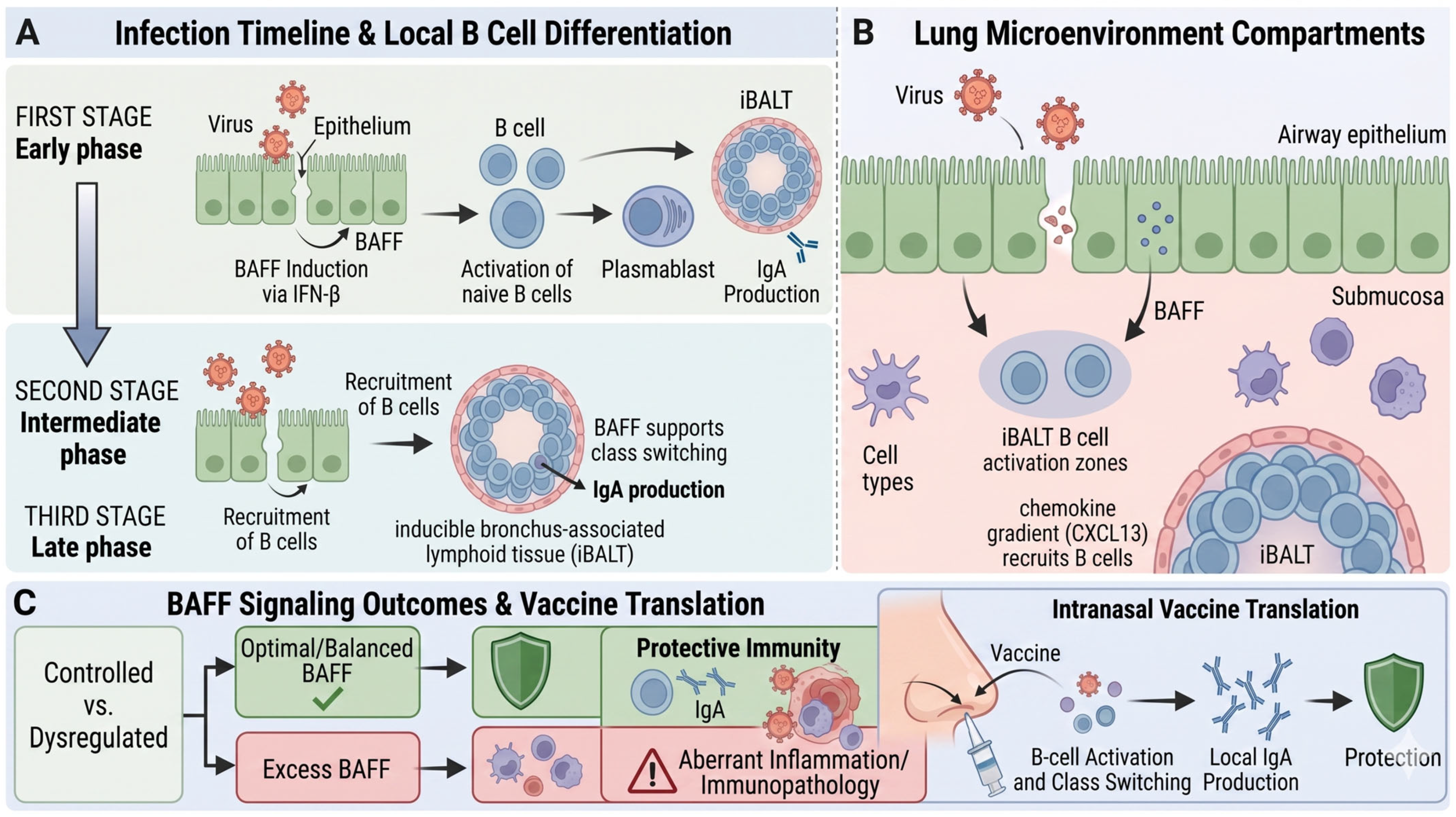
BAFF as a Key Modulator of Respiratory Mucosal B Cell Immunity in Viral Infection and Mucosal Vaccination

Abstract
1. Introduction
Methods of Literature Search
2. Induction and Dynamic Regulation of BAFF in Airway Epithelial Cells and the Lung Microenvironment During Viral Respiratory Infection
3. BAFF and Regulation of Airway B Cell Responses
3.1. BAFF and APRIL: Shared Receptors, Overlapping and Distinct Functions
3.2. BAFF Receptors and Signalling
4. BAFF in Immunopathology of the Lung
5. Implications of BAFF for Mucosal Vaccine Development

| Study | Model/Antigen | Route/Format | Key Outcome | Limitation/Gap |
|---|---|---|---|---|
| Tertilt et al., 2009 [84] | Pseudomonas aeruginosa vaccine; BAFF overexpression in mice | Systemic (parenteral) | BAFF overexpression enhanced vaccine-induced antibody responses and significantly improved survival after bacterial challenge | Not a mucosal vaccine; no IgA endpoint assessed; non-respiratory pathogen |
| Kanagavelu et al., 2014 [89] | HIV-1 Gag; adenoviral vector (Ad5) co-expressing multi-trimeric SP-D-BAFF (mice) | Systemic (Ad5 vector) | SP-D-BAFF significantly reduced vaccinia-Gag replication in female genital tract; enhanced T cell-mediated anti-viral immunity | Primarily T cell outcome; no mucosal IgA measured; non-respiratory model |
| Gupta et al., 2015 [90] | HIV-1 gp140 DNA vaccine; SP-D-BAFF and SP-D-APRIL as molecular adjuvants (mice) | Systemic (DNA + protein boost) | SP-D-BAFF significantly enhanced anti-gp120 IgG, germinal center responses, and HIV-1 tier 1 and tier 2 neutralizing antibody titers; enhanced antibody avidity | Systemic model only; no mucosal IgA endpoint; not a respiratory vaccine |
| Chen et al., 2019 (Antiviral Res) [91] | Influenza H5N1 VLPs molecularly fused with BAFF or APRIL; also multi-subtype H5H7 and H1H5H7 BAFF-VLPs (mice) | Parenteral (VLP + alum) | BAFF-VLPs with alum elicited broadly neutralizing IgG against homologous and two heterologous H5N1 clades; conferred protective immunity against live H5N1 challenge; multi-subtype VLPs induced cross-reactive neutralizing antibodies | Parenteral route only; no intranasal or mucosal IgA data; alum dependency limits standalone BAFF effect interpretation |
| Liu et al., 2020 [83] | HIV-1 trimeric gp140 fused with BAFF, APRIL, or CD40L (mice) | Parenteral (protein fusion) | Modestly enhanced antigen-specific IgG in mucosal secretions vs. gp140 alone; increased B cell proliferation | No IgA endpoint; not a respiratory or mucosal vaccine; modest effect size |
| Plummer & McGettigan, 2019 [86] | Rabies virus particles incorporating membrane-anchored BAFF (mice) | Parenteral (VLP) | Accelerated and improved neutralizing antibody responses; enhanced B cell activation vs. standard RABV vaccine | Non-respiratory, non-mucosal setting; IgA not assessed |
| Alnajran et al., 2025 [85] | RSV multi-epitope construct incorporating BAFF and APRIL (in silico reverse vaccinology) | Computational/in silico | Predicted enhanced immunogenicity, antigenicity, and immune activation profiles; integration of BAFF/APRIL improved in silico vaccine scores | No in vivo validation; computational predictions require experimental confirmation |
| Xie et al., 2025 (Front Immunol) [92] | BCG vaccination followed by post-vaccination BAFF or APRIL immunotherapy (mice; Mtb pulmonary challenge) | Subcutaneous BCG + i.p. BAFF/APRIL (transient) | BCG + BAFF/APRIL immunotherapy enhanced marginal-zone B cells, plasma cell differentiation, and central memory T cells; superior long-term pulmonary protection vs. BCG alone | Post-vaccination immunotherapy rather than adjuvant co-formulation; pulmonary (not airway mucosal) protection endpoint; non-viral pathogen |
6. Future Directions
7. Conclusions
Funding
Institutional Review Board Statement
Informed Consent Statement
Data Availability Statement
Conflicts of Interest
References
- Mettelman, R.C.; Allen, E.K.; Thomas, P.G. Mucosal immune responses to infection and vaccination in the respiratory tract. Immunity 2022, 55, 749–780. [Google Scholar] [CrossRef] [PubMed]
- Gambadauro, A.; Galletta, F.; Li Pomi, A.; Manti, S.; Piedimonte, G. Immune response to respiratory viral infections. Int. J. Mol. Sci. 2024, 25, 6178. [Google Scholar] [CrossRef] [PubMed]
- Mitsi, E.; Diniz, M.O.; Reiné, J.; Collins, A.M.; Robinson, R.E.; Hyder-Wright, A.; Farrar, M.; Liatsikos, K.; Hamilton, J.; Onyema, O. Respiratory mucosal immune memory to SARS-CoV-2 after infection and vaccination. Nat. Commun. 2023, 14, 6815. [Google Scholar] [CrossRef] [PubMed]
- Oh, J.E.; Song, E.; Moriyama, M.; Wong, P.; Zhang, S.; Jiang, R.; Strohmeier, S.; Kleinstein, S.H.; Krammer, F.; Iwasaki, A. Intranasal priming induces local lung-resident B cell populations that secrete protective mucosal antiviral IgA. Sci. Immunol. 2021, 6, eabj5129. [Google Scholar] [CrossRef] [PubMed]
- Wagstaffe, H.R.; Thwaites, R.S.; Reynaldi, A.; Sidhu, J.K.; McKendry, R.; Ascough, S.; Papargyris, L.; Collins, A.M.; Xu, J.; Lemm, N.-M. Mucosal and systemic immune correlates of viral control after SARS-CoV-2 infection challenge in seronegative adults. Sci. Immunol. 2024, 9, eadj9285. [Google Scholar] [PubMed]
- Russell, C.D.; Unger, S.A.; Walton, M.; Schwarze, J. The human immune response to respiratory syncytial virus infection. Clin. Microbiol. Rev. 2017, 30, 481–502. [Google Scholar] [CrossRef] [PubMed]
- Bagga, B.; Cehelsky, J.E.; Vaishnaw, A.; Wilkinson, T.; Meyers, R.; Harrison, L.M.; Roddam, P.L.; Walsh, E.E.; DeVincenzo, J.P. Effect of preexisting serum and mucosal antibody on experimental respiratory syncytial virus (RSV) challenge and infection of adults. J. Infect. Dis. 2015, 212, 1719–1725. [Google Scholar] [CrossRef] [PubMed]
- Sheikh-Mohamed, S.; Isho, B.; Chao, G.Y.; Zuo, M.; Cohen, C.; Lustig, Y.; Nahass, G.R.; Salomon-Shulman, R.E.; Blacker, G.; Fazel-Zarandi, M. Systemic and mucosal IgA responses are variably induced in response to SARS-CoV-2 mRNA vaccination and are associated with protection against subsequent infection. Mucosal Immunol. 2022, 15, 799–808. [Google Scholar] [PubMed]
- Craxton, A.; Magaletti, D.; Ryan, E.J.; Clark, E.A. Macrophage-and dendritic cell—Dependent regulation of human B-cell proliferation requires the TNF family ligand BAFF. Blood 2003, 101, 4464–4471. [Google Scholar] [PubMed]
- Boyaka, P.N. Inducing mucosal IgA: A challenge for vaccine adjuvants and delivery systems. J. Immunol. 2017, 199, 9–16. [Google Scholar] [CrossRef] [PubMed]
- Giordano, D.; Kuley, R.; Draves, K.E.; Roe, K.; Holder, U.; Giltiay, N.V.; Clark, E.A. BAFF produced by neutrophils and dendritic cells is regulated differently and has distinct roles in antibody responses and protective immunity against West Nile virus. J. Immunol. 2020, 204, 1508–1520. [Google Scholar] [CrossRef] [PubMed]
- Mackay, F.; Figgett, W.A.; Saulep, D.; Lepage, M.; Hibbs, M.L. B-cell stage and context-dependent requirements for survival signals from BAFF and the B-cell receptor. Immunol. Rev. 2010, 237, 205–225. [Google Scholar] [PubMed]
- Chorvinsky, E.; Bhattacharya, S.; Salka, K.; Bera, B.S.; Welham, A.; Mondell, E.; Perez, G.F.; Pillai, D.; Jaiswal, J.; Nino, G. Human airway epithelial B-cell activating factor is reduced in early life but is virally induced via JAK/STAT. J. Allergy Clin. Immunol. 2025, 156, 1082–1094. [Google Scholar] [CrossRef] [PubMed]
- Sakai, J.; Akkoyunlu, M. The role of BAFF system molecules in host response to pathogens. Clin. Microbiol. Rev. 2017, 30, 991–1014. [Google Scholar] [CrossRef] [PubMed]
- Pers, J.O.; Daridon, C.; Devauchelle, V.; Jousse, S.; Saraux, A.; Jamin, C.; Youinou, P. BAFF overexpression is associated with autoantibody production in autoimmune diseases. Ann. N. Y. Acad. Sci. 2005, 1050, 34–39. [Google Scholar] [CrossRef] [PubMed]
- Möckel, T.; Basta, F.; Weinmann-Menke, J.; Schwarting, A. B cell activating factor (BAFF): Structure, functions, autoimmunity and clinical implications in systemic lupus erythematosus (SLE). Autoimmun. Rev. 2021, 20, 102736. [Google Scholar] [CrossRef] [PubMed]
- Li, X.; Chen, M.; Chen, T.; Xie, L.; Luo, Q.; Fan, X.; Yin, Y.; Meng, S.; Jin, Z.; He, Y. The intricate interplay among microbiota, mucosal immunity, and viral infection in the respiratory tract. J. Transl. Med. 2025, 23, 488. [Google Scholar] [CrossRef] [PubMed]
- Groskreutz, D.J.; Monick, M.M.; Powers, L.S.; Yarovinsky, T.O.; Look, D.C.; Hunninghake, G.W. Respiratory syncytial virus induces TLR3 protein and protein kinase R, leading to increased double-stranded RNA responsiveness in airway epithelial cells. J. Immunol. 2006, 176, 1733–1740. [Google Scholar] [CrossRef] [PubMed]
- Hiller, B.E.; Yin, Y.; Perng, Y.-C.; de Araujo Castro, Í.; Fox, L.E.; Locke, M.C.; Monte, K.J.; López, C.B.; Ornitz, D.M.; Lenschow, D.J. Fibroblast growth factor-9 expression in airway epithelial cells amplifies the type I interferon response and alters influenza A virus pathogenesis. PLoS Pathog. 2022, 18, e1010228. [Google Scholar] [CrossRef] [PubMed]
- Lee, H.-C.; Headley, M.B.; Loo, Y.-M.; Berlin, A.; Gale, M., Jr.; Debley, J.S.; Lukacs, N.W.; Ziegler, S.F. Thymic stromal lymphopoietin is induced by respiratory syncytial virus–infected airway epithelial cells and promotes a type 2 response to infection. J. Allergy Clin. Immunol. 2012, 130, 1187–1196.e5. [Google Scholar] [CrossRef] [PubMed]
- Kato, A.; Schleimer, R.P. Beyond inflammation: Airway epithelial cells are at the interface of innate and adaptive immunity. Curr. Opin. Immunol. 2007, 19, 711–720. [Google Scholar] [CrossRef] [PubMed]
- McNamara, P.; Fonceca, A.; Howarth, D.; Correia, J.; Slupsky, J.; Trinick, R.; Al Turaiki, W.; Smyth, R.; Flanagan, B. Respiratory syncytial virus infection of airway epithelial cells, in vivo and in vitro, supports pulmonary antibody responses by inducing expression of the B cell differentiation factor BAFF. Thorax 2013, 68, 76–81. [Google Scholar] [PubMed]
- Ittah, M.; Miceli-Richard, C.; Gottenberg, J.E.; Sellam, J.; Eid, P.; Lebon, P.; Pallier, C.; Lepajolec, C.; Mariette, X. Viruses induce high expression of BAFF by salivary gland epithelial cells through TLR-and type-I IFN-dependent and-independent pathways. Eur. J. Immunol. 2008, 38, 1058–1064. [Google Scholar] [PubMed]
- Ittah, M.; Miceli-Richard, C.; Eric Gottenberg, J.; Lavie, F.; Lazure, T.; Ba, N.; Sellam, J.; Lepajolec, C.; Mariette, X. B cell-activating factor of the tumor necrosis factor family (BAFF) is expressed under stimulation by interferon in salivary gland epithelial cells in primary Sjögren’s syndrome. Arthritis Res. Ther. 2006, 8, R51. [Google Scholar] [PubMed]
- Xu, W.; Santini, P.A.; Matthews, A.J.; Chiu, A.; Plebani, A.; He, B.; Chen, K.; Cerutti, A. Viral double-stranded RNA triggers Ig class switching by activating upper respiratory mucosa B cells through an innate TLR3 pathway involving BAFF. J. Immunol. 2008, 181, 276–287. [Google Scholar] [CrossRef] [PubMed]
- Alturaiki, W.; McFarlane, A.J.; Rose, K.; Corkhill, R.; McNamara, P.S.; Schwarze, J.; Flanagan, B.F. Expression of the B cell differentiation factor BAFF and chemokine CXCL13 in a murine model of respiratory syncytial virus infection. Cytokine 2018, 110, 267–271. [Google Scholar] [CrossRef] [PubMed]
- Seys, L.J.; Verhamme, F.M.; Schinwald, A.; Hammad, H.; Cunoosamy, D.M.; Bantsimba-Malanda, C.; Sabirsh, A.; McCall, E.; Flavell, L.; Herbst, R. Role of B cell–activating factor in chronic obstructive pulmonary disease. Am. J. Respir. Crit. Care Med. 2015, 192, 706–718. [Google Scholar] [CrossRef] [PubMed]
- Alturaiki, W.; Flanagan, B. Respiratory Syncytial Virus Induces B Cell Activating Factor (BAFF) in Airway Epithelium: A Potential Avenue for Mucosal Vaccine Development. Viruses 2025, 17, 946. [Google Scholar] [CrossRef] [PubMed]
- Rangel-Moreno, J.; Hartson, L.; Navarro, C.; Gaxiola, M.; Selman, M.; Randall, T.D. Inducible bronchus-associated lymphoid tissue (iBALT) in patients with pulmonary complications of rheumatoid arthritis. J. Clin. Investig. 2006, 116, 3183–3194. [Google Scholar] [PubMed]
- Moyron-Quiroz, J.E.; Rangel-Moreno, J.; Kusser, K.; Hartson, L.; Sprague, F.; Goodrich, S.; Woodland, D.L.; Lund, F.E.; Randall, T.D. Role of inducible bronchus associated lymphoid tissue (iBALT) in respiratory immunity. Nat. Med. 2004, 10, 927–934. [Google Scholar] [CrossRef] [PubMed]
- Schweighoffer, E.; Tybulewicz, V.L. BAFF signaling in health and disease. Curr. Opin. Immunol. 2021, 71, 124–131. [Google Scholar] [CrossRef] [PubMed]
- McAllister, E.; Jellusova, J. BAFF signaling in B cell metabolism. Curr. Opin. Immunol. 2021, 71, 69–74. [Google Scholar] [CrossRef] [PubMed]
- Ingold, K.; Zumsteg, A.; Tardivel, A.; Huard, B.; Steiner, Q.-G.; Cachero, T.G.; Qiang, F.; Gorelik, L.; Kalled, S.L.; Acha-Orbea, H. Identification of proteoglycans as the APRIL-specific binding partners. J. Exp. Med. 2005, 201, 1375–1383. [Google Scholar] [CrossRef] [PubMed]
- Bossen, C.; Schneider, P. BAFF, APRIL and their receptors: Structure, function and signaling. Semin. Immunol. 2006, 18, 263–275. [Google Scholar] [CrossRef] [PubMed]
- Cheung, C.K.; Barratt, J.; Liew, A.; Zhang, H.; Tesar, V.; Lafayette, R. The role of BAFF and APRIL in IgA nephropathy: Pathogenic mechanisms and targeted therapies. Front. Nephrol. 2024, 3, 1346769. [Google Scholar] [CrossRef] [PubMed]
- Moisini, I.; Davidson, A. BAFF: A local and systemic target in autoimmune diseases. Clin. Exp. Immunol. 2009, 158, 155–163. [Google Scholar] [CrossRef] [PubMed]
- Eslami, M.; Schuepbach-Mallepell, S.; Diana, D.; Willen, L.; Kowalczyk-Quintas, C.; Desponds, C.; Peter, B.; Vigolo, M.; Renevey, F.; Donzé, O. Unique and redundant roles of mouse BCMA, TACI, BAFF, APRIL, and IL-6 in supporting antibody-producing cells in different tissues. Proc. Natl. Acad. Sci. USA 2024, 121, e2404309121. [Google Scholar] [CrossRef] [PubMed]
- Kimberley, F.C.; Van Bostelen, L.; Cameron, K.; Hardenberg, G.; Marquart, J.A.; Hahne, M.; Medema, J.P. The proteoglycan (heparan sulfate proteoglycan) binding domain of APRIL serves as a platform for ligand multimerization andcross-linking. FASEB J. 2009, 23, 1584–1595. [Google Scholar] [PubMed]
- Reijmers, R.M.; Groen, R.W.; Kuil, A.; Weijer, K.; Kimberley, F.C.; Medema, J.P.; van Kuppevelt, T.H.; Li, J.-P.; Spaargaren, M.; Pals, S.T. Disruption of heparan sulfate proteoglycan conformation perturbs B-cell maturation and APRIL-mediated plasma cell survival. Blood J. Am. Soc. Hematol. 2011, 117, 6162–6171. [Google Scholar]
- Cornelis, R.; Chang, H.-D.; Radbruch, A. Keeping up with the stress of antibody production: BAFF and APRIL maintain memory plasma cells. Curr. Opin. Immunol. 2021, 71, 97–102. [Google Scholar] [CrossRef] [PubMed]
- Evans, L.S.; Lewis, K.E.; DeMonte, D.; Bhandari, J.G.; Garrett, L.B.; Kuijper, J.L.; Ardourel, D.; Wolfson, M.F.; Debrot, S.; Mudri, S. Povetacicept, an enhanced dual APRIL/BAFF antagonist that modulates B lymphocytes and pathogenic autoantibodies for the treatment of lupus and other B cell–related autoimmune diseases. Arthritis Rheumatol. 2023, 75, 1187–1202. [Google Scholar] [PubMed]
- Kato, A.; Truong-Tran, A.Q.; Scott, A.L.; Matsumoto, K.; Schleimer, R.P. Airway epithelial cells produce B cell-activating factor of TNF family by an IFN-β-dependent mechanism. J. Immunol. 2006, 177, 7164–7172. [Google Scholar] [CrossRef] [PubMed]
- Alturaiki, W. Considerations for novel COVID-19 mucosal vaccine development. Vaccines 2022, 10, 1173. [Google Scholar] [CrossRef] [PubMed]
- Ullah, M.A.; Mackay, F. The BAFF-APRIL System in Cancer. Cancers 2023, 15, 1791. [Google Scholar] [CrossRef] [PubMed]
- Castigli, E.; Wilson, S.A.; Scott, S.; Dedeoglu, F.; Xu, S.; Lam, K.-P.; Bram, R.J.; Jabara, H.; Geha, R.S. TACI and BAFF-R mediate isotype switching in B cells. J. Exp. Med. 2005, 201, 35–39. [Google Scholar] [CrossRef] [PubMed]
- Tezuka, H.; Abe, Y.; Asano, J.; Sato, T.; Liu, J.; Iwata, M.; Ohteki, T. Prominent role for plasmacytoid dendritic cells in mucosal T cell-independent IgA induction. Immunity 2011, 34, 247–257. [Google Scholar] [PubMed]
- Seppo, A.E.; Rajani, P.S.; Wong, A.; Varrone, J.J.; Fridy, S.T.; Kuitunen, M.; Kukkonen, K.; Savilahti, E.; Järvinen, K.M. The role of TGF-β and APRIL in human milk IgA production and development of allergic disease in early childhood. Pediatr. Allergy Immunol. 2022, 33, e13813. [Google Scholar] [PubMed]
- Alturaiki, W. The roles of B cell activation factor (BAFF) and a proliferation-inducing ligand (APRIL) in allergic asthma. Immunol. Lett. 2020, 225, 25–30. [Google Scholar] [CrossRef] [PubMed]
- Smulski, C.R.; Zhang, L.; Burek, M.; Rubio, A.T.; Briem, J.-S.; Sica, M.P.; Sevdali, E.; Vigolo, M.; Willen, L.; Odermatt, P. Ligand-independent oligomerization of TACI is controlled by the transmembrane domain and regulates proliferation of activated B cells. Cell Rep. 2022, 38, 110583. [Google Scholar] [CrossRef] [PubMed]
- Bossen, C.; Cachero, T.G.; Tardivel, A.; Ingold, K.; Willen, L.; Dobles, M.; Scott, M.L.; Maquelin, A.; Belnoue, E.; Siegrist, C.-A. TACI, unlike BAFF-R, is solely activated by oligomeric BAFF and APRIL to support survival of activated B cells and plasmablasts. Blood J. Am. Soc. Hematol. 2008, 111, 1004–1012. [Google Scholar] [CrossRef]
- Müller-Winkler, J.; Mitter, R.; Rappe, J.C.; Vanes, L.; Schweighoffer, E.; Mohammadi, H.; Wack, A.; Tybulewicz, V.L. Critical requirement for BCR, BAFF, and BAFFR in memory B cell survival. J. Exp. Med. 2020, 218, e20191393. [Google Scholar] [CrossRef]
- He, B.; Santamaria, R.; Xu, W.; Cols, M.; Chen, K.; Puga, I.; Shan, M.; Xiong, H.; Bussel, J.B.; Chiu, A. The transmembrane activator TACI triggers immunoglobulin class switching by activating B cells through the adaptor MyD88. Nat. Immunol. 2010, 11, 836–845. [Google Scholar] [CrossRef] [PubMed]
- Barone, F.; Patel, P.; Sanderson, J.; Spencer, J. Gut-associated lymphoid tissue contains the molecular machinery to support T-cell-dependent and T-cell-independent class switch recombination. Mucosal Immunol. 2009, 2, 495–503. [Google Scholar] [PubMed]
- Reed, J.L.; Welliver, T.P.; Sims, G.P.; McKinney, L.; Velozo, L.; Avendano, L.; Hintz, K.; Luma, J.; Coyle, A.J.; Sr, R.C.W. Innate immune signals modulate antiviral and polyreactive antibody responses during severe respiratory syncytial virus infection. J. Infect. Dis. 2009, 199, 1128–1138. [Google Scholar] [CrossRef] [PubMed]
- Familiar-Macedo, D.; de Azeredo, E.L.; de Lemos, E.R.S.; Damasco, P.V.; de-Oliveira-Pinto, L.M. Profile of Humoral Immunity and B Cell Pool in Infection with the SARS-CoV-2 Prototype Strain and AZD1222 (ChAdOx nCoV-19) Vaccination. Vaccines 2025, 13, 101. [Google Scholar] [PubMed]
- Klocperk, A.; Bloomfield, M.; Parackova, Z.; Aillot, L.; Fremuth, J.; Sasek, L.; David, J.; Fencl, F.; Skotnicova, A.; Rejlova, K. B cell phenotype and serum levels of interferons, BAFF, and APRIL in multisystem inflammatory syndrome in children associated with COVID-19 (MIS-C). Mol. Cell. Pediatr. 2023, 10, 15. [Google Scholar] [CrossRef] [PubMed]
- Matsumoto, R.; Gray, J.; Rybkina, K.; Oppenheimer, H.; Levy, L.; Friedman, L.M.; Khamaisi, M.; Meng, W.; Rosenfeld, A.M.; Guyer, R.S. Induction of bronchus-associated lymphoid tissue is an early life adaptation for promoting human B cell immunity. Nat. Immunol. 2023, 24, 1370–1381. [Google Scholar] [CrossRef] [PubMed]
- Cumpelik, A.; Cody, E.; Yu, S.M.-W.; Grasset, E.K.; Dominguez-Sola, D.; Cerutti, A.; Heeger, P.S. Cutting edge: Neutrophil complement receptor signaling is required for BAFF-dependent humoral responses in mice. J. Immunol. 2023, 210, 19–23. [Google Scholar] [CrossRef] [PubMed]
- Neill, D.R.; Saint, G.L.; Bricio-Moreno, L.; Fothergill, J.L.; Southern, K.W.; Winstanley, C.; Christmas, S.E.; Slupsky, J.R.; McNamara, P.S.; Kadioglu, A. The B lymphocyte differentiation factor (BAFF) is expressed in the airways of children with CF and in lungs of mice infected with Pseudomonas aeruginosa. PLoS ONE 2014, 9, e95892. [Google Scholar] [CrossRef] [PubMed]
- Garić, D.; Tao, S.; Ahmed, E.; Youssef, M.; Kanagaratham, C.; Shah, J.; Mazer, B.; Radzioch, D. Depletion of BAFF cytokine exacerbates infection in Pseudomonas aeruginosa infected mice. J. Cyst. Fibros. 2019, 18, 349–356. [Google Scholar] [CrossRef] [PubMed]
- Polverino, F.; Cosio, B.G.; Pons, J.; Laucho-Contreras, M.; Tejera, P.; Iglesias, A.; Rios, A.; Jahn, A.; Sauleda, J.; Divo, M. B cell–activating factor. An orchestrator of lymphoid follicles in severe chronic obstructive pulmonary disease. Am. J. Respir. Crit. Care Med. 2015, 192, 695–705. [Google Scholar] [CrossRef] [PubMed]
- Gao, S.; Chen, J.; Xie, J.; Wang, J. The effects of BAFF on T lymphocytes in chronic obstructive pulmonary disease. Respir. Res. 2020, 21, 66. [Google Scholar] [CrossRef] [PubMed]
- Liang, Z.-Q.; Tu, P.-C.; Ji, J.-J.; Xing, Q.-Q.; Zhao, X. Gu-Ben-Fang-Xiao attenuates allergic airway inflammation by inhibiting BAFF-mediated B cell activation. Biomed. Pharmacother. 2020, 132, 110801. [Google Scholar] [PubMed]
- Samitas, K.; Malmhäll, C.; Rådinger, M.; Ramos-Ramirez, P.; Lu, Y.; Deák, T.; Semitekolou, M.; Gaga, M.; Sjöstrand, M.; Lötvall, J. Precursor B cells increase in the lung during airway allergic inflammation: A role for B cell-activating factor. PLoS ONE 2016, 11, e0161161. [Google Scholar] [CrossRef] [PubMed]
- François, A.; Gombault, A.; Villeret, B.; Alsaleh, G.; Fanny, M.; Gasse, P.; Adam, S.M.; Crestani, B.; Sibilia, J.; Schneider, P. B cell activating factor is central to bleomycin-and IL-17-mediated experimental pulmonary fibrosis. J. Autoimmun. 2015, 56, 1–11. [Google Scholar] [PubMed]
- Maglione, P.J.; Gyimesi, G.; Cols, M.; Radigan, L.; Ko, H.M.; Weinberger, T.; Lee, B.H.; Grasset, E.K.; Rahman, A.H.; Cerutti, A. BAFF-driven B cell hyperplasia underlies lung disease in common variable immunodeficiency. JCI Insight 2019, 4, e122728. [Google Scholar] [CrossRef] [PubMed]
- Lu, B.; Zhang, Y.; Wang, J.; Yang, D.; Liu, M.; Ma, L.; Yi, W.; Liang, Y.; Xu, Y.; Fan, H. PD1+ CD4+ T cells promote receptor editing and suppress autoreactivity of CD19+ CD21low B cells within the lower respiratory airways in adenovirus pneumonia. Mucosal Immunol. 2024, 17, 1045–1059. [Google Scholar] [PubMed]
- Zhang, Y.; Tian, J.; Xiao, F.; Zheng, L.; Zhu, X.; Wu, L.; Zhao, C.; Wang, S.; Rui, K.; Zou, H. B cell-activating factor and its targeted therapy in autoimmune diseases. Cytokine Growth Factor Rev. 2022, 64, 57–70. [Google Scholar] [CrossRef] [PubMed]
- Li, L.; Shen, S.; Shao, S.; Dang, E.; Wang, G.; Fang, H.; Qiao, H. The role of B cell-activating factor system in autoimmune diseases: Mechanisms, disease implications, and therapeutic advances. Front. Immunol. 2025, 16, 1538555. [Google Scholar] [CrossRef] [PubMed]
- Tagami, N.; Yuda, J.; Goto, Y. Current status of BAFF targeting immunotherapy in B-cell neoplasm. Int. J. Clin. Oncol. 2024, 29, 1676–1683. [Google Scholar] [CrossRef] [PubMed]
- Tanaka, Y. Belimumab: A BAFF-specific Inhibitor for the Treatment of Systemic Lupus Erythematosus and Lupus Nephritis. Touchreviews RMD 2022, 1, 32–36. [Google Scholar] [CrossRef]
- Zhao, L.; Jin, S.; Wang, S.; Zhang, Z.; Wang, X.; Chen, Z.; Wang, X.; Huang, S.; Zhang, D.; Wu, H. Tertiary lymphoid structures in diseases: Immune mechanisms and therapeutic advances. Signal Transduct. Target. Ther. 2024, 9, 225. [Google Scholar] [CrossRef] [PubMed]
- Woo, S.-J.; Im, J.; Jeon, J.H.; Kang, S.-S.; Lee, M.-H.; Yun, C.-H.; Moon, E.-Y.; Song, M.K.; Kim, H.-H.; Han, S.H. Induction of BAFF expression by IFN-γ via JAK/STAT signaling pathways in human intestinal epithelial cells. J. Leukoc. Biol. 2013, 93, 363–368. [Google Scholar] [PubMed]
- Moir, S.; Fauci, A.S. B cells in HIV infection and disease. Nat. Rev. Immunol. 2009, 9, 235–245. [Google Scholar] [CrossRef] [PubMed]
- Matson, E.M.; Abyazi, M.L.; Bell, K.A.; Hayes, K.M.; Maglione, P.J. B cell dysregulation in common variable immunodeficiency interstitial lung disease. Front. Immunol. 2021, 11, 622114. [Google Scholar] [CrossRef] [PubMed]
- Chagnon-Choquet, J.; Gauvin, J.; Roger, J.; Fontaine, J.; Poudrier, J.; Roger, M.; Infection, M.P.H.; Groups, S.P.S.; Vassal, A.; Legault, M.; et al. HIV Nef promotes expression of B-lymphocyte stimulator by blood dendritic cells during HIV infection in humans. J. Infect. Dis. 2015, 211, 1229–1240. [Google Scholar] [PubMed]
- Thwaites, R.S.; Uruchurtu, A.S.; Negri, V.A.; Cole, M.E.; Singh, N.; Poshai, N.; Jackson, D.; Hoschler, K.; Baker, T.; Scott, I.C. Early mucosal events promote distinct mucosal and systemic antibody responses to live attenuated influenza vaccine. Nat. Commun. 2023, 14, 8053. [Google Scholar] [CrossRef] [PubMed]
- Hartwell, B.L.; Melo, M.B.; Xiao, P.; Lemnios, A.A.; Li, N.; Chang, J.Y.; Yu, J.; Gebre, M.S.; Chang, A.; Maiorino, L. Intranasal vaccination with lipid-conjugated immunogens promotes antigen transmucosal uptake to drive mucosal and systemic immunity. Sci. Transl. Med. 2022, 14, eabn1413. [Google Scholar] [CrossRef] [PubMed]
- Stewart, E.L.; Counoupas, C.; Johansen, M.D.; Nguyen, D.H.; Miemczyk, S.; Hansbro, N.G.; Ferrell, K.C.; Ashhurst, A.; Alca, S.; Ashley, C. Mucosal immunization with a delta-inulin adjuvanted recombinant spike vaccine elicits lung-resident immune memory and protects mice against SARS-CoV-2. Mucosal Immunol. 2022, 15, 1405–1415. [Google Scholar] [PubMed]
- Gagne, M.; Flynn, B.J.; Andrew, S.F.; Marquez, J.; Flebbe, D.R.; Mychalowych, A.; Lamb, E.; Davis-Gardner, M.E.; Burnett, M.R.; Serebryannyy, L.A. Mucosal adenovirus vaccine boosting elicits IgA and durably prevents XBB. 1.16 infection in nonhuman primates. Nat. Immunol. 2024, 25, 1913–1927. [Google Scholar] [PubMed]
- Wørzner, K.; Schmidt, S.T.; Zimmermann, J.; Tami, A.; Polacek, C.; Fernandez-Antunez, C.; Hartmann, K.T.; Jensen, R.F.; Hansen, J.S.; Illigen, K. Intranasal recombinant protein subunit vaccine targeting TLR3 induces respiratory tract IgA and CD8 T cell responses and protects against respiratory virus infection. EBioMedicine 2025, 113, 105615. [Google Scholar] [CrossRef] [PubMed]
- Alturaiki, W. The role of cross-reactive immunity to emerging coronaviruses: Implications for novEl Universal mucosal vaccine design. Saudi Med. J. 2023, 44, 965. [Google Scholar] [PubMed]
- Liu, J.; Clayton, K.; Gao, W.; Li, Y.; Zealey, C.; Budylowski, P.; Schwartz, J.; Yue, F.Y.; Bie, Y.; Rini, J. Trimeric HIV-1 gp140 fused with APRIL, BAFF, and CD40L on the mucosal gp140-specific antibody responses in mice. Vaccine 2020, 38, 2149–2159. [Google Scholar] [PubMed]
- Tertilt, C.; Joh, J.; Krause, A.; Chou, P.; Schneeweiss, K.; Crystal, R.G.; Worgall, S. Expression of B-cell activating factor enhances protective immunity of a vaccine against Pseudomonas aeruginosa. Infect. Immun. 2009, 77, 3044–3055. [Google Scholar] [CrossRef] [PubMed]
- Alnajran, H.; Awadalla, M.; Aldakheel, F.M.; Alam, I.; Momin, A.A.; Alturaiki, W.; Alosaimi, B. Design of a peptide-based vaccine against human respiratory syncytial virus using a reverse vaccinology approach: Evaluation of immunogenicity, antigenicity, allergenicity, and toxicity. Front. Immunol. 2025, 16, 1546254. [Google Scholar] [CrossRef] [PubMed]
- Plummer, J.R.; McGettigan, J.P. Incorporating B cell activating factor (BAFF) into the membrane of rabies virus (RABV) particles improves the speed and magnitude of vaccine-induced antibody responses. PLoS Neglected Trop. Dis. 2019, 13, e0007800. [Google Scholar] [CrossRef]
- Lapuente, D.; genannt Bonsmann, M.S.; Maaske, A.; Stab, V.; Heinecke, V.; Watzstedt, K.; Heß, R.; Westendorf, A.; Bayer, W.; Ehrhardt, C. IL-1β as mucosal vaccine adjuvant: The specific induction of tissue-resident memory T cells improves the heterosubtypic immunity against influenza A viruses. Mucosal Immunol. 2018, 11, 1265–1278. [Google Scholar] [PubMed]
- Lee, D.S.; Rojas, O.L.; Gommerman, J.L. B cell depletion therapies in autoimmune disease: Advances and mechanistic insights. Nat. Rev. Drug Discov. 2021, 20, 179–199. [Google Scholar] [PubMed]
- Kanagavelu, S.; Termini, J.M.; Gupta, S.; Raffa, F.N.; Fuller, K.A.; Rivas, Y.; Philip, S.; Kornbluth, R.S.; Stone, G.W. HIV-1 adenoviral vector vaccines expressing multi-trimeric BAFF and 4-1BBL enhance T cell mediated anti-viral immunity. PLoS ONE 2014, 9, e90100. [Google Scholar] [PubMed]
- Gupta, S.; Clark, E.S.; Termini, J.M.; Boucher, J.; Kanagavelu, S.; LeBranche, C.C.; Abraham, S.; Montefiori, D.C.; Khan, W.N.; Stone, G.W. DNA vaccine molecular adjuvants SP-D-BAFF and SP-D-APRIL enhance anti-gp120 immune response and increase HIV-1 neutralizing antibody titers. J. Virol. 2015, 89, 4158–4169. [Google Scholar] [CrossRef] [PubMed]
- Chen, T.H.; Hong, J.Y.; Liu, C.C.; Chen, C.C.; Jan, J.T.; Wu, S.C. Production of Multi-Subtype Influenza Virus-Like Particles by Molecular Fusion with BAFF or APRIL for Vaccine Development. Methods Mol. Biol. 2021, 2248, 139–153. [Google Scholar] [CrossRef] [PubMed]
- Xie, M.; Tsai, C.-Y.; Woo, J.; Nuritdinov, F.; Cristaldo, M.; Odjourian, N.M.; Antilus-Sainte, R.; Dougher, M.; Gengenbacher, M. BAFF and APRIL immunotherapy following Bacille Calmette-Guérin vaccination enhances protection against pulmonary tuberculosis in mice. Front. Immunol. 2025, 16, 1551183. [Google Scholar] [CrossRef] [PubMed]

| Feature | BAFF | APRIL | References |
|---|---|---|---|
| Primary receptors | BAFF-R, TACI, BCMA | TACI, BCMA | [34,42,43] |
| Main role in B-cell biology | B-cell maturation, survival, homeostasis | Plasma-cell survival, IgA-linked humoral responses | [35,37,44] |
| Effect on IgA responses | Supports IgA class switching (esp. via TACI/BAFF-R) | Potent inducer of TI IgA class switching | [34,45,46,47] |
| Sources in respiratory mucosa | Airway epithelial cells, DCs, macrophages, neutrophils | Same | [43,48] |
| Contribution to mucosal immunity | Maintains local B-cell populations and Ab responses | Sustains mucosal plasma cells and secretory IgA | [35,37,42] |
| Relevance during respiratory infection | Upregulated by viral/bacterial stimuli; enhances humoral immunity | Supports durable mucosal Ab and plasma cells | [14,22,28,43] |
| Setting | BAFF Source | BAFF Regulatory Role | Functional Outcome | Disease/Consequence | Key References |
|---|---|---|---|---|---|
| Acute RSV infection (infants/children) | Airway epithelial cells (IFN-β dependent); DCs; infiltration inflammatory immune cells | Rapidly induced via TLR3/JAK-STAT; supports early B cell activation and IgA CSR | Early IgA and IgG production; plasmablast formation; iBALT initiation | Protective mucosal humoral immunity; limits viral spread | [22,26,28,54] |
| Acute influenza and rhinovirus infection | Airway epithelial cells; upper airway DCs | TLR3-driven BAFF induction activates T-independent IgG and IgA CSR in mucosal B cells | IgA and IgG class switching; B cell activation; local antibody production | Protective mucosal immunity against multiple respiratory viruses | [11,25] |
| SARS-CoV-2/COVID-19 infection | Myeloid cells; epithelial cells | BAFF elevated during acute infection; correlates positively with total B cells and IgG+ plasmablasts | B cell activation; IgG plasmablast expansion; supports systemic humoral response | Protective antibody response; dysregulated in MIS-C (elevated BAFF with reduced BAFFR expression and autoantibody production) | [55,56] |
| Early life/pediatric airway (baseline and viral infection) | Airway epithelial cells (low baseline; virally inducible via JAK/STAT) | Developmentally low but rapidly activated BAFF/BAFF-R axis upon viral stimulation | Rapid induction of BAFF supports local B cell responses in pediatric airways | Protective; developmentally regulated defense mechanism | [13] |
| iBALT formation during respiratory infection | Epithelial cells; myeloid cells; stromal cells | BAFF together with CXCL13 organizes B cell niches; sustains GC activity and plasma cell survival | Germinal center formation; class-switched IgA and IgG; tissue-resident memory B cells | Long-term protective mucosal immunity; reduced systemic vaccine dependence | [26,30,57] |
| Neutrophil-complement axis (gut and lung IgA) | Neutrophils (C3aR1/C5aR1-dependent BAFF release) | Complement receptor signaling drives neutrophil BAFF production; enables T-independent IgA CSR | IgA germinal center B cell expansion in Peyer’s patches; fecal IgA; likely conserved in lung | Protective T-independent mucosal IgA; innate-adaptive bridge | [58] |
| Cystic fibrosis airways (Pseudomonas aeruginosa) | Airway epithelial cells; myeloid cells | BAFF elevated in CF airways irrespective of Pseudomonal infection; BAFF depletion worsens infection outcomes | B cell recruitment and differentiation; local antibody production against P. aeruginosa | Protective role suggested (depletion exacerbates infection); but chronic BAFF elevation may reflect ineffective clearance | [59,60] |
| COPD (cigarette smoke-induced) | Follicular stromal cells; B cells; macrophages | Markedly overexpressed in pulmonary lymphoid follicles; prevents B cell apoptosis via Bcl-2; drives ectopic follicle expansion | Lymphoid follicle formation; local immunoglobulin elevation; reduced B cell apoptosis; airflow limitation | Pathogenic: emphysema progression; BAFF antagonism (BAFF-R:Fc) reduces follicles, immunoglobulins, and lung destruction | [27,61] |
| BAFF and T lymphocytes in COPD | Lung structural and myeloid cells | BAFF directly promotes CD4+ and CD8+ T cell activation and survival; amplifies airway inflammation | Enhanced T cell-mediated airway inflammation; cytokine amplification loop | Pathogenic: BAFF-driven T cell hyperactivation contributes to COPD progression | [62] |
| Allergic airway inflammation/OVA-RSV asthma | Pulmonary macrophages | Sustains BAFF-R+ and TACI+ B cells; promotes IgE CSR; pharmacologic BAFF inhibition reduces IgE | IgE+ B cell expansion; elevated IgE; airway eosinophilia; increased B cell precursors in lung | Pathogenic: enhanced allergic response; IgE-mediated mast cell activation; BAFF-R blockade reduces eosinophils | [63,64] |
| Pulmonary fibrosis (bleomycin model/IPF) | Gr1+ myeloid cells; neutrophils (IL-1beta/IL-17A-driven) | BAFF induced downstream of IL-1beta and IL-17A; promotes TGF-beta, collagen deposition; elevated in IPF BAL | Fibrosis progression; collagen deposition; IL-17A-dependent pathology | Pathogenic: BAFF blockade limits TGF-beta and fibrosis; elevated BAFF in human IPF | [65] |
| CVID-associated interstitial lung disease | IFN-gamma-activated CD14+ monocytes (STAT1-dependent) | Monocyte-derived BAFF drives BAFF-R-dependent Bcl-2 upregulation; naïve B cell accumulation in tertiary lymphoid structures | B cell hyperplasia in TLS; elevated IgM; disease progression; transient improvement after B cell depletion before relapse | Pathogenic: BAFF-driven chronic pulmonary autoimmunity; recurrence parallels BAFF re-elevation | [66] |
| Adenovirus pneumonia (autoimmunity) | Pulmonary myeloid cells | High BAFF from myeloid cells promotes tertiary lymphoid structure formation in lower airways | Local autoantibody production; CD19+CD21low autoreactive B cell accumulation | Pathogenic: BAFF links severe viral pneumonia to autoreactive B cell responses | [67] |
| Rheumatoid arthritis-associated lung disease (RA-ILD)/iBALT | Stromal and myeloid cells within iBALT | BAFF together with CXCL13, CCL21, lymphotoxin sustains GC-like B cell follicles in iBALT | Tertiary lymphoid structure maturation; sustained autoantibody production | Pathogenic: iBALT with GC activity linked to RA-ILD progression | [29] |
Disclaimer/Publisher’s Note: The statements, opinions and data contained in all publications are solely those of the individual author(s) and contributor(s) and not of MDPI and/or the editor(s). MDPI and/or the editor(s) disclaim responsibility for any injury to people or property resulting from any ideas, methods, instructions or products referred to in the content. |
© 2026 by the author. Licensee MDPI, Basel, Switzerland. This article is an open access article distributed under the terms and conditions of the Creative Commons Attribution (CC BY) license.
Share and Cite
Alturaiki, W. BAFF as a Key Modulator of Respiratory Mucosal B Cell Immunity in Viral Infection and Mucosal Vaccination. Cells 2026, 15, 1140. https://doi.org/10.3390/cells15131140
Alturaiki W. BAFF as a Key Modulator of Respiratory Mucosal B Cell Immunity in Viral Infection and Mucosal Vaccination. Cells. 2026; 15(13):1140. https://doi.org/10.3390/cells15131140
Chicago/Turabian StyleAlturaiki, Wael. 2026. "BAFF as a Key Modulator of Respiratory Mucosal B Cell Immunity in Viral Infection and Mucosal Vaccination" Cells 15, no. 13: 1140. https://doi.org/10.3390/cells15131140
APA StyleAlturaiki, W. (2026). BAFF as a Key Modulator of Respiratory Mucosal B Cell Immunity in Viral Infection and Mucosal Vaccination. Cells, 15(13), 1140. https://doi.org/10.3390/cells15131140