Axonal Transport Failure as a Cellular Mechanism of Diabetic Neuropathy


Highlights
- Diabetic neuropathy reflects convergent structural and functional injury to long axons. It is accompanied by glial, immune, and vascular dysfunction.
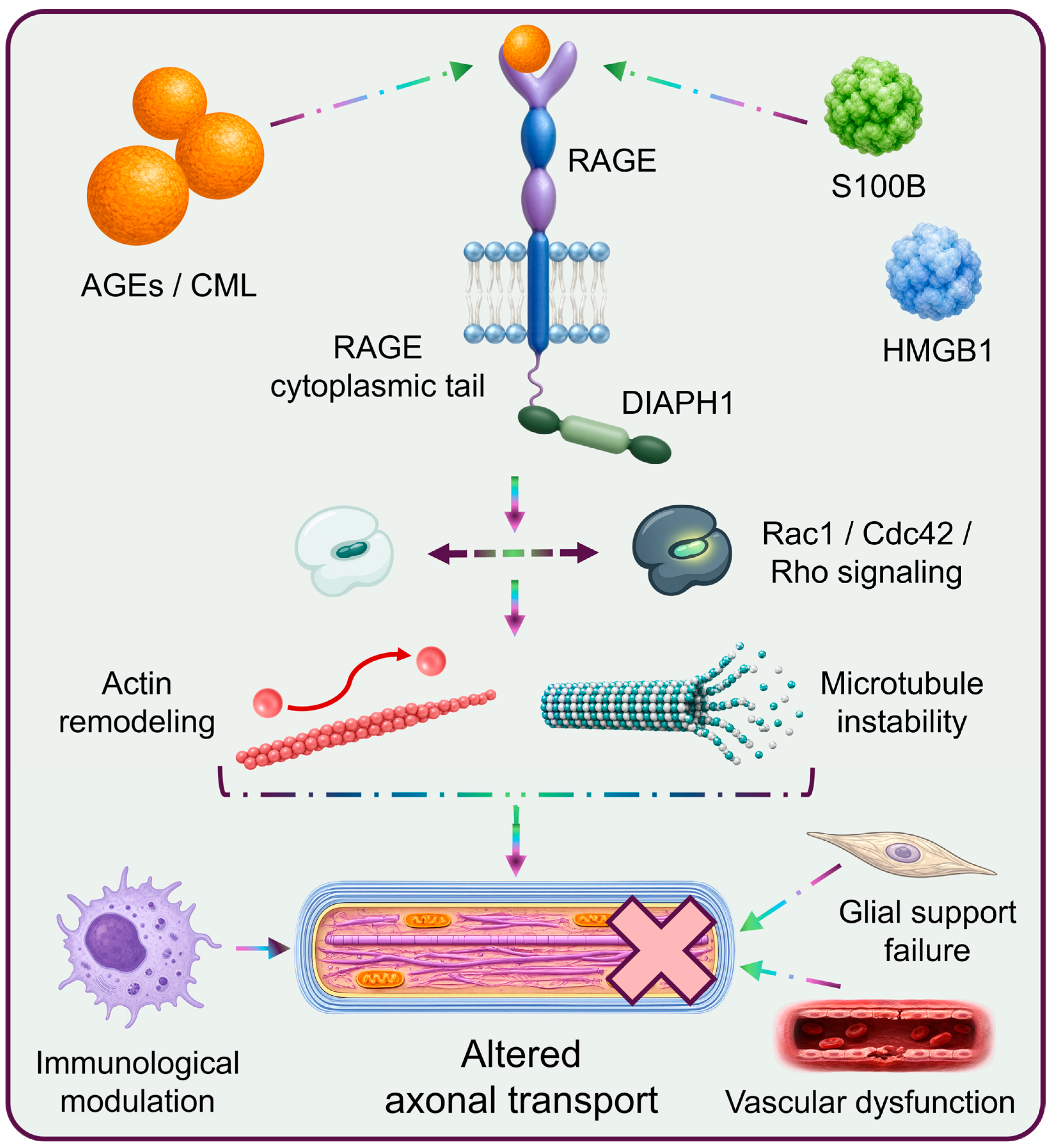
- Carbonyl stress and AGEs damage the axonal cytoskeleton and may contribute to transport vulnerability through mechanisms that include RAGE–DIAPH1 signaling.
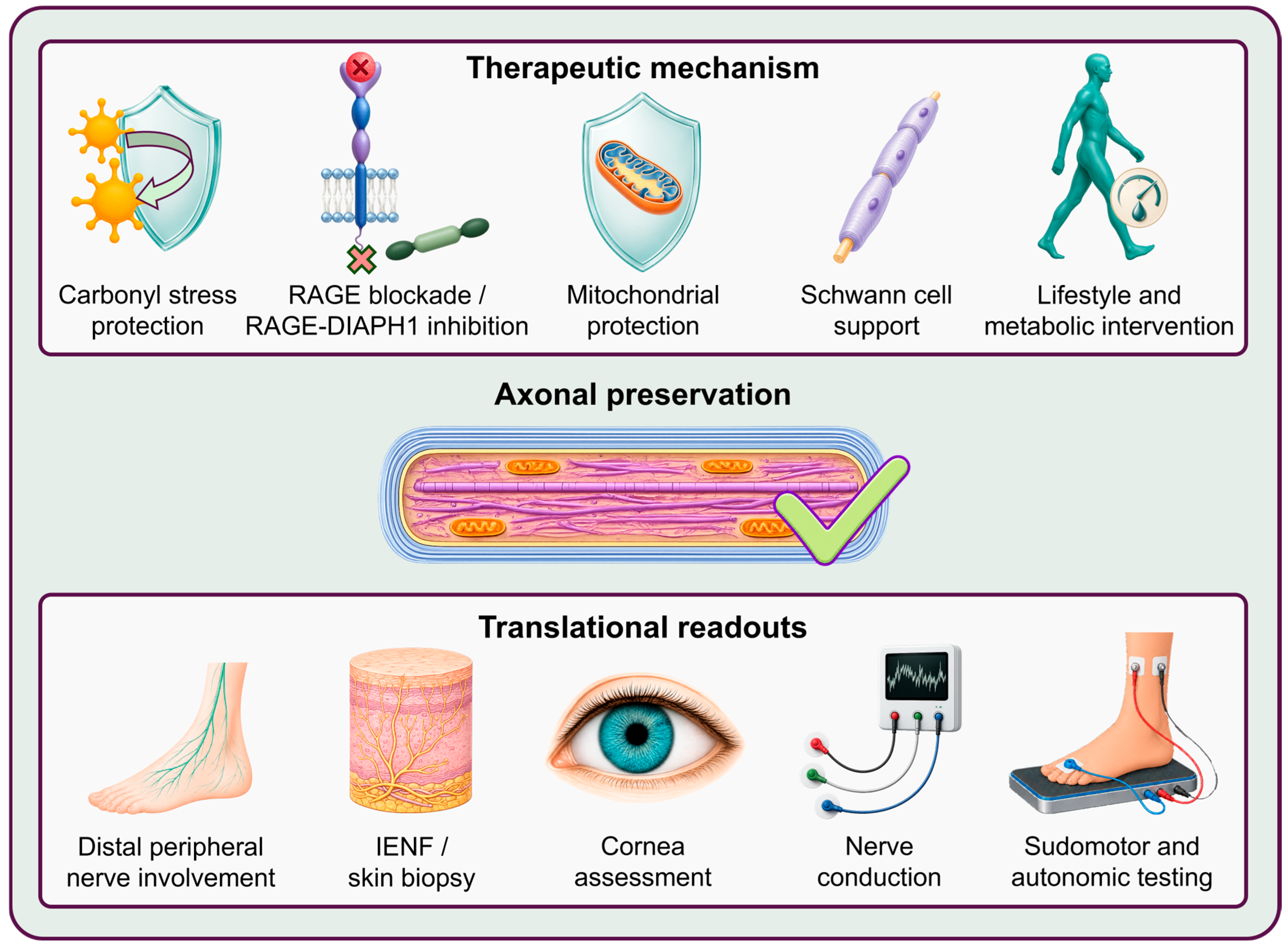
- Future therapies should protect axon integrity and transport, and not only target relief of symptoms.
- Future studies should pair molecular mechanisms with structural and functional nerve readouts.
Abstract
1. Introduction
2. Carbonyl Stress and Axonal Dysfunction
3. Signaling Through the RAGE and DIAPH1
4. Oxidative Stress and Mitochondrial Dysfunction
5. Neuroimmune Activation Changing the Axonal Environment
6. Axonal Cytoskeletal Remodeling and Transport Failure: Direct Evidence and Mechanistic Inference
7. Peripheral and Autonomic Axonopathy in Diabetes
8. Therapeutic Strategies and Translational Readouts for Axonal Preservation
9. Conclusions
Author Contributions
Funding
Institutional Review Board Statement
Informed Consent Statement
Data Availability Statement
Acknowledgments
Conflicts of Interest
Abbreviations
| AGEs | Advanced glycation end products |
| ALA | α-Lipoic acid |
| AMPK | Adenosine monophosphate-activated protein kinase |
| AUC | Area under the curve |
| BB/Wor | BioBreeding/Worcester |
| CML | N-ε-carboxymethyllysine |
| CNFL | Corneal nerve fiber length |
| DIAPH1 | Diaphanous-related formin 1 |
| DN | Diabetic neuropathy |
| DPN | Diabetic peripheral neuropathy |
| DRG | Dorsal root ganglion/ganglia |
| DRP1 | Dynamin-related protein 1 |
| ESC | Electrochemical skin conductance |
| GFAP | Glial fibrillary acidic protein |
| GO | Glyoxal |
| HMGB1 | High mobility group box 1 |
| IB4 | Isolectin B4 |
| IENFD | Intraepidermal nerve fiber density |
| IL-6 | Interleukin-6 |
| ISR | Integrated stress response |
| MG-H1 | Methylglyoxal-derived hydroimidazolone 1 |
| MGO | Methylglyoxal |
| MNCV | Motor nerve conduction velocity |
| MRP1 | Multidrug resistance-associated protein 1 |
| NAC | N-acetyl-L-cysteine |
| NF-κB | Nuclear factor kappa-light-chain-enhancer of activated B cells |
| NLRP3 | NLR family pyrin domain-containing protein 3 |
| Nrf2 | Nuclear factor erythroid 2-related factor 2 |
| OXPHOS | Oxidative phosphorylation |
| PARP | Poly(ADP-ribose) polymerase |
| PGC-1α | Peroxisome proliferator-activated receptor gamma coactivator 1-alpha |
| PMP22 | Peripheral myelin protein 22 |
| RAGE | Receptor for advanced glycation end products |
| ROS | Reactive oxygen species |
| SN | Sciatic nerve |
| STZ | Streptozotocin |
| T1DM | Type 1 diabetes mellitus |
| T2DM | Type 2 diabetes mellitus |
| TGF-β | Transforming growth factor beta |
| TIMP-1 | Tissue inhibitor of metalloproteinases 1 |
| TLR4 | Toll-like receptor 4 |
| TNF-α | Tumor necrosis factor alpha |
| TRPA1 | Transient receptor potential ankyrin 1 |
| TRPM8 | Transient receptor potential cation channel subfamily M (melastatin) member 8 |
| VEGF | Vascular endothelial growth factor |
| 3-DG | 3-Deoxyglucosone |
References
- Pop-Busui, R.; Boulton, A.J.M.; Feldman, E.L.; Bril, V.; Freeman, R.; Malik, R.A.; Sosenko, J.M.; Ziegler, D. Diabetic Neuropathy: A Position Statement by the American Diabetes Association. Diabetes Care 2017, 40, 136–154. [Google Scholar] [CrossRef]
- Hirokawa, N.; Niwa, S.; Tanaka, Y. Molecular Motors in Neurons: Transport Mechanisms and Roles in Brain Function, Development, and Disease. Neuron 2010, 68, 610–638. [Google Scholar] [CrossRef]
- Medori, R.; Jenich, H.; Autilio-Gambetti, L.; Gambetti, P. Experimental Diabetic Neuropathy: Similar Changes of Slow Axonal Transport and Axonal Size in Different Animal Models. J. Neurosci. 1988, 8, 1814–1821. [Google Scholar] [CrossRef]
- Vitadello, M.; Filliatreau, G.; Dupont, J.L.; Hassig, R.; Gorio, A.; Di Giamberardino, L. Altered Axonal Transport of Cytoskeletal Proteins in the Mutant Diabetic Mouse. J. Neurochem. 1985, 45, 860–868. [Google Scholar] [CrossRef]
- Macioce, P.; Filliatreau, G.; Figliomeni, B.; Hassig, R.; Thiéry, J.; Giamberardin, L. Di Slow Axonal Transport Impairment of Cytoskeletal Proteins in Streptozociti-Induced Diabetic Neuropathy. J. Neurochem. 1989, 53, 1261–1267. [Google Scholar] [CrossRef] [PubMed]
- Yagihashi, S.; Kamijo, M.; Watanabe, K. Reduced Myelinated Fiber Size Correlates with Loss of Axonal Neurofilaments in Peripheral Nerve of Chronically Streptozotocin Diabetic Rats. Am. J. Pathol. 1990, 136, 1365–1373. [Google Scholar] [PubMed]
- Scott, J.N.; Clark, A.W.; Zochodne, D.W. Neurofilament and Tubulin Gene Expression in Progressive Experimental Diabetes. Brain 1999, 122, 2109–2118. [Google Scholar] [CrossRef]
- Xu, G.; Pierson, C.R.; Murakawa, Y.; Sima, A.A.F. Altered Tubulin and Neurofilament Expression and Impaired Axonal Growth in Diabetic Nerve Regeneration. J. Neuropathol. Exp. Neurol. 2002, 61, 164–175. [Google Scholar] [CrossRef]
- Nishikawa, T.; Edelstein, D.; Du, X.L.; Yamagishi, S.; Matsumura, T.; Kaneda, Y.; Yorek, M.A.; Beebe, D.; Oates, P.J.; Hammes, H.-P.; et al. Normalizing Mitochondrial Superoxide Production Blocks Three Pathways of Hyperglycaemic Damage. Nature 2000, 404, 787–790. [Google Scholar] [CrossRef]
- Vincent, A.M.; Mclean, L.L.; Backus, C.; Feldman, E.L. Short-term Hyperglycemia Produces Oxidative Damage and Apoptosis in Neurons. FASEB J. 2005, 19, 1–24. [Google Scholar] [CrossRef] [PubMed]
- Roy Chowdhury, S.K.; Smith, D.R.; Saleh, A.; Schapansky, J.; Marquez, A.; Gomes, S.; Akude, E.; Morrow, D.; Calcutt, N.A.; Fernyhough, P. Impaired Adenosine Monophosphate-Activated Protein Kinase Signalling in Dorsal Root Ganglia Neurons Is Linked to Mitochondrial Dysfunction and Peripheral Neuropathy in Diabetes. Brain 2012, 135, 1751–1766. [Google Scholar] [CrossRef]
- Ryle, C.; Donaghy, M. Non-Enzymatic Glycation of Peripheral Nerve Proteins in Human Diabetics. J. Neurol. Sci. 1995, 129, 62–68. [Google Scholar] [CrossRef]
- Ryle, C.; Leow, C.K.; Donaghy, M. Nonenzymatic Glycation of Peripheral and Central Nervous System Proteins in Experimental Diabetes Mellitus. Muscle Nerve 1997, 20, 577–584. [Google Scholar] [CrossRef]
- Duran-Jimenez, B.; Dobler, D.; Moffatt, S.; Rabbani, N.; Streuli, C.H.; Thornalley, P.J.; Tomlinson, D.R.; Gardiner, N.J. Advanced Glycation End Products in Extracellular Matrix Proteins Contribute to the Failure of Sensory Nerve Regeneration in Diabetes. Diabetes 2009, 58, 2893–2903. [Google Scholar] [CrossRef] [PubMed]
- Vincent, A.M.; Perrone, L.; Sullivan, K.A.; Backus, C.; Sastry, A.M.; Lastoskie, C.; Feldman, E.L. Receptor for Advanced Glycation End Products Activation Injures Primary Sensory Neurons via Oxidative Stress. Endocrinology 2007, 148, 548–558. [Google Scholar] [CrossRef]
- Hall, B.E.; Macdonald, E.; Cassidy, M.; Yun, S.; Sapio, M.R.; Ray, P.; Doty, M.; Nara, P.; Burton, M.D.; Shiers, S.; et al. Transcriptomic Analysis of Human Sensory Neurons in Painful Diabetic Neuropathy Reveals Inflammation and Neuronal Loss. Sci. Rep. 2022, 12, 4729. [Google Scholar] [CrossRef]
- Osonoi, S.; Mizukami, H.; Takeuchi, Y.; Sugawa, H.; Ogasawara, S.; Takaku, S.; Sasaki, T.; Kudoh, K.; Ito, K.; Sango, K.; et al. RAGE Activation in Macrophages and Development of Experimental Diabetic Polyneuropathy. JCI Insight 2022, 7, e160555. [Google Scholar] [CrossRef]
- Menichella, D.M.; Abdelhak, B.; Ren, D.; Shum, A.; Frietag, C.; Miller, R.J. CXCR4 Chemokine Receptor Signaling Mediates Pain in Diabetic Neuropathy. Mol. Pain 2014, 10, 1744-8069-10-42. [Google Scholar] [CrossRef]
- Xu, K.; Zhong, G.; Zhuang, X. Actin, Spectrin, and Associated Proteins Form a Periodic Cytoskeletal Structure in Axons. Science 2013, 339, 452–456. [Google Scholar] [CrossRef] [PubMed]
- Qu, Y.; Hahn, I.; Webb, S.E.D.; Pearce, S.P.; Prokop, A. Periodic Actin Structures in Neuronal Axons Are Required to Maintain Microtubules. Mol. Biol. Cell 2017, 28, 296–308. [Google Scholar] [CrossRef] [PubMed]
- Watanabe, N.; Madaule, P.; Reid, T.; Ishizaki, T.; Watanabe, G.; Kakizuka, A.; Saito, Y.; Nakao, K.; Jockusch, B.M.; Narumiya, S. P140mDia, a Mammalian Homolog of Drosophila Diaphanous, Is a Target Protein for Rho Small GTPase and Is a Ligand for Profilin. EMBO J. 1997, 16, 3044–3056. [Google Scholar] [CrossRef] [PubMed]
- Hudson, B.I.; Kalea, A.Z.; del Mar Arriero, M.; Harja, E.; Boulanger, E.; D’Agati, V.; Schmidt, A.M. Interaction of the RAGE Cytoplasmic Domain with Diaphanous-1 Is Required for Ligand-Stimulated Cellular Migration through Activation of Rac1 and Cdc42. J. Biol. Chem. 2008, 283, 34457–34468. [Google Scholar] [CrossRef] [PubMed]
- Rai, V.; Maldonado, A.Y.; Burz, D.S.; Reverdatto, S.; Schmidt, A.M.; Shekhtman, A. Signal Transduction in Receptor for Advanced Glycation End Products (RAGE). J. Biol. Chem. 2012, 287, 5133–5144. [Google Scholar] [CrossRef]
- Wang, X.-J.; Ma, S.-B.; Liu, Z.-F.; Li, H.; Gao, W.-Y. Elevated Levels of α-Dicarbonyl Compounds in the Plasma of Type II Diabetics and Their Relevance with Diabetic Nephropathy. J. Chromatogr. B 2019, 1106–1107, 19–25. [Google Scholar] [CrossRef]
- Maessen, D.E.; Hanssen, N.M.; Scheijen, J.L.; van der Kallen, C.J.; van Greevenbroek, M.M.; Stehouwer, C.D.; Schalkwijk, C.G. Post–Glucose Load Plasma α-Dicarbonyl Concentrations Are Increased in Individuals With Impaired Glucose Metabolism and Type 2 Diabetes: The CODAM Study. Diabetes Care 2015, 38, 913–920. [Google Scholar] [CrossRef]
- Lo, T.W.; Westwood, M.E.; McLellan, A.C.; Selwood, T.; Thornalley, P.J. Binding and Modification of Proteins by Methylglyoxal under Physiological Conditions. A Kinetic and Mechanistic Study with N Alpha-Acetylarginine, N Alpha-Acetylcysteine, and N Alpha-Acetyllysine, and Bovine Serum Albumin. J. Biol. Chem. 1994, 269, 32299–32305. [Google Scholar] [CrossRef]
- Shinohara, M.; Thornalley, P.J.; Giardino, I.; Beisswenger, P.; Thorpe, S.R.; Onorato, J.; Brownlee, M. Overexpression of Glyoxalase-I in Bovine Endothelial Cells Inhibits Intracellular Advanced Glycation Endproduct Formation and Prevents Hyperglycemia-Induced Increases in Macromolecular Endocytosis. J. Clin. Investig. 1998, 101, 1142–1147. [Google Scholar] [CrossRef] [PubMed]
- Skapare, E.; Konrade, I.; Liepinsh, E.; Strele, I.; Makrecka, M.; Bierhaus, A.; Lejnieks, A.; Pirags, V.; Dambrova, M. Association of Reduced Glyoxalase 1 Activity and Painful Peripheral Diabetic Neuropathy in Type 1 and 2 Diabetes Mellitus Patients. J. Diabetes Complicat. 2013, 27, 262–267. [Google Scholar] [CrossRef]
- Jack, M.M.; Ryals, J.M.; Wright, D.E. Characterisation of Glyoxalase I in a Streptozocin-Induced Mouse Model of Diabetes with Painful and Insensate Neuropathy. Diabetologia 2011, 54, 2174–2182. [Google Scholar] [CrossRef]
- Jack, M.M.; Ryals, J.M.; Wright, D.E. Protection from Diabetes-Induced Peripheral Sensory Neuropathy—A Role for Elevated Glyoxalase I? Exp. Neurol. 2012, 234, 62–69. [Google Scholar] [CrossRef]
- Meerwaldt, R.; Links, T.P.; Graaff, R.; Hoogenberg, K.; Lefrandt, J.D.; Baynes, J.W.; Gans, R.O.B.; Smit, A.J. Increased Accumulation of Skin Advanced Glycation End-Products Precedes and Correlates with Clinical Manifestation of Diabetic Neuropathy. Diabetologia 2005, 48, 1637–1644. [Google Scholar] [CrossRef]
- Conway, B.N.; Aroda, V.R.; Maynard, J.D.; Matter, N.; Fernandez, S.; Ratner, R.E.; Orchard, T.J. Skin Intrinsic Fluorescence Correlates With Autonomic and Distal Symmetrical Polyneuropathy in Individuals With Type 1 Diabetes. Diabetes Care 2011, 34, 1000–1005. [Google Scholar] [CrossRef]
- Sveen, K.A.; Karimé, B.; Jørum, E.; Mellgren, S.I.; Fagerland, M.W.; Monnier, V.M.; Dahl-Jørgensen, K.; Hanssen, K.F. Small- and Large-Fiber Neuropathy After 40 Years of Type 1 Diabetes. Diabetes Care 2013, 36, 3712–3717. [Google Scholar] [CrossRef]
- Papachristou, S.; Pafili, K.; Trypsianis, G.; Papazoglou, D.; Vadikolias, Κ.; Papanas, N. Skin Advanced Glycation End Products as a Screening Tool of Neuropathy in Type 2 Diabetes Mellitus. J. Diabetes Complicat. 2022, 36, 108356. [Google Scholar] [CrossRef]
- Haslbeck, K.-M.; Schleicher, E.; Bierhaus, A.; Nawroth, P.; Haslbeck, M.; Neundörfer, B.; Heuss, D. The AGE/RAGE/NF-ΚB Pathway May Contribute to the Pathogenesis of Polyneuropathy in Impaired Glucose Tolerance (IGT). Exp. Clin. Endocrinol. Diabetes 2005, 113, 288–291. [Google Scholar] [CrossRef]
- Juranek, J.K.; Kothary, P.; Mehra, A.; Hays, A.; Brannagan, T.H.; Schmidt, A.M. Increased Expression of the Receptor for Advanced Glycation End-products in Human Peripheral Neuropathies. Brain Behav. 2013, 3, 701–709. [Google Scholar] [CrossRef]
- Bierhaus, A.; Haslbeck, K.-M.; Humpert, P.M.; Liliensiek, B.; Dehmer, T.; Morcos, M.; Sayed, A.A.R.; Andrassy, M.; Schiekofer, S.; Schneider, J.G.; et al. Loss of Pain Perception in Diabetes Is Dependent on a Receptor of the Immunoglobulin Superfamily. J. Clin. Investig. 2004, 114, 1741–1751. [Google Scholar] [CrossRef]
- Huang, Q.; Chen, Y.; Gong, N.; Wang, Y.X. Methylglyoxal Mediates Streptozotocin-Induced Diabetic Neuropathic Pain via Activation of the Peripheral TRPA1 and Nav1.8 Channels. Metabolism 2016, 65, 463–474. [Google Scholar] [CrossRef]
- Eberhardt, M.J.; Filipovic, M.R.; Leffler, A.; de la Roche, J.; Kistner, K.; Fischer, M.J.; Fleming, T.; Zimmermann, K.; Ivanovic-Burmazovic, I.; Nawroth, P.P.; et al. Methylglyoxal Activates Nociceptors through Transient Receptor Potential Channel A1 (TRPA1). J. Biol. Chem. 2012, 287, 28291–28306. [Google Scholar] [CrossRef]
- Düll, M.M.; Riegel, K.; Tappenbeck, J.; Ries, V.; Strupf, M.; Fleming, T.; Sauer, S.K.; Namer, B. Methylglyoxal Causes Pain and Hyperalgesia in Human through C-Fiber Activation. Pain 2019, 160, 2497–2507. [Google Scholar] [CrossRef]
- Barragán-Iglesias, P.; Kuhn, J.; Vidal-Cantú, G.C.; Salinas-Abarca, A.B.; Granados-Soto, V.; Dussor, G.O.; Campbell, Z.T.; Price, T.J. Activation of the Integrated Stress Response in Nociceptors Drives Methylglyoxal-Induced Pain. Pain 2019, 160, 160–171. [Google Scholar] [CrossRef]
- Ciobanu, A.C.; Selescu, T.; Gasler, I.; Soltuzu, L.; Babes, A. Glycolytic Metabolite Methylglyoxal Inhibits Cold and Menthol Activation of the Transient Receptor Potential Melastatin Type 8 Channel. J. Neurosci. Res. 2016, 94, 282–294. [Google Scholar] [CrossRef]
- Radu, B.M.; Dumitrescu, D.I.; Mustaciosu, C.C.; Radu, M. Dual Effect of Methylglyoxal on the Intracellular Ca2+ Signaling and Neurite Outgrowth in Mouse Sensory Neurons. Cell. Mol. Neurobiol. 2012, 32, 1047–1057. [Google Scholar] [CrossRef]
- Jiang, B.; Le, L.; Liu, H.; Xu, L.; He, C.; Hu, K.; Peng, Y.; Xiao, P. Marein Protects against Methylglyoxal-Induced Apoptosis by Activating the AMPK Pathway in PC12 Cells. Free Radic. Res. 2016, 50, 1173–1187. [Google Scholar] [CrossRef]
- Coccini, T.; Schicchi, A.; Locatelli, C.A.; Caloni, F.; Negri, S.; Grignani, E.; De Simone, U. Methylglyoxal-induced Neurotoxic Effects in Primary Neuronal-like Cells Transdifferentiated from Human Mesenchymal Stem Cells: Impact of Low Concentrations. J. Appl. Toxicol. 2023, 43, 1819–1839. [Google Scholar] [CrossRef]
- Fukunaga, M.; Miyata, S.; Higo, S.; Hamada, Y.; Ueyama, S.; Kasuga, M. Methylglyoxal Induces Apoptosis through Oxidative Stress-Mediated Activation of P38 Mitogen-Activated Protein Kinase in Rat Schwann Cells. Ann. N. Y. Acad. Sci. 2005, 1043, 151–157. [Google Scholar] [CrossRef]
- Ota, K.; Nakamura, J.; Li, W.; Kozakae, M.; Watarai, A.; Nakamura, N.; Yasuda, Y.; Nakashima, E.; Naruse, K.; Watabe, K.; et al. Metformin Prevents Methylglyoxal-Induced Apoptosis of Mouse Schwann Cells. Biochem. Biophys. Res. Commun. 2007, 357, 270–275. [Google Scholar] [CrossRef]
- Sato, K.; Tatsunami, R.; Yama, K.; Tampo, Y. Glycolaldehyde Induces Cytotoxicity and Increases Glutathione and Multidrug-Resistance-Associated Protein Levels in Schwann Cells. Biol. Pharm. Bull. 2013, 36, 1111–1117. [Google Scholar] [CrossRef]
- Sato, K.; Tatsunami, R.; Yama, K.; Murao, Y.; Tampo, Y. Glycolaldehyde Induces Endoplasmic Reticulum Stress and Apoptosis in Schwann Cells. Toxicol. Rep. 2015, 2, 1454–1462. [Google Scholar] [CrossRef]
- Yu, T.; Li, L.; Chen, T.; Liu, Z.; Liu, H.; Li, Z. Erythropoietin Attenuates Advanced Glycation Endproducts-Induced Toxicity of Schwann Cells In Vitro. Neurochem. Res. 2015, 40, 698–712. [Google Scholar] [CrossRef]
- Shimizu, F.; Sano, Y.; Haruki, H.; Kanda, T. Advanced Glycation End-Products Induce Basement Membrane Hypertrophy in Endoneurial Microvessels and Disrupt the Blood–Nerve Barrier by Stimulating the Release of TGF-β and Vascular Endothelial Growth Factor (VEGF) by Pericytes. Diabetologia 2011, 54, 1517–1526. [Google Scholar] [CrossRef]
- Tóth, A.E.; Walter, F.R.; Bocsik, A.; Sántha, P.; Veszelka, S.; Nagy, L.; Puskás, L.G.; Couraud, P.-O.; Takata, F.; Dohgu, S.; et al. Edaravone Protects against Methylglyoxal-Induced Barrier Damage in Human Brain Endothelial Cells. PLoS ONE 2014, 9, e100152. [Google Scholar] [CrossRef] [PubMed]
- Hamilton, R.T.; Bhattacharya, A.; Walsh, M.E.; Shi, Y.; Wei, R.; Zhang, Y.; Rodriguez, K.A.; Buffenstein, R.; Chaudhuri, A.R.; Van Remmen, H. Elevated Protein Carbonylation, and Misfolding in Sciatic Nerve from Db/Db and Sod1−/− Mice: Plausible Link between Oxidative Stress and Demyelination. PLoS ONE 2013, 8, e65725. [Google Scholar] [CrossRef] [PubMed]
- Strom, A.; Strassburger, K.; Schmuck, M.; Shevalye, H.; Davidson, E.; Zivehe, F.; Bönhof, G.; Reimer, R.; Belgardt, B.-F.; Fleming, T.; et al. Interaction between Magnesium and Methylglyoxal in Diabetic Polyneuropathy and Neuronal Models. Mol. Metab. 2021, 43, 101114. [Google Scholar] [CrossRef]
- Neeper, M.; Schmidt, A.M.; Brett, J.; Yan, S.D.; Wang, F.; Pan, Y.C.; Elliston, K.; Stern, D.; Shaw, A. Cloning and Expression of a Cell Surface Receptor for Advanced Glycosylation End Products of Proteins. J. Biol. Chem. 1992, 267, 14998–15004. [Google Scholar] [CrossRef]
- Koch, M.; Chitayat, S.; Dattilo, B.M.; Schiefner, A.; Diez, J.; Chazin, W.J.; Fritz, G. Structural Basis for Ligand Recognition and Activation of RAGE. Structure 2010, 18, 1342–1352. [Google Scholar] [CrossRef]
- Hori, O.; Brett, J.; Slattery, T.; Cao, R.; Zhang, J.; Chen, J.X.; Nagashima, M.; Lundh, E.R.; Vijay, S.; Nitecki, D.; et al. The Receptor for Advanced Glycation End Products (RAGE) Is a Cellular Binding Site for Amphoterin. J. Biol. Chem. 1995, 270, 25752–25761. [Google Scholar] [CrossRef]
- Hofmann, M.A.; Drury, S.; Fu, C.; Qu, W.; Taguchi, A.; Lu, Y.; Avila, C.; Kambham, N.; Bierhaus, A.; Nawroth, P.; et al. RAGE Mediates a Novel Proinflammatory Axis. Cell 1999, 97, 889–901. [Google Scholar] [CrossRef]
- Huttunen, H.J.; Fages, C.; Rauvala, H. Receptor for Advanced Glycation End Products (RAGE)-Mediated Neurite Outgrowth and Activation of NF-ΚB Require the Cytoplasmic Domain of the Receptor but Different Downstream Signaling Pathways. J. Biol. Chem. 1999, 274, 19919–19924. [Google Scholar] [CrossRef]
- Kovar, D.R.; Harris, E.S.; Mahaffy, R.; Higgs, H.N.; Pollard, T.D. Control of the Assembly of ATP- and ADP-Actin by Formins and Profilin. Cell 2006, 124, 423–435. [Google Scholar] [CrossRef]
- Mizuno, H.; Tanaka, K.; Yamashiro, S.; Narita, A.; Watanabe, N. Helical Rotation of the Diaphanous-Related Formin MDia1 Generates Actin Filaments Resistant to Cofilin. Proc. Natl. Acad. Sci. USA 2018, 115, E5000–E5007. [Google Scholar] [CrossRef]
- Ishizaki, T.; Morishima, Y.; Okamoto, M.; Furuyashiki, T.; Kato, T.; Narumiya, S. Coordination of Microtubules and the Actin Cytoskeleton by the Rho Effector MDia1. Nat. Cell Biol. 2001, 3, 8–14. [Google Scholar] [CrossRef] [PubMed]
- Gaillard, J.; Ramabhadran, V.; Neumanne, E.; Gurel, P.; Blanchoin, L.; Vantard, M.; Higgs, H.N. Differential Interactions of the Formins INF2, MDia1, and MDia2 with Microtubules. Mol. Biol. Cell 2011, 22, 4575–4587. [Google Scholar] [CrossRef]
- Zhang, W.; Ciorraga, M.; Mendez, P.; Retana, D.; Boumedine-Guignon, N.; Achón, B.; Russier, M.; Debanne, D.; Garrido, J.J. Formin Activity and MDia1 Contribute to Maintain Axon Initial Segment Composition and Structure. Mol. Neurobiol. 2021, 58, 6153–6169. [Google Scholar] [CrossRef]
- Manigrasso, M.B.; Pan, J.; Rai, V.; Zhang, J.; Reverdatto, S.; Quadri, N.; DeVita, R.J.; Ramasamy, R.; Shekhtman, A.; Schmidt, A.M. Small Molecule Inhibition of Ligand-Stimulated RAGE-DIAPH1 Signal Transduction. Sci. Rep. 2016, 6, 22450. [Google Scholar] [CrossRef]
- Manigrasso, M.B.; Rabbani, P.; Egaña-Gorroño, L.; Quadri, N.; Frye, L.; Zhou, B.; Reverdatto, S.; Ramirez, L.S.; Dansereau, S.; Pan, J.; et al. Small-Molecule Antagonism of the Interaction of the RAGE Cytoplasmic Domain with DIAPH1 Reduces Diabetic Complications in Mice. Sci. Transl. Med. 2021, 13, eabf7084. [Google Scholar] [CrossRef]
- Theophall, G.G.; Manigrasso, M.B.; Nazarian, P.; Premo, A.; Reverdatto, S.; Yepuri, G.; Burz, D.S.; Vanegas, S.M.; Mangar, K.; Zhao, Y.; et al. RAGE-Mediated Activation of the Formin DIAPH1 and Human Macrophage Inflammation Are Inhibited by a Small Molecule Antagonist. Cell Chem. Biol. 2025, 32, 1221–1234.e8. [Google Scholar] [CrossRef]
- Zglejc-Waszak, K.; Kordas, B.; Korytko, A.; Pomianowski, A.; Lewczuk, B.; Wojtkiewicz, J.; Wąsowicz, K.; Babińska, I.; Mukherjee, K.; Juranek, J. RAGE Cytosolic Partner Diaph1 Does Not Play an Essential Role in Diabetic Peripheral Neuropathy Progression. Cells 2025, 14, 1635. [Google Scholar] [CrossRef]
- Zglejc-Waszak, K.; Korytko, A.; Kordas, B.; Pomianowski, A.; Lewczuk, B.; Wojtkiewicz, J.; Wąsowicz, K.; Babińska, I.; Mukherjee, K.; Juranek, J.K. The Effect of RAGE-Diaph1 Signaling Inhibition on the Progression of Peripheral Neuropathy in Diabetic Mice. Int. J. Mol. Sci. 2025, 26, 11182. [Google Scholar] [CrossRef]
- Chowdhury, S.K.R.; Zherebitskaya, E.; Smith, D.R.; Akude, E.; Chattopadhyay, S.; Jolivalt, C.G.; Calcutt, N.A.; Fernyhough, P. Mitochondrial Respiratory Chain Dysfunction in Dorsal Root Ganglia of Streptozotocin-Induced Diabetic Rats and Its Correction by Insulin Treatment. Diabetes 2010, 59, 1082–1091. [Google Scholar] [CrossRef]
- Vale, R.D.; Reese, T.S.; Sheetz, M.P. Identification of a Novel Force-Generating Protein, Kinesin, Involved in Microtubule-Based Motility. Cell 1985, 42, 39–50. [Google Scholar] [CrossRef] [PubMed]
- Schnapp, B.J.; Reese, T.S. Dynein Is the Motor for Retrograde Axonal Transport of Organelles. Proc. Natl. Acad. Sci. USA 1989, 86, 1548–1552. [Google Scholar] [CrossRef] [PubMed]
- Morris, R.L.; Hollenbeck, P.J. Axonal Transport of Mitochondria along Microtubules and F-Actin in Living Vertebrate Neurons. J. Cell Biol. 1995, 131, 1315–1326. [Google Scholar] [CrossRef]
- Choi, J.; Chandrasekaran, K.; Inoue, T.; Muragundla, A.; Russell, J.W. PGC-1α Regulation of Mitochondrial Degeneration in Experimental Diabetic Neuropathy. Neurobiol. Dis. 2014, 64, 118–130. [Google Scholar] [CrossRef]
- Edwards, J.L.; Quattrini, A.; Lentz, S.I.; Figueroa-Romero, C.; Cerri, F.; Backus, C.; Hong, Y.; Feldman, E.L. Diabetes Regulates Mitochondrial Biogenesis and Fission in Mouse Neurons. Diabetologia 2010, 53, 160–169. [Google Scholar] [CrossRef]
- George, D.S.; Hackelberg, S.; Jayaraj, N.D.; Ren, D.; Edassery, S.L.; Rathwell, C.A.; Miller, R.E.; Malfait, A.-M.; Savas, J.N.; Miller, R.J.; et al. Mitochondrial Calcium Uniporter Deletion Prevents Painful Diabetic Neuropathy by Restoring Mitochondrial Morphology and Dynamics. Pain 2022, 163, 560–578. [Google Scholar] [CrossRef]
- Drel, V.; Pacher, P.; Vareniuk, I.; Pavlov, I.; Ilnytska, O.; Lyzogubov, V.; Bell, S.; Groves, J.; Obrosova, I. Evaluation of the Peroxynitrite Decomposition Catalyst Fe(III) Tetra-Mesitylporphyrin Octasulfonate on Peripheral Neuropathy in a Mouse Model of Type 1 Diabetes. Int. J. Mol. Med. 2007, 20, 783–792. [Google Scholar] [CrossRef]
- Drel, V.R.; Lupachyk, S.; Shevalye, H.; Vareniuk, I.; Xu, W.; Zhang, J.; Delamere, N.A.; Shahidullah, M.; Slusher, B.; Obrosova, I.G. New Therapeutic and Biomarker Discovery for Peripheral Diabetic Neuropathy: PARP Inhibitor, Nitrotyrosine, and Tumor Necrosis Factor-α. Endocrinology 2010, 151, 2547–2555. [Google Scholar] [CrossRef]
- Viader, A.; Golden, J.P.; Baloh, R.H.; Schmidt, R.E.; Hunter, D.A.; Milbrandt, J. Schwann Cell Mitochondrial Metabolism Supports Long-Term Axonal Survival and Peripheral Nerve Function. J. Neurosci. 2011, 31, 10128–10140. [Google Scholar] [CrossRef]
- Zhang, L.; Yu, C.; Vasquez, F.E.; Galeva, N.; Onyango, I.; Swerdlow, R.H.; Dobrowsky, R.T. Hyperglycemia Alters the Schwann Cell Mitochondrial Proteome and Decreases Coupled Respiration in the Absence of Superoxide Production. J. Proteome Res. 2010, 9, 458–471. [Google Scholar] [CrossRef] [PubMed]
- Viader, A.; Sasaki, Y.; Kim, S.; Strickland, A.; Workman, C.S.; Yang, K.; Gross, R.W.; Milbrandt, J. Aberrant Schwann Cell Lipid Metabolism Linked to Mitochondrial Deficits Leads to Axon Degeneration and Neuropathy. Neuron 2013, 77, 886–898. [Google Scholar] [CrossRef]
- Herder, C.; Bongaerts, B.W.C.; Rathmann, W.; Heier, M.; Kowall, B.; Koenig, W.; Thorand, B.; Roden, M.; Meisinger, C.; Ziegler, D. Association of Subclinical Inflammation With Polyneuropathy in the Older Population. Diabetes Care 2013, 36, 3663–3670. [Google Scholar] [CrossRef]
- Zheng, H.; Sun, W.; Zhang, Q.; Zhang, Y.; Ji, L.; Liu, X.; Zhu, X.; Ye, H.; Xiong, Q.; Li, Y.; et al. Proinflammatory Cytokines Predict the Incidence of Diabetic Peripheral Neuropathy over 5 Years in Chinese Type 2 Diabetes Patients: A Prospective Cohort Study. EClinicalMedicine 2021, 31, 100649. [Google Scholar] [CrossRef]
- Hussain, G.; Rizvi, S.A.A.; Singhal, S.; Zubair, M.; Ahmad, J. Serum Levels of TNF-α in Peripheral Neuropathy Patients and Its Correlation with Nerve Conduction Velocity in Type 2 Diabetes Mellitus. Diabetes Metab. Syndr. Clin. Res. Rev. 2013, 7, 238–242. [Google Scholar] [CrossRef]
- Hanani, M.; Blum, E.; Liu, S.; Peng, L.; Liang, S. Satellite Glial Cells in Dorsal Root Ganglia Are Activated in Streptozotocin-treated Rodents. J. Cell. Mol. Med. 2014, 18, 2367–2371. [Google Scholar] [CrossRef]
- Bhusal, A.; Rahman, M.H.; Lee, W.; Lee, I.; Suk, K. Satellite Glia as a Critical Component of Diabetic Neuropathy: Role of Lipocalin-2 and Pyruvate Dehydrogenase Kinase-2 Axis in the Dorsal Root Ganglion. Glia 2021, 69, 971–996. [Google Scholar] [CrossRef]
- Aye-Mon, A.; Hori, K.; Kozakai, Y.; Nakagawa, T.; Hiraga, S.; Nakamura, T.; Shiraishi, Y.; Okuda, H.; Ozaki, N. CCR2 Upregulation in DRG Neurons Plays a Crucial Role in Gastric Hyperalgesia Associated with Diabetic Gastropathy. Mol. Pain 2018, 14, 1744806917751322. [Google Scholar] [CrossRef]
- Thakur, V.; Sadanandan, J.; Chattopadhyay, M. High-Mobility Group Box 1 Protein Signaling in Painful Diabetic Neuropathy. Int. J. Mol. Sci. 2020, 21, 881. [Google Scholar] [CrossRef]
- Chen, W.; Wang, X.; Sun, Q.; Zhang, Y.; Liu, J.; Hu, T.; Wu, W.; Wei, C.; Liu, M.; Ding, Y.; et al. The Upregulation of NLRP3 Inflammasome in Dorsal Root Ganglion by Ten-Eleven Translocation Methylcytosine Dioxygenase 2 (TET2) Contributed to Diabetic Neuropathic Pain in Mice. J. Neuroinflammation 2022, 19, 302. [Google Scholar] [CrossRef]
- Daulhac, L.; Mallet, C.; Courteix, C.; Etienne, M.; Duroux, E.; Privat, A.-M.; Eschalier, A.; Fialip, J. Diabetes-Induced Mechanical Hyperalgesia Involves Spinal Mitogen-Activated Protein Kinase Activation in Neurons and Microglia via N-Methyl-D-Aspartate-Dependent Mechanisms. Mol. Pharmacol. 2006, 70, 1246–1254. [Google Scholar] [CrossRef]
- Wang, D.; Couture, R.; Hong, Y. Activated Microglia in the Spinal Cord Underlies Diabetic Neuropathic Pain. Eur. J. Pharmacol. 2014, 728, 59–66. [Google Scholar] [CrossRef]
- Fang, X.-X.; Xu, F.-F.; Liu, Z.; Cao, B.-B.; Qiu, Y.-H.; Peng, Y.-P. Interleukin 17A Deficiency Alleviates Neuroinflammation and Cognitive Impairment in an Experimental Model of Diabetic Encephalopathy. Neural Regen. Res. 2022, 17, 2771. [Google Scholar] [CrossRef]
- Roy, S.; Coffee, P.; Smith, G.; Liem, R.K.H.; Brady, S.T.; Black, M.M. Neurofilaments Are Transported Rapidly But Intermittently in Axons: Implications for Slow Axonal Transport. J. Neurosci. 2000, 20, 6849–6861. [Google Scholar] [CrossRef]
- Tomlinson, D.R.; Willars, G.B.; Calthrop-Owen, E.F. Defects of Axonal Transport in Experimental Diabetes That Are Unrelated to the Sorbitol Pathway. Exp. Neurol. 1987, 96, 194–202. [Google Scholar] [CrossRef]
- Sidenius, P.; Jakobsen, J. Impaired Retrograde Axonal Transport from a Nerve Crush in Streptozotocin Diabetic Rats. Diabetologia 1980, 19, 222–228. [Google Scholar] [CrossRef]
- Middlemas, A. Enhanced Activation of Axonally Transported Stress-Activated Protein Kinases in Peripheral Nerve in Diabetic Neuropathy Is Prevented by Neurotrophin-3. Brain 2003, 126, 1671–1682. [Google Scholar] [CrossRef]
- Baptista, F.I.; Pinto, M.J.; Elvas, F.; Almeida, R.D.; Ambrósio, A.F. Diabetes Alters KIF1A and KIF5B Motor Proteins in the Hippocampus. PLoS ONE 2013, 8, e65515. [Google Scholar] [CrossRef]
- Rumora, A.E.; Lentz, S.I.; Hinder, L.M.; Jackson, S.W.; Valesano, A.; Levinson, G.E.; Feldman, E.L. Dyslipidemia Impairs Mitochondrial Trafficking and Function in Sensory Neurons. FASEB J. 2018, 32, 195–207. [Google Scholar] [CrossRef]
- Sajic, M.; Rumora, A.E.; Kanhai, A.A.; Dentoni, G.; Varatharajah, S.; Casey, C.; Brown, R.D.R.; Peters, F.; Hinder, L.M.; Savelieff, M.G.; et al. High Dietary Fat Consumption Impairs Axonal Mitochondrial Function In Vivo. J. Neurosci. 2021, 41, 4321–4334. [Google Scholar] [CrossRef]
- England, J.D.; Gronseth, G.S.; Franklin, G.; Miller, R.G.; Asbury, A.K.; Carter, G.T.; Cohen, J.A.; Fisher, M.A.; Howard, J.F.; Kinsella, L.J.; et al. Distal Symmetric Polyneuropathy: A Definition for Clinical Research. Neurology 2005, 64, 199–207. [Google Scholar] [CrossRef]
- Løseth, S.; Stålberg, E.; Jorde, R.; Mellgren, S.I. Early Diabetic Neuropathy: Thermal Thresholds and Intraepidermal Nerve Fibre Density in Patients with Normal Nerve Conduction Studies. J. Neurol. 2008, 255, 1197–1202. [Google Scholar] [CrossRef] [PubMed]
- Divisova, S.; Vlckova, E.; Srotova, I.; Kincova, S.; Skorna, M.; Dusek, L.; Dubovy, P.; Bednarik, J. Intraepidermal Nerve-fibre Density as a Biomarker of the Course of Neuropathy in Patients with Type 2 Diabetes Mellitus. Diabet. Med. 2016, 33, 650–654. [Google Scholar] [CrossRef]
- Løseth, S.; Stålberg, E.V.; Lindal, S.; Olsen, E.; Jorde, R.; Mellgren, S.I. Small and Large Fiber Neuropathy in Those with Type 1 and Type 2 Diabetes: A 5-year Follow-up Study. J. Peripher. Nerv. Syst. 2016, 21, 15–21. [Google Scholar] [CrossRef]
- Dunnigan, S.K.; Ebadi, H.; Breiner, A.; Katzberg, H.D.; Lovblom, L.E.; Perkins, B.A.; Bril, V. Conduction Slowing in Diabetic Sensorimotor Polyneuropathy. Diabetes Care 2013, 36, 3684–3690. [Google Scholar] [CrossRef]
- Sima, A.A.; Nathaniel, V.; Bril, V.; McEwen, T.A.; Greene, D.A. Histopathological Heterogeneity of Neuropathy in Insulin-Dependent and Non-Insulin-Dependent Diabetes, and Demonstration of Axo-Glial Dysjunction in Human Diabetic Neuropathy. J. Clin. Investig. 1988, 81, 349–364. [Google Scholar] [CrossRef]
- Guo, J.; Guo, Z.; Huang, Y.; Ma, S.; Yan, B.; Pan, C.; Jiang, Z.; Wang, F.; Zhang, Z.; Da, Y.; et al. Blockage of MLKL Prevents Myelin Damage in Experimental Diabetic Neuropathy. Proc. Natl. Acad. Sci. USA 2022, 119, e2121552119. [Google Scholar] [CrossRef] [PubMed]
- Perkins, B.A.; Lovblom, L.E.; Lewis, E.J.H.; Bril, V.; Ferdousi, M.; Orszag, A.; Edwards, K.; Pritchard, N.; Russell, A.; Dehghani, C.; et al. Corneal Confocal Microscopy Predicts the Development of Diabetic Neuropathy: A Longitudinal Diagnostic Multinational Consortium Study. Diabetes Care 2021, 44, 2107–2114. [Google Scholar] [CrossRef]
- Badian, R.A.; Ekman, L.; Pripp, A.H.; Utheim, T.P.; Englund, E.; Dahlin, L.B.; Rolandsson, O.; Lagali, N. Comparison of Novel Wide-Field In Vivo Corneal Confocal Microscopy With Skin Biopsy for Assessing Peripheral Neuropathy in Type 2 Diabetes. Diabetes 2023, 72, 908–917. [Google Scholar] [CrossRef]
- Casellini, C.M.; Parson, H.K.; Richardson, M.S.; Nevoret, M.L.; Vinik, A.I. Sudoscan, a Noninvasive Tool for Detecting Diabetic Small Fiber Neuropathy and Autonomic Dysfunction. Diabetes Technol. Ther. 2013, 15, 948–953. [Google Scholar] [CrossRef] [PubMed]
- Kamiya, H.; Zhang, W.; Sima, A.A.F. Degeneration of the Golgi and Neuronal Loss in Dorsal Root Ganglia in Diabetic BioBreeding/Worcester Rats. Diabetologia 2006, 49, 2763–2774. [Google Scholar] [CrossRef]
- Jende, J.M.E.; Kender, Z.; Rother, C.; Alvarez-Ramos, L.; Groener, J.B.; Pham, M.; Morgenstern, J.; Oikonomou, D.; Hahn, A.; Juerchott, A.; et al. Diabetic Polyneuropathy Is Associated With Pathomorphological Changes in Human Dorsal Root Ganglia: A Study Using 3T MR Neurography. Front. Neurosci. 2020, 14, 570744. [Google Scholar] [CrossRef] [PubMed]
- Shiers, S.I.; Mazhar, K.; Wangzhou, A.; Haberberger, R.; Lesnak, J.B.; Ezeji, N.A.; Sankaranarayanan, I.; Tavares-Ferreira, D.; Cervantes, A.; Funk, G.; et al. Nageotte Nodules in Human Dorsal Root Ganglia Reveal Neurodegeneration in Diabetic Peripheral Neuropathy. Nat. Commun. 2025, 16, 4168. [Google Scholar] [CrossRef]
- Eslami Gharaati, M.; Nahavandi, A.; Baluchnejad Mojarad, T.; Roghani, M. Diabetic Encephalopathy Affecting Mitochondria and Axonal Transport Proteins. Basic Clin. Neurosci. 2020, 11, 781–793. [Google Scholar] [CrossRef]
- Smith, A.G.; Russell, J.; Feldman, E.L.; Goldstein, J.; Peltier, A.; Smith, S.; Hamwi, J.; Pollari, D.; Bixby, B.; Howard, J.; et al. Lifestyle Intervention for Pre-Diabetic Neuropathy. Diabetes Care 2006, 29, 1294–1299. [Google Scholar] [CrossRef]
- Singleton, J.R.; Marcus, R.L.; Jackson, J.E.; Lessard, M.K.; Graham, T.E.; Smith, A.G. Exercise Increases Cutaneous Nerve Density in Diabetic Patients without Neuropathy. Ann. Clin. Transl. Neurol. 2014, 1, 844–849. [Google Scholar] [CrossRef]
- Yagihashi, S.; Kamijo, M.; Baba, M.; Yagihashi, N.; Nagai, K. Effect of Aminoguanidine on Functional and Structural Abnormalities in Peripheral Nerve of STZ-Induced Diabetic Rats. Diabetes 1992, 41, 47–52. [Google Scholar] [CrossRef]
- Ziegler, D.; Ametov, A.; Barinov, A.; Dyck, P.J.; Gurieva, I.; Low, P.A.; Munzel, U.; Yakhno, N.; Raz, I.; Novosadova, M.; et al. Oral Treatment With α-Lipoic Acid Improves Symptomatic Diabetic Polyneuropathy. Diabetes Care 2006, 29, 2365–2370. [Google Scholar] [CrossRef]
- Ziegler, D.; Low, P.A.; Litchy, W.J.; Boulton, A.J.M.; Vinik, A.I.; Freeman, R.; Samigullin, R.; Tritschler, H.; Munzel, U.; Maus, J.; et al. Efficacy and Safety of Antioxidant Treatment With α-Lipoic Acid Over 4 Years in Diabetic Polyneuropathy. Diabetes Care 2011, 34, 2054–2060. [Google Scholar] [CrossRef]
- Sima, A.A.F.; Calvani, M.; Mehra, M.; Amato, A.; Acetyl-L-Carnitine Study Group. Acetyl-L-Carnitine Improves Pain, Nerve Regeneration, and Vibratory Perception in Patients with Chronic Diabetic Neuropathy: An Analysis of Two Randomized Placebo-Controlled Trials. Diabetes Care 2005, 28, 89–94. [Google Scholar] [CrossRef] [PubMed]
- Britten-Jones, A.C.; Kamel, J.T.; Roberts, L.J.; Braat, S.; Craig, J.P.; MacIsaac, R.J.; Downie, L.E. Investigating the Neuroprotective Effect of Oral Omega-3 Fatty Acid Supplementation in Type 1 Diabetes (NPROOFS1): A Randomized Placebo-Controlled Trial. Diabetes 2021, 70, 1794–1806. [Google Scholar] [CrossRef] [PubMed]
- Negi, G.; Kumar, A.; Sharma, S.S. Nrf2 and NF-ΚB Modulation by Sulforaphane Counteracts Multiple Manifestations of Diabetic Neuropathy in Rats and High Glucose-Induced Changes. Curr. Neurovasc. Res. 2011, 8, 294–304. [Google Scholar] [CrossRef]
- Tang, W.; Chen, X.; Liu, H.; Lv, Q.; Zou, J.; Shi, Y.; Liu, Z. Expression of Nrf2 Promotes Schwann Cell-Mediated Sciatic Nerve Recovery in Diabetic Peripheral Neuropathy. Cell. Physiol. Biochem. 2018, 46, 1879–1894. [Google Scholar] [CrossRef]
- Anand, P.; Privitera, R.; Donatien, P.; Fadavi, H.; Tesfaye, S.; Bravis, V.; Misra, V.P. Reversing Painful and Non-Painful Diabetic Neuropathy with the Capsaicin 8% Patch: Clinical Evidence for Pain Relief and Restoration of Function via Nerve Fiber Regeneration. Front. Neurol. 2022, 13, 998904. [Google Scholar] [CrossRef]
- de Jager, J.; Kooy, A.; Lehert, P.; Wulffele, M.G.; van der Kolk, J.; Bets, D.; Verburg, J.; Donker, A.J.M.; Stehouwer, C.D.A. Long Term Treatment with Metformin in Patients with Type 2 Diabetes and Risk of Vitamin B-12 Deficiency: Randomised Placebo Controlled Trial. BMJ 2010, 340, c2181. [Google Scholar] [CrossRef]
- Aroda, V.R.; Edelstein, S.L.; Goldberg, R.B.; Knowler, W.C.; Marcovina, S.M.; Orchard, T.J.; Bray, G.A.; Schade, D.S.; Temprosa, M.G.; White, N.H.; et al. Long-Term Metformin Use and Vitamin B12 Deficiency in the Diabetes Prevention Program Outcomes Study. J. Clin. Endocrinol. Metab. 2016, 101, 1754–1761. [Google Scholar] [CrossRef]
- Lam, J.R.; Schneider, J.L.; Zhao, W.; Corley, D.A. Proton Pump Inhibitor and Histamine 2 Receptor Antagonist Use and Vitamin B12 Deficiency. JAMA 2013, 310, 2435–2442. [Google Scholar] [CrossRef]
- Bell, D.S.H. Metformin-induced Vitamin B12 Deficiency Can Cause or Worsen Distal Symmetrical, Autonomic and Cardiac Neuropathy in the Patient with Diabetes. Diabetes Obes. Metab. 2022, 24, 1423–1428. [Google Scholar] [CrossRef]
- Lyon, P.; Strippoli, V.; Fang, B.; Cimmino, L. B Vitamins and One-Carbon Metabolism: Implications in Human Health and Disease. Nutrients 2020, 12, 2867. [Google Scholar] [CrossRef]


| Model/Material | Mechanistic Route and Principal Target | Axonal Maintenance Association | Evidence Category |
|---|---|---|---|
| Human diabetic sural nerve [12] | Glycation of structural proteins: cytoskeletal and myelin proteins | Direct chemical modification of structural substrates | Direct structural substrate modification |
| Experimental diabetes [13] | Glycation of nerve proteins: sciatic nerve cytoskeletal proteins | Peripheral nerve cytoskeleton is a target of chronic glycation | Direct structural substrate modification |
| AGE-modified extracellular matrix in vitro [14] | Matrix glycation: sensory neurite outgrowth | Glycated matrix limits regenerative growth | Transport-relevant but indirect |
| Primary sensory neurons [15] | RAGE-induced oxidative stress: DRG neurons | RAGE activation injures neurons through ROS and apoptosis | Transport-relevant but indirect |
| RAGE ligand-stimulated cells [22] | RAGE–DIAPH1 coupling: DIAPH1, Rac1, and Cdc42 | Connects RAGE ligands with actin regulatory machinery | Mechanistic inference |
| Structural RAGE-mDia1 studies [23] | Receptor–effector interaction: RAGE cytoplasmic tail and mDia1 | Defines the molecular interface for RAGE-dependent signaling | Mechanistic inference |
| Cell models of mDia1 activity [62] | Actin–microtubule coordination: F-actin and microtubules | Provides a route by which DIAPH1 may affect transport tracks | Mechanistic inference |
| Axonal cytoskeleton imaging [19] | Periodic axonal scaffold: actin, spectrin, and adducin | Defines structural organization required for axonal stability | Transport-relevant but indirect |
| Axonal cytoskeleton disruption [20] | Actin-dependent microtubule stability: axonal microtubules | Actin disruption destabilizes microtubule tracks | Mechanistic inference |
| Diabetic DRG neurons [11,70] | Mitochondrial respiration/AMPK signaling: DRG neurons | Reduced energy supply may weaken cargo movement and growth | Transport-relevant but indirect |
| Schwann cells exposed to carbonyl or AGE stress [46,50] | Schwann cell injury: Schwann cells | Loss of glial support can indirectly compromise axonal transport | Glial support mechanism |
| Human DRG and diabetic mice [16,17] | Neuroimmune activation: DRG neurons and macrophages | Inflammation alters the soma and nerve environment for transport | Clinical association; direct retrograde transport evidence |
| Model/Material | Transport Domain | Main Finding | Interpretation |
|---|---|---|---|
| STZ diabetic rats after sciatic nerve crush [95] | Retrograde transport | Altered accumulation of labeled proteins and glycoproteins | Early evidence of impaired axon-to-soma communication |
| Mutant diabetic mice [4] | Slow cytoskeletal transport | Altered transport of actin, tubulin, and neurofilament proteins | Structural cargo delivery is disturbed |
| STZ diabetic rats [94] | Metabolic enzyme transport | Impaired phosphofructokinase transport | Transport failure is not limited to cytoskeletal proteins |
| Experimental diabetes models [3] | Slow axonal transport | Reduced transport of neurofilaments, tubulin, actin, and glycolytic enzymes | Broad impairment of slow cargo movement |
| STZ diabetic rats [5] | Slow cytoskeletal transport | Impaired transport of cytoskeletal proteins in the sciatic nerve | Direct peripheral nerve evidence |
| Chronic diabetic rats [6] | Axonal caliber | Reduced fiber size correlated with neurofilament loss | Connects cytoskeletal cargo loss with axonal atrophy |
| STZ diabetic rats [7] | DRG synthesis and distal export | Reduced neurofilament and α-tubulin mRNA; distal loss of cytoskeletal proteins | Cargo production and delivery are both affected |
| STZ diabetic rats [96] | Stress signal transport | Increased retrograde transport of phosphorylated JNK and p38 | Diabetes alters selected retrograde signaling cargoes |
| Type 1 diabetic BB/Wor rats after sciatic nerve crush [8] | Regenerative transport response | Blunted DRG tubulin response with impaired axonal elongation and caliber growth | Regeneration reveals defective cytoskeletal remodeling in diabetic sensory neurons |
| Diabetic mice [17] | Retrograde transport | Macrophage RAGE slowed retrograde transport and reduced neuronal insulin sensitivity | Neuroimmune signaling can impair axon-to-soma maintenance |
| Model/Material | Strategy or Readout | Level | Endpoint | Main Value |
|---|---|---|---|---|
| Impaired glucose tolerance with neuropathy [114] | Diet and exercise | Metabolic/lifestyle | IENFD, pain | Shows structural small-fiber improvement |
| Diabetes without neuropathy [115] | Supervised exercise | Metabolic/lifestyle | Cutaneous nerve density | Suggests early distal axon preservation |
| Diabetic mice [30] | Glyoxalase-1 elevation | Carbonyl detoxification | IENFD, DRG OXPHOS proteins | Links dicarbonyl clearance with fiber preservation |
| Experimental diabetic neuropathy [116] | Aminoguanidine | AGE/carbonyl inhibition | MNCV, nerve structure | Preclinical support for anti-glycation treatment |
| Sensory neurons and diabetic mice [15,17] | RAGE blockade | Neuronal and immune signaling | ROS, DRG size, retrograde transport | Plausible target for preserving axon-to-soma communication |
| Cellular and diabetic models [65,66,67] | RAGE-DIAPH1 inhibition | Cytoskeletal signaling | RAGE-DIAPH1 interaction, inflammation | Mechanistically attractive, neuropathy data remain limited |
| Clinical diabetic neuropathy trials [117,118] | α-lipoic acid | Oxidative stress | Symptoms, deficits, composite endpoints | Functional benefit with limited transport specificity |
| Chronic diabetic neuropathy trials [119] | Acetyl-L-carnitine | Mitochondrial/regenerative support | Pain, nerve fiber regeneration, vibration perception | Compatible with an axonal preservation model |
| Type 1 diabetes trial [120] | Omega-3 fatty acids | Small-fiber support | Corneal nerve fiber length | Noninvasive structural regeneration signal |
| Clinical diabetic neuropathy cohorts [107,108] | Corneal confocal microscopy | Small-fiber readout | CNFL and related measures | Tracks small sensory axon integrity |
| Clinical diabetic neuropathy cohorts [101,102,109] | Skin biopsy and sudomotor testing | Distal small-fiber/autonomic readouts | IENFD, ESC | Captures distal structural and autonomic involvement |
Disclaimer/Publisher’s Note: The statements, opinions and data contained in all publications are solely those of the individual author(s) and contributor(s) and not of MDPI and/or the editor(s). MDPI and/or the editor(s) disclaim responsibility for any injury to people or property resulting from any ideas, methods, instructions or products referred to in the content. |
© 2026 by the authors. Licensee MDPI, Basel, Switzerland. This article is an open access article distributed under the terms and conditions of the Creative Commons Attribution (CC BY) license.
Share and Cite
Kordas, B.; Juranek, J.K. Axonal Transport Failure as a Cellular Mechanism of Diabetic Neuropathy. Cells 2026, 15, 1078. https://doi.org/10.3390/cells15121078
Kordas B, Juranek JK. Axonal Transport Failure as a Cellular Mechanism of Diabetic Neuropathy. Cells. 2026; 15(12):1078. https://doi.org/10.3390/cells15121078
Chicago/Turabian StyleKordas, Bernard, and Judyta K. Juranek. 2026. "Axonal Transport Failure as a Cellular Mechanism of Diabetic Neuropathy" Cells 15, no. 12: 1078. https://doi.org/10.3390/cells15121078
APA StyleKordas, B., & Juranek, J. K. (2026). Axonal Transport Failure as a Cellular Mechanism of Diabetic Neuropathy. Cells, 15(12), 1078. https://doi.org/10.3390/cells15121078