Determinants of Colorectal Cancer: An Integrative Immunometabolic Framework Linking Biomarkers, Therapy, and the Diet–Microbiota Axis


Highlights
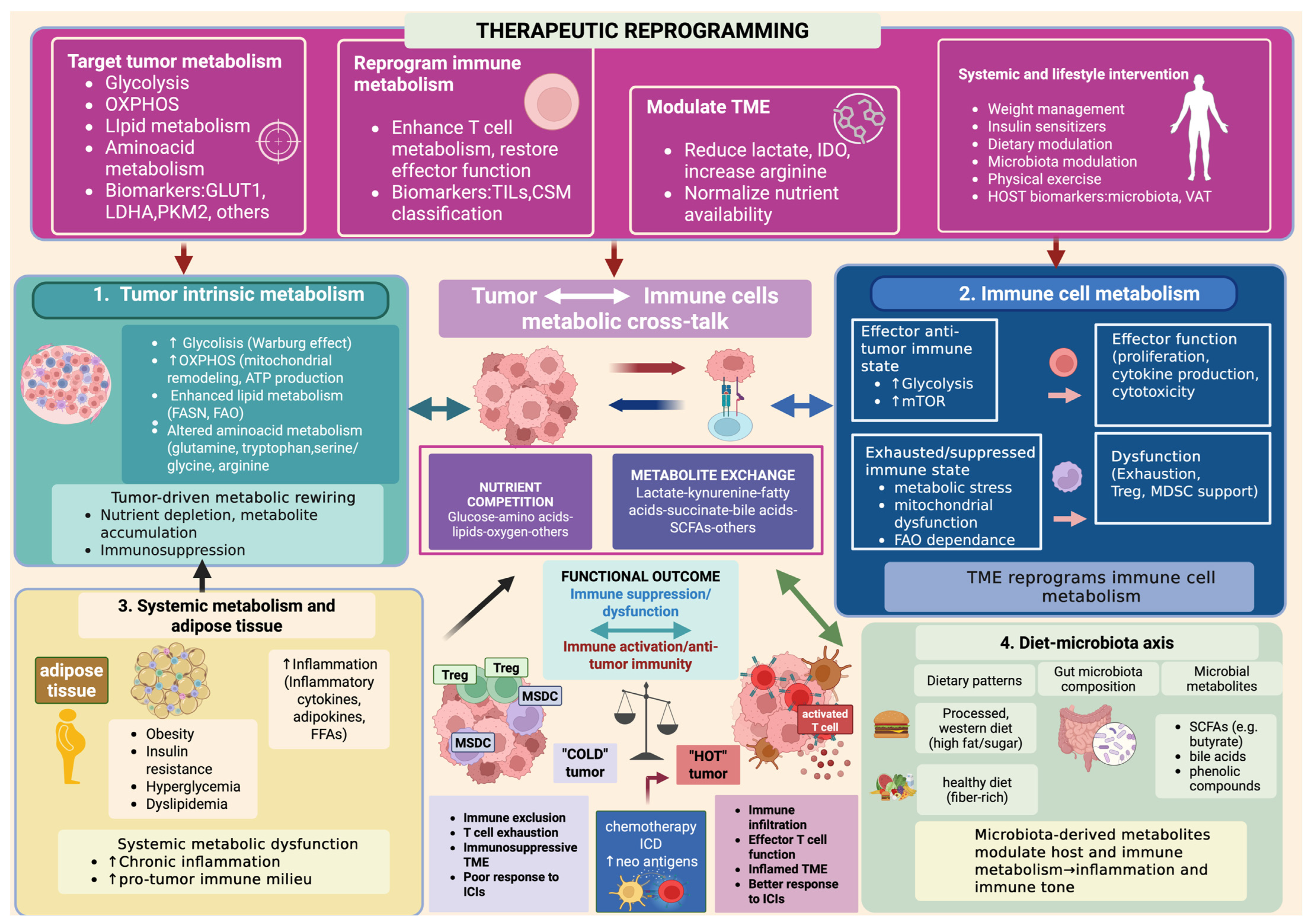
- Colorectal cancer progression is driven by interconnected immunometabolic programs involving tumor metabolism, immune-cell function, obesity, and the diet microbiota axis rather than by isolated genetic alterations alone.
- Metabolic biomarkers and immunometabolic signatures emerging from glycolysis, mitochondrial metabolism, lipid and amino acid pathways, autophagy, and systemic metabolic factors may improve patient stratification and identify novel therapeutic vulnerabilities.
- An integrated immunometabolic framework may complement current molecular classifications and provide a more comprehensive understanding of colorectal cancer heterogeneity and treatment response.
- Targeting metabolic interactions within the tumor microenvironment, particularly in immunotherapy-resistant microsatellite-stable colorectal cancer, may enable the development of more effective precision medicine strategies.
Abstract
1. Introduction
2. Metabolic Biomarkers in CRC
2.1. Metabolic Signaling Kinases
2.2. Glucose Metabolism
2.3. Amino Acid Metabolism
2.4. Lipid Metabolism
2.5. TCA Cycle and OXPHOS Metabolism
2.6. Autophagy
2.7. Metabolic Hormones in CRC

| Gene Acronym | Protein | Functional Category | Expression Activation | Prognosis | Drug Response | Functional State | References |
|---|---|---|---|---|---|---|---|
| PIK3CA; PAK1 | Phosphatidylinositol-4,5-bisphosphate 3-kinase catalytic subunit α; P21 (RAC1) activated kinase 1 | PI3K/PAK1 axis | High | Poor | Patient selection for copanlisib treatment | Oncogenic nutrient-sensing/anabolic state | [22] |
| MTOR | Mechanistic target of rapamycin | mTOR pathway | High | Poor | NA | Anabolic growth and immune-modulatory state | [23] |
| PRKAA1 and related genes | Protein kinase AMP-activated catalytic subunit alpha 1 (AMPK) | Energy sensor | Low/high | Good/Poor (debated) | NA | Energy-stress adaptive state | [24,25,26] |
| PDK4 | Pyruvate dehydrogenase kinase 4 | Glucose and fatty acid metabolism | High | Poor | Resistance to chemotherapy | Glycolytic–oxidative switch/resistant state | [28,29] |
| SLC2A1 | Solute carrier family 2 member 1 | Glucose transporter (GLUT1) | High | Poor | Resistance to chemotherapy | Glycolytic proliferative state | [34,35,40,41] |
| HK2 | Hexokinase 2 | Glycolysis | High | Poor | Multidrug resistance | Glycolytic survival/resistant state | [42] |
| PKM | Pyruvate kinase M1/2 | Glycolysis | High | Poor | Resistance to chemotherapy | Glycolytic proliferative and EMT-associated state | [44,48,49] |
| LDH | Lactate dehydrogenase | Glycolysis | High | Poor | Resistance to anti-angiogenic agents | Lactate-driven immunosuppressive state | [51,52,53,54,55,56] |
| Glycolysis-related genes (ENO3, GPC1, P4HA1, SPAG4, and STC2) | Enolase 3, Glypican-1, Prolyl 4-hydroxylase subunit alpha-1, Sperm-associated antigen 4, Stanniocalcin-2 | Glycolysis | High | Poor | NA | Glycolytic aggressive/prognostic state | [61] |
| Amino acid metabolism-related genes | Amino acid metabolism | Low | Poor | Resistance to immunotherapy | Amino acid-depleted immunosuppressive state | [64] | |
| Glutamine metabolism-related genes | ND | Amino acid metabolism | Differentially expressed | Poor/good | Resistance to chemo- and immuno-therapy | Glutamine-dependent adaptive/resistant state | [65,66,67] |
| PHGDH | Phosphoglycerate dehydrogenase | Serine biosynthesis | High | Poor | Resistance to chemotherapy | Serine/one-carbon stress-resistant state | [69] |
| PSAT1 | Phosphoserine aminotransferase 1 | Serine biosynthesis | High | Poor | NA | Serine biosynthesis proliferative/invasive state | [70] |
| PSPH | Phosphoserine Phosphatase | Serine biosynthesis | High | Poor | Antitumor immunity modulator | Serine-autophagy immune-modulatory state | [71,72] |
| IDO1/2 | Indoleamine 2,3-dioxygenase 1/2 | Tryptophan catabolism | High | Poor | NA | Tryptophan-kynurenine immunosuppressive state | [74] |
| Tryptophan metabolism-related genes | ND | Tryptophan catabolism | High | Poor | Antitumor immunity modulator | Tryptophan-driven immune-tolerant state | [75] |
| SLC7A5 | Solute carrier family 7 member 5 | Amino acid transporter | High | Poor | NA | Amino acid uptake/anabolic state | [77,78] |
| FASN | Fatty acid synthase | lipogenesis | High | Poor | Resistance to chemotherapy and anti-angiogenic agents | Lipogenic proliferative/resistant state | [81,82,84] |
| ACSL4 | Acyl-CoA synthetase long chain family member 4 | Lipid metabolism | High | Poor | Immune cytotoxicity modulator | Ferroptosis-linked lipid-remodeling state | [87] |
| LPCAT1 | Lysophosphatidylcholine Acyltransferase 1 | Membrane remodeling | High | Poor | NA | Ferroptosis-resistant membrane-remodeling state | [89] |
| CD36 | Cluster of differentiation 36 | lipid uptake receptor | High | Poor | Resistance to chemotherapy | Lipid uptake metastatic/resistant state | [92,93] |
| CPT1A and FAO-related genes | Carnitine palmitoyltransferase-1A | Lipid metabolism | High | Poor | Resistance to immunotherapy | FAO-dependent immunosuppressive state | [96,97,98] |
| Lipid metabolism-related genes | ND | Lipid metabolism | Differentially expressed | Poor | Resistance to immunotherapy | Lipid-adaptive immune-resistant state | [99,100,101] |
| CS | Citrate synthase | Krebs cycle | High | Poor | Therapy resistance | TCA-rewired aggressive state | [102,105] |
| IDH1/2 | Isocitrate dehydrogenase 1/2 | Krebs cycle | High | Poor | Resistance to chemotherapy | Oncometabolic chemotherapy-resistant state | [108,109,111] |
| SDH | Succinate dehydrogenase | Krebs cycle | Low | Poor | NA | Succinate-driven invasive/metastatic state | [115] |
| FH | Fumarate hydratase | Krebs cycle | Low | Poor | Modulation of ICI treatment | Fumarate/immune-response modulatory state | [116,117] |
| PPARGC1A | Peroxisome proliferator-activated receptor gamma coactivator 1α | Mitochondrial metabolic remodeling | High | Poor | Resistance to chemotherapy | OXPHOS-dependent metastatic/resistant state | [121,122] |
| NDUFA4L2 | NADH dehydrogenase 1 alpha subcomplex subunit 4-like 2 | OXPHOS | High | Poor | Resistance to chemotherapy | Hypoxia-associated OXPHOS-resistant state | [123,124,125] |
| OXPHOS-related genes | ND | OXPHOS | Differentially expressed | Poor | Resistance to chemotherapy and better response to immunotherapy | Mitochondrial oxidative/resistant state | [126,127,128,129] |
| BECN1 | Beclin 1 | Autophagy | High | Poor | Resistance to chemotherapy | Autophagy-dependent survival/resistant state | [131] |
| MAP1LC3B | Microtubule-associated protein 1 light chain 3 beta | Autophagy | High | Poor | NA | Autophagy-associated aggressive state | [132] |
| BECN1; MAP1LC3B | Beclin 1; Microtubule-associated protein 1 light chain 3 beta | Autophagy | Low | Poor | NA | Autophagy-defective aggressive state | [133] |
| ATG2B | Autophagy related 2B | Autophagy | ATG2B rs17094017 polymorphism | Good | Increased chemotherapy efficacy | Autophagy-associated chemosensitive state | [136] |
| ATG4B | Autophagy related 4B Cysteine Peptidase | Autophagy | High | Poor | Resistance to chemotherapy | Autophagy-driven chemoresistant state | [137] |
| ATG16L2 | Autophagy related 16 like 2 | Autophagy | High | Good | NA | Autophagy-associated favorable state | [138] |
| Autophagy-related genes | ND | Autophagy | Differentially expressed | Poor/good | Chemo- and immuno-therapy predictors | Autophagy-dependent prognostic/resistant state | [139,140,141,142,143,144,145,146] |
| LAMP1/2; BECN1; MAP1LC3B | Lysosomal associated membrane protein 1/2; Beclin 1; Microtubule-associated protein 1 light chain 3 beta | Autophagy-related pathway | High | Poor | NA | Lysosomal-autophagy invasive state | [147] |
| LAMP2A | Lysosome-Associated membrane protein 2A | Autophagy-related pathway | High | Poor | Resistance to chemotherapy | Chaperone-mediated autophagy resistant state | [148] |
| IGF-1 | Insulin-like growth factor 1 | metabolic factor | High (plasma) | CRC risk (debated) | NA | Systemic insulin/IGF anabolic state | [149] |
| IGFBP2 | Insulin growth factor binding protein 2 | metabolic factor | High (plasma) | Tumor grade | NA | Endocrine metabolic aggressive state | [150] |
| IGFBP3 | Insulin growth factor binding protein 3 | metabolic factor | High (plasma); high mRNA levels | Good (plasma); Poor (mRNA) | NA | Context-dependent IGF-modulatory state | [151,152] |
| IGFBP7 | Insulin growth factor binding protein 7 | metabolic factor | Low (plasma) | Good | NA | IGF-axis protective/modulatory state | [151] |
| LEPR | Leptin receptor | Metabolic homeostasis | High | Poor | NA | Leptin-driven inflammatory/pro-tumor state | [153] |
| ADIPOR | Adiponectin receptor | Metabolic homeostasis | Low | Poor | NA | Adiponectin-deficient inflammatory state | [153] |
| LEP; ADIPOQ | Leptin and adiponectin | Metabolic homeostasis | High (serum) | Poor | NA | Adipokine-imbalanced systemic state | [155] |
| PBEF1; RETN | Pre-B-cell colony-enhancing factor 1/visfatin and resistin | Metabolic homeostasis | High (serum) | Poor | Resistance to chemotherapy | Adipokine-driven chemoresistant inflammatory state | [156,157] |
| GLP-1-related genes | ND | metabolic homeostasis | Low | Poor | NA | Endocrine metabolic immune-modulatory state | [159] |
2.8. Convergence of Metabolic Programs into Functional Immunometabolic Configurations
3. Therapeutic Strategies for CRC
3.1. Current Therapies
3.2. New Drugs in Progress
4. Obesity and Adipose Tissue-Driven Immunometabolic Dysfunction in CRC
4.1. Adipose Tissue as a Systemic Immunometabolic Driver
4.1.1. Diet–Microbiota–Inflammasome Axis in Obesity-Associated CRC
4.1.2. Adipocyte–Tumor Crosstalk and Metabolic Reprogramming
4.1.3. TME Remodeling and Intercellular Communication
4.1.4. Adipokine Signaling and Systemic Inflammation
4.2. Visceral Obesity as a Major Risk Determinant of CRC
4.3. Metabolic Dysregulation as Systemic Drivers of CRC Risk and Tumorigenesis
4.3.1. Metabolic Syndrome and Diabetes
4.3.2. Metabolic Modulators and Therapeutic Implications
4.4. Diet–Microbiota Axis and Metabolic Inflammation in CRC
4.4.1. Dietary Patterns, Microbiota, and Metabolic Outputs
4.4.2. Microbiota, Host Interactions, and CRC Susceptibility
5. Immune Landscapes and Metabolic Constraints in CRC: Shaping the TME and Response to Immunotherapy
5.1. Hot and Cold Tumors: Immune Landscapes of Colorectal Cancer Across Microsatellite Status
5.2. Metabolic Reprogramming of Immune Cells Within the TME of CRC and Immunological Determinants of Response to Icis
5.3. Immunological Determinants of Response to ICIs
5.4. Dietary Modulation of Antitumor Immunity: The Diet/Immune/Microbiota Axis and Its Impact on Intratumoral Immunity and Response to ICIs in CRC
6. An Integrative Immunometabolic Model of CRC: From Risk to Precision Therapy
7. Conclusions
Supplementary Materials
Funding
Data Availability Statement
Conflicts of Interest
Abbreviations
| 5-FU | 5-Fluorouracil |
| ACSL4 | Acyl-CoA synthetase long-chain family member 4 |
| AKT | Protein kinase B |
| AMPK | AMP-activated protein kinase |
| APC | Adenomatous polyposis coli |
| ASs | Artificial sweeteners |
| ATG | Autophagy-related gene |
| BECN1 | Beclin-1 |
| BHB | Beta-hydroxybutyrate |
| BMI | Body mass index |
| BPA | Bisphenol A |
| BRAF | B-Rapidly Accelerated Fibrosarcoma |
| CAA | Cancer-associated adipocyte |
| CAPEOX | Capecitabine plus oxaliplatin |
| CD36 | Cluster of differentiation 36 |
| CMS | Consensus molecular subtype |
| COAD | Colon adenocarcinoma |
| CPT1A | Carnitine palmitoyltransferase 1A |
| CRC | Colorectal cancer |
| CS | Citrate synthase |
| CTLA-4 | Cytotoxic T-lymphocyte-associated protein 4 |
| DC | Dendritic cell |
| dMMR | Deficient mismatch repair |
| EGFR | Epidermal growth factor receptor |
| EMT | Epithelial–mesenchymal transition |
| EOCRC | Early-onset colorectal cancer |
| ER | Estrogen receptor |
| ERK | Extracellular signal-regulated kinase |
| FA | Fatty acid |
| FAO | Fatty acid oxidation |
| FASN | Fatty acid synthase |
| FH | Fumarate hydratase |
| FOXP3 | Forkhead box P3 |
| FOLFIRI | Folinic acid, fluorouracil and irinotecan |
| FOLFOX | Folinic acid, fluorouracil and oxaliplatin |
| FOLFOXIRI | Folinic acid, fluorouracil, irinotecan and oxaliplatin |
| FXR | Farnesoid X receptor |
| GCGR | Glucagon receptor |
| GEO | Gene Expression Omnibus |
| GLP-1 | Glucagon-like peptide-1 |
| GLP-1RA | Glucagon-like peptide-1 receptor agonist |
| GLUT1 | Glucose transporter 1 |
| GMRGs | Glutamine metabolism-related genes |
| GPER | G protein-coupled estrogen receptor |
| HDAC | Histone deacetylase |
| HER2 | Human epidermal growth factor receptor 2 |
| HIF-1α | Hypoxia-inducible factor 1 alpha |
| HK2 | Hexokinase 2 |
| HLA | Human leukocyte antigen |
| HMW | High molecular weight |
| ICB | Immune checkpoint blockade |
| ICD | Immunogenic cell death |
| ICI | Immune checkpoint inhibitor |
| IDO | Indoleamine 2,3-dioxygenase |
| IDH | Isocitrate dehydrogenase |
| IFN-γ | Interferon gamma |
| IGF | Insulin-like growth factor |
| IGFBP | Insulin-like growth factor binding protein |
| IHC | Immunohistochemistry |
| IL | Interleukin |
| JAK | Janus kinase |
| KRAS | Kirsten rat sarcoma viral oncogene homolog |
| LAMP | Lysosome-associated membrane protein |
| LAT1 | L-type amino acid transporter 1 |
| LDH | Lactate dehydrogenase |
| LPCAT1 | Lysophosphatidylcholine acyltransferase 1 |
| LPS | Lipopolysaccharide |
| mAb | Monoclonal antibody |
| MAP1LC3 | Microtubule-associated protein 1 light chain 3 |
| MAPK | Mitogen-activated protein kinase |
| mCRC | Metastatic colorectal cancer |
| MDSC | Myeloid-derived suppressor cell |
| MMR | Mismatch repair |
| mTOR | Mechanistic target of rapamycin |
| MSI | Microsatellite instability |
| MSI-H | Microsatellite instability-high |
| MSS | Microsatellite stable |
| NCCN | National Comprehensive Cancer Network |
| NDUFA4L2 | NADH dehydrogenase 1 alpha subcomplex subunit 4-like 2 |
| NF-κB | Nuclear factor kappa B |
| NK | Natural killer |
| NLRP3 | NLR family pyrin domain containing 3 |
| NO | nitric oxide |
| ORR | Objective response rate |
| OS | Overall survival |
| OXPHOS | Oxidative phosphorylation |
| PAK1 | P21 (RAC1) activated kinase 1 |
| PD-1 | Programmed cell death protein 1 |
| PD-L1 | Programmed death ligand 1 |
| PDK | Pyruvate dehydrogenase kinase |
| PFS | Progression-free survival |
| PGC-1α | Peroxisome proliferator-activated receptor gamma coactivator 1 alpha |
| PHGDH | Phosphoglycerate dehydrogenase |
| PI3K | Phosphoinositide 3-kinase |
| PKM2 | Pyruvate kinase M2 |
| POLE | Polymerase epsilon |
| PSAT1 | Phosphoserine aminotransferase 1 |
| PSPH | Phosphoserine phosphatase |
| RAS | Rat Sarcoma |
| ROS | Reactive oxygen species |
| SCFAs | Short-chain fatty acids |
| SDH | Succinate dehydrogenase |
| SGOC | Serine–glycine one-carbon metabolism |
| SIRT1 | Sirtuin 1 |
| SLC2A1 | Solute carrier family 2 member 1 |
| STAT3 | Signal transducer and activator of transcription 3 |
| T2DM | Type 2 diabetes mellitus |
| TAM | Tumor-associated macrophage |
| TCA | Tricarboxylic acid cycle |
| TDO | tryptophan 2,3-dioxygenase |
| TCGA | The Cancer Genome Atlas |
| TGF-β | Transforming growth factor beta |
| Th | T helper |
| TIL | Tumor infiltrating lymphocyte |
| TLS | Tertiary lymphoid structure |
| TLR4 | Toll-like receptor 4 |
| TMB | Tumor mutational burden |
| TME | Tumor microenvironment |
| TNF-α | Tumor Necrosis Factor alpha |
| Treg | Regulatory T cell |
| UPF | Ultra-processed food |
| VAT | Visceral adipose tissue |
| VEGF | Vascular endothelial growth factor |
| VEGFR | Vascular endothelial growth factor receptor |
| VFA | Visceral fat area |
| WHR | Waist-to-hip ratio |
References
- Sung, H.; Siegel, R.L.; Laversanne, M.; Jiang, C.; Morgan, E.; Zahwe, M.; Cao, Y.; Bray, F.; Jemal, A. Colorectal Cancer Incidence Trends in Younger versus Older Adults: An Analysis of Population-Based Cancer Registry Data. Lancet Oncol. 2025, 26, 51–63. [Google Scholar] [CrossRef] [PubMed]
- Zheng, S.; Schrijvers, J.J.A.; Greuter, M.J.W.; Kats-Ugurlu, G.; Lu, W.; de Bock, G.H. Effectiveness of Colorectal Cancer (Crc) Screening on All-Cause and Crc-Specific Mortality Reduction: A Systematic Review and Meta-Analysis. Cancers 2023, 15, 1948. [Google Scholar] [CrossRef] [PubMed]
- Murphy, C.C.; Lee, J.K.; Liang, P.S.; May, F.P.; Zaki, T.A. Declines in Colorectal Cancer Incidence and Mortality Rates Slow among Older Adults. Clin. Gastroenterol. Hepatol. 2024, 22, 416–419.e5. [Google Scholar] [CrossRef] [PubMed]
- Ewing, I.; Hurley, J.J.; Josephides, E.; Millar, A. The Molecular Genetics of Colorectal Cancer. Frontline Gastroenterol. 2014, 5, 26–30. [Google Scholar] [CrossRef] [PubMed]
- Makutani, Y.; Iwamoto, M.; Daito, K.; Tokoro, T.; Ueda, K.; Kawamura, J. Two Cases of Genetic Testing for Familial Adenomatous Polyposis Without a Family History. Int. Cancer Conf. J. 2025, 14, 387–395. [Google Scholar] [CrossRef] [PubMed]
- Housini, M.; Dariya, B.; Ahmed, N.; Stevens, A.; Fiadjoe, H.; Nagaraju, G.P.; Basha, R. Colorectal Cancer: Genetic Alterations, Novel Biomarkers, Current Therapeutic Strategies and Clinical Trials. Gene 2024, 892, 147857. [Google Scholar] [CrossRef] [PubMed]
- Postwala, H.; Shah, Y.; Parekh, P.S.; Chorawala, M.R. Unveiling the Genetic and Epigenetic Landscape of Colorectal Cancer: New Insights into Pathogenic Pathways. Med. Oncol. 2023, 40, 334. [Google Scholar] [CrossRef] [PubMed]
- Casak, S.J.; Marcus, L.; Fashoyin-Aje, L.; Mushti, S.L.; Cheng, J.; Shen, Y.L.; Pierce, W.F.; Her, L.; Goldberg, K.B.; Theoret, M.R.; et al. Fda Approval Summary: Pembrolizumab for the First-Line Treatment of Patients with Msi-H/Dmmr Advanced Unresectable or Metastatic Colorectal Carcinoma. Clin. Cancer Res. 2021, 27, 4680–4684. [Google Scholar] [CrossRef] [PubMed]
- Shaham, S.H.; Vij, P.; Tripathi, M.K. Advances in Targeted and Chemotherapeutic Strategies for Colorectal Cancer: Current Insights and Future Directions. Biomedicines 2025, 13, 642, Correction in Biomedicines 2025, 13, 2576. https://doi.org/10.3390/biomedicines13112576. [Google Scholar] [CrossRef] [PubMed]
- Peixoto, R.D.; Loree, J.M.; Miranda, T.A.; Solar Vasconcelos, J.P.; Renouf, D.J.; Davies, J.M.; Gill, K.; Gill, S.; Poon, V.; Metcalf, C.; et al. Systemic Adjuvant and Perioperative Chemotherapy Following Curative-Intent Liver Metastasectomy in Colorectal Cancer-Is It Justified? ESMO Gastrointest. Oncol. 2025, 9, 100190. [Google Scholar] [CrossRef] [PubMed]
- Strickler, J.H.; Bekaii-Saab, T.; Cercek, A.; Heinemann, V.; Nakamura, Y.; Raghav, K.; Siena, S.; Tabernero, J.; Van Cutsem, E.; Yoshino, T.; et al. MOUNTAINEER-03 Phase III Study Design: First-Line Mfolfox6 + Tucatinib + Trastuzumab for HER2+ Metastatic Colorectal Cancer. Future Oncol. 2025, 21, 303–311. [Google Scholar] [CrossRef] [PubMed]
- Rocha, L.S.D.S.; Riechelmann, R.P. Treatment of Patients with Metastatic Colorectal Cancer and Poor Performance Status: Current Evidence and Challenges. Clinics 2018, 73, e542s. [Google Scholar] [CrossRef]
- Modest, D.P.; Pant, S.; Sartore-Bianchi, A. Treatment Sequencing in Metastatic Colorectal Cancer. Eur. J. Cancer 2019, 109, 70–83. [Google Scholar] [CrossRef] [PubMed]
- Wen, Q.; Han, S.; Cui, Y. Research Progress of Colorectal Cancer in Genomic and Transcriptomic at Multi-Level. Front. Genet. 2025, 16, 1533817. [Google Scholar] [CrossRef] [PubMed]
- Benson, A.B.; Venook, A.P.; Adam, M.; Chang, G.; Chen, Y.J.; Ciombor, K.K.; Cohen, S.A.; Cooper, H.S.; Deming, D.; Garrido-Laguna, I.; et al. Colon Cancer, Version 3.2024, NCCN Clinical Practice Guidelines in Oncology. J. Natl. Compr. Canc. Netw. 2024, 22, e240029. [Google Scholar] [CrossRef] [PubMed]
- Favier, S.; Xiong, W.; Chalabi-Dchar, M.; Chettab, K.; Piercey, O.; Wu, T.; Fenouil, T.; Albaret, M.A.; Jordheim, L.P.; Diaz, J.J.; et al. Exploring and Bypassing Resistance to Targeted Therapies in Colorectal Cancer. Biomed. Pharmacother. 2025, 193, 118741. [Google Scholar] [CrossRef] [PubMed]
- Chen, K.; Chen, W.; Yue, R.; Zhu, D.; Cui, S.; Zhang, X.; Jin, Z.; Xiao, T. Evaluation of the Efficacy and Safety of First- and Second-Line Immunotherapy in Patients with Metastatic Colorectal Cancer: A Systematic Review and Network Meta-Analysis Based on Randomized Controlled Trials. Front. Immunol. 2024, 15, 1439624. [Google Scholar] [CrossRef] [PubMed]
- Zhang, J.; Zhu, H.; Liu, W.; Miao, J.; Mao, Y.; Li, Q. Prognostic and Predictive Molecular Biomarkers in Colorectal Cancer. Front. Oncol. 2025, 15, 1532924, Correction in Front. Oncol. 2025, 15, 1725836. https://doi.org/10.3389/fonc.2025.1725836. [Google Scholar] [PubMed]
- Ashouri, K.; Wong, A.; Mittal, P.; Torres-Gonzalez, L.; Lo, J.H.; Soni, S.; Algaze, S.; Khoukaz, T.; Zhang, W.; Yang, Y.; et al. Exploring Predictive and Prognostic Biomarkers in Colorectal Cancer: A Comprehensive Review. Cancers 2024, 16, 2796. [Google Scholar] [CrossRef] [PubMed]
- Leiphrakpam, P.D.; Are, C. PI3K/Akt/mTOR Signaling Pathway as a Target for Colorectal Cancer Treatment. Int. J. Mol. Sci. 2024, 25, 3178. [Google Scholar] [CrossRef] [PubMed]
- Fontana, F.; Giannitti, G.; Marchesi, S.; Limonta, P. The PI3K/AKT Pathway and Glucose Metabolism: A Dangerous Liaison in Cancer. Int. J. Biol. Sci. 2024, 20, 3113–3125. [Google Scholar] [CrossRef] [PubMed]
- Gunji, D.; Abe, Y.; Muraoka, S.; Narumi, R.; Isoyama, J.; Ikemoto, N.; Ishida, M.; Shinkura, A.; Tomonaga, T.; Nagayama, S.; et al. Longitudinal Phosphoproteomics Reveals the PI3K-PAK1 Axis as a Potential Target for Recurrent Colorectal Liver Metastases. Cell Rep. 2024, 43, 115061. [Google Scholar] [CrossRef] [PubMed]
- Wang, C.; Aikemu, B.; Shao, Y.; Zhang, S.; Yang, G.; Hong, H.; Huang, L.; Jia, H.; Yang, X.; Zheng, M.; et al. Genomic Signature of MTOR Could be an Immunogenicity Marker in Human Colorectal Cancer. BMC Cancer 2022, 22, 818. [Google Scholar] [CrossRef] [PubMed]
- Zhou, Y.; Lei, T.; Tang, Z.; Guo, P.; Huang, D.; Luo, Z.; Luo, L. Increased Phosphorylation of Ampkα1 S485 in Colorectal Cancer and Identification of Pkcα as a Responsible Kinase. Cancer Lett. 2024, 611, 217418. [Google Scholar] [CrossRef] [PubMed]
- Chen, Y.; Deng, Q.; Chen, Z.; Yang, L.; Li, X.; Fu, Z. PPA1 Promotes Oxidative Phosphorylation and Malignant Progression of Colorectal Cancer Under Glucose Restriction via AMPK/ULK1/FUNDC1-Mediated Mitophagy. Cell Death Discov. 2025, 11, 549. [Google Scholar] [CrossRef] [PubMed]
- Kang, D.H.; Jeong, D.J.; Ahn, T.S.; Lee, H.Y.; Kim, H.J.; Bae, S.B.; Kim, H.J.; Lee, M.S.; Kwon, H.Y.; Baek, M.J. Expression of AMP-Activated Protein Kinase/Ten-Eleven Translocation 2 and Their Clinical Relevance in Colorectal Cancer. Oncol. Lett. 2021, 21, 164. [Google Scholar] [CrossRef] [PubMed]
- Woolbright, B.L.; Rajendran, G.; Harris, R.A.; Taylor, J.A., 3rd. Metabolic Flexibility in Cancer: Targeting the Pyruvate Dehydrogenase Kinase: Pyruvate Dehydrogenase Axis. Mol. Cancer Ther. 2019, 18, 1673–1681. [Google Scholar] [CrossRef] [PubMed]
- Leclerc, D.; Pham, D.N.; Lévesque, N.; Truongcao, M.; Foulkes, W.D.; Sapienza, C.; Rozen, R. Oncogenic Role of PDK4 in Human Colon Cancer Cells. Br. J. Cancer 2017, 116, 930–936. [Google Scholar] [CrossRef] [PubMed]
- Strowitzki, M.J.; Radhakrishnan, P.; Pavicevic, S.; Scheer, J.; Kimmer, G.; Ritter, A.S.; Tuffs, C.; Volz, C.; Vondran, F.; Harnoss, J.M.; et al. High Hepatic Expression of PDK4 Improves Survival Upon Multimodal Treatment of Colorectal Liver Metastases. Br. J. Cancer 2019, 120, 675–688. [Google Scholar] [CrossRef] [PubMed]
- Su, W.Y.; Tian, L.Y.; Guo, L.P.; Huang, L.Q.; Gao, W.Y. PI3K Signaling-Regulated Metabolic Reprogramming: From Mechanism to Application. Biochim. Biophys. Acta. Rev. Cancer 2023, 1878, 188952. [Google Scholar] [CrossRef] [PubMed]
- Pavlova, N.N.; Thompson, C.B. The Emerging Hallmarks of Cancer Metabolism. Cell Metab. 2016, 23, 27–47. [Google Scholar] [CrossRef] [PubMed]
- Liberti, M.V.; Locasale, J.W. The Warburg Effect: How Does It Benefit Cancer Cells? Trends Biochem. Sci. 2016, 41, 287, Correction in Trends Biochem. Sci. 2016, 41, 211–218. https://doi.org/10.1016/j.tibs.2016.01.004. [Google Scholar] [PubMed]
- Faubert, B.; Solmonson, A.; DeBerardinis, R.J. Metabolic Reprogramming and Cancer Progression. Science 2020, 368, eaaw5473. [Google Scholar] [CrossRef] [PubMed]
- Yang, J.; Wen, J.; Tian, T.; Lu, Z.; Wang, Y.; Wang, Z.; Wang, X.; Yang, Y. GLUT-1 Overexpression as an Unfavorable Prognostic Biomarker in Patients with Colorectal Cancer. Oncotarget 2017, 8, 11788–11796. [Google Scholar] [CrossRef] [PubMed]
- Shen, Y.M.; Arbman, G.; Olsson, B.; Sun, X.F. Overexpression of GLUT1 in Colorectal Cancer Is Independently Associated with Poor Prognosis. Int. J. Biol. Markers 2011, 26, 166–172. [Google Scholar] [CrossRef] [PubMed]
- Shi, Y.; Zheng, H.; Wang, T.; Zhou, S.; Zhao, S.; Li, M.; Cao, B. Targeting KRAS: From Metabolic Regulation to Cancer Treatment. Mol. Cancer. 2025, 24, 9. [Google Scholar] [CrossRef] [PubMed]
- Yun, J.; Rago, C.; Cheong, I.; Pagliarini, R.; Angenendt, P.; Rajagopalan, H.; Schmidt, K.; Willson, J.K.; Markowitz, S.; Zhou, S.; et al. Glucose Deprivation Contributes to the Development of KRAS Pathway Mutations in Tumor Cells. Science 2009, 325, 1555–1559. [Google Scholar] [CrossRef] [PubMed]
- Taneja, N.; Chauhan, A.; Kulshreshtha, R.; Singh, S. HIF-1 Mediated Metabolic Reprogramming in Cancer: Mechanisms and Therapeutic Implications. Life Sci. 2024, 352, 122890. [Google Scholar] [CrossRef] [PubMed]
- Takeda, M.; Yoshida, S.; Inoue, T.; Sekido, Y.; Hata, T.; Hamabe, A.; Ogino, T.; Miyoshi, N.; Uemura, M.; Yamamoto, H.; et al. The Role of Kras Mutations in Colorectal Cancer: Biological Insights, Clinical Implications, and Future Therapeutic Perspectives. Cancers 2025, 17, 428. [Google Scholar] [CrossRef] [PubMed]
- Wang, T.; Ning, K.; Lu, T.X.; Hua, D. Elevated Expression of Trpc5 and GLUT1 Is Associated with Chemoresistance in Colorectal Cancer. Oncol. Rep. 2017, 37, 1059–1065. [Google Scholar] [CrossRef] [PubMed]
- Saigusa, S.; Toiyama, Y.; Tanaka, K.; Okugawa, Y.; Fujikawa, H.; Matsushita, K.; Uchida, K.; Inoue, Y.; Kusunoki, M. Prognostic Significance of Glucose Transporter-1 (GLUT1) Gene Expression in Rectal Cancer after Preoperative Chemoradiotherapy. Surg. Today 2012, 42, 460–469. [Google Scholar] [CrossRef] [PubMed]
- Zhang, B.; Chan, S.H.; Liu, X.Q.; Shi, Y.Y.; Dong, Z.X.; Shao, X.R.; Zheng, L.Y.; Mai, Z.Y.; Fang, T.L.; Deng, L.Z.; et al. Targeting Hexokinase 2 Increases the Sensitivity of Oxaliplatin by Twist1 in Colorectal Cancer. J. Cell. Mol. Med. 2021, 25, 8836–8849. [Google Scholar] [CrossRef] [PubMed]
- Wang, G.; Lai, Y.; Chen, X.; Li, N.; Zhong, C.; Yan, Y.; Ma, Q.; Hong, X.; Zhu, N.; Yu, W. Hexokinase 2 Promotes Tumor Development and Progression. Am. J. Cancer. Res. 2025, 15, 4499–4515. [Google Scholar] [CrossRef] [PubMed]
- Dong, G.; Mao, Q.; Xia, W.; Xu, Y.; Wang, J.; Xu, L.; Jiang, F. PKM2 and Cancer: The Function of PKM2 Beyond Glycolysis. Oncol. Lett. 2016, 11, 1980–1986. [Google Scholar] [CrossRef] [PubMed]
- Yang, W.; Xia, Y.; Ji, H.; Zheng, Y.; Liang, J.; Huang, W.; Gao, X.; Aldape, K.; Lu, Z. Nuclear PKM2 Regulates Β-Catenin Transactivation upon EGFR Activation. Nature 2017, 480, 118–122, Correction in Nature 2017, 550, 142. https://doi.org/10.1038/nature24008. [Google Scholar] [CrossRef] [PubMed]
- Cha, P.H.; Hwang, J.H.; Kwak, D.K.; Koh, E.; Kim, K.S.; Choi, K.Y. APC Loss Induces Warburg Effect via Increased PKM2 Transcription in Colorectal Cancer. Br. J. Cancer 2021, 124, 634–644. [Google Scholar] [CrossRef] [PubMed]
- Liu, T.; Zhu, S.; Sun, J.; Ma, Y. Interactions of Tumor Necrosis Factor Receptor-Associated Factor 4 and Pyruvate Kinase Muscle Isoform 2 Promote Malignant Behavior and Aerobic Glycolysis in Colorectal Cancer Cells. Cytojournal 2025, 22, 24. [Google Scholar] [CrossRef] [PubMed]
- Cui, R.; Shi, X.Y. Expression of Pyruvate Kinase M2 in Human Colorectal Cancer and Its Prognostic Value. Int. J. Clin. Exp. Pathol. 2015, 8, 11393–11399. [Google Scholar] [PubMed]
- Cao, Y.; Lin, Y.; Wang, D.; Pan, D.; Zhang, Y.; Jin, Y.; Zheng, C. Enhancing 5-Fluorouracil Efficacy Through Suppression of PKM2 in Colorectal Cancer Cells. Cancer Chemother. Pharmacol. 2018, 82, 1081–1086. [Google Scholar] [CrossRef] [PubMed]
- Sharma, D.; Singh, M.; Rani, R. Role of LDH in Tumor Glycolysis: Regulation of LDHA by Small Molecules for Cancer Therapeutics. Semin. Cancer Biol. 2022, 87, 184–195. [Google Scholar] [CrossRef] [PubMed]
- Wang, J.; Wang, H.; Liu, A.; Fang, C.; Hao, J.; Wang, Z. Lactate Dehydrogenase a Negatively Regulated by Mirnas Promotes Aerobic Glycolysis and Is Increased in Colorectal Cancer. Oncotarget 2015, 6, 19456–19468. [Google Scholar] [CrossRef] [PubMed]
- Bar, J.; Spencer, S.; Morgan, S.; Brooks, L.; Cunningham, D.; Robertson, J.; Jürgensmeier, J.M.; Goss, G.D. Correlation of Lactate Dehydrogenase Isoenzyme Profile with Outcome in Patients with Advanced Colorectal Cancer Treated with Chemotherapy and Bevacizumab or Cediranib: Retrospective Analysis of The HORIZON I Study. Clin. Color. Cancer 2014, 13, 46–53. [Google Scholar] [CrossRef] [PubMed]
- Li, G.; Wang, Z.; Xu, J.; Wu, H.; Cai, S.; He, Y. The Prognostic Value of Lactate Dehydrogenase Levels in Colorectal Cancer: A Meta-Analysis. BMC Cancer 2016, 16, 249. [Google Scholar] [CrossRef] [PubMed]
- Ding, H.; Yuan, M.; Yang, Y.; Gupta, M.; Xu, X.S. Evaluating Prognostic Value of Dynamics of Circulating Lactate Dehydrogenase in Colorectal Cancer Using Modeling and Machine Learning. Clin. Pharmacol. Ther. 2024, 115, 805–814. [Google Scholar] [CrossRef] [PubMed]
- Scartozzi, M.; Giampieri, R.; Maccaroni, E.; Del Prete, M.; Faloppi, L.; Bianconi, M.; Galizia, E.; Loretelli, C.; Belvederesi, L.; Bittoni, A.; et al. Pre-Treatment Lactate Dehydrogenase Levels as Predictor of Efficacy of First-Line Bevacizumab-Based Therapy in Metastatic Colorectal Cancer Patients. Br. J. Cancer. 2012, 106, 799–804. [Google Scholar] [CrossRef] [PubMed]
- Feng, W.; Wang, Y.; Zhu, X. Baseline Serum Lactate Dehydrogenase Level Predicts Survival Benefit in Patients with Metastatic Colorectal Cancer Receiving Bevacizumab as First-Line Chemotherapy: A Systematic Review and Meta-Analysis Of 7 Studies and 1,219 Patients. Ann. Transl. Med. 2019, 7, 133. [Google Scholar] [CrossRef] [PubMed]
- Mantrana, A.; Sánchez-Montero, M.T.; Navarrete-Sirvent, C.; Herrera-Casanova, N.; Mena-Osuna, R.; Rivas-Crespo, A.; Díaz-Chacón, A.; Ávila-Oca, V.; Toledano-Fonseca, M.; García-Ortíz, M.V.; et al. Glycolysis Inhibition Restores Immune Sensitivity in Gsnor-Deficient Colorectal Cancer. Lab. Investig. 2025, 105, 104250. [Google Scholar] [CrossRef] [PubMed]
- Liu, X.; Zhao, Y.; Wu, X.; Liu, Z.; Liu, X. A Novel Strategy to Fuel Cancer Immunotherapy: Targeting Glucose Metabolism to Remodel the Tumor Microenvironment. Front. Oncol. 2022, 12, 931104. [Google Scholar] [CrossRef]
- Verma, S.; Budhu, S.; Serganova, I.; Dong, L.; Mangarin, L.M.; Khan, J.F.; Bah, M.A.; Assouvie, A.; Marouf, Y.; Schulze, I.; et al. Pharmacologic LDH Inhibition Redirects Intratumoral Glucose Uptake and Improves Antitumor Immunity in Solid Tumor Models. J. Clin. Investig. 2024, 134, e177606. [Google Scholar] [CrossRef] [PubMed]
- Qin, R.; Fan, X.; Huang, Y.; Chen, S.; Ding, R.; Yao, Y.; Wu, R.; Duan, Y.; Li, X.; Khan, H.U.; et al. Role of Glucose Metabolic Reprogramming in Colorectal Cancer Progression and Drug Resistance. Transl. Oncol. 2024, 50, 102156. [Google Scholar] [CrossRef] [PubMed]
- Zhu, J.; Wang, S.; Bai, H.; Wang, K.; Hao, J.; Zhang, J.; Li, J. Identification of Five Glycolysis-Related Gene Signature and Risk Score Model for Colorectal Cancer. Front. Oncol. 2021, 11, 588811. [Google Scholar] [CrossRef] [PubMed]
- Wang, D.; Zou, S.; Ding, J.; Gao, C.; Wang, J.; Tang, Z. Crosstalk Between Dysregulated Amino Acid Sensing and Glucose and Lipid Metabolism in Colorectal Cancer. Front. Oncol. 2025, 15, 1665056. [Google Scholar] [CrossRef] [PubMed]
- Avram, L.; Crișan, D.; Moldovan, R.C.; Bogos, L.G.; Iuga, C.A.; Andraș, D.; Crișan, S.; Bodolea, C.; Nemeş, A.; Donca, V. Metabolomic Exploration of Colorectal Cancer Through Amino Acids and Acylcarnitines Profiling of Serum Samples. Cancers 2025, 17, 427. [Google Scholar] [CrossRef] [PubMed]
- Peng, X.; Zheng, T.; Guo, Y.; Zhu, Y. Amino Acid Metabolism Genes Associated with Immunotherapy Responses and Clinical Prognosis of Colorectal Cancer. Front. Mol. Biosci. 2022, 9, 955705. [Google Scholar] [CrossRef] [PubMed]
- Zhang, Y.; Zhu, H.; Fan, J.; Zhao, J.; Xia, Y.; Zhang, N.; Xu, H. A Glutamine Metabolism Gene Signature with Prognostic and Predictive Value for Colorectal Cancer Survival and Immunotherapy Response. Front. Mol. Biosci. 2025, 12, 1599141. [Google Scholar] [CrossRef] [PubMed]
- Xie, Y.; Li, J.; Tao, Q.; Wu, Y.; Liu, Z.; Zeng, C.; Chen, Y. Identification of Glutamine Metabolism-Related Gene Signature to Predict Colorectal Cancer Prognosis. J. Cancer 2024, 15, 3199–3214. [Google Scholar] [CrossRef] [PubMed]
- Yu, L.; Lin, X. Molecular Subtypes Based on the Expression of Glutamine Metabolism-Related Genes Predict Prognosis, Tumor Microenvironment, and Drug Therapy Response of Colon Adenocarcinoma. Arab. J. Gastroenterol. 2025, 26, 352–367. [Google Scholar] [CrossRef] [PubMed]
- Yang, M.; Vousden, K.H. Serine and One-Carbon Metabolism in Cancer. Nat. Rev. Cancer. 2016, 16, 650–662. [Google Scholar] [CrossRef] [PubMed]
- Mancini, C.; Lori, G.; Mattei, G.; Iozzo, M.; Desideri, D.; Cianchi, F.; Fortuna, L.; Passagnoli, F.; Massi, D.; Ugolini, F.; et al. PHGDH Drives 5-FU Chemoresistance in Colorectal Cancer through the Hedgehog Signaling. J. Exp. Clin. Cancer Res. 2025, 44, 198. [Google Scholar] [CrossRef] [PubMed]
- Tang, M.; Song, K.; Xie, D.; Yuan, X.; Wang, Y.; Li, Z.; Lu, X.; Guo, L.; Zhu, X.; Xiong, L.; et al. PSAT1 Promotes the Progression of Colorectal Cancer by Regulating Hippo-YAP/TAZ-ID1 Axis via AMOT. Mol. Cell. Biochem. 2025, 480, 3647–3668. [Google Scholar] [CrossRef] [PubMed]
- Guan, J.; Ji, J.; Sun, B.; Fu, J.; Luo, J.; Zhu, B. PSPH Promotes Colorectal Cancer Growth by Triggering Autophagy through AMPK-ULK1 Activation and Enhancing Tumor Immune Evasion. Gen. Physiol. Biophys. 2025, 44, 289–301. [Google Scholar] [CrossRef] [PubMed]
- Sato, K.; Masuda, T.; Hu, Q.; Tobo, T.; Kidogami, S.; Ogawa, Y.; Saito, T.; Nambara, S.; Komatsu, H.; Hirata, H.; et al. Phosphoserine Phosphatase Is a Novel Prognostic Biomarker on Chromosome 7 in Colorectal Cancer. Anticancer Res. 2017, 37, 2365–2371. [Google Scholar] [CrossRef] [PubMed]
- Platten, M.; Nollen, E.A.A.; Röhrig, U.F.; Fallarino, F.; Opitz, C.A. Tryptophan Metabolism as a Common Therapeutic Target in Cancer, Neurodegeneration and Beyond. Nat. Rev. Drug Discov. 2019, 18, 379–401. [Google Scholar] [CrossRef] [PubMed]
- Tang, S.; Wang, J.; Yu, S. IDO in Colorectal Tumorigenesis: Involvement of Immune Tolerance and Significance in Prevention and Therapy. Cell. Mol. Gastroenterol. Hepatol. 2021, 12, 1503–1504. [Google Scholar] [CrossRef] [PubMed]
- Zhang, C.; Rao, Z.; Zhan, X.; Qin, J.; Yang, L.; Yin, Q.; Ji, J.; Zhao, X.; Liu, Y.; Lu, Z.; et al. Deciphering Tryptophan Metabolism in Colorectal Cancer Through Multi-Omics Analysis. Biochem. Biophys. Rep. 2025, 43, 102157. [Google Scholar] [CrossRef] [PubMed]
- Akinlalu, A.; Ogberefor, E.; Gao, T.; Sun, D. Targeting Emerging Amino Acid Dependencies and Transporters in Cancer Therapy. Front. Pharmacol. 2025, 16, 1717414. [Google Scholar] [CrossRef] [PubMed]
- Ogawa, H.; Kaira, K.; Motegi, Y.; Yokobori, T.; Takada, T.; Katoh, R.; Osone, K.; Takahashi, R.; Katayama, C.; Oyama, T.; et al. Role of Amino Acid Transporter Expression as a Prognostic Marker in Patients with Surgically Resected Colorectal Cancer. Anticancer Res. 2019, 39, 2535–2543. [Google Scholar] [CrossRef] [PubMed]
- Ogawa, M.; Tanaka, A.; Maekawa, M.; Namba, K.; Otani, Y.; Shia, J.; Wang, J.Y.; Roehrl, M.H. Protein Expression of the Amino Acid Transporter SLC7A5 in Tumor Tissue Is Prognostic in Early-Stage Colorectal Cancer. PLoS ONE 2024, 19, e0298362. [Google Scholar] [CrossRef] [PubMed]
- Liu, W.; Dong, S.; Hao, F.; Gao, Y.; Wei, Q. Lipid Metabolic Reprogramming in Colorectal Cancer: Mechanisms and Therapeutic Strategies. Front. Immunol. 2025, 16, 1603032. [Google Scholar] [CrossRef] [PubMed]
- Medina Evora, G.; Brauer, M.; Letellier, E. Host and Microbiome Lipid Metabolism in Colorectal Cancer Development and Therapy. Trends Cancer 2025, 11, 1041–1057. [Google Scholar] [CrossRef] [PubMed]
- Liu, X.; Lu, J.; Ni, X.; He, Y.; Wang, J.; Deng, Z.; Zhang, G.; Shi, T.; Chen, W. FASN Promotes Lipid Metabolism and Progression in Colorectal Cancer via the SP1/PLA2G4B Axis. Cell Death Discov. 2025, 11, 122. [Google Scholar] [CrossRef] [PubMed]
- Han, L.; Dai, W.; Luo, W.; Ye, L.; Fang, H.; Mo, S.; Li, Q.; Xu, Y.; Wang, R.; Cai, G. Enhanced de novo Lipid Synthesis Mediated by Fasn Induces Chemoresistance in Colorectal Cancer. Cancers 2025, 17, 3941. [Google Scholar] [CrossRef] [PubMed]
- Wang, M.; Ge, F.; Wu, C.; Su, B.; Dong, X.; Xu, S.; Shi, H. FASN Promotes the Stemness of Cancer Stem Cells and Protects Colorectal Cancer Cells from Ferroptosis by Inhibiting the Activation of SREBP2. Front. Immunol. 2025, 16, 1611375. [Google Scholar] [CrossRef] [PubMed]
- Wang, J.; Millstein, J.; Yang, Y.; Stintzing, S.; Arai, H.; Battaglin, F.; Kawanishi, N.; Soni, S.; Zhang, W.; Mancao, C.; et al. Impact of Genetic Variants Involved in The Lipid Metabolism Pathway on Progression Free Survival in Patients Receiving Bevacizumab-Based Chemotherapy in Metastatic Colorectal Cancer: A Retrospective Analysis of FIRE-3 and MAVERICC Trials. EClinicalMedicine 2023, 57, 101827. [Google Scholar] [CrossRef] [PubMed]
- Yuan, H.; Li, X.; Zhang, X.; Kang, R.; Tang, D. Identification of ACSL4 as a Biomarker and Contributor of Ferroptosis. Biochem. Biophys. Res. Commun. 2016, 478, 1338–1343. [Google Scholar] [CrossRef] [PubMed]
- Zeng, K.; Li, W.; Wang, Y.; Zhang, Z.; Zhang, L.; Zhang, W.; Xing, Y.; Zhou, C. Inhibition of CDK1 Overcomes Oxaliplatin Resistance by Regulating ACSL4-Mediated Ferroptosis in Colorectal Cancer. Adv. Sci. 2023, 10, e2301088. [Google Scholar] [CrossRef] [PubMed]
- Liu, Y.; Jiang, X.; Jing, D.; Lin, Y.; Gao, R.; Zhao, Q.; Da, H.; Ren, Y.; Cao, Q.; Liu, N.; et al. ACSL4 Knockdown Inhibits Colorectal Cancer Progression Through Stimulating Anti-Tumor Immunity. Neoplasia 2025, 67, 101194. [Google Scholar] [CrossRef] [PubMed]
- Lin, J.; Lai, Y.; Lu, F.; Wang, W. Targeting Acsls to Modulate Ferroptosis and Cancer Immunity. Trends Endocrinol. Metab. 2025, 36, 677–690. [Google Scholar] [CrossRef] [PubMed]
- Li, Z.; Hu, Y.; Zheng, H.; Li, M.; Liu, Y.; Feng, R.; Li, X.; Zhang, S.; Tang, M.; Yang, M.; et al. LPCAT1-Mediated Membrane Phospholipid Remodelling Promotes Ferroptosis Evasion and Tumour Growth. Nat. Cell Biol. 2024, 26, 811–824. [Google Scholar] [CrossRef] [PubMed]
- Corn, K.C.; Windham, M.A.; Rafat, M. Lipids in the Tumor Microenvironment: From Cancer Progression to Treatment. Prog. Lipid Res. 2020, 80, 101055. [Google Scholar] [CrossRef] [PubMed]
- Lambrescu, I.M.; Gaina, G.F.; Ceafalan, L.C.; Hinescu, M.E. Inside Anticancer Therapy Resistance and Metastasis. Focus on CD36. J. Cancer 2024, 15, 1675–1686. [Google Scholar] [CrossRef] [PubMed]
- Drury, J.; Rychahou, P.G.; He, D.; Jafari, N.; Wang, C.; Lee, E.Y.; Weiss, H.L.; Evers, B.M.; Zaytseva, Y.Y. Inhibition of Fatty Acid Synthase Upregulates Expression of Cd36 to Sustain Proliferation of Colorectal Cancer Cells. Front. Oncol. 2020, 10, 1185. [Google Scholar] [CrossRef] [PubMed]
- Drury, J.; Rychahou, P.G.; Kelson, C.O.; Geisen, M.E.; Wu, Y.; He, D.; Wang, C.; Lee, E.Y.; Evers, B.M.; Zaytseva, Y.Y. Upregulation of CD36, a Fatty Acid Translocase, Promotes Colorectal Cancer Metastasis by Increasing Mmp28 and Decreasing E-Cadherin Expression. Cancers 2022, 14, 252. [Google Scholar] [CrossRef] [PubMed]
- Wang, Y.N.; Zeng, Z.L.; Lu, J.; Wang, Y.; Liu, Z.X.; He, M.M.; Zhao, Q.; Wang, Z.X.; Li, T.; Lu, Y.X.; et al. CPT1A-Mediated Fatty Acid Oxidation Promotes Colorectal Cancer Cell Metastasis by Inhibiting Anoikis. Oncogene 2018, 37, 6025–6040. [Google Scholar] [CrossRef] [PubMed]
- Zhuang, Z.; Chen, Y.; Yao, Y.; Zhu, X. Metabolic Reprogramming in Colorectal Cancer: The Impact of Fatty Acid Metabolism. Hum. Mutat. 2025, 2025, 9567214. [Google Scholar] [CrossRef] [PubMed]
- Wu, J.; Zhu, S.; Zang, G.; Wang, H.; Yang, N.; Qiao, Y.; Wei, Q.; Wang, L.; Ren, Z.; Liu, Y.J.; et al. CPT1A Inhibition Alleviates Plasmacytoid Dendritic Cell-Mediated Immune Suppression in Colon Cancer Through Fatty Acid Oxidation Modulation. J. Immunother. Cancer 2025, 13, e012162. [Google Scholar] [CrossRef] [PubMed]
- Zhu, R.; Gu, S.; Tao, Y.; Zhang, Y. Butyrate Confers Colorectal Cancer Cell Resistance to Anti-PD-1 Therapy by Promoting CPT1A-Mediated Fatty Acid Oxidation. Discov. Oncol. 2025, 16, 935. [Google Scholar] [CrossRef] [PubMed]
- Wang, H.; Zhang, K.; Wang, Y.; Chen, M.; Zhang, M. A Mitochondrial Lipid Metabolism-Related Gene Signature Predicts Prognosis and Immune Landscape in Colorectal Cancer. Front. Immunol. 2025, 16, 1669678. [Google Scholar] [CrossRef] [PubMed]
- Wang, Y.; Yao, J.; Zhang, Z.; Wei, L.; Wang, S. Generation of Novel Lipid Metabolism-Based Signatures to Predict Prognosis and Immunotherapy Response for Colorectal Adenocarcinoma. Sci. Rep. 2024, 14, 17158. [Google Scholar] [CrossRef] [PubMed]
- Liu, X.; Fang, X.; Lu, L.; Liu, G. Prognostic Significance and Immune Landscape of a Fatty Acid Metabolism-Related Gene Signature in Colon Adenocarcinoma. Front. Genet. 2022, 13, 996625. [Google Scholar] [CrossRef] [PubMed]
- Huang, X.; Sun, Y.; Song, J.; Huang, Y.; Shi, H.; Qian, A.; Cao, Y.; Zhou, Y.; Wang, Q. Prognostic Value of Fatty Acid Metabolism-Related Genes in Colorectal Cancer and Their Potential Implications for Immunotherapy. Front. Immunol. 2023, 14, 1301452. [Google Scholar] [CrossRef] [PubMed]
- Cheung, J.C.T.; Ng, L.W.; Zhu, Z.; Chen, B.; Li, S.; Xu, M.; Ding, X.; Pu, D.; Hu, Y.; Ren, Y.; et al. A Citrate Synthase Splice Variant Rewires the Tca Cycle to Promote Colorectal Cancer Progression. Cancer Res. 2025, 85, 4450–4468. [Google Scholar] [CrossRef] [PubMed]
- Chen, S.; Li, Q.; Zheng, W. Multiomics Analyses of Human Colorectal Cancer Reveal Changes in Mitochondrial Metabolism Associated with Chemotherapy Resistance. Front. Oncol. 2025, 15, 1756306. [Google Scholar] [CrossRef] [PubMed]
- Xiao, W.; Tan, D.; Zeng, W.; Nie, X.; Wang, M. Metabolic Reprogramming in Colorectal Cancer: Mechanisms and Therapeutic Insights. Genes Dis. 2026, in press. [Google Scholar] [CrossRef]
- Ren, M.; Yang, X.; Bie, J.; Wang, Z.; Liu, M.; Li, Y.; Shao, G.; Luo, J. Citrate Synthase Desuccinylation by SIRT5 Promotes Colon Cancer Cell Proliferation and Migration. Biol. Chem. 2020, 401, 1031–1039. [Google Scholar] [CrossRef] [PubMed]
- Zhang, X.; Qu, S.; Zhong, H.; Yang, Y.; Cheng, B.; Zeng, Y. Citrate Synthase Knockdown Suppresses Cell Proliferation and Induces Apoptosis in Select Human Cancer Cell Lines. Int. J. Mol. Sci. 2025, 27, 83. [Google Scholar] [CrossRef] [PubMed]
- Cadoux-Hudson, T.; Schofield, C.J.; McCullagh, J.S.O. Isocitrate Dehydrogenase Gene Variants in Cancer and Their Clinical Significance. Biochem. Soc. Trans. 2021, 49, 2561–2572. [Google Scholar] [CrossRef] [PubMed]
- He, X.; Wu, N.; Li, R.; Zhang, H.; Zhao, Y.; Nie, Y.; Wu, J. IDH2, a Novel Target of OGT, Facilitates Glucose Uptake and Cellular Bioenergy Production via NF-κb Signaling to Promote Colorectal Cancer Progression. Cell. Oncol. 2023, 46, 145–164, Erratum in Cell. Oncol. 2023 46, 165–166. https://doi.org/10.1007/s13402-022-00764-8. [Google Scholar] [CrossRef] [PubMed]
- Liu, S.; Zhou, Y.; Chen, Y.; Qiao, Y.; Bai, L.; Zhang, S.; Men, D.; Zhang, H.; Pan, F.; Gao, Y.; et al. Isocitrate Dehydrogenases 2-Mediated Dysfunctional Metabolic Reprogramming Promotes Intestinal Cancer Progression via Regulating HIF-1A Signaling Pathway. Int. Immunopharmacol. 2024, 140, 112828. [Google Scholar] [CrossRef] [PubMed]
- Wang, B.; Ye, Y.; Yang, X.; Liu, B.; Wang, Z.; Chen, S.; Jiang, K.; Zhang, W.; Jiang, H.; Mustonen, H.; et al. SIRT2-Dependent IDH1 Deacetylation Inhibits Colorectal Cancer and Liver Metastases. EMBO Rep. 2020, 21, e48183. [Google Scholar] [CrossRef] [PubMed]
- Yang, H.; Xie, S.; Liang, B.; Tang, Q.; Liu, H.; Wang, D.; Huang, G. Exosomal IDH1 Increases the Resistance of Colorectal Cancer Cells to 5-Fluorouracil. J. Cancer. 2021, 12, 4862–4872. [Google Scholar] [CrossRef] [PubMed]
- Dalla Pozza, E.; Dando, I.; Pacchiana, R.; Liboi, E.; Scupoli, M.T.; Donadelli, M.; Palmieri, M. Regulation of Succinate Dehydrogenase and Role of Succinate in Cancer. Semin. Cell Dev. Biol. 2020, 98, 4–14. [Google Scholar] [CrossRef] [PubMed]
- Valcarcel-Jimenez, L.; Frezza, C. Fumarate Hydratase (FH) and Cancer: A Paradigm of Oncometabolism. Br. J. Cancer 2023, 129, 1546–1557. [Google Scholar] [CrossRef] [PubMed]
- Turano, M.; Vicidomini, R.; Cammarota, F.; D’Agostino, V.; Duraturo, F.; Izzo, P.; Rosa, M. The Epithelial to Mesenchymal Transition in Colorectal Cancer Progression: The Emerging Role of Succinate Dehydrogenase Alterations and Succinate Accumulation. Biomedicines 2023, 11, 1428. [Google Scholar] [CrossRef] [PubMed]
- Ding, Z.; Wei, Y.; Dai, J.; Pan, C.; Yang, L.; Li, Q.; Zhang, Y.; Yan, Q.; Wu, C.; Li, A.; et al. Deficiency of SDHC Promotes Metastasis by Reprogramming Fatty Acid Metabolism in Colorectal Cancer. J. Transl. Med. 2024, 22, 544. [Google Scholar] [CrossRef] [PubMed]
- Qin, L.; Shi, L.; Wang, Y.; Yu, H.; Du, Z.; Chen, M.; Cai, Y.; Cao, Y.; Deng, S.; Wang, J.; et al. Fumarate Hydratase Enhances the Therapeutic Effect of PD-1 Antibody in Colorectal Cancer by Regulating Pcsk9. Cancers 2024, 16, 713. [Google Scholar] [CrossRef] [PubMed]
- Sciacovelli, M.; Gonçalves, E.; Johnson, T.I.; Zecchini, V.R.; da Costa, A.S.; Gaude, E.; Drubbel, A.V.; Theobald, S.J.; Abbo, S.R.; Tran, M.G.; et al. Fumarate Is an Epigenetic Modifier That Elicits Epithelial-to-Mesenchymal Transition. Nature 2016, 537, 544–547, Correction in Nature 2016, 540, 150. https://doi.org/10.1038/nature20144. PMID: 27760119. [Google Scholar] [CrossRef] [PubMed]
- Wang, C.; Chen, M.; Chen, P.; Han, J.; Hu, H.; Chen, J.; Wu, Q.; Zhao, D.; Wang, T.; Zhou, J.; et al. RBM15-Mediated Metabolic Reprogramming Boosts Immune Response in Colorectal Cancer. Front. Immunol. 2025, 16, 1515568. [Google Scholar] [CrossRef] [PubMed]
- Chen, K.; Wang, B.; Shu, H.; Lyu, J.; Cui, W.; Fang, H. Oxidative Phosphorylation at the Crossroads of Cancer: Metabolic Orchestration, Stromal Collusion, and Emerging Therapeutic Horizons. Interdiscip. Med. 2025, 3, e70054. [Google Scholar] [CrossRef]
- Denise, C.; Paoli, P.; Calvani, M.; Taddei, M.L.; Giannoni, E.; Kopetz, S.; Kazmi, S.M.; Pia, M.M.; Pettazzoni, P.; Sacco, E.; et al. 5-Fluorouracil Resistant Colon Cancer Cells Are Addicted to OXPHOS to Survive and Enhance Stem-Like Traits. Oncotarget 2015, 6, 41706–41721. [Google Scholar] [CrossRef] [PubMed]
- Chen, W.; Zhang, Q.; Dai, X.; Chen, X.; Zhang, C.; Bai, R.; Chen, Y.; Zhang, K.; Duan, X.; Qiao, Y.; et al. PGC-1α Promotes Colorectal Carcinoma Metastasis Through Regulating ABCA1 Transcription. Oncogene 2023, 42, 2456–2470. [Google Scholar] [CrossRef] [PubMed]
- Vellinga, T.T.; Borovski, T.; de Boer, V.C.; Fatrai, S.; van Schelven, S.; Trumpi, K.; Verheem, A.; Snoeren, N.; Emmink, B.L.; Koster, J.; et al. SIRT1/PGC1α-Dependent Increase in Oxidative Phosphorylation Supports Chemotherapy Resistance of Colon Cancer. Clin. Cancer Res. 2015, 21, 2870–2879. [Google Scholar] [CrossRef] [PubMed]
- Mei, Q.; Chen, P.; Lv, Y.; Zheng, L.; Liu, D.; Zhang, M.; Liu, W.; Li, P. Elevated of NDUFA4L2 Expression in Colon Adenocarcinoma Is Correlated with an Unfavorable Prognosis and Increased Immune Cell Infiltration. Heliyon 2024, 10, e25462. [Google Scholar] [CrossRef] [PubMed]
- He, H.; Zheng, S.; Jin, S.; Huang, W.; Wei, E.; Guan, S.; Yang, C. Nucleotide Metabolism-Associated Drug Resistance Gene NDUFA4L2 Promotes Colon Cancer Progression and 5-FU Resistance. Sci. Rep. 2025, 15, 570. [Google Scholar] [CrossRef] [PubMed]
- Lin, Y.; Xie, H.; Zhao, W.; Li, Y.; Zhang, Z. NDUFA4L2 Is a Novel Biomarker for Colorectal Cancer Through Bioinformatics Analysis. Medicine 2023, 102, e35893. [Google Scholar] [CrossRef] [PubMed]
- Martinez-Bernabe, T.; Pons, D.G.; Oliver, J.; Sastre-Serra, J. Oxidative Phosphorylation as a Predictive Biomarker of Oxaliplatin Response in Colorectal Cancer. Biomolecules 2024, 14, 1359. [Google Scholar] [CrossRef] [PubMed]
- Uslu, C.; Kapan, E.; Lyakhovich, A. Cancer Resistance and Metastasis Are Maintained through Oxidative Phosphorylation. Cancer Lett. 2024, 587, 216705. [Google Scholar] [CrossRef] [PubMed]
- Wang, C.; Cui, G.; Wang, D.; Wang, M.; Chen, Q.; Wang, Y.; Lu, M.; Tang, X.; Yang, B. Crosstalk of Oxidative Phosphorylation-Related Subtypes, Establishment of a Prognostic Signature and Immune Infiltration Characteristics in Colorectal Adenocarcinoma. Cancers 2022, 14, 4503. [Google Scholar] [CrossRef] [PubMed]
- Zhang, Z.; Zhu, H.; Li, Q.; Gao, W.; Zang, D.; Su, W.; Yang, R.; Zhong, J. Gene Expression Profiling of Tricarboxylic Acid Cycle and One Carbon Metabolism Related Genes for Prognostic Risk Signature of Colon Carcinoma. Front. Genet. 2021, 12, 647152. [Google Scholar] [CrossRef] [PubMed]
- Qu, Z.; Pen, X.; Liu, Y.; Pen, X.; Lu, X.; Luo, S. Autophagy in Colorectal Cancer: Current Understanding of Mechanisms and Future Therapeutic Directions. Biomed. Pharmacother. 2025, 191, 118524. [Google Scholar] [CrossRef] [PubMed]
- Koustas, E.; Sarantis, P.; Theoharis, S.; Saetta, A.A.; Chatziandreou, I.; Kyriakopoulou, G.; Giannopoulou, I.; Michelli, M.; Schizas, D.; Papavassiliou, A.G.; et al. Autophagy-Related Proteins as a Prognostic Factor of Patients with Colorectal Cancer. Am. J. Clin. Oncol. 2019, 42, 767–776. [Google Scholar] [CrossRef] [PubMed]
- Schmitz, K.J.; Ademi, C.; Bertram, S.; Schmid, K.W.; Baba, H.A. Prognostic Relevance of Autophagy-Related Markers LC3, P62/Sequestosome 1, Beclin-1 and ULK1 in Colorectal Cancer Patients with Respect to KRAS Mutational Status. World J. Surg. Oncol. 2016, 14, 189. [Google Scholar] [CrossRef] [PubMed]
- Zhao, H.; Yang, M.; Zhao, B. Beclin 1 and LC3 as Predictive Biomarkers for Metastatic Colorectal Carcinoma. Oncotarget 2017, 8, 59058–59067. [Google Scholar] [CrossRef] [PubMed]
- Li, J.X.; Yan, Q.; Liu, N.; Zheng, W.J.; Hu, M.; Yu, Z.M.; Zhou, Y.D.; Wang, X.W.; Liang, F.X.; Chen, R. The Prognostic Value of Autophagy-Related Markers Bclin-1 and LC-3 in Colorectal Cancers: A Systematic Review and Meta-Analysis. Evid. Based Complement. Altern. Med. 2020, 2020, 8475840. [Google Scholar] [CrossRef] [PubMed]
- Rekha, A.; Mishra, R.; Aundhia, C.; Rathore, V.; Anand, K.; Negi, P.; Singh, S.K.; Dua, K.; Gupta, G. Beclin-1 as an Autophagy Biomarker in Colorectal Cancer. Clin. Chim. Acta. 2026, 589, 120892. [Google Scholar] [CrossRef] [PubMed]
- Yu, T.; Ben, S.; Ma, L.; Jiang, L.; Chen, S.; Lin, Y.; Chen, T.; Li, S.; Zhu, L. Genetic Variants in Autophagy-Related Gene ATG2B Predict the Prognosis of Colorectal Cancer Patients Receiving Chemotherapy. Front. Oncol. 2022, 12, 876424. [Google Scholar] [CrossRef] [PubMed]
- Hu, W.H.; Liu, T.T.; Liu, P.F.; Morgan, P.; Lin, I.L.; Tsai, W.L.; Cheng, Y.Y.; Hsieh, A.T.; Hu, T.H.; Shu, C.W. ATG4B and Ps383/392-ATG4B Serve as Potential Biomarkers and Therapeutic Targets of Colorectal Cancer. Cancer Cell Int. 2023, 23, 63. [Google Scholar] [CrossRef] [PubMed]
- Tang, J.; Wang, D.; Shen, Y.; Xue, F. ATG16L2 Overexpression Is Associated with a Good Prognosis in Colorectal Cancer. J. Gastrointest. Oncol. 2021, 12, 2192–2202. [Google Scholar] [CrossRef] [PubMed]
- Lin, X.T.; Wu, Q.N.; Qin, S.; Fan, D.J.; Lv, M.Y.; Chen, X.; Cai, J.W.; Weng, J.R.; Zou, Y.F.; Rong, Y.M.; et al. Identification of an Autophagy-Related Gene Signature for the Prediction of Prognosis in Early-Stage Colorectal Cancer. Front. Genet. 2021, 12, 755789. [Google Scholar] [CrossRef] [PubMed]
- Liu, T.T.; Liu, S.M. Prediction of Prognostic Biomarkers and Construction of an Autophagy Prognostic Model for Colorectal Cancer Using Bioinformatics. Technol. Cancer Res. Treat. 2020, 19, 1533033820984177. [Google Scholar] [CrossRef] [PubMed]
- Chen, S.; Wang, Y.; Wang, B.; Zhang, L.; Su, Y.; Xu, M.; Zhang, M. A Signature Based on 11 Autophagy Genes for Prognosis Prediction of Colorectal Cancer. PLoS ONE 2021, 16, e0258741. [Google Scholar] [CrossRef] [PubMed]
- Zhou, Z.; Mo, S.; Dai, W.; Ying, Z.; Zhang, L.; Xiang, W.; Han, L.; Wang, Z.; Li, Q.; Wang, R.; et al. Development and Validation of an Autophagy Score Signature for the Prediction of Post-Operative Survival in Colorectal Cancer. Front. Oncol. 2019, 9, 878. [Google Scholar] [CrossRef] [PubMed]
- Zhang, C.; Jiang, J.; Wang, L.; Zheng, L.; Xu, J.; Qi, X.; Huang, H.; Lu, J.; Li, K.; Wang, H. Identification of Autophagy-Associated Biomarkers and Corresponding Regulatory Factors in the Progression of Colorectal Cancer. Front. Genet. 2020, 11, 245. [Google Scholar] [CrossRef] [PubMed]
- Huang, Z.; Liu, J.; Luo, L.; Sheng, P.; Wang, B.; Zhang, J.; Peng, S.S. Genome-Wide Identification of a Novel Autophagy-Related Signature for Colorectal Cancer. Dose Response 2019, 17, 1559325819894179. [Google Scholar] [CrossRef] [PubMed]
- Zhao, H.; Huang, C.; Luo, Y.; Yao, X.; Hu, Y.; Wang, M.; Chen, X.; Zeng, J.; Hu, W.; Wang, J.; et al. A Correlation Study of Prognostic Risk Prediction for Colorectal Cancer Based on Autophagy Signature Genes. Front. Oncol. 2021, 11, 595099. [Google Scholar] [CrossRef] [PubMed]
- Wang, L.; Jiang, X.; Zhang, X.; Shu, P. Prognostic Implications of an Autophagy-Based Signature in Colorectal Cancer. Medicine 2021, 100, e25148. [Google Scholar] [CrossRef] [PubMed]
- Ivanova, T.; Dikov, D.; Molander, D.; Dzhambov, A.M.; Sbirkov, Y.; Mehterov, N.; Belev, N.; Atanasov, B.; Kazakova, M.; Sarafian, V. Implication of LAMP Proteins and Autophagy Markers in Colorectal Cancer Aggressiveness. Front. Immunol. 2025, 16, 1662830. [Google Scholar] [CrossRef] [PubMed]
- Shi, Z.; Yang, S.; Shen, C.; Shao, J.; Zhou, F.; Liu, H.; Zhou, G. LAMP2A Regulates Cisplatin Resistance in Colorectal Cancer through Mediating Autophagy. J. Cancer. Res. Clin. Oncol. 2024, 150, 242. [Google Scholar] [CrossRef] [PubMed]
- Murphy, N.; Carreras-Torres, R.; Song, M.; Chan, A.T.; Martin, R.M.; Papadimitriou, N.; Dimou, N.; Tsilidis, K.K.; Banbury, B.; Bradbury, K.E.; et al. Circulating Levels of Insulin-Like Growth Factor 1 and Insulin-Like Growth Factor Binding Protein 3 Associate with Risk of Colorectal Cancer Based on Serologic and Mendelian Randomization Analyses. Gastroenterology 2020, 158, 1300–1312.e20. [Google Scholar] [CrossRef] [PubMed]
- Alrashid, M.H.; Al-Serri, A.E.; Hussain, R.F.; Al-Bustan, S.A.; Al-Barrak, J. Association Study of IGF-1 Rs35767 and Rs6214 Gene Polymorphisms with Cancer Susceptibility and Circulating Levels of IGF-1, IGFBP-2, and IGFBP-3 in Colorectal Cancer Patients. Biomedicines 2023, 11, 3166. [Google Scholar] [CrossRef] [PubMed]
- Guercio, B.J.; Zhang, S.; Ou, F.S.; Venook, A.P.; Niedzwiecki, D.; Lenz, H.J.; Innocenti, F.; Pollak, M.N.; Nixon, A.B.; Mullen, B.C.; et al. IGF-Binding Proteins, Adiponectin, and Survival in Metastatic Colorectal Cancer: Results from CALGB (Alliance)/SWOG 80405. JNCI Cancer Spectr. 2020, 5, pkaa074. [Google Scholar] [CrossRef] [PubMed]
- Yamamoto, N.; Oshima, T.; Yoshihara, K.; Aoyama, T.; Hayashi, T.; Yamada, T.; Sato, T.; Shiozawa, M.; Yoshikawa, T.; Morinaga, S.; et al. Clinicopathological Significance and Impact on Outcomes of the Gene Expression Levels of IGF-1, IGF-2 And IGF-1R, IGFBP-3 in Patients with Colorectal Cancer: Overexpression of the IGFBP-3 Gene Is an Effective Predictor of Outcomes in Patients with Colorectal Cancer. Oncol. Lett. 2017, 13, 3958–3966. [Google Scholar] [CrossRef]
- Parmesh, P.; Dinesh, U.S.; Khandagale, A.S.; Bapu, A.B.; Sadashiv, R.; Reddy, P. Correlation of Leptin and Adiponectin Receptor Expression with Clinicopathological Parameters in Colorectal Carcinoma-A Cross-Sectional Prospective Study. Arq. Gastroenterol. 2024, 61, e24016. [Google Scholar] [CrossRef] [PubMed]
- Scheurlen, K.M.; Snook, D.L.; Alfieri, T.; Littlefield, A.B.; George, J.B.; Seraphine, C.; Cook, C.N.; Rochet, A.; Gaskins, J.T.; Galandiuk, S. Obesity Hormones and Itaconate Mediating Inflammation in Human Colon Cancer Cells-Another Lead to Early-Onset Colon Cancer? Heliyon 2023, 9, e13132. [Google Scholar] [CrossRef] [PubMed]
- Mhaidat, N.M.; Alzoubi, K.H.; Kubas, M.A.; Banihani, M.N.; Hamdan, N.; Al-Jaberi, T.M. High Levels of Leptin and Non-High Molecular Weight-Adiponectin in Patients with Colorectal Cancer: Association with Chemotherapy and Common Genetic Polymorphisms. Biomed. Rep. 2021, 14, 13. [Google Scholar] [CrossRef] [PubMed]
- Zhang, W.; Wang, S. Relationships Between Nutritional Status and Serum Adipokine Levels with Chemotherapy Efficacy in Late-Stage Colorectal Cancer Patients. Int. J. Colorectal Dis. 2025, 40, 25. [Google Scholar] [CrossRef] [PubMed]
- Yan, X.; Zhao, J.; Zhang, R. Visfatin Mediates Doxorubicin Resistance in Human Colorectal Cancer Cells via Up Regulation of Multidrug Resistance 1 (MDR1). Cancer Chemother. Pharmacol. 2017, 80, 395–403. [Google Scholar] [CrossRef] [PubMed]
- Yagi, T.; Kubota, E.; Koyama, H.; Tanaka, T.; Kataoka, H.; Imaeda, K.; Joh, T. Glucagon Promotes Colon Cancer Cell Growth via Regulating AMPK and MAPK Pathways. Oncotarget 2018, 9, 10650–10664. [Google Scholar] [CrossRef] [PubMed]
- Zhu, C.; Lai, Y.; Liu, C.; Teng, L.; Zhu, Y.; Lin, X.; Fu, X.; Lai, Q.; Liu, S.; Zhou, X.; et al. Comprehensively Prognostic and Immunological Analyses of GLP-1 Signaling-Related Genes in Pan-Cancer and Validation in Colorectal Cancer. Front. Pharmacol. 2024, 15, 1387243. [Google Scholar] [CrossRef] [PubMed]
- Cremolini, C.; Chalabi, M.; Elez, E.; Fassan, M.; Gelli, M.; Goéré, D.; Modest, D.P.; Montagut, C.; Osterlund, P.; Ricke, J.; et al. ESMO Guidelines Committee. Metastatic Colorectal Cancer: ESMO Clinical Practice Guideline for Diagnosis, Treatment and Follow-Up. Ann. Oncol. 2026, 37, 759–776. [Google Scholar] [CrossRef] [PubMed]
- Fu, C.; Liu, X.; Wang, L.; Hang, D. The Potential of Metabolomics in Colorectal Cancer Prognosis. Metabolites 2024, 14, 708. [Google Scholar] [CrossRef] [PubMed]
- Armstrong, S.A.; Malley, R.; Weinberg, B.A. Molecular Profiling in Metastatic Colorectal Cancer. Oncology 2020, 34, 352–355. [Google Scholar] [CrossRef] [PubMed]
- Alcindor, T.; Beauger, N. Oxaliplatin: A Review in the Era of Molecularly Targeted Therapy. Curr. Oncol. 2011, 18, 18–25. [Google Scholar] [CrossRef] [PubMed]
- Peters, G.J.; Kathmann, I.; Giovannetti, E.; Smid, K.; Assaraf, Y.G.; Jansen, G. The Role of L-Leucovorin Uptake and Metabolism in the Modulation Of 5-Fluorouracil Efficacy and Antifolate Toxicity. Front. Pharmacol. 2024, 15, 1450418. [Google Scholar] [CrossRef] [PubMed]
- Grothey, A.; Venook, A.P. Optimizing Adjuvant Therapy for Localized Colon Cancer and Treatment Selection in Advanced Colorectal Cancer. J. Natl. Compr. Canc. Netw. 2018, 16, 611–615. [Google Scholar] [CrossRef] [PubMed]
- Waldstein, S.; Spengler, M.; Pinchuk, I.V.; Yee, N.S. Impact of Colorectal Cancer Sidedness and Location on Therapy and Clinical Outcomes: Role oof Blood-Based Biopsy for Personalized Treatment. J. Pers. Med. 2023, 13, 1114. [Google Scholar] [CrossRef] [PubMed]
- Bellio, H.; Fumet, J.D.; Ghiringhelli, F. Targeting BRAF and RAS in Colorectal Cancer. Cancers 2021, 13, 2201. [Google Scholar] [CrossRef] [PubMed]
- Sütcüoğlu, O.; Yıldırım, H.Ç.; Almuradova, E.; Günenç, D.; Yalçın, Ş. RAS Mutations in Advanced Colorectal Cancer: Mechanisms, Clinical Implications, and Novel Therapeutic Approaches. Medicina 2025, 61, 1202. [Google Scholar] [CrossRef] [PubMed]
- Miao, R.; Yu, J.; Kim, R.D. Targeting the KRAS Oncogene for Patients with Metastatic Colorectal Cancer. Cancers 2025, 17, 1512. [Google Scholar] [CrossRef] [PubMed]
- Bao, X.; Wu, J.; Kim, S.; LoRusso, P.; Li, J. Pharmacometabolomics Reveals Irinotecan Mechanism of Action in Cancer Patients. J. Clin. Pharmacol. 2019, 59, 20–34. [Google Scholar] [CrossRef] [PubMed]
- García-Foncillas, J.; Sunakawa, Y.; Aderka, D.; Wainberg, Z.; Ronga, P.; Witzler, P.; Stintzing, S. Distinguishing Features of Cetuximab and Panitumumab in Colorectal Cancer and Other Solid Tumors. Front. Oncol. 2019, 9, 849. [Google Scholar] [CrossRef] [PubMed]
- Baraniskin, A.; Buchberger, B.; Pox, C.; Graeven, U.; Holch, J.W.; Schmiegel, W.; Heinemann, V. Efficacy of Bevacizumab in First-Line Treatment of Metastatic Colorectal Cancer: A Systematic Review and Meta-Analysis. Eur. J. Cancer 2019, 106, 37–44. [Google Scholar] [CrossRef] [PubMed]
- Kooshkaki, O.; Derakhshani, A.; Hosseinkhani, N.; Torabi, M.; Safaei, S.; Brunetti, O.; Racanelli, V.; Silvestris, N.; Baradaran, B. Combination of Ipilimumab and Nivolumab in Cancers: From Clinical Practice to Ongoing Clinical Trials. Int. J. Mol. Sci. 2020, 21, 4427. [Google Scholar] [CrossRef] [PubMed]
- Xu, Z.; Peng, X.; Kong, Y.; Cui, Y.; Li, Y.; Guo, Y. The Best Strategy for Metastatic Colorectal Cancer (Mcrc) Patients in Second-Line Treatment: A Network Meta-Analysis. Cancer Treat. Res. Commun. 2021, 29, 100455. [Google Scholar] [CrossRef] [PubMed]
- Kopetz, S.; Grothey, A.; Yaeger, R.; Van Cutsem, E.; Desai, J.; Yoshino, T.; Wasan, H.; Ciardiello, F.; Loupakis, F.; Hong, Y.S.; et al. Encorafenib, Binimetinib, and Cetuximab in BRAF V600E-Mutated Colorectal Cancer. N. Engl. J. Med. 2019, 381, 1632–1643. [Google Scholar] [CrossRef] [PubMed]
- Cervantes, A.; Adam, R.; Roselló, S.; Arnold, D.; Normanno, N.; Taïeb, J.; Seligmann, J.; De Baere, T.; Osterlund, P.; Yoshino, T.; et al. Metastatic Colorectal Cancer: ESMO Clinical Practice Guideline for Diagnosis, Treatment and Follow-Up. ESMO Guidelines Committee. Ann. Oncol. 2023, 34, 10–32. [Google Scholar] [CrossRef] [PubMed]
- Eng, C.; Yoshino, T.; Ruíz-García, E.; Mostafa, N.; Cann, C.G.; O’Brian, B.; Benny, A.; Perez, R.O.; Cremolini, C. Colorectal Cancer. Lancet 2024, 404, 294–310. [Google Scholar] [CrossRef] [PubMed]
- Kawazoe, A.; Xu, R.H.; García-Alfonso, P.; Passhak, M.; Teng, H.W.; Shergill, A.; Gumus, M.; Qvortrup, C.; Stintzing, S.; Towns, K.; et al. LEAP-017 Investigators. Lenvatinib Plus Pembrolizumab versus Standard of Care for Previously Treated Metastatic Colorectal Cancer: Final Analysis of the Randomized, Open-Label, Phase III LEAP-017 Study. J. Clin. Oncol. 2024, 42, 2918–2927. [Google Scholar] [CrossRef] [PubMed]
- Gallois, C.; Emile, J.F.; Kim, S.; Monterymard, C.; Gilabert, M.; Bez, J.; Lièvre, A.; Dahan, L.; Laurent-Puig, P.; Mineur, L.; et al. Pembrolizumab with Capox Bevacizumab in Patients with Microsatellite Stable Metastatic Colorectal Cancer and a High Immune Infiltrate: The FFCD 1703-POCHI Trial. Dig. Liver Dis. 2021, 53, 1254–1259. [Google Scholar] [CrossRef] [PubMed]
- Tougeron, D.; Emile, J.F.; Bodere, A.; Barbier, E.; Bez, J.; Dourthe, L.M.; Perrier, H.; Corbinais, S.; Le Brun-Ly, V.; Bideau, K.; et al. Pembrolizumab in Combination with CAPOX and Bevacizumab in Patients with Microsatellite Stable Metastatic Colorectal Cancer and a High Immune Infiltrate: Preliminary Results of FFCD 1703 POCHI Trial. Ann. Oncol. 2024, 35, S428. [Google Scholar] [CrossRef]
- Liu, R.; Ji, Z.; Wang, X.; Zhu, L.; Xin, J.; Ma, L.; Zhang, J.; Ge, S.; Zhang, L.; Yang, Y.; et al. Regorafenib Plus Sintilimab as a Salvage Treatment for Microsatellite Stable Metastatic Colorectal Cancer: A Single-Arm, Open-Label, Phase II Clinical Trial. Nat. Commun. 2025, 16, 1481. [Google Scholar] [CrossRef] [PubMed]
- Xiao, A.; Li, X.; Wang, C.; Ye, J.; Fakih, M. Updated Survival Outcome of Regorafenib, Ipilimumab, and Nivolumab in Refractory Microsatellite Stable Non-Liver Metastatic Colorectal Cancer: A Phase I Nonrandomized Clinical Trial. Eur. J. Cancer. 2024, 213, 115111. [Google Scholar] [CrossRef] [PubMed]
- Bullock, A.J.; Schlechter, B.L.; Fakih, M.G.; Tsimberidou, A.M.; Grossman, J.E.; Gordon, M.S.; Wilky, B.A.; Pimentel, A.; Mahadevan, D.; Balmanoukian, A.S.; et al. Botensilimab Plus Balstilimab in Relapsed/Refractory Microsatellite Stable Metastatic Colorectal Cancer: A Phase 1 Trial. Nat. Med. 2024, 30, 2558–2567. [Google Scholar] [CrossRef] [PubMed]
- Bengala, E.; Santini, D.; Picone, V. Refractory Microsatellite-Stable Metastatic Colorectal Cancer: A Comparison Between Botensilimab + Balstilimab and Current Standard of Care. Immunooncol. Technol. 2025, 29, 101558. [Google Scholar] [CrossRef] [PubMed]
- Fakih, M.; Segal, N.H.; Schlechter, B.L.; Andre, T.; Pietrantonio, F.; Johnson, B.; Vasilyev, A.; Krishnamurthi, S.S.; Siena, S.; Messersmith, W.A.; et al. Preliminary Results from a Randomized, Open-Label, Phase 2 Study of Botensilimab (BOT) With or Without Balstilimab (BAL) in Refractory Microsatellite Stable Metastatic Colorectal Cancer with No Liver Metastases (MSS Mcrc NLM). J. Clin. Oncol. 2025, 43, 23. [Google Scholar] [CrossRef]
- Bando, H.; Yoshino, T. STELLAR-303: Breaking the Immunotherapy Wall in MSS Colorectal Cancer. Med 2026, 7, 100957. [Google Scholar] [CrossRef] [PubMed]
- Hecht, J.R.; Park, Y.S.; Tabernero, J.; Lee, M.A.; Lee, S.; Virgili, A.C.; Van den Eynde, M.; Fontana, E.; Fakih, M.; Asghari, G.; et al. Zanzalintinib Plus Atezolizumab versus Regorafenib in Refractory Colorectal Cancer (STELLAR-303): A Randomised, Open-Label, Phase 3 Trial. STELLAR-303 Study Investigators. Lancet 2025, 406, 2360–2370. [Google Scholar] [CrossRef] [PubMed]
- Andre, T.; Elez, E.; Van Cutsem, E.; Jensen, L.H.; Bennouna, J.; Mendez, G.; Schenker, M.; de la Fouchardie, C.; Limon, M.L.; Yoshino, T.; et al. Checkmate 8HW Investigators. Nivolumab Plus Ipilimumab in Microsatellite-Instability-High Metastatic Colorectal Cancer. N. Engl. J. Med. 2024, 391, 2014–2026. [Google Scholar] [CrossRef] [PubMed]
- André, T.; Elez, E.; Lenz, H.J.; Jensen, L.H.; Touchefeu, Y.; Van Cutsem, E.; Garcia-Carbonero, R.; Tougeron, D.; Mendez, G.A.; Schenker, M.; et al. Nivolumab Plus Ipilimumab versus Nivolumab in Microsatellite Instability-High Metastatic Colorectal Cancer (Checkmate 8HW): A Randomised, Open-Label, Phase 3 Trial. Lancet 2025, 405, 700. [Google Scholar] [CrossRef] [PubMed]
- Sao Pedro Rocha Lima, C.M.; Yothers, G.; George, T.J.; Hochster, H.S.; Sanoff, H.K.; Cohen, D.J.; Guthrie, K.A.; Jacobs, S.A.; Saeed, A.; Kopetz, S.; et al. Colorectal Cancer Metastatic Dmmr Immunotherapy (COMMIT) Study: A Randomized Phase III Study of Atezolizumab (Atezo) Monotherapy versus Mfolfox6/Bevacizumab/Atezo (FFX/Bev) in the First-Line Treatment of Patients (Pts) with Deficient DNA Mismatch Repair (Dmmr) or Microsatellite Instability-High (MSI-H) Metastatic Colorectal Cancer (Mcrc)— NRG-GI004/SWOG-S1610. J. Clin. Oncol. 2026, 44, 14. [Google Scholar] [CrossRef]
- Sinicrope, F.A.; Ou, F.-S.; Arnold, D.; Peters, W.; Behrens, R.J.; Lieu, C.H.; Matin, K.; Cohen, D.J.; Potter, S.L.; Frankel, W.L.; et al. Randomized Trial of Standard Chemotherapy Alone or Combined With Atezolizumab as Adjuvant Therapy for Patients with Stage III Deficient DNA Mismatch Repair (Dmmr) Colon Cancer (Alliance A021502; ATOMIC). J. Clin. Oncol. 2025, 43, LBA1. [Google Scholar] [CrossRef]
- Cercek, A.; Bachet, J.B.; Capdevila, J.; Starling, N.; Chen, E.; Salvatore, L.; Bando, H.; O’Donnell, S.; Harfst, L.; Szijgyarto, Z.; et al. A Phase Two, Single-Arm, Open-Label Study with Dostarlimab Monotherapy in Participants with Untreated Stage II/III Dmmr/MSI-H Locally Advanced Rectal Cancer (AZUR-1). Clin. Color. Cancer 2025, 24, 325–330. [Google Scholar] [CrossRef] [PubMed]
- Cercek, A.; Foote, M.B.; Rousseau, B.; Smith, J.J.; Shia, J.; Sinopoli, J.; Weiss, J.; Lumish, M.; Temple, L.; Patel, M.; et al. Nonoperative Management of Mismatch Repair-Deficient Tumors. N. Engl. J. Med. 2025, 392, 2297–2308. [Google Scholar] [CrossRef] [PubMed]
- Starling, N.; Elez, E.; Strickler, J.H.; Benson, A.; Oki, E.; Mendez, G.; Ferreiro, R.; Lau, Y.L.; Kawazoe, A.; Tian, M.; et al. A Phase III Study of Perioperative Dostarlimab in Patients with Dmmr/MSI-H Resectable Colon Cancer: AZUR-2 Study Design. Future Oncol. 2026, 22, 137–145. [Google Scholar] [CrossRef] [PubMed]
- Elez, E.; Kopetz, S.; Tabernero, J.; Bekaii-Saab, T.; Taieb, J.; Yoshino, T.; Manji, G.; Fernandez, K.; Abbattista, A.; Zhang, X.; et al. SEAMARK: Phase II Study of First-Line Encorafenib and Cetuximab Plus Pembrolizumab for MSI-H/Dmmr BRAF V600E-Mutant Mcrc. Future Oncol. 2024, 20, 653–663. [Google Scholar] [CrossRef] [PubMed]
- Elez, E.; Yoshino, T.; Shen, L.; Lonardi, S.; Van Cutsem, E.; Eng, C.; Kim, T.W.; Wasan, H.S.; Desai, J.; Ciardiello, F.; et al. Encorafenib, Cetuximab, and Mfolfox6 in BRAF-Mutated Colorectal Cancer. BREAKWATER Trial Investigators. N. Engl. J. Med. 2025, 392, 2425–2437. [Google Scholar] [CrossRef] [PubMed]
- Kopetz, S.; Yoshino, T.; Van Cutsem, E.; Eng, C.; Kim, T.W.; Wasan, H.S.; Desai, J.; Ciardiello, F.; Yaeger, R.; Maughan, T.S.; et al. Encorafenib, Cetuximab and Chemotherapy in BRAF-Mutant Colorectal Cancer: A Randomized Phase 3 Trial. Nat. Med. 2025, 31, 901–908. [Google Scholar] [CrossRef] [PubMed]
- Morris, V.K.; Parseghian, C.M.; Bahrambeigi, V.; Abdelfattah, N.; Xiao, L.; Agrawal, A.; Lin, K.; Raghav, K.P.S.; Wolff, R.A.; Dasari, A.; et al. Phase 1/2 Trial of Encorafenib, Cetuximab, and Nivolumab in Microsatellite Stable BRAFV600E Metastatic Colorectal Cancer. Cancer Cell 2025, 43, 2106–2118.e3. [Google Scholar] [CrossRef] [PubMed]
- Ree, A.H.; Høye, E.; Esbensen, Y.; Beitnes, A.R.; Negård, A.; Bernklev, L.; Tetlie, L.K.; Fretland, Å.A.; Hamre, H.M.; Kersten, C.; et al. Complete Response of Metastatic Microsatellite-Stable BRAF V600E Colorectal Cancer to First-Line Oxaliplatin-Based Chemotherapy and Immune Checkpoint Blockade. Oncoimmunology 2024, 13, 2372886. [Google Scholar] [CrossRef] [PubMed]
- Modest, D.P.; Fakih, M.; Salvatore, L.; Esaki, T.; Lopez-Bravo, D.P.; Taieb, J.; Karamouzis, M.; Ruiz-Garcia, E.; Kim, T.W.; Kuboki, Y.; et al. Health-Related Quality of Life In Patients with KRASG12C-Mutated Chemorefractory Metastatic Colorectal Cancer Treated with Sotorasib Plus Panitumumab or Standard of Care (Codebreak 300): Results From a Phase 3, Randomised Clinical Trial. Lancet Oncol. 2025, 26, 1240–1251. [Google Scholar] [CrossRef] [PubMed]
- Fakih, M.G.; Salvatore, L.; Esaki, T.; Modest, D.P.; Lopez-Bravo, D.P.; Taieb, J.; Karamouzis, M.V.; Ruiz-Garcia, E.; Kim, T.W.; Kuboki, Y.; et al. Sotorasib Plus Panitumumab in Refractory Colorectal Cancer with Mutated KRAS G12C. N. Engl. J. Med. 2023, 389, 2125–2139. [Google Scholar] [CrossRef] [PubMed]
- Pietrantonio, F.; Salvatore, L.; Esaki, T.; Modest, D.P.; Lopez-Bravo, D.P.; Taieb, J.; Karamouzis, M.V.; Ruiz-Garcia, E.; Kim, T.W.; Kuboki, Y.; et al. Overall Survival Analysis of the Phase III Codebreak 300 Study of Sotorasib Plus Panitumumab Versus Investigator’s Choice in Chemorefractory KRAS G12C Colorectal Cancer. J. Clin. Oncol. 2025, 43, 2147–2154. [Google Scholar] [CrossRef] [PubMed]
- Yaeger, R.; Weiss, J.; Pelster, M.S.; Spira, A.I.; Barve, M.; Ou, S.I.; Leal, T.A.; Bekaii-Saab, T.S.; Paweletz, C.P.; Heavey, G.A.; et al. Adagrasib with or Without Cetuximab in Colorectal Cancer with Mutated KRAS G12C. N. Engl. J. Med. 2023, 388, 44–54. [Google Scholar] [CrossRef] [PubMed]
- Desai, J.; Alonso, G.; Kim, S.H.; Cervantes, A.; Karasic, T.; Medina, L.; Shacham-Shmueli, E.; Cosman, R.; Falcon, A.; Gort, E.; et al. GO42144 Investigator and Study Group. Divarasib Plus Cetuximab in KRAS G12C-Positive Colorectal Cancer: A Phase 1b Trial. Nat. Med. 2024, 30, 271–278. [Google Scholar] [CrossRef] [PubMed]
- Strickler, J.H.; Cercek, A.; Siena, S.; André, T.; Ng, K.; Van Cutsem, E.; Wu, C.; Paulson, A.S.; Hubbard, J.M.; Coveler, A.L.; et al. Tucatinib Plus Trastuzumab for Chemotherapy-Refractory, HER2+, RAS Wild-Type Metastatic Colorectal Cancer (MOUNTAINEER): Final Analysis. Nat. Commun. 2026, 17, 1068. [Google Scholar] [CrossRef] [PubMed]
- Raghav, K.; Siena, S.; Takashima, A.; Kato, T.; Van den Eynde, M.; Pietrantonio, F.; Komatsu, Y.; Kawakami, H.; Peeters, M.; Andre, T.; et al. Trastuzumab Deruxtecan in Patients with HER2-Positive Advanced Colorectal Cancer (DESTINY-CRC02): Primary Results from a Multicentre, Randomised, Phase 2 Trial. Lancet Oncol. 2024, 25, 1147–1162. [Google Scholar] [CrossRef] [PubMed]
- Köhler, B.C.; Haag, G.M.; Le Cornet, L.; Hoffmeister-Wittmann, P.; Schmidt, M.; Manjunath, A.; Vaquero-Siguero, N.; Jenzer, M.; Gimmel, M.; Stahler, A.; et al. TROPHIT1-A Randomized, Open-Label, Multicenter, Phase II/III Trial Of Sacituzumab Govitecan Compared to Standard of Care in Metastatic Colorectal Cancer Patients. ESMO Gastrointest. Oncol. 2025, 7, 100118. [Google Scholar] [CrossRef] [PubMed]
- Guven, D.C.; Kavgaci, G.; Erul, E.; Syed, M.P.; Magge, T.; Saeed, A.; Yalcin, S.; Sahin, I.H. The Efficacy of Immune Checkpoint Inhibitors in Microsatellite Stable Colorectal Cancer: A Systematic Review. Oncologist 2024, 29, e580–e600. [Google Scholar] [CrossRef] [PubMed]
- Park, J.; Morley, T.S.; Kim, M.; Clegg, D.J.; Scherer, P.E. Obesity and Cancer-Mechanisms Underlying Tumour Progression and Recurrence. Nat. Rev. Endocrinol. 2014, 10, 455–465. [Google Scholar] [CrossRef] [PubMed]
- Kershaw, E.E.; Flier, J.S. Adipose Tissue as an Endocrine Organ. J. Clin. Endocrinol. Metab. 2004, 89, 2548–2556. [Google Scholar] [CrossRef] [PubMed]
- Trayhurn, P. Adipokines: Inflammation and the Pleiotropic Role of White Adipose Tissue. Br. J. Nutr. 2022, 127, 161–164. [Google Scholar] [CrossRef] [PubMed]
- Allott, E.H.; Hursting, S.D. Obesity and cancer: Mechanistic insights from transdisciplinary studies. Endocr. Relat. Cancer 2015, 22, R365–R386. [Google Scholar] [CrossRef] [PubMed]
- Chaplin, A.; Rodriguez, R.M.; Segura-Sampedro, J.J.; Ochogavía-Seguí, A.; Romaguera, D.; Barceló-Coblijn, G. Insights Behind the Relationship Between Colorectal Cancer and Obesity: Is Visceral Adipose Tissue the Missing Link? Int. J. Mol. Sci. 2022, 23, 13128. [Google Scholar] [CrossRef] [PubMed]
- Safizadeh, F.; Mandic, M.; Hoffmeister, M.; Brenner, H. Colorectal Cancer and Central Obesity. JAMA Netw. Open. 2025, 8, e2454753. [Google Scholar] [CrossRef] [PubMed]
- Bardou, M.; Barkun, A.N.; Martel, M. Obesity and Colorectal Cancer. Gut 2013, 62, 933–947. [Google Scholar] [CrossRef] [PubMed]
- Miranda, B.C.J.; Tustumi, F.; Nakamura, E.T.; Shimanoe, V.H.; Kikawa, D.; Waisberg, J. Obesity and Colorectal Cancer: A Narrative Review. Medicina 2024, 60, 1218. [Google Scholar] [CrossRef] [PubMed]
- Subedi, B.K.; Bhimineni, C.; Modi, S.; Jahanshahi, A.; Quiza, K.; Bitetto, D. The Role of Insulin Resistance in Cancer. Curr. Oncol. 2025, 32, 477. [Google Scholar] [CrossRef] [PubMed]
- Gutiérrez-Salmerón, M.; Lucena, S.R.; Chocarro-Calvo, A.; García-Martínez, J.M.; Martín Orozco, R.M.; García-Jiménez, C. Remodelling of Colorectal Cancer Cell Signalling by Microbiota and Immunity in Diabetes. Endocr. Relat. Cancer 2021, 28, R173–R190. [Google Scholar] [CrossRef] [PubMed]
- Hills, R.D., Jr.; Pontefract, B.A.; Mishcon, H.R.; Black, C.A.; Sutton, S.C.; Theberge, C.R. Gut Microbiome: Profound Implications for Diet and Disease. Nutrients 2019, 11, 1613. [Google Scholar] [CrossRef] [PubMed]
- Cadungog, M.E.G.T.; Tayo, L.L. Microinflammation-Driven Gene Expression Dynamics in the Pathogenesis of Metabolic Disorders and Cancer. Biology 2025, 15, 19. [Google Scholar] [CrossRef] [PubMed]
- Pazhouhesh Far, N.; Hajiheidari Varnousafaderani, M.; Faghihkhorasani, F.; Etemad, S.; Abdulwahid, A.R.R.; Bakhtiarinia, N.; Mousaei, A.; Dortaj, E.; Karimi, S.; Ebrahimi, N.; et al. Breaking the Barriers: Overcoming Cancer Resistance by Targeting the NLRP3 Inflammasome. Br. J. Pharmacol. 2025, 182, 3–25. [Google Scholar] [CrossRef] [PubMed]
- Modak, M.; Singh, S. Deciphering the TLR4 And NLRP3 Inflammasome Crosstalk for Therapeutic Restoration of Intestinal and Systemic Immunity. Dig. Dis. Sci. 2026. online ahead of print. [Google Scholar] [CrossRef] [PubMed]
- Glenny, E.M.; Lin, T.; Bandera, V.M.; Mirminachi, B.; Khumukcham, S.S.; Gigic, B.; Warby, C.A.; Aksonova, O.; Coleman, M.F.; Carpanese, A.; et al. Obesity Promotes Conserved Inflammatory and Metabolic Transcriptional Programs in Colon Tumors: Evidence from Mouse Models and the Colocare Study Patient Cohort. Am. J. Clin. Nutr. 2025, 122, 1545–1556. [Google Scholar] [CrossRef] [PubMed]
- Holowatyj, A.N.; Haffa, M.; Lin, T.; Scherer, D.; Gigic, B.; Ose, J.; Warby, C.A.; Himbert, C.; Abbenhardt-Martin, C.; Achaintre, D.; et al. Multi-Omics Analysis Reveals Adipose-Tumor Crosstalk in Patients with Colorectal Cancer. Cancer Prev. Res. 2020, 13, 817–828. [Google Scholar] [CrossRef] [PubMed]
- Yao, Y.; Fang, Y.; Yuan, B.; Yang, J. The Dual Role of CD36 In Cancer: From Lipid Metabolism to Tumor Microenvironment Regulation. Mol. Biol. Rep. 2025, 52, 787. [Google Scholar] [CrossRef] [PubMed]
- Terry, A.R.; Nogueira, V.; Rho, H.; Ramakrishnan, G.; Li, J.; Kang, S.; Pathmasiri, K.C.; Bhat, S.A.; Jiang, L.; Kuchay, S.; et al. CD36 Maintains Lipid Homeostasis via Selective Uptake of Monounsaturated Fatty Acids During Matrix Detachment and Tumor Progression. Cell Metab. 2023, 35, 2060–2076.e9. [Google Scholar] [CrossRef] [PubMed]
- Tian, W.; Zhang, W.; Zhang, Y.; Zhu, T.; Hua, Y.; Li, H.; Zhang, Q.; Xia, M. FABP4 Promotes Invasion and Metastasis of Colon Cancer by Regulating Fatty Acid Transport. Cancer Cell Int. 2020, 20, 512. [Google Scholar] [CrossRef] [PubMed]
- Hosogai, N.; Fukuhara, A.; Oshima, K.; Miyata, Y.; Tanaka, S.; Segawa, K.; Furukawa, S.; Tochino, Y.; Komuro, R.; Matsuda, M.; et al. Adipose Tissue Hypoxia in Obesity and Its Impact on Adipocytokine Dysregulation. Diabetes 2007, 56, 901–911. [Google Scholar] [CrossRef] [PubMed]
- Trayhurn, P. Hypoxia and adipose tissue function and dysfunction in obesity. Physiol. Rev. 2013, 93, 1–21. [Google Scholar] [CrossRef] [PubMed]
- Jing, X.; Yang, F.; Shao, C.; Wei, K.; Xie, M.; Shen, H.; Shu, Y. Role of Hypoxia in Cancer Therapy by Regulating the Tumor Microenvironment. Mol. Cancer 2019, 18, 157. [Google Scholar] [CrossRef] [PubMed]
- Pesapane, A.; Capasso, L.; Del Sorbo, M.R.; Scisciola, L.; Troiani, T.; Mele, D.; Franzese, M.; Puocci, A.; Tortorella, G.; Surina, S.; et al. Adipose-Tumor Crosstalk in Colorectal Cancer: Identifying (Epi)Genetic Biomarkers for Tumor Progression and Cachexia. Cell Death Dis. 2025, 16, 675. [Google Scholar] [CrossRef] [PubMed]
- Wang, J.H.; Zheng, Y.Q.; Qian, Z.Y.; Pan, Y.Q.; Tian, T.; Duan, X.T.; Wang, R.B.; Wang, L.Y.; Peng, J.H.; Mo, H.-Y.; et al. Peritumoural Adipose Tissue Drives Immune Evasion in Colorectal Cancer via Adipose-Mesenchymal Transformation. Nat. Cell Biol. 2026, 28, 581–595. [Google Scholar] [CrossRef] [PubMed]
- Tait, S.; Baldassarre, A.; Masotti, A.; Calura, E.; Martini, P.; Varì, R.; Scazzocchio, B.; Gessani, S.; Del Cornò, M. Integrated Transcriptome Analysis of Human Visceral Adipocytes Unravels Dysregulated Microrna-Long Non-Coding RNA-mRNA Networks in Obesity and Colorectal Cancer. Front. Oncol. 2020, 10, 1089. [Google Scholar] [CrossRef] [PubMed]
- Vahed, I.E.; Moshgelgosha, M.; Kor, A.; Minadi, M.; Ebrahimi, F.; Azhdarian, A.; Arjmandi, M.; Alamdar, A.; Zare, M.; Shabani, N.; et al. The Role of Adiponectin and Leptin in Colorectal Cancer and Adenoma: A Systematic Review and Meta-Analysis. BMC Cancer 2025, 25, 968. [Google Scholar] [CrossRef] [PubMed]
- Macleod, A.; Scheurlen, K.M.; Burton, J.F.; Parks, M.A.; Sumy, M.S.A.; Gaskins, J.T.; Galandiuk, S. Systemic Adiponectin Levels in Colorectal Cancer and Adenoma: A Systematic Review and Meta-Analysis. Int. J. Obes. 2023, 47, 911–921. [Google Scholar] [CrossRef] [PubMed]
- Singh, S.; Mayengbam, S.S.; Chouhan, S.; Deshmukh, B.; Ramteke, P.; Athavale, D.; Bhat, M.K. Role of TNFα and Leptin Signaling in Colon Cancer Incidence and Tumor Growth Under Obese Phenotype. Biochim. Biophys. Acta Mol. Basis Dis. 2020, 1866, 165660. [Google Scholar] [CrossRef] [PubMed]
- Tandon, K.; Imam, M.; Ismail, B.E.; Castro, F. Body Mass Index and Colon Cancer Screening: The Road Ahead. World J. Gastroenterol. 2015, 21, 1371–1376. [Google Scholar] [CrossRef] [PubMed]
- Paragomi, P.; Zhang, Z.; Abe, S.K.; Islam, M.R.; Rahman, M.S.; Saito, E.; Shu, X.O.; Dabo, B.; Pham, Y.T.; Chen, Y.; et al. Body Mass Index and Risk of Colorectal Cancer Incidence and Mortality in Asia. JAMA Netw. Open 2024, 7, e2429494. [Google Scholar] [CrossRef] [PubMed]
- Larsson, S.C.; Wolk, A. Obesity and Colon and Rectal Cancer Risk: A Meta-Analysis of Prospective Studies. Am. J. Clin. Nutr. 2007, 86, 556–565. [Google Scholar] [CrossRef] [PubMed]
- Ozoya, O.O.; Siegel, E.M.; Srikumar, T.; Bloomer, A.M.; DeRenzis, A.; Shibata, D. Quantitative Assessment of Visceral Obesity and Postoperative Colon Cancer Outcomes. J. Gastrointest. Surg. 2017, 21, 534–542. [Google Scholar] [CrossRef] [PubMed]
- Loosen, S.H.; Roderburg, C.; Jördens, M.S.; Fluegen, G.; Luedde, T.; Kostev, K. Overweight and Obesity Determine the Risk for Gastrointestinal Cancer in A Sex-Dependent Manner: A Retrospective Cohort Study of 287,357 Outpatients in Germany. Cancers 2022, 14, 931. [Google Scholar] [CrossRef] [PubMed]
- Loh, N.Y.; Wang, W.; Noordam, R.; Christodoulides, C. Obesity, Fat Distribution and Risk of Cancer in Women and Men: A Mendelian Randomisation Study. Nutrients 2022, 14, 5259. [Google Scholar] [CrossRef] [PubMed]
- Mori, N.; Keski-Rahkonen, P.; Gicquiau, A.; Rinaldi, S.; Dimou, N.; Harlid, S.; Harbs, J.; Van Guelpen, B.; Aune, D.; Cross, A.J.; et al. Endogenous Circulating Sex Hormone Concentrations and Colon Cancer Risk in Postmenopausal Women: A Prospective Study and Meta-Analysis. JNCI Cancer Spectr. 2021, 5, pkab084. [Google Scholar] [CrossRef] [PubMed]
- Chen, J.; Iverson, D. Estrogen in Obesity-Associated Colon Cancer: Friend or Foe? Protecting Postmenopausal Women but Promoting Late-Stage Colon Cancer. Cancer Causes Control 2012, 23, 1767–1773. [Google Scholar] [CrossRef] [PubMed]
- Sonavane, M. Chapter 1: Classical and Non-Classical Estrogen Receptor Effects of Bisphenol A. In Bisphenol A: A Multi-Modal Endocrine Disruptor; Free, Special Collection: 2022 Ebook Collection, Series: Issues in Toxicology; Royal Society of Chemistry: London, UK, 2022. [Google Scholar] [CrossRef]
- Iessi, E.; Cittadini, C.; Maranghi, F.; Tassinari, R.; Iorio, E.; Puglisi, R.; Mattia, G.; Frustagli, G.; Coppola, L.; Lori, G.; et al. Role of Bisphenol A in the Development and Progression of Colorectal Cancer: Possible Sex-Specific Effects of Endogenous and Exogenous Estrogens. Biomedicines 2025, 13, 2717. [Google Scholar] [CrossRef] [PubMed]
- Saad, M.F.S.; Abdullah, M.N.H.; Lim, V.; Bahari, H.; Khoo, B.Y.; Tan, J.J.; Yong, Y.K. Exploring the Role of Bisphenol A In Obesity-Driven Colorectal Cancer Progression: Network Toxicology and Multi-Organ Pathology in Animal Models. Toxicol. Appl. Pharmacol. 2025, 495, 117227. [Google Scholar] [CrossRef] [PubMed]
- Hixon, J.C.; Rivas Zarete, J.I.; White, J.; Hilaire, M.; Muhammad, A.; Yusuf, A.P.; Adu-Addai, B.; Yates, C.C.; Mahavadi, S. Epigenetic Modulation of Gper Expression in Gastric and Colonic Smooth Muscle of Male and Female Non-Obese Diabetic (NOD) Mice: Insights into H3k4me3 And H3k27ac Modifications. Int. J. Mol. Sci. 2024, 25, 5260. [Google Scholar] [CrossRef] [PubMed]
- Zhang, X.L.; Zhang, X.F.; Fang, Y.; Li, M.L.; Shu, R.; Gong, Y.; Luo, H.Y.; Tian, Y. A Possible Genetic Association Between Obesity and Colon Cancer in Females. Front. Endocrinol. 2023, 14, 1189570. [Google Scholar] [CrossRef] [PubMed]
- Zhou, X.; Sevilla-Gonzalez, M.; Phipps, A.I.; Udler, M.; Castellví-Bel, S.; Chan, A.T.; Pellatt, A.J.; Schoen, R.E.; Giovannucci, E.; Gunter, M.J.; et al. Diabetogenic Processes for Insulin Resistance-Linked Hyperinsulinaemia Are Associated with Colorectal Cancer. Diabetologia 2026, 69, 942–952. [Google Scholar] [CrossRef] [PubMed]
- Zhan, Z.; Zheng, H.; Chen, C.; Yu, J.; Zheng, L.; Yang, C.; Guo, Z.; Chen, B. Impact of Metabolic Risk Factors on Colorectal Cancer Burden in China: A Comprehensive Analysis of Trends From 1990 to 2021. Front. Nutr. 2026, 12, 1694231. [Google Scholar] [CrossRef] [PubMed]
- Yau, S.T.Y.; Hung, C.T.; Leung, E.Y.M.; Lee, A.; Yeoh, E.K. Survival Tree Analysis of Interactions Among Factors Associated with Colorectal Cancer Risk in Patients with Type 2 Diabetes: Retrospective Cohort Study. JMIR Public Health Surveill. 2025, 11, e62756. [Google Scholar] [CrossRef] [PubMed]
- Chen, H.; Zheng, X.; Zong, X.; Li, Z.; Li, N.; Hur, J.; Fritz, C.D.; Chapman, W., Jr.; Nickel, K.B.; Tipping, A.; et al. Metabolic Syndrome, Metabolic Comorbid Conditions and Risk of Early-Onset Colorectal Cancer. Gut 2021, 70, 1147–1154. [Google Scholar] [CrossRef] [PubMed]
- Du, M.; Drew, D.A.; Goncalves, M.D.; Cao, Y.; Chan, A.T. Early-Onset Colorectal Cancer as an Emerging Disease of Metabolic Dysregulation. Nat. Rev. Endocrinol. 2025, 21, 686–702. [Google Scholar] [CrossRef] [PubMed]
- Abu-Freha, N.; Beshara, A.; Winberg, J.; Weissmann, S.; Cohen, B.; Kopelman, Y.; Lerner, Z.; Gordon, M. Early Onset Colorectal Cancer, not Just the Age: Data from a large health organization. J. Investig. Med. 2025, 73, 261–267. [Google Scholar] [CrossRef] [PubMed]
- Mäkinen, E.; Heikkinen, S.; Pitkäniemi, J.; Seppä, K. The Association of Type 2 Diabetes and Its Complications with the Risk of Colorectal Cancer. Cancer Epidemiol. 2025, 98, 102879. [Google Scholar] [CrossRef] [PubMed]
- Huang, J.; Zhong, C.C.; Li, Z.; Jiang, Y.; Yang, Z.; Yuan, J.; Poon, J.; Dou, Q.; Wong, M.C.S. Machine Learning Predictive Models for Survival in Colorectal Cancer Patients with Diabetes: A Cohort Study of 10 749 Subjects. J. Dig. Dis. 2025, 26, 477–491. [Google Scholar] [CrossRef] [PubMed]
- Fernandez, C.J.; George, A.S.; Subrahmanyan, N.A.; Pappachan, J.M. Epidemiological Link Between Obesity, Type 2 Diabetes Mellitus and Cancer. World J. Methodol. 2021, 11, 23–45. [Google Scholar] [CrossRef] [PubMed]
- Sun, Y.; Liu, Y.; Dian, Y.; Zeng, F.; Deng, G.; Lei, S. Association of Glucagon-Like Peptide-1 Receptor Agonists with Risk of Cancers-Evidence from a Drug Target Mendelian Randomization and Clinical Trials. Int. J. Surg. 2024, 110, 4688–4694. [Google Scholar] [CrossRef] [PubMed]
- Zhang, G.; Wang, Z.; Yu, H.; Liu, X. A Commentary on ‘Association of Glucagon-Like Peptide-1 Receptor Agonists with Risk of Cancers-Evidence from a Drug Target Mendelian Randomization and Clinical Trials’. Int. J. Surg. 2024, 110, 6034–6035. [Google Scholar] [CrossRef] [PubMed]
- Kuo, C.C.; Chuang, M.H.; Li, C.H.; Tsai, Y.W.; Huang, P.Y.; Kuo, H.T.; Lai, C.C. Glucagon-Like Peptide-1 Receptor Agonists and Gastrointestinal Cancer Risk in Individuals with Type 2 Diabetes. Diabetologia 2025, 68, 1924–1936. [Google Scholar] [CrossRef] [PubMed]
- Wang, L.; Wang, W.; Kaelber, D.C.; Xu, R.; Berger, N.A. GLP-1 Receptor Agonists and Colorectal Cancer Risk in Drug-Naive Patients with Type 2 Diabetes, with and without Overweight/Obesity. JAMA Oncol. 2024, 10, 256–258. [Google Scholar] [CrossRef] [PubMed]
- Guo, M.; Liu, Y.; Zeng, Y.; Chen, J.; Zeng, C.; Huang, L.L.; Wang, J.Y.; Wu, Y.H.; Wu, Q.; Teng, F.Y.; et al. Association Between GLP-1 Receptor Agonists and the Risk of Colon Cancer in Adults with Type 2 Diabetes or Obesity: A Systematic Review and Network Meta-Analysis. Diabetes Metab. Res. Rev. 2026, 42, e70134. [Google Scholar] [CrossRef] [PubMed]
- Saghafi, S.; Yaghoubi, M.A.; Safarpour, H.; Raeisi, H.; Mousavi, Z. Protecting the Endocrine Axis in Immuno-Oncology: GLP-1 Receptor Agonists as Host-Directed Modulators in Colorectal Cancer. Biomed. Pharmacother. 2026, 194, 118948. [Google Scholar] [CrossRef] [PubMed]
- Lv, Z.; Guo, Y. Metformin and Its Benefits for Various Diseases. Front. Endocrinol. 2020, 11, 191. [Google Scholar] [CrossRef] [PubMed]
- Alasiri, G.; Almohandes, A.M.; Almutairi, R.H.; Busaid, N.F.; Allahem, H.H.; Aldali, J.A.; Aljehani, A.M.; Alrfaei, B.M. Impact of Obesity and Diabetes on Colorectal Cancer in Saudi Arabia Is Associated with Liver Γ-Glutamyl Transferase Abnormality. Exp. Ther. Med. 2024, 29, 23. [Google Scholar] [CrossRef] [PubMed]
- Gonzatti, M.B.; Goldberg, E.L. Ketone Bodies as Chemical Signals for the Immune System. Am. J. Physiol. Cell Physiol. 2024, 326, C707–C711. [Google Scholar] [CrossRef] [PubMed]
- Miro, C.; Docimo, A.; Barrea, L.; Verde, L.; Cernea, S.; Sojat, A.S.; Marina, L.V.; Docimo, G.; Colao, A.; Dentice, M.; et al. “Time” for Obesity-Related Cancer: The Role of the Circadian Rhythm in Cancer Pathogenesis and Treatment. Semin. Cancer Biol. 2023, 91, 99–109. [Google Scholar] [CrossRef] [PubMed]
- Kliemann, N.; Rauber, F.; Bertazzi Levy, R.; Viallon, V.; Vamos, E.P.; Cordova, R.; Freisling, H.; Casagrande, C.; Nicolas, G.; Tsilidis, K.K.; et al. Food Processing and Cancer Risk in Europe: Results from the Prospective EPIC Cohort Study. Lancet Planet. Health 2023, 7, e219–e232. [Google Scholar] [CrossRef] [PubMed]
- Palomar-Cros, A.; Straif, K.; Romaguera, D.; Aragonés, N.; Castaño-Vinyals, G.; Martin, V.; Moreno, V.; Gómez-Acebo, I.; Guevara, M.; Aizpurua, A.; et al. Consumption of Aspartame and Other Artificial Sweeteners and Risk of Cancer in the Spanish Multicase-Control Study (MCC-Spain). Int. J. Cancer 2023, 153, 979–993. [Google Scholar] [CrossRef] [PubMed]
- O’Keefe, S.J. Diet, Microorganisms and Their Metabolites, and Colon Cancer. Nat. Rev. Gastroenterol. Hepatol. 2016, 13, 691–706. [Google Scholar] [CrossRef] [PubMed]
- Wang, C.; Qin, S.; Shi, J.; Zhu, J.; Ju, X.; Wang, W.; Yang, L. Ideal Dietary Fiber Model: Personalized Gut Microbiota Modulation Based on Structure-Function Relationships. Carbohydr. Polym. 2025, 368, 124097. [Google Scholar] [CrossRef] [PubMed]
- Kang, S.; Jeong, D.Y.; Seo, J.; Daily, J.W.; Park, S. Microbiota-Mediated Bile Acid Metabolism as a Mechanistic Framework for Precision Nutrition in Gastrointestinal and Metabolic Diseases. Cells 2025, 15, 23. [Google Scholar] [CrossRef] [PubMed]
- Hartman, T.J.; Christie, J.; Wilson, A.; Ziegler, T.R.; Methe, B.; Flanders, W.D.; Rolls, B.J.; Loye Eberhart, B.; Li, J.V.; Huneault, H.; et al. Fibre-Rich Foods to Treat Obesity and Prevent Colon Cancer Trial Study Protocol: A Randomised Clinical Trial of Fibre-Rich Legumes Targeting the Gut Microbiome, Metabolome and Gut Transit Time of Overweight And Obese Patients with a History Of Noncancerous Adenomatous Polyps. BMJ Open 2024, 14, e081379. [Google Scholar] [CrossRef] [PubMed]
- Prakash, V.; Bose, C.; Sunilkumar, D.; Cherian, R.M.; Thomas, S.S.; Nair, B.G. Resveratrol as a Promising Nutraceutical: Implications in Gut Microbiota Modulation, Inflammatory Disorders, and Colorectal Cancer. Int. J. Mol. Sci. 2024, 25, 3370. [Google Scholar] [CrossRef] [PubMed]
- Chow, Z.; Liu, J.; He, D.; Wang, C.; Gan, T.; Mansour, A.; Shaker, N.; Dravillas, C.; Hoyd, R.; Durbin, E.; et al. Colon Cancer in Appalachian Kentucky: Unique Genetic, Microbiome and Obesity Findings in a Cohort Comparison. HGG Adv. 2026, 7, 100527. [Google Scholar] [CrossRef] [PubMed]
- Tammi, R.; Maukonen, M.; Kaartinen, N.E.; Koponen, K.; Niiranen, T.; Méric, G.; Albanes, D.; Eriksson, J.G.; Jousilahti, P.; Koskinen, S.; et al. Interplay Between Colorectal Cancer-Related Lifestyles and the Gut Microbiome: An Exploratory Analysis of Metagenomic Data. Cancer Causes Control. 2026, 37, 58. [Google Scholar] [CrossRef] [PubMed]
- Geier, D.A.; Geier, M.R. Colon Cancer Risk Following Intestinal Clostridioides difficile Infection: A Longitudinal Cohort Study. J. Clin. Med. Res. 2023, 15, 310–320. [Google Scholar] [CrossRef] [PubMed]
- Engelsberger, V.; Gerhard, M.; Mejías-Luque, R. Effects of Helicobacter Pylori Infection on Intestinal Microbiota, Immunity and Colorectal Cancer Risk. Front. Cell Infect. Microbiol. 2024, 14, 1339750. [Google Scholar] [CrossRef]
- Li, H.; Shan, C.; Zhu, Y.; Yao, X.; Lin, L.; Zhang, X.; Qian, Y.; Wang, Y.; Xu, J.; Zhang, Y.; et al. Helminth-Induced Immune Modulation in Colorectal Cancer: Exploring Therapeutic Applications. Front. Immunol. 2025, 16, 1484686. [Google Scholar] [CrossRef] [PubMed]
- Gholami, M. Novel Genetic Association Between Obesity, Colorectal Cancer, and Inflammatory Bowel Disease. J. Diabetes Metab. Disord. 2023, 23, 739–744. [Google Scholar] [CrossRef] [PubMed]
- Tomlinson, I.P.; Webb, E.; Carvajal-Carmona, L.; Broderick, P.; Howarth, K.; Pittman, A.M.; Spain, S.; Lubbe, S.; Walther, A.; Sullivan, K.; et al. A Genome-Wide Association Study Identifies Colorectal Cancer Susceptibility Loci on Chromosomes 10p14 and 8q23.3. Nat. Genet. 2008, 40, 623–630. [Google Scholar] [CrossRef] [PubMed]
- Laskar, R.S.; Qu, C.; Huyghe, J.R.; Harrison, T.; Hayes, R.B.; Cao, Y.; Campbell, P.T.; Steinfelder, R.; Talukdar, F.R.; Brenner, H.; et al. Genome-wide association studies and Mendelian randomization analyses provide insights into the causes of early-onset colorectal cancer. Ann. Oncol. 2024, 35, 523–536. [Google Scholar] [CrossRef] [PubMed]
- Yang, B.; Thrift, A.P.; Figueiredo, J.C.; Jenkins, M.A.; Schumacher, F.R.; Conti, D.V.; Lin, Y.; Win, A.K.; Limburg, P.J.; Berndt, S.I.; et al. Common Variants in the Obesity-Associated Genes FTO and MC4R Are Not Associated with Risk of Colorectal Cancer. Cancer Epidemiol. 2016, 44, 1–4. [Google Scholar] [CrossRef] [PubMed]
- Yang, Y.; Meng, W.J.; Wang, Z.Q. Immunotherapy with Immune Checkpoint Inhibitors for Advanced Colorectal Cancer: A Promising Individualized Treatment Strategy. Front. Biosci. 2023, 28, 69. [Google Scholar] [CrossRef] [PubMed]
- Yan, S.; Wang, W.; Feng, Z.; Xue, J.; Liang, W.; Wu, X.; Tan, Z.; Zhang, X.; Zhang, S.; Li, X.; et al. Immune Checkpoint Inhibitors in Colorectal Cancer: Limitation and Challenges. Front. Immunol. 2024, 15, 1403533. [Google Scholar] [CrossRef] [PubMed]
- Heregger, R.; Huemer, F.; Steiner, M.; Gonzalez-Martinez, A.; Greil, R.; Weiss, L. Unraveling Resistance to Immunotherapy in MSI-High Colorectal Cancer. Cancers 2023, 15, 5090. [Google Scholar] [CrossRef] [PubMed]
- Lin, A.; Zhang, J.; Luo, P. Crosstalk Between the MSI Status and Tumor Microenvironment in Colorectal Cancer. Front. Immunol. 2020, 11, 2039. [Google Scholar] [CrossRef] [PubMed]
- Wang, Q.; Yu, M.; Zhang, S. The Characteristics of The Tumor Immune Microenvironment in Colorectal Cancer with Different MSI Status and Current Therapeutic Strategies. Front. Immunol. 2025, 15, 1440830. [Google Scholar] [CrossRef] [PubMed]
- Bruni, D.; Angell, H.K.; Galon, J. The Immune Contexture and Immunoscore in Cancer Prognosis and Therapeutic Efficacy. Nat. Rev. Cancer 2020, 20, 662–680. [Google Scholar] [CrossRef] [PubMed]
- Borràs, D.M.; Verbandt, S.; Ausserhofer, M.; Sturm, G.; Lim, J.; Verge, G.A.; Vanmeerbeek, I.; Laureano, R.S.; Govaerts, J.; Sprooten, J.; et al. Single Cell Dynamics of Tumor Specificity vs Bystander Activity in CD8+ T Cells Define the Diverse Immune Landscapes in Colorectal Cancer. Cell Discov. 2023, 9, 114. [Google Scholar] [CrossRef] [PubMed]
- Pelka, K.; Hofree, M.; Chen, J.H.; Sarkizova, S.; Pirl, J.D.; Jorgji, V.; Bejnood, A.; Dionne, D.; Ge, W.H.; Xu, K.H.; et al. Spatially Organized Multicellular Immune Hubs in Human Colorectal Cancer. Cell 2021, 184, 4734–4752.e20. [Google Scholar] [CrossRef] [PubMed]
- Liu, R.X.; Wen, C.; Ye, W.; Li, Y.; Chen, J.; Zhang, Q.; Li, W.; Liang, W.; Wei, L.; Zhang, J.; et al. Altered B Cell Immunoglobulin Signature Exhibits Potential Diagnostic Values in Human Colorectal Cancer. iScience 2023, 26, 106140. [Google Scholar] [CrossRef] [PubMed]
- Fagarasan, G.; Fagarasan, V.; Bintintan, V.V.; Dindelegan, G.C. The Role of Tumor-Infiltrating B Lymphocytes in Colorectal Cancer Patients: A Systematic Review of Immune Landscape Evolution. Cancers 2025, 17, 2996. [Google Scholar] [CrossRef] [PubMed]
- Yamamoto, H.; Watanabe, Y.; Arai, H.; Umemoto, K.; Tateishi, K.; Sunakawa, Y. Microsatellite Instability: A 2024 Update. Cancer Sci. 2024, 115, 1738–1748. [Google Scholar] [CrossRef] [PubMed]
- Ambrosini, M.; Manca, P.; Nasca, V.; Sciortino, C.; Ghelardi, F.; Seligmann, J.F.; Taieb, J.; Pietrantonio, F. Epidemiology, Pathogenesis, Biology and Evolving Management of MSI-H/dMMR Cancers. Nat. Rev. Clin. Oncol. 2025, 22, 385–407. [Google Scholar] [CrossRef] [PubMed]
- Luke, J.J.; Bao, R.; Sweis, R.F.; Spranger, S.; Gajewski, T.F. WNT/Β-Catenin Pathway Activation Correlates with Immune Exclusion Across Human Cancers. Clin. Cancer Res. 2019, 25, 3074–3083. [Google Scholar] [CrossRef] [PubMed Central]
- Wang, L.; Geng, H.; Liu, Y.; Liu, L.; Chen, Y.; Wu, F.; Liu, Z.; Ling, S.; Wang, Y.; Zhou, L. Hot and Cold Tumors: Immunological Features and the Therapeutic Strategies. MedComm 2023, 4, e343. [Google Scholar] [CrossRef] [PubMed]
- Zhao, T.; Li, Y.; Zhang, J.; Zhang, B. PD-L1 Expression Increased By IFN-γ via JAK2-STAT1 Signaling and Predicts Poor Survival in Colorectal Cancer. Oncol. Lett. 2020, 20, 1127–1134. [Google Scholar] [CrossRef] [PubMed]
- Tang, Y.; Wei, J.; Ge, X.; Yu, C.; Lu, W.; Qian, Y.; Yang, H.; Fu, D.; Fang, Y.; Zhou, X.; et al. Intratumoral Injection of Interferon Gamma Promotes the Efficacy Of Anti-PD1 Treatment in Colorectal Cancer. Cancer Lett. 2024, 588, 216798. [Google Scholar] [CrossRef] [PubMed]
- Guinney, J.; Dienstmann, R.; Wang, X.; de Reyniès, A.; Schlicker, A.; Soneson, C.; Marisa, L.; Roepman, P.; Nyamundanda, G.; Angelino, P.; et al. The Consensus Molecular Subtypes of Colorectal Cancer. Nat. Med. 2015, 21, 1350–1356. [Google Scholar] [CrossRef] [PubMed]
- Zheng, Z.; Wieder, T.; Mauerer, B.; Schäfer, L.; Kesselring, R.; Braumüller, H. T Cells in Colorectal Cancer: Unravelling the Function of Different T Cell Subsets in the Tumor Microenvironment. Int. J. Mol. Sci. 2023, 24, 11673. [Google Scholar] [CrossRef] [PubMed]
- Watson, N.B.; Patel, R.K.; Kean, C.; Veazey, J.; Oyesola, O.O.; Laniewski, N.; Grenier, J.K.; Wang, J.; Tabilas, C.; Yee Mon, K.J.; et al. The Gene Regulatory Basis of Bystander Activation in CD8+ T Cells. Sci. Immunol. 2024, 9, eadf8776. [Google Scholar] [CrossRef] [PubMed]
- De Simone, V.; Pallone, F.; Monteleone, G.; Stolfi, C. Role of TH17 Cytokines in tThe Control of Colorectal Cancer. Oncoimmunology 2013, 2, e26617. [Google Scholar] [CrossRef] [PubMed]
- Amicarella, F.; Muraro, M.G.; Hirt, C.; Cremonesi, E.; Padovan, E.; Mele, V.; Governa, V.; Han, J.; Huber, X.; Droeser, R.A.; et al. Dual Role of Tumour-Infiltrating T Helper 17 Cells in Human Colorectal Cancer. Gut 2017, 66, 692–704. [Google Scholar] [CrossRef] [PubMed]
- Li, J.; Zeng, M.; Yan, K.; Yang, Y.; Li, H.; Xu, X. IL-17 Promotes Hepatocellular Carcinoma through Inhibiting Apoptosis Induced by IFN-γ. Biochem. Biophys. Res. Commun. 2020, 522, 525–531. [Google Scholar] [CrossRef] [PubMed]
- Wu, T.; Cui, L.; Liang, Z.; Liu, C.; Liu, Y.; Li, J. Elevated Serum IL-22 Levels Correlate wWith Chemoresistant Condition of Colorectal Cancer. Clin. Immunol. 2013, 147, 38–39. [Google Scholar] [CrossRef] [PubMed]
- Suzuki, T.; Hayman, L.; Kilbey, A.; Edwards, J.; Coffelt, S.B. Gut Γδ T Cells as Guardians, Disruptors, and Instigators of Cancer. Immunol. Rev. 2020, 298, 198–217. [Google Scholar] [CrossRef] [PubMed]
- de Vries, N.L.; van de Haar, J.; Veninga, V.; Chalabi, M.; Ijsselsteijn, M.E.; van der Ploeg, M.; van den Bulk, J.; Ruano, D.; van den Berg, J.G.; Haanen, J.B.; et al. γδ T cells are effectors of immunotherapy in cancers with HLA class I defects. Nature 2023, 613, 743–750. [Google Scholar] [CrossRef] [PubMed]
- Spranger, S.; Bao, R.; Gajewski, T.F. Melanoma-Intrinsic Β-Catenin Signalling Prevents Anti-Tumour Immunity. Nature 2015, 523, 231–235. [Google Scholar] [CrossRef] [PubMed]
- Pai, S.G.; Carneiro, B.A.; Mota, J.M.; Costa, R.; Leite, C.A.; Barroso-Sousa, R.; Kaplan, J.B.; Chae, Y.K.; Giles, F.J. Wnt/Beta-Catenin Pathway: Modulating Anticancer Immune Response. J. Hematol. Oncol. 2017, 10, 101. [Google Scholar] [CrossRef] [PubMed]
- Tauriello, D.V.F.; Palomo-Ponce, S.; Stork, D.; Berenguer-Llergo, A.; Badia-Ramentol, J.; Iglesias, M.; Sevillano, M.; Ibiza, S.; Cañellas, A.; Hernando-Momblona, X.; et al. TGFβ Drives Immune Evasion in Genetically Reconstituted Colon Cancer Metastasis. Nature 2018, 554, 538–543. [Google Scholar] [CrossRef] [PubMed]
- Xia, L.; Oyang, L.; Lin, J.; Tan, S.; Han, Y.; Wu, N.; Yi, P.; Tang, L.; Pan, Q.; Rao, S.; et al. The Cancer Metabolic Reprogramming and Immune Response. Mol. Cancer 2021, 20, 28. [Google Scholar] [CrossRef] [PubMed]
- Wang, J.; He, Y.; Hu, F.; Hu, C.; Sun, Y.; Yang, K.; Yang, S. Metabolic Reprogramming of Immune Cells in the Tumor Microenvironment. Int. J. Mol. Sci. 2024, 25, 12223. [Google Scholar] [CrossRef] [PubMed]
- Witte, D.; Ali, N.; Carlson, N.; Younes, M. Overexpression of the Neutral Amino Acid Transporter ASCT2 in Human Colorectal Adenocarcinoma. Anticancer Res. 2002, 22, 2555–2557. [Google Scholar] [PubMed]
- Chan, E.C.; Koh, P.K.; Mal, M.; Cheah, P.Y.; Eu, K.W.; Backshall, A.; Cavill, R.; Nicholson, J.K.; Keun, H.C. Metabolic Profiling of Human Colorectal Cancer Using High-Resolution Magic Angle Spinning Nuclear Magnetic Resonance Spectroscopy and Gas Chromatography Mass Spectrometry. J. Proteome Res. 2009, 8, 352–361. [Google Scholar] [CrossRef] [PubMed]
- Huang, F.; Zhao, Y.; Zhao, J.; Wu, S.; Jiang, Y.; Ma, H.; Zhang, T. Upregulated SLC1A5 Promotes Cell Growth and Survival in Colorectal Cancer. Int. J. Clin. Exp. Pathol. 2014, 7, 6006–6014. [Google Scholar] [PubMed]
- Scalise, M.; Pochini, L.; Console, L.; Losso, M.A.; Indiveri, C. The Human SLC1A5 (ASCT2) Transporter: Role in Cell Biology. Front. Cell Dev. Biol. 2018, 6, 96. [Google Scholar] [CrossRef] [PubMed]
- Li, J.; Wang, R.; Zhou, X.; Wang, W.; Gao, S.; Mao, Y.; Wu, X.; Guo, L.; Liu, H.; Wen, L.; et al. Genomic and Transcriptomic Profiling of Carcinogenesis in Patients with Familial Adenomatous Polyposis. Gut 2020, 69, 1283–1293. [Google Scholar] [CrossRef] [PubMed]
- Ippolito, L.; Morandi, A.; Giannoni, E.; Chiarugi, P. Lactate: A Metabolic Driver in the Tumour Landscape. Trends Biochem. Sci. 2019, 44, 153–166. [Google Scholar] [CrossRef] [PubMed]
- Nicolini, A.; Ferrari, P. Involvement of Tumor Immune Microenvironment Metabolic Reprogramming in Colorectal Cancer Progression, Immune Escape, and Response to Immunotherapy. Front. Immunol. 2024, 15, 1353787. [Google Scholar] [CrossRef] [PubMed]
- Hu, S.; Heng, H.; Yang, F.; Wang, M.; Liu, G.; Xiang, Y.; Miao, H. The Metabolism-Immune Axis in Colorectal Cancer: Remodeling the Tumor Microenvironment through Metabolite Signaling. Front. Immunol. 2025, 16, 1735873. [Google Scholar] [CrossRef] [PubMed]
- Carr, E.L.; Kelman, A.; Wu, G.S.; Gopaul, R.; Senkevitch, E.; Aghvanyan, A.; Turay, A.M.; Frauwirth, K.A. Glutamine Uptake and Metabolism Are Coordinately Regulated by ERK/MAPK During T Lymphocyte Activation. J. Immunol. 2010, 185, 1037–1044. [Google Scholar] [CrossRef] [PubMed]
- Metzler, B.; Gfeller, P.; Guinet, E. Restricting Glutamine or Glutamine-Dependent Purine and Pyrimidine Syntheses Promotes Human T Cells with High FOXP3 Expression and Regulatory Properties. J. Immunol. 2016, 196, 3618–3630. [Google Scholar] [CrossRef] [PubMed]
- Gupta, N.; Miyauchi, S.; Martindale, R.G.; Herdman, A.V.; Podolsky, R.; Miyake, K. Upregulation of the Amino Acid Transporter ATB0+ (SLC6A14) in Colorectal Cancer and Metastasis in Humans. Biochim. Biophys. Acta 2005, 174, 215–223. [Google Scholar] [CrossRef] [PubMed]
- Elliott, L.A.; Doherty, G.A.; Sheahan, K.; Ryan, E.J. Human Tumor-Infiltrating Myeloid Cells: Phenotypic and Functional Diversity. Front. Immunol. 2017, 8, 86. [Google Scholar] [CrossRef] [PubMed]
- Seo, S.K.; Kwon, B. Immune Regulation through Tryptophan Metabolism. Exp. Mol. Med. 2023, 55, 1371–1379. [Google Scholar] [CrossRef] [PubMed]
- Siska, P.J.; Kim, B.; Ji, X.; Hoeksema, M.D.; Massion, P.P.; Beckermann, K.E.; Wu, J.; Chi, J.T.; Hong, J.; Rathmell, J.C. Fluorescence-Based Measurement of Cystine Uptake Through Xct Shows Requirement for ROS Detoxification in Activated Lymphocytes. J. Immunol. Methods 2016, 438, 51–58. [Google Scholar] [CrossRef] [PubMed]
- Bian, Y.; Li, W.; Kremer, D.M.; Sajjakulnukit, P.; Li, S.; Crespo, J.; Nwosu, Z.C.; Zhang, L.; Czerwonka, A.; Pawłowska, A.; et al. Cancer SLC43A2 alters T cell methionine metabolism and histone methylation. Nature 2020, 585, 277–282. [Google Scholar] [CrossRef] [PubMed]
- Roy, D.G.; Chen, J.; Mamane, V.; Ma, E.H.; Muhire, B.M.; Sheldon, R.D.; Shorstova, T.; Koning, R.; Johnson, R.M.; Esaulova, E.; et al. Methionine Metabolism Shapes T Helper Cell Responses Through Regulation of Epigenetic Reprogramming. Cell Metab. 2020, 31, 250–266.e9. [Google Scholar] [CrossRef] [PubMed]
- Ron-Harel, N.; Ghergurovich, J.M.; Notarangelo, G.; LaFleur, M.W.; Tsubosaka, Y.; Sharpe, A.H.; Rabinowitz, J.D.; Haigis, M.C. T Cell Activation Depends on Extracellular Alanine. Cell Rep. 2019, 28, 3011–3021.e4. [Google Scholar] [CrossRef] [PubMed]
- Haas, R.; Smith, J.; Rocher-Ros, V.; Nadkarni, S.; Montero-Melendez, T.; D’Acquisto, F.; Bland, E.J.; Bombardieri, M.; Pitzalis, C.; Perretti, M.; et al. Lactate Regulates Metabolic and Pro-Inflammatory Circuits in Control of T Cell Migration and Effector Functions. PLoS Biol. 2015, 13, e1002202. [Google Scholar] [CrossRef] [PubMed]
- Moriwaki, K.; Noda, K.; Furukawa, Y.; Ohshima, K.; Uchiyama, A.; Nakagawa, T.; Taniguchi, N.; Daigo, Y.; Nakamura, Y.; Hayashi, N.; et al. Deficiency of GMDS Leads to Escape from NK Cell-Mediated Tumor Surveillance Through Modulation of TRAIL Signaling. Gastroenterology 2009, 137, 188–198.e2. [Google Scholar] [CrossRef] [PubMed]
- Brand, A.; Singer, K.; Koehl, G.E.; Kolitzus, M.; Schoenhammer, G.; Thiel, A.; Matos, C.; Bruss, C.; Klobuch, S.; Peter, K.; et al. LDHA-Associated Lactic Acid Production Blunts Tumor Immunosurveillance by T and NK Cells. Cell Metab. 2016, 24, 657–671. [Google Scholar] [CrossRef] [PubMed]
- Feng, J.; Yang, H.; Zhang, Y.; Wei, H.; Zhu, Z.; Zhu, B.; Yang, M.; Cao, W.; Wang, L.; Wu, Z. Tumor Cell-Derived Lactate Induces TAZ-Dependent Upregulation of PD-L1 Through GPR81 in Human Lung Cancer Cells. Oncogene 2017, 36, 5829–5839. [Google Scholar] [CrossRef] [PubMed]
- Brown, T.P.; Bhattacharjee, P.; Ramachandran, S.; Sivaprakasam, S.; Ristic, B.; Sikder, M.O.F.; Ganapathy, V. The Lactate Receptor GPR81 Promotes Breast Cancer Growth via a Paracrine Mechanism Involving Antigen-Presenting Cells in the Tumor Microenvironment. Oncogene 2020, 39, 3292–3304. [Google Scholar] [CrossRef] [PubMed]
- Yang, K.; Xu, J.; Fan, M.; Tu, F.; Wang, X.; Ha, T.; Williams, D.L.; Li, C. Lactate Suppresses Macrophage Pro-Inflammatory Response to LPS Stimulation by Inhibition of YAP and NF-κB Activation via GPR81-Mediated Signaling. Front. Immunol. 2020, 11, 587913. [Google Scholar] [CrossRef] [PubMed]
- Dai, X.; Lv, X.; Thompson, E.; Ostrikov, K. Histone lactylation: Epigenetic mark of glycolytic switch. Trends Genet. 2022, 38, 124–127. [Google Scholar] [CrossRef] [PubMed]
- Harris, A.L. Hypoxia—A Key Regulatory Factor in Tumour Growth. Nat. Rev. Cancer. 2002, 2, 38–47. [Google Scholar] [CrossRef] [PubMed]
- Masoud, G.N.; Li, W. HIF-1α Pathway: Role, Regulation and Intervention for Cancer Therapy. Acta Pharm. Sin. B. 2015, 5, 378–389. [Google Scholar] [CrossRef] [PubMed]
- Kumar, V.; Stewart, J.H. Immunometabolic Reprogramming, Another Cancer Hallmark. Front. Immunol. 2023, 14, 1125874. [Google Scholar] [CrossRef] [PubMed]
- Herber, D.L.; Cao, W.; Nefedova, Y.; Novitskiy, S.V.; Nagaraj, S.; Tyurin, V.A.; Corzo, A.; Cho, H.I.; Celis, E.; Lennox, B.; et al. Lipid Accumulation and Dendritic Cell Dysfunction in Cancer. Nat. Med. 2010, 16, 880–886. [Google Scholar] [CrossRef] [PubMed]
- Zitvogel, L.; Kroemer, G. Targeting Dendritic Cell Metabolism in Cancer. Nat. Med. 2010, 16, 858–859. [Google Scholar] [CrossRef] [PubMed]
- Kes, M.M.G.; Van den Bossche, J.; Griffioen, A.W.; Huijbers, E.J.M. Oncometabolites Lactate and Succinate Drive Pro-Angiogenic Macrophage Response in Tumors. Biochim. Biophys. Acta Rev. Cancer. 2020, 1874, 188427. [Google Scholar] [CrossRef] [PubMed]
- Michalek, R.D.; Gerriets, V.A.; Jacobs, S.R.; Macintyre, A.N.; MacIver, N.J.; Mason, E.F.; Sullivan, S.A.; Nichols, A.G.; Rathmell, J.C. Cutting Edge: Distinct Glycolytic and Lipid Oxidative Metabolic Programs Are Essential for Effector and Regulatory CD4+ T Cell Subsets. J. Immunol. 2011, 186, 3299–3303. [Google Scholar] [CrossRef] [PubMed]
- Shi, L.Z.; Wang, R.; Huang, G.; Vogel, P.; Neale, G.; Green, D.R.; Chi, H. HIF1alpha-Dependent Glycolytic Pathway Orchestrates a Metabolic Checkpoint for the Differentiation of TH17 and Treg Cells. J. Exp. Med. 2011, 208, 1367–1376. [Google Scholar] [CrossRef] [PubMed]
- Peng, M.; Yin, N.; Chhangawala, S.; Xu, K.; Leslie, C.S.; Li, M.O. Aerobic Glycolysis Promotes T Helper 1 Cell Differentiation through an Epigenetic Mechanism. Science 2016, 354, 481–484. [Google Scholar] [CrossRef] [PubMed]
- Quinn, W.J.; Jiao, J.; TeSlaa, T.; Stadanlick, J.; Wang, Z.; Wang, L.; Akimova, T.; Angelin, A.; Schäfer, P.M.; Cully, M.D.; et al. Lactate Limits T Cell Proliferation via the NAD(H) Redox State. Cell Rep. 2020, 33, 108500. [Google Scholar] [CrossRef] [PubMed]
- Watson, M.J.; Vignali, P.D.A.; Mullett, S.J.; Overacre-Delgoffe, A.E.; Peralta, R.M.; Grebinoski, S.; Menk, A.V.; Rittenhouse, N.L.; DePeaux, K.; Whetstone, R.D.; et al. Metabolic Support of Tumour-Infiltrating Regulatory T Cells by Lactic Acid. Nature 2021, 591, 645–651. [Google Scholar] [CrossRef] [PubMed]
- Namgaladze, D.; Brüne, B. Fatty Acid Oxidation Is Dispensable for Human Macrophage IL-4-Induced Polarization. Biochim. Biophys. Acta. 2014, 1841, 1329–1335. [Google Scholar] [CrossRef] [PubMed]
- Husain, Z.; Huang, Y.; Seth, P.; Sukhatme, V.P. Tumor-Derived Lactate Modifies Antitumor Immune Response: Effect on Myeloid-Derived Suppressor Cells and NK Cells. J. Immunol. 2013, 191, 1486–1495. [Google Scholar] [CrossRef] [PubMed]
- Husain, Z.; Seth, P.; Sukhatme, V.P. Tumor-Derived Lactate and Myeloid-Derived Suppressor Cells: Linking Metabolism to Cancer Immunology. Oncoimmunology 2013, 2, e26383. [Google Scholar] [CrossRef] [PubMed]
- Kumar, V.; Patel, S.; Tcyganov, E.; Gabrilovich, D.I. The Nature of Myeloid-Derived Suppressor Cells in the Tumor Microenvironment. Trends Immunol. 2016, 37, 208–220. [Google Scholar] [CrossRef] [PubMed Central]
- Patel, S.; Fu, S.; Mastio, J.; Dominguez, G.A.; Purohit, A.; Kossenkov, A.; Lin, C.; Alicea-Torres, K.; Sehgal, M.; Nefedova, Y.; et al. Unique Pattern of Neutrophil Migration and Function During Tumor Progression. Nat. Immunol. 2018, 19, 1236–1247. [Google Scholar] [CrossRef] [PubMed]
- Tcyganov, E.; Mastio, J.; Chen, E.; Gabrilovich, D.I. Plasticity of Myeloid-Derived Suppressor Cells in Cancer. Curr. Opin. Immunol. 2018, 51, 76–82. [Google Scholar] [CrossRef] [PubMed]
- Veglia, F.; Tyurin, V.A.; Blasi, M.; De Leo, A.; Kossenkov, A.V.; Donthireddy, L.; To, T.K.J.; Schug, Z.; Basu, S.; Wang, F.; et al. Fatty Acid Transport Protein 2 Reprograms Neutrophils in Cancer. Nature 2019, 569, 73–78. [Google Scholar] [CrossRef] [PubMed]
- O’Neill, L.A.; Pearce, E.J. Immunometabolism Governs Dendritic Cell and Macrophage Function. J. Exp. Med. 2016, 213, 15–23. [Google Scholar] [CrossRef] [PubMed]
- González-Montero, J.; Rojas, C.I.; Burotto, M. Predictors of Response to Immunotherapy in Colorectal Cancer. Oncologist 2024, 29, 824–832. [Google Scholar] [CrossRef] [PubMed]
- Wang, F.; Zhao, Q.; Wang, Y.N.; Jin, Y.; He, M.M.; Liu, Z.X.; Xu, R.H. Evaluation of POLE and POLD1 Mutations as Biomarkers for Immunotherapy Outcomes Across Multiple Cancer Types. JAMA Oncol. 2019, 5, 1504–1506. [Google Scholar] [CrossRef] [PubMed]
- André, T.; Shiu, K.K.; Kim, T.W.; Jensen, B.V.; Jensen, L.H.; Punt, C.; Smith, D.; Garcia-Carbonero, R.; Benavides, M.; Gibbs, P.; et al. Pembrolizumab in Microsatellite-Instability-High Advanced Colorectal Cancer. N. Engl. J. Med. 2020, 383, 2207–2218. [Google Scholar] [CrossRef] [PubMed]
- Lenz, H.J.; Van Cutsem, E.; Limon, M.L.; Wong, K.Y.M.; Hendlisz, A.; Aglietta, M.; García-Alfonso, P.; Neyns, B.; Luppi, G.; Cardin, D.B.; et al. First-Line Nivolumab Plus Low-Dose Ipilimumab for MSI-H/Dmmr Metastatic Colorectal Cancer: The Phase II Checkmate 142 Study. J. Clin. Oncol. 2022, 40, 161–170. [Google Scholar] [CrossRef] [PubMed]
- Presti, D.; Dall’Olio, F.G.; Besse, B.; Ribeiro, J.M.; Di Meglio, A.; Soldato, D. Tumor Infiltrating Lymphocytes (Tils) as a Predictive Biomarker of Response to Checkpoint Blockers in Solid Tumors: A Systematic Review. Crit. Rev. Oncol. Hematol. 2022, 177, 103773. [Google Scholar] [CrossRef] [PubMed]
- Chen, C.C.; Wu, M.L.; Huang, K.C.; Huang, I.P.; Chung, Y.L. The Effects of Neoadjuvant Treatment on the Tumor Microenvironment in Rectal Cancer: Implications for Immune Activation and Therapy Response. Clin. Color. Cancer 2020, 19, e164–e180. [Google Scholar] [CrossRef] [PubMed]
- Bai, Z.; Zhou, Y.; Ye, Z.; Xiong, J.; Lan, H.; Wang, F. Tumor-Infiltrating Lymphocytes in Colorectal Cancer. Front. Immunol. 2022, 12, 808964. [Google Scholar] [CrossRef] [PubMed]
- Liu, J.; Li, J.; Luo, F.; Wu, S.; Li, B.; Liu, K. Predictive Value of CD3+/CD8+ Lymphocytes in Colorectal Cancer. Curr. Oncol. 2023, 30, 9647–9659. [Google Scholar] [CrossRef] [PubMed]
- Idos, G.E.; Kwok, J.; Bonthala, N.; Kysh, L.; Gruber, S.B.; Qu, C. The Prognostic Implications of Tumor Infiltrating Lymphocytes in Colorectal Cancer: A Systematic Review and Meta-Analysis. Sci. Rep. 2020, 10, 3360. [Google Scholar] [CrossRef] [PubMed]
- Li, J.; Wu, C.; Hu, H.; Qin, G.; Wu, X.; Bai, F.; Zhang, J.; Cai, Y.; Huang, Y.; Wang, C.; et al. Remodeling of the Immune and Stromal Cell Compartment by PD-1 Blockade in Mismatch Repair-Deficient Colorectal Cancer. Cancer Cell 2023, 41, 1152–1169.e7. [Google Scholar] [CrossRef] [PubMed]
- Correale, P.; Rotundo, M.S.; Del Vecchio, M.T.; Remondo, C.; Migali, C.; Ginanneschi, C.; Tsang, K.Y.; Licchetta, A.; Mannucci, S.; Loiacono, L.; et al. Regulatory T-Cell Infiltration in Colon Cancer. J. Immunother. 2010, 33, 435–441. [Google Scholar] [CrossRef] [PubMed]
- Moretto, R.; Rossini, D.; Catteau, A.; Antoniotti, C.; Giordano, M.; Boccaccino, A.; Ugolini, C.; Proietti, A.; Conca, V.; Kassambara, A.; et al. Dissecting Tumor Lymphocyte Infiltration to Predict Benefit from Immune-Checkpoint Inhibitors in Metastatic Colorectal Cancer: Lessons from the Atezotribe Study. J. Immunother. Cancer 2023, 11, e006633. [Google Scholar] [CrossRef] [PubMed]
- Angell, H.K.; Bruni, D.; Barrett, J.C.; Herbst, R.; Galon, J. The Immunoscore: Colon Cancer and Beyond. Clin. Cancer Res. 2020, 26, 332–339. [Google Scholar] [CrossRef] [PubMed]
- El Sissy, C.; Kirilovsky, A.; Zeitoun, G.; Marliot, F.; Haicheur, N.; Lagorce-Pagès, C.; Galon, J.; Pagès, F. Therapeutic Implications of the Immunoscore in Patients with Colorectal Cancer. Cancers 2021, 13, 1281. [Google Scholar] [CrossRef] [PubMed]
- Munari, E.; Mariotti, F.R.; Quatrini, L.; Bertoglio, P.; Tumino, N.; Vacca, P.; Eccher, A.; Ciompi, F.; Brunelli, M.; Martignoni, G.; et al. PD-1/PD-L1 in Cancer: Pathophysiological, Diagnostic and Therapeutic Aspects. Int. J. Mol. Sci. 2021, 22, 5123. [Google Scholar] [CrossRef] [PubMed]
- Secinti, I.E.; Ozgur, T.; Dede, I. PD-L1 Expression in Colorectal Adenocarcinoma Is Associated with the Tumor Immune Microenvironment and Epithelial-Mesenchymal Transition. Am. J. Clin. Pathol. 2022, 158, 506–515. [Google Scholar] [CrossRef] [PubMed]
- Srivastava, P.; Husain, N.; Shukla, S.; Chauhan, S.; Pandey, A.; Masood, S. PD-L1 Expression in Colorectal Carcinoma and Its Correlation with Clinicopathological Parameters, Microsatellite Instability and BRAF Mutation. Indian J. Pathol. Microbiol. 2021, 64, 490–496. [Google Scholar] [CrossRef] [PubMed]
- Xin, H.; Zhou, C.; Wang, G.; Liu, Y.; Zhang, J.; Liu, Y.; Li, B.; Zhang, J.; Su, M.; Li, Z.; et al. Heterogeneity of PD-L1 Expression and CD8 Lymphocyte Infiltration in Metastatic Colorectal Cancer and Their Prognostic Significance. Heliyon 2023, 9, e13048. [Google Scholar] [CrossRef] [PubMed]
- Wang, H.B.; Yao, H.; Li, C.S.; Liang, L.X.; Zhang, Y.; Chen, Y.X.; Fang, J.Y.; Xu, J. Rise Of PD-L1 Expression During Metastasis of Colorectal Cancer: Implications for Immunotherapy. J. Dig. Dis. 2017, 18, 574–581. [Google Scholar] [CrossRef] [PubMed]
- Martinez-Morilla, S.; Moutafi, M.; Rimm, D.L. Standardization of PD-L1 Immunohistochemistry. Mod. Pathol. 2022, 35, 294–295. [Google Scholar] [CrossRef] [PubMed]
- Le, D.T.; Uram, J.N.; Wang, H.; Bartlett, B.R.; Kemberling, H.; Eyring, A.D.; Skora, A.D.; Luber, B.S.; Azad, N.S.; Laheru, D.; et al. PD-1 Blockade in Tumors with Mismatch-Repair Deficiency. N. Engl. J. Med. 2015, 372, 2509–2520. [Google Scholar] [CrossRef] [PubMed]
- Noh, B.J.; Kwak, J.Y.; Eom, D.W. Immune Classification for the PD-L1 Expression and Tumour-Infiltrating Lymphocytes in Colorectal Adenocarcinoma. BMC Cancer 2020, 20, 58. [Google Scholar] [CrossRef] [PubMed]
- Mulet-Margalef, N.; Linares, J.; Badia-Ramentol, J.; Jimeno, M.; Sanz Monte, C.; Manzano Mozo, J.L.; Calon, A. Challenges and Therapeutic Opportunities in the dMMR/MSI-H Colorectal Cancer Landscape. Cancers 2023, 15, 1022. [Google Scholar] [CrossRef] [PubMed]
- Chalabi, M.; Fanchi, L.F.; Dijkstra, K.K.; Van den Berg, J.G.; Aalbers, A.G.; Sikorska, K.; Lopez-Yurda, M.; Grootscholten, C.; Beets, G.L.; Snaebjornsson, P.; et al. Neoadjuvant Immunotherapy Leads to Pathological Responses in MMR-Proficient and MMR-Deficient Early-Stage Colon Cancers. Nat. Med. 2020, 26, 566–576. [Google Scholar] [CrossRef] [PubMed]
- Cercek, A.; Lumish, M.; Sinopoli, J.; Weiss, J.; Shia, J.; Lamendola-Essel, M.; El Dika, I.H.; Segal, N.; Shcherba, M.; Sugarman, R.; et al. PD-1 Blockade in Mismatch Repair-Deficient, Locally Advanced Rectal Cancer. N. Engl. J. Med. 2022, 386, 2363–2376. [Google Scholar] [CrossRef] [PubMed]
- Jardim, D.L.; Goodman, A.; de Melo Gagliato, D.; Kurzrock, R. The Challenges of Tumor Mutational Burden as an Immunotherapy Biomarker. Cancer Cell 2021, 39, 154–173. [Google Scholar] [CrossRef] [PubMed]
- Fabrizio, D.A.; George, T.J., Jr.; Dunne, R.F.; Frampton, G.; Sun, J.; Gowen, K.; Kennedy, M.; Greenbowe, J.; Schrock, A.B.; Hezel, A.F.; et al. Beyond Microsatellite Testing: Assessment of Tumor Mutational Burden Identifies Subsets of Colorectal Cancer Who May Respond to Immune Checkpoint Inhibition. J. Gastrointest. Oncol. 2018, 9, 610–617. [Google Scholar] [CrossRef] [PubMed]
- Rousseau, B.; Foote, M.B.; Maron, S.B.; Diplas, B.H.; Lu, S.; Argilés, G.; Cercek, A.; Diaz, L.A., Jr. The Spectrum of Benefit from Checkpoint Blockade in Hypermutated Tumors. N. Engl. J. Med. 2021, 384, 1168–1170. [Google Scholar] [CrossRef] [PubMed]
- Gaber, O.; Karan, C.; Walko, C.M.; Knepper, T.C.; Kim, R.D.; Sahin, I.H. Effect of Immunotherapy on the Survival Outcomes in Tumor Mutational Burden-High (TMB-H) Microsatellite Stable (MSS) Metastatic Colorectal Cancer (mCRC): A Single-Institution Experience. J. Clin. Oncol. 2023, 41, 239. [Google Scholar] [CrossRef]
- Kawai, T.; Nyuya, A.; Mori, Y.; Tanaka, T.; Tanioka, H.; Yasui, K.; Toshima, T.; Taniguchi, F.; Shigeyasu, K.; Umeda, Y.; et al. Clinical and Epigenetic Features of Colorectal Cancer Patients with Somatic POLE Proofreading Mutations. Clin. Epigenet. 2021, 13, 117. [Google Scholar] [CrossRef] [PubMed]
- Garmezy, B.; Gheeya, J.; Lin, H.Y.; Huang, Y.; Kim, T.; Jiang, X.; Thein, K.Z.; Pilié, P.G.; Zeineddine, F.; Wang, W.; et al. Clinical and Molecular Characterization of POLE Mutations as Predictive Biomarkers of Response to Immune Checkpoint Inhibitors in Advanced Cancers. JCO Precis. Oncol. 2022, 6, e2100267. [Google Scholar] [CrossRef] [PubMed]
- Ma, X.; Dong, L.; Liu, X.; Ou, K.; Yang, L. POLE/POLD1 Mutation and Tumor Immunotherapy. J. Exp. Clin. Cancer Res. 2022, 41, 216. [Google Scholar] [CrossRef] [PubMed]
- Guerra, J.; Pinto, C.; Pinto, D.; Pinheiro, M.; Silva, R.; Peixoto, A.; Rocha, P.; Veiga, I.; Santos, C.; Santos, R.; et al. POLE Somatic Mutations in Advanced Colorectal Cancer. Cancer Med. 2017, 6, 2966–2971. [Google Scholar] [CrossRef] [PubMed]
- Jiang, M.; Jia, Y.; Han, J.; Shi, J.; Su, C.; Zhang, R.; Xing, M.; Jin, S.; Zong, H. Distinct Clinical Pattern of Colorectal Cancer Patients with POLE Mutations: A Retrospective Study on Real-World Data. Front. Genet. 2022, 13, 963964. [Google Scholar] [CrossRef] [PubMed]
- Chen, J.; Lou, H. Complete Response to Pembrolizumab in Advanced Colon Cancer Harboring Somatic POLE F367S Mutation with Microsatellite Stability Status: A Case Study. Onco Targets Ther. 2021, 14, 1791–1796. [Google Scholar] [CrossRef] [PubMed]
- Ciombor, K.K.; Strickler, J.H.; Bekaii-Saab, T.S.; Yaeger, R. BRAF-Mutated Advanced Colorectal Cancer: A Rapidly Changing Therapeutic Landscape. J. Clin. Oncol. 2022, 40, 2706–2715. [Google Scholar] [CrossRef] [PubMed]
- Zhong, J.; Sun, Z.; Li, S.; Yang, L.; Cao, Y.; Bao, J. Immune Checkpoint Blockade Therapy for BRAF Mutant Metastatic Colorectal Cancer: The Efficacy, New Strategies, and Potential Biomarkers. Discov. Oncol. 2023, 14, 94. [Google Scholar] [CrossRef] [PubMed]
- Bortolomeazzi, M.; Keddar, M.R.; Montorsi, L.; Acha-Sagredo, A.; Benedetti, L.; Temelkovski, D.; Choi, S.; Petrov, N.; Todd, K.; Wai, P.; et al. Immunogenomics of Colorectal Cancer Response to Checkpoint Blockade: Analysis of The KEYNOTE 177 Trial and Validation Cohorts. Gastroenterology 2021, 161, 1179–1193. [Google Scholar] [CrossRef] [PubMed]
- Valenzuela, G.; Canepa, J.; Simonetti, C.; Solo de Zaldívar, L.; Marcelain, K.; González-Montero, J. Consensus Molecular Subtypes of Colorectal Cancer in Clinical Practice: A Translational Approach. World J. Clin. Oncol. 2021, 12, 1000–1008. [Google Scholar] [CrossRef] [PubMed]
- Ten Hoorn, S.; de Back, T.R.; Sommeijer, D.W.; Vermeulen, L. Clinical Value of Consensus Molecular Subtypes in Colorectal Cancer: A Systematic Review and Meta-Analysis. J. Natl. Cancer Inst. 2022, 114, 503–516. [Google Scholar] [CrossRef] [PubMed]
- Peters, N.A.; Constantinides, A.; Ubink, I.; van Kuik, J.; Bloemendal, H.J.; van Dodewaard, J.M.; Brink, M.A.; Schwartz, T.P.; Lolkema, M.P.J.K.; Lacle, M.M.; et al. Consensus Molecular Subtype 4 (CMS4)-Targeted Therapy in Primary Colon Cancer: A Proof-Of-Concept Study. Front. Oncol. 2022, 12, 969855. [Google Scholar] [CrossRef] [PubMed]
- Gallois, C.; Landi, M.; Taieb, J.; Sroussi, M.; Saberzadeh-Ardestani, B.; Cazelles, A.; Lonardi, S.; Bergamo, F.; Intini, R.; Maddalena, G.; et al. Transcriptomic Signatures of MSI-High Metastatic Colorectal Cancer Predict Efficacy of Immune Checkpoint Inhibitors. Clin. Cancer Res. 2023, 29, 3771–3778. [Google Scholar] [CrossRef] [PubMed]
- Magalhaes, B.; Peleteiro, B.; Lunet, N. Dietary Patterns and Colorectal Cancer: Systematic Review and Meta-Analysis. Eur. J. Cancer Prev. 2012, 21, 15–23. [Google Scholar] [CrossRef] [PubMed]
- Wang, X.; Geng, S. Diet–Gut Microbial Interactions Influence Cancer Immunotherapy. Front. Oncol. 2023, 13, 1138362. [Google Scholar] [CrossRef] [PubMed]
- Tini, S.; Baima, J.; Pigni, S.; Antoniotti, V.; Caputo, M.; De Palma, E.; Cerbone, L.; Grosso, F.; La Vecchia, M.; Bona, E.; et al. The Microbiota–Diet–Immunity Axis in Cancer Care: From Prevention to Treatment Modulation and Survivorship. Nutrients 2025, 17, 2898. [Google Scholar] [CrossRef] [PubMed]
- Wong, C.C.; Yu, J. Gut Microbiota in Colorectal Cancer Development and Therapy. Nat. Rev. Clin. Oncol. 2023, 20, 429–452. [Google Scholar] [CrossRef] [PubMed]
- Gaskarth, A.; Fan, S.; Highto, A.J.; Kemp, R.A. The Microbial Metabolite Butyrate Enhances the Effector and Memory Functions of Murine CD8+ T Cells and Improves Anti-Tumor Activity. Front. Med. 2025, 12, 1577906. [Google Scholar] [CrossRef] [PubMed]
- Lei, W.; Zhou, K.; Lei, Y.; Li, Q.; Zhu, H. Gut Microbiota Shapes Cancer Immunotherapy Responses. npj Biofilms Microbiomes 2025, 11, 143. [Google Scholar] [CrossRef] [PubMed]
- Perillo, F.; Amoroso, C.; Strati, F.; Giuffrè, M.R.; Díaz-Basabe, A.; Lattanzi, G.; Facciotti, F. Gut Microbiota Manipulation as a Tool for Colorectal Cancer Management: Recent Advances in Its Use for Therapeutic Purposes. Int. J. Mol. Sci. 2020, 21, 5389. [Google Scholar] [CrossRef] [PubMed]
- Xu, L.; Zhang, J.; Xiao, Y.; Jin, P.; Zhang, J. High-Fat Diet Promotes Colorectal Tumorigenesis Through Gut Microbiota-Mediated Metabolic Reprogramming and M2 Macrophage Polarization. Biochem. Biophys. Res. Commun. 2026, 794, 153014. [Google Scholar] [CrossRef] [PubMed]
- Sitthideatphaiboon, P.; Somlaw, N.; Zungsontiporn, N.; Ouwongprayoon, P.; Sukswai, N.; Korphaisarn, K.; Poungvarin, N.; Aporntewan, C.; Hirankarn, N.; Vinayanuwattikun, C.; et al. Dietary Pattern and the Corresponding Gut Microbiome in Response to Immunotherapy in Thai Patients with Advanced Non-Small Cell Lung Cancer (NSCLC). Sci. Rep. 2024, 14, 27791. [Google Scholar] [CrossRef] [PubMed]
- Li, Z.; Xiong, W.; Liang, Z.; Wang, J.; Zeng, Z.; Kołat, D.; Li, X.; Zhou, D.; Xu, X.; Zhao, L. Critical Role of the Gut Microbiota in Immune Responses and Cancer Immunotherapy. J. Hematol. Oncol. 2024, 17, 33. [Google Scholar] [CrossRef] [PubMed]
- Roichman, A.; Reyes-Castellanos, G.; Chen, Z.; Chen, Z.; Mitchell, S.J.; MacArthur, M.R.; Sawant, A.; Levett, L.; Powers, J.; Gomez, M.; et al. Dietary Fiber Lacks a Consistent Effect on Immune Checkpoint Blockade Efficacy Across Diverse Murine Tumor Models. Cancer Res. 2025, 85, 3335–3347. [Google Scholar] [CrossRef] [PubMed]
- Huo, Z.; Liu, G.; Li, J. Recent Research Progress and Clinical Status of Immunotherapy for Colorectal Cancer. J. Adv. Res. 2025, 82, 729–750. [Google Scholar] [CrossRef] [PubMed]
- Greathouse, K.L.; Wyatt, M.; Johnson, A.J.; Toy, E.P.; Khan, J.M.; Dunn, K.; Clegg, D.J.; Reddy, S. Diet–Microbiome Interactions in Cancer Treatment: Opportunities and Challenges for Precision Nutrition in Cancer. Neoplasia 2022, 29, 100800. [Google Scholar] [CrossRef] [PubMed]
- Morehead, L.C.; Garg, S.; Wallis, K.F.; Simoes, C.C.; Siegel, E.R.; Tackett, A.J.; Miousse, I.R. Increased Response to Immune Checkpoint Inhibitors with Dietary Methionine Restriction in a Colorectal Cancer Model. Cancers 2023, 15, 4467. [Google Scholar] [CrossRef] [PubMed]
- Helsingen, L.M.; Vandvik, P.O.; Jodal, H.C. Colorectal Cancer Screening with Faecal Immunochemical Testing, Sigmoidoscopy or Colonoscopy: A Clinical Practice Guideline. BMJ 2019, 67, l5515. [Google Scholar] [CrossRef] [PubMed]
- Thomas, A.M.; Manghi, P.; Asnicar, F.; Pasolli, E.; Armanini, F.; Zolfo, M.; Beghini, F.; Manara, S.; Karcher, N.; Pozzi, C.; et al. Metagenomic Analysis of Colorectal Cancer Datasets Identifies Cross-Cohort Microbial Diagnostic Signatures and a Link with Choline Degradation. Nat. Med. 2019, 25, 667–678. [Google Scholar] [CrossRef] [PubMed]
- Kipnis, V.; Midthune, D.; Freedman, L. Bias in Dietary-Report Instruments and Its Implications for Nutritional Epidemiology. Public Health Nutr. 2002, 5, 915–923. [Google Scholar] [CrossRef] [PubMed]
- Gnagnarella, P.; Draga, D.; Misotti, A.M. Validation of a Short Questionnaire to Record Adherence to the Mediterranean Diet: An Italian Experience. Nutr. Metab. Cardiovasc. Dis. 2018, 28, 1140–1147. [Google Scholar] [CrossRef] [PubMed]
- Guo, C.; Wang, C. Microbiota–Host Metabolism Reprogramming in Colorectal Cancer: From Pathogenesis to Precision Therapies. Front. Oncol. 2025, 15, 1713614. [Google Scholar] [CrossRef] [PubMed]
- Qiu, X.; Li, Y.; Zhang, Z. Crosstalk Between Oxidative Phosphorylation and Immune Escape in Cancer: A New Concept of Therapeutic Targets Selection. Cell. Oncol. 2023, 46, 847–865. [Google Scholar] [CrossRef] [PubMed]
- Chen, Z.; Wang, W.; Abdul Razak, S.R.; Han, T.; Ahmad, N.H.; Li, X. Ferroptosis as a Potential Target for Cancer Therapy. Cell Death Dis. 2023, 4, 460. [Google Scholar] [CrossRef] [PubMed]
- Sosnowska, A.; Chlebowska-Tuz, J.; Matryba, P.; Pilch, Z.; Greig, A.; Wolny, A.; Grzywa, T.M.; Rydzynska, Z.; Sokolowska, O.; Rygiel, T.P.; et al. Inhibition of Arginase Modulates T-Cell Response in the Tumor Microenvironment of Lung Carcinoma. Oncoimmunology 2021, 10, 1956143. [Google Scholar] [CrossRef] [PubMed]
- Guangzhao, L.; Xin, W.; Miaoqing, W.; Wenjuan, M.; Ranyi, L.; Zhizhong, P.; Rongxin, Z.; Gong, C. IDO1 Inhibitor Enhances the Effectiveness of PD-1 Blockade in Microsatellite Stable Colorectal Cancer by Promoting Macrophage Pro-Inflammatory Phenotype Polarization. Cancer Immunol. Immunother. 2025, 74, 71. [Google Scholar] [CrossRef] [PubMed]
- Galluzzi, L.; Vitale, I.; Warren, S.; Adjemian, S.; Agostinis, P.; Martinez, A.B.; Chan, T.A.; Coukos, G.; Demaria, S.; Deutsch, E.; et al. Consensus Guidelines for The Definition, Detection and Interpretation of Immunogenic Cell Death. J. Immunother. Cancer 2020, 8, e000337. [Google Scholar] [CrossRef] [PubMed]
- Franzese, O.; Torino, F.; Fuggetta, M.P.; Aquino, A.; Roselli, M.; Bonmassar, E.; Giuliani, A.; D’Atri, S. Tumor Immunotherapy: Drug-Induced Neoantigens (Xenogenization) and Immune Checkpoint Inhibitors. Oncotarget 2017, 8, 41641–41669. [Google Scholar] [CrossRef] [PubMed]
- Franzese, O.; Battaini, F.; Graziani, G.; Tentori, L.; Barbaccia, M.L.; Aquino, A.; Roselli, M.; Fuggetta, M.P.; Bonmassar, E.; Torino, F. Drug-Induced Xenogenization of Tumors: A Possible Role in the Immune Control of Malignant Cell Growth in The Brain? Pharmacol. Res. 2018, 131, 1–6. [Google Scholar] [CrossRef] [PubMed]
- Crisafulli, G.; Sartore-Bianchi, A.; Lazzari, L.; Pietrantonio, F.; Amatu, A.; Macagno, M.; Barault, L.; Cassingena, A.; Bartolini, A.; Luraghi, P.; et al. Temozolomide Treatment Alters Mismatch Repair and Boosts Mutational Burden in Tumor and Blood of Colorectal Cancer Patients. Cancer Discov. 2022, 12, 1656–1675. [Google Scholar] [CrossRef] [PubMed]
- Liu, Y.; Liu, Z.; Hu, Y.; Ling, Y.; Qing, S.; Liu, Y.; Zhan, Y.; Shen, Z.; Fang, Y.; Deng, H. Caffeine Enhances Antitumor T-Cell Activity by Suppressing Kynurenine Pathway in Colorectal Cancer. Nat. Commun. 2025, 16, 5906. [Google Scholar] [CrossRef] [PubMed]
- Su, P.; Yang, Y.; Zheng, H. The “Serine Code” of Metabolic Reprogramming: Multidimensional Roles of the Serine Synthesis Pathway in Tumors and Novel Breakthroughs for Targeted Therapy. Front. Immunol. 2026, 17, 1779543. [Google Scholar] [CrossRef] [PubMed]
- Patsoukis, N.; Bardhan, K.; Chatterjee, P.; Sari, D.; Liu, B.; Bell, L.N.; Karoly, E.D.; Freeman, G.J.; Petkova, V.; Seth, P.; et al. PD-1 Alters T-Cell Metabolic Reprogramming by Inhibiting Glycolysis and Promoting Lipolysis and Fatty Acid Oxidation. Nat. Commun. 2015, 6, 6692. [Google Scholar] [CrossRef] [PubMed]
- Zaytseva, Y.Y.; Rychahou, P.G.; Gulhati, P.; Elliott, V.A.; Mustain, W.C.; O’Connor, K.; Morris, A.J.; Sunkara, M.; Weiss, H.L.; Lee, E.Y.; et al. Inhibition of Fatty Acid Synthase Attenuates CD44-Associated Signaling and Reduces Metastasis in Colorectal Cancer. Cancer Res. 2012, 72, 1504–1517. [Google Scholar] [CrossRef] [PubMed]
- Ma, X.; Xiao, L.; Liu, L.; Ye, L.; Su, P.; Bi, E.; Wang, Q.; Yang, M.; Qian, J.; Yi, Q. CD36-Mediated Ferroptosis Dampens Intratumoral CD8+ T Cell Effector Function and Impairs Their Antitumor Ability. Cell Metab. 2021, 33, 1001–1012.e5. [Google Scholar] [CrossRef] [PubMed]
- Xu, S.; Chaudhary, O.; Rodríguez-Morales, P.; Sun, X.; Chen, D.; Zappasodi, R.; Xu, Z.; Pinto, A.F.M.; Williams, A.; Schulze, I.; et al. Uptake of Oxidized Lipids by the Scavenger Receptor CD36 Promotes Lipid Peroxidation and Dysfunction in CD8+ T Cells in Tumors. Immunity 2021, 54, 1561–1577.e7. [Google Scholar] [CrossRef] [PubMed]
- Pascual, G.; Avgustinova, A.; Mejetta, S.; Martín, M.; Castellanos, A.; Attolini, C.S.; Berenguer, A.; Prats, N.; Toll, A.; Hueto, J.A.; et al. Targeting Metastasis-Initiating Cells Through the Fatty Acid Receptor CD36. Nature 2017, 541, 41–45. [Google Scholar] [CrossRef] [PubMed]
- Ringel, A.E.; Drijvers, J.M.; Baker, G.J.; Catozzi, A.; García-Cañaveras, J.C.; Gassaway, B.M.; Miller, B.C.; Juneja, V.R.; Nguyen, T.H.; Joshi, S.; et al. Obesity Shapes Metabolism in the Tumor Microenvironment to Suppress Anti-Tumor Immunity. Cell 2020, 183, 1848–1866.e26. [Google Scholar] [CrossRef] [PubMed]
- Kern, L.; Mittenbühler, M.J.; Vesting, A.J.; Ostermann, A.L.; Wunderlich, C.M.; Wunderlich, F.T. Obesity-Induced Tnfα and IL-6 Signaling: The Missing Link Between Obesity and Inflammation-Driven Liver and Colorectal Cancers. Cancers 2018, 11, 24. [Google Scholar] [CrossRef] [PubMed]
- Endo, Y.; Asou, H.K.; Matsugae, N.; Hirahara, K.; Shinoda, K.; Tumes, D.J.; Tokuyama, H.; Yokote, K.; Nakayama, T. Obesity Drives Th17 Cell Differentiation by Inducing the Lipid Metabolic Kinase ACC1. Cell Rep. 2015, 12, 1042–1055. [Google Scholar] [CrossRef] [PubMed]
- Zhang, M.J.; Wen, Y.; Sun, Z.J. The Impact of Metabolic Reprogramming on Tertiary Lymphoid Structure Formation: Enhancing Cancer Immunotherapy. BMC Med. 2025, 23, 217. [Google Scholar] [CrossRef] [PubMed]
- Piening, A.; Ebert, E.; Gottlieb, C.; Khojandi, N.; Kuehm, L.M.; Hoft, S.G.; Pyles, K.D.; McCommis, K.S.; DiPaolo, R.J.; Ferris, S.T.; et al. Obesity-Related T Cell Dysfunction Impairs Immunosurveillance and Increases Cancer Risk. Nat. Commun. 2024, 15, 2835. [Google Scholar] [CrossRef] [PubMed]
- Kostic, A.D.; Chun, E.; Robertson, L.; Glickman, J.N.; Gallini, C.A.; Michaud, M.; Clancy, T.E.; Chung, D.C.; Lochhead, P.; Hold, G.L.; et al. Fusobacterium Nucleatumpotentiates Intestinal Tumorigenesis and Modulates the Tumor-Immune Microenvironment. Cell Host Microbe 2013, 14, 207–215. [Google Scholar] [CrossRef] [PubMed]
- Pedersen, L.; Idorn, M.; Olofsson, G.H.; Lauenborg, B.; Nookaew, I.; Hansen, R.H.; Johannesen, H.H.; Becker, J.C.; Pedersen, K.S.; Dethlefsen, C.; et al. Voluntary Running Suppresses Tumor Growth Through Epinephrine- and IL-6-Dependent NK Cell Mobilization and Redistribution. Cell Metab. 2016, 23, 554–562. [Google Scholar] [CrossRef] [PubMed]
- Dang, T.; Guan, X.; Cui, L.; Ruan, Y.; Chen, Z.; Zou, H.; Lan, Y.; Liu, C.; Zhang, Y. Epigenetics and Immunotherapy in Colorectal Cancer: Progress and Promise. Clin. Epigenet. 2024, 16, 123. [Google Scholar] [CrossRef] [PubMed]
- Huang, Y.; Ma, N.; Ren, W. Investigating the Therapeutic Efficacy of Physical Exercise on Tumor Immunity in a Mouse Model of Malignant Colon Cancer. Immunopharmacol. Immunotoxicol. 2026, 48, 34–42. [Google Scholar] [CrossRef] [PubMed]
- Gandini, A.; Puglisi, S.; Pirrone, C.; Martelli, V.; Catalano, F.; Nardin, S.; Seeber, A.; Puccini, A.; Sciallero, S. The Role of Immunotherapy in Microsatellite Stable Metastatic Colorectal Cancer: State of the Art and Future Perspectives. Front. Oncol. 2023, 13, 1161048. [Google Scholar] [CrossRef] [PubMed]


| Immunometabolic Configuration | Dominant Features | Resistance Pattern | Potential Therapeutic Opportunities |
|---|---|---|---|
| Glycolytic/proliferative | GLUT1, HK2, PKM2, LDHA | Chemotherapy resistance, immune suppression | Glycolysis inhibitors, LDH inhibitors, chemotherapy combinations |
| Stress-adaptive | AMPK, PDK4, glutamine metabolism, autophagy | Survival under metabolic stress, chemoresistance | Autophagy inhibitors, glutamine-targeting strategies |
| Lipid/FAO-immunosuppressive | CPT1A, FAO, FASN, IDO1 | ICI resistance | FAO inhibition, FASN targeting, immunotherapy combinations |
| OXPHOS-dependent | PGC-1α, NDUFA4L2 OXPHOS signatures | Chemotherapy resistance | Mitochondrial/OXPHOS-targeted therapies |
| Stage (AJCC/UICC) | TNM | Disease Setting | Standard Treatment Strategy | Systemic Therapy | Notes |
|---|---|---|---|---|---|
| Stage 0 | Tis N0 M0 | Carcinoma in situ | Endoscopic resection or local excision | None | Curative local treatment; no systemic therapy |
| Stage I | T1–T2 N0 M0 | Localized early CRC | Surgical resection | None | Surveillance; adjuvant therapy not recommended |
| Stage II | T3 N0 M0 | Localized CRC, low-risk subgroup | Surgical resection | Surveillance or capecitabine or 5-FU/leucovorin | Observation is preferred |
| Stage II | T3–T4 N0 M0 | Localized CRC, high-risk subgroup | Surgical resection | Surveillance or capecitabine or 5-FU/leucovorin or FOLFOX or CAPEOX | High-risk features: T4, obstruction, perforation, poor differentiation |
| Stage III (low- and high-risk) | Any T, N1–N2, M0 | Locally advanced, node-positive CRC | Surgical resection followed by adjuvant chemotherapy | FOLFOX or CAPEOX (standard) | Adjuvant chemotherapy improves disease-free survival and OS |
| Stage IV (resectable synchronous liver and/or lung and metachronous metastases) | Any T, any N, M1 (limited) | Metastatic CRC with potentially curable disease | Surgery of primary tumor and metastases ± perioperative therapy | FOLFOX or CAPEOX or capecitabine or 5-FU/leucovorin | Multidisciplinary approach essential |
| Stage IV (unresectable synchronous liver and/or lung metastases) | Any T, any N, M1 (unresectable) | Advanced metastatic CRC | Systemic therapy (palliative intent) | FOLFIRI or FOLFOX ± panitumumab or cetuximab | RAS/BRAF WT and left-sided tumors |
| FOLFIRI or FOLFOX or CAPEOX or FOLFIRINOX ± bevacizumab | RAS/BRAF mutants | ||||
| Stage IV (unresectable metachronous metastases) | Any T, any N, M1 (unresectable) | Advanced metastatic CRC | Systemic therapy (palliative intent) | FOLFIRI or irinotecan ± panitumumab or cetuximab | RAS/BRAF WT and left-sided tumors |
| FOLFIRI or irinotecan ± bevacizumab or ziv-aflibercept or ramucirumab | RAS/BRAF mutants | ||||
| Rectal cancer (LARC) | T3–T4 and/or N+ | Locally advanced rectal cancer | Total neoadjuvant therapy or chemoradiotherapy followed by surgery | Fluoropyrimidine-based chemotherapy ± oxaliplatin | Rectal cancer-specific pathway (ESMO/NCCN) |
| NCT | Trial Name | Phase | Status | Population/Setting | Investigational Regimen | Control | Therapeutic Response | References |
|---|---|---|---|---|---|---|---|---|
| NCT04262687 | FFCD 1703-POCHI | II | Completed | MSS/pMMR metastatic colorectal cancer with high immune infiltrate | Pembrolizumab + CAPOX + Bevacizumab | Single-arm | NA | [179,180] |
| NCT04745130 | sintilimab plus regorafenib phase II study | II | Completed | MSS, previously treated metastatic CRC | Sintilimab + Regorafenib | Single-arm | ORR 21.4%, DCR 63.1%, median OS 14.1 mo, median PFS 4.1 mo | [181] |
| NCT04362839 | RIN trial | I | Completed | Chemotherapy-resistant MSS metastatic CRC | Regorafenib + Ipilimumab + Nivolumab | Single-arm | ORR ≈36.4%; median PFS ~5.0 mo; 3-yr PFS ≈19.3%; median OS ~27.5 mo | [182] |
| NCT03860272 | C-800-01 | I | Active | Advanced solid tumors; includes MSS mCRC expansion cohorts | Botensilimab ± balstilimab | Single-arm | Activity of botensilimab + balstilimab in MSS mCRC cohorts. | [183,184] |
| NCT05571293 | NEST-1 | II | Recruiting | Resectable CRC (neoadjuvant) across pMMR and dMMR cohorts | Botensilimab + balstilimab | Single-arm | Trial ongoing | NA |
| NCT07152821 | BATTMAN | III | Not yet recruiting | Chemo-refractory, unresectable COAD | Botensilimab + balstilimab | Best supportive care (BSC) | Unavailable | NA |
| NCT05608044 | BOT/BAL | II | Active | Refractory MSS metastatic CRC | Botensilimab ± Balstilimab | Standard of care | NA | [185] |
| NCT05425940 | STELLAR-303 | III | Active | mCRC, refractory; non-MSI-H/non-dMMR (MSS/MSI-low) | Zanzalintinib (XL092) + atezolizumab | Regorafenib | Median OS 10.9 vs. 9.4 months; HR 0.80 | [186,187] |
| NCT04008030 | CheckMate 8HW | III | Active | Unresectable or metastatic CRC with dMMR/MSI-H (immunotherapy-naïve adults; multiple lines) | Nivolumab + ipilimumab (and nivolumab monotherapy arm) | Chemotherapy | Nivolumab+ipilimumab improved outcomes vs. nivolumab alone | [188,189] |
| NCT02997228 | COMMIT (NRG-GI004/SWOG-S1610) | III | Active | Previously untreated dMMR/MSI-H metastatic CRC | mFOLFOX6 + bevacizumab + atezolizumab | Atezolizumab monotherapy | NA | [190] |
| NCT02912559 | ATOMIC | III | Active | Stage III colon cancer after surgery, dMMR | mFOLFOX6 + atezolizumab (then atezolizumab continuation) | mFOLFOX6 | NA | [191] |
| NCT05723562 | AZUR-1 | II | Active | Treatment-naïve, locally advanced dMMR/MSI-H rectal cancer (organ preservation strategy) | Dostarlimab monotherapy | Single arm | Trial ongoing | [192] |
| NCT04165772 | Neoadjuvant dostarlimab for dMMR/MSI tumors (includes rectal) | II | Active | Locally advanced mismatch repair-deficient/MSI solid tumors (includes rectal cancer) | Dostarlimab before standard therapy; organ-sparing approaches evaluated | Single arm | High clinical complete response and non-operative management rates reported across dMMR tumors | [193] |
| NCT05855200 | AZUR-2 | III | Recruiting | Resectable T4N0 or stage III colon cancer, dMMR/MSI-H | Perioperative dostarlimab monotherapy | Standard of care | Trial ongoing | [194] |
| NCT05961709 | PHOENIX | II | Recruiting | Localized dMMR colon cancer (organ-sparing strategy) | Cemiplimab | Single arm | Trial ongoing | NA |
| NCT06959550 | Ivonescimab (anti-PD-1/VEGF bispecific) in mCRC | II | Recruiting | Previously treated mCRC; cohorts include dMMR/MSI-H post-anti-PD-1, MSS with/without liver mets | Ivonescimab | Single arm | Trial ongoing | NA |
| NCT05217446 | SEAMARK | II | Active | Previously untreated metastatic CRC with BRAF V600E and MSI-H/dMMR | Encorafenib + cetuximab + pembrolizumab | Pembrolizumab | Trial ongoing | [195] |
| NCT04607421 | BREAKWATER | III | Active | Previously untreated BRAF V600E-mutant mCRC | Encorafenib + cetuximab + mFOLFOX6 (and other EC ± chemo arms) | Chemotherapy ± bevacizumab | ORR improved with EC+mFOLFOX6 vs. control | [196,197] |
| NCT04017650 | ECN trial | I/II | Active | MSS BRAF V600E metastatic CRC | Encorafenib + cetuximab + nivolumab | Single arm | ORR ~50%; median PFS ~7.4 mo | [198] |
| NCT03388190 | METIMMOX | II | Completed | First-line MSS metastatic CRC (including BRAF V600E) | Encorafenib + cetuximab + nivolumab ± chemotherapy | Targeted + immunotherapy alone | ORR & PFS higher in chemo-containing arm; improved outcomes vs. non-chemo arm | [199] |
| NCT05198934 | CodeBreaK 300 | III | Active | Chemorefractory KRAS G12C-mutated mCRC | Sotorasib + panitumumab | Investigator’s choice (trifluridine–tipiracil or regorafenib) | PFS improved vs. standard therapies | [200,201,202] |
| NCT04793958 | KRYSTAL-10 | III | Active | Second-line KRAS G12C-mutated mCRC | Adagrasib + cetuximab | Chemotherapy (FOLFIRI or mFOLFOX6) | Trial ongoing | NA |
| NCT03785249 | KRYSTAL-1 | I/II | Active | KRAS G12C-mutated advanced solid tumors; includes mCRC cohorts | Adagrasib ± cetuximab | Single arm cohorts | Antitumor activity in heavily pretreated KRAS G12C mCRC | [203] |
| NCT04449874 | GO42144 (divarasib ± combinations) | I | Recruiting | KRAS G12C-positive advanced solid tumors; includes CRC cohorts (divarasib + cetuximab arm) | Divarasib (GDC-6036) + cetuximab (CRC cohort) and other combinations | Single arm | Divarasib + cetuximab showed encouraging activity in KRAS G12C mutated CRC patients | [204] |
| NCT07020221 | VS-7375 (KRAS G12D inhibitor) | I/II | Recruiting | Advanced solid tumors with KRAS G12D; includes CRC KRAS G12D expansion with cetuximab | VS-7375 ± cetuximab (CRC cohort) | Single arm | Trial ongoing | NA |
| NCT06917079 | BBO-11818 (pan-KRAS inhibitor) | I | Recruiting | KRAS-mutant advanced solid tumors (CRC eligible) | BBO-11818 (alone and combinations per protocol) | Single-arm dose-escalation/expansion | Trial ongoing | NA |
| NCT03043313 | MOUNTAINEER | II | Completed | First-line HER2+ metastatic CRC (RAS wild-type) | Tucatinib + trastuzumab | Single arm | ORR: 39.3%; median PFS: 8.1 mo; median OS: 23.9 mo | [205] |
| NCT05253651 | MOUNTAINEER-03 | III | Recruiting | First-line HER2+ metastatic CRC (RAS wild-type) | Tucatinib + trastuzumab + mFOLFOX6 | mFOLFOX6 ± bevacizumab or cetuximab (SOC) | Trial ongoing | [11] |
| NCT04744831 | DESTINY-CRC02 | II | Completed | HER2-overexpressing metastatic CRC | Trastuzumab deruxtecan | Single arm | ORR ~45–46%; DCR ~75–80%; median PFS ~7–9.3 mo | [206] |
| NCT06243393 | TROPHIT1 | II/III | Recruiting | Metastatic CRC refractory to ≥2 lines of SOC | Sacituzumab govitecan (SG) | Standard of care | Trial ongoing | [207] |
| NCT05379595 | OrigAMI-1 | I/II | Recruiting | Advanced/metastatic CRC; cohorts include RAS/BRAF WT (e.g., rechallenge/sidedness cohorts) | Amivantamab monotherapy and amivantamab + SOC chemotherapy cohorts | Non-randomized (multiple cohorts) | Trial ongoing | NA |
| NCT06750094 | OrigAMI-3 | III | Recruiting | KRAS/NRAS & BRAF wild-type recurrent/unresectable/mCRC after prior chemotherapy | Amivantamab + FOLFIRI | Cetuximab or bevacizumab + FOLFIRI | Trial ongoing | NA |
| NCT07023289 | ABBV-400 ctDNA+ CRC (post-adjuvant NED) | II | Recruiting | Post-adjuvant ctDNA-positive CRC with no radiographic evidence of disease (NED) | Telisotuzumab adizutecan (ABBV-400) monotherapy | Standard of care | Trial ongoing | NA |
| NCT04929223 | INTRINSIC (umbrella) | I | Recruiting | Biomarker-selected metastatic CRC (umbrella arms) | Targeted therapies/immunotherapy (arm-specific; includes divarasib combos) | Single arm | Trial ongoing | NA |
Disclaimer/Publisher’s Note: The statements, opinions and data contained in all publications are solely those of the individual author(s) and contributor(s) and not of MDPI and/or the editor(s). MDPI and/or the editor(s) disclaim responsibility for any injury to people or property resulting from any ideas, methods, instructions or products referred to in the content. |
© 2026 by the authors. Licensee MDPI, Basel, Switzerland. This article is an open access article distributed under the terms and conditions of the Creative Commons Attribution (CC BY) license.
Share and Cite
Aguiari, G.; Bianchi, N.; Franzese, O. Determinants of Colorectal Cancer: An Integrative Immunometabolic Framework Linking Biomarkers, Therapy, and the Diet–Microbiota Axis. Cells 2026, 15, 1074. https://doi.org/10.3390/cells15121074
Aguiari G, Bianchi N, Franzese O. Determinants of Colorectal Cancer: An Integrative Immunometabolic Framework Linking Biomarkers, Therapy, and the Diet–Microbiota Axis. Cells. 2026; 15(12):1074. https://doi.org/10.3390/cells15121074
Chicago/Turabian StyleAguiari, Gianluca, Nicoletta Bianchi, and Ornella Franzese. 2026. "Determinants of Colorectal Cancer: An Integrative Immunometabolic Framework Linking Biomarkers, Therapy, and the Diet–Microbiota Axis" Cells 15, no. 12: 1074. https://doi.org/10.3390/cells15121074
APA StyleAguiari, G., Bianchi, N., & Franzese, O. (2026). Determinants of Colorectal Cancer: An Integrative Immunometabolic Framework Linking Biomarkers, Therapy, and the Diet–Microbiota Axis. Cells, 15(12), 1074. https://doi.org/10.3390/cells15121074