Quantitative Assessment of GFAP-Based Astrocyte Morphology in the Cuprizone Model: A Comparative Evaluation of Neurolucida® 360 and SNT


Abstract
1. Introduction
2. Materials and Methods
2.1. Experimental Animals and Wet-Lab Procedures
2.2. Quantification of Spatial Anti-GFAP Immunoreactivity
2.3. Determining Overall GFAP Expression
2.4. Generation of Digital Models of GFAP Distribution in Individual Astrocytes
2.5. Comparison Between Neurolucida® 360 and the SNT
2.6. Reagents
- Anti-GFAP antibodies (RRID: AB_1209224, Abcam, Cambridge, UK, cat. no. ab68428).
- Anti-IBA1 antibodies (RRID: AB_8395049, FUJIFILM Wako Pure Chemical Corporation, Osaka, Japan, cat. no. 019-19741).
- Anti-PLP antibodies (RRID: AB_2237198, Bio-Rad AbD Serotec GmbH, Neurid, Germany, cat. no. MCA839G).
- Cuprizone ((bis(cyclohexanone)oxaldihyrazone (Sigma-Aldrich Inc., St. Louis, MO, USA, cat. no. 370-81-0).
- DAB+ Chromogen Kit (OriGene Technologies Inc., Rockville, MD, USA cat. no. C09-100).
- DePeX mounting medium (SERVA Electrophoresis, Heidelberg, Germany cat. no. 18243.02).
- Di-sodium hydrogen phosphate dihydrate (Na2HPO4 2H2O) (Merck, Darmstadt, Germany, cat. no. 1.06580.100).
- Embedding cassette (Roth, Karlsruhe, Germany, cat. no. EE16.1).
- EnVision with HPR labeled Polymer™ (DAKO/Agilent Technologies, Santa Clara, CA, USA, cat. no. K4001 and K4003).
- Ethanol denatured (Merck, Darmstadt, Germany, cat. no.N1006.9025).
- Formaldehyde solution 37% (Roth, Karlsruhe, Germany, cat. no. CP10.3).
- Ground chow (Sniff Spezialdiäten GmbH, Soest, Germany, cat. no. V1530-000).
- Hydrochloric acid (1 M) (HCl) (Roth, Karlsruhe, Germany, cat. no. K025.1).
- Hydrogen Peroxide 35% (H2O2) (Merck, Darmstadt, Germany, cat. no. 1.08600.1000).
- Ketamine (Ketabel®) (Bela-Pharm GmbH & Co. KG, Vechta, Germany, cat. no. E1670071).
- Mayer’s Hemalaum solution (Merck, Darmstadt, Germany, cat. no. 1.09249.0500).
- Microscope Cover Glasses (Paul Marienfeld GmbH & Co. KG, Lauda-Königshofen, Germany, cat. no. 0101222).
- Normal Goat Serum (Merck, Darmstadt, Germany, cat. no. 3947392).
- Paraffin (Histosec™ pastilles) (Merck, Darmstadt, Germany, cat. no. K958345 09).
- Paraffin embedding mold (Peel-A-Way®) (Merck, Darmstadt, Germany, cat. no. 18646A-1).
- Potassium chloride (KCl) (Roth, Karlsruhe, Germany, cat. no. 6781.1).
- Potassium dihydrogen phosphate (KH2PO4) (Merck, Darmstadt, Germany, cat. no. 1.04873.1000).
- Rodent chow (Sniff Spezialdiäten GmbH, Soest, Germany, cat. no. V1534-000).
- Sodium chloride (NaCl) (Roth, Karlsruhe, Germany, cat. no. 3957.2).
- Sodium dihydrogen phosphate (NaH2PO4) (Merck, Darmstadt, Germany, 1.06346.1000).
- Sodium hydroxide solution (NaOH) (Roth, Karlsruhe, Germany, cat. no. 6785.1).
- Superfrost™ Adhesion Microscope Slides (Epredia, Kalamazoo, MI, USA cat. no. J1800AMNZ).
- Xylazin (Rompun 2%) (Elanco GmbH, Monheim, Germany, cat. no. (01)04007221031017).
- Xylene (Merck, Darmstadt, Germany, cat. no. 28975.462).
2.7. Equipment
- Atraumatic tweezers, 105 mm (VWR by Avantor, Radnor, PA, USA, cat. no. 232–0086).
- Camera (Leica DMC 6200, Leica, Wetzlar, Germany).
- Ocus® 20 slide scanner (Grundium, Tampere, Finland).
- Kitchen mixer (Groupe SEB WMF Retail GmbH, Geislingen/Stiege, Germany, cat. no. 4211129132435).
- Microscope (Leica DM6, Leica, Wetzlar, Germany).
- Microscopy scissors, 100 mm (VWR by Avantor, Radnor, PA, USA, cat. no. 233–1454).
- Microtome (Leica, RM225 Leica, Wetzlar, Germany).
- Microwave (Panasonic, Kadoma, Japan, NN-K129M).
- Perfusion System (Labortechnick Glattbrug, Glattbrugg-Zürich, Switzerland Typ: IPC-4).
- Precision scale (A + P Instruments GmbH, Meschede, Germany, cat. no. GR-202-EC).
- Scale (Kern & Sohn GmbH, Balingen, Germany, cat. no. 4045761475403).
2.8. Software
- Neurolucida® 360 (MBF Bioscience, Version 2022.1.1).
- Neurolucida® Explorer (MBF Bioscience, Willistion, ND, USA; Version 2024.1.1).
- ImageJ (version 1.54k).
- Leica Application Suite X software [version 3.7.0.20979, 2019, Germany].
- R-studio [version 4.3.1 (16 June 2023 ucrt)].
- QuPath [version 0.5.1].
2.9. Reagent Setup
2.9.1. NGS 5%
2.9.2. DAB Working Solution
2.9.3. Cuprizone-Enriched Ground Chow
2.9.4. PBS (10×)
2.9.5. PBS (1×)
2.9.6. Perfusion Solution
2.9.7. Tris-EDTA Buffer Solution
2.10. Wet Lab Procedures
2.10.1. Transcardial Perfusion and Fixation
- (1)
- Anaesthetize each mouse with 0.1 mL per 10 g of body weight of a mixture consisting of 75% (v/v) ketamine and 25% (v/v) xylazine, administered via intraperitoneal injection.
- (2)
- After one minute, assess the depth of anesthesia using the following procedures:
- (i)
- Pinch the base of the mouse’s tail with atraumatic forceps and observe any reactions. If no reactions are observed, proceed with the next step.
- (ii)
- Pinch the interdigital webbing of a foot with atraumatic forceps and observe any reactions. If no reactions are observed, proceed with the next step.
- (iii)
- Moisten the animals’ eyes with a small amount of ethanol and observe any reactions.
- (3)
- Fix the mouse in a supine position on a corkboard or in a wax dish by securing all four limbs with pins in maximal abduction. Moisten the mouse with 70% (v/v) ethanol to prevent the spread of loose hair during dissection.
- (4)
- Carefully open the abdominal and peritoneal cavities using sharp scissors. Remove the ventral part of the ribcage to expose the heart.
- (5)
- Make an incision in the right atrium to allow blood and perfusion solution to flow out.
- (6)
- Insert a butterfly cannula with a cut-off tip into the left ventricle.
- (7)
- Perfuse the animal with 20 mL of ice-cold PBS using a 20 mL syringe. The injection should be performed with constant pressure over approximately 2 min.
- (8)
- Perfuse the animal with 50 mL of perfusion solution, following the same procedure as in step 7.
- (9)
- Repeat step 8 or inject an additional 50 mL of perfusion solution using an automatic perfusion system. After this stage, the entire mouse, including its tail, should be stiff.
- (10)
- Decapitate the mouse and make an incision through the dorsal soft tissue to expose the skull. Insert the tip of the scissors into the foramen magnum, carefully cut along the calvaria, and gently spread the skull to reveal the brain.
- (11)
- Submerge the entire head in 30 mL perfusion solution and incubate at 4 °C for 12 h.
2.10.2. Tissue Preparation and Paraffin Embedding
- (12)
- Carefully extract the entire brain from the skull, place it in a histological sample container and rinse it in tap water for 6 to 12 h at room temperature. Trim off the olfactory bulb using a razor blade to expose the ventricular system, ensuring it will be properly filled with paraffin.
- (13)
- Incubate the extracted brains in a series of solutions as specified in Table 1.
- (14)
- Position the paraffin-soaked brains upright in small plastic vessels, resting on their rostral end, and carefully immerse them in molten paraffin at 60 °C. Secure the base of the histological container to the filled plastic vessel using additional paraffin.
- (15)
- Allow the blocks to cool down for several hours or overnight, then carefully remove the plastic cap using a razor blade.
- (16)
- Using a microtome, section the paraffin block at a thickness of 5 µm. Float the sections onto microscope slides in a room-temperature water bath, then transfer them to a 50 °C water bath to remove wrinkles and ensure optimal section flattening.
- (17)
- Let the sections air dry at room temperature for at least 4 h, then incubate them at 40 °C overnight.
2.10.3. Immunohistochemistry
- (18)
- Incubate the microscope slides in a series of solutions according to Table 2.
- (19)
- Place the microscope slides in a heat-resistant vessel, ensuring they are fully submerged in the appropriate buffer (Table 3).
- (20)
- Heat the buffer in a microwave set to 700 W until it reaches a boil.
- (21)
- Reduce the power of the microwave to 200 W and allow the samples to simmer for another 10 min.
- (22)
- Remove the vessel from the microwave and let it slowly cool to room temperature.
- (23)
- Wash the sections by immersing them in PBS for 5 min under gentle agitation (ca. 120 rpm). Repeat this step 2 times.
- (24)
- Carefully dry the microscope slides around the sections using tissue paper.
- (25)
- Pipette 50 µL of 50% (v/v) NGS onto each section, ensuring complete coverage.
- (26)
- Incubate the slides horizontally in a dark, humid chamber at room temperature for one hour.
- (27)
- Wash the sections by immersing them in PBS for 5 min under gentle agitation (approx. 120 rpm). Repeat this step 2 times.
- (28)
- Carefully remove excess liquid using a paper towel.
- (29)
- Dilute the primary antibody in NGS, as specified in Table 4.
- (30)
- Pipette 50 µL of primary antibody solution onto each section, ensuring complete coverage.
- (31)
- Incubate the sections overnight at 4 °C in a humid chamber.
- (32)
- Wash the sections by immersing them in PBS for 5 min under agitation (approx. 120 rpm). Repeat this step 2 times.
- (33)
- Incubate the microscope slides in PBS containing 0.3% (v/v) H2O2 for 30 min at room temperature, protected from light and under gentle agitation (approx. 120 rpm).
- (34)
- Wash the sections by immersing them in PBS for 5 min. Repeat this step 2 times.
- (35)
- Remove excess liquid using a paper towel.
- (36)
- Cover each section with the appropriate Dako EnVision+ System—HRP (horse radish peroxidase) labelled Polymer Table 5.
- (37)
- Incubate the sections in a humid chamber at room temperature for one hour.
- (38)
- Wash the sections by immersing them in PBS for 5 min. Repeat this step 2 times.
- (39)
- Incubate all slides in DAB (prepared according to the manufacturer) for 10 min.
- Toxic: DAB is carcinogenic and teratogenic; handle with care.
- (40)
- Rinse the sections briefly with tap water.
- (41)
- Incubate the slides in distilled water for 5 min.
- (42)
- Submerge microscope slides in Mayer’s Hematoxylin working solution for 75 s.
- (43)
- Rinse the slides briefly in 1% (v/v) hydrochloric acid–ethanol mixture.
- (44)
- Place the slides under a constant tap water flow for 5 min at room temperature.
- (45)
- Incubate slides in distilled water for 3 min.
- (46)
- Incubate the stained sections in a series of solutions according to Table 6.
- (47)
- Cover the sections with DePeX mounting medium and place cover slips on them, before letting them dry for at least 12 h at room temperature.
2.11. Dry Lab Procedures
2.11.1. Microscopy
- (48)
- Acquire histological images (RGB color model) of the ROI (in this project, the stratum oriens of the hippocampus) as tile scans in Z-stacks. Ensure that the entire thickness of the section is encompassed within the z-stack acquisition. In this project, a Leica DM6 B microscope equipped with the Leica DMC 6200 camera (Leica Microsystems CMS GmbH Wetzlar, Germany; 63-fold objective with oil, Leica Application Suite X software [version 3.7.0.20979, 2019, Germany]) was used. Generate a maximum projection.
2.11.2. Cell Selection
- (49)
- Label all GFAP+ cells with consecutive numbers, ensuring they meet the following criteria:
- (i)
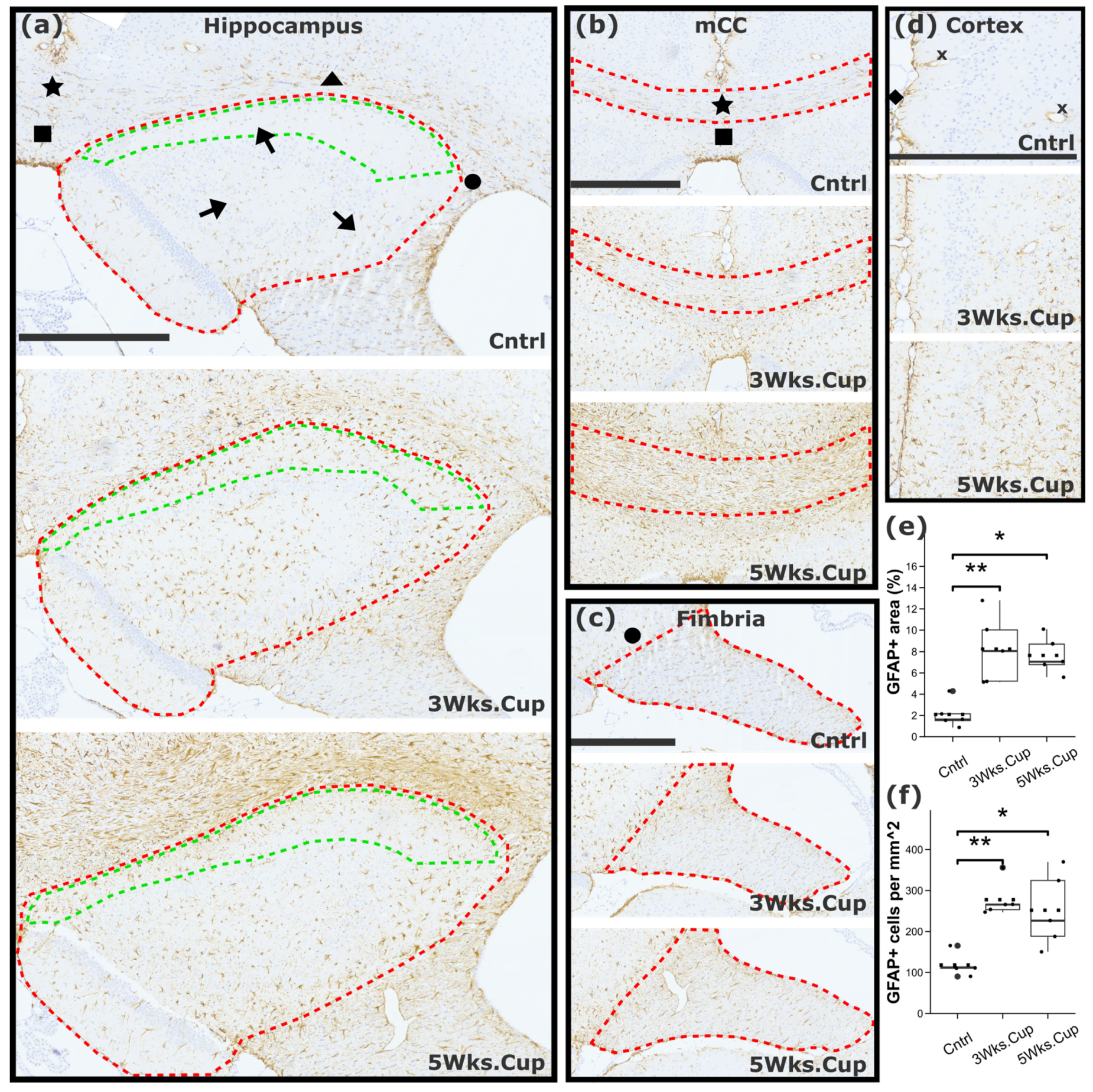
- Located in the stratum oriens, between the corpus callosum and the pyramidal layer (Figure 4a).
- (ii)
- No overlap with blood vessels or other cells, to make sure that only individual cells are analyzed.
- (iii)
- A GFAP+ or hematoxylin-stained soma/nucleus must be clearly visible.
- (50)
- Randomly select ten cells per animal from the total number of identified GFAP+ cells using, for example, the function “sample(x,10)” in R Studio, where x represents the total number of GFAP+ cells per animal.
2.11.3. Digital Cell Reconstructions
- (51)
- (A) Reconstruction with Neurolucida® 360:
- (i)
- Open Neurolucida® 360, load a microscopic image via drag-and-drop and set/ensure the correct image scaling.
- (ii)
- Close the “3D Environment” window.
- (iii)
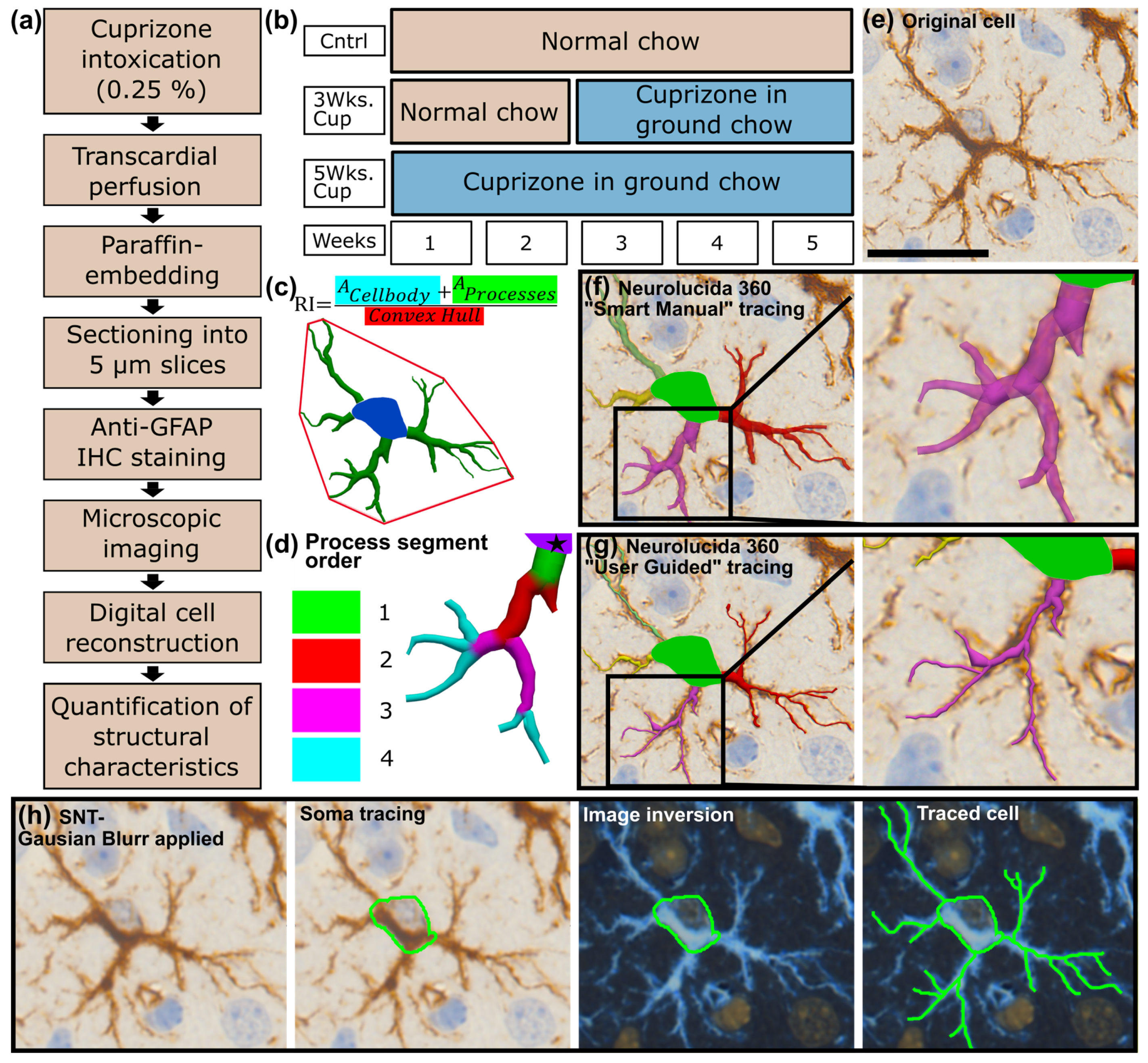
- Trace the soma (Figure 1f): Click >Trace>Neuron>Cell body< and mark the edges with left-clicks. Adjust line thickness by scrolling the mouse while tracing. Complete the tracing with a right-click and select >finish cell body<.
- (iv)
- Save the image with >File>Save as>Data File<.
- (v)
- Open the “3D Environment” window (>View>3D Environment<).
- (vi)
- Trace the cell processes using one of the following tracing modes (Figure 1f,g) (>Tree>Tracing Mode<):
- (a)
- “Smart manual”: Start tracing at the soma, follow the processes with left-clicks to their distal end. Adjust process thickness by pressing >Ctrl< and using the mouse wheel. Mark process endings with a right-click and select >Ending<.
- (b)
- “User-guided”: Start tracing at the soma and follow processes with left-clicks. Mark process endings with a right-click.
- (vii)
- Ensure branches belonging to the same process are connected. Modify individual points using >Tree>Edit>Points<.
Caution: It is possible that the software automatically generates small, barely visible segments that in fact belong to a continuous cellular process. Because such erroneous segmentation can substantially bias the results, careful inspection and, if necessary, manual correction are essential.- (viii)
- Set the process origin by selecting the proximal starting point and choosing “Set Point as Origin”. Click on >Tree>Edit>Points<, select the point that marks the proximal start of the process, and click on “Set Point as Origin”. If the origin is already set, “Selected point is already the origin of the tree” will be shown.
- (ix)
- Exit the edit menu via >Edit< and click on the symbol next to >Edit< on its left side.
- (x)
- Select the soma and all processes of a cell by pressing >Ctrl< and “right-click” and create a set with “Place Selected into Set”. Use logical designations like AC1 or cell1 as a set name.
- (xi)
- Save the file again.
- (52)
- (B) Reconstruction with the SNT (Figure 1h):
- (i)
- iOpen ImageJ and the image you want to analyze.
- (ii)
- iiApply a Gaussian blur with >Process>Filter>Gaussian Blur<, setting “Sigma (Radius)” to 3.
- (iii)
- iiiDuplicate the image with > “Shift” + “D”.
- (iv)
- ivOpen SNT and press “OK” to convert RGB images to multichannel images.
- (v)
- vUncheck >Enable Snapping<.
- (vi)
- viChoose the “A*Search-Algorithm”. Trace the edges of the soma by “left-clicking”. Note that after every click, you must either confirm the newly created segment by pressing “Y” or deny it by pressing “N”. The completed path is ultimately confirmed with “F”. Tag the tracing as “Soma” via >SNT>Path Manager>Tag>Soma<.
- (vii)
- viClose the current image and invert the duplicated image from step 47 iii via clicking >Edit>Invert<.
- (viii)
- viiiOpen the image in the SNT via >File>Choose Tracing Image>From Open Image<.
- (ix)
- ixTrace dendrites beginning from a fork point at the soma. Therefore, select the soma tracing and move the cursor; possible fork points will be displayed. Then, create a path from that point to the point where the process branches. Confirm the segment by pressing “Y” and trace the emerging segments.
- (x)
- xTag all the process segments as dendrites: >SNT>Path Manager>Tag>Type>Dendrite (Basal)<.
- (xi)
- xiSave the tracings by >SNT>File>Save Tracings>Save as<.
2.11.4. Quantification
- (53)
- (A) Quantification with Neurolucida® 360:
- (i)
- Open the Neurolucida® Explorer.
- (ii)
- Go to >File>Preferences>Select Ordering< and select >Centrifugal ordering<.
- (iii)
- Use the >Batch analysis< function, select the relevant data files and click on >Open<.
- (iv)
- Check the boxes for the following analysis: “Segment”, “Segment points”, “Cell body”, and “Convex Hull”.
- (v)
- Also, check the boxes for >Separate by set< and >One Excel file for each data file< and finally click >Run<.
- (54)
- (B) Quantification with the SNT:
- (i)
- Open the cellular model in the SNT and select all paths in the path manager.
- (ii)
- Click on >SNT>Path Manager> Analyze>Measurements>Measure Path(s)< and check the boxes for: “Length”, “No. of branch points”, and “Path order”. Start the analysis with >OK<.
- (iii)
- Save the results.
2.11.5. Data Organization and Processing
- (55)
- Combine the results to allow better handling of the data.
- (56)
- Calculate the area of single-segment points with the parameters from the “Segment points” analysis using the following formula:
- (57)
- Calculate the total cell area by summing the soma area (from the “Cell body” analysis) and the area of the processes.
- (58)
- Determine the ramification index by dividing the total cell area by the projection area (from the “Convex Hull” analysis).
2.12. Statistics
3. Results
3.1. Cuprizone Intoxication Causes Demyelination and Microglial Activation
3.2. Astrocytes in the Cuprizone Model
3.3. Morphology of GFAP Expression
3.4. Heterogeneity During Reactive Astrogliosis
3.5. Comparison of Neurolucida® 360 and the SNT
4. Discussion
5. Conclusions
Supplementary Materials
Author Contributions
Funding
Institutional Review Board Statement
Informed Consent Statement
Data Availability Statement
Acknowledgments
Conflicts of Interest
Abbreviations
| ALDH1L1 | Aldehyde Dehydrogenase 1 Family Member L1 |
| ANOVA | Analysis of Variance |
| ATP | Adenosine triphosphate |
| BBB | Blood–brain barrier |
| Ca2+ | Calcium ion |
| CNS | Central nervous system |
| Cuprizone | Bis(cyclohexanone)oxaldihydrazone |
| DAB | 3,3′-Diaminobenzidine |
| GFAP | Glial Fibrillary Acid Protein |
| GLAST1 | GLutamate ASpartate Transporter 1 |
| IBA1 | Ionized calcium-binding adaptor molecule 1 |
| IHC | Immunohistochemistry |
| lCC | Lateral corpus callosum |
| M | Mean |
| MAD | Median absolute deviation |
| mCC | Medial corpus callosum |
| Mdn | Median |
| MEGF10 | Multiple Epidermal Growth Factor-Like Domains Protein 10 |
| MERTK | MER Proto-Oncogene, Tyrosine Kinase |
| MRI | Magnetic Resonance Imaging |
| MS | Multiple sclerosis |
| NGS | Normal goat serum |
| PBS | Phosphate-buffered saline |
| PCA | Principal Component Analysis |
| PLP | Proteolipid protein 1 |
| RI | Ramification index |
| SD | Standard deviation |
| SNT | Simple Neurite Tracer |
References
- Browne, P.; Chandraratna, D.; Angood, C.; Tremlett, H.; Baker, C.; Taylor, B.V.; Thompson, A.J. Atlas of Multiple Sclerosis 2013: A growing global problem with widespread inequity. Neurology 2014, 83, 1022–1024. [Google Scholar] [CrossRef]
- Walton, C.; King, R.; Rechtman, L.; Kaye, W.; Leray, E.; Marrie, R.A.; Robertson, N.; La Rocca, N.; Uitdehaag, B.; van der Mei, I.; et al. Rising prevalence of multiple sclerosis worldwide: Insights from the Atlas of MS, third edition. Mult. Scler. 2020, 26, 1816–1821. [Google Scholar] [CrossRef]
- Lublin, F.D.; Reingold, S.C.; Cohen, J.A.; Cutter, G.R.; Sørensen, P.S.; Thompson, A.J.; Wolinsky, J.S.; Balcer, L.J.; Banwell, B.; Barkhof, F.; et al. Defining the clinical course of multiple sclerosis: the 2013 revisions. Neurology 2014, 83, 278–286. [Google Scholar] [CrossRef] [PubMed]
- Thompson, A.J.; Banwell, B.L.; Barkhof, F.; Carroll, W.M.; Coetzee, T.; Comi, G.; Correale, J.; Fazekas, F.; Filippi, M.; Freedman, M.S.; et al. Diagnosis of multiple sclerosis: 2017 revisions of the McDonald criteria. Lancet Neurol. 2018, 17, 162–173. [Google Scholar] [CrossRef]
- Evangelou, N.; Esiri, M.M.; Smith, S.; Palace, J.; Matthews, P.M. Quantitative pathological evidence for axonal loss in normal appearing white matter in multiple sclerosis. Ann. Neurol. 2000, 47, 391–395. [Google Scholar] [CrossRef] [PubMed]
- Kirk, J.; Plumb, J.; Mirakhur, M.; McQuaid, S. Tight junctional abnormality in multiple sclerosis white matter affects all calibres of vessel and is associated with blood-brain barrier leakage and active demyelination. J. Pathol. 2003, 201, 319–327. [Google Scholar] [CrossRef] [PubMed]
- Lucchinetti, C.F.; Popescu, B.F.G.; Bunyan, R.F.; Moll, N.M.; Roemer, S.F.; Lassmann, H.; Brück, W.; Parisi, J.E.; Scheithauer, B.W.; Giannini, C.; et al. Inflammatory cortical demyelination in early multiple sclerosis. N. Engl. J. Med. 2011, 365, 2188–2197. [Google Scholar] [CrossRef]
- Geurts, J.J.G.; Bö, L.; Roosendaal, S.D.; Hazes, T.; Daniëls, R.; Barkhof, F.; Witter, M.P.; Huitinga, I.; van der Valk, P. Extensive hippocampal demyelination in multiple sclerosis. J. Neuropathol. Exp. Neurol. 2007, 66, 819–827. [Google Scholar] [CrossRef]
- van Waesberghe, J.H.T.M.; Kamphorst, W.; de Groot, C.J.A.; van Walderveen, M.A.A.; Castelijns, J.A.; Ravid, R.; Lycklama à Nijeholt, G.J.; van der Valk, P.; Polman, C.H.; Thompson, A.J.; et al. Axonal loss in multiple sclerosis lesions: Magnetic reso-nance imaging insights into substrates of disability. Ann. Neurol. 1999, 46, 747–754. [Google Scholar] [CrossRef]
- Ferguson, B.; Matyszak, M.K.; Esiri, M.M.; Perry, V.H. Axonal damage in acute multiple sclerosis lesions. Brain 1997, 120, 393–399. [Google Scholar] [CrossRef]
- Trapp, B.D.; Peterson, J.; Ransohoff, R.M.; Rudick, R.; Mörk, S.; Bö, L. Axonal transection in the lesions of multiple sclerosis. N. Engl. J. Med. 1998, 338, 278–285. [Google Scholar] [CrossRef]
- Howell, O.W.; Rundle, J.L.; Garg, A.; Komada, M.; Brophy, P.J.; Reynolds, R. Activated microglia mediate axoglial disruption that contributes to axonal injury in multiple sclerosis. J. Neuropathol. Exp. Neurol. 2010, 69, 1017–1033. [Google Scholar] [CrossRef]
- Lucchinetti, C.; Brck, W.; Parisi, J.; Scheithauer, B.; Rodriguez, M.; Lassmann, H. Heterogeneity of multiple sclerosis lesions: Implications for the pathogenesis of demyelination. Ann. Neurol. 2000, 47, 707–717. [Google Scholar] [CrossRef]
- Frischer, J.M.; Weigand, S.D.; Guo, Y.; Kale, N.; Parisi, J.E.; Pirko, I.; Mandrekar, J.; Bramow, S.; Metz, I.; Brück, W.; et al. Clinical and pathological insights into the dynamic nature of the white matter multiple sclerosis plaque. Ann. Neurol. 2015, 78, 710–721. [Google Scholar] [CrossRef]
- Voskuhl, R.R.; Peterson, R.S.; Song, B.; Ao, Y.; Morales, L.B.J.; Tiwari-Woodruff, S.; Sofroniew, M.V. Reactive astrocytes form scar-like perivascular barriers to leukocytes during adaptive immune inflammation of the CNS. J. Neurosci. 2009, 29, 11511–11522. [Google Scholar] [CrossRef]
- Rudge, J.S.; Silver, J. Inhibition of neurite outgrowth on astroglial scars in vitro. J. Neurosci. 1990, 10, 3594–3603. [Google Scholar] [CrossRef]
- Das, G.D. Differentiation of Bergmann glia cells in the cerebellum: a golgi study. Brain Res. 1976, 110, 199–213. [Google Scholar] [CrossRef]
- Reichenbach, A. Attempt to classify glial cells by means of their process specialization using the rabbit retinal Müller cell as an example of cytotopographic specialization of glial cells. Glia 1989, 2, 250–259. [Google Scholar] [CrossRef]
- Simard, M.; Arcuino, G.; Takano, T.; Liu, Q.S.; Nedergaard, M. Signaling at the gliovascular interface. J. Neurosci. 2003, 23, 9254–9262. [Google Scholar] [CrossRef]
- Choi, H.B.; Gordon, G.R.J.; Zhou, N.; Tai, C.; Rungta, R.L.; Martinez, J.; Milner, T.A.; Ryu, J.K.; McLarnon, J.G.; Tresguerres, M.; et al. Metabolic communication between astrocytes and neurons via bicarbonate-responsive soluble adenylyl cyclase. Neuron 2012, 75, 1094–1104. [Google Scholar] [CrossRef]
- Cornell-Bell, A.H.; Finkbeiner, S.M.; Cooper, M.S.; Smith, S.J. Glutamate induces calcium waves in cultured astrocytes: long-range glial signaling. Science 1990, 247, 470–473. [Google Scholar] [CrossRef]
- Parpura, V.; Basarsky, T.A.; Liu, F.; Jeftinija, K.; Jeftinija, S.; Haydon, P.G. Glutamate-mediated astrocyte-neuron signalling. Nature 1994, 369, 744–747. [Google Scholar] [CrossRef]
- Escartin, C.; Galea, E.; Lakatos, A.; O’Callaghan, J.P.; Petzold, G.C.; Serrano-Pozo, A.; Steinhäuser, C.; Volterra, A.; Car-mignoto, G.; Agarwal, A.; et al. Reactive astrocyte nomenclature, definitions, and future directions. Nat. Neurosci. 2021, 24, 312–325. [Google Scholar] [CrossRef]
- Zamanian, J.L.; Xu, L.; Foo, L.C.; Nouri, N.; Zhou, L.; Giffard, R.G.; Barres, B.A. Genomic analysis of reactive astrogliosis. J. Neurosci. 2012, 32, 6391–6410. [Google Scholar] [CrossRef]
- Liddelow, S.A.; Guttenplan, K.A.; Clarke, L.E.; Bennett, F.C.; Bohlen, C.J.; Schirmer, L.; Bennett, M.L.; Münch, A.E.; Chung, W.-S.; Peterson, T.C.; et al. Neurotoxic reactive astrocytes are induced by activated microglia. Nature 2017, 541, 481–487. [Google Scholar] [CrossRef]
- Molina-Gonzalez, I.; Holloway, R.K.; Jiwaji, Z.; Dando, O.; Kent, S.A.; Emelianova, K.; Lloyd, A.F.; Forbes, L.H.; Mahmood, A.; Skripuletz, T.; et al. Astrocyte-oligodendrocyte interaction regulates central nervous system regeneration. Nat. Commun. 2023, 14, 3372. [Google Scholar] [CrossRef]
- Sun, C.; Fukushi, Y.; Wang, Y.; Yamamoto, S. Astrocytes Protect Neurons in the Hippocampal CA3 Against Ischemia by Suppressing the Intracellular Ca2+ Overload. Front. Cell. Neurosci. 2018, 12, 280. [Google Scholar] [CrossRef]
- Tsunemi, T.; Ishiguro, Y.; Yoroisaka, A.; Valdez, C.; Miyamoto, K.; Ishikawa, K.; Saiki, S.; Akamatsu, W.; Hattori, N.; Krainc, D. Astrocytes Protect Human Dopaminergic Neurons from α-Synuclein Accumulation and Propagation. J. Neurosci. 2020, 40, 8618–8628. [Google Scholar] [CrossRef]
- Chung, W.-S.; Clarke, L.E.; Wang, G.X.; Stafford, B.K.; Sher, A.; Chakraborty, C.; Joung, J.; Foo, L.C.; Thompson, A.; Chen, C.; et al. Astrocytes mediate synapse elimination through MEGF10 and MERTK pathways. Nature 2013, 504, 394–400. [Google Scholar] [CrossRef]
- Talantova, M.; Sanz-Blasco, S.; Zhang, X.; Xia, P.; Akhtar, M.W.; Okamoto, S.; Dziewczapolski, G.; Nakamura, T.; Cao, G.; Pratt, A.E.; et al. Aβ induces astrocytic glutamate release, extrasynaptic NMDA receptor activation, and synaptic loss. Proc. Natl. Acad. Sci. USA 2013, 110, E2518–2527, Erratum in Proc. Natl. Acad. Sci. USA 2015, 112, E2518–E2527. https://doi.org/10.1073/pnas.1306832110. [Google Scholar] [CrossRef]
- Ramon, Y.C.S.; Andriezen, W.L. Histologie du systeme nerveux de l’homme et des vertebres. In The Neuroglia Elements in the Human Brain; Maloine: Paris, Francce, 1909. [Google Scholar]
- Andriezen, W.L. The Neuroglia Elements in the Human Brain. Br. Med. J. 1893, 2, 227–230. [Google Scholar] [CrossRef]
- Somjen, G.G. Nervenkitt: notes on the history of the concept of neuroglia. Glia 1988, 1, 2–9. [Google Scholar] [CrossRef]
- Bushong, E.A.; Martone, M.E.; Jones, Y.Z.; Ellisman, M.H. Protoplasmic astrocytes in CA1 stratum radiatum occupy separate anatomical domains. J. Neurosci. 2002, 22, 183–192. [Google Scholar] [CrossRef]
- Bushong, E.A.; Martone, M.E.; Ellisman, M.H. Maturation of astrocyte morphology and the establishment of astrocyte domains during postnatal hippocampal development. Int. J. Dev. Neurosci. 2004, 22, 73–86. [Google Scholar] [CrossRef]
- Brosnan, C.F.; Raine, C.S. The astrocyte in multiple sclerosis revisited. Glia 2013, 61, 453–465. [Google Scholar] [CrossRef]
- Eilam, R.; Segal, M.; Malach, R.; Sela, M.; Arnon, R.; Aharoni, R. Astrocyte disruption of neurovascular communication is linked to cortical damage in an animal model of multiple sclerosis. Glia 2018, 66, 1098–1117. [Google Scholar] [CrossRef]
- Ishikawa, H.; Bischoff, R.; Holtzer, H. Formation of arrowhead complexes with heavy meromyosin in a variety of cell types. J. Cell Biol. 1969, 43, 312–328. [Google Scholar] [CrossRef]
- Ledbetter, M.C.; Porter, K.R. A "MICROTUBULE" IN PLANT CELL FINE STRUCTURE. J. Cell Biol. 1963, 19, 239–250. [Google Scholar] [CrossRef]
- Inoué, S.; Sato, H. Cell motility by labile association of molecules. The nature of mitotic spindle fibers and their role in chro-mosome movement. J. Gen. Physiol. 1967, 50, 259–292. [Google Scholar] [CrossRef]
- Ishikawa, H.; Bischoff, R.; Holtzer, H. Mitosis and intermediate-sized filaments in developing skeletal muscle. J. Cell Biol. 1968, 38, 538–555. [Google Scholar] [CrossRef]
- Sofroniew, M.V. Molecular dissection of reactive astrogliosis and glial scar formation. Trends Neurosci. 2009, 32, 638–647. [Google Scholar] [CrossRef]
- Castillo-Rodriguez, M.d.L.A.; Gingele, S.; Schröder, L.-J.; Möllenkamp, T.; Stangel, M.; Skripuletz, T.; Gudi, V. Astroglial and oligodendroglial markers in the cuprizone animal model for de- and remyelination. Histochem. Cell Biol. 2022, 158, 15–38. [Google Scholar] [CrossRef]
- Pekny, M.; Johansson, C.B.; Eliasson, C.; Stakeberg, J.; Wallén, A.; Perlmann, T.; Lendahl, U.; Betsholtz, C.; Berthold, C.H.; Frisén, J. Abnormal reaction to central nervous system injury in mice lacking glial fibrillary acidic protein and vimentin. J. Cell Biol. 1999, 145, 503–514. [Google Scholar] [CrossRef]
- Wilhelmsson, U.; Li, L.; Pekna, M.; Berthold, C.-H.; Blom, S.; Eliasson, C.; Renner, O.; Bushong, E.; Ellisman, M.; Morgan, T.E.; et al. Absence of glial fibrillary acidic protein and vimentin prevents hypertrophy of astrocytic processes and improves post-traumatic regeneration. J. Neurosci. 2004, 24, 5016–5021. [Google Scholar] [CrossRef] [PubMed]
- Höflich, K.M.; Beyer, C.; Clarner, T.; Schmitz, C.; Nyamoya, S.; Kipp, M.; Hochstrasser, T. Acute axonal damage in three different murine models of multiple sclerosis: A comparative approach. Brain Res. 2016, 1650, 125–133. [Google Scholar] [CrossRef] [PubMed]
- Komoly, S. Experimental demyelination caused by primary oligodendrocyte dystrophy. Regional distribution of the lesions in the nervous system of mice corrected. Ideggyogy. Szle. 2005, 58, 40–43. [Google Scholar]
- Buschmann, J.P.; Berger, K.; Awad, H.; Clarner, T.; Beyer, C.; Kipp, M. Inflammatory response and chemokine expression in the white matter corpus callosum and gray matter cortex region during cuprizone-induced demyelination. J. Mol. Neurosci. 2012, 48, 66–76. [Google Scholar] [CrossRef]
- Norkute, A.; Hieble, A.; Braun, A.; Johann, S.; Clarner, T.; Baumgartner, W.; Beyer, C.; Kipp, M. Cuprizone treatment induces demyelination and astrocytosis in the mouse hippocampus. J. Neurosci. Res. 2009, 87, 1343–1355. [Google Scholar] [CrossRef]
- Dickstein, D.L.; Dickstein, D.R.; Janssen, W.G.M.; Hof, P.R.; Glaser, J.R.; Rodriguez, A.; O’Connor, N.; Angstman, P.; Tappan, S.J. Automatic Dendritic Spine Quantification from Confocal Data with Neurolucida 360. Curr. Protoc. Neurosci. 2016, 77, 1.27.1–1.27.21. [Google Scholar] [CrossRef]
- Chiu, K.B.; Lee, K.M.; Robillard, K.N.; MacLean, A.G. A Method to Investigate Astrocyte and Microglial Morphological Changes in the Aging Brain of the Rhesus Macaque. Methods Mol. Biol. 2019, 1938, 265–276. [Google Scholar] [CrossRef]
- Arshadi, C.; Günther, U.; Eddison, M.; Harrington, K.I.S.; Ferreira, T.A. SNT: a unifying toolbox for quantification of neuronal anatomy. Nat. Methods 2021, 18, 374–377. [Google Scholar] [CrossRef]
- Hochstrasser, T.; Exner, G.L.; Nyamoya, S.; Schmitz, C.; Kipp, M. Cuprizone-Containing Pellets Are Less Potent to Induce Consistent Demyelination in the Corpus Callosum of C57BL/6 Mice. J. Mol. Neurosci. 2017, 61, 617–624. [Google Scholar] [CrossRef] [PubMed]
- Paxinos, G.; Franklin, K.B.J. Paxinos and Franklin’s The mouse brain in stereotaxic coordinates, 5th ed.; Elsevier Academic Press: London, UK, 2019; ISBN 9780128161579. [Google Scholar]
- Landini, G.; Martinelli, G.; Piccinini, F. Colour deconvolution: stain unmixing in histological imaging. Bioinformatics 2021, 37, 1485–1487. [Google Scholar] [CrossRef]
- Bankhead, P.; Loughrey, M.B.; Fernández, J.A.; Dombrowski, Y.; McArt, D.G.; Dunne, P.D.; McQuaid, S.; Gray, R.T.; Murray, L.J.; Coleman, H.G.; et al. QuPath: Open source software for digital pathology image analysis. Sci. Rep. 2017, 7, 16878. [Google Scholar] [CrossRef] [PubMed]
- Otsu, N. A Threshold Selection Method from Gray-Level Histograms. IEEE Trans. Syst. Man. Cybern. 1979, 9, 62–66. [Google Scholar] [CrossRef]
- Heppner, F.L.; Roth, K.; Nitsch, R.; Hailer, N.P. Vitamin E induces ramification and downregulation of adhesion molecules in cultured microglial cells. Glia 1998, 22, 180–188. [Google Scholar] [CrossRef]
- R Core Team. R: A Language and Environment for Statistical Computing; R Core Team: Vienna, Austria, 2023; Available online: https://www.R-project.org/ (accessed on 2 January 2026).
- Fox, J.; Weisberg, S.; Price, B. Car: Companion to Applied Regression, 2024. Available online: https://r-forge.r-project.org/projects/car/ (accessed on 2 January 2026).
- Wickham, H. ggplot2: Elegant Graphics for Data Analysis; Springer-Verlag: New York, NY, USA, 2016; ISBN 978-3-319-24277-4. [Google Scholar]
- Wickham, H. stringr: Simple, Consistent Wrappers for Common String Operations, 2022. Available online: https://stringr.tidyverse.org (accessed on 2 January 2026).
- Wickham, H.; Vaughan, D.; Girlich, M. tidyr: Tidy Messy Data, 2023. Available online: https://tidyr.tidyverse.org (accessed on 2 January 2026).
- Wickham, H.; Bryan, J. readxl: Read Excel Files, 2023. Available online: https://readxl.tidyverse.org (accessed on 2 January 2026).
- Wickham, H.; François, R.; Henry, L.; Müller, K.; Vaughan, D. dplyr: A Grammar of Data Manipulation, 2023. Available online: https://dplyr.tidyverse.org (accessed on 2 January 2026).
- Wickham, H.; Chang, W.; Henry, L.; Pedersen, T.L.; Takahashi, K.; Wilke, C.; Yutani, H.; Dunnington, D. ggplot2: Create Elegant Data Visualisations Using the Grammar of Graphics, 2023. Available online: https://ggplot2.tidyverse.org (accessed on 2 January 2026).
- Kassambara, A. ggpubr: ggplot2 Based Publication Ready Plots, 2023. Available online: https://rpkgs.datanovia.com/ggpubr/ (accessed on 2 January 2026).
- Kassambara, A. rstatix: Pipe-Friendly Framework for Basic Statistical Tests, 2023. Available online: https://rpkgs.datanovia.com/rstatix/ (accessed on 2 January 2026).
- Kassambara, A.; Mundt, F. factoextra: Extract and Visualize the Results of Multivariate Data Analyses, 2020. Available online: http://www.sthda.com/english/rpkgs/factoextra (accessed on 2 January 2026).
- Ripley, B. MASS: Support Functions and Datasets for Venables and Ripley’s MASS, 2023. Available online: http://www.stats.ox.ac.uk/pub/MASS4/ (accessed on 2 January 2026).
- Venables, W.N.; Ripley, B.D. Modern Applied Statistics with S, Fourth; Springer: New York, 2002. [Google Scholar]
- Kassambara, A.M.F. factoextra: Extract and Visualize the Results of Multivariate. R package, 2020. Available online: https://CRAN.R-project.org/package=factoextra (accessed on 2 January 2026).
- Ogata, K.; Kosaka, T. Structural and quantitative analysis of astrocytes in the mouse hippocampus. Neuroscience 2002, 113, 221–233. [Google Scholar] [CrossRef]
- Brown, K.M.; Gillette, T.A.; Ascoli, G.A. Quantifying neuronal size: summing up trees and splitting the branch difference. Semin. Cell Dev. Biol. 2008, 19, 485–493. [Google Scholar] [CrossRef]
- Martínez-Cerdeño, V. Dendrite and spine modifications in autism and related neurodevelopmental disorders in patients and animal models. Dev. Neurobiol. 2017, 77, 393–404. [Google Scholar] [CrossRef]
- Haas, M.A.; Bell, D.; Slender, A.; Lana-Elola, E.; Watson-Scales, S.; Fisher, E.M.C.; Tybulewicz, V.L.J.; Guillemot, F. Alterations to dendritic spine morphology, but not dendrite patterning, of cortical projection neurons in Tc1 and Ts1Rhr mouse models of Down syndrome. PLoS ONE 2013, 8, e78561. [Google Scholar] [CrossRef]
- Green, T.R.F.; Rowe, R.K. Quantifying microglial morphology: an insight into function. Clin. Exp. Immunol. 2024, 216, 221–229. [Google Scholar] [CrossRef]
- Wigger, N.; Krüger, J.; Vankriekelsvenne, E.; Kipp, M. Titration of cuprizone induces reliable demyelination. Brain Res. 2025, 1850, 149410. [Google Scholar] [CrossRef]
- Behrangi, N.; Heinig, L.; Frintrop, L.; Santrau, E.; Kurth, J.; Krause, B.; Atanasova, D.; Clarner, T.; Fragoulis, A.; Joksch, M.; et al. Siponimod ameliorates metabolic oligodendrocyte injury via the sphingosine-1 phosphate receptor 5. Proc. Natl. Acad. Sci. USA 2022, 119, e2204509119. [Google Scholar] [CrossRef] [PubMed]
- Anderson, A.M.; Ajayi, M.; Jonak, C.R.; Desfor, S.; Soto, J.; Akhuetie, A.; Deshpande, D.; Lapato, A.; Binder, D.K.; Ti-wari-Woodruff, S.K. Demyelination-induced glutamatergic imbalance mediates hippocampal Hyperexcitability. Neurobiol. Dis. 2025, 216, 107125. [Google Scholar] [CrossRef]
- Gingele, S.; Möllenkamp, T.M.; Henkel, F.; Schröder, L.-J.; Hümmert, M.W.; Skripuletz, T.; Stangel, M.; Gudi, V. Automated analysis of gray matter damage in aged mice reveals impaired remyelination in the cuprizone model. Brain Pathol. 2024, 34, e13218. [Google Scholar] [CrossRef]
- Koutsoudaki, P.N.; Skripuletz, T.; Gudi, V.; Moharregh-Khiabani, D.; Hildebrandt, H.; Trebst, C.; Stangel, M. Demyelination of the hippocampus is prominent in the cuprizone model. Neurosci. Lett. 2009, 451, 83–88. [Google Scholar] [CrossRef] [PubMed]
- Gudi, V.; Moharregh-Khiabani, D.; Skripuletz, T.; Koutsoudaki, P.N.; Kotsiari, A.; Skuljec, J.; Trebst, C.; Stangel, M. Regional differences between grey and white matter in cuprizone induced demyelination. Brain Res. 2009, 1283, 127–138. [Google Scholar] [CrossRef] [PubMed]
- Kipp, M.; Gingele, S.; Pott, F.; Clarner, T.; van der Valk, P.; Denecke, B.; Gan, L.; Siffrin, V.; Zipp, F.; Dreher, W.; et al. BLBP-expression in astrocytes during experimental demyelination and in human multiple sclerosis lesions. Brain Behav. Im.-Mun. 2011, 25, 1554–1568. [Google Scholar] [CrossRef]
- Wilhelmsson, U.; Bushong, E.A.; Price, D.L.; Smarr, B.L.; Phung, V.; Terada, M.; Ellisman, M.H.; Pekny, M. Redefining the concept of reactive astrocytes as cells that remain within their unique domains upon reaction to injury. Proc. Natl. Acad. Sci. USA 2006, 103, 17513–17518. [Google Scholar] [CrossRef]
- Srinivasan, R.; Lu, T.-Y.; Chai, H.; Xu, J.; Huang, B.S.; Golshani, P.; Coppola, G.; Khakh, B.S. New Transgenic Mouse Lines for Selectively Targeting Astrocytes and Studying Calcium Signals in Astrocyte Processes In Situ and In Vivo. Neuron 2016, 92, 1181–1195. [Google Scholar] [CrossRef]
- Moye, S.L.; Diaz-Castro, B.; Gangwani, M.R.; Khakh, B.S. Visualizing Astrocyte Morphology Using Lucifer Yellow Ionto-phoresis. J. Vis. Exp. 2019, e60225. [Google Scholar] [CrossRef]
- Brenner, M.; Kisseberth, W.C.; Su, Y.; Besnard, F.; Messing, A. GFAP promoter directs astrocyte-specific expression in trans-genic mice. J. Neurosci. 1994, 14, 1030–1037. [Google Scholar] [CrossRef] [PubMed]
- Eom, T.-Y.; Stanco, A.; Weimer, J.; Stabingas, K.; Sibrack, E.; Gukassyan, V.; Cheng, J.; Anton, E.S. Direct visualization of microtubules using a genetic tool to analyse radial progenitor-astrocyte continuum in brain. Nat. Commun. 2011, 2, 446. [Google Scholar] [CrossRef] [PubMed]
- Marques, S.I.; Carmo, H.; Carvalho, F.; Sá, S.I.; Silva, J.P. A Semi-Automatic Method for the Quantification of Astrocyte Number and Branching in Bulk Immunohistochemistry Images. Int. J. Mol. Sci. 2023, 24, 4508. [Google Scholar] [CrossRef]
- Endo, F.; Kasai, A.; Soto, J.S.; Yu, X.; Qu, Z.; Hashimoto, H.; Gradinaru, V.; Kawaguchi, R.; Khakh, B.S. Molecular basis of astrocyte diversity and morphology across the CNS in health and disease. Science 2022, 378, eadc9020. [Google Scholar] [CrossRef]
- Chai, H.; Diaz-Castro, B.; Shigetomi, E.; Monte, E.; Octeau, J.C.; Yu, X.; Cohn, W.; Rajendran, P.S.; Vondriska, T.M.; White-legge, J.P.; et al. Neural Circuit-Specialized Astrocytes: Transcriptomic, Proteomic, Morphological, and Functional Evidence. Neuron 2017, 95, 531–549.e9. [Google Scholar] [CrossRef]
- Arizono, M.; Idziak, A.; Quici, F.; Nägerl, U.V. Getting sharper: the brain under the spotlight of super-resolution microscopy. Trends Cell Biol. 2023, 33, 148–161. [Google Scholar] [CrossRef]



| Step | Solution | Incubation Time | Comment |
|---|---|---|---|
| I. | Ethanol 50% (v/v) | overnight | incubate at 4 °C |
| II. | Ethanol 70% (v/v) | 1 h | incubate under gentle agitation at room temperature |
| III. | Ethanol 70% (v/v) | 1 h | incubate at 60 °C |
| IV. | Ethanol 80% (v/v) | 1 h | incubate at 60 °C |
| V. | Ethanol 96% (v/v) | 1 h | incubate at 60 °C |
| VI. | Ethanol 96% (v/v) | 1 h | incubate at 60 °C |
| VII. | Ethanol 100% (v/v) | 1 h | incubate at 60 °C |
| VIII. | Ethanol 100% (v/v) | 1 h | incubate at 60 °C |
| IX. | Ethanol 100% (v/v) | 1 h | incubate at 60 °C |
| X. | Xylene | 1 h | incubate at 60 °C |
| XI. | Xylene | 1 h | incubate at 60 °C |
| XII. | Xylene | 1 h | incubate at 60 °C |
| XIII. | Paraffin | 1 h | incubate at 60 °C |
| XIV. | Paraffin | 1 h | incubate at 60 °C |
| XV. | Paraffin | 1 h | incubate at 60 °C |
| Step | Solution | Incubation Time |
|---|---|---|
| I. | Xylene | 10 min |
| II. | Xylene | 10 min |
| III. | Xylene | 10 min |
| IV. | Xylene/Ethanol (50%/50% (v/v)) | 5 min |
| V. | Ethanol 100% (v/v) | 3 min |
| VI. | Ethanol 100% (v/v) | 3 min |
| VII. | Ethanol 96% (v/v) | 3 min |
| VIII. | Ethanol 96% (v/v) | 3 min |
| IX. | Ethanol 70% (v/v) | 3 min |
| X. | Ethanol 50% (v/v | 3 min |
| XI. | Distilled Water | 3 min |
| Antigen | Supplier | Buffer |
|---|---|---|
| GFAP (Glial Fibrillary Acid Protein) | Abcam, Cambridge, UK (RRID: AB_1209224) | Tris-EDTA |
| IBA1 (Ionized Calcium-Binding Adaptor Molecule 1) | FUJIFILM Wako Pure Chemical Corporation, Osaka, Japan (RRID: AB_8395049) | Tris-EDTA |
| PLP (Proteolipid Protein 1) | Bio-Rad AbD Serotec GmbH, Neurid, Germany, ((RRID: AB_2237198) | Not applicable |
| Antigen | Supplier | Concentration |
|---|---|---|
| GFAP (Glial Fibrillary Acid Protein) | Abcam, Cambridge, UK (RRID: AB_1209224) | 1:750 |
| IBA1 (Ionized Calcium-Binding Adaptor Molecule 1) | FUJIFILM Wako Pure Chemical Corporation, Osaka, Japan (RRID: AB_8395049) | 1:1000 |
| PLP (Proteolipid Protein 1) | Bio-Rad AbD Serotec GmbH, Neurid, Germany, ((RRID: AB_2237198) | 1:5000 |
| Antigen | Dako Envision+ System—HRP Labelled Polymer |
|---|---|
| GFAP (Glial Fibrillary Acid Protein) | Anti-Rabbit (K4003) |
| IBA1 (Ionized Calcium-Binding Adaptor Molecule 1) | Anti-Rabbit (K4003) |
| PLP (Proteolipid Protein 1) | Anti-Mouse (K4001) |
| Step | Solution | Incubation Time |
|---|---|---|
| I. | Ethanol 50% (v/v) | 3 min |
| II. | Ethanol 70% (v/v) | 3 min |
| III. | Ethanol 96% (v/v) | 3 min |
| IV. | Ethanol 96% (v/v) | 3 min |
| V. | Ethanol 100% (v/v) | 3 min |
| VI. | Ethanol 100% (v/v) | 3 min |
| VII. | Xylene/Ethanol (50%/50% (v/v)) | 5 min |
| VIII. | Xylene | 10 min |
| IX. | Xylene | 10 min |
| X. | Xylene | 10 min |
Disclaimer/Publisher’s Note: The statements, opinions and data contained in all publications are solely those of the individual author(s) and contributor(s) and not of MDPI and/or the editor(s). MDPI and/or the editor(s) disclaim responsibility for any injury to people or property resulting from any ideas, methods, instructions or products referred to in the content. |
© 2026 by the authors. Licensee MDPI, Basel, Switzerland. This article is an open access article distributed under the terms and conditions of the Creative Commons Attribution (CC BY) license.
Share and Cite
Wenzel, L.; Heinig, L.; Wang, D.; Vankriekelsvenne, E.; Wigger, N.; Zimmermann, A.; Rößler, J.; Clarner, T.; Kipp, M. Quantitative Assessment of GFAP-Based Astrocyte Morphology in the Cuprizone Model: A Comparative Evaluation of Neurolucida® 360 and SNT. Cells 2026, 15, 964. https://doi.org/10.3390/cells15110964
Wenzel L, Heinig L, Wang D, Vankriekelsvenne E, Wigger N, Zimmermann A, Rößler J, Clarner T, Kipp M. Quantitative Assessment of GFAP-Based Astrocyte Morphology in the Cuprizone Model: A Comparative Evaluation of Neurolucida® 360 and SNT. Cells. 2026; 15(11):964. https://doi.org/10.3390/cells15110964
Chicago/Turabian StyleWenzel, Lukas, Leo Heinig, Dongshi Wang, Elise Vankriekelsvenne, Nicole Wigger, Annelie Zimmermann, Johann Rößler, Tim Clarner, and Markus Kipp. 2026. "Quantitative Assessment of GFAP-Based Astrocyte Morphology in the Cuprizone Model: A Comparative Evaluation of Neurolucida® 360 and SNT" Cells 15, no. 11: 964. https://doi.org/10.3390/cells15110964
APA StyleWenzel, L., Heinig, L., Wang, D., Vankriekelsvenne, E., Wigger, N., Zimmermann, A., Rößler, J., Clarner, T., & Kipp, M. (2026). Quantitative Assessment of GFAP-Based Astrocyte Morphology in the Cuprizone Model: A Comparative Evaluation of Neurolucida® 360 and SNT. Cells, 15(11), 964. https://doi.org/10.3390/cells15110964