Network Toxicology and Transcriptomic Analyses Reveal Ferroptosis-Related Neurotoxicity of Rotenone as an Environmental Hazardous Compound


 ,
,
Highlights
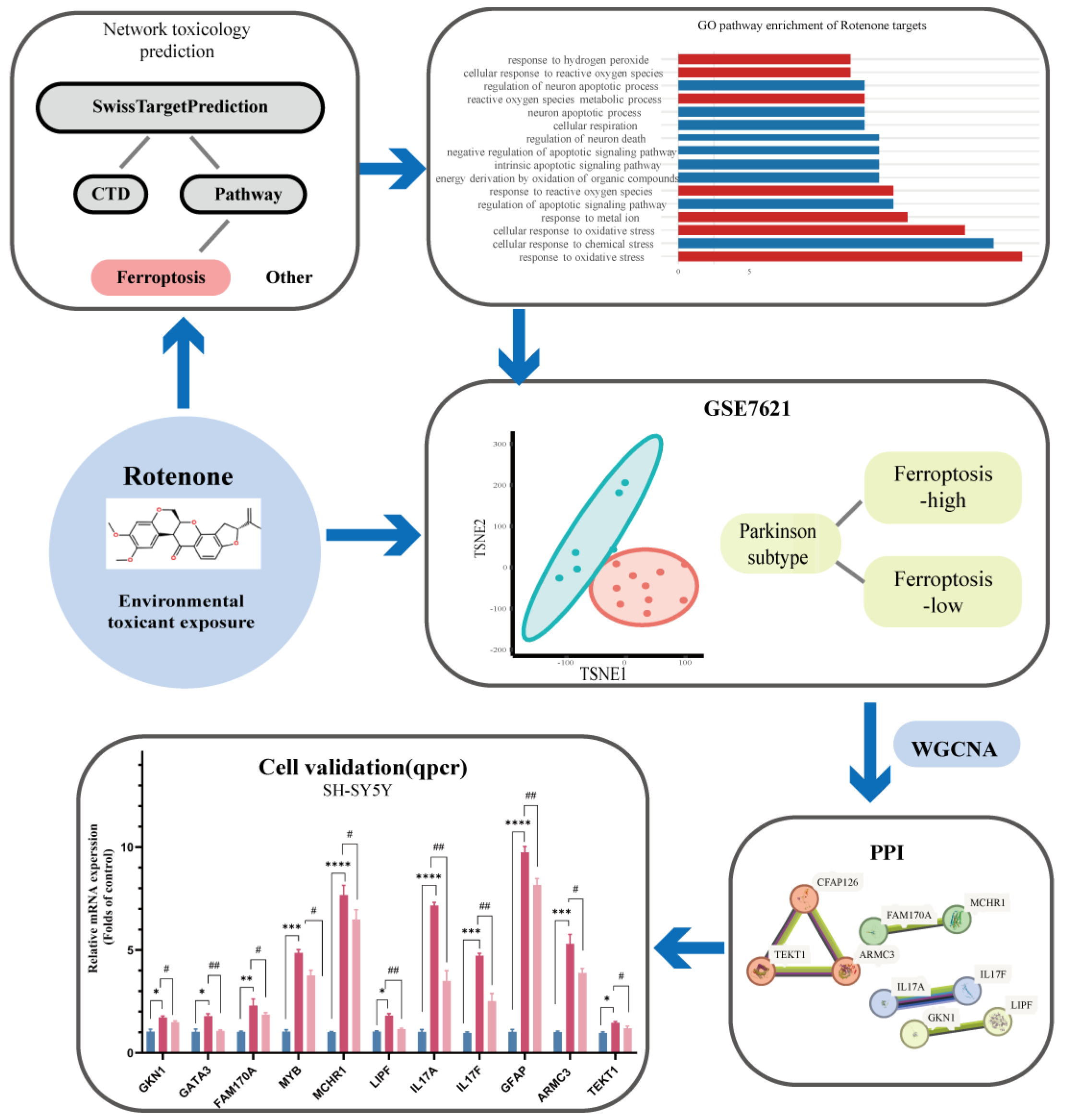
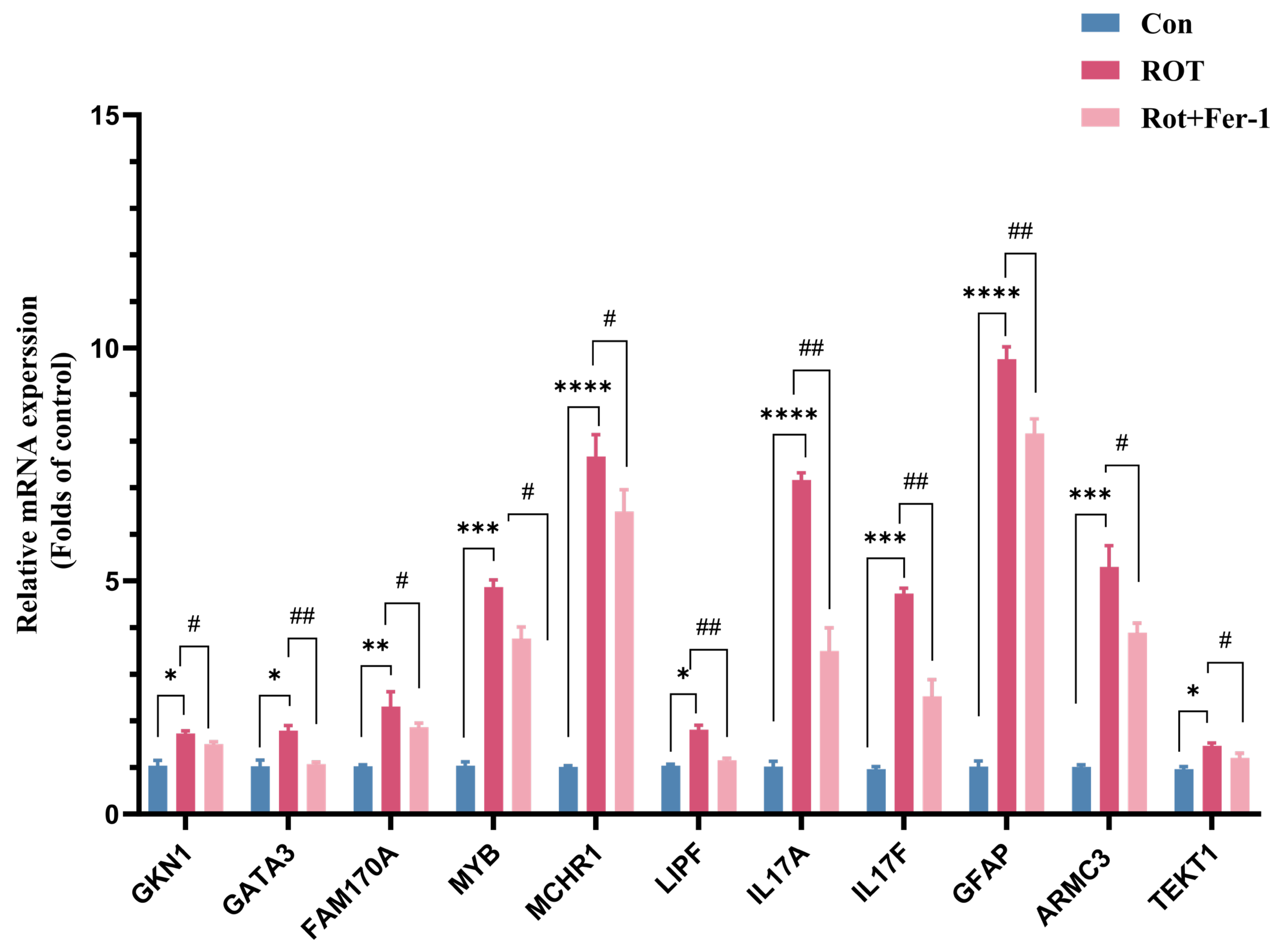
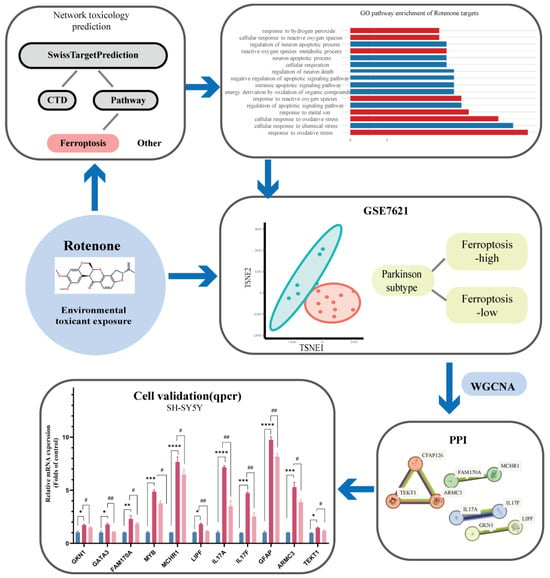
- Network toxicology and Parkinson’s disease transcriptomic analyses identify an 11-gene, PD-contextualized, ferroptosis-associated response module linked to rotenone-induced neuronal injury.
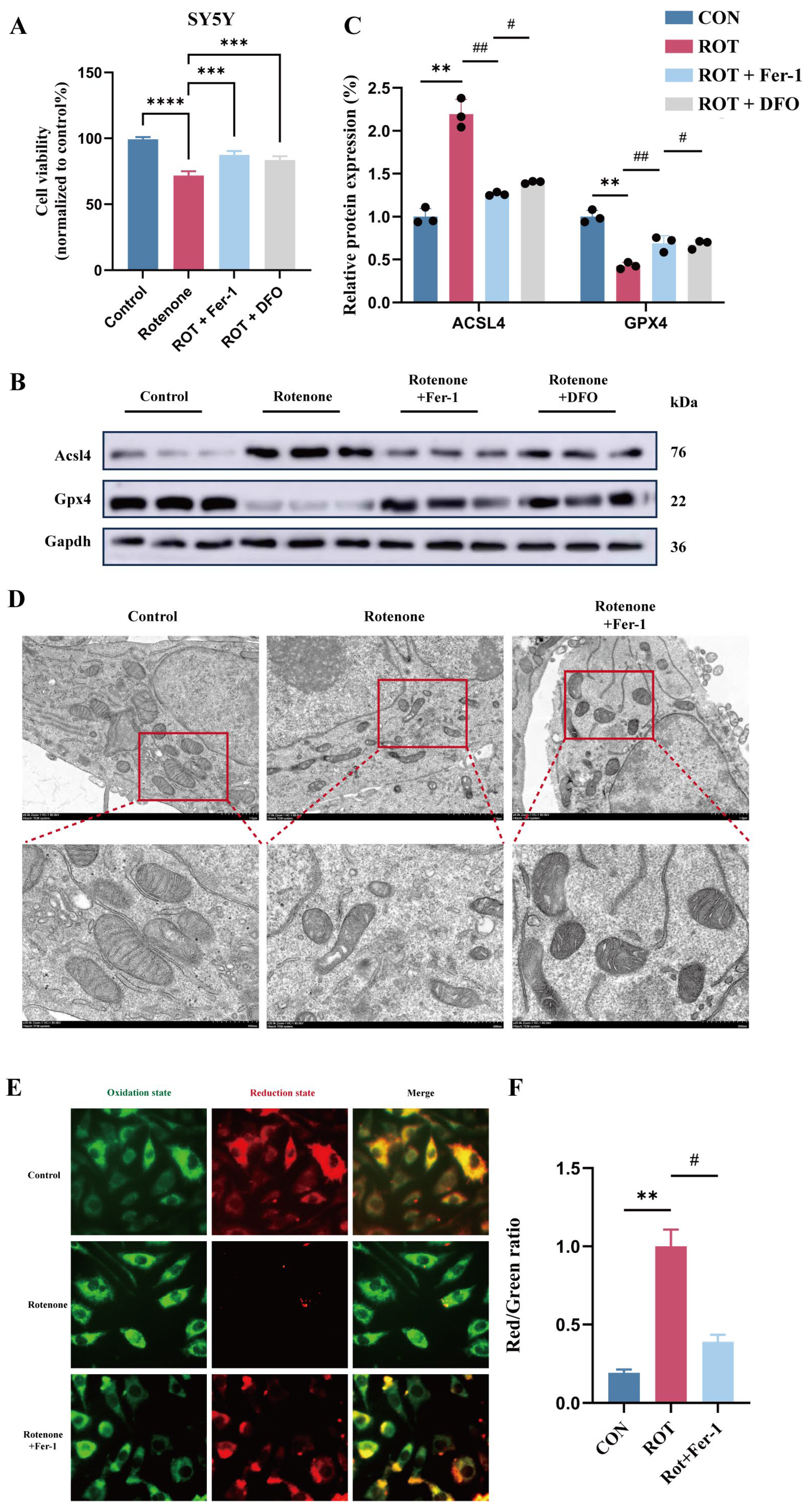
- Rotenone induces ferroptosis-associated neurotoxicity in SH-SY5Y cells, as supported by ultrastructural alterations, lipid peroxidation, and GPX4–ACSL4 dysregulation.
- These findings provide a disease-informed framework linking environmental rotenone exposure to ferroptosis-associated neuronal injury in a Parkinson’s disease-relevant context.
- The identified Fer-1-responsive gene module provides testable candidates for future mechanistic studies of ferroptosis-associated neurodegeneration.
Abstract
1. Introduction
2. Materials and Methods
2.1. Network Toxicology Analysis
2.2. Data Sources and Differential Expression Analysis
2.3. Cluster Analysis
2.4. WGCNA
2.5. Enrichment Analysis (GO/KEGG/GSEA)
2.6. PPI Network Construction
2.7. Quantitative Real-Time PCR Analysis
2.8. Cell Viability Assay (CCK-8) and Dose Selection
2.9. Western Blotting
2.10. Lipid Peroxidation Assay (BODIPY 581/591 C11)
2.11. Transmission Electron Microscopy (TEM)
2.12. Drug–Gene Interaction Analysis and Prioritization
2.13. Drug Intervention in Rotenone-Treated SH-SY5Y Cells (For qPCR Validation)
3. Results
3.1. Network Toxicology Analysis Implicates Ferroptosis-Related Pathways in Rotenone Neurotoxicity
3.2. Ferroptosis-Related Transcriptional Signatures in the Substantia Nigra of PD Patients
3.3. Ferroptosis-Related Transcriptional Heterogeneity and Network Organization in Parkinson’s Disease
3.4. Functional Validation Confirms Ferroptosis Involvement in Rotenone-Induced Neurotoxicity
3.5. Ferroptosis Inhibition Attenuates Rotenone-Induced Upregulation of a Network-Derived Candidate Transcriptional Module
3.6. Exploratory Drug–Gene Interaction Analysis
4. Discussion
5. Conclusions
Supplementary Materials
Author Contributions
Funding
Institutional Review Board Statement
Informed Consent Statement
Data Availability Statement
Conflicts of Interest
Abbreviations
| Abbreviation | Full Term |
| PD | Parkinson’s disease |
| DEGs | Differentially expressed genes |
| ROS | Reactive oxygen species |
| FDR | False discovery rate |
| FC | Fold change |
| GEO | Gene Expression Omnibus |
| GSE | Gene Expression Omnibus Series |
| WGCNA | Weighted gene co-expression network analysis |
| PPI | Protein–protein interaction |
| GO | Gene Ontology |
| KEGG | Kyoto Encyclopedia of Genes and Genomes |
| GSEA | Gene set enrichment analysis |
| qPCR | Quantitative polymerase chain reaction |
| CTD | Comparative Toxicogenomics Database |
| DGIdb | Drug–Gene Interaction Database |
| NAC | N-acetylcysteine |
| VPA | Valproic acid |
| Fer-1 | ferrostatin-1 |
| CCK-8 | Cell viability assay |
| DFO | Deferoxamine |
| TEM | Transmission electron microscopy |
| CDF | cumulative distribution function |
References
- Tsalenchuk, M.; Farmer, K.; Castro, S.; Scheirer, A.; Ye, Y.; Timothy Greenamyre, J.; Rocha, E.M.; Marzi, S.J. Unique nigral and cortical pathways implicated by epigenomic and transcriptional analyses in rotenone Parkinson’s model. npj Park. Dis. 2025, 11, 217. [Google Scholar] [CrossRef]
- Ibarra-Gutiérrez, M.T.; Serrano-García, N.; Orozco-Ibarra, M. Rotenone-Induced Model of Parkinson’s Disease: Beyond Mitochondrial Complex I Inhibition. Mol. Neurobiol. 2023, 60, 1929–1948. [Google Scholar] [CrossRef]
- Prats, R.M.; Ventura, M.; Pou-Rovira, Q.; Buchaca, T.; Fernández, P.; Grimalt, J.O.; van Drooge, B.L. Simple on-site extraction and GC-MS analysis of rotenone and degradation products for monitoring invasive fish eradication treatments in fresh and brackish waters. J. Chromatogr. A 2024, 1730, 465063. [Google Scholar] [CrossRef]
- Huang, M.; Bargues-Carot, A.; Riaz, Z.; Wickham, H.; Zenitsky, G.; Jin, H.; Anantharam, V.; Kanthasamy, A.; Kanthasamy, A.G. Impact of Environmental Risk Factors on Mitochondrial Dysfunction, Neuroinflammation, Protein Misfolding, and Oxidative Stress in the Etiopathogenesis of Parkinson’s Disease. Int. J. Mol. Sci. 2022, 23, 10808. [Google Scholar] [CrossRef]
- Soloway, S.B. Naturally occurring insecticides. Environ. Health Perspect. 1976, 14, 109–117. [Google Scholar] [CrossRef]
- Tanner, C.M.; Kamel, F.; Ross, G.W.; Hoppin, J.A.; Goldman, S.M.; Korell, M.; Marras, C.; Bhudhikanok, G.S.; Kasten, M.; Chade, A.R.; et al. Rotenone, paraquat, and Parkinson’s disease. Environ. Health Perspect. 2011, 119, 866–872. [Google Scholar] [CrossRef]
- Johnson, M.E.; Bobrovskaya, L. An update on the rotenone models of Parkinson’s disease: Their ability to reproduce the features of clinical disease and model gene-environment interactions. Neurotoxicology 2015, 46, 101–116. [Google Scholar] [CrossRef] [PubMed]
- Saleh, M.A.; Amer-Sarsour, F.; Berant, A.; Pasmanik-Chor, M.; Kobo, H.; Sharabi, Y.; Vatine, G.D.; Ashkenazi, A. Chronic and acute exposure to rotenone reveals distinct Parkinson’s disease-related phenotypes in human iPSC-derived peripheral neurons. Free Radic. Biol. Med. 2024, 213, 164–173. [Google Scholar] [CrossRef]
- Li, J.; Cao, F.; Yin, H.L.; Huang, Z.J.; Lin, Z.T.; Mao, N.; Sun, B.; Wang, G. Ferroptosis: Past, present and future. Cell Death Dis. 2020, 11, 88. [Google Scholar] [CrossRef] [PubMed]
- Li, S.; Zhou, C.; Zhu, Y.; Chao, Z.; Sheng, Z.; Zhang, Y.; Zhao, Y. Ferrostatin-1 alleviates angiotensin II (Ang II)- induced inflammation and ferroptosis in astrocytes. Int. Immunopharmacol. 2021, 90, 107179. [Google Scholar] [CrossRef] [PubMed]
- Liang, D.; Minikes, A.M.; Jiang, X. Ferroptosis at the intersection of lipid metabolism and cellular signaling. Mol. Cell 2022, 82, 2215–2227. [Google Scholar] [CrossRef]
- Liu, Y.; Wan, Y.; Jiang, Y.; Zhang, L.; Cheng, W. GPX4: The hub of lipid oxidation, ferroptosis, disease and treatment. Biochim. Biophys. Acta Rev. Cancer 2023, 1878, 188890. [Google Scholar] [CrossRef]
- Vellingiri, B.; Chandrasekhar, M.; Sri Sabari, S.; Gopalakrishnan, A.V.; Narayanasamy, A.; Venkatesan, D.; Iyer, M.; Kesari, K.; Dey, A. Neurotoxicity of pesticides—A link to neurodegeneration. Ecotoxicol. Environ. Saf. 2022, 243, 113972. [Google Scholar] [CrossRef]
- Davis, S.; Meltzer, P.S. GEOquery: A bridge between the Gene Expression Omnibus (GEO) and BioConductor. Bioinformatics 2007, 23, 1846–1847. [Google Scholar] [CrossRef]
- Lesnick, T.G.; Papapetropoulos, S.; Mash, D.C.; Ffrench-Mullen, J.; Shehadeh, L.; de Andrade, M.; Henley, J.R.; Rocca, W.A.; Ahlskog, J.E.; Maraganore, D.M. A genomic pathway approach to a complex disease: Axon guidance and Parkinson disease. PLoS Genet. 2007, 3, e98. [Google Scholar] [CrossRef]
- Ritchie, M.E.; Phipson, B.; Wu, D.; Hu, Y.; Law, C.W.; Shi, W.; Smyth, G.K. limma powers differential expression analyses for RNA-sequencing and microarray studies. Nucleic Acids Res. 2015, 43, e47. [Google Scholar] [CrossRef]
- Li, X.; Guo, L.; Zhang, W.; He, J.; Ai, L.; Yu, C.; Wang, H.; Liang, W. Identification of Potential Molecular Mechanism Related to Infertile Endometriosis. Front. Vet. Sci. 2022, 9, 845709. [Google Scholar] [CrossRef] [PubMed]
- Wilkerson, M.D.; Hayes, D.N. ConsensusClusterPlus: A class discovery tool with confidence assessments and item tracking. Bioinformatics 2010, 26, 1572–1573. [Google Scholar] [CrossRef] [PubMed]
- Pezzotti, N.; Lelieveldt, B.P.F.; Van Der Maaten, L.; Hollt, T.; Eisemann, E.; Vilanova, A. Approximated and User Steerable tSNE for Progressive Visual Analytics. IEEE Trans. Vis. Comput. Graph. 2017, 23, 1739–1752. [Google Scholar] [CrossRef]
- Langfelder, P.; Horvath, S. WGCNA: An R package for weighted correlation network analysis. BMC Bioinform. 2008, 9, 559. [Google Scholar] [CrossRef] [PubMed]
- Zhao, H.; Wang, D.; Fu, D.; Xue, L. Predicting the potential ankylosing spondylitis-related genes utilizing bioinformatics approaches. Rheumatol. Int. 2015, 35, 973–979. [Google Scholar] [CrossRef]
- Wang, L.; Yang, T.; Wang, B.; Lin, Q.; Zhu, S.; Li, C.; Ma, Y.; Tang, J.; Xing, J.; Li, X.; et al. RALF1-FERONIA complex affects splicing dynamics to modulate stress responses and growth in plants. Sci. Adv. 2020, 6, eaaz1622. [Google Scholar] [CrossRef]
- Kanehisa, M.; Goto, S. KEGG: Kyoto encyclopedia of genes and genomes. Nucleic Acids Res. 2000, 28, 27–30. [Google Scholar] [CrossRef]
- Sherman, B.T.; Hao, M.; Qiu, J.; Jiao, X.; Baseler, M.W.; Lane, H.C.; Imamichi, T.; Chang, W. DAVID: A web server for functional enrichment analysis and functional annotation of gene lists (2021 update). Nucleic Acids Res. 2022, 50, W216–W221. [Google Scholar] [CrossRef] [PubMed]
- Subramanian, A.; Tamayo, P.; Mootha, V.K.; Mukherjee, S.; Ebert, B.L.; Gillette, M.A.; Paulovich, A.; Pomeroy, S.L.; Golub, T.R.; Lander, E.S.; et al. Gene set enrichment analysis: A knowledge-based approach for interpreting genome-wide expression profiles. Proc. Natl. Acad. Sci. USA 2005, 102, 15545–15550. [Google Scholar] [CrossRef]
- Liberzon, A.; Birger, C.; Thorvaldsdóttir, H.; Ghandi, M.; Mesirov, J.P.; Tamayo, P. The Molecular Signatures Database (MSigDB) hallmark gene set collection. Cell Syst. 2015, 1, 417–425. [Google Scholar] [CrossRef] [PubMed]
- Szklarczyk, D.; Morris, J.H.; Cook, H.; Kuhn, M.; Wyder, S.; Simonovic, M.; Santos, A.; Doncheva, N.T.; Roth, A.; Bork, P.; et al. The STRING database in 2017: Quality-controlled protein-protein association networks, made broadly accessible. Nucleic Acids Res. 2017, 45, D362–D368. [Google Scholar] [CrossRef]
- Huang, Y.; Liu, X.; Feng, Y.; Nie, X.; Liu, Q.; Du, X.; Wu, Y.; Liu, T.; Zhu, X. Rotenone, an environmental toxin, causes abnormal methylation of the mouse brain organoid’s genome and ferroptosis. Int. J. Med. Sci. 2022, 19, 1184–1197. [Google Scholar] [CrossRef]
- Park, E.; Chung, S.W. ROS-mediated autophagy increases intracellular iron levels and ferroptosis by ferritin and transferrin receptor regulation. Cell Death Dis. 2019, 10, 822. [Google Scholar] [CrossRef] [PubMed]
- Stocchi, F.; Bravi, D.; Emmi, A.; Antonini, A. Parkinson disease therapy: Current strategies and future research priorities. Nat. Rev. Neurol. 2024, 20, 695–707. [Google Scholar] [CrossRef]
- Tanner, C.M.; Ostrem, J.L. Parkinson’s Disease. N. Engl. J. Med. 2024, 391, 442–452. [Google Scholar] [CrossRef]
- Do Van, B.; Gouel, F.; Jonneaux, A.; Timmerman, K.; Gelé, P.; Pétrault, M.; Bastide, M.; Laloux, C.; Moreau, C.; Bordet, R.; et al. Ferroptosis, a newly characterized form of cell death in Parkinson’s disease that is regulated by PKC. Neurobiol. Dis. 2016, 94, 169–178. [Google Scholar] [CrossRef]
- Forcina, G.C.; Dixon, S.J. GPX4 at the Crossroads of Lipid Homeostasis and Ferroptosis. Proteomics 2019, 19, e1800311. [Google Scholar] [CrossRef]
- Jiang, X.; Stockwell, B.R.; Conrad, M. Ferroptosis: Mechanisms, biology and role in disease. Nat. Rev. Mol. Cell Biol. 2021, 22, 266–282. [Google Scholar] [CrossRef]
- Ko, C.J.; Gao, S.L.; Lin, T.K.; Chu, P.Y.; Lin, H.Y. Ferroptosis as a Major Factor and Therapeutic Target for Neuroinflammation in Parkinson’s Disease. Biomedicines 2021, 9, 1679. [Google Scholar] [CrossRef] [PubMed]
- Homma, H.; Tanaka, H.; Fujita, K.; Okazawa, H. Necrosis Links Neurodegeneration and Neuroinflammation in Neurodegenerative Disease. Int. J. Mol. Sci. 2024, 25, 3636. [Google Scholar] [CrossRef]
- Song, J.; Zhang, H.; Tong, Y.; Wang, Y.; Xiang, Q.; Dai, H.; Weng, C.; Wang, L.; Fan, J.; Shuai, Y.; et al. Molecular mechanism of interleukin-17A regulating airway epithelial cell ferroptosis based on allergic asthma airway inflammation. Redox Biol. 2023, 68, 102970. [Google Scholar] [CrossRef]
- Zhang, J.; Ding, W.; Yin, Z.; Liu, S.; Zhao, M.; Xu, Y.; Liu, J.; Pan, W.; Peng, S.; Wei, C.; et al. Interleukin-12p40 deficiency attenuates myocardial ferroptosis in doxorubicin-induced chronic cardiomyopathy by inhibiting Th17 differentiation and interleukin-17A production. Cardiovasc. Res. 2024, 120, 2117–2133. [Google Scholar] [CrossRef] [PubMed]
- Viedma-Poyatos, Á.; González-Jiménez, P.; Pajares, M.A.; Pérez-Sala, D. Alexander disease GFAP R239C mutant shows increased susceptibility to lipoxidation and elicits mitochondrial dysfunction and oxidative stress. Redox Biol. 2022, 55, 102415. [Google Scholar] [CrossRef]
- Saran, A.; Nishizaki, D.; Lippman, S.M.; Kato, S.; Kurzrock, R. Interleukin-17: A pleiotropic cytokine implicated in inflammatory, infectious, and malignant disorders. Cytokine Growth Factor Rev. 2025, 83, 35–44. [Google Scholar] [CrossRef] [PubMed]
- Liu, Z.; Qiu, A.W.; Huang, Y.; Yang, Y.; Chen, J.N.; Gu, T.T.; Cao, B.B.; Qiu, Y.H.; Peng, Y.P. IL-17A exacerbates neuroinflammation and neurodegeneration by activating microglia in rodent models of Parkinson’s disease. Brain Behav. Immun. 2019, 81, 630–645. [Google Scholar] [CrossRef] [PubMed]
- Wang, H.; An, P.; Xie, E.; Wu, Q.; Fang, X.; Gao, H.; Zhang, Z.; Li, Y.; Wang, X.; Zhang, J.; et al. Characterization of ferroptosis in murine models of hemochromatosis. Hepatology 2017, 66, 449–465. [Google Scholar] [CrossRef]
- Zhu, Z.; Shen, H.; Xu, J.; Fang, Z.; Wo, G.; Ma, Y.; Yang, K.; Wang, Y.; Yu, Q.; Tang, J.H. GATA3 mediates doxorubicin resistance by inhibiting CYB5R2-catalyzed iron reduction in breast cancer cells. Drug Resist. Updat. 2023, 69, 100974. [Google Scholar] [CrossRef]
- Dixon, S.J.; Olzmann, J.A. The cell biology of ferroptosis. Nat. Rev. Mol. Cell Biol. 2024, 25, 424–442. [Google Scholar] [CrossRef]
- Xiahou, Z.; Xiao, H.; Song, Y.; Xu, X. Fatty acid metabolism-related signature suggests an oncogenic role of TEKT1 in endometrial cancer. Taiwan. J. Obstet. Gynecol. 2025, 64, 92–104. [Google Scholar] [CrossRef]
- Alarcón-Millán, J.; Martínez-Carrillo, D.N.; Peralta-Zaragoza, O.; Fernández-Tilapa, G. Regulation of GKN1 expression in gastric carcinogenesis: A problem to resolve (Review). Int. J. Oncol. 2019, 55, 555–569. [Google Scholar] [CrossRef]
- Kram, H.; Prokop, G.; Haller, B.; Gempt, J.; Wu, Y.; Schmidt-Graf, F.; Schlegel, J.; Conrad, M.; Liesche-Starnecker, F. Glioblastoma Relapses Show Increased Markers of Vulnerability to Ferroptosis. Front. Oncol. 2022, 12, 841418. [Google Scholar] [CrossRef] [PubMed]
- Zhou, Y.; Yang, Y.; Yi, L.; Pan, M.; Tang, W.; Duan, H. Propofol Mitigates Sepsis-Induced Brain Injury by Inhibiting Ferroptosis Via Activation of the Nrf2/HO-1axis. Neurochem. Res. 2024, 49, 2131–2147. [Google Scholar] [CrossRef] [PubMed]
- Lim, G.; You, K.Y.; Lee, J.H.; Jeon, M.K.; Lee, B.H.; Ryu, J.Y.; Oh, K.S. Identification and New Indication of Melanin-Concentrating Hormone Receptor 1 (MCHR1) Antagonist Derived from Machine Learning and Transcriptome-Based Drug Repositioning Approaches. Int. J. Mol. Sci. 2022, 23, 3807. [Google Scholar] [CrossRef]
- Lei, Y.; Zhang, X.; Xu, Q.; Liu, S.; Li, C.; Jiang, H.; Lin, H.; Kong, E.; Liu, J.; Qi, S.; et al. A conserved Vac8/ARMC3-PtdIns3K-CI cascade regulates autophagy initiation and functions in spermiogenesis by promoting ribophagy. Autophagy 2021, 17, 4512–4514. [Google Scholar] [CrossRef]
- Sandström, J.; Bomanson, J.; Pérez-Tenorio, G.; Jönsson, C.; Nordenskjöld, B.; Fornander, T.; Lindström, L.S.; Stål, O. GATA3 and markers of epithelial-mesenchymal transition predict long-term benefit from tamoxifen in ER-positive breast cancer. npj Breast Cancer 2024, 10, 78. [Google Scholar] [CrossRef]
- Rout, U.K.; Clausen, P. Common increase of GATA-3 level in PC-12 cells by three teratogens causing autism spectrum disorders. Neurosci. Res. 2009, 64, 162–169. [Google Scholar] [CrossRef]
- Bakheet, S.A.; Alzahrani, M.Z.; Ansari, M.A.; Nadeem, A.; Zoheir, K.M.A.; Attia, S.M.; Al-Ayadhi, L.Y.; Ahmad, S.F. Resveratrol Ameliorates Dysregulation of Th1, Th2, Th17, and T Regulatory Cell-Related Transcription Factor Signaling in a BTBR T + tf/J Mouse Model of Autism. Mol. Neurobiol. 2017, 54, 5201–5212. [Google Scholar] [CrossRef]
- Krug, N.; Hohlfeld, J.M.; Kirsten, A.M.; Kornmann, O.; Beeh, K.M.; Kappeler, D.; Korn, S.; Ignatenko, S.; Timmer, W.; Rogon, C.; et al. Allergen-induced asthmatic responses modified by a GATA3-specific DNAzyme. N. Engl. J. Med. 2015, 372, 1987–1995. [Google Scholar] [CrossRef]
- Kobeissy, F.; Mallah, K.; Zibara, K.; Dakroub, F.; Dalloul, Z.; Nasser, M.; Nasrallah, L.; Mallah, Z.; El-Achkar, G.A.; Ramadan, N.; et al. The effect of clopidogrel and aspirin on the severity of traumatic brain injury in a rat model. Neurochem. Int. 2022, 154, 105301. [Google Scholar] [CrossRef]
- Voigt, N.; Stein, J.; Galindo, M.M.; Dunkel, A.; Raguse, J.D.; Meyerhof, W.; Hofmann, T.; Behrens, M. The role of lipolysis in human orosensory fat perception. J. Lipid Res. 2014, 55, 870–882. [Google Scholar] [CrossRef] [PubMed]
- Andersen, D.; Storz, T.; Liu, P.; Wang, X.; Li, L.; Fan, P.; Chen, X.; Allgeier, A.; Burgos, A.; Tedrow, J.; et al. Stereoselective synthesis of a MCHr1 antagonist. J. Org. Chem. 2007, 72, 9648–9655. [Google Scholar] [CrossRef]
- Kang, J.B.; Son, H.K.; Shah, M.A.; Koh, P.O. Retinoic acid attenuates ischemic injury-induced activation of glial cells and inflammatory factors in a rat stroke model. PLoS ONE 2024, 19, e0300072. [Google Scholar] [CrossRef]
- Yang, F.; Jing, J.J.; Fu, S.Y.; Su, X.Z.; Zhong, Y.L.; Chen, D.S.; Wu, X.Z.; Zou, Y.Q. Spinal MCP-1 Contributes to Central Post-stroke Pain by Inducing Central Sensitization in Rats. Mol. Neurobiol. 2023, 60, 2086–2098. [Google Scholar] [CrossRef] [PubMed]
- Huang, L.; Gao, P.; Xiao, P.; Chen, Z.; Zhang, S. Transcription Factor MYB Upregulates IQGAP3 to Mediate DNA Repair and Promote 5-FU Resistance in Gastric Cancer Cells. Drug Dev. Res. 2025, 86, e70134. [Google Scholar] [CrossRef] [PubMed]
- Ren, Y.; Liu, D.; Zhao, W.; Wang, X.; Cao, X.; Wan, W. TcMYB73, a salicylic acid-responsive R2R3-MYB transcription factor, positively regulates paclitaxel biosynthesis in Taxus chinensis in direct and indirect ways. BMC Plant Biol. 2025, 25, 723. [Google Scholar] [CrossRef] [PubMed]
- Shi, X.; Xu, J.; Zhong, X.; Qian, Y.; Lin, L.; Fang, Z.; Ye, B.; Lyu, Y.; Zhang, R.; Zheng, Z.; et al. Deubiquitinase MYSM1 promotes doxorubicin-induced cardiotoxicity by mediating TRIM21-ferroptosis axis in cardiomyocytes. Cell Commun. Signal. 2024, 22, 593. [Google Scholar] [CrossRef] [PubMed]
- Lam, J.; Cazzaniga, S.; Jafari, S.M.S.; Maul, J.-T.; Feldmeyer, L.; Bossart, S.; Yawalkar, N.; Heidemeyer, K. Treatment of Psoriasis with II-17 Inhibitors: Comparison of Long-Term Effectiveness and Drug Survival of Secukinumab vs Ixekizumab in Real-World Practice. Psoriasis Targets Ther. 2025, 15, 71–84. [Google Scholar] [CrossRef]
- Fratton, Z.; Bighetti, S.; Bettolini, L.; Maione, V.; Arisi, M.; Buligan, C.; Stinco, G.; Errichetti, E. Real-World Ex-perience of Bimekizumab in a Cohort of 109 Patients Over 48 Weeks and Identification of Predictive Factors for an Early Super Response and Risk of Adverse Events. Psoriasis Targets Ther. 2025, 15, 145–158. [Google Scholar] [CrossRef]
- Reich, K.; A Papp, K.; Blauvelt, A.; Langley, R.G.; Armstrong, A.; Warren, R.B.; Gordon, K.B.; Merola, J.F.; Okubo, Y.; Madden, C.; et al. Bimekizumab versus ustekinumab for the treatment of moderate to severe plaque psoria-sis (BE VIVID): Efficacy and safety from a 52-week, multicentre, double-blind, active comparator and placebo controlled phase 3 trial. Lancet 2021, 397, 487–498. [Google Scholar] [CrossRef]



| Gene | Forward Primer | Reverse Primer |
|---|---|---|
| LIPF | 5′-TTGGACCCAGGCTGTTAAGTC-3′ | 5′-TTGTAGTAGGGAGGTTGGGAC-3′ |
| GKN1 | 5′-CTGTCCACTGCTTTCGTGAAG-3′ | 5′-GTCCCATCCGTTGTTATTGTCAA-3′ |
| MCHR1 | 5′-ATGGATCTGCAAGCCTCGTTG-3′ | 5′-CACGACCGCGAAGATGACC-3′ |
| FAM170A | 5′-TGTCTCCTTGTCGTCCTATTCA-3′ | 5′-GGAGTACCTACCCTCACAACC-3′ |
| MYB | 5′ATCTCCCGAATCGAACAGATGT-3′ | 5′-TGCTTGGCAATAACAGACCAAC-3′ |
| IL17F | 5′-GCTGTCGATATTGGGGCTTG-3′ | 5′-GGAAACGCGCTGGTTTTCAT-3′ |
| IL17A | 5′-TCCCACGAAATCCAGGATGC-3′ | 5′-GGATGTTCAGGTTGACCATCAC-3′ |
| GATA3 | 5′-GCCCCTCATTAAGCCCAAG-3′ | 5′-TTGTGGTGGTCTGACAGTTCG-3′ |
| GFAP | 5′-AGGCTACACTCAAATTATTGCCA-3′ | 5′-CTTGCCTAAGATTTCAGGACACA-3′ |
| TEKT1 | 5′-GGCACATTGCTAACAAGAACCA-3′ | 5′-CTCTGGCTTTCTGCGACCA-3′ |
| ARMC3 | 5′-GGATTAGAGCCACTCATCAGAC-3′ | 5′-GCCAACAACTGAATCACTGGAT-3′ |
Disclaimer/Publisher’s Note: The statements, opinions and data contained in all publications are solely those of the individual author(s) and contributor(s) and not of MDPI and/or the editor(s). MDPI and/or the editor(s) disclaim responsibility for any injury to people or property resulting from any ideas, methods, instructions or products referred to in the content. |
© 2026 by the authors. Licensee MDPI, Basel, Switzerland. This article is an open access article distributed under the terms and conditions of the Creative Commons Attribution (CC BY) license.
Share and Cite
Chen, Y.; Zhang, D.; Ma, J.; Li, H.; Xu, J.; Ma, C.; Liu, Y.; Zhao, Z.; Duffy, G.P.; Ma, J.; et al. Network Toxicology and Transcriptomic Analyses Reveal Ferroptosis-Related Neurotoxicity of Rotenone as an Environmental Hazardous Compound. Cells 2026, 15, 959. https://doi.org/10.3390/cells15110959
Chen Y, Zhang D, Ma J, Li H, Xu J, Ma C, Liu Y, Zhao Z, Duffy GP, Ma J, et al. Network Toxicology and Transcriptomic Analyses Reveal Ferroptosis-Related Neurotoxicity of Rotenone as an Environmental Hazardous Compound. Cells. 2026; 15(11):959. https://doi.org/10.3390/cells15110959
Chicago/Turabian StyleChen, Yimeng, Ding Zhang, Jiajia Ma, Huixin Li, Jingrong Xu, Cuixia Ma, Yuqian Liu, Zhenbing Zhao, Garry P. Duffy, Jun Ma, and et al. 2026. "Network Toxicology and Transcriptomic Analyses Reveal Ferroptosis-Related Neurotoxicity of Rotenone as an Environmental Hazardous Compound" Cells 15, no. 11: 959. https://doi.org/10.3390/cells15110959
APA StyleChen, Y., Zhang, D., Ma, J., Li, H., Xu, J., Ma, C., Liu, Y., Zhao, Z., Duffy, G. P., Ma, J., & Cui, H. (2026). Network Toxicology and Transcriptomic Analyses Reveal Ferroptosis-Related Neurotoxicity of Rotenone as an Environmental Hazardous Compound. Cells, 15(11), 959. https://doi.org/10.3390/cells15110959