Cystic Fibrosis Transmembrane Conductance Regulator (CFTR) Dysfunction in Human Diseases: Molecular Mechanisms and Pathophysiological Implications



Abstract
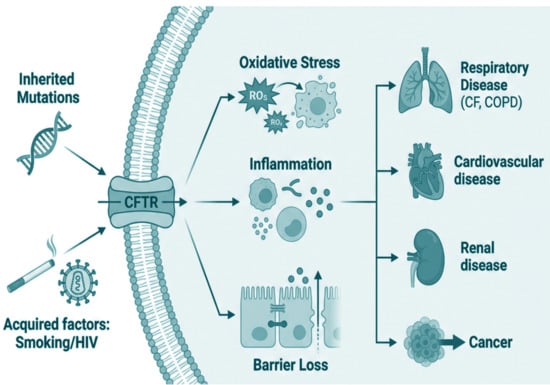
1. Introduction

2. HIV Infection and Acquired CFTR Dysfunction in Airway Disease
3. Involvement of CFTR in HIV-Associated Co-Morbidities
4. Respiratory Diseases Due to Acquired CFTR Dysfunction
4.1. Impacts of Dysregulated CFTR in COPD
4.2. Asthma
5. Emerging Systematic Diseases
5.1. Cancer
5.2. Cardiovascular Diseases
5.3. Kidney Diseases
5.4. Nervous System Diseases
6. Therapeutic Approaches Targeting CFTR

| Approach | Type | Description | Status | References |
|---|---|---|---|---|
| CFTR Modulators | Small molecules | Small molecules, including potentiators, correctors, and triple-combination modulators, are designed to improve CFTR folding, trafficking, and channel activity | Established in CF | [196,197,198] |
| Gene Therapy | Genetic modification | Experimental approaches aimed at restoring CFTR expression or function through viral or non-viral genetic delivery systems | Investigational | [199,200] |
| Antisense Oligonucleotides | Nucleic acid-based | Synthetic oligonucleotides designed to modify CFTR mRNA splicing, stability, or processing to restore protein function | Preclinical/Early clinical evaluation | [201,202] |
| Lipid-based Therapies | Delivery systems | Liposomes and lipid nanoparticles are used to enhance the intracellular delivery of CFTR-targeted therapeutics or nucleic acids | Investigational | [198,200] |
| Combination Therapies | Multi-agent strategies | Combined therapeutic approaches integrating multiple modulators or adjunct therapies to improve CFTR rescue and clinical response | Clinically evaluated/Expanding | [203,204] |
7. Ongoing and Completed CFTR-Focused Clinical Trials
8. Limitations and Challenges in Current CFTR Research
9. Conclusions and Future Directions
Author Contributions
Funding
Institutional Review Board Statement
Informed Consent Statement
Data Availability Statement
Conflicts of Interest
Abbreviations
| CFTR | Cystic Fibrosis Transmembrane Conductance Regulator |
| CS | Cigarette smoke |
| CF | Cystic fibrosis |
| TGF-β | Transforming growth factor-beta |
| CRC | Colorectal cancer |
| AIDS | Acquired immunodeficiency syndrome |
| COPD | Chronic obstructive pulmonary disease |
| ENaC | Epithelial sodium channel |
| MMP9 | Matrix Metalloproteinase-9 |
| COX-2 | Cyclooxygenase-2 |
| SP-A | Surfactant Protein A |
| MUC5AC | Mucin 5AC |
| RANTES | Regulated upon Activation, Normal T-cell Expressed and Secreted |
| EGFR | Epidermal Growth Factor Receptor |
| HCCs | Hepatocellular carcinoma |
| NSCLC | Non-small cell lung carcinoma |
| EMT | Epithelial-to-mesenchymal transition |
| HF | Heart failure |
| LV | Left ventricular |
| MMPs | Matrix metalloproteinases |
| S1P | Sphingosine-1-phosphate |
| VEGF | Vascular endothelial growth factor |
| INHBA | Inhibin Subunit Beta A |
| PDGF | Platelet-Derived Growth Factor |
| PSD-95 | Post-synaptic density protein 95 |
| BALF | Bronchoalveolar lavage fluid |
| BDNF | Brain-Derived Neurotrophic Factor |
References
- Mall, M.A.; Criner, G.J.; Miravitlles, M.; Rowe, S.M.; Vogelmeier, C.F.; Rowlands, D.J.; Schoenberger, M.; Altman, P. Cystic fibrosis transmembrane conductance regulator in COPD: A role in respiratory epithelium and beyond. Eur. Respir. J. 2023, 61, 2201307. [Google Scholar] [CrossRef]
- Wang, J.Q.; Wu, Z.X.; Yang, Y.; Teng, Q.X.; Li, Y.D.; Lei, Z.N.; Jani, K.A.; Kaushal, N.; Chen, Z.S. ATP-binding cassette (ABC) transporters in cancer: A review of recent updates. J. Evid. Based Med. 2021, 14, 232–256. [Google Scholar] [CrossRef]
- Marcorelles, P.; Friocourt, G.; Uguen, A.; Ledé, F.; Férec, C.; Laquerrière, A. Cystic fibrosis transmembrane conductance regulator protein (CFTR) expression in the developing human brain: Comparative immunohistochemical study between patients with normal and mutated CFTR. J. Histochem. Cytochem. 2014, 62, 791–801. [Google Scholar] [CrossRef] [PubMed]
- Yoshimura, K.; Nakamura, H.; Trapnell, B.C.; Chu, C.S.; Dalemans, W.; Pavirani, A.; Lecocq, J.P.; Crystal, R.G. Expression of the cystic fibrosis transmembrane conductance regulator gene in cells of non-epithelial origin. Nucleic Acids Res. 1991, 19, 5417–5423. [Google Scholar] [CrossRef] [PubMed]
- Jiang, Q.; Li, J.; Dubroff, R.; Ahn, Y.J.; Foskett, J.K.; Engelhardt, J.; Kleyman, T.R. Epithelial Sodium Channels Regulate Cystic Fibrosis Transmembrane Conductance Regulator Chloride Channels in XenopusOocytes. J. Biol. Chem. 2000, 275, 13266–13274. [Google Scholar] [CrossRef]
- Veit, G.; Avramescu, R.G.; Chiang, A.N.; Houck, S.A.; Cai, Z.; Peters, K.W.; Hong, J.S.; Pollard, H.B.; Guggino, W.B.; Balch, W.E.; et al. From CFTR biology toward combinatorial pharmacotherapy: Expanded classification of cystic fibrosis mutations. Mol. Biol. Cell 2016, 27, 424–433. [Google Scholar] [CrossRef]
- Chen, Q.; Shen, Y.; Zheng, J. A review of cystic fibrosis: Basic and clinical aspects. Anim. Models Exp. Med. 2021, 4, 220–232. [Google Scholar] [CrossRef]
- Du, K.; Sharma, M.; Lukacs, G.L. The DeltaF508 cystic fibrosis mutation impairs domain-domain interactions and arrests post-translational folding of CFTR. Nat. Struct. Mol. Biol. 2005, 12, 17–25. [Google Scholar] [CrossRef]
- Thomas, P.J.; Ko, Y.H.; Pedersen, P.L. Altered protein folding may be the molecular basis of most cases of cystic fibrosis. FEBS Lett. 1992, 312, 7–9. [Google Scholar] [CrossRef]
- Sahrawat, T.R.; Bhalla, S. Identification of critical target protein for cystic fibrosis using systems biology network approach. Int. J. Bioautom. 2013, 17, 227–240. [Google Scholar]
- Crothers, K.; Huang, L.; Goulet, J.L.; Goetz, M.B.; Brown, S.T.; Rodriguez-Barradas, M.C.; Oursler, K.K.; Rimland, D.; Gibert, C.L.; Butt, A.A.; et al. HIV infection and risk for incident pulmonary diseases in the combination antiretroviral therapy era. Am. J. Respir. Crit. Care Med. 2011, 183, 388–395. [Google Scholar] [CrossRef]
- Chinnapaiyan, S.; Dutta, R.; Bala, J.; Parira, T.; Agudelo, M.; Nair, M.; Unwalla, H.J. Cigarette smoke promotes HIV infection of primary bronchial epithelium and additively suppresses CFTR function. Sci. Rep. 2018, 8, 7984. [Google Scholar] [CrossRef]
- Gingo, M.R.; Morris, A. Pathogenesis of HIV and the lung. Curr. HIV AIDS Rep. 2013, 10, 42–50. [Google Scholar] [CrossRef] [PubMed]
- Chinnapaiyan, S.; Unwalla, H.J. Mucociliary dysfunction in HIV and smoked substance abuse. Front. Microbiol. 2015, 6, 1052. [Google Scholar] [CrossRef] [PubMed]
- Unwalla, H.J.; Ivonnet, P.; Dennis, J.S.; Conner, G.E.; Salathe, M. Transforming growth factor-β1 and cigarette smoke inhibit the ability of β2-agonists to enhance epithelial permeability. Am. J. Respir. Cell Mol. Biol. 2015, 52, 65–74. [Google Scholar] [CrossRef]
- Rennolds, J.; Butler, S.; Maloney, K.; Boyaka, P.N.; Davis, I.C.; Knoell, D.L.; Parinandi, N.L.; Cormet-Boyaka, E. Cadmium regulates the expression of the CFTR chloride channel in human airway epithelial cells. Toxicol. Sci. 2010, 116, 349–358. [Google Scholar] [CrossRef]
- Mitash, N.; Mu, F.; Donovan, J.E.; Myerburg, M.M.; Ranganathan, S.; Greene, C.M.; Swiatecka-Urban, A. Transforming Growth Factor-β1 Selectively Recruits microRNAs to the RNA-Induced Silencing Complex and Degrades CFTR mRNA under Permissive Conditions in Human Bronchial Epithelial Cells. Int. J. Mol. Sci. 2019, 20, 4933. [Google Scholar] [CrossRef] [PubMed]
- Rasmussen, J.E.; Sheridan, J.T.; Polk, W.; Davies, C.M.; Tarran, R. Cigarette smoke-induced Ca2+ release leads to cystic fibrosis transmembrane conductance regulator (CFTR) dysfunction. J. Biol. Chem. 2014, 289, 7671–7681. [Google Scholar] [CrossRef]
- Dutta, R.K.; Chinnapaiyan, S.; Santiago, M.J.; Rahman, I.; Unwalla, H.J. Gene-specific MicroRNA antagonism protects against HIV Tat and TGF-β-mediated suppression of CFTR mRNA and function. Biomed. Pharmacother. 2021, 142, 112090. [Google Scholar] [CrossRef]
- Wang, Y.; Fang, J.; Leonard, S.S.; Rao, K.M. Cadmium inhibits the electron transfer chain and induces reactive oxygen species. Free Radic. Biol. Med. 2004, 36, 1434–1443. [Google Scholar] [CrossRef]
- Rahman, M.S.; Ghorai, S.; Panda, K.; Santiago, M.J.; Aggarwal, S.; Wang, T.; Rahman, I.; Chinnapaiyan, S.; Unwalla, H.J. Dr. Jekyll or Mr. Hyde: The multifaceted roles of miR-145-5p in human health and disease. Noncoding RNA Res. 2025, 11, 22–37. [Google Scholar] [CrossRef] [PubMed]
- Santiago, M.J.; Chinnapaiyan, S.; Panda, K.; Rahman, M.S.; Ghorai, S.; Rahman, I.; Black, S.M.; Liu, Y.; Unwalla, H.J. Altered Host microRNAomics in HIV Infections: Therapeutic Potentials and Limitations. Int. J. Mol. Sci. 2024, 25, 8809. [Google Scholar] [CrossRef]
- Jin, T.; Nordberg, M.; Frech, W.; Dumont, X.; Bernard, A.; Ye, T.T.; Kong, Q.; Wang, Z.; Li, P.; Lundström, N.G.; et al. Cadmium biomonitoring and renal dysfunction among a population environmentally exposed to cadmium from smelting in China (ChinaCad). Biometals 2002, 15, 397–410. [Google Scholar] [CrossRef] [PubMed]
- Pääkkö, P.; Anttila, S.; Kokkonen, P.; Kalliomäki, P.L. Cadmium in Lung Tissue as Marker for Smoking. Lancet 1988, 331, 477. [Google Scholar] [CrossRef]
- Chambers, R.C.; Laurent, G.J.; Westergren-Thorsson, G. Cadmium inhibits proteoglycan and procollagen production by cultured human lung fibroblasts. Am. J. Respir. Cell Mol. Biol. 1998, 19, 498–506. [Google Scholar] [CrossRef] [PubMed]
- Schnúr, A.; Premchandar, A.; Bagdany, M.; Lukacs, G.L. Phosphorylation-dependent modulation of CFTR macromolecular signalling complex activity by cigarette smoke condensate in airway epithelia. Sci. Rep. 2019, 9, 12706. [Google Scholar] [CrossRef]
- Poore, T.S.; Taylor-Cousar, J.L.; Zemanick, E.T. Cardiovascular complications in cystic fibrosis: A review of the literature. J. Cyst. Fibros. 2022, 21, 18–25. [Google Scholar] [CrossRef]
- Parisi, G.F.; Terlizzi, V.; Manti, S.; Papale, M.; Pecora, G.; Presti, S.; Tosto, M.; Leonardi, S. Cutting-Edge Advances in Cystic Fibrosis: From Gene Therapy to Personalized Medicine and Holistic Management. Genes 2025, 16, 402. [Google Scholar] [CrossRef]
- Maisonneuve, P.; Lowenfels, A.B. Cancer in Cystic Fibrosis: A Narrative Review of Prevalence, Risk Factors, Screening, and Treatment Challenges: Adult Cystic Fibrosis Series. Chest 2022, 161, 356–364. [Google Scholar] [CrossRef]
- Miravitlles, M.; Criner, G.J.; Mall, M.A.; Rowe, S.M.; Vogelmeier, C.F.; Hederer, B.; Schoenberger, M.; Altman, P. Potential systemic effects of acquired CFTR dysfunction in COPD. Respir. Med. 2024, 221, 107499. [Google Scholar] [CrossRef]
- Rottner, M.; Freyssinet, J.M.; Martínez, M.C. Mechanisms of the noxious inflammatory cycle in cystic fibrosis. Respir. Res. 2009, 10, 23. [Google Scholar] [CrossRef]
- Levintov, L.; Vashisth, H. Structural and computational studies of HIV-1 RNA. RNA Biol. 2024, 21, 167–198. [Google Scholar] [CrossRef]
- Westerhout, E.M.; Ooms, M.; Vink, M.; Das, A.T.; Berkhout, B. HIV-1 can escape from RNA interference by evolving an alternative structure in its RNA genome. Nucleic Acids Res. 2005, 33, 796–804. [Google Scholar] [CrossRef]
- Douek, D.C.; Roederer, M.; Koup, R.A. Emerging concepts in the immunopathogenesis of AIDS. Annu. Rev. Med. 2009, 60, 471–484. [Google Scholar] [CrossRef] [PubMed]
- Caputo, V.; Libera, M.; Sisti, S.; Giuliani, B.; Diotti, R.A.; Criscuolo, E. The initial interplay between HIV and mucosal innate immunity. Front. Immunol. 2023, 14, 1104423. [Google Scholar] [CrossRef]
- Chinnapaiyan, S.; Dutta, R.K.; Nair, M.; Chand, H.S.; Rahman, I.; Unwalla, H.J. TGF-β1 increases viral burden and promotes HIV-1 latency in primary differentiated human bronchial epithelial cells. Sci. Rep. 2019, 9, 12552. [Google Scholar] [CrossRef] [PubMed]
- Moustakas, A.; Pardali, K.; Gaal, A.; Heldin, C.H. Mechanisms of TGF-beta signaling in regulation of cell growth and differentiation. Immunol. Lett. 2002, 82, 85–91. [Google Scholar] [CrossRef] [PubMed]
- Dutta, R.K.; Chinnapaiyan, S.; Unwalla, H. HIV Tat Protein Induces the TGF-β Signaling Pathway and Suppresses the CFTR Biogenesis and Activity by microRNA-Regulated Gene-Silencing Mechanism. FASEB J. 2020, 34, 1. [Google Scholar] [CrossRef]
- Santiago, M.J.; Chinnapaiyan, S.; Panda, K.; Rahman, M.S.; Ghorai, S.; Lucas, J.H.; Black, S.M.; Rahman, I.; Unwalla, H.J. MicroRNA mediated suppression of airway lactoperoxidase by TGF-β1 and cigarette smoke promotes airway inflammation. J. Inflamm. 2024, 21, 31. [Google Scholar] [CrossRef]
- Dutta, R.; Chinnapaiyan, S.; Nair, M.; Unwalla, H. HIV Tat Protein and TGF-β Suppresses CFTR Biogenesis and Activity by Microrna Mediated Gene Silencing. In D53. off the Beaten Path: New Approaches to Copd Pathogenesis; American Thoracic Society: New York, NY, USA, 2018; p. A7116. [Google Scholar]
- Howe, K.L.; Wang, A.; Hunter, M.M.; Stanton, B.A.; McKay, D.M. TGFβ down-regulation of the CFTR: A means to limit epithelial chloride secretion. Exp. Cell Res. 2004, 298, 473–484. [Google Scholar] [CrossRef]
- Swaminathan, S.; Murray, D.D.; Kelleher, A.D. The role of microRNAs in HIV-1 pathogenesis and therapy. Aids 2012, 26, 1325–1334. [Google Scholar] [CrossRef]
- Dutta, R.K.; Chinnapaiyan, S.; Rasmussen, L.; Raju, S.V.; Unwalla, H.J. A neutralizing aptamer to TGFBR2 and miR-145 antagonism rescue cigarette smoke-and TGF-β-mediated CFTR expression. Mol. Ther. 2019, 27, 442–455. [Google Scholar] [CrossRef]
- Liou, T.G. The Clinical Biology of Cystic Fibrosis Transmembrane Regulator Protein: Its Role and Function in Extrapulmonary Disease. Chest 2019, 155, 605–616. [Google Scholar] [CrossRef]
- Patel, S.D.; Bono, T.R.; Rowe, S.M.; Solomon, G.M. CFTR targeted therapies: Recent advances in cystic fibrosis and possibilities in other diseases of the airways. Eur. Respir. Rev. 2020, 29, 190068. [Google Scholar] [CrossRef]
- Fraser-Pitt, D.; O’Neil, D. Cystic fibrosis—A multiorgan protein misfolding disease. Future Sci. OA 2015, 1, Fso57. [Google Scholar] [CrossRef]
- Parisi, G.F.; Papale, M.; Pecora, G.; Rotolo, N.; Manti, S.; Russo, G.; Leonardi, S. Cystic Fibrosis and Cancer: Unraveling the Complex Role of CFTR Gene in Cancer Susceptibility. Cancers 2023, 15, 4244. [Google Scholar] [CrossRef] [PubMed]
- Kim, V.; Criner, G.J. Chronic bronchitis and chronic obstructive pulmonary disease. Am. J. Respir. Crit. Care Med. 2013, 187, 228–237. [Google Scholar] [CrossRef] [PubMed]
- Morris, A.; George, M.P.; Crothers, K.; Huang, L.; Lucht, L.; Kessinger, C.; Kleerup, E.C. HIV and chronic obstructive pulmonary disease: Is it worse and why? Proc. Am. Thorac. Soc. 2011, 8, 320–325. [Google Scholar] [CrossRef]
- Gingo, M.R.; Wenzel, S.E.; Steele, C.; Kessinger, C.J.; Lucht, L.; Lawther, T.; Busch, M.; Hillenbrand, M.E.; Weinman, R.; Slivka, W.A.; et al. Asthma diagnosis and airway bronchodilator response in HIV-infected patients. J. Allergy Clin. Immunol. 2012, 129, 708–714.e708. [Google Scholar] [CrossRef] [PubMed]
- Schmid, A.; Baumlin, N.; Ivonnet, P.; Dennis, J.S.; Campos, M.; Krick, S.; Salathe, M. Roflumilast partially reverses smoke-induced mucociliary dysfunction. Respir. Res. 2015, 16, 135. [Google Scholar] [CrossRef]
- Raju, S.V.; Rasmussen, L.; Sloane, P.A.; Tang, L.P.; Libby, E.F.; Rowe, S.M. Roflumilast reverses CFTR-mediated ion transport dysfunction in cigarette smoke-exposed mice. Respir. Res. 2017, 18, 173. [Google Scholar] [CrossRef] [PubMed]
- Clunes, L.A.; Davies, C.M.; Coakley, R.D.; Aleksandrov, A.A.; Henderson, A.G.; Zeman, K.L.; Worthington, E.N.; Gentzsch, M.; Kreda, S.M.; Cholon, D.; et al. Cigarette smoke exposure induces CFTR internalization and insolubility, leading to airway surface liquid dehydration. FASEB J. 2012, 26, 533–545. [Google Scholar] [CrossRef]
- Bhat, T.A.; Panzica, L.; Kalathil, S.G.; Thanavala, Y. Immune Dysfunction in Patients with Chronic Obstructive Pulmonary Disease. Ann. Am. Thorac. Soc. 2015, 12, S169–S175. [Google Scholar] [CrossRef]
- Keown, K.; Brown, R.; Doherty, D.F.; Houston, C.; McKelvey, M.C.; Creane, S.; Linden, D.; McAuley, D.F.; Kidney, J.C.; Weldon, S.; et al. Airway Inflammation and Host Responses in the Era of CFTR Modulators. Int. J. Mol. Sci. 2020, 21, 6379. [Google Scholar] [CrossRef]
- Lovewell, R.R.; Patankar, Y.R.; Berwin, B. Mechanisms of phagocytosis and host clearance of Pseudomonas aeruginosa. Am. J. Physiol. Lung Cell. Mol. Physiol. 2014, 306, L591–L603. [Google Scholar] [CrossRef]
- McKelvey, M.C.; Weldon, S.; McAuley, D.F.; Mall, M.A.; Taggart, C.C. Targeting Proteases in Cystic Fibrosis Lung Disease. Paradigms, Progress, and Potential. Am. J. Respir. Crit. Care Med. 2020, 201, 141–147. [Google Scholar] [CrossRef]
- Jang, J.H.; Panariti, A.; O’Sullivan, M.J.; Pyrch, M.; Wong, C.; Lauzon, A.M.; Martin, J.G. Characterization of cystic fibrosis airway smooth muscle cell proliferative and contractile activities. Am. J. Physiol. Lung Cell. Mol. Physiol. 2019, 317, L690–L701. [Google Scholar] [CrossRef]
- Yan, F.; Gao, H.; Zhao, H.; Bhatia, M.; Zeng, Y. Roles of airway smooth muscle dysfunction in chronic obstructive pulmonary disease. J. Transl. Med. 2018, 16, 262. [Google Scholar] [CrossRef] [PubMed]
- Hassan, F.; Xu, X.; Nuovo, G.; Killilea, D.W.; Tyrrell, J.; Da Tan, C.; Tarran, R.; Diaz, P.; Jee, J.; Knoell, D.; et al. Accumulation of metals in GOLD4 COPD lungs is associated with decreased CFTR levels. Respir. Res. 2014, 15, 69. [Google Scholar] [CrossRef]
- Li, J.; Ye, Z. The Potential Role and Regulatory Mechanisms of MUC5AC in Chronic Obstructive Pulmonary Disease. Molecules 2020, 25, 4437. [Google Scholar] [CrossRef] [PubMed]
- Panda, K.; Santiago, M.J.; Rahman, M.S.; Ghorai, S.; Black, S.M.; Rahman, I.; Unwalla, H.J.; Chinnapaiyan, S. HIV-1 Tat Protein and Cigarette Smoke Mediated ADAM17 Upregulation Can Lead to Impaired Mucociliary Clearance. Cells 2024, 13, 2009. [Google Scholar] [CrossRef]
- He, S.; Liu, C.; Wang, F.; Ma, W.; Zhang, H.; Zheng, H.; Zhang, X. Increased interleukin (IL)-8 and decreased IL-17 production in chronic obstructive pulmonary disease (COPD) provoked by cigarette smoke. Cytokine 2011, 56, 717–725. [Google Scholar] [CrossRef]
- Renda, T.; Baraldo, S.; Pelaia, G.; Bazzan, E.; Turato, G.; Papi, A.; Maestrelli, P.; Maselli, R.; Vatrella, A.; Fabbri, L.M.; et al. Increased activation of p38 MAPK in COPD. Eur. Respir. J. 2008, 31, 62–69. [Google Scholar] [CrossRef] [PubMed]
- Christopoulou, M.E.; Papakonstantinou, E.; Stolz, D. Matrix Metalloproteinases in Chronic Obstructive Pulmonary Disease. Int. J. Mol. Sci. 2023, 24, 3786. [Google Scholar] [CrossRef]
- Wang, J.; Zhu, M.; Wang, L.; Chen, C.; Song, Y. Amphiregulin potentiates airway inflammation and mucus hypersecretion induced by urban particulate matter via the EGFR-PI3Kα-AKT/ERK pathway. Cell Signal 2019, 53, 122–131. [Google Scholar] [CrossRef]
- de Boer, W.I.; Alagappan, V.K.T.; Sharma, H.S. Molecular mechanisms in chronic obstructive pulmonary disease. Cell Biochem. Biophys. 2007, 47, 131–147. [Google Scholar] [CrossRef] [PubMed]
- Vlachaki, E.M.; Koutsopoulos, A.V.; Tzanakis, N.; Neofytou, E.; Siganaki, M.; Drositis, I.; Moniakis, A.; Schiza, S.; Siafakas, N.M.; Tzortzaki, E.G. Altered surfactant protein-A expression in type II pneumocytes in COPD. Chest 2010, 137, 37–45. [Google Scholar] [CrossRef]
- Hristova, V.A.; Watson, A.; Chaerkady, R.; Glover, M.S.; Ackland, J.; Angerman, B.; Belfield, G.; Belvisi, M.G.; Burke, H.; Cellura, D.; et al. Multiomics links global surfactant dysregulation with airflow obstruction and emphysema in COPD. ERJ Open Res. 2023, 9, 378. [Google Scholar] [CrossRef]
- Wright, J.R. Immunoregulatory functions of surfactant proteins. Nat. Rev. Immunol. 2005, 5, 58–68. [Google Scholar] [CrossRef] [PubMed]
- Ghosh, A.; Boucher, R.C.; Tarran, R. Airway hydration and COPD. Cell. Mol. Life Sci. 2015, 72, 3637–3652. [Google Scholar] [CrossRef] [PubMed]
- Wu, M.; Chen, J.-H. CFTR dysfunction leads to defective bacterial eradication on cystic fibrosis airways. Front. Physiol. 2024, 15, 1385661. [Google Scholar] [CrossRef]
- Mercer, P.F.; Shute, J.K.; Bhowmik, A.; Donaldson, G.C.; Wedzicha, J.A.; Warner, J.A. MMP-9, TIMP-1 and inflammatory cells in sputum from COPD patients during exacerbation. Respir. Res. 2005, 6, 151. [Google Scholar] [CrossRef] [PubMed]
- Li, C.; Naren, A.P. CFTR chloride channel in the apical compartments: Spatiotemporal coupling to its interacting partners. Integr. Biol. 2010, 2, 161–177. [Google Scholar] [CrossRef]
- Nielsen, A.O.; Qayum, S.; Bouchelouche, P.N.; Laursen, L.C.; Dahl, R.; Dahl, M. Risk of asthma in heterozygous carriers for cystic fibrosis: A meta-analysis. J. Cyst. Fibros. 2016, 15, 563–567. [Google Scholar] [CrossRef]
- Aldossary, A.M. Correction of the ΔF508 Mutation in the CFTR Gene by CRISPR/Cas9 System. Doctoral Dissertation, UCL (University College London), London, UK, 2018. [Google Scholar]
- Hanssens, L.S.; Duchateau, J.; Casimir, G.J. CFTR Protein: Not Just a Chloride Channel? Cells 2021, 10, 2844. [Google Scholar] [CrossRef] [PubMed]
- Crites, K.S.; Morin, G.; Orlando, V.; Patey, N.; Cantin, C.; Martel, J.; Brochiero, E.; Mailhot, G. CFTR Knockdown induces proinflammatory changes in intestinal epithelial cells. J. Inflamm. 2015, 12, 62. [Google Scholar] [CrossRef] [PubMed]
- Zhang, L.; Zhang, W.; Wang, Y.; Cai, P.; Li, C.; Shi, Y.; Athari, S.S.; Li, A. Allergo-immunopathology mechanism of thymol-inhibiting airway remodeling in asthmatic mice by regulating TGF-β/Smad3 pathway. Allergol. Immunopathol. 2024, 52, 51–58. [Google Scholar] [CrossRef]
- Zhou, J.P.; Lin, Y.N.; Li, N.; Sun, X.W.; Ding, Y.J.; Ru, Y.Y.; Zhang, L.; Li, Q.Y. Angiotensin-(1-7) rescues chronic intermittent hypoxia-aggravated TGF-β-mediated airway remodeling in murine and cellular models of asthma. J. Pharmacol. Exp. Ther. 2020, 375, 268–275. [Google Scholar] [CrossRef]
- Rupani, H.; Busse, W.W.; Howarth, P.H.; Bardin, P.G.; Adcock, I.M.; Konno, S.; Jackson, D.J. Therapeutic relevance of eosinophilic inflammation and airway viral interactions in severe asthma. Allergy 2024, 79, 2589–2604. [Google Scholar] [CrossRef]
- Akenroye, A.; Nopsopon, T.; Hacker, J.J.; Laidlaw, T.M. Ratio of plasma IL-13/TNF- ∝ and CXCL10/CCL17 predicts mepolizumab and omalizumab response in asthma better than eosinophil count or immunoglobulin E level. Sci. Rep. 2024, 14, 10404. [Google Scholar] [CrossRef]
- Zhu, Z.; Homer, R.J.; Wang, Z.; Chen, Q.; Geba, G.P.; Wang, J.; Zhang, Y.; Elias, J.A. Pulmonary expression of interleukin-13 causes inflammation, mucus hypersecretion, subepithelial fibrosis, physiologic abnormalities, and eotaxin production. J. Clin. Investig. 1999, 103, 779–788. [Google Scholar] [CrossRef]
- Yadav, H.; Quijano, C.; Kamaraju, A.K.; Gavrilova, O.; Malek, R.; Chen, W.; Zerfas, P.; Zhigang, D.; Wright, E.C.; Stuelten, C.; et al. Protection from obesity and diabetes by blockade of TGF-β/Smad3 signaling. Cell Metab. 2011, 14, 67–79. [Google Scholar] [CrossRef]
- Zhu, Y.; Ehre, C.; Abdullah, L.H.; Sheehan, J.K.; Roy, M.; Evans, C.M.; Dickey, B.F.; Davis, C.W. Munc13-2-/- baseline secretion defect reveals source of oligomeric mucins in mouse airways. J. Physiol. 2008, 586, 1977–1992. [Google Scholar] [CrossRef]
- Le Cras, T.D.; Acciani, T.H.; Mushaben, E.M.; Kramer, E.L.; Pastura, P.A.; Hardie, W.D.; Korfhagen, T.R.; Sivaprasad, U.; Ericksen, M.; Gibson, A.M.; et al. Epithelial EGF receptor signaling mediates airway hyperreactivity and remodeling in a mouse model of chronic asthma. Am. J. Physiol. Lung Cell. Mol. Physiol. 2011, 300, L414–L421. [Google Scholar] [CrossRef]
- Koumpagioti, D.; Moriki, D.; Boutopoulou, B.; Matziou, V.; Loukou, I.; Priftis, K.N.; Douros, K. The Association between CFTR Gene Mutation Heterozygosity and Asthma Development: A Systematic Review. J. Clin. Med. 2023, 12, 2403. [Google Scholar] [CrossRef]
- Gyurkovits, K.; Markus, V.; Bittera, I. Cystic-fibrosis heterozygosity in childhood bronchial asthma. Lancet 1977, 1, 203. [Google Scholar] [CrossRef] [PubMed]
- Lara-Reyna, S.; Holbrook, J.; Jarosz-Griffiths, H.H.; Peckham, D.; McDermott, M.F. Dysregulated signalling pathways in innate immune cells with cystic fibrosis mutations. Cell. Mol. Life Sci. 2020, 77, 4485–4503. [Google Scholar] [CrossRef] [PubMed]
- Staples, K.J.; Hinks, T.S.; Ward, J.A.; Gunn, V.; Smith, C.; Djukanović, R. Phenotypic characterization of lung macrophages in asthmatic patients: Overexpression of CCL17. J. Allergy Clin. Immunol. 2012, 130, 1404–1412.e1407. [Google Scholar] [CrossRef]
- Sagel, S.D.; Chmiel, J.F.; Konstan, M.W. Sputum biomarkers of inflammation in cystic fibrosis lung disease. Proc. Am. Thorac. Soc. 2007, 4, 406–417. [Google Scholar] [CrossRef]
- Mattoscio, D.; Baeza, L.A.; Bai, H.; Colangelo, T.; Castagnozzi, S.; Marzotto, M.; Cufaro, M.C.; Lotti, V.; Yuan, Y.C.; Mucci, M.; et al. Inflammation and epithelial-mesenchymal transition in a CFTR-depleted human bronchial epithelial cell line revealed by proteomics and human organ-on-a-chip. FEBS J. 2025, 292, 5086–5104. [Google Scholar] [CrossRef] [PubMed]
- Mueller, C.; Braag, S.A.; Keeler, A.; Hodges, C.; Drumm, M.; Flotte, T.R. Lack of cystic fibrosis transmembrane conductance regulator in CD3+ lymphocytes leads to aberrant cytokine secretion and hyperinflammatory adaptive immune responses. Am. J. Respir. Cell Mol. Biol. 2011, 44, 922–929. [Google Scholar] [CrossRef]
- Kotas, M.E.; Moore, C.M.; Gurrola, J.G.; Pletcher, S.D.; Goldberg, A.N.; Alvarez, R.; Yamato, S.; Bratcher, P.E.; Shaughnessy, C.A.; Zeitlin, P.L. IL-13–programmed airway tuft cells produce PGE2, which promotes CFTR-dependent mucociliary function. JCI Insight 2022, 7, e159832. [Google Scholar] [CrossRef]
- Kramer, E.L.; Hudock, K.M.; Davidson, C.R.; Clancy, J.P. CFTR dysfunction in smooth muscle drives TGFβ dependent airway hyperreactivity. Respir. Res. 2023, 24, 198. [Google Scholar] [CrossRef] [PubMed]
- Thavagnanam, S.; Parker, J.C.; McBrien, M.E.; Skibinski, G.; Heaney, L.G.; Shields, M.D. Effects of IL-13 on Mucociliary Differentiation of Pediatric Asthmatic Bronchial Epithelial Cells. Pediatr. Res. 2011, 69, 95–100. [Google Scholar] [CrossRef][Green Version]
- Kim, S.; Beyer, B.A.; Lewis, C.; Nadel, J.A. Normal CFTR inhibits epidermal growth factor receptor-dependent pro-inflammatory chemokine production in human airway epithelial cells. PLoS ONE 2013, 8, e72981. [Google Scholar] [CrossRef] [PubMed]
- Schwiebert, L.M.; Estell, K.; Propst, S.M. Chemokine expression in CF epithelia: Implications for the role of CFTR in RANTES expression. Am. J. Physiol. 1999, 276, C700–C710. [Google Scholar] [CrossRef]
- Amaral, M.D.; Quaresma, M.C.; Pankonien, I. What Role Does CFTR Play in Development, Differentiation, Regeneration and Cancer? Int. J. Mol. Sci. 2020, 21, 3133. [Google Scholar] [CrossRef]
- Indra, R.; Černá, V. The relationship between cancer risk and cystic fibrosis: The role of CFTR in cell growth and cancer development. RSC Med. Chem. 2025, 16, 3416–3428. [Google Scholar] [CrossRef] [PubMed]
- Scott, P.; Anderson, K.; Singhania, M.; Cormier, R. Cystic Fibrosis, CFTR, and Colorectal Cancer. Int. J. Mol. Sci. 2020, 21, 2891. [Google Scholar] [CrossRef]
- Quaresma, M.C.; Pankonien, I.; Clarke, L.A.; Sousa, L.S.; Silva, I.A.L.; Railean, V.; Doušová, T.; Fuxe, J.; Amaral, M.D. Mutant CFTR Drives TWIST1 mediated epithelial–mesenchymal transition. Cell Death Dis. 2020, 11, 920. [Google Scholar] [CrossRef]
- Than, B.L.N.; Linnekamp, J.F.; Starr, T.K.; Largaespada, D.A.; Rod, A.; Zhang, Y.; Bruner, V.; Abrahante, J.; Schumann, A.; Luczak, T.; et al. CFTR is a tumor suppressor gene in murine and human intestinal cancer. Oncogene 2016, 35, 4191–4199. [Google Scholar] [CrossRef]
- Moribe, T.; Iizuka, N.; Miura, T.; Kimura, N.; Tamatsukuri, S.; Ishitsuka, H.; Hamamoto, Y.; Sakamoto, K.; Tamesa, T.; Oka, M. Methylation of multiple genes as molecular markers for diagnosis of a small, well-differentiated hepatocellular carcinoma. Int. J. Cancer 2009, 125, 388–397. [Google Scholar] [CrossRef] [PubMed]
- van der Heijden, A.G.; Mengual, L.; Ingelmo-Torres, M.; Lozano, J.J.; van Rijt-van de Westerlo, C.C.M.; Baixauli, M.; Geavlete, B.; Moldoveanud, C.; Ene, C.; Dinney, C.P.; et al. Urine cell-based DNA methylation classifier for monitoring bladder cancer. Clin. Epigenet. 2018, 10, 71. [Google Scholar] [CrossRef]
- Luo, J.H.; Ding, Y.; Chen, R.; Michalopoulos, G.; Nelson, J.; Tseng, G.; Yu, Y.P. Genome-wide methylation analysis of prostate tissues reveals global methylation patterns of prostate cancer. Am. J. Pathol. 2013, 182, 2028–2036. [Google Scholar] [CrossRef]
- Son, J.W.; Kim, Y.J.; Cho, H.M.; Lee, S.Y.; Lee, S.M.; Kang, J.K.; Lee, J.U.; Lee, Y.M.; Kwon, S.J.; Choi, E.; et al. Promoter hypermethylation of the CFTR gene and clinical/pathological features associated with non-small cell lung cancer. Respirology 2011, 16, 1203–1209. [Google Scholar] [CrossRef]
- Liu, K.; Dong, F.; Gao, H.; Guo, Y.; Li, H.; Yang, F.; Zhao, P.; Dai, Y.; Wang, J.; Zhou, W.; et al. Promoter hypermethylation of the CFTR gene as a novel diagnostic and prognostic marker of breast cancer. Cell Biol. Int. 2020, 44, 603–609. [Google Scholar] [CrossRef]
- Shin, Y.; Kim, M.; Won, J.; Kim, J.; Oh, S.B.; Lee, J.H.; Park, K. Epigenetic Modification of CFTR in Head and Neck Cancer. J. Clin. Med. 2020, 9, 734. [Google Scholar] [CrossRef]
- Zhao, M.; Zhang, J.; Huang, W.; Dong, J.; Guo, J.; U, K.P.; Weng, Z.; Liu, S.; Chan, H.C.; Feng, H.; et al. CFTR promotes malignant glioma development via up-regulation of Akt/Bcl2-mediated anti-apoptosis pathway. J. Cell. Mol. Med. 2020, 24, 7301–7312. [Google Scholar] [CrossRef]
- Xu, J.; Yong, M.; Li, J.; Dong, X.; Yu, T.; Fu, X.; Hu, L. High level of CFTR expression is associated with tumor aggression and knockdown of CFTR suppresses proliferation of ovarian cancer in vitro and in vivo. Oncol. Rep. 2015, 33, 2227–2234. [Google Scholar] [CrossRef] [PubMed]
- Bhattacharya, R.; Blankenheim, Z.; Scott, P.M.; Cormier, R.T. CFTR and Gastrointestinal Cancers: An Update. J. Pers. Med. 2022, 12, 868. [Google Scholar] [CrossRef] [PubMed]
- Santarpia, M.; Aguilar, A.; Chaib, I.; Cardona, A.F.; Fancelli, S.; Laguia, F.; Bracht, J.W.P.; Cao, P.; Molina-Vila, M.A.; Karachaliou, N.; et al. Non-Small-Cell Lung Cancer Signaling Pathways, Metabolism, and PD-1/PD-L1 Antibodies. Cancers 2020, 12, 1475. [Google Scholar] [CrossRef]
- Zhang, J.; Wang, Y.; Jiang, X.; Chan, H.C. Cystic fibrosis transmembrane conductance regulator-emerging regulator of cancer. Cell. Mol. Life Sci. 2018, 75, 1737–1756. [Google Scholar] [CrossRef]
- Kang, Y.; Li, H.; Liu, Y.; Li, Z. Regulation of VEGF-A expression and VEGF-A-targeted therapy in malignant tumors. J. Cancer Res. Clin. Oncol. 2024, 150, 221. [Google Scholar] [CrossRef] [PubMed]
- Chen, J.; Jiang, X.H.; Chen, H.; Guo, J.H.; Tsang, L.L.; Yu, M.K.; Xu, W.M.; Chan, H.C. CFTR negatively regulates cyclooxygenase-2-PGE(2) positive feedback loop in inflammation. J. Cell. Physiol. 2012, 227, 2759–2766. [Google Scholar] [CrossRef]
- Hoskins, B.; Wasuwanich, P.; Scheimann, A.O.; Karnsakul, W. Screening strategy for gastrointestinal and hepatopancreatobiliary cancers in cystic fibrosis. World J. Gastrointest. Oncol. 2021, 13, 1121. [Google Scholar] [CrossRef] [PubMed]
- Yarra, P.; Coreas, N.; Ginnaram, S.R.; Tripathi, R.; Nelson, A.; Hachem, C. S2111 CFTR Modulators Are Not Associated With Reduction in Cancer Incidence: A Propensity Matched Analysis of 15,280 Cystic Fibrosis Patients. Off. J. Am. Coll. Gastroenterol. ACG 2025, 120, S453. [Google Scholar] [CrossRef]
- Zhang, J.T.; Jiang, X.H.; Xie, C.; Cheng, H.; Da Dong, J.; Wang, Y.; Fok, K.L.; Zhang, X.H.; Sun, T.T.; Tsang, L.L.; et al. Downregulation of CFTR promotes epithelial-to-mesenchymal transition and is associated with poor prognosis of breast cancer. Biochim. Biophys. Acta (BBA)-Mol. Cell Res. 2013, 1833, 2961–2969. [Google Scholar] [CrossRef]
- González-Guerrico, A.M.; Cafferata, E.G.; Radrizzani, M.n.; Marcucci, F.; Gruenert, D.; Pivetta, O.H.; Favaloro, R.R.; Laguens, R.; Perrone, S.V.; Gallo, G.C.; et al. Tyrosine Kinase c-Src Constitutes a Bridge between Cystic Fibrosis Transmembrane Regulator Channel Failure and MUC1 Overexpression in Cystic Fibrosis. J. Biol. Chem. 2002, 277, 17239–17247. [Google Scholar] [CrossRef]
- Martin, C.; Coolen, N.; Wu, Y.; Thévenot, G.; Touqui, L.; Prulière-Escabasse, V.; Papon, J.F.; Coste, A.; Escudier, E.; Dusser, D.J.; et al. CFTR dysfunction induces vascular endothelial growth factor synthesis in airway epithelium. Eur. Respir. J. 2013, 42, 1553–1562. [Google Scholar] [CrossRef] [PubMed]
- Ramananda, Y.; Naren, A.P.; Arora, K. Functional Consequences of CFTR Interactions in Cystic Fibrosis. Int. J. Mol. Sci. 2024, 25, 3384. [Google Scholar] [CrossRef]
- Amoakon, J.P.; Mylavarapu, G.; Amin, R.S.; Naren, A.P. Pulmonary Vascular Dysfunctions in Cystic Fibrosis. Physiology 2024, 39, 179–192. [Google Scholar] [CrossRef]
- Shah, P.H.; Lee, J.H.; Salvi, D.J.; Rabbani, R.; Gavini, D.R.; Hamid, P. Cardiovascular System Involvement in Cystic Fibrosis. Cureus 2021, 13, e16723. [Google Scholar] [CrossRef]
- Tabeling, C.; Witzenrath, M.; Kuebler, W.M. CFTR in the regulation of pulmonary vascular tone and remodeling. Eur. Respir. J. 2021, 58, 2101861. [Google Scholar] [CrossRef]
- Lu, L.Y.; Pan, N.; Huang, Z.H.; Wang, J.S.; Tang, Y.B.; Sun, H.S.; Han, H.; Yang, H.Y.; Zhu, J.Z.; Guan, Y.Y.; et al. CFTR Suppresses Neointimal Formation Through Attenuating Proliferation and Migration of Aortic Smooth Muscle Cells. J. Cardiovasc. Pharmacol. 2022, 79, 914–924. [Google Scholar] [CrossRef] [PubMed]
- Kolur, V.; Vastrad, B.; Vastrad, C.; Kotturshetti, S.; Tengli, A. Identification of candidate biomarkers and therapeutic agents for heart failure by bioinformatics analysis. BMC Cardiovasc. Disord. 2021, 21, 329. [Google Scholar] [CrossRef]
- Lidington, D.; Fares, J.C.; Uhl, F.E.; Dinh, D.D.; Kroetsch, J.T.; Sauvé, M.; Malik, F.A.; Matthes, F.; Vanherle, L.; Adel, A.; et al. CFTR Therapeutics Normalize Cerebral Perfusion Deficits in Mouse Models of Heart Failure and Subarachnoid Hemorrhage. JACC Basic Transl. Sci. 2019, 4, 940–958. [Google Scholar] [CrossRef]
- Sellers, Z.M.; Kovacs, A.; Weinheimer, C.J.; Best, P.M. Left ventricular and aortic dysfunction in cystic fibrosis mice. J. Cyst. Fibros. 2013, 12, 517–524. [Google Scholar] [CrossRef]
- Lee, J.; Lee, S.; Zhang, H.; Hill, M.A.; Zhang, C.; Park, Y. Interaction of IL-6 and TNF-α contributes to endothelial dysfunction in type 2 diabetic mouse hearts. PLoS ONE 2017, 12, e0187189. [Google Scholar] [CrossRef] [PubMed]
- Declercq, M.; de Zeeuw, P.; Conchinha, N.V.; Geldhof, V.; Ramalho, A.S.; García-Caballero, M.; Brepoels, K.; Ensinck, M.; Carlon, M.S.; Bird, M.J. Transcriptomic analysis of CFTR-impaired endothelial cells reveals a pro-inflammatory phenotype. Eur. Respir. J. 2021, 57, 2000261. [Google Scholar] [CrossRef] [PubMed]
- Ran, R.; Cai, D.; King, S.D.; Que, X.; Bath, J.M.; Chen, S.-Y. Surfactant protein A, a novel regulator for smooth muscle phenotypic modulation and vascular remodeling—Brief report. Arterioscler. Thromb. Vasc. Biol. 2021, 41, 808–814. [Google Scholar] [CrossRef]
- Banerjee, I.; Fuseler, J.W.; Intwala, A.R.; Baudino, T.A. IL-6 loss causes ventricular dysfunction, fibrosis, reduced capillary density, and dramatically alters the cell populations of the developing and adult heart. Am. J. Physiol. Heart Circ. Physiol. 2009, 296, H1694–H1704. [Google Scholar] [CrossRef]
- Baluk, P.; Yao, L.C.; Feng, J.; Romano, T.; Jung, S.S.; Schreiter, J.L.; Yan, L.; Shealy, D.J.; McDonald, D.M. TNF-alpha drives remodeling of blood vessels and lymphatics in sustained airway inflammation in mice. J. Clin. Investig. 2009, 119, 2954–2964. [Google Scholar] [CrossRef]
- Wang, J.-H.; Zhao, L.; Pan, X.; Chen, N.-N.; Chen, J.; Gong, Q.-L.; Su, F.; Yan, J.; Zhang, Y.; Zhang, S.-H. Hypoxia-stimulated cardiac fibroblast production of IL-6 promotes myocardial fibrosis via the TGF-β1 signaling pathway. Lab. Investig. 2016, 96, 839–852. [Google Scholar] [CrossRef] [PubMed]
- Clayton, A.; Knox, A. COX-2: A link between airway inflammation and disordered chloride secretion in cystic fibrosis? Thorax 2006, 61, 552–553. [Google Scholar] [CrossRef][Green Version]
- Dawn, B.; Xuan, Y.T.; Guo, Y.; Rezazadeh, A.; Stein, A.B.; Hunt, G.; Wu, W.J.; Tan, W.; Bolli, R. IL-6 plays an obligatory role in late preconditioning via JAK-STAT signaling and upregulation of iNOS and COX-2. Cardiovasc. Res. 2004, 64, 61–71. [Google Scholar] [CrossRef]
- Morales, M.M.; Falkenstein, D.; Lopes, A.G. The cystic fibrosis transmembrane regulator (CFTR) in the kidney. An. Acad. Bras. Cienc. 2000, 72, 399–406. [Google Scholar] [CrossRef] [PubMed]
- Gabai, P.; Novel-Catin, E.; Reynaud, Q.; Nove-Josserand, R.; Pelletier, S.; Fouque, D.; Koppe, L.; Durieu, I. Kidney effects of triple CFTR modulator therapy in people with cystic fibrosis. Clin. Kidney J. 2024, 17, sfae256. [Google Scholar] [CrossRef]
- Hart, M.; Kumar, M.; Goswami, H.B.; Harris, W.T.; Skopelja-Gardner, S.; Swiatecka-Urban, A. Cystic fibrosis-related kidney disease-emerging morbidity and disease modifier. Pediatr. Nephrol. 2025, 40, 3605–3614. [Google Scholar] [CrossRef]
- Nazareth, D.; Walshaw, M. A review of renal disease in cystic fibrosis. J. Cyst. Fibros. 2013, 12, 309–317. [Google Scholar] [CrossRef]
- Rodan, A.R. Regulation of Distal Nephron Transport by Intracellular Chloride and Potassium. Nephron 2023, 147, 203–211. [Google Scholar] [CrossRef] [PubMed]
- Zhang, J.T.; Wang, Y.; Chen, J.J.; Zhang, X.H.; Dong, J.D.; Tsang, L.L.; Huang, X.R.; Cai, Z.; Lan, H.Y.; Jiang, X.H.; et al. Defective CFTR leads to aberrant β-catenin activation and kidney fibrosis. Sci. Rep. 2017, 7, 5233. [Google Scholar] [CrossRef] [PubMed]
- Tan, R.J.; Zhou, D.; Zhou, L.; Liu, Y. Wnt/β-catenin signaling and kidney fibrosis. Kidney Int. Suppl. 2014, 4, 84–90. [Google Scholar] [CrossRef] [PubMed]
- Meng, X.M.; Nikolic-Paterson, D.J.; Lan, H.Y. TGF-β: The master regulator of fibrosis. Nat. Rev. Nephrol. 2016, 12, 325–338. [Google Scholar] [CrossRef]
- Sun, Y.; Cai, H.; Ge, J.; Shao, F.; Huang, Z.; Ding, Z.; Dong, L.; Chen, J.; Zhang, J.; Zang, Y. Tubule-derived INHBB promotes interstitial fibroblast activation and renal fibrosis. J. Pathol. 2022, 256, 25–37. [Google Scholar] [CrossRef]
- Bertrand, C.A.; Zhang, R.; Pilewski, J.M.; Frizzell, R.A. SLC26A9 is a constitutively active, CFTR-regulated anion conductance in human bronchial epithelia. J. Gen. Physiol. 2009, 133, 421–438. [Google Scholar] [CrossRef]
- Dorwart, M.R.; Shcheynikov, N.; Wang, Y.; Stippec, S.; Muallem, S. SLC26A9 is a Cl(-) channel regulated by the WNK kinases. J. Physiol. 2007, 584, 333–345. [Google Scholar] [CrossRef]
- Liu, D.; Sun, H.; Li, K.; Zhao, Z.; Liu, Z.; Zhang, G.; Ge, Y.; Zhang, J.; Wang, D.; Leng, Y. HIF-1α mediates renal fibrosis by regulating metabolic remodeling of renal tubule epithelial cells. Biochem. Biophys. Res. Commun. 2022, 618, 15–23. [Google Scholar] [CrossRef] [PubMed]
- Wang, H.; Gao, L.; Zhao, C.; Fang, F.; Liu, J.; Wang, Z.; Zhong, Y.; Wang, X. The role of PI3K/Akt signaling pathway in chronic kidney disease. Int. Urol. Nephrol. 2024, 56, 2623–2633. [Google Scholar] [CrossRef]
- Hinojosa-Kurtzberg, A.M.; Johansson, M.E.; Madsen, C.S.; Hansson, G.C.; Gendler, S.J. Novel MUC1 splice variants contribute to mucin overexpression in CFTR-deficient mice. Am. J. Physiol. Gastrointest. Liver Physiol. 2003, 284, G853–G862. [Google Scholar] [CrossRef]
- Wang, Y.; Tang, Q.; Sun, Q. INHBA knockdown inhibits renal fibrosis in mice following ischemia-reperfusion injury by suppressing activation of the TGF-β/Smad signaling pathway. BMC Nephrol. 2025, 26, 526. [Google Scholar] [CrossRef]
- Khalaf, M.; Scott-Ward, T.; Causer, A.; Saynor, Z.; Shepherd, A.; Górecki, D.; Lewis, A.; Laight, D.; Shute, J. Cystic Fibrosis Transmembrane Conductance Regulator (CFTR) in Human Lung Microvascular Endothelial Cells Controls Oxidative Stress, Reactive Oxygen-Mediated Cell Signaling and Inflammatory Responses. Front. Physiol. 2020, 11, 879. [Google Scholar] [CrossRef] [PubMed]
- Kahle, K.T.; Staley, K.J.; Nahed, B.V.; Gamba, G.; Hebert, S.C.; Lifton, R.P.; Mount, D.B. Roles of the cation-chloride cotransporters in neurological disease. Nat. Clin. Pract. Neurol. 2008, 4, 490–503. [Google Scholar] [CrossRef]
- McGrath, S.A.; Basu, A.; Zeitlin, P.L. Cystic fibrosis gene and protein expression during fetal lung development. Am. J. Respir. Cell Mol. Biol. 1993, 8, 201–208. [Google Scholar] [CrossRef]
- Mulberg, A.E.; Resta, L.P.; Wiedner, E.B.; Altschuler, S.M.; Jefferson, D.M.; Broussard, D.L. Expression and localization of the cystic fibrosis transmembrane conductance regulator mRNA and its protein in rat brain. J. Clin. Investig. 1995, 96, 646–652. [Google Scholar] [CrossRef]
- Mulberg, A.E.; Weyler, R.T.; Altschuler, S.M.; Hyde, T.M. Cystic fibrosis transmembrane conductance regulator expression in human hypothalamus. Neuroreport 1998, 9, 141–144. [Google Scholar] [CrossRef]
- Reznikov, L.R.; Dong, Q.; Chen, J.-H.; Moninger, T.O.; Park, J.M.; Zhang, Y.; Du, J.; Hildebrand, M.S.; Smith, R.J.; Randak, C.O. CFTR-deficient pigs display peripheral nervous system defects at birth. Proc. Natl. Acad. Sci. USA 2013, 110, 3083–3088. [Google Scholar] [CrossRef]
- Rui, Y.; Myers, K.R.; Yu, K.; Wise, A.; De Blas, A.L.; Hartzell, H.C.; Zheng, J.Q. Activity-dependent regulation of dendritic growth and maintenance by glycogen synthase kinase 3β. Nat. Commun. 2013, 4, 2628. [Google Scholar] [CrossRef]
- Harmon, G.S.; Dumlao, D.S.; Ng, D.T.; Barrett, K.E.; Dennis, E.A.; Dong, H.; Glass, C.K. Pharmacological correction of a defect in PPAR-gamma signaling ameliorates disease severity in Cftr-deficient mice. Nat. Med. 2010, 16, 313–318. [Google Scholar] [CrossRef] [PubMed]
- Vanherle, L.; Lidington, D.; Uhl, F.E.; Steiner, S.; Vassallo, S.; Skoug, C.; Duarte, J.M.N.; Ramu, S.; Uller, L.; Desjardins, J.F.; et al. Restoring myocardial infarction-induced long-term memory impairment by targeting the cystic fibrosis transmembrane regulator. eBioMedicine 2022, 86, 104384. [Google Scholar] [CrossRef] [PubMed]
- Lidington, D.; Wan, H.; Dinh, D.D.; Ng, C.; Bolz, S.S. Circadian Rhythmicity in Cerebral Microvascular Tone Influences Subarachnoid Hemorrhage-Induced Injury. Stroke 2022, 53, 249–259. [Google Scholar] [CrossRef]
- Vij, N.; Mazur, S.; Zeitlin, P.L. CFTR is a negative regulator of NFκB mediated innate immune response. PLoS ONE 2009, 4, e4664. [Google Scholar] [CrossRef]
- Chu, E.; Mychasiuk, R.; Hibbs, M.L.; Semple, B.D. Dysregulated phosphoinositide 3-kinase signaling in microglia: Shaping chronic neuroinflammation. J. Neuroinflamm. 2021, 18, 276. [Google Scholar] [CrossRef]
- Balestri, W.; Sharma, R.; da Silva, V.A.; Bobotis, B.C.; Curle, A.J.; Kothakota, V.; Kalantarnia, F.; Hangad, M.V.; Hoorfar, M.; Jones, J.L.; et al. Modeling the neuroimmune system in Alzheimer’s and Parkinson’s diseases. J. Neuroinflamm. 2024, 21, 32. [Google Scholar] [CrossRef]
- Ostendorp, T.; Leclerc, E.; Galichet, A.; Koch, M.; Demling, N.; Weigle, B.; Heizmann, C.W.; Kroneck, P.M.; Fritz, G. Structural and functional insights into RAGE activation by multimeric S100B. EMBO J. 2007, 26, 3868–3878. [Google Scholar] [CrossRef] [PubMed]
- Leclerc, E.; Sturchler, E.; Vetter, S.W. The S100B/RAGE Axis in Alzheimer’s Disease. Cardiovasc. Psychiatry Neurol. 2010, 2010, 539581. [Google Scholar] [CrossRef]
- Valdivieso, A.G.; Clauzure, M.; Marín, M.C.; Taminelli, G.L.; Massip Copiz, M.M.; Sánchez, F.; Schulman, G.; Teiber, M.L.; Santa-Coloma, T.A. The mitochondrial complex I activity is reduced in cells with impaired cystic fibrosis transmembrane conductance regulator (CFTR) function. PLoS ONE 2012, 7, e48059. [Google Scholar] [CrossRef]
- Inestrosa, N.C.; Toledo, E.M. The role of Wnt signaling in neuronal dysfunction in Alzheimer’s Disease. Mol. Neurodegener. 2008, 3, 9. [Google Scholar] [CrossRef]
- Zhang, Z.; Leir, S.H.; Harris, A. Oxidative stress regulates CFTR gene expression in human airway epithelial cells through a distal antioxidant response element. Am. J. Respir. Cell Mol. Biol. 2015, 52, 387–396. [Google Scholar] [CrossRef] [PubMed]
- Numakawa, T.; Kajihara, R. Roles of MAPKs, Including Those Activated by BDNF/TrkB, and Their Contribution in Neurodegenerative Diseases. Int. J. Mol. Sci. 2026, 27, 984. [Google Scholar] [CrossRef]
- Taishi, P.; Churchill, L.; De, A.; Obal, F., Jr.; Krueger, J.M. Cytokine mRNA induction by interleukin-1beta or tumor necrosis factor alpha in vitro and in vivo. Brain Res. 2008, 1226, 89–98. [Google Scholar] [CrossRef] [PubMed]
- Bianchi, R.; Giambanco, I.; Donato, R. S100B/RAGE-dependent activation of microglia via NF-kappaB and AP-1 Co-regulation of COX-2 expression by S100B, IL-1beta and TNF-alpha. Neurobiol. Aging 2010, 31, 665–677. [Google Scholar] [CrossRef] [PubMed]
- Valdivieso, A.G.; Santa-Coloma, T.A. CFTR activity and mitochondrial function. Redox Biol. 2013, 1, 190–202. [Google Scholar] [CrossRef]
- Taminelli, G.L.; Sotomayor, V.; Valdivieso, Á.G.; Teiber, M.L.; Marín, M.C.; Santa-Coloma, T.A. CISD1 codifies a mitochondrial protein upregulated by the CFTR channel. Biochem. Biophys. Res. Commun. 2008, 365, 856–862. [Google Scholar] [CrossRef] [PubMed]
- Nadjar, A.; Tridon, V.; May, M.J.; Ghosh, S.; Dantzer, R.; Amédée, T.; Parnet, P. NFkappaB activates in vivo the synthesis of inducible Cox-2 in the brain. J. Cereb. Blood Flow Metab. 2005, 25, 1047–1059. [Google Scholar] [CrossRef]
- Liu, K.; Zhang, X.; Zhang, J.T.; Tsang, L.L.; Jiang, X.; Chan, H.C. Defective CFTR- β-catenin interaction promotes NF-κB nuclear translocation and intestinal inflammation in cystic fibrosis. Oncotarget 2016, 7, 64030–64042. [Google Scholar] [CrossRef]
- Lopes-Pacheco, M. CFTR Modulators: Shedding Light on Precision Medicine for Cystic Fibrosis. Front. Pharmacol. 2016, 7, 275. [Google Scholar] [CrossRef]
- Lopes-Pacheco, M. CFTR Modulators: The Changing Face of Cystic Fibrosis in the Era of Precision Medicine. Front. Pharmacol. 2019, 10, 1662. [Google Scholar] [CrossRef]
- Ramsey, B.W.; Davies, J.; McElvaney, N.G.; Tullis, E.; Bell, S.C.; Dřevínek, P.; Griese, M.; McKone, E.F.; Wainwright, C.E.; Konstan, M.W.; et al. A CFTR potentiator in patients with cystic fibrosis and the G551D mutation. N. Engl. J. Med. 2011, 365, 1663–1672. [Google Scholar] [CrossRef]
- Wainwright, C.E.; Elborn, J.S.; Ramsey, B.W.; Marigowda, G.; Huang, X.; Cipolli, M.; Colombo, C.; Davies, J.C.; De Boeck, K.; Flume, P.A.; et al. Lumacaftor-Ivacaftor in Patients with Cystic Fibrosis Homozygous for Phe508del CFTR. N. Engl. J. Med. 2015, 373, 220–231. [Google Scholar] [CrossRef]
- Middleton, P.G.; Mall, M.A.; Dřevínek, P.; Lands, L.C.; McKone, E.F.; Polineni, D.; Ramsey, B.W.; Taylor-Cousar, J.L.; Tullis, E.; Vermeulen, F.; et al. Elexacaftor-Tezacaftor-Ivacaftor for Cystic Fibrosis with a Single Phe508del Allele. N. Engl. J. Med. 2019, 381, 1809–1819. [Google Scholar] [CrossRef] [PubMed]
- Heijerman, H.G.M.; McKone, E.F.; Downey, D.G.; Van Braeckel, E.; Rowe, S.M.; Tullis, E.; Mall, M.A.; Welter, J.J.; Ramsey, B.W.; McKee, C.M.; et al. Efficacy and safety of the elexacaftor plus tezacaftor plus ivacaftor combination regimen in people with cystic fibrosis homozygous for the F508del mutation: A double-blind, randomised, phase 3 trial. Lancet 2019, 394, 1940–1948. [Google Scholar] [CrossRef]
- Barry, P.J.; Mall, M.A.; Álvarez, A.; Colombo, C.; de Winter-de Groot, K.M.; Fajac, I.; McBennett, K.A.; McKone, E.F.; Ramsey, B.W.; Sutharsan, S.; et al. Triple Therapy for Cystic Fibrosis Phe508del-Gating and -Residual Function Genotypes. N. Engl. J. Med. 2021, 385, 815–825. [Google Scholar] [CrossRef]
- Mayer, M. Lumacaftor-ivacaftor (Orkambi) for cystic fibrosis: Behind the ‘breakthrough’. BMJ Evid.-Based Med. 2016, 21, 83–86. [Google Scholar]
- Sagel, S.D.; Khan, U.; Heltshe, S.L.; Clancy, J.P.; Borowitz, D.; Gelfond, D.; Donaldson, S.H.; Moran, A.; Ratjen, F.; VanDalfsen, J.M. Clinical effectiveness of lumacaftor/ivacaftor in patients with cystic fibrosis homozygous for F508del-CFTR. A clinical trial. Ann. Am. Thorac. Soc. 2021, 18, 75–83. [Google Scholar] [CrossRef]
- Donaldson, S.H.; Pilewski, J.M.; Griese, M.; Cooke, J.; Viswanathan, L.; Tullis, E.; Davies, J.C.; Lekstrom-Himes, J.A.; Wang, L.T. Tezacaftor/ivacaftor in subjects with cystic fibrosis and F508del/F508del-CFTR or F508del/G551D-CFTR. Am. J. Respir. Crit. Care Med. 2018, 197, 214–224. [Google Scholar]
- Laffon, E.; de Clermont, H.; Lamare, F.; Marthan, R. Variability of total lesion glycolysis by 18F-FDG-positive tissue thresholding in lung cancer. J. Nucl. Med. Technol. 2013, 41, 186–191. [Google Scholar] [CrossRef]
- Schwank, G.; Koo, B.K.; Sasselli, V.; Dekkers, J.F.; Heo, I.; Demircan, T.; Sasaki, N.; Boymans, S.; Cuppen, E.; van der Ent, C.K.; et al. Functional repair of CFTR by CRISPR/Cas9 in intestinal stem cell organoids of cystic fibrosis patients. Cell Stem Cell 2013, 13, 653–658. [Google Scholar] [CrossRef] [PubMed]
- Zhou, A.; Xiong, C.; Hu, R.; Zhang, Y.; Bassig, B.A.; Triche, E.; Yang, S.; Qiu, L.; Zhang, Y.; Yao, C.; et al. Pre-Pregnancy BMI, Gestational Weight Gain, and the Risk of Hypertensive Disorders of Pregnancy: A Cohort Study in Wuhan, China. PLoS ONE 2015, 10, e0136291. [Google Scholar] [CrossRef]
- Suri, R.; Marshall, L.J.; Wallis, C.; Metcalfe, C.; Bush, A.; Shute, J.K. Effects of recombinant human DNase and hypertonic saline on airway inflammation in children with cystic fibrosis. Am. J. Respir. Crit. Care Med. 2002, 166, 352–355. [Google Scholar] [CrossRef]
- Mogayzel, P.J., Jr.; Naureckas, E.T.; Robinson, K.A.; Mueller, G.; Hadjiliadis, D.; Hoag, J.B.; Lubsch, L.; Hazle, L.; Sabadosa, K.; Marshall, B. Cystic fibrosis pulmonary guidelines. Chronic medications for maintenance of lung health. Am. J. Respir. Crit. Care Med. 2013, 187, 680–689. [Google Scholar] [CrossRef]
- Meyer, V.; Arentshorst, M.; Flitter, S.J.; Nitsche, B.M.; Kwon, M.J.; Reynaga-Peña, C.G.; Bartnicki-Garcia, S.; van den Hondel, C.A.; Ram, A.F. Reconstruction of signaling networks regulating fungal morphogenesis by transcriptomics. Eukaryot. Cell 2009, 8, 1677–1691. [Google Scholar] [CrossRef]
- Stallings, V.A.; Stark, L.J.; Robinson, K.A.; Feranchak, A.P.; Quinton, H. Evidence-based practice recommendations for nutrition-related management of children and adults with cystic fibrosis and pancreatic insufficiency: Results of a systematic review. J. Am. Diet. Assoc. 2008, 108, 832–839. [Google Scholar] [CrossRef]
- Sui, C.; Ma, J.; Chen, Q.; Yang, Y. The variation trends of SFRP2 methylation of tissue, feces, and blood detection in colorectal cancer development. Eur. J. Cancer Prev. 2016, 25, 288–298. [Google Scholar] [CrossRef]
- Amaral, M.D.; Kunzelmann, K. Molecular targeting of CFTR as a therapeutic approach to cystic fibrosis. Trends Pharmacol. Sci. 2007, 28, 334–341. [Google Scholar] [CrossRef]
- Brodlie, M.; Haq, I.J.; Roberts, K.; Elborn, J.S. Targeted therapies to improve CFTR function in cystic fibrosis. Genome Med. 2015, 7, 101. [Google Scholar] [CrossRef]
- Rafeeq, M.M.; Murad, H.A.S. Cystic fibrosis: Current therapeutic targets and future approaches. J. Transl. Med. 2017, 15, 84. [Google Scholar] [CrossRef] [PubMed]
- Amaral, M.D. Targeting CFTR: How to treat cystic fibrosis by CFTR-repairing therapies. Curr. Drug Targets 2011, 12, 683–693. [Google Scholar] [CrossRef] [PubMed]
- Li, H.; Pesce, E.; Sheppard, D.N.; Singh, A.K.; Pedemonte, N. Therapeutic approaches to CFTR dysfunction: From discovery to drug development. J. Cyst. Fibros. 2018, 17, S14–S21. [Google Scholar] [CrossRef] [PubMed]
- Fakioğlu, D.M.; Altun, B. New therapeutic approaches in cystic fibrosis. Turk. J. Pharm. Sci. 2020, 17, 686. [Google Scholar] [CrossRef]
- Quon, B.S.; Rowe, S.M. New and emerging targeted therapies for cystic fibrosis. BMJ 2016, 352, i859. [Google Scholar] [CrossRef]
- Jaques, R.; Shakeel, A.; Hoyle, C. Novel therapeutic approaches for the management of cystic fibrosis. Multidiscip. Respir. Med. 2020, 15, 690. [Google Scholar] [CrossRef]
- Graeber, S.Y.; Mall, M.A. The future of cystic fibrosis treatment: From disease mechanisms to novel therapeutic approaches. Lancet 2023, 402, 1185–1198. [Google Scholar] [CrossRef]
- Ajilore, P.O.; Yang, H.Y.; Kerasidis, A.; Castro, R. Curative Measures for Cystic Fibrosis: A Perspective on Current Stem Cell–Based, Gene, and Small Molecule Therapies. Georget. Med. Rev. 2022, 6. [Google Scholar] [CrossRef]
- Bardin, E.; Pastor, A.; Semeraro, M.; Golec, A.; Hayes, K.; Chevalier, B.; Berhal, F.; Prestat, G.; Hinzpeter, A.; Gravier-Pelletier, C. Modulators of CFTR. Updates on clinical development and future directions. Eur. J. Med. Chem. 2021, 213, 113195. [Google Scholar] [CrossRef]
- Habib, A.-R.R.; Kajbafzadeh, M.; Desai, S.; Yang, C.L.; Skolnik, K.; Quon, B.S. A systematic review of the clinical efficacy and safety of CFTR modulators in cystic fibrosis. Sci. Rep. 2019, 9, 7234. [Google Scholar] [CrossRef]
- Mayer-Hamblett, N.; Boyle, M.; VanDevanter, D. Advancing clinical development pathways for new CFTR modulators in cystic fibrosis. Thorax 2016, 71, 454–461. [Google Scholar] [CrossRef]
- Dekkers, J.F.; van der Ent, C.K.; Beekman, J.M. Novel opportunities for CFTR-targeting drug development using organoids. Rare Dis. 2013, 1, 939–945. [Google Scholar] [CrossRef] [PubMed]
- Zhang, W.; Fujii, N.; Naren, A.P. Recent advances and new perspectives in targeting CFTR for therapy of cystic fibrosis and enterotoxin-induced secretory diarrheas. Future Med. Chem. 2012, 4, 329–345. [Google Scholar] [CrossRef] [PubMed]
- Cai, Z.-w.; Liu, J.; Li, H.-y.; Sheppard, D.N. Targeting F508del-CFTR to develop rational new therapies for cystic fibrosis. Acta Pharmacol. Sin. 2011, 32, 693–701. [Google Scholar] [PubMed]
- Lopes-Pacheco, M.; Pedemonte, N.; Veit, G. Discovery of CFTR modulators for the treatment of cystic fibrosis. Expert Opin. Drug Discov. 2021, 16, 897–913. [Google Scholar] [CrossRef]
- Young, M.E. Temporal partitioning of cardiac metabolism by the cardiomyocyte circadian clock. Exp. Physiol. 2016, 101, 1035–1039. [Google Scholar] [CrossRef]
- Taylor-Cousar, J.L.; Jain, M.; Barto, T.L.; Haddad, T.; Atkinson, J.; Tian, S.; Tang, R.; Marigowda, G.; Waltz, D.; Pilewski, J. Lumacaftor/ivacaftor in patients with cystic fibrosis and advanced lung disease homozygous for F508del-CFTR. J. Cyst. Fibros. 2018, 17, 228–235. [Google Scholar] [CrossRef]
- Suarez-Kurtz, G. Pharmacogenomics in clinical practice: Biomarker information in Brazilian drug labels. Br. J. Clin. Pharmacol. 2026, 92, 109–118. [Google Scholar] [CrossRef]
- Davies, J.C.; Moskowitz, S.M.; Brown, C.; Horsley, A.; Mall, M.A.; McKone, E.F.; Plant, B.J.; Prais, D.; Ramsey, B.W.; Taylor-Cousar, J.L.; et al. VX-659-Tezacaftor-Ivacaftor in Patients with Cystic Fibrosis and One or Two Phe508del Alleles. N. Engl. J. Med. 2018, 379, 1599–1611. [Google Scholar] [CrossRef]
- King, J.A.; Nichols, A.-L.; Bentley, S.; Carr, S.B.; Davies, J.C. An update on CFTR modulators as new therapies for cystic fibrosis. Pediatr. Drugs 2022, 24, 321–333. [Google Scholar] [CrossRef] [PubMed]
- Wang, Y.; Ma, B.; Li, W.; Li, P. Efficacy and Safety of Triple Combination Cystic Fibrosis Transmembrane Conductance Regulator Modulators in Patients With Cystic Fibrosis: A Meta-Analysis of Randomized Controlled Trials. Front. Pharmacol. 2022, 13, 863280. [Google Scholar] [CrossRef] [PubMed]
- Davies, J.C.; Polineni, D.; Boyd, A.C.; Donaldson, S.; Gill, D.R.; Griesenbach, U.; Hyde, S.C.; Jain, R.; McLachlan, G.; Mall, M.A. Lentiviral gene therapy for cystic fibrosis: A promising approach and first-in-human trial. Am. J. Respir. Crit. Care Med. 2024, 210, 1398–1408. [Google Scholar] [CrossRef] [PubMed]
- Zomer-van Ommen, D.D.; de Poel, E.; Kruisselbrink, E.; Oppelaar, H.; Vonk, A.M.; Janssens, H.M.; van der Ent, C.K.; Hagemeijer, M.C.; Beekman, J.M. Comparison of ex vivo and in vitro intestinal cystic fibrosis models to measure CFTR-dependent ion channel activity. J. Cyst. Fibros. 2018, 17, 316–324. [Google Scholar] [CrossRef]
- Lefferts, J.W.; Boersma, V.; Nieuwenhuijze, N.D.A.; Suen, S.W.F.; Hajo, K.; Collantes, N.S.; Vermeulen, C.; Groeneweg, T.; Hagemeijer, M.C.; de Jonge, H.R.; et al. Targeted locus amplification reveals heterogeneity between and within CFTR genotypes and association with CFTR function in patient-derived intestinal organoids. J. Cyst. Fibros. 2023, 22, 538–547. [Google Scholar] [CrossRef]


| Gene | Regulation | Evidence | CFTR Association | Description | Reference |
|---|---|---|---|---|---|
| CCL17 | Up | Human clinical samples, in vitro | Indirect | Contribute to the recruitment of Th2 cells and promote the allergic inflammatory response | [90] |
| CXCL10 | Up | In vitro, human asthma samples | Indirect | CXCL10 may typically respond to inflammatory stimuli in the unique context of CFTR dysfunction related to asthma | [93] |
| IL-13 | Up | In vitro, human airway tissue studies | Direct | Up-regulates CFTR-mediated Cl-secretion and CFTR expression; implicated in asthma pathophysiology | [94] |
| SMAD3 | Up | In vitro, in vivo | Indirect | Involved in epithelial responses; upregulated in asthma exacerbations | [95] |
| MUC5AC | Up | In vitro, human asthma tissue studies | Indirect | Key mucin associated with mucus hypersecretion in asthma | [96] |
| EGFR | Up | In vitro | Direct | Associated with signaling pathways linked to asthma and mucus secretion | [97] |
| RANTES | Up | In vitro and inflammatory studies | Indirect | Regulates inflammatory responses in the airway epithelium | [98] |
| IL-8 | Up | In vitro, human inflammatory airway samples | Direct | A pro-inflammatory cytokine involved in asthmatic inflammation | [97] |
| IL-10 | Down | Human asthma samples | Indirect | An anti-inflammatory cytokine that may influence airway inflammation | [90] |
| Gene | Regulation | Evidence | CFTR Association | Description | References |
|---|---|---|---|---|---|
| p53 | Down | In vitro and limited human tumor correlation studies | Indirect/Moderate | Frequently downregulated in various cancers, contributing to unchecked cellular proliferation when CFTR is dysfunctional | [119] |
| E-cadherin | Down | In vitro, in vivo | Direct | Maintain cell adhesion; its downregulation due to CFTR dysfunction may enhance cancer invasion | [102] |
| MUC1 | Up | In vitro and human cancer tissue | Indirect | Oncogenic mucin that is often overexpressed in cancers, associated with poor prognosis and aggressive forms of tumors | [120] |
| VEGF | Up | In vitro, in vivo | Indirect/Moderate | Promotes angiogenesis; increased expression can enhance tumor growth and metastasis due to CFTR dysfunction | [121] |
| COX-2 | Up | In vitro, in vivo | Indirect | Involved in inflammation and known to be overexpressed in several cancers, contributing to tumor progression | [116] |
| NF-κB | Up | In vitro, in vivo | Direct | The NF-κB pathway is often activated with CFTR dysfunction, leading to inflammation and tumor survival mechanisms | [119] |
| Gene | Regulation | Evidence | CFTR Association | Description | References |
|---|---|---|---|---|---|
| IL-6 | Up | In vitro, in vivo | Indirect | A pro-inflammatory cytokine is often associated with inflammation and cardiovascular risk | [133] |
| TNF-α | Up | In vitro, in vivo, and limited human observational data | Indirect | A key player in inflammation, TNF-α is often found to be upregulated in CFTR-related cardiovascular complications | [134] |
| MMPs | Up | In vitro, in vivo | Indirect | Involved in extracellular matrix remodeling, their expression typically increases in response to CFTR dysfunction | [135] |
| VEGF | Up | In vitro, in vivo, and some human tissue studies | Indirect | Promotes angiogenesis, often found elevated in the context of CFTR dysfunction, contributing to cardiovascular pathology | [121,133] |
| COX-2 | Up | In vitro, in vivo | Indirect | Involved in inflammation and pain, typically upregulated in cardiovascular diseases linked with CFTR dysfunction | [136,137] |
| Gene | Regulation | Evidence | CFTR Association | Description | References |
|---|---|---|---|---|---|
| β-catenin | Up/Down | In vitro, in vivo, and human tissue | Direct | Altered β-catenin activity exacerbates kidney fibrosis by disrupting epithelial integrity, promoting apoptosis, and impairing renal repair | [134] |
| MUC1 | Up | In vitro, some human genetic kidney disease studies | Indirect | This gene is often overexpressed in renal disease, associated with CFTR dysfunction, and contributes to inflammatory processes | [151] |
| INHB-A | Up | Animal models and human CKD/fibrosis studies | Indirect | Often found elevated in kidney diseases associated with CFTR dysfunction, involved in fibrosis | [152] |
| E-cadherin | Down | In vitro and in vivo | Direct | A critical cell adhesion molecule whose reduced expression may promote kidney damage and fibrosis | [143] |
| SLC26A9 | Down | In vitro and animal models | Direct | A sulfate transporter is implicated in fluid balance and ion transport, which is often affected by CFTR dysfunction | [147] |
| VEGF | Up | In vitro and animal models | Indirect/Moderate | Increased expression is associated with angiogenesis and kidney injury, and is associated with CFTR dysfunction | [153] |
| Gene | Regulation | Evidence Type | CFTR Association | Description | References |
|---|---|---|---|---|---|
| IL-1, IL-6, IL-8 | Up | In vitro and in vivo | Indirect | Pro-inflammatory cytokines are associated with neuroinflammation | [97,172] |
| TNF-α | Up | In vitro and in vivo | Indirect | It can exacerbate inflammation and neuronal damage in CF-related disorders | [163,173] |
| S100B | Up | In vitro | Indirect | A protein linked to astrocyte activation and neuroinflammation | [173] |
| MUC1 | Up | In vitro | Indirect | Involved in inflammatory responses, and its upregulation is linked to CFTR dysfunction and inflammation in the nervous system | [174] |
| MT-ND4 | Down | In vitro | Indirect | Mitochondrial gene whose expression is reduced in CF, impacting mitochondrial function and neuronal health | [168] |
| CISD1 | Down | In vitro | Indirect | Mitochondrial protein involved in cellular energy; downregulated in cases of CFTR deficiency, affecting neuronal function | [175] |
| COX-2 | Up | In vitro and in vivo | Indirect | Involved in inflammation and pain pathways; often elevated in response to CFTR dysregulation in the nervous system | [176] |
| β-catenin | Up | In vitro and in vivo | Direct/Mechanistic | Associated with Wnt signaling; its aberrant activation is linked to neurodevelopmental disorders and fibrosis | [177] |
| BDNF | Down | In vitro and in vivo | Indirect | Reduced levels can impact neuronal survival and synaptic plasticity, often observed in CFTR-related neurodegenerative conditions | [172] |
| Trial/Therapy | Description | Status | FDA Approval Year | References |
|---|---|---|---|---|
| Ivacaftor (Kalydeco) for G551D Mutation | Evaluated the safety and efficacy of CFTR potentiation in patients carrying gating mutations such as G551D | Completed | 2012 | [55,199,214] |
| Lumacaftor/Ivacaftor (Orkambi) in F508del Patients | Combination corrector-potentiator therapy evaluated in homozygous F508del CF patients | Completed | 2015 | [185,186,206,214] |
| Tezacaftor/Ivacaftor (Symdeko/Symkevi) Study | Evaluated improved tolerability and efficacy in patients with specific CFTR genotypes | Completed | 2018 | [187,212,215] |
| VX-659 Triple-Combination Study | Investigated next-generation triple-combination regimens with Ivacaftor in F508del patients | Completed | 2019 | [207,210,215,216,217,218] |
| Elexacaftor/Tezacaftor/Ivacaftor (Trikafta/Kaftrio) | Triple-combination CFTR modulator therapy targets patients with at least one F508del mutation | Completed | 2019 | [55,161,207,208] |
| CFTR Gene Therapy Trials | Investigational gene-delivery approaches designed to restore functional CFTR expression in airway epithelial cells | Ongoing /Mixed Results | – | [208,209,219] |
| Emerging CFTR Modulators and mRNA Therapies | Early-phase studies evaluating novel modulators, mRNA therapies, and personalized CFTR-targeted strategies | Early Phase/Under Investigation | – | [209,210,211,217] |
Disclaimer/Publisher’s Note: The statements, opinions and data contained in all publications are solely those of the individual author(s) and contributor(s) and not of MDPI and/or the editor(s). MDPI and/or the editor(s) disclaim responsibility for any injury to people or property resulting from any ideas, methods, instructions or products referred to in the content. |
© 2026 by the authors. Licensee MDPI, Basel, Switzerland. This article is an open access article distributed under the terms and conditions of the Creative Commons Attribution (CC BY) license.
Share and Cite
Rahman, M.S.; Daira, M. Cystic Fibrosis Transmembrane Conductance Regulator (CFTR) Dysfunction in Human Diseases: Molecular Mechanisms and Pathophysiological Implications. Cells 2026, 15, 1034. https://doi.org/10.3390/cells15111034
Rahman MS, Daira M. Cystic Fibrosis Transmembrane Conductance Regulator (CFTR) Dysfunction in Human Diseases: Molecular Mechanisms and Pathophysiological Implications. Cells. 2026; 15(11):1034. https://doi.org/10.3390/cells15111034
Chicago/Turabian StyleRahman, Md. Sohanur, and Mohammed Daira. 2026. "Cystic Fibrosis Transmembrane Conductance Regulator (CFTR) Dysfunction in Human Diseases: Molecular Mechanisms and Pathophysiological Implications" Cells 15, no. 11: 1034. https://doi.org/10.3390/cells15111034
APA StyleRahman, M. S., & Daira, M. (2026). Cystic Fibrosis Transmembrane Conductance Regulator (CFTR) Dysfunction in Human Diseases: Molecular Mechanisms and Pathophysiological Implications. Cells, 15(11), 1034. https://doi.org/10.3390/cells15111034