Review

Artificial Intelligence in Tumor Evolution: Understanding Cancer Complexity Through Multi-Modal Data Integration in Precision Oncology


by
Asunción Espinosa-Sánchez
1,2 and
Amancio Carnero
1,2,*
1
Instituto de Biomedicina de Sevilla (IBIS), HUVR/CSIC/Universidad de Sevilla, 41013 Sevilla, Spain
2
CIBER de Cancer (CIBERONC), Instituto de Salud Carlos III, 28029 Madrid, Spain
*
Author to whom correspondence should be addressed.
Cells 2026, 15(11), 1031; https://doi.org/10.3390/cells15111031
Submission received: 11 May 2026 / Revised: 29 May 2026 / Accepted: 1 June 2026 / Published: 3 June 2026
(This article belongs to the Special Issue The Artificial Intelligence to the Rescue of Cancer Research)

Abstract

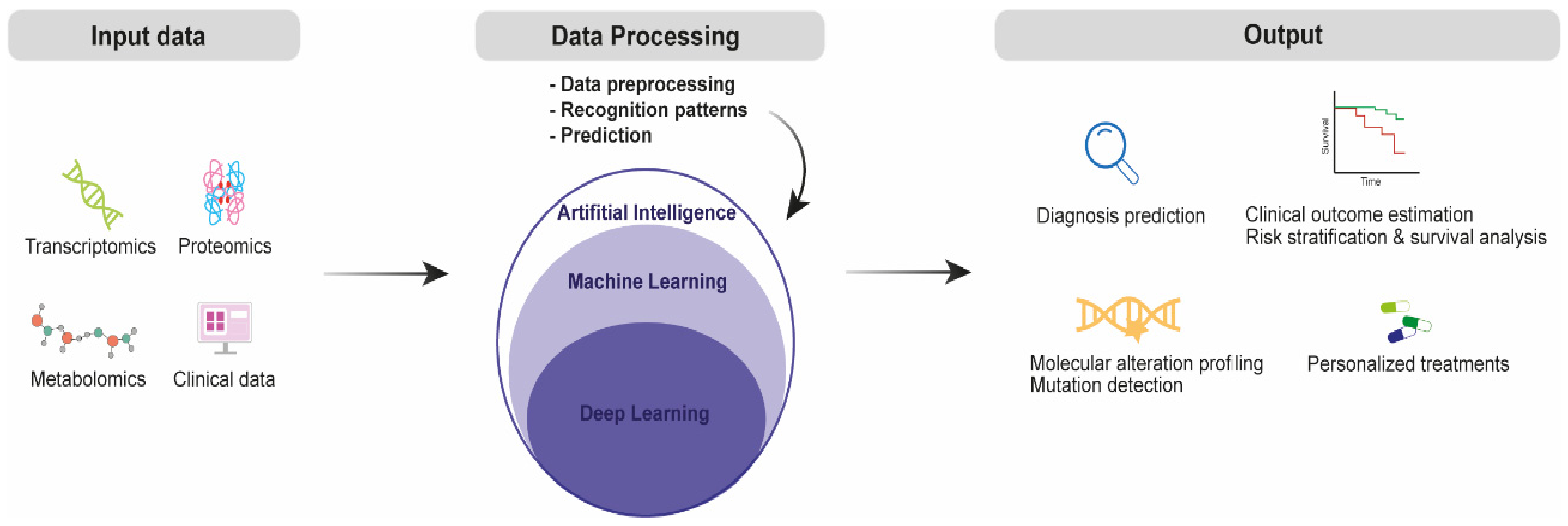
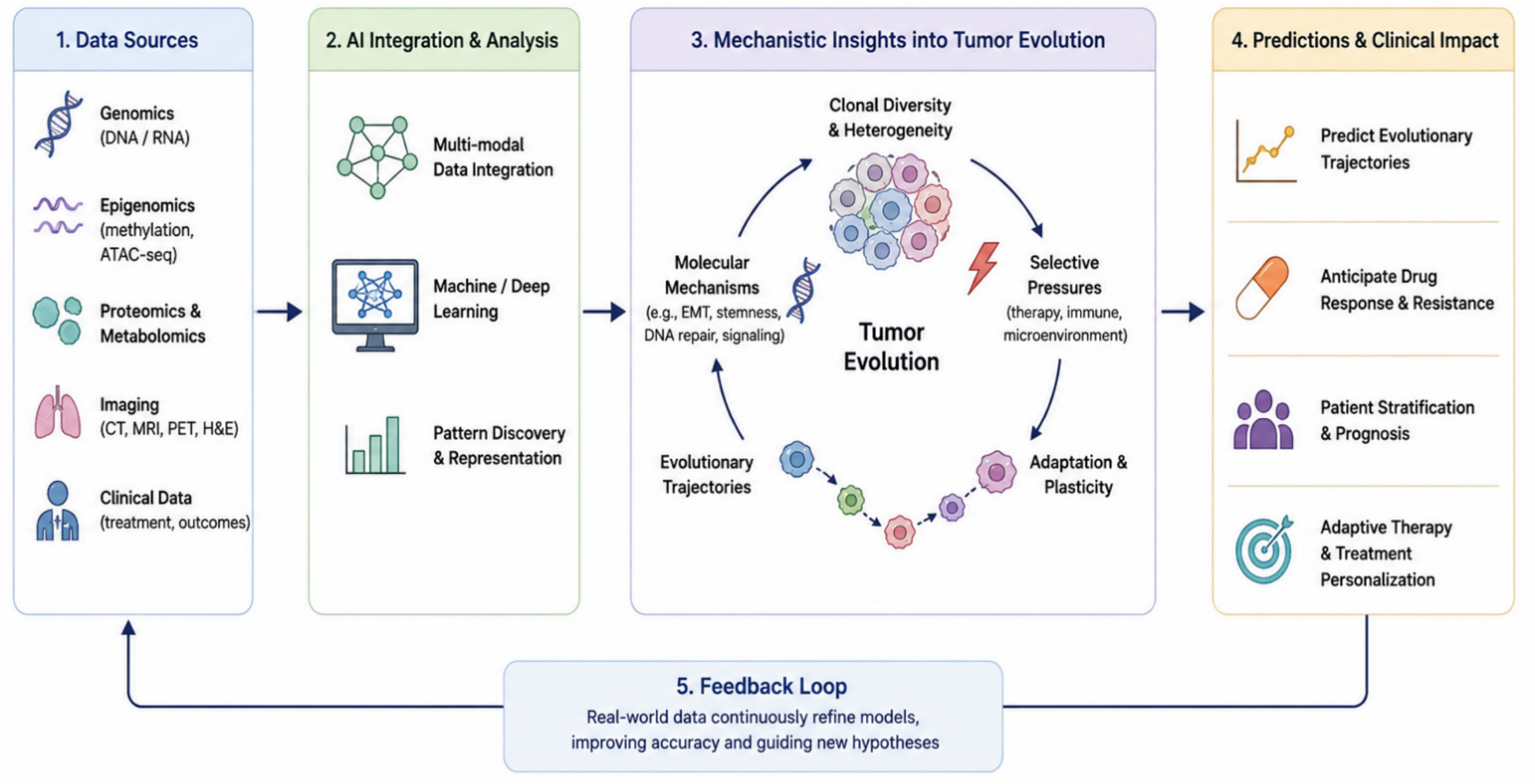
Cancer research has undergone a fundamental transformation in recent decades due to the integration of artificial intelligence (AI) models into the study of tumor biology. However, tumor evolution, driven by genetic and phenotypic alterations leading to heterogeneity, resistance and metastasis, remains a major challenge in oncology. To understand these processes is crucial for developing effective therapeutic strategies and improving patient outcomes. Conventional methods often fail to capture the complexity and dynamics of these processes. In contrast, AI tools have the ability to integrate and analyze large-scale multi-omics, imaging and clinical data, offering the capability to decode tumor complexity. AI-driven methods facilitate multi-modal data integration, enabling the recognition of patterns that connect molecular alterations with phenotypic outcomes. In functional genomics, AI tools predict the effects of genetic variants, identify regulatory elements and map dysregulated pathways, thus clarifying mechanisms underlying tumor development and resistance. In the imaging field, deep learning techniques improve tumor segmentation, characterization and longitudinal monitoring, providing more accurate insights into tumor progression and treatment response. Predictive modeling could allow the anticipation of tumor evolution and drug response, supporting adaptive therapeutic plans and real-time treatment adjustments. Moreover, AI supports biomarker discovery, patient stratification and decision support systems that can improve clinical trial design and accelerate the development of personalized therapies. However, these advances raise important ethical challenges, including data privacy, algorithmic bias and the preservation of patient autonomy. Addressing these concerns is essential to ensure the responsible deployment of AI in oncology.
Keywords: evolutionary oncology; intratumoral heterogeneity; multi-omics integration; single-cell transcriptomics; spatial transcriptomics; deep learning; convolutional neural networks; tumor microenvironment; adaptive therapy; evolutionary game theory; clonal evolution; precision oncology evolutionary oncology; intratumoral heterogeneity; multi-omics integration; single-cell transcriptomics; spatial transcriptomics; deep learning; convolutional neural networks; tumor microenvironment; adaptive therapy; evolutionary game theory; clonal evolution; precision oncology