Metabolic Crosstalk Between Host and Tumor as a Circuit of Resilience in Cancer Therapy


Abstract
1. Introduction
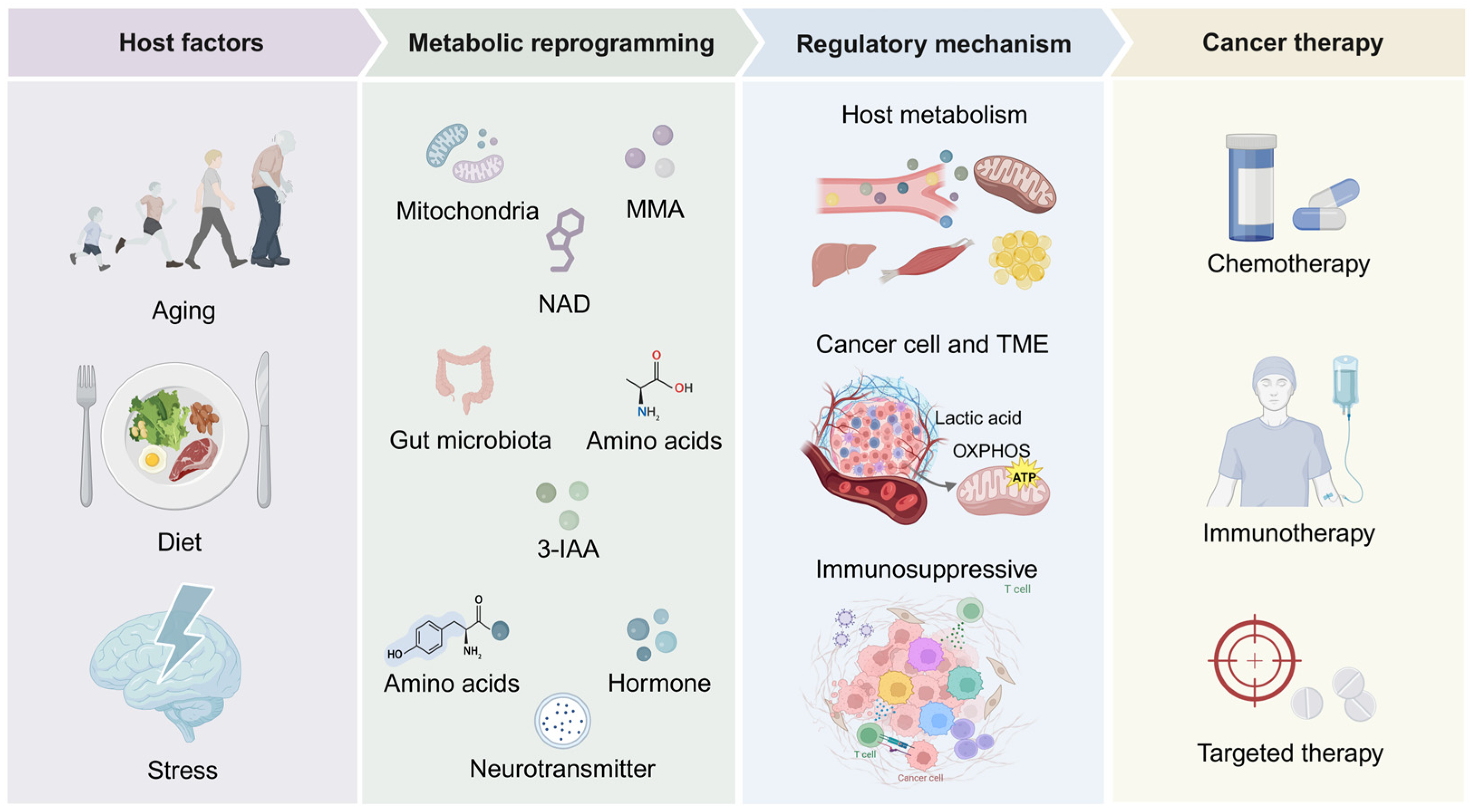
2. Metabolic Mediation of Host Factors in Therapy Response
2.1. Aging
2.2. Diet
2.3. Stress
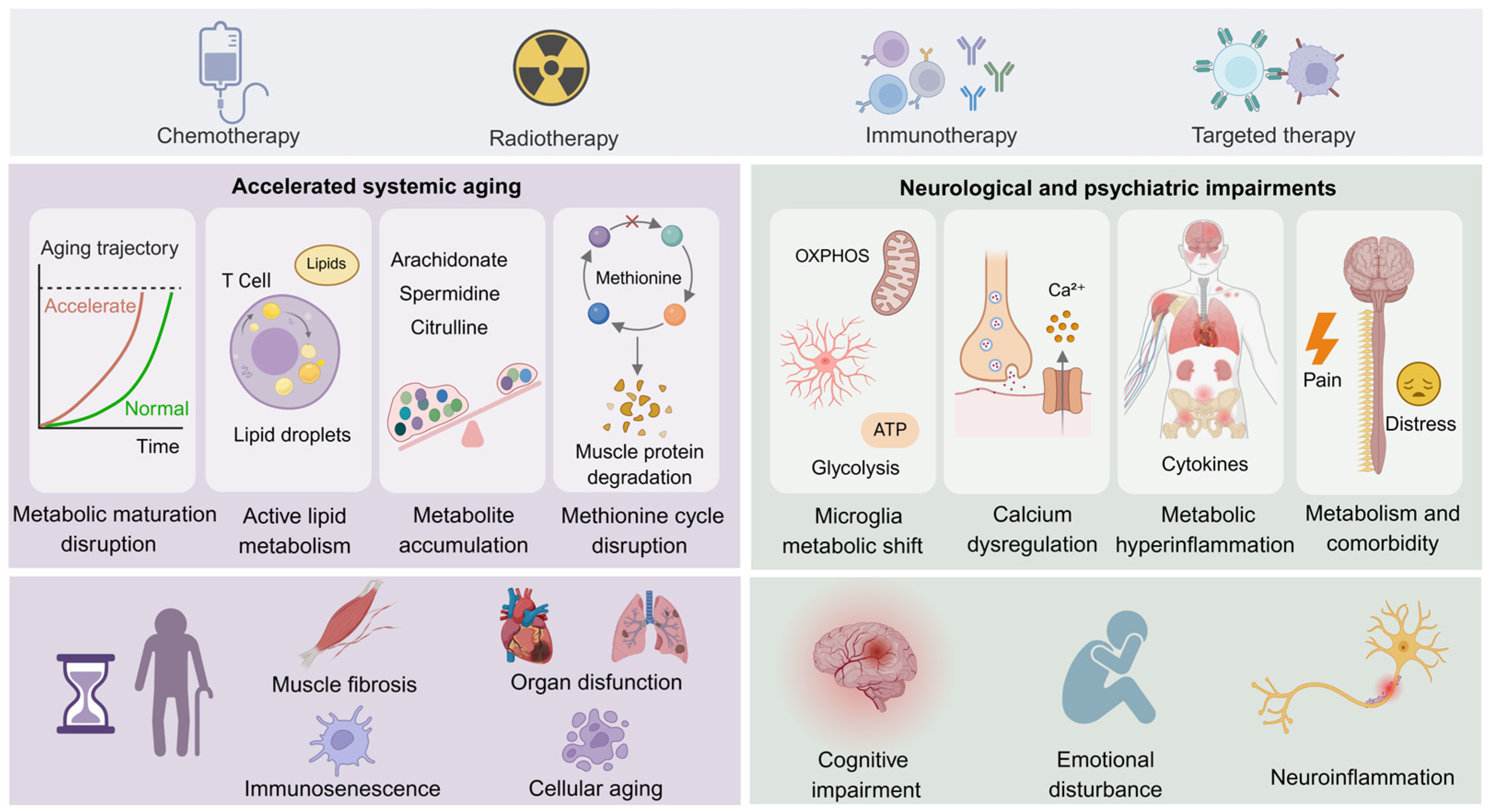
3. Metabolic Remodeling of Host Physiology by Therapies
3.1. Cancer Therapies Accelerate Host Aging
3.2. Therapies Influence Cognition
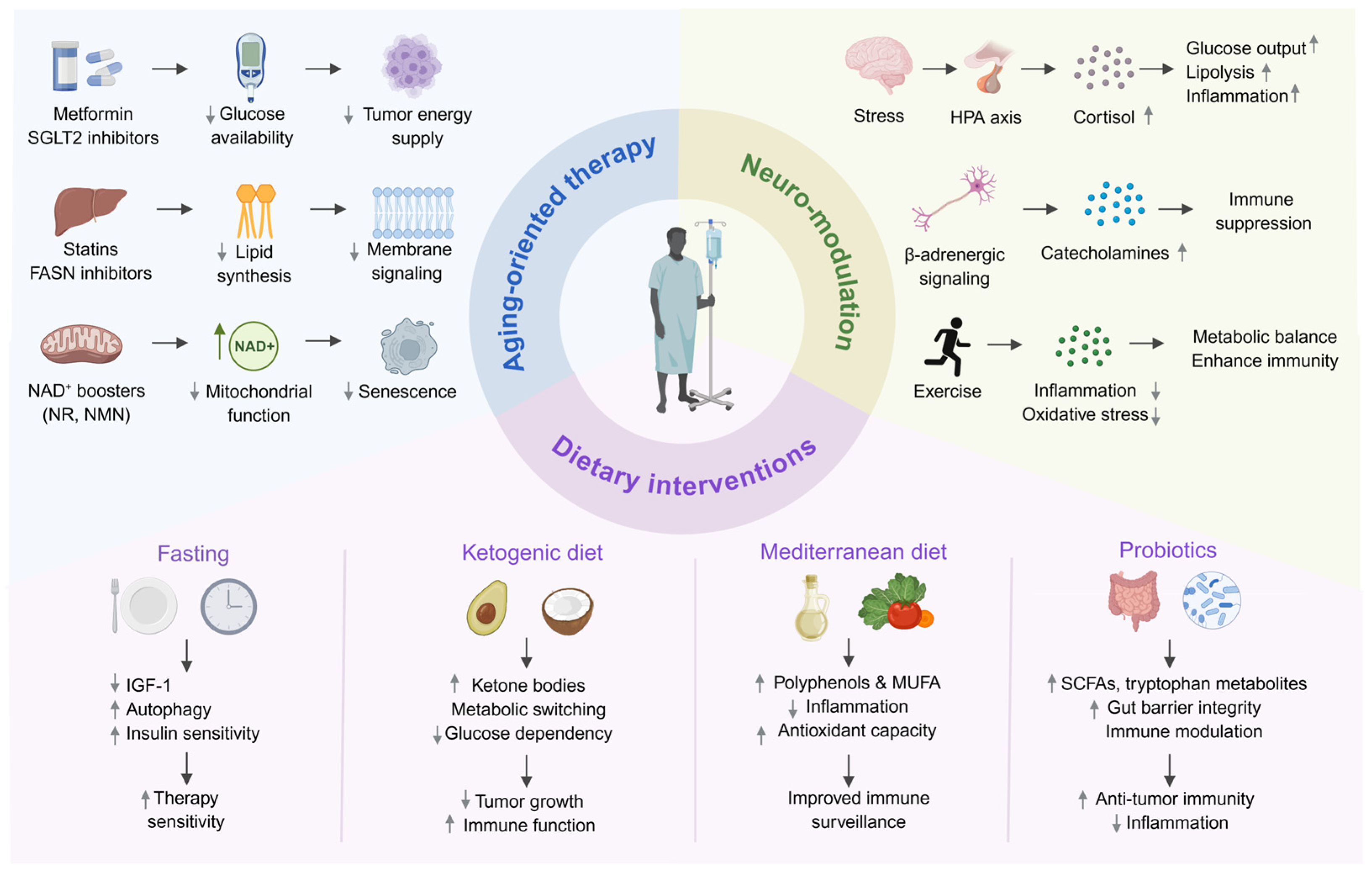
4. Therapeutic Interventions in Host Metabolism
4.1. Aging: The Metabolic Context for Intervention
4.1.1. Glucose Metabolism
4.1.2. Lipid Metabolism
4.1.3. Amino Acid Metabolism
4.1.4. Vitamins and Micronutrients
4.1.5. NAD+ and Spermidine
4.2. Dietary Interventions
4.2.1. Fasting
4.2.2. Ketogenic Diet
4.2.3. Mediterranean Diet
4.2.4. Nutrients and Dietary Supplements
4.3. Targeting Neural and Neuroendocrine Pathways
4.3.1. Neurotransmitters and Related Pathways
4.3.2. Neuropeptides and Neurotrophins
4.3.3. Hormonal Interventions
4.3.4. Non-Pharmacological Behavioral Interventions
5. Perspectives and Future Directions
5.1. Current Challenges
5.2. Emerging Technologies
5.3. Clinical Translation Strategies
Author Contributions
Funding
Institutional Review Board Statement
Informed Consent Statement
Data Availability Statement
Acknowledgments
Conflicts of Interest
References
- Parida, P.K.; Malladi, S. Metabolic adaptations of brain metastasis. Nat. Rev. Cancer 2025, 25, 723–739. [Google Scholar] [CrossRef]
- Martínez-Reyes, I.; Chandel, N.S. Cancer metabolism: Looking forward. Nat. Rev. Cancer 2021, 21, 669–680. [Google Scholar] [CrossRef]
- De Martino, M.; Rathmell, J.C.; Galluzzi, L.; Vanpouille-Box, C. Cancer cell metabolism and antitumour immunity. Nat. Rev. Immunol. 2024, 24, 654–669. [Google Scholar] [CrossRef]
- Scolaro, T.; Manco, M.; Pecqueux, M.; Amorim, R.; Trotta, R.; Van Acker, H.H.; Van Haele, M.; Shirgaonkar, N.; Naulaerts, S.; Daniluk, J.; et al. Nucleotide metabolism in cancer cells fuels a UDP-driven macrophage cross-talk, promoting immunosuppression and immunotherapy resistance. Nat. Cancer 2024, 5, 1206–1226. [Google Scholar] [CrossRef]
- Vitale, I.; Manic, G.; Coussens, L.M.; Kroemer, G.; Galluzzi, L. Macrophages and Metabolism in the Tumor Microenvironment. Cell Metab. 2019, 30, 36–50. [Google Scholar] [CrossRef] [PubMed]
- Aliazis, K.; Christofides, A.; Shah, R.; Yeo, Y.Y.; Jiang, S.; Charest, A.; Boussiotis, V.A. The tumor microenvironment’s role in the response to immune checkpoint blockade. Nat. Cancer 2025, 6, 924–937. [Google Scholar] [CrossRef] [PubMed]
- Murase, Y.; Nanjo, S.; Ueda, T.; Liu, Y.; Nomura, S.; Arai, S.; Terada, N.; Koba, H.; Tambo, Y.; Yano, S. Mechanisms of resistance to antibody-drug conjugates in cancers. Respir. Investig. 2025, 63, 693–698. [Google Scholar] [CrossRef]
- Swanton, C.; Bernard, E.; Abbosh, C.; André, F.; Auwerx, J.; Balmain, A.; Bar-Sagi, D.; Bernards, R.; Bullman, S.; DeGregori, J.; et al. Embracing cancer complexity: Hallmarks of systemic disease. Cell 2024, 187, 1589–1616. [Google Scholar] [CrossRef] [PubMed]
- Altea-Manzano, P.; Decker-Farrell, A.; Janowitz, T.; Erez, A. Metabolic interplays between the tumour and the host shape the tumour macroenvironment. Nat. Rev. Cancer 2025, 25, 274–292. [Google Scholar] [CrossRef]
- Febbraio, M.A.; Pedersen, B.K. Exercise as a therapeutic intervention for long-lasting and chronic diseases. Cell Metab. 2026, 38, 844–862. [Google Scholar] [CrossRef]
- Bass, J. Interorgan rhythmicity as a feature of healthful metabolism. Cell Metab. 2024, 36, 655–669. [Google Scholar] [CrossRef]
- Goncalves, R.L.S.; Wang, Z.B.; Riveros, J.K.; Parlakgül, G.; Inouye, K.E.; Lee, G.Y.; Fu, X.; Saksi, J.; Rosique, C.; Hui, S.T.; et al. CoQ imbalance drives reverse electron transport to disrupt liver metabolism. Nature 2025, 643, 1057–1065. [Google Scholar] [CrossRef]
- Wagle, N.S.; Nogueira, L.; Devasia, T.P.; Mariotto, A.B.; Yabroff, K.R.; Islami, F.; Jemal, A.; Alteri, R.; Ganz, P.A.; Siegel, R.L. Cancer treatment and survivorship statistics, 2025. CA Cancer J. Clin. 2025, 75, 308–340. [Google Scholar] [CrossRef]
- Baden, D.; Wolgast, N.; Altrock, P.M.; Steinhäuser, S.; Voran, J.; Beder, T.; Hecht, M.; Baden, C.; Bastian, L.; Ronckers, C.; et al. Epidemiology, survival, and treatment of acute myeloid and lymphoblastic leukaemia in Germany: A nationwide population-based registry analysis. Lancet Reg. Health Eur. 2025, 59, 101503. [Google Scholar] [CrossRef]
- Caruso, G.; Weroha, S.J.; Cliby, W. Ovarian Cancer: A Review. JAMA 2025, 334, 1278–1291. [Google Scholar] [CrossRef] [PubMed]
- Zhou, T.; Yan, J.; Zhang, Y.; Shao, F.; Xu, J.; Hu, T.; Mao, G.; Shi, S.; Zhang, Y.; Hao, J. Senescence as the Next Frontier in Cancer Research: Navigating the Rising Tide of Geriatric Oncology. Cancer Discov. 2026, 16, 207–212. [Google Scholar] [CrossRef] [PubMed]
- Gomes, A.P.; Ilter, D.; Low, V.; Endress, J.E.; Fernández-García, J.; Rosenzweig, A.; Schild, T.; Broekaert, D.; Ahmed, A.; Planque, M.; et al. Age-induced accumulation of methylmalonic acid promotes tumour progression. Nature 2020, 585, 283–287. [Google Scholar] [CrossRef]
- González-Gualda, E.; Reinius, M.A.V.; Macias, D.; Morsli, S.; Ge, J.; Olan, I.; Martín, J.E.; Ou, H.-L.; Hartono, M.; Puerto-Camacho, M.P.; et al. Treatment resistance to platinum-based chemotherapy in lung and ovarian cancer is driven by a targetable TGFβ senescent secretome. Nat. Aging 2026, 6, 368–392. [Google Scholar] [CrossRef] [PubMed]
- Alicea, G.M.; Rebecca, V.W.; Goldman, A.R.; Fane, M.E.; Douglass, S.M.; Behera, R.; Webster, M.R.; Kugel, C.H.; Ecker, B.L.; Caino, M.C.; et al. Changes in Aged Fibroblast Lipid Metabolism Induce Age-Dependent Melanoma Cell Resistance to Targeted Therapy via the Fatty Acid Transporter FATP2. Cancer Discov. 2020, 10, 1282–1295. [Google Scholar] [CrossRef]
- Fane, M.E.; Chhabra, Y.; Alicea, G.M.; Maranto, D.A.; Douglass, S.M.; Webster, M.R.; Rebecca, V.W.; Marino, G.E.; Almeida, F.; Ecker, B.L.; et al. Stromal changes in the aged lung induce an emergence from melanoma dormancy. Nature 2022, 606, 396–405. [Google Scholar] [CrossRef]
- Chhabra, Y.; Fane, M.E.; Pramod, S.; Hüser, L.; Zabransky, D.J.; Wang, V.; Dixit, A.; Zhao, R.; Kumah, E.; Brezka, M.L.; et al. Sex-dependent effects in the aged melanoma tumor microenvironment influence invasion and resistance to targeted therapy. Cell 2024, 187, 6016–6034.e25. [Google Scholar] [CrossRef]
- Hope, H.C.; de Sostoa, J.; Ginefra, P.; Andreatta, M.; Chiang, Y.-H.; Ronet, C.; Pich-Bavastro, C.; Corria Osorio, J.; Kuonen, F.; Auwerx, J.; et al. Age-associated nicotinamide adenine dinucleotide decline drives CAR-T cell failure. Nat. Cancer 2025, 6, 1524–1536. [Google Scholar] [CrossRef] [PubMed]
- Wang, F.; Bao, R.; Xu, S.; Li, W.; Huang, H.; Li, R.; Ding, X.; Zhang, Y.; Yu, X.; Han, Q.; et al. An age-related decrease in leptin contributes to CD8+ T cell aging in the tumor microenvironment. Cell Rep. Med. 2025, 6, 102310. [Google Scholar] [CrossRef] [PubMed]
- Parsons, A.; Sauras Colón, E.; Manjunath, M.; Zhang, H.; Chen, J.; Spasic, M.; Koca, B.; Binboga Kurt, B.; Freedman, R.A.; Mittendorf, E.A.; et al. Cell populations in human breast cancers are molecularly and biologically distinct with age. Nat. Aging 2025, 5, 2546–2563. [Google Scholar] [CrossRef]
- Sceneay, J.; Goreczny, G.J.; Wilson, K.; Morrow, S.; DeCristo, M.J.; Ubellacker, J.M.; Qin, Y.; Laszewski, T.; Stover, D.G.; Barrera, V.; et al. Interferon Signaling Is Diminished with Age and Is Associated with Immune Checkpoint Blockade Efficacy in Triple-Negative Breast Cancer. Cancer Discov. 2019, 9, 1208–1227. [Google Scholar] [CrossRef]
- Chen, M.-L.; He, Y.; Dong, X.-H.; Liu, H.-F.; Yan, Z.-X.; Lu, X.-L.; Miao, Q.-Q.; Zhao, Q.-N.; Zhang, H.; Luo, L.; et al. Ketogenic diet inhibits glioma progression by promoting gut microbiota-derived butyrate production. Cancer Cell 2025, 43, 2119–2135.e10. [Google Scholar] [CrossRef] [PubMed]
- Liu, S.; Guruprasad, P.; Ramasubramanian, R.; Madhu, B.; Paruzzo, L.; Han, K.; Kelly, A.; Shestov, A.; Xu, H.N.; Carturan, A.; et al. β-hydroxybutyrate enhances the metabolic fitness of CAR T cells in cancer. Cell 2026, 189, 1701–1716.e24. [Google Scholar] [CrossRef]
- Yang, L.; TeSlaa, T.; Ng, S.; Nofal, M.; Wang, L.; Lan, T.; Zeng, X.; Cowan, A.; McBride, M.; Lu, W.; et al. Ketogenic diet and chemotherapy combine to disrupt pancreatic cancer metabolism and growth. Med 2022, 3, 119–136.e8. [Google Scholar] [CrossRef]
- Roichman, A.; Zuo, Q.; Hwang, S.; Lu, W.; Cordova, R.A.; MacArthur, M.R.; Boyer, J.A.; Mitchell, S.J.; Powers, J.; Koval, S.A.; et al. Microbiome metabolism of dietary phytochemicals controls the anticancer activity of PI3K inhibitors. Cell 2025, 188, 3065–3080.e21. [Google Scholar] [CrossRef]
- Oswald, B.M.; DeCamp, L.M.; Longo, J.; Dahabieh, M.S.; Bunda, N.; Johnson, B.K.; Watson, M.J.; Ma, S.; Preston, S.E.J.; Sheldon, R.D.; et al. Dietary restriction reprograms CD8+ T cell fate to enhance anti-tumour immunity and immunotherapy responses. Nat. Metab. 2025, 7, 2489–2509. [Google Scholar] [CrossRef]
- Ajona, D.; Ortiz-Espinosa, S.; Lozano, T.; Exposito, F.; Calvo, A.; Valencia, K.; Redrado, M.; Remírez, A.; Lecanda, F.; Alignani, D.; et al. Short-term starvation reduces IGF-1 levels to sensitize lung tumors to PD-1 immune checkpoint blockade. Nat. Cancer 2020, 1, 75–85. [Google Scholar] [CrossRef]
- Delconte, R.B.; Owyong, M.; Santosa, E.K.; Srpan, K.; Sheppard, S.; McGuire, T.J.; Abbasi, A.; Diaz-Salazar, C.; Chun, J.; Rogatsky, I.; et al. Fasting reshapes tissue-specific niches to improve NK cell-mediated anti-tumor immunity. Immunity 2024, 57, 1923–1938.e27. [Google Scholar] [CrossRef]
- Padrão, N.; Severson, T.M.; Gregoricchio, S.; Guijarro, A.; Lutz, C.; Taranto, D.; Hutten, S.; Ligorio, F.; Persia, A.; Roest, M.; et al. Fasting boosts breast cancer therapy efficacy via glucocorticoid activation. Nature 2025, 649, 1013–1021. [Google Scholar] [CrossRef] [PubMed]
- Tintelnot, J.; Xu, Y.; Lesker, T.R.; Schönlein, M.; Konczalla, L.; Giannou, A.D.; Pelczar, P.; Kylies, D.; Puelles, V.G.; Bielecka, A.A.; et al. Microbiota-derived 3-IAA influences chemotherapy efficacy in pancreatic cancer. Nature 2023, 615, 168–174. [Google Scholar] [CrossRef]
- Bender, M.J.; McPherson, A.C.; Phelps, C.M.; Pandey, S.P.; Laughlin, C.R.; Shapira, J.H.; Medina Sanchez, L.; Rana, M.; Richie, T.G.; Mims, T.S.; et al. Dietary tryptophan metabolite released by intratumoral Lactobacillus reuteri facilitates immune checkpoint inhibitor treatment. Cell 2023, 186, 1846–1862.e26. [Google Scholar] [CrossRef]
- De Juan, A.; Coillard, A.; Cros, A.; Rigamonti, A.; Alaoui, L.; Sampaio, J.L.; Monot, N.; Balvay, A.; Foussier, A.; Rieux-Laucat, M.; et al. Physiological activation of Aryl hydrocarbon receptor by food-derived ligands is essential for the efficacy of anti-PD1 therapy. Nat. Commun. 2025, 16, 10598. [Google Scholar] [CrossRef]
- Kanarek, N.; Keys, H.R.; Cantor, J.R.; Lewis, C.A.; Chan, S.H.; Kunchok, T.; Abu-Remaileh, M.; Freinkman, E.; Schweitzer, L.D.; Sabatini, D.M. Histidine catabolism is a major determinant of methotrexate sensitivity. Nature 2018, 559, 632–636. [Google Scholar] [CrossRef] [PubMed]
- Qian, Z.Y.; Deng, Y.; Xi, M.; Zhang, X.Y.; Sun, H.; Mao, M.; Luo, X.J.; Li, M.; Zhang, Q.; Chen, B.; et al. Longitudinal Plasma Metabolomics Guides Dynamic Risk Assessment and Dietary Modulation for Esophageal Squamous Cell Cancer Chemoimmunotherapy. Cancer Discov. 2026. [Google Scholar] [CrossRef]
- Bolte, L.A.; Lee, K.A.; Björk, J.R.; Leeming, E.R.; Campmans-Kuijpers, M.J.E.; de Haan, J.J.; Vila, A.V.; Maltez-Thomas, A.; Segata, N.; Board, R.; et al. Association of a Mediterranean Diet with Outcomes for Patients Treated with Immune Checkpoint Blockade for Advanced Melanoma. JAMA Oncol. 2023, 9, 705–709. [Google Scholar] [CrossRef] [PubMed]
- Kok, D.E.; Arron, M.N.N.; Huibregtse, T.; Kruyt, F.M.; Bac, D.J.; van Halteren, H.K.; Kouwenhoven, E.A.; Wesselink, E.; Winkels, R.M.; van Zutphen, M.; et al. Association of Habitual Preoperative Dietary Fiber Intake with Complications After Colorectal Cancer Surgery. JAMA Surg. 2021, 156, 827–835. [Google Scholar] [CrossRef] [PubMed]
- Lanser, D.A.C.; de Leeuw, S.P.; Oomen-de Hoop, E.; de Bruijn, P.; Paats, M.S.; Dumoulin, D.W.; Koolen, S.L.W.; Dingemans, A.-M.C.; Mathijssen, R.H.J.; Veerman, G.D.M. Influence of Food with Different Fat Concentrations on Alectinib Exposure: A Randomized Crossover Pharmacokinetic Trial. J. Natl. Compr. Cancer Netw. 2023, 21, 645–651.e1. [Google Scholar] [CrossRef]
- Spencer, C.N.; McQuade, J.L.; Gopalakrishnan, V.; McCulloch, J.A.; Vetizou, M.; Cogdill, A.P.; Khan, M.A.W.; Zhang, X.; White, M.G.; Peterson, C.B.; et al. Dietary fiber and probiotics influence the gut microbiome and melanoma immunotherapy response. Science 2021, 374, 1632–1640. [Google Scholar] [CrossRef]
- Zhou, P.; Chang, W.-y.; Gong, D.-a.; Xia, J.; Chen, W.; Huang, L.-y.; Liu, R.; Liu, Y.; Chen, C.; Wang, K.; et al. High dietary fructose promotes hepatocellular carcinoma progression by enhancing O-GlcNAcylation via microbiota-derived acetate. Cell Metab. 2023, 35, 1961–1975.e66. [Google Scholar] [CrossRef]
- Niu, X.; Wu, T.; Zeng, L.; Wang, F.; Lv, W.; Zhang, L.; Zhou, F. Chronic stress in cancer development and progression. Sci. Bull. 2025, 70, 3885–3907. [Google Scholar] [CrossRef]
- Eckerling, A.; Ricon-Becker, I.; Sorski, L.; Sandbank, E.; Ben-Eliyahu, S. Stress and cancer: Mechanisms, significance and future directions. Nat. Rev. Cancer 2021, 21, 767–785. [Google Scholar] [CrossRef]
- Khan, A.; Song, M.; Dong, Z. Chronic stress: A fourth etiology in tumorigenesis? Mol. Cancer 2025, 24, 196. [Google Scholar] [CrossRef] [PubMed]
- Ma, Y.; Kroemer, G. The cancer-immune dialogue in the context of stress. Nat. Rev. Immunol. 2023, 24, 264–281. [Google Scholar] [CrossRef]
- Nilsson, M.B.; Sun, H.; Diao, L.; Tong, P.; Liu, D.; Li, L.; Fan, Y.; Poteete, A.; Lim, S.-O.; Howells, K.; et al. Stress hormones promote EGFR inhibitor resistance in NSCLC: Implications for combinations with β-blockers. Sci. Transl. Med. 2017, 9, eaao4307. [Google Scholar] [CrossRef] [PubMed]
- Yang, H.; Xia, L.; Chen, J.; Zhang, S.; Martin, V.; Li, Q.; Lin, S.; Chen, J.; Calmette, J.; Lu, M.; et al. Stress–glucocorticoid–TSC22D3 axis compromises therapy-induced antitumor immunity. Nat. Med. 2019, 25, 1428–1441. [Google Scholar] [CrossRef] [PubMed]
- Cassandras, M.; Sanchez, X.; Hsu, L.; Huang, Y.; Getzler, A.J.; Ganguly, D.; Baldominos, P.; Codinachs, I.; Chuong, J.; Martin, E.E.; et al. A glucocorticoid–FAS axis controls immune evasion during metastatic seeding. Nature 2026, 653, 567–575. [Google Scholar] [CrossRef]
- Zeng, Y.; Hu, C.-H.; Li, Y.-Z.; Zhou, J.-S.; Wang, S.-X.; Liu, M.-D.; Qiu, Z.-H.; Deng, C.; Ma, F.; Xia, C.-F.; et al. Association between pretreatment emotional distress and immune checkpoint inhibitor response in non-small-cell lung cancer. Nat. Med. 2024, 30, 1680–1688. [Google Scholar] [CrossRef]
- Chen, M.; Qiao, G.; Hylander, B.L.; Mohammadpour, H.; Wang, X.-Y.; Subjeck, J.R.; Singh, A.K.; Repasky, E.A. Adrenergic stress constrains the development of anti-tumor immunity and abscopal responses following local radiation. Nat. Commun. 2020, 11, 1821. [Google Scholar] [CrossRef]
- Huang, C.; Tao, H.; Zhou, Y.; Wu, Q.; Li, M.; Liu, A.; Zhu, T.; Yu, C.; Li, P.; Huang, S.; et al. Pregnenolone promotes immune evasion through blocking endogenous retrovirus expression. Cell Metab. 2026, 38, 981–994.e8. [Google Scholar] [CrossRef]
- Guan, Y.; Yao, W.; Yu, H.; Feng, Y.; Zhao, Y.; Zhan, X.; Wang, Y. Chronic stress promotes colorectal cancer progression by enhancing glycolysis through β2-AR/CREB1 signal pathway. Int. J. Biol. Sci. 2023, 19, 2006–2020. [Google Scholar] [CrossRef]
- Luo, M.; Luo, W. Aminopeptidase N: The glucocorticoid gateway linking chronic stress to ferroptosis resistance in liver cancer. J. Clin. Investig. 2026, 136, e202410. [Google Scholar] [CrossRef]
- Sun, R.; Jiao, D.; Yuan, W.; Wang, H.; Ren, L.; Fu, Z.; Zhang, J.; Yue, X.; Wu, Z.; Li, C.; et al. Chronic stress drives liver cancer by impairing the hepatic kynurenine pathway and immune surveillance. Nat. Metab. 2026, 8, 196–214. [Google Scholar] [CrossRef] [PubMed]
- Li, J.; Lu, J.; Zheng, C.; Huang, X.; Li, H.; Mai, Q.; Chen, S.; Zhou, Z.; Zhu, J.; Yu, T.; et al. Serotonin-licensed macrophages potentiate chemoresistance via inositol metabolic crosstalk in ovarian cancer. Cell Metab. 2026, 38, 331–349.e10. [Google Scholar] [CrossRef] [PubMed]
- Chen, Z.; Zhou, Y.; Xue, C.; Zeng, L.; Deng, S.; Xu, Z.; Li, M.; Zhao, H.; He, X.; Liu, S.; et al. Psychological stress-induced ALKBH5 deficiency promotes tumour innervation and pancreatic cancer via extracellular vesicle transfer of RNA. Nat. Cell Biol. 2025, 27, 1035–1047. [Google Scholar] [CrossRef] [PubMed]
- Zhang, Y.; Guo, Y.; Liu, Z.; Sun, Y.; Yang, X.; Chen, M.; Feng, G.; Lin, C.; Wang, Y.; Zhang, Z.; et al. Cancer cells co-opt an inter-organ neuroimmune circuit to escape immune surveillance. Cell 2025, 188, 6754–6773.e29. [Google Scholar] [CrossRef]
- Bucsek, M.J.; Qiao, G.; MacDonald, C.R.; Giridharan, T.; Evans, L.; Niedzwecki, B.; Liu, H.; Kokolus, K.M.; Eng, J.W.L.; Messmer, M.N.; et al. β-Adrenergic Signaling in Mice Housed at Standard Temperatures Suppresses an Effector Phenotype in CD8+ T Cells and Undermines Checkpoint Inhibitor Therapy. Cancer Res. 2017, 77, 5639–5651. [Google Scholar] [CrossRef]
- Cui, B.; Luo, H.; He, B.; Liu, X.; Lv, D.; Zhang, X.; Su, K.; Zheng, S.; Lu, J.; Wang, C.; et al. Gut dysbiosis conveys psychological stress to activate LRP5/β-catenin pathway promoting cancer stemness. Signal Transduct. Target. Ther. 2025, 10, 79. [Google Scholar] [CrossRef] [PubMed]
- Hoover, G.; Gilbert, S.; Curley, O.; Obellianne, C.; Lin, M.T.; Hixson, W.; Pierce, T.W.; Andrews, J.F.; Alexeyev, M.F.; Ding, Y.; et al. Nerve-to-cancer transfer of mitochondria during cancer metastasis. Nature 2025, 644, 252–262. [Google Scholar] [CrossRef] [PubMed]
- Peinado, P.; Stazi, M.; Ballabio, C.; Margineanu, M.-B.; Li, Z.; Colón, C.I.; Hsieh, M.-S.; Pal Choudhuri, S.; Stastny, V.; Hamilton, S.; et al. Intrinsic electrical activity drives small-cell lung cancer progression. Nature 2025, 639, 765–775. [Google Scholar] [CrossRef]
- Thiel, V.; Renders, S.; Panten, J.; Dross, N.; Bauer, K.; Azorin, D.; Henriques, V.; Vogel, V.; Klein, C.; Leppä, A.-M.; et al. Characterization of single neurons reprogrammed by pancreatic cancer. Nature 2025, 640, 1042–1051. [Google Scholar] [CrossRef] [PubMed]
- Winkler, F.; Venkatesh, H.S.; Amit, M.; Batchelor, T.; Demir, I.E.; Deneen, B.; Gutmann, D.H.; Hervey-Jumper, S.; Kuner, T.; Mabbott, D.; et al. Cancer neuroscience: State of the field, emerging directions. Cell 2023, 186, 1689–1707. [Google Scholar] [CrossRef]
- Zhang, Y.; Zhuang, W.; Zhu, H.; Meng, F.; Chen, M.; Guo, Y.; Fan, J.; Sun, Y.; Ji, T. Neuroimmunometabolic co-evolution in the tumor micro- and macroenvironment. Cell Metab. 2026, 38, 655–672. [Google Scholar] [CrossRef]
- Pich, O.; Ward, S.; Rowan, A.; Naceur-Lombardelli, C.; Shutkever, O.; Martinez-Ruiz, C.; Harries, S.; Hessey, S.; Naidu, B.; Brenton, J.D.; et al. Somatic evolution following cancer treatment in normal tissue. Nature 2025, 653, 900–910. [Google Scholar] [CrossRef]
- Smitherman, A.B.; Wood, W.A.; Mitin, N.; Ayer Miller, V.L.; Deal, A.M.; Davis, I.J.; Blatt, J.; Gold, S.H.; Muss, H.B. Accelerated aging among childhood, adolescent, and young adult cancer survivors is evidenced by increased expression of p16INK4a and frailty. Cancer 2020, 126, 4975–4983. [Google Scholar] [CrossRef]
- Williams, A.M.; Phillips, N.S.; Dong, Q.; Ehrhardt, M.J.; Gilmore, N.; Loh, K.P.; Meng, X.; Ness, K.K.; Hudson, M.M.; Robison, L.L.; et al. Epigenetic age acceleration, telomere length, and neurocognitive function in long-term survivors of childhood cancer. Nat. Commun. 2025, 16, 10655. [Google Scholar] [CrossRef]
- Krawczuk-Rybak, M.; Latoch, E. Risk factors for premature aging in childhood cancer survivors. Dev. Period Med. 2019, 23, 97–103. [Google Scholar] [CrossRef]
- Zhang, X.; Nie, Z.; Wang, S.; Ma, Y.; Han, D.; Hu, T.; Liu, L.; Men, L.; Zhang, T.; Wu, X.; et al. Arachidonic acid triggers spermidine synthase secretion from primary tumor to induce skeletal muscle weakness upon irradiation. Cell Metab. 2025, 37, 1766–1782.e12. [Google Scholar] [CrossRef]
- Fletcher-Sananikone, E.; Kanji, S.; Tomimatsu, N.; Di Cristofaro, L.F.M.; Kollipara, R.K.; Saha, D.; Floyd, J.R.; Sung, P.; Hromas, R.; Burns, T.C.; et al. Elimination of Radiation-Induced Senescence in the Brain Tumor Microenvironment Attenuates Glioblastoma Recurrence. Cancer Res. 2021, 81, 5935–5947. [Google Scholar] [CrossRef]
- Lin, K.; Wei, L.; Wang, R.; Li, L.; Song, S.; Wang, F.; He, M.; Pu, W.; Wang, J.; Wazir, J.; et al. Disrupted methionine cycle triggers muscle atrophy in cancer cachexia through epigenetic regulation of REDD1. Cell Metab. 2025, 37, 460–476.e68. [Google Scholar] [CrossRef]
- Ma, F.; Liu, X.; Zhang, Y.; Tao, Y.; Zhao, L.; Abusalamah, H.; Huffman, C.; Harbison, R.A.; Puram, S.V.; Wang, Y.; et al. Tumor extracellular vesicle–derived PD-L1 promotes T cell senescence through lipid metabolism reprogramming. Sci. Transl. Med. 2025, 17, eadm7269. [Google Scholar] [CrossRef] [PubMed]
- Dai, D.; Pei, Y.; Zhu, B.; Wang, D.; Pei, S.; Huang, H.; Zhu, Q.; Deng, X.; Ye, J.; Xu, J.; et al. Chemoradiotherapy-induced ACKR2+ tumor cells drive CD8+ T cell senescence and cervical cancer recurrence. Cell Rep. Med. 2024, 5, 101550. [Google Scholar] [CrossRef] [PubMed]
- Nicolas, A.M.; Pesic, M.; Engel, E.; Ziegler, P.K.; Diefenhardt, M.; Kennel, K.B.; Buettner, F.; Conche, C.; Petrocelli, V.; Elwakeel, E.; et al. Inflammatory fibroblasts mediate resistance to neoadjuvant therapy in rectal cancer. Cancer Cell 2022, 40, 168–184.e13. [Google Scholar] [CrossRef] [PubMed]
- Yousefzadeh, M.J.; Flores, R.R.; Zhu, Y.; Schmiechen, Z.C.; Brooks, R.W.; Trussoni, C.E.; Cui, Y.; Angelini, L.; Lee, K.-A.; McGowan, S.J.; et al. An aged immune system drives senescence and ageing of solid organs. Nature 2021, 594, 100–105. [Google Scholar] [CrossRef]
- Hesterberg, R.S.; Davis, J.T.; Handoo, K.J.; Elmarsafawi, A.G.; Augello, A.C.; Cheng, C.-H.; Atkins, R.; Lee, D.H.; Yang, C.; Yao, J.; et al. Lymphoma accelerates T cell and tissue aging. Cancer Cell 2025, 43, 1917–1936.e8. [Google Scholar] [CrossRef]
- Liu, L.; Wang, Q.; Chen, M.; Zhou, H.; Li, X.; Yuan, Z.; Hu, Y.; Wang, C.; Zhang, X.; Hu, S.; et al. Cancer-cell-secreted DDAH1 induces TGF-β1/Smad3 signaling pathway to promote fibrosis and aging in lung. Nat. Aging 2025, 6, 143–161. [Google Scholar] [CrossRef]
- Demaria, M.; O’Leary, M.N.; Chang, J.; Shao, L.; Liu, S.; Alimirah, F.; Koenig, K.; Le, C.; Mitin, N.; Deal, A.M.; et al. Cellular Senescence Promotes Adverse Effects of Chemotherapy and Cancer Relapse. Cancer Discov. 2017, 7, 165–176. [Google Scholar] [CrossRef]
- Karschnia, P.; Nelson, T.A.; Dietrich, J. Mechanisms and treatment of cancer therapy-induced peripheral and central neurotoxicity. Nat. Rev. Cancer 2025, 25, 887–909. [Google Scholar] [CrossRef]
- Heinrich, M.; Hofmann, L.; Baurecht, H.; Kreuzer, P.M.; Knüttel, H.; Leitzmann, M.F.; Seliger, C. Suicide risk and mortality among patients with cancer. Nat. Med. 2022, 28, 852–859. [Google Scholar] [CrossRef]
- Miller, N.E.; Pentti, J.; Steptoe, A.; Kivimaki, M.; Lally, P.; Frank, P.; Fisher, A. Mediators of the association between psychological distress and mortality in people diagnosed with cancer. Nat. Commun. 2025, 16, 11216. [Google Scholar] [CrossRef]
- Janelsins, M.C.; Heckler, C.E.; Peppone, L.J.; Kamen, C.; Mustian, K.M.; Mohile, S.G.; Magnuson, A.; Kleckner, I.R.; Guido, J.J.; Young, K.L.; et al. Cognitive Complaints in Survivors of Breast Cancer After Chemotherapy Compared with Age-Matched Controls: An Analysis From a Nationwide, Multicenter, Prospective Longitudinal Study. J. Clin. Oncol. 2017, 35, 506–514. [Google Scholar] [CrossRef]
- Kang, I.M.; Forschmiedt, J.K.; Loch, M.M.; Lew, D.L.; Barlow, W.E.; Gralow, J.R.; Meric-Bernstam, F.; Albain, K.S.; Hayes, D.F.; Lin, N.U.; et al. Cognitive Impairment and Chemoendocrine vs Endocrine Therapy in Pre- and Postmenopausal Women. JAMA Oncol. 2026, 12, 159–166. [Google Scholar] [CrossRef]
- Sleurs, C.; Zegers, C.M.L.; Ribeiro, M.F.; van Elmpt, W.; Dijkstra, J.; Postma, A.A.; De Roeck, L.; Gehring, K.; De Baene, W.; Sitskoorn, M.M.; et al. Radiotherapy-induced neurocognitive decline among adult intracranial tumor patients: A voxel-based approach. Neuro-Oncology 2025, 27, 2634–2646. [Google Scholar] [CrossRef]
- Bennett, C.L.; Focosi, D.; Socal, M.P.; Bian, J.C.; Nabhan, C.; Hrushesky, W.J.; Bennett, A.C.; Schoen, M.W.; Berger, J.R.; Armitage, J.O. Progressive multifocal leukoencephalopathy in patients treated with rituximab: A 20-year review from the Southern Network on Adverse Reactions. Lancet Haematol. 2021, 8, e593–e604. [Google Scholar] [CrossRef]
- Gibson, E.M.; Nagaraja, S.; Ocampo, A.; Tam, L.T.; Wood, L.S.; Pallegar, P.N.; Greene, J.J.; Geraghty, A.C.; Goldstein, A.K.; Ni, L.; et al. Methotrexate Chemotherapy Induces Persistent Tri-glial Dysregulation that Underlies Chemotherapy-Related Cognitive Impairment. Cell 2019, 176, 43–55.e13. [Google Scholar] [CrossRef]
- Groves, T.R.; Farris, R.; Anderson, J.E.; Alexander, T.C.; Kiffer, F.; Carter, G.; Wang, J.; Boerma, M.; Allen, A.R. 5-Fluorouracil chemotherapy upregulates cytokines and alters hippocampal dendritic complexity in aged mice. Behav. Brain Res. 2017, 316, 215–224. [Google Scholar] [CrossRef]
- Liu, Y.; Reiken, S.; Dridi, H.; Yuan, Q.; Mohammad, K.S.; Trivedi, T.; Miotto, M.C.; Wedderburn-Pugh, K.; Sittenfeld, L.; Kerley, Y.; et al. Targeting ryanodine receptor type 2 to mitigate chemotherapy-induced neurocognitive impairments in mice. Sci. Transl. Med. 2023, 15, eadf8977. [Google Scholar] [CrossRef]
- Geraghty, A.C.; Acosta-Alvarez, L.; Rotiroti, M.C.; Dutton, S.; O’Dea, M.R.; Kim, W.; Trivedi, V.; Mancusi, R.; Shamardani, K.; Malacon, K.; et al. Immunotherapy-related cognitive impairment after CAR T cell therapy in mice. Cell 2025, 188, 3238–3258.e25. [Google Scholar] [CrossRef]
- Berger, S.C.; Fehse, B.; Akyüz, N.; Geffken, M.; Wolschke, C.; Janson, D.; Gagelmann, N.; Luther, M.; Wichmann, D.; Frenzel, C.; et al. Molecular monitoring of T-cell kinetics and migration in severe neurotoxicity after real-world CD19-specific chimeric antigen receptor T cell therapy. Haematologica 2022, 108, 444–456. [Google Scholar] [CrossRef]
- Staedtke, V.; Bai, R.-Y.; Kim, K.; Darvas, M.; Davila, M.L.; Riggins, G.J.; Rothman, P.B.; Papadopoulos, N.; Kinzler, K.W.; Vogelstein, B.; et al. Disruption of a self-amplifying catecholamine loop reduces cytokine release syndrome. Nature 2018, 564, 273–277. [Google Scholar] [CrossRef]
- Yang, X.; Wang, X.; Lu, W.; Ye, Q.; Li, Y.; Ma, X.; Ye, Y.; Guo, X.; Chen, G.; Xin, W.; et al. METTL14 integrates tumor-derived SAM to drive parabrachial epigenetic rewiring in pancreatic cancer. Neuron 2026, 114, 250–267.e8. [Google Scholar] [CrossRef]
- Zhu, X.; Shen, J.; Feng, S.; Huang, C.; Wang, H.; Huo, F.; Liu, H. Akkermansia muciniphila, which is enriched in the gut microbiota by metformin, improves cognitive function in aged mice by reducing the proinflammatory cytokine interleukin-6. Microbiome 2023, 11, 120. [Google Scholar] [CrossRef]
- Kumazawa, T.; Xu, Y.; Wang, Y.; Lee, J.-W.; O’Brien, T.C.; Ho, C.-K.; Cetinbas, M.; Weiner, A.; Hochedlinger, K.; Sadreyev, R.I.; et al. Metformin inhibits nuclear egress of chromatin fragments in senescence and aging. Nat. Aging 2026, 6, 303–315. [Google Scholar] [CrossRef]
- Zhang, J.; Cai, W.; Liu, D.; Zheng, N.; Wang, Y.; Qiu, F.; Zheng, H.; Gan, H.; Huang, Y.; Zhou, Y.; et al. Effect of henagliflozin on aging biomarkers in patients with type 2 diabetes: A multicenter, randomized, double-blind, placebo-controlled study. Cell Rep. Med. 2025, 6, 102331. [Google Scholar] [CrossRef]
- Gozdecka, M.; Dudek, M.; Wen, S.; Gu, M.; Stopforth, R.J.; Rak, J.; Damaskou, A.; Grice, G.L.; McLoughlin, M.A.; Bond, L.; et al. Mitochondrial metabolism sustains DNMT3A-R882-mutant clonal haematopoiesis. Nature 2025, 642, 431–441. [Google Scholar] [CrossRef]
- Hosseini, M.; Voisin, V.; Chegini, A.; Varesi, A.; Cathelin, S.; Ayyathan, D.M.; Liu, A.C.H.; Yang, Y.; Wang, V.; Maher, A.; et al. Metformin reduces the competitive advantage of Dnmt3aR878H HSPCs. Nature 2025, 642, 421–430. [Google Scholar] [CrossRef]
- Elgendy, M.; Cirò, M.; Hosseini, A.; Weiszmann, J.; Mazzarella, L.; Ferrari, E.; Cazzoli, R.; Curigliano, G.; DeCensi, A.; Bonanni, B.; et al. Combination of Hypoglycemia and Metformin Impairs Tumor Metabolic Plasticity and Growth by Modulating the PP2A-GSK3β-MCL-1 Axis. Cancer Cell 2019, 35, 798–815.e5. [Google Scholar] [CrossRef]
- Eilenberg, W.; Klopf, J.; Sotir, A.; Scheuba, A.; Domenig, C.; Loewe, C.; Dalman, R.; Wanhainen, A.; Sakalihasan, N.; Ristl, R.; et al. Editor’s Choice—Metformin to Inhibit Progression of Abdominal Aortic Aneurysm: A Randomised, Placebo Controlled Clinical Trial. Eur. J. Vasc. Endovasc. Surg. 2025, 70, 417–425. [Google Scholar] [CrossRef]
- Cheng, C.; Geng, F.; Li, Z.; Zhong, Y.; Wang, H.; Cheng, X.; Zhao, Y.; Mo, X.; Horbinski, C.; Duan, W.; et al. Ammonia stimulates SCAP/Insig dissociation and SREBP-1 activation to promote lipogenesis and tumour growth. Nat. Metab. 2022, 4, 575–588. [Google Scholar] [CrossRef]
- Liu, J.; Shen, Y.; Liu, J.; Xu, D.; Chang, C.-Y.; Wang, J.; Zhou, J.; Haffty, B.G.; Zhang, L.; Bargonetti, J.; et al. Lipogenic enzyme FASN promotes mutant p53 accumulation and gain-of-function through palmitoylation. Nat. Commun. 2025, 16, 1762. [Google Scholar] [CrossRef]
- Sun, J.; Wang, J.-M.; Zhang, Q.; Lin, W.-Y.; Tang, L.; Lu, S.-Y.; Li, B.-Q.; Du, Z.-X.; Wang, H.-Q. The simultaneous targeted Inhibition of ISG15 and HMGCR disrupts cancer stemness through metabolic collapse and induces synthetic lethality in pancreatic ductal adenocarcinoma. J. Exp. Clin. Cancer Res. 2025, 44, 317. [Google Scholar] [CrossRef]
- Mittal, S.; Nenwani, M.; Pulikkal Kadamberi, I.; Kumar, S.; Animasahun, O.; George, J.; Tsaih, S.W.; Gupta, P.; Singh, M.; Geethadevi, A.; et al. eIF4E Enriched Extracellular Vesicles Induce Immunosuppressive Macrophages through HMGCR-Mediated Metabolic Rewiring. Adv. Sci. 2025, 12, e06307. [Google Scholar] [CrossRef]
- Zhong, Y.; Geng, F.; Su, H.; Mazik, L.; Yin, X.; Pan, M.; Li, N.; Chiang, C.Y.; Tonniges, J.R.; Mo, X.; et al. SREBP-1 increases glucose uptake to promote tumor resistance to lysosome inhibition. Sci. Transl. Med. 2026, 18, eadx6873. [Google Scholar] [CrossRef] [PubMed]
- Yu, Z.; Li, Q.; Ding, M.; Ping, X.; Gu, W.; Yi, Q.; Dai, J.; Tian, R.; Pan, Z.; Zheng, L. Exercise improves aging-induced cardiac dysfunction and prolongs lifespan via Hmgcr. Life Sci. 2025, 380, 123897. [Google Scholar] [CrossRef] [PubMed]
- Gong, Z.; Zhu, J.; Chen, J.; Feng, F.; Zhang, H.; Zhang, Z.; Song, C.; Liang, K.; Yang, S.; Fan, S.; et al. CircRREB1 mediates lipid metabolism related senescent phenotypes in chondrocytes through FASN post-translational modifications. Nat. Commun. 2023, 14, 5242. [Google Scholar] [CrossRef]
- Li, Y.; Tang, S.; Wang, H.; Zhu, H.; Lu, Y.; Zhang, Y.; Guo, S.; He, J.; Li, Y.; Zhang, Y.; et al. A pancreatic cancer organoid biobank links multi-omics signatures to therapeutic response and clinical evaluation of statin combination therapy. Cell Stem Cell 2025, 32, 1369–1389.e14. [Google Scholar] [CrossRef] [PubMed]
- Lao, M.; Zhang, X.; Li, Z.; Sun, K.; Yang, H.; Wang, S.; He, L.; Chen, Y.; Zhang, H.; Shi, J.; et al. Lipid metabolism reprograming by SREBP1-PCSK9 targeting sensitizes pancreatic cancer to immunochemotherapy. Cancer Commun. 2025, 45, 1010–1037. [Google Scholar] [CrossRef]
- Banerjee, M.; Zaytseva, Y.Y.; Reusch, E.M.; Napier, D.L.; Hasani, S.; Rychahou, P.; Izumi, T.; Cheek, D.A.; Li, J.; Flight, R.M.; et al. FASN Inhibition Enhances the Efficacy of Chemotherapy in Colorectal Cancer by Inhibiting the DNA Damage Response. Cancer Res. 2026, 86, 2522–2536. [Google Scholar] [CrossRef] [PubMed]
- Kosakamoto, H.; Obata, F.; Kuraishi, J.; Aikawa, H.; Okada, R.; Johnstone, J.N.; Onuma, T.; Piper, M.D.W.; Miura, M. Early-adult methionine restriction reduces methionine sulfoxide and extends lifespan in Drosophila. Nat. Commun. 2023, 14, 7832. [Google Scholar] [CrossRef] [PubMed]
- Rajabian, N.; Ikhapoh, I.; Shahini, S.; Choudhury, D.; Thiyagarajan, R.; Shahini, A.; Kulczyk, J.; Breed, K.; Saha, S.; Mohamed, M.A.; et al. Methionine adenosyltransferase2A inhibition restores metabolism to improve regenerative capacity and strength of aged skeletal muscle. Nat. Commun. 2023, 14, 886. [Google Scholar] [CrossRef]
- Hernández-Arciga, U.; Stamenkovic, C.; Yadav, S.; Nicoletti, C.; Albalawy, W.N.; Al Hammood, F.; Gonzalez, T.F.; Naikwadi, M.U.; Graham, A.; Smarz, C.; et al. Dietary methionine restriction started late in life promotes healthy aging in a sex-specific manner. Sci. Adv. 2025, 11, eads1532. [Google Scholar] [CrossRef]
- Bian, Y.; Li, W.; Kremer, D.M.; Sajjakulnukit, P.; Li, S.; Crespo, J.; Nwosu, Z.C.; Zhang, L.; Czerwonka, A.; Pawłowska, A.; et al. Cancer SLC43A2 alters T cell methionine metabolism and histone methylation. Nature 2020, 585, 277–282. [Google Scholar] [CrossRef]
- Gao, X.; Sanderson, S.M.; Dai, Z.; Reid, M.A.; Cooper, D.E.; Lu, M.; Richie, J.P.; Ciccarella, A.; Calcagnotto, A.; Mikhael, P.G.; et al. Dietary methionine influences therapy in mouse cancer models and alters human metabolism. Nature 2019, 572, 397–401. [Google Scholar] [CrossRef]
- Xue, Y.; Lu, F.; Chang, Z.; Li, J.; Gao, Y.; Zhou, J.; Luo, Y.; Lai, Y.; Cao, S.; Li, X.; et al. Intermittent dietary methionine deprivation facilitates tumoral ferroptosis and synergizes with checkpoint blockade. Nat. Commun. 2023, 14, 4758. [Google Scholar] [CrossRef]
- Mattes, M.D.; Koturbash, I.; Leung, C.N.; Wen, S.; Jacobson, G.M. A Phase I Trial of a Methionine Restricted Diet with Concurrent Radiation Therapy. Nutr. Cancer 2024, 76, 463–468. [Google Scholar] [CrossRef]
- Chen, H.; Huang, N.; Xu, W.; Yang, Y.; Wang, F.; Gong, H.; Zhou, J.; Tai, H.; Zhao, T.; Zhang, J.; et al. Hyperglutaminolysis drives senescence and aging through arginine-mTORC1 axis activation. Signal Transduct. Target. Ther. 2026, 11, 64. [Google Scholar] [CrossRef] [PubMed]
- Johmura, Y.; Yamanaka, T.; Omori, S.; Wang, T.W.; Sugiura, Y.; Matsumoto, M.; Suzuki, N.; Kumamoto, S.; Yamaguchi, K.; Hatakeyama, S.; et al. Senolysis by glutaminolysis inhibition ameliorates various age-associated disorders. Science 2021, 371, 265–270. [Google Scholar] [CrossRef]
- DiNardo, C.D.; Verma, D.; Baran, N.; Bhagat, T.D.; Skwarska, A.; Lodi, A.; Saxena, K.; Cai, T.; Su, X.; Guerra, V.A.; et al. Glutaminase inhibition in combination with azacytidine in myelodysplastic syndromes: A phase 1b/2 clinical trial and correlative analyses. Nat. Cancer 2024, 5, 1515–1533. [Google Scholar] [CrossRef]
- Tannir, N.M.; Agarwal, N.; Porta, C.; Lawrence, N.J.; Motzer, R.; McGregor, B.; Lee, R.J.; Jain, R.K.; Davis, N.; Appleman, L.J.; et al. Efficacy and Safety of Telaglenastat Plus Cabozantinib vs Placebo Plus Cabozantinib in Patients with Advanced Renal Cell Carcinoma. JAMA Oncol. 2022, 8, 1411–1418. [Google Scholar] [CrossRef]
- Patel, A.A.H.; Dzanan, J.J.; Ali, K.X.; Eklund, E.A.; Alvarez, S.W.; Raj, D.; Dankis, M.; Altinönder, I.; Schwarz, M.; Le Gal, K.; et al. Ageing promotes metastasis via activation of the integrated stress response. Nature 2026, 652, 1339–1348. [Google Scholar] [CrossRef]
- Abud, G.F.; De Carvalho, F.G.; Batitucci, G.; Travieso, S.G.; Bueno Junior, C.R.; Barbosa Junior, F.; Marchini, J.S.; de Freitas, E.C. Taurine as a possible antiaging therapy: A controlled clinical trial on taurine antioxidant activity in women ages 55 to 70. Nutrition 2022, 101, 111706. [Google Scholar] [CrossRef]
- Cao, T.; Zhang, W.; Wang, Q.; Wang, C.; Ma, W.; Zhang, C.; Ge, M.; Tian, M.; Yu, J.; Jiao, A.; et al. Cancer SLC6A6-mediated taurine uptake transactivates immune checkpoint genes and induces exhaustion in CD8(+) T cells. Cell 2024, 187, 2288–2304.e27. [Google Scholar] [CrossRef]
- Fernandez, M.E.; Bernier, M.; Price, N.L.; Camandola, S.; Aon, M.A.; Vaughan, K.; Mattison, J.A.; Preston, J.D.; Jones, D.P.; Tanaka, T.; et al. Is taurine an aging biomarker? Science 2025, 388, eadl2116. [Google Scholar] [CrossRef]
- Marcangeli, V.; Cefis, M.; Hammad, R.; Granet, J.; Leduc-Gaudet, J.P.; Gaudreau, P.; Aubertin-Leheudre, M.; Bélanger, M.; Robitaille, R.; Morais, J.A.; et al. Experimental Evidence Against Taurine Deficiency as a Driver of Aging in Humans. Aging Cell 2025, 24, e70191. [Google Scholar] [CrossRef] [PubMed]
- Sharma, S.; Rodems, B.J.; Baker, C.D.; Kaszuba, C.M.; Franco, E.I.; Smith, B.R.; Ito, T.; Swovick, K.; Welle, K.; Zhang, Y.; et al. Taurine from tumour niche drives glycolysis to promote leukaemogenesis. Nature 2025, 644, 263–272. [Google Scholar] [CrossRef] [PubMed]
- Singh, P.; Gollapalli, K.; Mangiola, S.; Schranner, D.; Yusuf, M.A.; Chamoli, M.; Shi, S.L.; Lopes Bastos, B.; Nair, T.; Riermeier, A.; et al. Taurine deficiency as a driver of aging. Science 2023, 380, eabn9257. [Google Scholar] [CrossRef] [PubMed]
- Li, S.; Hamaya, R.; Zhu, H.; Chen, B.H.; Pereira, A.C.; Ivey, K.L.; Rist, P.M.; Manson, J.E.; Dong, Y.; Sesso, H.D. Effects of daily multivitamin–multimineral and cocoa extract supplementation on epigenetic aging clocks in the COSMOS randomized clinical trial. Nat. Med. 2026, 32, 1012–1022. [Google Scholar] [CrossRef]
- Bodeker, K.L.; Smith, B.J.; Berg, D.J.; Chandrasekharan, C.; Sharif, S.; Fei, N.; Vollstedt, S.; Brown, H.; Chandler, M.; Lorack, A.; et al. A randomized trial of pharmacological ascorbate, gemcitabine, and nab-paclitaxel for metastatic pancreatic cancer. Redox Biol. 2024, 77, 103375. [Google Scholar] [CrossRef]
- Keum, N.; Lee, D.H.; Greenwood, D.C.; Manson, J.E.; Giovannucci, E. Vitamin D supplementation and total cancer incidence and mortality: A meta-analysis of randomized controlled trials. Ann. Oncol. 2019, 30, 733–743. [Google Scholar] [CrossRef]
- Galus, Ł.; Michalak, M.; Lorenz, M.; Stoińska-Swiniarek, R.; Tusień Małecka, D.; Galus, A.; Kolenda, T.; Leporowska, E.; Mackiewicz, J. Vitamin D supplementation increases objective response rate and prolongs progression-free time in patients with advanced melanoma undergoing anti-PD-1 therapy. Cancer 2023, 129, 2047–2055. [Google Scholar] [CrossRef] [PubMed]
- Grover, S.; Dougan, M.; Tyan, K.; Giobbie-Hurder, A.; Blum, S.M.; Ishizuka, J.; Qazi, T.; Elias, R.; Vora, K.B.; Ruan, A.B.; et al. Vitamin D intake is associated with decreased risk of immune checkpoint inhibitor-induced colitis. Cancer 2020, 126, 3758–3767. [Google Scholar] [CrossRef] [PubMed]
- Roldan Urgoiti, G.; de Robles, P.; Tsang, R.Y.; Willson, M.; Ghosh, S.; Faruqi, M.; Lim, G.; Loewen, S.; Nordal, R.; Cairncross, G.; et al. A phase I-II study of niacin in patients with newly diagnosed glioblastoma: Safety and interim phase II analysis. J. Neuro-Oncol. 2025, 176, 101. [Google Scholar] [CrossRef]
- Cichocki, F.; Zhang, B.; Wu, C.Y.; Chiu, E.; Day, A.; O’Connor, R.S.; Yackoubov, D.; Simantov, R.; McKenna, D.H.; Cao, Q.; et al. Nicotinamide enhances natural killer cell function and yields remissions in patients with non-Hodgkin lymphoma. Sci. Transl. Med. 2023, 15, eade3341. [Google Scholar] [CrossRef]
- Covarrubias, A.J.; Perrone, R.; Grozio, A.; Verdin, E. NAD+ metabolism and its roles in cellular processes during ageing. Nat. Rev. Mol. Cell Biol. 2020, 22, 119–141. [Google Scholar] [CrossRef] [PubMed]
- Yang, Q.; Chen, W.; Cong, L.; Wang, M.; Li, H.; Wang, H.; Luo, X.; Zhu, J.; Zeng, X.; Zhu, Z.; et al. NADase CD38 is a key determinant of ovarian aging. Nat. Aging 2023, 4, 110–128. [Google Scholar] [CrossRef]
- Chen, Z.; Yoo, S.-H. Boosting astrocytic NAD+ against tauopathy. Nat. Aging 2025, 5, 1939–1941. [Google Scholar] [CrossRef]
- Song, W.-S.; Shen, X.; Du, K.; Ramirez, C.B.; Park, S.H.; Cao, Y.; Le, J.; Bae, H.; Kim, J.; Chun, Y.; et al. Nicotinic acid riboside maintains NAD+ homeostasis and ameliorates aging-associated NAD+ decline. Cell Metab. 2025, 37, 1499–1514.e4. [Google Scholar] [CrossRef]
- Shen, J.; Xu, F.; Liu, T.; Ye, Y.; Xu, S. NAD+ Metabolism-Mediated SURF4-STING Axis Enhances T-Cell Anti-Tumor Effects in the Ovarian Cancer Microenvironment. Cell Death Dis. 2025, 16, 640. [Google Scholar] [CrossRef] [PubMed]
- Fu, T.; Jin, X.; He, M.; Chen, Y.Y.; Yang, Y.S.; Chen, L.; Zhang, H.Y.; Fan, L.; Wu, J.; Wang, Z.H.; et al. Interferon-induced senescent CD8(+) T cells reduce anti-PD1 immunotherapy efficacy in early triple-negative breast cancer. Sci. Transl. Med. 2025, 17, eadj7808. [Google Scholar] [CrossRef] [PubMed]
- Martens, C.R.; Denman, B.A.; Mazzo, M.R.; Armstrong, M.L.; Reisdorph, N.; McQueen, M.B.; Chonchol, M.; Seals, D.R. Chronic nicotinamide riboside supplementation is well-tolerated and elevates NAD+ in healthy middle-aged and older adults. Nat. Commun. 2018, 9, 1286. [Google Scholar] [CrossRef]
- Igarashi, M.; Nakagawa-Nagahama, Y.; Miura, M.; Kashiwabara, K.; Yaku, K.; Sawada, M.; Sekine, R.; Fukamizu, Y.; Sato, T.; Sakurai, T.; et al. Chronic nicotinamide mononucleotide supplementation elevates blood nicotinamide adenine dinucleotide levels and alters muscle function in healthy older men. npj Aging 2022, 8, 5. [Google Scholar] [CrossRef] [PubMed]
- Norheim, K.L.; Ben Ezra, M.; Heckenbach, I.; Andreasson, L.M.; Eriksen, L.L.; Dyhre-Petersen, N.; Damgaard, M.V.; Berglind, M.; Pricolo, L.; Sampson, D.; et al. Effect of nicotinamide riboside on airway inflammation in COPD: A randomized, placebo-controlled trial. Nat. Aging 2024, 4, 1772–1781. [Google Scholar] [CrossRef]
- Al-Habsi, M.; Chamoto, K.; Matsumoto, K.; Nomura, N.; Zhang, B.; Sugiura, Y.; Sonomura, K.; Maharani, A.; Nakajima, Y.; Wu, Y.; et al. Spermidine activates mitochondrial trifunctional protein and improves antitumor immunity in mice. Science 2022, 378, eabj3510. [Google Scholar] [CrossRef]
- Hofer, S.J.; Simon, A.K.; Bergmann, M.; Eisenberg, T.; Kroemer, G.; Madeo, F. Mechanisms of spermidine-induced autophagy and geroprotection. Nat. Aging 2022, 2, 1112–1129. [Google Scholar] [CrossRef]
- Schroeder, S.; Hofer, S.J.; Zimmermann, A.; Pechlaner, R.; Dammbrueck, C.; Pendl, T.; Marcello, G.M.; Pogatschnigg, V.; Bergmann, M.; Müller, M.; et al. Dietary spermidine improves cognitive function. Cell Rep. 2021, 35, 108985. [Google Scholar] [CrossRef]
- Wirth, M.; Benson, G.; Schwarz, C.; Köbe, T.; Grittner, U.; Schmitz, D.; Sigrist, S.J.; Bohlken, J.; Stekovic, S.; Madeo, F.; et al. The effect of spermidine on memory performance in older adults at risk for dementia: A randomized controlled trial. Cortex 2018, 109, 181–188. [Google Scholar] [CrossRef]
- Zhang, Y.; Bai, J.; Cui, Z.; Li, Y.; Gao, Q.; Miao, Y.; Xiong, B. Polyamine metabolite spermidine rejuvenates oocyte quality by enhancing mitophagy during female reproductive aging. Nat. Aging 2023, 3, 1372–1386. [Google Scholar] [CrossRef]
- Zou, M.; Li, D.; Yang, Y. The memory- and cognition-facilitating effects of spermidine in aging and aging-related disorders. Ageing Res. Rev. 2025, 109, 102787. [Google Scholar] [CrossRef]
- Vernieri, C.; Fucà, G.; Ligorio, F.; Huber, V.; Vingiani, A.; Iannelli, F.; Raimondi, A.; Rinchai, D.; Frigè, G.; Belfiore, A.; et al. Fasting-Mimicking Diet Is Safe and Reshapes Metabolism and Antitumor Immunity in Patients with Cancer. Cancer Discov. 2022, 12, 90–107. [Google Scholar] [CrossRef]
- Ligorio, F.; Vingiani, A.; Torelli, T.; Sposetti, C.; Drufuca, L.; Iannelli, F.; Zanenga, L.; Depretto, C.; Folli, S.; Scaperrotta, G.; et al. Early downmodulation of tumor glycolysis predicts response to fasting-mimicking diet in triple-negative breast cancer patients. Cell Metab. 2025, 37, 330–344.e7. [Google Scholar] [CrossRef]
- Chen, S.; Hu, T.; Zhu, K.; Liu, Y.; Yang, Y.; Li, X.; He, J.; Cui, W.; Chi, Z.; Yu, W.; et al. 16-h fasting optimizes cancer immunotherapy in mice and humans. Cell Metab. 2026, 38, 944–962.e14. [Google Scholar] [CrossRef]
- Link, V.M.; Subramanian, P.; Cheung, F.; Han, K.L.; Stacy, A.; Chi, L.; Sellers, B.A.; Koroleva, G.; Courville, A.B.; Mistry, S.; et al. Differential peripheral immune signatures elicited by vegan versus ketogenic diets in humans. Nat. Med. 2024, 30, 560–572. [Google Scholar] [CrossRef]
- Khodabakhshi, A.; Akbari, M.E.; Mirzaei, H.R.; Seyfried, T.N.; Kalamian, M.; Davoodi, S.H. Effects of Ketogenic metabolic therapy on patients with breast cancer: A randomized controlled clinical trial. Clin. Nutr. 2021, 40, 751–758. [Google Scholar] [CrossRef]
- Cohen, C.; Fontaine, K.; Arend, R.; Soleymani, T.; Gower, B. Favorable Effects of a Ketogenic Diet on Physical Function, Perceived Energy, and Food Cravings in Women with Ovarian or Endometrial Cancer: A Randomized, Controlled Trial. Nutrients 2018, 10, 1187. [Google Scholar] [CrossRef]
- Schreck, K.C.; Hsu, F.-C.; Berrington, A.; Henry-Barron, B.; Vizthum, D.; Blair, L.; Kossoff, E.H.; Easter, L.; Whitlow, C.T.; Barker, P.B.; et al. Feasibility and Biological Activity of a Ketogenic/Intermittent-Fasting Diet in Patients with Glioma. Neurology 2021, 97, e953–e963. [Google Scholar] [CrossRef]
- Fan, Y.; Hu, C.; Xie, X.; Weng, Y.; Chen, C.; Wang, Z.; He, X.; Jiang, D.; Huang, S.; Hu, Z.; et al. Effects of diets on risks of cancer and the mediating role of metabolites. Nat. Commun. 2024, 15, 5903. [Google Scholar] [CrossRef]
- Pavlidou, E.; Papadopoulou, S.K.; Tolia, M.; Mentzelou, M.; Tsoukalas, N.; Alexatou, O.; Tsiouda, T.; Tsourouflis, G.; Psara, E.; Bikos, V.; et al. Association of Mediterranean Diet Adherence with Disease Progression Characteristics, Lifestyle Factors and Overall Survival in Gastric Cancer Patients. Med. Sci. 2023, 11, 74. [Google Scholar] [CrossRef]
- Kleckner, A.S.; Reschke, J.E.; Kleckner, I.R.; Magnuson, A.; Amitrano, A.M.; Culakova, E.; Shayne, M.; Netherby-Winslow, C.S.; Czap, S.; Janelsins, M.C.; et al. The Effects of a Mediterranean Diet Intervention on Cancer-Related Fatigue for Patients Undergoing Chemotherapy: A Pilot Randomized Controlled Trial. Cancers 2022, 14, 4202. [Google Scholar] [CrossRef]
- Dizman, N.; Meza, L.; Bergerot, P.; Alcantara, M.; Dorff, T.; Lyou, Y.; Frankel, P.; Cui, Y.; Mira, V.; Llamas, M.; et al. Nivolumab plus ipilimumab with or without live bacterial supplementation in metastatic renal cell carcinoma: A randomized phase 1 trial. Nat. Med. 2022, 28, 704–712. [Google Scholar] [CrossRef]
- Ebrahimi, H.; Dizman, N.; Meza, L.; Malhotra, J.; Li, X.; Dorff, T.; Frankel, P.; Llamas-Quitiquit, M.; Hsu, J.; Zengin, Z.B.; et al. Cabozantinib and nivolumab with or without live bacterial supplementation in metastatic renal cell carcinoma: A randomized phase 1 trial. Nat. Med. 2024, 30, 2576–2585. [Google Scholar] [CrossRef]
- Tomita, Y.; Goto, Y.; Sakata, S.; Imamura, K.; Minemura, A.; Oka, K.; Hayashi, A.; Jodai, T.; Akaike, K.; Anai, M.; et al. Clostridium butyricum therapy restores the decreased efficacy of immune checkpoint blockade in lung cancer patients receiving proton pump inhibitors. OncoImmunology 2022, 11, 2081010. [Google Scholar] [CrossRef]
- Tomita, Y.; Ikeda, T.; Sakata, S.; Saruwatari, K.; Sato, R.; Iyama, S.; Jodai, T.; Akaike, K.; Ishizuka, S.; Saeki, S.; et al. Association of Probiotic Clostridium butyricum Therapy with Survival and Response to Immune Checkpoint Blockade in Patients with Lung Cancer. Cancer Immunol. Res. 2020, 8, 1236–1242. [Google Scholar] [CrossRef]
- Duttagupta, S.; Messaoudene, M.; Hunter, S.; Desilets, A.; Jamal, R.; Mihalcioiu, C.; Belkaid, W.; Marcoux, N.; Fidelle, M.; Suissa, D.; et al. Fecal microbiota transplantation plus immunotherapy in non-small cell lung cancer and melanoma: The phase 2 FMT-LUMINate trial. Nat. Med. 2026, 32, 1337–1350. [Google Scholar] [CrossRef]
- Fernandes, R.; Jabbarizadeh, B.; Rajeh, A.; Hong, M.M.Y.; Baines, K.J.; Ernst, S.; Winquist, E.; Ali, A.S.; Penny, S.; Figueredo, R.; et al. Fecal microbiota transplantation plus immunotherapy in metastatic renal cell carcinoma: The phase 1 PERFORM trial. Nat. Med. 2026, 32, 1325–1336. [Google Scholar] [CrossRef]
- Porcari, S.; Ciccarese, C.; Heidrich, V.; Rondinella, D.; Quaranta, G.; Severino, A.; Arduini, D.; Buti, S.; Fornarini, G.; Primi, F.; et al. Fecal microbiota transplantation plus pembrolizumab and axitinib in metastatic renal cell carcinoma: The randomized phase 2 TACITO trial. Nat. Med. 2026, 32, 1316–1324. [Google Scholar] [CrossRef]
- Zhang, Y.; Shen, X.; Shen, Y.; Wang, C.; Yu, C.; Han, J.; Cao, S.; Qian, L.; Ma, M.; Huang, S.; et al. Cytosolic acetyl-coenzyme A is a signalling metabolite to control mitophagy. Nature 2026, 649, 1022–1031. [Google Scholar] [CrossRef]
- Ferrer, M.; Mourikis, N.; Davidson, E.E.; Kleeman, S.O.; Zaccaria, M.; Habel, J.; Rubino, R.; Gao, Q.; Flint, T.R.; Young, L.; et al. Ketogenic diet promotes tumor ferroptosis but induces relative corticosterone deficiency that accelerates cachexia. Cell Metab. 2023, 35, 1147–1162.e7. [Google Scholar] [CrossRef]
- Su, Z.; Liu, Y.; Xia, Z.; Rustgi, A.K.; Gu, W. An unexpected role for the ketogenic diet in triggering tumor metastasis by modulating BACH1-mediated transcription. Sci. Adv. 2024, 10, eadm9481. [Google Scholar] [CrossRef] [PubMed]
- Hiller, J.G.; Cole, S.W.; Crone, E.M.; Byrne, D.J.; Shackleford, D.M.; Pang, J.-M.B.; Henderson, M.A.; Nightingale, S.S.; Ho, K.M.; Myles, P.S.; et al. Preoperative β-Blockade with Propranolol Reduces Biomarkers of Metastasis in Breast Cancer: A Phase II Randomized Trial. Clin. Cancer Res. 2020, 26, 1803–1811. [Google Scholar] [CrossRef]
- Løfling, L.L.; Støer, N.C.; Sloan, E.K.; Chang, A.; Gandini, S.; Ursin, G.; Botteri, E. β-blockers and breast cancer survival by molecular subtypes: A population-based cohort study and meta-analysis. Br. J. Cancer 2022, 127, 1086–1096. [Google Scholar] [CrossRef] [PubMed]
- De Giorgi, V.; Grazzini, M.; Benemei, S.; Marchionni, N.; Botteri, E.; Pennacchioli, E.; Geppetti, P.; Gandini, S. Propranolol for Off-label Treatment of Patients with Melanoma. JAMA Oncol. 2018, 4, e172908. [Google Scholar] [CrossRef] [PubMed]
- Li, B.; Elsten-Brown, J.; Li, M.; Zhu, E.; Li, Z.; Chen, Y.; Kang, E.; Ma, F.; Chiang, J.; Li, Y.-R.; et al. Serotonin transporter inhibits antitumor immunity through regulating the intratumoral serotonin axis. Cell 2025, 188, 3823–3842.e21. [Google Scholar] [CrossRef]
- Lee, S.; Weiss, T.; Bühler, M.; Mena, J.; Lottenbach, Z.; Wegmann, R.; Sun, M.; Bihl, M.; Augustynek, B.; Baumann, S.P.; et al. High-throughput identification of repurposable neuroactive drugs with potent anti-glioblastoma activity. Nat. Med. 2024, 30, 3196–3208. [Google Scholar] [CrossRef]
- Sanjinez, C.; Botteri, E.; Støer, N.C.; Lukas Löfling, L. Antimuscarinics and lung cancer survival: A Norwegian population-based cohort study. Lung Cancer 2023, 179, 107187. [Google Scholar] [CrossRef]
- Doz, F.; van Tilburg, C.M.; Geoerger, B.; Højgaard, M.; Øra, I.; Boni, V.; Capra, M.; Chisholm, J.; Chung, H.C.; DuBois, S.G.; et al. Efficacy and safety of larotrectinib in TRK fusion-positive primary central nervous system tumors. Neuro-Oncology 2022, 24, 997–1007. [Google Scholar] [CrossRef]
- Besse, B.; Lin, J.J.; Bazhenova, L.; Goto, K.; de Langen, A.J.; Kim, D.-W.; Wolf, J.; Springfeld, C.; Popat, S.; Lim, D.W.T.; et al. Repotrectinib in NTRK fusion–positive advanced solid tumors: A phase 1/2 trial. Nat. Med. 2026, 32, 682–689. [Google Scholar] [CrossRef]
- Wang, D.-S.; Hu, M.-T.; Wang, Z.-Q.; Ren, C.; Qiu, M.-Z.; Luo, H.-Y.; Jin, Y.; Fong, W.P.; Wang, S.-b.; Peng, J.-w.; et al. Effect of Aprepitant for the Prevention of Chemotherapy-Induced Nausea and Vomiting in Women. JAMA Netw. Open 2021, 4, e215250. [Google Scholar] [CrossRef]
- Botteri, E.; Hjorth, S.; Conforti, F.; Bagnardi, V.; Andreassen, B.K.; Støer, N.C.; Bhargava, S.; Ursin, G.; Gandini, S.; Sloan, E.K.; et al. Aprepitant use during chemotherapy and association with survival in women with early breast cancer. J. Natl. Cancer Inst. 2025, 117, 2249–2258. [Google Scholar] [CrossRef]
- Olawaiye, A.B.; Gladieff, L.; O’Malley, D.M.; Kim, J.-W.; Garbaos, G.; Salutari, V.; Gilbert, L.; Mileshkin, L.; Devaux, A.; Hopp, E.; et al. Relacorilant and nab-paclitaxel in patients with platinum-resistant ovarian cancer (ROSELLA): An open-label, randomised, controlled, phase 3 trial. Lancet 2025, 405, 2205–2216. [Google Scholar] [CrossRef]
- He, X.Y.; Gao, Y.; Ng, D.; Michalopoulou, E.; George, S.; Adrover, J.M.; Sun, L.; Albrengues, J.; Daßler-Plenker, J.; Han, X.; et al. Chronic stress increases metastasis via neutrophil-mediated changes to the microenvironment. Cancer Cell 2024, 42, 474–486.e12. [Google Scholar] [CrossRef] [PubMed]
- Obradović, M.M.S.; Hamelin, B.; Manevski, N.; Couto, J.P.; Sethi, A.; Coissieux, M.M.; Münst, S.; Okamoto, R.; Kohler, H.; Schmidt, A.; et al. Glucocorticoids promote breast cancer metastasis. Nature 2019, 567, 540–544. [Google Scholar] [CrossRef]
- Campone, M.; De Laurentiis, M.; Jhaveri, K.; Hu, X.; Ladoire, S.; Patsouris, A.; Zamagni, C.; Cui, J.; Cazzaniga, M.; Cil, T.; et al. Vepdegestrant, a PROTAC Estrogen Receptor Degrader, in Advanced Breast Cancer. N. Engl. J. Med. 2025, 393, 556–568. [Google Scholar] [CrossRef]
- Conforti, F.; Pala, L.; Di Mitri, D.; Catania, C.; Cocorocchio, E.; Laszlo, D.; Ceresoli, G.; Locatelli, M.; Facella, F.; De Pas, T.; et al. Sex hormones, the anticancer immune response, and therapeutic opportunities. Cancer Cell 2025, 43, 343–360. [Google Scholar] [CrossRef] [PubMed]
- Liu, S.; Wang, Z.; Su, Y.; Qi, L.; Yang, W.; Fu, M.; Jing, X.; Wang, Y.; Ma, Q. A neuroanatomical basis for electroacupuncture to drive the vagal–adrenal axis. Nature 2021, 598, 641–645. [Google Scholar] [CrossRef]
- Shen, G.; Ren, D.; Zhao, F.; Wang, M.; Liu, Z.; Feng, X.; He, Y.; Liu, X.; Ling, X.; Zhao, Y.; et al. Effect of Adding Electroacupuncture to Standard Triple Antiemetic Therapy on Chemotherapy-Induced Nausea and Vomiting: A Randomized Controlled Clinical Trial. J. Clin. Oncol. 2024, 42, 4051–4059. [Google Scholar] [CrossRef] [PubMed]
- Jeon, J.Y. Exercise as a new therapeutic modality in oncology: CHALLENGE trial refines survivorship care. Nat. Rev. Clin. Oncol. 2025, 22, 900–901. [Google Scholar] [CrossRef]
- Cheng, Y.; Xu, L.; Xia, N.; Wang, J.; Yang, W.; Jin, C.; Wang, R.; Qin, J.; Zhu, Y. Aerobic dance during chemotherapy in patients with breast cancer with cognitive impairment (ADANC): Protocol for an assessor-blinded randomised clinical trial. BMJ Open 2025, 15, e092003. [Google Scholar] [CrossRef]
- Li, J.; Li, C.; Puts, M.; Wu, Y.-c.; Lyu, M.-m.; Yuan, B.; Zhang, J.-p. Effectiveness of mindfulness-based interventions on anxiety, depression, and fatigue in people with lung cancer: A systematic review and meta-analysis. Int. J. Nurs. Stud. 2023, 140, 104447. [Google Scholar] [CrossRef]


Disclaimer/Publisher’s Note: The statements, opinions and data contained in all publications are solely those of the individual author(s) and contributor(s) and not of MDPI and/or the editor(s). MDPI and/or the editor(s) disclaim responsibility for any injury to people or property resulting from any ideas, methods, instructions or products referred to in the content. |
© 2026 by the authors. Licensee MDPI, Basel, Switzerland. This article is an open access article distributed under the terms and conditions of the Creative Commons Attribution (CC BY) license.
Share and Cite
Wang, J.; Wu, H.; Wang, T.; Nie, M. Metabolic Crosstalk Between Host and Tumor as a Circuit of Resilience in Cancer Therapy. Cells 2026, 15, 1008. https://doi.org/10.3390/cells15111008
Wang J, Wu H, Wang T, Nie M. Metabolic Crosstalk Between Host and Tumor as a Circuit of Resilience in Cancer Therapy. Cells. 2026; 15(11):1008. https://doi.org/10.3390/cells15111008
Chicago/Turabian StyleWang, Jingwen, Hongyi Wu, Tianqi Wang, and Meng Nie. 2026. "Metabolic Crosstalk Between Host and Tumor as a Circuit of Resilience in Cancer Therapy" Cells 15, no. 11: 1008. https://doi.org/10.3390/cells15111008
APA StyleWang, J., Wu, H., Wang, T., & Nie, M. (2026). Metabolic Crosstalk Between Host and Tumor as a Circuit of Resilience in Cancer Therapy. Cells, 15(11), 1008. https://doi.org/10.3390/cells15111008