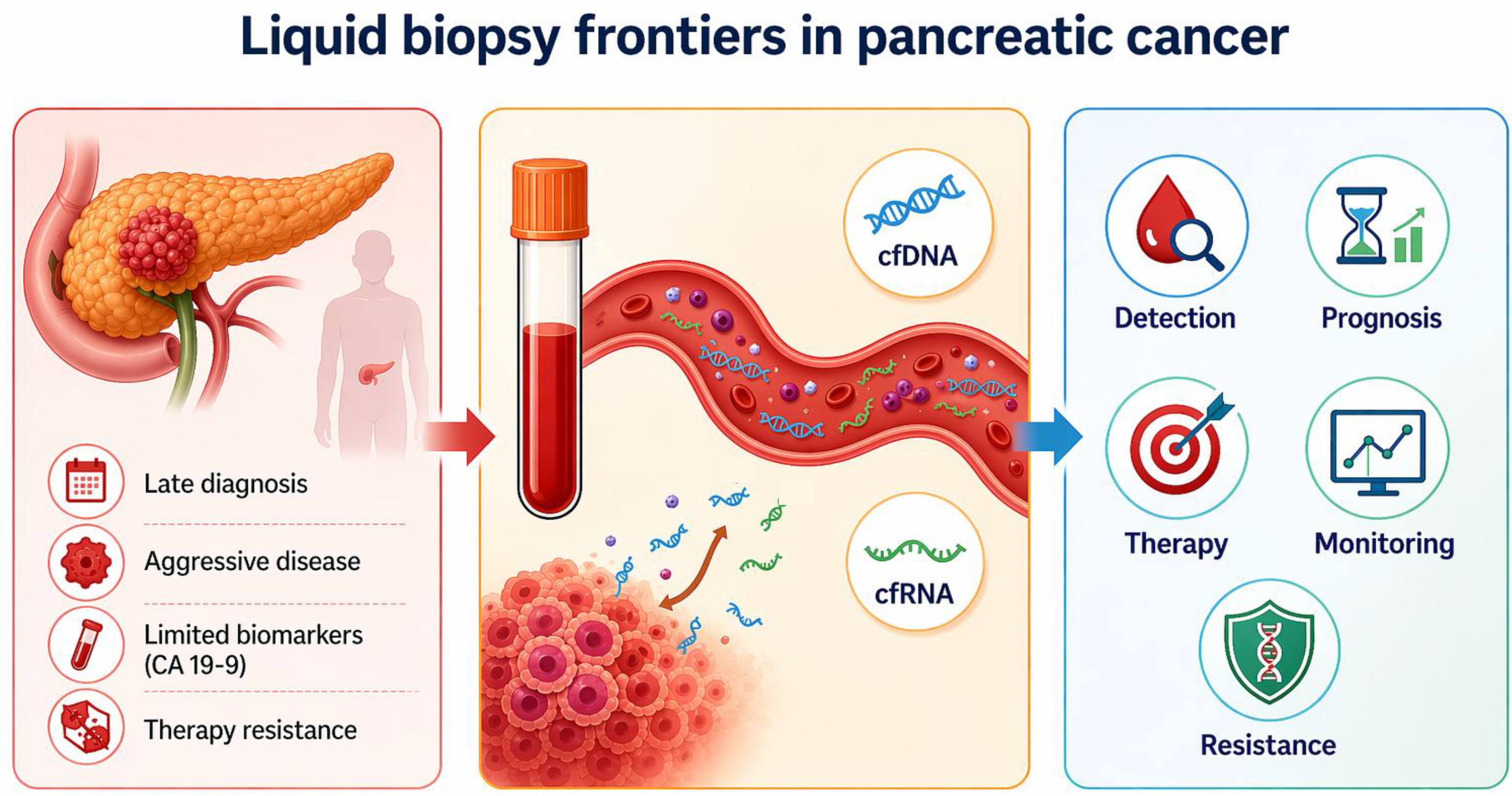
Liquid Biopsy Frontiers in Pancreatic Cancer: Insights from Circulating Cell-Free Nucleic Acids
 ,
,
Abstract
1. Introduction
1.1. Pancreatic Cancer
1.2. Emerging Landscape of Liquid Biopsy Testing
2. Materials and Methods
Search Strategy for Literature Review
3. Results
3.1. Circulating Cell-Free DNA
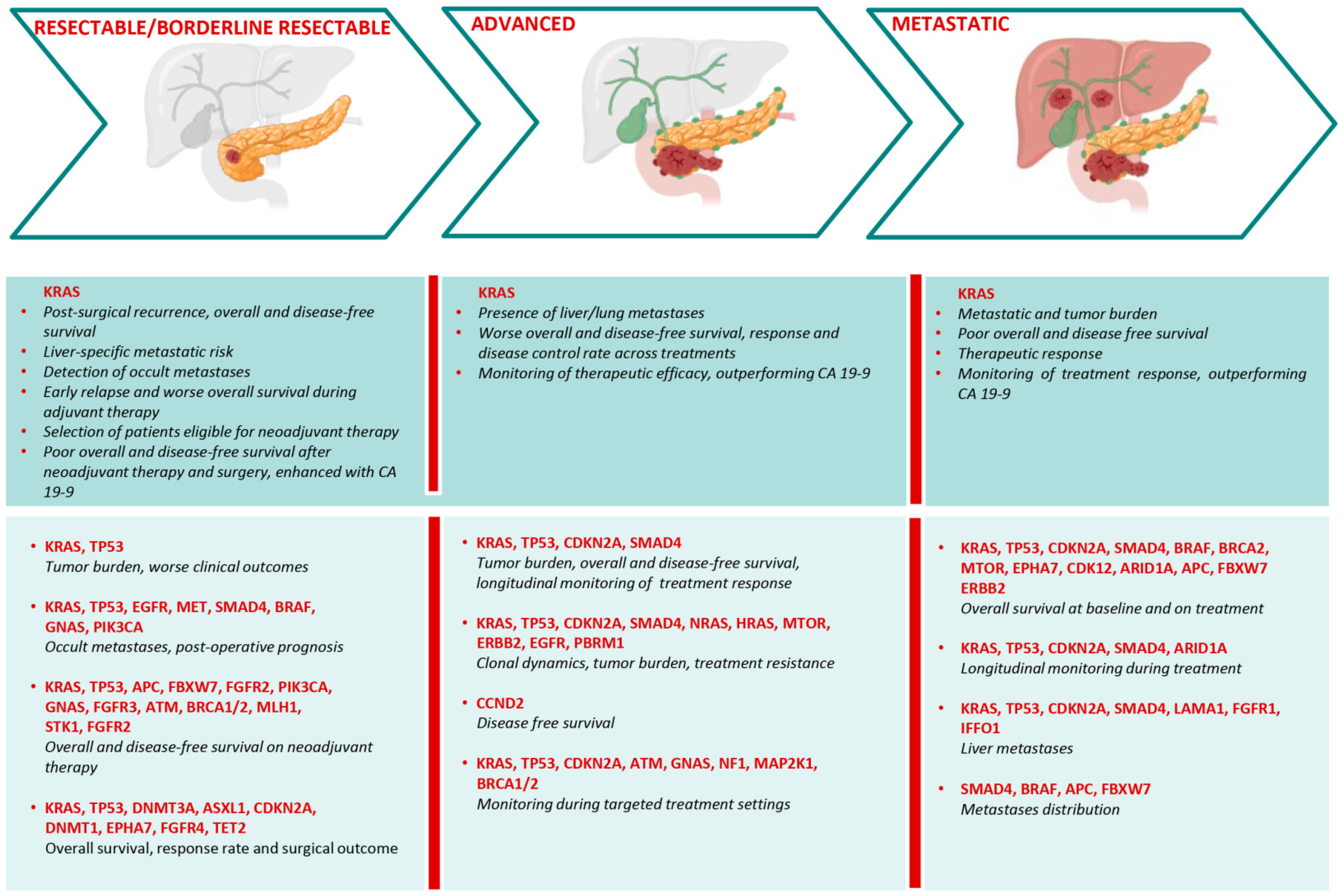
3.1.1. Circulating KRAS Mutations as Blood-Based Biomarkers

| Year | PC Stage | Biological Source | Study Population(s) | Methodology | Clinical Significance | Ref. |
|---|---|---|---|---|---|---|
| 2015 | all stages | plasma | 259 PC | ddPCR | prognosis | [42] |
| 2015 | all stages | serum | 75 PC (discovery) 66 PC (validation) 20 HC | ddPCR | prognosis | [33] |
| 2017 | all stages | plasma | 40 PC, 10 HC | ddPCR | prognosis | [34] |
| 2018 | all stages | plasma | 77 PC | ddPCR | prognosis | [29] |
| 2019 | all stages | plasma | 70 PC, 28 HC | SLHC-seq | early diagnosis prognosis | [38] |
| 2019 | all stages | plasma | 78 PC | ddPCR | prognosis treatment response | [52] |
| 2020 | all stages | plasma | 96 PC, 76 HC | ddPCR | prognosis | [40] |
| 2020 | all stages | plasma | 135 PC | NGS | prognosis treatment response | [69] |
| 2021 | all stages | plasma | 113 PC | ddPCR | prognosis | [39] |
| 2021 | all stages | plasma | 72 PC | ddPCR | post-resection prognosis | [43] |
| 2022 | all stages | plasma | 107 PC | ddPCR | prognosis | [41] |
| 2023 | all stages | plasma | 108 PC | ddPCR | prognosis | [31] |
| 2024 | all stages | plasma | 128 PC | ddPCR | prognosis | [35] |
| 2025 | all stages | plasma | 106 PC | NGS | prognosis | [32] |
| 2025 | all stages | plasma | 419 PC | ddPCR | prognosis | [28] |
| 2025 | all stages | plasma | 200 PC | ddPCR | prognosis | [30] |
| 2015 | R | plasma | 51 PC | NGS | prognosis | [48] |
| 2016 | R | plasma | 105 PC, 20 HC | ddPCR | prognosis | [47] |
| 2018 | R | serum | 45 PC | PNA clamp PCR | prognosis | [51] |
| 2019 | R | plasma | 42 PC | PCR-based-SafeSeqS | prognosis | [45] |
| 2019 | R | plasma | 59 PC | ddPCR | prognosis treatment response | [46] |
| 2020 | R | plasma | 113 PC (discovery) 44 (validation) | NGS | prognosis | [37] |
| 2021 | R | plasma | 105 PC | real-time PCR | prognosis | [44] |
| 2021 | R | plasma | 25 PC | ddPCR | prognosis treatment response | [53] |
| 2024 | R | plasma | 34 PC | ddPCR NGS | prognosis | [54] |
| 2024 | R | plasma | 298 PC | mPCR-based NGS | prognosis | [36] |
| 2021 | R, LA | plasma | 71 PC, 34 HC | ddPCR | prognosis | [50] |
| 2021 | R, BR, LA | plasma | 165 PC | ddPCR | occult metastases prognosis | [55] |
| 2023 | R, BR, LA | plasma | 66 PC | ddPCR | prognosis | [49] |
| 2021 | R, BR | plasma | 97 PC | ddPCR | prognosis | [56] |
| 2024 | R, BR | plasma | 46 PC | WGS | prognosis treatment response | [58] |
| 2025 | BR, LA | plasma | 743 PC | ddPCR | prognosis | [57] |
| 2022 | BR | plasma | 27 PC | ddPCR | prognosis treatment response | [59] |
| 2018 | LA | plasma | 65 PC, 20 HC | ddPCR | prognosis | [63] |
| 2015 | LA + M | plasma | 30 PC | ARMS PCR | prognosis treatment response | [67] |
| 2016 | LA + M | plasma | 14 PC, 29 HC | PNA clamp PCR | prognosis treatment response | [66] |
| 2017 | LA + M | plasma | 60 PC | BEAMing dPCR | treatment response | [68] |
| 2017 | LA + M | plasma | 27 PC | ddPCR | treatment response | [72] |
| 2018 | LA + M | plasma | 54 PC | BEAMing dPCR | prognosis treatment response | [64] |
| 2020 | LA + M | serum | 45 PC | ddPCR/NGS | prognosis treatment response | [62] |
| 2021 | LA + M | plasma | 29 PC | RT-PCR | prognosis treatment response | [65] |
| 2023 | LA + M | plasma | 79 PC, 29 HC | PNA clamp PCR | prognosis treatment response | [60] |
| 2023 | LA + M | plasma | 65 PC | ddPCR | prognosis treatment response | [70] |
| 2023 | LA + M | plasma | 61 PC | ddPCR | treatment response | [73] |
| 2024 | LA + M | plasma | 93 PC | PASEA | prognosis treatment response | [61] |
| 2024 | LA + M | plasma | 18 PC | ddPCR | treatment response | [71] |
| 2018 | M | plasma | 17 PC | NGS | prognosis treatment response | [76] |
| 2020 | M | plasma | 61 PC | BEAMing dPCR ddPCR | prognosis | [77] |
| 2020 | M | plasma | 1 PC | ddPCR | treatment response | [80] |
| 2022 | M | plasma | 70 PC | ddPCR | prognosis treatment response | [75] |
| 2023 | M | plasma | 512 PC | NGS | prognosis treatment response | [74] |
| 2024 | M | plasma | 45 PC | PCR capillary gel electrophoresis | prognosis | [78] |
| 2024 | M | plasma | 200 PC | ddPCR | prognosis treatment response | [79] |
3.1.2. Other Clinically Informative Somatic Alterations
| Year | PC Stage | Biological Source | Study Population | Methodology | Gene(s) | Clinical Significance | Ref. |
|---|---|---|---|---|---|---|---|
| 2017 | all stages | plasma | 135 PC | NGS/ddPCR | KRAS, TP53 | prognosis | [85] |
| 2019 | all stages | plasma | 112 PC | NGS | KRAS, TP53 | prognosis | [92] |
| 2021 | all stages | plasma | 48 PC | NGS | TP53 | prognosis | [110] |
| 2025 | all stages | plasma | 414 PC | NGS | KRAS, TP53, CDKN2A, SMAD4 | prognosis | [81] |
| 2020 | R | plasma | 27 PC | NGS | KRAS, TP53 | prognosis | [86] |
| 2021 | R | plasma | 14 PC, 4 HC | NGS | KRAS, TP53, SMAD4, ALK | prognosis | [83] |
| 2024 | R | plasma | 33 PC | NGS | KRAS, TP53 | prognosis | [82] |
| 2024 | R | plasma | 81 PC | NGS | KRAS, TP53 | prognosis | [84] |
| 2024 | R, BR | plasma | 30 PC | NGS | KRAS, TP53, APC, FBXW7, FGFR2, PIK3CA, GNAS, FGFR3 | prognosis | [88] |
| 2025 | R, BR | plasma | 135 PC | NGS | KRAS, TP53, EGFR, MET, SMAD4, BRAF, GNAS, PIK3CA | prognosis | [87] |
| 2023 | BR | plasma | 28 PC | Guardant 360 | KRAS, TP53, ATM, BRCA1/2, MLH1 | prognosis | [89] |
| 2022 | BR, LA | plasma | 69 PC | NGS | KRAS, TP53, STK1, FGFR2 | prognosis | [90] |
| 2023 | BR, LA | plasma | 29 PC | NGS | KRAS, TP53, DNMT3A, ASXL1, CDKN2A, DNMT1, EPHA7, FGFR4, TET2 | prognosis treatment response | [91] |
| 2019 | LA | plasma | 1 PC | NGS | KRAS, GNAS, NF1 | treatment response | [92] |
| 2015 | LA + M | plasma | 32 PC | Guardant 360 | KRAS, TP53, ATM, CDKN2A | treatment response | [102] |
| 2018 | LA + M | plasma | 19 PC | NGS | BRCA1/2 | treatment response | [100] |
| 2019 | LA + M | plasma | 38 PC, 13 HC | NGS | KRAS, TP53, CDKN2A, SMAD4 | prognosis treatment response | [96] |
| 2020 | LA + M | plasma | 141 PC | NGS | KRAS, TP53 | prognosis longitudinal monitoring | [94] |
| 2020 | LA + M | plasma | 223 PC | NGS | KRAS, TP53 | prognosis | [95] |
| 2022 | LA + M | plasma | 104 PC | NGS | KRAS, TP53, CCND2, BRCA1/2, ATM, SMAD4 | prognosis | [98] |
| 2022 | LA + M | plasma | 7 PC, 5 HC | NGS | KRAS, TP53, SMAD4, DKN2A, NRAS, HRAS, MTOR, ERBB2, EGFR, PBRM1 | longitudinal monitoring | [97] |
| 2022 | LA + M | plasma | 16 PC | NGS | KRAS, MAP2K1 | treatment response | [103] |
| 2023 | LA + M | plasma | 56 PC, 60 HC | HYTEC-seq ddPCR | KRAS, TP53 | prognosis longitudinal monitoring | [93] |
| 2024 | LA + M | plasma | 702 PC | Guardant 360 | BRCA1/2, ATM | treatment selection | [99] |
| 2024 | LA + M | plasma | 36 PC | Guardant 360 | KRAS | treatment response | [101] |
| 2017 | M | plasma | 188 PC | NGS ddPCR | KRAS, ERBB2 | treatment response | [111] |
| 2017 | M | plasma | 20 PC | NGS ddPCR | KRAS, TP53 | treatment response | [112] |
| 2020 | M | plasma | 58 PC | NGS | KRAS, TP53, SMAD4, BRAF | prognosis | [106] |
| 2020 | M | plasma | 104 PC | NGS | KRAS, TP53, APC, FBXW7, GNAS, ERBB2, CTNNB1, MAP2K1, EGFR, SMAD4, BRAF, NRAS, PIK3CA | prognosis | [108] |
| 2022 | M | plasma | 35 PC | NGS | KRAS, TP53, CDKN2A, SMAD4 | prognosis longitudinal monitoring | [104] |
| 2023 | M | plasma | 174 PC | NGS | KRAS, TP53, CDKN2A, SMAD4 | prognosis treatment selection | [109] |
| 2024 | M | plasma | 43 PC | NGS | KRAS, TP53, CDKN2A, SMAD4, ARID1A | prognosis longitudinal monitoring | [107] |
| 2024 | M | plasma | 80 PC | WES ddPCR | KRAS, TP53, BRCA2, MTOR, EPHA7, CDK12, LAMA1, FGFR1, IFFO1, HLA-H, HLA-DRB1, TRBV6-7 | prognosis liver metastasis longitudinal monitoring | [105] |
| 2025 | M | plasma | 53 PC | NGS | KRAS, TP53, CDKN2A, SMAD4 | treatment response | [114] |
| 2025 | M | plasma | 12 PC | NGS | KRAS, TP53 | treatment response | [113] |
3.1.3. cfDNA Methylation Analysis for Diagnosis and Prognostic Stratification
| Year | PC Stage | Biological Source | Study Population(s) | Methodology | Methylated Target(s) | Clinical Significance | Ref. |
|---|---|---|---|---|---|---|---|
| 2020 | all stages | serum | 47 PC, 14 HC | MBD–ddPCR | ADAMTS2, HOXA1, PCDH10, SEMA5A, SPSB4 | diagnosis | [115] |
| 2025 | all stages | plasma | 35 PC, 10 HC | WGS/NGS | CpG sites in intergenic regions | diagnosis | [116] |
| 2016 | all stages | plasma | 95 PC | Methylation-specific PCR | BMP3, RASSF1A, BNC1, MESTv2, TFPI2, APC, SFRP1, SFRP2 | diagnosis | [117] |
| 2020 | all stages | plasma | 72 PC, 136 HC | High-throughput sequencing | 5mC/5hmC signals | diagnosis | [118] |
| 2023 | all stages | plasma | 132 PC, 528 HC (training) 102 PC, 2048 HC (validation) | NGS | 5hmC signals | early diagnosis | [120] |
| 2024 | all stages | plasma | 255 PC, 209 HC | Ultra-deep targeted NGS | KCNA3, PRRX, CCNA1, TRIM58, NR2F1-AS1 | early diagnosis | [121] |
| 2024 | all stages | plasma | 43 PC, 20 HC | NGS | RASSF1A, EYA2, ppENK, p16, NPTX2 | early diagnosis | [122] |
| 2020 | all stages | plasma | 64 PC, 243 HC | NGS | 37-gene 5hmc model | early diagnosis | [123] |
| 2022 | all stages | plasma | 198 PC, 323 HC | Targeted methylation sequencing | 56-marker PDACatch classifier | early diagnosis | [124] |
| 2025 | all stages | plasma | 50 PC, 52 HC | MCTA-Seq | 120-marker methylation panel | early diagnosis | [125] |
| 2025 | all stages | plasma | 166 PC, 167 HC (training) 112 PC, 111 HC (validation) 198 PC, 200 HC (validation) | NGS | Methylation patterns, fragment size, copy number variations and mutational signatures | early diagnosis | [126] |
| 2020 | R | plasma | 4 PC, 2 HC (screening) 238 PC, 250 HC (training) 101 PC, 107 HC (validation) | High-throughput sequencing | TRIM73, FAM150A, EPB41L3, SIX3, MIR663, MAPT, LOC100128977, LOC100130148 | early diagnosis | [119] |
| 2024 | R, M | plasma | 105 PC, 40 HC | Methylation-specific real-time PCR | BRCA1/2 | prognosis | [127] |
| 2025 | LA + M | plasma | 33 PC, 19 HC | NGS | Methylation patterns and cfDNA features (fragment size and end motifs) | prognosis | [130] |
| 2023 | M | plasma | 44 PC | ddPCR | NPTX2 | prognosis | [128] |
| 2022 | M | plasma | 372 PC, 12 HC | Met-ddPCR | HOXD8, POU4F1 | prognosis | [129] |
3.1.4. Fragmentomic Features, Actionable Mutations and Structural Alterations
| Year | PC Stage | Biological Source | Study Population | Methodology | Alteration(s) | Clinical Significance | Refs. |
|---|---|---|---|---|---|---|---|
| 2015 | all stages | plasma | 48 PC | NGS | ALK, ATM, DNMT3A, EGFR, KIT, MAP2K4, PIK3CA; copy number alterations (CCND1, ERBB2) | targetable alterations | [42] |
| 2016 | all stages | plasma | 259 PC | NGS ddPCR | KRAS, ALK, ATM, DNMT3A, EGFR, KIT, MAP2K4, PIK3CA | targetable mutations | [133] |
| 2020 | all stages | plasma | 70 PC | WGS | Tumor fraction; copy number alterations (KRAS, MYC, TGFBR2, PBRM1) | prognosis treatment response | [139] |
| 2021 | all stages | plasma | 315 PC, 38 HC | WGS | Genomic instability | prognosis | [138] |
| 2024 | all stages | plasma | 82 PC | Fluorometric | cfDNA concentration, neutrophil-to-lymphocyte ratio | prognosis | [131] |
| 2020 | LA | plasma | 1 PC | Guardant 360 | Microsatellite instability | treatment response | [137] |
| 2018 | LA + M | plasma | 61 PC, 21 HC | Automated electrophoresis | cfDNA concentration, fragment size | prognosis | [132] |
| 2019 | LA + M | plasma | 55 PC, 16 HC | WGS ddPCR | Copy number alteration (KRAS) | prognosis | [140] |
| 2021 | M | plasma | 1 PC | ddPCR NGS | Copy number alteration (KRAS) | treatment response | [141] |
| 2020 | LA + M | plasma | 2 PC | NGS | MLH1, BRCA1 | treatment response | [95] |
| 2021 | LA + M | plasma | 282 PC | NGS | KRAS, PIK3CA, ATM, EGFR, MYC, BRCA1/2, CCND2, SMAD4, TP53, RET, MET, PDGFRA, ERBB2, FGFR2 | targetable mutations | [135] |
| 2022 | LA + M | plasma | 10 PC | Guardant 360 | Microsatellite instability | treatment response | [136] |
| 2024 | LA + M | plasma | 36 PC | Guardant 360 | Copy number alteration (ERBB2) | treatment response | [101] |
| 2021 | M | plasma | 77 PC | Guardant 360 | BRCA2, STK11, KRAS, PIK3CA, ATM, NF-1, EGFR, FGFR | targetable mutations | [134] |
| 2024 | M | plasma | 80 PC | WES ddPCR | PTEN, BRCA2, TSC2 | targetable mutations | [105] |
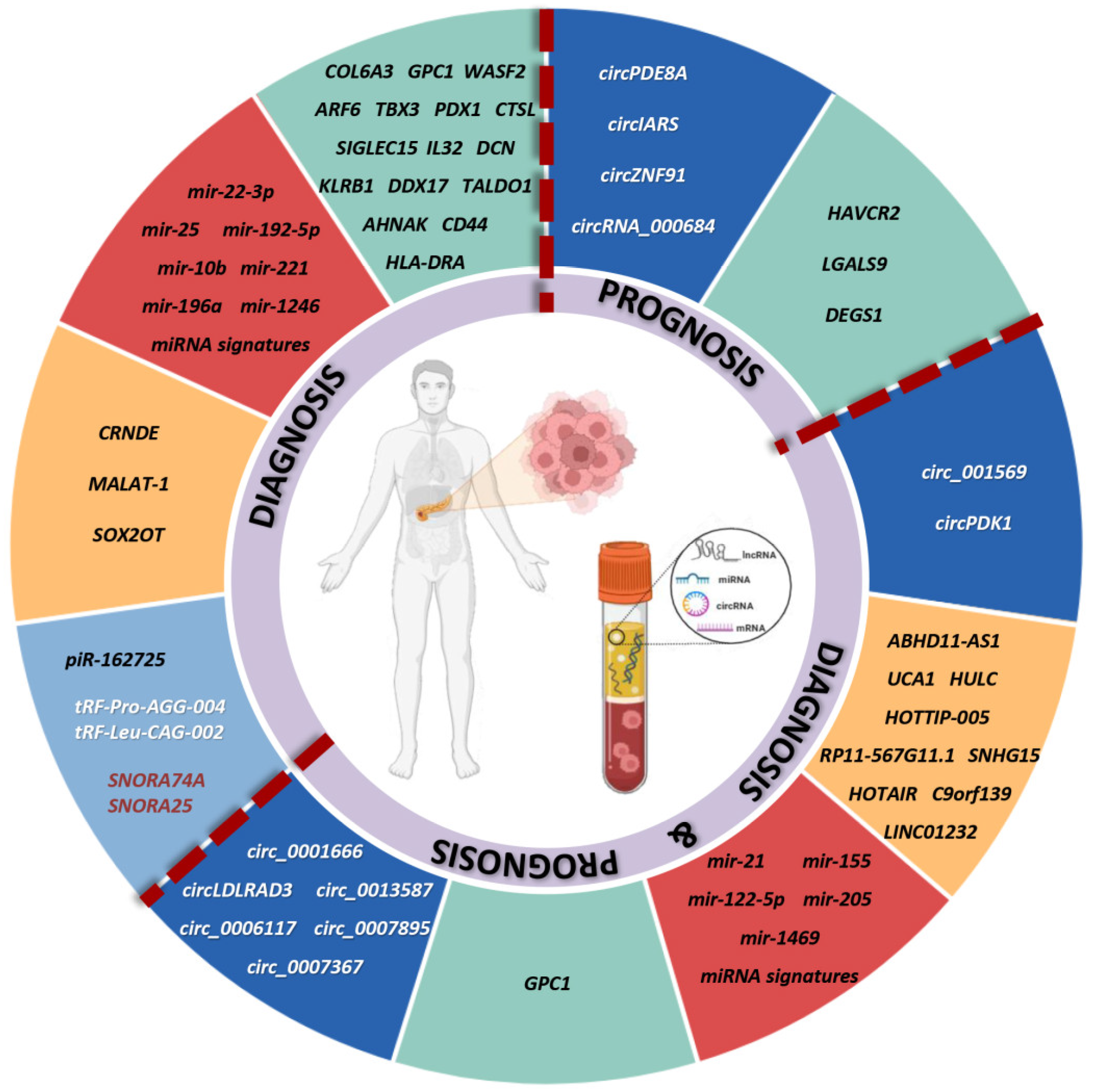
3.2. Circulating Cell-Free RNA
3.2.1. Circulating Protein-Coding RNA Candidate Biomarkers
| Year | mRNA | Biological Source(s) | Study Population(s) | Methodology | Clinical Significance | Ref. |
|---|---|---|---|---|---|---|
| 2014 | COL6A3 | serum | 44 PC, 30 HC | qRT-PCR | diagnosis | [142] |
| 2017 | GPC1 | serum exosome | 118 PC, 60 HC (discovery) 48 PC, 15 HC (validation) | LPHN–CHDC | early diagnosis | [143] |
| 2024 | GPC1 | serum exosome | 91 PC (discovery) 138 PC (non-blinded validation) 55 PC (blinded validation) 30 HC | ILN biochip | diagnosis prognosis | [144] |
| 2018 | WASF2, ARF6 | serum exosome | 27 PC, 13 HC | qRT-PCR | diagnosis | [145] |
| 2020 | MMP8, TBX3, PDX1, CTSL, SIGLEC15, IL32, SIGLEC114, DCN, HOXA5, KLRB1 | serum exosome | 2 PC, 2 HC | qRT-PCR | diagnosis | [146] |
| 2020 | CLDN1, FGA, HIST1H2BK, ITIH2, KRT19, MARCH2, MAL2, TIMP1 | plasma extracellular vesicles | 284 PC, 117 HC | ExLR-seq | diagnosis | [147] |
| 2021 | FBXO7, MORF4L1, DDX17, TALDO1, AHNAK, TUBA1B, CD44, SETD3 | serum exosome | 284 PC, 117 HC (training and testing; GSE133684) 44 PC, 27 HC (validation) | NGS qRT-PCR | diagnosis | [148] |
| 2021 | HIST2H2AA3, LUZP6, HLA-DRA | plasma exosome | 14 PC, 32 HC (discovery; GSE100232, GSE100206) 284 PC, 117 HC (validation; GSE133684) | RNA-Seq | diagnosis | [149] |
| 2021 | EVL | plasma | 79 PC, 19 HC | qRT-PCR | prognosis | [150] |
| 2021 | ACD, ADK, CANT1, HAVCR2, LGALS9, LYL1, PKIG, TBL3, TP53I11 | plasma exosome | 345 PC, 81 HC | ExLR-seq | prognosis | [151] |
| 2023 | PPP1R12A, SCN7A, SGCD | plasma exosome | 65 PC (discovery) 91 PC (training) 83 PC (validation) | ddPCR | prognosis | [152] |
| 2024 | DEGS1, KDELC1, RPL23AP7 | plasma/serum | 14 PC (COMPASS), 12 PC (UK-Essen), 24 HC; 20 PC (COMPASS), 122 (NEOLAP), 24 HC | NGS RT-ddPCR | prognosis | [153] |
3.2.2. Circulating miRNAs and Other Small Non-Coding RNA Biomarkers and Signatures
MiRNA
- Single miRNA candidates in PC
- MiRNA panel candidates in PC
| Year | miRNA | Biological Source(s) | Study Population(s) | Methodology | Regulation | Clinical Significance | Ref. |
|---|---|---|---|---|---|---|---|
| 2014 | miR-10b | plasma | 17 PC, 20 HC | qRT-PCR | up | diagnosis | [154] |
| 2015 | plasma exosome | 3 PC, 3 HC | LSPR-based quantification | up | diagnosis | [155] | |
| 2017 | plasma exosome | 29 PC, 6 HC | qRT-PCR | up | diagnosis | [157] | |
| 2020 | plasma exosome | 36 PC, 65 HC | Tethered cationic lipoplex nanoparticle biochip | up | diagnosis | [156] | |
| 2016 | mir-221 | serum | 17 PC | qRT-PCR | up | treatment response | [158] |
| 2018 | plasma | 87 PC, 48 HC | qRT-PCR | up | metastasis detection | [160] | |
| 2019 | plasma | 94 PC, 51 HC | qRT-PCR | up | diagnosis | [161] | |
| 2024 | plasma/serum | 9 PC, 4 HC | qRT-PCR | up | diagnosis | [159] | |
| 2018 | plasma plasma exosome | 20 PC, 10 HC (screening) 40 PC, 40 HC (training) 112 PC, 116 HC (testing) 64 PC, 64 HC (validation) 31 PC, 37 HC | qRT-PCR | up down | diagnosis | [162] | |
| 2016 | miR-196a | plasma | 76 PC, 82 HC (training) 82 PC, 88 HC (blinded validation) 10 PC, 90 HC (double-blinded validation) | qRT-PCR | up | diagnosis prognosis | [163] |
| 2017 | plasma exosome | 15 PC, 15 HC | qRT-PCR | up | early diagnosis | [165] | |
| 2019 | plasma | 20 PC, 10 HC | qRT-PCR | up | diagnosis lymph node involvement | [164] | |
| 2015 | miR-1246 | serum exosome | 131 PC, 30 HC | Microarray qRT-PCR | up | diagnosis | [167] |
| 2017 | plasma exosome | 15 PC, 15 HC | qRT-PCR | up | early diagnosis | [165] | |
| 2020 | serum | 41 PC, 30 HC | qRT-PCR | up | diagnosis | [166] | |
| 2017 | miR-22-3p | plasma | 35 PC, 15 HC | qRT-PCR | up | early diagnosis | [169] |
| 2021 | serum | 63 PC, 29 non-cancer controls, 34 non-PC (training) 25 PC, 81 non-PC (validation) 17 PC, 16 non-cancer controls (validation) | Microarray qRT-PCR | up | diagnosis | [168] | |
| 2024 | plasma | 185 PC, 185 HC (discovery) 277 PC, 277 HC (replication) | NanoString nCounter Human v3 miRNA Expression Assay | up | risk | [170] | |
| 2016 | miR-25 | serum | 303 PC, 600 HC | qRT-PCR | up | diagnosis | [171] |
| 2020 | serum | 80 PC, 91 HC | qRT-PCR | up | early diagnosis | [172] | |
| 2016 | plasma | 76 PC, 82 HC (training) 82 PC, 88 HC (blinded validation) 10 PC, 90 HC (double-blinded validation) | qRT-PCR | up | diagnosis | [163] | |
| 2020 | miR-192-5p | serum exosome | 44 PC, 12 HC | qRT-PCR | up | diagnosis | [173] |
| 2021 | serum | 50 PC, 25 HC | qRT-PCR | up | diagnosis | [174] | |
| 2019 | plasma | 94 PC, 51 HC | qRT-PCR | up | diagnosis | [161] | |
| 2015 | miR-21 | plasma | 32 PC, 30 HC | qRT-PCR | up | diagnosis prognosis | [179] |
| 2016 | serum | 24 PC, 10 HC | qRT-PCR | up | diagnosis | [175] | |
| 2017 | plasma exosome | 29 PC, 6 HC | qRT-PCR | up | diagnosis | [157] | |
| 2018 | serum exosome | 32 PC, 22 HC | NGS qRT-PCR | up | early diagnosis prognosis chemoresistance | [178] | |
| 2018 | serum | 181 PC, 40 HC | qRT-PCR | up | diagnosis prognosis | [177] | |
| 2019 | plasma exosome (PB/PVB) | 55 PC, 20 HC | Microarray qRT-PCR | up | diagnosis prognosis | [180] | |
| 2020 | plasma exosome | 36 PC, 65 HC | Tethered cationic lipoplex nanoparticle biochip | up | diagnosis early diagnosis | [156] | |
| 2017 | serum | 56 PC, 15 HC | qRT-PCR | up | diagnosis | [176] | |
| 2016 | plasma | 76 PC, 82 HC (training) 82 PC, 88 HC (blinded validation) 10 PC, 90 HC (double-blinded validation) | qRT-PCR | up | diagnosis | [163] | |
| 2019 | plasma | 94 PC, 51 HC | qRT-PCR | up | diagnosis | [161] | |
| 2017 | miR-155 | plasma exosome | 23 PC | qRT-PCR | up | prognosis | [181] |
| 2019 | plasma | 20 PC, 10 HC | qRT-PCR | up | diagnosis lymph node involvement | [164] | |
| 2021 | serum | 63 PC, 29 non-cancer controls, 34 non-PC (training) 25 PC, 81 non-PC (validation) 17 PC, 16 non-cancer controls (validation) | Microarray qRT-PCR | down | diagnosis | [168] | |
| 2016 | plasma | 76 PC, 82 HC (training) 82 PC, 88 HC (blinded validation) 10 PC, 90 HC (double-blinded validation) | qRT-PCR | up | diagnosis prognosis | [163] | |
| 2020 | miR-122-5p | plasma | 5 PC, 5 HS (discovery) 112 PC, 150 HS (validation) | GeneChip miRNA 4.0 Array ddPCR | up | prognosis | [182] |
| 2021 | serum | 50 PC, 25 HC | qRT-PCR | up | diagnosis | [174] | |
| 2022 | plasma exosome | 65 PC, 78 HC | qRT-PCR | up | diagnosis | [183] | |
| 2018 | plasma plasma exosome | 20 PC, 10 HC (screening) 40 PC, 40 HC (training) 112 PC, 116 HC (testing) 64 PC, 64 HC (validation) 31 PC, 37 HC | qRT-PCR | up | diagnosis | [162] | |
| 2018 | miR-451a | plasma exosome | 6 PC, 3 HC (discovery) 50 PC, 20 HC (validation) | Microarray qRT-PCR | up | prognosis | [184] |
| 2019 | plasma exosome (PB/PVB) | 55 PC, 20 HC | Microarray qRT-PCR | up | diagnosis prognosis | [180] | |
| 2018 | serum exosome | 32 PC, 22 HC | NGS qRT-PCR | up | early diagnosis chemoresistance | [178] | |
| 2018 | miR-205 | serum | 65 PC, 34 HC | qRT-PCR | up | diagnosis | [185] |
| 2022 | plasma exosome | 65 PC, 78 HC | qRT-PCR | up | diagnosis prognosis | [183] | |
| 2023 | serum | 26 PC | NGS | up | prognosis | [186] | |
| 2020 | miR-1469 | serum | 342 PC, 329 HC (discovery; GSE106817, GSE113486, GSE59856, GSE85589) 81 PC, 70 HC (validation; GSE112264, GSE124158) | Profiling by array | up | diagnosis | [188] |
| 2020 | serum | 100 PC, 150 HC (GSE59856) | Profiling by array | up | diagnosis prognosis | [189] | |
| 2020 | plasma | 49 PC, 29 HC | qRT-PCR | up | diagnosis prognosis | [187] | |
| 2018 | miR-99a | serum | 181 PC, 40 HC | qRT-PCR | up | diagnosis | [177] |
| 2019 | serum | 2 PC (screening) 26 PC (validation) | qRT-PCR | up | prognosis | [190] | |
| 2020 | plasma | 48 PC (discovery) 64 PC (validation) | NGS qRT-PCR | down | prognosis | [191] |
Other Small Non-Coding RNAs
| Year | miRNA Signature | Biological Source(s) | Study Population(s) | Methodology | Regulation | Clinical Significance | Ref. |
|---|---|---|---|---|---|---|---|
| 2024 | sEV-miR-155, sEV-miR-21, sEV-miR-27a, miR-221-3p, miR-let-7a-5p; 23b-3p, miR-34a-5p, miR-193a-3p | plasma/serum (vesicle-associated and circulating); plasma | 11 PC, 8 HC; 4 PC 5 HC | qRT-PCR ddPCR | down; up | diagnosis | [159] |
| 2020 | miR-125a-3p, miR-642b-3p, miR-5100 | serum | 342 PC, 329 HC (discovery) (GSE106817, GSE113486, GSE59856, GSE85589) 81 PC, 70 HC (validation) (GSE112264, GSE124158) | Profiling by array | down; up | diagnosis | [188] |
| 2022 | miR-125a-3p, miR-4530, miR-92a-2-5p | plasma | 77 PC, 65 HC | qRT-PCR | up | diagnosis | [192] |
| 2019 | let-7b-5p, miR-192-5p, miR-19a-3p, miR-19b-3p, miR-223-3p, and miR-25-3p | serum/ serum exosome | 159 PC, 137 HC; 32 PC, 32 HC | qRT-PCR | up | diagnosis | [193] |
| 2023 | miR-1246, miR-205-5p, miR-191-5p | serum | 26 PC | NGS | up | diagnosis | [186] |
| 2020 | miR-181b, miR-196a, miR-210 | plasma | 40 PC, 40 HC | qRT-PCR | up | diagnosis | [194] |
| 2014 | miR-642b, miR-885-5p, miR-22 | plasma | 8 PC, 11 HC | Microarray qRT-PCR | up | diagnosis | [195] |
| 2019 | miR-33a-3p + miR-320a + CA 19-9 | plasma | 94 PC, 51 HC | qRT-PCR | up | diagnosis | [161] |
| 2016 | miR-16, miR-27a, miR-25, miR-29c, miR-483-5p, CA 19-9; miR-16, miR-24, miR-27a, miR-30-5p, miR-323-3p, miR-20a, miR-25, miR-29c, miR-483-5p, CA 19-9 | serum | 417 PC, 248 HC | qRT-PCR | down; up | diagnosis early stage | [196] |
| 2014 | index I: miR-145, miR-150, miR-223, miR-636; index II: miR-26b, miR-34a, miR-122, miR-126star, miR-145, miR-150, miR-223, miR-505, miR-636, miR-885-5p | whole blood | 409 PC, 312 HC | qRT-PCR | down; up | diagnosis early stage | [197] |
| 2022 | cf-miRNAs (miR-30c-5p, miR-340-5p, miR-335-5p, miR-23b-3p, miR-142-3p) + exo-miRNA candidates (miR-145-5p, miR-200b-3p, miR-429, miR-1260b, miR145-3p, miR-216b-5p, miR-200a-3p, miR-217-5p) | plasma/plasma exosome | 44 PC, 57 HC (discovery) 124 PC, 67 HC (training/validation) | NGS qRT-PCR | up | diagnosis early diagnosis | [198] |
| 2023 | miR-10b, miR-let7a | plasma | 90 PC, 60 HC (training) 15 PC, 2 HS (validation) | High-throughput nanoplasmonic quantification qRT-PCR | down; up | diagnosis early stage surgical response | [199] |
| 2020 | miR-1290, miR-1246+ CA 19-9 | serum | 120 PC, 40 HC | qRT-PCR | up | diagnosis surgical response | [200] |
| 2020 | miR-99a-5p, miR-365a-3p, miR-200c-3p | plasma | 48 PC (discovery) 64 PC (validation) | NGS qRT-PCR | down; up | prognosis | [191] |
| 2022 | miR-205–5p, miR-934, miR-192–5p, miR-194–5p, miR-194–3p, miR-215–5p, miR-375–3p, miR-552–3p, miR-1251–5p | serum | 279 (discovery (ICGC, TCGA) 51 PC (validation) | Microarray qRT-PCR | down; up | prognosis | [201] |
| 2022 | miR-130b-5p, miR-133a-3p, miR-195-5p, miR-432-5p, miR-1229-3p, miR-1273f | plasma/serum exosome | 25 PC (discovery) 139 PC (training, pre-NAT validation) 46 PC (post-NAT validation) | WGS qRT-PCR | up | prognosis response to NAT | [202] |
| 2018 | miR-122-5p and miR-193b-3p, miR-221-3p and miR-125b-5p, miR-192-5p, miR-27b-3p | plasma | 20 PC, 10 HC (screening) 40 PC, 40 HC (training) 112 PC, 116 HC (testing) 64 PC, 64 HC (validation) | qRT-PCR | up | diagnosis prognosis | [162] |
| 2023 | miR-222-3p, miR-221-3p | plasma | 46 PC, 20 HC (training) 115+50 PC, 2759+40 HC (validation) (GSE106817, GSE112264) | qRT-PCR | up | diagnosis prognosis | [203] |
| Year | sncRNA | Biological Source | Study Population | Methodology | Clinical Significance | Ref. |
|---|---|---|---|---|---|---|
| 2020 | piR-52959, piR-53108, piR-30690, piR-54479, piR-56621, piR-54888, piR-42185, piR-46410, piR-58897, piR-43043 | serum exosomes | 2 PC, 2 HC | qRT-PCR | diagnosis | [146] |
| 2022 | piR-162725 | plasma | 45 PC, 27 HC | NGS | diagnosis | [204] |
| 2024 | piR-32871, piR-28104, piR-32981 piR-32977, piR-1961, piR-32895, piR-32978, piR-775, piR-25274, piR-12654, piR-3411 | plasma | 15 PC, 16 HC | NGS | diagnosis | [205] |
| 2019 | SNORA74A, SNORA25, SNORA22, SNORA14B, SNORD22 | serum exosomes | 27 PC, 13 HC | qRT-PCR | diagnosis | [145] |
| 2020 | tRNA125-Thr-CGT, tRNA21-Ser-TGA, tRNA15-Cys-GCA, tRNA55-Ile-TAT tRNA5-Ile-TAT | serum exosomes | 2 PC, 2 HC | qRT-PCR | diagnosis | [146] |
| 2021 | tRF-Pro-AGG-004, tRF-Leu-CAG-002 | serum | 30 PC, 30 HC | qRT-PCR | diagnosis | [206] |
3.2.3. Linear and Circular Long Non-Coding RNAs as Circulating Biomarkers
Linear Long Non-Coding RNA
| Year | lncRNA | Biological Source | Study Population | Methodology | Clinical Significance | Ref. |
|---|---|---|---|---|---|---|
| 2020 | MALAT-1, CRNDE | serum exosome | 2 PC, 2 HC | qRT-PCR | diagnosis | [146] |
| 2018 | Sox2ot | plasma | 61 PC, 20 HC | Microarray | prognosis | [210] |
| 2015 | HOTTIP-005, RP11-567G11.1 (HDRF, RDRF) | plasma | 127 PC, 122 HC | qRT-PCR | diagnosis/prognosis | [213] |
| 2018 | SNGH15 | serum | 171 PC, 59 HC | qRT-PCR | diagnosis/prognosis | [214] |
| 2019 | ABHD11-AS1 | plasma | 15 PC, 15 HC | qRT-PCR | diagnosis/prognosis | [207] |
| 2019 | UCF1 | serum | 40 PC, 40 HC | qRT-PCR | diagnosis/prognosis | [208] |
| 2019 | HULC | serum | 60 PC, 60 HC | qRT-PCR | diagnosis/prognosis | [212] |
| 2019 | HOTAIR | serum | 78 PC, 30 HC | qRT-PCR | diagnosis/prognosis | [215] |
| 2020 | UCA1 | serum exosome | 46 PC, 16 HC | qRT-PCR | diagnosis/prognosis | [209] |
| 2020 | HULC | serum extracellular vesicles | 20 PC, 21 HC | dPCR | diagnosis/prognosis | [211] |
| 2020 | C9orf139 | serum | 54 PC, 30 HC | qRT-PCR | diagnosis/prognosis | [216] |
| 2021 | LINC01232 | serum | 108 PC, 60 HC | qRT-PCR | diagnosis/prognosis | [217] |
Circular RNA
| Year | circRNA | Biological Source | Study Population | Methodology | Clinical Significance | Ref. |
|---|---|---|---|---|---|---|
| 2017 | circLDLRAD3 | plasma | 31 PC, 31 HC | qRT-PCR | diagnosis | [219] |
| 2021 | circ_0013587 | plasma | 30 PC, 30 HC | qRT-PCR | diagnosis | [220] |
| 2021 | circPDAC | serum | 20 PC, 20 HC | ddPCR | diagnosis | [221] |
| 2022 | circ_0006220, circ_0001666 | plasma exosome | 62 PC, 62 HC | qRT-PCR | diagnosis | [218] |
| 2024 | circ_0060733, circ_0006117 circ_0064288, circ_0007895 circ_0007367 | plasma | 158 PC, 81 HC | qRT-PCR | diagnosis | [222] |
| 2018 | circPDE8A | plasma exosome | 93 PC | qRT-PCR | prognosis | [223] |
| 2018 | circIARS | plasma exosome | 40 PC | qRT-PCR | prognosis | [224] |
| 2021 | circZNF91 | plasma exosome | 40 PC | qRT-PCR | prognosis | [225] |
| 2021 | circRNA_000684 | plasma | 38 PC, 38 HC | qRT-PCR | prognosis | [226] |
| 2021 | circ_001569 | plasma | 97 PC, 71 HC | qRT-PCR | diagnosis, prognosis | [227] |
| 2022 | circPDK1 | serum exosome | 20 PC, 10 HC | qRT-PCR | diagnosis, prognosis | [228] |
4. Discussion
4.1. Circulating KRAS and Other Somatic Alterations
4.2. cfDNA Methylation, Fragmentomic Features, and Actionable/Structural Alterations
4.3. CfRNA Alterations
4.3.1. miRNAs
4.3.2. Protein-Coding RNA
4.3.3. LncRNAs
4.3.4. CircRNAs
4.3.5. piRNAs, snoRNAs, and tRNAs
5. Conclusive Remarks and Future Perspectives
Supplementary Materials
Author Contributions
Funding
Institutional Review Board Statement
Informed Consent Statement
Data Availability Statement
Conflicts of Interest
Abbreviations
| ARMS PCR | Amplification-refractory mutation system polymerase chain reaction |
| BEAMing dPCR | Beads, emulsion, amplification, magnetics, digital polymerase chain reaction |
| BR | Borderline resectable |
| CA 19-9 | Carbohydrate antigen 19-9 |
| CEA | Carcinoembryonic antigen |
| cfDNA | Circulating cell-free DNA |
| cfRNA | Circulating cell-free RNA |
| circRNAs | Circular RNAs |
| CT | Computed tomography |
| ctDNA | Circulating tumor DNA |
| ddPCR | Droplet digital polymerase chain reaction |
| ERCP | Endoscopic retrograde cholangiopancreatography |
| EUS | Endoscopic ultrasound |
| FNA | Fine-needle aspiration |
| FNB | Fine-needle biopsy |
| HC | Healthy control |
| HYTEC-seq | Hybridization- and tag-based error-corrected sequencing |
| LA | Locally advanced |
| lncRNAs | Long non-coding RNAs |
| LSPR-based quantification | Localized surface plasmon resonance-based quantification |
| M | Metastatic |
| MBD–ddPCR | Methyl-CpG-binding protein–droplet digital polymerase chain reaction |
| MCTA-Seq | Methylated CpG tandem amplification and sequencing |
| Met-ddPCR | Methylation-specific droplet digital polymerase chain reaction |
| miRNAs | MicroRNAs |
| mPCR-based NGS | Multiplex polymerase chain reaction-based next-generation sequencing |
| MR | Magnetic resonance |
| NAT | Neoadjuvant therapy |
| NGS | Next-generation sequencing |
| PASEA | Programmable enzyme-assisted selective exponential amplification |
| PB | Peripheral blood |
| PC | Pancreatic cancer |
| PCR-based-SafeSeqS | Polymerase chain reaction based on safe-sequencing system |
| piRNAs | Piwi-interacting RNAs |
| PNA clamp PCR | Peptide nucleic acid clamp polymerase chain reaction |
| PVB | Portal vein blood |
| qRT-PCR | Quantitative real-time polymerase chain reaction |
| R | Resectable |
| RT-PCR | Real-time polymerase chain reaction |
| SLHC-seq | Single-strand library preparation and hybrid-capture sequencing |
| snoRNAs | Small nucleolar RNAs |
| tRNAs | Transfer RNAs |
| US | Ultrasonography |
| WES | Whole-exome sequencing |
| WGS | Whole-genome sequencing |
References
- Siegel, R.L.; Miller, K.D.; Wagle, N.S.; Jemal, A. Cancer statistics, 2023. CA Cancer J. Clin. 2023, 73, 17–48. [Google Scholar] [CrossRef]
- Park, W.; Chawla, A.; O’Reilly, E.M. Pancreatic Cancer: A Review. JAMA 2021, 326, 851–862, Erratum in JAMA 2021, 326, 2081. https://doi.org/10.1001/jama.2021.19984. [Google Scholar] [CrossRef] [PubMed]
- Conroy, T.; Pfeiffer, P.; Vilgrain, V.; Lamarca, A.; Seufferlein, T.; O’Reilly, E.M.; Hackert, T.; Golan, T.; Prager, G.; Haustermans, K.; et al. Pancreatic cancer: ESMO Clinical Practice Guideline for diagnosis, treatment and follow-up. Ann. Oncol. 2023, 34, 987–1002. [Google Scholar] [CrossRef]
- Conroy, T.; Ducreux, M.; ESMO Guidelines Committee. ESMO Clinical Practice Guideline Express Update on the management of metastatic pancreatic cancer. ESMO Open 2025, 10, 104528. [Google Scholar] [CrossRef] [PubMed]
- Kleeff, J.; Korc, M.; Apte, M.; La Vecchia, C.; Johnson, C.D.; Biankin, A.V.; Neale, R.E.; Tempero, M.; Tuveson, D.A.; Hruban, R.H.; et al. Pancreatic cancer. Nat. Rev. Dis. Primers 2016, 2, 16022. [Google Scholar] [CrossRef]
- Olakowski, M.; Bułdak, Ł. Modifiable and Non-Modifiable Risk Factors for the Development of Non-Hereditary Pancreatic Cancer. Medicina 2022, 58, 978. [Google Scholar] [CrossRef]
- Miura, F.; Takada, T.; Amano, H.; Yoshida, M.; Furui, S.; Takeshita, K. Diagnosis of pancreatic cancer. HPB 2006, 8, 337–342. [Google Scholar] [CrossRef]
- Duffy, M.J.; Sturgeon, C.; Lamerz, R.; Haglund, C.; Holubec, V.L.; Klapdor, R.; Nicolini, A.; Topolcan, O.; Heinemann, V. Tumor markers in pancreatic cancer: A European Group on Tumor Markers (EGTM) status report. Ann. Oncol. 2010, 21, 441–447. [Google Scholar] [CrossRef]
- Zhao, J.; Wang, J.; Gu, Y.; Huang, X.; Wang, L. Diagnostic methods for pancreatic cancer and their clinical applications (Review). Oncol. Lett. 2025, 30, 370. [Google Scholar] [CrossRef]
- Luo, G.; Jin, K.; Deng, S.; Cheng, H.; Fan, Z.; Gong, Y.; Qian, Y.; Huang, Q.; Ni, Q.; Liu, C.; et al. Roles of CA19-9 in pancreatic cancer: Biomarker, predictor and promoter. Biochim. Biophys. Acta Rev. Cancer 2021, 1875, 188409. [Google Scholar] [CrossRef]
- Isaji, S.; Mizuno, S.; Windsor, J.A.; Bassi, C.; Fernández-Del Castillo, C.; Hackert, T.; Hayasaki, A.; Katz, M.H.G.; Kim, S.W.; Kishiwada, M.; et al. International consensus on definition and criteria of borderline resectable pancreatic ductal adenocarcinoma 2017. Pancreatology 2018, 18, 2–11. [Google Scholar] [CrossRef]
- Meng, Q.; Shi, S.; Liang, C.; Liang, D.; Xu, W.; Ji, S.; Zhang, B.; Ni, Q.; Xu, J.; Yu, X. Diagnostic and prognostic value of carcinoembryonic antigen in pancreatic cancer: A systematic review and meta-analysis. OncoTargets Ther. 2017, 10, 4591–4598. [Google Scholar] [CrossRef]
- Amaral, M.J.; Oliveira, R.C.; Donato, P.; Tralhão, J.G. Pancreatic Cancer Biomarkers: Oncogenic Mutations, Tissue and Liquid Biopsies, and Radiomics—A Review. Dig. Dis. Sci. 2023, 68, 2811–2823. [Google Scholar] [CrossRef] [PubMed]
- Marrugo-Ramírez, J.; Mir, M.; Samitier, J. Blood-Based Cancer Biomarkers in Liquid Biopsy: A Promising Non-Invasive Alternative to Tissue Biopsy. Int. J. Mol. Sci. 2018, 19, 2877. [Google Scholar] [CrossRef] [PubMed]
- Pandey, S.; Yadav, P. Liquid biopsy in cancer management: Integrating diagnostics and clinical applications. Pract. Lab. Med. 2024, 43, e00446. [Google Scholar] [CrossRef]
- Imamura, T.; Komatsu, S.; Ichikawa, D.; Kawaguchi, T.; Miyamae, M.; Okajima, W.; Ohashi, T.; Arita, T.; Konishi, H.; Shiozaki, A.; et al. Liquid biopsy in patients with pancreatic cancer: Circulating tumor cells and cell-free nucleic acids. World J. Gastroenterol. 2016, 22, 5627–5641. [Google Scholar] [CrossRef]
- McGowan, R.; Sally, Á.; McCabe, A.; Moran, B.M.; Finn, K. Circulating Nucleic Acids as Novel Biomarkers for Pancreatic Ductal Adenocarcinoma. Cancers 2022, 14, 2027. [Google Scholar] [CrossRef]
- Marin, A.M.; Sanchuki, H.B.S.; Namur, G.N.; Uno, M.; Zanette, D.L.; Aoki, M.N. Circulating Cell-Free Nucleic Acids as Biomarkers for Diagnosis and Prognosis of Pancreatic Cancer. Biomedicines 2023, 11, 1069. [Google Scholar] [CrossRef]
- Keller, L.; Belloum, Y.; Wikman, H.; Pantel, K. Clinical relevance of blood-based ctDNA analysis: Mutation detection and beyond. Br. J. Cancer 2021, 124, 345–358. [Google Scholar] [CrossRef]
- Cristiano, S.; Leal, A.; Phallen, J.; Fiksel, J.; Adleff, V.; Bruhm, D.C.; Jensen, S.Ø.; Medina, J.E.; Hruban, C.; White, J.R.; et al. Genome-wide cell-free DNA fragmentation in patients with cancer. Nature 2019, 570, 385–389. [Google Scholar] [CrossRef]
- O’Brien, J.; Hayder, H.; Zayed, Y.; Peng, C. Overview of MicroRNA Biogenesis, Mechanisms of Actions, and Circulation. Front. Endocrinol. 2018, 9, 402. [Google Scholar] [CrossRef]
- Svoronos, A.A.; Engelman, D.M.; Slack, F.J. OncomiR or Tumor Suppressor? The Duplicity of MicroRNAs in Cancer. Cancer Res. 2016, 76, 3666–3670. [Google Scholar] [CrossRef]
- Weng, W.; Li, H.; Goel, A. Piwi-interacting RNAs (piRNAs) and cancer: Emerging biological concepts and potential clinical implications. Biochim. Biophys. Acta Rev. Cancer 2019, 1871, 160–169. [Google Scholar] [CrossRef] [PubMed]
- Wang, Y.; Fu, M.; Zheng, Z.; Feng, J.; Zhang, C. Small Nucleolar RNAs: Biological Functions and Diseases. MedComm 2025, 6, e70257. [Google Scholar] [CrossRef]
- Berg, M.D.; Brandl, C.J. Transfer RNAs: Diversity in form and function. RNA Biol. 2021, 18, 316–339. [Google Scholar] [CrossRef]
- Chodurska, B.; Kunej, T. Long non-coding RNAs in humans: Classification, genomic organization and function. Noncoding RNA Res. 2025, 11, 313–327. [Google Scholar] [CrossRef] [PubMed]
- Conn, V.M.; Chinnaiyan, A.M.; Conn, S.J. Circular RNA in cancer. Nat. Rev. Cancer 2024, 24, 597–613. [Google Scholar] [CrossRef] [PubMed]
- Chun, J.W.; Lee, D.E.; Kim, M.K.; Hwang, J.H.; Lee, S.H.; Jung, M.K.; Kim, E.J.; Ahn, D.W.; Kim, Y.H.; Han, S.S.; et al. Optimal Value of Mutant KRAS Circulating Tumor DNA for Predicting Prognosis and Monitoring in Patients with Pancreatic Adenocarcinoma: A Prospective Multicenter Cohort Study. Clin. Chem. 2025, 71, 993–1004. [Google Scholar] [CrossRef]
- Kim, M.K.; Woo, S.M.; Park, B.; Yoon, K.A.; Kim, Y.H.; Joo, J.; Lee, W.J.; Han, S.S.; Park, S.J.; Kong, S.Y. Prognostic Implications of Multiplex Detection of KRAS Mutations in Cell-Free DNA from Patients with Pancreatic Ductal Adenocarcinoma. Clin. Chem. 2018, 64, 726–734. [Google Scholar] [CrossRef]
- Chun, J.W.; Lee, D.E.; Han, N.; Heo, S.; Kim, H.; Lee, M.R.; Park, H.M.; Han, S.S.; Park, S.J.; Kim, T.H.; et al. Mutant KRAS and GATA6 Stratify Survival in Patients Treated with Chemotherapy for Pancreatic Adenocarcinoma: A Prospective Cohort Study. Cancers 2025, 17, 896. [Google Scholar] [CrossRef]
- Nitschke, C.; Markmann, B.; Walter, P.; Badbaran, A.; Tölle, M.; Kropidlowski, J.; Belloum, Y.; Goetz, M.R.; Bardenhagen, J.; Stern, L.; et al. Peripheral and Portal Venous KRAS ctDNA Detection as Independent Prognostic Markers of Early Tumor Recurrence in Pancreatic Ductal Adenocarcinoma. Clin. Chem. 2023, 69, 295–307. [Google Scholar] [CrossRef]
- Furukawa, T.; Fukada, I.; Hayashi, N.; Okamoto, T.; Sato, Y.; Maegawa, Y.; Hirai, T.; Mie, T.; Takeda, T.; Sasaki, T.; et al. Clinical predictors of KRAS mutation detection in liquid biopsies for pancreatic ductal adenocarcinoma. Pancreatology 2025, 25, 736–742. [Google Scholar] [CrossRef] [PubMed]
- Kinugasa, H.; Nouso, K.; Miyahara, K.; Morimoto, Y.; Dohi, C.; Tsutsumi, K.; Kato, H.; Matsubara, T.; Okada, H.; Yamamoto, K. Detection of K-ras gene mutation by liquid biopsy in patients with pancreatic cancer. Cancer 2015, 121, 2271–2280. [Google Scholar] [CrossRef] [PubMed]
- Ako, S.; Nouso, K.; Kinugasa, H.; Dohi, C.; Matushita, H.; Mizukawa, S.; Muro, S.; Akimoto, Y.; Uchida, D.; Tomoda, T.; et al. Utility of serum DNA as a marker for KRAS mutations in pancreatic cancer tissue. Pancreatology 2017, 17, 285–290. [Google Scholar] [CrossRef] [PubMed]
- Lee, M.R.; Woo, S.M.; Kim, M.K.; Han, S.S.; Park, S.J.; Lee, W.J.; Lee, D.E.; Choi, S.I.; Choi, W.; Yoon, K.A.; et al. Application of plasma circulating KRAS mutations as a predictive biomarker for targeted treatment of pancreatic cancer. Cancer Sci. 2024, 115, 1283–1295, Erratum in Cancer Sci. 2024, 115, 2846. https://doi.org/10.1111/cas.16233. [Google Scholar] [CrossRef]
- Botta, G.P.; Abdelrahim, M.; Drengler, R.L.; Aushev, V.N.; Esmail, A.; Laliotis, G.; Brewer, C.M.; George, G.V.; Abbate, S.M.; Chandana, S.R.; et al. Association of personalized and tumor-informed ctDNA with patient survival outcomes in pancreatic adenocarcinoma. Oncologist 2024, 29, 859–869, Erratum in Oncologist 2024, 29, e1630. https://doi.org/10.1093/oncolo/oyae231. [Google Scholar] [CrossRef]
- Guo, S.; Shi, X.; Shen, J.; Gao, S.; Wang, H.; Shen, S.; Pan, Y.; Li, B.; Xu, X.; Shao, Z.; et al. Preoperative detection of KRAS G12D mutation in ctDNA is a powerful predictor for early recurrence of resectable PDAC patients. Br. J. Cancer 2020, 122, 857–867. [Google Scholar] [CrossRef]
- Liu, X.; Liu, L.; Ji, Y.; Li, C.; Wei, T.; Yang, X.; Zhang, Y.; Cai, X.; Gao, Y.; Xu, W.; et al. Enrichment of short mutant cell-free DNA fragments enhanced detection of pancreatic cancer. eBioMedicine 2019, 41, 345–356. [Google Scholar] [CrossRef]
- Watanabe, F.; Suzuki, K.; Tamaki, S.; Abe, I.; Endo, Y.; Takayama, Y.; Ishikawa, H.; Kakizawa, N.; Saito, M.; Futsuhara, K.; et al. Optimal value of CA19-9 determined by KRAS-mutated circulating tumor DNA contributes to the prediction of prognosis in pancreatic cancer patients. Sci. Rep. 2021, 11, 20797. [Google Scholar] [CrossRef]
- Okada, T.; Mizukami, Y.; Ono, Y.; Sato, H.; Hayashi, A.; Kawabata, H.; Koizumi, K.; Masuda, S.; Teshima, S.; Takahashi, K.; et al. Digital PCR-based plasma cell-free DNA mutation analysis for early-stage pancreatic tumor diagnosis and surveillance. J. Gastroenterol. 2020, 55, 1183–1193. [Google Scholar] [CrossRef]
- Kirchweger, P.; Kupferthaler, A.; Burghofer, J.; Webersinke, G.; Jukic, E.; Schwendinger, S.; Weitzendorfer, M.; Petzer, A.; Függer, R.; Rumpold, H.; et al. Circulating tumor DNA correlates with tumor burden and predicts outcome in pancreatic cancer irrespective of tumor stage. Eur. J. Surg. Oncol. 2022, 48, 1046–1053. [Google Scholar] [CrossRef] [PubMed]
- Takai, E.; Totoki, Y.; Nakamura, H.; Morizane, C.; Nara, S.; Hama, N.; Suzuki, M.; Furukawa, E.; Kato, M.; Hayashi, H.; et al. Clinical utility of circulating tumor DNA for molecular assessment in pancreatic cancer. Sci. Rep. 2015, 5, 18425. [Google Scholar] [CrossRef]
- Ako, S.; Kato, H.; Nouso, K.; Kinugasa, H.; Terasawa, H.; Matushita, H.; Takada, S.; Saragai, Y.; Mizukawa, S.; Muro, S.; et al. Plasma KRAS mutations predict the early recurrence after surgical resection of pancreatic cancer. Cancer Biol. Ther. 2021, 22, 564–570. [Google Scholar] [CrossRef]
- Li, S.; Zhang, G.; Li, X.; Li, X.; Chen, X.; Xu, Y.; Ren, H. Role of the preoperative circulating tumor DNA KRAS mutation in patients with resectable pancreatic cancer. Pharmacogenomics 2021, 22, 657–667. [Google Scholar] [CrossRef]
- Lee, B.; Lipton, L.; Cohen, J.; Tie, J.; Javed, A.A.; Li, L.; Goldstein, D.; Burge, M.; Cooray, P.; Nagrial, A.; et al. Circulating tumor DNA as a potential marker of adjuvant chemotherapy benefit following surgery for localized pancreatic cancer. Ann. Oncol. 2019, 30, 1472–1478. [Google Scholar] [CrossRef]
- Groot, V.P.; Mosier, S.; Javed, A.A.; Teinor, J.A.; Gemenetzis, G.; Ding, D.; Haley, L.M.; Yu, J.; Burkhart, R.A.; Hasanain, A.; et al. Circulating Tumor DNA as a Clinical Test in Resected Pancreatic Cancer. Clin. Cancer Res. 2019, 25, 4973–4984. [Google Scholar] [CrossRef]
- Hadano, N.; Murakami, Y.; Uemura, K.; Hashimoto, Y.; Kondo, N.; Nakagawa, N.; Sueda, T.; Hiyama, E. Prognostic value of circulating tumour DNA in patients undergoing curative resection for pancreatic cancer. Br. J. Cancer 2016, 115, 59–65. [Google Scholar] [CrossRef]
- Sausen, M.; Phallen, J.; Adleff, V.; Jones, S.; Leary, R.J.; Barrett, M.T.; Anagnostou, V.; Parpart-Li, S.; Murphy, D.; Kay Li, Q.; et al. Clinical implications of genomic alterations in the tumour and circulation of pancreatic cancer patients. Nat. Commun. 2015, 6, 7686. [Google Scholar] [CrossRef] [PubMed]
- Hata, T.; Mizuma, M.; Motoi, F.; Ohtsuka, H.; Nakagawa, K.; Morikawa, T.; Unno, M. Prognostic impact of postoperative circulating tumor DNA as a molecular minimal residual disease marker in patients with pancreatic cancer undergoing surgical resection. J. Hepato-Biliary-Pancreat. Sci. 2023, 30, 815–824. [Google Scholar] [CrossRef]
- Hipp, J.; Hussung, S.; Timme-Bronsert, S.; Boerries, M.; Biesel, E.; Fichtner-Feigl, S.; Fritsch, R.; Wittel, U.A. Perioperative cell-free mutant KRAS dynamics in patients with pancreatic cancer. Br. J. Surg. 2021, 108, 239–243. [Google Scholar] [CrossRef] [PubMed]
- Nakano, Y.; Kitago, M.; Matsuda, S.; Nakamura, Y.; Fujita, Y.; Imai, S.; Shinoda, M.; Yagi, H.; Abe, Y.; Hibi, T.; et al. KRAS mutations in cell-free DNA from preoperative and postoperative sera as a pancreatic cancer marker: A retrospective study. Br. J. Cancer 2018, 118, 662–669. [Google Scholar] [CrossRef]
- Watanabe, F.; Suzuki, K.; Tamaki, S.; Abe, I.; Endo, Y.; Takayama, Y.; Ishikawa, H.; Kakizawa, N.; Saito, M.; Futsuhara, K.; et al. Longitudinal monitoring of KRAS-mutated circulating tumor DNA enables the prediction of prognosis and therapeutic responses in patients with pancreatic cancer. PLoS ONE 2019, 14, e0227366. [Google Scholar] [CrossRef]
- Hussung, S.; Akhoundova, D.; Hipp, J.; Follo, M.; Klar, R.F.U.; Philipp, U.; Scherer, F.; von Bubnoff, N.; Duyster, J.; Boerries, M.; et al. Longitudinal analysis of cell-free mutated KRAS and CA 19-9 predicts survival following curative resection of pancreatic cancer. BMC Cancer 2021, 21, 49. [Google Scholar] [CrossRef] [PubMed]
- Maulat, C.; Canivet, C.; Cabarrou, B.; Pradines, A.; Selves, J.; Casanova, A.; Doussine, A.; Hanoun, N.; Cuellar, E.; Boulard, P.; et al. Prognostic impact of circulating tumor DNA detection in portal and peripheral blood in resected pancreatic ductal adenocarcinoma patients. Sci. Rep. 2024, 14, 27296. [Google Scholar] [CrossRef] [PubMed]
- Hata, T.; Mizuma, M.; Iseki, M.; Takadate, T.; Ishida, M.; Nakagawa, K.; Hayashi, H.; Morikawa, T.; Motoi, F.; Unno, M. Circulating tumor DNA as a predictive marker for occult metastases in pancreatic cancer patients with radiographically non-metastatic disease. J. Hepato-Biliary-Pancreat. Sci. 2021, 28, 648–658. [Google Scholar] [CrossRef]
- Yamaguchi, T.; Uemura, K.; Murakami, Y.; Kondo, N.; Nakagawa, N.; Okada, K.; Seo, S.; Hiyama, E.; Takahashi, S.; Sueda, T. Clinical Implications of Pre- and Postoperative Circulating Tumor DNA in Patients with Resected Pancreatic Ductal Adenocarcinoma. Ann. Surg. Oncol. 2021, 28, 3135–3144. [Google Scholar] [CrossRef]
- Leiting, J.L.; Alva-Ruiz, R.; Yonkus, J.A.; Abdelrahman, A.M.; Lynch, I.T.; Carlson, D.M.; Carr, R.M.; Salomao, D.R.; McWilliams, R.R.; Starlinger, P.P.; et al. Molecular KRAS ctDNA Predicts Metastases and Survival in Pancreatic Cancer: A Prospective Cohort Study. Ann. Surg. Oncol. 2025, 32, 4453–4463. [Google Scholar] [CrossRef] [PubMed]
- Cecchini, M.; Salem, R.R.; Robert, M.; Czerniak, S.; Blaha, O.; Zelterman, D.; Rajaei, M.; Townsend, J.P.; Cai, G.; Chowdhury, S.; et al. Perioperative Modified FOLFIRINOX for Resectable Pancreatic Cancer: A Nonrandomized Controlled Trial. JAMA Oncol. 2024, 10, 1027–1035. [Google Scholar] [CrossRef]
- Kitahata, Y.; Kawai, M.; Hirono, S.; Okada, K.I.; Miyazawa, M.; Motobayashi, H.; Ueno, M.; Hayami, S.; Miyamoto, A.; Yamaue, H. Circulating Tumor DNA as a Potential Prognostic Marker in Patients with Borderline-Resectable Pancreatic Cancer Undergoing Neoadjuvant Chemotherapy Followed by Pancreatectomy. Ann. Surg. Oncol. 2022, 29, 1596–1605. [Google Scholar] [CrossRef]
- Edland, K.H.; Tjensvoll, K.; Oltedal, S.; Dalen, I.; Lapin, M.; Garresori, H.; Glenjen, N.; Gilje, B.; Nordgård, O. Monitoring of circulating tumour DNA in advanced pancreatic ductal adenocarcinoma predicts clinical outcome and reveals disease progression earlier than radiological imaging. Mol. Oncol. 2023, 17, 1857–1870. [Google Scholar] [CrossRef]
- Shen, Y.; Zhang, X.; Zhang, L.; Zhang, Z.; Lyu, B.; Lai, Q.; Li, Q.; Zhang, Y.; Ying, J.; Song, J. Performance evaluation of a CRISPR Cas9-based selective exponential amplification assay for the detection of KRAS mutations in plasma of patients with advanced pancreatic cancer. J. Clin. Pathol. 2024, 77, 853–860. [Google Scholar] [CrossRef] [PubMed]
- Sugimori, M.; Sugimori, K.; Tsuchiya, H.; Suzuki, Y.; Tsuyuki, S.; Kaneta, Y.; Hirotani, A.; Sanga, K.; Tozuka, Y.; Komiyama, S.; et al. Quantitative monitoring of circulating tumor DNA in patients with advanced pancreatic cancer undergoing chemotherapy. Cancer Sci. 2020, 111, 266–278. [Google Scholar] [CrossRef] [PubMed]
- Lin, M.; Alnaggar, M.; Liang, S.; Chen, J.; Xu, K.; Dong, S.; Du, D.; Niu, L. Circulating Tumor DNA as a Sensitive Marker in Patients Undergoing Irreversible Electroporation for Pancreatic Cancer. Cell. Physiol. Biochem. 2018, 47, 1556–1564, Erratum in Cell. Physiol. Biochem. 2018, 48, 1397. https://doi.org/10.1159/000492039. [Google Scholar] [CrossRef] [PubMed]
- Kruger, S.; Heinemann, V.; Ross, C.; Diehl, F.; Nagel, D.; Ormanns, S.; Liebmann, S.; Prinz-Bravin, I.; Westphalen, C.B.; Haas, M.; et al. Repeated mutKRAS ctDNA measurements represent a novel and promising tool for early response prediction and therapy monitoring in advanced pancreatic cancer. Ann. Oncol. 2018, 29, 2348–2355. [Google Scholar] [CrossRef]
- Schlick, K.; Markus, S.; Huemer, F.; Ratzinger, L.; Zaborsky, N.; Clemens, H.; Neureiter, D.; Neumayer, B.; Beate, A.S.; Florian, S.; et al. Evaluation of circulating cell-free KRAS mutational status as a molecular monitoring tool in patients with pancreatic cancer. Pancreatology 2021, 21, 1466–1471. [Google Scholar] [CrossRef]
- Tjensvoll, K.; Lapin, M.; Buhl, T.; Oltedal, S.; Steen-Ottosen Berry, K.; Gilje, B.; Søreide, J.A.; Javle, M.; Nordgård, O.; Smaaland, R. Clinical relevance of circulating KRAS mutated DNA in plasma from patients with advanced pancreatic cancer. Mol. Oncol. 2016, 10, 635–643. [Google Scholar] [CrossRef]
- Semrad, T.; Barzi, A.; Lenz, H.J.; Hutchins, I.M.; Kim, E.J.; Gong, I.Y.; Tanaka, M.; Beckett, L.; Holland, W.; Burich, R.A.; et al. Pharmacodynamic separation of gemcitabine and erlotinib in locally advanced or metastatic pancreatic cancer: Therapeutic and biomarker results. Int. J. Clin. Oncol. 2015, 20, 518–524. [Google Scholar] [CrossRef]
- Van Laethem, J.L.; Riess, H.; Jassem, J.; Haas, M.; Martens, U.M.; Weekes, C.; Peeters, M.; Ross, P.; Bridgewater, J.; Melichar, B.; et al. Phase I/II Study of Refametinib (BAY 86-9766) in Combination with Gemcitabine in Advanced Pancreatic cancer. Target. Oncol. 2017, 12, 97–109. [Google Scholar] [CrossRef]
- Takada, R.; Ohkawa, K.; Kukita, Y.; Ikezawa, K.; Fukutake, N.; Abe, Y.; Imai, T.; Kiyota, R.; Nawa, T.; Yamai, T.; et al. Clinical Utility of Pancreatic Cancer Circulating Tumor DNA in Predicting Disease Progression, Prognosis, and Response to Chemotherapy. Pancreas 2020, 49, e93–e95. [Google Scholar] [CrossRef]
- Evrard, C.; Ingrand, P.; Rochelle, T.; Martel, M.; Tachon, G.; Flores, N.; Randrian, V.; Ferru, A.; Haineaux, P.A.; Goujon, J.M.; et al. Circulating tumor DNA in unresectable pancreatic cancer is a strong predictor of first-line treatment efficacy: The KRASCIPANC prospective study. Dig. Liver Dis. 2023, 55, 1562–1572. [Google Scholar] [CrossRef]
- Motobayashi, H.; Kitahata, Y.; Okada, K.I.; Miyazawa, M.; Ueno, M.; Hayami, S.; Miyamoto, A.; Shimizu, A.; Sato, M.; Yoshimura, T.; et al. Short-term serial circulating tumor DNA assessment predicts therapeutic efficacy for patients with advanced pancreatic cancer. J. Cancer Res. Clin. Oncol. 2024, 150, 35. [Google Scholar] [CrossRef]
- Del Re, M.; Vivaldi, C.; Rofi, E.; Vasile, E.; Miccoli, M.; Caparello, C.; d’Arienzo, P.D.; Fornaro, L.; Falcone, A.; Danesi, R. Early changes in plasma DNA levels of mutant KRAS as a sensitive marker of response to chemotherapy in pancreatic cancer. Sci. Rep. 2017, 7, 7931. [Google Scholar] [CrossRef]
- Watanabe, F.; Suzuki, K.; Aizawa, H.; Endo, Y.; Takayama, Y.; Kakizawa, N.; Kato, T.; Noda, H.; Rikiyama, T. Circulating tumor DNA in molecular assessment feasibly predicts early progression of pancreatic cancer that cannot be identified via initial imaging. Sci. Rep. 2023, 13, 4809. [Google Scholar] [CrossRef]
- Umemto, K.; Sunakawa, Y.; Ueno, M.; Furukawa, M.; Mizuno, N.; Sudo, K.; Kawamoto, Y.; Kajiwara, T.; Ohtsubo, K.; Okano, N.; et al. Clinical significance of circulating-tumour DNA analysis by metastatic sites in pancreatic cancer. Br. J. Cancer 2023, 128, 1603–1608. [Google Scholar] [CrossRef] [PubMed]
- Kirchweger, P.; Kupferthaler, A.; Burghofer, J.; Webersinke, G.; Jukic, E.; Schwendinger, S.; Wundsam, H.; Biebl, M.; Petzer, A.; Rumpold, H. Prediction of response to systemic treatment by kinetics of circulating tumor DNA in metastatic pancreatic cancer. Front. Oncol. 2022, 12, 902177. [Google Scholar] [CrossRef] [PubMed]
- Perets, R.; Greenberg, O.; Shentzer, T.; Semenisty, V.; Epelbaum, R.; Bick, T.; Sarji, S.; Ben-Izhak, O.; Sabo, E.; Hershkovitz, D. Mutant KRAS Circulating Tumor DNA Is an Accurate Tool for Pancreatic Cancer Monitoring. Oncologist 2018, 23, 566–572. [Google Scholar] [CrossRef]
- Toledano-Fonseca, M.; Cano, M.T.; Inga, E.; Rodríguez-Alonso, R.; Gómez-España, M.A.; Guil-Luna, S.; Mena-Osuna, R.; de la Haba-Rodríguez, J.R.; Rodríguez-Ariza, A.; Aranda, E. Circulating Cell-Free DNA-Based Liquid Biopsy Markers for the Non-Invasive Prognosis and Monitoring of Metastatic Pancreatic Cancer. Cancers 2020, 12, 1754. [Google Scholar] [CrossRef]
- Hálková, T.; Bunganič, B.; Traboulsi, E.; Minárik, M.; Zavoral, M.; Benešová, L. Prognostic Role of Specific KRAS Mutations Detected in Aspiration and Liquid Biopsies from Patients with Pancreatic Cancer. Genes 2024, 15, 1302. [Google Scholar] [CrossRef]
- Till, J.E.; McDaniel, L.; Chang, C.; Long, Q.; Pfeiffer, S.M.; Lyman, J.P.; Padrón, L.J.; Maurer, D.M.; Yu, J.X.; Spencer, C.N.; et al. Circulating KRAS G12D but not G12V is associated with survival in metastatic pancreatic ductal adenocarcinoma. Nat. Commun. 2024, 15, 5763. [Google Scholar] [CrossRef]
- Martino, C.; Pandya, D.; Lee, R.; Levy, G.; Lo, T.; Lobo, S.; Frank, R.C. ATM-Mutated Pancreatic Cancer: Clinical and Molecular Response to Gemcitabine/Nab-Paclitaxel After Genome-Based Therapy Resistance. Pancreas 2020, 49, 143–147. [Google Scholar] [CrossRef]
- Keane, F.; Saadat, L.V.; O’Connor, C.A.; Chou, J.F.; Bowman, A.S.; Xu, F.; Crowley, F.; Debnath, N.; Schoenfeld, J.D.; Singhal, A.; et al. Clinical utility and tissue concordance of circulating tumor DNA in pancreatic ductal adenocarcinoma. J. Natl. Cancer Inst. 2025, 117, 1848–1857. [Google Scholar] [CrossRef]
- Imamura, T.; Ashida, R.; Urakami, K.; Ohshima, K.; Uesaka, K.; Sugiura, T.; Okamura, Y.; Ohgi, K.; Yamada, M.; Otsuka, S.; et al. Comprehensive sequencing of circulating tumour DNA in resectable pancreatic cancer. Br. J. Surg. 2024, 111, znae059. [Google Scholar] [CrossRef]
- Affolter, K.E.; Hellwig, S.; Nix, D.A.; Bronner, M.P.; Thomas, A.; Fuertes, C.L.; Hamil, C.L.; Garrido-Laguna, I.; Scaife, C.L.; Mulvihill, S.J.; et al. Detection of circulating tumor DNA without a tumor-informed search using next-generation sequencing is a prognostic biomarker in pancreatic ductal adenocarcinoma. Neoplasia 2021, 23, 859–869. [Google Scholar] [CrossRef] [PubMed]
- Theparee, T.; Akroush, M.; Sabatini, L.M.; Wang, V.; Mangold, K.A.; Joseph, N.; Stocker, S.J.; Freedman, A.; Helseth, D.L.; Talamonti, M.S.; et al. Cell free DNA in patients with pancreatic adenocarcinoma: Clinicopathologic correlations. Sci. Rep. 2024, 14, 15744. [Google Scholar] [CrossRef] [PubMed]
- Pietrasz, D.; Pécuchet, N.; Garlan, F.; Didelot, A.; Dubreuil, O.; Doat, S.; Imbert-Bismut, F.; Karoui, M.; Vaillant, J.C.; Taly, V.; et al. Plasma Circulating Tumor DNA in Pancreatic Cancer Patients Is a Prognostic Marker. Clin. Cancer Res. 2017, 23, 116–123. [Google Scholar] [CrossRef]
- Jiang, J.; Ye, S.; Xu, Y.; Chang, L.; Hu, X.; Ru, G.; Guo, Y.; Yi, X.; Yang, L.; Huang, D. Circulating Tumor DNA as a Potential Marker to Detect Minimal Residual Disease and Predict Recurrence in Pancreatic Cancer. Front. Oncol. 2020, 10, 1220. [Google Scholar] [CrossRef]
- Murakami, T.; Imamura, M.; Kimura, Y.; Watanabe, K.; Shinohara, Y.; Nakamura, T.; Low, S.K.; Motoya, M.; Kawakami, Y.; Masaki, Y.; et al. Role of preoperative circulating tumor DNA in predicting occult metastases in resectable and borderline resectable pancreatic ductal adenocarcinoma. World J. Gastroenterol. 2025, 31, 109383. [Google Scholar] [CrossRef]
- Labiano, I.; Huerta, A.E.; Alsina, M.; Arasanz, H.; Castro, N.; Mendaza, S.; Lecumberri, A.; Gonzalez-Borja, I.; Guerrero-Setas, D.; Patiño-Garcia, A.; et al. Building on the clinical applicability of ctDNA analysis in non-metastatic pancreatic ductal adenocarcinoma. Sci. Rep. 2024, 14, 16203. [Google Scholar] [CrossRef]
- Lim, D.H.; Yoon, H.; Kim, K.P.; Ryoo, B.Y.; Lee, S.S.; Park, D.H.; Song, T.J.; Hwang, D.W.; Lee, J.H.; Song, K.B.; et al. Analysis of Plasma Circulating Tumor DNA in Borderline Resectable Pancreatic Cancer Treated with Neoadjuvant Modified FOLFIRINOX: Clinical Relevance of DNA Damage Repair Gene Alteration Detection. Cancer Res. Treat. 2023, 55, 1313–1320. [Google Scholar] [CrossRef]
- Caliez, O.; Pietrasz, D.; Ksontini, F.; Doat, S.; Simon, J.M.; Vaillant, J.C.; Taly, V.; Laurent-Puig, P.; Bachet, J.B. Circulating tumor DNA: A help to guide therapeutic strategy in patients with borderline and locally advanced pancreatic adenocarcinoma? Dig. Liver Dis. 2022, 54, 1428–1436. [Google Scholar] [CrossRef]
- Du, J.; Lu, C.; Mao, L.; Zhu, Y.; Kong, W.; Shen, S.; Tang, M.; Bao, S.; Cheng, H.; Li, G.; et al. PD-1 blockade plus chemoradiotherapy as preoperative therapy for patients with BRPC/LAPC: A biomolecular exploratory, phase II trial. Cell Rep. Med. 2023, 4, 100972. [Google Scholar] [CrossRef]
- Patel, H.; Okamura, R.; Fanta, P.; Patel, C.; Lanman, R.B.; Raymond, V.M.; Kato, S.; Kurzrock, R. Clinical correlates of blood-derived circulating tumor DNA in pancreatic cancer. J. Hematol. Oncol. 2019, 12, 130. [Google Scholar] [CrossRef]
- Lapin, M.; Edland, K.H.; Tjensvoll, K.; Oltedal, S.; Austdal, M.; Garresori, H.; Rozenholc, Y.; Gilje, B.; Nordgård, O. Comprehensive ctDNA Measurements Improve Prediction of Clinical Outcomes and Enable Dynamic Tracking of Disease Progression in Advanced Pancreatic Cancer. Clin. Cancer Res. 2023, 29, 1267–1278. [Google Scholar] [CrossRef]
- Bachet, J.B.; Blons, H.; Hammel, P.; Hariry, I.E.; Portales, F.; Mineur, L.; Metges, J.P.; Mulot, C.; Bourreau, C.; Cain, J.; et al. Circulating Tumor DNA is Prognostic and Potentially Predictive of Eryaspase Efficacy in Second-line in Patients with Advanced Pancreatic Adenocarcinoma. Clin. Cancer Res. 2020, 26, 5208–5216. [Google Scholar] [CrossRef]
- Li, H.; Di, Y.; Li, J.; Jiang, Y.; He, H.; Yao, L.; Gu, J.; Lu, J.; Song, J.; Chen, S.; et al. Blood-based Genomic Profiling of Circulating Tumor DNA from Patients with Advanced Pancreatic Cancer and its Value to Guide Clinical Treatment. J. Cancer 2020, 11, 4316–4323. [Google Scholar] [CrossRef] [PubMed]
- Wei, T.; Zhang, Q.; Li, X.; Su, W.; Li, G.; Ma, T.; Gao, S.; Lou, J.; Que, R.; Zheng, L.; et al. Monitoring Tumor Burden in Response to FOLFIRINOX Chemotherapy Via Profiling Circulating Cell-Free DNA in Pancreatic Cancer. Mol. Cancer Ther. 2019, 18, 196–203. [Google Scholar] [CrossRef] [PubMed]
- Sivapalan, L.; Thorn, G.J.; Gadaleta, E.; Kocher, H.M.; Ross-Adams, H.; Chelala, C. Longitudinal profiling of circulating tumour DNA for tracking tumour dynamics in pancreatic cancer. BMC Cancer 2022, 22, 369. [Google Scholar] [CrossRef]
- Botrus, G.; Uson, P.L.S., Jr.; Raman, P.; Kaufman, A.E.; Kosiorek, H.; Yin, J.; Fu, Y.; Majeed, U.; Sonbol, M.B.; Ahn, D.H.; et al. Circulating Cell-Free Tumor DNA in Advanced Pancreatic Adenocarcinoma Identifies Patients With Worse Overall Survival. Front. Oncol. 2022, 11, 794009. [Google Scholar] [CrossRef]
- Sudo, K.; Nakamura, Y.; Ueno, M.; Furukawa, M.; Mizuno, N.; Kawamoto, Y.; Okano, N.; Umemoto, K.; Asagi, A.; Ozaka, M.; et al. Clinical utility of BRCA and ATM mutation status in circulating tumour DNA for treatment selection in advanced pancreatic cancer. Br. J. Cancer 2024, 131, 1237–1245. [Google Scholar] [CrossRef]
- Shroff, R.T.; Hendifar, A.; McWilliams, R.R.; Geva, R.; Epelbaum, R.; Rolfe, L.; Goble, S.; Lin, K.K.; Biankin, A.V.; Giordano, H.; et al. Rucaparib Monotherapy in Patients With Pancreatic Cancer and a Known Deleterious BRCA Mutation. JCO Precis. Oncol. 2018, 2018, PO.17.00316. [Google Scholar] [CrossRef]
- Barzi, A.; Weipert, C.M.; Espenschied, C.R.; Raymond, V.M.; Wang-Gillam, A.; Nezami, M.A.; Gordon, E.J.; Mahadevan, D.; Mody, K. ERBB2 (HER2) amplifications and co-occurring KRAS alterations in the circulating cell-free DNA of pancreatic ductal adenocarcinoma patients and response to HER2 inhibition. Front. Oncol. 2024, 14, 1339302. [Google Scholar] [CrossRef]
- Ko, A.H.; Bekaii-Saab, T.; Van Ziffle, J.; Mirzoeva, O.M.; Joseph, N.M.; Talasaz, A.; Kuhn, P.; Tempero, M.A.; Collisson, E.A.; Kelley, R.K.; et al. Multicenter, Open-Label Phase II Clinical Trial of Combined MEK plus EGFR Inhibition for Chemotherapy-Refractory Advanced Pancreatic Adenocarcinoma. Clin. Cancer Res. 2016, 22, 61–68. [Google Scholar] [CrossRef]
- Aung, K.L.; McWhirter, E.; Welch, S.; Wang, L.; Lovell, S.; Stayner, L.A.; Ali, S.; Malpage, A.; Makepeace, B.; Ramachandran, M.; et al. A phase II trial of GSK2256098 and trametinib in patients with advanced pancreatic ductal adenocarcinoma. J. Gastrointest. Oncol. 2022, 13, 3216–3226. [Google Scholar] [CrossRef] [PubMed]
- Guan, S.; Deng, G.; Sun, J.; Han, Q.; Lv, Y.; Xue, T.; Ding, L.; Yang, T.; Qian, N.; Dai, G. Evaluation of circulating tumor DNA as a prognostic biomarker for metastatic pancreatic adenocarcinoma. Front. Oncol. 2022, 12, 926260. [Google Scholar] [CrossRef]
- Huerta, M.; Martín-Arana, J.; Gimeno-Valiente, F.; Carbonell-Asins, J.A.; García-Micó, B.; Martínez-Castedo, B.; Robledo-Yagüe, F.; Camblor, D.G.; Fleitas, T.; García Bartolomé, M.; et al. ctDNA whole exome sequencing in pancreatic ductal adenocarcinoma unveils organ-dependent metastatic mechanisms and identifies actionable alterations in fast progressing patients. Transl. Res. 2024, 271, 105–115. [Google Scholar] [CrossRef]
- Strijker, M.; Soer, E.C.; de Pastena, M.; Creemers, A.; Balduzzi, A.; Beagan, J.J.; Busch, O.R.; van Delden, O.M.; Halfwerk, H.; van Hooft, J.E.; et al. Circulating tumor DNA quantity is related to tumor volume and both predict survival in metastatic pancreatic ductal adenocarcinoma. Int. J. Cancer 2020, 146, 1445–1456. [Google Scholar] [CrossRef]
- Huang, L.; Lv, Y.; Guan, S.; Yan, H.; Han, L.; Wang, Z.; Han, Q.; Dai, G.; Shi, Y. High somatic mutations in circulating tumor DNA predict response of metastatic pancreatic ductal adenocarcinoma to first-line nab-paclitaxel plus S-1: Prospective study. J. Transl. Med. 2024, 22, 184. [Google Scholar] [CrossRef] [PubMed]
- Uesato, Y.; Sasahira, N.; Ozaka, M.; Sasaki, T.; Takatsuki, M.; Zembutsu, H. Evaluation of circulating tumor DNA as a biomarker in pancreatic cancer with liver metastasis. PLoS ONE 2020, 15, e0235623. [Google Scholar] [CrossRef]
- Renouf, D.J.; Loree, J.M.; Knox, J.J.; Topham, J.T.; Kavan, P.; Jonker, D.; Welch, S.; Couture, F.; Lemay, F.; Tehfe, M.; et al. The CCTG PA.7 phase II trial of gemcitabine and nab-paclitaxel with or without durvalumab and tremelimumab as initial therapy in metastatic pancreatic ductal adenocarcinoma. Nat. Commun. 2022, 13, 5020. [Google Scholar] [CrossRef]
- van der Sijde, F.; Azmani, Z.; Besselink, M.G.; Bonsing, B.A.; de Groot, J.W.B.; Groot Koerkamp, B.; Haberkorn, B.C.M.; Homs, M.Y.V.; van IJcken, W.F.J.; Janssen, Q.P.; et al. Circulating TP53 mutations are associated with early tumor progression and poor survival in pancreatic cancer patients treated with FOLFIRINOX. Ther. Adv. Med. Oncol. 2021, 13, 17588359211033704. [Google Scholar] [CrossRef]
- Cheng, H.; Liu, C.; Jiang, J.; Luo, G.; Lu, Y.; Jin, K.; Guo, M.; Zhang, Z.; Xu, J.; Liu, L.; et al. Analysis of ctDNA to predict prognosis and monitor treatment responses in metastatic pancreatic cancer patients. Int. J. Cancer 2017, 140, 2344–2350. [Google Scholar] [CrossRef]
- Berger, A.W.; Schwerdel, D.; Ettrich, T.J.; Hann, A.; Schmidt, S.A.; Kleger, A.; Marienfeld, R.; Seufferlein, T. Targeted deep sequencing of circulating tumor DNA in metastatic pancreatic cancer. Oncotarget 2017, 9, 2076–2085. [Google Scholar] [CrossRef]
- Christenson, E.S.; Lim, S.J.; Durham, J.; De Jesus-Acosta, A.; Bever, K.; Laheru, D.; Ryan, A.; Agarwal, P.; Scharpf, R.B.; Le, D.T.; et al. Cell-free DNA Predicts Prolonged Response to Multi-agent Chemotherapy in Pancreatic Ductal Adenocarcinoma. Cancer Res. Commun. 2022, 2, 1418–1425. [Google Scholar] [CrossRef]
- Kim, H.; Lee, J.; Park, M.R.; Choi, Z.; Han, S.J.; Kim, D.; Shin, S.; Lee, S.T.; Choi, J.R.; Park, S.W. Prognostic Value of Residual Circulating Tumor DNA in Metastatic Pancreatic Ductal Adenocarcinoma. Ann. Lab. Med. 2025, 45, 199–208, Erratum in Ann. Lab. Med. 2025, 45, 467. https://doi.org/10.3343/alm.2025.0179. [Google Scholar] [CrossRef] [PubMed]
- Shinjo, K.; Hara, K.; Nagae, G.; Umeda, T.; Katsushima, K.; Suzuki, M.; Murofushi, Y.; Umezu, Y.; Takeuchi, I.; Takahashi, S.; et al. A novel sensitive detection method for DNA methylation in circulating free DNA of pancreatic cancer. PLoS ONE 2020, 15, e0233782. [Google Scholar] [CrossRef]
- Ito, T.; Iwasawa, T.; Sakuraba, S.; Tanaka, K. Plasma and Urine Circulating Tumor DNA Methylation Profiles for Non-Invasive Pancreatic Ductal Adenocarcinoma Detection: Significant Findings in Plasma Only. Int. J. Mol. Sci. 2025, 26, 4972. [Google Scholar] [CrossRef]
- Henriksen, S.D.; Madsen, P.H.; Larsen, A.C.; Johansen, M.B.; Drewes, A.M.; Pedersen, I.S.; Krarup, H.; Thorlacius-Ussing, O. Cell-free DNA promoter hypermethylation in plasma as a diagnostic marker for pancreatic adenocarcinoma. Clin. Epigenetics 2016, 8, 117. [Google Scholar] [CrossRef] [PubMed]
- Cao, F.; Wei, A.; Hu, X.; He, Y.; Zhang, J.; Xia, L.; Tu, K.; Yuan, J.; Guo, Z.; Liu, H.; et al. Integrated epigenetic biomarkers in circulating cell-free DNA as a robust classifier for pancreatic cancer. Clin. Epigenetics 2020, 12, 112. [Google Scholar] [CrossRef]
- Li, S.; Wang, L.; Zhao, Q.; Wang, Z.; Lu, S.; Kang, Y.; Jin, G.; Tian, J. Genome-Wide Analysis of Cell-Free DNA Methylation Profiling for the Early Diagnosis of Pancreatic Cancer. Front. Genet. 2020, 11, 596078. [Google Scholar] [CrossRef]
- Haan, D.; Bergamaschi, A.; Friedl, V.; Guler, G.D.; Ning, Y.; Reggiardo, R.; Kesling, M.; Collins, M.; Gibb, B.; Hazen, K.; et al. Epigenomic Blood-Based Early Detection of Pancreatic Cancer Employing Cell-Free DNA. Clin. Gastroenterol. Hepatol. 2023, 21, 1802–1809.e6. [Google Scholar] [CrossRef]
- Zhao, G.; Jiang, R.; Shi, Y.; Gao, S.; Wang, D.; Li, Z.; Zhou, Y.; Sun, J.; Wu, W.; Peng, J.; et al. Circulating cell-free DNA methylation-based multi-omics analysis allows early diagnosis of pancreatic ductal adenocarcinoma. Mol. Oncol. 2024, 18, 2801–2813. [Google Scholar] [CrossRef] [PubMed]
- Xin, W.; Tu, S.; Yi, S.; Xiong, Y.; Fang, K.; Sun, G.; Xiao, W. Clinical significance of tumor suppressor genes methylation in circulating tumor DNA of patients with pancreatic cancer. Gene 2024, 897, 148078. [Google Scholar] [CrossRef]
- Guler, G.D.; Ning, Y.; Ku, C.J.; Phillips, T.; McCarthy, E.; Ellison, C.K.; Bergamaschi, A.; Collin, F.; Lloyd, P.; Scott, A.; et al. Detection of early stage pancreatic cancer using 5-hydroxymethylcytosine signatures in circulating cell free DNA. Nat. Commun. 2020, 11, 5270. [Google Scholar] [CrossRef] [PubMed]
- Wu, H.; Guo, S.; Liu, X.; Li, Y.; Su, Z.; He, Q.; Liu, X.; Zhang, Z.; Yu, L.; Shi, X.; et al. Noninvasive detection of pancreatic ductal adenocarcinoma using the methylation signature of circulating tumour DNA. BMC Med. 2022, 20, 458. [Google Scholar] [CrossRef] [PubMed]
- Hu, W.; Zhao, X.; Luo, N.; Xiao, M.; Feng, F.; An, Y.; Chen, J.; Rong, L.; Yang, Y.; Peng, J. Circulating cell-free DNA methylation analysis of pancreatic cancer patients for early noninvasive diagnosis. Front. Oncol. 2025, 15, 1552426. [Google Scholar] [CrossRef]
- Yin, L.; Cao, C.; Lin, J.; Wang, Z.; Peng, Y.; Zhang, K.; Xu, C.; Yang, R.; Zhu, D.; Wang, F.; et al. Development and Validation of a Cell-Free DNA Fragmentomics-Based Model for Early Detection of Pancreatic Cancer. J. Clin. Oncol. 2025, 43, 2863–2874. [Google Scholar] [CrossRef]
- Koukaki, T.; Balgkouranidou, I.; Biziota, E.; Karayiannakis, A.; Bolanaki, H.; Karamitrousis, E.; Zarogoulidis, P.; Deftereos, S.; Charalampidis, C.; Ioannidis, A.; et al. Prognostic significance of BRCA1 and BRCA2 methylation status in circulating cell-free DNA of Pancreatic Cancer patients. J. Cancer 2024, 15, 2573–2579. [Google Scholar] [CrossRef]
- García-Ortiz, M.V.; Cano-Ramírez, P.; Toledano-Fonseca, M.; Cano, M.T.; Inga-Saavedra, E.; Rodríguez-Alonso, R.M.; Guil-Luna, S.; Gómez-España, M.A.; Rodríguez-Ariza, A.; Aranda, E. Circulating NPTX2 methylation as a non-invasive biomarker for prognosis and monitoring of metastatic pancreatic cancer. Clin. Epigenetics 2023, 15, 118. [Google Scholar] [CrossRef]
- Pietrasz, D.; Wang-Renault, S.; Taieb, J.; Dahan, L.; Postel, M.; Durand-Labrunie, J.; Le Malicot, K.; Mulot, C.; Rinaldi, Y.; Phelip, J.M.; et al. Prognostic value of circulating tumour DNA in metastatic pancreatic cancer patients: Post-hoc analyses of two clinical trials. Br. J. Cancer 2022, 126, 440–448. [Google Scholar] [CrossRef]
- Lapin, M.; Tjensvoll, K.; Edland, K.H.; Oltedal, S.; Garresori, H.; Gilje, B.; Ekedal, S.; Eftestøl, T.; Kvaløy, J.T.; Janku, F.; et al. Tumor-agnostic detection of circulating tumor DNA in patients with advanced pancreatic cancer using targeted DNA methylation sequencing and cell-free DNA fragmentomics. Mol. Oncol. 2025, 19, 3535–3547. [Google Scholar] [CrossRef]
- Varzaru, B.; Iacob, R.A.; Bunduc, S.; Manea, I.; Sorop, A.; Spiridon, A.; Chelaru, R.; Croitoru, A.; Topala, M.; Becheanu, G.; et al. Prognostic Value of Circulating Cell-Free DNA Concentration and Neutrophil-to-Lymphocyte Ratio in Patients with Pancreatic Ductal Adenocarcinoma: A Prospective Cohort Study. Int. J. Mol. Sci. 2024, 25, 2854. [Google Scholar] [CrossRef]
- Lapin, M.; Oltedal, S.; Tjensvoll, K.; Buhl, T.; Smaaland, R.; Garresori, H.; Javle, M.; Glenjen, N.I.; Abelseth, B.K.; Gilje, B.; et al. Fragment size and level of cell-free DNA provide prognostic information in patients with advanced pancreatic cancer. J. Transl. Med. 2018, 16, 300. [Google Scholar] [CrossRef]
- Takai, E.; Totoki, Y.; Nakamura, H.; Kato, M.; Shibata, T.; Yachida, S. Clinical Utility of Circulating Tumor DNA for Molecular Assessment and Precision Medicine in Pancreatic Cancer. In Circulating Nucleic Acids in Serum and Plasma–CNAPS IX; Advances in Experimental Medicine and Biology; Springer: Cham, Switzerland, 2016; Volume 924, pp. 13–17. [Google Scholar] [CrossRef]
- Chung, C.; Galvin, R.; Achenbach, E.; Dziadkowiec, O.; Sen, S. Characterization of Blood-Based Molecular Profiling in Pancreatic Adenocarcinoma. Oncology 2021, 35, 794–803. [Google Scholar] [CrossRef]
- Botrus, G.; Kosirorek, H.; Sonbol, M.B.; Kusne, Y.; Uson, P.L.S., Jr.; Borad, M.J.; Ahn, D.H.; Kasi, P.M.; Drusbosky, L.M.; Dada, H.; et al. Circulating Tumor DNA-Based Testing and Actionable Findings in Patients with Advanced and Metastatic Pancreatic Adenocarcinoma. Oncologist 2021, 26, 569–578. [Google Scholar] [CrossRef]
- Chakrabarti, S.; Bucheit, L.; Starr, J.S.; Innis-Shelton, R.; Shergill, A.; Dada, H.; Resta, R.; Wagner, S.; Fei, N.; Kasi, P.M. Detection of microsatellite instability-high (MSI-H) by liquid biopsy predicts robust and durable response to immunotherapy in patients with pancreatic cancer. J. Immunother. Cancer 2022, 10, e004485. [Google Scholar] [CrossRef]
- Kamatham, S.; Shahjehan, F.; Kasi, P.M. Circulating Tumor DNA-Based Detection of Microsatellite Instability and Response to Immunotherapy in Pancreatic Cancer. Front. Pharmacol. 2020, 11, 23. [Google Scholar] [CrossRef]
- Woo, S.M.; Kim, M.K.; Park, B.; Cho, E.H.; Lee, T.R.; Ki, C.S.; Yoon, K.A.; Kim, Y.H.; Choi, W.; Kim, D.Y.; et al. Genomic Instability of Circulating Tumor DNA as a Prognostic Marker for Pancreatic Cancer Survival: A Prospective Cohort Study. Cancers 2021, 13, 5466. [Google Scholar] [CrossRef] [PubMed]
- Wei, T.; Zhang, J.; Li, J.; Chen, Q.; Zhi, X.; Tao, W.; Ma, J.; Yang, J.; Lou, Y.; Ma, T.; et al. Genome-wide profiling of circulating tumor DNA depicts landscape of copy number alterations in pancreatic cancer with liver metastasis. Mol. Oncol. 2020, 14, 1966–1977. [Google Scholar] [CrossRef] [PubMed]
- Mohan, S.; Ayub, M.; Rothwell, D.G.; Gulati, S.; Kilerci, B.; Hollebecque, A.; Sun Leong, H.; Smith, N.K.; Sahoo, S.; Descamps, T.; et al. Analysis of circulating cell-free DNA identifies KRAS copy number gain and mutation as a novel prognostic marker in Pancreatic cancer. Sci. Rep. 2019, 9, 11610. [Google Scholar] [CrossRef] [PubMed]
- Pittella-Silva, F.; Kimura, Y.; Low, S.K.; Nakamura, Y.; Motoya, M. Amplification of mutant KRASG12D in a patient with advanced metastatic pancreatic adenocarcinoma detected by liquid biopsy: A case report. Mol. Clin. Oncol. 2021, 15, 172. [Google Scholar] [CrossRef]
- Kang, C.Y.; Wang, J.; Axell-House, D.; Soni, P.; Chu, M.L.; Chipitsyna, G.; Sarosiek, K.; Sendecki, J.; Hyslop, T.; Al-Zoubi, M.; et al. Clinical significance of serum COL6A3 in pancreatic ductal adenocarcinoma. J. Gastrointest. Surg. 2014, 18, 7–15. [Google Scholar] [CrossRef] [PubMed]
- Hu, J.; Sheng, Y.; Kwak, K.J.; Shi, J.; Yu, B.; Lee, L.J. A signal-amplifiable biochip quantifies extracellular vesicle-associated RNAs for early cancer detection. Nat. Commun. 2017, 8, 1683. [Google Scholar] [CrossRef]
- Li, H.; Chiang, C.L.; Kwak, K.J.; Wang, X.; Doddi, S.; Ramanathan, L.V.; Cho, S.M.; Hou, Y.C.; Cheng, T.S.; Mo, X.; et al. Extracellular Vesicular Analysis of Glypican 1 mRNA and Protein for Pancreatic Cancer Diagnosis and Prognosis. Adv. Sci. 2024, 11, e2306373. [Google Scholar] [CrossRef]
- Kitagawa, T.; Taniuchi, K.; Tsuboi, M.; Sakaguchi, M.; Kohsaki, T.; Okabayashi, T.; Saibara, T. Circulating pancreatic cancer exosomal RNAs for detection of pancreatic cancer. Mol. Oncol. 2019, 13, 212–227. [Google Scholar] [CrossRef] [PubMed]
- Kumar, S.R.; Kimchi, E.T.; Manjunath, Y.; Gajagowni, S.; Stuckel, A.J.; Kaifi, J.T. RNA cargos in extracellular vesicles derived from blood serum in pancreas associated conditions. Sci. Rep. 2020, 10, 2800, Erratum in Sci. Rep. 2020, 10, 9981. https://doi.org/10.1038/s41598-020-66766-4. [Google Scholar] [CrossRef] [PubMed]
- Yu, S.; Li, Y.; Liao, Z.; Wang, Z.; Wang, Z.; Li, Y.; Qian, L.; Zhao, J.; Zong, H.; Kang, B.; et al. Plasma extracellular vesicle long RNA profiling identifies a diagnostic signature for the detection of pancreatic ductal adenocarcinoma. Gut 2020, 69, 540–550. [Google Scholar] [CrossRef]
- Qin, D.; Zhao, Y.; Guo, Q.; Zhu, S.; Zhang, S.; Min, L. Detection of Pancreatic Ductal Adenocarcinoma by A qPCR-based Normalizer-free Circulating Extracellular Vesicles RNA Signature. J. Cancer 2021, 12, 1445–1454. [Google Scholar] [CrossRef]
- Wu, Y.; Zeng, H.; Yu, Q.; Huang, H.; Fervers, B.; Chen, Z.S.; Lu, L. A Circulating Exosome RNA Signature Is a Potential Diagnostic Marker for Pancreatic Cancer, a Systematic Study. Cancers 2021, 13, 2565. [Google Scholar] [CrossRef]
- Du, Y.; Yao, K.; Feng, Q.; Mao, F.; Xin, Z.; Xu, P.; Yao, J. Discovery and Validation of Circulating EVL mRNA as a Prognostic Biomarker in Pancreatic Cancer. J. Oncol. 2021, 2021, 6656337. [Google Scholar] [CrossRef]
- Li, Y.; Li, Y.; Yu, S.; Qian, L.; Chen, K.; Lai, H.; Zhang, H.; Li, Y.; Zhang, Y.; Gu, S.; et al. Circulating EVs long RNA-based subtyping and deconvolution enable prediction of immunogenic signatures and clinical outcome for PDAC. Mol. Ther. Nucleic Acids 2021, 26, 488–501. [Google Scholar] [CrossRef]
- Han, Y.; Drobisch, P.; Krüger, A.; William, D.; Grützmann, K.; Böthig, L.; Polster, H.; Seifert, L.; Seifert, A.M.; Distler, M.; et al. Plasma extracellular vesicle messenger RNA profiling identifies prognostic EV signature for non-invasive risk stratification for survival prediction of patients with pancreatic ductal adenocarcinoma. J. Hematol. Oncol. 2023, 16, 7. [Google Scholar] [CrossRef]
- Metzenmacher, M.; Zaun, G.; Trajkovic-Arsic, M.; Cheung, P.; Reissig, T.M.; Schürmann, H.; von Neuhoff, N.; O’Kane, G.; Ramotar, S.; Dodd, A.; et al. Minimally invasive determination of pancreatic ductal adenocarcinoma (PDAC) subtype by means of circulating cell-free RNA. Mol. Oncol. 2025, 19, 357–376. [Google Scholar] [CrossRef] [PubMed]
- Ouyang, H.; Gore, J.; Deitz, S.; Korc, M. microRNA-10b enhances pancreatic cancer cell invasion by suppressing TIP30 expression and promoting EGF and TGF-β actions. Oncogene 2014, 33, 4664–4674, Erratum in Oncogene 2017, 36, 4952. https://doi.org/10.1038/onc.2017.190. [Google Scholar] [CrossRef] [PubMed]
- Joshi, G.K.; Deitz-McElyea, S.; Liyanage, T.; Lawrence, K.; Mali, S.; Sardar, R.; Korc, M. Label-Free Nanoplasmonic-Based Short Noncoding RNA Sensing at Attomolar Concentrations Allows for Quantitative and Highly Specific Assay of MicroRNA-10b in Biological Fluids and Circulating Exosomes. ACS Nano 2015, 9, 11075–11089. [Google Scholar] [CrossRef] [PubMed]
- Pu, X.; Ding, G.; Wu, M.; Zhou, S.; Jia, S.; Cao, L. Elevated expression of exosomal microRNA-21 as a potential biomarker for the early diagnosis of pancreatic cancer using a tethered cationic lipoplex nanoparticle biochip. Oncol. Lett. 2020, 19, 2062–2070. [Google Scholar] [CrossRef]
- Lai, X.; Wang, M.; McElyea, S.D.; Sherman, S.; House, M.; Korc, M. A microRNA signature in circulating exosomes is superior to exosomal glypican-1 levels for diagnosing pancreatic cancer. Cancer Lett. 2017, 393, 86–93. [Google Scholar] [CrossRef]
- Tian, X.; Shivapurkar, N.; Wu, Z.; Hwang, J.J.; Pishvaian, M.J.; Weiner, L.M.; Ley, L.; Zhou, D.; Zhi, X.; Wellstein, A.; et al. Circulating microRNA profile predicts disease progression in patients receiving second-line treatment of lapatinib and capecitabine for metastatic pancreatic cancer. Oncol. Lett. 2016, 11, 1645–1650. [Google Scholar] [CrossRef]
- Girolimetti, G.; Pelisenco, I.A.; Eusebi, L.H.; Ricci, C.; Cavina, B.; Kurelac, I.; Verri, T.; Calcagnile, M.; Alifano, P.; Salvi, A.; et al. Dysregulation of a Subset of Circulating and Vesicle-Associated miRNA in Pancreatic Cancer. Noncoding RNA 2024, 10, 29. [Google Scholar] [CrossRef]
- Li, F.; Xu, J.W.; Wang, L.; Liu, H.; Yan, Y.; Hu, S.Y. MicroRNA-221-3p is up-regulated and serves as a potential biomarker in pancreatic cancer. Artif. Cells Nanomed. Biotechnol. 2018, 46, 482–487. [Google Scholar] [CrossRef]
- Vila-Navarro, E.; Duran-Sanchon, S.; Vila-Casadesús, M.; Moreira, L.; Ginès, À.; Cuatrecasas, M.; Lozano, J.J.; Bujanda, L.; Castells, A.; Gironella, M. Novel Circulating miRNA Signatures for Early Detection of Pancreatic Neoplasia. Clin. Transl. Gastroenterol. 2019, 10, e00029. [Google Scholar] [CrossRef]
- Zhou, X.; Lu, Z.; Wang, T.; Huang, Z.; Zhu, W.; Miao, Y. Plasma miRNAs in diagnosis and prognosis of pancreatic cancer: A miRNA expression analysis. Gene 2018, 673, 181–193. [Google Scholar] [CrossRef]
- Yuan, W.; Tang, W.; Xie, Y.; Wang, S.; Chen, Y.; Qi, J.; Qiao, Y.; Ma, J. New combined microRNA and protein plasmatic biomarker panel for pancreatic cancer. Oncotarget 2016, 7, 80033–80045. [Google Scholar] [CrossRef] [PubMed]
- Lemberger, M.; Loewenstein, S.; Lubezky, N.; Nizri, E.; Pasmanik-Chor, M.; Barazovsky, E.; Klausner, J.M.; Lahat, G. MicroRNA profiling of pancreatic ductal adenocarcinoma (PDAC) reveals signature expression related to lymph node metastasis. Oncotarget 2019, 10, 2644–2656. [Google Scholar] [CrossRef] [PubMed]
- Xu, Y.F.; Hannafon, B.N.; Zhao, Y.D.; Postier, R.G.; Ding, W.Q. Plasma exosome miR-196a and miR-1246 are potential indicators of localized pancreatic cancer. Oncotarget 2017, 8, 77028–77040. [Google Scholar] [CrossRef] [PubMed]
- Ishige, F.; Hoshino, I.; Iwatate, Y.; Chiba, S.; Arimitsu, H.; Yanagibashi, H.; Nagase, H.; Takayama, W. MIR1246 in body fluids as a biomarker for pancreatic cancer. Sci. Rep. 2020, 10, 8723. [Google Scholar] [CrossRef]
- Madhavan, B.; Yue, S.; Galli, U.; Rana, S.; Gross, W.; Müller, M.; Giese, N.A.; Kalthoff, H.; Becker, T.; Büchler, M.W.; et al. Combined evaluation of a panel of protein and miRNA serum-exosome biomarkers for pancreatic cancer diagnosis increases sensitivity and specificity. Int. J. Cancer 2015, 136, 2616–2627. [Google Scholar] [CrossRef]
- Lee, J.; Lee, H.S.; Park, S.B.; Kim, C.; Kim, K.; Jung, D.E.; Song, S.Y. Identification of Circulating Serum miRNAs as Novel Biomarkers in Pancreatic Cancer Using a Penalized Algorithm. Int. J. Mol. Sci. 2021, 22, 1007. [Google Scholar] [CrossRef]
- Hussein, N.A.; Kholy, Z.A.; Anwar, M.M.; Ahmad, M.A.; Ahmad, S.M. Plasma miR-22-3p, miR-642b-3p and miR-885-5p as diagnostic biomarkers for pancreatic cancer. J. Cancer Res. Clin. Oncol. 2017, 143, 83–93. [Google Scholar] [CrossRef]
- Wang, C.; Cai, H.; Cai, Q.; Wu, J.; Stolzenberg-Solomon, R.; Guo, X.; Zhu, C.; Gao, Y.T.; Berlin, J.; Ye, F.; et al. Circulating microRNAs in association with pancreatic cancer risk within 5 years. Int. J. Cancer 2024, 155, 519–531. [Google Scholar] [CrossRef]
- Deng, T.; Yuan, Y.; Zhang, C.; Zhang, C.; Yao, W.; Wang, C.; Liu, R.; Ba, Y. Identification of Circulating MiR-25 as a Potential Biomarker for Pancreatic Cancer Diagnosis. Cell. Physiol. Biochem. 2016, 39, 1716–1722. [Google Scholar] [CrossRef]
- Yu, Y.; Tong, Y.; Zhong, A.; Wang, Y.; Lu, R.; Guo, L. Identification of Serum microRNA-25 as a novel biomarker for pancreatic cancer. Medicine 2020, 99, e23863. [Google Scholar] [CrossRef]
- Flammang, I.; Reese, M.; Ströse, A.J.; Yang, Z.; Eble, J.A.; Dhayat, S.A. Tumor-Suppressive miR-192-5p Has Prognostic Value in Pancreatic Ductal Adenocarcinoma. Cancers 2020, 12, 1693, Erratum in Cancers 2024, 16, 2825. https://doi.org/10.3390/cancers16162825. [Google Scholar] [CrossRef] [PubMed]
- Khan, I.A.; Rashid, S.; Singh, N.; Rashid, S.; Singh, V.; Gunjan, D.; Das, P.; Dash, N.R.; Pandey, R.M.; Chauhan, S.S.; et al. Panel of serum miRNAs as potential non-invasive biomarkers for pancreatic ductal adenocarcinoma. Sci. Rep. 2021, 11, 2824. [Google Scholar] [CrossRef] [PubMed]
- Alemar, B.; Izetti, P.; Gregório, C.; Macedo, G.S.; Castro, M.A.; Osvaldt, A.B.; Matte, U.; Ashton-Prolla, P. miRNA-21 and miRNA-34a Are Potential Minimally Invasive Biomarkers for the Diagnosis of Pancreatic Ductal Adenocarcinoma. Pancreas 2016, 45, 84–92. [Google Scholar] [CrossRef]
- Qu, K.; Zhang, X.; Lin, T.; Liu, T.; Wang, Z.; Liu, S.; Zhou, L.; Wei, J.; Chang, H.; Li, K.; et al. Circulating miRNA-21-5p as a diagnostic biomarker for pancreatic cancer: Evidence from comprehensive miRNA expression profiling analysis and clinical validation. Sci. Rep. 2017, 7, 1692. [Google Scholar] [CrossRef]
- Stroese, A.J.; Ullerich, H.; Koehler, G.; Raetzel, V.; Senninger, N.; Dhayat, S.A. Circulating microRNA-99 family as liquid biopsy marker in pancreatic adenocarcinoma. J. Cancer Res. Clin. Oncol. 2018, 144, 2377–2390. [Google Scholar] [CrossRef]
- Goto, T.; Fujiya, M.; Konishi, H.; Sasajima, J.; Fujibayashi, S.; Hayashi, A.; Utsumi, T.; Sato, H.; Iwama, T.; Ijiri, M.; et al. An elevated expression of serum exosomal microRNA-191, - 21, -451a of pancreatic neoplasm is considered to be efficient diagnostic marker. BMC Cancer 2018, 18, 116. [Google Scholar] [CrossRef] [PubMed]
- Abue, M.; Yokoyama, M.; Shibuya, R.; Tamai, K.; Yamaguchi, K.; Sato, I.; Tanaka, N.; Hamada, S.; Shimosegawa, T.; Sugamura, K.; et al. Circulating miR-483-3p and miR-21 is highly expressed in plasma of pancreatic cancer. Int. J. Oncol. 2015, 46, 539–547. [Google Scholar] [CrossRef]
- Kawamura, S.; Iinuma, H.; Wada, K.; Takahashi, K.; Minezaki, S.; Kainuma, M.; Shibuya, M.; Miura, F.; Sano, K. Exosome-encapsulated microRNA-4525, microRNA-451a and microRNA-21 in portal vein blood is a high-sensitive liquid biomarker for the selection of high-risk pancreatic ductal adenocarcinoma patients. J. Hepato-Biliary-Pancreat. Sci. 2019, 26, 63–72. [Google Scholar] [CrossRef]
- Mikamori, M.; Yamada, D.; Eguchi, H.; Hasegawa, S.; Kishimoto, T.; Tomimaru, Y.; Asaoka, T.; Noda, T.; Wada, H.; Kawamoto, K.; et al. MicroRNA-155 Controls Exosome Synthesis and Promotes Gemcitabine Resistance in Pancreatic Ductal Adenocarcinoma. Sci. Rep. 2017, 7, 42339. [Google Scholar] [CrossRef]
- Mazza, T.; Gioffreda, D.; Fontana, A.; Biagini, T.; Carella, M.; Palumbo, O.; Maiello, E.; Bazzocchi, F.; Andriulli, A.; Tavano, F. Clinical Significance of Circulating miR-1273g-3p and miR-122-5p in Pancreatic Cancer. Front. Oncol. 2020, 10, 44. [Google Scholar] [CrossRef]
- Marin, A.M.; Mattar, S.B.; Amatuzzi, R.F.; Chammas, R.; Uno, M.; Zanette, D.L.; Aoki, M.N. Plasma Exosome-Derived microRNAs as Potential Diagnostic and Prognostic Biomarkers in Brazilian Pancreatic Cancer Patients. Biomolecules 2022, 12, 769. [Google Scholar] [CrossRef]
- Takahasi, K.; Iinuma, H.; Wada, K.; Minezaki, S.; Kawamura, S.; Kainuma, M.; Ikeda, Y.; Shibuya, M.; Miura, F.; Sano, K. Usefulness of exosome-encapsulated microRNA-451a as a minimally invasive biomarker for prediction of recurrence and prognosis in pancreatic ductal adenocarcinoma. J. Hepato-Biliary-Pancreat. Sci. 2018, 25, 155–161. [Google Scholar] [CrossRef] [PubMed]
- Michael Traeger, M.; Rehkaemper, J.; Ullerich, H.; Steinestel, K.; Wardelmann, E.; Senninger, N.; Abdallah Dhayat, S. The ambiguous role of microRNA-205 and its clinical potential in pancreatic ductal adenocarcinoma. J. Cancer Res. Clin. Oncol. 2018, 144, 2419–2431. [Google Scholar] [CrossRef] [PubMed]
- Shi, W.; Wartmann, T.; Accuffi, S.; Al-Madhi, S.; Perrakis, A.; Kahlert, C.; Link, A.; Venerito, M.; Keitel-Anselmino, V.; Bruns, C.; et al. Integrating a microRNA signature as a liquid biopsy-based tool for the early diagnosis and prediction of potential therapeutic targets in pancreatic cancer. Br. J. Cancer 2024, 130, 125–134. [Google Scholar] [CrossRef]
- Liu, J.; Zhu, C.; Zhang, L.; Lu, H.; Wang, Z.; Lv, J.; Fan, C. MicroRNA-1469-5p promotes the invasion and proliferation of pancreatic cancer cells via direct regulating the NDRG1/NF-κB/E-cadherin axis. Hum. Cell 2020, 33, 1176–1185. [Google Scholar] [CrossRef] [PubMed]
- Shams, R.; Saberi, S.; Zali, M.; Sadeghi, A.; Ghafouri-Fard, S.; Aghdaei, H.A. Identification of potential microRNA panels for pancreatic cancer diagnosis using microarray datasets and bioinformatics methods. Sci. Rep. 2020, 10, 7559. [Google Scholar] [CrossRef]
- Yan, Q.; Hu, D.; Li, M.; Chen, Y.; Wu, X.; Ye, Q.; Wang, Z.; He, L.; Zhu, J. The Serum MicroRNA Signatures for Pancreatic Cancer Detection and Operability Evaluation. Front. Bioeng. Biotechnol. 2020, 8, 379. [Google Scholar] [CrossRef]
- Vietsch, E.E.; Peran, I.; Suker, M.; van den Bosch, T.P.P.; van der Sijde, F.; Kros, J.M.; van Eijck, C.H.J.; Wellstein, A. Immune-Related Circulating miR-125b-5p and miR-99a-5p Reveal a High Recurrence Risk Group of Pancreatic Cancer Patients after Tumor Resection. Appl. Sci. 2019, 9, 4784. [Google Scholar] [CrossRef]
- Gablo, N.; Trachtova, K.; Prochazka, V.; Hlavsa, J.; Grolich, T.; Kiss, I.; Srovnal, J.; Rehulkova, A.; Lovecek, M.; Skalicky, P.; et al. Identification and Validation of Circulating Micrornas as Prognostic Biomarkers in Pancreatic Ductal Adenocarcinoma Patients Undergoing Surgical Resection. J. Clin. Med. 2020, 9, 2440. [Google Scholar] [CrossRef]
- Seyed Salehi, A.; Parsa-Nikoo, N.; Roshan-Farzad, F.; Shams, R.; Fathi, M.; Asaszadeh Aghdaei, H.; Behmanesh, A. MicroRNA-125a-3p, -4530, and -92a as a Potential Circulating MicroRNA Panel for Noninvasive Pancreatic Cancer Diagnosis. Dis. Markers 2022, 2022, 8040419. [Google Scholar] [CrossRef]
- Zou, X.; Wei, J.; Huang, Z.; Zhou, X.; Lu, Z.; Zhu, W.; Miao, Y. Identification of a six-miRNA panel in serum benefiting pancreatic cancer diagnosis. Cancer Med. 2019, 8, 2810–2822. [Google Scholar] [CrossRef] [PubMed]
- Liu, G.; Shao, C.; Li, A.; Zhang, X.; Guo, X.; Li, J. Diagnostic Value of Plasma miR-181b, miR-196a, and miR-210 Combination in Pancreatic Cancer. Gastroenterol. Res. Pract. 2020, 2020, 6073150. [Google Scholar] [CrossRef]
- Ganepola, G.A.; Rutledge, J.R.; Suman, P.; Yiengpruksawan, A.; Chang, D.H. Novel blood-based microRNA biomarker panel for early diagnosis of pancreatic cancer. World J. Gastrointest. Oncol. 2014, 6, 22–33. [Google Scholar] [CrossRef] [PubMed]
- Johansen, J.S.; Calatayud, D.; Albieri, V.; Schultz, N.A.; Dehlendorff, C.; Werner, J.; Jensen, B.V.; Pfeiffer, P.; Bojesen, S.E.; Giese, N.; et al. The potential diagnostic value of serum microRNA signature in patients with pancreatic cancer. Int. J. Cancer 2016, 139, 2312–2324. [Google Scholar] [CrossRef]
- Schultz, N.A.; Dehlendorff, C.; Jensen, B.V.; Bjerregaard, J.K.; Nielsen, K.R.; Bojesen, S.E.; Calatayud, D.; Nielsen, S.E.; Yilmaz, M.; Holländer, N.H.; et al. MicroRNA biomarkers in whole blood for detection of pancreatic cancer. JAMA 2014, 311, 392–404. [Google Scholar] [CrossRef]
- Nakamura, K.; Zhu, Z.; Roy, S.; Jun, E.; Han, H.; Munoz, R.M.; Nishiwada, S.; Sharma, G.; Cridebring, D.; Zenhausern, F.; et al. An Exosome-based Transcriptomic Signature for Noninvasive, Early Detection of Patients With Pancreatic Ductal Adenocarcinoma: A Multicenter Cohort Study. Gastroenterology 2022, 163, 1252–1266.e2. [Google Scholar] [CrossRef] [PubMed]
- Masterson, A.N.; Chowdhury, N.N.; Fang, Y.; Yip-Schneider, M.T.; Hati, S.; Gupta, P.; Cao, S.; Wu, H.; Schmidt, C.M.; Fishel, M.L.; et al. Amplification-Free, High-Throughput Nanoplasmonic Quantification of Circulating MicroRNAs in Unprocessed Plasma Microsamples for Earlier Pancreatic Cancer Detection. ACS Sens. 2023, 8, 1085–1100. [Google Scholar] [CrossRef]
- Wei, J.; Yang, L.; Wu, Y.N.; Xu, J. Serum miR-1290 and miR-1246 as Potential Diagnostic Biomarkers of Human Pancreatic Cancer. J. Cancer 2020, 11, 1325–1333. [Google Scholar] [CrossRef]
- Kandimalla, R.; Shimura, T.; Mallik, S.; Sonohara, F.; Tsai, S.; Evans, D.B.; Kim, S.C.; Baba, H.; Kodera, Y.; Von Hoff, D.; et al. Identification of Serum miRNA Signature and Establishment of a Nomogram for Risk Stratification in Patients With Pancreatic Ductal Adenocarcinoma. Ann. Surg. 2022, 275, e229–e237. [Google Scholar] [CrossRef]
- Nishiwada, S.; Cui, Y.; Sho, M.; Jun, E.; Akahori, T.; Nakamura, K.; Sonohara, F.; Yamada, S.; Fujii, T.; Han, I.W.; et al. Transcriptomic Profiling Identifies an Exosomal microRNA Signature for Predicting Recurrence Following Surgery in Patients With Pancreatic Ductal Adenocarcinoma. Ann. Surg. 2022, 276, e876–e885. [Google Scholar] [CrossRef] [PubMed]
- Álvarez-Hilario, L.G.; Salmerón-Bárcenas, E.G.; Ávila-López, P.A.; Hernández-Montes, G.; Aréchaga-Ocampo, E.; Herrera-Goepfert, R.; Albores-Saavedra, J.; Manzano-Robleda, M.D.C.; Saldívar-Cerón, H.I.; Martínez-Frías, S.P.; et al. Circulating miRNAs as Noninvasive Biomarkers for PDAC Diagnosis and Prognosis in Mexico. Int. J. Mol. Sci. 2023, 24, 15193. [Google Scholar] [CrossRef] [PubMed]
- Li, W.; Gonzalez-Gonzalez, M.; Sanz-Criado, L.; Garcia-Carbonero, N.; Celdran, A.; Villarejo-Campos, P.; Minguez, P.; Pazo-Cid, R.; Garcia-Jimenez, C.; Orta-Ruiz, A.; et al. A Novel PiRNA Enhances CA19-9 Sensitivity for Pancreatic Cancer Identification by Liquid Biopsy. J. Clin. Med. 2022, 11, 7310. [Google Scholar] [CrossRef] [PubMed]
- Saha, B.; Chakravarty, S.; Ray, S.; Saha, H.; Das, K.; Ghosh, I.; Mallick, B.; Biswas, N.K.; Goswami, S. Correlating tissue and plasma-specific piRNA changes to predict their possible role in pancreatic malignancy and chronic inflammation. Biomed. Rep. 2024, 21, 186. [Google Scholar] [CrossRef]
- Jin, F.; Yang, L.; Wang, W.; Yuan, N.; Zhan, S.; Yang, P.; Chen, X.; Ma, T.; Wang, Y. A novel class of tsRNA signatures as biomarkers for diagnosis and prognosis of pancreatic cancer. Mol. Cancer 2021, 20, 95. [Google Scholar] [CrossRef]
- Liu, Y.; Feng, W.; Liu, W.; Kong, X.; Li, L.; He, J.; Wang, D.; Zhang, M.; Zhou, G.; Xu, W.; et al. Circulating lncRNA ABHD11-AS1 serves as a biomarker for early pancreatic cancer diagnosis. J. Cancer 2019, 10, 3746–3756. [Google Scholar] [CrossRef]
- Liu, P.; Sun, Q.Q.; Liu, T.X.; Lu, K.; Zhang, N.; Zhu, Y.; Chen, M. Serum lncRNA-UFC1 as a potential biomarker for diagnosis and prognosis of pancreatic cancer. Int. J. Clin. Exp. Pathol. 2019, 12, 4125–4129. [Google Scholar]
- Guo, Z.; Wang, X.; Yang, Y.; Chen, W.; Zhang, K.; Teng, B.; Huang, C.; Zhao, Q.; Qiu, Z. Hypoxic Tumor-Derived Exosomal Long Noncoding RNA UCA1 Promotes Angiogenesis via miR-96-5p/AMOTL2 in Pancreatic Cancer. Mol. Ther. Nucleic Acids 2020, 22, 179–195. [Google Scholar] [CrossRef]
- Li, Z.; Jiang, P.; Li, J.; Peng, M.; Zhao, X.; Zhang, X.; Chen, K.; Zhang, Y.; Liu, H.; Gan, L.; et al. Tumor-derived exosomal lnc-Sox2ot promotes EMT and stemness by acting as a ceRNA in pancreatic ductal adenocarcinoma. Oncogene 2018, 37, 3822–3838. [Google Scholar] [CrossRef]
- Takahashi, K.; Ota, Y.; Kogure, T.; Suzuki, Y.; Iwamoto, H.; Yamakita, K.; Kitano, Y.; Fujii, S.; Haneda, M.; Patel, T.; et al. Circulating extracellular vesicle-encapsulated HULC is a potential biomarker for human pancreatic cancer. Cancer Sci. 2020, 111, 98–111. [Google Scholar] [CrossRef]
- Ou, Z.L.; Luo, Z.; Lu, Y.B. Long non-coding RNA HULC as a diagnostic and prognostic marker of pancreatic cancer. World J. Gastroenterol. 2019, 25, 6728–6742. [Google Scholar] [CrossRef]
- Wang, Y.; Li, Z.; Zheng, S.; Zhou, Y.; Zhao, L.; Ye, H.; Zhao, X.; Gao, W.; Fu, Z.; Zhou, Q.; et al. Expression profile of long non-coding RNAs in pancreatic cancer and their clinical significance as biomarkers. Oncotarget 2015, 6, 35684–35698. [Google Scholar] [CrossRef]
- Guo, X.B.; Yin, H.S.; Wang, J.Y. Evaluating the diagnostic and prognostic value of long non-coding RNA SNHG15 in pancreatic ductal adenocarcinoma. Eur. Rev. Med. Pharmacol. Sci. 2018, 22, 5892–5898. [Google Scholar] [CrossRef] [PubMed]
- Ma, Y.; Hu, M.; Zhou, L.; Ling, S.; Li, Y.; Kong, B.; Huang, P. Long non-coding RNA HOTAIR promotes cancer cell energy metabolism in pancreatic adenocarcinoma by upregulating hexokinase-2. Oncol. Lett. 2019, 18, 2212–2219. [Google Scholar] [CrossRef] [PubMed]
- Ge, J.N.; Yan, D.; Ge, C.L.; Wei, M.J. LncRNA C9orf139 can regulate the growth of pancreatic cancer by mediating the miR-663a/Sox12 axis. World J. Gastrointest. Oncol. 2020, 12, 1272–1287. [Google Scholar] [CrossRef] [PubMed]
- Du, W.; Lei, C.; Wang, Y.; Ding, Y.; Tian, P. LINC01232 Sponges Multiple miRNAs and Its Clinical Significance in Pancreatic Adenocarcinoma Diagnosis and Prognosis. Technol. Cancer Res. Treat. 2021, 20, 1533033820988525. [Google Scholar] [CrossRef] [PubMed]
- Hong, L.; Xu, L.; Jin, L.; Xu, K.; Tang, W.; Zhu, Y.; Qiu, X.; Wang, J. Exosomal circular RNA hsa_circ_0006220, and hsa_circ_0001666 as biomarkers in the diagnosis of pancreatic cancer. J. Clin. Lab. Anal. 2022, 36, e24447. [Google Scholar] [CrossRef]
- Yang, F.; Liu, D.Y.; Guo, J.T.; Ge, N.; Zhu, P.; Liu, X.; Wang, S.; Wang, G.X.; Sun, S.Y. Circular RNA circ-LDLRAD3 as a biomarker in diagnosis of pancreatic cancer. World J. Gastroenterol. 2017, 23, 8345–8354. [Google Scholar] [CrossRef]
- Xu, K.; Qiu, Z.; Xu, L.; Qiu, X.; Hong, L.; Wang, J. Increased levels of circulating circular RNA (hsa_circ_0013587) may serve as a novel biomarker for pancreatic cancer. Biomark. Med. 2021, 15, 977–985. [Google Scholar] [CrossRef]
- Seimiya, T.; Otsuka, M.; Iwata, T.; Tanaka, E.; Sekiba, K.; Shibata, C.; Moriyama, M.; Nakagawa, R.; Maruyama, R.; Koike, K. Aberrant expression of a novel circular RNA in pancreatic cancer. J. Hum. Genet. 2021, 66, 181–191. [Google Scholar] [CrossRef]
- Xu, C.; Jun, E.; Okugawa, Y.; Toiyama, Y.; Borazanci, E.; Bolton, J.; Taketomi, A.; Kim, S.C.; Shang, D.; Von Hoff, D.; et al. A Circulating Panel of circRNA Biomarkers for the Noninvasive and Early Detection of Pancreatic Ductal Adenocarcinoma. Gastroenterology 2024, 166, 178–190.e16. [Google Scholar] [CrossRef] [PubMed]
- Li, Z.; Yanfang, W.; Li, J.; Jiang, P.; Peng, T.; Chen, K.; Zhao, X.; Zhang, Y.; Zhen, P.; Zhu, J.; et al. Tumor-released exosomal circular RNA PDE8A promotes invasive growth via the miR-338/MACC1/MET pathway in pancreatic cancer. Cancer Lett. 2018, 432, 237–250. [Google Scholar] [CrossRef] [PubMed]
- Li, J.; Li, Z.; Jiang, P.; Peng, M.; Zhang, X.; Chen, K.; Liu, H.; Bi, H.; Liu, X.; Li, X. Circular RNA IARS (circ-IARS) secreted by pancreatic cancer cells and located within exosomes regulates endothelial monolayer permeability to promote tumor metastasis. J. Exp. Clin. Cancer Res. 2018, 37, 177. [Google Scholar] [CrossRef]
- Zeng, Z.; Zhao, Y.; Chen, Q.; Zhu, S.; Niu, Y.; Ye, Z.; Hu, P.; Chen, D.; Xu, P.; Chen, J.; et al. Hypoxic exosomal HIF-1α-stabilizing circZNF91 promotes chemoresistance of normoxic pancreatic cancer cells via enhancing glycolysis. Oncogene 2021, 40, 5505–5517. [Google Scholar] [CrossRef] [PubMed]
- Liu, X.; Zhong, L.; Jiang, W.; Wen, D. Repression of circRNA_000684 inhibits malignant phenotypes of pancreatic ductal adenocarcinoma cells via miR-145-mediated KLF5. Pancreatology 2021, 21, 406–417. [Google Scholar] [CrossRef]
- Shen, X.; Chen, Y.; Li, J.; Huang, H.; Liu, C.; Zhou, N. Identification of Circ_001569 as a Potential Biomarker in the Diagnosis and Prognosis of Pancreatic Cancer. Technol. Cancer Res. Treat. 2021, 20, 1533033820983302. [Google Scholar] [CrossRef]
- Lin, J.; Wang, X.; Zhai, S.; Shi, M.; Peng, C.; Deng, X.; Fu, D.; Wang, J.; Shen, B. Hypoxia-induced exosomal circPDK1 promotes pancreatic cancer glycolysis via c-myc activation by modulating miR-628-3p/BPTF axis and degrading BIN1. J. Hematol. Oncol. 2022, 15, 128. [Google Scholar] [CrossRef]
- Abdullah, S.T.; Abdullah, S.R.; Hussen, B.M.; Younis, Y.M.; Rasul, M.F.; Taheri, M. Role of circular RNAs and gut microbiome in gastrointestinal cancers and therapeutic targets. Noncoding RNA Res. 2023, 9, 236–252. [Google Scholar] [CrossRef]
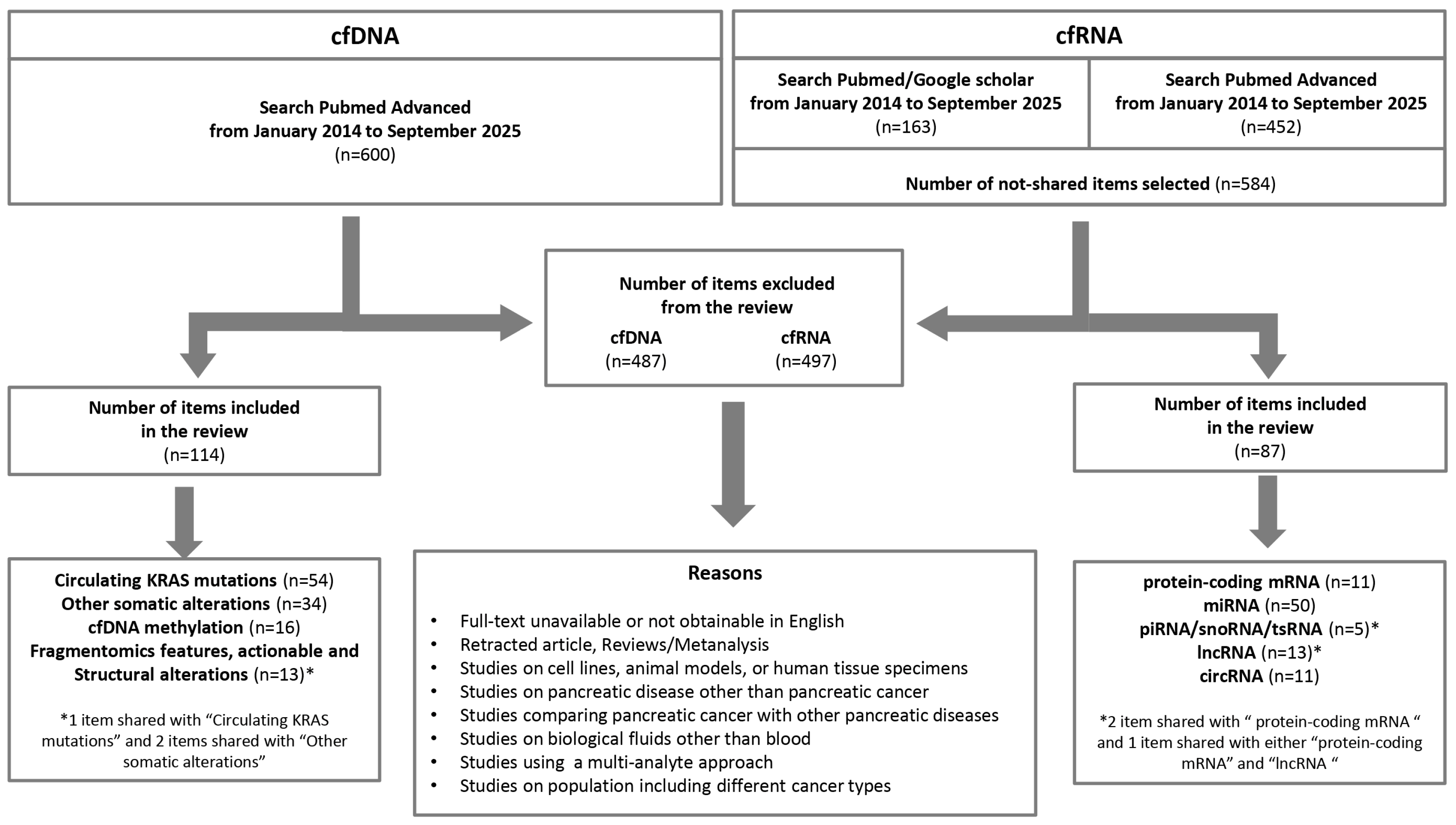

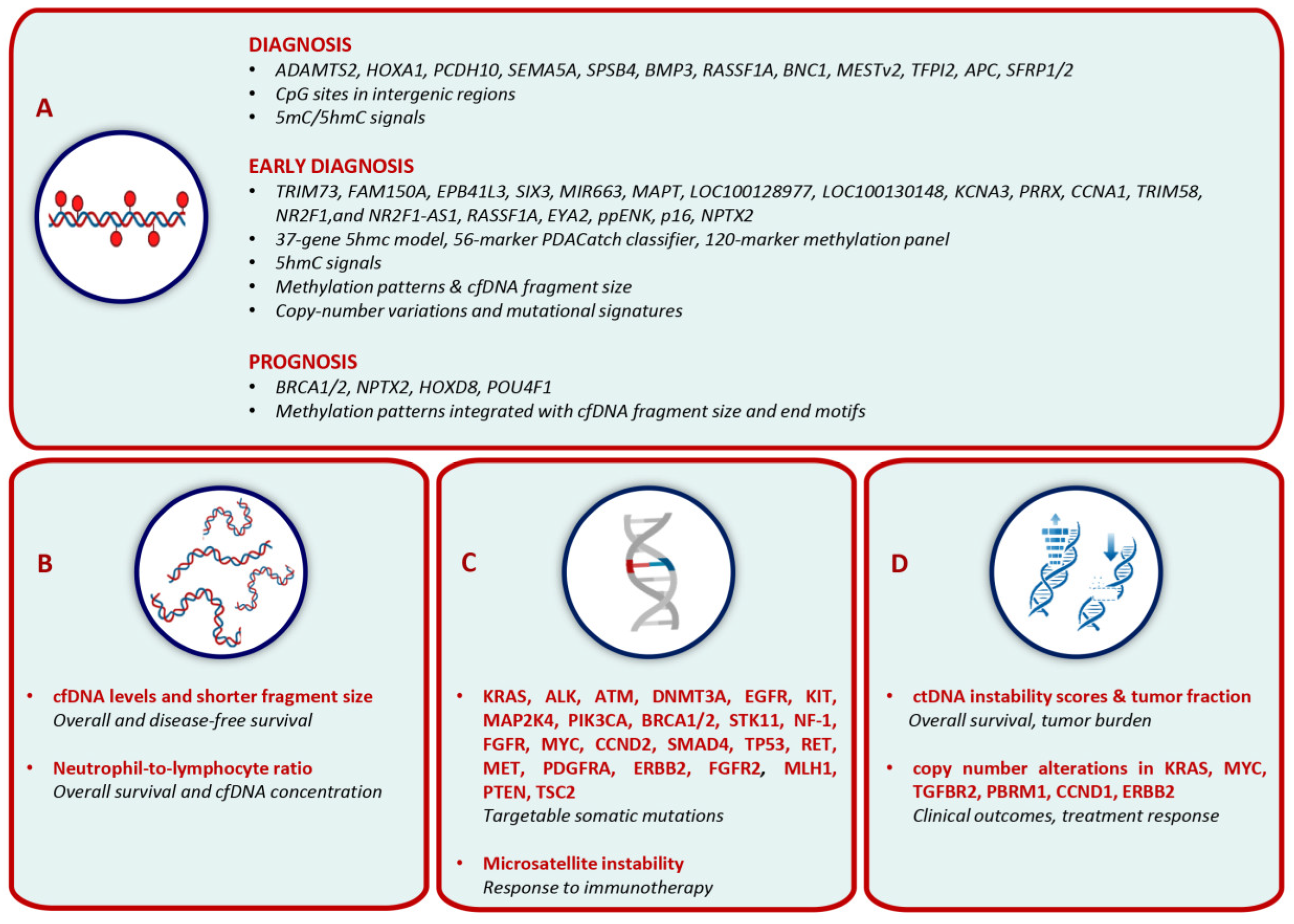

Disclaimer/Publisher’s Note: The statements, opinions and data contained in all publications are solely those of the individual author(s) and contributor(s) and not of MDPI and/or the editor(s). MDPI and/or the editor(s) disclaim responsibility for any injury to people or property resulting from any ideas, methods, instructions or products referred to in the content. |
© 2026 by the authors. Licensee MDPI, Basel, Switzerland. This article is an open access article distributed under the terms and conditions of the Creative Commons Attribution (CC BY) license.
Share and Cite
Latiano, M.; De Angelis, M.; Latiano, A.; Palmieri, O.; Latiano, T.P.; Delcuratolo, M.D.; Tardio, M.; Bazzocchi, F.; Gentile, M.; Terracciano, F.; et al. Liquid Biopsy Frontiers in Pancreatic Cancer: Insights from Circulating Cell-Free Nucleic Acids. Cells 2026, 15, 904. https://doi.org/10.3390/cells15100904
Latiano M, De Angelis M, Latiano A, Palmieri O, Latiano TP, Delcuratolo MD, Tardio M, Bazzocchi F, Gentile M, Terracciano F, et al. Liquid Biopsy Frontiers in Pancreatic Cancer: Insights from Circulating Cell-Free Nucleic Acids. Cells. 2026; 15(10):904. https://doi.org/10.3390/cells15100904
Chicago/Turabian StyleLatiano, Maria, Maria De Angelis, Anna Latiano, Orazio Palmieri, Tiziana Pia Latiano, Marco Donatello Delcuratolo, Matteo Tardio, Francesca Bazzocchi, Marco Gentile, Fulvia Terracciano, and et al. 2026. "Liquid Biopsy Frontiers in Pancreatic Cancer: Insights from Circulating Cell-Free Nucleic Acids" Cells 15, no. 10: 904. https://doi.org/10.3390/cells15100904
APA StyleLatiano, M., De Angelis, M., Latiano, A., Palmieri, O., Latiano, T. P., Delcuratolo, M. D., Tardio, M., Bazzocchi, F., Gentile, M., Terracciano, F., Niro, G. A., & Tavano, F. (2026). Liquid Biopsy Frontiers in Pancreatic Cancer: Insights from Circulating Cell-Free Nucleic Acids. Cells, 15(10), 904. https://doi.org/10.3390/cells15100904