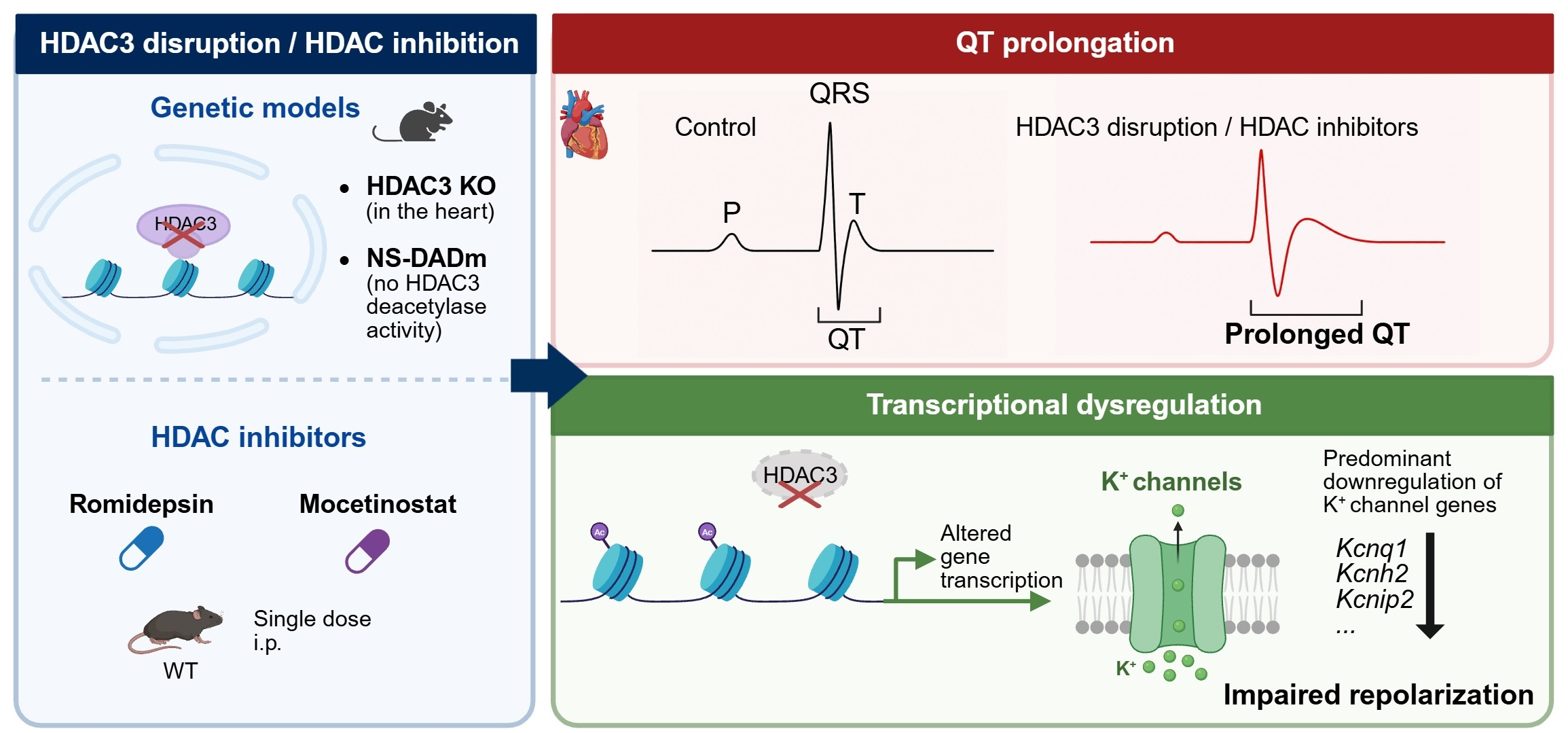
Cardiac HDAC3 Disruption Contributes to HDAC Inhibitor-Induced QT Prolongation


Abstract
1. Introduction
2. Methods
2.1. Animals
2.2. Surface EKG
2.3. RNA Sequencing
2.4. Statistics
3. Results
4. Discussion
Supplementary Materials
Author Contributions
Funding
Institutional Review Board Statement
Informed Consent Statement
Data Availability Statement
Acknowledgments
Conflicts of Interest
References
- Yang, X.-J.; Seto, E. The Rpd3/Hda1 family of lysine deacetylases: From bacteria and yeast to mice and men. Nat. Rev. Mol. Cell Biol. 2008, 9, 206–218. [Google Scholar] [CrossRef] [PubMed]
- Parveen, R.; Harihar, D.; Chatterji, B.P. Recent histone deacetylase inhibitors in cancer therapy. Cancer 2023, 129, 3372–3380. [Google Scholar] [CrossRef] [PubMed]
- Lu, J.; Qian, S.; Sun, Z. Targeting histone deacetylase in cardiac diseases. Front. Physiol. 2024, 15, 1405569. [Google Scholar] [CrossRef]
- Shukla, S.; Tekwani, B.L. Histone deacetylases inhibitors in neurodegenerative diseases, neuroprotection and neuronal differentiation. Front. Pharmacol. 2020, 11, 537. [Google Scholar] [CrossRef]
- Halili, M.A.; Andrews, M.R.; Sweet, M.J.; Fairlie, D.P. Histone deacetylase inhibitors in inflammatory disease. Curr. Top. Med. Chem. 2009, 9, 309–319. [Google Scholar] [CrossRef]
- Cabell, C.; Bates, S.; Piekarz, R.; Whittaker, S.; Kim, Y.H.; Currie, M.; Godfrey, C.; Schoonmaker, C.; Nichols, J.; Nix, D. Systematic assessment of potential cardiac effects of the novel histone deacetylase (HDAC) inhibitor romidepsin. Blood 2009, 114, 3709. [Google Scholar] [CrossRef]
- Piekarz, R.L.; Frye, A.R.; Wright, J.J.; Steinberg, S.M.; Liewehr, D.J.; Rosing, D.R.; Sachdev, V.; Fojo, T.; Bates, S.E. Cardiac studies in patients treated with depsipeptide, FK228, in a phase II trial for T-cell lymphoma. Clin. Cancer Res. 2006, 12, 3762–3773. [Google Scholar] [CrossRef]
- Shah, M.H.; Binkley, P.; Chan, K.; Xiao, J.; Arbogast, D.; Collamore, M.; Farra, Y.; Young, D.; Grever, M. Cardiotoxicity of histone deacetylase inhibitor depsipeptide in patients with metastatic neuroendocrine tumors. Clin. Cancer Res. 2006, 12, 3997–4003. [Google Scholar] [CrossRef] [PubMed]
- Weber, H.A.; Tai, F.; Paul, S.; Schindler, J.; Woo, M.M.; Spence, S.; Marlowe, J.; Lin, R. QT Interval Measurements in Patients with Hematologic Malignancies and Solid Tumors Treated with Oral Panobinostat (LBH589). Blood 2009, 114, 3781. [Google Scholar] [CrossRef]
- Asteggiano, R.; Norbiato, C.; Marengo, S.; Parrini, I. Cancer and arrhythmias. J. Cardiol. Pract. 2021, 19, 4. [Google Scholar]
- Thomas, A.; Rajan, A.; Szabo, E.; Tomita, Y.; Carter, C.A.; Scepura, B.; Lopez-Chavez, A.; Lee, M.-J.; Redon, C.E.; Frosch, A. A phase I/II trial of belinostat in combination with cisplatin, doxorubicin, and cyclophosphamide in thymic epithelial tumors: A clinical and translational study. Clin. Cancer Res. 2014, 20, 5392–5402. [Google Scholar] [CrossRef]
- Munster, P.N.; Rubin, E.H.; Van Belle, S.; Friedman, E.; Patterson, J.K.; Van Dyck, K.; Li, X.; Comisar, W.; Chodakewitz, J.A.; Wagner, J.A. A single supratherapeutic dose of vorinostat does not prolong the QTc interval in patients with advanced cancer. Clin. Cancer Res. 2009, 15, 7077–7084. [Google Scholar] [CrossRef]
- Spence, S.; Deurinck, M.; Ju, H.; Traebert, M.; McLean, L.; Marlowe, J.; Emotte, C.; Tritto, E.; Tseng, M.; Shultz, M. Histone deacetylase inhibitors prolong cardiac repolarization through transcriptional mechanisms. Toxicol. Sci. 2016, 153, 39–54. [Google Scholar] [CrossRef] [PubMed]
- Xu, Q.; Patel, D.; Zhang, X.; Veenstra, R.D. Changes in cardiac Nav1. 5 expression, function, and acetylation by pan-histone deacetylase inhibitors. Am. J. Physiol.-Heart Circ. Physiol. 2016, 311, H1139–H1149. [Google Scholar] [CrossRef] [PubMed]
- Lugenbiel, P.; Govorov, K.; Rahm, A.-K.; Wieder, T.; Gramlich, D.; Syren, P.; Weiberg, N.; Seyler, C.; Katus, H.A.; Thomas, D. Inhibition of histone deacetylases induces K+ channel remodeling and action potential prolongation in HL-1 atrial cardiomyocytes. Cell. Physiol. Biochem. 2018, 49, 65–77. [Google Scholar] [CrossRef]
- Montgomery, R.L.; Potthoff, M.J.; Haberland, M.; Qi, X.; Matsuzaki, S.; Humphries, K.M.; Richardson, J.A.; Bassel-Duby, R.; Olson, E.N. Maintenance of cardiac energy metabolism by histone deacetylase 3 in mice. J. Clin. Investig. 2008, 118, 3588–3597. [Google Scholar] [CrossRef]
- Sun, Z.; Singh, N.; Mullican, S.E.; Everett, L.J.; Li, L.; Yuan, L.; Liu, X.; Epstein, J.A.; Lazar, M.A. Diet-induced lethality due to deletion of the Hdac3 gene in heart and skeletal muscle. J. Biol. Chem. 2011, 286, 33301–33309. [Google Scholar] [CrossRef]
- Qian, S.; Zhang, C.; Li, W.; Song, S.; Lin, G.; Cheng, Z.; Zhou, W.; Yin, H.; Wang, Y.; Li, H. Enzyme-independent functions of HDAC3 in the adult heart. Acta Pharm. Sin. B 2025, 15, 3561–3574. [Google Scholar] [CrossRef]
- Zheng, W.; Xie, Q.; Zhang, Z.; Li, J.; Fang, L.; Li, W. Inhibited HDAC3 or elevated microRNA-494-3p plays a protective role in myocardial ischemia-reperfusion injury via suppression of BRD4. Mol. Neurobiol. 2021, 58, 4268–4279. [Google Scholar] [CrossRef]
- Song, K.; Li, L.; Quan, Q.; Wei, Y.; Hu, S. Inhibited histone deacetylase 3 ameliorates myocardial ischemia–reperfusion injury in a rat model by elevating microRNA-19a-3p and reducing cyclin-dependent kinase 2. IUBMB Life 2020, 72, 2696–2709. [Google Scholar] [CrossRef] [PubMed]
- Sharifi-Sanjani, M.; Shoushtari, A.H.; Quiroz, M.; Baust, J.; Sestito, S.F.; Mosher, M.; Ross, M.; McTiernan, C.F.; St. Croix, C.M.; Bilonick, R.A. Cardiac CD47 drives left ventricular heart failure through Ca2+-CaMKII-regulated induction of HDAC3. J. Am. Heart Assoc. 2014, 3, e000670. [Google Scholar] [CrossRef] [PubMed]
- Lewandowski, S.L.; Janardhan, H.P.; Trivedi, C.M. Histone deacetylase 3 coordinates deacetylase-independent epigenetic silencing of transforming growth factor-β1 (TGF-β1) to orchestrate second heart field development. J. Biol. Chem. 2015, 290, 27067–27089. [Google Scholar] [CrossRef] [PubMed]
- Jang, J.; Song, G.; Pettit, S.M.; Li, Q.; Song, X.; Cai, C.-l.; Kaushal, S.; Li, D. Epicardial HDAC3 promotes myocardial growth through a novel microRNA pathway. Circ. Res. 2022, 131, 151–164. [Google Scholar] [CrossRef]
- Zhou, W.; He, Y.; Rehman, A.U.; Kong, Y.; Hong, S.; Ding, G.; Yalamanchili, H.K.; Wan, Y.-W.; Paul, B.; Wang, C. Loss of function of NCOR1 and NCOR2 impairs memory through a novel GABAergic hypothalamus–CA3 projection. Nat. Neurosci. 2019, 22, 205–217. [Google Scholar] [CrossRef]
- You, S.-H.; Lim, H.-W.; Sun, Z.; Broache, M.; Won, K.-J.; Lazar, M.A. Nuclear receptor co-repressors are required for the histone-deacetylase activity of HDAC3 in vivo. Nat. Struct. Mol. Biol. 2013, 20, 182–187. [Google Scholar] [CrossRef] [PubMed]
- Sohal, D.S.; Nghiem, M.; Crackower, M.A.; Witt, S.A.; Kimball, T.R.; Tymitz, K.M.; Penninger, J.M.; Molkentin, J.D. Temporally regulated and tissue-specific gene manipulations in the adult and embryonic heart using a tamoxifen-inducible Cre protein. Circ. Res. 2001, 89, 20–25. [Google Scholar] [CrossRef]
- Mitchell, G.F.; Jeron, A.; Koren, G. Measurement of heart rate and QT interval in the conscious mouse. Am. J. Physiol.-Heart Circ. Physiol. 1998, 274, H747–H751. [Google Scholar] [CrossRef]
- Fischle, W.; Dequiedt, F.; Hendzel, M.J.; Guenther, M.G.; Lazar, M.A.; Voelter, W.; Verdin, E. Enzymatic activity associated with class II HDACs is dependent on a multiprotein complex containing HDAC3 and SMRT/N-CoR. Mol. Cell 2002, 9, 45–57. [Google Scholar] [CrossRef]
- Heymans, A.B.; Bianchi, L.; Volders, P.G.; van der Crabben, S.N.; Verdonschot, J.A. SCN5A Cardiomyopathy: From Ion Channel Dysfunction To Clinical Disease. Curr. Cardiol. Rep. 2025, 27, 138. [Google Scholar] [CrossRef]
- Liu, M.; Yang, K.-C.; Dudley, S.C., Jr. Cardiac sodium channel mutations: Why so many phenotypes? Nat. Rev. Cardiol. 2014, 11, 607–615. [Google Scholar] [CrossRef]
- Begic, E.; Hodzic, E.; Begic, Z.; Iglica, A.; Begic, N.; Jusic, O. Therapeutic Modality of the Long QT Syndrome: Lesson from the Past. Iran. J. Cardiovasc. Med. 2020, 9, 72–74. [Google Scholar] [CrossRef]
- Panicker, J.; Li, Z.; McMahon, C.; Sizer, C.; Steadman, K.; Piekarz, R.; Bates, S.E.; Thiele, C.J. Romidepsin (FK228/depsipeptide) controls growth and induces apoptosis in neuroblastoma tumor cells. Cell Cycle 2010, 9, 1830–1838. [Google Scholar] [CrossRef]
- Vitanza, N.A.; Biery, M.C.; Myers, C.; Ferguson, E.; Zheng, Y.; Girard, E.J.; Przystal, J.M.; Park, G.; Noll, A.; Pakiam, F. Optimal therapeutic targeting by HDAC inhibition in biopsy-derived treatment-naïve diffuse midline glioma models. Neuro-Oncol. 2021, 23, 376–386. [Google Scholar] [CrossRef]
- Kawata, M.; McClatchy, D.B.; Diedrich, J.K.; Olmer, M.; Johnson, K.A.; Yates, J.R.; Lotz, M.K. Mocetinostat activates Krüppel-like factor 4 and protects against tissue destruction and inflammation in osteoarthritis. JCI Insight 2023, 8, e170513. [Google Scholar] [CrossRef]
- Nerbonne, J.M.; Kass, R.S. Molecular physiology of cardiac repolarization. Physiol. Rev. 2005, 85, 1205–1253. [Google Scholar] [CrossRef] [PubMed]
- Grant, A.O. Cardiac ion channels. Circ. Arrhythmia Electrophysiol. 2009, 2, 185–194. [Google Scholar] [CrossRef]
- Montgomery, R.L.; Davis, C.A.; Potthoff, M.J.; Haberland, M.; Fielitz, J.; Qi, X.; Hill, J.A.; Richardson, J.A.; Olson, E.N. Histone deacetylases 1 and 2 redundantly regulate cardiac morphogenesis, growth, and contractility. Genes Dev. 2007, 21, 1790–1802. [Google Scholar] [CrossRef] [PubMed]
- Ranjbarvaziri, S.; Zeng, A.; Wu, I.; Greer-Short, A.; Farshidfar, F.; Budan, A.; Xu, E.; Shenwai, R.; Kozubov, M.; Li, C. Targeting HDAC6 to treat heart failure with preserved ejection fraction in mice. Nat. Commun. 2024, 15, 1352. [Google Scholar] [CrossRef] [PubMed]
- Kawaguchi, Y.; Kovacs, J.J.; McLaurin, A.; Vance, J.M.; Ito, A.; Yao, T.-P. The deacetylase HDAC6 regulates aggresome formation and cell viability in response to misfolded protein stress. Cell 2003, 115, 727–738. [Google Scholar] [CrossRef]
- Viskin, S. Long QT syndromes and torsade de pointes. Lancet 1999, 354, 1625–1633. [Google Scholar] [CrossRef]
- Martinez, K.; Bains, S.; Giudicessi, J.R.; Bos, J.M.; Neves, R.; Ackerman, M.J. Spectrum and prevalence of side effects and complications with guideline-directed therapies for congenital long QT syndrome. Heart Rhythm 2022, 19, 1666–1672. [Google Scholar] [CrossRef] [PubMed]



| HDACi | Key EKG Findings | Other EKG Changes/Notes | References |
|---|---|---|---|
| Romidepsin (FK228) 14 mg/m2 as a 4 h infusion | QT prolongation and ventricular arrhythmia: Among 15 patients with metastatic neuroendocrine tumors, cases of prolonged QTc and ventricular tachycardia, 1 sudden death possibly attributed to fatal ventricular arrhythmia. (study prematurely terminated due to serious cardiac toxicity) | No difference in plasma depsipeptide levels in patients with versus without cardiac adverse events. | [8] |
| Romidepsin (FK228) 14 mg/m2 as a 4 h infusion | QT prolongation and ST/T Wave Changes: Among 42 patients with cutaneous or peripheral T-cell lymphoma, a mean increase of 14.4 ms in QTcF interval | T-wave flattening or ST-segment depression observed in more than half of EKGs | [7] |
| Romidepsin (FK228) 14 mg/m2 as a 4 h infusion; analysis during day 1 exposure to drug vs. baseline | QT prolongation and ST/T Wave Changes: Among 110 patients with peripheral T-cell lymphoma and advanced cancer, a mean increase of 5.0 ms in QTcF interval, with QTcF increased in 68% of events. | T-wave flattening or inversion, biphasic T-waves, and minor ST-segment depression. | [6] |
| Panobinostat (LBH589) 20 mg/dose, 30 mg/dose, 40 mg/dose, or 60 mg/dose weekly | QT prolongation: At 60 mg/dose, among 54 patients with hematologic malignancies and solid tumors (average age of 60 years, range 16–88), QTcF >500 ms in 5.6% and mean QTcF change from baseline >60 ms in 9.3% of patients. | Dose-dependent changes less significant in 20 mg/dose, 30 mg/dose, or 40 mg/dose | [9] |
| Vorinostat (Zolinza) A single supratherapeutic dose of 800 mg. EKG was monitored before treatment and for 24 h post-dose. | Among 25 patients with advanced-stage cancer aged 29–78 years old, placebo-adjusted mean QTcF change from baseline <10 ms at every time point, one patient >450 ms, none >480 ms. | 800 mg of vorinostat at a single dose was generally tolerated | [12] |
| Vorinostat (Zolinza) | QT prolongation: In 3.5–6.0% of cases in a report by Asteggiano et al., 2021, case details unknown. | A greater risk of torsade de pointes in females/older patients | [10] |
| Belinostat increasing doses as a continuous intravenous infusion over 48 h with chemotherapy, maximum tolerated dose of 1000 mg/m2 | QT prolongation: Among 26 patients with thymic epithelial tumors aged 23–76 years old, 9 (35%) had QTc prolongation, 1 event >500 ms, 2 had electrolyte abnormalities and dehydration. | Cases of electrolyte abnormalities | [11] |
| LQT# | Gene | Full Name | Syndrome | Fold Change (KO vs. WT) | q-Value |
|---|---|---|---|---|---|
| LQT1 | KCNQ1 | potassium voltage-gated channel, subfamily Q, member 1 | Romano–Ward syndrome, Jervell and Lange-Nielsen syndrome | −3.2 | 2.9 × 10−58 |
| LQT2 | KCNH2 | potassium voltage-gated channel, subfamily H, member 2 | Romano–Ward syndrome | −3.7 | 2.2 × 10−117 |
| LQT3 | SCN5A | sodium channel, voltage-gated, type V, alpha | Romano–Ward syndrome | −2.7 | 4.1 × 10−182 |
| LQT4 | ANK2 | ankyrin 2 | Romano–Ward syndrome | −1.4 | 1.3 × 10⁻¹¹ |
| LQT5 | KCNE1 | potassium voltage-gated channel, Isk-related subfamily, member 1 | Romano–Ward syndrome, Jervell and Lange-Nielsen syndrome | −12.4 | 8.6 × 10⁻¹⁹ |
| LQT6 | KCNE2 | potassium voltage-gated channel, Isk-related subfamily, gene 2 | Romano–Ward syndrome | −1.2 | 9.4 × 10−01 |
| LQT7 | KCNJ2 | potassium inwardly rectifying channel, subfamily J, member 2 | Andersen syndrome | −1.5 | 8.2 × 10⁻¹⁵ |
| LQT8 | CACNA1C | calcium channel, voltage-dependent, L type, alpha 1C subunit | Timothy syndrome | −1.5 | 3.4 × 10−36 |
| LQT9 | CAV3 | caveolin 3 | Romano–Ward syndrome | −1.9 | 8.5 × 10⁻²⁶ |
| LQT10 | SCN4B | sodium channel, type IV, beta | Romano–Ward syndrome | −2.5 | 9.3 × 10−94 |
| LQT11 | AKAP9 | A kinase (PRKA) anchor protein 9 | Romano–Ward syndrome | −1.3 | 2.3 × 10⁻⁵ |
| LQT12 | SNTA1 | syntrophin, acidic 1 | Romano–Ward syndrome | 1.0 | 8.4 × 10⁻¹ |
| LQT13 | KCNJ5 | potassium inwardly rectifying channel, subfamily J, member 5 | Romano–Ward syndrome | −3.9 | 7.6 × 10−98 |
Disclaimer/Publisher’s Note: The statements, opinions and data contained in all publications are solely those of the individual author(s) and contributor(s) and not of MDPI and/or the editor(s). MDPI and/or the editor(s) disclaim responsibility for any injury to people or property resulting from any ideas, methods, instructions or products referred to in the content. |
© 2026 by the authors. Licensee MDPI, Basel, Switzerland. This article is an open access article distributed under the terms and conditions of the Creative Commons Attribution (CC BY) license.
Share and Cite
Lu, J.; Ward, C.; Qian, S.; Zhang, L.; Chang, J.; Sun, Z. Cardiac HDAC3 Disruption Contributes to HDAC Inhibitor-Induced QT Prolongation. Cells 2026, 15, 902. https://doi.org/10.3390/cells15100902
Lu J, Ward C, Qian S, Zhang L, Chang J, Sun Z. Cardiac HDAC3 Disruption Contributes to HDAC Inhibitor-Induced QT Prolongation. Cells. 2026; 15(10):902. https://doi.org/10.3390/cells15100902
Chicago/Turabian StyleLu, Jiao, Christopher Ward, Sichong Qian, Lilei Zhang, Jiang Chang, and Zheng Sun. 2026. "Cardiac HDAC3 Disruption Contributes to HDAC Inhibitor-Induced QT Prolongation" Cells 15, no. 10: 902. https://doi.org/10.3390/cells15100902
APA StyleLu, J., Ward, C., Qian, S., Zhang, L., Chang, J., & Sun, Z. (2026). Cardiac HDAC3 Disruption Contributes to HDAC Inhibitor-Induced QT Prolongation. Cells, 15(10), 902. https://doi.org/10.3390/cells15100902